1. Introduction
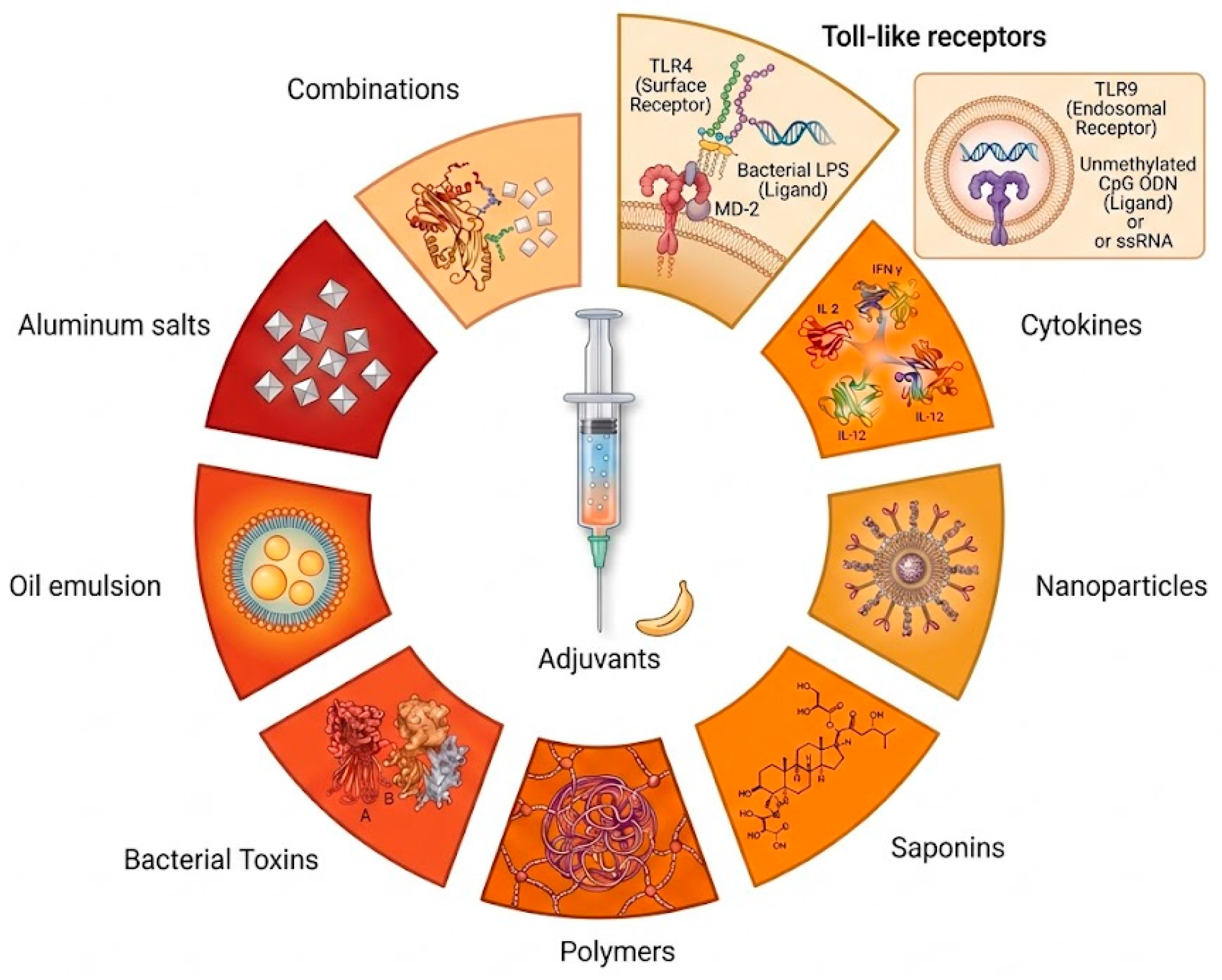
Adjuvants play a crucial role in modern immunotherapy and vaccine development by enhancing immune responses to prophylactic vaccines. They improve antigen recognition and activate key immune cells, fostering adaptive immunity. Various classes of adjuvants exist, ranging from traditional mineral salts to advanced agents such as Toll-like receptor agonists and nanoparticles (
Figure 1). However, the emergence of advanced immunotherapies has revealed the limitations of traditional adjuvants, particularly their narrow spectrum of immune activation. For instance, many conventional adjuvants often fall short of effectively polarizing Th1 or Th17 immune responses, which are indispensable for combating intracellular pathogens and tumors, or of inducing robust cross-presentation, which is necessary for cytotoxic T lymphocyte (CTL)-mediated immunity [
1,
2,
3].
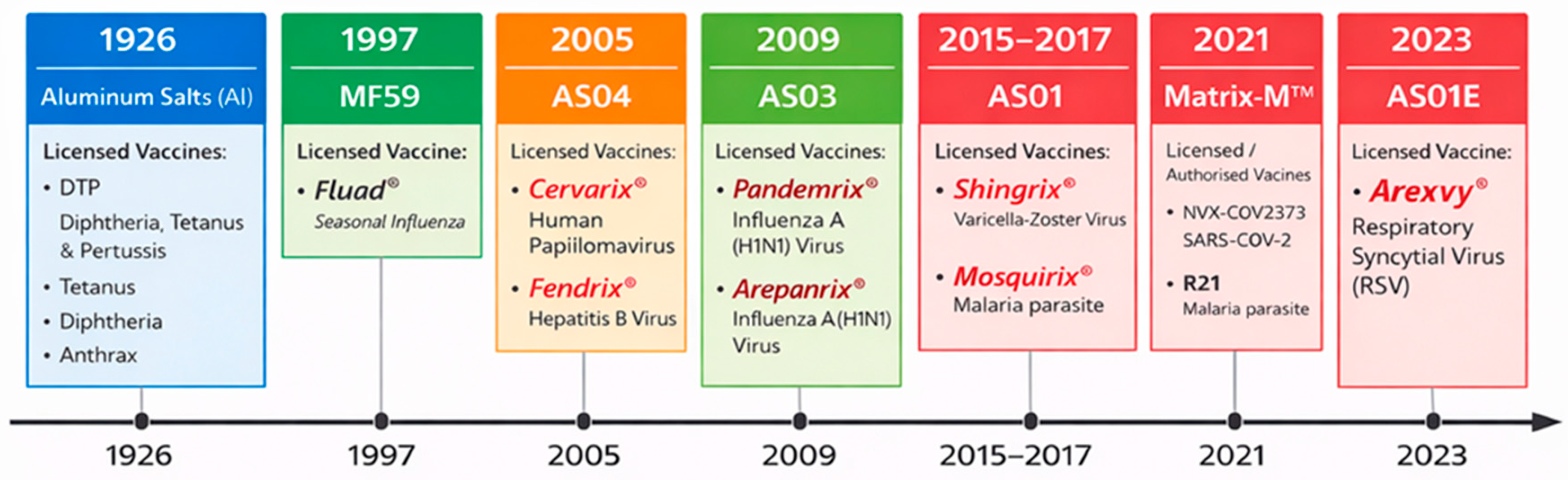
Figure 1 represents the adjuvants that have been researched and developed. These components have been evaluated at multiple levels over time, and the majority are currently used in several vaccine formulations.
The evolution in adjuvant development marks a shift from empirical discovery to a strategic design approach. Historically, adjuvants were included by chance, with little understanding of their biological effects. However, improved understanding of innate immune mechanisms and pattern recognition receptor (PRR) signaling has led to a more targeted approach to immunomodulation. This paradigm shift enables fine-tuning of immune responses, promoting Th1 responses for cellular immunity or Th2 responses for humoral immunity. This precision enhances vaccine efficacy, minimizes off-target effects, and improves the safety profiles of vaccine formulations [
4].
Emerging agents, such as the synthetic TLR3 ligand ARNAX, synthetic DNA-capped double-stranded RNA (dsRNA) molecule, CpG ODNs, STING agonists, β-glucan derivatives, and synthetic poly(I:C), employ distinct mechanisms to modulate the immune response. Adjuvants not only enhance immune responses but also reduce the antigen doses required, thereby improving vaccine cost-effectiveness and accessibility [
4,
5]. Modern adjuvants are no longer categorized merely as agents that increase the magnitude of an immune response. Instead, they are viewed as biological switches capable of polarizing T-helper responses toward Th1 (cellular), Th2 (humoral), or Th17 (mucosal) phenotypes depending on the specific requirement of the pathogen or malignancy being targeted. This precision is achieved through the targeted engagement of PRRs, the innate immune system’s primary sensors [
6]. The review aims to provide an overview of adjuvants and delivery systems, offering insight into recent developments in this area.
2. Methodology
A comprehensive literature search was conducted across electronic databases, including PubMed/MEDLINE, Scopus, and Web of Science, for peer-reviewed articles published through April 2026. The search strategy focused on identifying high-quality evidence regarding vaccine adjuvants and delivery systems with a specific emphasis on their application in human clinical settings. Key search terms and descriptors utilized included “vaccines,” “adjuvants,” “nanoformulations,” “delivery systems,” “aluminum salts,” “lipid nanoparticles,” and “oil emulsions”.
The selection criteria prioritized human-centered research and translational immunology, specifically targeting the clinical efficacy and safety profiles of licensed adjuvant systems, including AS01, AS03, AS04, and Matrix-M™. Particular attention was given to studies describing the molecular mechanisms of human PRRs engagement and the cytokine-driven T-helper cell differentiation required for robust immunity. Evidence was further gathered regarding the impact of diverse biological variables—including age, genetic variation, biological sex, and comorbidities—on the human immune response to various vaccine platforms.
Finally, the search incorporated the latest clinical advancements in advanced drug delivery systems (DDSs), with a primary focus on mRNA-lipid nanoparticle (LNP) formulations and the emerging role of exosomes as potent biological adjuvants. Strategic focus was placed on technological milestones through early 2026, including needle-free administration platforms, thermostable microneedle patches, and the integration of artificial intelligence frameworks to predict T-cell recognition with high molecular accuracy. Only English-language publications involving human subjects or direct clinical applications were synthesized to ensure the highest level of evidence for this review.
3. Carriers, Adjuvants, Immunostimulants, Small Molecules, and Combination Adjuvants
3.1. Carriers
Carrier proteins function as molecular transporters covalently conjugated to the antigen, a linkage essential for polysaccharides with low intrinsic immunogenicity [
7]. Pure polysaccharides were historically classified as T-cell-independent antigens because they couldn’t be processed by T lymphocytes, thereby preventing B lymphocytes from undergoing isotype switching or creating immunological memory. Conjugating these polysaccharides to carrier proteins, such as CRM197 or tetanus toxoid, enables B lymphocytes to recognize and internalize the entire conjugate [
7,
8,
9].
Once internalized, the protein is degraded into peptides and presented via the MHC-II pathway to helper T cells, transforming the immune response into a T-cell-dependent process. This interaction stimulates germinal center formation, leading to the maturation of B cells into high-affinity memory cells and long-lived plasma cells. This mechanism is essential to the effectiveness of modern vaccines, such as the 13-, 15-, and 20-valent pneumococcal conjugate vaccine [
10]. Carrier proteins are essential for attracting T lymphocytes, but they usually lack intrinsic adjuvant properties and are often combined with mineral salts to enhance immune response.
The evolution of conjugate vaccines is moving towards higher-valency formulations and site-specific bioconjugation to improve structural consistency. Future developments are exploring recombinant or synthetic carrier proteins to reduce carrier-induced epitope suppression and enhance T lymphocyte recruitment. Additionally, new adjuvant systems are being integrated to widen the protective window and ensure stronger, longer-lasting immunity in diverse populations [
9,
10].
3.2. Adjuvants
Vaccine adjuvants are mainly categorized into two types: immunostimulants and delivery systems. Many adjuvants combine these properties, highlighting the complex interactions within the immune system [
11]. Immunostimulants activate antigen-presenting cells (APCs) by engaging PRRs, which are crucial for APCs’ maturation and activation [
12,
13]. In contrast, delivery systems primarily facilitate the uptake, transport, and presentation of antigens by APCs, ensuring prolonged immune exposure and, consequently, high, sustained antibody levels [
14,
15].
Immunostimulants activate the immune system by signaling danger from pathogens or damaged cells through molecules recognized by PAMPs and DAMPs. PAMPs include lipopolysaccharide (LPS), bacterial DNA, liposomes, glycolipids, flagellin, and viral components, including glycoproteins and nucleic acids (dsRNA, ssRNA, 5-triphosphate RNA) [
15]. Heat shock proteins (HSPA1A and HSPB1), High Mobility Group Box 1 (HMGB1), histones, mitochondrial components, and uric acid interact with DAMP receptors [
16,
17,
18].
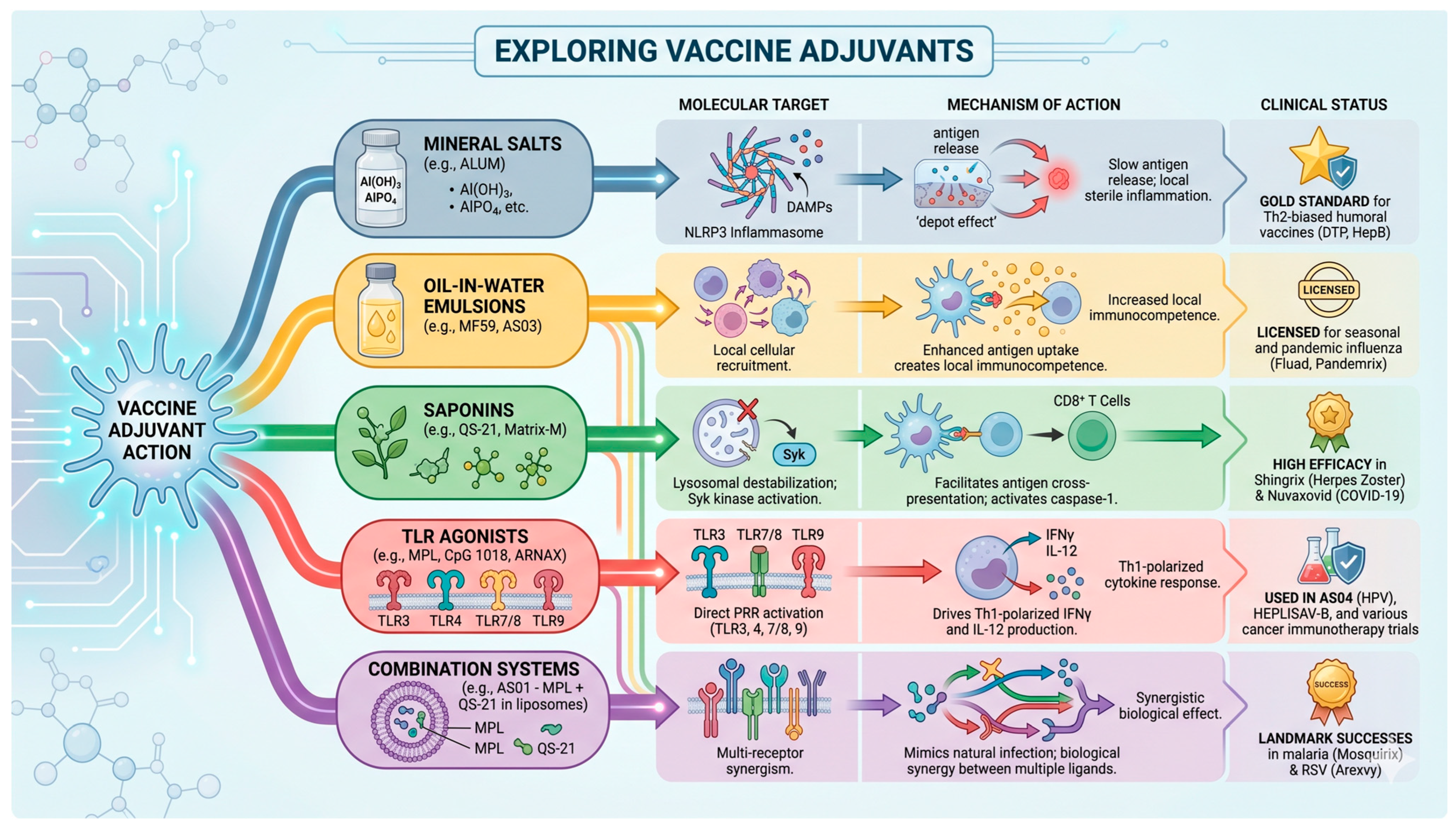
Figure 2 provides a comprehensive schematic representation synthesizing the complex landscape of the diverse adjuvant classes currently employed in modern immunology. It offers an integrated summary that systematically links the chemical identities of these agents to their specific molecular targets, such as PRRs, while detailing the underlying mechanisms of action that facilitate modulation and enhancement of the adaptive immune response.
3.3. Mechanisms of PRRS Engagement by Immunostimulants
Binding PAMPs, DAMPs, or their mimics to PRRs triggers conformational changes that initiate intracellular signaling cascades involving adaptor molecules such as MyD88 and TRIF. This activates transcription factors, such as NF-κB, MAPKs, and IRFs, leading to the production of proinflammatory cytokines and chemokines that are vital for the host response to infection and adaptive immunity [
19,
20]. Importantly, PRR signaling is context-dependent, enabling the immune system to tailor its response to the type and location of the threat. The engagement of diverse ligands triggers distinct intracellular signaling pathways, resulting in specific cytokine profiles that orchestrate T helper cell differentiation (e.g., Th1, Th2, Th17) and CTL generation. This mechanistic insight enables the strategic design of adjuvants to elicit vaccine responses tailored to the requirements of specific pathogens [
20,
21,
22,
23,
24].
The localization of PRRS receptors is crucial for activating immune responses. PRRs are located on cell surfaces, within endosomes, and in the cytosol, allowing the immune system to detect hazards effectively [
25,
26]. Nucleic acid-sensing PRRs in endosomes or the cytosol detect intracellular viral replication, activating pathways such as TLR3 and RLRs, which lead to Type I interferon production and enhance antiviral immunity. Additionally, the distinct responses of TLR4 to MPL and LPS highlight how different stimuli engage distinct signaling pathways. Understanding PRR signaling mechanisms is essential for developing effective adjuvants [
25,
26].
3.4. Antigen-Presenting Cells (APCs) Maturation and Activation by Immunostimulants
Understanding PRR signaling is crucial for developing effective adjuvants. During maturation, APCs enhance antigen processing, forming MHC-peptide complexes that serve as Signal 1 for T lymphocyte activation. These complexes are presented on APCs, predominantly by dendritic cells. Mature APCs also express higher levels of co-stimulatory molecules, such as CD40, CD80 (B7.1), and CD86 (B7.2), which are vital for activating naive T lymphocytes. Additionally, co-stimulators such as CD54 (ICAM-1) and the 4-1BB ligand play essential roles, with CD86 being notably abundant on DCs and crucial for the formation of the immunological synapse with T lymphocytes [
27,
28].
3.5. Role of Cytokine Secretion in APCs Activation
Activation of PRRs triggers the secretion of inflammatory cytokines and chemokines, known as Signal 3 in T cell activation, which is essential for the adaptive immune response. Activated APCs produce: (1) pro-inflammatory cytokines (e.g., IL-1, IL-6, IL-12, IL-23, TNF-α); (2) T helper-polarizing cytokines (e.g., IL-12, IL-23, IL-15, type I interferons); (3) immunosuppressive cytokines (e.g., IL-10, TGF-β); and (4) chemokines that guide DCS migration. Notably, CCL19 and CCL21 lead DCS to lymph nodes via CCR7, while CXCL12 and CXCL14 direct them to inflammation sites. CCL22 and CCL17 also influence DCS positioning within tissues [
29].
3.6. DCs: The Master Orchestrators of Adaptive Immunity
DCs are considered nature’s adjuvants because they initiate and shape adaptive immune responses. They are effective in capturing, processing, and presenting antigens, supporting the expansion of Th1 helper T lymphocytes and cytotoxic T lymphocytes [
30]. Antigen-bearing DCs can elicit strong antimicrobial and anti-tumor immunity even without extra adjuvants [
30,
31,
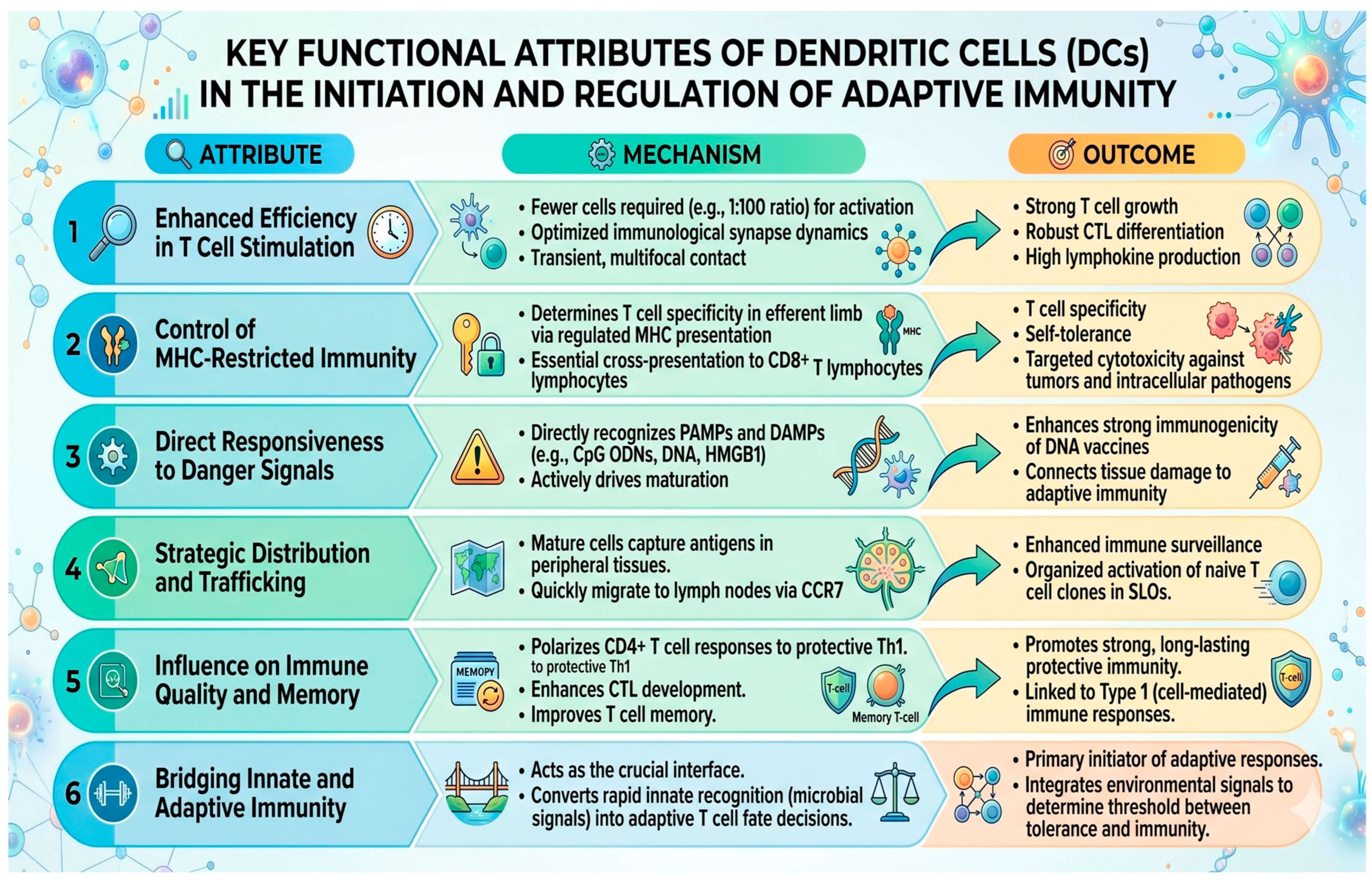
32]. Several unique attributes make DCs superior APCs and prime targets for immunostimulant action. They are summarized in
Figure 3. Key elements that enhance the efficacy of vaccine responses include effective stimulation of T cells, regulation of MHC presentation, responsiveness to danger signals, the strategic distribution and migration of dendritic cells, contributions to sustained and robust T cell memory responses, and the interaction between innate and adaptive immune responses. In conclusion, the role of dendritic cells in facilitating a strong, specific response to an antigen is essential to the overall effectiveness of vaccines.
3.7. The Critical Role of DCs Maturation as a Control Point for Initiating Immunity
Vaccine antigens are most effective when presented by mature DCs, which stimulate T lymphocytes, which are essential for a robust adaptive immune response [
31]. Microbial products, such as LPS, double-stranded RNA, and CpG-ODN, along with cytokines like GM-CSF, TNF-α, IL-1β, lipid products like PGE2, and TNF family members like CD40L, effectively stimulate dendritic cell maturation both in vitro and in vivo [
30,
31,
32,
33]. This maturation requires upregulation of CCR7 receptors to enable migration to lymph nodes, a critical step in T cell priming [
34]. Conversely, inadequate DC maturation triggered by DNA vaccines or delivery strategies can lead to tolerance and immune suppression [
32,
33]. Immature DCs may promote tolerogenic cross-presentation, inducing regulatory T lymphocytes or deletion tolerance, which prevents the immune system from responding to self-antigens [
35].
Adjuvants serve as critical regulators of the DC migratory journey, moving beyond simple immune stimulation to precisely calibrate the cellular mechanics required for adaptive immunity. As Olson et al. [
36] detail, this process is governed by a triad of Rho-family GTPases-Rac1, Cdc42, and RhoA, which manage the actin polymerization and nuclear protection necessary for DCs to navigate the dense extracellular matrix and enter the lymphatic vasculature. By modulating these biomechanical pathways and the expression of navigation receptors such as CCR7, modern adjuvants ensure that antigen-carrying sentinels maintain directional persistence to reach secondary lymphoid organs effectively. Furthermore, targeted interventions can correct the “migratory bottlenecks” that frequently lead to vaccine failure in aged or genetically predisposed populations. Research by Zhao et al. [
37] highlights a decisive signaling checkpoint in which hyperactivation of p38α suppresses ERK-dependent “go” signals required for DC movement. This defect can be bypassed through innovative strategies, such as oral yeast-derived nanoparticles (YNPs), which engage the gut-immune axis to upregulate CCR7 and restore DC trafficking to distant lymph nodes. Such precision adjuvancy “unlocks” the migratory potential of otherwise stationary cells, offering a noninvasive pathway to reverse immunosenescence and enhance systemic vaccine efficacy [
37].
4. Types of Adjuvants and Their Evolution over Time
The evolution of adjuvant technology reflects a paradigm shift toward precision immunology, where the focus has moved beyond simple immune stimulation to the fine-tuning of specific cellular responses. Modern research and development efforts now integrate a wide spectrum of chemical and biological platforms, including novel combinations designed to optimize vaccine efficacy and safety. An overview of these prominent adjuvant classes and their structural diversity is illustrated in
Figure 4.
4.1. Aluminum Salt Adjuvants
While traditional aluminum salts have been the gold standard for nearly a century [
38], their inability to induce Th1-mediated cellular immunity has led to the development of next-generation alternatives. Layered Double Hydroxides (LDHs), reengineered from first-line antacid drugs, have emerged as a potent class of “NanoAlum” that overcomes these historical limitations [
39,
40].
NanoAlum offers several transformative advantages over conventional salts: Balanced Immunogenicity: Unlike traditional alum, which is strictly Th2-biased, LDH nanoparticles can be engineered to induce both robust antibody responses and Th1-polarized CD8+ cytotoxic T lymphocyte (CTL) immunity [
39,
40]. This is achieved by tuning the metal cation ratios (e.g., Mg/Al) or by doping the layers with cations such as Zn
2+, Cu
2+, or Fe
3+, which can activate the NF-κB and NLRP3 inflammasome pathways [
39,
40]. Tumor Microenvironment (TME) Modulation: A critical breakthrough identified by Su et al. [
40] is LDH’s ability to act as a pH-responsive neutralizer. In solid tumors, NanoAlum persistently neutralizes TME acidity, converting an immunosuppressive environment (characterized by M2-like macrophages and Tregs) into an immunoregulatory one that favors tumor-killing M1-like macrophages and CD8+ T cells. Rapid Endosomal Escape: LDH nanoparticles are readily internalized and exhibit an intrinsic capacity to escape from endosomes (typically within 30 min). This allows the antigen payload to reach the cytosol directly, facilitating efficient cross-presentation on MHC-I molecules, a process that traditional alum aggregates (1–20 μm) cannot efficiently perform [
40].
4.2. Oil-in-Water Emulsion Adjuvants
4.2.1. MF59
Oil-in-water (O/W) emulsions, such as MF59 and AS03, disperse microscopic squalene droplets in an aqueous phase, stabilized by surfactants, such as Polysorbate 80, which reduce interfacial tension and prevent droplet coalescence [
41]. MF59 contains 4.3% squalene and 0.5% each of Tween 80 and Span 85 in a citric acid buffer. This biodegradable formulation, with an average droplet size of 160 nm, was originally designed for antigen delivery but later demonstrated strong adjuvant properties [
41,
42,
43].
This mechanism enhances antigen uptake by antigen-presenting cells and stimulates innate immune signaling at the injection site. It is crucial for improving antibody response, as demonstrated by the Fluad
® vaccine, which uses MF59 for better protection in the senior population, and pandemic vaccines like Pandemrix™ and Arepanrix™, which use AS03 for dose-sparing effects. The evolution of these emulsions involves integrating synthetic TLR4 agonists to further polarize the immune response, ensuring that next-generation vaccines can provide robust, cross-reactive immunity against emerging viral threats and highly mutable pathogens [
43,
44].
The MF59-adjuvanted influenza vaccine was licensed in 1997 for the senior population and is approved in over 30 countries, including the U.S. Nearly 100 million doses of MF59-adjuvanted H1N1 pandemic vaccines have been given to groups such as pregnant women and young children. MF59 boosts vaccine effectiveness by increasing antibody levels and enhancing long-term memory T and B lymphocytes. Its efficacy has been demonstrated in diverse populations, including children and older adults [
45]. Ongoing studies are exploring its application to other vaccine antigens and platforms, as well as its mechanisms of action.
4.2.2. AS03
AS03 is an oil-in-water emulsion adjuvant (squalene, DL-tocopherol, and polysorbate 80) for pandemic influenza vaccines, enhancing antibody and CD4+ T cell responses in recombinant COVID-19 vaccine trials and providing better protection than non-adjuvanted vaccines [
46,
47]. Licensed for use with pandemic influenza vaccines, it has been evaluated in trials of recombinant COVID-19 vaccines. AS03 significantly enhances antibody and CD4+ T cell responses, providing superior protection compared to non-adjuvanted vaccines. Further research indicates that AS03 can temporarily downregulate genes involved in lipid metabolism in lymph nodes. These genes are linked to changes in lipid composition and the unfolded protein response. In humans, elevated IL-6 and IP-10 (CXCL10) levels within 24 h post-vaccination are associated with stronger antibody responses. AS03 and MF59 are squalene-based adjuvants that likely share common activation pathways, although the exact roles of pathways such as IRE1α and RIPK3 remain to be clarified [
48]. The future may see specialized adjuvants with carefully chosen components to achieve targeted outcomes, such as strong humoral, cellular, or mucosal immunity. These adjuvants can also be tailored to specific populations, including older adults and individuals with compromised immune systems [
49].
4.2.3. AS04
The development of AS04 and AS01 highlights the effectiveness of multi-component adjuvant systems. AS04, when combined with MPL, a TLR4 agonist, and aluminum salts, has shown better outcomes than alum alone; AS01 enhances this by incorporating MPL and QS-21 into a liposomal delivery system, where their synergy is crucial for its strong adjuvant effect [
50,
51]. This progression reflects a trend toward more sophisticated adjuvants that integrate multiple immunostimulants and delivery methods to achieve synergistic effects, addressing limitations such as QS-21′s toxicity. This approach marks a significant advancement in vaccine design, focusing on optimized immune responses, particularly in older populations.
To date, this adjuvant system has been successfully integrated into two primary clinical applications: the bivalent human papillomavirus (HPV) types 16 and 18 vaccine, marketed as Cervarix™ [
52], and the specialized hepatitis B vaccine, Fendrix
® [
53]. Fendrix
® is presently indicated for use in patients with renal insufficiency, such as those undergoing hemodialysis, to overcome the characteristic suboptimal immune signaling observed in this population.
4.2.4. AS01
AS01 is used in several licensed vaccines. This adjuvant combines MPL, the TLR4 ligand in AS04, and QS-21, a purified glycoside from
Quillaja Saponaria [
54]. While QS-21 enhances immune responses, its use as a standalone has raised concerns about tolerability. AS01 addresses this by encapsulating MPL and QS-21 within liposomes containing cholesterol, thereby reducing QS-21′s reactogenicity. In the murine model, QS-21 activates caspase-1 in lymph node macrophages, but its adjuvant effect is independent of the NLRP3 pathway [
55]. It is taken up via cholesterol-dependent endocytosis, leading to lysosomal destabilization and SYK kinase activation. This synergy is essential for AS01′s strong effect, enhancing poly-functional CD4+ T cell responses and inducing effective antibodies. This dual activation is significant for addressing immunosenescence in older populations. Further research is needed to fully understand the mechanisms of AS01 in humans.
The AS01 adjuvant system is currently incorporated into several breakthrough licensed vaccines, demonstrating a versatile capacity to enhance both humoral and cellular immunity. This includes Shingrix
® (Herpes Zoster [
56], which achieves over 90% efficacy in adults aged 50 and older by significantly boosting T-cell memory; Mosquirix
® (Malaria) [
57], the first vaccine to elicit high antibody titers and robust CD4+ T-cell responses in vulnerable pediatric populations; and Arexvy (RSVPreF3) [
58], approved in 2023. Specifically designed for adults aged 60 and older, Arexvy combines a stabilized prefusion F protein with the AS01E adjuvant system to effectively bolster the immune response against severe lower respiratory tract disease (LRTD) caused by the respiratory syncytial virus.
Saponins are potent immunostimulants, and immunostimulatory complexes (ISCOMs) enhance vaccine delivery by combining antigens with cholesterol, phospholipids, and saponins to form 40-nm cage-like nanoparticles. Incorporating saponins into this lipid matrix is crucial, as it provides adjuvant properties and reduces the hemolytic toxicity of free saponins [
59]. This structure encapsulates hydrophobic antigens for sustained release and improved uptake by antigen-presenting cells. Consequently, ISCOMs function as both high-efficiency carriers and immune activators, mimicking pathogen morphology to bridge innate and adaptive immunity by robustly recruiting dendritic cells and macrophages.
The clinical utility of this technology has been further expanded by ISCOMATRIX, a lipid-saponin framework that maintains the structural integrity of the complex without a pre-incorporated antigen. This allows for greater flexibility in vaccine formulation and precise dosage control during preparation. Both ISCOM and ISCOMATRIX have consistently outperformed traditional delivery systems in antigen presentation across a broad spectrum of targets, including HPV, HIV, and cancer immunotherapy. By using refined saponin fractions such as QS-21 and QuilA, these systems maintain a favorable safety profile while eliciting balanced cellular and humoral responses. Ultimately, ISCOMs exemplify rational vaccine design, providing a potent model for next-generation immunotherapies that achieve maximal efficacy with minimal antigenic and adjuvant requirements [
60,
61].
4.2.5. CpG Oligodeoxynucleotides (ODNs)
ODNs mimic bacterial DNA and activate the immune system by binding to TLR9, which is expressed in various immune cells, including B cells, plasmacytoid dendritic cells, and macrophages [
62]. This binding triggers the production of proinflammatory cytokines (IL-6, TNF-α, IL-12). It enhances the maturation of antigen-presenting cells, typically resulting in a Th1-biased immune response that helps combat intracellular pathogens or cancer [
62].
The clinical use of free CpG ODNs is limited by rapid degradation, poor cellular uptake, and nonspecific distribution [
63]. To address these issues, various nanomaterial-based delivery systems are being developed to enhance stability, targeting, and controlled release of CpG ODNs. Despite progress in enhancing immunostimulatory activity, challenges remain in elucidating the molecular mechanisms underlying nanocarrier effects, ensuring long-term safety and biocompatibility, and translating preclinical results into scalable, clinically relevant formulations. The integration of nanotechnology with immunotherapy, facilitated through diverse delivery platforms such as DNA nanostructures and lipid-based carriers, holds promise for advancing vaccines and therapeutics, particularly in cancer treatment and personalized medicine. By enabling protection and targeted delivery, nanotechnology transforms unstable compounds into viable therapeutic agents, extending its impact beyond CpG ODNs to other sensitive biomolecules [
64,
65].
In the contemporary global landscape, the following immunizations have been formally authorized for clinical distribution, integrating synthetic CpG oligodeoxynucleotide (ODN) motifs to bolster immune efficacy: HEPLISAV-B
® (Hepatitis B Vaccine [Recombinant], Adjuvanted), developed by Dynavax Technologies, was granted U.S. FDA approval in 2017 utilizing the CpG 1018
® adjuvant [
66]. Subsequently, CORBEVAX™, a protein subunit-based COVID-19 vaccine, received its initial Emergency Use Authorization (EUA) in 2021, leveraging the CpG 1018
® platform to enhance immunogenicity [
67]. Furthermore, in 2023, the FDA approved CYFENDUS
® (Anthrax Vaccine Adsorbed, Adjuvanted) for post-exposure prophylaxis; this formulation incorporates the CpG 7909 adjuvant to facilitate an accelerated and robust immune response against Bacillus anthracis [
68].
4.2.6. Matrix-M™
Matrix-M™ is a saponin-based adjuvant designed for modern subunit vaccines. It consists of two purified fractions of
Quillaja saponaria saponins, combined with cholesterol and phospholipids to create ~40-nm nanoparticles. This defined blend (approximately 85% Matrix-A and 15% Matrix-C) maximizes immunostimulant potency while improving tolerability. Matrix-M exhibits vigorous adjuvant activity, allowing for significant antigen dose-sparing, and remains stable in solution at 2–8 °C for years [
69].
Matrix-M saponins released from acidic lysosomes promote antigen escape into the cytosol for cross-presentation to CD8+ T lymphocytes via MHC class I. Intramuscular injection of Matrix-M–adjuvanted vaccines rapidly activates the innate immune system by recruiting neutrophils, monocytes, and antigen-presenting cells to the injection site. These cells transport the antigen to draining lymph nodes, improving antigen presentation. Matrix-M activates innate signaling pathways, such as the NLRP3 inflammasome, promoting the release of pro-inflammatory cytokines (IL-1β, IL-18) [
70,
71,
72,
73]. This enhances T-cell activation and Th1-type immunity, resulting in stronger adaptive responses, higher antibody titers, and robust memory B-cell development. Preclinical studies show that Matrix-M induces multifunctional CD4+ and CD8+ T lymphocytes and potent neutralizing antibodies, providing long-lasting immunity compared to unadjuvanted vaccines. Its dose-sparing effect also leads to enlarged, cell-rich lymph nodes, effectively priming adaptive responses even with low antigen doses.
Several immunological characteristics influence the clinical efficacy of vaccines, including age, genetic variation in HLA, biological sex, comorbidities, vaccine type, adjuvants, obesity, and nutrition, among others [
74]. For instance, the NVX-CoV2373 SARS-CoV-2 spike nanoparticle vaccine (Novavax) requires the Matrix-M adjuvant to achieve 90–96% efficacy against symptomatic COVID-19 in Phase 3 trials [
75,
76]. Matrix-M enhances both humoral and cellular immunity, leading to higher antibody levels and stronger CD4+ T-cell responses. Furthermore, research conducted by Datoo et al. revealed that the formulation of the R21 malaria vaccine with the Matrix-M adjuvant induced a robust production of anti-CSP antibodies. This heightened immune response was associated with 74–77% protective efficacy against
Plasmodium falciparum in African pediatric populations, further validating the vaccine’s pivotal role in reducing disease burden in endemic regions [
77]. For seasonal influenza, Matrix-M adjuvanted vaccines elicited broader immunity than standard vaccines, with higher antibody responses and stronger multifunctional T-cell responses against drifted A(H3N2) strains [
78]. Overall, Matrix-M significantly enhances immune response across diverse vaccine targets, including COVID-19, malaria, and influenza.
5. Adjuvant Combinations
Modern vaccinology has evolved from the empirical use of single substances toward the rational design of “Adjuvant Systems” (AS), which combine multiple immunostimulatory molecules to elicit a specific and potent immune profile [
79,
80]. While traditional aluminum salts (alum) have been the standard for decades, they are often insufficient for protecting against complex intracellular pathogens such as malaria or tuberculosis. By integrating multiple ligands targeting PRRs, these systems mimic the natural complexity of infections to activate multiple innate immune pathways simultaneously [
81].
Several examples of successful adjuvant combinations are: (1) The AS01 system, TLR4 agonist monophosphoryl lipid A (MPL) with the saponin QS-21, in a liposomal carrier, which is effective in vaccines, described before, Shingrix and Mosquirix, helping counteract immunosenescence in older populations for sustained protection. (2) The AS04 system, which pairs MPL with aluminum salts, boosts Th1-biased immune responses in vaccines such as Cervarix™ (for HPV) and Fendrix
® (for hepatitis B), outperforming those containing aluminum alone. (3) Emulsion-based systems like AS03 boost antibody response in pandemic influenza vaccines, enabling lower doses. (4) The saponin-based Matrix-M adjuvant has demonstrated strong efficacy in the Novavax COVID-19 and R21 malaria vaccines for both children and adults. Advances in systems biology, such as TLR and STING agonists, may enhance future vaccination safety and efficacy [
82]. New approaches are currently under scrutiny to increase antigen immune response and specificity.
6. Drug Delivery Systems (DDSs): Platforms, Formulations, and Clinical Profiles
DDSs are innovative technologies for the formulation and storage of drug molecules for targeted delivery [
82,
83,
84]. In addition to transport, these systems can act as adjuvants, rapidly directing therapeutic agents to specific tissues to enhance efficacy and minimize side effects. By enabling precise drug release and superior pharmacological control, DDSs improve patient outcomes, and recent advances have emphasized the critical role of drug-release kinetics. Over the past few decades, DDSs have been developed for controlled and simplified release [
83]. Each DDS has distinct physical, chemical, and morphological characteristics that influence its release rate and effectiveness [
84,
85]. The journey of controlled-release formulations began in the 1950s with sustained-release technology, allowing drug delivery for up to 12 h. By the 1980s, oral and transdermal formulations achieved therapeutic effects for up to 24 h. DDSs now offer advantages over conventional drugs, such as predetermined release rates and extended durations from days to years [
86].
In 2020, a significant advancement in vaccine delivery was achieved with the introduction of LNP formulations for COVID-19 vaccines [
87] and for cancer, H1N1, H3N2, and monkeypox virus vaccines in clinical trials. LNPs are leading non-viral vectors for delivering nucleic acids. They can efficiently encapsulate nucleic acids, protect them from degradation, enhance cellular uptake, and promote endosome escape, resulting in high transfection efficiency. LNPs can be formed with different lipid matrices depending on the target. They can be efficiently used for CRISPR-related gene editing [
88]. The primary challenge now is developing practical, safe delivery platforms. Future advancements will hinge on innovations in materials science, nanotechnology, and bioengineering to improve antigen presentation and immune responses.
Detailed Architecture of Lipid Nanoparticles (LNPs)
LNPs are the leading delivery system for mRNA therapeutics, especially demonstrated during the COVID-19 pandemic. Unlike traditional liposomes, LNPs have a core-shell structure that protects mRNA in a lipid matrix. Their performance relies on the synergistic interaction of four primary lipid components, formulated at specific molar ratios to optimize stability and transfection efficiency [
88,
89].
Over the past several decades, DDSs have undergone a transformative evolution to achieve precise, controlled, and simplified drug release. This journey began in the 1950s with the introduction of sustained-release technologies, such as the Spansule capsule, which extended therapeutic delivery for up to 12 h. By the 1980s, the development of sophisticated oral and transdermal formulations further pushed these boundaries, achieving consistent therapeutic effects for up to 24 h. Today, DDSs represent a cornerstone of modern medicine, offering advantages such as predetermined release rates and extended durations ranging from days to several years [
90,
91,
92].
Among these advancements, LNPs have emerged as a breakthrough platform, particularly for their ability to be engineered with diverse lipid matrices tailored to specific biological targets, including efficient CRISPR-related gene editing [
93,
94,
95]. The architecture of these LNPs is meticulously designed: helper lipids, such as 1,2-distearoyl-sn-glycero-3-phosphocholine (DSPC) or 1,2-dioleoyl-sn-glycero-3-phosphoethanolamine (DOPE), typically constitute about 10 mol% of the formulation. While DSPC provides essential structural stability to the LNP surface, DOPE is often preferred for its fusogenic properties; it can transition into an inverted hexagonal (HII) phase at low pH, directly promoting endosomal membrane fusion and enhancing the delivery of mRNA into the cytoplasm [
94,
95,
96].
Sterols, primarily cholesterol, occupy a significant portion of the LNP structure (38.5–42.7 mol%), filling gaps between phospholipids to regulate membrane fluidity and ensure structural integrity during storage and transport. Recent research has also explored cholesterol analogs, such as β-sitosterol, to modify the particle’s internal crystalline structure and further boost delivery efficiency. Finally, PEGylated lipids are incorporated at low concentrations (~1.5 mol%) to act as surface stabilizers. These lipids create a hydration layer that prevents particle aggregation and inhibits the adsorption of serum proteins (opsonization), thereby extending the circulation half-life by delaying clearance by the mononuclear phagocyte system. There is a significant clinical trade-off: while PEG offers stability, high concentrations may hinder cellular uptake and have been associated with the production of anti-PEG antibodies, potentially reducing the effectiveness of subsequent doses [
97,
98].
7. Types of DDSs
7.1. Liposomes
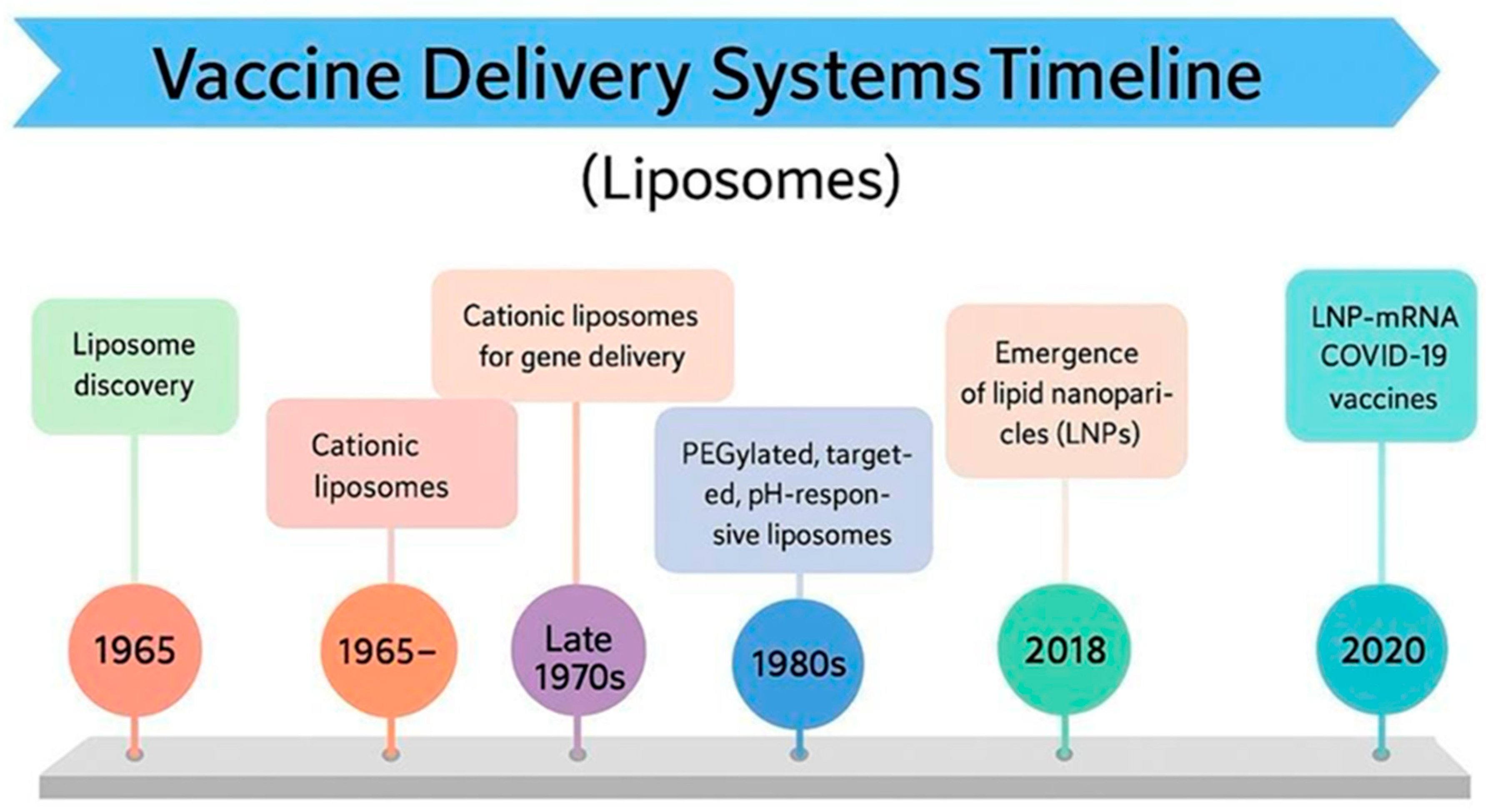
Liposomes are self-assembled phospholipid vesicles used for drug delivery and can encapsulate both hydrophilic and lipophilic molecules. Their glycerophospholipid bilayer, stabilized by cholesterol, protects drugs from degradation and enables controlled release. In recent decades, liposomes have evolved from lab curiosities to clinically approved products, offering benefits like improved site targeting through the enhanced permeability retention (EPR) effect and better therapeutic outcomes with less toxicity than traditional formulations.
Figure 5 illustrates the historical background of liposomes [
99,
100,
101].
Next-generation delivery systems are integrating nanotechnology with new administration routes. Polymersomes are synthetic polymer vesicles with a hollow aqueous core and a bilayer of amphiphilic block copolymers [
102]. Unlike liposomes composed of natural lipids, polymersomes offer improved mechanical stability, greater chemical diversity, and tunable membrane properties, including selective permeability. Polymersomes are more robust than lipid membranes due to their higher molecular weight and entangled structure, which prevents fusion and extends shelf life [
102,
103,
104]. They allow extensive chemical modifications while maintaining self-assembly, making them ideal for advanced biomedical applications like drug delivery, gene therapy, and medical imaging [
102,
103,
104]. Polymersomes can carry a range of therapeutics, including drugs and nucleic acids, and offer broader potential than liposomes. These innovative vaccine platforms are designed to address challenges such as cold-chain logistics and resource constraints in resource-limited countries [
102,
103,
104].
7.2. Nanoparticle-Based Systems
Nanoparticle-based vaccine systems are a cornerstone of modern vaccinology, serving as innovative platforms that meticulously mimic viral structures and architectures to optimize antigen delivery and processing. Unlike vaccines and conventional vaccine formulations, these nanoparticles allow for self-assembled nanostructures that enable multivalent antigen presentation, which is essential for inducing B-cell receptor (BCR) clustering and robust primary activation. Furthermore, their high surface-to-volume ratio enables precise cargo loading and controlled release kinetics, thereby enhancing the stability of the molecular payload against extracellular enzymatic degradation [
105,
106,
107,
108] and enabling the engineering of the physicochemical properties of these carriers, such as size, zeta potential, and surface functionalization. It is possible to orchestrate targeted delivery to APCs, particularly dendritic cells. This targeted approach facilitates the efficient transport of antigens to secondary lymphoid organs, thereby amplifying immunogenicity and orchestrating the adaptive immune response [
106,
107,
108].
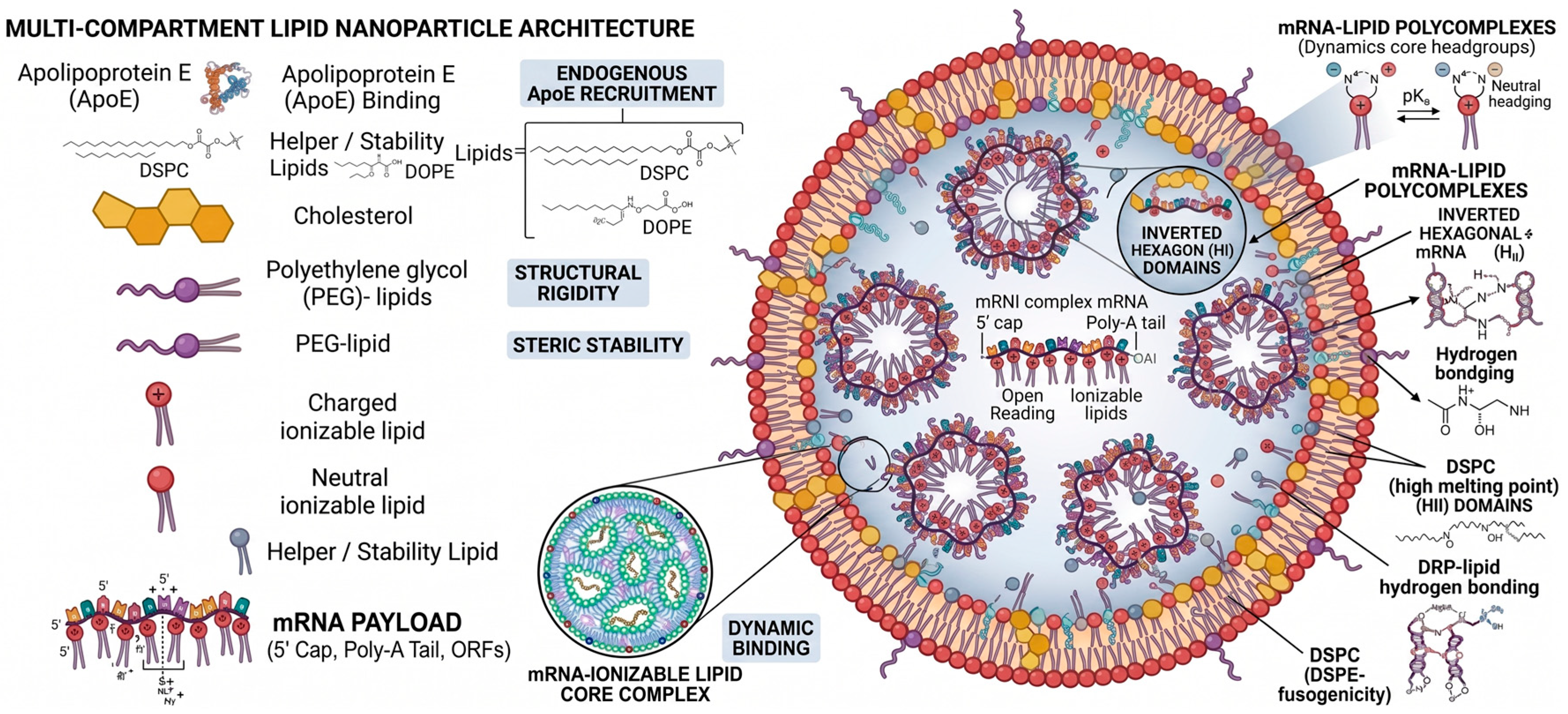
A pinnacle of this bioengineering is the sophisticated, multi-compartment lipid nanoparticle (LNP) architecture, which has revolutionized the delivery of nucleoside-modified mRNA (
Figure 6). This system operates as a dynamic, bio-responsive entity rather than a static carrier. At its core, the mRNA payload—stabilized by a 5′ cap, a Poly(A) tail, and strategically designed Open Reading Frames (ORFs)—is sequestered within a highly organized internal matrix. This core is characterized by inverted hexagonal H
II domains and dense core complexes that provide the necessary structural rigidity and facilitate the transition from a lamellar to a fusogenic state. The functional versatility of the LNP is primarily governed by ionizable lipids, which possess a specific acid dissociation constant (pKa) typically below 7.0. This allows the particles to maintain a near-neutral surface charge at physiological pH, minimizing non-specific interactions and systemic toxicity. Upon internalization via receptor-mediated endocytosis, the acidic environment of the maturing endosome triggers the protonation of these ionizable lipids. This transition induces a synergistic interaction with the anionic lipids of the endosomal membrane, leading to membrane destabilization and the subsequent “endosomal escape.” This process is vital for releasing the genetic payload into the cytosol before it can be trafficked to lysosomes for degradation. The external interface of the LNP is further refined by PEGylated lipids, which provide a steric barrier that prevents particle aggregation and reduces opsonization by plasma proteins. To ensure structural integrity and efficient delivery, specific helper lipids are strategically incorporated into the formulation. Saturated lipids such as DSPC and DSPE provide structural stability to the bilayer and often serve as anchors for PEG chains. Additionally, DOPE (1,2-dioleoyl-sn-glycero-3-phosphoethanolamine) enhances the particle’s fusogenic potential, while cholesterol is included to modulate bilayer fluidity and particle persistence [
105,
106,
107,
108].
This intricate interplay of molecular components is the fundamental driver of efficient cytosolic delivery. This process is paramount for high-fidelity antigen translation, which ultimately promotes potent CD8+ T cell activation and the production of high-affinity neutralizing antibodies. In the burgeoning field of cancer immunotherapy, researchers are leveraging these precision nanovaccines to reprogram the immunosuppressive TME via this same endosomal bypass, minimizing systemic cytotoxicity. Beyond efficacy, current research prioritizes thermostability challenges, exploring lyophilization techniques and the use of biomimetic, stimuli-responsive polymers to bypass stringent cold-chain requirements [
109,
110]. Furthermore, the horizon of vaccine administration is shifting toward minimally invasive routes, such as biodegradable microneedle patches and mucoadhesive nanocarriers for intranasal delivery. These innovations are designed to trigger a robust secretory IgA response, creating a first line of defense that prevents viral replication at the primary mucosal entry sites [
111].
Innovative vaccine platforms, including polymersomes, microneedle patches, and intranasal sprays, aim to enhance systemic and mucosal immunity while reducing reliance on traditional injections and overcoming logistics constraints in resource-limited settings [
112,
113,
114]. The convergence of nanotechnology and synthetic biology will inevitably lead to a new generation of single-dose vaccines characterized by unparalleled delivery efficiency and superior safety profiles.
8. Key Industrial Applications of Nanotechnology
Nanotechnology’s versatility is evident in its applications, especially in nanomedicine. It enhances disease treatment by using DDSs that target specific cells with nanoparticles, thereby improving efficacy and reducing side effects [
114]. Additionally, nanoparticles serve as contrast agents in medical imaging (e.g., iron oxides for MRI and silica for CT), offering advantages over traditional radiation-based methods [
115].
8.1. Fundamental Physicochemical Properties of Nanoparticles
Nanoparticles have unique properties that enhance their reactivity in biological environments, making them crucial for nanomedicine. Their small size (1–100 nm) offers a high surface-to-volume ratio, allowing easy infiltration into tissues and fluids [
116,
117,
118,
119]. Size affects key processes, including endocytosis and the ability to cross biological barriers, such as the blood-brain barrier; particles smaller than 200 nm enter cells via clathrin-coated vesicles.
Surface chemistry plays a crucial role in determining reactivity and function. Modifying surfaces, such as coating AuNPs and DNA with lipid layers, increases permeability and cellular uptake [
120]. PEGylation of liposomes enhances bioavailability by reducing immune recognition, while ligand conjugation (e.g., folate or monoclonal antibodies) facilitates the selective targeting of cells, particularly cancer cells [
121]. Additionally, surface chemistry enables environment-activated drug release in response to factors such as the acidic pH of tumors [
122]. The shape of a nanoparticle is vital for its biological function. Spherical nanoparticles are generally more easily endocytosed than rod or tube-shaped ones due to their interaction with the cell membrane [
123]. However, long nanorods can offer prolonged bioavailability and greater encapsulation capacity. Shape also influences the endocytosis pathway (clathrin-mediated vs. clathrin-independent) [
124]. This tunability of physicochemical properties suggests that the future of nanomedicine is geared toward precision design, in which nanoparticles are tailored to specific therapeutic challenges [
122,
123,
124].
8.2. Lipid-Based Carriers
Lipid-based carriers include micelles (5–50 nm) for hydrophobic drugs and liposomes (10 nm to several microns) that encapsulate both hydrophobic and hydrophilic drugs [
125,
126]. Liposomes play a crucial role in cancer treatment through the “enhanced permeability and retention effect” (EPR), which enables selective accumulation [
127,
128,
129,
130,
131]. PEGylation extends half-life, while ligand conjugation facilitates active targeting. LNPs are also effective for nucleic acid therapies, such as CRISPR-Cas9 [
132,
133,
134,
135].
8.3. Dendrimers
Silica, magnetic, and gold nanoparticles play crucial roles in drug delivery. Dendrimers facilitate controlled drug release, while silica and magnetic nanoparticles enable targeted delivery [
136,
137,
138]. Gold nanoparticles are functional for imaging and photothermal therapy [
139,
140,
141]. The emergence of innovative drug delivery systems that respond to stimuli enhances control over drug release and localization. Nanocarrier encapsulation reduces the systemic toxicity of cytotoxic drugs like [
142,
143]. For instance, liposomal AgNP incorporation minimizes inflammation and enhances cytotoxicity at lower concentrations, providing a model for reducing drug toxicity [
144].
9. Nanoparticle Cytotoxicity and Safety Considerations
The widespread use of nanotechnology has raised concerns about health and the environment, leading to the emergence of nanotoxicology [
145,
146,
147]. The properties that enhance the pharmacological benefits of nanoparticles can also contribute to their toxicity, highlighting a trade-off between efficacy and safety, as optimizing cellular uptake and reactivity may increase the risk of unintended cellular damage [
145,
146,
147,
148]. Cytotoxic mechanisms involve tissue infiltration and disruption of cellular functions, primarily through the rupture of subcellular membranes and excessive production of reactive oxygen species (ROS), which leads to oxidative stress, DNA damage, and cell death [
149,
150]. Small nanoparticles show greater cytotoxicity due to enhanced cellular entry [
151]. Surface modifications impact toxicity: charged nanoparticles are often more toxic, while PEGylation reduces uptake [
152,
153]. However, recent studies suggest that lipid PEGylation may enhance lipid nanoparticle delivery [
154,
155], opening new options for targeting specific tissues and cells.
10. Exosomes
Exosomes are vesicle-like structures, first identified in the 1980s, with diameters ranging from 40 to 1000 nm, which facilitate intercellular communication by transferring substances such as proteins, mRNAs, miRNAs, and lipids between cells [
156,
157]. Due to their greater biocompatibility and lower toxicity, they are being explored for drug-delivery applications; furthermore, exosomes secreted by immune cells can either stimulate or inhibit the immune response, with dendritic cell exosomes being explored for cancer and infectious disease vaccines [
158,
159].
Exosomes can enhance Th1-type responses and cell-mediated immunity, which is crucial for fighting viral and bacterial infections, and research specifically shows that exosomes with mycobacterial antigens induce a more effective Th1 response against
M. tuberculosis in mice than protein subunit vaccines, which tend to promote Th2 responses and antibody-mediated immunity [
126,
160,
161].
The synthesized evidence positions exosomes not merely as inert delivery vehicles, but as potent biological adjuvants that represent the next generation of rational vaccine design [
162]. Their role as immunological helpers is fundamental to overcoming the limitations of traditional vaccinology. Unlike conventional aluminum salts (Alum), which are restricted to Th2-dominant humoral responses and often fail against intracellular pathogens, exosomes actively polarize the immune system toward Th1 and Th17 responses and robust CTL activity [
163,
164]. This intrinsic adjuvanticity is driven by a sophisticated molecular synergy: exosomes simultaneously deliver high-fidelity antigens and “danger signals,” including heat shock proteins (HSP70, HSP90) and specific lipids (oxidized phospholipids, lipid aldehydes, non-lysosomal sphingolipids, and acyl ceramides), which can activate the TLR4 and NLRP3 inflammasome pathways [
165]. The efficiency of this biological adjuvancy is exemplified by “dose-sparing” effects, in which nanogram-level doses delivered via exosomes elicit immunity comparable to that elicited by microgram doses of protein subunit vaccines supplemented with chemical enhancers [
166].
Furthermore, the transition from empirical to rational adjuvant design is facilitated by exosome engineering [
167]. Platforms like StealthX™ prove that multivalent “mix-and-match” strategies can provide broad protection against evolving variants without the reactogenicity or “liver trap” effects associated with synthetic lipid nanoparticles [
168,
169]. While the chemistry, manufacturing, and controls bottleneck regarding yield and purification remains a critical hurdle for large-scale clinical implementation, the ability of exosomes to act as independent, biocompatible, and self-adjuvanted systems suggests they will redefine the standards of efficacy for both infectious disease prophylaxis and personalized cancer immunotherapy [
170,
171]. As regulatory frameworks evolve [
171], the strategic integration of exosomes as primary helpers will likely be the cornerstone of non-invasive, needle-free, and high-precision global immunization efforts [
172,
173].
11. Induction of Tolerogenic Responses (Vaccines and Nanoparticles)
Tolerogenic vaccines represent a therapeutic strategy aimed at reinstating immune tolerance in the treatment of autoimmune disorders and allergic reactions [
174,
175,
176]. This approach specifically targets and suppresses pathogenic immune responses associated with particular antigens, rather than activating them. In contrast to conventional vaccines, tolerogenic vaccines stimulate regulatory T (Treg) and B cells to mitigate autoimmunity without imposing broad immunosuppression. They demonstrate considerable potential to address conditions such as Type 1 Diabetes and allergic diseases [
174,
175,
176]. Furthermore, transdermal tolerogenic nanoparticles have been used as an effective delivery system in asthma [
177].
Further preclinical and clinical research is required in this domain, as the therapeutic effects of vaccines have not been adequately investigated.
12. Conclusions
The landscape of biological sciences is undergoing a fundamental transformation, marking a decisive shift from traditional, empirical vaccine design toward an era of molecularly programmed immunity. We have moved beyond simply boosting the immune system with basic aids; researchers are now leveraging synthetic biology and nanotechnology to engineer every functional component of the immune response precisely. The clinical success of advanced adjuvant systems such as AS01 and Matrix-M™ represents a critical milestone in overcoming the immunogenicity challenges posed by complex pathogens, including those responsible for malaria and RSV, that have historically evaded intervention. These achievements demonstrate that directed molecular synergy, achieved through the strategic engagement of multiple PRRs, is the most effective approach for eliciting the potent, targeted immune profiles required to address modern global health threats.
Looking toward the future, the distinction between “algorithm” and “adjuvant” is increasingly merging into a singular, optimized therapeutic entity. The integration of artificial intelligence frameworks, such as AlphaFold 3, now enables the prediction of T-cell recognition and MHC-peptide interactions with exceptional molecular accuracy, allowing for the rapid design of next-generation vaccine candidates. This computational revolution, combined with tools like CRISPR-Cas9 for scalable mRNA design, paves the way for “one-and-done” genetic treatments and chronic mRNA therapies for cancer and autoimmune diseases that were previously considered unattainable. Simultaneously, innovations in delivery vehicles, such as LNPs, are prioritizing endosomal escape and the use of next-generation selective organ target (SORT) lipids and poly-sarcosine to overcome the immunogenic limitations and biodistribution challenges associated with conventional PEGylation.
The next frontier of rational vaccine design centers on exosomes and biomimetic vesicles, which function not merely as inert carriers but as potent biological adjuvants. Their intrinsic ability to deliver high-fidelity antigens alongside biological “danger signals”—such as heat shock proteins and specific lipids—allows them to actively polarize the immune system toward Th1 and Th17 responses while maintaining a superior safety profile. Furthermore, the global future of vaccine administration lies in overcoming the “cold-chain bottleneck” through the vitrification of nanocomposites and the deployment of needle-free platforms, such as thermostable microneedle patches and mucoadhesive nanocarriers for intranasal delivery. These systems are specifically designed to induce potent mucosal IgA responses, blocking viral replication at the primary site of entry—a critical requirement for preventing future pandemics.
The 100-Day Mission to mitigate risks associated with the emergence of “Disease X” is an ambitious endeavor now feasible with current technological capabilities. This objective necessitates a profound shift away from outdated reliance on animal models toward a human-centric approach that leverages organ-on-a-chip technologies and AI-driven screening methods. However, the true significance of these technological milestones resides not in their technical complexity but in their ethical implications. Precision immunology must be inextricably linked with the moral imperative of global equity to ensure that health security is a universal biological certainty. Our final objective is to realize a future in which the highest caliber of scientific advancement safeguards every individual, regardless of their geographical location or economic status.
Ultimately, vaccines and efficient delivery systems have the potential to elicit tolerogenic responses, which may play a crucial role in the management of autoimmune and allergic diseases, particularly when pharmacological treatments are constrained.
Author Contributions
Conceptualization, A.H.G. and J.B.D.S.; investigation, A.H.G. and J.B.D.S.; resources, A.H.G. and J.B.D.S.; writing—original draft preparation, A.H.G.; writing—review and editing, A.H.G. and J.B.D.S.; supervision, A.H.G. and J.B.D.S.; project administration, A.H.G. and J.B.D.S.; funding acquisition, A.H.G. and J.B.D.S. All authors have read and agreed to the published version of the manuscript.
Funding
This work was supported by the National Fund for Science, Technology, and Innovation (FONACIT), an entity affiliated with the Ministry of Popular Power for Science and Technology of the Bolivarian Republic of Venezuela (MINCYT). J.B.D.S. was partially financed by the National Institute of Virology and Bacteriology [Program EXCELES, ID Project No. LX22NPO5103]—Funded by the European Union—Next Generation EU from the Ministry of Education, Youth, and Sports of the Czech Republic (MEYS).
Data Availability Statement
No new data were created or analyzed in this study. Data sharing is not applicable to this article.
Conflicts of Interest
The authors declare that they have no conflicts of interest.
Glossary
| DDS | Drug Delivery System |
| CTL | Cytotoxic T lymphocyte |
| DC | Dendritic Cells |
| TLR | Toll-like receptors |
| TLRL | Toll-like receptor ligands |
| AI | Artificial intelligence |
| PRRs | Pattern recognition receptors |
| Th1 | T lymphocyte helper 1 |
| Th2 | T lymphocyte helper 2 |
| Th17 | T lymphocyte helper 17 |
| dsRNA | DNA-capped double-stranded RNA |
| ARNAX | A synthetic DNA-capped double-stranded RNA (dsRNA) molecule used as a ligand of TLR3 |
| CpG ODNs | Short, synthetic single-stranded DNA molecules containing unmethylated cytosine-guanine (CpG) dinucleotides |
| STING | Stimulator of IFN genes |
| Poly(I:C) | Polyinosinic: polycytidylic acid, activator of TLR3 |
| LNP | Lipid nanoparticle |
| Cross-Reactive Material 197 (CRM197) | A non-toxic mutant of diphtheria toxin |
| MHC | Major Histocompatibility Complex |
| APC | Antigen-presenting cells |
| PAMP | Pathogen-Associated Molecular Patterns |
| DAMP | Damage-associated molecular patterns or alarmins |
| LPS | Lipopolysaccharide |
| HSP | Heat shock protein |
| HMGB1 | High Mobility Group Box 1 |
| MPL | Monophosphoryl lipid A |
| HPV | Human Papillomavirus |
| NLRP3 | Nucleotide-binding domain, leucine-rich-containing family, pyrin domain-containing-3 |
| TRIF | TIR-domain-containing adapter-inducing interferon β |
| MyD88 | Myeloid Differentiation Primary Response 88 |
| IRF | Interferon Regulatory Factors |
| LDHs | Layered Double Hydroxides |
| TME | Tumor Microenvironment |
| LRTD | Severe lower respiratory tract disease |
| ISCOMs | Immunostimulatory complexes |
| AS | Adjuvant Systems |
| DSPC | 1,2-Distearoyl-sn-glycero-3-phosphocholine |
| DOPE | 1,2-dioleoyl-sn-glycero-3-phosphoethanolamine |
| EPR | Enhanced permeability retention |
| PEG | Polyethylene glycol |
| BCR | B-cell receptor |
| ORFs | Open Reading Frames |
| AuNP | Gold nanoparticles |
| AgNP | Silver nanoparticles |
| ROS | Reactive oxygen species |
| T reg | T regulatory cells |
| SORT | Selective ORgan Targeting |
References
- Ghattas, M.; Dwivedi, G.; Lavertu, M.; Alameh, M.G. Vaccine Technologies and Platforms for Infectious Diseases: Current Progress, Challenges, and Opportunities. Vaccines 2021, 9, 1490. [Google Scholar] [CrossRef] [PubMed]
- García, A.; De Sanctis, J.B. An overview of adjuvant formulations and delivery systems. APMIS 2014, 122, 257–267. [Google Scholar] [CrossRef]
- Marciani, D.J. Vaccine Adjuvants: From Empirical to a More Rational Drug Design. Explor. Res. Hypothesis Med. 2024, 9, 199–208. [Google Scholar] [CrossRef]
- Facciolà, A.; Visalli, G.; Laganà, A.; Di Pietro, A. An Overview of Vaccine Adjuvants: Current Evidence and Future Perspectives. Vaccines 2022, 10, 819. [Google Scholar] [CrossRef]
- Komal, A.; Noreen, M.; El-Kott, A.F. TLR3 agonists: RGC100, ARNAX, and poly-IC: A comparative review. Immunol. Res. 2021, 69, 312–322. [Google Scholar] [CrossRef]
- Zhao, T.; Cai, Y.; Jiang, Y.; He, X.; Wei, Y.; Yu, Y.; Tian, X. Vaccine adjuvants: Mechanisms and platforms. Signal Transduct. Target. Ther. 2023, 8, 283. [Google Scholar] [CrossRef]
- Pichichero, M.E. Protein carriers of conjugate vaccines: Characteristics, development, and clinical trials. Hum. Vaccin. Immunother. 2013, 9, 2505–2523. [Google Scholar] [CrossRef]
- Micoli, F.; Adamo, R.; Costantino, P. Protein Carriers for Glycoconjugate Vaccines: History, Selection Criteria, Characterization and New Trends. Molecules 2018, 23, 1451. [Google Scholar] [CrossRef]
- Zhang, F.; Thompson, C.; Ma, N.; Lu, Y.J.; Malley, R. Carrier Proteins Facilitate the Generation of Antipolysaccharide Immunity via Multiple Mechanisms. mBio 2022, 13, e0379021. [Google Scholar] [CrossRef] [PubMed]
- Ganaie, F.A.; Nahm, M.H. Approaches to assess new pneumococcal vaccines for immunogenicity, development, and licensure. Hum. Vaccin. Immunother. 2025, 21, 2545032. [Google Scholar] [CrossRef]
- Pulendran, B.S.; Arunachalam, P.; O’Hagan, D.T. Emerging concepts in the science of vaccine adjuvants. Nat. Rev. Drug Discov. 2021, 20, 454–475. [Google Scholar] [CrossRef] [PubMed]
- Ong, G.H.; Lian, B.S.X.; Kawasaki, T.; Kawai, T. Exploration of Pattern Recognition Receptor Agonists as Candidate Adjuvants. Front. Cell. Infect. Microbiol. 2021, 11, 745016. [Google Scholar] [CrossRef]
- Vasou, A.; Sultanoglu, N.; Goodbourn, S.; Randall, R.E.; Kostrikis, L.G. Targeting Pattern Recognition Receptors (PRR) for Vaccine Adjuvantation: From Synthetic PRR Agonists to the Potential of Defective Interfering Particles of Viruses. Viruses 2017, 9, 186. [Google Scholar] [CrossRef]
- Trovato, M.; De Berardinis, P. Novel antigen delivery systems. World J. Virol. 2015, 4, 156–168. [Google Scholar] [CrossRef]
- Fu, X. Current landscape and challenges in adjuvant and antigen delivery systems for vaccines. Vaccine X 2025, 27, 100735. [Google Scholar] [CrossRef]
- Ogbodo, E.; Michelangeli, F.; Williams, J.H.H. Exogenous heat shock proteins HSPA1A and HSPB1 regulate TNF-α, IL-1β and IL-10 secretion from monocytic cells. FEBS Open Bio 2023, 13, 1922–1940. [Google Scholar] [CrossRef]
- Datta, S.; Rahman, M.A.; Koka, S.; Boini, K.M. High Mobility Group Box 1 (HMGB1): Molecular Signaling and Potential Therapeutic Strategies. Cells 2024, 13, 1946. [Google Scholar] [CrossRef]
- Braga, T.; Forni, M.; Correa-Costa, M.; Ramos, R.N.; Barbuto, J.A.; Branco, P.; Castoldi, A.; Hiyane, M.I.; Davanso, M.R.; Latz, E.; et al. Soluble Uric Acid Activates the NLRP3 Inflammasome. Sci. Rep. 2017, 7, 39884. [Google Scholar] [CrossRef] [PubMed]
- Mogensen, T.H. Pathogen recognition and inflammatory signaling in innate immune defenses. Clin. Microbiol. Rev. 2009, 22, 240–273. [Google Scholar] [CrossRef] [PubMed]
- Che, R.; Zou, J.; Zhong, X.; Liu, J.; Kang, R.; Tang, D. DAMP signaling networks: From receptors to diverse pathophysiological functions. J. Adv. Res. 2026, 83, 183–218. [Google Scholar] [CrossRef]
- Iwasaki, A.; Medzhitov, R. Control of adaptive immunity by the innate immune system. Nat. Immunol. 2015, 16, 343–353. [Google Scholar] [CrossRef]
- Kawai, T.; Akira, S. Toll-like receptors and their crosstalk with other innate receptors in infection and immunity. Immunity 2011, 34, 637–650. [Google Scholar] [CrossRef]
- Vardikar, A.; Prajapati, M.K.; Gholap, A.D.; Rojekar, S.; Keshari, R.; Jain, H.; Rajput, A. Recent Advances in Vaccine Adjuvants: From Lab to Clinic. Int. J. Pharm. 2025, 684, 126180. [Google Scholar] [CrossRef] [PubMed]
- Chao, Z.; Mei, Q.; Yang, C.; Luo, J.; Liu, P.; Peng, H.; Guo, X.; Yin, Z.; Li, L.; Wang, Z. Immunological synapse: Structures, molecular mechanisms and therapeutic implications in disease. Signal Transduct. Target. Ther. 2025, 10, 254. [Google Scholar] [CrossRef]
- Brubaker, S.W.; Bonham, K.S.; Zanoni, I.; Kagan, J.C. Innate immune pattern recognition: A cell biological perspective. Annu. Rev. Immunol. 2015, 33, 257–290. [Google Scholar] [CrossRef] [PubMed]
- Chen, R.; Zou, J.; Chen, J.; Zhong, X.; Kang, R.; Tang, D. Pattern recognition receptors: Function, regulation and therapeutic potential. Signal Transduct. Target. Ther. 2025, 10, 216. [Google Scholar] [CrossRef]
- Martín-Cófreces, N.B.; Calzada-Fraile, D.; Sánchez-Madrid, F. How crosstalk at the immune synapse shapes T cell and dendritic cell biology. Nat. Rev. Immunol. 2026. Epub ahead of print. [Google Scholar] [CrossRef]
- Dustin, M.L. The immunological synapse: Structural coordination of CD80/86, ICAM-1, and 4-1BB during T cell activation. Immunity 2026, 59, 12–28. [Google Scholar] [CrossRef]
- Sallusto, F.; Lanzavecchia, A. Cytokine-driven coordination of innate and adaptive immunity. Immunity 2025, 58, 32–48. [Google Scholar] [CrossRef]
- Mehrani, Y.; Morovati, S.; Keivan, F.; Tajik, T.; Forouzanpour, D.; Shojaei, S.; Bridle, B.W.; Karimi, K. Dendritic Cells and Their Crucial Role in Modulating Innate Lymphoid Cells for Treating and Preventing Infectious Diseases. Pathogens 2025, 14, 794. [Google Scholar] [CrossRef]
- Zhang, H.; Floyd, K.; Fang, Z.; Hoffmann, F.A.; Lee, A.; Froggatt, H.M.; Bharj, G.; Xie, X.; Eppler, H.B.; Santagata, J.M.; et al. Mucosal vaccination in mice provides protection from diverse respiratory threats. Science 2026, eaea1260. [Google Scholar] [CrossRef]
- Heras-Murillo, I.; Adán-Barrientos, I.; Galán, M.; Wculek, S.K.; Sancho, D. Dendritic cells as orchestrators of anticancer immunity and immunotherapy. Nat. Rev. Clin. Oncol. 2024, 21, 257–277. [Google Scholar] [CrossRef]
- Poženel, P.; Zajc, K.; Švajger, U. Factor of time in dendritic cell (DC) maturation: Short-term activation of DCs significantly improves type 1 cytokine production and T cell responses. J. Transl. Med. 2024, 22, 541. [Google Scholar] [CrossRef] [PubMed]
- León, B.; Lund, F.E. Compartmentalization of dendritic cell and T-cell interactions in the lymph node: Anatomy of T-cell fate decisions. Immunol. Rev. 2019, 289, 84–100. [Google Scholar] [CrossRef] [PubMed]
- Motallebzadeh Khanmiri, J.; Khani-Eshratabadi, M.; Seyedmoharrami, F.; Khazaee-Nasirabadi, M.H.; Dehdashti, M.; Seddighi, N.; Peymaninezhad, F.; Khiabani, A.; Khanahmad, A.; Baradaran, B. Innovative combinatory approaches with dendritic cell-based vaccines: Bridging preclinical insights and clinical challenges. Clin. Exp. Med. 2026, 26, 154. [Google Scholar] [CrossRef]
- Olson, E.C.; Williams, A.; Eisenbarth, S.C. Dendritic Cell Migration: An Essential Step in Initiating Adaptive Immunity Across Tissues. Immunol. Rev. 2026, 337, e70080. [Google Scholar] [CrossRef]
- Zhao, L.; Kepp, O.; Kroemer, G.; Liu, P. Restoring dendritic cell migration: A gut reaction to boost vaccine efficacy in aging. Oncoimmunology 2026, 15, 2657070. [Google Scholar] [CrossRef]
- Lan, J.; Feng, D.; He, X.; Zhang, Q.; Zhang, R. Basic Properties and Development Status of Aluminum Adjuvants Used for Vaccines. Vaccines 2024, 12, 1187. [Google Scholar] [CrossRef] [PubMed]
- Gao, C.; Jiang, J.; Zhao, J.; Xu, Z.P.; Zhang, L. Engineered nano-aluminum adjuvant for cancer immunotherapy: Progress, challenges and opportunities towards preclinical/clinical application. Coord. Chem. Rev. 2024, 519, 216109. [Google Scholar] [CrossRef]
- Su, Z.; Boucetta, H.; Shao, J.; Huang, J.; Wang, R.; Shen, A.; He, W.; Xu, Z.P.; Zhang, L. Next-generation aluminum adjuvants: Immunomodulatory layered double hydroxide NanoAlum reengineered from first-line drugs. Acta Pharm. Sin. B 2024, 14, 4665–4682. [Google Scholar] [CrossRef]
- Schijns, V.E.J.C.; Strioga, M.; Ascarateil, S. Oil-based emulsion vaccine adjuvants. In Current Protocols in Immunology; John Wiley & Sons: Hoboken, NJ, USA, 2014; Volume 106, pp. 2–18. [Google Scholar] [CrossRef]
- Calabro, S.; Tritto, E.; Pezzotti, A.; Taccone, M.; Muzzi, A.; Bertholet, S.; De Gregorio, E.; O’Hagan, D.T.; Baudner, B.; Seubert, A. The adjuvant effect of MF59 is due to the oil-in-water emulsion formulation, none of the individual components induce a comparable adjuvant effect. Vaccine 2013, 31, 3363–3369. [Google Scholar] [CrossRef]
- O’Hagan, D.T.; Ott, G.S.; De Gregorio, E.; Seubert, A. The mechanism of action of MF59—An innately attractive adjuvant formulation. Vaccine 2012, 30, 4341–4348, Erratum in Vaccine 2013, 31, 1877. [Google Scholar] [CrossRef] [PubMed]
- El Sahly, H. MF59™ as a vaccine adjuvant: A review of safety and immunogenicity. Expert Rev. Vaccines 2010, 9, 1135–1141. [Google Scholar] [CrossRef]
- Huang, Z.; Gong, H.; Sun, Q.; Yang, J.; Yan, X.; Xu, F. Research progress on emulsion vaccine adjuvants. Heliyon 2024, 10, e24662. [Google Scholar] [CrossRef] [PubMed]
- Morel, S.; Didierlaurent, A.; Bourguignon, P.; Delhaye, S.; Baras, B.; Jacob, V.; Planty, C.; Elouahabi, A.; Harvengt, P.; Carlsen, H.; et al. The adjuvant System AS03 containing α-tocopherol modulates the innate immune response and enhances adaptive immunity. Vaccine 2011, 29, 2461–2473. [Google Scholar] [CrossRef]
- Strbo, N.; Vaccari, M.; Pahwa, S.; Kolber, M.A.; Fisher, E.; Gonzalez, L.; Doster, M.N.; Hryniewicz, A.; Felber, B.K.; Pavlakis, G.N.; et al. Gp96SIV Ig immunization induces potent polyepitope specific, multifunctional memory responses in rectal and vaginal mucosa. Vaccine 2011, 29, 2619–2625. [Google Scholar] [CrossRef] [PubMed]
- Grigoryan, L.; Feng, Y.; Bellusci, L.; Lai, L.; Wali, B.; Ellis, M.; Yuan, M.; Arunachalam, P.S.; Hu, M.; Kowli, S.; et al. AS03 adjuvant enhances the magnitude, persistence, and clonal breadth of memory B cell responses to a plant-based COVID-19 vaccine in humans. Sci. Immunol. 2024, 9, eadi8039. [Google Scholar] [CrossRef]
- Adachi, T.; Kuroda, E. Immunogenic cell death as a promising platform for adjuvant development. Curr. Opin. Virol. 2026, 76, 101528. [Google Scholar] [CrossRef]
- Didierlaurent, A.M.; Morel, S.; Lockman, L.; Giannini, S.L.; Bisteau, M.; Carlsen, H.; Kielland, A.; Vosters, O.; Vanderheyde, N.; Schiavetti, F.; et al. AS04, an Aluminum Salt- and TLR4 Agonist-Based Adjuvant System, Induces a Transient Localized Innate Immune Response Leading to Enhanced Adaptive Immunity. J. Immunol. 2009, 183, 6186–6197. [Google Scholar] [CrossRef]
- Luo, Z.; Zhou, S.; Wang, H.; Ge, W.; Liu, Z.; He, M.; Zhong, T.; Wang, Y.; Li, X.; Wang, S.; et al. Developing a Next-Generation Vaccine Adjuvant System through Rational Design to Alleviate AS01 Adjuvant Deficiency. J. Med. Chem. 2026, 69, 8535–8547. [Google Scholar] [CrossRef]
- McKeage, K.; Romanowski, B. AS04-adjuvanted human papillomavirus (HPV) types 16 and 18 vaccine (Cervarix®): A review of its use in the prevention of premalignant cervical lesions and cervical cancer causally related to certain oncogenic HPV types. Drugs 2011, 71, 465–488. [Google Scholar]
- Tejada-Pérez, J.J.; Vázquez-Vicente, J.J.; Herrera-Burgos, M.R.; Martín-Martín, F.G.; Parrón-Carreño, T.; Alarcón-Rodríguez, R. Fendrix® Vaccine Effectiveness in Healthcare Workers Who Are Non-Responsive to Engerix B® Vaccination. Vaccines 2021, 9, 279. [Google Scholar] [CrossRef]
- Roman, F.; Burny, W.; Ceregido, M.A.; Laupèze, B.; Temmerman, S.T.; Warter, L.; Coccia, M. Adjuvant system AS01: From mode of action to effective vaccines. Expert Rev. Vaccines 2024, 23, 715–729. [Google Scholar] [CrossRef] [PubMed]
- Marty-Roix, R.; Vladimer, G.I.; Pouliot, K.; Weng, D.; Buglione-Corbett, R.; West, K.; MacMicking, J.D.; Chee, J.D.; Wang, S.; Lu, S.; et al. Identification of QS-21 as an Inflammasome-activating Molecular Component of Saponin Adjuvants. J. Biol. Chem. 2016, 291, 1123–1136. [Google Scholar] [CrossRef] [PubMed]
- Stoker, K.; Levien, T.L.; Baker, D.E. Zoster Vaccine Recombinant, Adjuvanted. Hosp. Pharm. 2018, 53, 136–141. [Google Scholar] [CrossRef]
- Nadeem, A.Y.; Shehzad, A.; Islam, S.U.; Al-Suhaimi, E.A.; Lee, Y.S. Mosquirix™ RTS, S/AS01 Vaccine Development, Immunogenicity, and Efficacy. Vaccines 2022, 10, 713. [Google Scholar] [CrossRef]
- Torres, B.; King, J.M.; Richardson, R.M. A Review of Respiratory Syncytial Virus Vaccines in the Older Adult. Sr. Care Pharm. 2025, 40, 402–411. [Google Scholar] [CrossRef]
- Sanders, M.T.; Brown, L.E.; Deliyannis, G.; Pearse, M.J. ISCOMTM-based vaccines: The second decade. Immunol. Cell Biol. 2005, 83, 119–128. [Google Scholar] [CrossRef]
- Hook, S.; Rades, T. Immune Stimulating Complexes (ISCOMs) and Quil-A Containing Particulate Formulations as Vaccine Delivery Systems. In Immunomic Discovery of Adjuvants and Candidate Subunit Vaccines. Immunomics Reviews; Flower, D., Perrie, Y., Eds.; Springer: New York, NY, USA, 2013; Volume 5. [Google Scholar] [CrossRef]
- García, A.; Lema, D. An Updated Review of ISCOMSTM and ISCOMATRIXTM Vaccines. Curr. Pharm. Des. 2016, 22, 6294–6299. [Google Scholar] [CrossRef] [PubMed]
- Bode, C.; Zhao, G.; Steinhagen, F.; Kinjo, T.; Klinman, D.M. CpG DNA as a vaccine adjuvant. Expert Rev. Vaccines 2011, 10, 499–511. [Google Scholar] [CrossRef]
- Scheiermann, J.; Klinman, D.M. Clinical evaluation of CpG oligonucleotides as adjuvants for vaccines targeting infectious diseases and cancer. Vaccine 2014, 32, 6377–6389. [Google Scholar] [CrossRef]
- Anwar, S.; Mir, F.; Yokota, T. Enhancing the Effectiveness of Oligonucleotide Therapeutics Using Cell-Penetrating Peptide Conjugation, Chemical Modification, and Carrier-Based Delivery Strategies. Pharmaceutics 2023, 15, 1130. [Google Scholar] [CrossRef]
- Chiu, C.Y.; Sampathkumar, P.; Brumble, L.M.; Vikram, H.R.; Watt, K.D.; Beam, E. Optimizing hepatitis B virus seroprotection in thoracic organ transplantation: The role of HepB-CpG (Heplisav-B) vaccination schedule. Vaccine 2025, 47, 126705. [Google Scholar] [CrossRef]
- Kwon, S.Y.; Lee, H.S. CpG-adjuvanted hepatitis B vaccine (HEPLISAV-B®) update. Expert Rev. Vaccines 2021, 20, 487–495. [Google Scholar] [CrossRef]
- Thuluva, S.; Paradkar, V.; Gunneri, S.; Yerroju, V.; Mogulla, R.R.; Suneetha, P.V.; Turaga, K.; Kyasani, M.; Manoharan, S.K.; Adabala, S.; et al. Safety, tolerability, and immunogenicity of Biological E’s CORBEVAX™ vaccine in children and adolescents: A prospective, randomized, double-blind, placebo-controlled, phase-2/3 study. Vaccine 2022, 40, 7130–7140. [Google Scholar] [CrossRef]
- Drobic, B.; Akintunde, G.; Kim, J.; Mirceta, M.; Beach, M.; Komlenovic, V. Immunogenicity, safety, and lot consistency of the anthrax vaccine adsorbed, adjuvanted for post-exposure prophylaxis of anthrax in healthy adults: A phase 3, randomized, double-blind trial. Vaccine 2026, 72, 128068. [Google Scholar] [CrossRef]
- Stertman, L.; Palm, A.E.; Zarnegar, B.; Carow, B.; Lunderius Andersson, C.; Magnusson, S.E.; Carnrot, C.; Shinde, V.; Smith, G.; Glenn, G.; et al. The Matrix-M™ adjuvant: A critical component of vaccines for the 21st century. Hum. Vaccin. Immunother. 2023, 19, 2189885. [Google Scholar] [CrossRef] [PubMed]
- Zarnegar, B.; Carow, B.; Eriksson, J.; Spennare, E.; Öhlund, P.; Akpinar, E.; Bringeland, E.; Osterman, I.L.; Lundqvist, L.; Antti, J.; et al. Matrix-M adjuvant triggers inflammasome activation and enables antigen cross-presentation through induction of lysosomal membrane permeabilization. NPJ Vaccines 2025, 10, 184. [Google Scholar] [CrossRef] [PubMed]
- Reimer, J.M.; Karlsson, K.H.; Lövgren-Bengtsson, K.; Magnusson, S.E.; Fuentes, A.; Stertman, L. Matrix-M™ adjuvant induces local recruitment, activation and maturation of central immune cells in absence of antigen. PLoS ONE 2012, 7, e41451. [Google Scholar] [CrossRef] [PubMed]
- Fix, J.; Lee, S.; Nachbar, J.; Sadadia, P.; Lövgren Bengtsson, K.; Stertman, L.; Palm, A.E.; Walker, R.; Draghia Akli, R.; Sellers, S. Safety of Matrix-M-adjuvanted COVID-19, seasonal influenza, combination influenza-COVID-19, and malaria vaccines: A review of the evidence. Expert Rev. Vaccines 2026, 25, 2638828. [Google Scholar] [CrossRef]
- Carnrot, C.; Carow, B.; Palm, A.K.; Akpinar, E.; Helgesson, P.H.; Osterman, I.L.; Bringeland, E.; Foreman, B.; Patel, N.; Bankefors, J.; et al. Biodistribution of the saponin-based adjuvant Matrix-M™ following intramuscular injection in mice. Front. Drug Deliv. 2023, 3, 1279710. [Google Scholar] [CrossRef] [PubMed]
- De Sanctis, J.B.; Balda Noria, G.; García, A.H. Exploring How Adipose Tissue, Obesity, and Gender Influence the Immune Response to Vaccines: A Comprehensive Narrative Review. Int. J. Mol. Sci. 2025, 26, 862. [Google Scholar] [CrossRef]
- Bergmann-Leitner, E.S.; Leitner, W.W. Adjuvants in the Driver’s Seat: How Magnitude, Type, Fine Specificity and Longevity of Immune Responses Are Driven by Distinct Classes of Immune Potentiators. Vaccines 2014, 2, 252–296. [Google Scholar] [CrossRef]
- Alves, K.; Plested, J.S.; Galbiati, S.; Chau, G.; Cloney-Clark, S.; Zhu, M.; Kalkeri, R.; Patel, N.; Smith, K.; Marcheschi, A.; et al. Novavax 2019nCoV-101 Study Group. Immunogenicity of a Fourth Homologous Dose of NVX-CoV2373. N. Engl. J. Med. 2023, 388, 857–859. [Google Scholar] [CrossRef]
- Datoo, M.S.; Dicko, A.; Tinto, H.; Ouédraogo, J.B.; Hamaluba, M.; Olotu, A.; Beaumont, E.; Ramos Lopez, F.; Natama, H.M.; Weston, S.; et al. R21/Matrix-M Phase 3 Trial Group. Safety and efficacy of malaria vaccine candidate R21/Matrix-M in African children: A multicentre, double-blind, randomised, phase 3 trial. Lancet 2024, 403, 533–544. [Google Scholar] [CrossRef]
- Wilkins, A.L.; Kazmin, D.; Napolitani, G.; Clutterbuck, E.A.; Pulendran, B.; Siegrist, C.A.; Pollard, A.J. AS03- and MF59-Adjuvanted Influenza Vaccines in Children. Front. Immunol. 2017, 8, 1760. [Google Scholar] [CrossRef] [PubMed]
- Levast, B.; Awate, S.; Babiuk, L.; Mutwiri, G.; Gerdts, V.; van Drunen Littel-van den Hurk, S. Vaccine Potentiation by Combination Adjuvants. Vaccines 2014, 2, 297–322. [Google Scholar] [CrossRef] [PubMed]
- Hernandez-Davies, J.; Felgner, J.; Strahsburger, E.; Laster, J.; Jain, A.; Yates, T.; Silzel, E.; Assis, R.; Nakajima, R.; Jasinskas, A.; et al. Comparative evaluation of 5 combination adjuvants on immunogenicity and efficacy of approved seasonal influenza vaccines. npj Vaccines 2026, 11, 30. [Google Scholar] [CrossRef]
- Moni, S.S.; Abdelwahab, S.I.; Jabeen, A.; Elmobark, M.E.; Aqaili, D.; Ghoal, G.; Oraibi, B.; Farasani, A.M.; Jerah, A.A.; Alnajai, M.M.A.; et al. Advancements in Vaccine Adjuvants: The Journey from Alum to Nano Formulations. Vaccines 2023, 11, 1704. [Google Scholar] [CrossRef]
- Shen, Y.; Huang, W.; Nie, J.; Zhang, L. Progress Update on STING Agonists as Vaccine Adjuvants. Vaccines 2025, 13, 371. [Google Scholar] [CrossRef]
- Bharti, S.; Sharma, G.; Sarwal, A.; Katare, O.P. Nano Lipid Carriers (NLCs): Potential and Promises in Drug Delivery. Crit. Rev. Ther. Drug Carrier Syst. 2026, 43, 97–142. [Google Scholar] [CrossRef]
- Park, H.; Otte, A.; Park, K. Evolution of drug delivery systems: From 1950 to 2020 and beyond. J. Control. Release 2001, 342, 53–65. [Google Scholar] [CrossRef]
- Li, K.; Guo, B.; Gu, J.; Ta, N.; Gu, J.; Yu, H.; Sun, M.; Han, T. Emerging advances in drug delivery systems (DDSs) for optimizing cancer complications. Mater. Today Bio 2024, 30, 101375. [Google Scholar] [CrossRef] [PubMed]
- Ezike, T.C.; Okpala, U.S.; Onoja, U.L.; Nwike, C.P.; Ezeako, E.C.; Okpara, O.J.; Okoroafor, C.C.; Eze, S.C.; Kalu, O.L.; Odoh, E.C.; et al. Advances in drug delivery systems, challenges, and future directions. Heliyon 2023, 9, e17488. [Google Scholar] [CrossRef]
- de Moura, I.A.; Silva, A.J.D.; de Macêdo, L.S.; Melo, K.M.T.B.d.; Leal, L.R.S.; Espinoza, B.C.F.; Invenção, M.d.C.V.; Pinho, S.S.d.; Freitas, A.C.d. Advances in the Functionalization of Vaccine Delivery Systems: Innovative Strategies and Translational Perspectives. Pharmaceutics 2025, 17, 640. [Google Scholar] [CrossRef]
- Mitchell, M.J.; Billingsley, M.M.; Haley, R.M.; Wechsler, M.E.; Peppas, N.A.; Langer, R. Engineering precision nanoparticles for drug delivery. Nat. Rev. Drug Discov. 2021, 20, 101–124. [Google Scholar] [CrossRef]
- Herianto, S.; Subramani, B.; Chen, B.R.; Chen, C.S. Recent advances in liposome development for studying protein-lipid interactions. Crit. Rev. Biotechnol. 2024, 44, 1–14. [Google Scholar] [CrossRef] [PubMed]
- Hald Albertsen, C.; Kulkarni, J.A.; Witzigmann, D.; Lind, M.; Petersson, K.; Simonsen, J.B. The role of lipid components in lipid nanoparticles for vaccines and gene therapy. Adv. Drug Deliv. Rev. 2022, 188, 114416. [Google Scholar] [CrossRef] [PubMed]
- Patel, S.; Ashwanikumar, N.; Robinson, E.; Xia, Y.; Mihai, C.; Griffith, J.P., 3rd; Hou, S.; Esposito, A.A.; Ketova, T.; Welsher, K.; et al. Naturally-occurring cholesterol analogues in lipid nanoparticles induce polymorphic shape and enhance intracellular delivery of mRNA. Nat. Commun. 2020, 11, 983, Erratum in Nat. Commun. 2020, 11, 3435. https://doi.org/10.1038/s41467-020-17025-7. [Google Scholar] [CrossRef]
- Akbarzadeh, A.; Rezaei-Sadabady, R.; Davaran, S.; Joo, S.W.; Zarghami, N.; Hanifehpour, Y.; Samiei, M.; Kouhi, M.; Nejati-Koshki, K. Liposome: Classification, preparation, and applications. Nanoscale Res. Lett. 2013, 8, 102. [Google Scholar] [CrossRef]
- Tsirogianni, A.G.; Chountoulesi, M.; Pippa, N. Recent Advances in pH-Responsive Liposomes: Lessons Learnt and New Directions in Nanomedicine Development. Materials 2025, 18, 4295. [Google Scholar] [CrossRef] [PubMed]
- Finn, J.D.; Smith, A.R.; Patel, M.C.; Shaw, L.; Youniss, M.R.; van Heteren, J.; Dirstine, T.; Ciullo, C.; Lescarbeau, R.; Seitzer, J.; et al. A Single Administration of CRISPR/Cas9 Lipid Nanoparticles Achieves Robust and Persistent In Vivo Genome Editing. Cell Rep. 2018, 22, 2227–2235. [Google Scholar] [CrossRef]
- Hou, X.; Zaks, T.; Langer, R.; Dong, Y. Lipid nanoparticles for mRNA delivery. Nat. Rev. Mater. 2021, 6, 1078–1094, Correction in Nat. Rev. Mater. 2022, 7, 65. [Google Scholar] [CrossRef]
- Wang, X.; Liu, S.; Sun, Y.; Yu, X.; Lee, S.M.; Cheng, Q.; Wei, T.; Gong, J.; Robinson, J.; Zhang, D. Preparation of selective organ-targeting (SORT) lipid nanoparticles for tissue-specific mRNA delivery and CRISPR–Cas gene editing. Nat. Protoc. 2023, 18, 265–291. [Google Scholar] [CrossRef]
- Fu, S.; Zhu, X.; Huang, F.; Chen, X. Anti-PEG Antibodies and Their Biological Impact on PEGylated Drugs: Challenges and Strategies for Optimization. Pharmaceutics 2025, 17, 1074. [Google Scholar] [CrossRef]
- Zhang, K.; Li, M.; Sui, D.; Zhao, J.; She, Z.; Ding, K.; Shang, X.; Du, Z.; Wang, N.; Lu, Y.; et al. Asymmetrical branched PEG-modified liposomes evade anti-PEG antibody recognition to abolish accelerated blood clearance and amplify tu-mor drug accumulation. Nanoscale 2025, 17, 21693–21705. [Google Scholar] [CrossRef] [PubMed]
- Chelliah, R.; Rubab, M.; Vijayalakshmi, S.; Karuvelan, M.; Barathikannan, K.; Oh, D.H. Liposomes for drug delivery: Classification, therapeutic applications, and limitations. Next Nanotechnol. 2025, 8, 100209. [Google Scholar] [CrossRef]
- Schoenmaker, L.; Witzigmann, D.; Kulkarni, J.A.; Verbeke, R.; Kersten, G.; Jiskoot, W.; Crommelin, D.J.A. mRNA-lipid nanoparticle COVID-19 vaccines: Structure and stability. Int. J. Pharm. 2021, 601, 120586. [Google Scholar] [CrossRef]
- Beltrán-Gracia, M.; López-Camacho, A.; Higuera-Ciapara, I.; Velázquez-Leyva, E.I.; Corona-Martínez, A.; Vallejo-Cardona, A.A. Nanomedicine review: Clinical developments in liposomal applications. Cancer Nanotechnol. 2024, 15, 15. [Google Scholar] [CrossRef]
- Discher, D.E.; Ortiz, V.; Srinivas, G.; Klein, M.L.; Kim, Y.; Christian, D.; Cai, S.; Photos, P.; Ahmed, F. Emerging Applications of Polymersomes in Delivery: From Molecular Dynamics to Shrinkage of Tumors. Prog. Polym. Sci. 2007, 32, 838–857. [Google Scholar] [CrossRef]
- Fonseca, M.; Jarak, I.; Victor, F.; Domingues, C.; Veiga, F.; Figueiras, A. Polymersomes as the Next Attractive Generation of Drug Delivery Systems: Definition, Synthesis and Applications. Materials 2024, 17, 319. [Google Scholar] [CrossRef]
- Negut, I.; Bita, B. Polymersomes as Innovative, Stimuli-Responsive Platforms for Cancer Therapy. Pharmaceutics 2024, 16, 463. [Google Scholar] [CrossRef]
- Lin, X.; Xiang, H.; Wu, J.; Liao, R.; Li, Y.; Xu, B.; Xu, Y.; Shen, Y.; Li, Q.; Tian, Y. The evolution of lipid nanoparticles: Paving the way for next-generation nucleic acid medicines. Asian J. Pharm. Sci. 2026, 21, 101121. [Google Scholar] [CrossRef] [PubMed]
- Sobol, Ż.; Chiczewski, R.; Wątróbska-Świetlikowska, D. Advances in Liposomal Drug Delivery: Multidirectional Perspectives on Overcoming Biological Barriers. Pharmaceutics 2025, 17, 885. [Google Scholar] [CrossRef]
- Subramaniam, S.; Donnellan, L.; Wignall, A.; Woodcock, J.; Coolen, C.; Pitson, S.; Taheri, A.; Young, C.; Hoffmann, P.; Prestidge, C.A.; et al. Polymeric-lipid nanoparticles that leverage cationic helper lipids and the protein corona for lung-targeted delivery of a novel anti-cancer drug. J. Control. Release 2025, 388, 114299. [Google Scholar] [CrossRef] [PubMed]
- Dhuri, K.; Ubhe, A. Emerging lipids-based adjuvant delivery technologies for vaccines. Vaccine 2026, 84, 128662. [Google Scholar] [CrossRef]
- Khan, M.D.F.H.; Baudin, F.; Sudalaiyadum Perumal, A.; Kamen, A.A. Freeze-Drying of mRNA-LNPs Vaccines: A Review. Vaccines 2025, 13, 853. [Google Scholar] [CrossRef] [PubMed]
- Tian, S.N.; Zhao, J.J.; Peng, Z.Y.; Ren, J.X.; Zhao, X.D.; Cheng, T.; Zhang, J.P.; Zhang, X.B. Recombinant ApoE3 corona plus sucrose vitrification endows mRNA-LNPs with Freeze-Thaw and −80 °C stability. Int. J. Pharm. 2025, 685, 126281. [Google Scholar] [CrossRef]
- Jahan, N.; Archie, S.R.; Shoyaib, A.A.; Kabir, N.; Cheung, K. Recent Advancements in Non-Invasive Vaccination Strategies. Vaccines 2025, 13, 978. [Google Scholar] [CrossRef]
- Rideau, E.; Dimova, R.; Schwille, P.; Wurm, F.R.; Landfester, K. Liposomes and polymersomes: A comparative review towards cell mimicking. Chem. Soc. Rev. 2018, 47, 8572–8610. [Google Scholar] [CrossRef] [PubMed]
- Huang, Y.; Guo, X.; Wu, Y.; Chen, X.; Feng, L.; Xie, N.; Shen, G. Nanotechnology’s frontier in combatting infectious and inflammatory diseases: Prevention and treatment. Signal Transduct. Target. Ther. 2024, 9, 34. [Google Scholar] [CrossRef]
- Joseph, T.M.; Kar Mahapatra, D.; Esmaeili, A.; Piszczyk, Ł.; Hasanin, M.S.; Kattali, M.; Haponiuk, J.; Thomas, S. Nanoparticles: Taking a Unique Position in Medicine. Nanomaterials 2023, 13, 574. [Google Scholar] [CrossRef] [PubMed]
- Smith, L.; Byrne, H.L.; Waddington, D.; Kuncic, Z. Nanoparticles for MRI-guided radiation therapy: A review. Cancer Nanotechnol. 2022, 13, 38, Correction in Cancer Nanotechnol. 2022, 13, 42. [Google Scholar] [CrossRef]
- Blanco, E.; Shen, H.; Ferrari, M. Principles of nanoparticle design for overcoming biological barriers to drug delivery. Nat. Biotechnol. 2015, 33, 941–951. [Google Scholar] [CrossRef]
- Rodriguez-Cruz, J.J.; Chapa-Villarreal, F.A.; Duggal, I.; Peppas, N.A. Advanced rational design of polymeric nanoparticles for the controlled delivery of biologics. J. Control. Release 2025, 384, 113940. [Google Scholar] [CrossRef]
- Karahmet Sher, E.; Alebić, M.; Marković Boras, M.; Boškailo, E.; Karahmet Farhat, E.; Karahmet, A.; Pavlović, B.; Sher, F.; Lekić, L. Nanotechnology in medicine revolutionizing drug delivery for cancer and viral infection treatments. Int. J. Pharm. 2024, 660, 124345. [Google Scholar] [CrossRef]
- Sousa de Almeida, M.; Susnik, E.; Drasler, B.; Taladriz-Blanco, P.; Petri-Fink, A.; Rothen-Rutishauser, B. Understanding nanoparticle endocytosis to improve targeting strategies in nanomedicine. Chem. Soc. Rev. 2021, 50, 5397–5434. [Google Scholar] [CrossRef] [PubMed]
- Nguyen, T.T.A.; Dutour, R.; Conrard, L.; Vermeersch, M.; Mirgaux, M.; Perez-Morga, D.; Baeyens, N.; Bruylants, G.; Demeestere, I. Effect of Surface Modification of Gold Nanoparticles Loaded with Small Nucleic Acid Sequences on Cytotoxicity and Uptake: A Comparative Study In Vitro. ACS Appl. Bio Mater. 2025, 8, 3040–3051. [Google Scholar] [CrossRef]
- Makharadze, D.; del Valle, L.J.; Katsarava, R.; Puiggalí, J. The Art of PEGylation: From Simple Polymer to Sophisticated Drug Delivery System. Int. J. Mol. Sci. 2025, 26, 3102. [Google Scholar] [CrossRef]
- Thomas, R.G.; Surendran, S.P.; Jeong, Y.Y. Tumor Microenvironment-Stimuli Responsive Nanoparticles for Anticancer Therapy. Front. Mol. Biosci. 2020, 7, 610533, Erratum in Front. Mol. Biosci. 2021, 6, 693909. [Google Scholar] [CrossRef] [PubMed]
- Wang, X.; Li, L.; Li, L.; Song, F.; Song, F. Interplay of Nanoparticle Properties during Endocytosis. Crystals 2021, 11, 728. [Google Scholar] [CrossRef]
- Xu, W.; Liu, X.; Liu, X. Effects of nanoparticle size and shape in clathrin-mediated endocytosis. J. Appl. Phys. 2022, 131, 134701. [Google Scholar] [CrossRef]
- Wang, H.; Gemingnuer, A.; Wang, Y.; Liu, Y.; Meng, X. Beyond drug delivery: Nanoparticles as active modulators of immunometabolism for treating inflammatory diseases. J. Drug Target. 2026, 16, 1–33. [Google Scholar] [CrossRef]
- Su, J.; Na, J.; Yang, Q.; Huang, H.; Xiao, L.; Wu, P.; Zhong, L. Targeting strategies, clinical translation and translational barriers of liposomes in cancer therapy. Biochem. Biophys. Res. Commun. 2026, 796, 153155. [Google Scholar] [CrossRef]
- Hanafy, N.A.N.; Kolemen, S. Liposomal nanoparticles as a drug delivery system for improved treatment of multiple myeloma. RSC Adv. 2026, 16, 13995–14009. [Google Scholar] [CrossRef]
- Wu, J. The Enhanced Permeability and Retention (EPR) Effect: The Significance of the Concept and Methods to Enhance Its Application. J. Pers. Med. 2021, 11, 771. [Google Scholar] [CrossRef] [PubMed]
- Iannotta, D.A.A.; Kijas, A.W.; Rowan, A.E.; Wolfram, J. Entry and exit of extracellular vesicles to and from the blood circulation. Nat. Nanotechnol. 2024, 19, 13–20. [Google Scholar] [CrossRef]
- Yun, Y.; An, J.; Kim, H.J.; Choi, H.K.; Cho, H.Y. Recent advances in functional lipid-based nanomedicines as drug carriers for organ-specific delivery. Nanoscale 2025, 17, 7617–7638. [Google Scholar] [CrossRef] [PubMed]
- Tong, P.; Wang, R.; Zhou, Y.; Liu, Y.; Chen, X.; James, T.D.; Li, M.; Peng, X. Enhancing the targeting ability of metal-organic frameworks in cancer therapy and diagnosis. Nat. Rev. Chem. 2026, 10, 258–276. [Google Scholar] [CrossRef]
- Krishnan, J.; Poomalai, P.; Ravichandran, A.; Reddy, A.; Sureshkumar, R. A Concise Review on Effect of PEGylation on the Properties of Lipid-Based Nanoparticles. Assay Drug Dev. Technol. 2024, 22, 246–264. [Google Scholar] [CrossRef]
- Farsani, A.M.; Mokhtari, N.; Nooraei, S.; Bahrulolum, H.; Akbari, A.; Farsani, Z.M.; Khatami, S.; sadat Ebadi, M.; Ahmadian, G. Lipid nanoparticles: The game-changer in CRISP-Cas9 genome editing. Heliyon 2024, 10, e24606. [Google Scholar] [CrossRef]
- Folda, P.; Weidinger, E.; Seidl, J.; Yazdi, M.; Pöhmerer, J.; Grau, M.; Minde, D.P.; Ali, M.; Kimna, C.; Wagner, E. PEGylation Enhances Colloidal Stability and Promotes Ligand-Mediated Targeting of LAF–Xenopeptide mRNA Complexes. Polymers 2025, 17, 2979. [Google Scholar] [CrossRef]
- Yang, F.; Scott, T.A. Advances in lipid nanoparticles delivering genetic medicines for solid cancers. Mol. Ther. Nucleic Acids 2026, 37, 102838. [Google Scholar] [CrossRef] [PubMed]
- Cheng, Y.; Wang, J.; Rao, T.; He, X.; Xu, T. Pharmaceutical applications of dendrimers: Promising nanocarriers for drug delivery. Front. Biosci. 2008, 13, 1447–1471. [Google Scholar] [CrossRef] [PubMed]
- Abedi-Gaballu, F.; Dehghan, G.; Ghaffari, M.; Yekta, R.; Abbaspour-Ravasjani, S.; Baradaran, B.; Dolatabadi, J.E.N.; Hamblin, M.R. PAMAM dendrimers as efficient drug and gene delivery nanosystems for cancer therapy. Appl. Mater. Today 2018, 12, 177–190. [Google Scholar] [CrossRef] [PubMed]
- Fadaei, M.R.; Fadaei, M.S.; Kheirieh, A.E.; Hatami, H.; Rahmanian-Devin, P.; Tayebi-Khorrami, V.; Fathabadi, M.F.; Rahimi, V.B.; Askari, V.R. Overview of dendrimers as promising drug delivery systems with insight into anticancer and anti-microbial applications. Int. J. Pharm. X 2025, 10, 100390. [Google Scholar] [CrossRef]
- Vines, J.B.; Yoon, J.H.; Ryu, N.E.; Lim, D.J.; Park, H. Gold Nanoparticles for Photothermal Cancer Therapy. Front. Chem. 2019, 7, 167. [Google Scholar] [CrossRef]
- Singh, P.; Joshi, A.S.; Singh, H.; Mijakovic, I. Medical importance and pharmacokinetics of gold nanoparticles in the human body. Mol. Cancer 2025, 24, 252. [Google Scholar] [CrossRef]
- Chauhan, D.S.; Prasad, R.; Dhanka, M.; Kaur, N.; Vithalani, H.; Liyanapathirana, K.; Hebbandi Nanjundappa, R.; Gao, H.; Umeshappa, C.S. Nanoparticles-based phototherapy systems: Molecular mechanisms and clinical applications. Signal Transduct. Target. Ther. 2026, 11, 95. [Google Scholar] [CrossRef]
- Xuan, L.; Ju, Z.; Skonieczna, M.; Zhou, P.K.; Huang, R. Nanoparticles-induced potential toxicity on human health: Applications, toxicity mechanisms, and evaluation models. Medcomm 2023, 4, e327. [Google Scholar] [CrossRef] [PubMed]
- Bhairam, M.; Shukla, S.S.; Pande, R.K.; Gidwani, B. Emerging Frontiers of Responsive Nanomaterials in Drug Delivery Systems: From Design to Clinical Translation. OpenNano 2026, 29, 100299. [Google Scholar] [CrossRef]
- El-Meligy, M.A.; Abd El-Monaem, E.M.; Eltaweil, A.S.; Mohy-Eldin, M.S.; Ziora, Z.M.; Heydari, A.; Omer, A.M. Recent Advancements in Metallic Au- and Ag-Based Chitosan Nanocomposite Derivatives for Enhanced Anticancer Drug Delivery. Molecules 2024, 29, 2393. [Google Scholar] [CrossRef]
- Qamar, W.; Gulia, S.; Athar, M.; Ahmad, R.; Imam, M.T.; Chandra, P.; Singh, B.P.; Haque, R.; Hassan, M.I.; Rahman, S. An insight into impact of nanomaterials toxicity on human health. PeerJ 2024, 12, e17807. [Google Scholar] [CrossRef]
- Nel, A.; Xia, T.; Mädler, L.; Li, N. Toxic potential of materials at the nanolevel. Science 2006, 311, 622–627. [Google Scholar] [CrossRef] [PubMed]
- Liu, Q.; Que, S.; Qiu, Y.; Tang, M.; Liu, S.; Yang, G.; Wang, Y.; Deng, A.; Hu, X.; Lian, X.; et al. Host Immune Response to Mycobacterium tuberculosis Infection: Implications for Vaccine Development. J. Inflamm. Res. 2025, 18, 8429–8445. [Google Scholar] [CrossRef] [PubMed]
- Desai, N.; Rana, D.; Patel, M.; Bajwa, N.; Prasad, R.; Vora, L.K. Nanoparticle Therapeutics in Clinical Perspective: Classification, Marketed Products, and Regulatory Landscape. Small 2025, 21, e2502315. [Google Scholar] [CrossRef]
- Calé, A.; Elblová, P.; Andělová, H.; Lunova, M.; Lunov, O. Analyzing Molecular Determinants of Nanodrugs’ Cytotoxic Effects. Int. J. Mol. Sci. 2025, 26, 6687. [Google Scholar] [CrossRef]
- Thomas, J.; Kumar, V.; Sharma, N.; John, N.; Huligowda, L.K.D.; Kaur, K.; Utreja, D. Recent approaches in nanotoxicity assessment for drug delivery applications: Challenges and prospects. Med. Drug Discov. 2025, 25, 100204. [Google Scholar] [CrossRef]
- Awashra, M.; Młynarz, P. The toxicity of nanoparticles and their interaction with cells: An in vitro metabolomic perspective. Nanoscale Adv. 2023, 5, 2674–2723. [Google Scholar] [CrossRef]
- de Bourayne, M.; Meunier, S.; Bitoun, S.; Correia, E.; Mariette, X.; Nozach, H.; Maillère, B. Pegylation Reduces the Uptake of Certolizumab Pegol by Dendritic Cells and Epitope Presentation to T-Cells. Front. Immunol. 2022, 13, 808606. [Google Scholar] [CrossRef] [PubMed]
- Taher, M.; Susanti, D.; Haris, M.S.; Rushdan, A.A.; Widodo, R.T.; Syukri, Y.; Khotib, J. PEGylated liposomes enhance the effect of cytotoxic drug: A review. Heliyon 2023, 9, e13823. [Google Scholar] [CrossRef]
- Gao, P. PEGylated lipids in lipid nanoparticle delivery dynamics and therapeutic innovation. Beilstein J. Nanotechnol. 2025, 16, 1914–1930. [Google Scholar] [CrossRef] [PubMed]
- Carrillo-Romero, J.; Fernández-Méndez, L.; de la Iglesia, E.; Katsumiti, A.; Germán, L.; Silvio, D.D.; Ruiz-Cabello, J.; Carregal-Romero, S.; Goñi-de-Cerio, F. In Vitro Evaluation of the Effect of Size and PEGylation on Inhalable Liposomes for Pulmonary Drug Delivery. Nanomaterials 2026, 16, 200. [Google Scholar] [CrossRef]
- Chen, Y.; Qi, W.; Wang, Z.; Niu, F. Exosome Source Matters: A Comprehensive Review from the Perspective of Diverse Cellular Origins. Pharmaceutics 2025, 17, 147. [Google Scholar] [CrossRef]
- Schank, M.B.; Zhao, J.; Wang, L.; Moorman, J.P.; Yao, Z.Q. Extracellular Vesicles: A Comprehensive Review of Their Origins, Functions, and Therapeutic Potential. Biomedicines 2026, 14, 495. [Google Scholar] [CrossRef]
- Lema, D.A.; Burlingham, W.J. Role of exosomes in tumour and transplant immune regulation. Scand. J. Immunol. 2019, 90, e12807. [Google Scholar] [CrossRef]
- Ye, J.; Li, D.; Jie, Y.; Luo, H.; Zhang, W.; Qiu, C. Exosome-based nanoparticles and cancer immunotherapy. Biomed. Pharmacother. 2024, 179, 117296. [Google Scholar] [CrossRef]
- Sharma, M.; Afghan, S.; Singh, A.; Alam, I.; Agarwal, M.; Shahid, M.; Atif, S.M.; Khan, S.; Malik, S.S.; Yenuganti, V.O.; et al. Mycobacterium tuberculosis antigen-containing exosomes reinforce BCG vaccine efficacy by augmenting long-term protection and memory response against experimental tuberculosis in BALB-C mice. Front. Immunol. 2026, 17, 1742207. [Google Scholar] [CrossRef]
- Cheng, Y.; Schorey, J.S. Exosomes carrying mycobacterial antigens can protect mice against Mycobacterium tuberculosis infection. Eur. J. Immunol. 2013, 43, 3279–3290. [Google Scholar] [CrossRef] [PubMed]
- Kalluri, R.; LeBleu, V.S. The biology, function, and biomedical applications of exosomes. Science 2020, 367, eaau6947. [Google Scholar] [CrossRef]
- Sonar, S.; Das, A.; Kalele, K.; Subramaniyan, V. Exosome-based cancer vaccine: A cell-free approach. Mol. Biol. Rep. 2025, 52, 421. [Google Scholar] [CrossRef]
- Liu, J.J.J.; Liu, D.; To, S.K.Y.; Wong, A.S.T. Exosomes in cancer nanomedicine: Biotechnological advancements and innovations. Mol. Cancer 2025, 24, 166. [Google Scholar] [CrossRef]
- Li, Z.; Chen, X.; Tao, J.; Shi, A.; Zhang, J.; Yu, P. Exosomes Regulate NLRP3 Inflammasome in Diseases. Front. Cell Dev. Biol. 2022, 9, 802509. [Google Scholar] [CrossRef]
- Tan, D.; Li, G.; Fu, W.; Lei, C. Exosomes: The next frontier in vaccine development and delivery. Front. Immunol. 2024, 15, 1435426. [Google Scholar] [CrossRef]
- Zhao, Y.; Li, J.; Chen, J.; Yang, C.; Tao, J.; Zhu, R. Rational design of next-generation vaccine adjuvants: From molecular mechanisms to hybrid delivery platforms. Hum. Vaccin. Immunother. 2026, 22, 2644737. [Google Scholar] [CrossRef] [PubMed]
- Negahdaripour, M.; Vakili, B.; Nezafat, N. Exosome-based vaccines and their position in next generation vaccines. Int. Immunopharmacol. 2022, 113, 109265. [Google Scholar] [CrossRef] [PubMed]
- Sun, M.; Elliott, K. StealthX: A Versatile and Potent Exosome-Based Vaccine Platform for the Next Pandemic. Vaccines 2025, 13, 1239. [Google Scholar] [CrossRef]
- Bibi, R.; Koley, A.; Sarkar, K. Therapeutic potential of exosomes in malignancies: From drug delivery to clinical application. Pathol. Res. Pract. 2026, 279, 156381. [Google Scholar] [CrossRef]
- Li, Q.; Li, Y.; Shao, J.; Sun, J.; Hu, L.; Yun, X.; Liuqing, C.; Gong, L.; Wu, S. Exploring Regulatory Frameworks for Exosome Therapy: Insights and Perspectives. Health Care Sci. 2025, 4, 299–309. [Google Scholar] [CrossRef] [PubMed]
- Sheikhhossein, H.H.; Iommelli, F.; Di Pietro, N.; Curia, M.C.; Piattelli, A.; Palumbo, R.; Roviello, G.N.; De Rosa, V. Exosome-like Systems: From Therapies to Vaccination for Cancer Treatment and Prevention-Exploring the State of the Art. Vaccines 2024, 12, 519. [Google Scholar] [CrossRef] [PubMed]
- Primorac, D.; Brlek, P.; Bulić, L.; Hrvatin, N.; Škaro, V.; Projić, P.; Glavan, M.; Oleru, I.; Rocheteau, P.; Tremolada, C.; et al. Clinical Applications of Extracellular Vesicles: Promises and Pitfalls. Int. J. Mol. Sci. 2026, 27, 1509. [Google Scholar] [CrossRef]
- Mannie, M.D.; DeOca, K.B.; Bastian, A.G.; Moorman, C.D. Tolerogenic vaccines: Targeting the antigenic and cytokine niches of FOXP3+ regulatory T cells. Cell. Immunol. 2020, 355, 104173. [Google Scholar] [CrossRef]
- Arve-Butler, S.; Moorman, C.D. A comprehensive overview of tolerogenic vaccine adjuvants and their modes of action. Front. Immunol. 2024, 15, 1494499. [Google Scholar] [CrossRef] [PubMed]
- Nachod, B.E.; Thatte, A.S.; Palanki, R.; Mitchell, M.J. Nanoparticle-Based Tolerogenic Vaccines: Next-Generation Strategies for Autoimmune and Allergic Disease Therapies. Angew. Chem. Int. Ed. Engl. 2026, 65, e24097. [Google Scholar] [CrossRef] [PubMed]
- Zhao, J.; He, P.; Jiang, M.; He, C.; Zhao, Y.; Zhang, Z.; Zhang, Z.; Du, G.; Sun, X. Transdermally delivered tolerogenic nanoparticles induced effective immune tolerance for asthma treatment. J. Control. Release 2024, 366, 637–649. [Google Scholar] [CrossRef]
Figure 1.
Schematic representation of the diverse landscape of vaccine adjuvants and their molecular targets. The illustration highlights fundamental categories such as aluminum salts, oil-in-water emulsions, and saponins, which act through distinct mechanisms to enhance immunogenicity. Furthermore, it incorporates advanced delivery platforms such as polymers and nanoparticles, alongside potent biological modifiers, including cytokines and bacterial toxins. As part of this comprehensive repertoire, specific Toll-like receptor (TLR) ligands—such as TLR4 and TLR9 agonists—are depicted to show their role in triggering innate signaling pathways. These distinct agents are employed alone or in strategic combinations to refine the overall magnitude, duration, and specificity of the resulting adaptive immune response. The image was generated using Gemini 3 Pro Image (Nano Banana,
https://ai.google.dev/gemini-api/docs/models/gemini-3-pro-image, access is available from 1 March to 30 April 2026).
Figure 1.
Schematic representation of the diverse landscape of vaccine adjuvants and their molecular targets. The illustration highlights fundamental categories such as aluminum salts, oil-in-water emulsions, and saponins, which act through distinct mechanisms to enhance immunogenicity. Furthermore, it incorporates advanced delivery platforms such as polymers and nanoparticles, alongside potent biological modifiers, including cytokines and bacterial toxins. As part of this comprehensive repertoire, specific Toll-like receptor (TLR) ligands—such as TLR4 and TLR9 agonists—are depicted to show their role in triggering innate signaling pathways. These distinct agents are employed alone or in strategic combinations to refine the overall magnitude, duration, and specificity of the resulting adaptive immune response. The image was generated using Gemini 3 Pro Image (Nano Banana,
https://ai.google.dev/gemini-api/docs/models/gemini-3-pro-image, access is available from 1 March to 30 April 2026).

Figure 2.
Exploring the landscape of vaccine adjuvants reveals five primary categories, starting with mineral salts like Alum, which target the NLRP3 inflammasome to promote slow antigen release in Th2-biased vaccines. Oil-in-water emulsions, such as MF59 and AS03, enhance local cellular recruitment and antigen uptake, thereby boosting immunocompetence in seasonal and pandemic influenza vaccines. Saponins, including QS-21 and Matrix-M, destabilize lysosomes and activate Syk kinase, facilitating CD8+ T cell cross-presentation for high-efficacy vaccines such as Shingrix and Nuvaxovid. TLR agonists, such as monophosphoryl lipid A (MPL), directly activate pattern recognition receptors to drive Th1-polarized cytokine responses in HPV- and cancer-immunotherapy trials. Ultimately, combination systems like AS01 leverage multi-receptor synergism to mimic natural infection, achieving landmark success in vaccines against malaria and RSV. The image was generated using Gemini AI.
Figure 2.
Exploring the landscape of vaccine adjuvants reveals five primary categories, starting with mineral salts like Alum, which target the NLRP3 inflammasome to promote slow antigen release in Th2-biased vaccines. Oil-in-water emulsions, such as MF59 and AS03, enhance local cellular recruitment and antigen uptake, thereby boosting immunocompetence in seasonal and pandemic influenza vaccines. Saponins, including QS-21 and Matrix-M, destabilize lysosomes and activate Syk kinase, facilitating CD8+ T cell cross-presentation for high-efficacy vaccines such as Shingrix and Nuvaxovid. TLR agonists, such as monophosphoryl lipid A (MPL), directly activate pattern recognition receptors to drive Th1-polarized cytokine responses in HPV- and cancer-immunotherapy trials. Ultimately, combination systems like AS01 leverage multi-receptor synergism to mimic natural infection, achieving landmark success in vaccines against malaria and RSV. The image was generated using Gemini AI.
Figure 3.
Key functional attributes of dendritic cells (DCs) highlight their central role in initiating and regulating adaptive immunity, starting with their remarkable efficiency in T cell stimulation through optimized synapse dynamics that lead to robust cytotoxic T lymphocyte (CTL) differentiation. They maintain control over MHC-restricted immunity by facilitating essential cross-presentation to CD8+ T lymphocytes, ensuring both targeted cytotoxicity and self-tolerance. By directly responding to danger signals like PAMPs and DAMPs, DCs trigger maturation and effectively connect localized tissue damage to systemic adaptive responses. Their strategic distribution and CCR7-mediated trafficking allow for efficient antigen capture in the periphery and organized T cell activation in secondary lymphoid organs. Additionally, DCs shape the quality of the immune response and long-term memory by polarizing CD4+ cells toward a protective Th1 response. Serving as the primary bridge between innate and adaptive systems, these cells integrate environmental signals to determine the vital threshold between immune tolerance and active defense. The image was generated using Gemini AI.
Figure 3.
Key functional attributes of dendritic cells (DCs) highlight their central role in initiating and regulating adaptive immunity, starting with their remarkable efficiency in T cell stimulation through optimized synapse dynamics that lead to robust cytotoxic T lymphocyte (CTL) differentiation. They maintain control over MHC-restricted immunity by facilitating essential cross-presentation to CD8+ T lymphocytes, ensuring both targeted cytotoxicity and self-tolerance. By directly responding to danger signals like PAMPs and DAMPs, DCs trigger maturation and effectively connect localized tissue damage to systemic adaptive responses. Their strategic distribution and CCR7-mediated trafficking allow for efficient antigen capture in the periphery and organized T cell activation in secondary lymphoid organs. Additionally, DCs shape the quality of the immune response and long-term memory by polarizing CD4+ cells toward a protective Th1 response. Serving as the primary bridge between innate and adaptive systems, these cells integrate environmental signals to determine the vital threshold between immune tolerance and active defense. The image was generated using Gemini AI.

Figure 4.
Timeline of licensed vaccine adjuvants (1926–2023). Aluminum salts (1926) were the first widely used adjuvants. Subsequent milestones include MF59 (1997), AS04 (2005), AS03 (2009), AS01 (2015–2017), Matrix-M™ (2021), and AS01E (2023), reflecting the progressive evolution of modern vaccine adjuvant platforms. The image was generated using Gemini AI.
Figure 4.
Timeline of licensed vaccine adjuvants (1926–2023). Aluminum salts (1926) were the first widely used adjuvants. Subsequent milestones include MF59 (1997), AS04 (2005), AS03 (2009), AS01 (2015–2017), Matrix-M™ (2021), and AS01E (2023), reflecting the progressive evolution of modern vaccine adjuvant platforms. The image was generated using Gemini AI.
Figure 5.
Historical evolution of lipid-based vaccine delivery systems (1965–2020). This timeline traces the progression from the foundational discovery of liposomes to modern mRNA-LNP technology. It highlights key shifts, including the development of gene delivery in the 1970s, the introduction of PEGylated and pH-responsive systems in the 1980s, and the development of specialized LNPs in 2018. This image was generated using Gemini AI.
Figure 5.
Historical evolution of lipid-based vaccine delivery systems (1965–2020). This timeline traces the progression from the foundational discovery of liposomes to modern mRNA-LNP technology. It highlights key shifts, including the development of gene delivery in the 1970s, the introduction of PEGylated and pH-responsive systems in the 1980s, and the development of specialized LNPs in 2018. This image was generated using Gemini AI.
Figure 6.
Structural Architecture and Molecular Composition of Multi-Compartment Lipid Nanoparticles (LNPs). This diagram illustrates the sophisticated, multi-compartment LNP architecture engineered for precise mRNA delivery. The internal core sequesters the mRNA payload stabilized by its 5′ cap, Poly(A) tail, and Open Reading Frames (ORFs)—within inverted hexagonal (HII) domains and dense core complexes to ensure structural rigidity. Stabilization of the genetic cargo is further enhanced by Degradable-Reduced-Polymer Lipids (DRP-lipids) through specialized hydrogen bonding. The particle’s biological interface is governed by ionizable lipids that undergo pH-dependent transitions to facilitate endosomal escape, while external PEG-lipids provide steric stability against immune clearance. Strategic incorporation of helper lipids, including 1,2-distearoyl-sn-glycero-3-phosphocholine (DSPC) and 1,2-dioleoyl-sn-glycero-3-phosphoethanolamine (DOPE), modulates bilayer fluidity. Furthermore, the recruitment of Apolipoprotein E (ApoE) facilitates receptor-mediated cellular uptake, while 1,2-distearoyl-sn-glycero-3-phosphoethanolamine (DSPE) enhances the particle’s fusogenicity and overall kinetic stability during therapeutic transport. This image was generated using Gemini AI.
Figure 6.
Structural Architecture and Molecular Composition of Multi-Compartment Lipid Nanoparticles (LNPs). This diagram illustrates the sophisticated, multi-compartment LNP architecture engineered for precise mRNA delivery. The internal core sequesters the mRNA payload stabilized by its 5′ cap, Poly(A) tail, and Open Reading Frames (ORFs)—within inverted hexagonal (HII) domains and dense core complexes to ensure structural rigidity. Stabilization of the genetic cargo is further enhanced by Degradable-Reduced-Polymer Lipids (DRP-lipids) through specialized hydrogen bonding. The particle’s biological interface is governed by ionizable lipids that undergo pH-dependent transitions to facilitate endosomal escape, while external PEG-lipids provide steric stability against immune clearance. Strategic incorporation of helper lipids, including 1,2-distearoyl-sn-glycero-3-phosphocholine (DSPC) and 1,2-dioleoyl-sn-glycero-3-phosphoethanolamine (DOPE), modulates bilayer fluidity. Furthermore, the recruitment of Apolipoprotein E (ApoE) facilitates receptor-mediated cellular uptake, while 1,2-distearoyl-sn-glycero-3-phosphoethanolamine (DSPE) enhances the particle’s fusogenicity and overall kinetic stability during therapeutic transport. This image was generated using Gemini AI.

| Disclaimer/Publisher’s Note: The statements, opinions and data contained in all publications are solely those of the individual author(s) and contributor(s) and not of MDPI and/or the editor(s). MDPI and/or the editor(s) disclaim responsibility for any injury to people or property resulting from any ideas, methods, instructions or products referred to in the content. |