Novel SIM1 Variants Expanding the Spectrum of SIM1-Related Obesity
 , , and
Abstract
1. Introduction
2. Methodology
3. Results
- CASES
- Case1: c. 52_53delAG, p.(Ser18Ter)
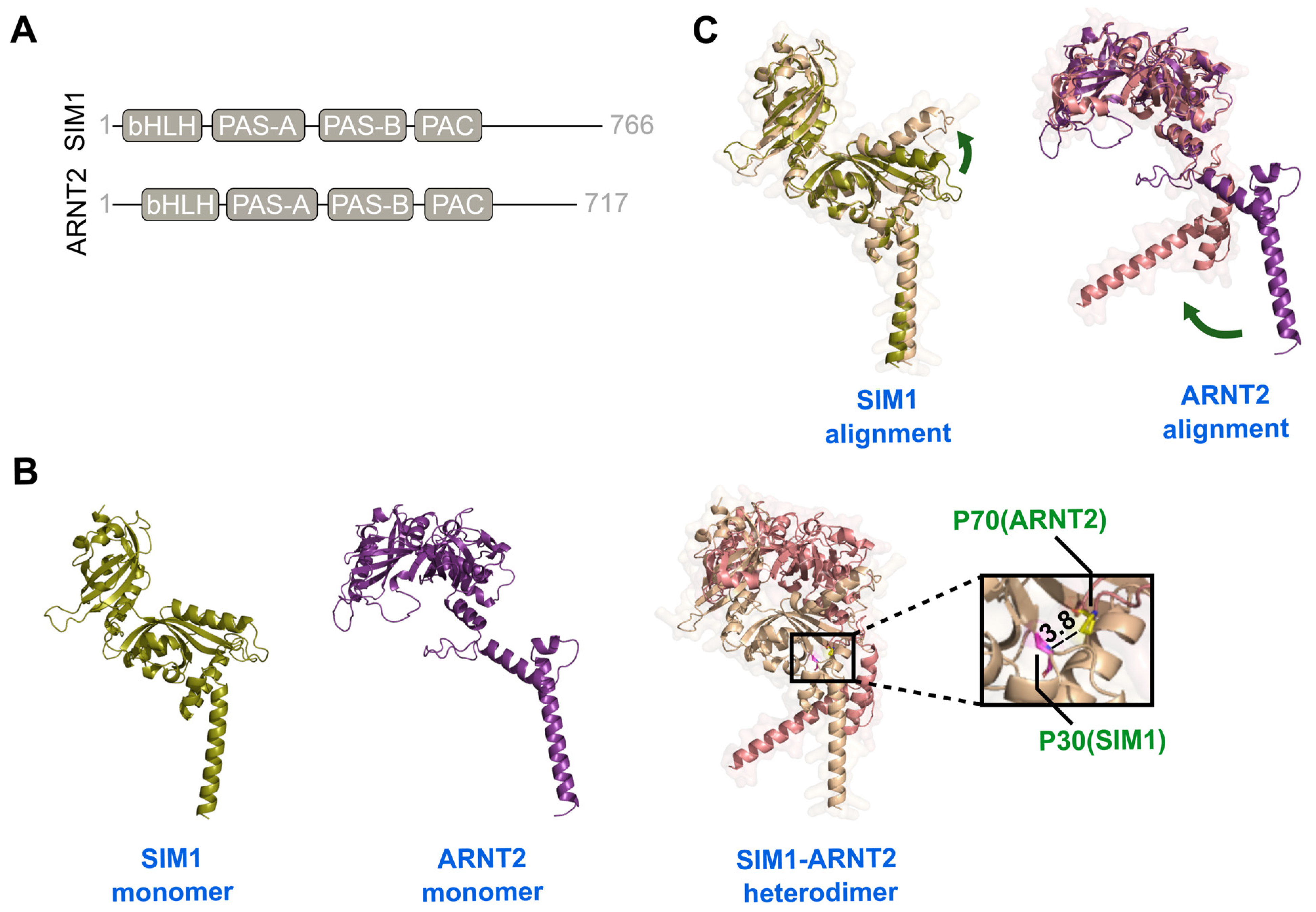
- Case 2: c.88c>g, p.(Pro30Ala)
- Case 3. c.428_434del, p.(His143Ter18)
- Cases 4, 5 and 6 c.1988C>T, p.(Ser663Leu)
- Case 4:
- Case 5:
- Case 6:
- Cases 7, 8, 9, 10, 11. (c.1173G>A, p.Ser391Ser)
- Case 7:
- Case 8:
- Case 9:
- Case 10:
- Case 11:
Structural Predictions and Domain Organization of the Missense Variants
4. Discussion
Limitations
5. Conclusions
Author Contributions
Funding
Institutional Review Board Statement
Informed Consent Statement
Data Availability Statement
Acknowledgments
Conflicts of Interest
References
- World Health Organization 2021. Available online: https://www.who.int/news-room/fact-sheets/detail/obesity-and-overweight (accessed on 2 November 2025).
- Hinney, A.; Vogel, C.I.G.; Hebebrand, J. From monogenic to polygenic obesity: Recent advances. Eur. Child Adolesc. Psychiatry 2010, 19, 297–310. [Google Scholar] [CrossRef]
- Oswal, A.; Yeo, G.S.H. The leptin melanocortin pathway and the control of body weight: Lessons from human and murine genetics. Obes. Rev. 2007, 8, 293–306. [Google Scholar] [CrossRef]
- Farooqi, I.S.; O’Rahilly, S. Monogenic Obesity in Humans. Annu. Rev. Med. 2005, 56, 443–458. [Google Scholar] [CrossRef]
- Faivre, L.; Cormier-Daire, V.; Lapierre, J.M.; Colleaux, L.; Jacquemont, S.; Geneviéve, D.; Saunier, P.; Munnich, A.; Turleau, C.; Romana, S.; et al. Deletion of the SIM1 gene (6q16.2) in a patient with a Prader-Willi-like phenotype. J. Med. Genet. 2002, 39, 594–596. [Google Scholar] [CrossRef][Green Version]
- Kim, M.S.; Rossi, M.; Abusnana, S.; Sunter, D.; Morgan, D.G.; Small, C.J.; Edwards, C.M.; Heath, M.M.; Stanley, S.A.; Seal, L.J.; et al. Hypothalamic localization of the feeding effect of agouti-related peptide and alpha-melanocyte-stimulating hormone. Diabetes 2000, 49, 177–182. [Google Scholar] [CrossRef]
- Michaud, J.L.; Boucher, F.; Melnyk, A.; Gauthier, F.; Goshu, E.; Lévy, E.; Mitchell, G.A.; Himms-Hagen, J.; Fan, C.M. Sim1 haploinsufficiency causes hyperphagia, obesity and reduction of the paraventricular nucleus of the hypothalamus. Hum. Mol. Genet. 2001, 10, 1465–1473. [Google Scholar] [CrossRef]
- Bonnefond, A.; Raimondo, A.; Stutzmann, F.; Ghoussaini, M.; Ramachandrappa, S.; Bersten, D.C.; Durand, E.; Vatin, V.; Balkau, B.; Lantieri, O.; et al. Loss-of-function mutations in SIM1 contribute to obesity and Prader-Willi–like features. J. Clin. Investig. 2013, 123, 3037–3041. [Google Scholar] [CrossRef]
- Ramachandrappa, S.; Raimondo, A.; Cali, A.M.; Keogh, J.M.; Henning, E.; Saeed, S.; Thompson, A.; Garg, S.; Bochukova, E.G.; Brage, S.; et al. Rare variants in single-minded 1 (SIM1) are associated with severe obesity. J. Clin. Investig. 2013, 123, 3042–3050, Erratum in J. Clin. Investig. 2013, 123, 3635. [Google Scholar] [CrossRef]
- Yang, C.; Gagnon, D.; Vachon, P.; Tremblay, A.; Levy, E.; Massie, B.; Michaud, J.L. Adenoviral-Mediated Modulation of Sim1 Expression in the Paraventricular Nucleus Affects Food Intake. J. Neurosci. 2006, 26, 7116–7120. [Google Scholar] [CrossRef]
- Zegers, D.; Beckers, S.; Hendrickx, R.; Van Camp, J.K.; De Craemer, V.; Verrijken, A.; Van Hoorenbeeck, K.; Verhulst, S.L.; Rooman, R.P.; Desager, K.N.; et al. Mutation screen of the SIM1 gene in pediatric patients with early-onset obesity. Int. J. Obes. 2014, 38, 1000–1004. [Google Scholar] [CrossRef]
- Gonsalves, R.; Aleck, K.; Newbern, D.; Shaibi, G.; Kapadia, C.; Oatman, O. Severe early onset obesity and hypopituitarism in a child with a novel SIM1 gene mutation. Endocrinol. Diabetes Metab. Case Rep. 2020, 2020, 2052. [Google Scholar] [CrossRef]
- Michaud, J.L.; DeRossi, C.; May, N.R.; Holdener, B.C.; Fan, C.M. ARNT2 acts as the dimerization partner of SIM1 for the development of the hypothalamus. Mech. Dev. 2000, 90, 253–261. [Google Scholar] [CrossRef] [PubMed]
- Shimogori, T.; Lee, D.A.; Miranda-Angulo, A.; Yang, Y.; Wang, H.; Jiang, L.; Yoshida, A.C.; Kataoka, A.; Mashiko, H.; Avetisyan, M.; et al. A genomic atlas of mouse hypothalamic development. Nat. Neurosci. 2010, 13, 767–775. [Google Scholar] [CrossRef]
- Michaud, J.L.; Rosenquist, T.; May, N.R.; Fan, C.M. Development of neuroendocrine lineages requires the bHLH–PAS transcription factor SIM1. Genes Dev. 1998, 12, 3264–3275. [Google Scholar] [CrossRef]
- Tolson, K.P.; Gemelli, T.; Gautron, L.; Elmquist, J.K.; Zinn, A.R.; Kublaoui, B.M. Postnatal Sim1 Deficiency Causes Hyperphagic Obesity and Reduced Mc4r and Oxytocin Expression. J. Neurosci. 2010, 30, 3803–3812. [Google Scholar] [CrossRef]
- Akıncı, A.; Türkkahraman, D.; Tekedereli, İ.; Özer, L.; Evren, B.; Şahin, İ.; Kalkan, T.; Çürek, Y.; Çamtosun, E.; Döğer, E.; et al. Novel Mutations in Obesity-related Genes in Turkish Children with Non-syndromic Early Onset Severe Obesity: A Multicentre Study. J. Clin. Res. Pediatr. Endocrinol. 2019, 11, 341–349. [Google Scholar] [CrossRef] [PubMed]
- Kleinendorst, L.; Massink, M.P.G.; Cooiman, M.; Savas, M.; Van Der Baan-Slootweg, O.H.; Roelants, R.J.; Janssen, I.C.M.; Meijers-Heijboer, H.J.; Knoers, N.V.A.M.; van Amstel, H.K.P.; et al. Genetic obesity: Next-generation sequencing results of 1230 patients with obesity. J. Med. Genet. 2018, 55, 578–586. [Google Scholar] [CrossRef]
- Serra-Juhé, C.; Martos-Moreno, G.Á.; Bou de Pieri, F.; Flores, R.; Chowen, J.A.; Pérez-Jurado, L.A.; Argente, J. Heterozygous rare genetic variants in non-syndromic early-onset obesity. Int. J. Obes. 2020, 44, 830–841. [Google Scholar] [CrossRef]
- Stanikova, D.; Buzga, M.; Krumpolec, P.; Skopkova, M.; Surova, M.; Ukropcova, B.; Ticha, L.; Petrasova, M.; Gabcova, D.; Huckova, M.; et al. Genetic analysis of single-minded 1 gene in early-onset severely obese children and adolescents. PLoS ONE 2017, 12, e0177222. [Google Scholar] [CrossRef]
- Saeed, S.; Janjua, Q.M.; Haseeb, A.; Khanam, R.; Durand, E.; Vaillant, E.; Ning, L.; Badreddine, A.; Berberian, L.; Boissel, M.; et al. Rare Variant Analysis of Obesity-Associated Genes in Young Adults with Severe Obesity from a Consanguineous Population of Pakistan. Diabetes 2022, 71, 694–705. [Google Scholar] [CrossRef] [PubMed]
- Foucan, L.; Larifla, L.; Durand, E.; Rambhojan, C.; Armand, C.; Michel, C.T.; Billy, R.; Dhennin, V.; De Graeve, F.; Rabearivelo, I.; et al. High Prevalence of Rare Monogenic Forms of Obesity in Obese Guadeloupean Afro-Caribbean Children. J. Clin. Endocrinol. Metab. 2018, 103, 539–545. [Google Scholar] [CrossRef]
- Geets, E.; Zegers, D.; Beckers, S.; Verrijken, A.; Massa, G.; Van Hoorenbeeck, K.; Verhulst, S.; Van Gaal, L.; Van Hul, W. Copy number variation (CNV) analysis and mutation analysis of the 6q14.1–6q16.3 genes SIM1 and MRAP2 in Prader Willi like patients. Mol. Genet. Metab. 2016, 117, 383–388. [Google Scholar] [CrossRef]
- Mohammed, I.; Haris, B.; Al-Barazenji, T.; Vasudeva, D.; Tomei, S.; Al Azwani, I.; Dauleh, H.; Shehzad, S.; Chirayath, S.; Mohamadsalih, G.; et al. Understanding the Genetics of Early-Onset Obesity in a Cohort of Children from Qatar. J. Clin. Endocrinol. Metab. 2023, 108, 3201–3213. [Google Scholar] [CrossRef]
- UniProt Consortium. UniProt: A worldwide hub of protein knowledge. Nucleic Acids Res. 2019, 47, D506–D515. [Google Scholar] [CrossRef]
- Abramson, J.; Adler, J.; Dunger, J.; Evans, R.; Green, T.; Pritzel, A.; Ronneberger, O.; Willmore, L.; Ballard, A.J.; Bambrick, J.; et al. Accurate structure prediction of biomolecular interactions with AlphaFold 3. Nature 2024, 630, 493–500. [Google Scholar] [CrossRef]
- Plotkin, J.B.; Kudla, G. Synonymous but not the same: The causes and consequences of codon bias. Nat. Rev. Genet. 2011, 12, 32–42. [Google Scholar] [CrossRef] [PubMed]
- Hunt, R.C.; Simhadri, V.L.; Iandoli, M.; Sauna, Z.E.; Kimchi-Sarfaty, C. Exposing synonymous mutations. Trends Genet. 2014, 30, 308–321. [Google Scholar] [CrossRef] [PubMed]
- Farooqi, I.S.; Keogh, J.M.; Yeo, G.S.H.; Lank, E.J.; Cheetham, T.; O’Rahilly, S. Clinical Spectrum of Obesity and Mutations in the Melanocortin 4 Receptor Gene. N. Engl. J. Med. 2003, 348, 1085–1095. [Google Scholar] [CrossRef] [PubMed]
- Sauna, Z.E.; Kimchi-Sarfaty, C. Understanding the contribution of synonymous mutations to human disease. Nat. Rev. Genet. 2011, 12, 683–691. [Google Scholar] [CrossRef]
- Farooqi, S.I. Genetic, molecular and physiological mechanisms involved in human obesity: Society for Endocrinology Medal Lecture 2012. Clin. Endocrinol. 2015, 82, 23–28. [Google Scholar] [CrossRef]
- Xi, D.; Gandhi, N.; Lai, M.; Kublaoui, B.M. Ablation of Sim1 Neurons Causes Obesity through Hyperphagia and Reduced Energy Expenditure. PLoS ONE 2012, 7, e36453. [Google Scholar] [CrossRef]
- El Khattabi, L.; Guimiot, F.; Pipiras, E.; Andrieux, J.; Baumann, C.; Bouquillon, S.; Delezoide, A.L.; Delobel, B.; Demurger, F.; Dessuant, H.; et al. Incomplete penetrance and phenotypic variability of 6q16 deletions including SIM1. Eur. J. Hum. Genet. 2015, 23, 1010–1018. [Google Scholar] [CrossRef]
- Hao, N.; Bhakti, V.L.D.; Peet, D.J.; Whitelaw, M.L. Reciprocal regulation of the basic helix–loop–helix/Per–Arnt–Sim partner proteins, Arnt and Arnt2, during neuronal differentiation. Nucleic Acids Res. 2013, 41, 5626–5638. [Google Scholar] [CrossRef]
- Turer, E.E.; San Miguel, M.; Wang, K.W.; McAlpine, W.; Ou, F.; Li, X.; Tang, M.; Zang, Z.; Wang, J.; Hayse, B.; et al. A viable hypomorphic Arnt2 mutation causes hyperphagic obesity, diabetes and hepatic steatosis. Dis. Model Mech. 2018, 11, dmm035451. [Google Scholar] [CrossRef]
- Coban, M.A.; Blackburn, P.R.; Whitelaw, M.L.; van Haelst, M.M.; Atwal, P.S.; Caulfield, T.R. Structural Models for the Dynamic Effects of Loss-of-Function Variants in the Human SIM1 Protein Transcriptional Activation Domain. Biomolecules 2020, 10, 1314. [Google Scholar] [CrossRef] [PubMed]
- Woods, S.L.; Whitelaw, M.L. Differential Activities of Murine Single Minded 1 (SIM1) and SIM2 on a Hypoxic Response Element. J. Biol. Chem. 2002, 277, 10236–10243. [Google Scholar] [CrossRef] [PubMed]
- Blackburn, P.R.; Sullivan, A.E.; Gerassimou, A.G.; Kleinendorst, L.; Bersten, D.C.; Cooiman, M.; Harris, K.G.; Wierenga, K.J.; Klee, E.W.; van Gerpen, J.A.; et al. Functional Analysis of the SIM1 Variant p.G715V in 2 Patients with Obesity. J. Clin. Endocrinol. Metab. 2020, 105, 355–361. [Google Scholar] [CrossRef] [PubMed]


| Variants | Nucleotide Change | AA Change | rs | Phenotype | Reference |
|---|---|---|---|---|---|
| 1 | c.106C>T | p.Gln36* | NA | Early-onset Obesity | [17] |
| 2 | c.137C>G | p.Thr46Arg | rs1356756679 | Obesity | [8] |
| 3 | c.184G>A | p.Glu62Lys | rs201038781 | Obesity | [8] |
| 4 | c.213C>G | p.Ser71Arg | rs111927367 | Obesity | [9] |
| 5 | c.214C>T | p.Pro72Ser | rs138378556 | Early-onset obesity and hypopituitarism | [12] |
| 6 | c.280G>A | p.Val94Met | rs1189500818 | Obesity | [18] |
| 7 | c.348+5G>A | N/A (splicing) | NA | Obesity | [19] |
| 8 | c.400G>A | p.Asp134Asn | rs1260456470 | Early-onset obesity | [20] |
| 9 | c.454C>G | p.Gln152Glu | rs140908824 | Obesity with Prader–Willi syndrome | [8] |
| 10 | c.490A>T | p.Met164Leu | rs533688069 | Early-onset obesity | [21] |
| 11 | c.616C>A | p.Gln206Lys | rs757280640 | Early-onset obesity | [19] |
| 12 | c.918G>T | p.Trp306Cys | NA | Early-onset obesity | [17] |
| 13 | c.967C>T | p.His323Tyr | rs756633599 | Obesity | [8] |
| 14 | c.975_976insACTCCTG | p.(Val326Thrfs*43) | NA | Obesity | [22] |
| 15 | c.1027T>C | p.Ser343Pro | NA | Obesity | [22] |
| 16 | c.1054C>T | p.Pro352Ser | rs3734354 | Prader–Willi-like syndrome | [23] |
| 17 | c.1121G>A | p.Arg374Gln | rs191644383 | Obesity | [18] |
| 18 | c.1147A>G | p.Arg383Gly | rs188821440 | Obesity | [9] |
| 19 | c.1442C>A | p.Thr481Lys | rs745899394 | Early-onset obesity | [11] |
| 20 | c.1490C>G | p.Pro497Arg | NA | Obesity | [9] |
| 21 | c.1550C>T | p.Ala517Val | NA | Early-onset obesity | [11] |
| 22 | c.1622C>T | p.Ser541Leu | rs968598837 | Obesity | [9] |
| 23 | c.1649G>A | p.Arg550His | rs137870558 | Obesity | [9] |
| 24 | c.1846G>C | p.Gly616Arg | rs757303574 | Early-onset obesity | [21] |
| 25 | c.2075C>T | p.Pro692Leu | rs757043702 | Obesity | [9] |
| 26 | c.2108G>A | p.Arg703Gln | rs376058205 | Obesity | [9] |
| 27 | c.2119G>C | p.Asp707His | rs74726213 | Obesity | [9] |
| 28 | c.2135C>T | p.Thr712Ile | rs745821604 | Obesity | [9] |
| 329 | c.2140A>G | p.Thr714Ala | rs757139012 | Obesity with Prader–Willi syndrome | [9] |
| 30 | c.2144G>T | p.Gly715Val | rs753660670 | Obesity | [18] |
| 31 | c.2218G>C | p.Asp740His | NA | Obesity | [8] |
| (A) c.88C>G, p. (Pro30Ala) | |||||||||||||||||||||||||
| Species | Match | Amino Acid | |||||||||||||||||||||||
| Human | Wild Type | 30 | E | F | Y | E | L | A | K | L | L | P | L | P | S | A | I | T | S | Q | L | D | K | A | S |
| mutated (p.P30A) | not conserved | 30 | E | F | Y | E | L | A | K | L | L | P | L | A | S | A | I | T | S | Q | L | D | K | A | S |
| Ptroglodytes | all identical | 30 | E | F | Y | E | L | A | K | L | L | P | L | P | S | A | I | T | S | Q | L | D | K | A | S |
| Mmulatta | all identical | 30 | E | F | Y | E | L | A | K | L | L | P | L | P | S | A | I | T | S | Q | L | D | K | A | S |
| Fcatus | all identical | 30 | E | F | Y | E | L | A | K | L | L | P | L | P | S | A | I | T | S | Q | L | D | K | A | S |
| Mmusculus | all identical | 30 | E | F | Y | E | L | A | K | L | L | P | L | P | S | A | I | T | S | Q | L | D | K | A | S |
| Ggallus | all identical | 30 | E | F | Y | E | L | A | K | L | L | P | L | P | S | A | I | T | S | Q | L | D | K | A | S |
| Drerio | all identical | 30 | E | F | Y | E | L | A | K | L | L | P | L | P | S | A | I | T | S | Q | L | D | K | A | S |
| Dmelanogaster | all identical | 54 | E | F | C | E | L | A | K | L | L | P | L | P | A | A | I | T | S | Q | L | D | K | A | S |
| Xtropicalis | all identical | 30 | E | F | Y | E | L | A | K | L | L | P | L | P | S | A | I | T | S | Q | L | D | K | A | S |
| (B) c.1988C/T, p.(Ser633Leu) | |||||||||||||||||||||||||
| Species | Match | Amino Acid | |||||||||||||||||||||||
| Human | Wild Type | 663 | P | T | A | L | S | R | I | S | S | P | N | S | D | R | I | S | K | S | S | L | I | L | A |
| Mutated (p.S633L) | not conserved | 663 | P | N | L | D | R | I | S | K | S | S | L | I | L | A | |||||||||
| Ptroglodytes | all identical | 663 | P | N | S | D | R | I | S | K | S | S | L | I | L | A | |||||||||
| Mmulatta | all identical | 663 | P | N | S | D | R | I | S | K | S | S | L | I | L | A | |||||||||
| Fcatus | all identical | 635 | P | N | S | D | R | I | S | K | S | S | L | I | L | A | |||||||||
| Mmusculus | all identical | 662 | P | S | S | D | R | I | T | K | S | S | L | I | L | A | |||||||||
| Ggallus | all identical | 663 | S | P | N | S | D | R | I | S | K | S | S | L | V | L | A | ||||||||
| Xtropicalis | all identical | 663 | S | S | P | N | S | D | R | V | S | K | S | S | V | T | I | A | |||||||
| Cases | Age | Weight (Kg) | BMI (Kg/m2) | Variant | Coordinates (GRCh37) | SIFT | Polyphen2 | MutationTaster | ACMG Variant Interpretation | gnomAD MAF |
|---|---|---|---|---|---|---|---|---|---|---|
| Case 1 | 13 | 112.8 | 35.7 | c. 52_53delAG, p.Ser18Ter | 6:100911292-100911293delCT | NA | NA | Disease Causing | PVS1 (Pathogenic) | 0.0000 |
| Case 2 | 15 | 159.0 | 47.3 | c.88C>G, p.Pro30Ala | 6:100911257-G-C | Deleterious | Probably Damaging | Disease Causing | PM1, PM2, PM3 (Likely pathogenic) | 0.0000 |
| Case 3 | 13 | 108.6 | 48.0 | c.428_434del p.His143Ter | 6:100897490-100897496delGGTTGAT | NA | NA | Disease causing | PVS1 (Pathogenic) | 0.0000 |
| Case 4 Case 5 Case 6 | 17 5 15 | 99.6 40.7 102 | 35.4 28.7 32.4 | c.1988C>T p.Ser663Leu | 6:100838550-G-A | Deleterious | Likely Benign | Disease Causing | PM2 (Uncertain Significance) | 000003977 |
| Case 7 Case 8 Case 9 Case 10 Case 11 | 11 10 15 17 14 | 71.7 65.0 136.0 103.0 106.0 | 32.0 31.5 48.8 37.0 35.0 | c.1173G>A, p.Ser391Ser | 6:100841760-C-T | NA | NA | Polymorphism | PM2, BP4, BP7 (Likely Benign) | 0.000004305 |
Disclaimer/Publisher’s Note: The statements, opinions and data contained in all publications are solely those of the individual author(s) and contributor(s) and not of MDPI and/or the editor(s). MDPI and/or the editor(s) disclaim responsibility for any injury to people or property resulting from any ideas, methods, instructions or products referred to in the content. |
© 2026 by the authors. Licensee MDPI, Basel, Switzerland. This article is an open access article distributed under the terms and conditions of the Creative Commons Attribution (CC BY) license.
Share and Cite
Mohammed, I.; Ahmed, W.S.; Al-Barazenji, T.; Dauleh, H.; Love, D.R.; Hussain, K. Novel SIM1 Variants Expanding the Spectrum of SIM1-Related Obesity. Int. J. Mol. Sci. 2026, 27, 533. https://doi.org/10.3390/ijms27010533
Mohammed I, Ahmed WS, Al-Barazenji T, Dauleh H, Love DR, Hussain K. Novel SIM1 Variants Expanding the Spectrum of SIM1-Related Obesity. International Journal of Molecular Sciences. 2026; 27(1):533. https://doi.org/10.3390/ijms27010533
Chicago/Turabian StyleMohammed, Idris, Wesam S. Ahmed, Tara Al-Barazenji, Hajar Dauleh, Donald R. Love, and Khalid Hussain. 2026. "Novel SIM1 Variants Expanding the Spectrum of SIM1-Related Obesity" International Journal of Molecular Sciences 27, no. 1: 533. https://doi.org/10.3390/ijms27010533
APA StyleMohammed, I., Ahmed, W. S., Al-Barazenji, T., Dauleh, H., Love, D. R., & Hussain, K. (2026). Novel SIM1 Variants Expanding the Spectrum of SIM1-Related Obesity. International Journal of Molecular Sciences, 27(1), 533. https://doi.org/10.3390/ijms27010533