Article

Kinetic and Potentiometric Characteristics of Ferredoxin: NADP+ Oxidoreductase from Chlorobaculum tepidum


by
Dominykas Laibakojis
1,
Daisuke Seo
2,
Narimantas Čėnas
1,* and
Mindaugas Lesanavičius
1
1
Department of Xenobiotics Biochemistry, Institute of Biochemistry, Life Sciences Center, Vilnius University, Saulėtekio Av. 7, LT-10257 Vilnius, Lithuania
2
Division of Material Sciences, Graduate School of Natural Science and Technology, Kanazawa University, Kakuma, Kanazawa 920-1192, Japan
*
Author to whom correspondence should be addressed.
Int. J. Mol. Sci. 2026, 27(1), 481; https://doi.org/10.3390/ijms27010481
Submission received: 3 December 2025 / Revised: 26 December 2025 / Accepted: 31 December 2025 / Published: 2 January 2026
(This article belongs to the Collection Feature Papers Collection in Biochemistry)

Abstract

Chlorobaculum tepidum ferredoxin: NADP + oxidoreductase (CtFNR) is a dimeric thioredoxin reductase (TrxR)-type FNR, whose mechanism and redox properties are poorly characterized. In this work, we focused on the reoxidation mechanisms of its flavin adenine dinucleotide (FAD) cofactor using quinones (Q), nitroaromatics ( ArNO 2 ), and other nonphysiological oxidants with different single-electron reduction midpoint potentials ( E 7 1 ) and electrostatic charge. Like in other FNRs, the rate-limiting step of the reaction is the reoxidation of FAD semiquinone ( FADH ). However, only one FAD per dimer functions in CtFNR due to some nonequivalence of the NADP(H) binding domains in separate subunits. The reactivity of Q increases with increasing E 7 1 , while ArNO 2 form another analogous series of lower reactivity. The compounds are reduced in a dominant single-electron way. These data are consistent with an “outer sphere” electron transfer mechanism. On the basis of reactions with 3-acetylpyridine adenine dinucleotide phosphate, the two-electron reduction midpoint potential of FAD at pH 7.0 is −0.282 V. In CtFNR, 11% FADH was stabilized at equilibrium. Calculated electron transfer distances in reactions with Q and ArNO 2 were in the range of 2.6–3.4 Å. Taken together with previous studies of Rhodopseudomonas palustris and Bacillus subtilis FNRs, this work allows us to generalize the information on the catalytic ant thermodynamic properties of TrxR-type FNRs. In addition, our data may be valuable from an applied perspective, e.g., the use of redox mediators in photobioelectrochemical systems or microbial cells based on anoxygenic phototrophic bacteria.

1. Introduction

Ferredoxin: NADP + oxidoreductases (FNRs, E.C. 1.18.1.2) transform a two-electron transfer into a single-electron one, and according to flavoenzyme classification belong to the class of dehydrogenases–electrontransferases [1,2]. A typical feature of FNRs is the relative high stability of a neutral flavin adenine dinucleotide semiquinone ( FADH ) intermediate, which enables efficient redox reactions between two molecules of ferredoxin (Fd) and NADP(H). FNRs are found in all domains of life and function in versatile cellular metabolic processes. In oxygenic photosynthesis, plant-type FNRs reduce NADP + at the expense of two molecules of reduced Fd generated by an FeS-type photoreduction center photosystem I, thus providing NADPH for CO 2 assimilation (Equation (1)) [3,4,5]. In nonphotosynthetic processes, FNRs reduce Fd by NADPH, with reduced Fd then being used for nitrate assimilation or the synthesis of cell membrane components [5,6,7]. In the case of iron deficiency low redox potential electron carrier flavodoxin (Fld) can function as the physiological partner of FNRs in place of Fd [8]. FNRs and their protein redox partners are characterized by electrostatic and hydrophobic interactions [9].
2 Fd red + NADP + + H + 2 Fd ox + NADPH
FNR from the thermophilic green sulfur bacterium Chlorobaculum tepidum (CtFNR) belongs to a relatively poorly studied group of thioredoxin reductase (TrxR)-type FNRs [10,11]. The distinguishing features of this type FNRs are a homodimeric structure and a FAD-binding domain comprising two discontinuous segments separated by an NADP(H)-binding domain (Figure 1) just as found in disulfide reductases [5]. In the case of CtFNR, the FAD-binding domain consists of amino acid residues 13–131 and 262–329, while residues 134–258 build up an NADP(H) binding domain [12]. The distance between the isoalloxazine ring of FAD and nicotinamide ring of NADP + is assumed to be approximately 15 Å in the crystal structure, too great for an efficient hydride transfer (Figure 1) [12]. The two nucleotide binding domains are connected by flexible hinge regions allowing for domain rotation during catalysis. As in other TrxR-type FNRs, there are also π–π stacking interactions between the isoalloxazine ring of FAD and Tyr57 on the si-side and Phe337 on its re-side [12]. Another notable peculiarity of CtFNR is the asymmetric arrangement of the homodimer, i.e., NADP(H) domain in one protomer is in “open” conformation, while the equivalent domain in the other protomer is “relatively closed” in the crystal structure. The asymmetry may be related to the presence of the distinct long hydrophilic C-terminal extension which acts as a subdomain to physically tether one protomer of the dimer while interacting with the other protomer [12].
As an obligate photoautotrophic anaerobe, C. tepidum utilizes the reverse tricarboxylic acid cycle for CO 2 fixation and this pathway needs a continuous supply of low-potential reductants, e.g., reduced Fd [14,15,16]. C. tepidum utilizes an FeS-type photoreaction center as a sole photosystem for photosynthesis which reduces Fds directly as just the case of photosystem I in oxygenic photosynthesis [15,17,18]. Although C. tepidum FNR can catalyze the reduction of NAD ( P ) + in the presence of photosynthetic reaction center and Fd from C. tepidum [11], kinetic details of the interactions of Fds with CtFNR have not been studied [17,19]. The positively charged domain of Lys60, Lys262 and Arg321 is suggested to be candidate for Fd binding based on the crystal structure [12].
While kinetic studies of CtFNR with electron donors/acceptors such as Fd are scarce, the reactions with NADPH and NADP + are studied with steady state and pre-steady state approaches [18,20]. At pH 7.0, the initial phase of reduction of the enzyme by excess NADPH is characterized by k ≥ 500 s 1 ; however, after 500 ms, the FAD absorbance decrease is about 50% of that expected during the complete CtFNR reduction. Similarly, reoxidation of dithionite-reduced CtFNR by NADP + restores only about 70% of the absorption of oxidized FAD. This is likely related to the above-mentioned structural nonequivalence of its subunits.
In our previous studies, we determined the mechanisms of reactions of homologous TrxR-type FNRs from Rhodopseudomonas palustris (RpFNR) and Bacillus subtilis (BsFNR) with nonphysiological oxidants quinones (Q), nitroaromatic compounds ( ArNO 2 ), and inorganic complexes [21,22]. This type of reaction can reveal properties of redox proteins that are important for their reactions with physiological redox partners in solution, such as electrostatic or hydrophobic interaction, electron transfer mechanisms, etc., and is valuable for comparative analysis [23]. In many cases, especially when it comes to the reduction of quinones and nitroaromatics by flavoenzymes, this information can also elucidate the mechanisms of the therapeutic/toxic effects or biodegradation pathways of these compounds [24,25,26]. Moreover, FNRs in general have been recently investigated for various applications, e.g., for NADPH regeneration [27,28], and microbial production of ethanol or biofuels [29,30].
In this work we studied the reactions of CtFNR with a panel of nonphysiological oxidants, mainly quinones and nitroaromatics with a wide range of oxidative potency and different electrostatic charge. Taken together with the determination of the redox potentials of the first and second electron transfer of the FAD cofactor of this enzyme, these data provide valuable comparative information, further generalizing the catalytic mechanisms of TrxR-type FNRs.

2. Results

2.1. Presteady-State Kinetics Studies of CtFNR Reoxidation

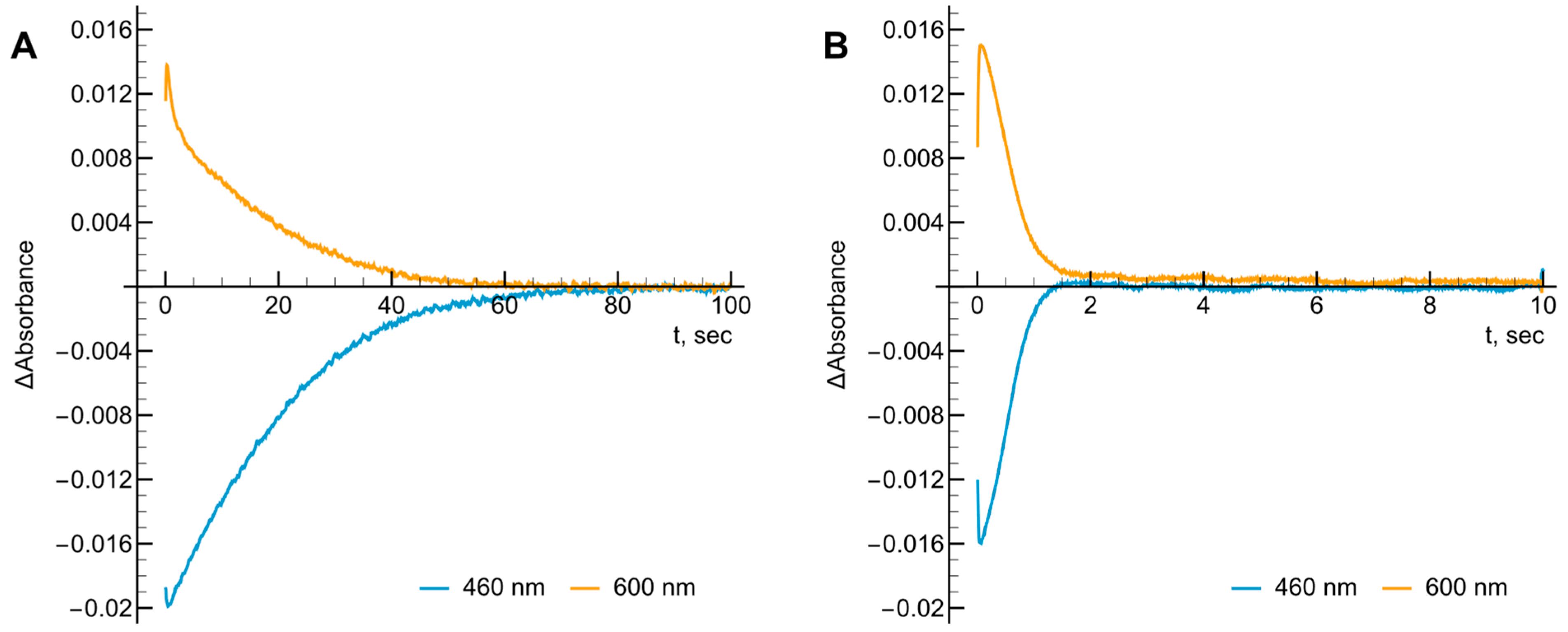
Existing evidence suggests that FAD reduction in the dimeric CtFNR by NADPH may be partial [18,20]. Thus, we examined the possible manifestation of this phenomenon in the kinetics of CtFNR reoxidation under multiple turnover conditions by tetramethyl-1,4-benzoquinone (duroquinone, DQ). We utilized DQ as an electron acceptor due to its optical transparency above 460 nm and its semiquinone being rapidly reoxidized by oxygen. The control experiment performed without DQ shows very fast reduction of FAD by NADPH followed by its slow reoxidation by O 2 , evidenced by a slow reappearance of absorbance at 460 nm, and a corresponding initial absorbance increase with a slow decrease at 600 nm (Figure 2A). The addition of DQ increases the rate of reoxidation approximately 40-fold with spectral changes at both wavelengths being on the same timescale (Figure 2B). Most importantly, the maximum degree of FAD reduction determined from the difference in absorbance between oxidized and dithionite-reduced CtFNR ( Δ ε 460   =   9.6   mM 1 cm 1 [18]) was equal to 46.4% ( O 2 ), and 33.1% (DQ) which is 2–2.5 times less than in the case of R. palustris or B. subtillis FNR, when the studies were performed with the same NADPH and DQ concentrations [21,22]. These findings imply that only a fraction of the FAD cofactor participates in the catalytic turnover of CtFNR. However, for convenience, the rate constants presented later will be calculated based on the total enzyme concentration.
The rate constants of enzyme reoxidation ( k ox ) under multiple turnover conditions were calculated using Equation (2) [31]:
k ox = NADPH 0 E red max × t 1 / 2 off
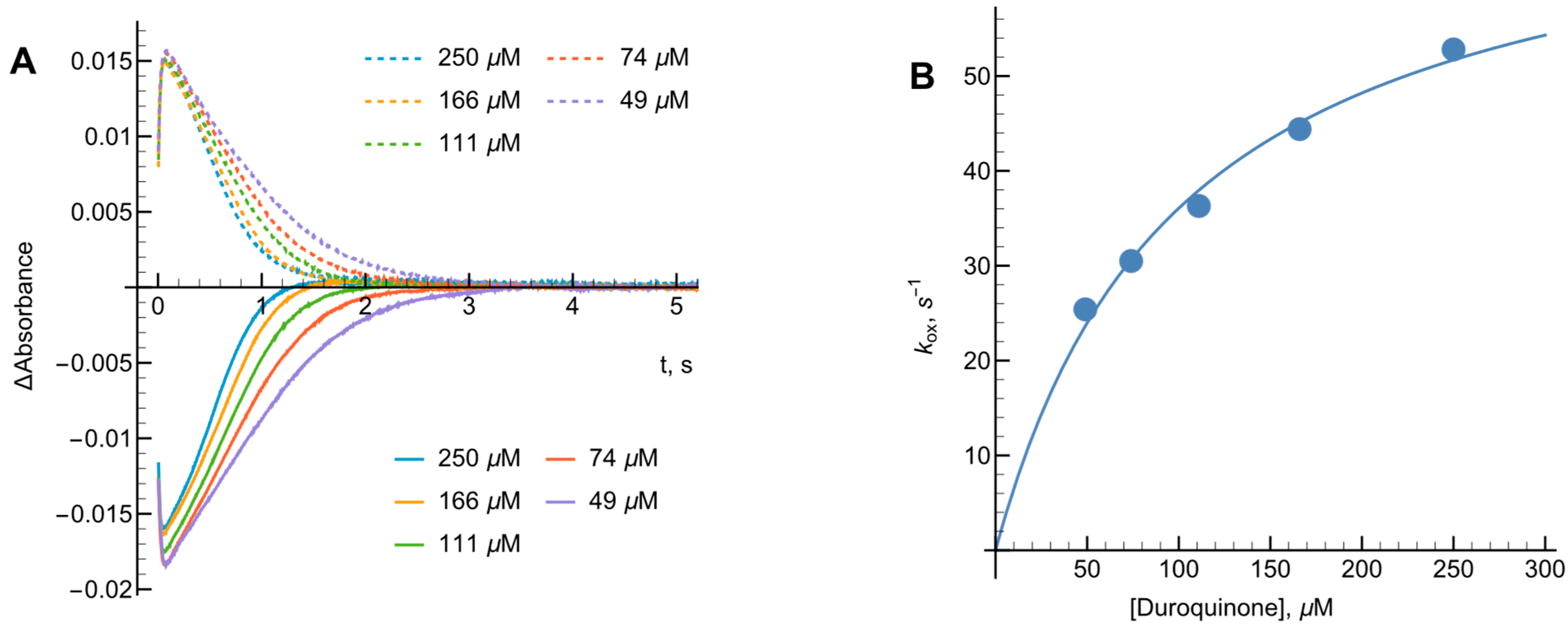
In this expression, [ NADPH ] 0 represents the starting NADPH concentration, while [ E red ] max denotes the peak level of reduced enzyme observed during turnover. The term t 1 / 2 ( off ) refers to the duration measured between the points where the reduced enzyme reaches half its maximal concentration during both the formation and decay phases. Based on the data in Figure 2A, the k ox for oxygen was 1.8 s 1 . By varying DQ concentrations (Figure 3A,B) we calculated k ox of 73.2 ± 4.6 s 1 at infinite oxidant concentration and the apparent bimolecular oxidation rate constant was determined to be 8.0 ± 1.4 × 10 5   M 1 s 1 .

2.2. Steady-State Kinetics and Oxidant Substrate Specificity of CtFNR

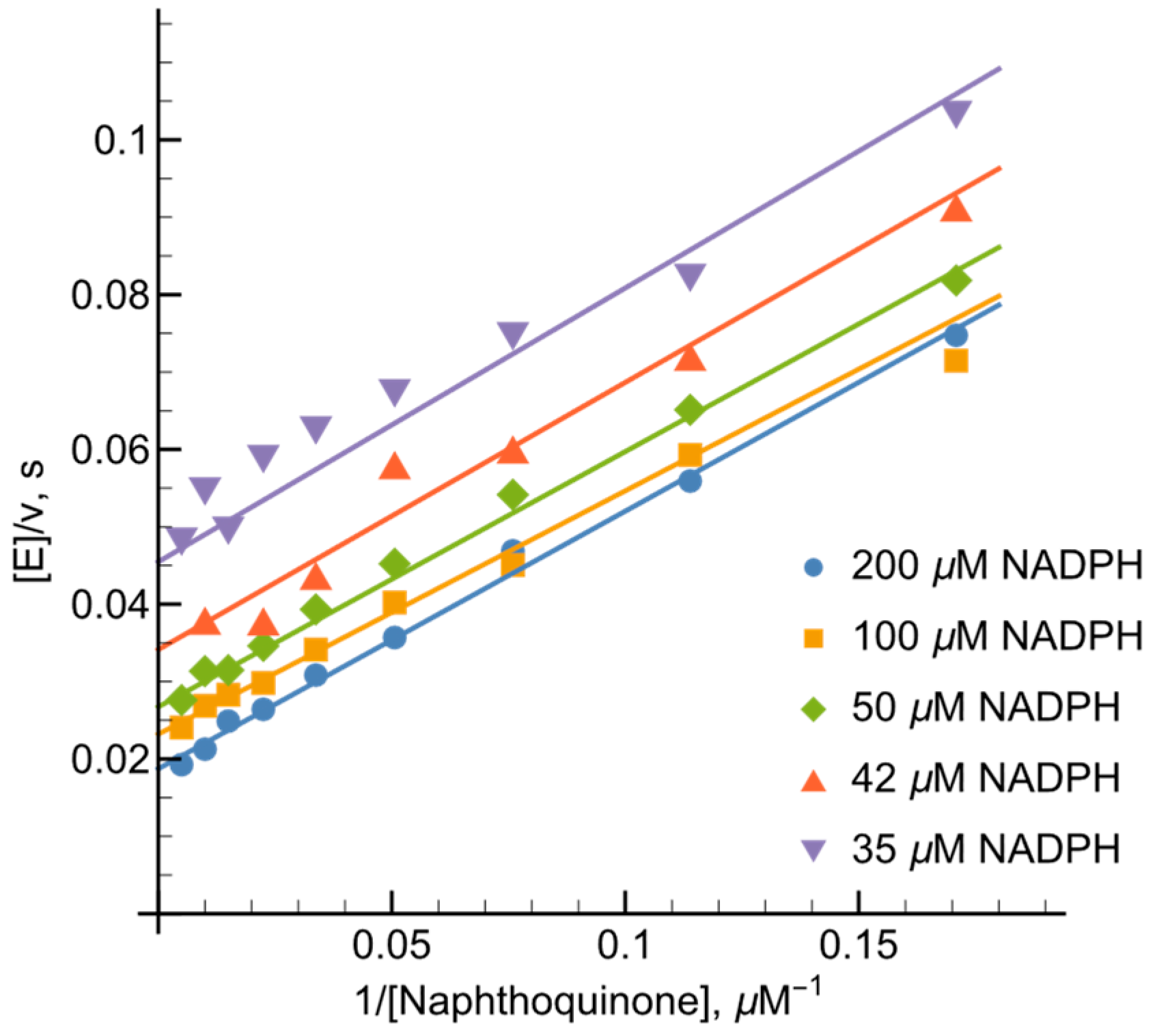
At NADPH concentrations ranging from 20 to 200 µM, NADPH–oxidase activity of CtFNR was determined to be 2.1 s 1 , a value consistent with our presteady-state kinetic observations (Figure 2A). The k cat values reported herein have been adjusted to account for this baseline oxidase activity. Previous research [21,22] has identified 1,4-naphthoquinone derivatives as effective nonphysiological oxidants for FNR enzymes. In our study, varying the concentrations of both NADPH and 1,4-naphthoquinone yielded a series of parallel lines in double-reciprocal (Lineweaver–Burk) plots (Figure 4). This kinetic pattern strongly suggests that CtFNR operates via a “ping-pong” catalytic mechanism, where the enzyme alternates between its oxidized and reduced forms without forming a ternary complex.
Calculated according to Equation (11) (see Section 4), the k cat for 1,4-naphthoquinone reduction at saturating NADPH concentrations was 80.9 ± 10.3 s 1 . The bimolecular rate constants ( k cat / K m ) for 1,4-napthoquinone and NADPH were determined to be 3.3 ± 0.4 × 10 6   M 1 s 1 and 9.3 ± 1.3 × 10 5   M 1 s 1 , respectively.
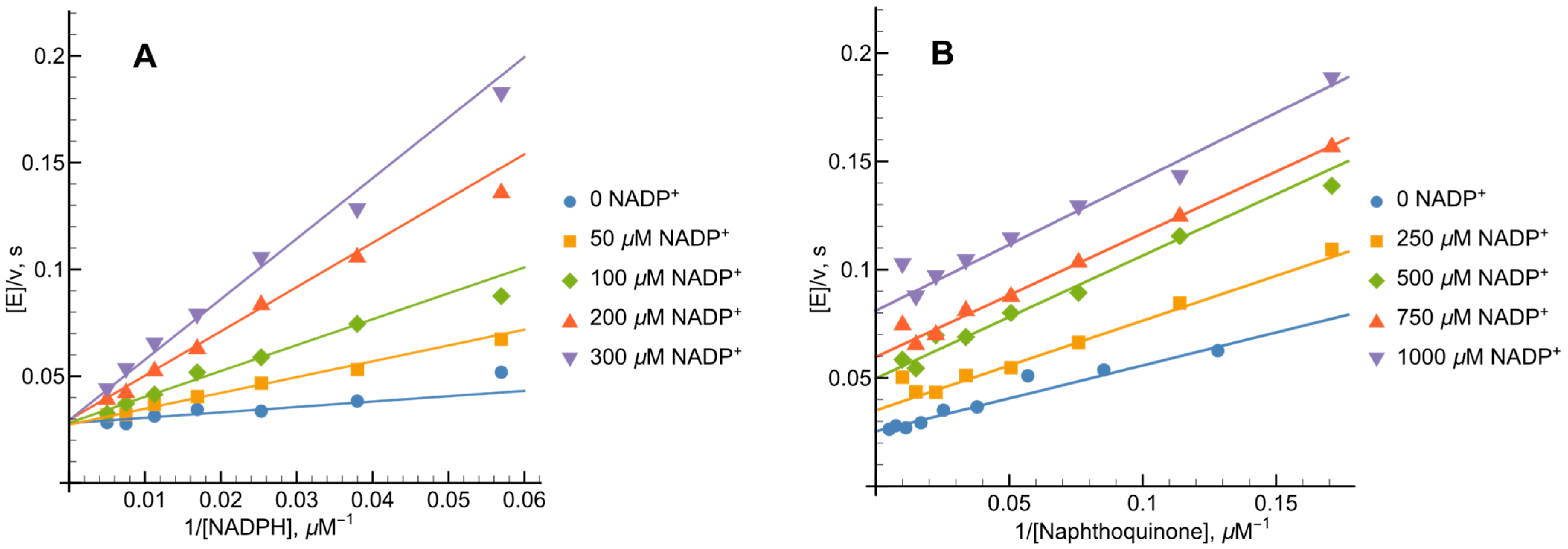
We observed that NADP + acts as a product inhibitor of the CtFNR-catalyzed quinone reduction. Specifically, at a fixed 1,4-napthoquinone concentration (100 μM) NADP + exhibited competitive inhibition relative to NADPH (Figure 5A) with K i c = 33.8 ± 4.0 μM (Equation (12)). Conversely, NADP + functioned as an uncompetitive inhibitor toward the oxidant (at 100 μM NADPH), characterized by parallel lines in the Lineweaver–Burk plot (Figure 5B). The resulting K i u was to 447.4 ± 54.5 μM, as calculated according to Equation (13).
To evaluate the oxidant specificity of CtFNR, we characterized a diverse array of nonphysiological electron acceptors. This includes quinones (Q), nitroaromatics ( ArNO 2 ), aromatic N-oxides (ArN→O) with single-electron reduction midpoint potentials ( E 7 1 ) spanning 0.09 V to −0.494 V. Additionally, single-electron acceptors such as ferricyanide, benzyl viologen ( BV 2 + ) and Fe ( EDTA ) were included. The calculated k cat app and k cat / K m values at 100 µM NADPH are summarized in Table 1, derived from non-linear regression using Equation (9) or Equation (10). Notably, the k cat / K m for DQ closely aligns with the apparent bimolecular reaction rate constant observed in our presteady-state analysis (Table 1, Figure 3B), validating the consistency of our kinetic model.
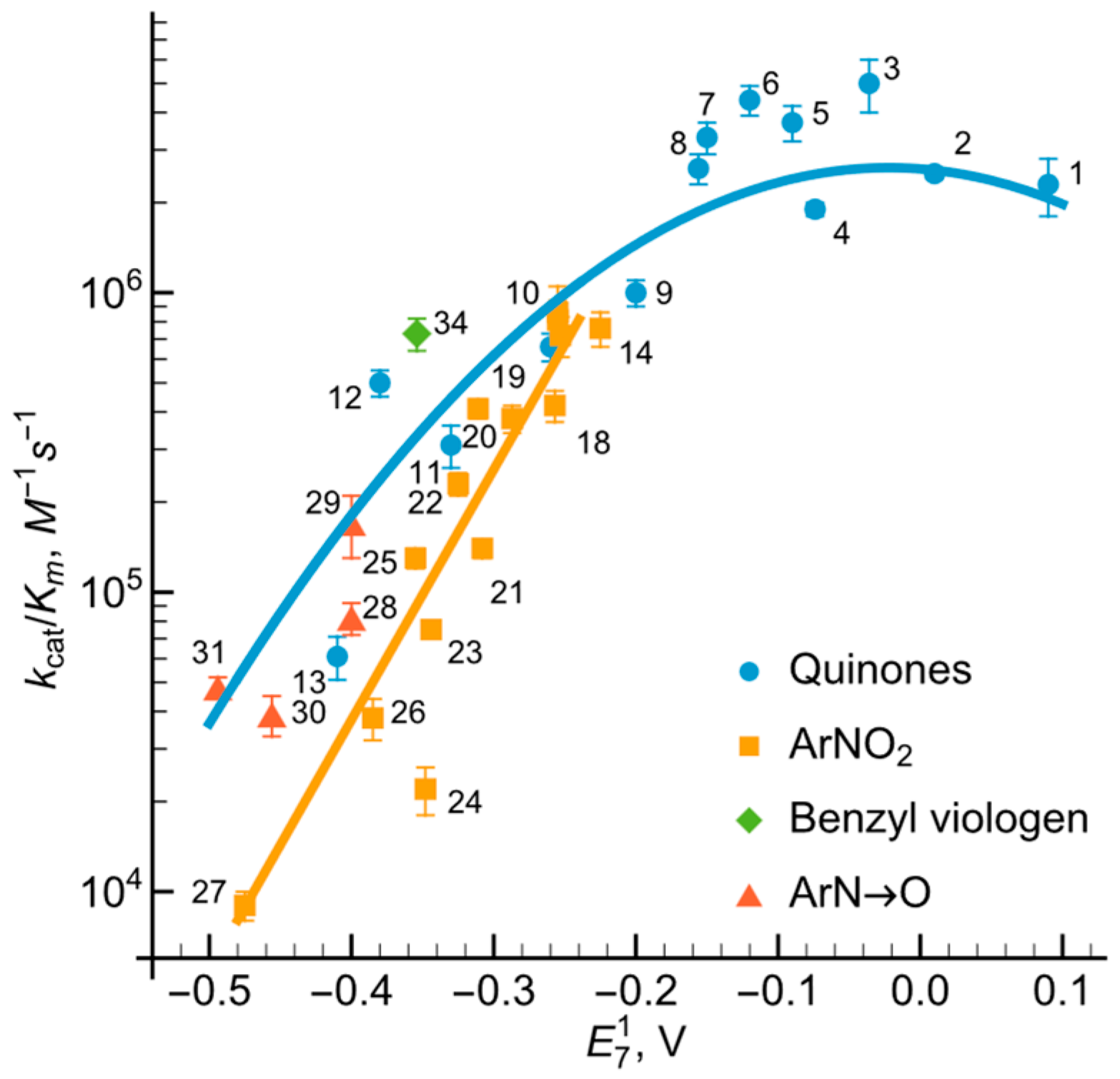
The reactivity of the examined nitroaromatics, expressed as log k cat / K m , demonstrated a linear correlation with their E 7 1 values (Figure 6), where nifuroxime and nitrofurantoin emerged as the most efficient oxidants. In contrast, the reactivity profiles for quinones and aromatic N-oxides followed a parabolic dependence on E 7 1 with both chemical groups displaying comparable log k cat / K m magnitudes. Notably, the single-electron acceptor benzyl viologen (compound 34, Figure 6) showed a reactivity level consistent with quinones of similar reduction potentials. Collectively, these data suggest that the redox reactions are governed primarily by thermodynamic driving force ( E 7 1 ) rather than specific structural recognition of the oxidant’s scaffold.
Our results demonstrate that CtFNR primarily reduces quinones and nitroaromatics to their radical forms. To quantify this, we measured the single-electron flux using the cytochrome c reduction assay at pH < 7.2 [34]. For CtFNR, the ratio of cytochrome c reduction to the doubled rate of NADPH oxidation was 155%, indicating a 77% single-electron flux. When 4-nitroacetophenone was employed as the oxidant, we observed a 90% single-electron flux. Interestingly, the addition of superoxide dismutase (SOD) reduced the cytochrome c reduction rate by 25%. This suggests that the nitroaromatic radical reacts with oxygen to generate superoxide, which subsequently contributes to cytochrome c reduction [35,36].
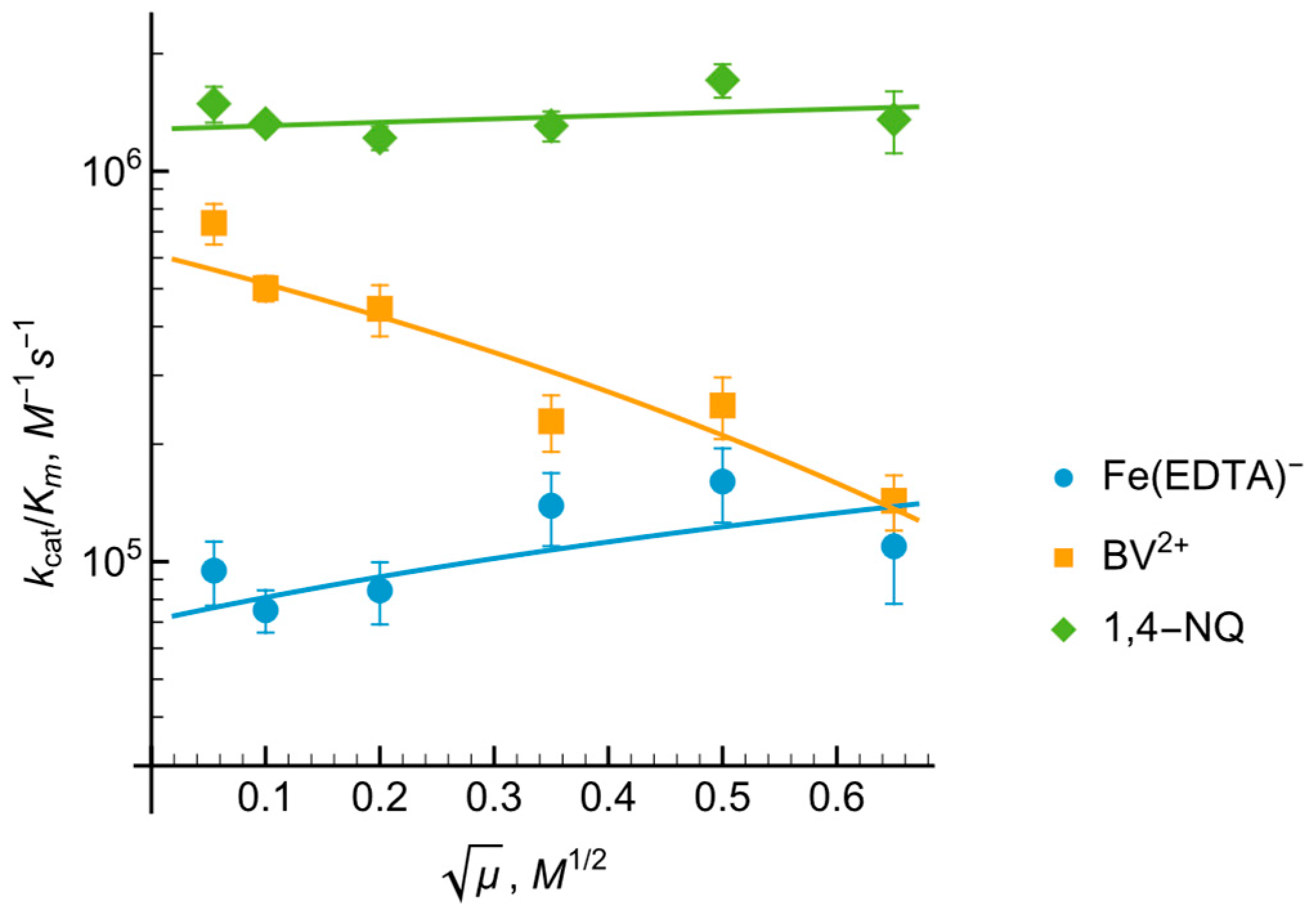
To investigate the role of electrostatic forces in CtFNR reoxidation, we examined the impact of ionic strength on oxidant reactivity (Figure 7). The log k cat / K m for the cationic benzyl viologen ( BV 2 + ) decreased as ionic strength increased, whereas the reactivity of anionic Fe ( EDTA ) showed the opposite trend. The reactivity of neutral 1,4-naphthoquinone was largely independent of ionic strength. These observations suggest that these electorn acceptors interact with a negatively charged region of the CtFNR protein surface.

2.3. Redox Potential Determination

Building on our previous characterization of FNRs from R. palustris and B. subtilis [21,22], we utilized the Haldane relationship to determine the standard redox potential ( E 7 0 ) of the E - FAD / E - FADH couple in CtFNR. For two-electron hydride transfer, the potential difference between reactants is described by Equation (3):
Δ E 0 V = 0.0295 × log K
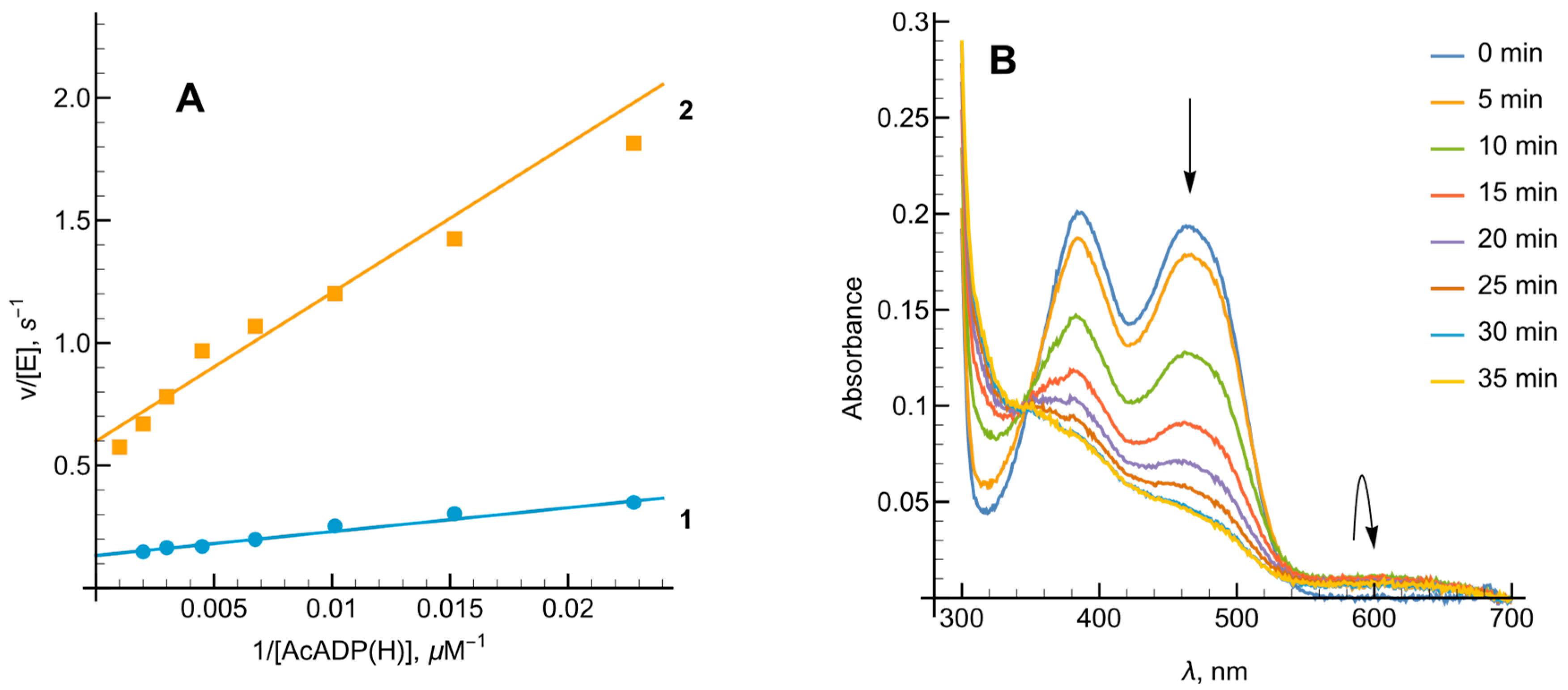
To circumvent the kinetic complexities of NADP + reduction, we employed the analog 3-acetylpyridine adenine dinucleotide phosphate (AcADP(H), E 7 0 = −0.258 V [37]). We monitored the forward reaction (AcADPH oxidation) by observing 1 mM ferricyanide reduction, with AcADPH generated in situ using a glucose-6-phosphate dehydrogenase system. The rate constants obtained were k cat = 1.63 ± 0.12 s 1 and k cat / K m = 1.6 ± 0.3 × 10 4   M 1 s 1 (on a two-electron basis) (Figure 8A). For the reverse reaction (reduction of AcADP + by 200 µM NADPH) the constants were k cat = 7.54 ± 0.24 s 1 and k cat / K m = 1.0 ± 0.1 × 10 5   M 1 s 1 . No inhibition was observed when performing the transhydrogenase reaction with constant NADPH concentrations in the range of 25–200 µM. These data yielded an equilibrium constant K = 0.16 ± 0.04, corresponding to a calculated E 7 0 of −0.282 ± 0.003 V.
To evaluate the concentration of FADH at equilibrium and determine the individual redox potentials for the two single-electron transfers, we initially followed the photoreduction methodology used for RpFNR and BsFNR using 5-deazaFMN and EDTA [21,22]. However, this approach was ineffective for CtFNR, even at high reagent concentrations. As an alternative, we achieved enzyme-bound FAD reduction by employing a catalytic amount of NADPH (1 μM) and an enzymatic regeneration system (glucose-6-phosphate/glucose-6-phosphate dehydrogenase). Strictly anaerobic conditions were maintained using an excess of glucose, glucose oxidase and catalase to scavenge residual O 2 and H 2 O 2 . After establishing anaerobiosis, the enzyme reduction begins immediately upon the introduction of NADPH, marked by an absorbance decrease at 460 nm and increase at 600 nm, characteristic of the neutral FAD semiquinone ( FADH ) (Figure 8B). Upon reintroducing oxygen to the sample, the absorbance at 460 nm and 600 nm rapidly returned to the initial values.
Based on established extinction coefficients ( ε 600 = 5.0   mM 1 cm 1 ) [38], the maximum semiquinone yield was calculated to be at 11%. By utilizing sub-stoichiometric concentration of NADPH, we minimized spectral interference from enzyme-NADP(H) complexes [18,20]. The separation of the two single-electron transfer potentials Δ E 7 1 = E 7 E - FAD / E - FADH E 7 E - FADH / E - FADH can then be calculated based on the semiquinone formation constant K s (Equations (4) and (5)):
E - FADH max E - FAD tot = K s 2 + K s
Δ E 7 1 V = 0.059 × log K s
where [ E - FADH ] max is the maximum concentration of the semiquinone, and [ E - FAD ] tot is the total concentration of the enzyme [39]. According to our data, K s = 0.061 and Δ E 7 1 = −0.070 V, which corresponds to E 7 E - FAD / E - FADH = −0.317 V and E 7 E - FADH / E - FADH = −0.247 V. In this case, questions may arise about the actual percentage of FADH in equilibrium, since only one of the two subunits is involved in catalysis (Figure 2A,B). However, it can be argued that the different activities of the subunits are associated with the nonequivalence of the NADP(H) binding domains, since the FAD isoalloxazine environment is the same in both subunits [12]. Moreover, the reduction of CtFNR in our experiment proceeds quite slowly, and its degree of reduction significantly exceeds 50% (Figure 8B). Therefore, we believe that under these conditions a redox equilibrium is established involving both FAD-binding domains, and the resulting FADH percentage reflects identical redox properties of both subunits. On the other hand, the possibility that the obtained values reflect the average of the redox potentials of both FADs cannot be excluded; however a more detailed study of these details is a subject of our further studies.

3. Discussion

The results of this work, complementing our previous studies on TrxR-type RpFNR and BsFNR [21,22], allow us to draw more general conclusions about the catalytic mechanisms and thermodynamic properties of this relatively poorly studied group of enzymes. Although the mechanisms of reactions with nonphysiological oxidants are not necessarily analogous to reactions with physiological redox partners, they provide important information that may be valuable in the application of these enzymes.
First, as in the case of RpFNR and BsFNR and other types of FNRs, reoxidation of CtFNR with duroquinone results in a transient 600 nm absorption (Figure 2 and Figure 3) [21,22,23]. It is consistent with a two-step reoxidation process FADH FADH FAD with FADH oxidation being rate limiting. Next, CtFNR catalysis proceeds according to a “ping-pong” mechanism (Figure 4) [21,22]. Thus, it can be stated that the reduction and oxidation half-reactions occur independently, but at the same or significantly overlapping binding sites. Given that at a fixed NADPH concentration, the apparent k cat of the reactions vary significantly with different oxidants (Table 1), this indicates that the oxidative half-reaction is rate-limiting. As in the case of RpFNR and BsFNR [21,22], NADP + is a competitive inhibitor for NADPH and an uncompetitive inhibitor for the oxidant (Figure 5A,B). This indicates that NADP + binds much more efficiently to the oxidized form of the enzyme than to the reduced form, in this case its semiquinone form. Since oxidants are likely to interact with the negatively charged domain near the isoalloxazine (Figure 7), a possible candidate is the conserved Asp64 [11]. Similar patterns have been observed in the reactions of oxidants with BsFNR containing the Asp57 residue, which in turn corresponds to Asp56 in RpFNR [22].
One of the most important features that unites CtFNR with RpFNR, BsFNR and other types of FNRs is that the log k cat / K m values for quinones, aromatic nitrocompounds and N-oxides increase with an increase in their E 7 1 (Figure 6) [21,22,23], i.e., the reactivity is governed by the single-electron accepting potency of oxidants rather than by their structural features. Taken together with the dominant single-electron flux during Q and ArNO 2 reduction, this is consistent with the “outer sphere” single electron transfer model [40,41]. In this case, the rate constant for the electron transfer between two reactants ( k 12 ) is dependent on the electron self-exchange rate constants of those reactants ( k 11 and k 22 ) and the reaction equilibrium constant (K):
k 12 = k 11 × k 22 × K × f
where log K is expressed as in Equation (5), and
log f = log 2 K 4 log k 11   ×   k 22 Z 2
and Z is the frequency factor, 10 11   M 1 s 1 . According to Equations (5)–(7), log k 12 for a reaction of electron donor with a series of oxidants with similar k 22 values will exhibit a parabolic dependence on Δ E 1 , or a linear one, if Δ E 1 = ±0.15 V. It has been established that the k 22 of ArNO 2 , ~ 10 6   M 1 s 1 , is 100 times lower than that of Q and ArN→O, ~ 10 8   M 1 s 1 [42,43,44], which would lead to a 10-fold lower reactivity of ArNO 2 when compared to quinones of similar E 7 1 values. A similar difference in their reactivity is observed experimentally (Figure 6).
Focusing on specific properties of CtFNR, we have for the first time determined its standard redox potential of −0.282 V, which is more negative than that of BsFNR (−0.240 V) and similar to that of R. palustris (−0.276 V) [21,22]. The similarities of the amino acids in the FAD isoalloxazine ring environment of these TrxR-type FNRs have been discussed in previous papers [21,22], therefore only the differences that may influence the standard redox potentials of the enzymes and their FADH stability will be discussed. The si-side of the FAD isoalloxazine of CtFNR is shielded by Tyr57, along with that RpFNR and BsFNR have homologous Tyr49 and Tyr50, respectively [45]. In contrast, the re-side of the isoalloxazine of CtFNR is stacked with Phe337, which corresponds toTyr328 in RpFNR and His324 in BsFNR [45]. The effect of the presence of His324 in BsFNR is similar to the case for flavodoxin from Desulfovibrio vulgaris, where Tyr98His substitution increased the E 7 0 of FMN by 0.07 V [46]. The presence of the imidazole group of histidine is thought to stabilize the anionic form of the reduced flavin, i.e., to make its oxidation more difficult. On the other hand, the Tyr98Phe substitution has almost no effect on E 7 0 of flavodoxin [46]. These differences in E 7 0 match those observed in the aforementioned TrxR-type FNRs. It should also be noted that in the case of CtFNR, the 11% stability of FADH at equilibrium is much lower than that of RpFNR, 26.5%, or BsFNR, 44% [21,22]. In this context, BsFNR and RpFNR have Thr326 and Thr330, respectively, which form H-bonds with N5 of isoalloxazine, while in CtFNR these functions are performed by Ser339 [12,18,20]. It is possible that the substitution of Thr for Ser destabilizes FADH , as is known in the case of neuronal NO synthase, where the Ser1176Thr mutation significantly stabilizes FAD semiquinone [47].
Some mechanistic details of the CtFNR-catalyzed electron transfer can be quantitatively assessed using the data in Figure 6. According to Mauk et al., the electron transfer distance ( R p ) in the reactions of metalloproteins with inorganic complexes at infinite ionic strength, i.e., in the absence of electrostatic effects, can be related to the electron self-exchange rate constant ( k 11 ) of metalloproteins [48]:
R p Å = 6.3 0.35 ln k 11
Based on the fact that when Δ E 7 1 = 0, k 12   =   k 11   ×   k 22 we have used this approach for the comparative purposes to estimate the R p values of various flavoenzymes dehydrogenases–electrontransferases, including the Trx-type FNRs [21,22,23]. Assuming that FADH oxidation is the rate-limiting step, we obtained that at E 7 1 = −0.317 V of the oxidant, the log k 11 values for CtFNR are 3.6 ± 0.3 (Q), and 4.6 ± 0.4 ( ArNO 2 ). This gives the R p values of 3.4 ± 0.3 Å and 2.6 ± 0.3 Å, respectively. Since it is possible that only one CtFNR subunit can participate in the reaction, the value of k 12 can be multiplied by 2, and accordingly the value of k 11 can be multiplied by 4. According to Equation (8), this would further reduce the value of R p by 0.5 Å. One may note that these values are lower than those estimated in the cases of RpFNR (5.2–5.4 Å) or BsFNR (3.8 Å) [21,22]. This can be attributed either to the insufficient accuracy of Equation (8), or to the specific structural features CtFNR. Recent studies have shown that the reduced FAD of CtFNR is in a more viscous environment than in RpFNR and BsFNR, and, correspondingly, contains less bound H 2 O molecules close to the active center [49]. This can decrease the local dielectric constant at the environment of isoalloxazine, which in turn may decrease the solvent reorganization energy, thus increasing an intrinsic reactivity of flavin cofactor [50,51,52]. Taken together, these data indicate that the intrinsic activity of CtFNR towards nonphysiological oxidants is similar to that of RpFNR and BsFNR, thus ruling out the effects of possible shielding of isoalloxazine by C-terminal extension [12].
In conclusion, the studies of the reactions of CtFNR and other TrxR-type FNRs with nonphysiological oxidants can provide valuable information on their structural and catalytic properties, which, however, may not entirely clarify their physiologically relevant functions. On the other hand, this information may be valuable from an application perspective, including the use of anoxygenic phototrophic bacteria in photobioelectrochemical systems and microbial fuel cells [53,54,55]. In this case, a very important aspect is the ensuring of efficient electron transfer between the cellular redox enzymes and the electrode, which is carried out by redox-active mediators [56]. Our data on the efficiency of reduction of the redox mediators by flavoenzymes are directly related to this problem.

4. Materials and Methods

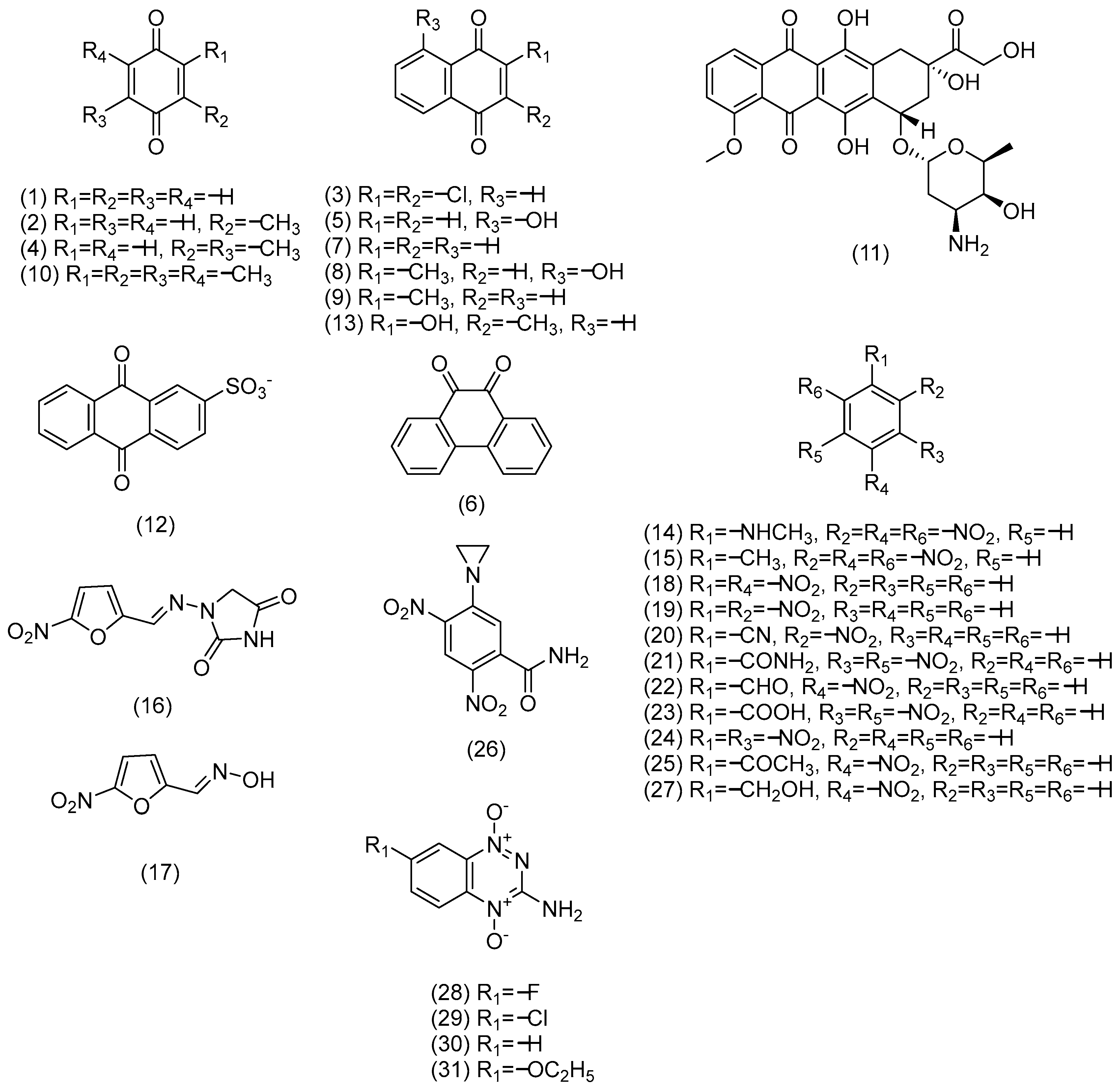
C. tepidum ferredoxin:NADP+ oxidoreductase was purified as previously described and its concentration was determined spectrophotometrically according to ε 466   =   10.3   mM 1 cm 1 [12]. NADP(H), 3-acetylpyridineadenine dinucleotide phosphate ( AcADP + ), horse heart cytochrome c, superoxide dismutase, glucose oxidase, glucose 6-phosphate, glucose 6-phosphate dehydrogenase, 5-deazaFMN and other commercially available reagents were obtained from Sigma-Aldrich (St. Louis, MO, USA) and used as received. 5-(Aziridin-1-yl)-2,4-dinitrobenzamid synthesized as described in [57], was generous gift of Dr. Vanda Miškinienė (Institute of Biochemistry, Vilnius University). 2,4,6-Trinitrotoluene and N-methylpicramide synthesized as described in [58,59] and tirapazamine derivatives synthesized as described in [60,61,62] were a generous gift of Dr. Jonas Šarlauskas (Institute of Biochemistry, Vilnius University). The structural formulae of nonphysiological electron acceptors are given in Figure 9:
The steady-state kinetics experiments were performed using a Cary60 UV/Vis spectrophotometer (Agilent Technologies, Santa Clara, CA, USA). All experiments were performed in 0.02 M Hepes/NaOH + 1 mM EDTA buffer solution (pH 7.0) at 25 °C. The kinetic data were fitted to the Michaelis–Menten equation in Mathematica (Wolfram Research, Inc., Mathematica, Version 14.0, Champaign, IL, USA (2024)) (Equations (9) and 10) to yield the steady-state parameters of the reactions, namely the catalytic constant k cat , bimolecular reaction rate constants (or catalytic efficiency constants) k cat / K m and substrate inhibitions constants K i (where applicable) of the oxidants under a constant concentration of NADPH:
v E = k cat S K m + S
v E = k cat S K m + S 1 + S K i
where v is the reaction rate, [E] is the CtFNR concentration, [S] is the concentration of the oxidant and k cat represents the number of molecules of NADPH oxidized by a single native molecule of the enzyme per second at saturated concentrations of both substrates. The fitted parameters correspond to the reciprocal intercepts and slopes of Lineweaver–Burk plots, [E]/v vs. 1/[S], respectively. The concentrations of the enzyme used in the experiments were 5–50 nM. The kinetic parameters of the steady-state reactions according to the ‘ping-pong’ mechanism were calculated according to Equation (11):
v E = k cat Q NADPH K m NADPH Q + K m Q NADPH + Q NADPH
where Q is the electron acceptor.
The competitive inhibition constant K i c of NADP + vs. NADPH was calculated according to Equation (12):
v E = k cat Q K m NADPH 1 + NADP + K ic + NADPH
The uncompetitive inhibition constant K i u of NADP + vs. electron acceptor (Q) was calculated according to Equation (13):
v E = k cat Q K m Q + Q 1 + NADP + K iu
The rates of enzymatic NADPH oxidation in the presence of quinones, nitroaromatics, aromatic N-oxides or single electron acceptors were determined according to Δ ε 340   =   6.22   mM 1 cm 1 and they were corrected for the intrinsic NADPH oxidase activity of CtFNR (2.1 s 1 ) and/or nonenzymatic NADPH oxidation by high-potential quinones. When 50 μM of cytochrome c was added to the reaction mixture, its quinone- and nitroaromatic-mediated reduction was assessed according to Δ ε 550   =   20   mM 1 cm 1 . The ferricyanide reduction rate was measured according to Δ ε 420   =   1.03   mM 1 cm 1 . The rate of CtFNR-catalyzed reduction of AcADP + by NADPH was determined according to Δ ε 363 = 5.6   mM 1 cm 1 and AcADPH was prepared in situ by reducing AcADP + with 10 mM glucose 6-phosphate and 0.01 mg/mL glucose 6-phosphate dehydrogenase with its concentration determined according to ε 363 = 7.8   mM 1 cm 1 [37]. NaCl was used to vary the ionic strength of the buffer solution. The stock solutions of organic compounds were prepared in DMSO. The final concentration of DMSO in reaction mixtures was 1% (v/v). The starting concentrations for the oxidants ranged from 100 to 1000 μM, and every compound was measured in a series of measurements with 1.5× serial dilutions for 7–10 different concentrations. The reactions were initiated by adding CtFNR to the mixture of the buffer solution, NADPH and electron acceptor in the cuvette.
Presteady-state kinetics assays were performed under aerobic conditions using SX20 stopped-flow system (Applied Photophysics, Leatherhead, UK). The reduction of CtFNR by NADPH and its reoxidation by a quinone or oxygen was evaluated at 460 nm and 600 nm. The CtFNR in syringe 1 (~10 μM) was mixed with the contents of syringe 2 (100 μM NADPH or 100 μM NADPH + 100–500 μM of duroquinone).
The reduction of CtFNR under anaerobic conditions was performed using an NADPH regeneration system with a catalytic amount of NADPH. The anaerobic cuvette contained 10 mM glucose, 50 nM glucose oxidase, 50 nM catalase, 10 mM glucose 6-phosphate, 0.01 mg/mL glucose 6-phosphate dehydrogenase and 1 μM NADPH. CtFNR (~200 μM) was placed in a side arm and the cuvette was flushed with oxygen free argon for 30 min. The reaction was initiated by mixing CtFNR with the cuvette contents for a final CtFNR concentration of ~20 μM. The progress of the reaction was followed spectrophotometrically for 3 h.

Author Contributions

Conceptualization, N.Č.; methodology, D.L., D.S. and M.L.; formal analysis, D.L., N.Č. and M.L.; investigation, D.L. and M.L.; resources, D.S. and N.Č.; writing—original draft preparation, D.L. and M.L.; writing—review and editing, D.S., N.Č. and M.L.; visualization, D.L. and M.L.; supervision, N.Č. All authors have read and agreed to the published version of the manuscript.

Funding

This research received no external funding.

Institutional Review Board Statement

Not applicable.

Informed Consent Statement

Not applicable.

Data Availability Statement

The data cited here can be provided upon reasonable request.

Acknowledgments

Some of the data presented in this research article was used by D.L. in his BSc thesis “Tioredoksino reduktazės tipo feredoksino reduktazės (FNR) iš Chlorobaculum tepidum katalizės su nefiziologiniais elektronų akceptoriais tyrimai” (Vilnius University, Vilnius, Lithuania, 2025). We thank Jonas Šarlauskas and Vanda Miškinienė for their generous gift of aromatic nitrocompounds and N-oxides.

Conflicts of Interest

The authors declare no conflicts of interest.

Abbreviations

The following abbreviations are used in this manuscript:
ArNO 2 Nitroaromatic compound
ArN→OAromatic N-oxide
BsFNRFerredoxin: NADP + oxidoreductase from Bacillus subtilis
CtFNRFerredoxin: NADP + oxidoreductase from Chlorobaculum tepidum
DQDuroquinone (1,4-benzoquinone)
E 7 1 Single-electron reduction potential at pH 7.0
FdFerredoxin
FldFlavodoxin
FNRFerredoxin: NADP + oxidoreductase
NQ1,4-naphthoquinone
QQuinone
RpFNRFerredoxin: NADP + oxidoreductase from Rhodopseudomonas palustris
TrxRThioredoxin reductase

References

  1. Hemmerich, P.; Massey, V. The Role of the Apoprotein in Directing Pathways of Flavin Catalysis. In Proceedings of the Third International Symposium on Oxidases and Related Redox Systems, State University of New York at Albany, Albany, NY, USA, 3–7 July 1979; pp. 379–405. [Google Scholar]
  2. Massey, V.; Hemmerich, P. Active-site probes of flavoproteins. Biochem. Soc. Trans. 1980, 8, 246–257. [Google Scholar] [CrossRef] [PubMed]
  3. Shin, M.; Arnon, D.I. Enzymic Mechanisms of Pyridine Nucleotide Reduction in Chloroplasts. J. Biol. Chem. 1965, 240, 1405–1411. [Google Scholar] [CrossRef]
  4. Ceccarelli, E.A.; Arakaki, A.K.; Cortez, N.; Carrillo, N. Functional plasticity and catalytic efficiency in plant and bacterial ferredoxin-NADP(H) reductases. Biochim. Biophys. Acta Proteins Proteom. 2004, 1698, 155–165. [Google Scholar] [CrossRef]
  5. Aliverti, A.; Pandini, V.; Pennati, A.; de Rosa, M.; Zanetti, G. Structural and functional diversity of ferredoxin-NADP+ reductases. Arch. Biochem. Biophys. 2008, 474, 283–291. [Google Scholar] [CrossRef]
  6. Nogués, I.; Tejero, J.; Hurley, J.K.; Paladini, D.; Frago, S.; Tollin, G.; Mayhew, S.G.; Gómez-Moreno, C.; Ceccarelli, E.A.; Carrillo, N.; et al. Role of the C-Terminal Tyrosine of Ferredoxin-Nicotinamide Adenine Dinucleotide Phosphate Reductase in the Electron Transfer Processes with Its Protein Partners Ferredoxin and Flavodoxin. Biochemistry 2004, 43, 6127–6137. [Google Scholar] [CrossRef]
  7. Röhrich, R.C.; Englert, N.; Troschke, K.; Reichenberg, A.; Hintz, M.; Seeber, F.; Balconi, E.; Aliverti, A.; Zanetti, G.; Köhler, U.; et al. Reconstitution of an apicoplast-localised electron transfer pathway involved in the isoprenoid biosynthesis of Plasmodium falciparum. FEBS Lett. 2005, 579, 6433–6438. [Google Scholar] [CrossRef] [PubMed]
  8. Goñi, G.; Herguedas, B.; Hervás, M.; Peregrina, J.R.; De la Rosa, M.A.; Gómez-Moreno, C.; Navarro, J.A.; Hermoso, J.A.; Martínez-Júlvez, M.; Medina, M. Flavodoxin: A compromise between efficiency and versatility in the electron transfer from Photosystem I to Ferredoxin-NADP+ reductase. Biochim. Biophys. Acta Bioenerg. 2009, 1787, 144–154. [Google Scholar] [CrossRef]
  9. Hurley, J.K.; Fillat, M.F.; Gómez-Moreno, C.; Tollin, G. Electrostatic and Hydrophobic Interactions during Complex Formation and Electron Transfer in the Ferredoxin/Ferredoxin: NADP+ Reductase System from Anabaena. J. Am. Chem. Soc. 1996, 118, 5526–5531. [Google Scholar] [CrossRef]
  10. Wahlund, T.M.; Woese, C.R.; Castenholz, R.W.; Madigan, M.T. A thermophilic green sulfur bacterium from New Zealand hot springs, Chlorobium tepidum sp. nov. Arch. Microbiol. 1991, 156, 81–90. [Google Scholar] [CrossRef]
  11. Seo, D.; Sakurai, H. Purification and characterization of ferredoxin-NAD(P)+ reductase from the green sulfur bacterium Chlorobium tepidum. Biochim. Biophys. Acta Prot. Struct. Mol. Enzymol. 2002, 1597, 123–132. [Google Scholar] [CrossRef]
  12. Muraki, N.; Seo, D.; Shiba, T.; Sakurai, T.; Kurisu, G. Asymmetric dimeric structure of ferredoxin-NAD(P)+ oxidoreductase from the green sulfur bacterium Chlorobaculum tepidum: Implications for binding ferredoxin and NADP+. J. Mol. Biol. 2010, 401, 403–414. [Google Scholar] [CrossRef] [PubMed]
  13. Pettersen, E.F.; Goddard, T.D.; Huang, C.C.; Meng, E.C.; Couch, G.S.; Croll, T.I.; Morris, J.H.; Ferrin, T.E. UCSF ChimeraX: Structure visualization for researchers, educators, and developers. Protein Sci. 2021, 30, 70–82. [Google Scholar] [CrossRef]
  14. Wahlund, T.M.; Tabita, F.R. The reductive tricarboxylic acid cycle of carbon dioxide assimilation: Initial studies and purification of ATP-citrate lyase from the green sulfur bacterium Chlorobium tepidum. J. Bacteriol. 1997, 179, 4859–4867. [Google Scholar] [CrossRef]
  15. Feng, X.; Tang, K.H.; Blankenship, R.E.; Tang, Y.J. Metabolic flux analysis of the mixotrophic metabolisms in the green sulfur bacterium Chlorobaculum tepidum. J. Biol. Chem. 2010, 285, 39544–39550. [Google Scholar] [CrossRef] [PubMed]
  16. Frigaard, N.U.; Chew, A.G.; Li, H.; Maresca, J.A.; Bryant, D.A. Chlorobium tepidum: Insights into the structure, physiology, and metabolism of a green sulfur bacterium derived from the complete genome sequence. Photosynth. Res. 2003, 78, 93–117. [Google Scholar] [CrossRef] [PubMed]
  17. Yoon, K.S.; Bobst, C.; Hemann, C.F.; Hille, R.; Tabita, F.R. Spectroscopic and functional properties of novel 2[4Fe-4S] cluster-containing ferredoxins from the green sulfur bacterium Chlorobium tepidum. J. Biol. Chem. 2001, 276, 44027–44036. [Google Scholar] [CrossRef]
  18. Seo, D.; Kitashima, M.; Sakurai, T.; Inoue, K. Kinetics of NADP+/NADPH reduction–oxidation catalyzed by the ferredoxin-NAD(P)+ reductase from the green sulfur bacterium Chlorobaculum tepidum. Photosynth. Res. 2016, 130, 479–489. [Google Scholar] [CrossRef] [PubMed]
  19. Seo, D.; Tomioka, A.; Kusumoto, N.; Kamo, M.; Enami, I.; Sakurai, H. Purification of ferredoxins and their reaction with purified reaction center complex from the green sulfur bacterium Chlorobium tepidum. Biochim. Biophys. Acta Bioenerg. 2001, 1503, 377–384. [Google Scholar] [CrossRef]
  20. Seo, D.; Asano, T. C-terminal residues of ferredoxin-NAD(P)+ reductase from Chlorobaculum tepidum are responsible for reaction dynamics in the hydride transfer and redox equilibria with NADP+/NADPH. Photosynth. Res. 2018, 136, 275–290. [Google Scholar] [CrossRef]
  21. Lesanavičius, M.; Seo, D.; Čėnas, N. Thioredoxin Reductase-Type Ferredoxin: NADP+ Oxidoreductase of Rhodopseudomonas palustris: Potentiometric Characteristics and Reactions with Nonphysiological Oxidants. Antioxidants 2022, 11, 1000. [Google Scholar] [CrossRef]
  22. Lesanavičius, M.; Seo, D.; Maurutytė, G.; Čėnas, N. Redox Properties of Bacillus subtilis Ferredoxin:NADP+ Oxidoreductase: Potentiometric Characteristics and Reactions with Pro-Oxidant Xenobiotics. Int. J. Mol. Sci. 2024, 25, 5373. [Google Scholar] [CrossRef]
  23. Lesanavičius, M.; Aliverti, A.; Šarlauskas, J.; Čėnas, N. Reactions of Plasmodium falciparum Ferredoxin:NADP+ Oxidoreductase with Redox Cycling Xenobiotics: A Mechanistic Study. Int. J. Mol. Sci. 2020, 21, 3234. [Google Scholar] [CrossRef]
  24. Nemeikaitė-Čėnienė, A.; Šarlauskas, J.; Misevičienė, L.; Marozienė, A.; Jonušienė, V.; Lesanavičius, M.; Čėnas, N. Aerobic Cytotoxicity of Aromatic N-Oxides: The Role of NAD(P)H:Quinone Oxidoreductase (NQO1). Int. J. Mol. Sci. 2020, 21, 8754. [Google Scholar] [CrossRef]
  25. Wardman, P.; Dennis, M.F.; Everett, S.A.; Patel, K.B.; Stratford, M.R.; Tracy, M. Radicals from one-electron reduction of nitro compounds, aromatic N-oxides and quinones: The kinetic basis for hypoxia-selective, bioreductive drugs. Biochem. Soc. Symp. 1995, 61, 171–194. [Google Scholar] [CrossRef] [PubMed][Green Version]
  26. Roldán, M.D.; Pérez-Reinado, E.; Castillo, F.; Moreno-Vivián, C. Reduction of polynitroaromatic compounds: The bacterial nitroreductases. FEMS Microbiol. Rev. 2008, 32, 474–500. [Google Scholar] [CrossRef] [PubMed]
  27. Medipally, H.; Mann, M.; Kötting, C.; van Berkel, W.J.H.; Nowaczyk, M.M. A Clickable Photosystem I, Ferredoxin, and Ferredoxin NADP+ Reductase Fusion System for Light-Driven NADPH Regeneration. Chembiochem 2023, 24, e202300025. [Google Scholar] [CrossRef]
  28. Housseini, W.E.; Lapicque, F.; Walcarius, A.; Lojou, E.; Rouhier, N.; Etienne, M. Ferredoxin NADP(+) reductase for NADPH and NADH regeneration in a flow bioelectrochemical reactor. Bioelectrochemistry 2025, 164, 108919. [Google Scholar] [CrossRef]
  29. Huang, S.; Saad Imran, S.M.; Lanahan, A.A.; Hammer, S.K.; Lubner, C.E.; Lynd, L.R.; Olson, D.G. A distinct class of ferredoxin:NADP+ oxidoreductase enzymes driving thermophilic ethanol production. J. Biol. Chem. 2025, 301, 110263. [Google Scholar] [CrossRef]
  30. Treesukkasem, N.; Visitsatthawong, S.; Buttranon, S.; Intasian, P.; Jaroensuk, J.; Maenpuen, S.; Sucharitakul, J.; Poddar, H.; Heyes, D.J.; Scrutton, N.S.; et al. Structural and functional insights into a novel aldehyde deformylating oxygenase with enhanced efficiency for biofuel applications. FEBS J. 2025. Epub ahead of printing. [Google Scholar] [CrossRef] [PubMed]
  31. Chance, B. A simple relationship for a calculation of the “on” velocity constant in enzyme reactions. Arch. Biochem. Biophys. 1957, 71, 130–136. [Google Scholar] [CrossRef]
  32. Wardman, P. Reduction Potentials of One-Electron Couples Involving Free Radicals in Aqueous Solution. J. Phys. Chem. Ref. Data 1989, 18, 1637–1755. [Google Scholar] [CrossRef]
  33. Hay, M.P.; Gamage, S.A.; Kovacs, M.S.; Pruijn, F.B.; Anderson, R.F.; Patterson, A.V.; Wilson, W.R.; Brown, J.M.; Denny, W.A. Structure-activity relationships of 1,2,4-benzotriazine 1,4-dioxides as hypoxia-selective analogues of tirapazamine. J. Med. Chem. 2003, 46, 169–182. [Google Scholar] [CrossRef] [PubMed]
  34. Iyanagi, T.; Yamazaki, I. One-electron-transfer reactions in biochemical systems V. Difference in the mechanism of quinone reduction by the NADH dehydrogenase and the NAD(P)H dehydrogenase (DT-diaphorase). Biochim. Biophys. Acta Bioenerg. 1970, 216, 282–294. [Google Scholar] [CrossRef]
  35. Butler, J.; Jayson, G.G.; Swallow, A.J. The reaction between the superoxide anion radical and cytochrome c. Biochim. Biophys. Acta Bioenerg. 1975, 408, 215–222. [Google Scholar] [CrossRef]
  36. Koppenol, W.H.; van Buuren, K.J.; Butler, J.; Braams, R. The kinetics of the reduction of cytochrome c by the superoxide anion radical. Biochim. Biophys. Acta Bioenerg. 1976, 449, 157–168. [Google Scholar] [CrossRef]
  37. Kaplan, N.O.; Ciotti, M.M. Chemistry and Properties of the 3-Acetylpyridine Analogue of Diphosphopyridine Nucleotide. J. Biol. Chem. 1956, 221, 823–832. [Google Scholar] [CrossRef]
  38. Edmondson, D.E.; Tollin, G. Semiquinone formation in flavo- and metalloflavoproteins. Top. Curr. Chem. 1983, 108, 109–138. [Google Scholar] [CrossRef] [PubMed]
  39. Mayhew, S.G. The effects of pH and semiquinone formation on the oxidation-reduction potentials of flavin mononucleotide. A reappraisal. Eur. J. Biochem. 1999, 265, 698–702. [Google Scholar] [CrossRef]
  40. Marcus, R.A.; Sutin, N. Electron transfers in chemistry and biology. Biochim. Biophys. Acta Rev. Bioenerg. 1985, 811, 265–322. [Google Scholar] [CrossRef]
  41. Chou, M.; Creutz, C.; Sutin, N. Rate constants and activation parameters for outer-sphere electron-transfer reactions and comparisons with the predictions of Marcus theory. J. Am. Chem. Soc. 2002, 99, 5615–5623. [Google Scholar] [CrossRef]
  42. Grampp, G.; Jaenicke, W. ESR-spectroscopic investigation of the parallel electron and proton exchange between quinones and their radicals: Part I. Measurements at 298 K. J. Electroanal. Chem. Interfacial Electrochem. 1987, 229, 297–303. [Google Scholar] [CrossRef]
  43. Nemeikaitė-Čėnienė, A.; Šarlauskas, J.; Jonušienė, V.; Marozienė, A.; Misevičienė, L.; Yantsevich, A.V.; Čėnas, N. Kinetics of Flavoenzyme-Catalyzed Reduction of Tirapazamine Derivatives: Implications for Their Prooxidant Cytotoxicity. Int. J. Mol. Sci. 2019, 20, 4602. [Google Scholar] [CrossRef]
  44. Meot-Ner, M.; Neta, P. Kinetics of electron transfer from nitroaromatic radical anions in aqueous solutions. Effects of temperature and steric configuration. J. Phys. Chem. 1986, 90, 4648–4650. [Google Scholar] [CrossRef]
  45. Seo, D.; Okabe, S.; Yanase, M.; Kataoka, K.; Sakurai, T. Studies of interaction of homo-dimeric ferredoxin-NAD(P)+ oxidoreductases of Bacillus subtilis and Rhodopseudomonas palustris, that are closely related to thioredoxin reductases in amino acid sequence, with ferredoxins and pyridine nucleotide coenzymes. Biochim. Biophys. Acta Proteins Proteom. 2009, 1794, 594–601. [Google Scholar] [CrossRef] [PubMed][Green Version]
  46. Swenson, R.P.; Krey, G.D. Site-directed mutagenesis of tyrosine-98 in the flavodoxin from Desulfovibrio vulgaris (Hildenborough): Regulation of oxidation-reduction properties of the bound FMN cofactor by aromatic, solvent, and electrostatic interactions. Biochemistry 1994, 33, 8505–8514. [Google Scholar] [CrossRef]
  47. Panda, S.P.; Gao, Y.T.; Roman, L.J.; Martasek, P.; Salerno, J.C.; Masters, B.S. The role of a conserved serine residue within hydrogen bonding distance of FAD in redox properties and the modulation of catalysis by Ca2+/calmodulin of constitutive nitric-oxide synthases. J. Biol. Chem. 2006, 281, 34246–34257. [Google Scholar] [CrossRef]
  48. Mauk, A.G.; Scott, R.A.; Gray, H.B. Distances of electron transfer to and from metalloprotein redox sites in reactions with inorganic complexes. J. Am. Chem. Soc. 1980, 102, 4360–4363. [Google Scholar] [CrossRef]
  49. Zhuang, B.; Aleksandrov, A.; Seo, D.; Vos, M.H. Excited-State Properties of Fully Reduced Flavins in Ferredoxin–NADP+ Oxidoreductase. J. Phys. Chem. Lett. 2023, 14, 1096–1102. [Google Scholar] [CrossRef] [PubMed]
  50. Gray, H.B.; Winkler, J.R. Electron transfer in proteins. Annu. Rev. Biochem. 1996, 65, 537–561. [Google Scholar] [CrossRef]
  51. Krishtalik, L.I. Role of the protein’s low dielectric constant in the functioning of the photosynthetic reaction center. Photosynth. Res. 1999, 60, 241–246. [Google Scholar] [CrossRef]
  52. Gunner, M.R.; Mao, J.; Song, Y.; Kim, J. Factors influencing the energetics of electron and proton transfers in proteins. What can be learned from calculations. Biochim. Biophys. Acta Bioenerg. 2006, 1757, 942–968. [Google Scholar] [CrossRef]
  53. Xing, D.; Zuo, Y.; Cheng, S.; Regan, J.M.; Logan, B.E. Electricity generation by Rhodopseudomonas palustris DX-1. Environ. Sci. Technol. 2008, 42, 4146–4151. [Google Scholar] [CrossRef]
  54. George, D.M.; Vincent, A.S.; Mackey, H.R. An overview of anoxygenic phototrophic bacteria and their applications in environmental biotechnology for sustainable resource recovery. Biotechnol. Rep. 2020, 28, e00563. [Google Scholar] [CrossRef]
  55. Li, Y.; Zhang, H.-M.; Tian, Y. Sulfur-driven microbial fuel cells denitrification system for targeted treatment of nitrate-containing groundwater: Performance and mechanism. Chem. Eng. J. 2024, 496, 154328. [Google Scholar] [CrossRef]
  56. Gemünde, A.; Lai, B.; Pause, L.; Krömer, J.; Holtmann, D. Redox Mediators in Microbial Electrochemical Systems. Chemelectrochem 2022, 9, e202200216. [Google Scholar] [CrossRef]
  57. Khan, A.H.; Ross, W.C. Tumour-growth inhibitory nitrophenylaziridines and related compounds: Structure-activity relationships. Chem.-Biol. Interact. 1969, 1, 27–47. [Google Scholar] [CrossRef]
  58. De Beule, P. Les substitués nitrés obtenus par nitration directe du toluéne dans la préparation du T. N. T. Bull. Soc. Chim. Belg 1933, 42, 27–79. [Google Scholar] [CrossRef]
  59. Clarkson, C.E.; Holden, I.G.; Malkin, T. The nitration of dimethylaniline to tetryl, 2: 4: 6: N-tetranitro-methylaniline. The course of the reaction. J. Chem. Soc. (Resumed) 1950, 1556–1562. [Google Scholar] [CrossRef]
  60. Shinde, S.S.; Maroz, A.; Hay, M.P.; Patterson, A.V.; Denny, W.A.; Anderson, R.F. Characterization of radicals formed following enzymatic reduction of 3-substituted analogues of the hypoxia-selective cytotoxin 3-amino-1,2,4-benzotriazine 1,4-dioxide (tirapazamine). J. Am. Chem. Soc. 2010, 132, 2591–2599. [Google Scholar] [CrossRef] [PubMed]
  61. Anderson, R.F.; Shinde, S.S.; Hay, M.P.; Denny, W.A. Potentiation of the cytotoxicity of the anticancer agent tirapazamine by benzotriazine N-oxides: The role of redox equilibria. J. Am. Chem. Soc. 2006, 128, 245–249. [Google Scholar] [CrossRef] [PubMed]
  62. Vicente, E.; Lima, L.M.; Bongard, E.; Charnaud, S.; Villar, R.; Solano, B.; Burguete, A.; Perez-Silanes, S.; Aldana, I.; Vivas, L.; et al. Synthesis and structure-activity relationship of 3-phenylquinoxaline 1,4-di-N-oxide derivatives as antimalarial agents. Eur. J. Med. Chem. 2008, 43, 1903–1910. [Google Scholar] [CrossRef] [PubMed]
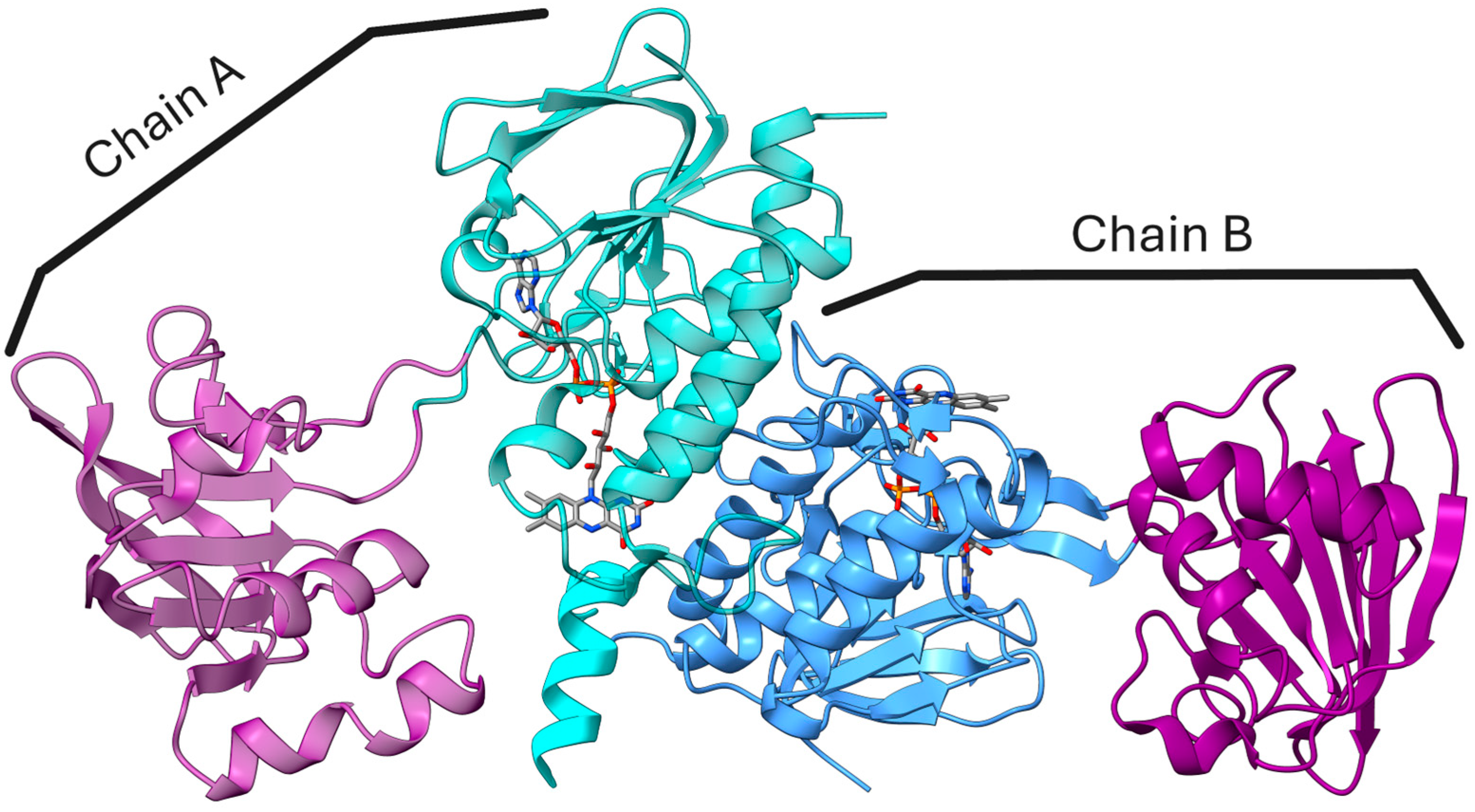
Figure 1. The 3D structure of the asymmetric homodimeric CtFNR (PDB ID: 3AB1). FAD-binding domain is colored teal and NADPH binding domain is colored purple for chain A. Chain B FAD-binding domain is colored blue, NADPH binding domain is colored purple and C-terminal subdomain is colored teal. Enzyme-bound FADs are shown and colored according to elements. The molecular graphics were made using UCSF ChimeraX (version 1.7) [13].
Ijms 27 00481 g001
Figure 2. The absorbance changes at 460 and 600 nm during the reduction of 5 μM CtFNR with 50 μM NADPH and its subsequent reoxidation by O 2 (A) or 250 μM duroquinone (B). Concentrations reported after mixing.
Ijms 27 00481 g002
Figure 3. (A) The kinetics of CtFNR (5 μM) reduction and reoxidation under multiple turnover conditions with a varying concentration of duroquinone in the presence of 50 μM NADPH followed at 460 nm (solid curves) and 600 nm (dashed curves). (B) Michaelis–Menten fit for the dependence of reoxidation constant k ox on the concentration of duroquinone. Values obtained from (A) upon treatment according to Equation (2).
Ijms 27 00481 g003
Figure 4. Lineweaver–Burk plots of the steady-state kinetics of the oxidation of NADPH catalyzed by CtFNR with varied concentrations of 1,4-naphthoquinone (NQ) under constant concentrations of NADPH.
Ijms 27 00481 g004
Figure 5. Inhibition of CtFNR-catalyzed reactions by reaction product NADP + . (A) Competitive inhibition at varied concentrations of NADPH in the presence of 100 μM 1,4-naphthoquinone. (B). Uncompetitive inhibition at varied 1,4-naphthoquinone concentrations in the presence of 100 μM NADPH.
Ijms 27 00481 g005
Figure 6. The dependence of the reactivity of quinones, nitroaromatic compounds, aromatic N-oxides and benzyl viologen on their single-electron reduction midpoint potentials ( log 10 scale). The compounds and their reduction potentials corresponding to the numbers are given in Table 1.
Ijms 27 00481 g006
Figure 7. The dependence of k cat / K m (logarithmic scale) of CtFNR-catalyzed reaction on the ionic strength of the buffer solution with the electron acceptors being a negatively charged Fe ( EDTA ) (blue circles), positively charged benzyl viologen ( BV 2 + , orange squares) and neutral 1,4-naphthoquinone (green diamonds).
Ijms 27 00481 g007
Figure 8. (A) Lineweaver–Burk plots for the transhydrogenase reaction with AcADP(H) with varied concentration of AcADP + at 200 µM NADPH (line 1, blue) or varied concentration of AcADPH at 1.0 mM ferricyanide (line 2, orange). (B) The reduction of CtFNR with a catalytic amount of NADPH under anaerobic conditions using an NADPH regeneration system at different timepoints of the reaction. Arrows indicate the disappearance of flavin peak ~460 nm and the appearance of the semiquinone at the 600 nm region.
Ijms 27 00481 g008
Figure 9. Structural formulae of nonphysiological electron-acceptors used in this study. Numbers correspond to the compounds given in Table 1.
Ijms 27 00481 g009
Table 1. Steady-state rate constants for the reduction of nonphysiological electron acceptors by 100 μM NADPH catalyzed by CtFNR. The E 7 1 values taken from [25,32,33].
No.Compound E 7 1  (V) k cat app ( s 1 ) k cat / K m   ( M 1 s 1 )
Quinones
11,4-Benzoquinone0.09040.0 ± 2.5 2.3   ±   0.5   ×   10 6
22-Methyl-1,4-benzoquinone0.01034.6 ± 0.6 2.5   ±   0.1   ×   10 6
32,3-Dichloro-1,4-naphthoquinone−0.03642.6 ± 3.5 5.0   ±   1.0   ×   10 6
42,3-Dimethyl-1,4-benzoquinone−0.07461.8 ± 1.2 1.9   ±   0.1   ×   10 6
55-Hydroxy-1,4-naphthoquinone−0.09027.7 ± 0.9 3.7   ±   0.5   ×   10 6
69,10-Phenanthrene quinone−0.12036.4 ± 6.9 4.4   ±   0.5   ×   10 6
71,4-Naphthoquinone−0.15039.1 ± 1.4 3.3   ±   0.4   ×   10 6
85-Hydroxy-2-methyl-1,4-naphthoquinone−0.15629.4 ± 1.5 2.6   ±   0.3   ×   10 6
92-Methyl-1,4-naphthoquinone−0.20029.4 ± 1.3 1.0   ±   0.1   ×   10 6
10Tetramethyl-1,4-benzoquinone−0.26063.6 ± 4.3 6.6   ±   0.7   ×   10 5
11Doxorubicin−0.33025.6 ± 2.9 3.1   ±   0.5   ×   10 5
129,10-Anthraquinone-2-sulphonate−0.38023.5 ± 0.9 5.0   ±   0.5   ×   10 5
132-Hydroxy-3-methyl-1,4-naphthoquinone−0.41021.8 ± 1.8 6.1   ±   1.0   ×   10 4
Nitroaromatics
14N-methylpicramide−0.22532.5 ± 1.0 7.6   ±   1.0   ×   10 5
152,4,6-Trinitrotoluene−0.25341.0 ± 2.0 7.2   ±   1.1   ×   10 5
16Nitrofurantoin−0.25545.3 ± 2.4 8.1   ±   1.3   ×   10 5
17Nifuroxime−0.25568.2 ± 5.2 8.6   ±   1.9   ×   10 5
18p-Dinitrobenzene−0.25711.2 ± 1.3 4.2   ±   0.5   ×   10 5
19o-Dinitrobenzene−0.28711.0 ± 0.5 3.8   ±   0.4   ×   10 5
202-Nitrobenzonitrile−0.30857.4 ± 2.9 1.4   ±   0.1   ×   10 5
213,5-Dinitrobenzamide−0.31140.1 ± 1.3 4.1   ±   0.3   ×   10 5
224-Nitrobenzaldehyde−0.32531.2 ± 2.1 2.3   ±   0.2   ×   10 5
233,5-Dinitrobenzoic acid−0.34429.7 ± 0.5 7.5   ±   0.5   ×   10 4
24m-Dinitrobenzene−0.34813.6 ± 2.0 2.2   ±   0.4   ×   10 4
254-Nitroacetophenone−0.35516.3 ± 0.7 1.3   ±   0.1   ×   10 5
265-(Aziridin-1-yl)-2,4-dinitrobenzamide−0.3858.8 ± 0.6 3.8   ±   0.6   ×   10 4
274-Nitrobenzyl alcohol−0.47512.9 ± 0.7 9.0   ±   1.0   ×   10 3
Aromatic N-oxides
287-Fluorotirapazamine−0.40017.4 ± 1.0 8.2   ±   1.0   ×   10 4
297-Chlorotirapazamine−0.40014.0 ± 1.2 1.7   ±   0.2   ×   10 5
30Tirapazamine−0.4566.3 ± 0.4 3.9   ±   0.6   ×   10 4
317-Ethoxytirapazamine−0.49416.5 ± 0.6 4.8   ±   0.4   ×   10 4
Single electron acceptors
32Ferricyanide a0.41013.6 ± 0.9 9.2   ±   1.5   ×   10 4
33 Fe ( EDTA ) 0.12014.9 ± 1.2 9.5   ±   1.8   ×   10 4
34Benzyl viologen−0.35431.5 ± 0.8 7.3   ±   0.9   ×   10 5
a—according to the rate of ferricyanide reduction.
Disclaimer/Publisher’s Note: The statements, opinions and data contained in all publications are solely those of the individual author(s) and contributor(s) and not of MDPI and/or the editor(s). MDPI and/or the editor(s) disclaim responsibility for any injury to people or property resulting from any ideas, methods, instructions or products referred to in the content.