Desiccation Tolerance in Moss and Liverwort: Insights into the Evolutionary Mechanisms of Terrestrialization

 , , and
Abstract
1. Introduction

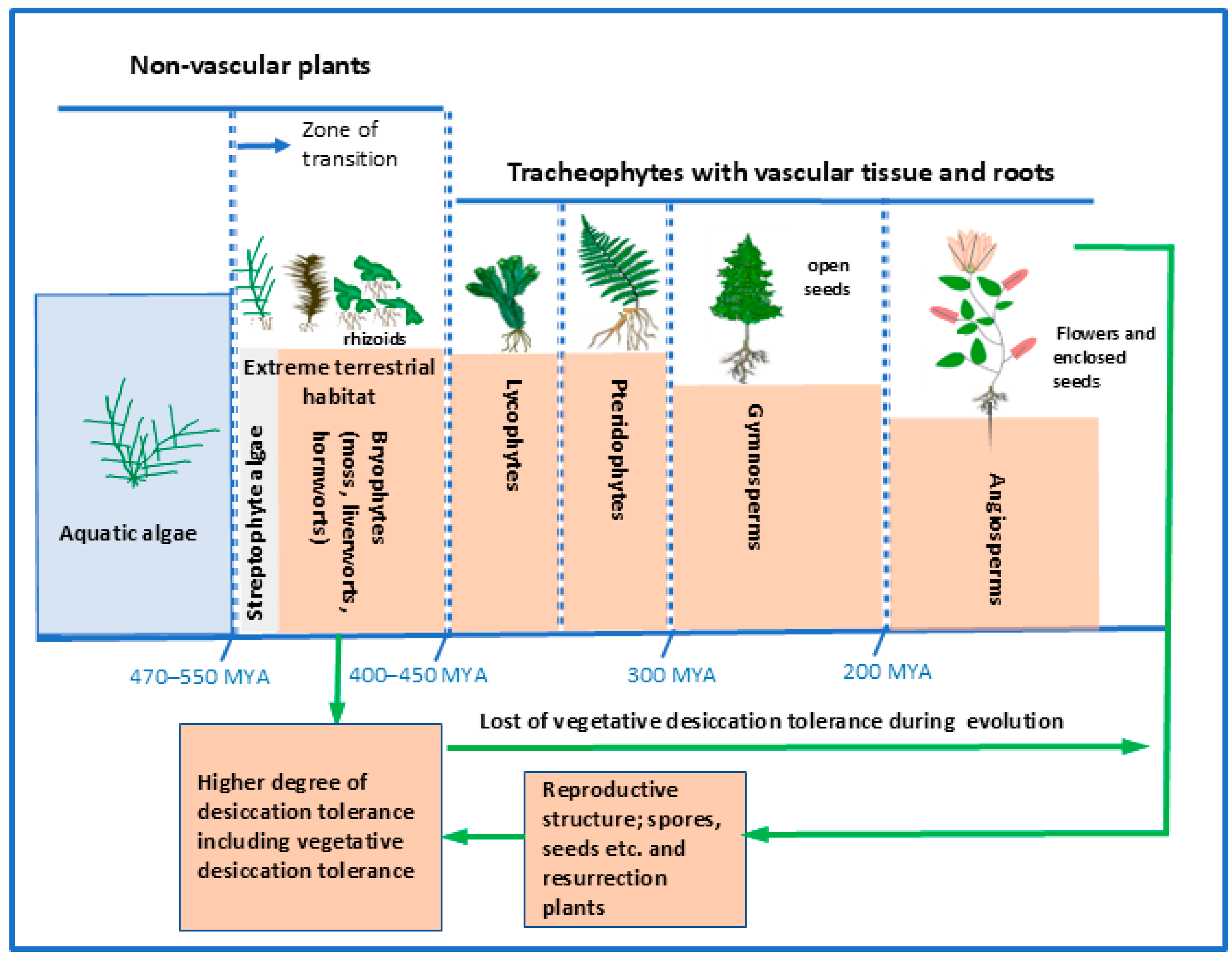
2. Desiccation Responses in Mosses and Liverworts
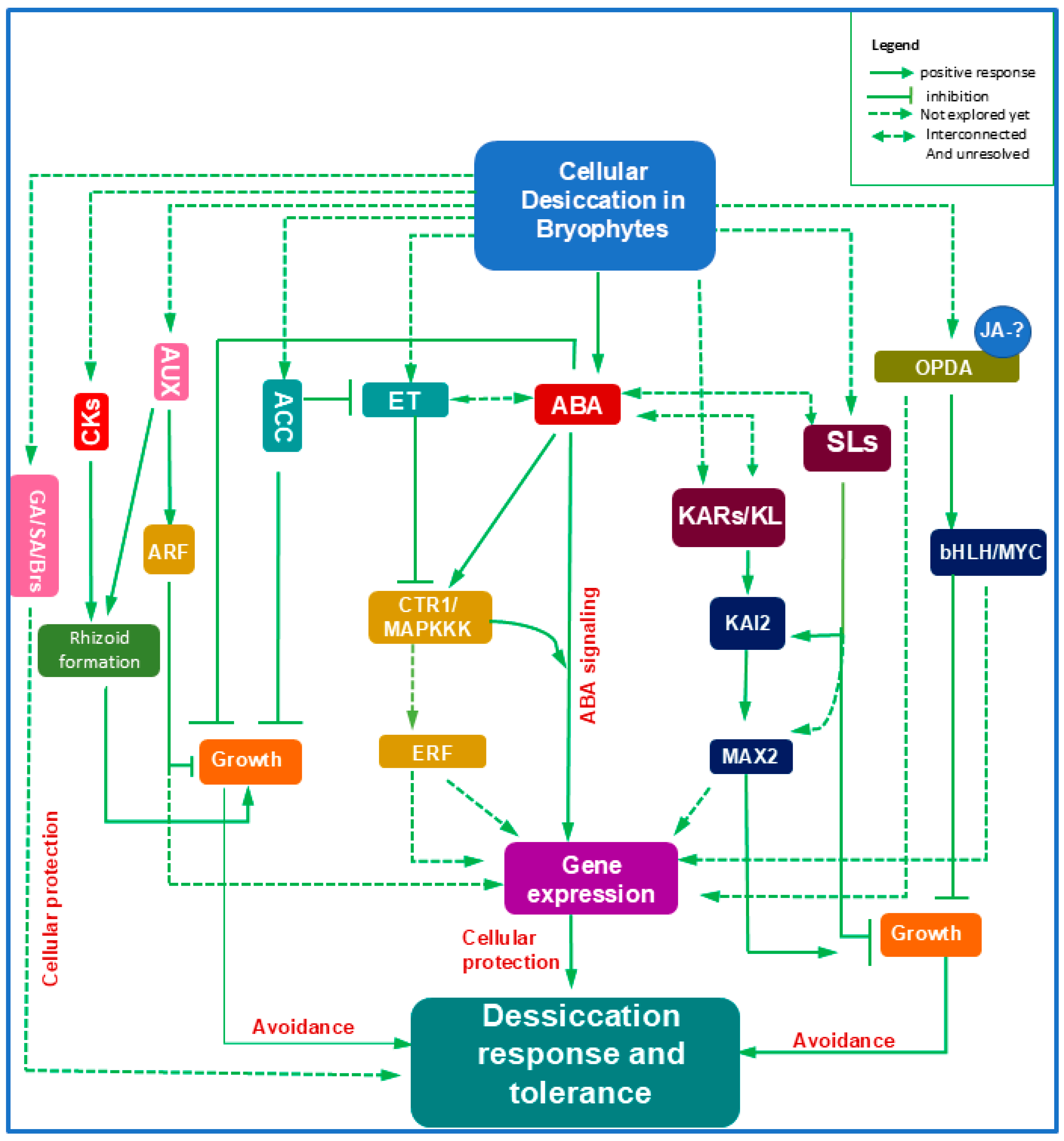
3. Roles of Phytohormones in DT and Terrestrialization of Bryophytes
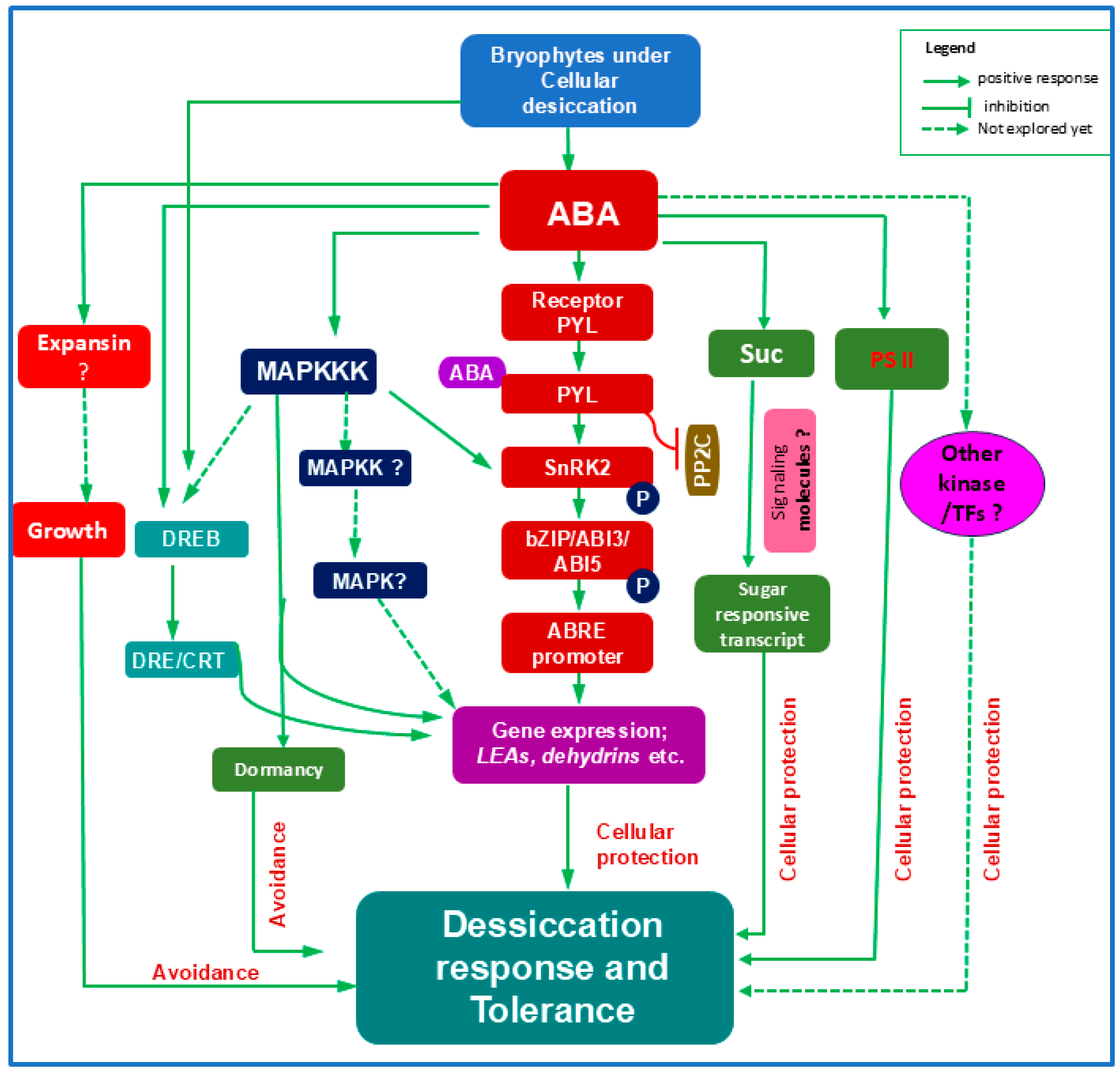
3.1. Mosses and Liverworts Rely Heavily on ABA During Their Transition to Terrestrial Environments
3.2. Role of Ethylene (ET) in the Terrestrial Adaptation of Mosses and Liverworts
3.3. Jasmonic Acid (JA) and Its Role in Moss and Liverwort Terrestrialization
3.4. Strigolactones (SLs) as Emerging Regulators in Land Plant Terrestrialization
3.5. Karrikins (KARs) as Conserved Regulators of Growth and Stress Responses
3.6. Auxin (AUX) in the Adaptation of Mosses and Liverworts
3.7. Evolutionary Roles of Other Growth Regulators
4. DT in Mosses and Liverworts Is Strongly Supported by the Accumulation of Compatible Solutes
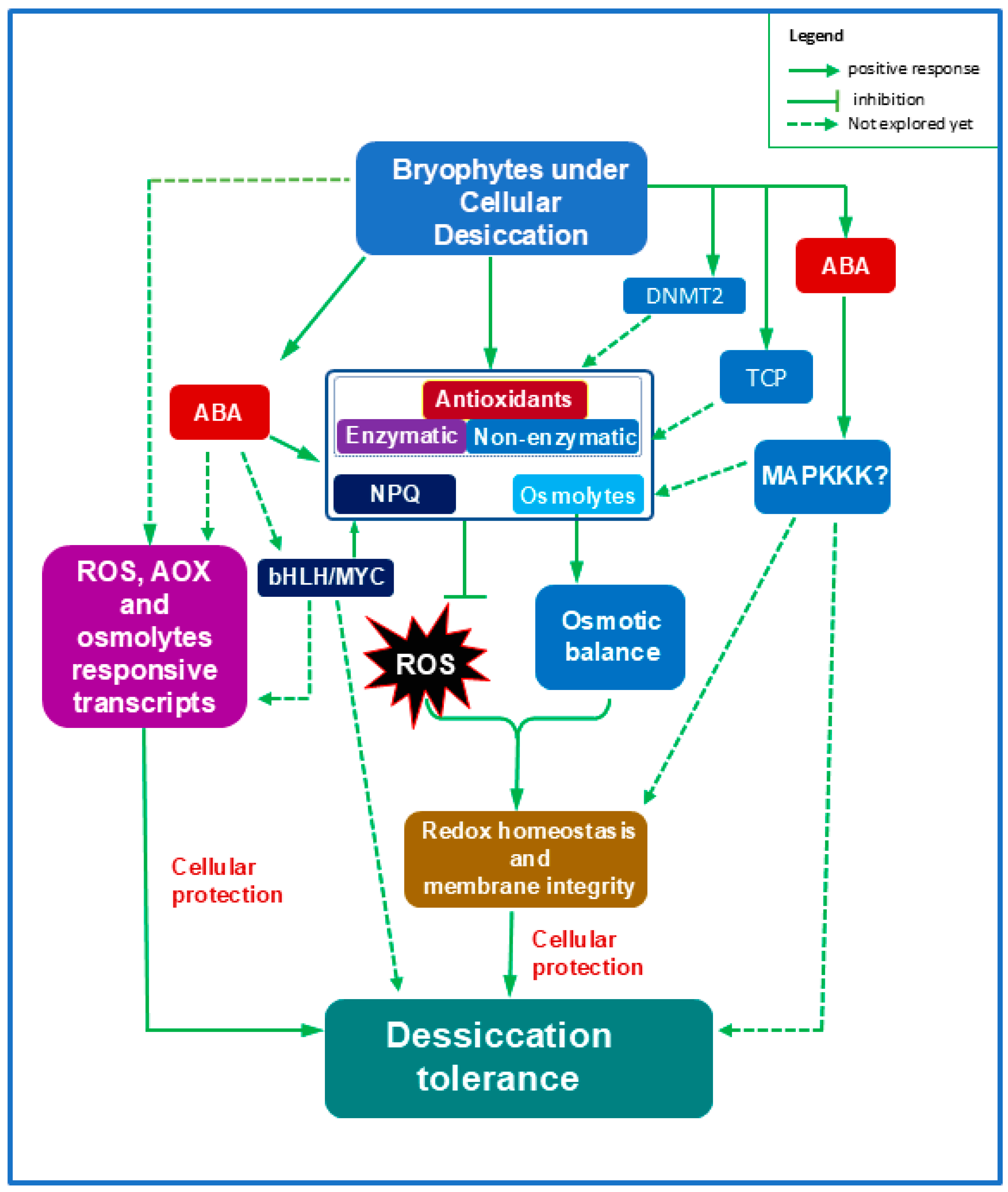
5. Antioxidant Defense in Bryophytes During Cellular Desiccation
6. Conclusions and Future Perspectives
Author Contributions
Funding
Data Availability Statement
Acknowledgments
Conflicts of Interest
References
- Takakura, J.; Fujimori, S.; Hanasaki, N.; Hasegawa, T.; Hirabayashi, Y.; Honda, Y.; Iizumi, T.; Kumano, N.; Park, C.; Shen, Z. Dependence of economic impacts of climate change on anthropogenically directed pathways. Nat. Clim. Chang. 2019, 9, 737–741, Correction in Nat. Clim. Chang. 2019, 9, 894. Correction in Nat. Clim. Chang. 2024, 14, 407. [Google Scholar] [CrossRef]
- Lesk, C.; Rowhani, P.; Ramankutty, N. Influence of extreme weather disasters on global crop production. Nature 2016, 529, 84–87. [Google Scholar] [CrossRef]
- Bowman, J.L.; Kohchi, T.; Yamato, K.T.; Jenkins, J.; Shu, S.; Ishizaki, K.; Yamaoka, S.; Nishihama, R.; Nakamura, Y.; Berger, F. Insights into land plant evolution garnered from the Marchantia polymorpha genome. Cell 2017, 171, 287–304.e15. [Google Scholar] [CrossRef] [PubMed]
- Jahan, A.; Komatsu, K.; Wakida-Sekiya, M.; Hiraide, M.; Tanaka, K.; Ohtake, R.; Umezawa, T.; Toriyama, T.; Shinozawa, A.; Yotsui, I. Archetypal roles of an abscisic acid receptor in drought and sugar responses in liverworts. Plant Physiol. 2019, 179, 317–328. [Google Scholar] [CrossRef]
- Jahan, A.; Yamazaki, Y.; Islam, M.; Ghosh, T.K.; Yoshimura, N.; Kato, H.; Ishizaki, K.; Shinozawa, A.; Sakata, Y.; Takezawa, D. Differential regulations of abscisic acid-induced desiccation tolerance and vegetative dormancy by group B3 Raf kinases in liverworts. Front. Plant Sci. 2022, 13, 952820. [Google Scholar] [CrossRef]
- Wu, T.-Y.; Goh, H.; Azodi, C.B.; Krishnamoorthi, S.; Liu, M.-J.; Urano, D. Evolutionarily conserved hierarchical gene regulatory networks for plant salt stress response. Nat. Plants 2021, 7, 787–799. [Google Scholar] [CrossRef]
- Su, D.; Yang, L.; Shi, X.; Ma, X.; Zhou, X.; Hedges, S.B.; Zhong, B. Large-scale phylogenomic analyses reveal the monophyly of bryophytes and neoproterozoic origin of land plants. Mol. Biol. Evol. 2021, 38, 3332–3344. [Google Scholar] [CrossRef]
- Oliver, M.J.; Farrant, J.M.; Hilhorst, H.W.; Mundree, S.; Williams, B.; Bewley, J.D. Desiccation tolerance: Avoiding cellular damage during drying and rehydration. Annu. Rev. Plant Biol. 2020, 71, 435–460. [Google Scholar] [CrossRef]
- Tomescu, A.M.; Bomfleur, B.; Bippus, A.C.; Savoretti, A. Why are bryophytes so rare in the fossil record? A spotlight on taphonomy and fossil preservation. In Transformative Paleobotany; Elsevier: Amsterdam, The Netherlands, 2018; pp. 375–416. [Google Scholar]
- Budke, J.M.; Bernard, E.C.; Gray, D.J.; Huttunen, S.; Piechulla, B.; Trigiano, R.N. Introduction to the special issue on bryophytes. Crit. Rev. Plant Sci. 2018, 37, 102–112. [Google Scholar] [CrossRef]
- Shimamura, M. Marchantia polymorpha: Taxonomy, phylogeny and morphology of a model system. Plant Cell Physiol. 2016, 57, 230–256. [Google Scholar] [CrossRef]
- Proctor, M.C.; Pence, V.C. Vegetative tissues: Bryophytes, vascular resurrection plants and vegetative propagules. In Desiccation and Survival in Plants: Drying Without Dying; CABI: Wallingford, UK, 2002; pp. 207–237. [Google Scholar]
- Marks, R.A.; Farrant, J.M.; Nicholas McLetchie, D.; VanBuren, R. Unexplored dimensions of variability in vegetative desiccation tolerance. Am. J. Bot. 2021, 108, 346–358. [Google Scholar] [CrossRef] [PubMed]
- Marks, R.A.; Smith, J.J.; VanBuren, R.; McLetchie, D.N. Expression dynamics of dehydration tolerance in the tropical plant Marchantia inflexa. Plant J. 2021, 105, 209–222. [Google Scholar] [CrossRef]
- Aki, S.S.; Mikami, T.; Naramoto, S.; Nishihama, R.; Ishizaki, K.; Kojima, M.; Takebayashi, Y.; Sakakibara, H.; Kyozuka, J.; Kohchi, T. Cytokinin signaling is essential for organ formation in Marchantia polymorpha. Plant Cell Physiol. 2019, 60, 1842–1854. [Google Scholar] [CrossRef]
- Hyoung, S.; Cho, S.H.; Chung, J.H.; So, W.M.; Cui, M.H.; Shin, J.S. Cytokinin oxidase PpCKX1 plays regulatory roles in development and enhances dehydration and salt tolerance in Physcomitrella patens. Plant Cell Rep. 2020, 39, 419–430. [Google Scholar] [CrossRef]
- Davies, K.M.; Jibran, R.; Zhou, Y.; Albert, N.W.; Brummell, D.A.; Jordan, B.R.; Bowman, J.L.; Schwinn, K.E. The evolution of flavonoid biosynthesis: A bryophyte perspective. Front. Plant Sci. 2020, 11, 7. [Google Scholar] [CrossRef]
- Komatsu, K.; Takezawa, D.; Sakata, Y. Decoding ABA and osmostress signalling in plants from an evolutionary point of view. Plant Cell Environ. 2020, 43, 2894–2911. [Google Scholar] [CrossRef]
- Rensing, S.A.; Lang, D.; Zimmer, A.D.; Terry, A.; Salamov, A.; Shapiro, H.; Nishiyama, T.; Perroud, P.-F.; Lindquist, E.A.; Kamisugi, Y. The Physcomitrella genome reveals evolutionary insights into the conquest of land by plants. Science 2008, 319, 64–69. [Google Scholar] [CrossRef] [PubMed]
- Ghosh, T.K.; Kaneko, M.; Akter, K.; Murai, S.; Komatsu, K.; Ishizaki, K.; Yamato, K.T.; Kohchi, T.; Takezawa, D. Abscisic acid-induced gene expression in the liverwort Marchantia polymorpha is mediated by evolutionarily conserved promoter elements. Physiol. Plant. 2016, 156, 407–420. [Google Scholar] [CrossRef]
- Guillory, A.; Bonhomme, S. Phytohormone biosynthesis and signaling pathways of mosses. Plant Mol. Biol. 2021, 107, 245–277. [Google Scholar] [CrossRef] [PubMed]
- Takezawa, D.; Watanabe, N.; Ghosh, T.K.; Saruhashi, M.; Suzuki, A.; Ishiyama, K.; Somemiya, S.; Kobayashi, M.; Sakata, Y. Epoxycarotenoid-mediated synthesis of abscisic acid in Physcomitrella patens implicating conserved mechanisms for acclimation to hyperosmosis in embryophytes. New Phytol. 2015, 206, 209–219. [Google Scholar] [CrossRef]
- Farrant, J.M. A comparison of mechanisms of desiccation tolerance among three angiosperm resurrection plant species. Plant Ecol. 2000, 151, 29–39. [Google Scholar] [CrossRef]
- Glime, J.M. Water Relations: Habitats. Chapter 7–8. In Bryophyte Ecology; Glime, J.M., Ed.; Physiological Ecology; Michigan Technological University: Houghton, MI, USA, 2017; Volume 1. [Google Scholar]
- Arif, M.A.; Hiss, M.; Tomek, M.; Busch, H.; Meyberg, R.; Tintelnot, S.; Reski, R.; Rensing, S.A.; Frank, W. ABA-induced vegetative diaspore formation in Physcomitrella patens. Front. Plant Sci. 2019, 10, 315. [Google Scholar] [CrossRef]
- Kooyers, N.J. The evolution of drought escape and avoidance in natural herbaceous populations. Plant Sci. 2015, 234, 155–162. [Google Scholar] [CrossRef]
- Maggio, A.; Bressan, R.A.; Zhao, Y.; Park, J.; Yun, D.-J. It’s hard to avoid avoidance: Uncoupling the evolutionary connection between plant growth, productivity and stress “tolerance”. Int. J. Mol. Sci. 2018, 19, 3671. [Google Scholar] [CrossRef]
- Pizarro, M.; Contreras, R.A.; Köhler, H.; Zúñiga, G.E. Desiccation tolerance in the Antarctic moss Sanionia uncinata. Biol. Res. 2019, 52, 46. [Google Scholar] [CrossRef]
- Godinez-Vidal, D.; López-Leal, G.; Covarrubias, A.A.; Reyes, J.L. Early events leading to water deficit responses in the liverwort Marchantia polymorpha. Environ. Exp. Bot. 2020, 178, 104172. [Google Scholar] [CrossRef]
- Stark, L.R.; Greenwood, J.L.; Brinda, J.C. Desiccated Syntrichia ruralis shoots regenerate after 20 years in the herbarium. J. Bryol. 2017, 39, 85–93. [Google Scholar] [CrossRef]
- Takezawa, D.; Komatsu, K.; Sakata, Y. ABA in bryophytes: How a universal growth regulator in life became a plant hormone? J. Plant Res. 2011, 124, 437–453. [Google Scholar] [CrossRef] [PubMed]
- Xiao, L.; Yobi, A.; Koster, K.L.; He, Y.; Oliver, M.J. Desiccation tolerance in Physcomitrella patens: Rate of dehydration and the involvement of endogenous abscisic acid (ABA). Plant Cell Environ. 2018, 41, 275–284. [Google Scholar] [CrossRef]
- Lunde, C.; Baumann, U.; Shirley, N.J.; Drew, D.P.; Fincher, G.B. Gene structure and expression pattern analysis of three monodehydroascorbate reductase (Mdhar) genes in Physcomitrella patens: Implications for the evolution of the MDHAR family in plants. Plant Mol. Biol. 2006, 60, 259–275. [Google Scholar] [CrossRef]
- Li, W.; Nguyen, K.H.; Chu, H.D.; Ha, C.V.; Watanabe, Y.; Osakabe, Y.; Leyva-González, M.A.; Sato, M.; Toyooka, K.; Voges, L. The karrikin receptor KAI2 promotes drought resistance in Arabidopsis thaliana. PLoS Genet. 2017, 13, e1007076. [Google Scholar] [CrossRef]
- Rajan, S.S.; Murugan, K. Purification and kinetic characterization of the liverwort Pallavicinia lyelli (Hook.) S. Gray. cytosolic ascorbate peroxidase. Plant Physiol. Biochem. 2010, 48, 758–763. [Google Scholar] [CrossRef] [PubMed]
- Tan, T.; Sun, Y.; Peng, X.; Wu, G.; Bao, F.; He, Y.; Zhou, H.; Lin, H. ABSCISIC ACID INSENSITIVE3 is involved in cold response and freezing tolerance regulation in Physcomitrella patens. Front. Plant Sci. 2017, 8, 1599. [Google Scholar] [CrossRef]
- Khatun, N.; Shinozawa, A.; Takahashi, K.; Matsuura, H.; Jahan, A.; Islam, M.; Karim, M.; Sk, R.; Yoshikawa, M.; Ishizaki, K. Abscisic acid-mediated sugar responses are essential for vegetative desiccation tolerance in the liverwort Marchantia polymorpha. Physiol. Plant. 2023, 175, e13898. [Google Scholar] [CrossRef]
- Stevenson, S.R.; Kamisugi, Y.; Trinh, C.H.; Schmutz, J.; Jenkins, J.W.; Grimwood, J.; Muchero, W.; Tuskan, G.A.; Rensing, S.A.; Lang, D. Genetic analysis of Physcomitrella patens identifies ABSCISIC ACID NON-RESPONSIVE, a regulator of ABA responses unique to basal land plants and required for desiccation tolerance. Plant Cell 2016, 28, 1310–1327. [Google Scholar] [CrossRef] [PubMed]
- Li, D.; Flores-Sandoval, E.; Ahtesham, U.; Coleman, A.; Clay, J.M.; Bowman, J.L.; Chang, C. Ethylene-independent functions of the ethylene precursor ACC in Marchantia polymorpha. Nat. Plants 2020, 6, 1335–1344. [Google Scholar] [CrossRef] [PubMed]
- Saruhashi, M.; Kumar Ghosh, T.; Arai, K.; Ishizaki, Y.; Hagiwara, K.; Komatsu, K.; Shiwa, Y.; Izumikawa, K.; Yoshikawa, H.; Umezawa, T. Plant Raf-like kinase integrates abscisic acid and hyperosmotic stress signaling upstream of SNF1-related protein kinase2. Proc. Natl. Acad. Sci. USA 2015, 112, E6388–E6396. [Google Scholar] [CrossRef]
- Yasumura, Y.; Pierik, R.; Kelly, S.; Sakuta, M.; Voesenek, L.A.; Harberd, N.P. An ancestral role for CONSTITUTIVE TRIPLE RESPONSE1 proteins in both ethylene and abscisic acid signaling. Plant Physiol. 2015, 169, 283–298. [Google Scholar] [CrossRef]
- Eklund, D.M.; Kanei, M.; Flores-Sandoval, E.; Ishizaki, K.; Nishihama, R.; Kohchi, T.; Lagercrantz, U.; Bhalerao, R.P.; Sakata, Y.; Bowman, J.L. An evolutionarily conserved abscisic acid signaling pathway regulates dormancy in the liverwort Marchantia polymorpha. Curr. Biol. 2018, 28, 3691–3699.e3. [Google Scholar] [CrossRef]
- Tougane, K.; Komatsu, K.; Bhyan, S.B.; Sakata, Y.; Ishizaki, K.; Yamato, K.T.; Kohchi, T.; Takezawa, D. Evolutionarily conserved regulatory mechanisms of abscisic acid signaling in land plants: Characterization of ABSCISIC ACID INSENSITIVE1-like type 2C protein phosphatase in the liverwort Marchantia polymorpha. Plant Physiol. 2010, 152, 1529–1543. [Google Scholar] [CrossRef]
- Clayton, W.A.; Albert, N.W.; Thrimawithana, A.H.; McGhie, T.K.; Deroles, S.C.; Schwinn, K.E.; Warren, B.A.; McLachlan, A.R.; Bowman, J.L.; Jordan, B.R. UVR8-mediated induction of flavonoid biosynthesis for UVB tolerance is conserved between the liverwort Marchantia polymorpha and flowering plants. Plant J. 2018, 96, 503–517. [Google Scholar] [CrossRef] [PubMed]
- Soriano, G.; Cloix, C.; Heilmann, M.; Núñez-Olivera, E.; Martínez-Abaigar, J.; Jenkins, G.I. Evolutionary conservation of structure and function of the UVR 8 photoreceptor from the liverwort Marchantia polymorpha and the moss Physcomitrella patens. New Phytol. 2018, 217, 151–162. [Google Scholar] [CrossRef]
- Shinozawa, A.; Otake, R.; Takezawa, D.; Umezawa, T.; Komatsu, K.; Tanaka, K.; Amagai, A.; Ishikawa, S.; Hara, Y.; Kamisugi, Y. SnRK2 protein kinases represent an ancient system in plants for adaptation to a terrestrial environment. Commun. Biol. 2019, 2, 30, Correction in Commun. Biol. 2019, 2, 55. [Google Scholar] [CrossRef] [PubMed]
- Umezawa, T.; Nakashima, K.; Miyakawa, T.; Kuromori, T.; Tanokura, M.; Shinozaki, K.; Yamaguchi-Shinozaki, K. Molecular basis of the core regulatory network in ABA responses: Sensing, signaling and transport. Plant Cell Physiol. 2010, 51, 1821–1839. [Google Scholar] [CrossRef]
- He, J.; Li, P.; Huo, H.; Liu, L.; Tang, T.; He, M.; Huang, J.; Liu, L. Heterologous expression of HpBHY and CrBKT increases heat tolerance in Physcomitrella patens. Plant Divers. 2019, 41, 266–274. [Google Scholar] [CrossRef]
- Busch, A.; Deckena, M.; Almeida-Trapp, M.; Kopischke, S.; Kock, C.; Schüssler, E.; Tsiantis, M.; Mithöfer, A.; Zachgo, S. Mp TCP 1 controls cell proliferation and redox processes in Marchantia polymorpha. New Phytol. 2019, 224, 1627–1641. [Google Scholar] [CrossRef]
- Peñuelas, M.; Monte, I.; Schweizer, F.; Vallat, A.; Reymond, P.; García-Casado, G.; Franco-Zorrilla, J.M.; Solano, R. Jasmonate-related MYC transcription factors are functionally conserved in Marchantia polymorpha. Plant Cell 2019, 31, 2491–2509. [Google Scholar] [CrossRef]
- Zhao, Y.; Zhang, Y.-Y.; Liu, H.; Zhang, X.-S.; Ni, R.; Wang, P.-Y.; Gao, S.; Lou, H.-X.; Cheng, A.-X. Functional characterization of a liverworts bHLH transcription factor involved in the regulation of bisbibenzyls and flavonoids biosynthesis. BMC Plant Biol. 2019, 19, 497. [Google Scholar] [CrossRef] [PubMed]
- Singh, D.; Yadav, R.; Kaushik, S.; Wadhwa, N.; Kapoor, S.; Kapoor, M. Transcriptome analysis of ppdnmt2 and identification of superoxide dismutase as a novel interactor of DNMT2 in the moss physcomitrella patens. Front. Plant Sci. 2020, 11, 1185. [Google Scholar] [CrossRef]
- Monte, I.; Kneeshaw, S.; Franco-Zorrilla, J.M.; Chini, A.; Zamarreño, A.M.; García-Mina, J.M.; Solano, R. An ancient COI1-independent function for reactive electrophilic oxylipins in thermotolerance. Curr. Biol. 2020, 30, 962–971.e3. [Google Scholar] [CrossRef]
- Kumar, D.; Kumar, R.; Baek, D.; Hyun, T.-K.; Chung, W.S.; Yun, D.-J.; Kim, J.-Y. Arabidopsis thaliana RECEPTOR DEAD KINASE1 functions as a positive regulator in plant responses to ABA. Mol. Plant 2017, 10, 223–243. [Google Scholar] [CrossRef]
- Suzuki, N.; Bassil, E.; Hamilton, J.S.; Inupakutika, M.A.; Zandalinas, S.I.; Tripathy, D.; Luo, Y.; Dion, E.; Fukui, G.; Kumazaki, A. ABA is required for plant acclimation to a combination of salt and heat stress. PLoS ONE 2016, 11, e0147625. [Google Scholar] [CrossRef] [PubMed]
- Gietler, M.; Fidler, J.; Labudda, M.; Nykiel, M. Abscisic acid—Enemy or savior in the response of cereals to abiotic and biotic stresses? Int. J. Mol. Sci. 2020, 21, 4607. [Google Scholar] [CrossRef] [PubMed]
- Yao, T.; Zhang, J.; Xie, M.; Yuan, G.; Tschaplinski, T.J.; Muchero, W.; Chen, J.-G. Transcriptional regulation of drought response in Arabidopsis and woody plants. Front. Plant Sci. 2021, 11, 572137. [Google Scholar] [CrossRef]
- Qu, L.; Sun, M.; Li, X.; He, R.; Zhong, M.; Luo, D.; Liu, X.; Zhao, X. The Arabidopsis F-box protein FOF2 regulates ABA-mediated seed germination and drought tolerance. Plant Sci. 2020, 301, 110643. [Google Scholar] [CrossRef] [PubMed]
- Lind, C.; Dreyer, I.; Lopez-Sanjurjo, E.J.; von Meyer, K.; Ishizaki, K.; Kohchi, T.; Lang, D.; Zhao, Y.; Kreuzer, I.; Al-Rasheid, K.A. Stomatal guard cells co-opted an ancient ABA-dependent desiccation survival system to regulate stomatal closure. Curr. Biol. 2015, 25, 928–935. [Google Scholar] [CrossRef]
- Amagai, A.; Honda, Y.; Ishikawa, S.; Hara, Y.; Kuwamura, M.; Shinozawa, A.; Sugiyama, N.; Ishihama, Y.; Takezawa, D.; Sakata, Y. Phosphoproteomic profiling reveals ABA-responsive phosphosignaling pathways in Physcomitrella patens. Plant J. 2018, 94, 699–708. [Google Scholar] [CrossRef]
- Koster, K.L.; Balsamo, R.A.; Espinoza, C.; Oliver, M.J. Desiccation sensitivity and tolerance in the moss Physcomitrella patens: Assessing limits and damage. Plant Growth Regul. 2010, 62, 293–302. [Google Scholar] [CrossRef]
- Akter, K.; Kato, M.; Sato, Y.; Kaneko, Y.; Takezawa, D. Abscisic acid-induced rearrangement of intracellular structures associated with freezing and desiccation stress tolerance in the liverwort Marchantia polymorpha. J. Plant Physiol. 2014, 171, 1334–1343. [Google Scholar] [CrossRef]
- Liu, N.; Zhong, N.-Q.; Wang, G.-L.; Li, L.-J.; Liu, X.-L.; He, Y.-K.; Xia, G.-X. Cloning and functional characterization of PpDBF1 gene encoding a DRE-binding transcription factor from Physcomitrella patens. Planta 2007, 226, 827–838. [Google Scholar] [CrossRef]
- Wang, X.; Liu, Y.; Yang, P. Proteomic studies of the abiotic stresses response in model moss–Physcomitrella patens. Front. Plant Sci. 2012, 3, 258. [Google Scholar] [CrossRef]
- Ghosh, T.K.; Tompa, N.H.; Rahman, M.M.; Mohi-Ud-Din, M.; Al-Meraj, S.Z.; Biswas, M.S.; Mostofa, M.G. Acclimation of liverwort Marchantia polymorpha to physiological drought reveals important roles of antioxidant enzymes, proline and abscisic acid in land plant adaptation to osmotic stress. PeerJ 2021, 9, e12419. [Google Scholar] [CrossRef]
- Zhao, M.; Li, Q.; Chen, Z.; Lv, Q.; Bao, F.; Wang, X.; He, Y. Regulatory Mechanism of ABA and ABI3 on Vegetative Development in the Moss Physcomitrella patens. Int. J. Mol. Sci. 2018, 19, 2728. [Google Scholar] [CrossRef]
- Ríos-Meléndez, S.; Valadez-Hernández, E.; Delgadillo, C.; Luna-Guevara, M.L.; Martínez-Núñez, M.A.; Sánchez-Pérez, M.; Martínez-y-Pérez, J.L.; Arroyo-Becerra, A.; Cárdenas, L.; Bibbins-Martínez, M. Pseudocrossidium replicatum (Taylor) RH Zander is a fully desiccation-tolerant moss that expresses an inducible molecular mechanism in response to severe abiotic stress. Plant Mol. Biol. 2021, 107, 387–404. [Google Scholar] [CrossRef]
- Zhang, X.; Ekwealor, J.T.B.; Mishler, B.D.; Silva, A.T.; Yu, L.; Jones, A.K.; Nelson, A.D.L.; Oliver, M.J. Syntrichia ruralis: Emerging model moss genome reveals a conserved and previously unknown regulator of desiccation in flowering plants. New Phytol. 2024, 243, 981–996. [Google Scholar] [CrossRef]
- Iqbal, N.; Khan, N.A.; Ferrante, A.; Trivellini, A.; Francini, A.; Khan, M. Ethylene role in plant growth, development and senescence: Interaction with other phytohormones. Front. Plant Sci. 2017, 8, 475. [Google Scholar] [CrossRef]
- Bharadwaj, P.S.; Sanchez, L.; Li, D.; Enyi, D.; Van de Poel, B.; Chang, C. The plant hormone ethylene promotes abiotic stress tolerance in the liverwort Marchantia polymorpha. Front. Plant Sci. 2022, 13, 998267. [Google Scholar] [CrossRef] [PubMed]
- Müller, M. Foes or friends: ABA and ethylene interaction under abiotic stress. Plants 2021, 10, 448. [Google Scholar] [CrossRef] [PubMed]
- Karim, M.M.; Islam, M.; Miyabe, M.T.; Ikeda, Y.; Polash, M.A.S.; Hirota, K.; Sakayama, H.; Sakata, Y.; Takezawa, D. ETHYLENE INSENSITIVE2-like protein mediates submergence and drought responses in Physcomitrium patens. Plant Physiol. 2025, 198, 293. [Google Scholar] [CrossRef] [PubMed]
- Wasternack, C.; Feussner, I. The oxylipin pathways: Biochemistry and function. Annu. Rev. Plant Biol. 2018, 69, 363–386. [Google Scholar] [CrossRef]
- Monte, I.; Ishida, S.; Zamarreño, A.M.; Hamberg, M.; Franco-Zorrilla, J.M.; García-Casado, G.; Gouhier-Darimont, C.; Reymond, P.; Takahashi, K.; García-Mina, J.M. Ligand-receptor co-evolution shaped the jasmonate pathway in land plants. Nat. Chem. Biol. 2018, 14, 480–488. [Google Scholar] [CrossRef]
- Yamamoto, Y.; Ohshika, J.; Takahashi, T.; Ishizaki, K.; Kohchi, T.; Matusuura, H.; Takahashi, K. Functional analysis of allene oxide cyclase, MpAOC, in the liverwort Marchantia polymorpha. Phytochemistry 2015, 116, 48–56. [Google Scholar] [CrossRef] [PubMed]
- Avramova, Z. The jasmonic acid-signalling and abscisic acid-signalling pathways cross talk during one, but not repeated, dehydration stress: A non-specific ‘panicky’or a meaningful response? Plant Cell Environ. 2017, 40, 1704–1710. [Google Scholar] [CrossRef] [PubMed]
- Yoneyama, K.; Xie, X.; Yoneyama, K.; Kisugi, T.; Nomura, T.; Nakatani, Y.; Akiyama, K.; McErlean, C.S. Which are the major players, canonical or non-canonical strigolactones? J. Exp. Bot. 2018, 69, 2231–2239, Correction in J. Exp. Bot. 2019, 70, 1987. [Google Scholar] [CrossRef]
- Lopez-Obando, M.; Guillory, A.; Boyer, F.-D.; Cornu, D.; Hoffmann, B.; Le Bris, P.; Pouvreau, J.-B.; Delavault, P.; Rameau, C.; de Saint Germain, A. The Physcomitrium (Physcomitrella) patens PpKAI2L receptors for strigolactones and related compounds function via MAX2-dependent and-independent pathways. Plant Cell 2021, 33, 3487–3512. [Google Scholar] [CrossRef]
- Waters, M.T.; Gutjahr, C.; Bennett, T.; Nelson, D.C. Strigolactone signaling and evolution. Annu. Rev. Plant Biol. 2017, 68, 291–322. [Google Scholar] [CrossRef]
- Waldie, T.; McCulloch, H.; Leyser, O. Strigolactones and the control of plant development: Lessons from shoot branching. Plant J. 2014, 79, 607–622. [Google Scholar] [CrossRef] [PubMed]
- Delaux, P.-M.; Xie, X.; Timme, R.E.; Puech-Pages, V.; Dunand, C.; Lecompte, E.; Delwiche, C.F.; Yoneyama, K.; Bécard, G.; Séjalon-Delmas, N. Origin of strigolactones in the green lineage. New Phytol. 2012, 195, 857–871. [Google Scholar] [CrossRef]
- Bennett, T.; Leyser, O. Strigolactone signalling: Standing on the shoulders of DWARFs. Curr. Opin. Plant Biol. 2014, 22, 7–13. [Google Scholar] [CrossRef]
- Walker, C.H.; Siu-Ting, K.; Taylor, A.; O’Connell, M.J.; Bennett, T. Strigolactone synthesis is ancestral in land plants, but canonical strigolactone signalling is a flowering plant innovation. BMC Biol. 2019, 17, 70. [Google Scholar] [CrossRef]
- Brewer, P.B.; Koltai, H.; Beveridge, C.A. Diverse roles of strigolactones in plant development. Mol. Plant 2013, 6, 18–28. [Google Scholar] [CrossRef]
- Hoffmann, B.; Proust, H.; Belcram, K.; Labrune, C.; Boyer, F.-D.; Rameau, C.; Bonhomme, S. Strigolactones inhibit caulonema elongation and cell division in the moss Physcomitrella patens. PLoS ONE 2014, 9, e99206. [Google Scholar] [CrossRef] [PubMed]
- Ruiz-Lozano, J.M.; Aroca, R.; Zamarreño, Á.M.; Molina, S.; Andreo-Jiménez, B.; Porcel, R.; García-Mina, J.M.; Ruyter-Spira, C.; López-Ráez, J.A. Arbuscular mycorrhizal symbiosis induces strigolactone biosynthesis under drought and improves drought tolerance in lettuce and tomato. Plant Cell Environ. 2016, 39, 441–452. [Google Scholar] [CrossRef]
- Min, Z.; Li, R.; Chen, L.; Zhang, Y.; Li, Z.; Liu, M.; Ju, Y.; Fang, Y. Alleviation of drought stress in grapevine by foliar-applied strigolactones. Plant Physiol. Biochem. 2019, 135, 99–110. [Google Scholar] [CrossRef] [PubMed]
- Bu, Q.; Lv, T.; Shen, H.; Luong, P.; Wang, J.; Wang, Z.; Huang, Z.; Xiao, L.; Engineer, C.; Kim, T.H. Regulation of drought tolerance by the F-box protein MAX2 in Arabidopsis. Plant Physiol. 2014, 164, 424–439. [Google Scholar] [CrossRef]
- Liu, J.; He, H.; Vitali, M.; Visentin, I.; Charnikhova, T.; Haider, I.; Schubert, A.; Ruyter-Spira, C.; Bouwmeester, H.J.; Lovisolo, C. Osmotic stress represses strigolactone biosynthesis in Lotus japonicus roots: Exploring the interaction between strigolactones and ABA under abiotic stress. Planta 2015, 241, 1435–1451. [Google Scholar] [CrossRef]
- López-Ráez, J.A.; Kohlen, W.; Charnikhova, T.; Mulder, P.; Undas, A.K.; Sergeant, M.J.; Verstappen, F.; Bugg, T.D.; Thompson, A.J.; Ruyter-Spira, C. Does abscisic acid affect strigolactone biosynthesis? New Phytol. 2010, 187, 343–354. [Google Scholar] [CrossRef]
- Torres-Vera, R.; García, J.M.; Pozo, M.J.; López-Ráez, J.A. Do strigolactones contribute to plant defence? Mol. Plant Pathol. 2014, 15, 211–216. [Google Scholar] [CrossRef]
- Sami, A.; Zhu, Z.H.; Zhu, T.X.; Zhang, D.M.; Xiao, L.H.; Yu, Y.; Zhou, K.J. Influence of KAR1 on the plant growth and development of dormant seeds by balancing different factors. Int. J. Environ. Sci. Technol. 2022, 19, 3401–3410. [Google Scholar] [CrossRef]
- Mizuno, Y.; Komatsu, A.; Shimazaki, S.; Naramoto, S.; Inoue, K.; Xie, X.; Ishizaki, K.; Kohchi, T.; Kyozuka, J. Major components of the KARRIKIN INSENSITIVE2-dependent signaling pathway are conserved in the liverwort Marchantia polymorpha. Plant Cell 2021, 33, 2395–2411. [Google Scholar] [CrossRef] [PubMed]
- Wang, L.; Waters, M.T.; Smith, S.M. Karrikin-KAI2 signalling provides Arabidopsis seeds with tolerance to abiotic stress and inhibits germination under conditions unfavourable to seedling establishment. New Phytol. 2018, 219, 605–618. [Google Scholar] [CrossRef]
- Ha, C.V.; Leyva-González, M.A.; Osakabe, Y.; Tran, U.T.; Nishiyama, R.; Watanabe, Y.; Tanaka, M.; Seki, M.; Yamaguchi, S.; Dong, N.V. Positive regulatory role of strigolactone in plant responses to drought and salt stress. Proc. Natl. Acad. Sci. USA 2014, 111, 851–856. [Google Scholar] [CrossRef]
- Shah, F.A.; Wei, X.; Wang, Q.; Liu, W.; Wang, D.; Yao, Y.; Hu, H.; Chen, X.; Huang, S.; Hou, J. Karrikin improves osmotic and salt stress tolerance via the regulation of the redox homeostasis in the oil plant Sapium sebiferum. Front. Plant Sci. 2020, 11, 216. [Google Scholar] [CrossRef]
- Liu, X.; Zhang, H.; Zhao, Y.; Feng, Z.; Li, Q.; Yang, H.-Q.; Luan, S.; Li, J.; He, Z.-H. Auxin controls seed dormancy through stimulation of abscisic acid signaling by inducing ARF-mediated ABI3 activation in Arabidopsis. Proc. Natl. Acad. Sci. USA 2013, 110, 15485–15490. [Google Scholar] [CrossRef]
- Záveská Drábková, L.; Dobrev, P.I.; Motyka, V. Phytohormone profiling across the bryophytes. PLoS ONE 2015, 10, e0125411. [Google Scholar] [CrossRef] [PubMed]
- Eklund, D.M.; Ishizaki, K.; Flores-Sandoval, E.; Kikuchi, S.; Takebayashi, Y.; Tsukamoto, S.; Hirakawa, Y.; Nonomura, M.; Kato, H.; Kouno, M. Auxin produced by the indole-3-pyruvic acid pathway regulates development and gemmae dormancy in the liverwort Marchantia polymorpha. Plant Cell 2015, 27, 1650–1669, Erratum in Plant Cell 2016, 28, 266.. [Google Scholar] [CrossRef] [PubMed]
- Thelander, M.; Landberg, K.; Sundberg, E. Auxin-mediated developmental control in the moss Physcomitrella patens. J. Exp. Bot. 2018, 69, 277–290. [Google Scholar] [CrossRef]
- Sabovljević, M.; Vujičić, M.; Sabovljević, A. Plant growth regulators in bryophytes. Bot. Serbica 2014, 38, 99–108. [Google Scholar]
- Pavlović, I.; Petřík, I.; Tarkowská, D.; Lepeduš, H.; Vujčić Bok, V.; Radić Brkanac, S.; Novák, O.; Salopek-Sondi, B. Correlations between phytohormones and drought tolerance in selected Brassica crops: Chinese cabbage, white cabbage and kale. Int. J. Mol. Sci. 2018, 19, 2866. [Google Scholar] [CrossRef]
- Moncaleán, P.; García-Mendiguren, O.; Novák, O.; Strnad, M.; Goicoa, T.; Ugarte, M.D.; Montalbán, I.A. Temperature and water availability during maturation affect the cytokinins and auxins profile of radiata pine somatic embryos. Front. Plant Sci. 2018, 9, 1898. [Google Scholar] [CrossRef]
- Hayashi, K.-I.; Horie, K.; Hiwatashi, Y.; Kawaide, H.; Yamaguchi, S.; Hanada, A.; Nakashima, T.; Nakajima, M.; Mander, L.N.; Yamane, H. Endogenous diterpenes derived from ent-kaurene, a common gibberellin precursor, regulate protonema differentiation of the moss Physcomitrella patens. Plant Physiol. 2010, 153, 1085–1097. [Google Scholar] [CrossRef]
- Yan, J.; Li, X.; Zeng, B.; Zhong, M.; Yang, J.; Yang, P.; Li, X.; He, C.; Lin, J.; Liu, X.; et al. FKF1 F-box protein promotes flowering in part by negatively regulating DELLA protein stability under long-day photoperiod in Arabidopsis. J. Integr. Plant Biol. 2020, 62, 1717–1740. [Google Scholar] [CrossRef]
- Blanco-Touriñán, N.; Legris, M.; Minguet, E.G.; Costigliolo-Rojas, C.; Nohales, M.A.; Iniesto, E.; García-León, M.; Pacín, M.; Heucken, N.; Blomeier, T.; et al. COP1 destabilizes DELLA proteins in Arabidopsis. Proc. Natl. Acad. Sci. USA 2020, 117, 13792–13799. [Google Scholar] [CrossRef]
- Briones-Moreno, A.; Hernández-García, J.; Vargas-Chávez, C.; Romero-Campero, F.J.; Romero, J.M.; Valverde, F.; Blázquez, M.A. Evolutionary analysis of DELLA-associated transcriptional networks. Front. Plant Sci. 2017, 8, 626. [Google Scholar] [CrossRef]
- Hernández-García, J.; Briones-Moreno, A.; Blázquez, M.A. Origin and evolution of gibberellin signaling and metabolism in plants. Semin. Cell Dev. Biol. 2020, 109, 46–54. [Google Scholar] [CrossRef] [PubMed]
- Rensing, S.A.; Goffinet, B.; Meyberg, R.; Wu, S.-Z.; Bezanilla, M. The moss Physcomitrium (Physcomitrella) patens: A model organism for non-seed plants. Plant Cell 2020, 32, 1361–1376. [Google Scholar] [CrossRef] [PubMed]
- Kieber, J.J.; Schaller, G.E. Cytokinin signaling in plant development. Development 2018, 145, dev149344. [Google Scholar] [CrossRef]
- Nishiyama, R.; Watanabe, Y.; Fujita, Y.; Le, D.T.; Kojima, M.; Werner, T.; Vankova, R.; Yamaguchi-Shinozaki, K.; Shinozaki, K.; Kakimoto, T. Analysis of cytokinin mutants and regulation of cytokinin metabolic genes reveals important regulatory roles of cytokinins in drought, salt and abscisic acid responses, and abscisic acid biosynthesis. Plant Cell 2011, 23, 2169–2183. [Google Scholar] [CrossRef] [PubMed]
- Wani, S.H.; Kumar, V.; Shriram, V.; Sah, S.K. Phytohormones and their metabolic engineering for abiotic stress tolerance in crop plants. Crop J. 2016, 4, 162–176. [Google Scholar] [CrossRef]
- Bhyan, S.B.; Minami, A.; Kaneko, Y.; Suzuki, S.; Arakawa, K.; Sakata, Y.; Takezawa, D. Cold acclimation in the moss Physcomitrella patens involves abscisic acid-dependent signaling. J. Plant Physiol. 2012, 169, 137–145. [Google Scholar] [CrossRef]
- Hu, R.; Xiao, L.; Bao, F.; Li, X.; He, Y. Dehydration-responsive features of Atrichum undulatum. J. Plant Res. 2016, 129, 945–954. [Google Scholar] [CrossRef]
- de Carvalho, R.C.; da Silva, A.B.; Branquinho, C.; da Silva, J.M. Influence of dehydration rate on cell sucrose and water relations parameters in an inducible desiccation tolerant aquatic bryophyte. Environ. Exp. Bot. 2015, 120, 18–22. [Google Scholar] [CrossRef]
- Liu, W.; Xu, J.; Fu, W.; Wang, X.; Lei, C.; Chen, Y. Evidence of stress imprinting with population-level differences in two moss species. Ecol. Evol. 2019, 9, 6329–6341. [Google Scholar] [CrossRef] [PubMed]
- Zhang, L.; Gao, M.; Hu, J.; Zhang, X.; Wang, K.; Ashraf, M. Modulation role of abscisic acid (ABA) on growth, water relations and glycinebetaine metabolism in two maize (Zea mays L.) cultivars under drought stress. Int. J. Mol. Sci. 2012, 13, 3189–3202. [Google Scholar] [CrossRef]
- Erxleben, A.; Gessler, A.; Vervliet-Scheebaum, M.; Reski, R. Metabolite profiling of the moss Physcomitrella patens reveals evolutionary conservation of osmoprotective substances. Plant Cell Rep. 2012, 31, 427–436. [Google Scholar] [CrossRef]
- Karimi, R.; Ershadi, A. Role of exogenous abscisic acid in adapting of ‘Sultana’grapevine to low-temperature stress. Acta Physiol. Plant. 2015, 37, 151. [Google Scholar] [CrossRef]
- Maurya, A.K. Oxidative stress in crop plants. In Agronomic Crops: Volume 3: Stress Responses and Tolerance; Springer: Berlin/Heidelberg, Germany, 2020; pp. 349–380. [Google Scholar]
- Sachdev, S.; Ansari, S.A.; Ansari, M.I.; Fujita, M.; Hasanuzzaman, M. Abiotic stress and reactive oxygen species: Generation, signaling, and defense mechanisms. Antioxidants 2021, 10, 277. [Google Scholar] [CrossRef]
- Bhuyan, M.B.; Hasanuzzaman, M.; Parvin, K.; Mohsin, S.M.; Al Mahmud, J.; Nahar, K.; Fujita, M. Nitric oxide and hydrogen sulfide: Two intimate collaborators regulating plant defense against abiotic stress. Plant Growth Regul. 2020, 90, 409–424. [Google Scholar] [CrossRef]
- Mostofa, M.G.; Rahman, M.M.; Siddiqui, M.N.; Fujita, M.; Tran, L.-S.P. Salicylic acid antagonizes selenium phytotoxicity in rice: Selenium homeostasis, oxidative stress metabolism and methylglyoxal detoxification. J. Hazard. Mater. 2020, 394, 122572. [Google Scholar] [CrossRef] [PubMed]
- Milošević, S.; Milosevic, S.; Sabovljevic, M.S.; Sabovljevic, A. Effect of ABA treatment on activities of antioxidative enzymes in selected bryophyte species. Bot. Serbica 2017, 41, 11–15. [Google Scholar]
- Landi, M.; Tattini, M.; Gould, K.S. Multiple functional roles of anthocyanins in plant-environment interactions. Environ. Exp. Bot. 2015, 119, 4–17. [Google Scholar] [CrossRef]
- Davies, K.M.; Albert, N.W.; Zhou, Y.; Schwinn, K.E. Functions of flavonoid and betalain pigments in abiotic stress tolerance in plants. In Annual Plant Reviews Online; Roberts, J.A., Ed.; John Wiley & Sons, Ltd.: Hoboken, NJ, USA, 2018; pp. 21–62. [Google Scholar]
- Takemura, M.; Misawa, N. Carotenoid Biosynthesis in Liverworts. In Carotenoids: Biosynthetic and Biofunctional Approaches; Misawa, N., Ed.; Advances in Experimental Medicine and Biology; Springer: Singapore, 2021; Volume 1261. [Google Scholar]
- Shi, Y.; Zhang, Z.; Yan, Z.; Chu, H.; Luo, C. Tomato mitogen-activated protein kinase: Mechanisms of adaptation in response to biotic and abiotic stresses. Front. Plant Sci. 2025, 16, 1533248. [Google Scholar] [CrossRef] [PubMed]



| Signaling Components | Bryophyte Species | Characteristics | Stress Responses | References |
|---|---|---|---|---|
| PpMDHAR1, PpMDHAR3 | P. patens | Monodehydro ascorbate reductase, enzyme for Ascorbate-glutathione cycle for regulating ROS | Drought, osmotic and salinity stress | [33] |
| PpDHNA, PpDHNC | P. patens | Dehydrin, Group 2 LEA having role to abiotic stress adaptation | ABA, drought and osmotic stress | [34] |
| PpDBF1 | P. patens | Dehydration responsive elements (DRE)binding transcription factor | ABA, drought and salt stress | [34] |
| APX | Pallavicinia lyelli | Ascorbate peroxidase, enzymatic antioxidant for scavenging ROS | oxidative stress | [35] |
| LEA | P. patens and M. polymorpha | Late embryogenic abundant proteins | Desiccation stress, osmotic stress and ABA | [20] |
| PpABI3 | P. patens | Abscisic acid insensitive 3, Transcription factor interacting to ABI5 and showing ABA signaling | ABA, desiccation, cold and oxidative stress | [36] |
| PpABA1/MpABA1 | P. patens and M. polymorpha | Zeaxanthin Epoxidase (ZEP), ABA biosynthesis gene | ABA and hyperosmotic responses | [22,37] |
| NCED | P. patens | 9-cis-epoxycarotenoid dioxygenase, ABA biosynthesis gene | ABA, dehydration and osmotic stress | [38] |
| AAO | P. patens | Aldehyde oxidase, ABA biosynthesis gene | ABA and dehydration | [38] |
| ABI5 | P. patens | Abscisic acid insensitive 5, bZIP like transcription factor having wide array of abiotic stress responses | ABA, dehydration and osmotic stress | [38] |
| PpARK/ANR/ PpCTR1/MpARK | P. patens and M. polymorpha | Raf-like kinase (Mitogen activated protein kinase kinase kinase), ABA and ET signaling components | ABA, dehydration and hyperosmotic stress | [5,38,39,40,41] |
| ACGT core motif | M. polymorpha | Cis-acting promoter elements | ABA | [20] |
| PpABI1, MpABI1A and MpABI1B | P. patens and M. polymorpha | Abscisic acid insensitive protein phosphatase 2 C, Negative regulator of ABA signaling | ABA | [42,43] |
| UVR8 | P. patens and M. polymorpha | UV resistance locus 8 photoreceptor, Flavonoid biosynthesis gene, non-enzymatic antioxidant | UV B stress/light stress, oxidative stress | [44,45] |
| PpSnRK2 | P. patens | Sucrose non-fermenting 1 related protein kinase, regulating wide array of stress responses | ABA and desiccation stress | [46] |
| PYR1, PYL | P. patens and M. polymorpha | Pyrabactin resistance 1, Pyrabactin like receptor for ABA signaling | ABA and osmotic stress | [4,47] |
| CrBKT | P. patens | β-carotene ketolase for carotenoid biosynthesis | Heat stress, oxidative stress and ABA | [48] |
| MpTCP1 | M. polymorpha | Teosinte branched1/Cincinnata/proliferating cell factor (TCP), bHLH TF | Cell proliferation, Oxidative stress, Redox homeostasis | [49] |
| MpMYC | M. polymorpha | bHLH TF, Jasmonic acid pathway | JA signaling | [50] |
| PabHLH | M. polymorpha | Basic helix-loop-helix, Flavonoid synthesis, bibenzyls synthesis | UV stress and SA | [51] |
| PpDNMT2 | P. patens | DNA methyltransferase2 | Salinity and oxidative stress responses | [52] |
| MpCOI1 | P. patens | Coronatine insensitive1, JA signaling component | JA, OPDA and heat stress | [53] |
| PpCKX1 | P. patens | Cytokinin oxidase/dehydrogenase, enzyme for cytokinin degradation | Dehydration and salinity stress | [16] |
Disclaimer/Publisher’s Note: The statements, opinions and data contained in all publications are solely those of the individual author(s) and contributor(s) and not of MDPI and/or the editor(s). MDPI and/or the editor(s) disclaim responsibility for any injury to people or property resulting from any ideas, methods, instructions or products referred to in the content. |
© 2026 by the authors. Licensee MDPI, Basel, Switzerland. This article is an open access article distributed under the terms and conditions of the Creative Commons Attribution (CC BY) license.
Share and Cite
Ghosh, T.K.; Nazran, A.; Khan, I.; Naimul Islam, S.M.; Islam, T.; Xu, Y.; Mostofa, M.G. Desiccation Tolerance in Moss and Liverwort: Insights into the Evolutionary Mechanisms of Terrestrialization. Int. J. Mol. Sci. 2026, 27, 478. https://doi.org/10.3390/ijms27010478
Ghosh TK, Nazran A, Khan I, Naimul Islam SM, Islam T, Xu Y, Mostofa MG. Desiccation Tolerance in Moss and Liverwort: Insights into the Evolutionary Mechanisms of Terrestrialization. International Journal of Molecular Sciences. 2026; 27(1):478. https://doi.org/10.3390/ijms27010478
Chicago/Turabian StyleGhosh, Totan Kumar, Anika Nazran, Imran Khan, Shah Mohammad Naimul Islam, Tofazzal Islam, Yuan Xu, and Mohammad Golam Mostofa. 2026. "Desiccation Tolerance in Moss and Liverwort: Insights into the Evolutionary Mechanisms of Terrestrialization" International Journal of Molecular Sciences 27, no. 1: 478. https://doi.org/10.3390/ijms27010478
APA StyleGhosh, T. K., Nazran, A., Khan, I., Naimul Islam, S. M., Islam, T., Xu, Y., & Mostofa, M. G. (2026). Desiccation Tolerance in Moss and Liverwort: Insights into the Evolutionary Mechanisms of Terrestrialization. International Journal of Molecular Sciences, 27(1), 478. https://doi.org/10.3390/ijms27010478