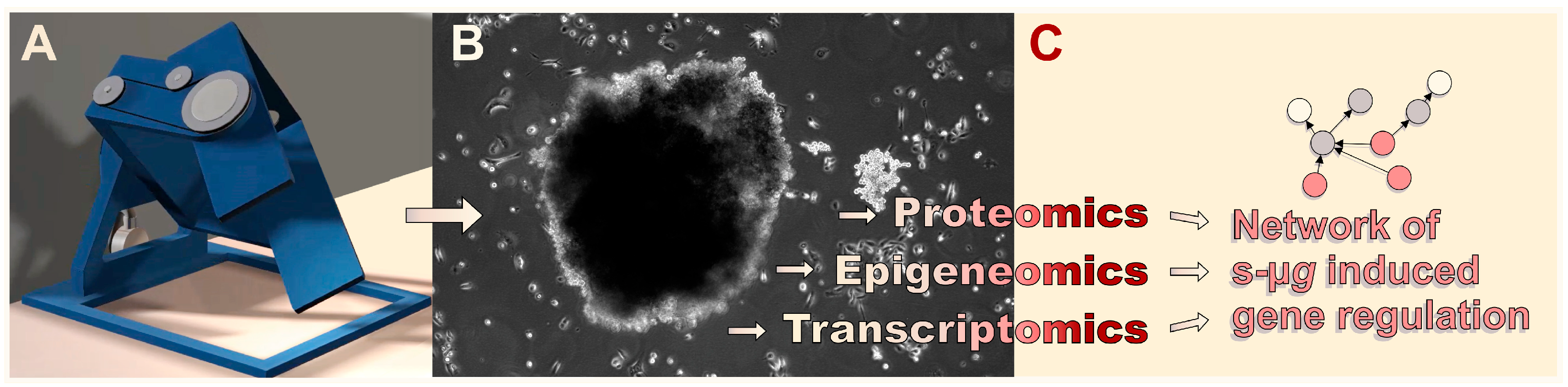
New Knowledge About Tissue Engineering Under Microgravity Conditions in Space and on Earth
 , , ,
, , ,  , , , , , ,
  ,
,  and
and 
Abstract
1. Introduction
2. Microgravity Platforms
2.1. Space Stations
2.2. µg-Simulation Devices
- Clinostats and Rotating Wall Vessels:
- Random Positioning Machine:
3. Methods for Tissue Engineering
3.1. Cells
3.2. Scaffolds
3.3. Scaffold Biofabrication
3.4. Scaffold-Free Tissue Engineering
4. Results from Tissue Engineering Studies Performed in Space or on Earth
4.1. Cartilage
4.2. Bone and Muscle

4.3. Vessels
4.4. Heart
4.5. Organoids and Multicellular Tumor Spheroids
4.6. Breast Cancer
4.7. Lung Cancer
4.8. Thyroid Cancer
4.8.1. Follicular Thyroid Carcinoma
4.8.2. Papillary and Anaplastic Thyroid Carcinoma
4.9. Prostate Cancer
4.10. Gastrointestinal Tumors
4.10.1. Gastric Cancer
4.10.2. Colorectal Cancer
4.10.3. Pancreatic Cancer
4.10.4. Hepatocellular/Liver System
5. Discussion
6. Methods
7. Conclusions
Author Contributions
Funding
Data Availability Statement
Acknowledgments
Conflicts of Interest
References
- Allgower, M. Basics and possibilities of tissue engineering in vitro. Schweiz. Med. Wochenschr. 1948, 78, 312. [Google Scholar]
- Glatthaar, E. Experiments on the cytological differentiation of the atypical portio epithelium with the help of tissue engineering and phase contrast microscopy. Schweiz. Med. Wochenschr. 1948, 78, 720–724. [Google Scholar]
- Langer, R.; Vacanti, J.P. Tissue engineering. Science 1993, 260, 920–926. [Google Scholar] [CrossRef] [PubMed]
- Beysens, D.A.; Van Loon, J.J. Generation and Applications of Extra-Terrestrial Environments on Earth; Taylor & Francis: Oxfordshire, UK, 2015. [Google Scholar]
- Dittus, H. Drop tower ‘bremen’: A weightlessness laboratory on earth. Endeavour 1991, 15, 72–78. [Google Scholar] [CrossRef]
- von Kampen, P.; Kaczmarczik, U.; Rath, H.J. The new Drop Tower catapult system. Acta Astronaut. 2006, 59, 278–283. [Google Scholar] [CrossRef]
- Karmali, F.; Shelhamer, M. The dynamics of parabolic flight: Flight characteristics and passenger percepts. Acta Astronaut. 2008, 63, 594–602. [Google Scholar] [CrossRef] [PubMed]
- Pletser, V. European aircraft parabolic flights for microgravity research, applications and exploration: A review. REACH 2016, 1, 11–19. [Google Scholar] [CrossRef]
- Seibert, G. The History of Sounding Rockets and Their Contribution to European Space Research; Battrick, B., Ed.; ESA Publications Division: Noordwijk, The Netherlands, 2006. [Google Scholar]
- Cosmos/Bion: The age of the biosatellites. In Animals in Space: From Research Rockets to the Space Shuttle; Springer: New York, NY, USA, 2007; pp. 277–305.
- Duan, E.; Long, M. Life Science in Space: Experiments on Board the SJ-10 Recoverable Satellite; Springer: Singapore, 2019. [Google Scholar]
- NASA. Reference Guide to the International Space Station.—Assembly Complete Edition; National Aeronautics and Space Administration (NASA): Washington, DC, USA, 2010. [Google Scholar]
- Rai, A.; Robinson, J.A.; Tate-Brown, J.; Buckley, N.; Zell, M.; Tasaki, K.; Karabadzhak, G.; Sorokin, I.V.; Pignataro, S. Expanded benefits for humanity from the International Space Station. Acta Astronaut. 2016, 126, 463–474. [Google Scholar] [CrossRef]
- Yin, Z.; Zhu, Z.; Guo, P.; Wang, Z.; Yang, J.; Song, Y. On-orbit Space Technology Experiment and Verification Project Outlook of China’s Tiangong Space Station. Space Sci. Technol. 2023, 3, 0061. [Google Scholar] [CrossRef]
- Wang, X.; Zhang, Q.; Wang, W. Design and Application Prospect of China’s Tiangong Space Station. Space Sci. Technol. 2023, 3, 0035. [Google Scholar] [CrossRef]
- Herranz, R.; Anken, R.; Boonstra, J.; Braun, M.; Christianen, P.C.; de Geest, M.; Hauslage, J.; Hilbig, R.; Hill, R.J.; Lebert, M.; et al. Ground-based facilities for simulation of microgravity: Organism-specific recommendations for their use, and recommended terminology. Astrobiology 2013, 13, 1–17. [Google Scholar] [CrossRef]
- Brungs, S.; Egli, M.; Wuest, S.L.; M. Christianen, P.C.; W. A. van Loon, J.J.; Ngo Anh, T.J.; Hemmersbach, R. Facilities for Simulation of Microgravity in the ESA Ground-Based Facility Programme. Microgravity Sci. Technol. 2016, 28, 191–203. [Google Scholar] [CrossRef]
- Hammond, T.; Allen, P. The Bonn Criteria: Minimal Experimental Parameter Reporting for Clinostat and Random Positioning Machine Experiments with Cells and Tissues. Microgravity Sci. Technol. 2011, 23, 271–275. [Google Scholar] [CrossRef]
- Wuest, S.L.; Richard, S.; Kopp, S.; Grimm, D.; Egli, M. Simulated microgravity: Critical review on the use of random positioning machines for mammalian cell culture. Biomed Res. Int. 2015, 2015, 971474. [Google Scholar] [CrossRef] [PubMed]
- van Loon, J.J.W.A. Some history and use of the random positioning machine, RPM, in gravity related research. Adv. Space Res. 2007, 39, 1161–1165. [Google Scholar] [CrossRef]
- Dedolph, R.R.; Dipert, M.H. The physical basis of gravity stimulus nullification by clinostat rotation. Plant Physiol. 1971, 47, 756–764. [Google Scholar] [CrossRef] [PubMed]
- Briegleb, W. Some qualitative and quantitative aspects of the fast-rotating clinostat as a research tool. ASGSB Bull. 1992, 5, 23–30. [Google Scholar]
- Hammond, T.G.; Hammond, J.M. Optimized suspension culture: The rotating-wall vessel. Am. J. Physiol. Ren. Physiol. 2001, 281, F12–F25. [Google Scholar] [CrossRef]
- Ayyaswamy, P.S.; Mukundakrishnan, K. Optimal conditions for simulating microgravity employing NASA designed rotating wall vessels. Acta Astronaut. 2007, 60, 397–405. [Google Scholar] [CrossRef]
- Klaus, D.M.; Todd, P.; Schatz, A. Functional weightlessness during clinorotation of cell suspensions. Adv. Space Res. 1998, 21, 1315–1318. [Google Scholar] [CrossRef]
- Wuest, S.L.; Stern, P.; Casartelli, E.; Egli, M. Fluid Dynamics Appearing during Simulated Microgravity Using Random Positioning Machines. PLoS ONE 2017, 12, e0170826. [Google Scholar] [CrossRef]
- Leguy, C.A.D.; Delfos, R.; Pourquie, M.J.B.M.; Poelma, C.; Westerweel, J.; van Loon, J.J.W.A. Fluid dynamics during Random Positioning Machine micro-gravity experiments. Adv. Space Res. 2017, 59, 3045–3057. [Google Scholar] [CrossRef]
- Hauslage, J.; Cevik, V.; Hemmersbach, R. Pyrocystis noctiluca represents an excellent bioassay for shear forces induced in ground-based microgravity simulators (clinostat and random positioning machine). npj Microgravity 2017, 3, 12. [Google Scholar] [CrossRef]
- Al-Himdani, S.; Jessop, Z.M.; Al-Sabah, A.; Combellack, E.; Ibrahim, A.; Doak, S.H.; Hart, A.M.; Archer, C.W.; Thornton, C.A.; Whitaker, I.S. Tissue-Engineered Solutions in Plastic and Reconstructive Surgery: Principles and Practice. Front. Surg. 2017, 4, 4. [Google Scholar] [CrossRef]
- Aggarwal, S.; Pittenger, M.F. Human mesenchymal stem cells modulate allogeneic immune cell responses. Blood 2005, 105, 1815–1822. [Google Scholar] [CrossRef]
- Basu, M.; Xiao, J.F.; Kailasam Mani, S.K.; Qu, F.; Lin, Y.; Duex, J.; Ye, H.; Neang, V.; Theodorescu, D. Genes driving three-dimensional growth of immortalized cells and cancer. Cell Death Dis. 2025, 16, 442. [Google Scholar] [CrossRef]
- Ferreira, A.M.; Gentile, P.; Chiono, V.; Ciardelli, G. Collagen for bone tissue regeneration. Acta Biomater. 2012, 8, 3191–3200. [Google Scholar] [CrossRef] [PubMed]
- Basha, M.; Aburub, A.; Karageorgos, F.F.; Tsoulfas, G.; Alexopoulos, A.H. Advances in Gelatin-Based Tissue Engineering Using HRP/H2O2. Gels 2025, 11, 460. [Google Scholar] [CrossRef] [PubMed]
- Burdick, J.A.; Prestwich, G.D. Hyaluronic acid hydrogels for biomedical applications. Adv. Mater. 2011, 23, H41–H56. [Google Scholar] [CrossRef] [PubMed]
- Lee, K.Y.; Mooney, D.J. Alginate: Properties and biomedical applications. Prog. Polym. Sci. 2012, 37, 106–126. [Google Scholar] [CrossRef]
- Gilbert, T.W.; Sellaro, T.L.; Badylak, S.F. Decellularization of tissues and organs. Biomaterials 2006, 27, 3675–3683. [Google Scholar] [CrossRef]
- Castaneda-Rodriguez, S.; Gonzalez-Torres, M.; Ribas-Aparicio, R.M.; Del Prado-Audelo, M.L.; Leyva-Gomez, G.; Gurer, E.S.; Sharifi-Rad, J. Recent advances in modified poly (lactic acid) as tissue engineering materials. J. Biol. Eng. 2023, 17, 21. [Google Scholar] [CrossRef]
- Pan, Z.; Ding, J. Poly(lactide-co-glycolide) porous scaffolds for tissue engineering and regenerative medicine. Interface Focus 2012, 2, 366–377. [Google Scholar] [CrossRef] [PubMed]
- Zhu, J. Bioactive modification of poly(ethylene glycol) hydrogels for tissue engineering. Biomaterials 2010, 31, 4639–4656. [Google Scholar] [CrossRef]
- Rahaman, M.N.; Day, D.E.; Bal, B.S.; Fu, Q.; Jung, S.B.; Bonewald, L.F.; Tomsia, A.P. Bioactive glass in tissue engineering. Acta Biomater. 2011, 7, 2355–2373. [Google Scholar] [CrossRef] [PubMed]
- Pham, Q.P.; Sharma, U.; Mikos, A.G. Electrospinning of polymeric nanofibers for tissue engineering applications: A review. Tissue Eng. 2006, 12, 1197–1211. [Google Scholar] [CrossRef] [PubMed]
- Zhang, A.P.; Qu, X.; Soman, P.; Hribar, K.C.; Lee, J.W.; Chen, S.; He, S. Rapid fabrication of complex 3D extracellular microenvironments by dynamic optical projection stereolithography. Adv. Mater. 2012, 24, 4266–4270. [Google Scholar] [CrossRef]
- Zhu, W.; Qu, X.; Zhu, J.; Ma, X.; Patel, S.; Liu, J.; Wang, P.; Lai, C.S.; Gou, M.; Xu, Y.; et al. Direct 3D bioprinting of prevascularized tissue constructs with complex microarchitecture. Biomaterials 2017, 124, 106–115. [Google Scholar] [CrossRef]
- Kang, H.W.; Lee, S.J.; Ko, I.K.; Kengla, C.; Yoo, J.J.; Atala, A. A 3D bioprinting system to produce human-scale tissue constructs with structural integrity. Nat. Biotechnol. 2016, 34, 312–319. [Google Scholar] [CrossRef]
- Lee, A.; Hudson, A.R.; Shiwarski, D.J.; Tashman, J.W.; Hinton, T.J.; Yerneni, S.; Bliley, J.M.; Campbell, P.G.; Feinberg, A.W. 3D bioprinting of collagen to rebuild components of the human heart. Science 2019, 365, 482–487. [Google Scholar] [CrossRef]
- Ryu, N.E.; Lee, S.H.; Park, H. Spheroid Culture System Methods and Applications for Mesenchymal Stem Cells. Cells 2019, 8, 1620. [Google Scholar] [CrossRef]
- Dreiner, M.; Willwacher, S.; Kramer, A.; Kummel, J.; Frett, T.; Zaucke, F.; Liphardt, A.M.; Gruber, M.; Niehoff, A. Short-term Response of Serum Cartilage Oligomeric Matrix Protein to Different Types of Impact Loading Under Normal and Artificial Gravity. Front. Physiol. 2020, 11, 1032. [Google Scholar] [CrossRef]
- Fitzgerald, J.; Endicott, J.; Hansen, U.; Janowitz, C. Articular cartilage and sternal fibrocartilage respond differently to extended microgravity. NPJ Microgravity 2019, 5, 3. [Google Scholar] [CrossRef]
- Steinwerth, P.; Bertrand, J.; Sandt, V.; Marchal, S.; Sahana, J.; Bollmann, M.; Schulz, H.; Kopp, S.; Grimm, D.; Wehland, M. Structural and Molecular Changes of Human Chondrocytes Exposed to the Rotating Wall Vessel Bioreactor. Biomolecules 2023, 14, 25. [Google Scholar] [CrossRef]
- Wehland, M.; Steinwerth, P.; Aleshcheva, G.; Sahana, J.; Hemmersbach, R.; Lutzenberg, R.; Kopp, S.; Infanger, M.; Grimm, D. Tissue Engineering of Cartilage Using a Random Positioning Machine. Int. J. Mol. Sci. 2020, 21, 9596. [Google Scholar] [CrossRef] [PubMed]
- Aissiou, A.K.; Jha, S.; Dhunnoo, K.; Ma, Z.; Li, D.X.; Ravin, R.; Kunze, M.; Wong, K.; Adesida, A.B. Transcriptomic response of bioengineered human cartilage to parabolic flight microgravity is sex-dependent. NPJ Microgravity 2023, 9, 5. [Google Scholar] [CrossRef] [PubMed]
- Ma, Z.; Li, D.X.; Lan, X.; Bubelenyi, A.; Vyhlidal, M.; Kunze, M.; Sommerfeldt, M.; Adesida, A.B. Short-term response of primary human meniscus cells to simulated microgravity. Cell Commun. Signal. 2024, 22, 342. [Google Scholar] [CrossRef]
- Ma, Z.; Li, D.X.; Kunze, M.; Mulet-Sierra, A.; Westover, L.; Adesida, A.B. Engineered Human Meniscus in Modeling Sex Differences of Knee Osteoarthritis In Vitro. Front. Bioeng. Biotechnol. 2022, 10, 823679. [Google Scholar] [CrossRef] [PubMed]
- Mann, V.; Grimm, D.; Corydon, T.J.; Kruger, M.; Wehland, M.; Riwaldt, S.; Sahana, J.; Kopp, S.; Bauer, J.; Reseland, J.E.; et al. Changes in Human Foetal Osteoblasts Exposed to the Random Positioning Machine and Bone Construct Tissue Engineering. Int. J. Mol. Sci. 2019, 20, 1357. [Google Scholar] [CrossRef]
- Widrick, J.J.; Romatowski, J.G.; Norenberg, K.M.; Knuth, S.T.; Bain, J.L.; Riley, D.A.; Trappe, S.W.; Trappe, T.A.; Costill, D.L.; Fitts, R.H. Functional properties of slow and fast gastrocnemius muscle fibers after a 17-day spaceflight. J. Appl. Physiol. 2001, 90, 2203–2211. [Google Scholar] [CrossRef]
- Fitts, R.H.; Trappe, S.W.; Costill, D.L.; Gallagher, P.M.; Creer, A.C.; Colloton, P.A.; Peters, J.R.; Romatowski, J.G.; Bain, J.L.; Riley, D.A. Prolonged space flight-induced alterations in the structure and function of human skeletal muscle fibres. J. Physiol. 2010, 588, 3567–3592. [Google Scholar] [CrossRef]
- Chang, M.; Liu, R.; Chen, B.; Xu, J.; Wang, W.; Ji, Y.; Gao, Z.; Liu, B.; Yao, X.; Sun, H.; et al. hBMSC-EVs alleviate weightlessness-induced skeletal muscle atrophy by suppressing oxidative stress and inflammation. Stem Cell Res. Ther. 2025, 16, 46. [Google Scholar] [CrossRef]
- Poveda, L.; Dash, S.; Madrid, D.; Devane, K.; Lenchik, L.; Tooze, J.; Weaver, A.A. Thoracolumbar spine muscle size and composition changes in long-duration space missions. Life Sci. Space Res. 2025, 44, 1–8. [Google Scholar] [CrossRef]
- Sotos-Prieto, M.; Ruiz-Canela, M.; Song, Y.; Christophi, C.; Mofatt, S.; Rodriguez-Artalejo, F.; Kales, S.N. The Effects of a Mediterranean Diet Intervention on Targeted Plasma Metabolic Biomarkers among US Firefighters: A Pilot Cluster-Randomized Trial. Nutrients 2020, 12, 3610. [Google Scholar] [CrossRef] [PubMed]
- Zhao, S.; Liu, H.; Li, Y.; Song, Y.; Wang, W.; Zhang, C. Numerical analysis of the flow field in the lacunar-canalicular system under different magnitudes of gravity. Med. Biol. Eng. Comput. 2020, 58, 509–518. [Google Scholar] [CrossRef] [PubMed]
- Liu, H.Y.; Zhao, S.; Zhang, H.; Huang, S.Y.; Peng, W.T.; Zhang, C.Q.; Wang, W. Research on solute transport behaviors in the lacunar-canalicular system using numerical simulation in microgravity. Comput. Biol. Med. 2020, 119, 103700. [Google Scholar] [CrossRef] [PubMed]
- Wang, H.; Gao, L.; Chen, X.; Zhang, C. Study on mass transfer in the bone lacunar-canalicular system under different gravity fields. J. Bone Min. Metab. 2022, 40, 940–950. [Google Scholar] [CrossRef]
- Siew, K.; Nestler, K.A.; Nelson, C.; D’Ambrosio, V.; Zhong, C.; Li, Z.; Grillo, A.; Wan, E.R.; Patel, V.; Overbey, E.; et al. Cosmic kidney disease: An integrated pan-omic, physiological and morphological study into spaceflight-induced renal dysfunction. Nat. Commun. 2024, 15, 4923. [Google Scholar] [CrossRef]
- Krüger, M.; Kopp, S.; Wehland, M.; Bauer, J.; Baatout, S.; Moreels, M.; Egli, M.; Corydon, T.J.; Infanger, M.; Grimm, D. Growing blood vessels in space: Preparation studies of the SPHEROIDS project using related ground-based studies. Acta Astronaut. 2019, 159, 267–272. [Google Scholar] [CrossRef]
- Paar, V.; Boxhammer, E.; Marmullaku, F.; Hoppe, U.C.; Lichtenauer, M.; Jirak, P. Parabolic flight as a space-flight analogon impacts angiogenesis and lipid metabolism. Life Sci. Space Res. 2025, 46, 115–127. [Google Scholar] [CrossRef]
- Kruger, M.; Pietsch, J.; Bauer, J.; Kopp, S.; Carvalho, D.T.O.; Baatout, S.; Moreels, M.; Melnik, D.; Wehland, M.; Egli, M.; et al. Growth of Endothelial Cells in Space and in Simulated Microgravity—A Comparison on the Secretory Level. Cell. Physiol. Biochem. 2019, 52, 1039–1060. [Google Scholar] [CrossRef]
- Joksiene, J.; Sahana, J.; Wehland, M.; Schulz, H.; Cortes-Sanchez, J.L.; Prat-Duran, J.; Grimm, D.; Simonsen, U. Effects of High Glucose on Human Endothelial Cells Exposed to Simulated Microgravity. Biomolecules 2023, 13, 189. [Google Scholar] [CrossRef]
- Camberos, V.; Baio, J.; Bailey, L.; Hasaniya, N.; Lopez, L.V.; Kearns-Jonker, M. Effects of Spaceflight and Simulated Microgravity on YAP1 Expression in Cardiovascular Progenitors: Implications for Cell-Based Repair. Int. J. Mol. Sci. 2019, 20, 2742. [Google Scholar] [CrossRef]
- Camberos, V.; Baio, J.; Mandujano, A.; Martinez, A.F.; Bailey, L.; Hasaniya, N.; Kearns-Jonker, M. The Impact of Spaceflight and Microgravity on the Human Islet-1+ Cardiovascular Progenitor Cell Transcriptome. Int. J. Mol. Sci. 2021, 22, 3577. [Google Scholar] [CrossRef]
- Del Re, D.P.; Yang, Y.; Nakano, N.; Cho, J.; Zhai, P.; Yamamoto, T.; Zhang, N.; Yabuta, N.; Nojima, H.; Pan, D.; et al. Yes-associated protein isoform 1 (Yap1) promotes cardiomyocyte survival and growth to protect against myocardial ischemic injury. J. Biol. Chem. 2013, 288, 3977–3988. [Google Scholar] [CrossRef] [PubMed]
- Wnorowski, A.; Sharma, A.; Chen, H.; Wu, H.; Shao, N.Y.; Sayed, N.; Liu, C.; Countryman, S.; Stodieck, L.S.; Rubins, K.H.; et al. Effects of Spaceflight on Human Induced Pluripotent Stem Cell-Derived Cardiomyocyte Structure and Function. Stem Cell Rep. 2019, 13, 960–969. [Google Scholar] [CrossRef] [PubMed]
- Forghani, P.; Rashid, A.; Armand, L.C.; Wolfson, D.; Liu, R.; Cho, H.C.; Maxwell, J.T.; Jo, H.; Salaita, K.; Xu, C. Simulated microgravity improves maturation of cardiomyocytes derived from human induced pluripotent stem cells. Sci. Rep. 2024, 14, 2243. [Google Scholar] [CrossRef] [PubMed]
- Karbassi, E.; Fenix, A.; Marchiano, S.; Muraoka, N.; Nakamura, K.; Yang, X.; Murry, C.E. Cardiomyocyte maturation: Advances in knowledge and implications for regenerative medicine. Nat. Rev. Cardiol. 2020, 17, 341–359. [Google Scholar] [CrossRef]
- Rampoldi, A.; Forghani, P.; Li, D.; Hwang, H.; Armand, L.C.; Fite, J.; Boland, G.; Maxwell, J.; Maher, K.; Xu, C. Space microgravity improves proliferation of human iPSC-derived cardiomyocytes. Stem Cell Rep. 2022, 17, 2272–2285. [Google Scholar] [CrossRef]
- Hwang, H.; Rampoldi, A.; Forghani, P.; Li, D.; Fite, J.; Boland, G.; Maher, K.; Xu, C. Space microgravity increases expression of genes associated with proliferation and differentiation in human cardiac spheres. NPJ Microgravity 2023, 9, 88. [Google Scholar] [CrossRef]
- Forghani, P.; Liu, W.; Wang, Z.; Ling, Z.; Takaesu, F.; Yang, E.; Tharp, G.K.; Nielsen, S.; Doraisingam, S.; Countryman, S.; et al. Spaceflight alters protein levels and gene expression associated with stress response and metabolic characteristics in human cardiac spheroids. Biomaterials 2025, 317, 123080. [Google Scholar] [CrossRef]
- Mair, D.B.; Tsui, J.H.; Higashi, T.; Koenig, P.; Dong, Z.; Chen, J.F.; Meir, J.U.; Smith, A.S.T.; Lee, P.H.U.; Ahn, E.H.; et al. Spaceflight-induced contractile and mitochondrial dysfunction in an automated heart-on-a-chip platform. Proc. Natl. Acad. Sci. USA 2024, 121, e2404644121. [Google Scholar] [CrossRef]
- Han, X.; Qu, L.; Yu, M.; Ye, L.; Shi, L.; Ye, G.; Yang, J.; Wang, Y.; Fan, H.; Wang, Y.; et al. Thiamine-modified metabolic reprogramming of human pluripotent stem cell-derived cardiomyocyte under space microgravity. Signal Transduct. Target. Ther. 2024, 9, 86. [Google Scholar] [CrossRef]
- Acharya, A.; Nemade, H.; Papadopoulos, S.; Hescheler, J.; Neumaier, F.; Schneider, T.; Rajendra Prasad, K.; Khan, K.; Hemmersbach, R.; Gusmao, E.G.; et al. Microgravity-induced stress mechanisms in human stem cell-derived cardiomyocytes. iScience 2022, 25, 104577. [Google Scholar] [CrossRef]
- Bray, F.; Laversanne, M.; Sung, H.; Ferlay, J.; Siegel, R.L.; Soerjomataram, I.; Jemal, A. Global cancer statistics 2022: GLOBOCAN estimates of incidence and mortality worldwide for 36 cancers in 185 countries. CA Cancer J. Clin. 2024, 74, 229–263. [Google Scholar] [CrossRef]
- Amos, S.E.; Choi, Y.S. The Cancer Microenvironment: Mechanical Challenges of the Metastatic Cascade. Front. Bioeng. Biotechnol. 2021, 9, 625859. [Google Scholar] [CrossRef] [PubMed]
- Dominiak, A.; Chelstowska, B.; Olejarz, W.; Nowicka, G. Communication in the Cancer Microenvironment as a Target for Therapeutic Interventions. Cancers 2020, 12, 1232. [Google Scholar] [CrossRef] [PubMed]
- Radajewska, A.; Przybyszewski, O.; Emhemmed, F.; Muller, C.D.; Barg, E.; Moreira, H. Three dimensional in vitro culture systems in anticancer drug discovery targeted on cancer stem cells. Am. J. Cancer Res. 2021, 11, 4931–4946. [Google Scholar]
- Jensen, C.; Teng, Y. Is It Time to Start Transitioning From 2D to 3D Cell Culture? Front. Mol. Biosci. 2020, 7, 33. [Google Scholar] [CrossRef]
- Workman, P.; Aboagye, E.O.; Balkwill, F.; Balmain, A.; Bruder, G.; Chaplin, D.J.; Double, J.A.; Everitt, J.; Farningham, D.A.; Glennie, M.J.; et al. Guidelines for the welfare and use of animals in cancer research. Br. J. Cancer 2010, 102, 1555–1577. [Google Scholar] [CrossRef]
- Marques, J.; Gonzalez-Alva, P.; Yu-Tong Lin, R.; Ferreira Fernandes, B.; Chaurasia, A.; Dubey, N. Advances in tissue engineering of cancer microenvironment-from three-dimensional culture to three-dimensional printing. SLAS Technol. 2023, 28, 152–164. [Google Scholar] [CrossRef]
- Paul, C.D.; Yankaskas, C.; Shahi Thakuri, P.; Balhouse, B.; Salen, S.; Bullock, A.; Beam, S.; Chatman, A.; Djikeng, S.; Yang, X.J.; et al. Long-term maintenance of patient-specific characteristics in tumoroids from six cancer indications. Sci. Rep. 2025, 15, 3933. [Google Scholar] [CrossRef]
- Abbasi-Malati, Z.; Khanicheragh, P.; Narmi, M.T.; Mardi, N.; Khosrowshahi, N.D.; Hiradfar, A.; Rezabakhsh, A.; Sadeghsoltani, F.; Rashidi, S.; Chegeni, S.A.; et al. Tumoroids, a valid preclinical screening platform for monitoring cancer angiogenesis. Stem Cell Res. Ther. 2024, 15, 267. [Google Scholar] [CrossRef] [PubMed]
- Augustine, R.; Kalva, S.N.; Ahmad, R.; Zahid, A.A.; Hasan, S.; Nayeem, A.; McClements, L.; Hasan, A. 3D Bioprinted cancer models: Revolutionizing personalized cancer therapy. Transl. Oncol. 2021, 14, 101015. [Google Scholar] [CrossRef] [PubMed]
- Jain, P.; Kathuria, H.; Dubey, N. Advances in 3D bioprinting of tissues/organs for regenerative medicine and in-vitro models. Biomaterials 2022, 287, 121639. [Google Scholar] [CrossRef]
- Barbosa, M.A.G.; Xavier, C.P.R.; Pereira, R.F.; Petrikaite, V.; Vasconcelos, M.H. 3D Cell Culture Models as Recapitulators of the Tumor Microenvironment for the Screening of Anti-Cancer Drugs. Cancers 2021, 14, 190. [Google Scholar] [CrossRef]
- Lancaster, M.A.; Huch, M. Disease modelling in human organoids. Dis. Model. Mech. 2019, 12, dmm039347. [Google Scholar] [CrossRef] [PubMed]
- Vitale, I.; Shema, E.; Loi, S.; Galluzzi, L. Intratumoral heterogeneity in cancer progression and response to immunotherapy. Nat. Med. 2021, 27, 212–224. [Google Scholar] [CrossRef]
- van den Nieuwenhof, D.W.A.; Moroni, L.; Chou, J.; Hinkelbein, J. Cellular response in three-dimensional spheroids and tissues exposed to real and simulated microgravity: A narrative review. npj Microgravity 2024, 10, 102. [Google Scholar] [CrossRef]
- Breideband, L.; Wachtershauser, K.N.; Sarkar, R.; Puspathasan, M.; Stelzer, E.H.K.; Pampaloni, F. Gravitational forces and matrix stiffness modulate the invasiveness of breast cancer cells in bioprinted spheroids. Mater. Today Bio 2025, 31, 101640. [Google Scholar] [CrossRef]
- Sahana, J.; Cortes-Sanchez, J.L.; Sandt, V.; Melnik, D.; Corydon, T.J.; Schulz, H.; Cai, Z.; Evert, K.; Grimm, D.; Wehland, M. Long-Term Simulation of Microgravity Induces Changes in Gene Expression in Breast Cancer Cells. Int. J. Mol. Sci. 2023, 24, 1181. [Google Scholar] [CrossRef] [PubMed]
- Sahana, J.; Corydon, T.J.; Wehland, M.; Kruger, M.; Kopp, S.; Melnik, D.; Kahlert, S.; Relja, B.; Infanger, M.; Grimm, D. Alterations of Growth and Focal Adhesion Molecules in Human Breast Cancer Cells Exposed to the Random Positioning Machine. Front. Cell Dev. Biol. 2021, 9, 672098. [Google Scholar] [CrossRef] [PubMed]
- Strube, F.; Infanger, M.; Wehland, M.; Delvinioti, X.; Romswinkel, A.; Dietz, C.; Kraus, A. Alteration of Cytoskeleton Morphology and Gene Expression in Human Breast Cancer Cells under Simulated Microgravity. Cell J. 2020, 22, 106–114. [Google Scholar] [CrossRef]
- Strube, F.; Infanger, M.; Dietz, C.; Romswinkel, A.; Kraus, A. Short-term effects of simulated microgravity on morphology and gene expression in human breast cancer cells. Physiol. Int. 2019, 106, 311–322. [Google Scholar] [CrossRef] [PubMed]
- Wise, P.M.; Sahana, J.; Neviani, P.; Corydon, T.J.; Schulz, H.; Wehland, M.; Infanger, M.; Grimm, D. Prolonged Exposure to Simulated Microgravity Changes Release of Small Extracellular Vesicle in Breast Cancer Cells. Int. J. Mol. Sci. 2022, 23, 16095. [Google Scholar] [CrossRef]
- Chen, Y.; Xue, F.; Russo, A.; Wan, Y. Proteomic Analysis of Extracellular Vesicles Derived from MDA-MB-231 Cells in Microgravity. Protein J. 2021, 40, 108–118. [Google Scholar] [CrossRef]
- Monti, N.; Masiello, M.G.; Proietti, S.; Catizone, A.; Ricci, G.; Harrath, A.H.; Alwasel, S.H.; Cucina, A.; Bizzarri, M. Survival Pathways Are Differently Affected by Microgravity in Normal and Cancerous Breast Cells. Int. J. Mol. Sci. 2021, 22, 862. [Google Scholar] [CrossRef]
- Mabela, C.M.; Gouws, C.; Pheiffer, W. Overcoming obstacles in three-dimensional cell culture model establishment: Approaches for growing A549 non-small cell lung cancer spheroids using a clinostat system. J. Pharmacol. Toxicol. Methods 2024, 130, 107564. [Google Scholar] [CrossRef]
- Baghoum, H.; Alahmed, H.; Hachim, M.; Senok, A.; Jalaleddine, N.; Al Heialy, S. Simulated Microgravity Influences Immunity-Related Biomarkers in Lung Cancer. Int. J. Mol. Sci. 2022, 24, 155. [Google Scholar] [CrossRef]
- Degan, P.; Cortese, K.; Pulliero, A.; Bruno, S.; Gagliani, M.C.; Congiu, M.; Izzotti, A. Simulated Microgravity Effects on Human Adenocarcinoma Alveolar Epithelial Cells: Characterization of Morphological, Functional, and Epigenetic Parameters. Int. J. Mol. Sci. 2021, 22, 6951. [Google Scholar] [CrossRef]
- Ahn, C.B.; Lee, J.H.; Han, D.G.; Kang, H.W.; Lee, S.H.; Lee, J.I.; Son, K.H.; Lee, J.W. Simulated microgravity with floating environment promotes migration of non-small cell lung cancers. Sci. Rep. 2019, 9, 14553. [Google Scholar] [CrossRef]
- Dietz, C.; Infanger, M.; Romswinkel, A.; Strube, F.; Kraus, A. Apoptosis Induction and Alteration of Cell Adherence in Human Lung Cancer Cells under Simulated Microgravity. Int. J. Mol. Sci. 2019, 20, 3601. [Google Scholar] [CrossRef] [PubMed]
- Barkia, B.; Sandt, V.; Melnik, D.; Cortes-Sanchez, J.L.; Marchal, S.; Baselet, B.; Baatout, S.; Sahana, J.; Grimm, D.; Wehland, M.; et al. The Formation of Stable Lung Tumor Spheroids during Random Positioning Involves Increased Estrogen Sensitivity. Biomolecules 2024, 14, 1292. [Google Scholar] [CrossRef]
- Sung, H.; Ferlay, J.; Siegel, R.L.; Laversanne, M.; Soerjomataram, I.; Jemal, A.; Bray, F. Global Cancer Statistics 2020: GLOBOCAN Estimates of Incidence and Mortality Worldwide for 36 Cancers in 185 Countries. CA Cancer J. Clin. 2021, 71, 209–249. [Google Scholar] [CrossRef]
- Melnik, D.; Sahana, J.; Corydon, T.J.; Kopp, S.; Nassef, M.Z.; Wehland, M.; Infanger, M.; Grimm, D.; Kruger, M. Dexamethasone Inhibits Spheroid Formation of Thyroid Cancer Cells Exposed to Simulated Microgravity. Cells 2020, 9, 367. [Google Scholar] [CrossRef] [PubMed]
- Bevelacqua, J.J.; Welsh, J.; Mortazavi, S.M.J. Comment on “Dexamethasone Inhibits Spheroid Formation of Thyroid Cancer Cells Exposed to Simulated Microgravity”. Cells 2020, 9, 1738. [Google Scholar] [CrossRef] [PubMed]
- Kruger, M.; Kopp, S.; Wehland, M.; Corydon, T.J.; Grimm, D. Science between Bioreactors and Space Research-Response to Comments by Joseph J. Bevelacqua et al. on “Dexamethasone Inhibits Spheroid Formation of Thyroid Cancer Cells Exposed to Simulated Microgravity”. Cells 2020, 9, 1763. [Google Scholar] [CrossRef]
- Melnik, D.; Cortes-Sanchez, J.L.; Sandt, V.; Kahlert, S.; Kopp, S.; Grimm, D.; Kruger, M. Dexamethasone Selectively Inhibits Detachment of Metastatic Thyroid Cancer Cells during Random Positioning. Cancers 2023, 15, 1641. [Google Scholar] [CrossRef]
- Cortes-Sanchez, J.L.; Melnik, D.; Sandt, V.; Kahlert, S.; Marchal, S.; Johnson, I.R.D.; Calvaruso, M.; Liemersdorf, C.; Wuest, S.L.; Grimm, D.; et al. Fluid and Bubble Flow Detach Adherent Cancer Cells to Form Spheroids on a Random Positioning Machine. Cells 2023, 12, 2665. [Google Scholar] [CrossRef]
- Melnik, D.; Kruger, M.; Schulz, H.; Kopp, S.; Wehland, M.; Bauer, J.; Baselet, B.; Vermeesen, R.; Baatout, S.; Corydon, T.J.; et al. The CellBox-2 Mission to the International Space Station: Thyroid Cancer Cells in Space. Int. J. Mol. Sci. 2021, 22, 8777. [Google Scholar] [CrossRef]
- Ahn, J.H.; Park, S.; Hwang, Y.M.; Choi, Y.S.; Yi, J.W. Morphologic and genomic changes of thyroid cancer cell lines exposed to conditions of simulated microgravity. NPJ Microgravity 2024, 10, 8. [Google Scholar] [CrossRef]
- Demirbakan, B. Biosensor Systems for Prostate Cancer Diagnosis: Principles, Advances and Clinical Perspectives. In Advancements in Biosensors: Fundamentals, Technologies, and Applications; Özgür Yayınları: Gaziantep, Turkey, 2025. [Google Scholar]
- Grimm, D.; Schulz, H.; Kruger, M.; Cortes-Sanchez, J.L.; Egli, M.; Kraus, A.; Sahana, J.; Corydon, T.J.; Hemmersbach, R.; Wise, P.M.; et al. The Fight against Cancer by Microgravity: The Multicellular Spheroid as a Metastasis Model. Int. J. Mol. Sci. 2022, 23, 3073. [Google Scholar] [CrossRef]
- Chen, Z.Y.; Guo, S.; Li, B.B.; Jiang, N.; Li, A.; Yan, H.F.; Yang, H.M.; Zhou, J.L.; Li, C.L.; Cui, Y. Effect of Weightlessness on the 3D Structure Formation and Physiologic Function of Human Cancer Cells. Biomed. Res. Int. 2019, 2019, 4894083. [Google Scholar] [CrossRef] [PubMed]
- Bradbury, P.; Wu, H.; Choi, J.U.; Rowan, A.E.; Zhang, H.; Poole, K.; Lauko, J.; Chou, J. Modeling the Impact of Microgravity at the Cellular Level: Implications for Human Disease. Front. Cell Dev. Biol. 2020, 8, 96. [Google Scholar] [CrossRef] [PubMed]
- Aleshcheva, G.; Bauer, J.; Hemmersbach, R.; Slumstrup, L.; Wehland, M.; Infanger, M.; Grimm, D. Scaffold-free Tissue Formation Under Real and Simulated Microgravity Conditions. Basic. Clin. Pharmacol. Toxicol. 2016, 119, 26–33. [Google Scholar] [CrossRef]
- Grimm, D.; Wehland, M.; Corydon, T.J.; Richter, P.; Prasad, B.; Bauer, J.; Egli, M.; Kopp, S.; Lebert, M.; Kruger, M. The effects of microgravity on differentiation and cell growth in stem cells and cancer stem cells. Stem Cells Transl. Med. 2020, 9, 882–894. [Google Scholar] [CrossRef] [PubMed]
- Graf, J.; Schulz, H.; Wehland, M.; Corydon, T.J.; Sahana, J.; Abdelfattah, F.; Wuest, S.L.; Egli, M.; Kruger, M.; Kraus, A.; et al. Omics Studies of Tumor Cells under Microgravity Conditions. Int. J. Mol. Sci. 2024, 25, 926. [Google Scholar] [CrossRef]
- Wang, R.; Xu, J.; Juliette, L.; Castilleja, A.; Love, J.; Sung, S.Y.; Zhau, H.E.; Goodwin, T.J.; Chung, L.W. Three-dimensional co-culture models to study prostate cancer growth, progression, and metastasis to bone. Semin. Cancer Biol. 2005, 15, 353–364. [Google Scholar] [CrossRef]
- Hybel, T.E.; Dietrichs, D.; Sahana, J.; Corydon, T.J.; Nassef, M.Z.; Wehland, M.; Kruger, M.; Magnusson, N.E.; Bauer, J.; Utpatel, K.; et al. Simulated Microgravity Influences VEGF, MAPK, and PAM Signaling in Prostate Cancer Cells. Int. J. Mol. Sci. 2020, 21, 1263. [Google Scholar] [CrossRef]
- Dietrichs, D.; Grimm, D.; Sahana, J.; Melnik, D.; Corydon, T.J.; Wehland, M.; Kruger, M.; Vermeesen, R.; Baselet, B.; Baatout, S.; et al. Three-Dimensional Growth of Prostate Cancer Cells Exposed to Simulated Microgravity. Front. Cell Dev. Biol. 2022, 10, 841017. [Google Scholar] [CrossRef]
- Clejan, S.; O’Connor, K.; Rosensweig, N. Tri-dimensional prostate cell cultures in simulated microgravity and induced changes in lipid second messengers and signal transduction. J. Cell. Mol. Med. 2001, 5, 60–73. [Google Scholar] [CrossRef]
- Song, H.; David, O.; Clejan, S.; Giordano, C.L.; Pappas-Lebeau, H.; Xu, L.; O’Connor, K.C. Spatial composition of prostate cancer spheroids in mixed and static cultures. Tissue Eng. 2004, 10, 1266–1276. [Google Scholar] [CrossRef]
- Schulz, H.; Abdelfattah, F.; Heinrich, A.; Melnik, D.; Sandt, V.; Kruger, M.; Wehland, M.; Hoffmann, P.; Cortes-Sanchez, J.L.; Evert, M.; et al. Omics Investigations of Prostate Cancer Cells Exposed to Simulated Microgravity Conditions. Biomolecules 2025, 15, 303. [Google Scholar] [CrossRef]
- Twombly, R. Prostate modeling experiment success becomes part of legacy of shuttle astronauts. J. Natl. Cancer Inst. 2003, 95, 505–507. [Google Scholar] [CrossRef]
- Schulz, H.; Dietrichs, D.; Wehland, M.; Corydon, T.J.; Hemmersbach, R.; Liemersdorf, C.; Melnik, D.; Hubner, N.; Saar, K.; Infanger, M.; et al. In Prostate Cancer Cells Cytokines Are Early Responders to Gravitational Changes Occurring in Parabolic Flights. Int. J. Mol. Sci. 2022, 23, 7876. [Google Scholar] [CrossRef]
- Chen, Z.Y.; Jiang, N.; Guo, S.; Li, B.B.; Yang, J.Q.; Chai, S.B.; Yan, H.F.; Sun, P.M.; Zhang, T.; Sun, H.W.; et al. Effect of simulated microgravity on metabolism of HGC-27 gastric cancer cells. Oncol. Lett. 2020, 19, 3439–3450. [Google Scholar] [CrossRef] [PubMed]
- Arun, R.P.; Sivanesan, D.; Patra, B.; Varadaraj, S.; Verma, R.S. Simulated microgravity increases polyploid giant cancer cells and nuclear localization of YAP. Sci. Rep. 2019, 9, 10684. [Google Scholar] [CrossRef] [PubMed]
- Rembialkowska, N.; Baczynska, D.; Dubinska-Magiera, M.; Choromanska, A.; Biezunska-Kusiak, K.; Gajewska-Naryniecka, A.; Novickij, V.; Saczko, J.; Przystupski, D.; Kulbacka, J. RCCS Bioreactor-Based Modeled Microgravity Affects Gastric Cancer Cells and Improves the Chemotherapeutic Effect. Membranes 2022, 12, 448. [Google Scholar] [CrossRef]
- Kim, S.C.; Kim, M.J.; Park, J.W.; Shin, Y.K.; Jeong, S.Y.; Kim, S.; Ku, J.L. Effects of simulated microgravity on colorectal cancer organoids growth and drug response. Sci. Rep. 2024, 14, 25526. [Google Scholar] [CrossRef]
- Masini, M.A.; Bonetto, V.; Manfredi, M.; Pasto, A.; Barberis, E.; Timo, S.; Vanella, V.V.; Robotti, E.; Masetto, F.; Andreoli, F.; et al. Prolonged exposure to simulated microgravity promotes stemness impairing morphological, metabolic and migratory profile of pancreatic cancer cells: A comprehensive proteomic, lipidomic and transcriptomic analysis. Cell. Mol. Life Sci. 2022, 79, 226. [Google Scholar] [CrossRef] [PubMed]
- Pagano, C.A.; Masini, M.A.; Sabbatini, M.; Gribaudo, G.; Manfredi, M.; Capri, F.G.; Bonetto, V.; Magnelli, V.; Donadelli, M.; Corino, R.; et al. Simulated Microgravity-Induced Alterations in PDAC Cells: A Potential Role for Trichostatin A in Restoring Cellular Phenotype. Int. J. Mol. Sci. 2025, 26, 4758. [Google Scholar] [CrossRef]
- Zeger, L.; Barasa, P.; Han, Y.; Hellgren, J.; Redwan, I.N.; Reiche, M.E.; Florin, G.; Christoffersson, G.; Kozlova, E.N. Microgravity Effect on Pancreatic Islets. Cells 2024, 13, 1588. [Google Scholar] [CrossRef] [PubMed]
- Hoang, H.N.Q.; Ho, C.N.Q.; Dang, L.T.T.; Phan, N.L.C.; Doan, C.C.; Nguyen, H.T.M.; Le, C.P.M.; Hoang, S.N.; Le, L.T. The Proliferation of Chang Liver Cells After Simulated Microgravity Induction. Curr. Issues Mol. Biol. 2025, 47, 164. [Google Scholar] [CrossRef]
- Tuğcu, B.; Yarkent, Ç.; Çelik, Y.; Köse, A.; Oncel, S.S. Comparison of HepG2 Cell Spheroid Formation Under Bioreactor Productions with Two Mixing Strategies by RCCS and CSTR. Microgravity Sci. Technol. 2025, 37, 16. [Google Scholar] [CrossRef]
- Riwaldt, S.; Bauer, J.; Pietsch, J.; Braun, M.; Segerer, J.; Schwarzwalder, A.; Corydon, T.J.; Infanger, M.; Grimm, D. The Importance of Caveolin-1 as Key-Regulator of Three-Dimensional Growth in Thyroid Cancer Cells Cultured under Real and Simulated Microgravity Conditions. Int. J. Mol. Sci. 2015, 16, 28296–28310. [Google Scholar] [CrossRef] [PubMed]
- Ingram, M.; Techy, G.B.; Saroufeem, R.; Yazan, O.; Narayan, K.S.; Goodwin, T.J.; Spaulding, G.F. Three-dimensional growth patterns of various human tumor cell lines in simulated microgravity of a NASA bioreactor. In Vitro Cell. Dev. Biol. Anim. 1997, 33, 459–466. [Google Scholar] [CrossRef] [PubMed]
- Ma, X.; Pietsch, J.; Wehland, M.; Schulz, H.; Saar, K.; Hubner, N.; Bauer, J.; Braun, M.; Schwarzwalder, A.; Segerer, J.; et al. Differential gene expression profile and altered cytokine secretion of thyroid cancer cells in space. FASEB J. 2014, 28, 813–835. [Google Scholar] [CrossRef]
- Pietsch, J.; Ma, X.; Wehland, M.; Aleshcheva, G.; Schwarzwalder, A.; Segerer, J.; Birlem, M.; Horn, A.; Bauer, J.; Infanger, M.; et al. Spheroid formation of human thyroid cancer cells in an automated culturing system during the Shenzhou-8 Space mission. Biomaterials 2013, 34, 7694–7705. [Google Scholar] [CrossRef]
- Dittrich, A.; Grimm, D.; Sahana, J.; Bauer, J.; Kruger, M.; Infanger, M.; Magnusson, N.E. Key Proteins Involved in Spheroid Formation and Angiogenesis in Endothelial Cells After Long-Term Exposure to Simulated Microgravity. Cell. Physiol. Biochem. 2018, 45, 429–445. [Google Scholar] [CrossRef]
- Freed, L.E.; Langer, R.; Martin, I.; Pellis, N.R.; Vunjak-Novakovic, G. Tissue engineering of cartilage in space. Proc. Natl. Acad. Sci. USA 1997, 94, 13885–13890. [Google Scholar] [CrossRef]
- Stamenkovic, V.; Keller, G.; Nesic, D.; Cogoli, A.; Grogan, S.P. Neocartilage formation in 1 g, simulated, and microgravity environments: Implications for tissue engineering. Tissue Eng. Part A 2010, 16, 1729–1736. [Google Scholar] [CrossRef]
- Parfenov, V.A.; Khesuani, Y.D.; Petrov, S.V.; Karalkin, P.A.; Koudan, E.V.; Nezhurina, E.K.; Pereira, F.D.; Krokhmal, A.A.; Gryadunova, A.A.; Bulanova, E.A.; et al. Magnetic levitational bioassembly of 3D tissue construct in space. Sci. Adv. 2020, 6, eaba4174. [Google Scholar] [CrossRef] [PubMed]
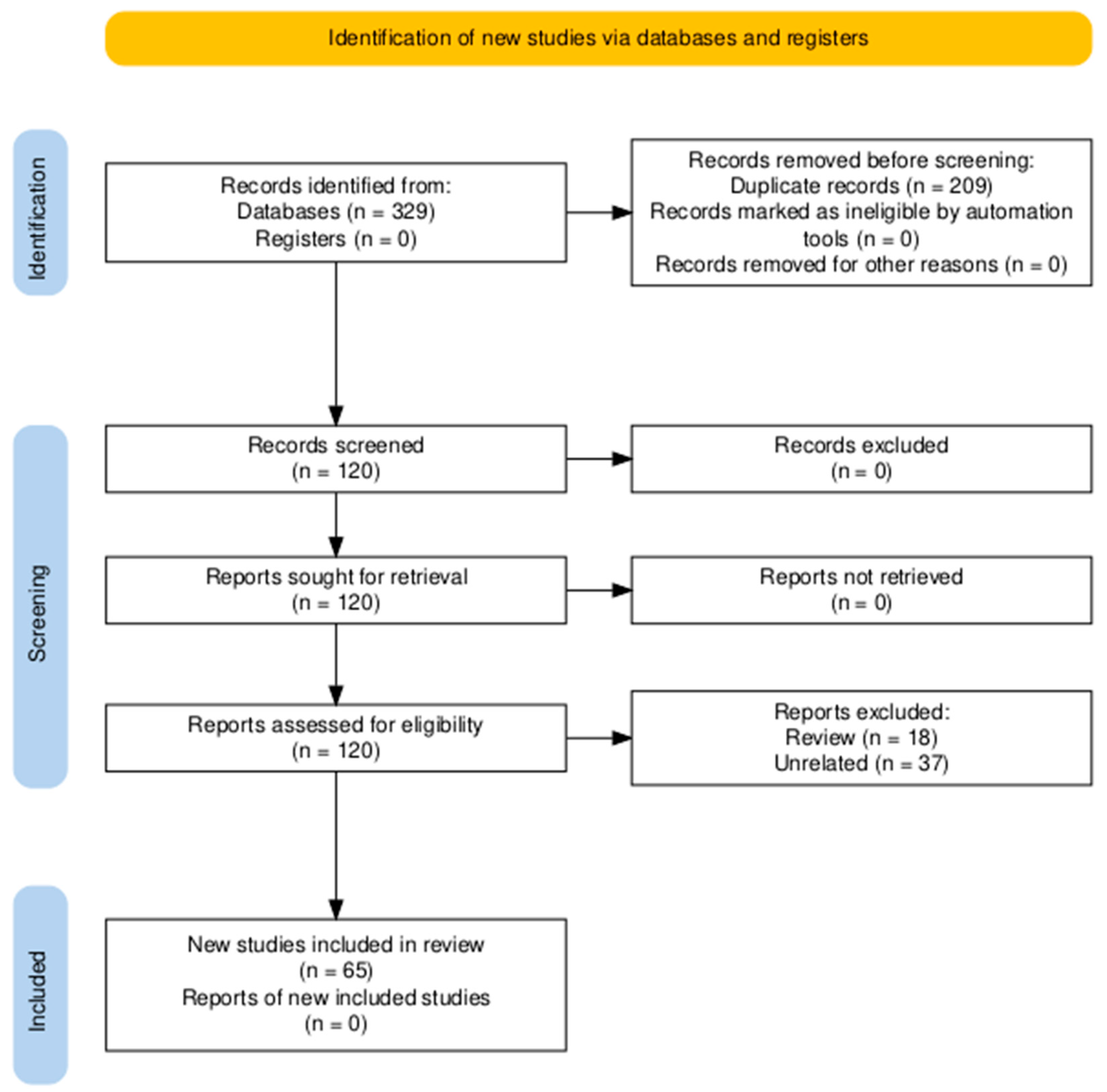
- Haddaway, N.R.; Page, M.J.; Pritchard, C.C.; McGuinness, L.A. PRISMA2020: An R package and Shiny app for producing PRISMA 2020-compliant flow diagrams, with interactivity for optimised digital transparency and Open Synthesis. Campbell Syst. Rev. 2022, 18, e1230. [Google Scholar] [CrossRef] [PubMed]
- Unsworth, B.R.; Lelkes, P.I. Growing tissues in microgravity. Nat. Med. 1998, 4, 901–907. [Google Scholar] [CrossRef]
- Marotta, D.; Ward, N.; Bauer, S.R.; Hunsberger, J.; Stoudemire, J.; Savin, K.; Giulianotti, M.; Jamieson, C.H.M.; Roberts, D.; Roberts, M. Biomanufacturing in low Earth orbit: A paradigm shift. Stem Cell Reports 2025, 20, 102536. [Google Scholar] [CrossRef] [PubMed]
- Marotta, D.; Ijaz, L.; Barbar, L.; Nijsure, M.; Stein, J.; Pirjanian, N.; Kruglikov, I.; Clements, T.; Stoudemire, J.; Grisanti, P.; et al. Effects of microgravity on human iPSC-derived neural organoids on the International Space Station. Stem Cells Transl. Med. 2024, 13, 1186–1197. [Google Scholar] [CrossRef]
- Pirjanian, N.A.; Kalpana, K.; Kruglikov, I.; Mesci, P.; Stoudemire, J.; Grisanti, P.; Noggle, S.A.; Loring, J.F.; Fossati, V. Establishing Neural Organoid Cultures for Investigating the Effects of Microgravity in Low-Earth Orbit (LEO). Methods Mol Biol. 2025, 2951, 91–109. [Google Scholar] [CrossRef]
- Mozneb, M.; Arzt, M.; Mesci, P.; Martin, D.M.N.; Pohlman, S.; Lawless, G.; Doraisingam, S.; Al Neyadi, S.; Barnawi, R.; Al Qarni, A.; et al. Surface tension enables induced pluripotent stem cell culture in commercially available hardware during spaceflight. NPJ Microgravity 2024, 10, 97. [Google Scholar] [CrossRef]
- Kim, S.; Min, K.; Park, Y.G.; Moon, S.H. Stem cells in space: Microgravity effects on stem cell fate and implications for regenerative medicine. npj Microgravity 2025. [Google Scholar] [CrossRef]
- Derobertmasure, A.; Toh, L.S.; Wotring, V.E.; Williams, P.M.; Morbidelli, L.; Stingl, J.C.; Vinken, M.; Ramadan, R.; Chhun, S.; Boutouyrie, P. Pharmacological countermeasures for long-duration space missions: Addressing cardiovascular challenges and advancing space-adapted healthcare. Eur J Pharm Sci. 2025, 209, 107063. [Google Scholar] [CrossRef]



| Space Station | Clinostat | Rotating Wall Vessel (RWV) | Random Positioning Machine (RPM) | |
|---|---|---|---|---|
| µg quality | 10−4–10−6 g | Simulated | Simulated | Simulated |
| Working principle | Orbit | Gravity vector averaging by rotation about one axis | Gravity vector averaging by rotation about one axis | Gravity vector averaging by rotation about two axes |
| Rotation speed | NA | Depending on experiment 1–100 rpm | Adjusted, typ. 10–30 rpm | Typ. 10 rpm |
| Experiment hardware | Newly developed or reused flight certified hardware | Standard lab consumables or dedicated containers | Typ. dedicated containers | Standard lab consumables or dedicated containers |
| Size limitation | Size and weight are major cost drivers | Diameter of maximum a few millimeters | Typ. small suspended or bead attached samples (millimeter or submillimeter size) | Typ. smaller than 10 cm |
| Accessibility | Low, very costly | Very good | Very good | Very good |
| Upload conditions | Hypergravity, vibrations, temperature might not be well controlled | NA | NA | NA |
| Delays | Launch scrub likely | Immediate | Immediate | Immediate |
| Fluid dynamics | Minimal fluid motion | Laminar | Laminar | Complex, laminar and/or turbulent |
| Shear stresses | Very low | Low after initial speed up | Low after initial speed up | Noticeable, depending on experiment design |
| Radiation | Ca. 100 times higher | Low, location dependent | Low, location dependent | Low, location dependent |
| Human intervention | Limited, very costly | No specific limitation | No specific limitation | No specific limitation |
| Sample collection | Typ. fixation and subsequent cold stowage | Immediate and flexible | Immediate and flexible | Immediate and flexible |
| Sample return | Hypergravity, vibrations, temperature might not be well controlled | NA | NA | NA |
| Tissue | Microgravity Platform | Results | Reference |
|---|---|---|---|
| Cartilage | |||
| Primary human chondrocytes and C28/I2 cell line | RVW, 14 days | Scaffold-free 5 mm large C28/I2 cell constructs and 3 mm large primary chondrocyte spheroids | [49] |
| Primary human chondrocytes | RPM, 5–28 days | Scaffold-free Spheroids, 2 mm in diameter by day 28 | [50] |
| Human bone marrow mesenchymal stem cells (female and male donors) | Parabolic flight; Falcon 20 shuttle by the National Research Council of Canada. 11 parabolas | Successful induction of cartilage-like tissue in type I collagen porous scaffolds engineered cartilage tissues responded to microgravity in a sex-dependent manner | [51] |
| Primary human meniscus fibrochondrocytes (female and male donors) | RCCS-4 bioreactor, 7 days | Cell-seeded meniscus constructs in porous collagen scaffolds Sex-specific transcriptional responses like an upregulation of key osteoarthritis markers | [52] |
| Bone | |||
| human foetal osteroblast cells (hFOB 1.19) | RPM, 7 and 14 days | Scaffold-free After 14 days: spheroids exhibited morphological characteristics indicative of bone-specific tissue organization | [54] |
| Vessels | |||
| EA.hy926 cells and human microvascular endothelial cells | RPM, 7 days, 14 days ESA-SPHEROIDS ISS Mission 12 days | Scaffold-free 3D tubular constructs and 3D spheroids in Space and on the RPM | [64] |
| EA.hy926 cells | ESA-SPHEROIDS ISS Mission, 12 days | Scaffold-free 3D intima constructs Elevated IL-6 and IL-8 are involved in 3D formation | [66] |
| EA.hy926 cells | 3D clinostat, 14 days, low and high glucose (HG) | Cells were viable and formed stable spheroids HG: number and size of aggregates increased Metabolic stress can enhance 3D morphogenesis | [67] |
| Heart | |||
| Human induced pluripotent stem cell (hiPSC)-derived cardiac progenitors | ISS spaceflight, 3 weeks | 3-fold larger sphere sizes, 20-fold higher counts of nuclei, and increased expression of proliferation markers. Improved Ca2+ handling and increased expression of contraction-associated genes. | [74] |
| Cardiac spheroids from hiPSC-CMs | ISS spaceflight, 8 days | Short-term ISS-exposure of 3D hiPSC-CMs induced altered i protein levels and gene expression changes (cell survival metabolism) | [76] |
| Tissue Engineering | Tumor Engineering | |
|---|---|---|
| Goal | Create biological substitutes to restore, maintain, or improve tissue function for medical applications. | Create models for understanding and combating cancer. |
| Methodology | Rebuild tissues outside the body before potential implantation. | Build complex, multi-cellular 3D models that mimic a patient’s tumor ex vivo. |
| Challenges | Finding a reliable cell source, and controlling cell proliferation, differentiation, and function to match the target tissue; recreating the correct 3D architecture and providing a supportive microenvironment for cell communication and tissue development | Recreate the full complexity of a tumor’s in vivo environment, including features like cellular heterogeneity, altered extracellular matrix (ECM), and the metabolic and inflammatory profiles of cancer cells. |
| Cancer | Microgravity Platform | Results | Reference |
|---|---|---|---|
| Breast cancer | |||
| MCF-7 MDA-MB-231 | 2D-clinostat, 7 days | 3D bio-printed MCS in hydrogel result in a stiffer ECM, influencing protein and gene expression levels, which could be modulated and sometimes even reversed in µg | [95] |
| MCF-7 MDA-MB-231 | RPM, 14 days | Scaffold-free MCS formation Positive association between the real metastatic microtumor environment and MCSs regarding ECM, cytoskeleton, morphology, and different signaling pathways, among others | [96] |
| MCF-7 MDA-MB-231 | RPM, 24 h | Scaffold-free MCS formation BCL9, MYC, and JUN of the Wnt/β-catenin signaling pathway were differentially expressed in RPM-exposed MCF-7 cells Vinculin and β-catenin are key mediators to form MCS in µg | [97] |
| CRL2351 | RPM, 5 days | Scaffold-free 3D-culture model Substantial changes in cytoskeleton morphology, cytoskeleton-related gene and protein expression. | [98] |
| Lung cancer | |||
| A549 human lung adenocarcinoma cells | ClinoStar™ system, up to 25 days | Scaffold-free NSCLC mini-tumor model The spheroids survived for 25 days and had a significant increase in growth | [103] |
| Squamous non-small-cell lung cancer cells (CRL-5889) | RPM, 4 days | Scaffold-free 3D spheroid formation Cytoskeletal changes Increased apoptosis after 24 and after 96 h µg Upregulation of tumor suppressor genes (TP53, PTEN, RB1, and CDKN2A) and SOX2 compared to 1 g | [107] |
| Squamous non-small-cell lung cancer cells (CRL-5889) and Calu-3 adenocarcinoma cells | RPM, 3 days | Scaffold-free 3D | [108] |
| Thyroid Cancer | |||
| FTC-133 follicular thyroid cancer cells | RPM, 4 h and 3 days | Spheroid formation is mediated by complex Wnt/β-catenin and TGF-β-related signaling | [110] |
| FTC-133, WRO and ML-1 cancer cells and Nthy-ori 3-1 thyrocytes | RPM, 3 days, dexamethasone | Mechanical stress influences this metastasis model system, processed differently by metastatic and healthy cells. The balance between adhesion, anti-adhesion, and cell–cell connections enables detachment of adherent cells on the RPM, or not, allowing selective inhibition of thyroid cancer in vitro metastasis by dexamethasone. | [113] |
| FTC-133 cells | RPM, 3 days | Formation of 3D spheroids is a two-step process: 1. detachment and 2. aggregation The RPM simulates physiological shear forces on the adherent cell layer. It offers a unique combination of environmental conditions for in vitro cancer research. | [114] |
| FTC-133 cells | ISS spaceflight, 5 and 10 days | Spheroid formation in space without any scaffolds. The response to microgravity was mainly anti-proliferative. ERK/RELA was identified as a major microgravity regulatory pathway | [115] |
| Prostate cancer | |||
| PC-3 cells | RPM, 3 and 5 days | Spheroid formation, cytoskeletal alterations, deposition of collagen in the MCS Significant upregulation of genes belonging to the PAM pathway | [125] |
| PC-3 cells | RPM, up to 24 h | Spheroid formation, differential expression of the cytokines IL-1α, IL-1β, IL-6, and IL-8 | [126] |
| PC-3 cells | RPM, 3 days | Spheroid formation; at a 5% FDR significance level, 11,090 genome-wide differentially methylated positions (DMPs) and one differentially methylated region in the SRMS gene in the 1 g vs. AD comparison, as well as an additional 10,797 DMPs in the 1 g vs. MCSs comparison. | [129] |
| Gastrointestinal tumors | |||
| Human colorectal cancer (CRC) organoids | 3D clinostat, up to 10 days | Significant dysregulation in the TBC1D3 gene family, increased viability, changes in cell cycle regulation Drug screening results indicated an enhanced response rate to 5-FU | [135] |
| Human ductal pancreatic adenocarcinoma cell lines PaCa-44 and CFPAC-1 | RPM, 1, 7 and 9 days | Formation of 3D spheroids and enhancement of epithelial-to-mesenchymal transition The RPM activates ERK5/NF-κB/IL-8 axis remediate energy stress and apoptosis activation Metabolic reprogramming orchestrated by HIF-1α and PI3K/Akt pathways that upregulate glycolysis and impair β-oxidation, de novo synthesis of triglycerides for the membrane lipid bilayer formation | [136] |
| HepG2 cells, human liver carcinoma cell line | RCCS (Rotary Cell Culture System) and CSTR (Continuous Stirred-tank Reactor) | 3D spheroids: (>80% viability for 10 days) in both RCCS and CSTR (Continuous Stirred-tank Reactor) bioreactors without scaffolds | [140] |
Disclaimer/Publisher’s Note: The statements, opinions and data contained in all publications are solely those of the individual author(s) and contributor(s) and not of MDPI and/or the editor(s). MDPI and/or the editor(s) disclaim responsibility for any injury to people or property resulting from any ideas, methods, instructions or products referred to in the content. |
© 2025 by the authors. Licensee MDPI, Basel, Switzerland. This article is an open access article distributed under the terms and conditions of the Creative Commons Attribution (CC BY) license.
Share and Cite
Wehland, M.; Corydon, T.J.; González-Torres, L.F.; Abdelfattah, F.; Sahana, J.; Schulz, H.; Mushunuri, A.; Burenkova, H.; Wuest, S.L.; Krüger, M.; et al. New Knowledge About Tissue Engineering Under Microgravity Conditions in Space and on Earth. Int. J. Mol. Sci. 2026, 27, 341. https://doi.org/10.3390/ijms27010341
Wehland M, Corydon TJ, González-Torres LF, Abdelfattah F, Sahana J, Schulz H, Mushunuri A, Burenkova H, Wuest SL, Krüger M, et al. New Knowledge About Tissue Engineering Under Microgravity Conditions in Space and on Earth. International Journal of Molecular Sciences. 2026; 27(1):341. https://doi.org/10.3390/ijms27010341
Chicago/Turabian StyleWehland, Markus, Thomas J. Corydon, Luis Fernando González-Torres, Fatima Abdelfattah, Jayashree Sahana, Herbert Schulz, Ashwini Mushunuri, Hanna Burenkova, Simon L. Wuest, Marcus Krüger, and et al. 2026. "New Knowledge About Tissue Engineering Under Microgravity Conditions in Space and on Earth" International Journal of Molecular Sciences 27, no. 1: 341. https://doi.org/10.3390/ijms27010341
APA StyleWehland, M., Corydon, T. J., González-Torres, L. F., Abdelfattah, F., Sahana, J., Schulz, H., Mushunuri, A., Burenkova, H., Wuest, S. L., Krüger, M., Kraus, A., & Grimm, D. (2026). New Knowledge About Tissue Engineering Under Microgravity Conditions in Space and on Earth. International Journal of Molecular Sciences, 27(1), 341. https://doi.org/10.3390/ijms27010341