


Brief Report

Expression of Serum and Exosomal microRNA-34a in Subjects with Increased Fat Mass †

by
Jacqueline Alejandra Noboa-Velástegui
1,
Rodolfo Iván Valdez-Vega
2,
Jorge Castro-Albarran
3,
Perla Madrigal-Ruiz
4,
Ana Lilia Fletes-Rayas
5,
Sandra Luz Ruiz-Quezada
6,
Martha Eloisa Ramos-Márquez
7,
José de Jesús López-Jiménez
8,9,
Iñaki Álvarez
1,* and
Rosa Elena Navarro-Hernández
4,*
1
Departamento de Biología Celular, Fisiología e Inmunología, Institut de Biotecnologia i Biomedicina, Campus de Bellaterra, Bellatera, 08193 Barcelona, Spain
2
Programa de Doctorado en Ciencias Biomédicas, Centro Universitario de Ciencias de la Salud, Universidad de Guadalajara, Calle Sierra Mojada No. 950, Colonia Independencia, Guadalajara C.P. 44340, Mexico
3
Departamento de Ciencias de la Salud y Ecología Humana, División de Desarrollo Regional, Centro Universitario de la Costa Sur, Autlan de Navarro C.P. 48900, Mexico
4
UDG-CA-701, Inmunometabolismo en Enfermedades Complejas y Envejecimiento, Departamento de Biología Molecular y Genómica, Centro Universitario de Ciencias de la Salud, Universidad de Guadalajara, Calle Sierra Mojada No. 950, Colonia Independencia, Guadalajara C.P. 44340, Mexico
5
Instituto de Investigación en Enfermería y Salud Traslacional, Departamento de Enfermería Aplicada, Centro Universitario de Ciencias de la Salud, Universidad de Guadalajara, Calle Sierra Mojada No. 950, Colonia Independencia, Guadalajara C.P. 44340, Mexico
6
Departamento de Farmacobiología, Division de Ciencias Básicas, Centro Universitario de Ciencias Exactas e Ingenierias, Universidad de Guadalajara, Calle Sierra Mojada No. 950, Colonia Independencia, Guadalajara C.P. 44340, Mexico
7
Instituto de Investigación en Enfermedades Crónoco Degenerativas, Centro Universitario de Ciencias de la Salud, Universidad de Guadalajara, Calle Sierra Mojada No. 950, Colonia Independencia, Guadalajara C.P. 44340, Mexico
8
Laboratorio de Ciencias Morfológico-Forenses y Medicina Molecular, Departamento de Morfología, Centro Universitario de Ciencias de la Salud, Universidad de Guadalajara, Calle Sierra Mojada No. 950, Colonia Independencia, Guadalajara C.P. 44340, Mexico
9
Centro de Investigación Biomédica de Occidente, Instituto Mexicano del Seguro Social, Calle Sierra Mojada No. 800, Colonia Independencia, Guadalajara C.P. 44340, Mexico
*
Authors to whom correspondence should be addressed.
This article is a revised and expanded version of an abstract that will be presented in Noboa J., Castro J., Fletes A., Madrigal P., Álvarez I.; Navarro R. Differential expression of serum and exosomal microRNA-34a in subjects with increased fat mass. In European Congress of Obesity, Malaga, Spain, 11–14 May 2025.
Int. J. Mol. Sci. 2026, 27(1), 270; https://doi.org/10.3390/ijms27010270 (registering DOI)
Submission received: 15 November 2025 / Revised: 23 December 2025 / Accepted: 24 December 2025 / Published: 26 December 2025

Abstract

Extracellular vesicles (EVs), particularly exosomes, are key mediators of intercellular communication, transporting biomolecules such as nucleic acids, lipids, and proteins that influence immune and metabolic pathways. In adipose tissue (AT), adipocyte-derived EVs (AdEVs) play a crucial role in maintaining metabolic homeostasis and have been implicated in obesity-related dysfunction. Among their bioactive cargo, microRNAs regulate post-transcriptional gene expression and participate in immunometabolic regulation. This study aimed to determine whether miR-34a expression in serum and circulating EVs varies according to body fat percentage, to explore its potential utility as a non-invasive biomarker of AT dysfunction. A total of 142 adults (mean age 36 ± 11 years) were classified by body fat percentage (≥25% in men, ≥35% in women). Exosomes were isolated (Invitrogen®) and characterized by cryo-TEM, and miR-34a expression was quantified by qRT-PCR. miR-34a expression correlated negatively with Total Cholesterol, Triglycerides, LDLc/HDLc, TG/HDLc, BMI, C3, CRP, fasting insulin, HOMA-IR, HOMA-B, Body adiposity, Chemerin, CCL2, AdipoQT, and AdipoQ-H, but positively with HDLc and QUICKI. Notably, LDLc, sdLDLc, sdLDLc/LDLc, TC/HDLc, and fasting glucose showed opposite correlation patterns between serum and exosomes. Overall, serum miR-34a levels were higher than in exosomes, suggesting its potential as a biomarker of metabolic dysfunction and insulin resistance.

1. Introduction

Exosomes are a specific class of extracellular vesicles (EVs), typically measuring between 50 and 150 nm in diameter. They are produced through a distinct biogenetic pathway and can be detected in a variety of biological fluids—such as plasma, serum, urine, seminal fluid, tears, saliva, breast milk, and aqueous humor—as well as in different cell types and cultured media [1,2,3]. Exosomes play a crucial role in intercellular communication by transporting diverse biological materials, including nucleic acids (DNA, mRNA, microRNA), lipids, proteins and virulence factors, between cells [4,5]. Through the selective transfer of these molecules, exosomes contribute to the crosstalk between metabolic and immune networks. Their cargo not only mirrors the metabolic reprogramming of the parent cell but also redefines signaling cascades in recipient cells, ultimately shaping their immunometabolic phenotype [6,7].
In its secretory function, the AT (adipose tissue) is currently recognized as an essential source of EVs, also known as adipocyte-derived extracellular vesicles (AdEVs), which function as a bridge between adipocytes and cells in the stromal fraction of the AT as well as with cells from other systems [8]. AdEVs are filled with biological material that, in AT, play a role in metabolic alterations such as obesity, type 2 diabetes, and related illnesses and maintain the body’s homeostasis [9].
Behind the biological material are the microRNA (miRNAs or miRs), non-coding RNA of 18–25 nucleotides, which regulate gene expression post-transcriptional. It has been reported that many miRs are secreted between AdEVs and within the AT [10,11,12,13,14,15,16]. In this regard, the family of miR-34 is conserved in mammalian organisms and consists of three members: miR-34a and miR-34b/c are encoded in chromosomes 1 and 11, respectively [17]. miR-34a mostly expresses in adipocytes and macrophages, has been implicated in the regulation of immune and metabolic functions in AT, inhibiting M2 macrophage activity by downregulating KLF4 expression, and is positively associated with insulin resistance (IR) and indicators of metabolic inflammation [18,19].
The global prevalence of obesity is a growing concern, with projections estimating that up to 40% of adults will be classified as overweight or obese by 2025 [20]. The primary indicator for obesity is the body mass index (BMI; >30 kg/m2) [21]. However, BMI does not provide enough information about the status of AT (hyperplasia and hypertrophy [22]), which becomes dysfunctional in obesity. Elevated levels of proinflammatory markers and imbalances in adipokines exacerbate this dysfunction.
Based on recent evidence identifying miRs as promising biomarkers in serum and EVs [23,24], and considering that epigenetic mechanisms help explain how hereditary and environmentally acquired factors contribute to the global rise in obesity [25], the aim of this study was to evaluate whether its expression in serum and circulating exosomes differs between adults with normal and high body fat. Comparing these two miRs sources allows us to explore whether changes in circulating miR-34a reflect early immunometabolic alterations related to adipose tissue expansion. Furthermore, we assessed its associations with metabolic, inflammatory, lipid, and anthropometric markers, with particular emphasis on differences according to body fat percentage.

2. Results

Individuals aged 20 to 59 years, 84 women and 58 men, were included in the study. There was an increment in blood pressure, inflammatory parameters, insulin resistance status, and the body adiposity status in the high-fat group versus normal-fat percentage subjects, especially in the visceral area which is reflected in the abdominal measures and indices (Table 1).
Serum and exosome-derived miR-34a showed distinct correlation patterns across lipid, inflammatory, insulin-resistance, adiposity, and adipokine parameters. The observed correlations indicate a tendency that, in our initial assessment, warrants consideration. Firstly, serum miR-34a correlated positively with HDLc. We noted opposite trends between compartments for other lipids: serum miR-34a showed a positive correlation with sdLDLc, whereas exosomal miR-34a displayed a strong negative correlation. Both serum and exosomal miR-34a correlated negatively with triglycerides. Cardiovascular risk ratios showed correlations in both compartments. Serum miR-34a exhibited positive correlation with the TC/HDLc ratio and negative with the TG/HDLc ratio. In contrast, exosomal miR-34a correlation was negative with the LDLc/HDLc ratio. Secondly, inflammatory parameters also showed negative correlations: C3 with serum miR-34a, while CRP and AdipoQT with exosomal miR-34a. Regarding insulin resistance status, serum miR-34a exhibited negative correlation with HOMA-B, while QUICKI showed a positive correlation. Third, negative correlations were observed for serum miR-34a during body adiposity status evaluation, specifically concerning BMI and AVI. Finally, serum miR-34a correlations with adipokines were close to zero, whereas exosomal miR-34a displayed a negative correlation with AdipoQT (Table 2).
To evaluate the diagnostic potential of serum and exosomal miR-34a expression, we performed univariate and multivariate logistic regression analyses incorporating insulin resistance (HOMA-IR), cardiovascular risk (sdLDL-c), and body fat percentage as dependent variable. As shown in Table 3, Models 1 and 2 exhibited non-significant p-values (p = 0.11 and p = 0.70, respectively) and low explanatory power (R2 = 0.30 and 0.01), with AUC values of 0.6. Model 3 showed the highest explanatory capacity (R2 = 0.60) and an AUC of 0.9, although its p-value remained non-significant (p = 0.08). Model 4 displayed moderate fit (R2 = 0.20) with an AUC of 0.6. Overall, none of the models reached statistical significance.
To evaluate whether miR-34a expression differed between individuals with normal and high fat percentages, we first compared its relative expression in serum and circulating exosomes. As shown in Figure 1a, miR-34a levels were markedly higher in serum than in exosomes across the study population. When participants were classified by body fat percentage, a similar pattern was observed: serum samples consistently showed higher miR-34a expression, whereas exosomal levels remained lower (Figure 1b). In both normal-fat and high-fat groups, individuals exhibited a mixed distribution of overexpression and underexpression, indicating that both expression patterns were present within each category. However, the overall trend persisted, with serum displaying higher miR-34a expression than exosomes regardless of adiposity status.

3. Discussion

Deciphering the role of epigenetic regulation mediated by exosomal microRNAs in metabolic health and disease could significantly enhance our understanding of the molecular mechanisms underlying the dysregulation of inflammatory and metabolic pathways in obesity. This understanding could pave the way for developing novel therapeutic approaches and predictive biomarkers to address obesity-related disorders.
Addressing the inflammation-associated miR-34a, it has been reported that correlated with proinflammatory markers, such as CXCL9, TNF, and IL10, and is a senescence-associated microRNA, characterized by its increased expression in serum and various tissues [26,27,28]. This investigation was performed in serum or tissue, while we, for the first time, compared miR-34a in serum and circulating exosomes in the fat percentage context, considering that a portion of circulating exosomes derived from adipose tissue [29].
Our findings revealed comparable correlation patterns between serum and exosomal miR-34a and the inflammatory and adipokine markers evaluated. The negative correlations observed for CRP and AdipoQ-H are consistent with previous reports in individuals with obesity and metabolic dysfunction, as described by Lischka et al. [30], suggesting that their association with miR-34a may reflect inflammatory status rather than fat mass itself. The negative correlation observed here may relate to the locally involvement of miR-34a in signaling pathways upstream of adipokine regulation, particularly in the activation of inflammatory pathways mediated by NF-κB [31,32]. Specifically, chemerin acts as a proinflammatory adipokine that activates NF-κB signaling through its receptor CMKLR1, promoting the secretion of cytokines such as IL-6 and TNF-α within adipose tissue [33]. miR-34a modulates this pathway by targeting SIRT1, a deacetylase that normally suppresses NF-κB activity. Downregulation of SIRT1 by miR-34a leads to enhanced acetylation and activation of the NF-κB subunit p65, thereby amplifying chemerin-induced inflammatory signaling [32]. Furthermore, miR-34a may also directly regulate NF-κB pathway components such as IκBα, contributing to a sustained proinflammatory state in obesity [34,35]. This crosstalk positions miR-34a as a key epigenetic amplifier linking adipokine signaling to chronic inflammation in expanded adipose tissue. Cheleschi et al. [35] demonstrated that miR-34a participates in NF-κB modulation within visfatin signaling, providing a plausible mechanistic link connecting miR-34a, inflammation, and adipokine dynamics. Taken together, these findings support a coherent immunometabolic framework in which miR-34a interacts with inflammatory and adipokine-related pathways.
miR-34a plays a crucial role in lipid and glucose metabolism by inhibiting SIRT1 and downregulating HNF4, two key regulators of these metabolic pathways [36,37]. Consistent with existing literature, we demonstrated for the first time a correlation between serum and exosomal miR-34a expression in individuals with normal and high fat percentages. Notably, exosome miR-34a exhibited a significant correlation with lipids, strongly with sdLDLc. Contrary with our findings, Li et al. [38], reported positive correlations of miR-34a with triglycerides and total cholesterol and a negative correlation with HDLc in patients with an existence heart disease. Similarly to our results, Shen et al. [39] observed that miR-34a positively correlates with LDLc and negatively with triglycerides in individuals with type 2 diabetes mellitus (T2DM). For exosomal miR-34a, our results have an opposites trend with those of Alshaymaa et al. [40] who reported positive correlations with the lipid profile in children with T1DM, while in our study showed a negative correlation with most of the lipid markers in metabolic healthy individuals. These findings provide further evidence of miR-34a’s involvement in lipid regulation and its potential as a biomarker in metabolic disorders.
In this context, several cardiovascular disease (CVD) risk ratios have been identified as markers for both metabolic syndrome and CVD. As reported by Kosmas et al., the TG/HDLc ratio has been suggested as a valuable predictor for various aspects of CVD [41]. Similarly, an elevated LDLc/HDLc ratio has been linked to the presence of carotid plaques, indicating a higher risk of atherosclerosis [42]. In our study, we observed a positive correlation between the sdLDLc/LDLc ratio and the expression of serum miR-34a, further supporting the role of this miRNA in lipid metabolism. This finding aligns with previous reports suggesting that miR-34a plays a key role in the regulation of lipid homeostasis, potentially influencing pathways related to cholesterol transport and atherogenesis. The association between sdLDLc, a well-known atherogenic lipid fraction, and miR-34a expression may provide additional insights into the molecular mechanisms underlying dyslipidemia and its contribution to metabolic and cardiovascular risk [36,37].
As previously discussed, miR-34a plays a pivotal role in glucose metabolism, influencing not only within the AT, but also on visceral fat accumulation and hepatic processes by targeting genes such as SIRT1, fibroblast growth factor 21 (FGF21), nicotinamide phosphoribosyl transferase (NAMPT), and ENO3, effectively implicated in high-fat diet-induced insulin resistance (IR), where overexpression of hepatic miR-34a lowered insulin signaling and altered glucose metabolism [43]. The tissue-specific targets of miR-34a further elucidate its systemic metabolic impact. In adipose tissue, miR-34a represses SIRT1 and KLF4, modulating macrophage polarization and insulin sensitivity [19]. In the liver, it directly targets HNF4α, ENO3, and NAMPT, disrupting gluconeogenesis and lipid homeostasis [37,43]. In skeletal muscle, miR-34a regulates FGF21 and VAMP2, affecting glucose uptake and insulin secretion [44,45]. These coordinated actions across metabolic tissues underscore miR-34a’s role as a pleiotropic regulator integrating inflammatory and metabolic signals in obesity. Our findings reveal a negative correlation between miR-34a and all IR parameters, contrary with the report by Pan et al. [19], who demonstrated a correlation between miR-34a and HOMA-IR in AT, leading to glucose intolerance and IR. Additionally, HOMA-B was positively correlated with serum miR-34a isolated from PBMCs from individuals with T2DM, as reported by Shen et al. [39], these findings contrast with our observations in both serum and exosomal miR-34a. Notably, the suppression of vesicle-associated membrane protein 2 expression, a crucial component of β-cell exocytosis, has been connected to the exosomal miR-34a impact [45]. Studies examining the expression of miR-34a in the visceral adipose tissue (VAT) and subcutaneous adipose tissue (SAT) of people with IR and non-diabetic controls corroborate our findings, emphasizing the significance of adipose tissue depots in IR [46].
The expression of miRs has been extensively studied across various diseases, with promising findings reported in serum, tissue, and cell-derived exosomes [47,48]. In this study, we focused on serum and circulating exosomal miR-34a. miR-34a expression in AT is significantly lower in normal weight persons but increases under obese situations due to metabolic stress in adipocytes [49]. Our data showed a similar trend for serum miR-34a, although no significant differences were found. This shows that miR-34a’s effects are essentially local in the growth and development of dysfunctional AT. This idea is consistent with the findings of Pan et al., who reported variations in exosomal miR-34a expression in VAT and SAT between lean and overweight/obese people [19].
Current literature primarily emphasizes the role of miR-34a in obesity-related disorders, with limited investigation in individuals without clinical disease but exhibiting different body fat percentages. Based on our findings, we propose that miR-34a may serve as a biomarker of adipose tissue dysfunction and a potential indicator of early metabolic alterations associated with excess adiposity. Moreover, considering its systemic immunometabolic involvement, future approaches may benefit from evaluating miR-34a in combination with other microRNAs, as suggested by previous studies using composite miRNA signatures to improve biomarker performance.
In the context of predictive performance, none of the logistic regression models reached statistical significance, despite Model 3 showing a higher explanatory capacity (R2 = 0.60) and an AUC of 0.9. These findings indicate that miR-34a expression alone is insufficient to reliably discriminate individuals with normal versus high fat percentage. This contrasts with studies performed in populations with established metabolic or other diseases, where miR-34a demonstrates stronger predictive utility [50,51,52]. Our results suggest that in metabolically healthy individuals, miR-34a may reflect early immunometabolic changes but does not, by itself, provide adequate sensitivity or specificity for diagnostic use. Future models incorporating combined miRNA signatures, together with metabolic and inflammatory markers, may enhance predictive performance.
Additionally, although oxidative stress markers were not measured in our study, the available literature indicates that miR-34a participates in oxidative stress-related pathways [37,53,54], adding another layer through which this miRNA may influence metabolic deterioration. Future research should explore this connection in greater depth, as targeting miR-34a–related oxidative and immunometabolic pathways may offer promising therapeutic opportunities for addressing early stages of obesity-associated dysfunction.

4. Materials and Methods

4.1. Samples

One hundred forty-two individuals aged 20 to 59 (58 men and 84 women) were classified by fat percentage; a high fat percentage was considered more than 25% in men and 35% in women, and we included 74 individuals with normal and 68 with high fat percentages. In fasting conditions, 10 mL of blood was obtained in EDTA tubes for exosome isolation, and without anticoagulant tubes for all the tests. The samples were allowed at room temperature for 30 min and were centrifuged at 3000× g for 15 min at room temperature to separate plasma and serum. Blood collection was approved by the Comisión de Investigación y Ética del Antiguo Hospital Civil de Guadalajara “Fray Antonio Alcalde”, Guadalajara, México. O.P.D. HCG/CEI-0835/22, NO. 130/22, and participants provided written informed consent.

4.2. Chemical and Anthropometric Indices

The following tests were performed according to the manufacturer’s recommendations: glucose (mg/dL), basal serum insulin (μΙU/mL), total adiponectin (AdipoQT), adiponectin of high molecular weight (AdipoQ-H), chemerin, and CCL2 by immunoassay type ELISA. Lipid profile (mg/dL): total cholesterol, triglycerides, HDLc, LDLc and sdLDLc were performed by the immunoturbidimetric method, and VLDLc was calculated by the Friedewald formula. Anthropometric indices (BMI [55], BAI [56], AVI [57], CI [58], VAI [59], and WC [59]) were calculated as mentioned before.

4.3. Exosome Isolation and Characterization

The Total Exosome Isolation Kit (Invitrogen®, Cat. No. 4404450, Vilnius, Lithuania) was used to isolate exosomes from plasma as recommended. Exosome isolation and characterization in the present study represent a methodological continuation of the standardization previously reported by Noboa et al. [60]. In that work, vesicles were characterized by Western blot detection of the tetraspanins CD81 and CD9 and by transmission electron microscopy (TEM) using a FEI Tecnai Spirit BioTwin microscope (FEI Technology; FEI TIA software v4.15, Hillsboro, OR, USA). Throughout the manuscript, the term ‘exosomes’ is used to refer to small extracellular vesicles enriched by the isolation method employed. This terminology is used in an operational sense and does not imply definitive attribution of endosomal biogenesis, in accordance with MISEV 2023 recommendations [3].

4.4. miRs Extraction from Isolated Exosomes

Isolated exosomes were lysed by Radioimmunoprecipitation assay buffer (RIPA), and briefly Trizol reagent was used to extract total miRNA. The total miRs concentration was assessed using a Qubit assay kit Invitrogen™. cDNA was synthesized with a cDNA Synthesis Kit (TaqMan™ Advanced miRNA cDNA Synthesis Kit, Carlsbad, CA, USA). miRNA relative expression was performed using SYBRGreen Master Mix (Applied Biosystem, Warrington, UK) in real-time qRT-PCR (StepOne, Foster City, CA, USA). Normalized to the mean of CT of miR-24-3p that served as internal control [61]. Obtained −2ΔCT values give the logarithmic relative expression. The miR-24-3p and miR-34-5p primers used in PCR were extracted with T4Oligo (Irapuato, Gto, Mexico) (primer assay miR-24-3p CTGCTGAACTGAGCCA, miR-34-5p AGCTAAGACACTGCCA, both with 10X MiniScript (Quiagen, Hilden, Germany)).

4.5. Statistical Analysis

The differences were analyzed using the Mann–Whitney U test for the serum and exosome microRNA concentrations. The correlation was determined by the Spearman rho test. Data are presented as mean ± standard deviations, with statistical significance set at p < 0.05. GraphPad Prism version 8.4.0 for macOS was used for data analysis and graphing.

5. Conclusions

This study aimed to evaluate the presence and differential expression of miR-34a in serum and plasma exosomes among adults characterized by normal or increased body fat percentage. We observed the presence of miR-34a in both compartments, and the expression levels exhibited alternately divergent and specific relative expression and correlation patterns with markers of metabolism, inflammation, insulin resistance status, and body adiposity.
In this context, we highlight the importance of three aspects. First, we observed an evident negative correlation between serum sdLDLc concentration and exosomal miR-34a overexpression in individuals with increased body fat percentage, and second, we noted a tendency toward negative correlation with parameters such as triglycerides, the LDLc/HDLc ratio, and AdipoQT. Third, in contrast, a tendency toward positive correlation was observed between the relative expression levels of serum miR-34a and the concentration of HDLc and the TC/HDLc, BMI, and AVI ratios, as well as a negative correlation with C3.
The divergence in these observations suggests that the relative expression of miR-34a in both compartments—serum and exosomes—may reflect early alterations in lipid metabolism. Furthermore, it may indicate a subclinical inflammatory process developing toward chronicity, preferentially in individuals with an increased body fat percentage.
We recommend future studies to define the relevance of the relative expression of miR-34a and other miRs as potential targets.

Author Contributions

Conceptualization, J.A.N.-V. and R.E.N.-H.; methodology, J.A.N.-V. and R.I.V.-V.; formal analysis, J.A.N.-V. and R.E.N.-H.; investigation, J.A.N.-V. and R.E.N.-H.; resources, J.C.-A., P.M.-R., A.L.F.-R., S.L.R.-Q., M.E.R.-M., J.d.J.L.-J., I.Á. and R.E.N.-H.; data curation, J.A.N.-V., R.I.V.-V., I.Á. and R.E.N.-H.; writing—original draft preparation, J.A.N.-V. and R.E.N.-H.; writing—review and editing, J.A.N.-V., R.I.V.-V., J.C.-A., P.M.-R., A.L.F.-R., S.L.R.-Q., M.E.R.-M., J.d.J.L.-J., I.Á. and R.E.N.-H.; visualization, J.A.N.-V., I.Á. and R.E.N.-H.; supervision, I.Á. and R.E.N.-H.; project administration, I.Á. and R.E.N.-H.; funding acquisition, J.C.-A., P.M.-R., A.L.F.-R., S.L.R.-Q., M.E.R.-M., J.d.J.L.-J., I.Á. and R.E.N.-H. All authors have read and agreed to the published version of the manuscript.

Funding

This research received no external funding.

Institutional Review Board Statement

The study was conducted in accordance with the Declaration of Helsinki and authorized by the Ethics Committee at the Antiguo Hospital Civil de Guadalajara “Fray Antonio Alcalde” in Guadalajara, Mexico. O.P.D. HCG/CEI-0835/22, N° 130/22, dated 23 May 2022, for human studies.

Informed Consent Statement

Informed consent was obtained from all subjects involved in the study.

Data Availability Statement

The raw data supporting the conclusions of this article will be made available by the authors on request.

Acknowledgments

Noboa J., Castro J., Fletes A., Madrigal P., Álvarez I.; Navarro R. Differential expression of serum and exo-somal microRNA-34a in subjects with increased fat mass. In European Congress of Obesity, Malaga, Spain, 11–14 May 2025 [62].

Conflicts of Interest

The authors declare no conflicts of interest.

References

  1. Fujiwara, S.; Morikawa, K.; Endo, T.; Hisamoto, H.; Sueyoshi, K. Size Sorting of Exosomes by Tuning the Thicknesses of the Electric Double Layers on a Micro-Nanofluidic Device. Micromachines 2020, 11, 458. [Google Scholar] [CrossRef]
  2. Miron, R.J.; Zhang, Y. Understanding exosomes: Part 1—Characterization, quantification and isolation techniques. Periodontology 2000 2024, 94, 231–256. [Google Scholar] [CrossRef]
  3. Welsh, J.A.; Goberdhan, D.C.I.; O’Driscoll, L.; Buzas, E.I.; Blenkiron, C.; Bussolati, B.; Cai, H.; Di Vizio, D.; Driedonks, T.A.P.; Erdbrügger, U.; et al. Minimal information for studies of extracellular vesicles (MISEV2023): From basic to advanced approaches. J. Extracell. Vesicles 2024, 13, e12404, Erratum in J. Extracell. Vesicles 2024, 13, e12451. [Google Scholar] [CrossRef]
  4. Sawant, H.; Bihl, J.; Borthakur, A. A Simplified Method for the Isolation of Extracellular Vesicles from Probiotic Bacteria and Their Characterization. Int. J. Mol. Sci. 2025, 26, 1058. [Google Scholar] [CrossRef]
  5. Muttiah, B.; Law, J.X. Milk-derived extracellular vesicles and gut health. npj Sci. Food 2025, 9, 12. [Google Scholar] [CrossRef]
  6. Saraswathi, V.; Ai, W.; Kumar, V.; Sharma, K.; Gopal, T.; Kumar, N.; Malhi, H.; Sehrawat, T.; Desouza, C.V. A Pilot Study on the Proteomics Profile of Serum Exosome-Enriched Extracellular Vesicles from Normal versus Individuals with Obesity-Related Insulin Resistance. Biomedicines 2024, 12, 799. [Google Scholar] [CrossRef]
  7. Sood, S.; Devi, S.; Singh, T.G.; Yadav, N.; Kumar, P.; Chatterjee, A. Exosomes as Crucial Player in Insulin Resistance and Obesity: Potential Therapeutic Approach. Int. J. Pharm. Qual. Assur. 2022, 13, 510–521. [Google Scholar] [CrossRef]
  8. Al-Mansoori, L.; Al-Jaber, H.; Prince, M.S.; Elrayess, M.A. Role of Inflammatory Cytokines, Growth Factors and Adipokines in Adipogenesis and Insulin Resistance. Inflammation 2021, 45, 31–44. [Google Scholar] [CrossRef]
  9. Amato, M.C.; Giordano, C.; Pitrone, M.; Galluzzo, A. Cut-off points of the visceral adiposity index (VAI) identifying a visceral adipose dysfunction associated with cardiometabolic risk in a Caucasian Sicilian population. Lipids Health Dis. 2011, 10, 183. [Google Scholar] [CrossRef]
  10. Corona-Meraz, F.-I.; Mercado, M.V.-D.; Ortega, F.J.; Ruiz-Quezada, S.-L.; Guzmán-Ornelas, M.-O.; Navarro-Hernández, R.-E. Ageing influences the relationship of circulating miR-33a and miR-33b levels with insulin resistance and adiposity. SAGE J. 2018, 16, 10. [Google Scholar] [CrossRef]
  11. Fodor, A.; Lazar, A.L.; Buchman, C.; Tiperciuc, B.; Orasan, O.H.; Cozma, A. MicroRNAs: The Link between the Metabolic Syndrome and Oncogenesis. Int. J. Mol. Sci. 2021, 22, 6337. [Google Scholar] [CrossRef]
  12. Gharanei, S.; Shabir, K.; Brown, J.E.; Weickert, M.O.; Barber, T.M.; Kyrou, I.; Randeva, H.S. Regulatory microRNAs in Brown, Brite and White Adipose Tissue. Cells 2020, 9, 2489. [Google Scholar] [CrossRef]
  13. Chen, Q.; Zhang, Y.D.; Wu, S.N.; Chen, Y.X.; Liu, X.J.; Wei, H.Y. Correlation between serum microRNA-122 and insulin resistance in obese children. Zhongguo Dang Dai Er Ke Za Zhi 2019, 21, 910–914. [Google Scholar]
  14. Wang, Y.; Jin, P.; Liu, J.; Xie, X. Exosomal microRNA-122 mediates obesity-related cardiomyopathy through suppressing mitochondrial ADP-ribosylation factor-like 2. Clin. Sci. 2019, 133, 1871–1881. [Google Scholar] [CrossRef]
  15. Zhou, Y.; Tan, C. miRNAs in Adipocyte-Derived Extracellular Vesicles: Multiple Roles in Development of Obesity-Associated Disease. Front. Mol. Biosci. 2020, 7, 171. [Google Scholar] [CrossRef]
  16. Lei, L.M.; Lin, X.; Xu, F.; Shan, S.K.; Guo, B.; Li, F.X.; Zheng, M.H.; Wang, Y.; Xu, Q.S.; Yuan, L.Q. Exosomes and Obesity-Related Insulin Resistance. Front. Cell Dev. Biol. 2021, 9, 651996. [Google Scholar] [CrossRef]
  17. Fu, J.; Imani, S.; Wu, M.Y.; Wu, R.C. MicroRNA-34 Family in Cancers: Role, Mechanism, and Therapeutic Potential. Cancers 2023, 15, 4723. [Google Scholar] [CrossRef]
  18. Perdoncin, M.; Konrad, A.; Wyner, J.R.; Lohana, S.; Pillai, S.S.; Pereira, D.G.; Lakhani, H.V.; Sodhi, K. A Review of miRNAs as Biomarkers and Effect of Dietary Modulation in Obesity Associated Cognitive Decline and Neurodegenerative Disorders. Front. Mol. Neurosci. 2021, 14, 756499. [Google Scholar] [CrossRef]
  19. Pan, Y.; Hui, X.; Hoo, R.L.C.; Ye, D.; Chan, C.Y.C.; Feng, T.; Wang, Y.; Lam, K.S.L.; Xu, A. Adipocyte-secreted exosomal microRNA-34a inhibits M2 macrophage polarization to promote obesity-induced adipose inflammation. J. Clin. Investig. 2019, 129, 834–849. [Google Scholar] [CrossRef]
  20. World Obesity Federation. World Obesity Atlas 2024; World Obesity Federation: London, UK, 2024. [Google Scholar]
  21. World Health Organization. Obesity. 2024. Available online: https://www.who.int/health-topics/obesity#tab=tab_1 (accessed on 12 December 2024).
  22. Choe, S.S.; Huh, J.Y.; Hwang, I.J.; Kim, J.I.; Kim, J.B. Adipose Tissue Remodeling: Its Role in Energy Metabolism and Metabolic Disorders. Front. Endocrinol 2016, 7, 30. [Google Scholar] [CrossRef]
  23. Lai, Z.H.; Ye, T.Q.; Zhang, M.J.; Mu, Y. Exosomes as Vehicles for Noncoding RNA in Modulating Inflammation: A Promising Regulatory Approach for Ischemic Stroke and Myocardial Infarction. J. Inflamm. Res. 2024, 17, 7485–7501. [Google Scholar] [CrossRef]
  24. Liu, X.X.; Gao, J.W.; Yang, L.X.; Yuan, X.X. Roles of Exosomal miRNAs in Asthma: Mechanisms and Applications. J. Asthma Allergy 2024, 17, 935–947. [Google Scholar] [CrossRef]
  25. Villagrán-Silva, F.; Loren, P.; Sandoval, C.; Lanas, F.; Salazar, L.A. Circulating microRNAs as Potential Biomarkers of Overweight and Obesity in Adults: A Narrative Review. Genes 2025, 16, 349. [Google Scholar] [CrossRef] [PubMed]
  26. Raucci, A.; Vinci, M.C. miR-34a: A Promising Target for Inflammaging and Age-Related Diseases. Int. J. Mol. Sci. 2020, 21, 8293. [Google Scholar] [CrossRef]
  27. Liu, H.; Liu, W.; Tang, X.; Wang, T.; Sun, X.; Lv, J. IL-6/STAT3/miR-34a protects against neonatal lung injury patients. Mol. Med. Rep. 2017, 16, 4355–4361. [Google Scholar] [CrossRef]
  28. Wu, J.; Li, X.; Li, D.; Ren, X.; Li, Y.; Herter, E.K.; Qian, M.; Toma, M.A.; Wintler, A.M.; Serezal, I.G.; et al. MicroRNA-34 Family Enhances Wound Inflammation by Targeting LGR4. J. Investig. Dermatol. 2020, 140, 465–476.e11. [Google Scholar] [CrossRef]
  29. Qi, D.; Deng, W.; Chen, X.; Fan, S.; Peng, J.; Tang, X.; Wang, D.; Yu, Q. Adipose-Derived Circulating Exosomes Promote Protection of the Pulmonary Endothelial Barrier by Inhibiting EndMT and Oxidative Stress through Down-Regulation of the TGF-β Pathway: A Potential Explanation for the Obesity Paradox in ARDS. Oxid. Med. Cell. Longev. 2022, 2022, 5475832. [Google Scholar] [CrossRef]
  30. Lischka, J.; Schanzer, A.; Hojreh, A.; Ba-Ssalamah, A.; de Gier, C.; Valent, I.; Item, C.B.; Greber-Platzer, S.; Zeyda, M. Circulating microRNAs 34a, 122, and 192 are linked to obesity-associated inflammation and metabolic disease in pediatric patients. Int. J. Obes. 2021, 45, 1763–1772. [Google Scholar] [CrossRef] [PubMed]
  31. Ren, Y.; Zhao, H.; Yin, C.; Lan, X.; Wu, L.; Du, X.; Griffiths, H.R.; Gao, D. Adipokines, Hepatokines and Myokines: Focus on Their Role and Molecular Mechanisms in Adipose Tissue Inflammation. Front. Endocrinol. 2022, 13, 873699. [Google Scholar] [CrossRef]
  32. Ma, X.; Yin, B.; Guo, S.; Umar, T.; Liu, J.; Wu, Z.; Zhou, Q.; Zahoor, A.; Deng, G. Enhanced Expression of miR-34a Enhances Escherichia coli Lipopolysaccharide-Mediated Endometritis by Targeting LGR4 to Activate the NF-kappaB Pathway. Oxid. Med. Cell. Longev. 2021, 2021, 1744754. [Google Scholar] [CrossRef] [PubMed]
  33. Wang, Y.; Huo, J.; Zhang, D.; Hu, G.; Zhang, Y. Chemerin/ChemR23 axis triggers an inflammatory response in keratinocytes through ROS-sirt1-NF-κB signaling. J. Cell. Biochem. 2019, 120, 6459–6470. [Google Scholar] [CrossRef] [PubMed]
  34. Cheleschi, S.; Giordano, N.; Volpi, N.; Tenti, S.; Gallo, I.; Di Meglio, M.; Giannotti, S.; Fioravanti, A. A Complex Relationship between Visfatin and Resistin and microRNA: An In Vitro Study on Human Chondrocyte Cultures. Int. J. Mol. Sci. 2018, 19, 3909. [Google Scholar] [CrossRef]
  35. Cheleschi, S.; Tenti, S.; Mondanelli, N.; Corallo, C.; Barbarino, M.; Giannotti, S.; Gallo, I.; Giordano, A.; Fioravanti, A. MicroRNA-34a and MicroRNA-181a Mediate Visfatin-Induced Apoptosis and Oxidative Stress via NF-kappaB Pathway in Human Osteoarthritic Chondrocytes. Cells 2019, 8, 874. [Google Scholar] [CrossRef]
  36. Wang, L.; Sun, M.; Cao, Y.; Ma, L.; Shen, Y.; Velikanova, A.A.; Li, X.; Sun, C.; Zhao, Y. miR-34a regulates lipid metabolism by targeting SIRT1 in non-alcoholic fatty liver disease with iron overload. Arch. Biochem. Biophys. 2020, 695, 108642. [Google Scholar] [CrossRef]
  37. Xu, Y.; Zalzala, M.; Xu, J.; Li, Y.; Yin, L.; Zhang, Y. A metabolic stress-inducible miR-34a-HNF4alpha pathway regulates lipid and lipoprotein metabolism. Nat. Commun. 2015, 6, 7466. [Google Scholar] [CrossRef]
  38. Li, H.; Chen, M.; Feng, Q.; Zhu, L.; Bai, Z.; Wang, B.; Guo, Z.; Hou, A.; Li, H. MicroRNA-34a in coronary heart disease: Correlation with disease risk, blood lipid, stenosis degree, inflammatory cytokines, and cell adhesion molecules. J. Clin. Lab. Anal. 2022, 36, e24138. [Google Scholar] [CrossRef]
  39. Shen, Y.; Xu, H.; Pan, X.; Wu, W.; Wang, H.; Yan, L.; Zhang, M.; Liu, X.; Xia, S.; Shao, Q. miR-34a and miR-125b are upregulated in peripheral blood mononuclear cells from patients with type 2 diabetes mellitus. Exp. Ther. Med. 2017, 14, 5589–5596. [Google Scholar] [CrossRef]
  40. Ibrahim, A.A.; Wahby, A.A.; Ashmawy, I.; Saleh, R.M.; Soliman, H. Association of Exosomal miR-34a with Markers of Dyslipidemia and Endothelial Dysfunction in Children and Adolescents with T1DM. J. Clin. Res. Pediatr. Endocrinol. 2020, 12, 401–409. [Google Scholar] [CrossRef]
  41. Kosmas, C.E.; Rodriguez Polanco, S.; Bousvarou, M.D.; Papakonstantinou, E.J.; Peña Genao, E.; Guzman, E.; Kostara, C.E. The Triglyceride/High-Density Lipoprotein Cholesterol (TG/HDL-C) Ratio as a Risk Marker for Metabolic Syndrome and Cardiovascular Disease. Diagnostics 2023, 13, 929. [Google Scholar] [CrossRef]
  42. Geng, Y.; Liu, Y.; Chen, Y.; Zhang, Z.; Wang, L.; Li, X.; Xia, B.; Song, B.; Zhang, H. Association of LDLc to HDLc ratio with carotid plaques in a community-based population with a high stroke risk: A cross-sectional study in China. Clin. Biochem. 2021, 88, 43–48. [Google Scholar] [CrossRef]
  43. Wang, Y.; Zhao, X.; Zhang, L.; Yang, C.; Zhang, K.; Gu, Z.; Ding, H.; Li, S.; Qin, J.; Chu, X. MicroRNA-34a Mediates High-Fat-Induced Hepatic Insulin Resistance by Targeting ENO3. Nutrients 2023, 15, 4616. [Google Scholar] [CrossRef]
  44. Jones, P.H.; Deng, B.; Winkler, J.; Zirnheld, A.L.; Ehringer, S.; Shetty, V.; Cox, M.; Nguyen, H.; Shen, W.J.; Huang, T.T.; et al. Over-expression of miR-34c leads to early-life visceral fat accumulation and insulin resistance. Sci. Rep. 2019, 9, 13844. [Google Scholar] [CrossRef] [PubMed]
  45. Lovis, P.; Roggli, E.; Laybutt, D.R.; Gattesco, S.; Yang, J.Y.; Widmann, C.; Abderrahmani, A.; Regazzi, R. Alterations in microRNA expression contribute to fatty acid-induced pancreatic beta-cell dysfunction. Diabetes 2008, 57, 2728–2736. [Google Scholar] [CrossRef] [PubMed]
  46. Yuzbashian, E.; de Campos Zani, S.C.; Zarkash, M.; Asghari, G.; Hedayati, M.; Khalaj, A.; Chan, C.B. Elevated miR-143 and miR-34a gene expression in human visceral adipose tissue are associated with insulin resistance in non-diabetic adults: A cross-sectional study. Eat. Weight. Disord. 2022, 27, 3419–3428. [Google Scholar] [CrossRef]
  47. Maeda, K.; Sasaki, H.; Ueda, S.; Miyamoto, S.; Terada, S.; Konishi, H.; Kogata, Y.; Ashihara, K.; Fujiwara, S.; Tanaka, Y.; et al. Serum exosomal microRNA-34a as a potential biomarker in epithelial ovarian cancer. J. Ovarian Res. 2020, 13, 47. [Google Scholar] [CrossRef]
  48. Vakhshiteh, F.; Rahmani, S.; Ostad, S.N.; Madjd, Z.; Dinarvand, R.; Atyabi, F. Exosomes derived from miR-34a-overexpressing mesenchymal stem cells inhibit in vitro tumor growth: A new approach for drug delivery. Life Sci. 2021, 266, 118871. [Google Scholar] [CrossRef]
  49. Cornejo, P.J.; Vergoni, B.; Ohanna, M.; Angot, B.; Gonzalez, T.; Jager, J.; Tanti, J.F.; Cormont, M. The Stress-Responsive microRNA-34a Alters Insulin Signaling and Actions in Adipocytes through Induction of the Tyrosine Phosphatase PTP1B. Cells 2022, 11, 2581. [Google Scholar] [CrossRef] [PubMed]
  50. Singh, P.; Singh, A.; Gupta, N.; Raja, K.; Singh, P.; Agarwal, S.; Sharma, A. Non-invasive diagnostic potential of microRNA-203 in liquid biopsy of urothelial carcinoma of bladder. Mol. Cell. Biochem. 2022, 477, 2173–2182. [Google Scholar] [CrossRef]
  51. Postole, X.; Cimponeriu, D.; Alexiu Toma, O.A.; Radu, I.; Berca, L.; Eremia, I.; Nica, S.; Nica, R. The Impact of miRNAs in Diabetes Mellitus. Rom. J. Mil. Med. 2025, 128, 508–519. [Google Scholar] [CrossRef]
  52. Mohamed, A.A.; Abdallah, G.M.; Ibrahim, I.T.; Ali, N.S.; Hussein, M.A.; Thabet, G.M.; Azzam, O.M.; Mohamed, A.Y.; Farghly, M.I.; Al Hussain, E.; et al. Evaluation of miRNA-146a, miRNA-34a, and pro-inflammatory cytokines as a potential early indicators for type 1 diabetes mellitus. Non-Coding RNA Res. 2024, 9, 1249–1256. [Google Scholar] [CrossRef]
  53. Zhu, H.; Lin, Y.; Liu, Y. miR-34a increases inflammation and oxidative stress levels in patients with necrotizing enterocolitis by downregulating SIRT1 expression. Mol. Med. Rep. 2021, 24, 664. [Google Scholar] [CrossRef]
  54. Erceg, S.; Munjas, J.; Sopić, M.; Tomašević, R.; Mitrović, M.; Kotur-Stevuljević, J.; Mamić, M.; Vujčić, S.; Klisic, A.; Ninić, A. Expression Analysis of Circulating miR-21, miR-34a and miR-122 and Redox Status Markers in Metabolic Dysfunction-Associated Steatotic Liver Disease Patients with and Without Type 2 Diabetes. Int. J. Mol. Sci. 2025, 26, 2392. [Google Scholar] [CrossRef]
  55. Garrow, J.S.; Webster, J. Quetelet’s index (W/H2) as a measure of fatness. Int. J. Obes. 1985, 9, 147–153. [Google Scholar] [PubMed]
  56. Freedman, D.S.; Thornton, J.C.; Pi-Sunyer, F.X.; Heymsfield, S.B.; Wang, J.; Pierson, R.N., Jr.; Blanck, H.M.; Gallagher, D. The body adiposity index (hip circumference ÷ height(1.5)) is not a more accurate measure of adiposity than is BMI, waist circumference, or hip circumference. Obesity 2012, 20, 2438–2444. [Google Scholar] [CrossRef]
  57. Guerrero-Romero, F.; Rodríguez-Morán, M. Abdominal volume index. An anthropometry-based index for estimation of obesity is strongly related to impaired glucose tolerance and type 2 diabetes mellitus. Arch. Med. Res. 2003, 34, 428–432. [Google Scholar] [CrossRef] [PubMed]
  58. Valdez, R.; Seidell, J.C.; Ahn, Y.I.; Weiss, K.M. A new index of abdominal adiposity as an indicator of risk for cardiovascular disease. A cross-population study. Int. J. Obes. Relat. Metab. Disord. 1993, 17, 77–82. [Google Scholar]
  59. Amato, M.C.; Giordano, C.; Galia, M.; Criscimanna, A.; Vitabile, S.; Midiri, M.; Galluzzo, A. Visceral Adiposity Index: A reliable indicator of visceral fat function associated with cardiometabolic risk. Diabetes Care 2010, 33, 920–922. [Google Scholar] [CrossRef] [PubMed]
  60. Noboa-Velástegui, J.; León, J.C.; Castro, J.; Fletes, A.; Madrigal, P.; Álvarez, I.; Navarro, R. Comparison of Methods for Isolating Exosomes from Plasma Subjects with Normal and High Fat Percentages. Life 2025, 15, 410. [Google Scholar] [CrossRef]
  61. ThermoFisher. miRNA from Serum and Plasma Samples Reference Guide; Thermo Fisher Scientific: Waltham, MA, USA, 2018. [Google Scholar]
  62. Avcilar, T. 32nd European Congress on Obesity (ECO 2025). Obes. Facts 2025, 18, 1–656. [Google Scholar] [CrossRef]
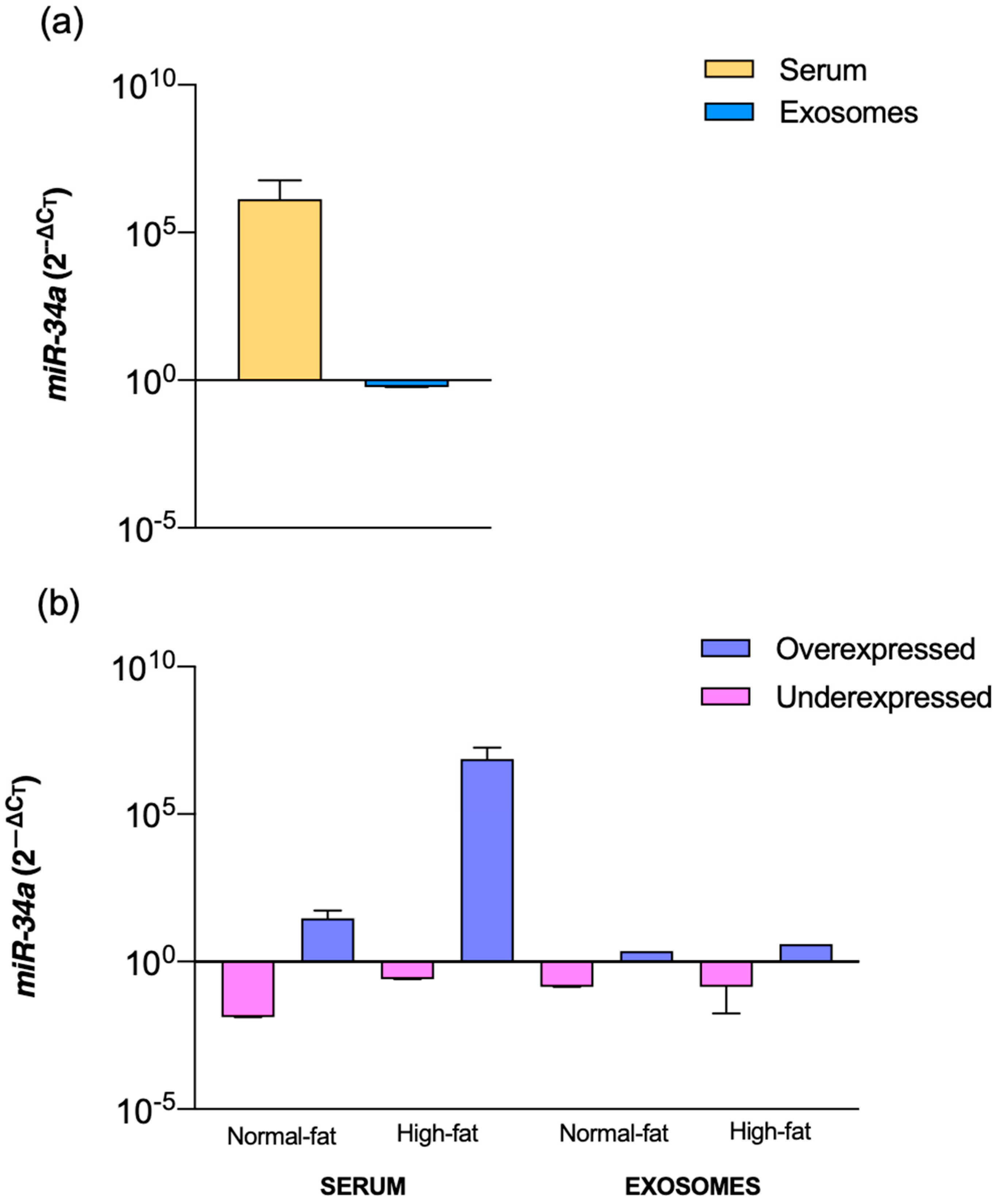
Figure 1. Serum and exosome miR-34a expression in subjects with normal and high-fat percentage (a) miR-34a expression in serum versus exosomes, (b) under and overexpression of miR-34a in serum and exosomes in normal and high-fat percentage subjects. Mann–Whitney U test, Kruskal-Wallis test, and Dun’s multiple comparison test. No statistically significant differences were found.
Ijms 27 00270 g001
Table 1. Clinical and anthropometric characteristics of study subjects.
GroupsNormal-Fat PercentageHigh-Fat PercentagepValue
n7468
Sex (Men:Women)33:4125:43
Age (years)40 ± 933 ± 11
Blood Pressure (mmHg)
Systolic109 ± 7117 ± 130.0015
Diastolic67 ± 1175 ± 110.0003
Lipid Profile (mg/dL)
HDLc35.6 ± 13.933.3 ± 6.8NS
LDLc93.4 ± 47.9108.2 ± 56.1NS
sdLDLc21.8 ± 6.129.3 ± 18.9NS
VLDLc22.4 ± 13.840.6 ± 38.1<0.0001
TC176 ± 46196 ± 450.0299
Triglycerides107 ± 71207 ± 189<0.0001
Cardiovascular risk ratios
sdLDLc/LDLc0.4 ± 0.40.5 ± 0.7NS
TC/HDLc5.2 ± 1.56.1 ± 2.90.0003
LDLc/HDLc2.8 ± 1.43.4 ± 2.3NS
TG/HDLc3.1 ± 1.96.8 ± 8.4<0.0001
Inflammatory Parameters
C3 (mg/dL)75.9 ± 12.294.6 ± 17.4<0.0001
CRP (mg/L)5.7 ± 3.410.6 ± 7.0<0.0001
Insulin Resistance Status
Fasting glucose (mg/dL)76.7 ± 16.587.7 ± 40.20.0331
Fasting insulin (μUI/mL)12.4 ± 9.221.7 ± 11.2<0.0001
HOMA-IR2.5 ± 2.64.7 ± 4.1<0.0001
HOMA-B549 ± 8786812 ± 1106NS
QUICKI0.35 ± 0.050.31 ± 0.02<0.0001
Body Adiposity Status Evaluation
BMI (kg/m2)23.7 ± 4.333.8 ± 5.5<0.0001
BAI27. 6 ± 4.234.8 ± 9.5<0.0001
AVI (cm2)14.0 ± 5.823.0 ± 8.6<0.0001
CI15.9 ± 44.75.3 ± 32.4<0.0001
VAI1.3 ± 3.20.2 ± 0.1<0.0001
WC (cm)79.1 ± 18.5103.7 ± 21.6<0.0001
SA126 ± 593−401 ± 1524NS
VA394 ± 5811294 ± 1556<0.0001
Adipokines (ng/mL)
AdipoQT7055 ± 36836091 ± 3010NS
AdipoQ-H1672 ± 14871283 ± 1443NS
Chemerin112 ± 73106 ± 52NS
CCL20.3 ± 0.20.3 ± 0.2NS
Mann–Whitney U test. p < 0.05 of significance. Abbreviations: NS, non-significative; HDLc, high-density, LDLc, low-density, sdLDLc, small low-density and VLDLc, very low-density lipoprotein cholesterol; TC, total cholesterol; CRP, C-reactive protein; HOMA-IR, homeostasis model assessment-estimated insulin resistance; HOMA-B, homeostasis model assessment of β-cell function; QUICKI, quantitative insulin-sensitivity check index; BMI, body mass index; BAI, body adiposity index; AVI, abdominal volume index; CI, conicity index; VAI, visceral adiposity index; WC, waist circumference; SA, subcutaneous adipose area; VA, visceral adipose area; AdipoQT, total adiponectin; AdipoQ-H, adiponectin of high molecular weight, CCL2, C-C motif chemokine ligand 2.
Table 2. Correlations of serum and exosome miR-34a expression.
ParametersSerum miR-34a (rho)Exosome miR-34a (rho)
Lipid Profile(mg/dL)
HDLc0.530.19
LDLc0.17−0.26
sdLDLc0.35−0.62 *
TC−0.11−0.27
Triglycerides−0.42−0.82
Cardiovascular risk ratios
sdLDLc/LDLc0.13−0.06
TC/HDLc0.42−0.08
LDLc/HDLc−0.07−0.49
TG/HDLc−0.60−0.01
Inflammatory Parameters
C3 (mg/dL)−0.45−0.05
CRP (mg/L)−0.27−0.39
Insulin Resistance Status
Fasting glucose (mg/dL)0.03−0.24
Fasting insulin (μUI/mL)−0.35−0.25
HOMA-IR−0.33−0.27
HOMA-B−0.39−0.02
QUICKI0.360.29
Body Adiposity Status Evaluation
BMI (kg/m2)−0.46−0.01
BAI−0.340.11
AVI−0.55−0.04
SA−0.17−0.13
VA−0.130.04
Adipokines(ng/mL)
AdipoQT−0.05−0.40
AdipoQ-H−0.06−0.04
CHEM−0.06−0.13
CCL2−0.07−0.35
Spearman rank correlation coefficients (rho). * p < 0.05 of significance. Abbreviations: HDLc, high-density, LDLc, low-density and sdLDLc small low-density lipoprotein cholesterol; TC, total cholesterol; CRP, C-reactive protein; HOMA-IR, homeostasis model assessment-estimated insulin resistance; HOMA-B, homeostasis model assessment of β-cell function; QUICKI, quantitative insulin-sensitivity check index; BMI, body mass index; BAI, body adiposity index; AVI, abdominal volume index; SA, subcutaneous adipose area; VA, visceral adipose area; AdipoQT, total adiponectin; AdipoQ-H, adiponectin of high molecular weight, CCL2, C-C motif chemokine ligand 2.
Table 3. Logistic regression for miR-34 expression.
Modelp ValueNagelkerke R2AUC
M10.110.300.6
M20.700.010.6
M30.080.600.9
M40.200.200.6
p < 0.05 of significance. M1 includes: ΔCt serum miR-34 expression. M2 includes: ΔCt exosome miR-34 expression. M3 includes: ΔCt serum miR-34 expression, sdLDLc, HOMA-IR. M4 includes: ΔCt exosome miR-34 expression, sdLDLc, HOMA-IR.
Disclaimer/Publisher’s Note: The statements, opinions and data contained in all publications are solely those of the individual author(s) and contributor(s) and not of MDPI and/or the editor(s). MDPI and/or the editor(s) disclaim responsibility for any injury to people or property resulting from any ideas, methods, instructions or products referred to in the content.


