Structural Basis for TGF-β Mimetic Peptide-Induced Signaling Activation Through Molecular Dynamics Simulations

 and
and
Abstract
1. Introduction
2. Results
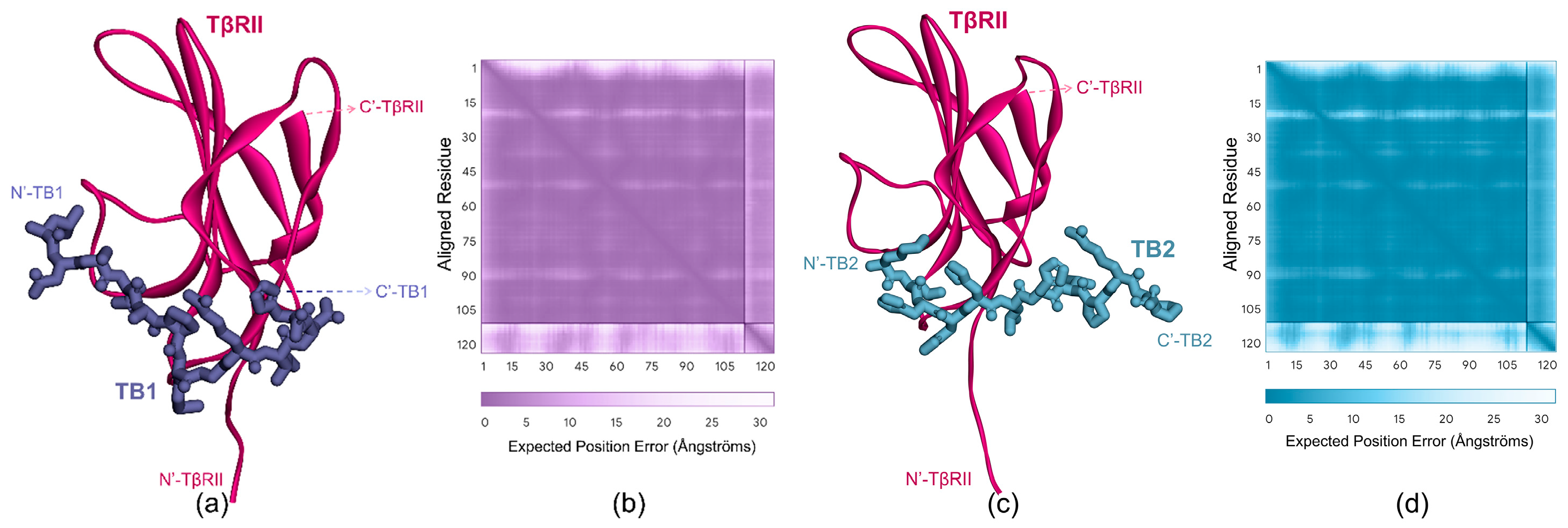
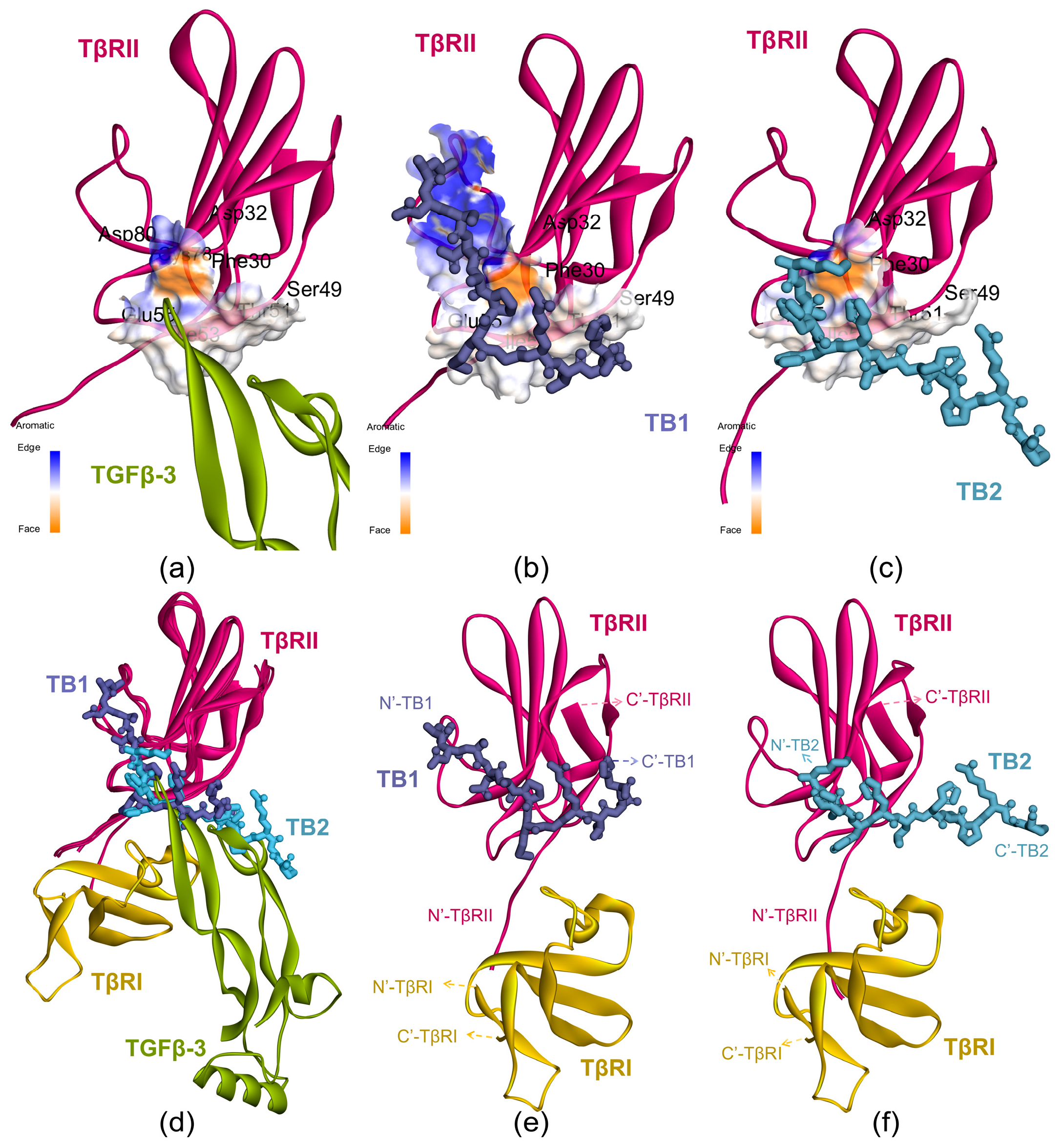
2.1. AlphaFold3-Driven Modeling
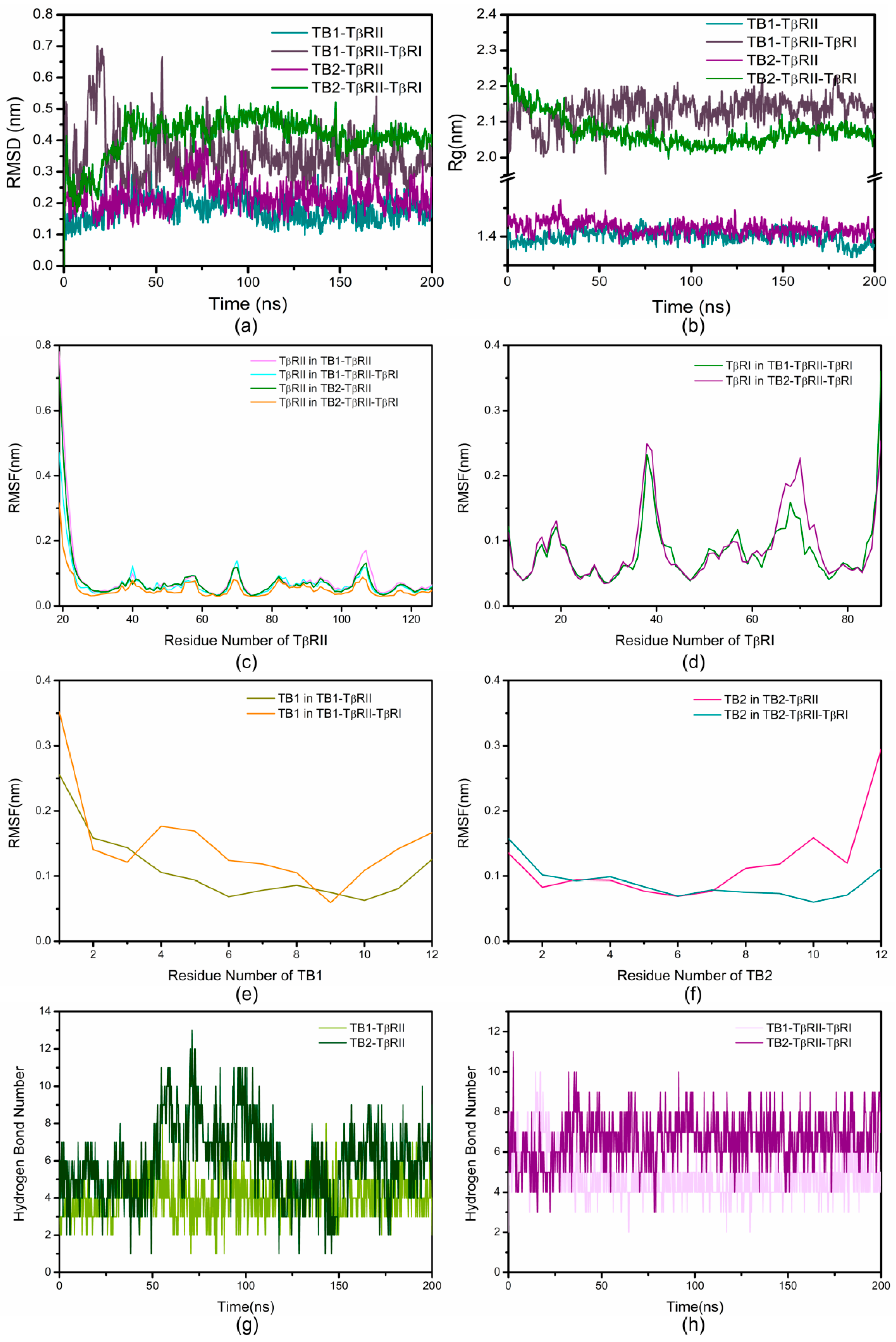
2.2. Stability of Molecular Dynamics Simulations
2.2.1. RMSD Analysis
2.2.2. Rg Analysis
2.2.3. RMSF Analysis
2.2.4. Number of Hydrogen Bonds
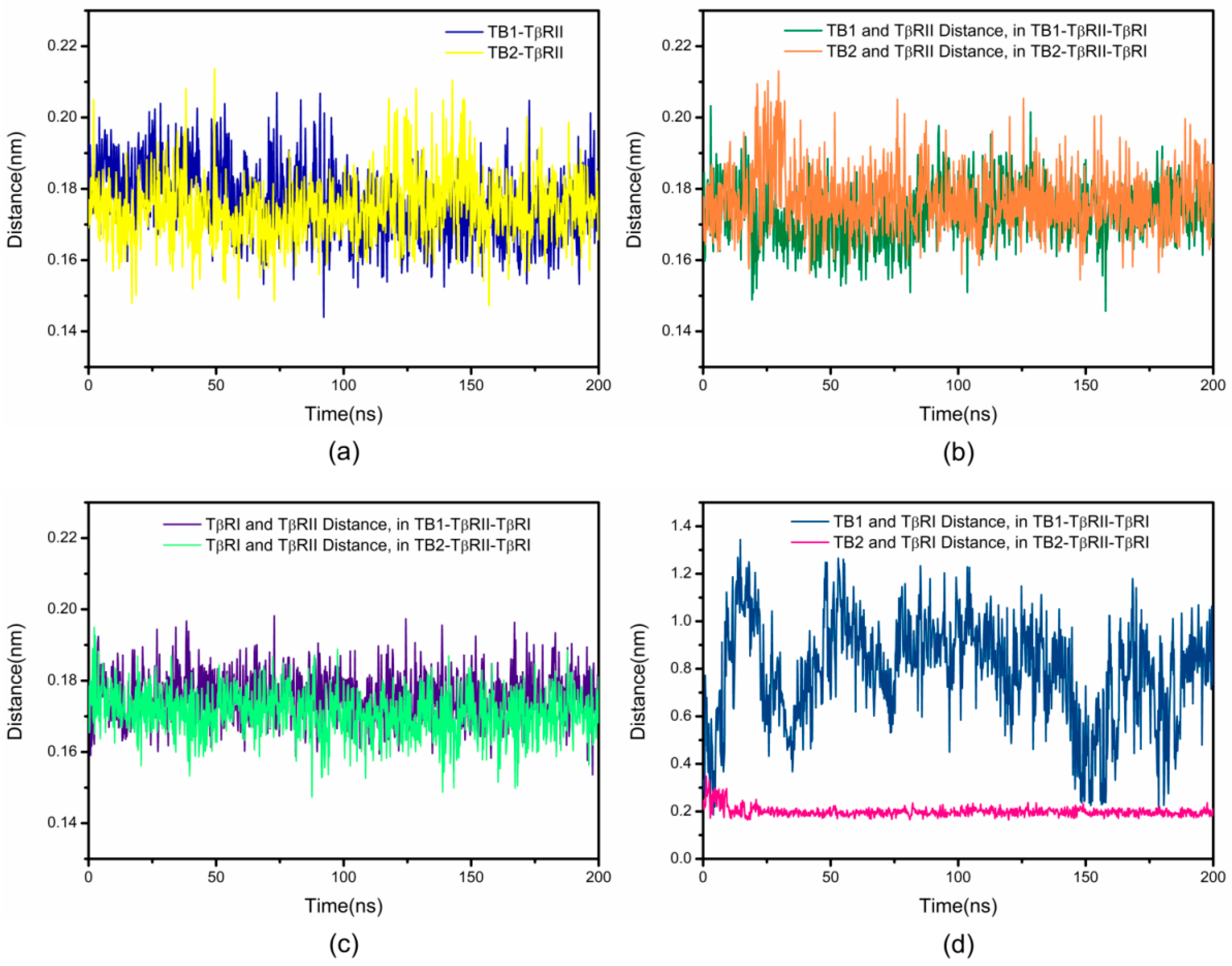
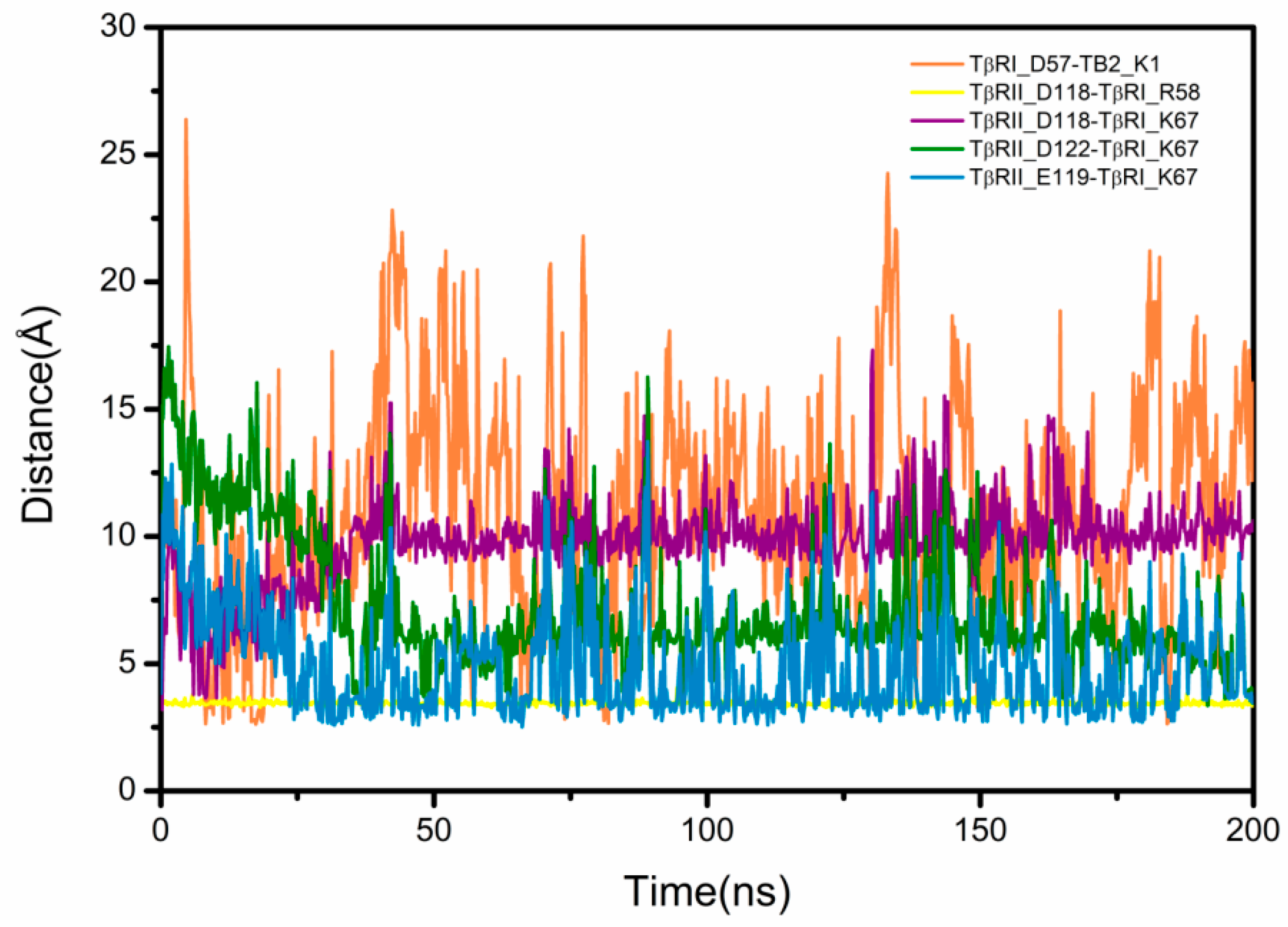
2.3. Inter-Subunit Distances
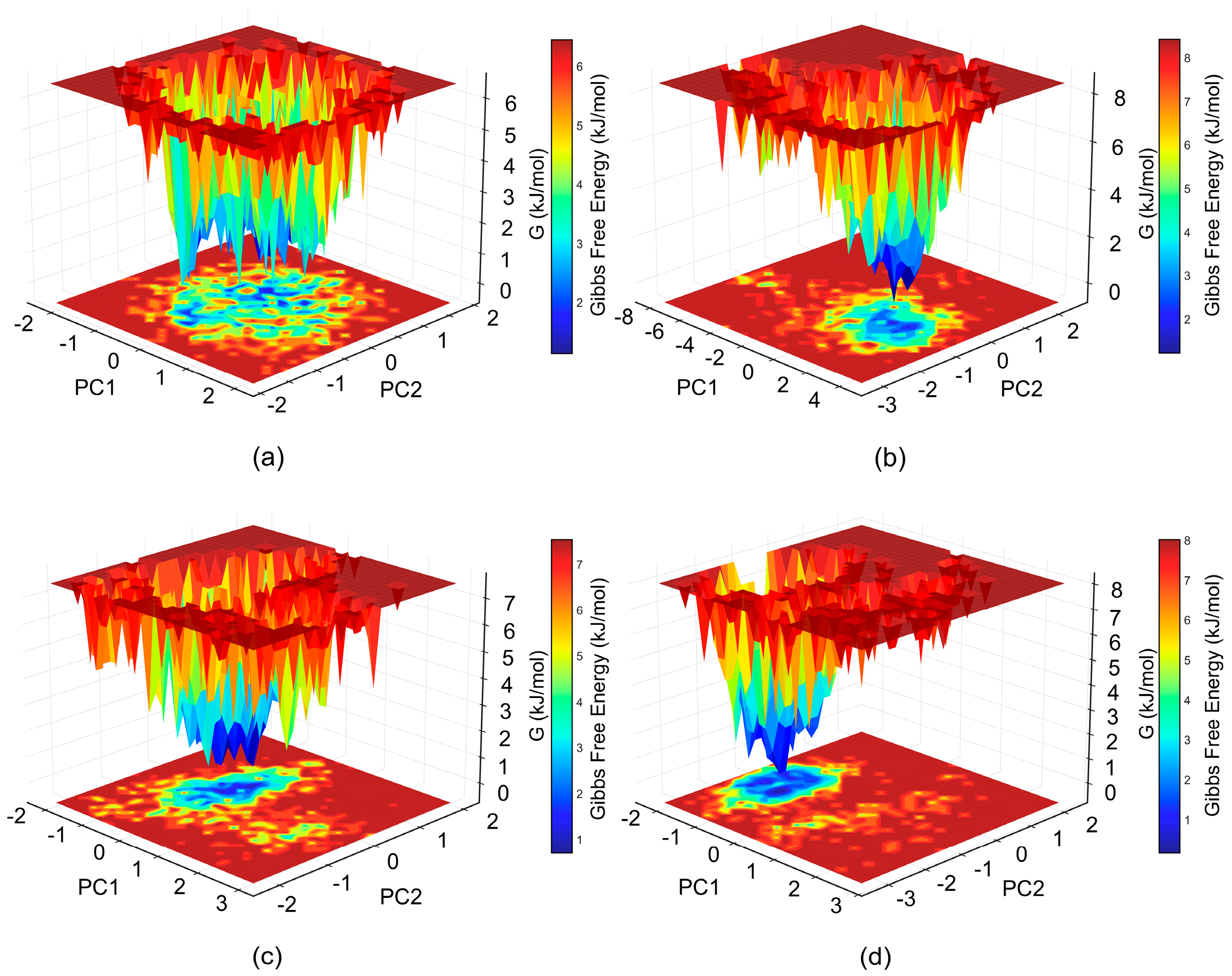
2.4. Free Energy Landscape (FEL)
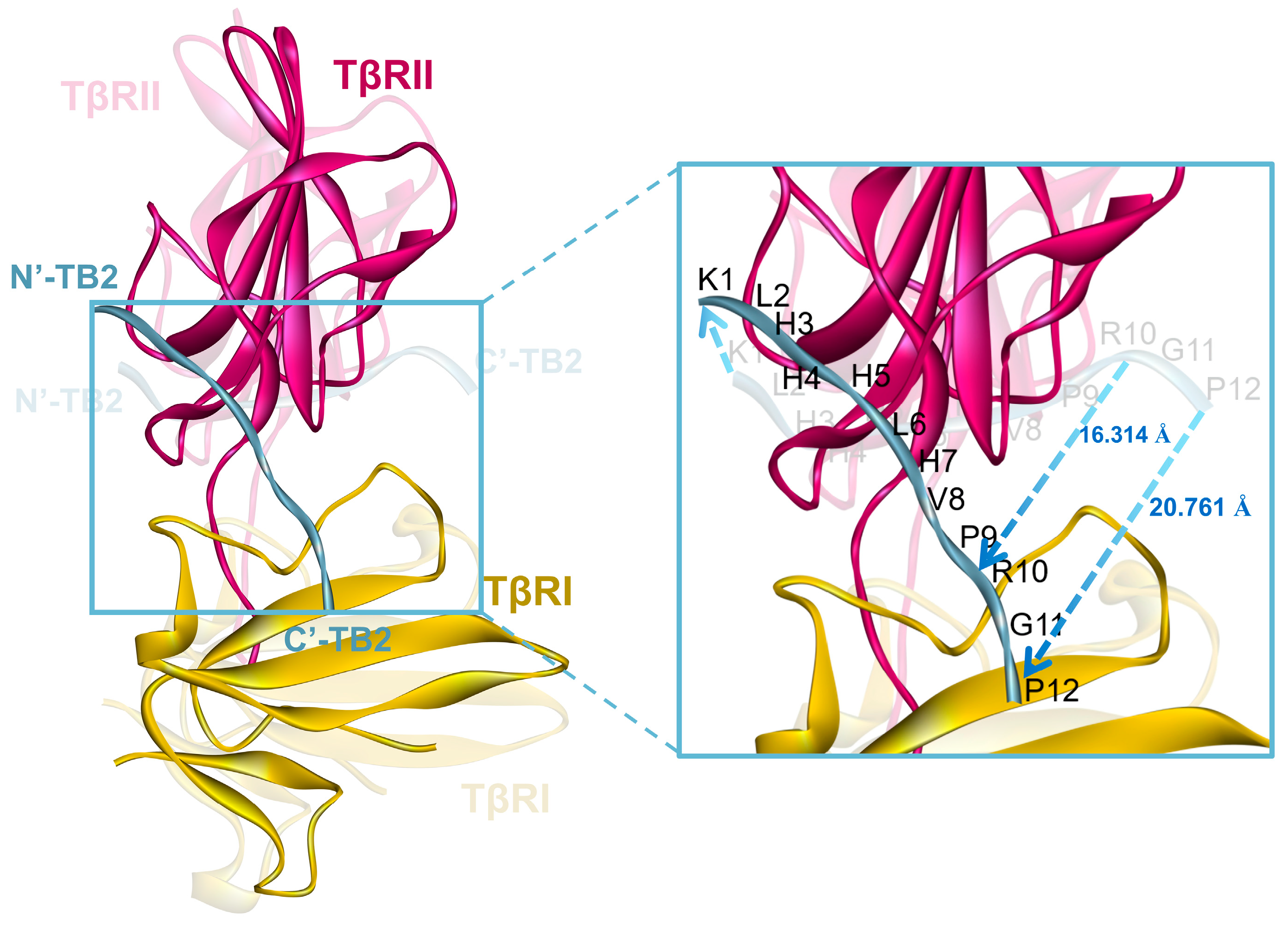
2.5. TB2 Peptide Movement
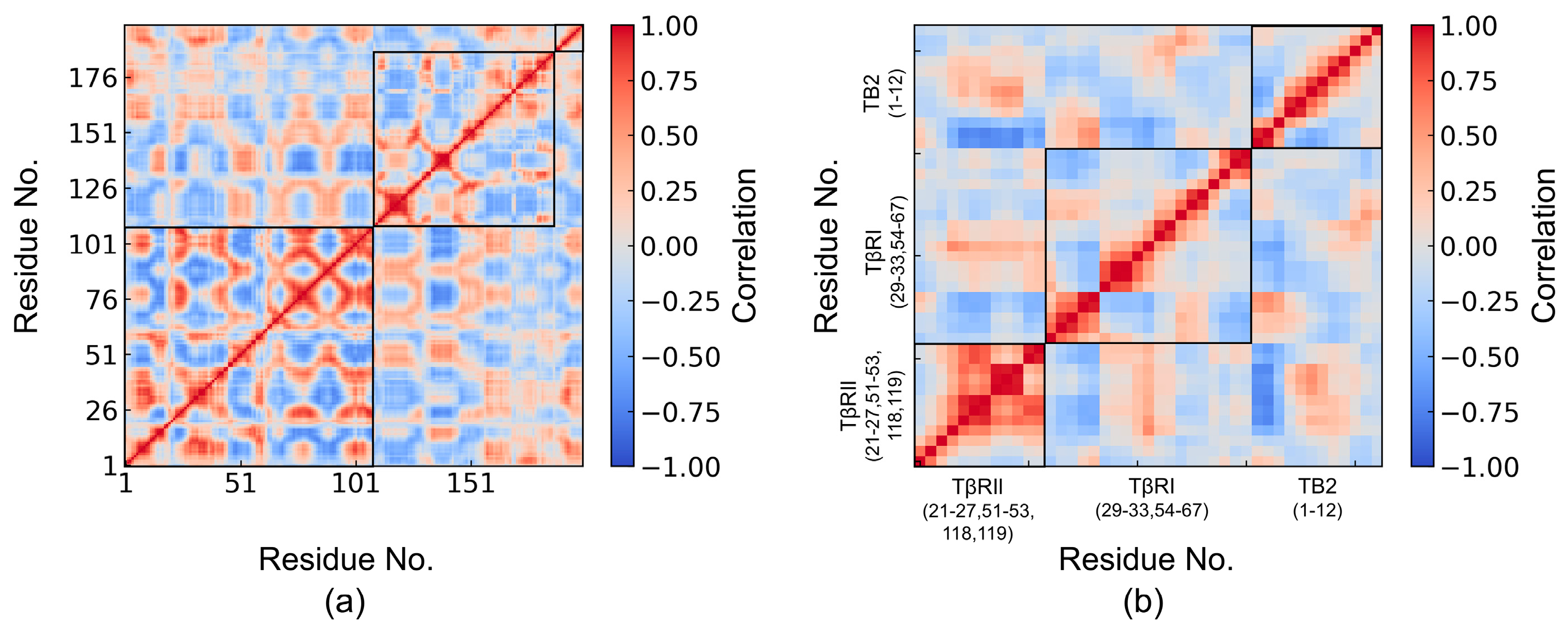
2.6. Dynamic Cross-Correlation Matrix (DCCM)
2.7. Key Hydrogen Bond Interactions
2.8. Salt Bridge Interactions
2.9. Relative Binding Free Energy Calculation
2.10. Per-Residue Energy Decomposition
2.11. Experimental Validation of Peptide Activation of the Smad Pathway
3. Discussion
4. Materials and Methods
4.1. Modeling of TB1–TβRII and TB2–TβRII Using AlphaFold3
4.2. Construction of TB1–TβRII–TβRI and TB2–TβRII–TβRI Hypothetical Models
4.3. Molecular Dynamics (MD) Simulations
4.4. Dynamical Cross-Correlation Matrix (DCCM) Analysis
4.5. Relative Binding Free Energy Calculation by MM-PBSA
4.6. Peptide Synthesis and Western Blot (WB) Analysis
Author Contributions
Funding
Institutional Review Board Statement
Informed Consent Statement
Data Availability Statement
Acknowledgments
Conflicts of Interest
References
- Chia, Z.J.; Cao, Y.N.; Little, P.J.; Kamato, D. Transforming growth factor-β receptors: Versatile mechanisms of ligand activation. Acta Pharmacol. Sin. 2024, 45, 1337–1348. [Google Scholar] [CrossRef]
- Deng, Z.; Fan, T.; Xiao, C.; Tian, H.; Zheng, Y.; Li, C.; He, J. TGF-β signaling in health, disease and therapeutics. Signal Transduct. Target. Ther. 2024, 9, 61. [Google Scholar] [CrossRef]
- Wrana, J.L.; Attisano, L.; Wieser, R.; Ventura, F.; Massagué, J. Mechanism of activation of the TGF-β receptor. Nature 1994, 370, 341–347. [Google Scholar] [CrossRef] [PubMed]
- Donniacuo, A.; Mauro, A.; Cardamone, C.; Basile, A.; Manzo, P.; Dimitrov, J.; Cammarota, A.L.; Marzullo, L.; Triggiani, M.; Turco, M.C.; et al. Comprehensive Profiling of Cytokines and Growth Factors: Pathogenic Roles and Clinical Applications in Autoimmune Diseases. Int. J. Mol. Sci. 2025, 26, 8921. [Google Scholar] [CrossRef] [PubMed]
- Derynck, R. TGF-β-receptor-mediated signaling. Trends Biochem. Sci. 1994, 19, 548–553. [Google Scholar] [CrossRef]
- Feng, X.H.; Derynck, R. Specificity and versatility in tgf-β signaling through Smads. Annu. Rev. Cell Dev. Biol. 2005, 21, 659–693. [Google Scholar] [CrossRef]
- Wieser, R.; Wrana, J.L.; Massagué, J. GS domain mutations that constitutively activate T beta R-I, the downstream signaling component in the TGF-beta receptor complex. EMBO J. 1995, 14, 2199–2208. [Google Scholar] [CrossRef]
- Liarte, S.; Bernabé-García, Á.; Nicolás, F.J. Role of TGF-β in Skin Chronic Wounds: A Keratinocyte Perspective. Cells 2020, 9, 306. [Google Scholar] [CrossRef] [PubMed]
- Mustoe, T.A.; Pierce, G.F.; Thomason, A.; Gramates, P.; Sporn, M.B.; Deuel, T.F. Accelerated healing of incisional wounds in rats induced by transforming growth factor-β. Science 1987, 237, 1333–1336. [Google Scholar] [CrossRef]
- Ksander, G.A.; Gerhardt, C.O.; Olsen, D.R. Exogenous transforming growth factor-β2 enhances connective tissue formation in transforming growth factor-β1-deficient, healing-impaired dermal wounds in mice. Wound Repair Regen. 1993, 1, 137–148. [Google Scholar] [CrossRef]
- Fu, P.J.; Zheng, S.Y.; Luo, Y.; Ren, Z.Q.; Li, Z.H.; Wang, Y.P.; Lu, B.B. Prg4 and Osteoarthritis: Functions, Regulatory Factors, and Treatment Strategies. Biomedicines 2025, 13, 693. [Google Scholar] [CrossRef] [PubMed]
- Cai, L.; Chen, J.; Yuan, Q.; Zhuang, W.; Wang, G.; Xu, X.; Yao, Y.; Hu, W.W. Recent advances in platelet-rich plasma therapy for osteoarthritis: Mechanisms and clinical efficacy. J. Mater. Chem. B 2025, 13, 9001–9022. [Google Scholar] [CrossRef]
- Irma, J.; Kartasasmita, A.S.; Kartiwa, A.; Irfani, I.; Rizki, S.A.; Onasis, S. From Growth Factors to Structure: PDGF and TGF-β in Granulation Tissue Formation. A Literature Review. J. Cell Mol. Med. 2025, 29, e70374. [Google Scholar] [CrossRef]
- Smith, M.M.; Melrose, J. COMP Is a Biomarker of Cartilage Destruction, Extracellular Matrix and Vascular Remodeling and Tissue Repair. Int. J. Mol. Sci. 2025, 26, 9182. [Google Scholar] [CrossRef]
- Ignotz, R.A.; Massagué, J. Transforming growth factor-beta stimulates the expression of fibronectin and collagen and their incorporation into the extracellular matrix. J. Biol. Chem. 1986, 261, 4337–4345. [Google Scholar] [CrossRef]
- Groppe, J.; Hinck, C.S.; Samavarchi-Tehrani, P.; Zubieta, C.; Schuermann, J.P.; Taylor, A.B.; Schwarz, P.M.; Wrana, J.L.; Hinck, A.P. Cooperative assembly of TGF-β superfamily signaling complexes is mediated by two disparate mechanisms and distinct modes of receptor binding. Mol. Cell 2008, 29, 157–168. [Google Scholar] [CrossRef]
- Hayes, S.; Chawla, A.; Corvera, S. TGF beta receptor internalization into EEA1-enriched early endosomes: Role in signaling to Smad2. J. Cell Biol. 2002, 158, 1239–1249. [Google Scholar] [CrossRef]
- Tsukazaki, T.; Chiang, T.A.; Davison, A.F.; Attisano, L.; Wrana, J.L. SARA, a FYVE domain protein that recruits Smad2 to the TGFβ receptor. Cell 1998, 95, 779–791. [Google Scholar] [CrossRef] [PubMed]
- Runyan, C.E.; Schnaper, H.W.; Poncelet, A.C. The role of internalization in transforming growth factor β1-induced Smad2 association with Smad anchor for receptor activation (SARA) and Smad2-dependent signaling in human mesangial cells. J. Biol. Chem. 2005, 280, 8300–8308. [Google Scholar] [CrossRef]
- Peng, D.; Fu, M.; Wang, M.; Wei, Y.; Wei, X. Targeting TGF-β signal transduction for fibrosis and cancer therapy. Mol. Cancer 2022, 21, 104. [Google Scholar] [CrossRef] [PubMed]
- Lee, M.K.; Pardoux, C.; Hall, M.C.; Lee, P.S.; Warburton, D.; Qing, J.; Smith, S.M.; Derynck, R. TGF-beta activates Erk MAP kinase signalling through direct phosphorylation of ShcA. EMBO J. 2007, 26, 3957–3967. [Google Scholar] [CrossRef] [PubMed]
- Lavoie, H.; Gagnon, J.; Therrien, M. ERK signalling: A master regulator of cell behaviour, life and fate. Nat. Rev. Mol. Cell Biol. 2020, 21, 607–632. [Google Scholar] [CrossRef] [PubMed]
- Yamashita, M.; Fatyol, K.; Jin, C.; Wang, X.; Liu, Z.; Zhang, Y.E. TRAF6 mediates Smad-independent activation of JNK and p38 by TGF-β. Mol. Cell 2008, 31, 918–924. [Google Scholar] [CrossRef]
- Massagué, J.; Sheppard, D. TGF-β signaling in health and disease. Cell 2023, 186, 4007–4037. [Google Scholar] [CrossRef]
- McCollum, P.T.; Bush, J.A.; James, G.; Mason, T.; O’Kane, S.; McCollum, C.; Krievins, D.; Shiralkar, S.; Ferguson, M.W. Randomized phase II clinical trial of avotermin versus placebo for scar improvement. Br. J. Surg. 2011, 98, 925–934. [Google Scholar] [CrossRef] [PubMed]
- Beck, A.; Goetsch, L.; Dumontet, C.; Corvaïa, N. Strategies and challenges for the next generation of antibody-drug conjugates. Nat. Rev. Drug Discov. 2017, 16, 315–337. [Google Scholar] [CrossRef]
- Serratì, S.; Margheri, F.; Pucci, M.; Cantelmo, A.R.; Cammarota, R.; Dotor, J.; Borràs-Cuesta, F.; Fibbi, G.; Albini, A.; Del Rosso, M. TGFβ1 antagonistic peptides inhibit TGFβ1-dependent angiogenesis. Biochem. Pharmacol. 2009, 77, 813–825. [Google Scholar] [CrossRef]
- Wang, D.; Yin, F.; Li, Z.; Zhang, Y.; Shi, C. Current progress and remaining challenges of peptide-drug conjugates (PDCs): Next generation of antibody-drug conjugates (ADCs)? J. Nanobiotechnol. 2025, 23, 305. [Google Scholar] [CrossRef]
- Sharma, K.; Sharma, K.K.; Sharma, A.; Jain, R. Peptide-based drug discovery: Current status and recent advances. Drug Discov. Today 2023, 28, 103464. [Google Scholar] [CrossRef]
- Dean, T.T.; Jelú-Reyes, J.; Allen, A.C.; Moore, T.W. Peptide-Drug Conjugates: An Emerging Direction for the Next Generation of Peptide Therapeutics. J. Med. Chem. 2024, 67, 1641–1661. [Google Scholar] [CrossRef]
- Saw, P.E.; Song, E.W. Phage display screening of therapeutic peptide for cancer targeting and therapy. Protein Cell 2019, 10, 787–807. [Google Scholar] [CrossRef]
- Ledsgaard, L.; Kilstrup, M.; Karatt-Vellatt, A.; McCafferty, J.; Laustsen, A.H. Basics of Antibody Phage Display Technology. Toxins 2018, 10, 236. [Google Scholar] [CrossRef]
- Roy, R.; Al-Hashimi, H.M. AlphaFold3 takes a step toward decoding molecular behavior and biological computation. Nat. Struct. Mol. Biol. 2024, 31, 997–1000. [Google Scholar] [CrossRef]
- Abramson, J.; Adler, J.; Dunger, J.; Evans, R.; Green, T.; Pritzel, A.; Ronneberger, O.; Willmore, L.; Ballard, A.J.; Bambrick, J.; et al. Accurate structure prediction of biomolecular interactions with AlphaFold 3. Nature 2024, 630, 493–500. [Google Scholar] [CrossRef] [PubMed]
- Krokidis, M.G.; Koumadorakis, D.E.; Lazaros, K.; Ivantsik, O.; Exarchos, T.P.; Vrahatis, A.G.; Kotsiantis, S.; Vlamos, P. AlphaFold3: An Overview of Applications and Performance Insights. Int. J. Mol. Sci. 2025, 26, 3671. [Google Scholar] [CrossRef]
- Voss, J.M.; Harder, O.F.; Olshin, P.K.; Drabbels, M.; Lorenz, U.J. Rapid melting and revitrification as an approach to microsecond time-resolved cryo-electron microscopy. Chem. Phys. Lett. 2021, 778, 138812. [Google Scholar] [CrossRef]
- Hollingsworth, S.A.; Dror, R.O. Molecular Dynamics Simulation for All. Neuron 2018, 99, 1129–1143. [Google Scholar] [CrossRef]
- Tuckerman, M.E.; Martyna, G.J. Understanding Modern Molecular Dynamics: Techniques and Applications. J. Phys. Chem. B 2000, 104, 159–178. [Google Scholar] [CrossRef]
- dos Santos Nascimento, I.J.; de Moura, R.O. Molecular Dynamics Simulations in Drug Discovery. Mini Rev. Med. Chem. 2024, 24, 1061–1062. [Google Scholar] [CrossRef]
- Genheden, S.; Ryde, U. The MM/PBSA and MM/GBSA methods to estimate ligand-binding affinities. Expert. Opin Drug Discov. 2015, 10, 449–461. [Google Scholar] [CrossRef] [PubMed]
- Gohlke, H.; Case, D.A. Converging free energy estimates: MM-PB(GB)SA studies on the protein-protein complex Ras-Raf. J. Comput. Chem. 2004, 25, 238–250. [Google Scholar] [CrossRef]
- Kang, W.; Jiang, F.; Wu, Y.D. Universal Implementation of a Residue-Specific Force Field Based on CMAP Potentials and Free Energy Decomposition. J. Chem. Theory Comput. 2018, 14, 4474–4486. [Google Scholar] [CrossRef]
- Peng, C.; Ni, W.; Liu, Q.; Hu, G.A.-O.; Zheng, W.A.-O. A comprehensive benchmarking of the AlphaFold3 for predicting biomacromolecules and their interactions. Briefings Bioinform. 2025, 26, bbaf616. [Google Scholar] [CrossRef]
- Kufareva, I.; Abagyan, R. Methods of protein structure comparison. Methods Mol. Biol. 2012, 857, 231–257. [Google Scholar] [CrossRef]
- Maruyama, Y.; Igarashi, R.; Ushiku, Y.; Mitsutake, A. Analysis of Protein Folding Simulation with Moving Root Mean Square Deviation. J. Chem. Inf. Model. 2023, 63, 1529–1541. [Google Scholar] [CrossRef]
- Zhang, D.; Chen, C.F.; Zhao, B.B.; Gong, L.L.; Jin, W.J.; Liu, J.J.; Wang, J.F.; Wang, T.T.; Yuan, X.H.; He, Y.W. A novel antibody humanization method based on epitopes scanning and molecular dynamics simulation. PLoS ONE 2013, 8, e80636. [Google Scholar] [CrossRef][Green Version]
- Martínez, L. Automatic identification of mobile and rigid substructures in molecular dynamics simulations and fractional structural fluctuation analysis. PLoS ONE 2015, 10, e0119264. [Google Scholar] [CrossRef] [PubMed]
- Chen, P.; Yao, L.; Liu, Y.; Luo, J.; Zhou, G.; Jiang, B. Experimental and theoretical study of dilute polyacrylamide solutions: Effect of salt concentration. J. Mol. Model. 2012, 18, 3153–3160. [Google Scholar] [CrossRef] [PubMed]
- Papaleo, E.; Mereghetti, P.; Fantucci, P.; Grandori, R.; De Gioia, L. Free-energy landscape, principal component analysis, and structural clustering to identify representative conformations from molecular dynamics simulations: The myoglobin case. J. Mol. Graph. Model. 2009, 27, 889–899. [Google Scholar] [CrossRef]
- Wu, J.; Long, K.; Wang, F.; Qian, C.; Li, C.; Lin, Z.; Zha, H. Deep Comprehensive Correlation Mining for Image Clustering. In Proceedings of the 2019 IEEE/CVF International Conference on Computer Vision (ICCV), Seoul, Republic of Korea, 27 October–2 November 2019; pp. 8149–8158. [Google Scholar]
- Hsin, J.; Arkhipov, A.; Yin, Y.; Stone, J.E.; Schulten, K. Using VMD: An introductory tutorial. Curr. Protoc. Bioinform. 2008, 24, 5.7.1–5.7.48. [Google Scholar] [CrossRef]
- Valdés-Tresanco, M.S.; Valdés-Tresanco, M.E.; Valiente, P.A.; Moreno, E. gmx_MMPBSA: A New Tool to Perform End-State Free Energy Calculations with GROMACS. J. Chem. Theory Comput. 2021, 17, 6281–6291. [Google Scholar] [CrossRef]
- Pearlman, D.A.; Case, D.A.; Caldwell, J.W.; Ross, W.S.; Cheatham, T.E.; DeBolt, S.; Ferguson, D.; Seibel, G.; Kollman, P. AMBER, a package of computer programs for applying molecular mechanics, normal mode analysis, molecular dynamics and free energy calculations to simulate the structural and energetic properties of molecules. Comput. Phys. Commun. 1995, 91, 1–41. [Google Scholar] [CrossRef]
- Dassault Systèmes BIOVIA. Discovery Studio (DS) 4.5; Dassault Systèmes BIOVIA: San Diego, CA, USA, 2015. [Google Scholar]
- Cavasotto, C.N.; Phatak, S.S. Homology modeling in drug discovery: Current trends and applications. Drug Discov. Today 2009, 14, 676–683. [Google Scholar] [CrossRef] [PubMed]
- Eswar, N.; Webb, B.; Marti-Renom, M.A.; Madhusudhan, M.S.; Eramian, D.; Shen, M.Y.; Pieper, U.; Sali, A. Comparative protein structure modeling using Modeller. Curr. Protoc. Bioinform. 2006, 54, 5–6. [Google Scholar] [CrossRef] [PubMed]
- Vyas, V.K.; Ukawala, R.D.; Ghate, M.; Chintha, C. Homology modeling a fast tool for drug discovery: Current perspectives. Indian J. Pharm. Sci. 2012, 74, 1–17. [Google Scholar] [CrossRef]
- Zuniga, J.E.; Ilangovan, U.; Mahlawat, P.; Hinck, C.S.; Huang, T.; Groppe, J.C.; McEwen, D.G.; Hinck, A.P. The TβR-I pre-helix extension is structurally ordered in the unbound form and its flanking prolines are essential for binding. J. Mol. Biol. 2011, 412, 601–618. [Google Scholar] [CrossRef]
- Deep, S.; Walker, K.P., 3rd; Shu, Z.; Hinck, A.P. Solution structure and backbone dynamics of the TGFβ type II receptor extracellular domain. Biochemistry 2003, 42, 10126–10139. [Google Scholar] [CrossRef]
- Brooks, B.R.; Brooks, C.L., III; Mackerell, A.D., Jr.; Nilsson, L.; Petrella, R.J.; Roux, B.; Won, Y.; Archontis, G.; Bartels, C.; Boresch, S.; et al. CHARMM: The biomolecular simulation program. J. Comput. Chem. 2009, 30, 1545–1614. [Google Scholar] [CrossRef] [PubMed]
- Abraham, M.J.; Murtola, T.; Schulz, R.; Páll, S.; Smith, J.C.; Hess, B.; Lindahl, E. GROMACS: High performance molecular simulations through multi-level parallelism from laptops to supercomputers. SoftwareX 2015, 1, 19–25. [Google Scholar] [CrossRef]
- Páll, S.; Zhmurov, A.; Bauer, P.; Abraham, M.; Lundborg, M.; Gray, A.; Hess, B.; Lindahl, E. Heterogeneous parallelization and acceleration of molecular dynamics simulations in GROMACS. J. Chem. Phys. 2020, 153, 134110. [Google Scholar] [CrossRef]
- Chen, J.N.; Jiang, F.; Wu, Y.D. Accurate Prediction for Protein-Peptide Binding Based on High-Temperature Molecular Dynamics Simulations. J. Chem. Theory Comput. 2022, 18, 6386–6395. [Google Scholar] [CrossRef]
- Feng, J.J.; Chen, J.N.; Kang, W.; Wu, Y.D. Accurate Structure Prediction for Protein Loops Based on Molecular Dynamics Simulations with RSFF2C. J. Chem. Theory Comput. 2021, 17, 4614–4628. [Google Scholar] [CrossRef] [PubMed]
- Mark, P.; Nilsson, L. Structure and Dynamics of the TIP3P, SPC, and SPC/E Water Models at 298 K. J. Phys. Chem. A 2001, 105, 9954–9960. [Google Scholar] [CrossRef]
- Delhommelle, J.; Evans, D.J. Comparison of thermostatting mechanisms in NVT and NPT simulations of decane under shear. J. Chem. Phys. 2001, 115, 43–49. [Google Scholar] [CrossRef]
- Zia, M.; Muhammad, S.; Shafiq-urRehman; Bibi, S.; Abbasi, S.W.; Al-Sehemi, A.G.; Chaudhary, A.R.; Bai, F.Q. Exploring the potential of novel phenolic compounds as potential therapeutic candidates against SARS-CoV-2, using quantum chemistry, molecular docking and dynamic studies. Bioorg. Med. Chem. Lett. 2021, 43, 128079. [Google Scholar] [CrossRef]
- Muhammad, S.; Hassan, S.H.; Al-Sehemi, A.G.; Shakir, H.A.; Khan, M.; Irfan, M.; Iqbal, J. Exploring the new potential antiviral constituents of Moringa oliefera for SARS-COV-2 pathogenesis: An in silico molecular docking and dynamic studies. Chem. Phys. Lett. 2021, 767, 138379. [Google Scholar] [CrossRef]
- Makov, G.; Payne, M.C. Periodic boundary conditions in ab initio calculations. Phys. Rev. B Condens. Matter 1995, 51, 4014–4022. [Google Scholar] [CrossRef]
- Hess, B. P-LINCS: A Parallel Linear Constraint Solver for Molecular Simulation. J. Chem. Theory Comput. 2008, 4, 116–122. [Google Scholar] [CrossRef]
- Yu, W.; Wu, X.; Zhao, Y.; Chen, C.; Yang, Z.; Zhang, X.; Ren, J.; Wang, Y.; Wu, C.; Li, C.; et al. Computational Simulation of HIV Protease Inhibitors to the Main Protease (Mpro) of SARS-CoV-2: Implications for COVID-19 Drugs Design. Molecules 2021, 26, 7385. [Google Scholar] [CrossRef] [PubMed]



| Amino Acid Residues of TB2 | Displacement (Å) |
|---|---|
| LYS1 | 4.971 |
| LEU2 | 6.860 |
| HIS3 | 6.057 |
| HIS4 | 5.671 |
| HIS5 | 1.369 |
| LEU6 | 2.414 |
| HIS7 | 4.050 |
| VAL8 | 9.777 |
| PRO9 | 12.394 |
| ARG10 | 16.314 |
| GLY11 | 19.459 |
| PRO12 | 20.761 |
| Donor and Acceptor | Occupancy (%) | Distance (nm) |
|---|---|---|
| TB2_GLY11:H–TβRI_PHE60:O | 77.8 | 0.293 ± 0.014 |
| TβRII_THR51:H–TB2_HIS5:ND1 | 92.9 | 0.307 ± 0.014 |
| TB2_LEU6:H–TβRII_THR51:O | 88.4 | 0.302 ± 0.017 |
| TB2_ARG10:HH22–TβRII_GLU119:OE1 | 49.1 | 0.282 ± 0.014 |
| TβRII_SER52:HG–TB2_HIS4:O | 46.1 | 0.280 ± 0.016 |
| TB2_ARG10:HH12–TβRII_GLU119:OE2 | 45.5 | 0.291 ± 0.019 |
| TB2_ARG10:HH12–TβRII_GLU119:OE1 | 44.3 | 0.292 ± 0.019 |
| TβRI_ARG58:HH22–TβRII_ASP118:OD2 | 98.6 | 0.277 ± 0.010 |
| TβRI_ARG58:HH12–TβRII_ASP118:OD1 | 97 | 0.282 ± 0.011 |
| TβRI_ARG58:HH11–TβRII_PRO25:O | 95.9 | 0.285 ± 0.011 |
| TβRII_VAL22:H–TβRI_CYS76:O | 91.2 | 0.298 ± 0.015 |
| TβRI_SER66:HG–TβRII_ASP118:O | 46.7 | 0.273 ± 0.013 |
| System (kcal/mol) | Van Der Waals Energy (ΔEvdw) | Electrostatic Energy (ΔEele) | Polar Solvation Energy (ΔGpolar) | Nonpolar Energy (ΔGnonpolar) | Binding Energy (ΔGbinding) | |
|---|---|---|---|---|---|---|
| TB1-TβRII | −54.05 ± 5.36 | −30.29 ± 20.24 | 69.82 ± 17.52 | −5.83 ± 0.5 | −20.35 ± 7.89 | |
| TB2-TβRII | −44.85 ± 5.83 | −304.11 ± 35.05 | 318.07 ± 30.90 | −5.02 ± 0.43 | −35.91 ± 9.29 | |
| TB1-TβRII-TβRI | TB1-TβRI | −0.18 ± 0.08 | −2.82 ± 2.15 | 2.82 ± 2.13 | −0.00 ± 0.01 | −0.18 ± 0.11 |
| TβRI-TβRII | −36.87 ± 3.81 | −81.96 ± 21.67 | 85.29 ± 19.92 | −4.40 ± 0.21 | −37.94 ± 4.06 | |
| TβRI-(TB1-TβRII) | −37.05 ± 5.79 | −84.78 ± 21.33 | 88.11 ± 19.59 | −4.40 ± 0.21 | −38.12 ± 4.07 | |
| TB2-TβRII-TβRI | TB2-TβRI | −29.29 ± 3.71 | −4.09 ± 22.07 | 17.21 ± 20.40 | −3.42 ± 0.34 | −19.58 ± 4.00 |
| TβRI-TβRII | −46.37 ± 4.15 | −200.01 ± 33.94 | 205.29 ± 30.72 | −6.11 ± 0.30 | −47.19 ± 5.94 | |
| TβRI-(TB2-TβRII) | −76.12 ± 5.09 | −205.01 ± 34.61 | 222.27 ± 31.76 | −8.91 ± 0.35 | −67.76 ± 7.70 | |
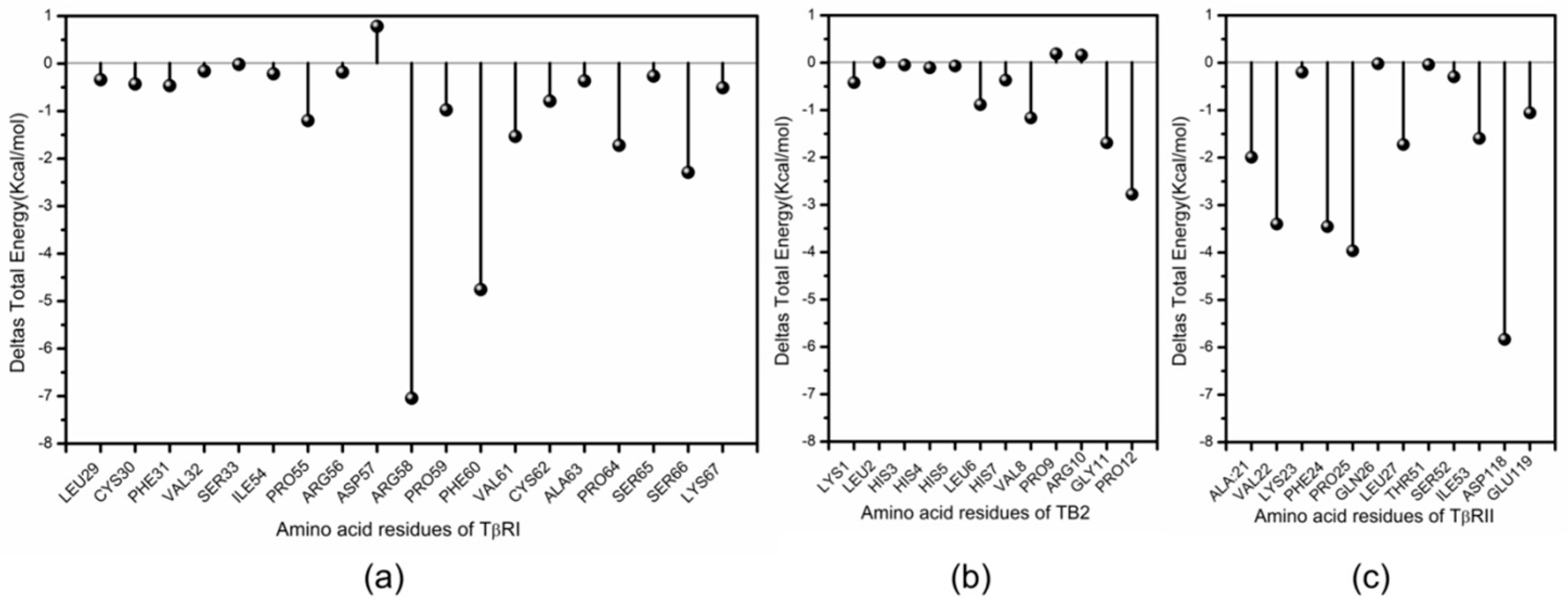
| Residue | Van der Waals (ΔEvdw) | Electrostatic (ΔEele) | Polar Solvation (ΔGpolar) | TOTAL (ΔGtotal) | |
|---|---|---|---|---|---|
| TβRI | ARG:58 | −4.67 | −46.333 | 43.958 | −7.045 |
| PHE:60 | −5.804 | −3.642 | 4.690 | −4.756 | |
| SER:66 | −1.231 | −8.091 | 7.031 | −2.291 | |
| LYS:67 | −1.5 | −31.932 | 32.92 | −0.507 | |
| TβRII | VAL:22 | −3.192 | −2.367 | 2.16 | −3.398 |
| PRO:25 | −1.11 | −8.781 | 5.926 | −3.965 | |
| ASP:118 | 0.01 | −35.103 | 29.261 | −5.833 | |
| GLU:119 | −1.006 | −27.26 | 27.211 | −1.055 | |
| TB2 | ARG:10 | −4.175 | 5.107 | −0.769 | 0.163 |
| GLY:11 | −1.937 | −2.656 | 2.903 | −1.69 | |
| PRO:12 | −3.076 | 25.292 | −24.995 | −2.779 |
Disclaimer/Publisher’s Note: The statements, opinions and data contained in all publications are solely those of the individual author(s) and contributor(s) and not of MDPI and/or the editor(s). MDPI and/or the editor(s) disclaim responsibility for any injury to people or property resulting from any ideas, methods, instructions or products referred to in the content. |
© 2025 by the authors. Licensee MDPI, Basel, Switzerland. This article is an open access article distributed under the terms and conditions of the Creative Commons Attribution (CC BY) license.
Share and Cite
Chen, C.; Ai, J.; Huang, J.; Li, X.; Wang, Y.; Tong, M.; Xie, X.; Xie, Q.; Xiong, S. Structural Basis for TGF-β Mimetic Peptide-Induced Signaling Activation Through Molecular Dynamics Simulations. Int. J. Mol. Sci. 2026, 27, 22. https://doi.org/10.3390/ijms27010022
Chen C, Ai J, Huang J, Li X, Wang Y, Tong M, Xie X, Xie Q, Xiong S. Structural Basis for TGF-β Mimetic Peptide-Induced Signaling Activation Through Molecular Dynamics Simulations. International Journal of Molecular Sciences. 2026; 27(1):22. https://doi.org/10.3390/ijms27010022
Chicago/Turabian StyleChen, Chun, Jingsong Ai, Junhui Huang, Xiaobin Li, Yiting Wang, Mingjie Tong, Xinshan Xie, Qiuling Xie, and Sheng Xiong. 2026. "Structural Basis for TGF-β Mimetic Peptide-Induced Signaling Activation Through Molecular Dynamics Simulations" International Journal of Molecular Sciences 27, no. 1: 22. https://doi.org/10.3390/ijms27010022
APA StyleChen, C., Ai, J., Huang, J., Li, X., Wang, Y., Tong, M., Xie, X., Xie, Q., & Xiong, S. (2026). Structural Basis for TGF-β Mimetic Peptide-Induced Signaling Activation Through Molecular Dynamics Simulations. International Journal of Molecular Sciences, 27(1), 22. https://doi.org/10.3390/ijms27010022