Article

The Influence of Hydrazo and Azo Bonds on the Conformation of New 4-Methyl-3,5-dinitro-2-(2-phenylhydrazinyl)pyridine and Its Azo Derivative—Structural Properties, Vibrational Spectra and Quantum Chemical DFT Calculations


1
Department of Bioorganic Chemistry, Faculty of Production Engineering, Wroclaw University of Economics and Business, 118-120 Komandorska Str., 53-345 Wrocław, Poland
2
Department of Organic Chemistry and Drug Technology, Faculty of Pharmacy, Wroclaw Medical University, 211A Borowska Str., 50-556 Wrocław, Poland
3
Faculty of Chemistry, University of Wrocław, 14 Joliot-Curie Str., 50-383 Wrocław, Poland
4
Institute of Low Temperature and Structure Research, Polish Academy of Sciences, 2 Okólna Str., 50-422 Wrocław, Poland
*
Author to whom correspondence should be addressed.
Int. J. Mol. Sci. 2025, 26(24), 12106; https://doi.org/10.3390/ijms262412106
Submission received: 7 November 2025 / Revised: 8 December 2025 / Accepted: 12 December 2025 / Published: 16 December 2025
(This article belongs to the Section Materials Science)

Abstract

A review of studies has shown that aromatic azo and hydrazo derivatives are used in a wide spectrum of fields, including food, pharmaceutical, and cosmetic products, as well as in technical and electronic technologies, which has contributed to the development of new such compounds. In this work, the structures of newly obtained 4-methyl-3,5-dinitro-2-(2-phenylhydrazinyl)pyridine (4MDNPHP) and its azo derivative, 4-methyl-3,5-dinitro-2-[(E)-phenyldiazenyl]pyridine (4MDNPAP), were established by spectroscopic (NMR, IR, Raman, and UV-Vis) and emission studies. Single-crystal X-ray diffraction analysis was used to determine the molecular structure of the studied compounds, and the results were compared with DFT calculations (B3LYP/6-311G(2d,2p)). The collected X-ray data revealed that the crystal of the hydrazo compound (4MDNPHP) belongs to the triclinic space group P 1 ¯ (Z = 2), whereas the crystal of the azo compound (4MDNPAP) follows the symmetry of the monoclinic space group P21/n (Z = 4). Both presented derivatives crystallized with one molecule in the asymmetric unit. Specific properties of the hydrazo bridge Cϕ-NH-NH-Cθ moiety and its azo counterpart Cϕ-N=N-Cθ were considered in detail.

Graphical Abstract

1. Introduction

Aromatic azo and hydrazo derivatives constitute a crucial category of organic compounds, with applications in various fields [1,2]. These include their utilization as dyes and their incorporation into pharmaceutical formulations [3]. Arylhydrazines are composed of a hydrazine group directly bonded to any aromatic ring. This broad definition of this group allows for compounds with highly diverse structures, containing different rings and substituents in different positions. This directly influences a wide range of properties and biological activities (for example, hypotensive [4], anticoagulant [5], and anticancer [6,7]). Hydrazines can also react with the carbonyl groups of enzymes, making them enzyme inhibitors, for example, monoamine oxidase (MAO) [8]. Azo compounds represent a significant class of artificial dyes and pigments, holding a central position within this domain. Due to their applications in the food, pharmaceutical, and cosmetic industries, azo compounds are regarded as highly versatile pigments and are categorized as FD&C dyes [9]. Beyond their use in coloration, they are also deployed in applications such as molecular memory components, nonlinear optical systems, and photoconductors [10,11]. Furthermore, the study of their biological activities has highlighted anti-inflammatory properties [12,13] and anti-cancer potential [14,15]. Azo compounds are also employed in a range of other applications, including textile dyeing [16,17], optical storage systems [18,19,20], and printing technologies [21,22].
Hydrazine compounds have versatile applications in supramolecular chemistry. They are used in three key areas: as molecular switches, metallosupramolecular assemblies, and sensors, thanks to their unique properties, such as ease of synthesis, stability, and, in particular, the possibility of structural and configurational control, e.g., through E/Z isomerization activated by light or chemical stimuli such as pH. They can also be used to create dynamic and stimuli-responsive metallogrids, as well as in a wide range of sensory applications for the detection of metal cations (such as Zn2+, Hg2+ or Cu2+), anions (such as F, CN or P2O74−), and neutral molecules (amines, water or cysteine), exploiting their acidic N–H proton and ability to form hydrogen bonds [23].
Studies on hydrazine-connected, stable, luminescent covalent–organic polymers have shown that this material is stable, highly selective, and capable of detecting explosives with record-breaking sensitivity. The connection of an electron-rich, porous structure with precisely arranged hydrogen-bonding sites can be systematically used in developing a new generation of luminescent polymers for advanced chemosensor applications, e.g., compounds with hydrazine groups can be used as a luminescent sensor for nitro-explosives [24].
Despite their extensive applications, the structural and electronic properties of azo and hydrazo derivatives require further investigation, particularly regarding their stability, spectroscopic characteristics, and molecular interactions. The relationship between molecular structure and physicochemical properties remains a fundamental research problem, especially in the context of their potential biological activity and optoelectronic applications. Addressing this issue is crucial for advancing their practical applications and optimizing their performance in diverse industrial and pharmaceutical contexts.
This work extends our existing research concerning phenyl-pyridine derivatives, specifically focusing on azo and hydrazo compounds [25,26]. The structural composition of newly synthesized 4-methyl-3,5-dinitro-2-(2-phenylhydrazinyl)pyridine (4MDNPHP), as well as that of its associated azo derivative, 4-methyl-3,5-dinitro-2-[(E)-phenyldiazenyl]pyridine (4MDNPAP) has been determined. These findings have subsequently been investigated by employing single-crystal X-ray diffraction analysis and spectroscopic methods incorporating NMR, IR, Raman, and UV-Vis. Additionally, the structural and spectroscopic properties were further examined via Density Functional Theory (DFT) calculations, utilizing the B3LYP/6-311G(2d,2p) functional and basis set.
By integrating experimental and computational approaches, this study aims to provide deeper insights into these derivatives, electronic structure, vibrational characteristics, and stability, contributing to a broader understanding of their functional properties and potential applications.

2. Results and Discussion

2.1. Synthesis and Crystallization

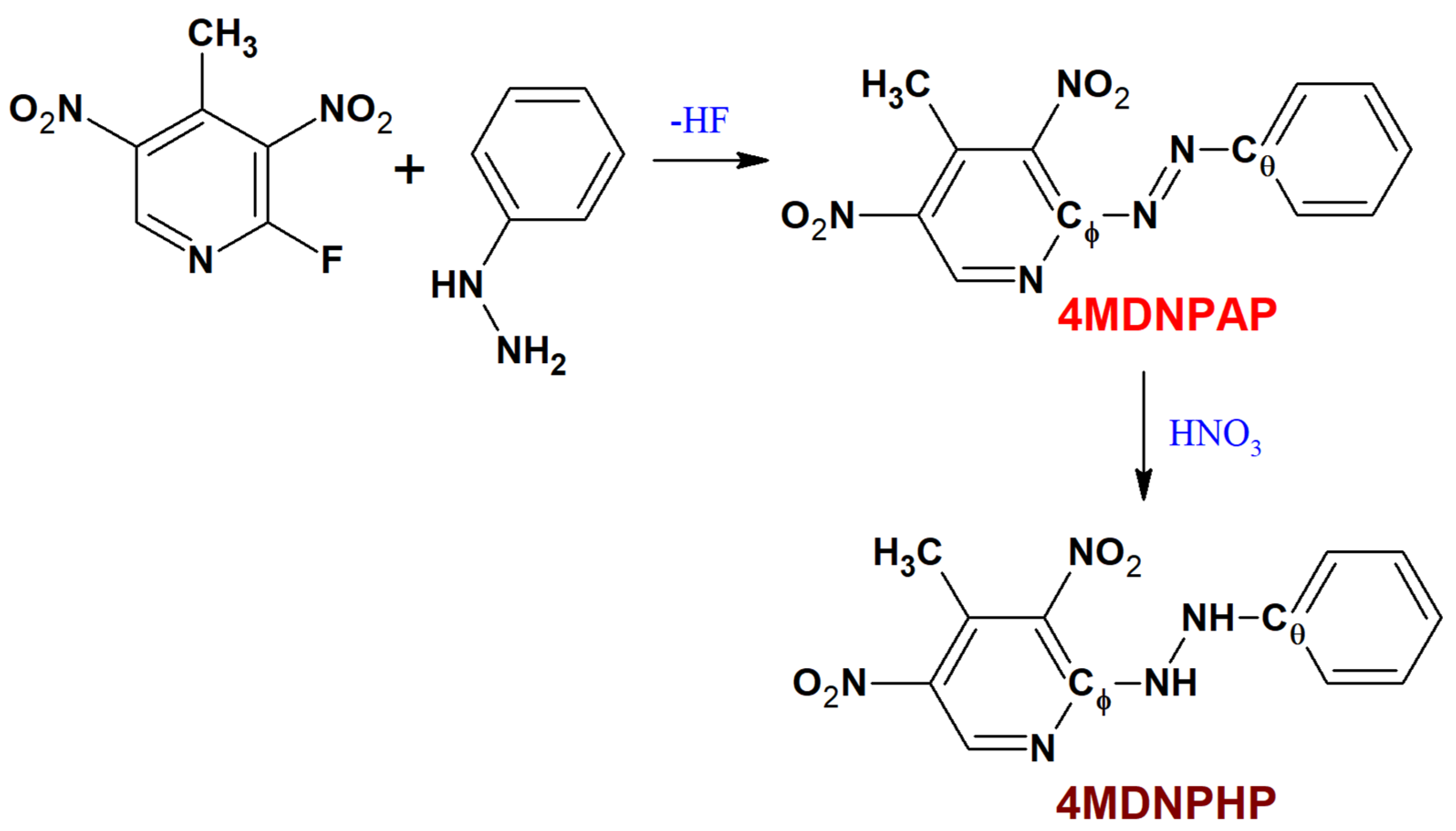
The synthesis of the title compounds, 4MDNPHP and 4MDNPAP, followed the methodology detailed in a prior publication (refer to Scheme 1) [26]. The yields achieved were 45.3% for 4MDNPHP and 63.4% for 4MDNPAP. Furthermore, the resultant materials displayed melting points of 131 °C and 170 °C; correspondingly, 4MDNPHP presented an orange hue, while 4MDNPAP manifested as a dark red solid. Purification involved recrystallization; 4MDNPHP was first treated with ethanol and subsequently with benzene mixed with petrol.

2.2. X-Ray Structural Studies

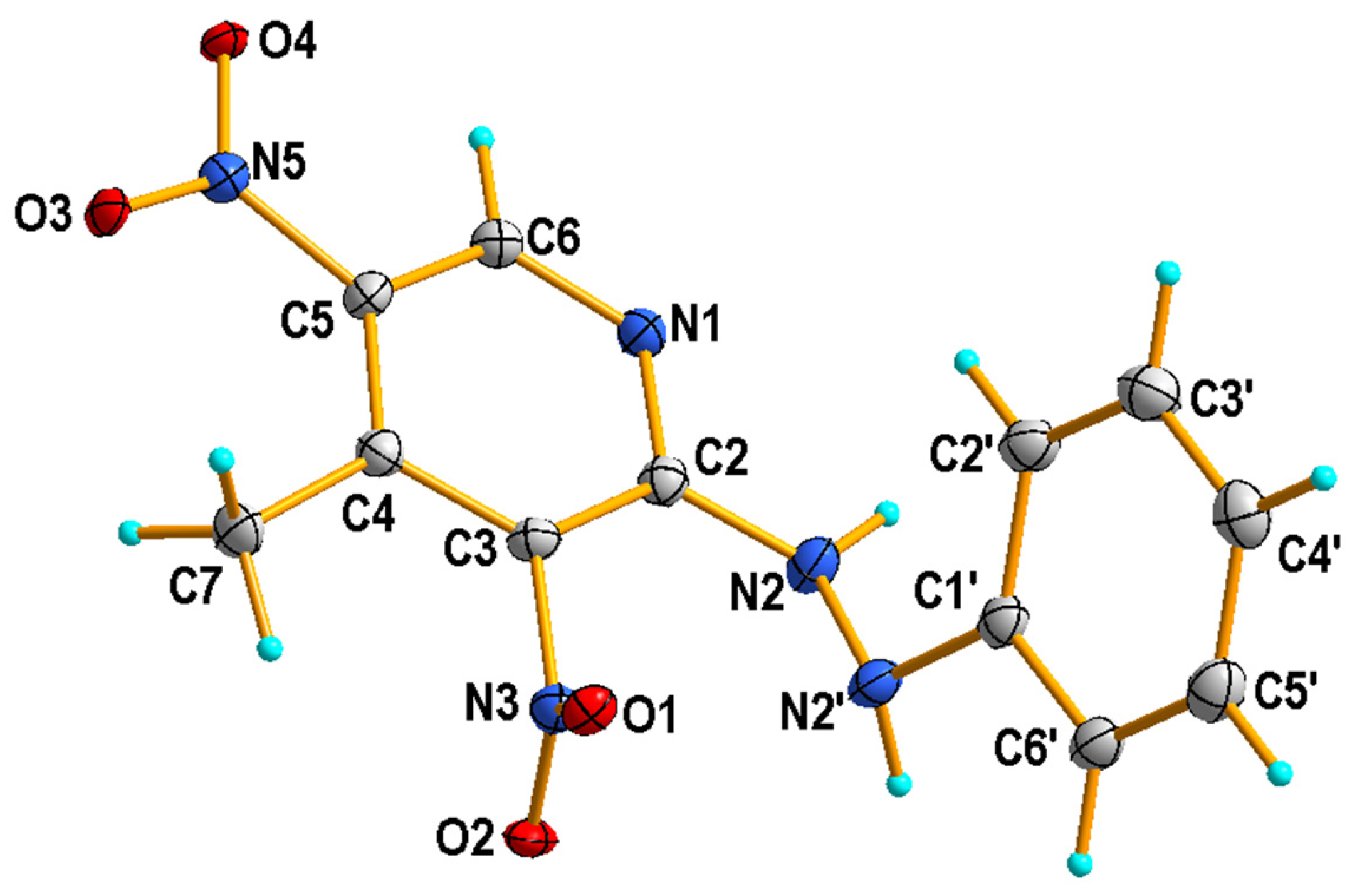
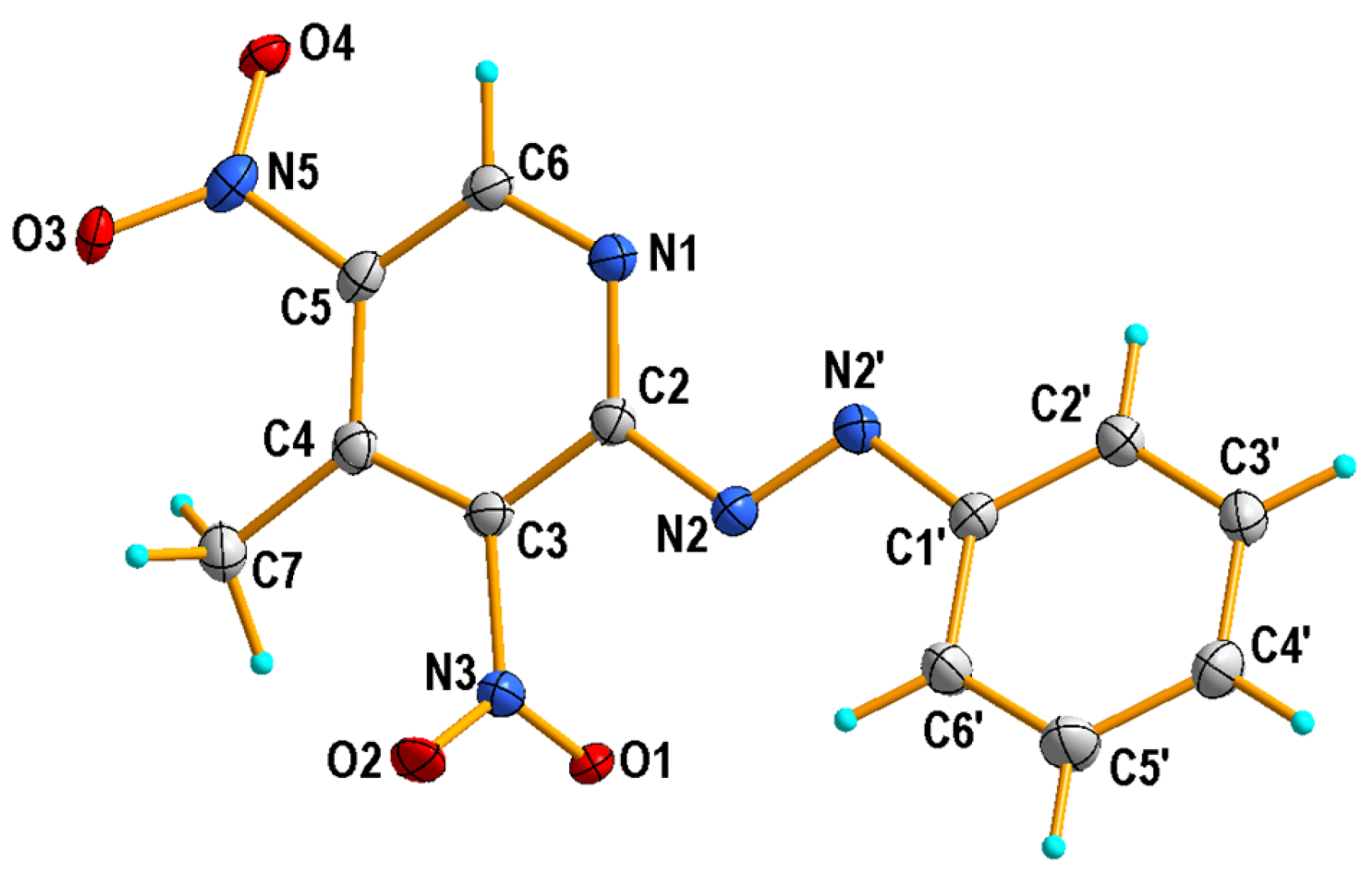
Selected crystallographic data along with details of structure refinement for 4MDNPHP and 4MDNPAP are summarized in Table 1. The hydrazo compound, 4-methyl-3,5-dinitro-2-(2-phenylhydrazinyl)pyridine (4MDNPHP), crystallizes in the triclinic space group P 1 ¯ (Z = 2), with one molecule in the asymmetric unit (Figure 1). The geometric parameters obtained from structural analysis (Crystallographic data in Supplementary Materials) and DFT calculations are summarized in Table S1, which is included in the Supplementary Materials of this article. The structure of 4MDNPHP consists of two rings, pyridine and phenyl, and a central Cϕ-NH-NH-Cθ moiety linking unit, with the C2-N2-N2’-C1’ torsion angle of −97.41 (9)° (Table S1) and the dihedral angle of 77.9 (2)° between the planes of pyridine and phenyl rings. Such nearly perpendicular conformation, but with an opposite value, has been observed in the case of 2-(2-phenylhydrazinyl)pyridine and its 6-mehyl-3-nitropyridine derivatives studied previously, where the corresponding torsion angle was 85.8 (2)° and 77.3 (2)° [27,28], respectively. Furthermore, the values for this angle [128.1 (2)° and 117.9 (2)°] found in both symmetry-independent molecules of a similar dinitro derivative additionally containing a methyl group at position 6 of the pyridine ring [26] differ significantly from those in 4MDNPHP.
In contrast to the nitro group attached to the C5 atom, the nitro group attached to the C3 atom is strongly twisted with respect to the pyridine ring plane, resulting in the absence of a typical intramolecular hydrogen bond; the dihedral angles between these planes are 76.1 (2)° and 4.0 (2)°, respectively. So far, a higher value of this angle, involving the nitro group also attached to the C3 atom, has only been observed in 6-methyl-3,5-dinitro-2-[(E)-phenyldiazenyl]pyridine [25]. The conformational differences in the 4DNPHP molecule most likely result from steric hindrance associated with the presence of the -CH3 group at position 4 of the pyridine ring, between the two –NO2 groups occupying adjacent positions and attached to the C3 and C5 atoms in this ring, next to the hydrazinyl group.
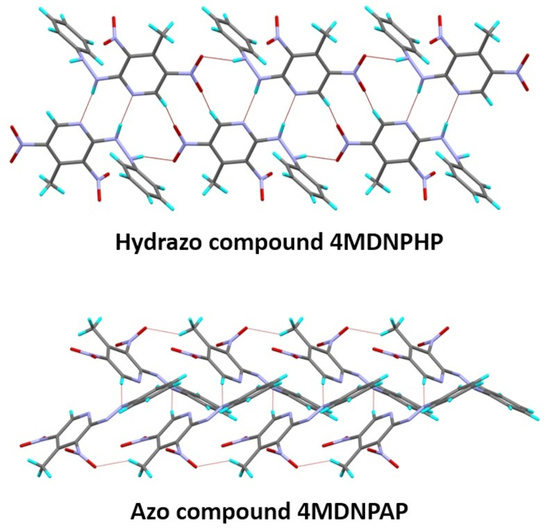
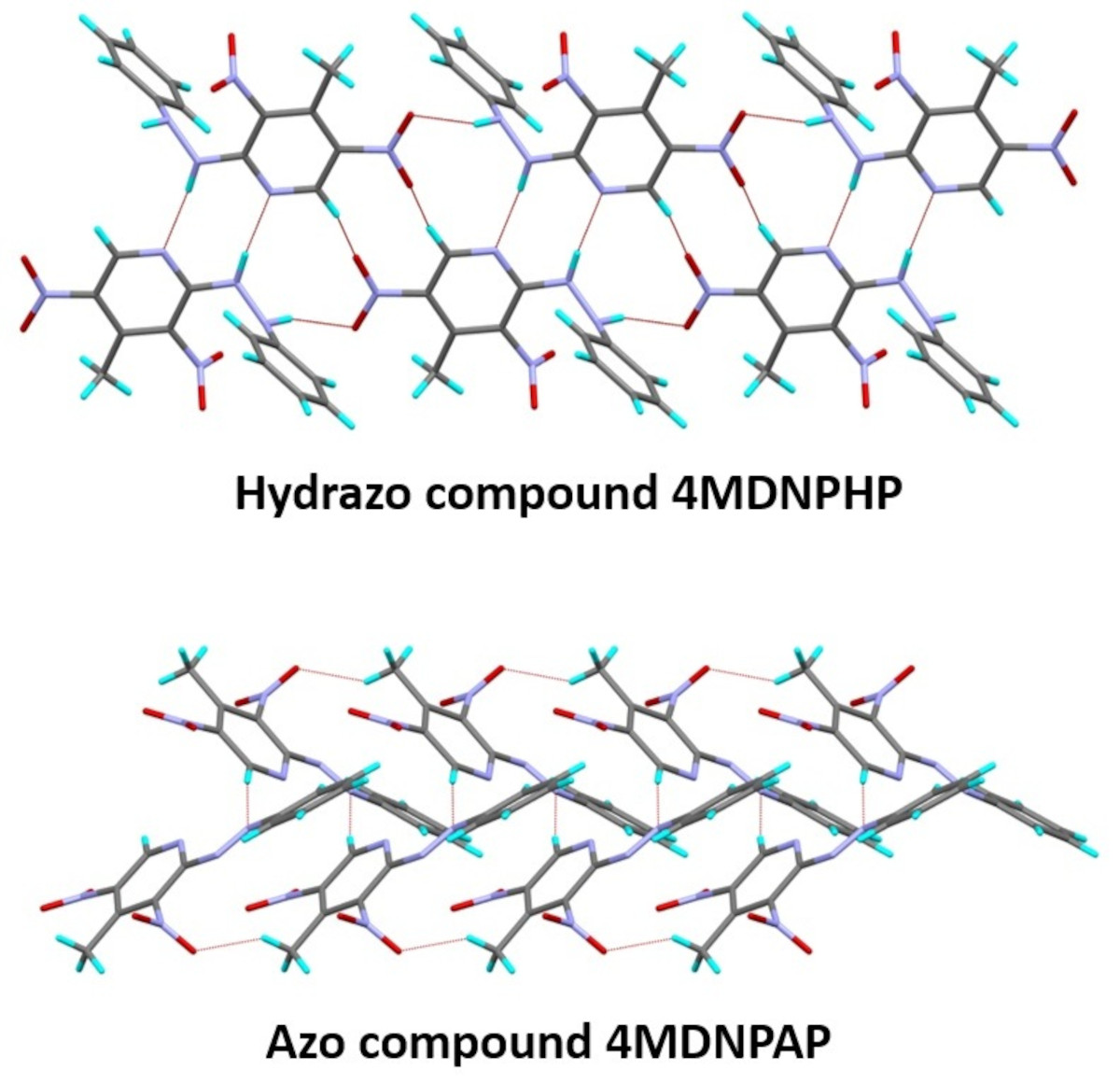
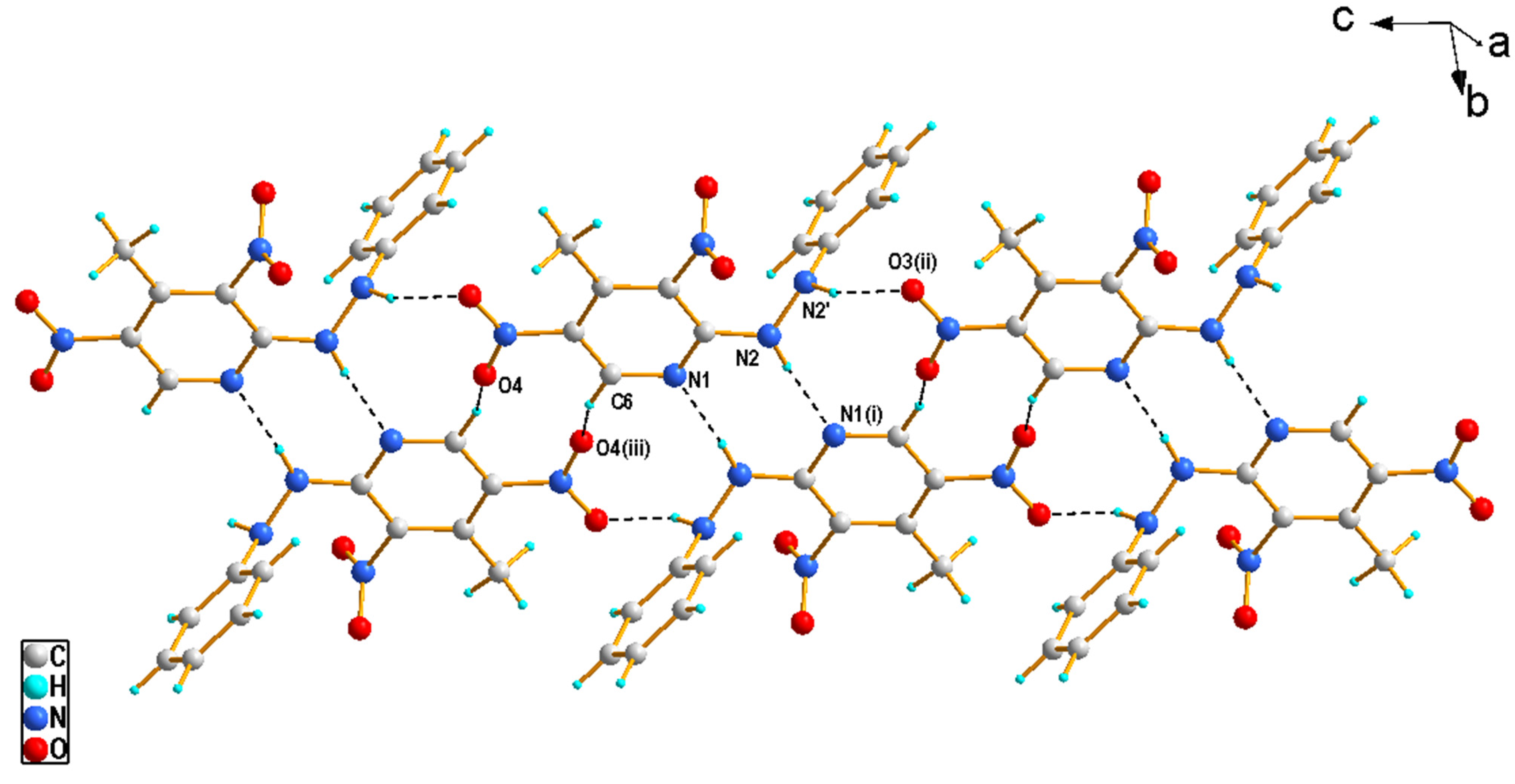
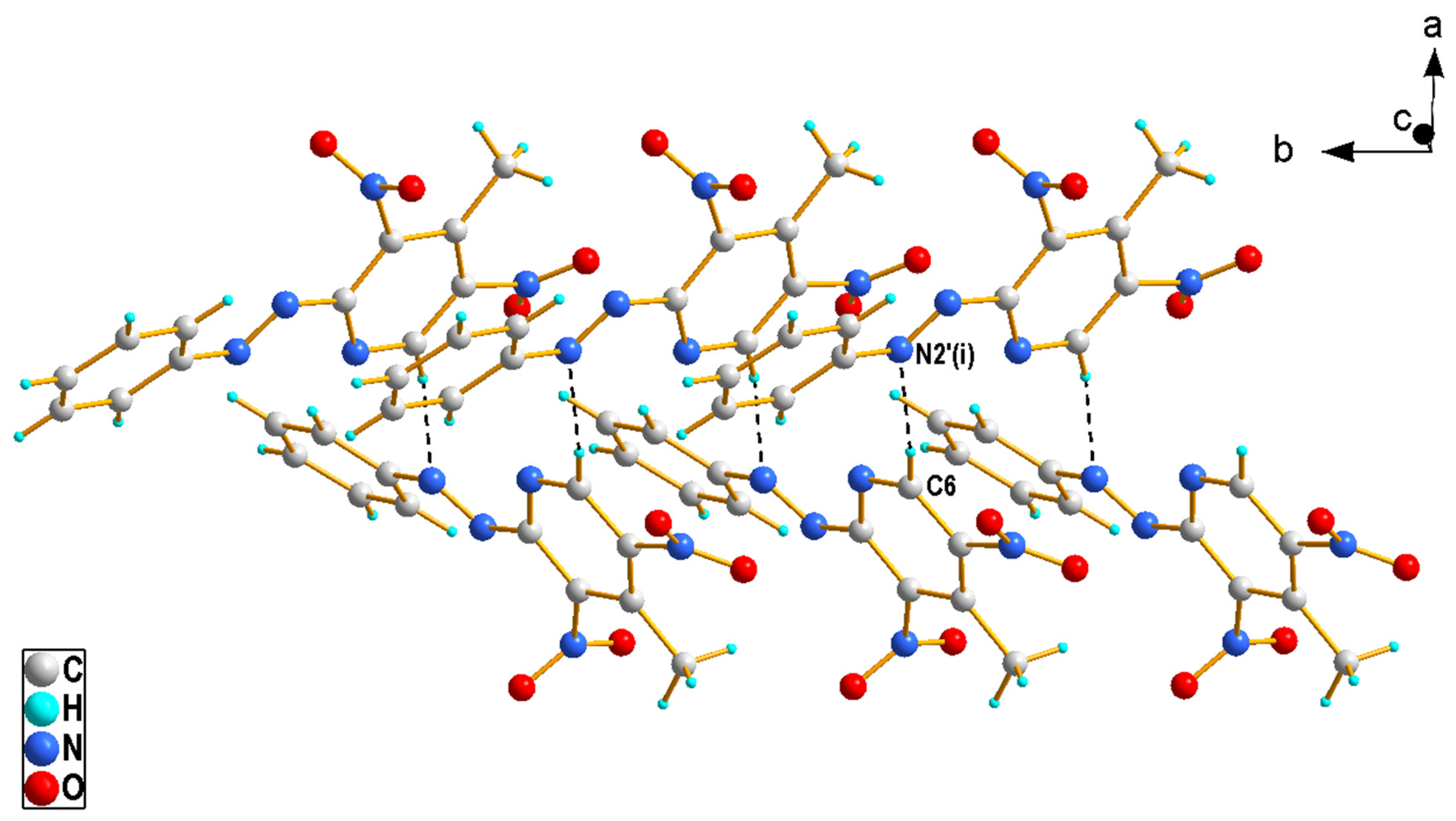
Overall, the crystal structure of 4MDNPHP exhibits three different types of hydrogen bonds, primarily involving as the -NH-NH- group, the pyridine ring and the nitro group attached to the C5 atom. It should be noted that in 4MDNPHP there is no intramolecular N2-H2⋯O1 hydrogen bond involving hydrazine (or amino) and nitro groups commonly observed in 2-amino-3-nitropyridine derivatives [26,28,29,30,31]. It seems that the role of the typical intramolecular interaction has most likely been completely taken over by the intermolecular interactions, which are additionally different from those observed in previously studied 3-nitrohydrazinylpyridine derivatives [26,28]. In the 4MDNPHP crystal, a pair of intermolecular N-H⋯N hydrogen bonds, involving the N2 atom as a donor and the pyridine N1 atom (−x + 1, −y + 1, −z) as an acceptor, connect molecules into a dimer with an R22(8) ring motif [32]. These dimers are further linked by the intramolecular N-H⋯O hydrogen bond between the N2’ atom (as a donor) and the nitro O3 atom (x, y, z−1) (as an acceptor), thus forming a double chain propagated in the direction of c (Figure 2). The crystal structure of 4MDNPHP is also stabilized by a pair C-H⋯O interactions formed between the aromatic C6 atom as a donor and the nitro O4 atom (−x + 1, −y + 1, −z + 1) as an acceptor, which completes the ladder motif in the double chain (Figure 2, Table 2).
The further analysis of non-hydrogen bonding interactions [33] indicates that the nitro group attached to the C3 atom is involved in the N-O⋯π[N3-O2∙∙∙Cg(pyridine) contact, with the shortest O∙∙∙π distance of 2.860 Å, than previously observed [26,28,29]. Aromatic ring π–π stacking interactions have also been recognized, but are weak, the centroid–centroid distance between two phenyl rings is as long as 4.026 Å. The remaining shortest intermolecular distances O⋯N between adjacent nitro groups are 3.069 Å and are equal to the sum of the van der Waals radii, which indicates weak contacts ONO2 π (N)NO2 type [34]. Furthermore, Hirshfeld surface (HS) analysis and 2D fingerprint plots generated for 4MDNPAP indicate the participation of oxygen, nitrogen or carbon atoms in the formation of intermolecular interactions [35]. The areas coloured red on the dnorm-mapped HS correspond to shorter contacts than the sum of van der Waals radii and confirm the interactions mentioned below. Additional confirmation of the presence of weak interactions is the shape index, where, among other things, triangular red-blue regions correspond to intermolecular interactions of the π…π type (Figures S1 and S2).
The azo compound, 4-methyl-3,5-dinitro-2-[(E)-phenyldiazenyl]pyridine (4MDNPAP), crystallizes in the monoclinic space group P21/n (Z = 4), with one molecule in the asymmetric unit (Figure 3). The structure of 4MDNPHP consists of two rings, pyridine and phenyl, and a central Cϕ-N=N-Cθ linking unit that appeared to be in the trans conformation, with the C2-N2-N2’-C1’ torsion angle of 176.49 (12)° (Table S1). It is worth emphasizing, however, that the -N=N- group is not coplanar with the aromatic rings in the 4MDNPAP molecule, largely due to steric hindrance associated with the presence of four substituents next to each other on the pyridine ring. The dihedral angle of 25.4 (2)° between the planes of the pyridine and phenyl rings is significantly larger than that previously observed in the structures of similar 6-methylpyridine derivatives, where it was much smaller and amounted to 3.5° [25] and 4.8° [36], respectively. As a consequence, the dihedral angles between the mean planes of the C-N=N planes (Cϕ-N=N and N=N-Cθ) and the planes of the phenyl and pyridine rings are 13.0(1)° and 15.0(1)°, respectively, leading to an unexpected conformation of the molecule. Both nitro groups substituted on the pyridine ring are significantly rotated relative to its plane with the dihedral angle between these planes of 74 (2)° and 34.6 (2)° for the NO2 group attached to C3 and C5 atoms, respectively. The crystal structure of 4MDNPAP is stabilized mainly by C-H⋯N interactions (Figure 4, Table 3). The molecules are linked by C-H⋯N interactions involving the aromatic C6 atom as a donor and the hydrazo N2’ atom (−x + 3/2, y − 1/2, −z + 1/2), thus forming a zig-zag chain (Figure 3, Table 3).
The crystal structure of 4MDNPAP were analyzed in terms of weak C–H⋯O/N,··π⋯π stacking and ONO2⋯π(N)NO2 type, and together with N-O⋯π contacts [33,35]. An analysis revealed that, in addition to the C6-H6⋯N2’ intermolecular interaction, weak C-H⋯O hydrogen bonds exist in the zigzag chain, involving the C7 methyl atom as a donor and the O1 nitro atom (x, y − 1, z) as an acceptor. This interaction is also visible as the red region on the dnorm-mapped HS, located on the hydrogen methyl (H73) and the oxygen (O1) atoms. Similarly to the 4MDNPHP crystal, the O⋯N intermolecular distances between adjacent nitro groups are over 3 Å. Furthermore, π–π stacked interactions with d(Cg∙∙∙Cg) < 4.0 Å between the overlapping aromatic rings and short N-O⋯π contacts do not characterize the molecular packing in this case [shortest stacked interactions d(Cg∙∙∙Cg) = 4.9 Å and d(O...π) = 3.65 Å]. An ensemble of HSs and the investigation of 2D fingerprint plots show that the hydrogen and non-hydrogen bonding interactions in the 4MDNPHP crystal are significantly different from those in the 4MDNPAP crystal (Figures S3 and S4).

2.3. Comparison of Selected X-Ray Crystal Structures from DFT Calculations

The molecular structures of the studied compounds were optimized using initial parameters transferred from their crystal structure. As shown in Table 4 (and also in Table S1, which contains more details for 4MDNPHP and 4MDNPAP), the deviations between the calculated and observed geometric parameters are in good agreement. The largest differences concern the values of the torsional angles defining the position of the nitro groups relative to the pyridine ring in both compounds. Moreover, the experimental parameters of the central segment C—N(H)—N(H)—C (CΦ-N-N-CΘ) show small deviations from the corresponding calculated values in the case of 4MDNPHP. Since the hydrogen bonds and interactions between molecules inside the crystal structure appeared weak, further modelling of the contacts was not necessary for the calculations.
Comparative analysis of azo and hydrazo analogues indicates that the fundamental geometric differences result primarily from the chemical nature of the bridge—a double N=N bond in azo compounds and a single –NH–NH– bond in hydrazo compounds. In the case of azo analogues, the short N=N bond imposes a planar geometry, which favours effective conjugation with neighbouring aromatic systems and mesomeric stabilization. In the hydrazo analogues, on the other hand, the N–N bond is longer and more flexible, resulting in greater rotational freedom and a wide range of observed torsion angles. In this series, local steric effects (repulsion of nitro and methyl groups) and electrostatic interactions, including potential N–H⋯O(NO2) hydrogen bonds and donor–acceptor interactions involving nitro groups, become crucial. This results in different orientations of NO2 groups and a lack of clear preference for planar conformers. It can therefore be summarized that the geometry of azo compounds is mainly determined by the requirements of electronic conjugation, whereas in the case of hydrazo, local steric and electrostatic effects play a dominant role, leading to a much greater structural diversity.

2.4. Vibrational Spectra

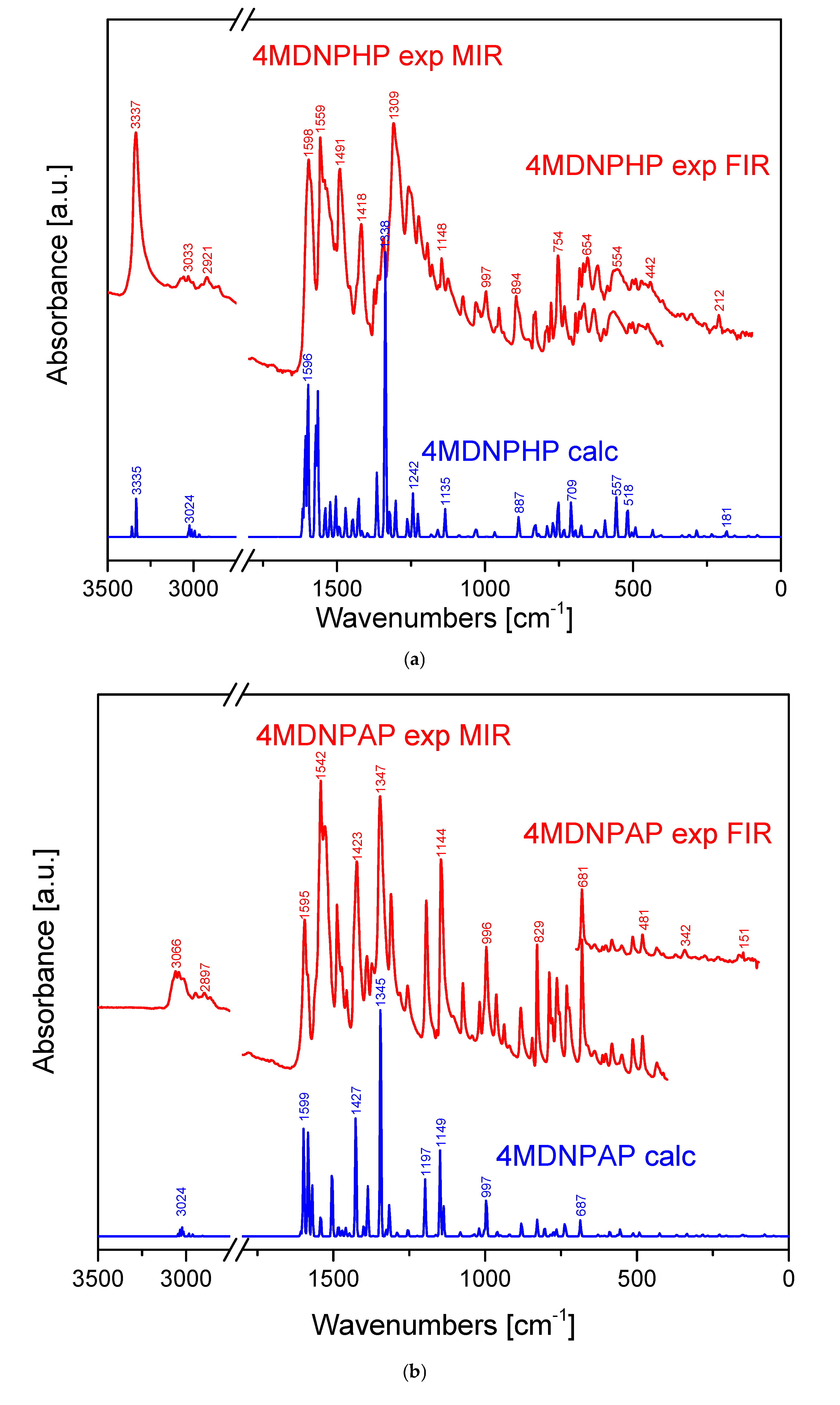
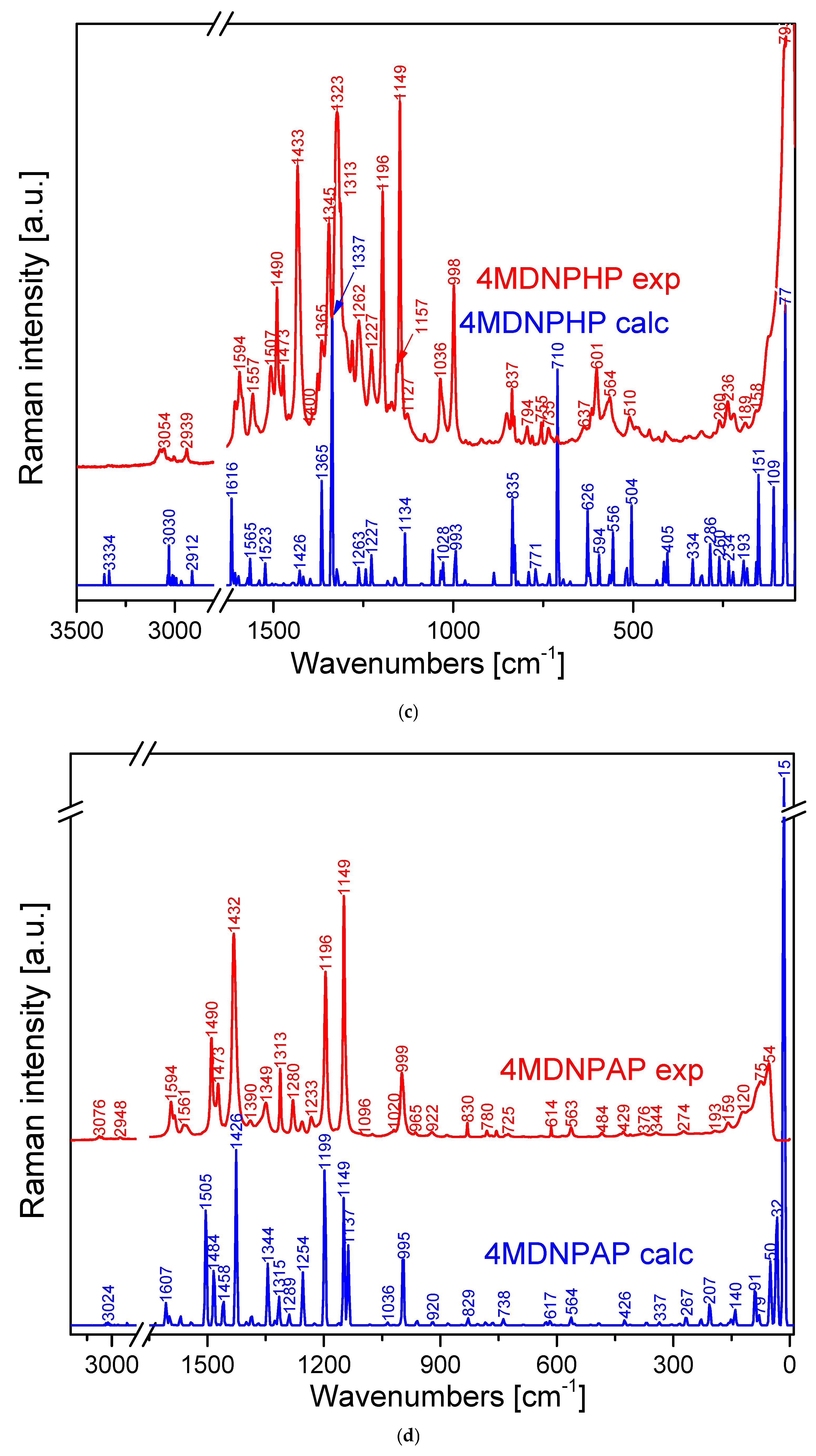
The infrared and Raman spectra of the analyzed compounds (4MDNPHP and 4MDNPAP) are depicted in Figure 5. These spectra reveal characteristic vibrations associated with the pyridine and phenyl rings, alongside methyl and nitro groups, aligning with their established spectral ranges [36,38]. An analysis of the hydrazo and azo compounds and their bonds has been undertaken, specifically in relation to the molecular conformation and the hydrogen bonds identified in the studied crystals. A complete vibrational mode assignment, aligning observed bands to the studied molecules is provided in Table S1. The vibrational properties of both the hydrazo and azo bonds were examined, considering the molecular conformational state and how it interacts with intermolecular hydrogen bonds within the compound. In the studied molecule 4MDNPHP, the NH group plays a crucial role as a proton donor, participating in intermolecular interactions. The observed vibrational bands in the 3500–2800 cm−1 range were assigned to hydrogen bonds of the N–H⋯O type (between the NH and oxygen atoms of the nitro groups) as well as N–H⋯N contacts (involving the NH group and the nitrogen atom of the pyridine ring). The stretching vibration ν(N–H⋯O) located at 3337 cm−1 indicates the presence of hydrogen bonds of moderate strength. These results, along with earlier studies, reveal the diversity of hydrogen-bonding interactions among related systems [26,27,31]. For 6-methyl-3-nitro-2-(2-phenylhydrazinyl)pyridine MNPHP [28], the ν(NH) vibrations appear as a doublet at 3318 and 3290 cm−1, reflecting the presence of two N–H bonds in the hydrazo bridge. By contrast, the structures reported by Michalski et al. (2013) display a different hydrogen-bonding arrangement [37]. The hydrazo bridge linking bulky substituents in chair-like pyridine conformations enables the formation of two intermolecular N–H⋯N hydrogen bonds between adjacent molecules, creating symmetrical six-membered ring motifs. These interactions give rise to characteristic band splitting in the 3440–3300 cm−1 region, attributed to resonance effects between the vibrations of two hydrogen bonds in the ring. In this case, intermolecular hydrogen bonding dominates and significantly enhances crystal stability. For 2-methyl-3,5-dinitro-6-(2-phenylhydrazinyl)pyridine PHPDNM [26], the NH group acts as a proton donor, forming medium-strength intramolecular N–H⋯O hydrogen bonds with nitro oxygen atoms. The characteristic vibrational bands observed in the 3500–2900 cm−1 region, with the ν(N–H⋯O) stretching vibration at 3308 cm−1, are consistent with the values obtained for 4MDNPHP, suggesting a similar stabilization mechanism in the solid state.
In summary, 4MDNPHP exhibits an intermediate character compared to the literature data [26,28,37]. It forms medium-strength intermolecular N–H⋯O interactions and engages in distinct intermolecular N–H⋯N contacts. The coexistence of N–H⋯O and N–H⋯N intermolecular hydrogen bonds stabilizes 4MDNPHP, highlighting the synergistic role of these interactions in shaping its structural and spectroscopic properties.
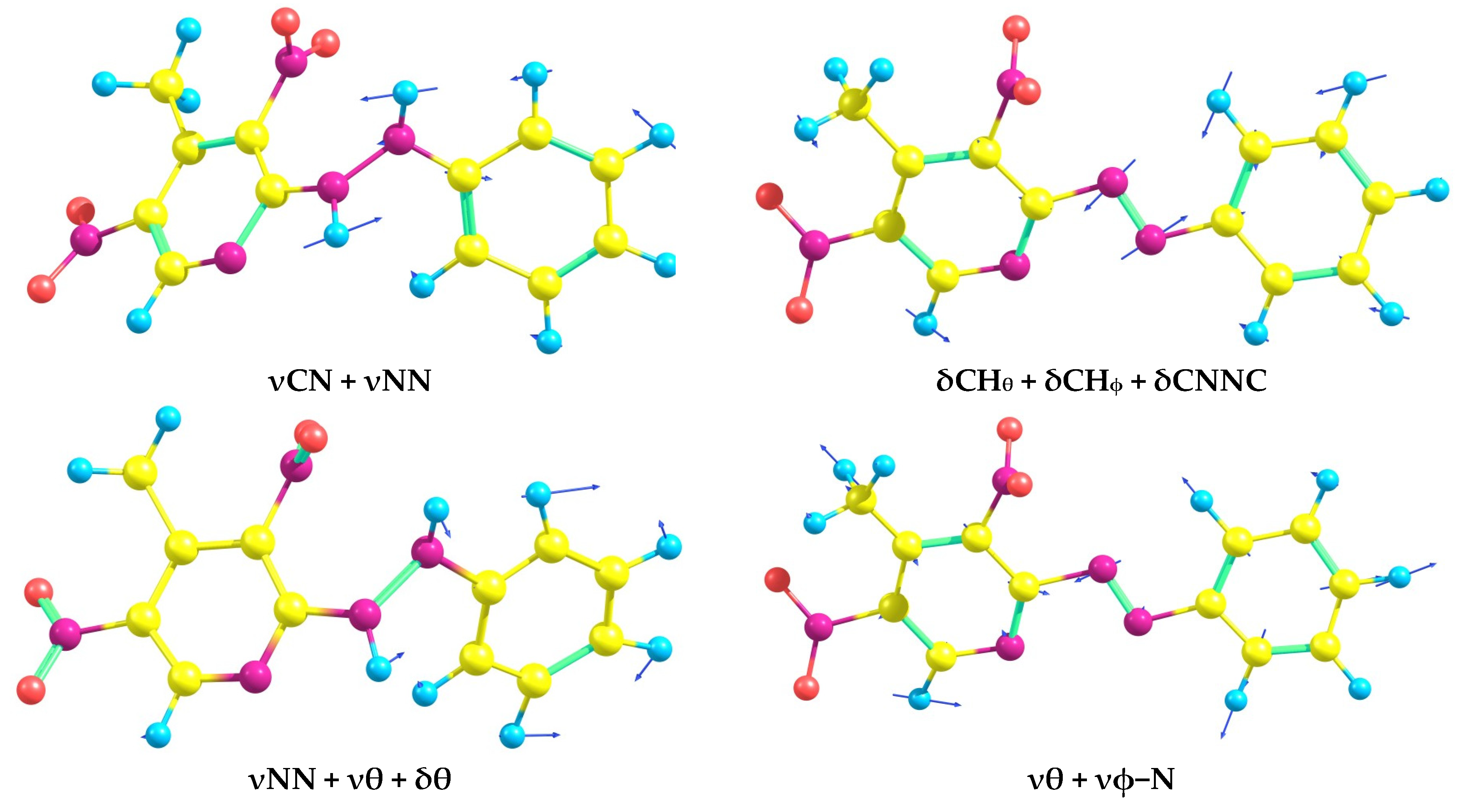
In 4MDNPHP, the hydrazo bridge (Cϕ–NH–NH–Cθ, where ϕ = pyridine and θ = phenyl) exhibits a characteristic set of twelve vibrational degrees of freedom, comprising five stretching and seven bending modes. The stretching vibrations are assigned to ν(NH)ϕ, ν(NH)θ, ν(Cϕ–N), ν(Cθ–N), and ν(N–N), while the bending group includes δas(HN–NH), δs(HN–NH), δ(NNH)ϕ, δ(NNH)θ, γ(HN–NH), τ(NH–NH), and τ(CϕN–NCθ). The corresponding experimental bands appear at 3337 cm−1 [ν(NH)θ], 3152 (3301) cm−1 [ν(NH)ϕ], 1258 (1262) cm−1 [ν(Cθ–N)], 1157 (1146) cm−1 [ν(N–N)], and 1031 (1035) cm−1 [ν(Cϕ–N)], with bending and torsional modes extending from 1589 to 148 cm−1: δas(HN-NH) 1589 (1585) cm−1, δ(NNH)ϕ 1542 (1544) cm−1, δs(HN-NH) 1523 (1533) cm−1, δ(NNH)θ 1490 (1490) cm−1, γ(HN-NH) 710 (711) cm−1, τ(CϕN-NCθ) 230 (237) cm−1, and τ(NH-NH) 148 (158) cm−1. These data confirm the strong involvement of the hydrazo unit in both stretching and deformation vibrations coupled with motions of the adjacent pyridine and phenyl rings (Figure 6).
A similar vibrational characteristic is observed compared to MNPHP [29]. The bands of the stretching vibrations ν(NH) appear at 3318 and 3290 cm−1, and bands of the deformation vibrations in the 1576–1391 cm−1 region and torsional/bending modes down to 192 cm−1. The data discussed in the earlier paper [37] provide further insight into the variability of hydrazo bond vibrations. The ν(NH) stretching modes are clearly separated into two categories: intermolecular hydrogen-bonded NH stretching vibration (3436–3328 cm−1) and intramolecular hydrogen-bonded NH stretching vibration (3265–3168 cm−1). The coexistence of intra- and intermolecular hydrogen bonds is corroborated by multiple bands in regions characteristic of bending vibrations, such as δas(HN–NH) and δs(HN–NH). The band of stretching vibration ν(N–N) is observed at slightly higher wavenumbers (1165–1135 cm−1) than in 4MDNPHP, consistent with stronger or more delocalized bonding contributions. In PHPDNM [26], the vibrational characteristic of the hydrazo bridge closely parallels that of 4MDNPHP. The bands of stretching vibration ν(NH) are observed at 3329 and 3308 cm−1, while the ν(N–N) mode at 1144 cm−1 and ν(Cϕ–N)/ν(Cθ–N) at 1062 and 1263 cm−1 fall in nearly identical positions to those in 4MDNPHP. The agreement in bending and torsional modes confirms strong coupling of the hydrazo bond with the aromatic fragments, yielding almost identical vibrational characteristics.
Comparison shows that although 4MDNPHP follows the same 12-mode vibrational scheme as other hydrazo-bonded compounds, the exact band positions and coupling patterns differ. Overall, the spectroscopic characteristics of the hydrazo bond in 4MDNPHP most closely resemble those of PHPDNM, as described by Michalski et al. (2024) [26].
The bridge, Cϕ-N=N-Cθ, plays an important role in defining the structure and related properties of 4MDNPAP. The azo ν(N=N) vibration is visible at 1490 cm−1 in the Raman and 1487 cm−1 in the IR spectrum. The vibrations ν(Cϕ=N) and ν(Cθ=N) of the bridge are assigned to bands at 1194 cm−1 (IR) and 1195 cm−1 (Raman), respectively. The stretching vibrations of the two C=N bonds, represented as νas(CNNC) and νs(CNNC), create other distinctive vibrations found in the ranges of 1282–1256 cm−1 and 1160–1144 cm−1, respectively. Further characteristic vibrations for the azo-bond include in-plane bending δas(CNNC) at 550 cm−1 and δs(CNNC) at 586–582 cm−1, out-of-plane bending γ(CNNC) at 131 cm−1, and torsional vibrations τ(CNNC) at 254–246 cm−1.
In 6-methyl-3,5-dinitro-2-[(E)-phenyldiazenyl]pyridine 6M3,5NPAP [25], the ν(N=N) band is also detected strongly in the Raman spectrum at 1490 cm−1. The C–N stretching bands occur at 1199 and 1193 cm−1, closely matching 4MDNPAP. The broader vibrational region (1265–1180 cm−1) for νas(CNNC) and νs(CNNC) modes demonstrates coupling with pyridine ring vibrations, similar to 4MDNPAP. Characteristic bending and torsional azo modes are observed at slightly different positions: δas(CNNC) 975–910 cm−1, δs(CNNC) 640–610 cm−1, γ(CNNC) 139–119 cm−1, τ(CNNC) 100–30 cm−1, suggesting a stronger participation of the azo bridge in low-frequency vibrations compared to 4MDNPAP.
In 6-methyl-3,5-dinitro-2-[(E)-phenyldiazenyl]pyridine (PANP) [26], the band of azo ν(N=N) stretching vibration appears as a weak IR band but a strong Raman band. Two coupled modes are reported: one at 1484/1487 cm−1 (IR/Raman) with ~11% of ν(N=N) vibrations, and another at 1469 cm−1 with ~44% contribution, confirming resonance effects between azo vibrations and aromatic substituents. The azo bridge is strongly coupled to pyridine, phenyl, and substituents, leading to doublet-like splitting and distribution of N=N character across several normal modes.
All three compounds (4MDNPAP, 6M3,5NPAP, PANP) confirm the diagnostic role of the Raman band characteristic of ν(N=N) vibration (1460–1490 cm−1), which consistently appears with strong intensity in Raman and weak intensity in IR. For 4MDNPAP, this band is observed at 1490/1487 cm−1, placing it at the higher-frequency edge of the range and suggesting a relatively rigid N=N bond compared to PANP (1469–1487 cm−1). The bands characteristic of C–N stretching modes are observed near 1190–1200 cm−1 in spectra of three compounds. However, in 6M3,5NPAP [25], they show enhanced sensitivity to substitution effects on the pyridine ring. The greatest variability is found in the low-frequency region: in 4MDNPAP, the band of τ(CNNC) mode occurs near 254–246 cm−1, while in 6M3,5NPAP [25] and PANP [26] the corresponding bands are shifted into the 100–30 cm−1 range, reflecting differences in mass distribution and coupling with ring modes. Taken together, these observations demonstrate that 4MDNPAP shares the same 12-mode vibrational framework of the azo bridge as described for the related compounds 6M3,5NPAP [25] and PANP [26], but also exhibits subtle shifts in band positions and intensities that point to differences in bond strength and delocalization effects associated with substitution [39,40,41,42]. Table 5 compares the characteristic wavenumber values of the nitro group for the azo and hydrazine compounds.

2.5. NMR Studies

The 1H and 13C NMR spectra for both compounds are presented in Figures S5 and S6. Table 6 and Table 7 contain a comparison of the experimental and calculated chemical shifts for 4MDNPHP and 4MDNPAP, relative to acetone, with respect to both 1H and 13C NMR analyses.
Based on the chemical formula unit of the investigated compounds, C12H11N6O4 for 4MDNPHP and C12H9N6O4 for 4MDNPAP, twelve signals would theoretically be expected in the 13C NMR spectra. These are associated with six carbon atoms belonging to the benzene ring, five carbon atoms belonging to the pyridine ring and one carbon from a methyl group. The experimental ranges of values, 149.232–114.064 and 153.636–124.895 ppm, correspond to carbons of the benzene ring, respectively, for 4MDNPHP and 4MDNPAP. The recorded values for hydrazo and (azo compound), 144.241 (147.346), 154.668 and 154.442, 139.562–135.485 (154.714), and 153.617 (147.751) ppm, correspond to carbons connected with CH3, NHNH or NN and two NO2 groups, and atom H, respectively, within the pyridine ring structure. The signals at 15.964–14.641 (hydrazo compound) and 24.04 ppm (azo compound) are assigned to the carbon atom of the methyl unit. This specific carbon is situated near three hydrogen atoms and exhibits the largest observed chemical shift. The allocation of the observed spectral signals to specific chemical shifts is consistent with findings in the published literature regarding the NMR spectra of pyridine derivatives [43,44,45,46,47].
The 1H NMR spectrum (as seen in Figure S5) of the hydrazo derivative should display eleven lines, while the azo compound is expected to show nine peaks. Concerning the observed chemical shifts, those linked to the hydrogen atoms and appearing at 9.395 and 9.069 ppm in the spectra of the 4MDNPHP and 9.383 ppm for 4MDNPAP compounds are associated with the pyridine ring. Resonance signals at 7.993 and 7.749, 7.689, 7.422 and 7.451, and 7.202 ppm for 4MDNPHP (7.980 and 7.735 ppm for 4MDNPAP) are indicative of the phenyl ring. The resonances at 2.813, 2.718, and 2.510 ppm for 4MDNPHP (2.706 ppm for 4MDNPAP) stem from the methyl groups bound to the pyridine ring at position four. Additionally, the lines at 6.894 and 6.847 ppm are attributable to the protons of the hydrazo group. The chemical shift assignments presented here agree with previous NMR spectral data for similar compounds [48,49,50,51,52].

2.6. UV-Vis Studies

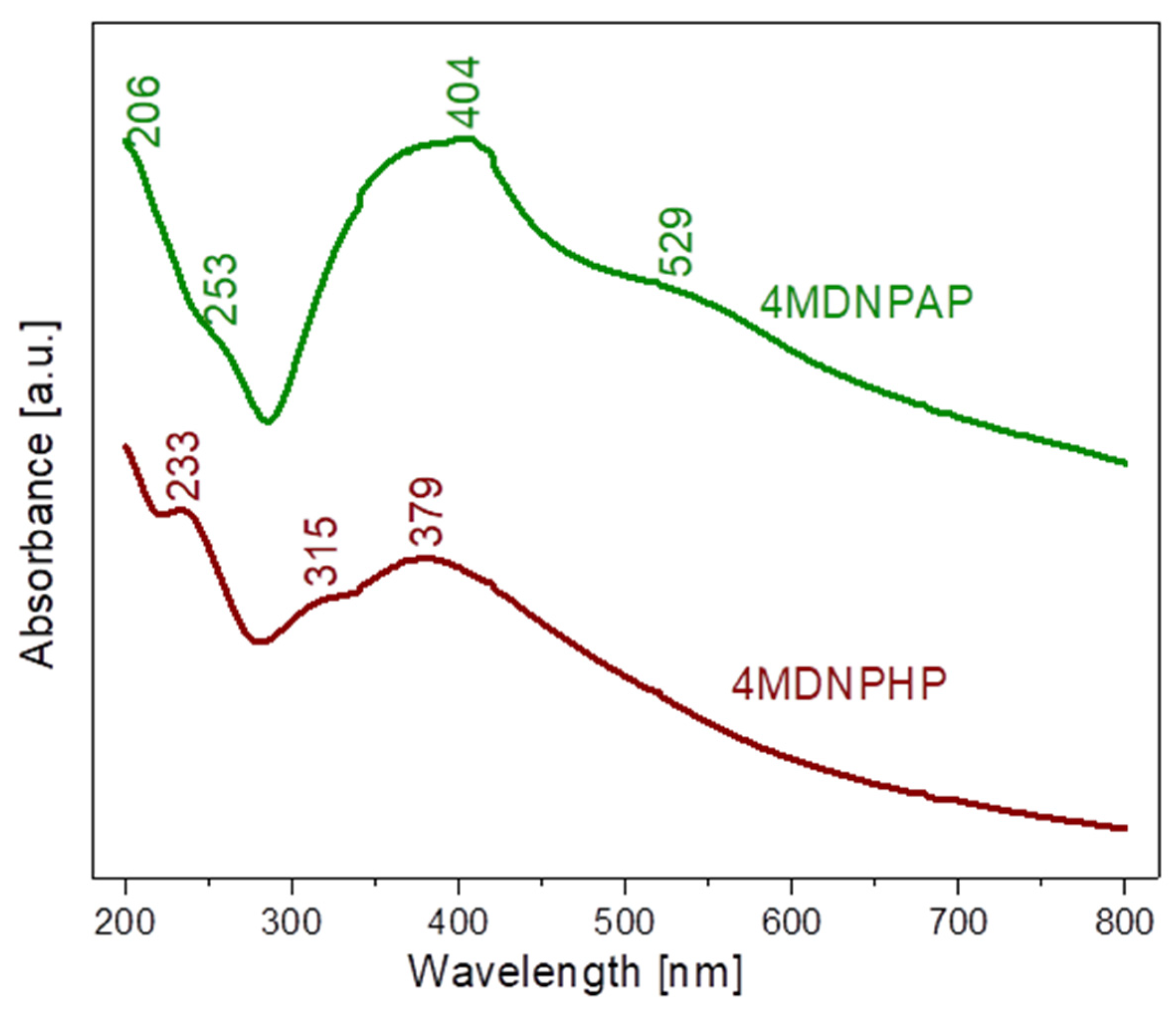
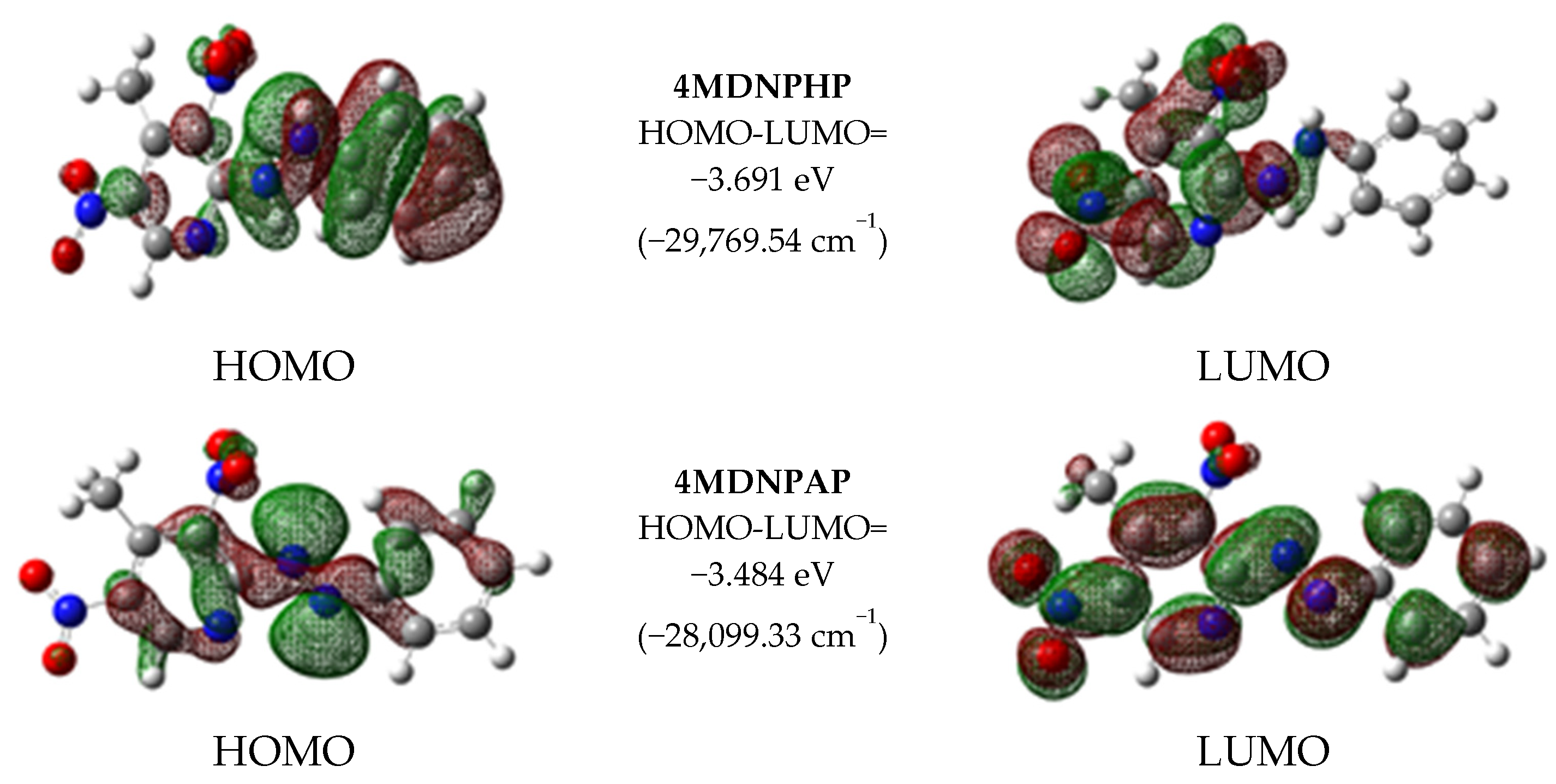
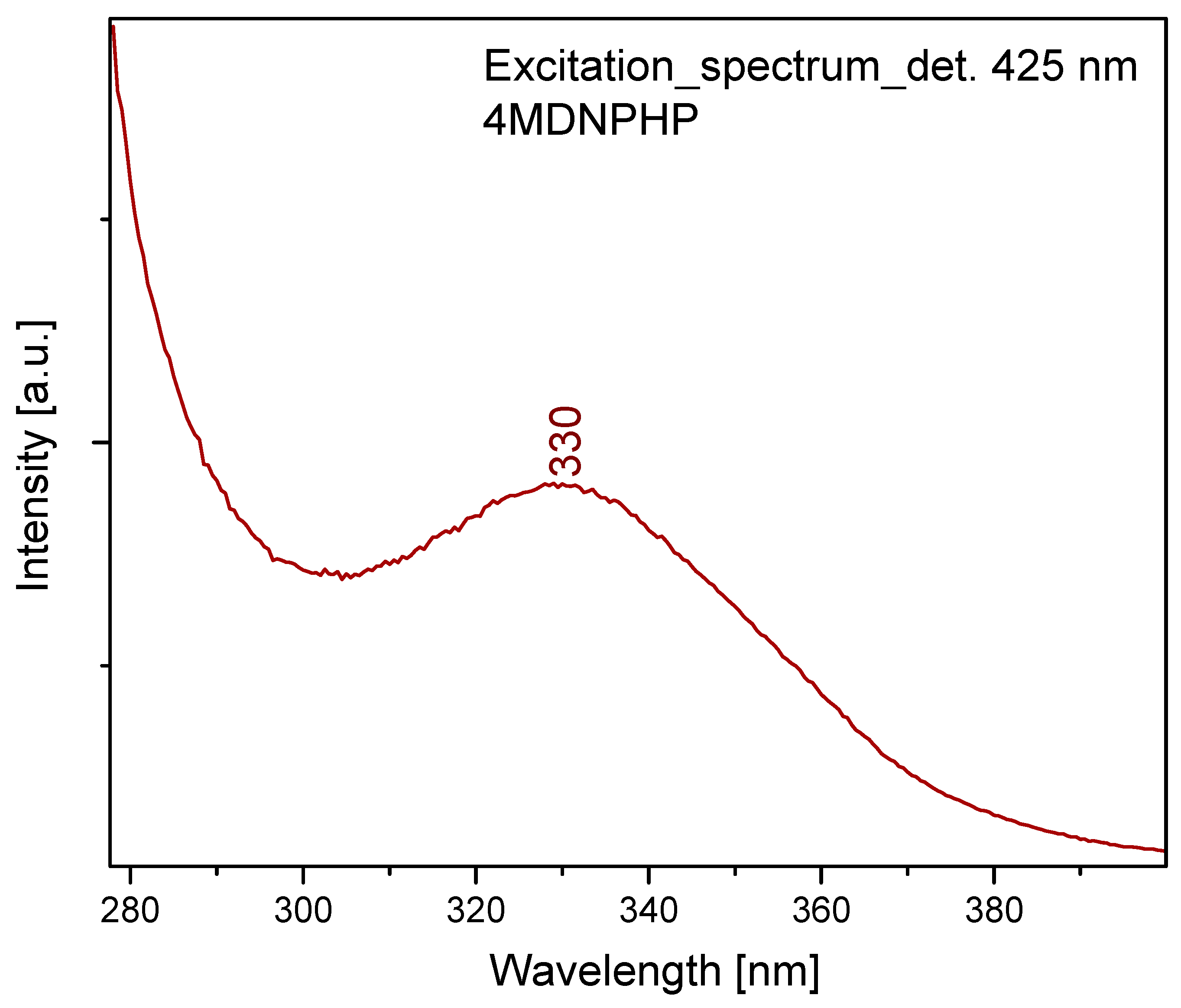
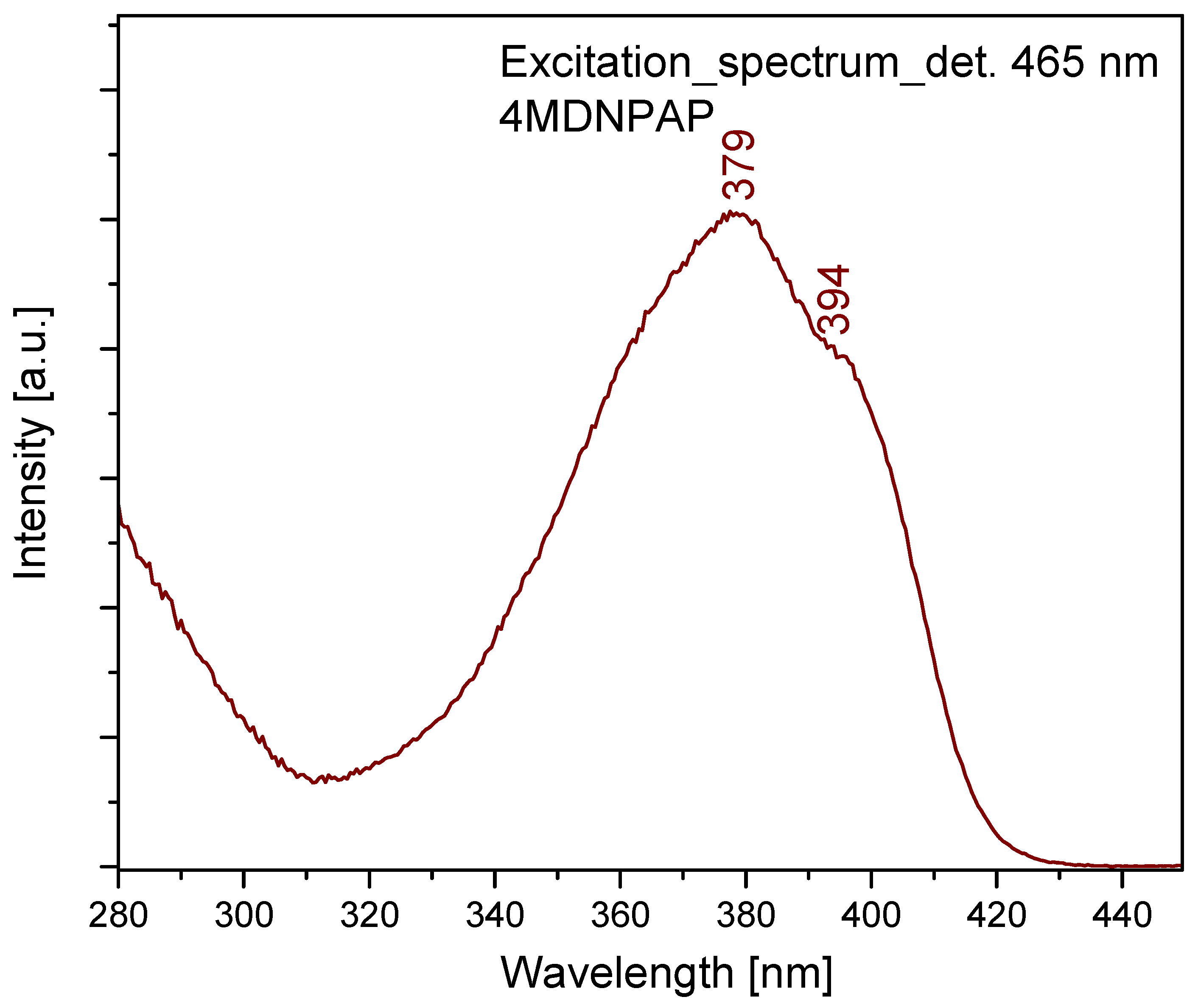
The diffuse reflectance spectra are presented in Figure 7 and Figure S7. They reveal a strong absorption band in the range of 230–260 nm (assigned to π-π* transitions between singlet states) and distinct bands in the 360–420 nm range, which are responsible for n-π* transitions. The Gauss deconvolution gives peaks at 203, 314, 372, and 432 nm for 4MDNPHP and 185, 337, 391, and 495 nm for 4MDNPAP. They correspond to the S9, S4, S2, and S1 electron levels, respectively. In both spectra, at about 500 nm, a very broad shoulder is observed, which originates from the combination of the S4 and S9 transitions. Calculated singlet and triplet states are collected in Tables S2 and S3, the Mulliken atomic charges estimated for 4MDNPHP are presented in Tables S4 and S5. The HOMO-LUMO energy gaps shown in Figure 8 correspond to the S0 ⟶  S4 transitions for which the oscillator strengths take values 0.0442 and 0.0550 for 4MDNPHP and 4MDNPAP, respectively. The position of the absorption bands agrees with those appearing in the excitation spectra (see Figure 9, Figure 10, Figure 11 and Figure 12), in which the band at 330 nm for 4MDNPHP and 375–390 nm for 4MDNPAP are observed. What could have potential application in obtaining these dyes as biosensors [19].
The diffuse reflectance spectra are presented in Figure 7 and Figure S7. They reveal a strong absorption band in the range of 230–260 nm (assigned to π-π* transitions between singlet states) and distinct bands in the 360–420 nm range, which are responsible for n-π* transitions. The Gauss deconvolution gives peaks at 203, 314, 372, and 432 nm for 4MDNPHP and 185, 337, 391, and 495 nm for 4MDNPAP. They correspond to the S9, S4, S2, and S1 electron levels, respectively. In both spectra, at about 500 nm, a very broad shoulder is observed, which originates from the combination of the S4 and S9 transitions. Calculated singlet and triplet states are collected in Tables S2 and S3, the Mulliken atomic charges estimated for 4MDNPHP are presented in Tables S4 and S5. The HOMO-LUMO energy gaps shown in Figure 8 correspond to the S0·⟶··S4 transitions for which the oscillator strengths take values 0.0442 and 0.0550 for 4MDNPHP and 4MDNPAP, respectively. The position of the absorption bands agrees with those appearing in the excitation spectra (see Figure 9, Figure 10, Figure 11 and Figure 12), in which the band at 330 nm for 4MDNPHP and 375–390 nm for 4MDNPAP are observed. What could have potential application in obtaining these dyes as biosensors [19].

2.7. Emission Studies

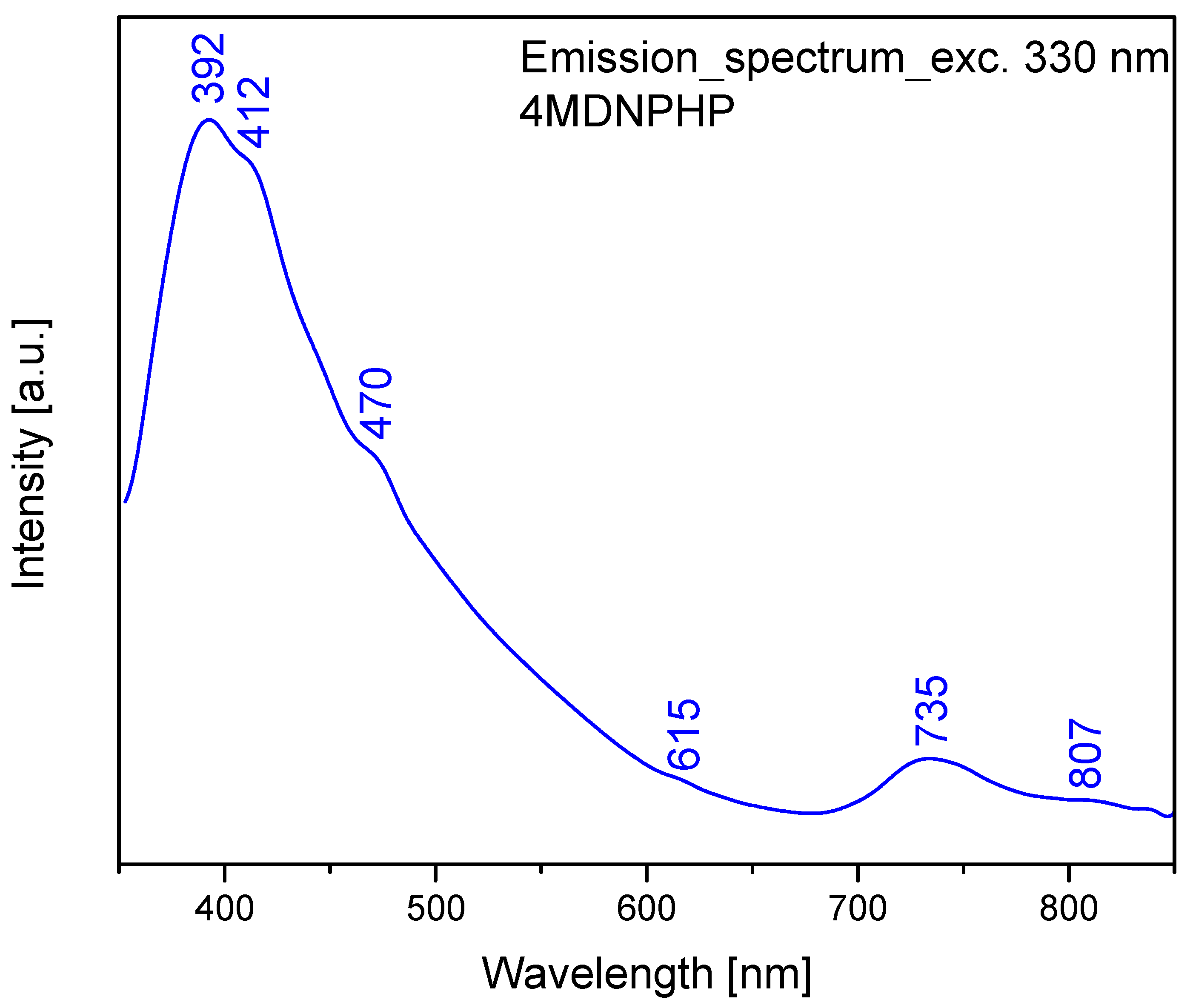
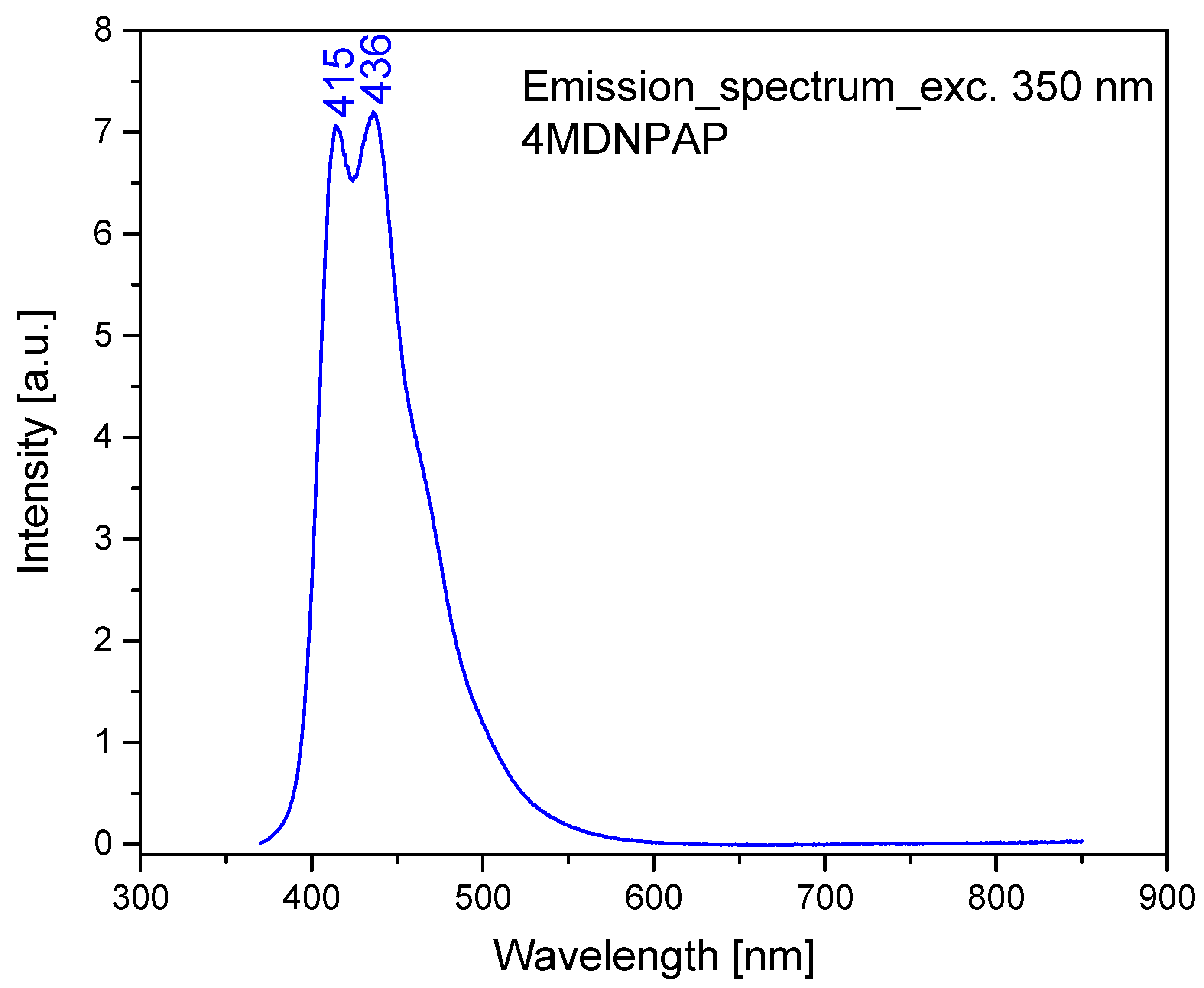
The emission spectra of the studied compounds are shown in Figure 9, Figure 10, Figure 11 and Figure 12. They showed several key bands, identified by deconvolution into Gaussian components, namely at 390 nm (25,641 cm−1), 465 nm (21,505 cm−1) and 735 nm (36,054 cm−1) for 4MDNPHP and at 410 nm (24,390 cm−1) and 440 nm (22,727 cm−1) for 4MDNPAP. Emission bands are observed in the range 390–735 nm (25,651–36,054 cm−1) for 4MDNPHP and in the range 410–440 nm (24,390–22,727 cm−1) for 4MDNPAP, while electronic transitions in the absorption spectra occur in the ranges 203–432 nm (49,261–23,148 cm−1) and 185–495 nm (54,054–20,202 cm−1). These results can be explained by a scheme describing the depopulation of excited states. The emission spectra were recorded using excitations at wavelengths of 30,303 (330 nm) and 28,571 cm−1 (350 nm), suggesting that the molecules are excited to the S1 state. During the intersystem transition (ISC), the T1, T2, and T3 triplet levels are occupied.
Deconvolution of experimental spectra and DFT calculations were used to elucidate the most probable electronic transitions. The Mulliken charge itself is not a directly observable physical quantity, so it does not directly influence IR or UV-Vis spectra. However, it is an indirectly important theoretical quantity because it reflects the distribution of electron density within the molecule, which in turn influences spectral properties. The influence of Mulliken charges on IR spectra. The IR vibration spectrum depends on: bond strengths (force constants), dipole moments, and their changes during vibration. Because the Mulliken charge shows how electrons are distributed between atoms, greater bond polarization → greater change in dipole moment during vibration leads to greater IR band intensity [53].
These levels were found to be 22,595, 23,555, and 24,092 cm−1 for 4MDNPHP and 12,752, 17,998, and 23,116 cm−1 for 4MDNPAP, respectively (Tables S2 and S3). Strong T1, T2, and T3 ⟶ S0 phosphorescence is observed as broad bands in the 300–700 and 350–600 nm ranges. Although room-temperature phosphorescence is typically not observed in excited triplet states, this explanation for the transition is reasonable given the calculated energies of the molecular orbitals. Their red shift is consistent with expectations. It is well known that intra- and intermolecular hydrogen bonds significantly influence the properties of excited states. Excited-state hydrogen bonds influence non-adiabatic processes such as internal conversion, intersystem transition, intramolecular charge transfer, and photoinduced electron transfer [54,55,56,57,58]. The average Stokes shift for the studied compounds is approximately 3000 cm−1.

3. Materials and Methods

3.1. Materials

All commercially available starting materials (AR grade) obtained from Sigma Aldrich (St. Louis, MO, USA) or Thermo Fischer (Waltham, MA, USA) were used in the synthesis of the studied compounds without prior purification.

3.2. X-Ray Structural Studies

Single-crystal X-ray diffraction data for both compounds were collected on an Xcalibur Ruby (Gemini ultra) diffractometer (Rigaku Polska Sp. z o.o., Wroclaw, Poland) at 100 K. The CrysAlisPro software package (Version 1.171.37.35) [59] was used for data collection, cell refinement, data reduction, and analysis. The structures were solved by direct methods using SHELXS-97 [60] and refined by a full-matrix least-squares technique on F2 with SHELXL-2013 (and further with SHELXL-2018) [61]. C, N, and O atoms were found in the Fourier difference maps. They were then refined using anisotropic displacement parameters. N-bonded H atoms were freely refined [d(N–H) = 0.87–0.89 (2) Å; Uiso(H) = 1.2 Ueq(N)], while in the final refinement cycles, C-bonded aromatic and methyl H atoms were allowed to rotate and refined in riding mode [d(C–H) = 0.95 Å and 0.98 Å; Uiso(H) = 1.2Ueq(C) and 1.5Ueq(C)]. The figures were prepared using the DIAMOND (Version 4.0) [62] and Mercury (Version 3.8) [63] programs.

3.3. IR and Raman Spectra

Room temperature infrared (IR) spectra in the 4000–40 cm−1 spectral range, and with the 2 cm−1 resolution, were obtained using the KBr pellet method, employing a Biorad 575C FT-IR spectrometer (Bio-Rad Laboratories, Inc., Hercules, CA, USA). Raman spectral data were acquired over the 4000–80 cm−1 range, using a Bruker RFS 110/S FT-Raman spectrometer (Bruker Corporation, Billerica, MA, USA) configured in a backscattering geometry and equipped with a YAG:Nd3+ laser operating at 1064 nm. The spectra were recorded at a resolution of 2 cm−1 and were the product of averaging 64 scans.

3.4. NMR Spectra

Proton Nuclear Magnetic Resonance (1H NMR) spectra were collected utilizing a JEOL ECZ500R (JEOL Ltd., Tokyo, Japan) instrument operating at 500 MHz. The spectrometer was fitted with a SONDA AUTOMAS 3.2 mm probe, employing a sample rotation rate of 10,000 Hz and the WPMLG (Windowed Phase Modulated Lee-Goldberg) pulse sequence.

3.5. UV-Vis Spectra

The diffuse reflectance spectra, ranging from 200 to 1500 nm, were performed at ambient temperature using a Cary-Varian 5E UV-Vis-near-IR spectrophotometer (Agilent Technologies, Santa Clara, CA, USA) equipped with a Praying Mantis diffuse reflectance attachment. The diffuse reflectance spectra were gathered from the powdered samples dispersed in silicon paste; the Al2O3 powder served as a reference.

3.6. Emission Spectra

Emission spectra were collected with an Edinburgh Instruments FLS1000 fluorescence spectrometer (Techcomp Europe Ltd., Livingston, UK). This setup utilized a 450 W xenon lamp for excitation, with a Hamamatsu 928 PMT (Hamamatsu Photonics K.K., Hamamatsu City, Japan) serving as the main detector. The monochromators, configured in the Czerny-Turner mode, incorporated 1800 lines per mm holographic gratings optimized for 300 nm, enabling a 0.2 nm spectral resolution. Spectra obtained were subsequently corrected to account for the sensitivity and wavelength characteristics of the measurement apparatus.
Luminescence decay dynamics were investigated with a femtosecond laser, specifically a Coherent “Libra” model (Coherent Corp., Saxonburg, PA, USA), interfaced with a Light Conversion “OPerA” optical parametric amplifier. Decay curves were acquired utilizing a Princeton Instruments Acton 2500i grating spectrograph (Teledyne Princeton Instruments, Trenton, NJ, USA)coupled to a Hamamatsu C5680 streak camera (Hamamatsu Photonics K.K., Hamamatsu City, Japan). The streak camera offered a temporal resolution of 20 ps and the measurements covered the 200–1100 nm spectral window.

3.7. Theoretical Calculations

The molecules of the examined compounds underwent geometry optimization utilizing the Gaussian 16 software suite [64]. The DFT, specifically the B3LYP hybrid functional employing three parameters [65,66,67,68,69], was used in all calculations. The calculations utilized the 6–311G(2d,2p) [70,71] basis set. This choice facilitated comparison with prior findings concerning the optical attributes of other pyridine derivatives, as documented in our previous study [26]. To adjust for vibrational anharmonicity within the calculated wavenumbers, scaling factors of 0.980 (2499–0 cm−1) and 0.947 (3500–2500 cm−1), determined using the procedure delineated by Palafox and Rastogi [72], were implemented. Following optimization, the geometric parameters, infrared (IR) and Raman wavenumbers, Nuclear Magnetic Resonance (NMR) spectra, and the characteristics of the excited states were calculated for individual molecules. The Potential Energy Distribution (PED) across the normal modes and corresponding internal coordinates was computed using the FCART06 program [73]. The GaussView 6.1 program [74] was employed to visualize the molecular structures. Furthermore, the ChemCraft program (Version 1.8, build 682) [75] served to recalculate the theoretical Raman intensities and visualize specific vibrational modes of the molecules.

4. Conclusions

The compound 4-methyl-3,5-dinitro-2-(2-phenylhydrazinyl)pyridine and its azo derivative, 4-methyl-3,5-dinitro-2-[(E)-phenyldiazenyl]pyridine, were synthesized and examined using various experimental spectroscopic methods, including 1H and 13C NMR, IR, Raman, absorption, and emission. The analysis was supported by quantum DFT computations of vibrational, optical, and NMR spectra. Both compounds were further characterized by low-temperature single-crystal X-ray diffraction studies. The 4MDNPHP compound crystallizes in triclinic symmetry (P 1 ¯ space group, Z = 2), and its hydrazo analogue 4MDNPAP adopts the monoclinic symmetry (P21/n space group, Z = 4). Their crystal structures, similar to compounds that have shown promising use in medicine, acting as antiviral and antifungal treatments and metal ion complexing agents, were discussed regarding potential applications. In these roles, the molecules bind by using the hydrogen atom of the amino groups or the lone pair electrons of the azo bridge. In the 4MDNPHP crystal structure, intermolecular interactions, including hydrogen bonding patterns, were analyzed, showing that in 4MDNPHP, molecules form dimers via N-H⋯N hydrogen bonds, further stabilized by N-H⋯O and C-H⋯O interactions, resulting a ribbon formation. In contrast, 4MDNPAP exhibits a molecular chain linked through C-H⋯N interactions. In both studied compounds, the adjacent substituents, methyl and -NH-NH-/-N=N- groups, have a significant influence on the geometry of both nitro groups and thus on the entire molecule, its hydrogen bond network or attractive non-covalent contacts. These influence the physicochemical properties and, consequently, their applications in complexing lanthanide ions.
A comparison of azo and hydrazine analogues shows that their geometric differences arise mainly from the nature of the bridging bond. In azo compounds, the short and rigid N=N double bond usually enforces a planar structure, promoting conjugation with aromatic rings. However, that the -N=N- group is not coplanar with the aromatic rings in the 4MDNPAP molecule, largely due to steric hindrance associated with the presence of four substituents next to each other on the pyridine ring [with the dihedral angle of 25.4 (2)° between the aromatic rings]. On the other hand, in hydrazine derivatives, the longer and more flexible N–N single bond allows free rotation, resulting in a wide range of torsional angles and varied orientations of nitro groups. Their conformations are strongly influenced by steric and electrostatic effects, including possible N–H⋯O(NO2) hydrogen bonding, but in the case of 4MDNPHP the role of typical intramolecular interactions has most likely been completely taken over by intermolecular interactions. Furthermore, hydrazines exhibit greater structural diversity compared to the more rigid and typically conjugated azo systems. These differences translate directly into distinct coordination behaviours toward lanthanide ions. The azo system is predisposed to form more rigid and predictable coordination environments, whereas the hydrazine derivative offers enhanced adaptability due to its conformational freedom and the presence of an additional NH donor site. Consequently, the present study provides clear guidelines for the rational design of azo- and hydrazine-based ligands with tailored structural and functional properties for lanthanide complexation.
Vibrational properties of hydrazine and azo bonds were investigated with respect to molecular conformation and the influence of intermolecular hydrogen bonding. In the 4MDNPHP molecule, the NH group plays an important role as a proton donor. For the 4MDNPAP compound, the characteristic ν(N=N) Raman band in the 1460–1490 cm−1 range was confirmed, showing high intensity in Raman spectra and low intensity in IR. Strong coupling of the azo bridge with aromatic rings leads to splitting and distribution of the N=N character across several normal vibration modes.
Hirshfeld surface analysis combined with the associated two-dimensional fingerprint plots revealed that both hydrogen-bonding and non-hydrogen-bonding interactions in the 4MDNPHP crystal differ significantly from those observed in the 4MDNPAP crystal, further highlighting the substantial influence of the bridging unit on the supramolecular organization.

Supplementary Materials

The following supporting information can be downloaded at: https://www.mdpi.com/article/10.3390/ijms262412106/s1.

Author Contributions

Conceptualization, J.M. and J.H.; methodology, J.H.; software, A.P. and I.B.; validation, J.H. and W.S.; formal analysis, J.M., I.B., J.H. and W.S.; investigation, J.M., E.K., I.B., A.P., R.L. and M.P.; resources, A.P. and I.B.; data curation; writing—original draft preparation, J.M., E.K., I.B., L.D., A.P. and J.H.; writing—review and editing, J.M., E.K., I.B., L.D., M.P., J.H. and W.S.; visualization, J.M., E.K., I.B., A.P. and R.L.; supervision, E.K.; project administration; funding acquisition, L.D. All authors have read and agreed to the published version of the manuscript.

Funding

This research received no external funding.

Institutional Review Board Statement

Not applicable.

Informed Consent Statement

Not applicable.

Data Availability Statement

The original contributions presented in this study are included in the article/Supplementary Materials. Further inquiries can be directed to the corresponding author(s).

Conflicts of Interest

The authors declare no conflicts of interest.

References

  1. Poornesh, P.; Hegde, P.K.; Umesh, G.; Manjunatha, M.G.; Manjunatha, K.B.; Adhikari, A.V. Nonlinear optical and optical power limiting studies on a new thiophene-based conjugated polymer in solution and solid PMMA matrix. Opt. Laser Technol. 2010, 42, 230–236. [Google Scholar] [CrossRef]
  2. Narendar, P.; Parthiban, J.; Anbalagan, N.; Gunasekaran, V.; Leonard, J.T. Pharmacological evaluation of some new 2-substituted pyridine derivatives. Biol. Pharm. Bull. 2003, 26, 182–187. [Google Scholar] [CrossRef]
  3. Rollas, S.; Küçükgüzel, Ş.G. Biological activities of hydrazone derivatives. Molecules 2007, 12, 1910–1939. [Google Scholar] [CrossRef]
  4. McEvoy, J.; McCarthy, C.; Bruno, R.; Brouwers, S.; Canavan, M.; Ceconi, C.; Christodorescu, R.; Ferro, C.; Daskalopoulou, S.; Gerdts, E.; et al. 2024 ESC Guidelines for the management of elevated blood pressure and hypertension. Eur. Heart J. 2024, 45, 3912–4018. [Google Scholar] [CrossRef]
  5. González-Porras, J.; Godeau, B.; Carpenedo, M. Switching thrombopoietin receptor agonist treatments in patients with primary immune thrombocytopenia. Ther. Adv. Hematol. 2019, 10, 1–9. [Google Scholar] [CrossRef]
  6. Massoud, M.; Armand, J.-P.; Ribrag, V. Procarbazine in haematology: An old drug with a new life? Eur. J. Cancer 2004, 40, 1924–1927. [Google Scholar] [CrossRef] [PubMed]
  7. Eilender, D.; LoRusso, P.; Thomas, L.; McCormick, C.; Rodgers, A.H.; Hooper, C.L.; Tornyos, K.; Krementz, E.T.; Parker, S.; Morgan, L. 4,4′-Dihydroxybenzophenone-2,4-dinitrophenylhydrazone (A-007): A topical treatment for cutaneous metastases from malignant cancers. Cancer Chemother. Pharmacol. 2006, 57, 719–726. [Google Scholar] [CrossRef] [PubMed]
  8. Arora, T.; Devi, J.; Boora, A.; Taxak, B.; Rani, S. Synthesis and characterization of hydrazones and their transition metal complexes: Antimicrobial, antituberculosis and antioxidant activity. Res. Chem. Intermed. 2023, 49, 4819–4843. [Google Scholar] [CrossRef]
  9. Barciela, P.; Cabaleiro, N.; Herrero, C.; Bermejo-Barrera, P. Azo dyes in the food industry: Features, classification, toxicity, alternatives and regulation. Food Chem. Adv. 2023, 2, 100124. [Google Scholar] [CrossRef]
  10. Savić, J.; Vasić, V. Complex formation between Pd(II) and immobilized imidazol-azo-chromotropic acid. Acta Chim. Slov. 2006, 53, 36–42. [Google Scholar]
  11. Dong, Y.; Chen, J.; Li, C.; Zhu, H. Decoloration of three azo dyes in water by photocatalysis of Fe(III)–oxalate complexes/H2O2 in the presence of inorganic salts. Dye. Pigment. 2007, 73, 261–268. [Google Scholar] [CrossRef]
  12. Pathak, P.; Jolly, V.S.; Sharma, K.P. Synthesis and biological activities of some new substituted arylazo Schiff bases. Orient. J. Chem. 2000, 16, 493–494. [Google Scholar]
  13. Olcay, B.; Hakan, B. Synthesis of Schiff and Mannich bases of isatin derivatives with 4-amino-4,5-dihydro-1H-1,2,4-triazole-5-ones. Molecules 2008, 13, 2126–2135. [Google Scholar] [CrossRef]
  14. Sharma, K.P.; Jolly, V.S.; Phatak, P. Schiff base and their derivatives as potential anticancer agents. Ultra Sci. Phys. Sci. 1998, 10, 263–266. [Google Scholar]
  15. Muzael, M.H.; Al-Zamili, T.F.; Shanan, H.K. Preparation, characterization and biological activity of some new tetra-azo compounds. J. Thi-Qar Sci. 2008, 1, 35–44. [Google Scholar] [CrossRef]
  16. Hihara, T.; Okada, Y.; Morita, Z. A semiempirical molecular orbital study of the photoreactivity of monoazo reactive dyes derived from γ- and J-acids. Dye. Pigment. 2007, 73, 141–161. [Google Scholar] [CrossRef]
  17. Skelton, R.; Dubois, F.; Zenobi, R. A MALDI sample preparation method suitable for insoluble polymers. Anal. Chem. 2000, 72, 1707–1710. [Google Scholar] [CrossRef] [PubMed]
  18. Otutu, J.O.; Okoro, D.; Ossai, E.K. Preparation of dis-azo dyes derived from p-aminophenol and their fastness properties for synthetic polymer-fibres. J. Appl. Sci. 2008, 8, 334–339. [Google Scholar] [CrossRef]
  19. Jeon, B.J.; Cha, S.W.; Jeong, M.Y.; Lim, T.K.; Jin, J.I. Synthesis and 2nd order nonlinear optical properties of soluble polyimides bearing nitroazobenzene type chromophore pendants attached in side-on mode. J. Mater. Chem. 2002, 12, 546–552. [Google Scholar] [CrossRef]
  20. Tian, Z.Y.; Huang, W.T.; Xiao, D.B.; Wang, S.Q.; Wu, Y.S.; Gong, Q.H. Enhanced and size-tunable third-order nonlinearity of nanoparticles from an azo metal chelate. Chem. Phys. Lett. 2004, 391, 283–287. [Google Scholar] [CrossRef]
  21. Ofomaja, A.E.; Ho, Y.S. Equilibrium sorption of anionic dye from aqueous solution by palm kernel fibre as sorbent. Dye. Pigment. 2007, 74, 60–66. [Google Scholar] [CrossRef]
  22. Peter, A.T.; Freeman, H.S. Colour Chemistry: The Design and Synthesis of Organic Dyes and Pigments; Springer: Dordrecht, The Netherlands, 1991; ISBN 1851665773/9781851665778. [Google Scholar]
  23. Su, X.; Aprahamian, I. Hydrazone-based switches, metallo-assemblies and sensors. Chem. Soc. Rev. 2014, 43, 1963–1981. [Google Scholar] [CrossRef]
  24. Asad, M.; Wang, Y.-J.; Wang, S.; Dong, Q.-G.; Li, L.-K.; Majeed, S.; Wang, Q.-Y.; Zang, S.-Q. Hydrazone connected stable luminescent covalent–organic polymer for ultrafast detection of nitro-explosives. RSC Adv. 2021, 11, 39270–39277. [Google Scholar] [CrossRef] [PubMed]
  25. Michalski, J.; Bryndal, I.; Lorenc, J.; Hermanowicz, K.; Janczak, J.; Hanuza, J. Conformation of the azo bond and its influence on the molecular and crystal structures, IR and Raman spectra, and electron properties of 6-methyl-3,5-dinitro-2-[(E)-phenyldiazenyl]pyridine—Quantum chemical DFT calculations. Spectrochim. Acta A 2018, 191, 521–531. [Google Scholar] [CrossRef] [PubMed]
  26. Michalski, J.; Stoczewski, Z.; Roszak, S.; Kucharska, E.; Bryndal, I.; Dymińska, L.; Lisiecki, R.; Hanuza, J. Conformation of the hydrazo bond in new 2-methyl-3,5-dinitro-6-(2-phenylhydrazinyl)pyridine and its influence on the structural and optic properties—Quantum chemical DFT calculations. Spectrochim. Acta A 2024, 308, 123760. [Google Scholar] [CrossRef]
  27. Oniciu, D.C.; Ghivirga, I.; Katritzky, A.R.; Steel, P.J.; Tomasik, P. Tautomerism and rotamerism in 2-(2-phenylhydrazino)pyridine. Chem. Heterocycl. Compd. 2001, 37, 785–789. [Google Scholar] [CrossRef]
  28. Kucharska, E.; Michalski, J.; Sąsiadek, W.; Talik, Z.; Bryndal, I.; Hanuza, J. Vibrational spectra, crystal structure, DFT quantum chemical calculations and conformation of the hydrazo–bond in 6-methyl-3-nitro-2-(2-phenylhydrazinyl)pyridine. Spectrochim. Acta A 2013, 107, 317–325. [Google Scholar] [CrossRef]
  29. Kucharska, E.; Bryndal, I.; Lis, T.; Lorenc, J.; Hanuza, J. Influence of methyl and nitro group substitutions on the structure and vibrational characteristics of the hydrazo-bridge in 6,6′-dimethyl-3,3′,5,5′-tetranitro-2,2′-hydrazobipyridine. Vib. Spectrosc. 2016, 83, 70–77. [Google Scholar] [CrossRef]
  30. Bryndal, I.; Kucharska, E.; Wandas, M.; Lorenc, J.; Hermanowicz, K.; Mączka, M.; Lis, T.; Marchewka, M.; Hanuza, J. Comprehensive physicochemical studies of a new hybrid material: 2-Amino-4-methyl-3-nitropyridinium hydrogen oxalate. Spectrochim. Acta A 2014, 117, 434–441. [Google Scholar] [CrossRef]
  31. Bryndal, I.; Kucharska, E.; Sąsiadek, W.; Wandas, M.; Lis, T.; Lorenc, J.; Hanuza, J. Molecular and crystal structures, vibrational studies and quantum chemical calculations of 3- and 5-nitroderivatives of 2-amino-4-methylpyridine. Spectrochim. Acta A 2012, 96, 952–962. [Google Scholar] [CrossRef]
  32. Bernstein, J.; Davis, R.E.; Shimoni, L.; Chang, N.-L. Patterns in hydrogen bonding: Functionality and graph set analysis in crystals. Angew. Chem. Int. Ed. Engl. 1995, 34, 1555–1573. [Google Scholar] [CrossRef]
  33. Speak, A.L. Single-crystal structure validation with the program PLATON. J. Appl. Cryst. 2003, 36, 7–13. [Google Scholar] [CrossRef]
  34. Daszkiewicz, M. Importance of O⋯N interaction between nitro groups in crystals. CrystEngComm 2013, 15, 10427–10430. [Google Scholar] [CrossRef]
  35. Spackman, P.R.; Turner, M.J.; McKinnon, J.J.; Wolff, S.K.; Grimwood, D.J.; Jayatilaka, D.; Spackman, M.A. Crystal Explorer: A program for Hirshfeld surface analysis, visualization and quantitative analysis of molecular crystals. J. Appl. Cryst. 2021, 54, 1006–1011. [Google Scholar] [CrossRef] [PubMed]
  36. Michalski, J.; Kucharska, E.; Wandas, M.; Hanuza, J.; Waśkowska, A.; Mączka, M.; Talik, Z.; Olejniczak, S.; Potrzebowski, M.J. Crystal structure, vibrational and NMR studies and chemical quantum calculations of 2-phenylazo-5-nitro-6-methyl-pyridine (C12H10N4O2). J. Mol. Struct. 2005, 744–747, 377–392. [Google Scholar] [CrossRef]
  37. Michalski, J.; Kucharska, E.; Sąsiadek, W.; Lorenc, J.; Hanuza, J. Intra- and intermolecular hydrogen bonds, conformation and vibrational characteristics of the hydrazo group in 5-nitro-2-(2-phenylhydrazinyl)pyridine and its 3-, 4- or 6-methyl isomers. Spectrochim. Acta A 2013, 112, 263–275. [Google Scholar] [CrossRef]
  38. Socrates, G. Infrared and Raman Characteristic Group Frequencies: Tables and Charts, 3rd ed.; John Wiley & Sons, Ltd.: Chichester, UK, 2004; ISBN 978-0-470-09307-8. [Google Scholar]
  39. Castillo, M.V.; Rudyk, R.A.; Davies, L.; Brandán, S.A. Analysis of the structure and the FT-IR and Raman spectra of 2-(4-nitrophenyl)-4H-3,1-benzoxazin-4-one. Comparisons with the chlorinated and methylated derivatives. J. Mol. Struct. 2017, 1140, 2–11. [Google Scholar] [CrossRef]
  40. Rakkasagi, A.M.; Hiremath, S.M.; Khemalapure, S.S.; Basanagouda, M.M.; Kulkarni, S.S.; Koppal, V.V.; Jeyaseelan, S.C. Synthesis, spectroscopic (FT-IR, FT-Raman), solvent effects (absorption, fluorescence), electronic and biological evaluation of 7-methyl-4-(4-methyl-2-nitro-phenoxymethyl)-2H-chromen-2-one. J. Photochem. Photobiol. 2023, 444, 114976. [Google Scholar] [CrossRef]
  41. Potla, K.M.; Suchetan, P.A.; Poojith, N.; Osório, F.A.P.; Valverde, C.; Mary, Y.S.; Vankayalapati, S. A comparative study of structural and spectroscopic properties of three structurally similar mechanically bending organic single crystals—2-Amino-3-nitro-5-halo (halo = Cl, Br, or I) pyridine. Spectrochim. Acta A 2023, 302, 123093. [Google Scholar] [CrossRef]
  42. Brito, I.; Mundaca, A.; Cárdenas, A.; López-Rodríguez, M. 3,3′-Dinitro-2,2′-dithiodipyridine. Acta Cryst. C 2008, 64, 117–118. [Google Scholar] [CrossRef]
  43. Jackman, L.M.; Sternhell, S. Application of NMR Spectroscopy in Organic Chemistry, 2nd ed.; Pergamon Press: Oxford, UK, 1969. [Google Scholar]
  44. Brügel, W. Die Kernresonanzspektren von Pyridin-Derivaten. Z. Elektrochem. 1962, 66, 159–177. [Google Scholar] [CrossRef]
  45. Kątcka, M.; Urbański, T. NMR spectra of pyridine, picolines and hydrochlorides and of their hydrochlorides and methiodides. Bull. Acad. Pol. Sci. Sér. Sci. Chim. 1968, 16, 347–350. [Google Scholar]
  46. Katritzky, A.R. (Ed.) Advances in Heterocyclic Chemistry; Elsevier Academic Press: Amsterdam, The Netherlands, 2006; Volume 91, ISBN 9780080463018. [Google Scholar]
  47. Sąsiadek, W.; Bryndal, I.; Lis, T.; Wandas, M.; Hanuza, J. Synthesis and physicochemical properties of the methyl-nitro-pyridine-disulfide: X-ray, NMR, electron absorption and emission, IR and Raman studies and quantum chemical calculations. J. Mol. Struct. 2022, 1257, 132535. [Google Scholar] [CrossRef]
  48. Wandas, M.; Kucharska, E.; Michalski, J.; Talik, Z.; Lorenc, J.; Hanuza, J. Experimental and simulated 1H and 13C NMR spectra (GIAO/DFT approach) and molecular and crystal structures of dimethyl-dinitro-azo- and dimethyl-dinitro-hydrazo-pyridines. J. Mol. Struct. 2011, 1004, 156–162. [Google Scholar] [CrossRef]
  49. Barakat, A.; Al-Najjart, H.J.; Al-Majid, A.M.; Soliman, S.M.; Mabkhot, Y.N.; Shaik, M.R.; Chabbiur, H.A.; Fun, H.-K. Synthesis, NMR, FT-IR, X-ray structural characterization, DFT analysis and isomerism aspects of 5-(2,6-dichlorobenzylidene)pyrimidine-2,4,6(1H,3H,5H)-trione. Spectrochim. Acta A 2015, 147, 107–116. [Google Scholar] [CrossRef] [PubMed]
  50. Carthigayan, K.; Xavier, S.; Periandy, S. HOMO–LUMO, UV, NLO, NMR and vibrational analysis of 3-methyl-1-phenylpyrazole using FT-IR, FT-RAMAN, FT-NMR spectra and HF-DFT computational methods. Spectrochim. Acta A 2015, 142, 350–363. [Google Scholar] [CrossRef] [PubMed]
  51. Puszko, A.; Wasylina, L. The Influence of Steric Effect on 1H NMR, 13C NMR, and IR Spectra of Methylated Derivatives of 4-Nitropyridine N-Oxide. Chem. Pap. 1995, 49, 176–181. [Google Scholar] [CrossRef]
  52. Raymo, F.M.; Bartberger, M.D.; Houk, K.N.; Stoddart, J.F. The Magnitude of [C−H⋯O] Hydrogen Bonding in Molecular and Supramolecular Assemblies. J. Am. Chem. Soc. 2001, 123, 9264–9267. [Google Scholar] [CrossRef]
  53. Michalski, J.; Kucharska, E.; Sąsiadek, W.; Lorenc, J.; Hanuza, J. Excited states of selected hydrazo-compounds on the example of 5-nitro-2-(2-phenylhydrazinyl)pyridine and its 3-, 4- or 6-methyl isomers. J. Mol. Struct. 2016, 1123, 80–91. [Google Scholar] [CrossRef]
  54. Yi, Y.-R.; Lee, I.-J. Photoreactions of spirophenanthrooxazine dispersed in polystyrene film at room temperature. J. Photochem. Photobiol. A Chem. 2002, 151, 89–94. [Google Scholar] [CrossRef]
  55. Glasbeek, M.; Zhang, H. Femtosecond Studies of Solvation and Intramolecular Configurational Dynamics of Fluorophores in Liquid Solution. Chem. Rev. 2004, 104, 1929–1954. [Google Scholar] [CrossRef] [PubMed]
  56. Zhao, G.-J.; Yu, F.; Zhang, M.-X.; Northrop, B.H.; Yang, H.; Han, K.-L.; Stang, P.J. Substituent Effects on the Intramolecular Charge Transfer and Fluorescence of Bimetallic Platinum Complexes. J. Phys. Chem. A 2011, 115, 6390–6393. [Google Scholar] [CrossRef]
  57. Cao, X.; Liu, C.; Liu, Y. Theoretical Studies on the Mechanism of Cyclic Nucleotide Monophosphate Hydrolysis within Phosphodiesterases. Theor. Comput. Chem. 2012, 11, 573–586. [Google Scholar] [CrossRef]
  58. Zhao, G.-J.; Han, K.-L. Hydrogen Bonding in the Electronic Excited State. Acc. Chem. Res. 2012, 45, 404–413. [Google Scholar] [CrossRef]
  59. CrysAlis PRO, Version 1.171.37.35; Rigaku Oxford Diffraction: Oxford, UK, 2014.
  60. Sheldrick, G.M. A short history of SHELX. Acta Crystallogr. A 2008, 64, 112–122. [Google Scholar] [CrossRef]
  61. Sheldrick, G.M. Crystal structure refinement with SHELXL. Acta Crystallogr. C 2015, 71, 3–8. [Google Scholar] [CrossRef]
  62. Brandenburg, K. DIAMOND 4.0, Crystal Impact GbR: Bonn, Germany, 2014.
  63. Macrae, C.F.; Bruno, I.J.; Chisholm, J.A.; Edgington, P.R.; McCabe, P.; Pidcock, E.; Rodriguez-Monge, L.; Taylor, R.; van de Streek, J.; Wood, P.A. Mercury CSD 2.0—new features for the visualization and investigation of crystal structures. J. Appl. Cryst. 2008, 41, 466–470. [Google Scholar] [CrossRef]
  64. Frisch, M.J.; Trucks, G.W.; Schlegel, H.B.; Scuseria, G.E.; Robb, M.A.; Cheeseman, J.R.; Scalmani, G.; Barone, V.; Petersson, G.A.; Nakatsuji, H.; et al. Gaussian 16, Revision C.01, Gaussian Inc.: Wallingford, CT, USA, 2016.
  65. Becke, A.D. Density-functional thermochemistry. III. The role of exact exchange. J. Chem. Phys. 1993, 98, 5648–5652. [Google Scholar] [CrossRef]
  66. Becke, A.D. Density-functional exchange-energy approximation with correct asymptotic behaviour. Phys. Rev. A 1988, 38, 3098–3100. [Google Scholar] [CrossRef] [PubMed]
  67. Parr, R.G.; Yang, W. Density-Functional Theory of Atoms and Molecules; Oxford University Press: New York, NY, USA; Oxford, UK, 1989. [Google Scholar] [CrossRef]
  68. Vosko, S.H.; Wilk, L.; Nusair, M. Accurate spin-dependent electron liquid correlation energies for local spin density calculations: A critical analysis. Can. J. Phys. 1980, 58, 1200–1211. [Google Scholar] [CrossRef]
  69. Lee, C.; Yang, W.; Parr, R.G. Development of the Colle–Salvetti correlation-energy formula into a functional of the electron density. Phys. Rev. B Condens. Matter 1988, 37, 785–789. [Google Scholar] [CrossRef] [PubMed]
  70. Krishnan, R.; Binkley, J.S.; Seeger, R.; Pople, J.A. Self-consistent molecular orbital methods. XX. A basis set for correlated wave functions. J. Chem. Phys. 1980, 72, 650–654. [Google Scholar] [CrossRef]
  71. McLean, A.D.; Chandler, G.S. Contracted Gaussian basis sets for molecular calculations. I. Second row atoms, Z = 11–18. J. Chem. Phys. 1980, 72, 5639–5648. [Google Scholar] [CrossRef]
  72. Palafox, M.A.; Rastogi, V.K. Quantum chemical predictions of the vibrational spectra of polyatomic molecules: The uracil molecule and two derivatives. Spectrochim. Acta A 2002, 58, 411–440. [Google Scholar] [CrossRef]
  73. Collier, W.B.; Magdo, I.; Klots, T.D. Infrared and Raman spectra of bicyclic molecules using scaled noncorrelated and correlated ab initio force fields. J. Chem. Phys. 1999, 110, 5710–5720. [Google Scholar] [CrossRef]
  74. Dennington, R.; Keith, T.A.; Millam, J.M. GaussView, Version 6.1.1; Semichem Inc.: Shawnee Mission, KS, USA, 2019.
  75. Zhurko, G.A.; Zhurko, D.A. ChemCraft—Graphical Program for Visualization of Computed Results. Available online: http://www.chemcraftprog.com (accessed on 15 October 2025).
Scheme 1. Synthesis of the studied compounds. In the central fragment of the title compounds, carbon atoms belonging to different aromatic rings are marked as: ϕ—pyridine ring and θ—phenyl ring.
Ijms 26 12106 sch001
Figure 1. The molecular structure of 4MDNPHP, showing the atom-numbering scheme and displacement ellipsoids drawn at the 50% probability level.
Ijms 26 12106 g001
Figure 2. Part of the crystal packing of 4MDNPHP. The dashed lines (black) indicate intermolecular interactions. Symmetry codes are given in Table 2.
Ijms 26 12106 g002
Figure 3. The molecular structure of 4MDNPAP, showing the atom-numbering scheme and displacement ellipsoids drawn at the 50% probability level.
Ijms 26 12106 g003
Figure 4. Part of the crystal packing of 4MDNPAP. The dashed lines (black) indicate C-H⋯N intermolecular interactions. The symmetry code is given in Table 3.
Ijms 26 12106 g004
Figure 5. Experimental and calculated IR (a,b) and Raman (c,d) spectra of 4MDNPHP and 4MDNPAP.
Ijms 26 12106 g005aIjms 26 12106 g005b
Figure 6. The selected vibrations of the hydrazo and azo bridges, the atomic colors: C—yellow, H—blue, O—red, N—pink.
Ijms 26 12106 g006
Figure 7. The UV-Vis spectra of 4MDNPHP and 4MDNPAP.
Ijms 26 12106 g007
Figure 8. The HOMO-LUMO energy gap of 4MDNPHP and 4MDNPAP compounds.
Ijms 26 12106 g008
Figure 9. Emission spectrum of 4MDNPHP excited at 330 nm.
Ijms 26 12106 g009
Figure 10. Excitation spectrum of 4MDNPHP luminescence detected at 425 nm.
Ijms 26 12106 g010
Figure 11. Emission spectrum of 4MDNPAP excited at 350 nm.
Ijms 26 12106 g011
Figure 12. Excitation spectrum of 4MDNPAP luminescence detected at 465 nm.
Ijms 26 12106 g012
Table 1. Crystallographic data and structure refinement details for the studied compounds.
4MDNPHP4MDNPAP
Chemical formulaC12H11N5O4C12H9N5O4
Mr (g/mol)289.26287.24
Crystal system, space grouptriclinic, P 1 ¯ monoclinic, P21/n
Temperature (K)100100
a (Å)8.006 (2)8.085 (3)
b (Å)8.735 (3)6.035 (2)
c (Å)9.518 (3)26.238 (9)
α (°)104.13 (3)90
β (°)99.20 (3)96.26 (3)
γ (°)95.11 (3)90
V (Å3)631.4 (3)1272.4 (7)
Z24
λ (Å)0.710730.71073
µ (mm−1)0.120.12
Crystal size (mm)0.50 × 0.36 × 0.260.41 × 0.19 × 0.10
No of measured, independent and observed [I > 2σ (I)] reflections14,468, 4051, 371412,114, 4067, 3242
Rint0.0170.044
θmax, θmin (°)31.8, 2.832.0, 2.7
R1 [F2 > 2σ (F2)]0.0340.055
wR (F2)0.0990.135
Goof on F21.071.08
Δρmax, Δρmin (e Å−3)0.45, −0.280.51, −0.24
CCDC No24271612427162
Table 2. Hydrogen-bond geometry (Å, °) for 4MDNPHP.
D—H⋯AD—HH⋯ADAD—H⋯A
N2—H2⋯N1 i0.885 (14)2.121 (14)3.0042 (14)174.8 (12)
N2’—H2’⋯O3 ii0.869 (13)2.295 (13)3.1425 (14)164.7 (11)
C6—H6⋯O4 iii0.952.453.2525 (16)142
Symmetry codes: (i) −x + 1, −y + 1, −z; (ii) x, y, z − 1; (iii) −x + 1, −y + 1, −z + 1.
Table 3. Hydrogen-bond geometry (Å, °) for 4MDNPAP.
D—H⋯AD—HH⋯ADAD—H⋯A
C6—H6⋯N2’ i0.952.523.460 (2)173
C7—H73⋯O1 ii0.982.533.398 (2)147
Symmetry codes: (i) −x + 3/2, y − 1/2, −z + 1/2; (ii) x, y − 1, z.
Table 4. Comparison of selected experimental and calculated geometric parameters of the studies compounds (1, 4) and their azo analogues (compounds 2, 3) and hydrazo analogues (compounds 510).
No Compound-N=N-/-HN-NH-
Exp/calc [Å, °]
-NO2 (p3)
Exp/calc [°]
-NO2 (p5)
Exp/calc [°]
N-NN-N-CΦN-N-CΘCΦ-N-N-CΘC-N-OC-C-N-OC-N-OC-C-N-O
11.2562
1.2524
114.29
114.35
113.68
115.11
176.49
178.44
117.36
116.92
106.19
97.69
118.22
117.94
34.07
25.21
21.237
1.251
113.2
113.2
114.5
115.6
−178.6
−178.6
116.9
116.6
−89.7
−42.2
117.2
117.3
19.4
13.7
31.240
1.279
114.5
113.9
116.1
115.2
4.8
−179.0
118.4
117.4

14.9
41.3953
1.3852
119.07
122.19
116.60
117.94
−97.41
−112.61
118.03
117.86
−77.90
−63.92
119.58
118.29
1.79
22.32
51.391
1.384
121.06
121.59
116.01
117.49
128.10
150.83
118.90
117.99
170.90
179.82
117.77
117.48
22.2
0.70
61.407
1.381
119.96
121.7
115.02
118.5
77.3
127.1
119.20
118.70
166.8
178.6
7
1.398

120.73

116.79

103.16

117.53

−0.10
8
1.383

120.68

118.38

144.75

117.29

−22.48
9
1.399

120.43

116.78

104.20

118.41

−1.79
10
1.397

120.85

116.77

1–2.18

117.58

−0.39
Explanations: Both azo and hydrazo compounds are composed of a pyridine ring substituted with one or two nitro groups and a methyl group (one is missing). The pyridine ring is connected via an azo or hydrazide bridge from the 2-position to an unsubstituted phenyl ring. Substitution positions in individual azo compounds: 2—6-methyl-3,5-dinitro [25], 3—6-methyl-5-nitro [36]. Hydrazo analogues: 5—6-methyl-3,5-dinitro [26], 6—6-methyl-3-nitro [28], 7—none methyl-5-nitro [37], 8—3-methyl-5-nitro [37], 9—4-methyl-5-nitro [37], 10—6-methyl-5-nitro [37]; CΦ—carbon atom of the pyridine ring, CΘ—carbon atom of the phenyl ring; (p3)—position 3, (p5)—position 5.
Table 5. The wavenumbers (cm−1) corresponding to the vibrations of the NO2 groups.
4MDNPAP4MDNPHPMode
IRRamanIRRaman
1589–15441585–15421584–15421584–1562νas(NO2)
13771377–13231378–13471349νs(NO2)
884–883882–836829830δ(NO2)
777–732781–735754756–726ω(NO2)
107---τ(NO2)
Table 6. 1H NMR experimental and calculated chemical shifts for 4MDNPHP and 4MDNPAP.
4MDNPHP4MDNPAP
Chemical Shifts Chemical Shifts
No AtomExp.Calc.No AtomExp.Calc.
H6ϕ9.395, 9.0699.4247H6ϕ9.3839.7110
H3’θ8.9157.6051H2’θ 8.7666
H5’θ7.993, 7.7497.5889H6’θ7.9808.1696
H7’θ7.6897.2627H3’θ 8.1100
H6’θ7.442, 7.3517.0352H5’θ7.7357.8670
H2’θ7.2026.9245H4’θ7.6677.8670
HN2 (NH)ϕ6.8946.4176
HN2’ (NH)θ6.8475.1554
H7(3) (CH3)2.8132.7820H7(3) (CH3) 3.0483
H7(2) (CH3)2.7182.7156H7(2) (CH3)2.7062.8735
H7(1) (CH3)2.5102.1235H7(1) (CH3) 2.3483
Table 7. 13C NMR experimental and calculated chemical shifts for 4MDNPHP and 4MDNPAP.
4MDNPHP4MDNPAP
Chemical Shifts Chemical Shifts
No AtomExp.Calc.No AtomExp.Calc.
C2ϕ154.688, 154.442163.240C5ϕ154.714163.037
C6ϕ153.617155.303C2ϕ 160.130
C1’θ149.232, 148.678, 147.737154.319C1’θ153.636159.406
C4ϕ144.241150.910C3ϕ 157.549
C5ϕ139.562, 139.338, 139.236, 138.732146.711C6ϕ147.751154.258
C3ϕ135.485140.587C4ϕ147.346148.557
C3’θ133.761, 133.088 135.400C2’θ145.610145.327
C5’θ130.782, 129.826, 129.797, 129.173135.290C4’θ139.233143.995
C4’θ124.887, 123.256125.668C3’θ135.489135.864
C6’θ121.408, 119.525117.989C5’θ130.796135.071
C2’θ114.116, 114.064115.006C6’θ124.895118.367
C7 (CH3)15.964, 15.287, 14.64120.1131C7 (CH3)14.65119.000
(ϕ—pyridine ring, θ—phenyl ring).
Disclaimer/Publisher’s Note: The statements, opinions and data contained in all publications are solely those of the individual author(s) and contributor(s) and not of MDPI and/or the editor(s). MDPI and/or the editor(s) disclaim responsibility for any injury to people or property resulting from any ideas, methods, instructions or products referred to in the content.