Profound Impact of Local Climatic Conditions on IgE Sensitization Profiles: Evidence from Argentine Cities

 , , , , , , and
Abstract
1. Introduction
2. Results
2.1. Demographic and Clinical Characterization of the Study Population
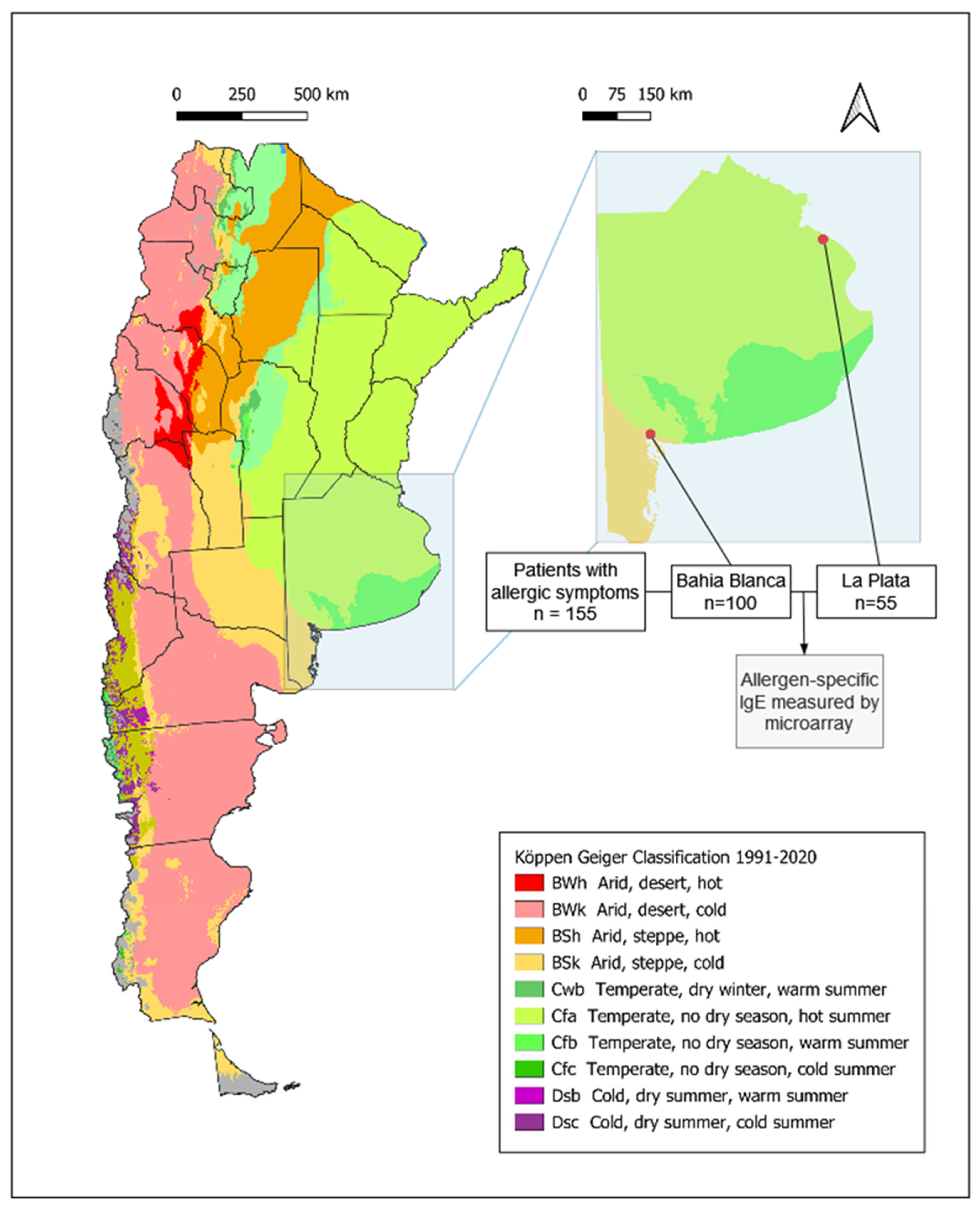
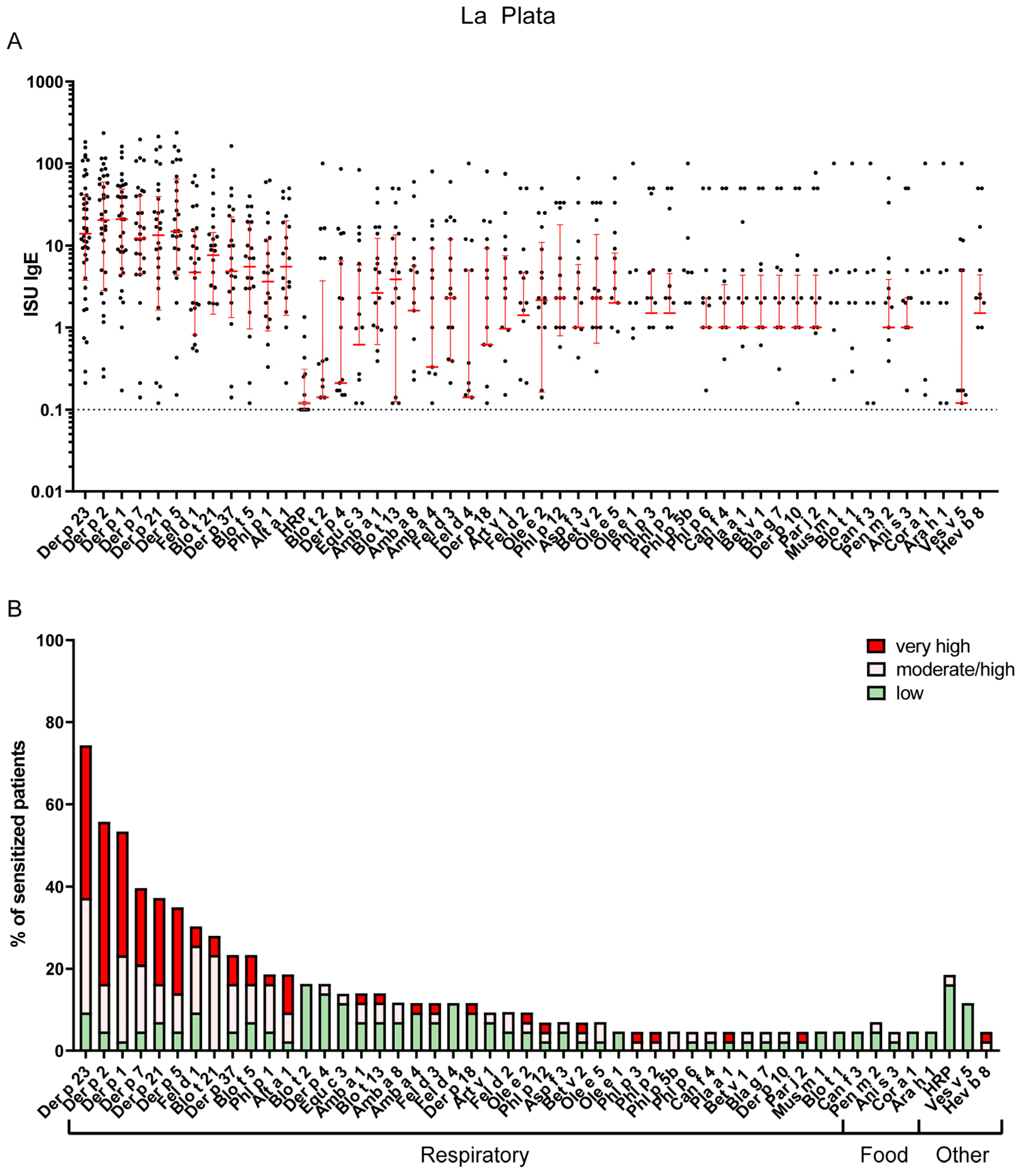
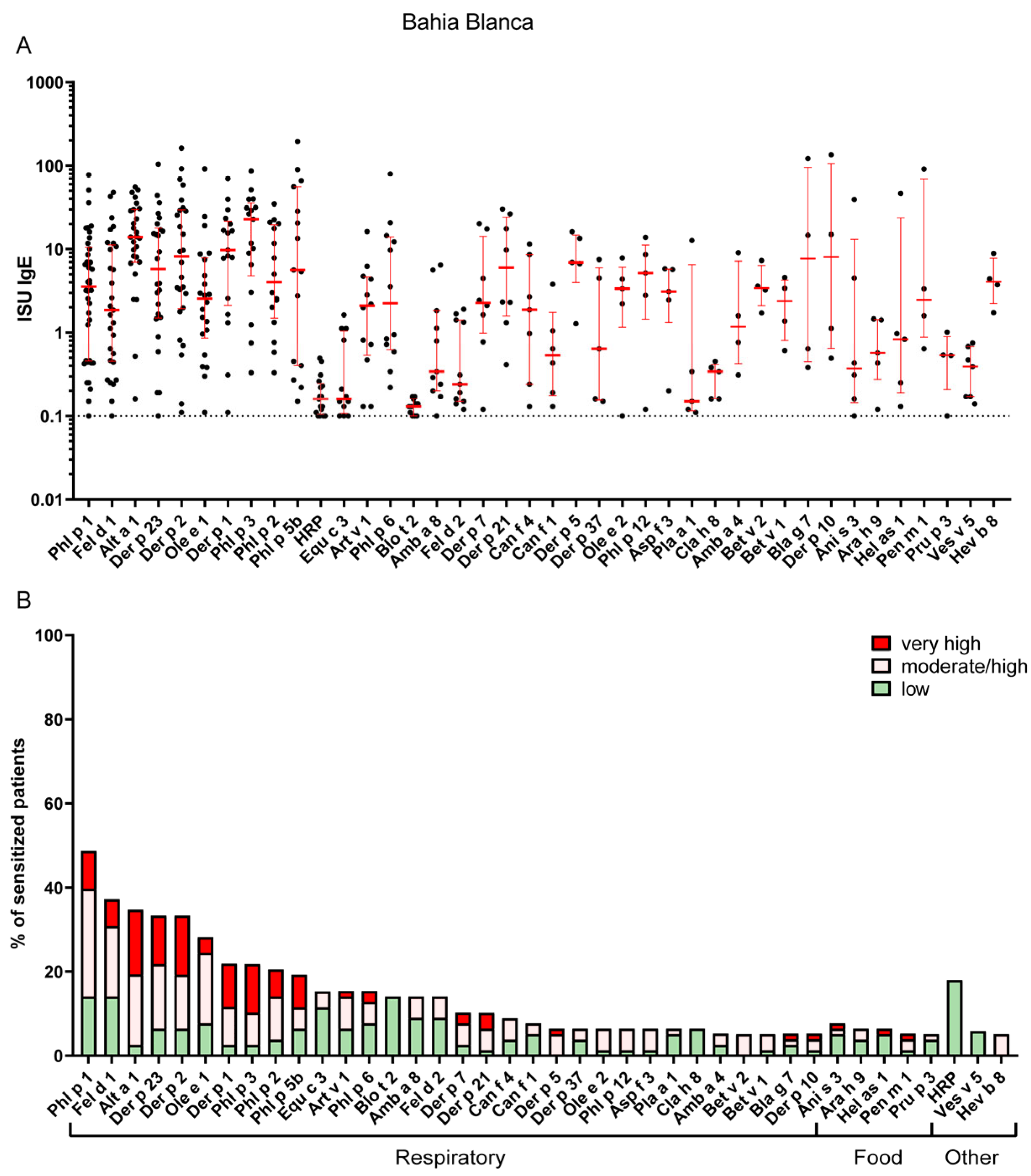
2.2. Bahía Blanca and La Plata Show Different Molecular IgE Sensitization Patterns Associated with Different Climatic and Environmental Factors
2.3. Cross-Reactive Arginine Kinase and Tropomyosin Represent the Most Frequently Recognized Potential Food Allergens in Both Cities
2.4. Peculiarities of IgE Sensitizations to Other Antigens
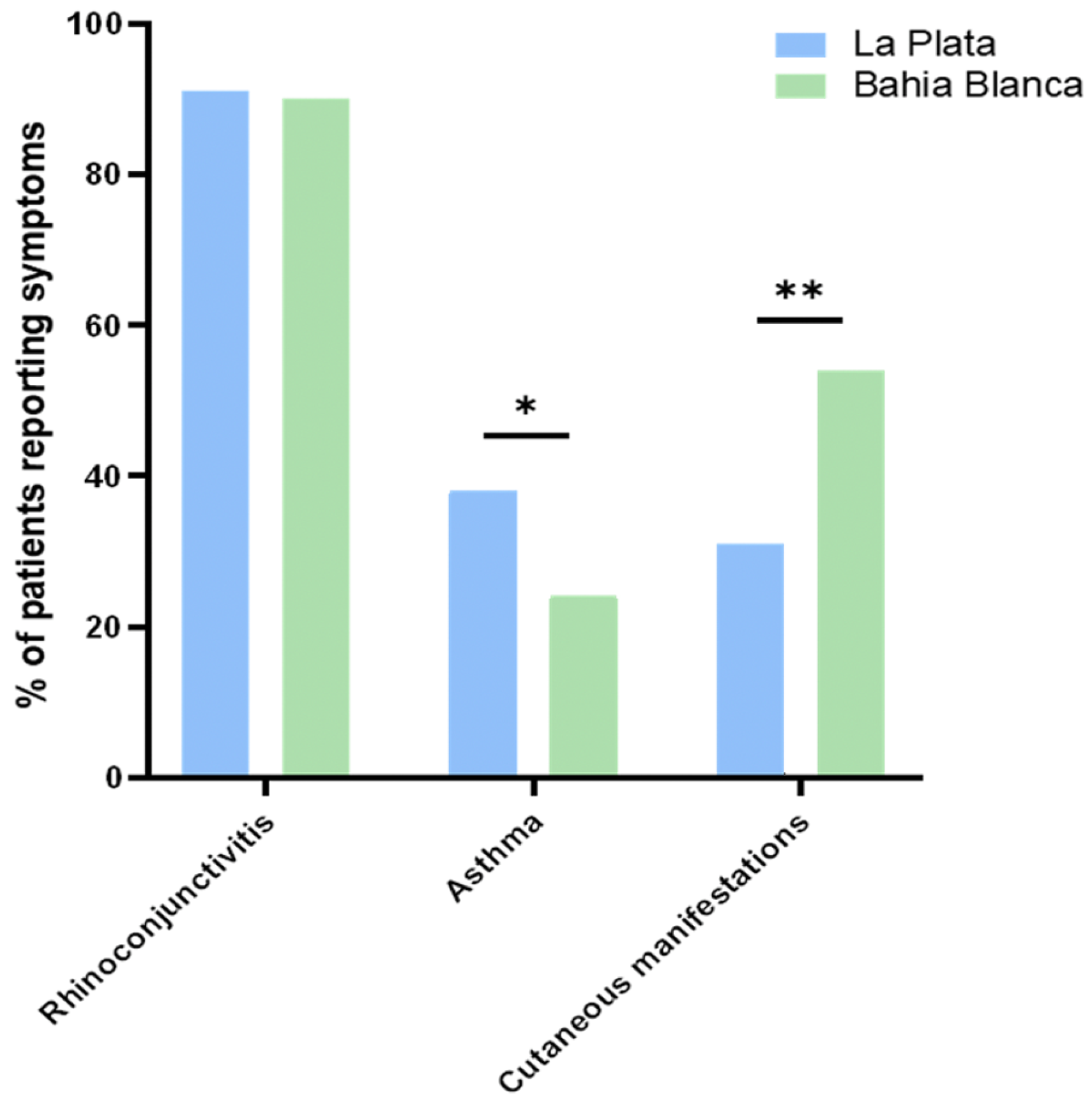
2.5. Regional Variation in Allergic Symptoms in La Plata and Bahía Blanca
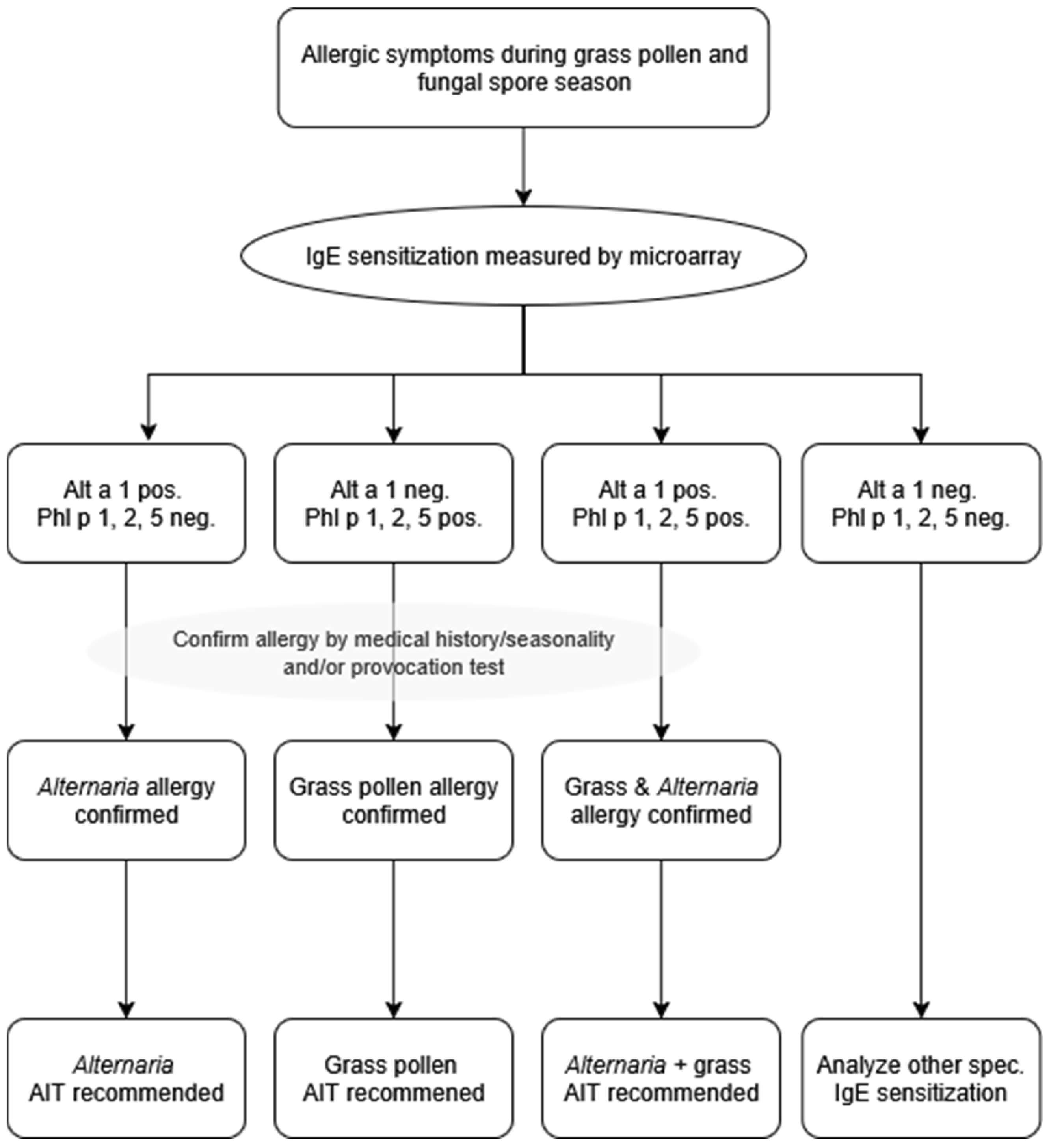
2.6. High Sensitization Rates to Grass Pollen Allergen Phl p 1 and Fungal Spore Allergen from Alternaria alternata Alt a 1, with Evidence of Seasonal Overlap
3. Discussion
4. Materials and Methods
4.1. Cohorts and Design of the Study
4.2. Immunoglobulin E Measurements
4.3. Data Analysis
4.4. Climatic and Geospatial Data Acquisition and Map Generation
Supplementary Materials
Author Contributions
Funding
Institutional Review Board Statement
Informed Consent Statement
Data Availability Statement
Acknowledgments
Conflicts of Interest
Abbreviations
| AIT | Allergen-specific immunotherapy |
| AS | Asthma |
| CCD | Cross-reactive carbohydrate determinant |
| CRD | Component-resolved diagnostics |
| D | Dermatitis/skin manifestations |
| FI | Fluorescence intensity |
| HDM | House dust mite |
| IgE | Immunoglobulin E |
| ISAAC | International Study of Asthma and Allergies in Childhood |
| ISUs | IgE standardized units |
| RC | Rhinoconjunctivitis |
| TM | Tropomyosin |
Appendix A
- Allergochip Working Group: Adebanke Oluwatoyin Akinfenwa1 Maria-Roxana Buzan2,3, Kuan-Wei Chen2, Raffaela Campana1, Monica Daniela Cotarcă3, Mirela Curin1, Yulia Dorofeeva1, Nishelle Dsouza1, Alexandra Dubovets4,5, Margarete Focke-Tejkl1, Pia Gattinger1, Heinrich Grausgruber6, Alexander Karaulov4,5, Evgenii Kozlov4,5, Andrea Krisai6, Birgit Linhart1, Carmen Panaitescu2,3, Daria Trifonova1,4,5, Milena Weber1
- 1Division of Immunopathology, Department of Pathophysiology and Allergy Research, Center for Pathophysiology, Infectiology and Immunology, Medical University of Vienna, Vienna, Austria 2OncoGen Center, Pius Brinzeu County Clinical Emergency Hospital, Timisoara, Romania; 3Center of Immuno-Physiology and Biotechnologies, Department of Functional Sciences, Victor Babes University of Medicine and Pharmacy, Timisoara, Romania; 4Laboratory of Immunopathology, Department of Clinical Immunology and Allergy, Sechenov First Moscow State Medical University, Moscow, Russia; 5Life Improvement by Future Technologies (LIFT) Center, Moscow, Russia; 6BOKU University, Department of Agricultural Sciences, Institute of Crop Breeding and Genomics; Tulln an der Donau, Austria.
References
- Katelaris, C.H.; Beggs, P.J. Climate change: Allergens and allergic diseases. Intern. Med. J. 2018, 48, 129–134. [Google Scholar] [CrossRef]
- Basilico, M.d.l.L.Z.; Chiericatti, C.; Aringoli, E.E.; Althaus, R.L.; Basilico, J.C. Influence of environmental factors on airborne fungi in houses of Santa Fe City, Argentina. Sci. Total Environ. 2007, 376, 143–150. [Google Scholar] [CrossRef]
- Acevedo, N.; Zakzuk, J.; Caraballo, L. House dust mite allergy under changing environments. Allergy Asthma Immunol. Res. 2019, 11, 450–469. [Google Scholar] [CrossRef]
- D’Amato, G.; Chong-Neto, H.J.; Monge Ortega, O.P.; Vitale, C.; Ansotegui, I.; Rosario, N.; Haahtela, T.; Galan, C.; Pawankar, R.; Murrieta-Aguttes, M.; et al. The effects of climate change on respiratory allergy and asthma induced by pollen and mold allergens. Allergy 2020, 75, 2219–2228. [Google Scholar] [CrossRef]
- Price, D.; Hughes, K.M.; Thien, F.; Suphioglu, C. Epidemic thunderstorm asthma: Lessons learned from the storm Down-Under. J. Allergy Clin. Immunol. Pract. 2021, 9, 1510–1515. [Google Scholar] [CrossRef] [PubMed]
- Beck, H.E.; McVicar, T.R.; Vergopolan, N.; Berg, A.; Lutsko, N.J.; Dufour, A.; Zeng, Z.; Jiang, X.; van Dijk, A.I.J.M.; Miralles, D.G. High-resolution (1 km) Köppen–Geiger maps for 1901–2099 based on constrained CMIP6 projections. Sci. Data 2023, 10, 724. [Google Scholar] [CrossRef] [PubMed]
- Matricardi, P.M.; van Hage, M.; Custovic, A.; Korosec, P.; Santos, A.F.; Valenta, R. Molecular allergy diagnosis enabling personalized medicine. J. Allergy Clin. Immunol. 2025, 156, 485–502. [Google Scholar] [CrossRef]
- Andiappan, A.K.; Puan, K.J.; Lee, B.; Nardin, A.; Poidinger, M.; Connolly, J.; Chew, F.T.; Wang, D.Y.; Rotzschke, O. Allergic airway diseases in a tropical urban environment are driven by dominant mono-specific sensitization against house dust mites. Allergy 2014, 69, 501–509. [Google Scholar] [CrossRef] [PubMed]
- Neffen, H.E.; Maillo, M. Letter from Argentina. Respirology 2024, 29, 82–83. [Google Scholar] [CrossRef]
- Vázquez, D.; Medina, I.; Logusso, G.; Arias, S.; Gattolin, G.; Parisi, C. Cross-sectional survey about the prevalence of allergic rhinitis in Argentina: Study PARA. Rev. Alerg. Mex. 2019, 66, 55–64. [Google Scholar] [CrossRef]
- Pendino, P.; Agüero, C.; Cavagnero, P.; Lopez, K.; Kriunis, I.; Molinas, J. Aeroallergen sensitization in wheezing children from Rosario, Argentina. World Allergy Organ. J. 2011, 4, 159–163. [Google Scholar] [CrossRef] [PubMed]
- Ramon, G.D.; Barrionuevo, L.B.; Viego, V.; Vanegas, E.; Felix, M.; Cherrez-Ojeda, I. Sensitization to subtropical grass pollens in patients with seasonal allergic rhinitis from Bahía Blanca, Argentina. World Allergy Organ. J. 2019, 12, 100062. [Google Scholar] [CrossRef]
- Dorofeeva, Y.; Shilovskiy, I.; Tulaeva, I.; Focke-Tejkl, M.; Flicker, S.; Kudlay, D.; Khaitov, M.; Karsonova, A.; Riabova, K.; Karaulov, A.; et al. Past, present, and future of allergen immu-notherapy vaccines. Allergy 2021, 76, 131–149. [Google Scholar] [CrossRef]
- Emmerson, K.M.; Silver, J.D.; Thatcher, M.; Wain, A.; Jones, P.J.; Dowdy, A.; Newbigin, E.J.; Picking, B.W.; Choi, J.; Ebert, E.; et al. Atmospheric modelling of grass pollen rupturing mechanisms for thunderstorm asthma prediction. PLoS ONE 2021, 16, e0249488. [Google Scholar] [CrossRef]
- Dona, D.W.; Suphioglu, C. Egg allergy: Diagnosis and immunotherapy. Int. J. Mol. Sci. 2020, 21, 5010. [Google Scholar] [CrossRef]
- Dhanapala, P.; De Silva, C.; Doran, T.; Suphioglu, C. Cracking the egg: An insight into egg hypersensitivity. Mol. Immunol. 2015, 66, 375–383. [Google Scholar] [CrossRef]
- Mittermann, I.; Zidarn, M.; Silar, M.; Markovic-Housley, Z.; Aberer, W.; Korosec, P.; Kosnik, M.; Valenta, R. Recombinant allergen-based IgE testing to distinguish bee and wasp allergy. J. Allergy Clin. Immunol. 2010, 125, 1097–1103. [Google Scholar] [CrossRef]
- Gattinger, P.; Lupinek, C.; Kalogiros, L.; Silar, M.; Zidarn, M.; Korosec, P.; Koessler, C.; Novak, N.; Valenta, R.; Mittermann, I. The culprit insect—But not severity—Of allergic reactions to bee and wasp venom can be determined by molecular diagnosis. PLoS ONE 2018, 13, e0199250. [Google Scholar] [CrossRef]
- Kiewiet, M.B.G.; Lupinek, C.; Vrtala, S.; Wieser, S.; Baar, A.; Kiss, R.; Kull, I.; Melén, E.; Wickman, M.; Porta, D.; et al. A molecular sensitization map of European children reveals exposome- and climate-dependent sensitization profiles. Allergy 2023, 78, 2007–2018. [Google Scholar] [CrossRef] [PubMed]
- Mallo, A.C.; Nitiu, D.S.; Gardella Sambeth, M.C. Airborne fungal spore content in the atmosphere of the city of La Plata, Argentina. Aerobiologia 2011, 27, 77–84. [Google Scholar] [CrossRef]
- Huang, H.J.; Breyer-Kohansal, R.; Niespodziana, K.; Lim, C.J.M.; Breyer, M.K.; Valenta, R.; Hartl, S.; Buzan, M.R.; Chen, K.W.; Cotarcă, M.D.; et al. Molecular IgE sensitization profiling with micro-arrayed allergen molecules in adult patients with asthma from the LEAD cohort: A precision medicine approach. Allergy 2025, in press. [Google Scholar] [CrossRef]
- Portnoy, J.; Miller, J.D.; Williams, P.B.; Chew, G.L.; Miller, J.D.; Zaitoun, F.; Phipatanakul, W.; Kennedy, K.; Barnes, C.; Grimes, C.; et al. Environmental assessment and exposure control of dust mites: A practice parameter. Allergy Asthma Immunol. 2013, 111, 465–507. [Google Scholar] [CrossRef]
- Peat, J.K.; Tovey, E.; Mellis, C.M.; Leeder, S.R.; Woolcock, A.J. Importance of house dust mite and Alternaria allergens in childhood asthma: An epidemiological study in two climatic regions of Australia. Clin. Exp. Allergy 1993, 23, 812–820. [Google Scholar] [CrossRef] [PubMed]
- Hughes, K.M.; Price, D.; Torriero, A.A.J.; Symonds, M.R.E.; Suphioglu, C. Impact of fungal spores on asthma prevalence and hospitalization. Int. J. Mol. Sci. 2022, 23, 4313. [Google Scholar] [CrossRef] [PubMed]
- Twaroch, T.E.; Curin, M.M.; Valenta, R.; Swoboda, I. Mold allergens in respiratory allergy: From structure to therapy. Allergy Asthma Immunol. Res. 2015, 7, 205–220. [Google Scholar] [CrossRef] [PubMed]
- Calzada, D.; Bartra, J.; Serrano, C.; Riggioni, S.; Moran, E.; Maselli, J.; Silva, D.; Ramirez, L.; Pascal, M.; Carnés, J.; et al. Differences in molecular sensitization profiles between Spanish and Latin American mite-allergic patients. J. Investig. Allergol. Clin. Immunol. 2024, 35, 114–121. [Google Scholar] [CrossRef]
- Muddaluru, V.; Valenta, R.; Vrtala, S.; Schlederer, T.; Hindley, J.; Hickey, P.; Larché, M.; Tonti, E. Comparison of house dust mite sensitization profiles in allergic adults from Canada, Europe, South Africa and USA. Allergy 2021, 76, 2177–2188. [Google Scholar] [CrossRef]
- Pauli, G.; Wurmser, C.; Roos, A.; Kokou, C.; Huang, H.J.; D’souza, N.; Lupinek, C.; Zakzuk, J.; Regino, R.; Acevedo, N.; et al. Frequent IgE recognition of Blomia tropicalis allergen molecules in asthmatic children and young adults in equatorial Africa. Front. Immunol. 2023, 14, 1133935. [Google Scholar] [CrossRef]
- D’souza, N.; Weber, M.; Sarzsinszky, E.; Vrtala, S.; Curin, M.; Schaar, M.; Garib, V.; Focke-Tejkl, M.; Li, Y.; Jones, R.; et al. The molecular allergen recognition profile in China as basis for allergen-specific immunotherapy. Front. Immunol. 2021, 12, 719573. [Google Scholar] [CrossRef]
- Cat Population by Country 2025. World Population Review. 2025. Available online: https://worldpopulationreview.com/country-rankings/cat-population-by-country (accessed on 17 May 2024).
- Mattsson, L.; Lundgren, T.; Everberg, H.; Larsson, H.; Lidholm, J. Prostatic kallikrein: A new major dog allergen. J. Allergy Clin. Immunol. 2009, 123, 362–368. [Google Scholar] [CrossRef]
- Palomares, O.; Swoboda, I.; Villalba, M.; Balic, N.; Spitzauer, S.; Rodríguez, R.; Valenta, R. The major allergen of olive pollen Ole e 1 is a diagnostic marker for sensitization to Oleaceae. Int. Arch. Allergy Immunol. 2006, 141, 110–118. [Google Scholar] [CrossRef] [PubMed]
- Murray, M.G.; Galán, C.; Villamil, C.B. Airborne pollen in Bahía Blanca, Argentina: Seasonal distribution of pollen types. Aerobiologia 2010, 26, 195–207. [Google Scholar] [CrossRef]
- Ramon, G.D.; Felix, M.; Barrionuevo, L.B.; Benedetti, G.M.; Duval, V.S.; Vanegas, E.; Cherrez-Ojeda, I. Persistence of airborne tree pollen from the Cupressaceae family during the last decade in the city of Bahía Blanca. Allergol. Immunopathol. 2022, 50, 75–77. [Google Scholar] [CrossRef]
- De Linares, C.; Plaza, M.P.; Valle, A.M.; Alcázar, P.; de la Guardia, C.D.; Galán, C. Airborne Cupressaceae pollen and its major allergen, Cup a 1, in urban green areas of southern Iberian Peninsula. Forests 2021, 12, 254. [Google Scholar] [CrossRef]
- Siroux, V.; Lupinek, C.; Resch, Y.; Curin, M.; Just, J.; Keil, T.; Kiss, R.; Lødrup Carlsen, K.; Melén, E.; Nadif, R.; et al. Specific IgE and IgG measured by the MeDALL allergen-chip depend on allergen and route of exposure: The EGEA study. J. Allergy Clin. Immunol. 2017, 139, 643–654.e6. [Google Scholar] [CrossRef]
- Elisyutina, O.; Lupinek, C.; Fedenko, E.; Litovkina, A.; Smolnikov, E.; Ilina, N.; Kudlay, D.; Shilovskiy, I.; Valenta, R.; Khaitov, M. IgE-reactivity profiles to allergen molecules in Russian children with and without symptoms of allergy revealed by micro-array analysis. Pediatr. Allergy Immunol. 2021, 32, 251–263. [Google Scholar] [CrossRef]
- Mittermann, I.; Dzoro, S.; Gattinger, P.; Botha, M.; Basera, W.; Facey-Thomas, H.E.; Gaunt, B.; Genuneit, J.; Gray, C.L.; Hlela, C.; et al. Molecular IgE sensitization profiles of urban and rural children in South Africa. Pediatr. Allergy Immunol. 2021, 32, 234–241. [Google Scholar] [CrossRef]
- Sicherer, S.H.; Muñoz-Furlong, A.; Sampson, H.A. Prevalence of seafood allergy in the United States determined by a random telephone survey. J. Allergy Clin. Immunol. 2004, 114, 159–165. [Google Scholar] [CrossRef]
- Gupta, R.S.; Warren, C.M.; Smith, B.M.; Jiang, J.; Blumenstock, J.A.; Davis, M.M.; Schleimer, R.P.; Nadeau, K.C. Prevalence and Severity of Food Allergies Among US Adults. JAMA Netw. Open 2019, 2, e185630. [Google Scholar] [CrossRef] [PubMed]
- Wai, C.Y.Y.; Leung, N.Y.H.; Chu, K.H.; Leung, P.S.C.; Leung, A.S.Y.; Wong, G.W.K.; Leung, T.F. Overcoming shellfish allergy: How far have we come? Int. J. Mol. Sci. 2020, 21, 2234. [Google Scholar] [CrossRef] [PubMed]
- Wai, C.Y.Y.; Leung, N.Y.H.; Leung, A.S.Y.; Wong, G.W.K.; Leung, T.F. Seafood Allergy in Asia: Geographical Specificity and Beyond. Front. Allergy 2021, 2, 676903. [Google Scholar] [CrossRef]
- Ben-Shoshan, M.; Harrington, D.W.; Soller, L.; Fragapane, J.; Joseph, L.; St Pierre, Y.; Godefroy, S.B.; Elliot, S.J.; Clarke, A.E. A population-based study on peanut, tree nut, fish, shellfish, and sesame allergy prevalence in Canada. J. Allergy Clin. Immunol. 2010, 125, 1327–1335, Correction in J. Allergy Clin. Immunol. 2011, 127, 840.. [Google Scholar] [CrossRef]
- Moonesinghe, H.; Mackenzie, H.; Venter, C.; Kilburn, S.; Turner, P.; Weir, K.; Dean, T. Prevalence of fish and shellfish allergy: A systematic review. Ann. Allergy Asthma Immunol. 2016, 117, 264–272.e4. [Google Scholar] [CrossRef]
- Kline, A.A.; Vysochyn, M.; Dushenko, N.; Stewart, K. Revisiting Shellfish as the Leading Allergen in Adult-Onset Food Allergy. Cureus 2025, 17, e94357. [Google Scholar] [CrossRef]
- Mullins, R.J.; Wainstein, B.K.; Barnes, E.H.; Liew, W.K.; Campbell, D.E. Increases in anaphylaxis fatalities in Australia from 1997 to 2013. Clin. Exp. Allergy 2016, 46, 1099–1110. [Google Scholar] [CrossRef]
- Nantanee, R.; Suratannon, N.; Chatchatee, P. Characteristics and laboratory findings of food-induced anaphylaxis in children: Study in an Asian developing country. Int. Arch. Allergy Immunol. 2022, 183, 59–67. [Google Scholar] [CrossRef]
- Conrado, A.B.; Patel, N.; Turner, P.J. Global patterns in anaphylaxis due to specific foods: A systematic review. J. Allergy Clin. Immunol. 2021, 148, 1515–1525.e3. [Google Scholar] [CrossRef] [PubMed]
- Jimenez-Garcia, R.; Lopez-de-Andres, A.; Hernandez-Barrera, V.; Zamorano-Leon, J.J.; Cuadrado-Corrales, N.; de Miguel-Diez, J.; Del-Barrio, J.L.; Jimenez-Sierra, A.; Carabantes-Alarcon, D. Hospitalizations for Food-Induced Anaphylaxis Between 2016 and 2021: Population-Based Epidemiologic Study. JMIR Public Health Surveill. 2024, 10, e57340. [Google Scholar] [CrossRef] [PubMed]
- Niespodziana, K.; Stenberg-Hammar, K.; Papadopoulos, N.G.; Focke-Tejkl, M.; Errhalt, P.; Konradsen, J.R.; Söderhäll, C.; van Hage, M.; Hedlin, G.; Valenta, R. Microarray technology may reveal the contribution of allergen exposure and rhinovirus infections as possible triggers for acute wheezing attacks in preschool children. Viruses 2021, 13, 915. [Google Scholar] [CrossRef]
- Borochova, K.; Niespodziana, K.; Focke-Tejkl, M.; Hofer, G.; Keller, W.; Valenta, R. Dissociation of the respiratory syncytial virus F protein-specific human IgG, IgA and IgM response. Sci. Rep. 2021, 11, 3551. [Google Scholar] [CrossRef] [PubMed]
- Gangl, K.; Niederberger, V.; Valenta, R. Multiple grass mixes as opposed to single grasses for allergen immunotherapy in allergic rhinitis. Clin. Exp. Allergy 2013, 43, 1202–1216. [Google Scholar] [CrossRef] [PubMed]
- Hemmer, W.; Altmann, F.; Holzweber, F.; Gruber, C.; Wantke, F.; Wöhrl, S. ImmunoCAP cellulose displays cross-reactive carbohydrate determinant (CCD) epitopes and can cause false-positive test results in patients with high anti-CCD IgE antibody levels. J. Allergy Clin. Immunol. 2018, 141, 372–381.e3. [Google Scholar] [CrossRef]
- Bush, R.K.; Prochnau, J.J. Alternaria-induced asthma. J. Allergy Clin. Immunol. 2004, 113, 227–234. [Google Scholar] [CrossRef]
- Vailes, L.; Sridhara, S.; Cromwell, O.; Weber, B.; Breitenbach, M.; Chapman, M. Quantitation of the major fungal allergens, Alt a 1 and Asp f 1, in commercial allergenic products. J. Allergy Clin. Immunol. 2001, 107, 641–646. [Google Scholar] [CrossRef]
- Kazemi-Shirazi, L.; Niederberger, V.; Linhart, B.; Lidholm, J.; Kraft, D.; Valenta, R. Recombinant marker allergens: Diagnostic gatekeepers for the treatment of allergy. Int. Arch. Allergy Immunol. 2002, 127, 259–268. [Google Scholar] [CrossRef]
- Westritschnig, K.; Horak, F.; Swoboda, I.; Balic, N.; Spitzauer, S.; Kundi, M.; Fiebig, H.; Suck, R.; Cromwell, O.; Valenta, R. Different allergenic activity of grass pollen allergens revealed by skin testing. Eur. J. Clin. Investig. 2008, 38, 260–267. [Google Scholar] [CrossRef]
- Twaroch, T.E.; Arcalís, E.; Sterflinger, K.; Stöger, E.; Swoboda, I.; Valenta, R. Predominant localization of the major Alternaria allergen Alt a 1 in the cell wall of airborne spores. J. Allergy Clin. Immunol. 2012, 129, 1148–1149. [Google Scholar] [CrossRef]
- Asher, M.I.; Keil, U.; Anderson, H.R.; Beasley, R.; Crane, J.; Martinez, F.; Mitchell, E.A.; Pearce, N.; Sibbald, B.; Stewart, A.W. International Study of Asthma and Allergies in Childhood (ISAAC): Rationale and methods. Eur. Respir. J. 1995, 8, 483–491. [Google Scholar] [CrossRef]
- Gattinger, P.; Niespodziana, K.; Stiasny, K.; Sahanic, S.; Tulaeva, I.; Borochova, K.; Dorofeeva, Y.; Schlederer, T.; Sonnweber, T.; Hofer, G.; et al. Neutralization of SARS-CoV-2 requires antibodies against conformational receptor-binding domain epitopes. Allergy 2022, 77, 230–242. [Google Scholar] [CrossRef] [PubMed]
- Beck, H.E.; Zimmermann, N.E.; McVicar, T.R.; Vergopolan, N.; Berg, A.; Wood, E.F. Present and future Köppen–Geiger climate classification maps at 1-km resolution. Sci. Data 2018, 5, 180214. [Google Scholar] [CrossRef] [PubMed]


Disclaimer/Publisher’s Note: The statements, opinions and data contained in all publications are solely those of the individual author(s) and contributor(s) and not of MDPI and/or the editor(s). MDPI and/or the editor(s) disclaim responsibility for any injury to people or property resulting from any ideas, methods, instructions or products referred to in the content. |
© 2025 by the authors. Licensee MDPI, Basel, Switzerland. This article is an open access article distributed under the terms and conditions of the Creative Commons Attribution (CC BY) license (https://creativecommons.org/licenses/by/4.0/).
Share and Cite
Sarzsinszky, E.; Smaldini, P.; Chinigo, M.; Ardanaz, M.; Benítez, P.; Ramos, A.; Braviz Lopez, M.E.; Ramón, G.; Ramón, G.; Schlederer, T.; et al. Profound Impact of Local Climatic Conditions on IgE Sensitization Profiles: Evidence from Argentine Cities. Int. J. Mol. Sci. 2025, 26, 12101. https://doi.org/10.3390/ijms262412101
Sarzsinszky E, Smaldini P, Chinigo M, Ardanaz M, Benítez P, Ramos A, Braviz Lopez ME, Ramón G, Ramón G, Schlederer T, et al. Profound Impact of Local Climatic Conditions on IgE Sensitization Profiles: Evidence from Argentine Cities. International Journal of Molecular Sciences. 2025; 26(24):12101. https://doi.org/10.3390/ijms262412101
Chicago/Turabian StyleSarzsinszky, Eszter, Paola Smaldini, Marcela Chinigo, María Ardanaz, Pablo Benítez, Ana Ramos, María Eugenia Braviz Lopez, Gonzalo Ramón, Germán Ramón, Thomas Schlederer, and et al. 2025. "Profound Impact of Local Climatic Conditions on IgE Sensitization Profiles: Evidence from Argentine Cities" International Journal of Molecular Sciences 26, no. 24: 12101. https://doi.org/10.3390/ijms262412101
APA StyleSarzsinszky, E., Smaldini, P., Chinigo, M., Ardanaz, M., Benítez, P., Ramos, A., Braviz Lopez, M. E., Ramón, G., Ramón, G., Schlederer, T., Tulaev, M., Valenta, R., Huang, H.-J., Vrtala, S., Docena, G., & the Allergochip Working Group. (2025). Profound Impact of Local Climatic Conditions on IgE Sensitization Profiles: Evidence from Argentine Cities. International Journal of Molecular Sciences, 26(24), 12101. https://doi.org/10.3390/ijms262412101