Article

Synthesis, Reactions, and Agrochemical Studies of New 4,6-Diaryl-2-hydrazinylnicotinonitriles

1
Department of Organic Chemistry and Technologies, Kuban State University, 149 Stavropolskaya St., 350040 Krasnodar, Russia
2
Department of Chemistry, North Caucasus Federal University, 1a Pushkin St., 355017 Stavropol, Russia
3
Department of Analytical Chemistry, Kuban State University, 149 Stavropolskaya St., 350040 Krasnodar, Russia
4
School of Bioengineering and Health, Wuhan Textile University, 1 Sunshine Avenue, Jiang Xia District, Wuhan 430200, China
5
Faculty of Energetics, Kuban State Agrarian University, 13 Kalinina St., 350044 Krasnodar, Russia
*
Author to whom correspondence should be addressed.
Int. J. Mol. Sci. 2025, 26(24), 11874; https://doi.org/10.3390/ijms262411874
Submission received: 14 November 2025 / Revised: 1 December 2025 / Accepted: 5 December 2025 / Published: 9 December 2025
(This article belongs to the Section Molecular Plant Sciences)

Abstract

This work aimed to synthesize new derivatives of 2-hydrazinylpyridine-3-carbonitrile and to investigate their biological activity as safeners for the 2,4-D herbicide. The new 2-hydrazinylnicotinonitriles were obtained in high yields (up to quantitative) under mild conditions (25 °C, dioxane) by treating 4,6-diaryl-2-bromo-3-cyanopyridines with hydrazine hydrate. The latter were synthesized by brominating 2-(3-oxo-1,3-diarylpropyl)malononitriles, the Michael adducts, which are readily available from 1,3-diarylpropenones (chalcones) and malononitrile. An unusual side product of the bromination/carbocyclization was isolated and characterized; it consisted of co-crystals of 3-benzoyl-4-hydroxy-4-phenyl-2,6-di-(p-tolyl)cyclohexane-1,1-dicarbonitrile and 3-benzoyl-5-bromo-4-hydroxy-4-phenyl-2,6-di-(p-tolyl)cyclohexane-1,1-dicarbonitrile at a ~4:6 ratio. The new 2-hydrazinylnicotinonitriles react with halogen-containing aromatic aldehydes to form the corresponding hydrazones. The biological activity of the new nicotinonitriles was examined for their function as 2,4-D antidotes. It was found that, under laboratory conditions, eight of the synthesized compounds exhibited a notable antidote effect against 2,4-D on sunflower seedlings.

1. Introduction

2-Hydrazinylpyridines represent a promising class of compounds with diverse, though not yet fully realized, potential [1]. According to recent data, 2-hydrazinylpyridines 1 are of interest as antioxidants and antimicrobial agents [2]. Compounds 2 and 3 serve as intermediates in the synthesis of wheat growth regulators [3,4] (Figure 1). Hydrazones 4 exhibit antimicrobial action, with MIC values ranging from 12.5 to 25 μg/mL [5]. Nicotinonitrile 5 demonstrated significant activity against the breast cancer cell line MCF-7 in in vivo experiments [6]. The unsubstituted 2-hydrazinylpyridine 6 is used for inhibiting lysyl oxidase-2 (LOXL2) as an alternative to phenyl hydrazine [7,8], for preparing coordination compounds with various metals [9,10,11,12,13,14,15], and as an analytical reagent for derivatization in the determination of steroid hormones [16,17,18,19,20,21]. Recently, 2-hydrazinylpyridine 6 and 2-hydrazinyl-5-methylpyridine 7 were proposed as twin derivatization reagents for the rapid determination of α,β-unsaturated aldehydes in vegetable oils [22]. Hydrazines 6 and 7, in combination with nicotinonitrile 8, were recently proposed for identifying potential lung cancer carbonyl biomarkers in human plasma samples [23]. 6-Hydrazinylnicotinamide 9 is used to produce bifunctional coupling agents for 99mTc labeling of small biomolecules [24,25]. In recent years, condensation products of 2-hydrazinylpyridine with carbonyl compounds have been proposed as chemosensors for detecting SO42− and CO32− [26], Cu2+ and Co2+ [27], Al3+ and OH [28], and Hg2+ and Au3+ [29,30,31], as viscosity-sensitive fluorescent probes [32], and as aggregation-induced emission dyes suitable for fluorescence imaging of cellular organelles [33]. Compound 10 showed 100% tumor inhibition, comparable to the standard drug Vincristine, and it also exhibited tremendous activity toward Leishmania major [34]. Cytotoxic activity has also been reported for 2-hydrazinylnicotinonitrile 11 [35], high fungicidal activity for compound 12 [36], and antimicrobial effects for nicotinonitrile 13 [37] and hydrazones 14 [38] (Figure 1). It is also worth mentioning that 2-hydrazinylpyridines and 2-hydrazinylnicotinonitriles are precursors to several practically important classes of heterocyclic compounds, such as 1,2,4-triazolo[4,3-a]pyridines [39,40,41,42,43,44], pyrazolo[3,4-b]pyridines [45,46,47,48,49,50,51,52,53,54,55], and pyrido-1,2,4-triazines [56].
Continuing our research in the chemistry of nicotinonitriles with agrochemical applications [57,58,59,60,61,62,63,64,65] on one hand, and the search for new derivatizing agents for UHPLC-HRMS determination of metabolites in biological fluids [66,67,68,69] on the other, we aimed to prepare new 4,6-diaryl-2-hydrazinylnicotinonitriles, study some of their reactions, and evaluate the biological activity of the products as antidotes for the herbicide 2,4-D.
Despite their potential, 4,6-diaryl-2-hydrazinylnicotinonitriles have not yet found application in analytical chemistry or agrochemistry. These compounds are expected to be more selective derivatizing agents for carbonyl compounds than the currently used 2-hydrazinylpyridine derivatives [16,17,18,19,20,21,22,23]. Support for their potential in agrochemistry comes from reports on analogous structures. Some related compounds 15 are known herbicide safeners and rice growth stimulants [70,71], others, like compounds 16, are growth regulators for winter wheat [72], and hydrazones 17 exhibit antifungal activity against Aspergillus flavus and A. niger [73] (Figure 2). Nevertheless, 4,6-diaryl-2-hydrazinylnicotinonitriles remain a scarcely studied group of compounds, and their practical application has not been reported in the literature to date.
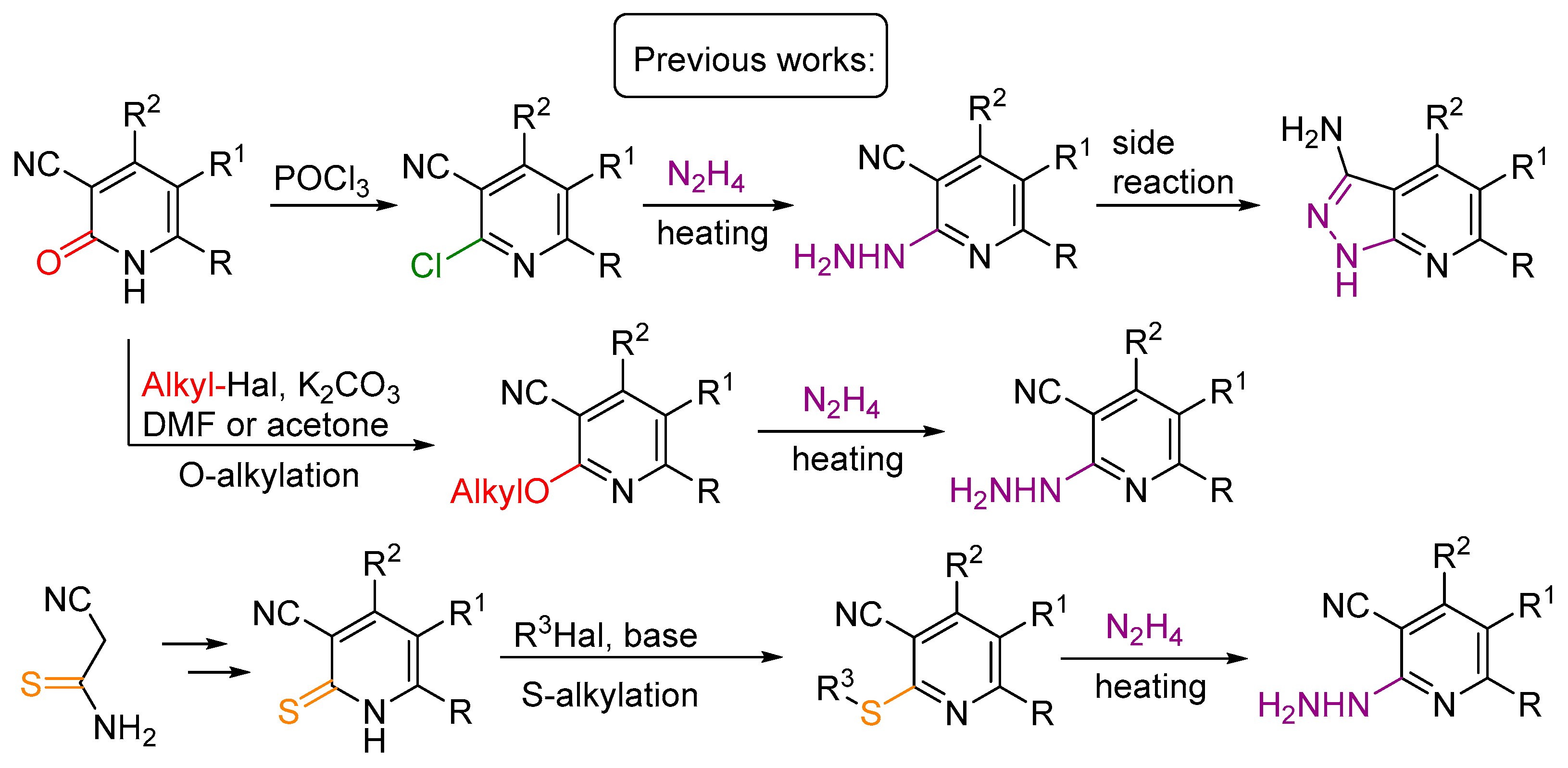
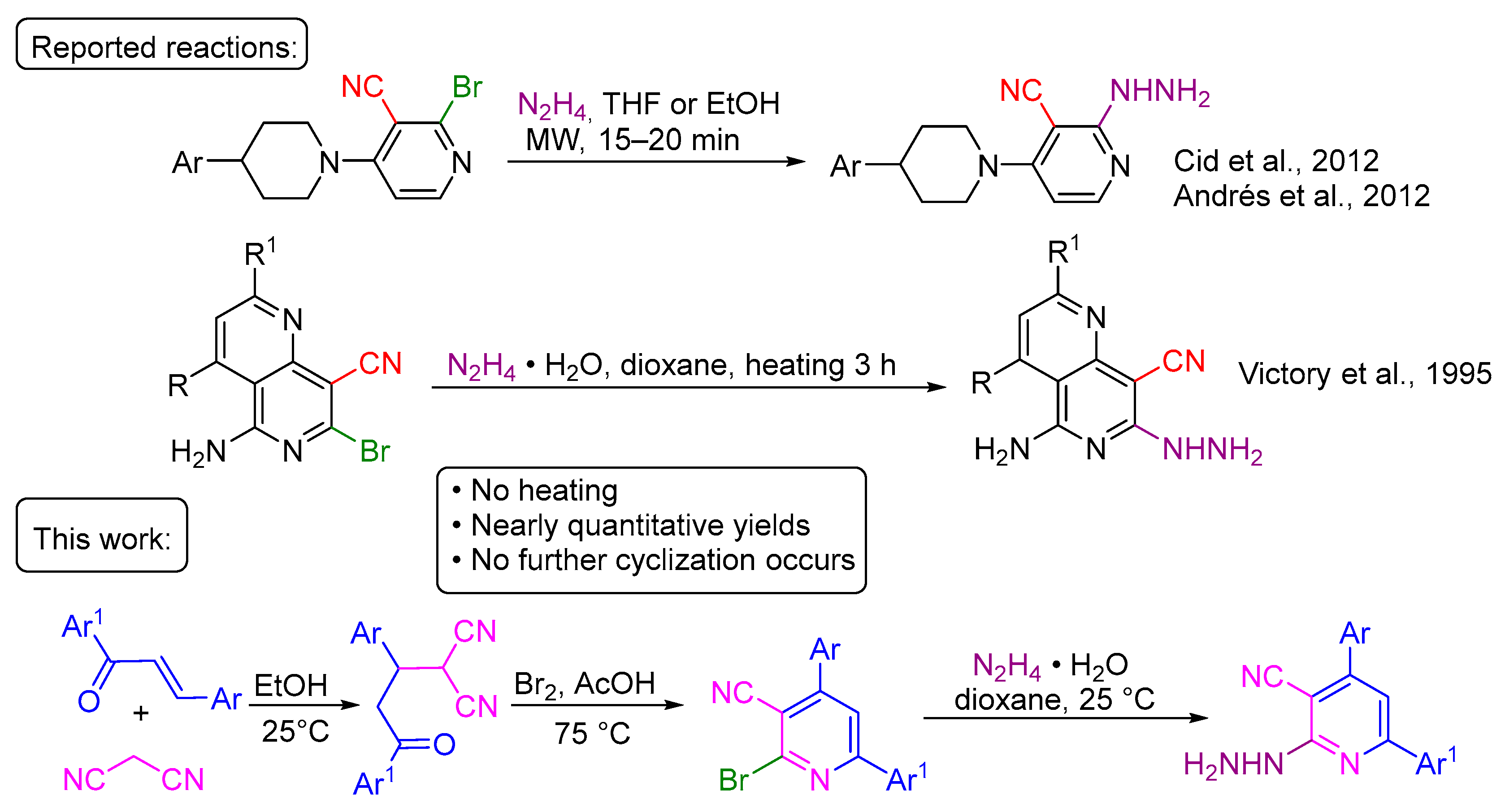
The primary methods for the synthesis of 2-hydrazinylnicotinonitrile derivatives are based on the hydrazinolysis of 2-chloro-3-cyanopyridines [6,34,35,36,37,38,74,75,76,77,78,79,80,81,82,83,84,85,86,87,88,89,90,91,92] or 2-alkoxy-3-cyanopyridines [73,92,93,94,95,96]. An alternative route involves the nucleophilic displacement of a sulfur-containing group in 2-mercaptonicotinonitrile derivatives [5,92,97,98,99,100] (Scheme 1). It is important to note certain limitations associated with these established synthetic pathways. A significant drawback is the multi-step nature of the synthesis for 2-hydrazinyl-3-cyanopyridines. The required starting 2-alkoxy-, 2-chloro-, or 2-alkylthio nicotinonitrile precursors are themselves predominantly obtained from starting materials that already contain the pre-formed nicotinonitrile core structure.
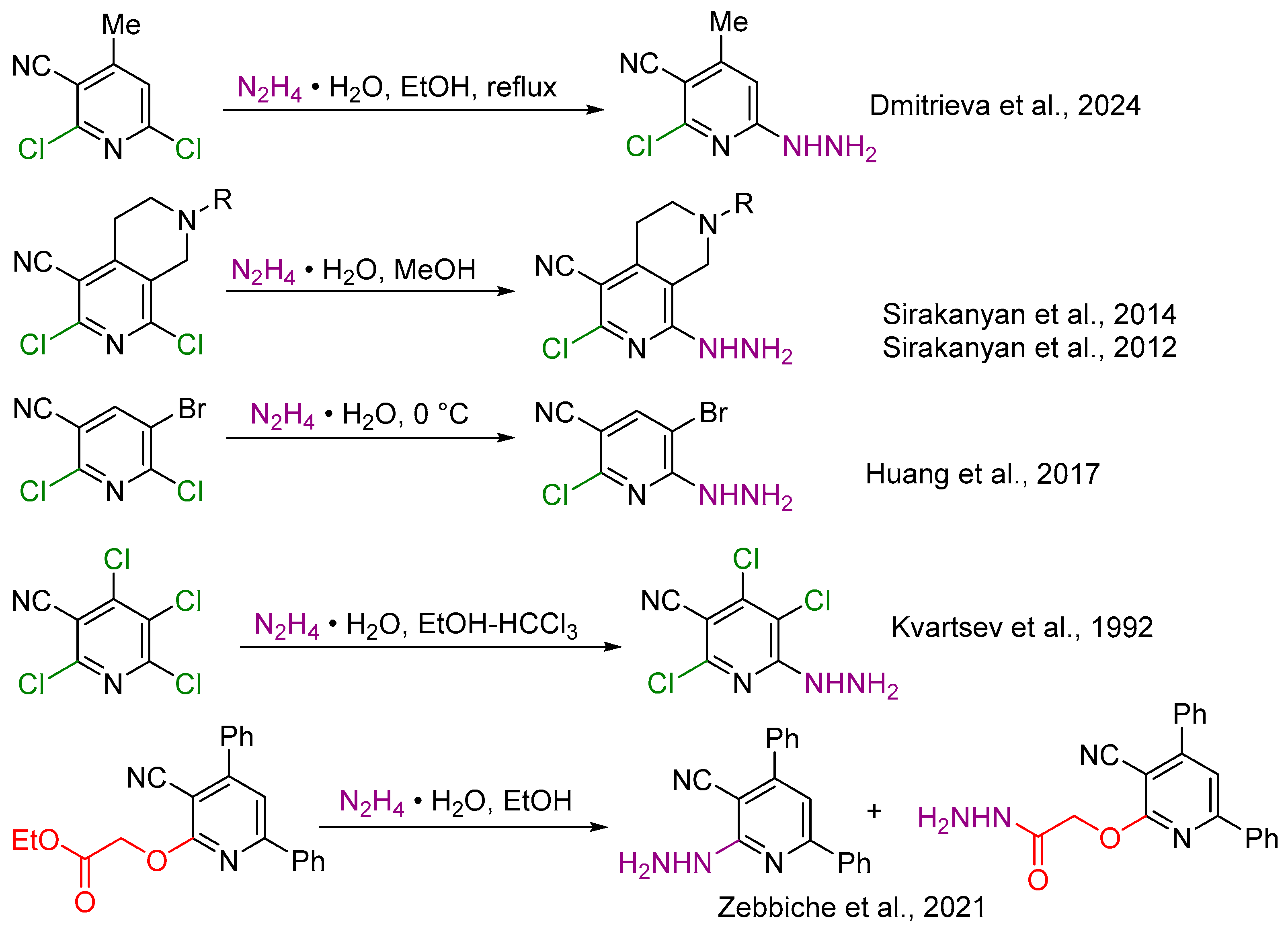
It should be noted that the chlorine atom or the RS group at the 2 position of a 3-cyanopyridine molecule is a relatively poor nucleofuge. Thus, it is known that in the case of 2,6-dichloronicotinonitriles, the halogen atom at the C-6 position is substituted first during hydrazinolysis [3,101,102,103,104] (Scheme 2). Furthermore, when hydrazinolysis is performed on esters of 3-cyanopyridine-2-(thio/oxy)acetic acid, the main product is often not the 2-hydrazinylnicotinonitrile but the corresponding carboxylic acid hydrazide (for example, [93,94,105]).
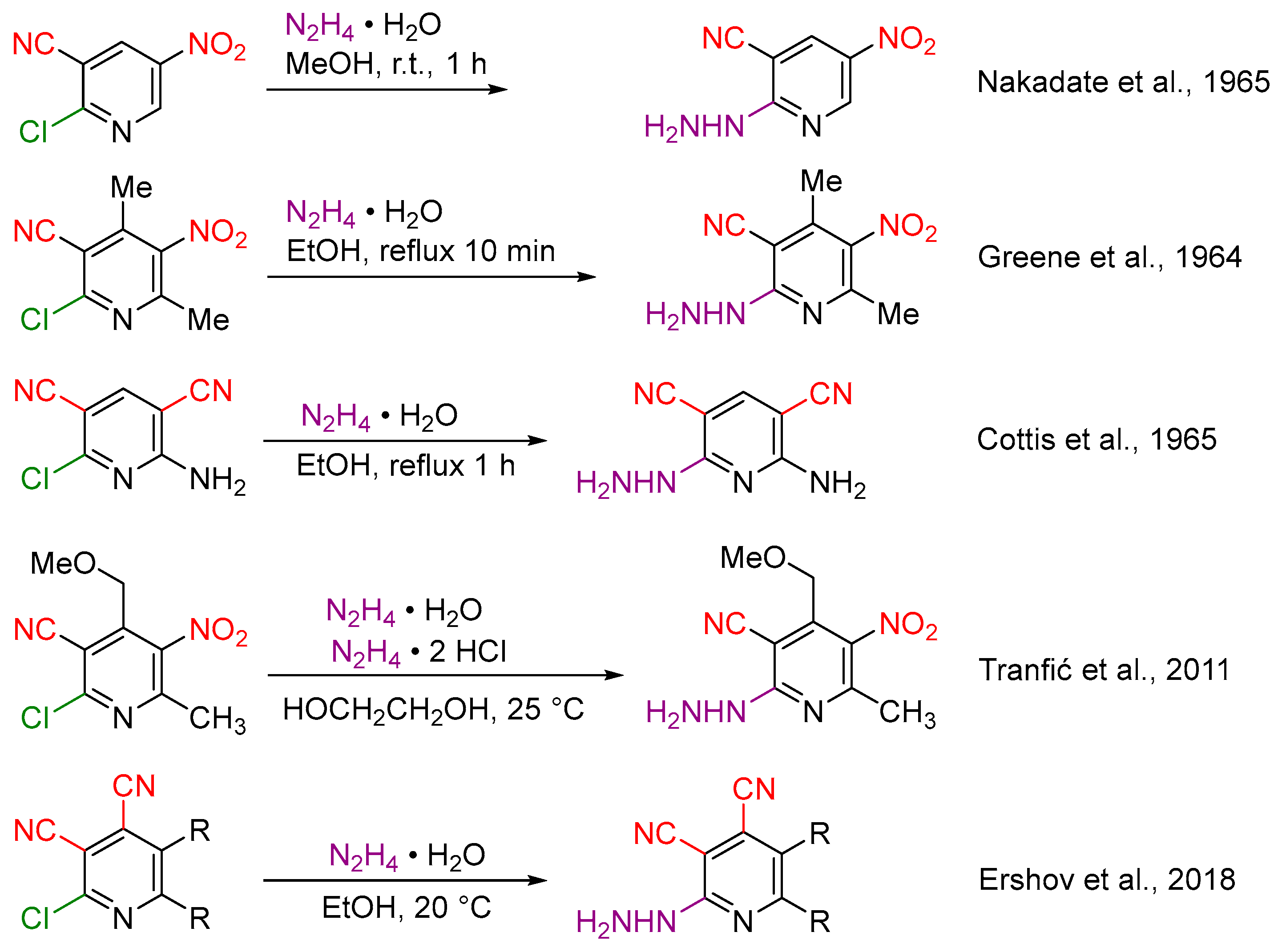
The hydrazinolysis reaction of 2-chloronicotinonitriles generally requires heating—for instance, refluxing in ethanol for 4–18 h [83,84,85,86,87,88,89,90,91,92], refluxing in DMF for 6 h [35], refluxing in dioxane for 3–12 h [74,75,76,77,78,79,80], or heating in 1-butanol at 110–112 °C [82]. In contrast, under relatively mild conditions (20–25 °C or with brief heating), the reaction between 2-chloropyridines and hydrazine occurs only if the pyridine ring contains two or more strong electron-withdrawing substituents [106,107,108,109,110] (Scheme 3).
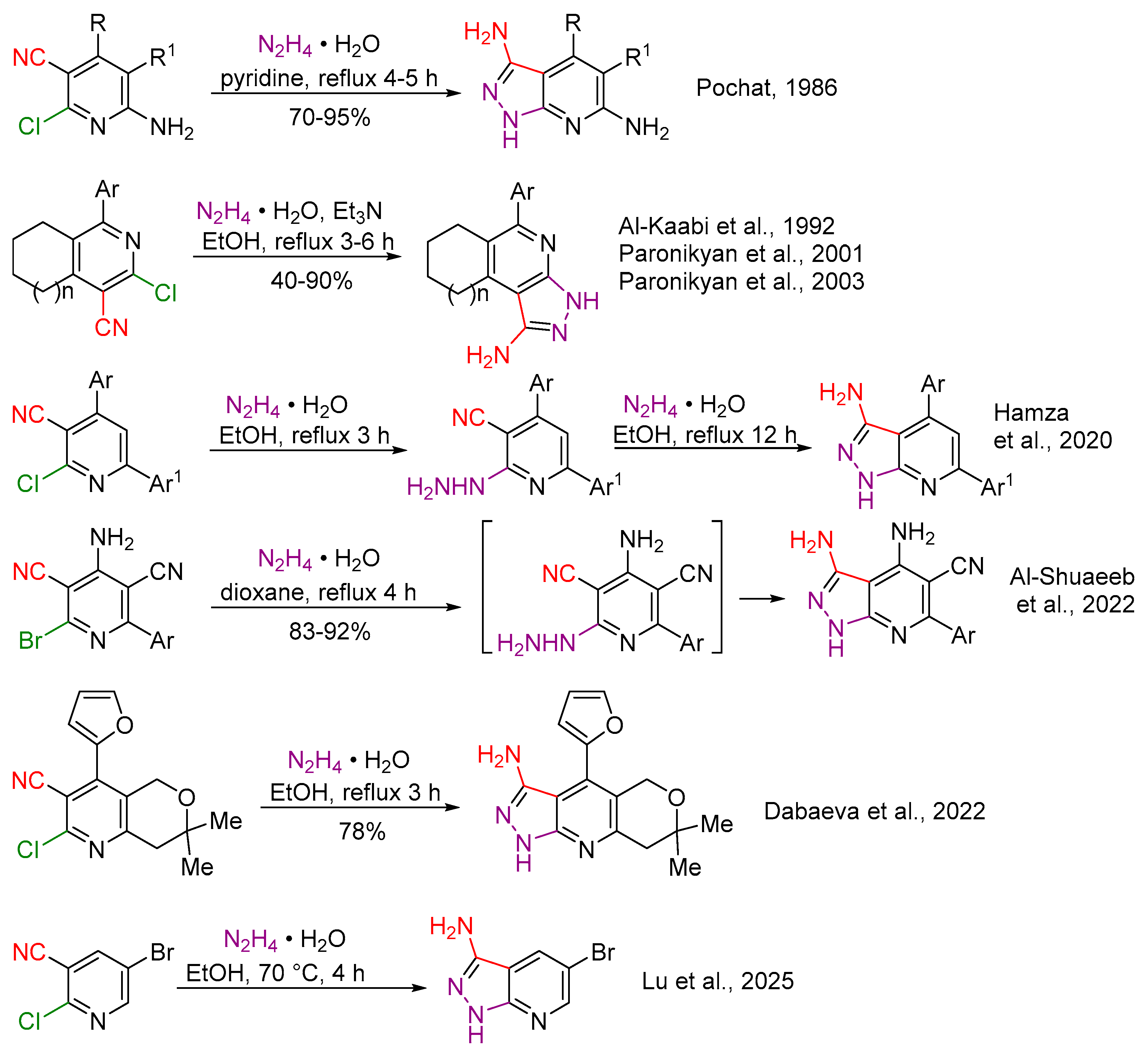
However, the use of harsher reaction conditions promotes an intramolecular cyclization between the hydrazine fragment and the cyano group, yielding well-known 3-amino-1H-pyrazolo[3,4-b]pyridines [45,46,47,48,49,50,51,52,53,54,55]. This side reaction commonly accompanies or even competes with the formation of 2-hydrazinylnicotinonitriles. Moreover, in many cases, the isolation of 2-hydrazinyl-3-cyanopyridines is often impossible, and pyrazolo[3,4-b]pyridines are obtained as the sole products. Typical examples that demonstrate this pathway can be found in references [90,111,112,113,114,115,116,117,118] (Scheme 4).
Given the aforementioned drawbacks and limitations of existing methods, developing new and optimized approaches for synthesizing 2-hydrazinylnicotinonitriles is highly desirable. This work presents an efficient route to 4,6-diaryl-2-hydrazinyl-3-cyanopyridines based on the reaction of 4,6-diaryl-2-bromo-3-cyanopyridines with hydrazine hydrate under mild conditions. The starting 2-bromo-3-cyanopyridines are readily available in high yields from inexpensive, commercially available acyclic precursors in only two steps (Scheme 5). In general, literature reports on the use of 2-bromo-3-cyanopyridines for the synthesis of 2-hydrazinylnicotinonitriles are limited to isolated examples [78,119,120] (Scheme 5). Notably, the reaction with 2-bromopyridines proceeds more rapidly and in higher yields compared to their 2-chloropyridine analogs.

2. Results and Discussion

2.1. Synthesis

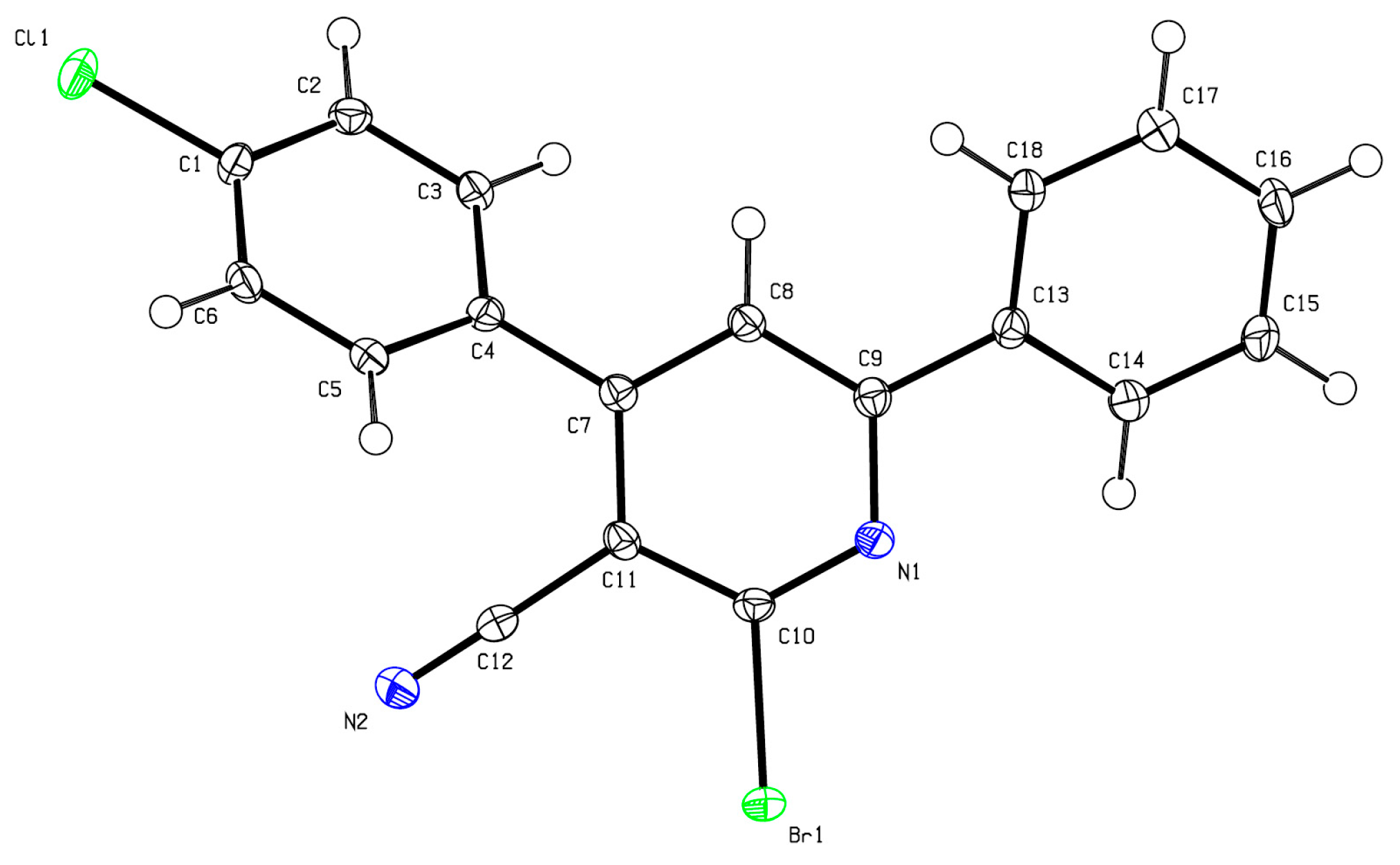
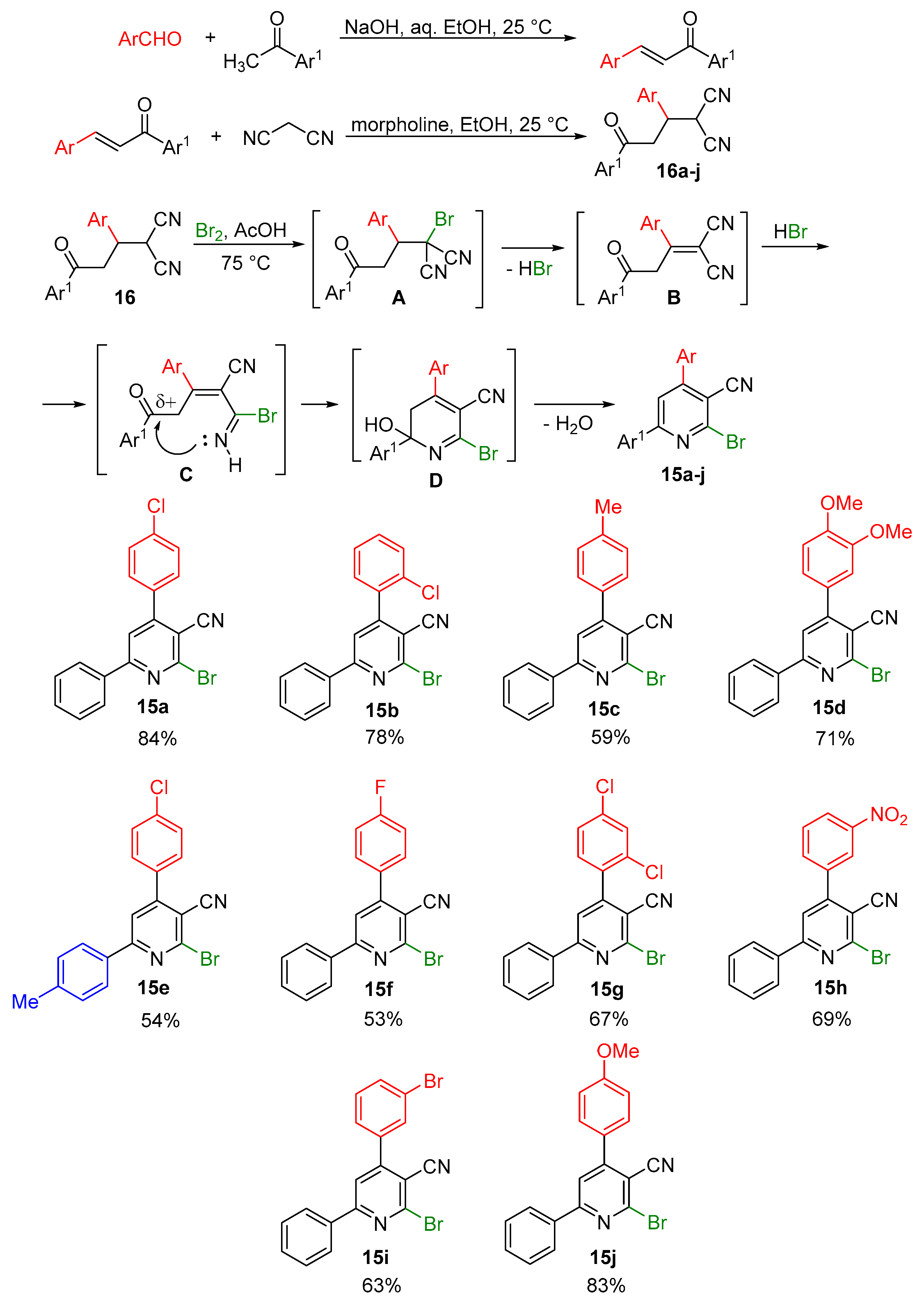
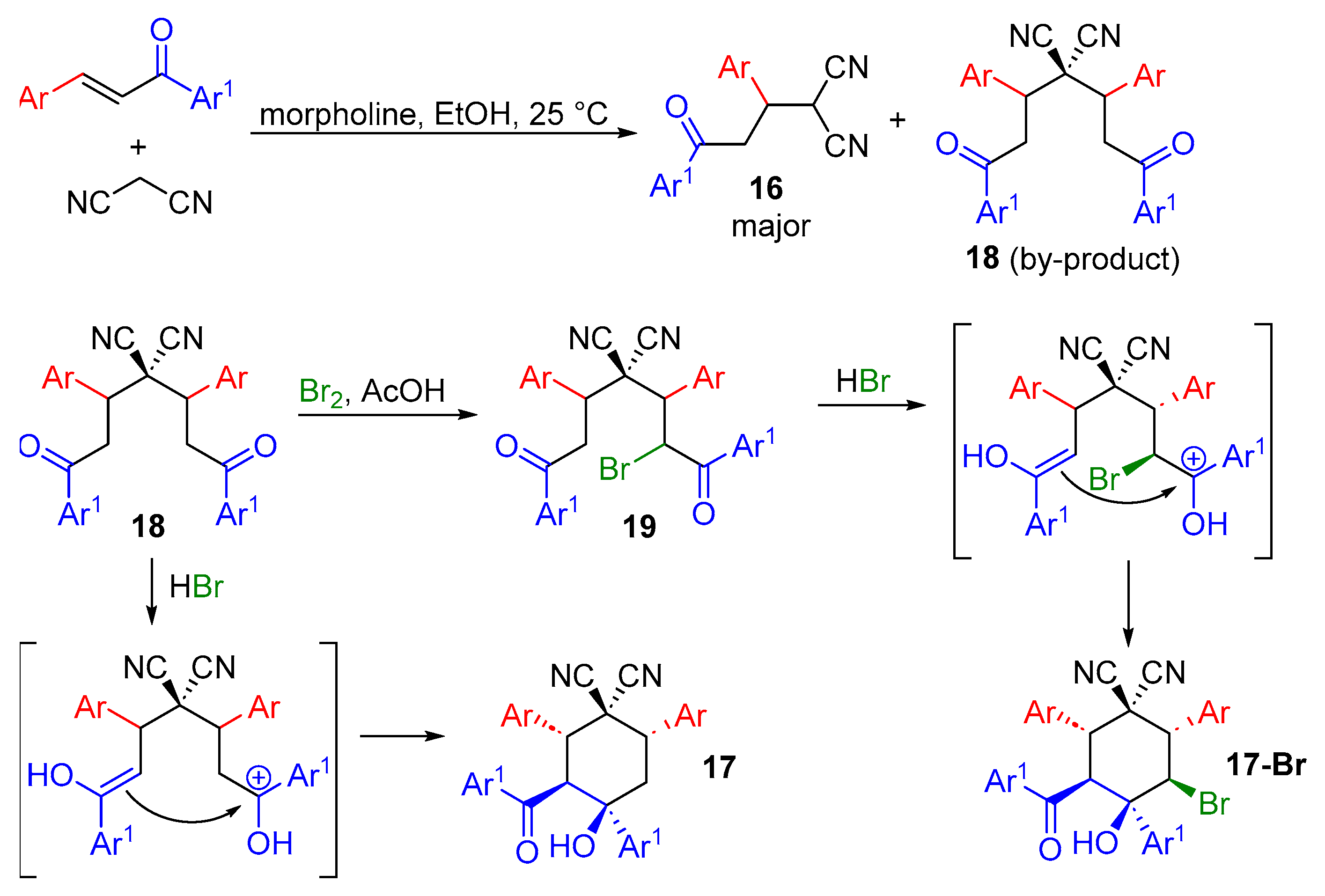
The starting 4,6-diaryl-2-bromo-3-cyanopyridines 15 were synthesized according to a modified procedure initially described by Shestopalov and Sharanin in papers [121,122]. Briefly, readily available α,β-unsaturated ketones (chalcones) were reacted with malononitrile in the presence of catalytic amounts of morpholine to yield the Michael adducts—δ-ketodinitriles 16a–j. These intermediates were then treated with a solution of bromine in AcOH under gentle heating to afford 2-bromopyridines 15a–j in 53–84% yields (Scheme 6). The reaction mechanism involves the initial formation of bromination products—2-bromo-2-(3-oxo-1,3-diarylpropyl)malononitriles A. Dehydrobromination of bromides A, followed by the addition of HBr to the cyano group of the unsaturated nitrile B, gives imidoyl bromides C. These intermediates subsequently undergo cyclization to form 2,3-dihydropyridine species D, which readily aromatize under the reaction conditions to give the 2-bromopyridines (Scheme 6). The structures of the bromides 15 were verified by FT-IR and NMR spectroscopy. Additionally, the structure of 2-bromo-4-(4-chlorophenyl)-6-phenylnicotinonitrile 15a was definitively confirmed through single-crystal X-ray diffraction analysis, as shown in Figure 3.
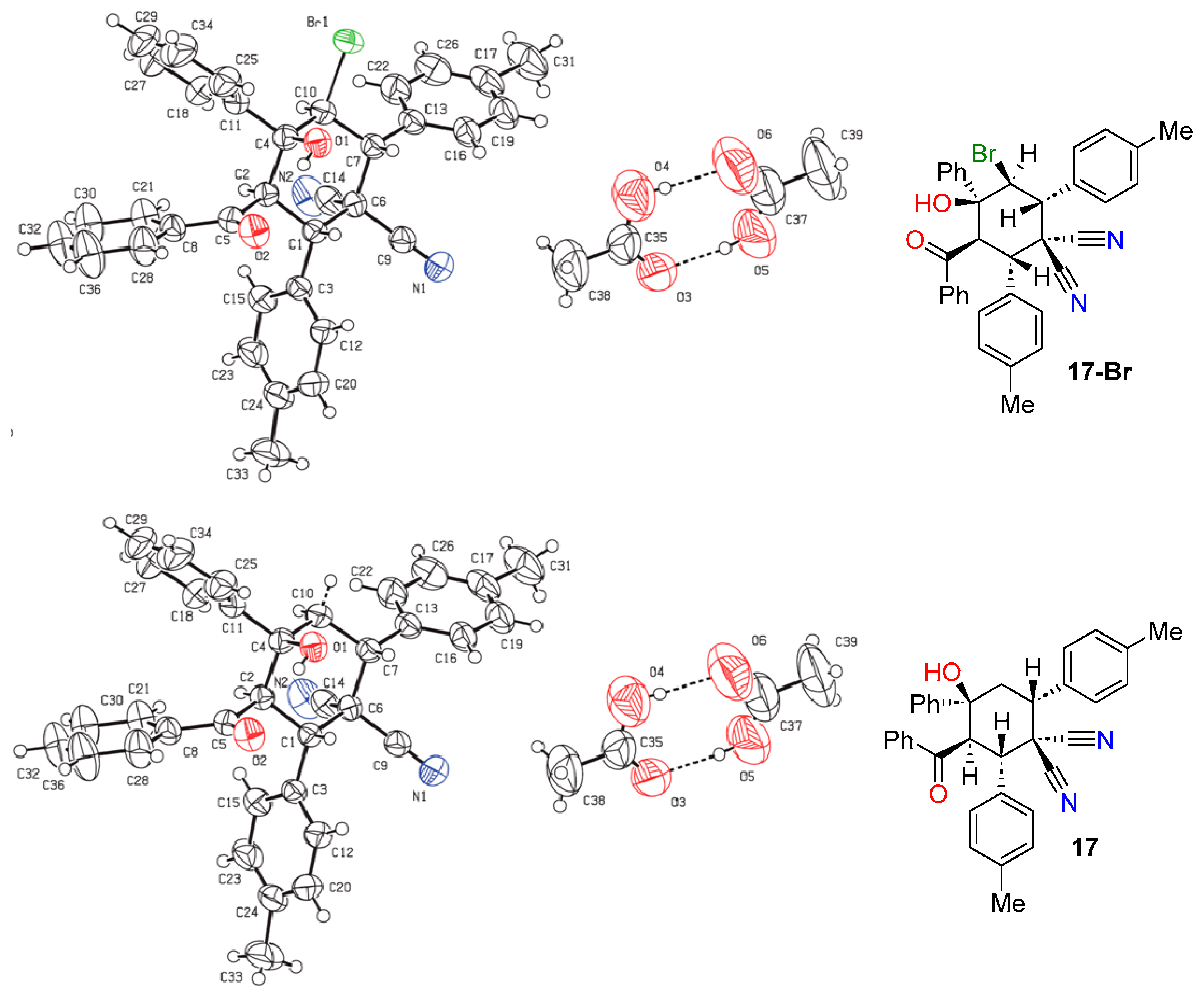
Interestingly, during an attempt to isolate additional crops of 4,6-diaryl-2-bromo-3-cyanopyridine 15 by slow evaporation of the acetic acid mother liquor, small amounts of crystalline products were obtained in several cases. However, the IR spectra of these products indicated the presence of a ketone C=O group and non-conjugated cyano groups (Csp3–C≡N) in the region of ν 2250 cm−1. At the same time, the absorption bands for the conjugated cyano group, characteristic of compounds 15 (ν 2222–2230 cm−1), were absent from the spectra. X-ray structural analysis of the crystalline solid obtained by slow concentration from the mother liquor of compound 15c revealed a substitutional disorder and showed that the isolated product consisted of co-crystals of (2S*,3R*,4S*,6R*)-3-benzoyl-4-hydroxy-4-phenyl-2,6-di-p-tolylcyclohexane-1,1-dicarbonitrile 17 and (2S*,3R*,4S*,6R*)-3-benzoyl-5-bromo-4-hydroxy-4-phenyl-2,6-di-p-tolylcyclohexane-1,1-dicarbonitrile 17-Br at a ~4:6 ratio as a solvate with AcOH (Figure 4).
We propose the following pathway for the formation of this unusual product. During the reaction of chalcones with malononitrile, alongside the formation of the δ-ketodinitriles 16, by-products 18—the Michael adducts with a 2:1 stoichiometry—are also generated (Scheme 7). The formation of such bis-adducts under analogous conditions has been reported in the literature [123,124,125]. Bromination of bis-adducts 18 yields the only possible α-bromoketones 19. Subsequently, both the adducts 18 and their brominated derivatives 19 undergo an acid-catalyzed aldol-type addition, leading to the cyclohexanols 17 and 17-Br. Bromination likely precedes cyclization, as bromination of compounds like 17 would be expected to proceed with different regioselectivity.
The observed stereochemistry of the products appears to result from steric repulsion between the bulky aryl and benzoyl substituents and stabilization provided by the cis-orientation of the OH and C=O benzoyl groups, the latter being facilitated by hydrogen bonding during the cyclization.
It is important to note that compound 17-Br and related brominated analogs are not reported in the literature, in contrast to the well-documented compounds 17 [123,124,125,126,127,128,129,130,131,132,133,134,135,136,137,138,139,140]. Nevertheless, the reactions and properties of this class of compounds remain largely unexplored. While further research in this area is warranted, it lies beyond the scope of the current study and will be examined in detail in future works.
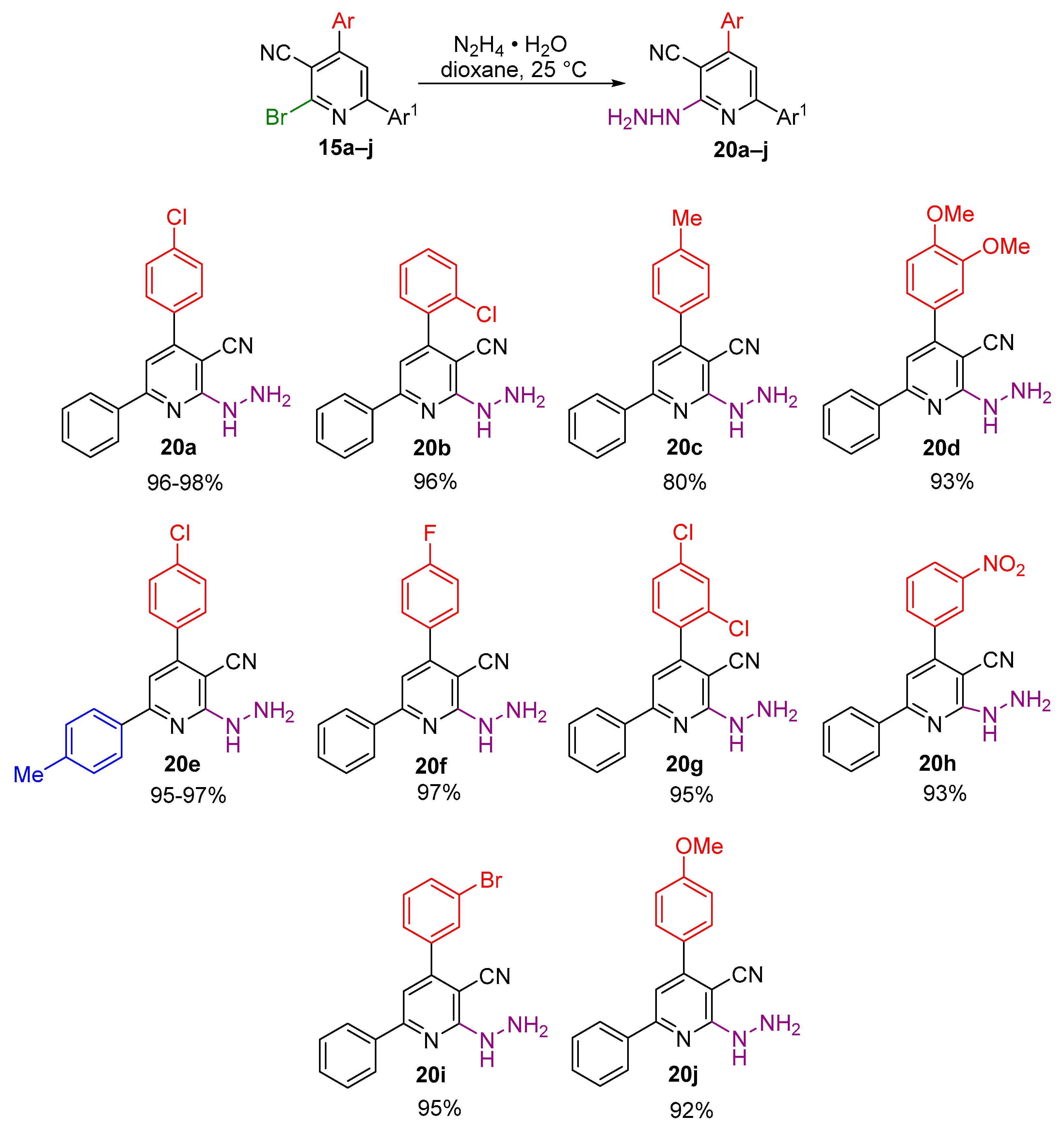
The prepared 4,6-diaryl-2-bromonicotinonitriles 15a–j react with hydrazine hydrate in 1,4-dioxane under mild conditions (25 °C) to form the expected 4,6-diaryl-2-hydrazinyl-3-cyanopyridines 20a–j. The reaction proceeds in high yields (80–97%) (Scheme 8), with no observed formation of further cyclization products—specifically, 3-amino-1H-pyrazolo[3,4-b]pyridines—in any of the cases. FT-IR, NMR, and HRMS spectral data were used to confirm the structures of the synthesized compounds 20.
Compounds 20 are yellow powders, typically sparingly soluble in water, Et2O, or hydrocarbons and soluble in hot EtOH, dioxane, DMSO, or DMF.
The FT-IR spectra of 2-hydrazinylnicotinonitriles 20 exhibited absorption bands for the conjugated cyano group at ν 2206–2212 cm−1. In addition, two strong bands corresponding to the NH–NH2 fragment vibrations were observed at ν 3411–3302 cm−1 and 3207–3326 cm−1. In the 1H NMR spectra of hydrazines 20a–j, the protons of the primary amino group appeared as a very broad singlet at δ 4.58–4.76 ppm. The signals of C(5)H and –NH– protons appeared as sharp singlets at δ 7.25–7.44 ppm and as broadened peaks at δ 8.27–8.55 ppm, respectively.
The 13C NMR spectra of 3-cyano-2-hydrazinylpyridines 20 showed characteristic signals for the following carbons: C-3 (δ 86.2–88.4 ppm), C-5 (δ 109.2–109.7 ppm), cyano group (δ 115.5–116.7 ppm), pyridine C-4 (δ 152.6–155.3 ppm), C-6 (δ 156.4–158.0 ppm), and C-2 (δ 160.2–161.0 ppm).
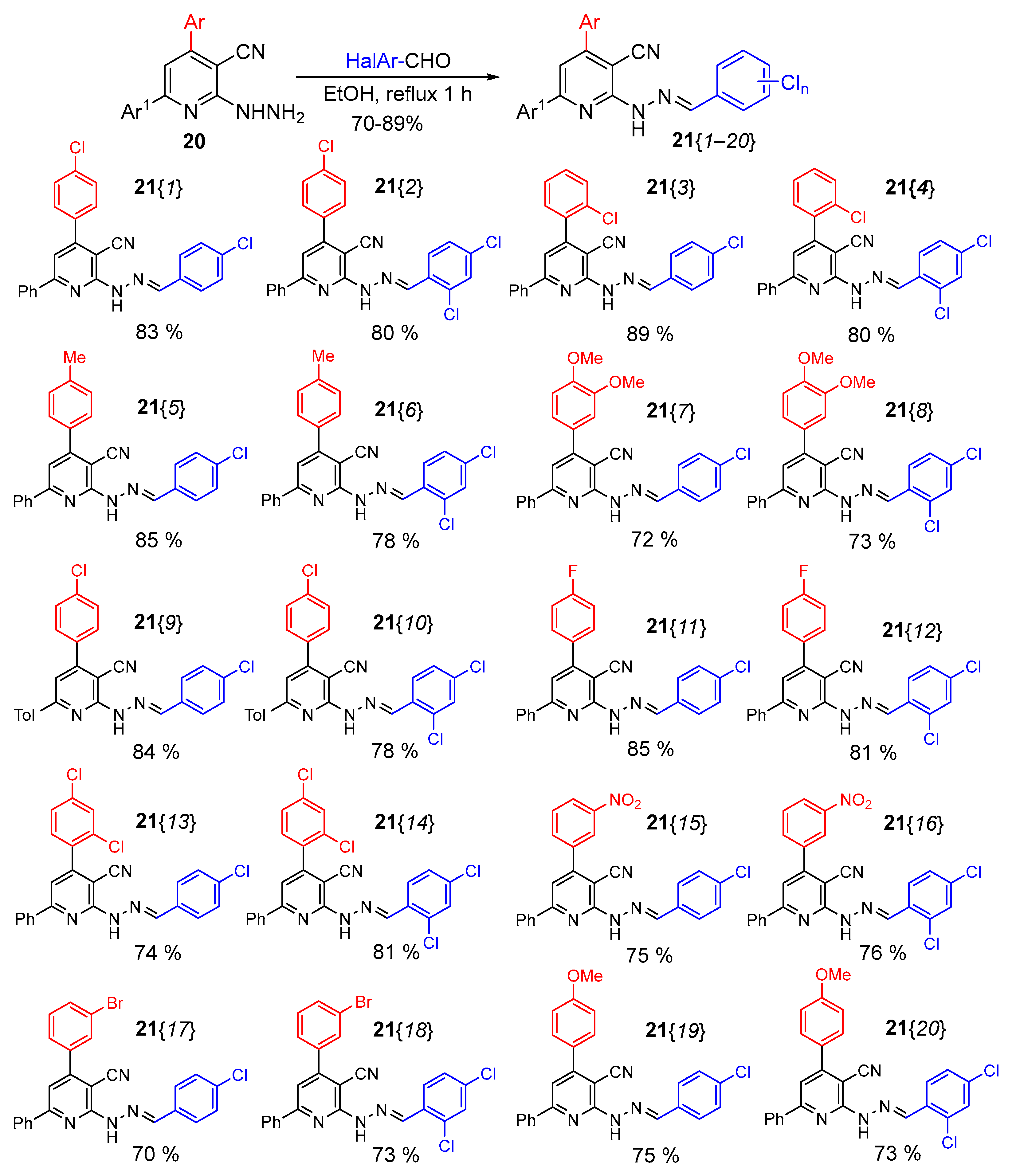
We investigated the properties of the synthesized compounds. Given the potential of hydrazinylnicotinonitriles and their derivatives in agrochemistry (see, e.g., [3,4,5,38,70,71,72,73,141]), we prepared a series of new hydrazones 21 by reacting compounds 20 with aromatic aldehydes (Scheme 9).
It is well-known that halogenated compounds play an important role in agrochemistry [142,143,144,145,146,147,148,149]. This can be explained by the physico-chemical effects (such as steric and electronic effects, C–Hal bond polarity, thermal and metabolic stability, etc.) that arise from the introduction of halogens or halogen-containing substituents into biologically active molecules, such as insecticides, acaricides, plant growth regulators, and herbicide safeners. Thus, in each area of crop protection (fungicides, insecticides, or herbicides), 12 halogen-containing products (~60%) are among the 20 best-selling agrochemicals [144]. As of 2020, out of 48 new agrochemicals provisionally approved by the International Organization for Standardization (ISO), 39 (~81%) contain halogen atoms as substituents [145]. The greater availability of chlorine compared to other halogens accounts for the prevalence of chlorinated agrochemicals [146,147,148,149].
On the other hand, pyridine is the most important heterocyclic scaffold in agrochemistry [150]. (Poly)halogenated pyridines exhibit pronounced activity and are widely represented on the market [150,151,152].
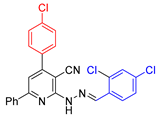
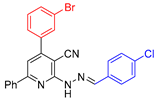
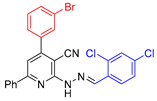
For this reason, we selected chlorinated aromatic aldehydes (4-chlorobenzaldehyde and 2,4-dichlorobenzaldehyde) to prepare a small library of new hydrazones 21. The synthesis, diversity, and yields of the resulting products 21 are presented in Scheme 9.
Hydrazones 21 are yellow powders that are moderately soluble in EtOH and 1,4-dioxane, and readily soluble in acetone, DMF, or DMSO. The FT-IR spectra of hydrazones 21 exhibit absorption bands assigned to N–H stretching vibrations in the region of ν 3178–3327 cm−1. The bands corresponding to conjugated C≡N groups were observed at ν 2206–2218 cm−1. In the 1H NMR spectra of the hydrazones derived from 4-chlorobenzaldehyde, the proton signals of the –CH=N– group appear at δ 8.11–8.14 ppm, while the NH signals are observed at δ 11.73–11.97 ppm. In the derivatives of 2,4-dichlorobenzaldehyde, the corresponding signals are found at δ 8.48–8.56 ppm and δ 11.95–12.16 ppm, respectively.

2.2. Agrochemical Studies

The prepared compounds were evaluated as herbicide antidotes against herbicide 2,4-dichlorophenoxyacetic (2,4-D). Though this widely used herbicide is not considered significantly toxic to humans [153], its application can still have negative side effects, such as the inhibition of crop growth, potentially reducing yields by 15–60%. To mitigate these effects and improve crop yields, some agrochemicals known as herbicide safeners, or antidotes, are used. These antidotes (for reviews, see [154,155,156,157,158]) protect crops by neutralizing phytotoxins without reducing the herbicide’s effectiveness against weeds. Typically, herbicide safeners appear to be non-toxic to cultivated plants and can sometimes stimulate plant growth.
Following the reported procedures [159,160,161,162], we investigated the efficacy of the new nicotinonitriles as 2,4-D antidotes. The experiments were performed on sunflower seedlings of the Master cultivar. The antidote effect (A) was calculated as the ratio of the hypocotyl or root length of seedlings treated with both the herbicide and an antidote to the length of those treated with 2,4-D alone, as defined in Equation (1). Further details are provided in the Section 3.
A = (Vexp/Vref) × 100%,
where Vexp is the organ length (in mm) of seedlings treated with both 2,4-D herbicide and an antidote and Vref is the organ length of the reference seedlings treated with 2,4-D only.
We found that several of the novel 2-hydrazinylpyridines 20 and hydrazones 21 demonstrated a pronounced antidote effect in laboratory experiments (Table 1).
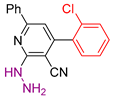
As shown in Table 1, 4-chlorophenyl derivative 20a is the most active compound among the 2-hydrazinyl pyridines 20. Compound 20a counteracts the negative effect of 2,4-D by 34–86% on sunflower seedling roots and by 30–46% on hypocotyls. Other notable compounds include hydrazines 20b,f,i, which demonstrate significant antidote activity on seedling roots (up to 80% effect), though their impact on hypocotyls is less consistent.
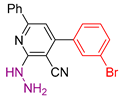
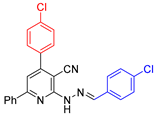
Among the hydrazones 21, compounds with 3-bromophenyl substituents unexpectedly showed the highest activity. Specifically, hydrazone 21{17} reduced the phytotoxic effects of the herbicide on hypocotyls by 38–52% and on sunflower roots by 61–86%. Hydrazone 21{18} reduced the negative effect on hypocotyls by 27–52% and on roots by 59–97%. Hydrazones 21{1,2} bearing 4-chlorophenyl substituents primarily influenced root growth (50–84% antidote effect) but exhibited only moderate activity on hypocotyls.

3. Materials and Methods

The 1H, 13C, and 13C DEPTQ NMR spectra were recorded in DMSO-d6 or acetone-d6 solutions using a Bruker AVANCE-III HD spectrometer (Bruker, Göttingen, Germany) operating at 400.40 MHz for 1H and 100.61 MHz for 13C nuclei or a JEOL JNM-ECA-400 spectrometer (JEOL, Tokyo, Japan) operating at 399.78 MHz for 1H and 100.53 MHz for 13C nuclei. Residual solvent signals were used as internal standards, set at 2.49 ppm for 1H and 39.50 ppm for 13C in DMSO-d6. Elemental analyses were performed with a Carlo Erba 1106 Elemental Analyzer (Carlo Erba, Milan, Italy). FTIR spectra were acquired on a Bruker Vertex 70 spectrometer (Bruker, Ettlingen, Germany) using an ATR device or on an Infraspec FSM 2201 spectrometer (Infraspec, Saint-Petersburg, Russia) using KBr pellets or Nujol mulls. Single-crystal X-ray diffraction data were collected on an Agilent SuperNova, Dual, Cu at home/near, Atlas diffractometer (Agilent Technologies, Santa Clara, CA, USA). High-resolution mass spectra (HRMS) were obtained using a Bruker MaXis Impact spectrometer (Bruker, Bremen, Germany) with electrospray ionization and HCO2Na–HCO2H calibration. Samples were dissolved in acetonitrile at 37–38 °C under ultrasonication. NMR, FTIR, and HRMS spectral charts, along with X-ray analysis data, are provided in the Electronic Supplementary Materials (Figures S1–S104 and Tables S1–S15).
Reaction progress and compound purity were monitored by TLC on Sorbfil-A plates (Imid Ltd., Krasnodar, Russia) using solvent systems of Me2CO–hexane (2:1), Me2CO–PhMe (3:2), HCCl3–PhMe (1:1), or AcOEt–light petroleum (1:1). Visualization was achieved under UV light and with iodine vapor. All reagents and solvents were purchased from BioInLabs (Rostov-on-Don, Russia) and used without further purification.
4,6-Diaryl-2-bromo-3-cyanopyridines (15a–j) (Scheme 6) were prepared as follows.
A. Synthesis of 2-(1,3-diaryl-3-oxopropyl)malononitriles (δ-ketodinitriles) 16.
The corresponding chalcone (0.01 mol) was dissolved or suspended in EtOH (20 mL) at 25 °C. With stirring, malononitrile (0.75 g, 0.0114 mol) was added, followed after 1–2 min by one drop of morpholine. The resulting mixture was vigorously stirred at 25 °C, and the reaction progress was monitored by TLC (eluent: acetone–toluene, 3:2). After 1–1.5 h, complete consumption of the chalcone and formation of the target Michael adduct 16 were observed. Depending on the structure of the starting chalcone, the product either crystallized directly from the reaction mixture or precipitated upon the addition of cold water (5–10 mL). The precipitated product was used in the next step without purification. If analytically pure samples were required, the Michael adducts 16 could be recrystallized from EtOH.
B. Bromination of the Michael adducts 16.
The corresponding δ-ketodinitrile 16 was dissolved in glacial AcOH (~100 mL per 5 g of ketodinitrile) with gentle heating (to about 60 °C). A solution of an equimolar amount of Br2 in 10 mL of glac. AcOH was added dropwise to the resulting light-yellow transparent solution with vigorous stirring. The bromine solution must be added at a rate that prevents the reaction temperature from exceeding 75 °C. After approximately half of the bromine has been added, the solution decolorizes. Almost immediately after decolorization, intensive precipitation of the 2-bromopyridine 15 begins. If the reaction mixture solidifies and stirring becomes impossible, the mixture should be diluted with hot AcOH. After the complete addition of bromine, stirring was continued for another 1.5 h. The mixture was then cooled to 25 °C, and the solid of 2-bromopyridine was filtered off and washed sequentially with AcOH and aq. EtOH until the washings were neutral with petroleum ether. The resulting 2-bromonicotinonitriles 15 were obtained as fluffy light-yellow powders or fibrous crystals. The 2-bromonicotinonitriles 15 were used in the next step without purification. If analytically pure samples were required, the crude product was either recrystallized from AcOH or, in cases of insufficient solubility, the suspension was boiled in AcOH for 20–30 min.
2-Bromo-4-(4-chlorophenyl)-6-phenylnicotinonitrile 15a was isolated in 84% yield, m.p. 188–189 °C (Lit. [122]: m.p. 231–232 °C (from MeNO2)). FTIR (KBr), νmax, cm−1: 2222 (C≡N). 1H NMR (400 MHz, DMSO-d6): 7.50–7.57 (m, 4H, H Ar), 7.66–7.69 (m, 3H, H Ar), 7.80–7.84 (m, 2H, H Ar), 8.22–8.28 (m, 2H, H Ar). 13C DEPTQ NMR (101 MHz, DMSO-d6): 115.1 (C-3), 116.4 (C≡N), 119.8 * (C-5), 127.8 * (2 CH Ar), 129.0 * (2 CH Ar), 129.2 * (2 CH Ar), 130.5 * (CH Ph), 130.9 * (2 CH Ar), 134.1 (C Ar), 135.4 (C Ar), 135.1 (C Ar), 144.3 (C–Br), 155.0 (C-4), 159.4 (C-6). * Negatively phased signals. Elemental Analysis: found, %: C, 58.60; H, 2.91; N, 7.40. C18H10BrClN2 (M 369.65). Calculated, %: C, 58.49; H, 2.73; N, 7.58.
2-Bromo-4-(2-chlorophenyl)-6-phenylnicotinonitrile 15b was isolated in 78% yield, m.p. 185–186 °C (Lit. [122]: m.p. 187–188 °C (from AcOH)). FTIR (KBr), νmax, cm−1: 2230 (C≡N). NMR spectral data were identical to those reported in [122].
2-Bromo-4-(4-methylphenyl)-6-phenylnicotinonitrile 15c was isolated in 59% yield, m.p. 191–191 °C. FTIR (nujol), νmax, cm−1: 2224 (C≡N). NMR spectral data were identical to those reported in [163].
2-Bromo-4-(3,4-dimethoxyphenyl)-6-phenylnicotinonitrile 15d was isolated in 71% yield, m.p. 194–195 °C. FTIR (KBr), νmax, cm−1: 2227 (C≡N).
2-Bromo-4-(4-chlorophenyl)-6-(4-methylphenyl)nicotinonitrile 15e was isolated in 54% yield, m.p. 187–188 °C (Lit. [122]: m.p. 282–283 °C (from dioxane)). FTIR (KBr), νmax, cm−1: 2222 (C≡N). NMR spectral data were identical to those reported in [122].
2-Bromo-4-(4-fluorophenyl)-6-phenylnicotinonitrile 15f was isolated in 53% yield, m.p. 181–183 °C (Lit. [164]: m.p. 184–187 °C). FTIR (KBr), νmax, cm−1: 2222 (C≡N). NMR spectral data were identical to those reported in [164].
2-Bromo-4-(2,4-dichlorophenyl)-6-phenylnicotinonitrile 15g was isolated in 67% yield, m.p. 180–181 °C (Lit. [122]: m.p. 160–161 °C (from MeNO2)). Spectral data were identical to those reported in [122].
2-Bromo-4-(3-nitrophenyl)-6-phenylnicotinonitrile 15h was isolated in 69% yield, m.p. 186–188 °C. FTIR (KBr), νmax, cm−1: 2222 (C≡N).
2-Bromo-4-(3-bromophenyl)-6-phenylnicotinonitrile 15i was isolated in 63% yield, m.p. 191–192 °C. FTIR (KBr), νmax, cm−1: 2222 (C≡N).
2-Bromo-4-(4-methoxyphenyl)-6-phenylnicotinonitrile 15j was isolated in 83% yield, m.p. 192–195 °C (Lit. [122]: m.p. 218–218 °C (from MeNO2)). Spectral data were identical to those reported in [122,164].
4,6-Diaryl-2-hydrazinyl-3-cyanopyridines (20a–j) (Scheme 8) were prepared as follows. The corresponding 2-bromonicotinonitrile 15a–j (5.5–6 mmol) was dissolved in 1,4-dioxane (~15 mL per 2 g of 2-bromopyridine 15). An excess of hydrazine hydrate (25–30 mmol) was added to the solution formed. The resulting emulsion was stirred vigorously at 25 °C. The reaction progress was monitored by TLC (eluent: chloroform–toluene, 1:1). Complete conversion was typically achieved within 5–6 h, though in some cases, stirring was continued for 24 h. Upon reaction completion, dioxane was removed under reduced pressure at ambient temperature. The residue was triturated with cold water to remove hydrazine and hydrazinium hydrobromide. The precipitate was filtered off and washed with water and then with petroleum ether, yielding hydrazines 20 as yellow powders. For purification, the compounds can be recrystallized from MeOH or dioxane.
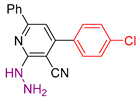
4-(4-Chlorophenyl)-2-hydrazinyl-6-phenylnicotinonitrile 20a was isolated in 97% yield, m.p. 160–162 °C. FTIR (nujol), νmax, cm−1: 3304 br (N–H), 2206 (C≡N). 1H NMR (400 MHz, DMSO-d6): 4.67 (br s, 2H, NH2), 7.32 (s, 1H, H-5), 7.47–7.51 (m, 3H, H Ph), 7.62 (d, 3J = 8.7 Hz, 2H, H-3, and H-5, 4-ClC6H4), 7.69 (d, 3J = 8.7 Hz, 2H, H-3, and H-5, 4-ClC6H4), 8.23–8.26 (m, 2H, H Ph), 8.41 (br s, 1H, NH). 13C DEPTQ NMR (101 MHz, DMSO-d6): 86.3 (C-3), 109.2 * (C(5)H), 116.2 (C≡N), 127.5 * (2 CH Ar), 128.6 * (2 CH Ar), 128.8 * (2 CH Ar), 130.3 * (CH Ph), 130.4 * (2 CH Ar), 134.5 (C1 Ar), 135.7 (C1 Ar), 137.5 (C–Cl), 154.0 (C-4), 158.0 (C–6), 160.8 (C–NH). * Negatively phased signals. HRMS (ESI) m/z: calculated for C18H14ClN4 [M + H]+: 321.090699, found 321.0891 (Δ 4.98 ppm). Elemental Analysis: found, %: C, 67.36; H, 4.21; N, 17.40. C18H13ClN4 (M 320.78). Calculated, %: C, 67.40; H, 4.09; N, 17.47.
4-(2-Chlorophenyl)-2-hydrazinyl-6-phenylnicotinonitrile 20b was isolated in 96% yield, m.p. 158–160 °C. FTIR (nujol), νmax, cm−1: 3315, 3250 br (N–H), 2208 (C≡N). 1H NMR (400 MHz, DMSO-d6): 4.62 (br s, 2H, NH2), 7.25 (s, 1H, H-5), 7.47–7.54 (m, 7H, H Ar), 7.64 (dd, 3J = 8.2 Hz, 4J = 1.4 Hz, 1H, H Ar), 8.21–8.24 (m, 2H, H Ph), 8.49 (br s, 1H, NH). 13C NMR (101 MHz, DMSO-d6): 88.3 (C-3), 109.7 (C(5)H), 115.5 (C≡N), 127.4 (2 CH Ar), 127.5 (CH Ar), 128.7 (2 CH Ar), 129.7 (CH Ar), 130.3 (CH Ph), 130.6 (CH Ar), 130.9 (CH Ar), 131.3 (C Ar), 136.2 (C Ar), 137.3 (C Ar), 153.4 (C-4), 157.8 (C–6), 160.2 (C–NH). Elemental Analysis: found, %: C, 67.29; H, 4.24; N, 17.38. C18H13ClN4 (M 320.78). Calculated, %: C, 67.40; H, 4.09; N, 17.47. HRMS (ESI) m/z: calculated for C18H14ClN4 [M + H]+: 321.090699, found 321.0904 (Δ 0.93 ppm).
2-Hydrazinyl-4-(2-methylphenyl)-6-phenylnicotinonitrile 20c was isolated in 80% yield, m.p. 163–165 °C. FTIR (nujol), νmax, cm−1: 3315, 3267 br (N–H), 2206 (C≡N). 1H NMR (400 MHz, DMSO-d6): 2.38 (s, 3H, Me), 4.59 (br s, 2H, NH2), 7.29 (s, 1H, H-5), 7.48–7.50 (m, 3H, H Ph), 7.56 (d, 3J = 7.8 Hz, 2H, H Ar), 8.23–8.25 (m, 2H, H Ph), 8.31 (br s, 1H, NH). 13C NMR (101 MHz, DMSO-d6): 20.9 (Me), 88.4 (C-3), 109.3 (C(5)H), 116.4 (C≡N), 127.4 (2 CH Ar), 128.3 (CH Ar), 128.6 (2 CH Ar), 129.3 (CH Ar), 130.2 (CH Ph), 134.0 (C–Me), 137.6 (C1 Ar), 139.4 (C1 Ar), 155.2 (C-4), 157.7 (C–6), 160.9 (C–NH). Elemental Analysis: found, %: C, 75.90; H, 5.44; N, 18.66. C19H16N4 (M 300.37). Calculated, %: C, 75.98; H, 5.37; N, 18.65.
2-Hydrazinyl-4-(3,4-dimethoxyphenyl)-6-phenylnicotinonitrile 20d was isolated as solvate with dioxane (2:1) in 93% yield, m.p. 152–155 °C. FTIR (nujol), νmax, cm−1: 3314, 3279 br (N–H), 2212 (C≡N). 1H NMR (400 MHz, DMSO-d6): 3.55 (br s, dioxane), 3.83 (s, 3H, MeO), 3.84 (s, 3H, MeO), 4.69 (br s, 2H, NH2), 7.11 (d, 3J = 7.8 Hz, 1H, H Ar), 7.23–7.27 (m, 2H, H Ar), 7.34 (s, 1H, H-5), 7.48–7.50 (m, 3H, H Ph), 8.24–8.27 (m, 3H, H Ph, and NH overlapped). 13C NMR (101 MHz, DMSO-d6): 55.6 (2 C, 2 MeO), 66.4 (CH2O dioxane), 86.3 (C-3), 109.3 (C(5)H), 111.6 (CH Ar), 112.1 (CH Ar), 116.7 (C≡N), 121.2 (CH Ar), 127.5 (2 CH Ph), 128.6 (2 CH Ph), 129.0 (C1 Ar), 130.1 (CH Ph), 137.7 (C1 Ph), 148.6 (C–OMe), 150.1 (C–OMe), 155.0 (C-4), 157.6 (C–6), 161.0 (C–NH). HRMS (ESI) m/z: calculated for C20H19N4O2 [M + H]+: 347.150801, found 347.1503 (Δ 1.44 ppm).
4-(4-Chlorophenyl)-2-hydrazinyl-6-(4-methylphenyl)nicotinonitrile 20e was isolated in 96% yield, m.p. 160–162 °C. FTIR (nujol), νmax, cm−1: 3400, 3326 br (N–H), 2210 (C≡N). 1H NMR (400 MHz, DMSO-d6): 2.38 (s, 3H, Me), 4.60 (br s, 2H, NH2), 7.31 (s, 1H, H-5), 7.35 (d, 3J = 7.8 Hz, 2H, H Ar), 7.53–7.57 (m, 4H, H Ar, two doublets overlapped), 8.29 (d, 3J = 8.2 Hz, 2H, H Ar), 8.34 (br s, 1H, NH). 13C NMR (101 MHz, DMSO-d6): 20.9 (Me), 86.7 (C-3), 109.2 (C(5)H), 116.3 (C≡N), 128.4 (2 CH Ar), 128.6 (2 CH Ar), 129.25 (2 CH Ar), 129.27 (2 CH Ar), 133.8 (C–Me), 135.0 (C–Cl), 136.4 (C1 Ar), 139.5 (C1 Ar), 155.3 (C-4), 156.4 (C–6), 160.8 (C–NH). HRMS (ESI) m/z: calculated for C19H15ClN4 [M + H]+: 335.106349, found 335.1061 (Δ 0.74 ppm).
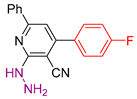
4-(4-Fluorophenyl)-2-hydrazinyl-6-phenylnicotinonitrile 20f was isolated in 97% yield, m.p. 153–155 °C. FTIR (nujol), νmax, cm−1: 3302, 3246 br (N–H), 2208 (C≡N). 1H NMR (400 MHz, DMSO-d6): 4.59 (br s, 2H, NH2), 7.31 (s, 1H, H-5), 7.37–7.41 (m, 2H, H Ar), 7.48–7.50 (m, 3H, H Ph), 7.71–7.74 (m, 2H, H Ar), 8.24–8.26 (m, 2H, H Ph), 8.39 (br s, 1H, NH). 13C NMR (101 MHz, DMSO-d6): 86.5 (C-3), 109.4 (C(5)H), 115.7 (d, 2JC–F = 21.1 Hz, 2 CH Ar), 116.3 (C≡N), 127.5 (2 CH Ph), 128.6 (2 CH Ph), 130.2 (C(4)H Ph), 130.9 (d, 3JC–F = 8.6 Hz, 2 CH Ar), 133.3 (d, 4JC–F = 2.9 Hz, C1 Ar), 137.5 (C1 Ph), 154.2 (C-4), 157.9 (C–6), 160.8 (C–NH), 161.7, 164.2 (d, 1JC–F = 247.3 Hz, C–F). HRMS (ESI) m/z: calculated for C18H14FN4 [M + H]+: 305.120249, found 305.1205 (Δ −0.82 ppm).
4-(2,4-Dichlorophenyl)-2-hydrazinyl-6-phenylnicotinonitrile 20g was isolated in 95% yield, m.p. 142–143 °C. FTIR (nujol), νmax, cm−1: 3307, 3246 br (N–H), 2210 (C≡N). 1H NMR (400 MHz, DMSO-d6): 4.62 (br s, 2H, NH2), 7.26 (s, 1H, H-5), 7.47–7.49 (m, 3H, H Ar), 7.53 (d, 3J = 8.2 Hz, 1H, H-6 Ar), 7.61 (dd, 3J = 8.2 Hz, 4J = 1.8 Hz, 1H, H-5 Ar), 7.85 (d, 4J = 1.8 Hz, 1H, H-3 Ar), 8.20–8.23 (m, 2H, H Ph), 8.55 (br s, 1H, NH). 13C NMR (101 MHz, DMSO-d6): 88.0 (C-3), 109.6 (C(5)H), 115.5 (C≡N), 127.4 (2 CH Ar), 127.8 (CH Ar), 128.7 (2 CH Ar), 129.2 (CH Ar), 130.4 (CH Ph), 132.0 (CH Ar), 132.6 (C1 Ar), 134.7 (C–Cl), 135.2 (C–Cl), 137.2 (C1 Ph), 152.6 (C-4), 157.9 (C–6), 160.2 (C–NH). HRMS (ESI) m/z: calculated for C18H13Cl2N4 [M + H]+: 355.051727, found 355.0516 (Δ 0.36 ppm).
2-Hydrazinyl-4-(3-nitrophenyl)-6-phenylnicotinonitrile 20h was isolated as solvate with dioxane (2:1) in 93% yield, m.p. 157–159 °C. FTIR (nujol), νmax, cm−1: 3312, 3245 br (N–H), 2210 (C≡N), 1535 (NO2 asymm), 1350 (NO2 symm). 1H NMR (400 MHz, DMSO-d6): 3.55 (s, CH2O, dioxane), 4.76 (br s, 2H, NH2), 7.44 (s, 1H, H-5), 7.48–7.50 (m, 3H, H Ph), 7.62–7.63 (m, 1H, H Ar), 7.83–7.86 (m, 1H, H Ar), 8.12–8.20 (m, 2H, H Ar), 8.26–8.29 (m, 2H, H Ph), 8.53 (br s, 1H, NH). 13C NMR (101 MHz, DMSO-d6): 66.4 (dioxane), 88.3 (C-3), 109.4 (C(5)H), 116.1 (C≡N), 123.4 (CH Ar), 124.3 (CH Ar), 127.6 (2 CH Ph), 128.6 (2 CH Ph), 128.8 (CH Ar), 130.2 (C(4)H Ph) 130.4 (CH Ar), 135.3 (C1 Ar), 137.4 (C1 Ph), 147.8 (C–NO2), 155.6 (C-4), 158.2 (C–6), 160.8 (C–NH). HRMS (ESI) m/z: calculated for C18H14N5O2 [M + H]+: 332.114750, found 332.1143 (Δ 1.36 ppm).
4-(3-Bromophenyl)-2-hydrazinyl-6-phenylnicotinonitrile 20i was isolated as solvate with dioxane (1:1) in 97% yield, m.p. 165–166 °C. FTIR (nujol), νmax, cm−1: 3309, 3207 br (N–H), 2210 (C≡N). 1H NMR (400 MHz, DMSO-d6): 3.55 (s, CH2O, dioxane), 4.66 (br s, 2H, NH2), 7.36 (s, 1H, H-5), 7.48–7.54 (m, 4H, H Ar), 7.66–7.75 (m, 2H, H Ar), 7.86–7.87 (m, 1H, H Ar), 8.26–8.28 (m, 2H, H Ph), 8.43 (br s, 1H, NH). 13C NMR (101 MHz, DMSO-d6): 66.4 (dioxane), 86.4 (C-3), 109.4 (C(5)H), 116.1 (C≡N), 121.9 (C–Br), 127.6 (2 CH Ph), 127.7 (CH Ar), 128.6 (2 CH Ph), 130.3 (C(4)H Ph) 130.8 (CH Ar), 131.1 (CH Ar), 132.4 (CH Ar), 137.5 (C1 Ph), 139.1 (C1 Ar), 153.6 (C-4), 158.0 (C–6), 160.7 (C–NH). HRMS (ESI) m/z: calculated for C18H14BrN4 [M + H]+: 365.040182, found 365.0398 (Δ 1.05 ppm).
2-Hydrazinyl-4-(4-methoxyphenyl)-6-phenylnicotinonitrile 20j was isolated in 92% yield, m.p. 141–143 °C. FTIR (nujol), νmax, cm−1: 3390, 3321 br (N–H), 2208 (C≡N). 1H NMR (400 MHz, DMSO-d6): 3.83 (s, 3H, MeO), 4.58 (br s, 2H, NH2), 7.10 (d, 3J = 8.7 Hz, 3H, H-3, and H-5, 4-MeOC6H4), 7.29 (s, 1H, H-5), 7.48–7.50 (m, 3H, H Ph), 7.64 (d, 3J = 8.7 Hz, 3H, H-2 and H-6, 4-MeOC6H4), 8.23–8.26 (m, 2H, H Ph), 8.28 (br s, 1H, NH). 13C NMR (101 MHz, DMSO-d6): 55.4 (MeO), 86.2 (C-3), 109.2 (C(5)H), 114.2 (2 CH Ar), 116.6 (C≡N), 127.4 (2 CH Ph), 128.6 (2 CH Ph), 128.9 (C1 Ar), 130.0 (2 CH Ar), 130.1 (CH Ph), 137.7 (C1 Ph), 154.8 (C-4), 157.7 (C–6), 160.5 (C–OMe), 161.0 (C–NH). HRMS (ESI) m/z: calculated for C19H17N4O [M + H]+: 317.140236, found 317.1399 (Δ 1.06 ppm).
Synthesis of 2-(2-arylidenehydrazinyl)-4,6-diarylnicotinonitriles 21{1–20}. General procedure. Into a 10 mL vial, 0.5 mmol of the corresponding hydrazine 20, an aromatic aldehyde (0.5 mmol), and 5 mL of EtOH were placed. The reaction mixture was heated under reflux with vigorous stirring for 1–1.5 h (conversion was monitored by TLC, eluent: chloroform/toluene, 1:1). The reaction mixture was cooled, and the product was precipitated by adding cold water. The resulting precipitate of hydrazone 21 was filtered off and purified by recrystallization from an appropriate solvent (MeOH, EtOH, or 1,4-dioxane). Hydrazones 21 are fine crystalline powders, ranging from light yellow to bright yellow in color, and are soluble in acetone, 1,4-dioxane, lower alcohols, and DMSO.
2-[2-(4-Chlorobenzylidene)hydrazinyl]-4-(4-chlorophenyl)-6-phenylnicotinonitrile 21{1} was isolated in 83% yield. FTIR (nujol), νmax, cm−1: 3265 br (N–H), 2218 (C≡N). 1H NMR (400 MHz, DMSO-d6): 7.47 (d, 3J = 8.7 Hz, 2H, H-3, and H-5, 4-ClC6H4), 7.50–7.55 (m, 4H, H-5, and 3H Ph overlapped), 7.63 (d, 3J = 8.7 Hz, 2H, H-3, and H-5, 4-ClC6H4), 7.73 (d, 3J = 8.7 Hz, 2H, H-2, and H-6, 4-ClC6H4), 7.82 (d, 3J = 8.7 Hz, 2H, H-2, and H-6, 4-ClC6H4), 8.14 (br s, 1H, –CH=), 8.18–8.20 (m, 2H, H Ph), 11.86 (br s, 1H, NH). 13C NMR (101 MHz, DMSO-d6): 89.6 (C-3), 115.8 (C(5)H), 117.4 (C≡N), 127.4 (2 CH Ar), 128.4 (2 CH Ar), 128.6 (2 CH Ar), 128.7 (2 CH Ar), 128.8 (2 CH Ar), 130.6 (CH Ph), 130.9 (2 CH Ar), 133.3, 133.6, 134.4, 136.3 (C1 Ar), 136.8 (C1 Ar), 155.8 (C-4), 158.1 (C–6), 159.9 (C–NH). Elemental Analysis: found, %: C, 67.66; H, 3.77; N, 12.60. C25H16Cl2N4 (M 443.33). Calculated, %: C, 67.73; H, 3.64; N, 12.64. HRMS (ESI) m/z: calculated for C25H17Cl2N4 [M + H]+: 443.083027, found 443.0808 (Δ 5.03 ppm).
2-[2-(2,4-Dichlorobenzylidene)hydrazinyl]-4-(4-chlorophenyl)-6-phenylnicotinonitrile 21{2} was isolated in 80% yield. FTIR (nujol), νmax, cm−1: 3260 br (N–H), 2210 (C≡N). 1H NMR (400 MHz, DMSO-d6): 7.43–7.53 (m, 7H, H-5, and H Ar overlapped), 7.62–7.69 (m, 3H, H Ar), 8.18–8.23 (m, 3H, 2H Ph, H Ar), 8.50 (br s, 1H, –CH=), 12.06 (br s, 1H, NH). 13C NMR (101 MHz, DMSO-d6): 89.6 (C-3), 115.3 (C(5)H), 117.5 (C≡N), 127.4 (2 CH Ar), 127.8 (CH Ar), 128.0 (CH Ar), 128.4 (2 CH Ar), 128.6 (2 CH Ar), 128.8 (2CH Ar), 129.3 (CH Ar), 130.6 (C(4)H Ph), 131.3, 132.9, 134.1, 135.8, 136.4, 136.6, 136.7, 156.2 (C-4), 158.0 (C–6), 160.3 (C–NH). HRMS (ESI) m/z: calculated for C18H14ClN4 [M + H + H2O–ArCHO]+: 321.090699, found 321.0891 (Δ 4.99 ppm). Elemental Analysis: found, %: C, 62.9; H, 3.30; N, 11.63. C25H15Cl3N4 (M 477.77). Calculated, %: C, 62.85; H, 3.16; N, 11.73.
2-[2-(4-Chlorobenzylidene)hydrazinyl]-4-(2-chlorophenyl)-6-phenylnicotinonitrile 21{3} was isolated in 89% yield. FTIR (nujol), νmax, cm−1: 3314 br (N–H), 2208 (C≡N). 1H NMR (400 MHz, DMSO-d6): 7.44 (d, 3J = 8.7 Hz, 2H, H-3, and H-5, 4-ClC6H4), 7.48 (s, 1H, H-5), 7.51–7.57 (m, 6H, H Ar), 7.65–7.67 (m, 1H, H Ar), 7.79 (d, 3J = 8.7 Hz, 2H, H-2, and H-6, 4-ClC6H4), 8.14 (br s, 1H, –CH=), 8.16–8.19 (m, 2H, H Ph), 11.91 (br s, 1H, NH). 13C NMR (101 MHz, DMSO-d6): 89.1 (C-3), 112.5 (C(5)H), 116.7 (C≡N), 127.3 (2 CH Ar), 127.4 (CH Ar), 128.4 (2 CH Ar), 128.7 (2 CH Ar), 128.8 (2 CH Ar), 129.5 (CH Ar), 130.6 (CH Ph), 130.7 (CH Ar), 130.8 (CH Ar), 131.4, 133.6, 133.9, 136.4 (C1 Ar), 136.7 (C1 Ar), 140.5, 155.5 (C-4), 156.1 (C–6), 158.0 (C–NH). HRMS (ESI) m/z: calculated for C25H17Cl2N4 [M + H]+: 443.083027, found 443.0803 (Δ 6.16 ppm).
2-[2-(2,4-Dichlorobenzylidene)hydrazinyl]-4-(2-chlorophenyl)-6-phenylnicotinonitrile 21{4} was isolated in 80% yield. FTIR (nujol), νmax, cm−1: 3298 br (N–H), 2214 (C≡N). 1H NMR (400 MHz, acetone-d6): 7.35 (dd, 3J = 8.7 Hz, 4J = 1.8 Hz, 1H, H-5, 2,4-ClC6H3), 7.49 (s, 1H, H-5), 7.50–7.57 (m, 7H, H Ar), 7.62–7.64 (m, 1H, H Ar), 8.18–8.20 (m, 2H, H Ph), 8.36 (d, 3J = 8.7 Hz, 1H, H-6, 2,4-ClC6H3), 8.57 (br s, 1H, –CH=), 11.00 (br s, 1H, NH). 13C NMR (101 MHz, acetone-d6): 91.3 (C-3), 114.0 (C(5)H), 117.2 (C≡N), 128.1 (2 CH Ar), 128.2 (2 CH Ar), 128.5 (CH Ar), 129.5 (CH Ar), 126.6 (2 CH Ar), 130.0 (CH Ar), 130.5 (CH Ph), 131.3 (CH Ar), 131.5 (2CH Ar), 132.4, 132.9, 134.2, 135.6, 137.7, 137.9, 156.7 (C-4), 156.9 (C–6), 159.3 (C–NH). HRMS (ESI) m/z: calculated for C25H16Cl3N4 [M + H]+: 477.044055, found 477.0415 (Δ 5.36 ppm).
2-[2-(4-Chlorobenzylidene)hydrazinyl]-4-(4-methylphenyl)-6-phenylnicotinonitrile 21{5} was isolated in 85% yield. FTIR (nujol), νmax, cm−1: 3273 br (N–H), 2208 (C≡N). 1H NMR (400 MHz, DMSO-d6): 2.41 (s, 3H, Me), 7.36 (d, 3J = 7.5 Hz, 2H, H Tol), 7.41–7.56 (m, 6H, H Ar, and H-5 overlapped), 7.60 (d, 3J = 7.5 Hz, 2H, H Tol), 7.82 (d, 3J = 7.8 Hz, 2H, H-2, and H-6, 4-ClC6H4), 8.14 (br s, 1H, –CH=), 8.17–8.21 (m, 2H, H Ph), 11.77 (br s, 1H, NH). HRMS (ESI) m/z: calculated for C26H20ClN4 [M + H]+: 423.137649, found 423.1357 (Δ 4.6 ppm).
2-[2-(2,4-Dichlorobenzylidene)hydrazinyl]-4-(4-methylphenyl)-6-phenylnicotinonitrile 21{6} was isolated in 78% yield. FTIR (nujol), νmax, cm−1: 3312, 3292 (N–H), 2218 (C≡N). 1H NMR (400 MHz, DMSO-d6): 2.40 (s, 3H, Me), 7.36 (d, 3J = 7.8 Hz, 2H, H Tol), 7.39–7.46 (m, 1H, H Ar), 7.50 (s, 1H, H-5), 7.51–7.56 (m, 3H, H Ph), 7.60 (d, 3J = 7.8 Hz, 2H, H Tol), 7.67–7.69 (m, 1H, H Ar), 8.17–8.21 (m, 2H, H Ph), 8.23 (d, 3J = 8.7 Hz, 1H, H Ar), 8.51 (br s, 1H, –CH=), 12.01 (br s, 1H, NH). 13C NMR (101 MHz, DMSO-d6): 21.5 (Me), 86.6 (C-3), 111.5 (C(5)H), 116.3 (C≡N), 127.9 (2 CH Ar), 128.4 (CH Ar), 129.4 (2 CH Ar), 129.7 (2 CH Ar), 129.8 (CH Ar), 130.0 (2 CH Ar), 130.7 (CH Ph), 131.0 (CH Ar), 131.9, 133.4, 134.5, 134.6, 137.0, 137.4, 141.8, 153.0 (C-4), 157.1 (C–6), 158.4 (C–NH). Elemental Analysis: found, %: C, 68.33; H, 4.11; N, 12.19. C26H18Cl2N4 (M 457.36). Calculated, %: C, 68.28; H, 3.97; N, 12.25. HRMS (ESI) m/z: calculated for C25H17Cl2N4 [M + H–Me]+: 443.083027, found 443.0801 (Δ 6.6 ppm).
2-[2-(4-Chlorobenzylidene)hydrazinyl]-4-(3,4-dimethoxyphenyl)-6-phenylnicotinonitrile 21{7} was isolated in 72% yield. FTIR (nujol), νmax, cm−1: 3277 br (N–H), 2206 (C≡N). 1H NMR (400 MHz, DMSO-d6): 3.84 (s, 3H, MeO), 3.86 (s, 3H, MeO), 7.12 (d, 3J = 8.7 Hz, 1H, H Ar), 7.28 (d, 3J = 8.7 Hz, 1H, H Ar), 7.30 (s, 1H, H Ar), 7.46 (d, 3J = 8.3 Hz, 2H, H Ar), 7.50–7.53 (m, 4H, H-5, H Ar overlapped), 7.82 (d, 3J = 8.3 Hz, 1H, H Ar), 8.14 (br s, 1H, –CH=), 8.18–8.21 (m, 2H, H Ph), 11.73 (br s, 1H, NH). 13C NMR (101 MHz, DMSO-d6): 55.6 (MeO), 55.7 (MeO), 87.5 (C-3), 111.5 (C(5)H), 112.4 (CH Ar), 112.6 (CH Ar), 117.8 (C≡N), 121.7 (C Ar), 127.3 (2 CH Ar), 128.3 (2 CH Ar), 128.7 (4 CH Ar), 129.3 (CH Ar), 130.3 (CH Ph), 133.5, 134.0, 137.1, 137.4, 140.2, 148.5 (C–OMe), 150.0 (C–OMe), 156.8 (C-4), 157.3 (C–6), 157.8 (C–NH). HRMS (ESI) m/z: calculated for C27H22ClN4O2 [M + H]+: 469.143129, found 469.1417 (Δ 3.05 ppm).
2-[2-(2,4-Dichlorobenzylidene)hydrazinyl]-4-(3,4-dimethoxyphenyl)-6-phenylnicotinonitrile 21{8} was isolated in 73% yield. FTIR (nujol), νmax, cm−1: 3260 br (N–H), 2206 (C≡N). 1H NMR (400 MHz, DMSO-d6): 3.84 (s, 3H, MeO), 3.86 (s, 3H, MeO), 7.11 (d, 3J = 8.2 Hz, 1H, H Ar), 7.28 (dd, 3J = 8.2 Hz, 4J = 1.8 Hz, 1H, H Ar), 7.30 (d, 4J = 1.8 Hz, 1H, H Ar), 7.45 (dd, 3J = 8.2 Hz, 4J = 1.8 Hz, 1H, H Ar), 7.51–7.54 (m, 4H, H-5, H Ph overlapped), 7.65 (d, 4J = 1.8 Hz, 1H, H Ar), 8.17–8.20 (m, 2H, H Ph), 8.24 (d, 3J = 8.2 Hz, 1H, H Ar), 8.51 (br s, 1H, –CH=),), 11.95 (br s, 1H, NH). 13C NMR (101 MHz, DMSO-d6): 55.6 (MeO), 55.7 (MeO), 87.7 (C-3), 111.5 (C(5)H), 112.6 (CH Ar), 112.8 (CH Ar), 117.8 (C≡N), 121.8 (C Ar), 127.3 (2 CH Ar), 127.8 (CH Ar), 128.0 (CH Ar), 127.6 (2 CH Ar), 129.2 (CH Ar), 130.4 (CH Ph), 131.4 (CH Ar), 132.8, 134.0, 136.4, 136.9, 148.5 (C–OMe), 150.0 (C–OMe), 156.6 (C-4), 157.2 (C–6), 157.8 (C–NH). HRMS (ESI) m/z: calculated for C27H22ClN4O2 [M + H–Cl]+: 469.14314, found 469.1408 (Δ 4.99 ppm).
2-[2-(4-Chlorobenzylidene)hydrazinyl]-4-(4-chlorophenyl)-6-(methylphenyl)nicotinonitrile 21{9} was isolated in 84% yield. FTIR (nujol), νmax, cm−1: 3269 br (N–H), 2218 (C≡N). 1H NMR (400 MHz, DMSO-d6): 2.39 (s, 3H, Me), 7.34 (d, 3J = 7.8 Hz, 2H, H Tol), 7.43–7.45 (m, 3H, H Ar, and H-5 overlapped), 7.55–7.58 (m, 4H, H Ar), 7.80 (d, 3J = 8.7 Hz, 2H, H Ar), 8.11 (br s, 1H, –CH=), 8.18 (d, 3J = 8.7 Hz, 2H, H Ar), 11.77 (br s, 1H, NH). 13C NMR (101 MHz, DMSO-d6): 20.9 (Me), 87.8 (C-3), 112.3 (C(5)H), 117.5 (C≡N), 123.27 (2 CH Ar), 128.32 (2 CH Ar), 128.7 (2 CH Ar), 128.8 (2 CH Ar), 129.0 (2 CH Ar), 129.1 (2 CH Ar), 133.5, 134.0, 134.1, 135.2, 135.7, 139.2, 140.3, 156.5 (C-4), 156.7 (C–6), 157.5 (C–NH). Elemental Analysis: found, %: C, 68.36; H, 4.09; N, 12.22. C26H18Cl2N4 (M 457.36). Calculated, %: C, 68.28; H, 3.97; N, 12.25. HRMS (ESI) m/z: calculated for C26H19Cl2N4 [M + H]+: 457.098677, found 457.0967 (Δ 4.33 ppm).
2-[2-(2,4-Dichlorobenzylidene)hydrazinyl]-4-(4-chlorophenyl)-6-(methylphenyl)nicotinonitrile 21{10} was isolated in 78% yield. FTIR (nujol), νmax, cm−1: 3306 br (N–H), 2210 (C≡N). 1H NMR (400 MHz, DMSO-d6): 2.39 (s, 3H, Me), 7.30 (s, CH Ar), 7.34 (d, 3J = 7.8 Hz, 2H, H Ar), 7.42 (br d, 3J = 8.7 Hz, 1H, H-5, 2,4-Cl2C6H3), 7.49–7.54 (m, 4H, H Ar), 7.63 (d, 4J = 1.8 Hz, 1H, H-3, 2,4-Cl2C6H3), 8.18 (d, 3J = 7.8 Hz, 2H, H Ar), 8.27 (d, 3J = 8.7 Hz, 1H, H Ar), 8.48 (br s, 1H, –CH=), 11.98 (br s, 1H, NH). 13C NMR (101 MHz, DMSO-d6): 20.9 (Me), 86.7 (C-3), 112.7 (C(5)H), 117.5 (C≡N), 127.7 (CH Ar), 128.0 (CH Ar), 128.4 (2 CH Ar), 128.6 (2 CH Ar), 129.1 (2 CH Ar), 129.3 (2 CH Ar), 131.3 (CH Ar), 132.8, 134.0, 134.1, 135.3, 135.7, 136.5, 139.4, 156.5 (C-4), 156.4 (C-6), 159.1 (C–NH). Elemental Analysis: found, %: C, 63.38; H, 3.62; N, 11.33. C26H17Cl3N4 (M 491.80). Calculated, %: C, 63.50; H, 3.48; N, 11.39. HRMS (ESI) m/z: calculated for C19H16ClN4 [M + H + H2O–ArCHO]+: 335.106349, found 335.1046 (Δ 5.2 ppm).
2-[2-(4-Chlorobenzylidene)hydrazinyl]-4-(4-fluorophenyl)-6-phenylnicotinonitrile 21{11} was isolated in 85% yield as solvate with EtOH (1:1). FTIR (nujol), νmax, cm−1: 3479 br (OH of EtOH), 3323 br (N–H), 2208 (C≡N). 1H NMR (400 MHz, DMSO-d6): 1.04 (t, 3J = 7.1 Hz, 3H, CH3CH2OH), 3.40–3.46 (m, 2H, CH3CH2OH), 4.35 (t, 3J = 5.0 Hz, 3H, CH3CH2OH), 7.38–7.42 (m, 2H, H Ar), 7.46 (d, 3J = 8.5 Hz, 2H, H Ar), 7.50 (s, 1H, H-5), 7.51–7.53 (m, 3H, H Ph), 7.75–7.78 (m, 2H, H Ar), 7.82 (d, 3J = 8.5 Hz, 2H, H Ar), 8.14 (br s, 1H, –CH=), 8.17–8.20 (m, 2H, H Ph), 11.81 (br s, 1H, NH). 13C NMR (101 MHz, DMSO-d6): 18.6 (CH3CH2OH), 56.0 (CH3CH2OH), 87.6 (C-3), 112.5 (C(5)H), 115.5 (d, 2JC–F = 21.1 Hz, C(3)H C(5)H, 4-FC6H4), 117.5 (C≡N), 127.4 (2 CH Ph), 128.4 (2 CH Ph), 128.8 (4 CH, 4-ClC6H4), 130.5 (C(4)H Ph), 131.3 (d, 3JC–F = 8.6 Hz, C(2)H C(6)H, 4-FC6H4), 133.5 (d, 4JC–F = 3.8 Hz, C1 4-FC6H4), 133.6, 134.0, 136.9, 140.4, 156.5 (C-4), 156.7 (C–6), 158.0 (C–NH), 161.8, 164.2 (d, 1JC–F = 239 Hz, C–F). HRMS (ESI) m/z: calculated for C25H17ClFN4 [M + H]+: 427.112577, found 427.1131 (Δ −1.23 ppm); calculated for C18H14FN4 [M + H + H2O–ArCHO]+: 305.120249, found 305.1203 (Δ −0.17 ppm).
2-[2-(2,4-Dichlorobenzylidene)hydrazinyl]-4-(4-fluorophenyl)-6-phenylnicotinonitrile 21{12} was isolated in 81% yield as solvate with EtOH (1:1). FTIR (nujol), νmax, cm−1: 3458 br (OH of EtOH), 3327 br (N–H), 2206 (C≡N). 1H NMR (400 MHz, DMSO-d6): 1.04 (t, 3J = 7.1 Hz, 3H, CH3CH2OH), 3.40–3.46 (m, 2H, CH3CH2OH), 4.36 (t, 3J = 5.0 Hz, 3H, CH3CH2OH), 7.37–7.44 (m, 3H, H Ar), 7.51–7.52 (m, 4H, H Ph, and H-5 overlapped), 7.64 (br s, 1H, H-3, 2,4-Cl2C6H3), 7.74–7.78 (m, 2H, H Ar), 8.17–8.19 (m, 2H, H Ph), 8.22 (d, 3J = 8.7 Hz, 1H, H-6, 2,4-Cl2C6H3), 8.50 (br s, 1H, –CH=), 12.03 (br s, 1H, NH). 13C NMR (101 MHz, DMSO-d6): 18.6 (CH3CH2OH), 56.0 (CH3CH2OH), 87.9 (C-3), 112.9 (C(5)H), 115.5 (d, 2JC–F = 22.1 Hz, C(3)H C(5)H, 4-FC6H4), 117.6 (C≡N), 127.4 (2 CH Ph), 127.8 (CH Ar), 128.0 (CH Ar), 128.8 (2 CH Ph), 129.2 (CH Ar), 130.6 (C(4)H Ph), 131.3 (d, 3JC–F = 8.6 Hz, C(2)H C(6)H, 4-FC6H4), 132.9 (C Ar), 133.4 (d, 4JC–F = 2.9 Hz, C1 4-FC6H4), 134.1, 136.6, 136.8, 143.0, 156.4 (C-4), 156.5 (C–6), 158.0 (C–NH), 161.7, 164.2 (d, 1JC–F = 247.3 Hz, C–F). HRMS (ESI) m/z: calculated for C18H14FN4 [M + H + H2O–ArCHO]+: 305.120249, found 305.1185 (Δ 5.73 ppm).
2-[2-(4-Chlorobenzylidene)hydrazinyl]-4-(2,4-dichlorophenyl)-6-phenylnicotinonitrile 21{13} was isolated in 74% yield. FTIR (nujol), νmax, cm−1: 3304 (N–H), 2218 (C≡N). 1H NMR (400 MHz, DMSO-d6): 7.44 (d, 3J = 8.5 Hz, 2H, H Ar), 7.50–7.54 (m, 4H, H Ph, and H-5 overlapped), 7.58–7.64 (m, 2H, H Ar), 7.79 (d, 3J = 8.5 Hz, 2H, H Ar), 7.87 (d, 4J = 1.4 Hz, 1H, H Ar), 8.13 (s, 1H, –CH=), 8.15–8.18 (m, 2H, H Ph), 11.97 (br s, 1H, NH). 13C NMR (101 MHz, DMSO-d6): 88.9 (C-3), 112.5 (C(5)H), 116.8 (C≡N), 127.3 (2 CH Ar), 127.7 (CH Ar), 128.4 (2 CH Ar), 128.8 (2 CH Ar), 128.9 (2 CH Ar), 129.1 (CH Ar), 130.7 (C(4)H Ph), 132.1 (CH Ar), 132.7 (CH Ar), 133.7, 133.9, 134.7, 135.4, 136.6, 140.7, 154.5 (C-4), 156.1 (C-6), 158.2 (C–NH). HRMS (ESI) m/z: calculated for C25H16Cl3N4 [M + H]+: 479.04111, found 477.0390 (Δ 4.4 ppm);
2-[2-(2,4-Dichlorobenzylidene)hydrazinyl]-4-(2,4-dichlorophenyl)-6-phenylnicotinonitrile 21{14} was isolated as solvate with 1,4-dioxane (1:1) in 81% yield. FTIR (nujol), νmax, cm−1: 3178 (N–H), 2216 (C≡N). 1H NMR (400 MHz, DMSO-d6): 3.55 (br s, 8H, dioxane), 7.42 (dd, 3J = 8.7 Hz, 4J = 1.8 Hz, 1H, H-5, 2,4-Cl2C6H3), 7.52–7.54 (m, 3H, H Ph), 7.56 (br s, 1H, H-5), 7.60 (d, 3J = 8.2 Hz, 1H, H-6, 2,4-Cl2C6H3), 7.63 (dd, 3J = 8.2 Hz, 4J = 1.8 Hz, 1H, H-5, 2,4-Cl2C6H3), 7.67 (d, 4J = 1.8 Hz, 1H, H-3, 2,4-Cl2C6H3), 7.87 (d, 4J = 1.8 Hz, 1H, H-3, 2,4-Cl2C6H3), 8.16–8.18 (m, 3H, 2 H Ph, and H-6 2,4-Cl2C6H3 overlapped), 8.52 (br s, 1H, –CH=), 12.16 (br s, 1H, NH). 13C NMR (101 MHz, DMSO-d6): 66.3 (OCH2 dioxane), 89.2 (C-3), 112.9 (C(5)H), 116.7 (C≡N), 127.3 (2 CH Ar), 127.69 (CH Ar), 127.74 (CH Ar), 127.9 (CH Ar), 128.9 (2 CH Ar), 129.1 (CH Ar), 129.2 (CH Ar), 130.7 (C(4)H Ph), 131.2 (CH Ar), 132.1 (CH), 132.7, 132.9, 134.2, 134.7, 135.3, 136.5, 136.9, 154.4 (C-4), 155.9 (C-6), 158.2 (C–NH). Elemental Analysis: found, %: C, 58.11; H, 3.64; N, 9.30. C25H14Cl4N4 × C4H8O2 (M 600.32). Calculated, %: C, 58.02; H, 3.69; N, 9.33. HRMS (ESI) m/z: calculated for C18H13Cl2N4 [M + H + H2O–ArCHO]+: 355.051727, found 355.0501 (Δ 4.58 ppm).
2-[2-(4-Chlorobenzylidene)hydrazinyl]-4-(3-nitrophenyl)-6-phenylnicotinonitrile 21{15} was isolated in 75% yield. FTIR (nujol), νmax, cm−1: 3308 br (N–H), 2208 (C≡N), 1531 (NO2 asymm), 1356 (NO2 symm). 1H NMR (400 MHz, acetone-d6): 7.43 (d, 3J = 8.2 Hz, 2H, H Ar), 7.49–7.54 (m, 3H, H Ar), 7.64 (s, 1H, H Ar), 7.87–7.92 (m, 3H, H Ar), 8.17–8.21 (m, 3H, 2 H Ph, and H Ar overlapped), 8.43 (dd, 3J = 8.1 Hz, 4J = 1.8 Hz, 1H, H Ar), 8.58–8.59 (m, 1H, H-2 3-NO2C6H4), 8.66 (br s, 1H, –CH=), 10.79 (br s, 1H, NH). 13C NMR (101 MHz, acetone-d6): 89.2 (C-3), 113.5 (C(5)H), 117.7 (C≡N), 124.7 (CH Ar), 124.9 (CH Ar), 128.3 (2 CH Ar), 129.5 (2 CH Ar), 129.6 (4 CH Ar), 129.9 (CH Ar), 130.8 (C(4)H Ph), 130.9 (CH Ar), 131.4 (CH Ar), 135.1, 135.2, 136.2, 138.0, 141.6, 149.1 (C–NO2), 156.3 (C-4), 159.6 (C-6), 161.5 (C–NH). Elemental Analysis: found, %: C, 66.08; H, 3.64; N, 15.33. C25H16ClN5O2 (M 453.89). Calculated, %: C, 66.16; H, 3.55; N, 15.43. HRMS (ESI) m/z: calculated for C18H12N3O3 [M + H + H2O–ArCH = N-NH2]+: 318.087867, found 318.0856 (Δ 7.1 ppm); calculated for C36H23N6O6 [2M + H + 2H2O–2ArCH = N-NH2]+: 635.167909, found 635.1648 (Δ 4.9 ppm); calculated for C36H22N6O6Na [2M + Na + 2H2O–2ArCH = N-NH2]+: 657.149854, found 657.1463 (Δ 5.4 ppm).
2-[2-(2,4-Dichlorobenzylidene)hydrazinyl]-4-(3-nitrophenyl)-6-phenylnicotinonitrile 21{16} was isolated in 76% yield. FTIR (nujol), νmax, cm−1: 3294 br (N–H), 2210 (C≡N), 1526 (NO2 asymm), 1350 (NO2 symm). 1H NMR (400 MHz, DMSO-d6): 7.44 (d, 3J = 8.7 Hz, 1H, H Ar), 7.50–7.56 (m, 4H, H Ar, and H-5 overlapped), 7.68 (br s, 1H, H Ar), 7.83–7.88 (m, 2H, H Ar), 8.17–8.21 (m, 3H, 2 H Ph, and H Ar overlapped), 8.41 (d, 3J = 8.2 Hz, 1H, H Ar), 8.53–8.55 (m, 2H, H-Ar, and –CH= overlapped), 12.13 (br s, 1H, NH). Elemental Analysis: found, %: C, 61.40; H, 3.24; N, 14.28. C25H15Cl2N5O2 (M 488.33). Calculated, %: C, 61.49; H, 3.10; N, 14.34. HRMS (ESI) m/z: calculated for C18H12N3O3 [M + H + H2O–ArCH = N-NH2]+: 318.087867, found 318.0854 (Δ 7.75 ppm); calculated for C36H23N6O6 [2M + H + 2H2O–2ArCH = N-NH2]+: 635.167909, found 635.1647 (Δ 5.05 ppm).
4-(3-Bromophenyl)-2-[2-(4-chlorobenzylidene)hydrazinyl]-6-phenylnicotinonitrile 21{17} was isolated in 70% yield. FTIR (nujol), νmax, cm−1: 3300 br (N–H), 2214 (C≡N). 1H NMR (400 MHz, DMSO-d6): 7.38–7.42 (m, 1H, H Ar), 7.46 (d, 3J = 8.5 Hz, 2H, H Ar), 7.51–7.55 (m, 4H, H Ph, and H-5 overlapped), 7.69–7.76 (m, 2H, H Ar), 7.82 (d, 3J = 8.5 Hz, 2H, H Ar), 7.89–7.90 (m, 1H, H Ar), 8.14 (br s, 1H, –CH=), 8.19–8.21 (m, 2H, H Ph), 11.84 (br s, 1H, NH). 13C NMR (101 MHz, DMSO-d6): 87.4 (C-3), 112.4 (C(5)H), 117.4 (C≡N), 121.7 (C–Br), 127.4 (2 CH Ar), 128.1 (2 CH Ar), 128.4 (2 CH Ar), 128.7 (2 CH Ar), 129.1 (CH Ar), 130.0 (CH Ar), 130.6 (C(4)H Ph), 131.4 (CH Ar), 132.2 (CH Ar), 133.6, 133.9, 136.8, 139.3, 140.4, 155.8 (C-4), 156.6 (C-6), 158.1 (C–NH). Elemental Analysis: found, %: C, 61.43; H, 3.44; N, 11.38. C25H16BrClN4 (M 487.79). Calculated, %: C, 61.56; H, 3.31; N, 11.49. HRMS (ESI) m/z: calculated for C18H14BrN4 [M + H + H2O–ArCHO]+: 365.040182, found 365.0398 (Δ 7.07 ppm); calculated for C25H17BrClN4 [M + H]+: 489.03047, found 489.0272 (Δ 6.69 ppm);
4-(3-Bromophenyl)-2-[2-(2,4-dichlorobenzylidene)hydrazinyl]-6-phenylnicotinonitrile 21{18} was isolated in 73% yield. FTIR (nujol), νmax, cm−1: 3234 br (N–H), 2218 (C≡N). 7.39–7.43 (m, 2H, H Ar), 7.51–7.55 (m, 4H, H Ph, and H-5 overlapped), 7.63 (d, 4J = 1.8 Hz, 1H, H Ar), 7.70–7.75 (m, 2H, H Ar), 7.88–7.90 (m, 1H, H Ar), 8.18–8.23 (m, 3H, H Ph, H Ar), 8.51 (br s, 1H, –CH=), 12.06 (br s, 1H, NH). 13C NMR (101 MHz, DMSO-d6): 87.7 (C-3), 112.8 (C(5)H), 116.7 (C≡N), 121.7 (C–Br), 127.4 (2 CH Ph), 127.8 (CH Ar), 128.0 (CH Ar), 128.8 (2 CH Ph), 129.1 (CH Ar), 129.2 (CH Ar), 130.0 (CH Ar), 130.6 (C(4)H Ph), 131.7 (CH Ar), 132.3 (CH Ar), 128.1 (2 CH Ar), 128.4 (2 CH Ar), 128.7 (2 CH Ar), 129.1 (CH Ar), 130.0 (CH Ar), 130.6 (C(4)H Ph), 131.4 (CH Ar), 132.2 (CH Ar), 132.8, 133.9, 134.1, 136.7, 139.2, 143.6, 155.8 (C-4), 156.8 (C-6), 158.1 (C–NH). Elemental Analysis: found, %: C, 57.57; H, 3.06; N, 10.60. C25H15BrCl2N4 (M 522.23). Calculated, %: C, 57.50; H, 2.90; N, 10.73. HRMS (ESI) m/z: calculated for C25H17Cl2N4 [M + H–Br]+: 443.083027, found 443.0804 (Δ 5.9 ppm); calculated for C18H14BrN4 [M + H + H2O–ArCHO]+: 365.040182, found 365.0373 (Δ 7.9 ppm).
2-[2-(4-Chlorobenzylidene)hydrazinyl]-4-(4-methoxyphenyl)-6-phenylnicotinonitrile 21{19} was isolated in 75% yield. FTIR (nujol), νmax, cm−1: 3269 br (N–H), 2218 (C≡N). 1H NMR (400 MHz, DMSO-d6): 3.84 (s, 3H, MeO), 7.10 (d, 3J = 8.7 Hz, 2H, H-3 H-5 4-MeOC6H4), 7.44–7.47 (m, 3H, H Ar, and H-5 overlapped), 7.50–7.53 (m, 3H, H Ph), 7.67 (d, 3J = 8.7 Hz, 2H, H-Ar), 7.82 (d, 3J = 8.7 Hz, 2H, H-Ar), 8.13 (br s, 1H, –CH=), 8.16–8.18 (m, 2H, H Ph), 11.73 (br s, 1H, NH). 13C NMR (101 MHz, DMSO-d6): 55.3 (MeO), 87.4 (C-3), 112.3 (C(5)H), 113.9 (2 CH Ar), 117.8 (C≡N), 127.3 (2 CH Ph), 128.3 (2 CH Ar), 128.8 (4 CH Ar), 129.2 (CH), 130.3 (C(4)H Ph), 130.4 (2 CH Ar), 133.5, 134.1, 137.0, 140.1, 156.9 (C-4), 157.1 (C–OMe), 157.8 (C-6), 160.4 (C–NH). Elemental Analysis: found, %: C, 71.08; H, 4.42; N, 12.75. C26H19ClN4O (M 438.92). Calculated, %: C, 71.15; H, 4.36; N, 12.77. HRMS (ESI) m/z: calculated for C26H20ClN4O [M + H]+: 439.132564, found 439.1297 (Δ 6.5 ppm).
2-[2-(2,4-Dichlorobenzylidene)hydrazinyl]-4-(4-methoxyphenyl)-6-phenylnicotinonitrile 21{20} was isolated in 73% yield. FTIR (nujol), νmax, cm−1: 3287 br (N–H), 2208 (C≡N). 1H NMR (400 MHz, DMSO-d6): 3.84 (s, 3H, MeO), 7.10 (d, 3J = 8.8 Hz, 2H, H-3 H-5 4-MeOC6H4), 7.42–7.44 (m, 1H, H Ar), 7.49–7.51 (m, 4H, 3 H Ph, and H-5 overlapped), 7.64–7.68 (m, 3H, H Ar), 8.15–8.17 (m, 2H, H Ph), 8.22–8.25 (m, 1H, H Ar), 8.49 (br s, 1H, –CH=), 11.97 (br s, 1H, NH). 13C NMR (101 MHz, DMSO-d6): 55.4 (MeO), 87.7 (C-3), 112.7 (C(5)H), 114.0 (2 CH Ar), 117.9 (C≡N), 127.4 (2 CH Ph), 127.8 (CH Ar), 128.0 (CH Ar), 128.8 (2 CH Ph), 129.1 (CH), 129.2 (CH Ar), 130.4 (C(4)H Ph), 130.5 (2 CH Ar), 131.4, 132.8, 134.0, 136.3, 136.9, 156.7 (C-4), 157.0 (C–OMe), 157.8 (C-6), 160.4 (C–NH). Elemental Analysis: found, %: C, 65.94; H, 3.97; N, 11.77. C26H18Cl2N4O (M 473.36). Calculated, %: C, 65.97; H, 3.83; N, 11.84. HRMS (ESI) m/z: calculated for C25H17Cl2N4 [M + H–MeO]+: 443.083027, found 443.0809 (Δ 4.8 ppm).
X-ray studies of crystals of 2-bromo-4-(4-chlorophenyl)-6-phenylnicotinonitrile (15a).
Single crystals of 2-bromo-4-(4-chlorophenyl)-6-phenylnicotinonitrile (15a) were isolated from mother liquor (AcOH solution). A suitable crystal was selected and studied on a SuperNova, Dual, Cu at home/near, AtlasS2 diffractometer. The crystal was kept at 100.00 (11) K during data collection. Using Olex2 [165], the structure was solved using the SHELXT [166] structure solution program using Intrinsic Phasing and then refined with the SHELXL [167] refinement package using Least Squares minimization. The crystals of 15a (C18H10BrClN2, M =369.64 g/mol) were monoclinic, space group P21/c (no. 14), a = 15.2876(4) Å, b = 7.21330(10) Å, c = 15.3758(4) Å, β = 118.885(3)°, V = 1484.61(7) Å3, Z = 4, T = 100.00(11) K, μ(Cu Kα) = 5.392 mm−1, and Dcalc = 1.654 g/cm3, and 10,591 reflections were measured (6.604° ≤ 2Θ ≤ 152.484°), of which 3098 were unique (Rint = 0.0382, Rsigma = 0.0316), which were used in all calculations. The final R1 was 0.0323 (I > 2σ(I)), and wR2 was 0.0865 (all data). A full set of crystallographic data has been deposited in the Cambridge Crystallographic Data Center (CCDC Deposition Number 2499675).
X-ray studies of co-crystallized (2S*,3R*,4S*,6R*)-3-benzoyl-5-bromo-4- hydroxy-4-phenyl-2,6-di-p-tolylcyclohexane-1,1-dicarbonitrile 17-Br and (2S*,3R*,4S*,6R*)- 3-benzoyl-4-hydroxy-4-phenyl-2,6-di-p-tolylcyclohexane-1,1-dicarbonitrile 17, solvate with AcOH.
Single crystals of C39H37.39Br0.61N2O6 (17 + 17-Br) were crystallized by slow evaporation of filtrate (glac. AcOH) that remained after the separation of 2-bromonicotinonitrile 15c. A suitable crystal was selected and studied on a SuperNova, Dual, Cu at home/near, AtlasS2 diffractometer. The crystal was kept at 293(2) K during data collection. Using Olex2 [165], the structure was solved with the SHELXT [166] structure solution program using Intrinsic Phasing and refined with the SHELXL [167] refinement package using Least Squares minimization. The co-crystals 17 + 17-Br (C39H37.39Br0.61N2O6, M = 678.84 g/mol) were triclinic, space group P-1 (no. 2), a = 11.7101(2) Å, b = 12.1777(2) Å, c = 13.1548(3) Å, α = 105.5935(16)°, β = 95.2886(16)°, γ = 91.2975(15)°, V = 1796.97(6) Å3, Z = 2, T = 293(2) K, μ(Cu Kα) = 1.436 mm−1, and Dcalc = 1.255 g/cm3, and 26,097 reflections were measured (7.014° ≤ 2Θ ≤ 152.508°), of which 7469 were unique (Rint = 0.0156, Rsigma = 0.0143), which were used in all calculations. The final R1 was 0.0527 (I > 2σ(I)), and wR2 was 0.1366 (all data). A full set of crystallographic data has been deposited in the Cambridge Crystallographic Data Center (CCDC Deposition Number 2499676).

Herbicide-Safening Effect Studies

The evaluation of the antidote effect was performed on sunflower seedlings (cv. Master) according to the reported procedure [159,160,161,162] as follows. Sunflower seedlings having 2–4 mm long embryo roots were treated with a solution of 2,4-D (10−3% by weight) for 1 h to achieve 40–60% inhibition of hypocotyl growth. Following exposure to the herbicide, the germinated seeds were rinsed with distilled water and transferred to a solution containing either compound 20 or 21 (applied at weight concentrations of 10−2, 10−3, 10−4, or 10−5% representing the “herbicide + antidote” test series). After one hour of immersion, the seedlings were again rinsed with distilled water and positioned on paper strips (10 × 75 cm), with 20 seeds per strip. The strips were subsequently rolled and placed into beakers containing 50 cm3 of distilled water. A reference group, designated for the “herbicide-only” series, was treated with a 2,4-D solution (10−3%) for one hour, followed by a one-hour immersion in water. Seeds for the “control” series were maintained in water for the entire two-hour period. All solutions were kept at a constant temperature of 28 °C. Subsequently, the samples were transferred to a thermostat for a 72 h incubation period at 28 °C. Each experimental variant was carried out in triplicate, with 20 seeds per replication. The obtained data are presented in Table 1.

4. Conclusions

In summary, we have developed a method for the synthesis of new 2-hydrazinylnicotinonitriles, prepared a series of hydrazones, and investigated their biological activity. A key advantage of this new synthetic approach is the use of 4,6-diaryl-2-bromo-3-cyanopyridines in the reaction with hydrazine, instead of the less reactive 2-chloro-, 2-alkoxy-, 2-mercapto-, or 2-(alkylthio)nicotinonitriles. This allows the reaction with N2H4 to proceed under milder conditions without heating to give products in nearly quantitative yields. Further benefits include the absence of the side reaction leading to 3-aminopyrazolo[3,4-b]pyridines. The starting 4,6-diaryl-2-bromo-3-cyanopyridines are readily available and can be prepared in high yield in two steps starting from cheap acyclic precursors. First, malononitrile and 1,3-diarylpropenones (chalcones) were reacted to afford intermediate Michael adducts. The latter were brominated with Br2 in AcOH to give 2-bromonicotinonitriles. During an attempt to isolate additional crops of bromopyridine from the mother liquor, we isolated and characterized by X-ray diffraction a crystalline by-product resulting from a tandem bromination–carbocyclization of a Michael bis-adduct. This compound was identified as a previously unreported derivative of 2,6-diaryl-3-benzoyl-5-bromo-4-hydroxy-4-phenylcyclohexane-1,1-dicarbonitrile.
To explore the agrochemical potential, a small library of hydrazones was synthesized by reacting the new 2-hydrazinylnicotinonitriles with chlorine-substituted aromatic aldehydes. Laboratory experiments on sunflower seedlings revealed that four samples from the series of 2-hydrazinylnicotinonitriles and four samples of arylhydrazones exhibit a significant herbicide safening effect against 2,4-D.
The most active compounds were 4-(4-chlorophenyl)-2-hydrazinyl- 6-phenylnicotinonitrile 20a, which reduced the negative effect of the 2,4-D herbicide by 34–86% on roots and by 30–46% on hypocotyls and 4-(3-bromophenyl)-2-[2-(4-chlorobenzylidene)hydrazinyl]-6-phenylnicotinonitrile 21{17}, which reduced the negative effect on sunflower seedling hypocotyls by 38–52% and on roots by 61–86%.

Supplementary Materials

The following supporting information can be downloaded at https://www.mdpi.com/article/10.3390/ijms262411874/s1.

Author Contributions

V.V.D., conceptualization, data analysis, supervision, funding acquisition, and writing (original draft, review, and editing); V.K.K. (Vladislav K. Kindop), investigation (synthesis); V.K.K. (Vyacheslav K. Kindop), investigation (synthesis) and funding acquisition; R.G.A., investigation (synthesis); A.G.L., investigation (agrochemical studies); P.G.D., investigation (agrochemical studies); A.Z.T., supervision, data analysis, and funding acquisition; Y.-Q.F., supervision, data analysis, and funding acquisition; Q.-F.Z., data analysis and funding acquisition; E.S.D., investigation (synthesis); I.V.Y., data analysis and agrochemical studies; Y.V.D., data analysis and agrochemical studies; A.V.A., supervision and data analysis; N.A.A., X-ray and NMR studies and data analysis; I.V.A., supervision and data analysis. All authors have read and agreed to the published version of the manuscript.

Funding

The research was carried out with financial support from the National Natural Science Foundation of China (22361132526) and the Russian Science Foundation project No. 24-43-00003.

Institutional Review Board Statement

Not applicable.

Informed Consent Statement

Not applicable.

Data Availability Statement

The original contributions presented in this study are included in the article/Supplementary Materials. Further inquiries can be directed to the corresponding author.

Acknowledgments

The studies were performed using the equipment of the scientific and educational center “Diagnostics of the Structure and Properties of Nanomaterials” and the equipment of the Center for Collective Use “Ecological Analytical Center” of Kuban State University, Krasnodar.

Conflicts of Interest

The authors declare no conflicts of interest.

References

  1. Kobrakov, K.I.; Ruchkina, A.G.; Rybina, I.I. Methods for the synthesis of hydrazinylpyridines and some of their characteristics. (review). Chem. Heterocycl. Compd. 2003, 39, 283–307. [Google Scholar] [CrossRef]
  2. Flefel, E.M.; El-Sofany, W.I.; El-Shahat, M.; Naqvi, A.; Assirey, E. Synthesis, molecular docking and in vitro screening of some newly synthesized triazolopyridine, pyridotriazine and pyridine–pyrazole hybrid derivatives. Molecules 2018, 23, 2548. [Google Scholar] [CrossRef]
  3. Dmitrieva, I.G.; Vasilin, V.K.; Dotsenko, V.V.; Aksenov, N.A. 6-(Pyrazol-1-yl)pyrazolo[3,4-b]pyridines: Synthesis, structure, and wheat growth regulating activity. Russ. J. Gen. Chem. 2024, 94, 2603–2615. [Google Scholar] [CrossRef]
  4. Dyadyuchenko, L.V.; Balakhov, A.A.; Nazarenko, D.Y.; Morozovskij, V.V.; Tkach, L.N. Method of Increasing Winter Wheat Yield. Patent RU 2623115, 22 June 2017. [Google Scholar]
  5. El-Gamal, K.M.; El-Morsy, A.M.; Saad, A.M.; Eissa, I.H.; Alswah, M. Synthesis, docking, QSAR, ADMET and antimicrobial evaluation of new quinoline-3-carbonitrile derivatives as potential DNA-gyrase inhibitors. J. Mol. Struct. 2018, 1166, 15–33. [Google Scholar] [CrossRef]
  6. AbdelHaleem, A.; Mansour, A.O.; AbdelKader, M.; Arafa, R.K. Selective VEGFR-2 inhibitors: Synthesis of pyridine derivatives, cytotoxicity and apoptosis induction profiling. Bioorg. Chem. 2020, 103, 104222. [Google Scholar] [CrossRef]
  7. Meier, A.A.; Moon, H.J.; Sabuncu, S.; Singh, P.; Ronnebaum, T.A.; Ou, S.; Douglas, J.T.; Jackson, T.A.; Moënne-Loccoz, P.; Mure, M. Insight into the spatial arrangement of the lysine tyrosylquinone and Cu2+ in the active site of lysyl oxidase-like 2. Int. J. Mol. Sci. 2022, 23, 13966. [Google Scholar] [CrossRef]
  8. Meier, A.A.; Kuczera, K.; Mure, M. A 3D–predicted structure of the amine oxidase domain of lysyl oxidase–like 2. Int. J. Mol. Sci. 2022, 23, 13385. [Google Scholar] [CrossRef]
  9. Anacona, J.R.; Rincones, M. Tridentate hydrazone metal complexes derived from cephalexin and 2-hydrazinylpyridine: Synthesis, characterization and antibacterial activity. Spectrochim. Acta A 2015, 141, 169–175. [Google Scholar] [CrossRef] [PubMed]
  10. Edwards, D.A.; Larter, S.J. Complexes of palladium(II) and platinum(II) with 2-hydrazinylpyridine and 8-hydrazinylquinoline. Polyhedron 1986, 5, 1213–1216. [Google Scholar] [CrossRef]
  11. Dinda, S.; Patra, S.C.; Ganguly, S. Rhodium(III) complex with pyrene-pyridyl-hydrazone: Synthesis, structure, ligand redox, spectral characterization and DFT calculation. J. Chem. Sci. 2019, 131, 24. [Google Scholar] [CrossRef]
  12. Soliman, A.A.; Attaby, F.A.; Alajrawy, O.I.; Majeed, S.R.; Sahin, C.; Varlikli, C. Soluble cytotoxic Ruthenium(II) complexes with 2-Hydrazinylpyridine. Russ. J. Inorg. Chem. 2019, 64, 742–754. [Google Scholar] [CrossRef]
  13. Diop, A.; Sarr, M.; Diop, M.; Thiam, I.E.; Barry, A.H.; Coles, S.; Orton, J.; Gaye, M. Metal transition complexes of tridentate Schiff base ligands derived from 2-hydrazinylpyridine: Synthesis, spectroscopic characterization and X-ray structures. Transit. Met. Chem. 2019, 44, 415–423. [Google Scholar] [CrossRef]
  14. Alajrawy, O.I.; Almhmdi, A.A. Dioxomolybdenum (VI) and oxomolybdenum (IV) complexes with N, O, and S bidentate ligands, syntheses, spectral characterization, and DFT studies. J. Mol. Struct. 2022, 1260, 132813. [Google Scholar] [CrossRef]
  15. Hirsch-Kuchma, M.; Nicholson, T.; Davison, A.; Davis, W.M.; Jones, A.G. Synthesis and characterization of Rhenium(III) and Technetium(III) organohydrazide Chelate Complexes. reactions of 2-hydrazinylpyridine with complexes of rhenium and Technetium. Inorg. Chem. 1997, 36, 3237–3241. [Google Scholar] [CrossRef] [PubMed]
  16. Bai, Y.L.; Hong, Z.D.; Zhang, T.Y.; Cai, B.D.; Zhang, Y.Z.; Feng, Y.Q. A method for simultaneous determination of 14 carbonyl-steroid hormones in human serum by ultra high performance liquid chromatography–tandem mass spectrometry. J. Anal. Test. 2020, 4, 1–12. [Google Scholar] [CrossRef]
  17. Nadarajah, N.; Skadberg, Ø.; Adaway, J.; Brede, C. Multiplexed analysis of steroid hormones in saliva by LC-MS/MS with 2-hydrazinylpyridine derivatization. Clin. Mass Spectrom. 2017, 4–5, 1–10, Erratum in J. Mass. Spectrom. Adv. Clin. Lab. 2021, 20, 48. [Google Scholar] [CrossRef]
  18. Hala, D.; Overturf, M.D.; Petersen, L.H.; Huggett, D.B. Quantification of 2-hydrazinylpyridine derivatized steroid hormones in fathead minnow (Pimephales promelas) blood plasma using LC-ESI+/MS/MS. J. Chromatogr. B 2011, 879, 591–598. [Google Scholar] [CrossRef]
  19. Im, E.; Lew, B.L.; Lee, M.Y.; Lee, J.; Paeng, K.J.; Chung, B.C. Simultaneous determination of androgens and prostaglandins in human urine using ultra-high-performance liquid chromatography–tandem mass spectrometry. J. Chromatogr. B 2019, 1109, 45–53. [Google Scholar] [CrossRef]
  20. Sosvorova, L.; Vitku, J.; Chlupacova, T.; Mohapl, M.; Hampl, R. Determination of seven selected neuro- and immunomodulatory steroids in human cerebrospinal fluid and plasma using LC-MS/MS. Steroids 2015, 98, 1–8. [Google Scholar] [CrossRef]
  21. Skodova, T.; Vitku, J.; Bradac, O.; Skalicky, P.; Bubenikova, A.; Kanceva, R.; Kolatorova, L. LC-MS/MS techniques for the analysis of steroid panel in human cerebrospinal fluid. Neurochem. Int. 2025, 191, 106080. [Google Scholar] [CrossRef]
  22. Qin, Y.; Li, H.; Luo, S.; Tang, S.; Zeng, H.; Zhu, S.; Guo, B.; Chen, B.; Ma, M. Rapid determination of α,β-unsaturated aldehydes in vegetable oils by desorption corona beam ionization-tandem mass spectrometry based on a twin derivatization strategy. Microchem. J. 2025, 208, 112447. [Google Scholar] [CrossRef]
  23. Yuan, C.; Jin, Y.; Zhang, H.; Chen, S.; Yi, J.; Xie, Q.; Dong, J.; Wu, C. Strategy to empower nontargeted metabolomics by triple-dimensional combinatorial derivatization with MS-TDF Software. Anal. Chem. 2024, 96, 7634–7642. [Google Scholar] [CrossRef] [PubMed]
  24. Liu, S. 6-Hydrazinylnicotinamide derivatives as bifunctional coupling agents for 99mTc-labeling of small biomolecules. Top. Curr. Chem. 2005, 252, 117–153. [Google Scholar]
  25. Xu, W.; Yan, J.; Zhong, X.; Pan, D.; Wang, X.; Xu, Y.; Wang, L.; Chen, C.; Yang, M. Development and evaluation of a 99mTc-labeled olaparib analog for PARP imaging. EJNMMI Radiopharm. Chem. 2025, 10, 46. [Google Scholar] [CrossRef]
  26. Thakur, N.; Rajak, N.; Garg, N.; Pandey, R. Stimuli-responsive and biocompatible pyridyhydrazone-phenol Schiff base and its Zn(II)-complex: Distinct fluorescent detection of SO42−/CO32− in cell lines and real water samples. Anal. Chim. Acta 2025, 1382, 344812. [Google Scholar] [CrossRef]
  27. Park, J.; Moon, D.I.; Shah, B.; Singh, N.; Jang, D.O. Pyridine-hydrazone-based charge-transfer probe for detecting Cu2+ and Co2+ ions in aqueous solutions. Spectrochim. Acta A 2026, 347, 126979. [Google Scholar] [CrossRef]
  28. Li, S.Y.; Zhang, D.B.; Wang, J.Y.; Lu, R.M.; Zheng, C.H.; Pu, S.Z. A novel diarylethene-hydrazinylpyridine-based probe for fluorescent detection of aluminum ion and naked-eye detection of hydroxide ion. Sens. Actuators B Chem. 2017, 245, 263–272. [Google Scholar] [CrossRef]
  29. Eldem, A.; Ozcan, B.C.; Kalmaz, S.; Ucuncu, M. A Sensitive and Reversible Fluorescent Probe for Selective Detection of Hg2⁺ and Au3⁺ Ions. J. Fluoresc. 2025. in print. [Google Scholar] [CrossRef] [PubMed]
  30. Xu, J.; Wang, H.; Fang, X.; He, Y.; Zhang, W.; Yang, Y.; Qian, J. Ratiometic fluorescent detection of Au(III) and fluorescent “turn-off” identification of Cu(II)/Hg(II) with a coumarin-based probe. Tetrahedron 2024, 155, 133934. [Google Scholar] [CrossRef]
  31. Subasi, N.T. Colorimetric sensing of Au3+ ions in aqueous media: A xanthene-based probe for rapid and visual detection. Sens. Bio-Sens. Res. 2025, 48, 100799. [Google Scholar] [CrossRef]
  32. Rattanopas, S.; Muangsopa, P.; Khrootkaew, T.; Pinyou, P.; Kamkaew, A.; Chansaenpak, K. Viscosity-sensitive fluorescent probe based on diphenylamino-substituted triazaborolopyridinium. J. Mol. Struct. 2026, 1349, 143936. [Google Scholar] [CrossRef]
  33. Wang, H.; Guo, X.; Bu, W.; Kang, Z.; Yu, C.; Wu, Q.; Jiao, L.; Hao, E. Boronic acid derived salicylidenehydrazinylpyridine (BOSPY) complexes with aggregation-induced emission for fluorescence imaging of cellular organelles. Dyes Pigments 2023, 210, 111013. [Google Scholar] [CrossRef]
  34. Madkour, H.M.F.; El-Hashash, M.A.E.A.M.; Salem, M.S.; Mahmoud, A.S.O.A. Synthesis, antileishmanial and cytotoxicity activities of fused and nonfused tetrahydroquinoline derivatives. Res. Chem. Intermed. 2018, 44, 3349–3364. [Google Scholar] [CrossRef]
  35. Waly, M.A.; EL-Hawary, I.I.; Hamama, W.S.; Zoorob, H.H. Synthesis and antitumor evaluation of some new fused and binary pyridines. J. Heterocycl. Chem. 2013, 50 (Suppl. S1), E12–E17. [Google Scholar] [CrossRef]
  36. Sayed, H.H.; Flefel, E.M.; Abd El-Fattah, A.M.; El-Sofany, W.I.; Hassan, A.M. Focus on the synthesis and reactions of some new pyridine carbonitrile derivatives as antimicrobial and antioxidant agents. Egypt J. Chem. 2010, 53, 17–35. [Google Scholar]
  37. EL-Hashash, M.A.; Shaban, S.S.; Ali, R.S. Synthesis of 3-cyano-2-pyridone derivative and its utility in the synthesis of some heterocyclic compounds with expecting antimicrobial activity. J. Heterocycl. Chem. 2021, 58, 329–339. [Google Scholar] [CrossRef]
  38. Salman, A.S.S. Synthesis and reaction of cyanopyridone derivatives and their potential biological activities. Pharmazie 1999, 54, 178–183. [Google Scholar]
  39. Poormoradkhan Melal, S.; Mahmoodi, N.O. A review of synthetic methods of 1,2,4-triazolopyridines and their therapeutic properties. Results Chem. 2023, 5, 100782. [Google Scholar] [CrossRef]
  40. Stoikov, I.I.; Antipin, I.S.; Burilov, V.A.; Kurbangalieva, A.R.; Rostovskii, N.V.; Pankova, A.S.; Balova, I.A.; Remizov, Y.O.; Pevzner, L.M.; Petrov, M.L.; et al. Organic chemistry in russian Universities. achievements of recent Years. Russ. J. Org. Chem. 2024, 60, 1361–1584, Erratum in Russ. J. Org. Chem. 2024, 60, 2052–2053. [Google Scholar] [CrossRef]
  41. Mohite, P.; Nahar, D.; Pawara, R.; Alqahtani, T.; Eldin, S.M.; Mukherje, N.; Rahman Mohammad Said Al-Tawaha, A.; Iqbal, R.; Bawazeer, S.; Ali, I. Triazolopyridine, a leitmotif of synthetic methods and pharmacological attributes: An extensive review. Arab. J. Chem. 2023, 16, 105181. [Google Scholar] [CrossRef]
  42. Shen, Z.H.; Wang, Q.; Yang, M.Y.; Sun, Z.H.; Weng, J.Q.; Tan, C.X.; Wu, H.K.; Han, L.; Liu, X.H. Recent advances of 1,2,4-triazolo[3,4-a]pyridines: Synthesis and Bioactivities. Curr. Org. Chem. 2017, 21, 1626–1650. [Google Scholar]
  43. Jones, G. The chemistry of the triazolopyridines: An update. Adv. Heterocycl. Chem. 2002, 83, 1–70. [Google Scholar]
  44. Jones, G.; Sliskovic, D.R. The chemistry of the Triazolopyridines. Adv. Heterocycl. Chem. 1983, 34, 79–143. [Google Scholar]
  45. Abdel-Aziem, A.; Fouad, S.A. Recent advances in pyrazolo[3,4-b]pyridine chemistry: Synthesis techniques and biological activity. Mol. Divers. 2025. in print. [Google Scholar] [CrossRef]
  46. Atukuri, D. Pyrazolopyridine: An efficient pharmacophore in recent drug design and development. Chem. Biol. Drug Des. 2022, 100, 376–388. [Google Scholar] [CrossRef] [PubMed]
  47. Smolobochkin, A.V.; Gazizov, A.S.; Garifzyanov, A.R.; Burilov, A.R.; Pudovik, M.A. Methods for the synthesis of 1H-pyrazolo[3,4-b]pyridine derivatives. Russ. Chem. Bull. 2022, 71, 878–884. [Google Scholar] [CrossRef]
  48. El-Bana, G.G.; Zoorob, H.H.; Ibrahim, M.E.; Hamama, W.S. Advances in 4,6-dimethyl-3-amino-3H-pyrazolo[3,4-b] pyridine-based and their annulated systems. Synth. Commun. 2020, 50, 2861–2884. [Google Scholar]
  49. Danel, A.; Gondek, E.; Kucharek, M.; Szlachcic, P.; Gut, A. 1H-Pyrazolo[3,4-b]quinolines: Synthesis and properties over 100 years of Research. Molecules 2022, 27, 2775. [Google Scholar]
  50. Charushin, V.N.; Verbitskiy, E.V.; Chupakhin, O.N.; Vorobyeva, D.V.; Gribanov, P.S.; Osipov, S.N.; Ivanov, A.V.; Martynovskaya, S.V.; Sagitova, E.F.; Dyachenko, V.D.; et al. The chemistry of heterocycles in the 21st century. Russ. Chem. Rev. 2024, 93, RCR5125. [Google Scholar] [CrossRef]
  51. Gouda, M.A.; Berghot, M.A.; El Ghani, G.E.A.; Khalil, A.G.M. Recent development in the chemistry of bicyclic 6+5 Systems, part I: Chemistry of Pyrazolo[3,4-b]pyridines. Lett. Org. Chem. 2019, 17, 2–23. [Google Scholar] [CrossRef]
  52. Dyadyuchenko, L.V.; Dmitrieva, I.G. Microwave-assisted synthesis of pyrazolo[3,4-b]pyridine derivatives (microreview). Chem. Heterocycl. Compd. 2020, 56, 1414–1416. [Google Scholar] [CrossRef]
  53. Titova, E.M.; Titov, A.A.; Shubina, E.S. Functional pyrazolylpyridine ligands in the design of metal complexes with tunable properties. Russ. Chem. Rev. 2023, 92, RCR5099. [Google Scholar] [CrossRef]
  54. Komarova, E.S.; Makarov, V.A.; Granik, V.G.; Párkányi, C. Synthesis of pyrazolo[3,4-b]pyridin-6-ones. J. Heterocycl. Chem. 2012, 49, 969–998. [Google Scholar] [CrossRef]
  55. Wenglowsky, S. Pyrazolo[3,4-b]pyridine kinase inhibitors: A patent review (2008–present). Expert. Opin. Ther. Pat. 2013, 23, 281–298. [Google Scholar] [CrossRef] [PubMed]
  56. Abdel-Rahman, R.M.; Makki, M.S.T.; Ali, T.E.; Ibrahim, M.A. 1,2,4-Triazine Chemistry part III: Synthetic strategies to functionalized bridgehead nitrogen heteroannulated 1,2,4-triazine systems and their regiospecific and pharmacological properties. Curr. Org. Synth. 2013, 10, 136–160. [Google Scholar] [PubMed]
  57. Dotsenko, V.V.; Kindop, V.K.; Kindop, V.K.; Daus, E.S.; Yudaev, I.V.; Daus, Y.V.; Bespalov, A.V.; Buryi, D.S.; Lukina, D.Y.; Aksenov, N.A.; et al. Synthesis of new phenothiazine/3-cyanoquinoline and phenothiazine/3-aminothieno[2,3-b]pyridine(-quinoline) heterodimers. Int. J. Mol. Sci. 2025, 26, 9798. [Google Scholar] [CrossRef]
  58. Rudenko, S.V.; Lukina, D.Y.; Kuchmas, P.S.; Kindop, V.K.; Bespalov, A.V.; Dotsenko, V.V.; Aksenov, N.A.; Aksenova, I.V. Synthesis of (pyrido[3’,2’:4,5]thieno[3,2-d]pyrimidin-2-ylthio)acetic acids esters by the reaction of N-(thieno[2,3-b]pyridin-3-yl)-α-chloroacetamides with potassium thiocyanate. Russ. J. Gen. Chem. 2025, 95, 2699–2708. [Google Scholar]
  59. Kindop, V.K.; Bespalov, A.V.; Dotsenko, V.V.; Strelkov, V.D.; Lukina, D.Y.; Baichurin, R.I.; Paronikyan, E.G.; Harutyunyan, A.S.; Ovcharov, S.N.; Aksenov, N.A.; et al. Synthesis and structural characterization of 2-iminothiazoline/quinoline and 2-iminothiazoline/thieno[2,3-b]quinoline molecular hybrids with herbicide safening properties. Tetrahedron 2025, 186, 134889. [Google Scholar] [CrossRef]
  60. Dotsenko, V.V.; Sinotsko, A.E.; Strelkov, V.D.; Varzieva, E.A.; Russkikh, A.A.; Levchenko, A.G.; Temerdashev, A.Z.; Aksenov, N.A.; Aksenova, I.V. Alkyl 4-Aryl-6-amino-7-phenyl-3-(phenylimino)-4,7-dihydro- 3H-[1,2]dithiolo[3,4-b]pyridine-5-carboxylates: Synthesis and agrochemical Studies. Molecules 2023, 28, 609. [Google Scholar] [PubMed]
  61. Dotsenko, V.V.; Jassim, N.T.; Temerdashev, A.Z.; Abdul-Hussein, Z.R.; Aksenov, N.A.; Aksenova, I.V. New 6′-Amino-5′-cyano-2-oxo-1,2-dihydro-1′H-spiro[indole-3,4′-pyridine]-3′-carboxamides: Synthesis, reactions, molecular docking studies and biological activity. Molecules 2023, 28, 3161. [Google Scholar] [CrossRef]
  62. Dotsenko, V.V.; Muraviev, V.S.; Lukina, D.Y.; Strelkov, V.D.; Aksenov, N.A.; Aksenova, I.V.; Krapivin, G.D.; Dyadyuchenko, L.V. Reaction of 3-Amino-4,6-diarylthieno[2,3-b]pyridine-2-carboxamides with ninhydrin. Russ. J. Gen. Chem. 2020, 90, 948–960. [Google Scholar]
  63. Dotsenko, V.V.; Buryi, D.S.; Lukina, D.Y.; Stolyarova, A.N.; Aksenov, N.A.; Aksenova, I.V.; Strelkov, V.D.; Dyadyuchenko, L.V. Substituted N-(thieno[2,3-b]pyridine-3-yl)acetamides: Synthesis, reactions, and biological activity. Monatsh. Chem. 2019, 150, 1973–1985. [Google Scholar] [CrossRef]
  64. Dotsenko, V.V.; Rudenko, S.V.; Lukina, D.Y.; Smirnova, A.K.; Krivokolysko, S.G.; Temerdashev, A.Z.; Harutyunyan, A.S.; Paronikyan, E.G.; Aksenov, N.A.; Aksenova, I.V. Synthesis of 2,2-dimethyl-2,3-dihydropyrido[3′,2′: 4,5]thieno[3,2-d]pyrimidin-4(1H)-ones by reaction of 3-aminothieno[2,3-b]pyridine- 2-carboxamides with acetone. Russ. J. Gen. Chem. 2025, 95, 1236–1247. [Google Scholar]
  65. Panaetov, A.O.; Strelkov, V.D.; Dotsenko, V.V.; Aksenov, N.A.; Aksenova, I.V.; Chausov, F.F.; Lomova, N.V.; Kazantseva, I.S.; Isupov, N.Y. Mannich reaction involving 6-amino-4-methyl-2-(thio)oxo-1,2-dihydropyridine-3,5-dicarbonitriles. Russ. J. Gen. Chem. 2023, 93, 1655–1668. [Google Scholar] [CrossRef]
  66. Temerdashev, A.; Zorina, M.; Feng, Y.Q.; Gashimova, E.; Dotsenko, V.V.; Ioutsi, V.; Atapattu, S.N. Cyanoacetohydrazide as a novel derivatization agent for the determination of UHPLC-HRMS steroids in urine. Molecules 2024, 29, 2433. [Google Scholar] [CrossRef] [PubMed]
  67. Temerdashev, A.; Nesterenko, P.N.; Atapattu, S.N.; Feng, Y.Q.; Zorina, M.; Zhurkina, K.; Gashimova, E.; Steshin, M.O.; Dotsenko, V.V. Phthalylglycyl chloride as a derivatization reagent for determination of urinary amino acids using ultra high-performance liquid chromatography coupled with high resolution mass spectrometry. J. Chromatogr. Open 2024, 6, 100162. [Google Scholar] [CrossRef]
  68. Zorina, M.; Feng, Y.Q.; Atapattu, S.N.; Girel, S.; Konshina, D.; Konshin, V.V.; Temerdashev, A. A novel ionic liquid 3-(2-hydrazinyl-2-oxoethyl)-1-methyl-1H-imidazol-3-ium chloride as a derivatization reagent for HPLC-HRMS determination of steroid hormones in urine. J. Chromatogr. B 2025, 1265, 124760. [Google Scholar] [CrossRef]
  69. Temerdashev, A.; Azaryan, A.; Konshina, D.; Konshin, V.; Steshin, M.; Gashimova, E.; Atapattu, S.N.; Feng, Y.Q.; Zhu, Q.F. Application of alrestatin chloride as a derivatizing reagent for the determination of amino acids, catecholamines and biogenic amines in urine. J. Chromatogr. Open 2025, 8, 100268. [Google Scholar] [CrossRef]
  70. Dyadyuchenko, L.V.; Dmitrieva, I.G.; Nazarenko, D.Y.; Strelkov, V.D. Antidote and Growth-Regulating Activity of N1-Aryl-N2-(Substituted Nicotinonitrile) Hydrazones. Agrochemistry 2014, N 7, 33–37. (In Russian) [Google Scholar]
  71. Dyadyuchenko, L.V.; Taranenko, V.V.; Muraviev, V.S. A new growth regulator for rice plants. Agrochemistry 2021, N 4, 57–61. (In Russian) [Google Scholar] [CrossRef]
  72. Gomktsyan, T.A.; Shainova, R.S.; Karapetyan, A.V.; Yengoyan, A.P. Synthesis and biological Activity of new 3-Pyrazolyl-6-hydrazinylpyridazine Derivatives. Russ. J. Gen. Chem. 2021, 91, 2019–2024. [Google Scholar] [CrossRef]
  73. El-Sayed, H.A.; Moustafa, A.H.; El-Torky, A.E.; Abd El-Salam, E.A. A series of pyridines and pyridine based sulfa-drugs as antimicrobial agents: Design, synthesis and antimicrobial activity. Russ. J. Gen. Chem. 2017, 87, 2401–2408. [Google Scholar] [CrossRef]
  74. Bomika, Z.A.; Andaburskaya, M.B.; Pelcher, Y.É.; Dubur, G.Y. Some nucleophilic substitution reactions of 2-chloro-3-cyanopyridines. Chem. Heterocycl. Compd. 1976, 12, 896–899. [Google Scholar] [CrossRef]
  75. Radwan, M.A.A.; Alshubramy, M.A.; Abdel-Motaal, M.; Hemdan, B.A.; El-Kady, D.S. Synthesis, molecular docking and antimicrobial activity of new fused pyrimidine and pyridine derivatives. Bioorg. Chem. 2020, 96, 103516. [Google Scholar]
  76. Al-Warhi, T.; Al-Karmalawy, A.A.; Elmaaty, A.A.; Alshubramy, M.A.; Abdel-Motaal, M.; Majrashi, T.A.; Asem, M.; Nabil, A.; Eldehna, W.M.; Sharaky, M. Biological evaluation, docking studies, and in silico ADME prediction of some pyrimidine and pyridine derivatives as potential EGFRWT and EGFRT790M inhibitors. J. Enzyme Inhib. Med. Chem. 2023, 38, 176–191. [Google Scholar] [CrossRef]
  77. Kotb, E.R.; Soliman, H.A.; Morsy, E.M.; Abdelwahed, N.A. New pyridine and triazolopyridine derivatives: Synthesis, antimicrobial and antioxidant evaluation. Acta Pol. Pharm. Drug Res. 2017, 74, 861–872. [Google Scholar]
  78. Victory, P.; Busquets, N.; Borrell, J.I.; Teixidó, J.; Serra, B.; Matallana, J.L.; Junek, H.; Sterk, H. Cyclization of 2-dicyanomethylene-1,2-dihydro-pyridine-3-carbonitriles with hydrogen halides: A re-examination on the regioselectivity. Heterocycles 1995, 41, 1013–1022. [Google Scholar]
  79. Kotb, E.R.; Anwar, M.M.; Abbas, H.-A.S.; Abd El-Moez, S.I. A concise synthesis and antimicrobial activity of a novel series of naphthylpyridine-3-carbonitrile compounds. Acta Pol. Pharm. 2013, 70, 667–679. [Google Scholar]
  80. Bardasov, I.N.; Alekseeva, A.U.; Ievlev, M.Y. Synthesis and spectral–luminescent properties of 2-amino-6-chloro-4-(4-(dimethylamino)phenyl)pyridine-3,5-dicarbonitrile and compounds based on it. Russ. J. Gen. Chem. 2025, 95, 980–989. [Google Scholar]
  81. Arustamova, I.S.; Piven’, V.T. Investigations on furopyridines. 10. Synthesis of 4-N-substituted 1H-furo[3,4]pyridin-3-ones. Chem. Heterocycl. Compd. 1999, 35, 58–63. [Google Scholar] [CrossRef]
  82. Sycheva, T.V.; Anisimova, O.S.; Yakhontov, L.N. Azaindole derivatives. 67. Synthesis of N-substituted 1-benzyl-4-methyl-5-cyano-6-amino-7-azaindoles. Chem. Heterocycl. Compd. 1986, 22, 76–80. [Google Scholar] [CrossRef]
  83. Flefel, E.M.; Abbas, H.A.S.; Abdel Mageid, R.E.; Zaghary, W.A. Synthesis and cytotoxic effect of some novel 1,2-dihydropyridin-3-carbonitrile and nicotinonitrile derivatives. Molecules 2016, 21, 30. [Google Scholar] [CrossRef]
  84. El-Sayed, A.A.; Amr, A.E.G.E.E.; EL-Ziaty, A.K.; Elsayed, E.A. Cytotoxic effects of newly synthesized heterocyclic candidates containing nicotinonitrile and pyrazole moieties on hepatocellular and cervical carcinomas. Molecules 2019, 24, 1965. [Google Scholar] [CrossRef] [PubMed]
  85. Aboukhatwa, S.M.; Ibrahim, A.O.; Aoyama, H.; Al-Behery, A.S.; Shaldam, M.A.; El-Ashmawy, G.; Tawfik, H.O. Nicotinonitrile-derived apoptotic inducers: Design, synthesis, X-ray crystal structure and pim kinase inhibition. Bioorg. Chem. 2022, 129, 106126. [Google Scholar] [CrossRef]
  86. Mohamed, S.F.; Kotb, E.R.; Abd El-Meguid, E.A.; Awad, H.M. Synthesis and anticancer activity of novel 2-substituted pyranopyridine derivatives. Res. Chem. Intermed. 2017, 43, 437–456. [Google Scholar] [CrossRef]
  87. Cheney, I.W.; Yan, S.; Appleby, T.; Walker, H.; Vo, T.; Yao, N.; Hamatake, R.; Hong, Z.; Wu, J.Z. Identification and structure–activity relationships of substituted pyridones as inhibitors of Pim-1 kinase. Bioorg. Med. Chem. Lett. 2007, 17, 1679–1683. [Google Scholar] [CrossRef]
  88. Nikam, P.S.; Patil, S.P.; Kanawade, S.B.; Gangurde, S.A.; Rathi, M.; Toche, R.B. The use of Pinner type reaction for the synthesis of new indeno[2,1-c]pyridine-4-carbonitrile derivatives. J. Heterocycl. Chem. 2015, 52, 150–155. [Google Scholar] [CrossRef]
  89. Salem, M.S.; Sakr, S.I.; El-Senousy, W.M.; Madkour, H.M.F. Synthesis, Antibacterial, and antiviral Evaluation of new Heterocycles containing the pyridine Moiety. Arch. Pharm. 2013, 346, 766–773. [Google Scholar] [CrossRef] [PubMed]
  90. Hamza, E.K.; Hamdy, N.A.; Zarie, E.S.; Fakhr, I.M.I.; Elwahy, A.H.M.; Awad, H.M. Synthesis and in vitro evaluation of novel tetralin-pyrazolo[3,4-b]pyridine hybrids as potential anticancer agents. J. Heterocycl. Chem. 2020, 57, 182–196. [Google Scholar] [CrossRef]
  91. Al-Issa, S.A.R. Synthesis of a new series of pyridine and fused pyridine derivatives. Molecules 2012, 17, 10902–10915. [Google Scholar] [CrossRef]
  92. Alsafi, M.A.; Al-Dhuwayin, B.H.A.; El-Sofany, W.I.; Rateb, H.S.; Flefel, E.M. Functionalization of novel anti-microbial drug based on molecular docking study for nicotinonitrile analogs prepared by microwave irradiation. J. Mol. Struct. 2022, 1264, 133261. [Google Scholar] [CrossRef]
  93. Elewa, S.I.; Abdel-Haleem, D.R.; Tantawy, A.H.; Mohamed, H.I.; Lashin, W.H. Exploring the larvicidal and pupicidal activities of new functionalized pyridines against Culex pipiens L. referring to molecular docking and SAR studies. Bioorg. Chem. 2025, 157, 108283. [Google Scholar]
  94. Keshk, R.M. Design and synthesis of new series of 3-cyanopyridine and pyrazolopyridine derivatives. J. Heterocycl. Chem. 2020, 57, 3384–3393. [Google Scholar]
  95. Abbas, H.A.S.; Abo Zeina, E.A.; Radwan, H.A.; Shati, A.A.; Alfaifi, M.Y.; Elbehairi, S.E.I. Efficient synthesis and biological evaluation of some new series of pyridine derivatives: Promising and potent new class of anticancer agents. J. Heterocycl. Chem. 2022, 59, 1971–1989. [Google Scholar] [CrossRef]
  96. Rashad, A.E.; Shamroukh, A.H.; El-Hashash, M.A.; El-Farargy, A.F.; Yousif, N.M.; Salama, M.A.; Mostafa, A.; El-Shahat, M. Synthesis and Anti-avian Influenza virus (H5N1) evaluation of some novel nicotinonitriles and their N-acylic nucleosides. J. Heterocycl. Chem. 2012, 49, 1130–1135. [Google Scholar] [CrossRef]
  97. Moustafa, O.S.; Badr, M.Z.A.; Kamel, E.M. Synthesis of new pyridoquinoxalines, thienopyridoquinoxalines and pyrimidothienopyridoquinoxalines. Pharmazie 2000, 55, 896–899. [Google Scholar]
  98. Sanad, S.M.H.; Hawass, M.A.E.; Ahmed, A.A.M.; Elneairy, M.A.A. Facile synthesis and characterization of novel pyrido[3′,2′:4,5]thieno[3,2-d]pyrimidin-4(3H)-one and pyrido[2′,3′:3,4]pyrazolo[1,5-a]pyrimidine incorporating 1,3-diarylpyrazole moiety. Synth. Commun. 2018, 48, 1847–1856. [Google Scholar] [CrossRef]
  99. Abdel-Megid, M. A convenient route for the synthesis of some new bi- and triheterocondensed uracils. Chem. Heterocycl. Compd. 2010, 46, 316–324. [Google Scholar] [CrossRef]
  100. Rateb, N.M.; Abdelaziz, S.H.; Zohdi, H.F. Synthesis and antimicrobial evaluation of some new thienopyridine, pyrazolopyridine and pyridothienopyrimidine derivatives. J. Sulfur. Chem. 2011, 32, 345–354. [Google Scholar] [CrossRef]
  101. Sirakanyan, S.N.; Spinelli, D.; Geronikaki, A.; Hovakimyan, A.A.; Noravyan, A.S. New heterocyclic systems derived from pyridine: New substrates for the investigation of the azide/tetrazole equilibrium. Tetrahedron 2014, 70, 8648–8656. [Google Scholar] [CrossRef]
  102. Sirakanyan, S.N.; Avetisyan, N.G.; Noravyan, A.S. New heterocyclic systems based on 1-hydrazinyl-5,6,7,8- tetrahydro[2,7]naphthyridine: 7,8,9,10-tetrahydro[1,2,4]triazolo[3,4-a]- and 7,8,9,10-tetrahydro[1,2,4]triazolo[5,1-a][2,7]- naphthyridines. Chem. Heterocycl. Compd. 2012, 48, 470–475. [Google Scholar] [CrossRef]
  103. Huang, Y.; Zhang, J.; Yu, Z.; Zhang, H.; Wang, Y.; Lingel, A.; Qi, W.; Gu, J.; Zhao, K.; Shultz, M.D.; et al. Discovery of first-in-class, potent, and orally bioavailable embryonic ectoderm development (EED) inhibitor with robust anticancer efficacy. J. Med. Chem. 2017, 60, 2215–2226. [Google Scholar] [CrossRef]
  104. Kvartsev, V.G.; Gizatullina, M.; Aliev, Z.G. Synthesis and structure of 6-hydrazinyl-2,4,5-trichloronicotinonitrile. Chem. Heterocycl. Compd. 1992, 28, 309–313. [Google Scholar] [CrossRef]
  105. Zebbiche, Z.; Tekin, S.; Küçükbay, H.; Yüksel, F.; Boumoud, B. Synthesis and anticancer properties of novel hydrazone derivatives incorporating pyridine and isatin moieties. Arch. Pharm. 2021, 354, 2000377. [Google Scholar] [CrossRef]
  106. Nakadate, M.; Takano, Y.; Hirayama, T.; Sakaizawa, S.; Hirano, T.; Okamoto, K.; Hirao, K.; Kawamura, T.; Kimura, M. Janovsky reaction of Nitropyridines. II. Preparation of 5-nitronicotinic acid and its related compounds. Chem. Pharm. Bull. 1965, 13, 113–118. [Google Scholar] [CrossRef]
  107. Greene, J.L.; Montgomery, J.A. Vitamin B6 Analogs. II.1,2 synthesis of 4,6-dimethyl-5-mercapto-3-pyridinemethanol and of 5-mercapto-6-methyl-3,4-pyridinedimethanol hydrochlorides. J. Med. Chem. 1964, 7, 17–20. [Google Scholar] [CrossRef] [PubMed]
  108. Cottis, S.G.; Clarke, P.B.; Tieckelmann, H. Pyrazolo[3,4-b]pyridines and pyrazolo[3′,4′:6,5]pyrido[2,3-d]pyrimidines. J. Heterocycl. Chem. 1965, 2, 192–195. [Google Scholar] [CrossRef]
  109. Tranfić, M.; Halambek, J.; Cetina, M.; Jukić, M. Synthesis, X-ray and spectroscopic analysis of 2-hydrazinyl-6-methyl-4-(methoxymethyl)-5-nitropyridine-3-carbonitrile. J. Mol. Struct. 2011, 1001, 145–151. [Google Scholar] [CrossRef]
  110. Ershov, O.V.; Ievlev, M.Y.; Belikov, M.Y.; Maksimova, V.N. Synthesis of 2-Hydrazinylpyridine-3,4-dicarbonitriles and their Reaction with salicylaldehyde Derivatives. Russ. J. Org. Chem. 2018, 54, 873–877. [Google Scholar] [CrossRef]
  111. Pochat, F. Acces aux alkyl (ou aryl)-4 diamino-3,6 pyrazolo[3,4-b]pyridines substituees en 5 par un groupe SR ou Cl. Tetrahedron 1986, 42, 4461–4469. [Google Scholar] [CrossRef]
  112. Al-Kaabi, S.S.; Elgemeie, G.E.H. Studies on fused 2(1H)-pyridenethiones: New routes for the synthesis of fused 1H-pyrazolo[3,4-b]pyridines and fused thieno[2,3-b]pyridines. Bull. Chem. Soc. Jpn. 1992, 65, 2241–2245. [Google Scholar]
  113. Paronikyan, E.G.; Sirakanyan, S.N.; Noravyan, A.S.; Paronikyan, R.G.; Dzhagatspanyan, I.A. Synthesis and anticonvulsant activity of pyrazolo[3,4-b]pyrano(thiopyrano)[4,3-d]pyridine and pyrazolo[3,4-c]isoquinoline derivatives. Pharm. Chem. J. 2001, 35, 8–10. [Google Scholar] [CrossRef]
  114. Paronikyan, E.G.; Sirakanyan, S.N.; Noravyan, A.S. Synthesis ad some conversions of partially hydrogenated 1-aminopyrano(thiopyrano)[4,3-d]pyrazolo[3,4-b]pyridines and pyrazolo[3,4-c]isoquinolines. Chem. Heterocycl. Compd. 2003, 39, 374–378. [Google Scholar] [CrossRef]
  115. Al-Shuaeeb, R.A.A.; Alekseeva, A.Y.; Yashchenko, N.N.; Zhitar, S.V.; Mel’nik, E.A.; Bardasov, I.N. Synthesis and optical Properties of 3,4-diamino-6-aryl-1H-pyrazolo[3,4-b]pyridine-5-carbonitriles. Russ. J. Org. Chem. 2022, 58, 997–1001. [Google Scholar] [CrossRef]
  116. Dabaeva, V.V.; Baghdasaryan, M.R.; Barkhudaryants, I.M.; Paronikyan, E.G.; Panosyan, H.A.; Dashyan, S.S. Synthesis of new fused derivatives of 4-(fur-2-yl)pyrano[4,3-b]pyridines. Russ. J. Gen. Chem. 2022, 92, 1686–1691. [Google Scholar] [CrossRef]
  117. Sirakanyan, S.N.; Ghazaryan, S.G.; Hakobyan, E.K.; Hovakimyan, A.A. Synthesis of novel 1-pyrazolyl-2,7-naphthyridine derivatives. Russ. J. Org. Chem. 2020, 56, 840–844. [Google Scholar] [CrossRef]
  118. Lu, J.; Yin, A.; Tan, S.; Zhuge, R.; Liu, Y.; Zhang, P.; Liu, L.; Xuan, X.; Li, H.; Wang, W.; et al. Design, synthesis, and evaluation of pyrazolopyridine derivatives as novel calreticulin (CALR) ligands that inhibit triple-negative breast cancer (TNBC) via inducing calcium overloading. J. Med. Chem. 2025, 68, 11419–11436. [Google Scholar] [CrossRef]
  119. Cid, J.M.; Tresadern, G.; Vega, J.A.; de Lucas, A.I.; Matesanz, E.; Iturrino, L.; Linares, M.L.; Garcia, A.; Andrés, J.I.; Macdonald, G.J.; et al. Discovery of 3-cyclopropylmethyl-7-(4-phenylpiperidin-1-yl)-8-trifluoromethyl [1,2,4]triazolo[4,3-a]pyridine (JNJ-42153605): A positive allosteric modulator of the metabotropic glutamate 2 receptor. J. Med. Chem. 2012, 55, 8770–8789. [Google Scholar] [CrossRef]
  120. Andrés, J.I.; Alcázar, J.; Cid, J.M.; De Angelis, M.; Iturrino, L.; Langlois, X.; Lavreysen, H.; Trabanco, A.A.; Celen, S.; Bormans, G. Synthesis, Evaluation, and radiolabeling of new potent positive allosteric modulators of the metabotropic glutamate receptor 2 as potential tracers for positron emission tomography imaging. J. Med. Chem. 2012, 55, 8685–8699. [Google Scholar] [CrossRef]
  121. Sharanin, Y.A.; Promonenkov, V.K.; Shestopalov, A.M. Cyclization reactions of nitriles. V. 2-Aryl-3-(2-thenoyl)-1,1-dicyanopropanes and pyridine derivatives based on them. J. Org. Chem. USSR 1982, 18, 548–556. [Google Scholar]
  122. Shestopalov, A.M.; Promonenkov, V.K.; Sharanin, Y.A.; Rodinovskaya, L.A.; Sharanin, S.Y. Cyclization of nitriles. IX. Syntheses based on 2-aryl-3-aroyl-1,1-dicyanopropanes. J. Org. Chem. USSR 1984, 20, 1382–1401. [Google Scholar]
  123. Mishriky, N.; Asaad, F.M.; Girgis, A.S.; Ibrahim, Y.A. New pyridinecarbonitriles from fluoro arylpropenones. Recl. Trav. Chim. Pays-Bas 1994, 113, 35–39. [Google Scholar] [CrossRef]
  124. Victory, P.; Borrell, J.I.; Vidal-Ferran, A.; Seoane, C.; Soto, J.L. The reaction of malononitrile with chalcone: A controversial chemical process. Tetrahedron Lett. 1991, 32, 5375–5378. [Google Scholar] [CrossRef]
  125. Igushkina, A.V.; Golovanov, A.A.; Boyarskaya, I.A.; Kolesnikov, I.E.; Vasilyev, A.V. Stereoselective synthesis of multisubstituted cyclohexanes by reaction of conjugated enynones with malononitrile in the presence of LDA. Molecules 2020, 25, 5920. [Google Scholar] [CrossRef]
  126. Al-Arab, M.M.; Tabba, H.D.; Ghanem, B.S.; Olmstead, M.M. Michael-addition of malononitrile to 1,3-diaryl-2-propen-1-ones. Synthesis 1990, 1990, 1157–1159. [Google Scholar] [CrossRef]
  127. El-Sadany, S.K.; Sharaf, S.M.; Darwish, A.I.; Youssef, A.A. New aspects of Michael reaction: Reaction of 1,3-diarylpropenones with active cyano compounds. Ind. J. Chem. Sect. B 1991, 30, 567–573. [Google Scholar]
  128. Darwish, A.I. Reactions of vinylketones and β-chloroketones with malononitrile: A novel synthesis of cyclohexanol derivatives. Egypt. J. Chem. 2001, 44, 373–385. [Google Scholar]
  129. Laskar, D.D.; Prajapati, D.; Sandhu, J.S. A rapid one-pot synthesis of 2,4,6-triaryl-3-aroyl-4-hydroxy-1,1-cyclohexane- dicarbonitriles and 2-aminoisophthalo nitriles under microwave activation. Ind. J. Chem. Sect. B 2003, 42, 135–139. [Google Scholar]
  130. Sanin, A.V.; Nenaidenko, V.G.; Krasovskii, A.L.; Churakov, A.V.; Howard, J.A.K.; Balenkova, E.S. Synthesis of trifluoromethyl-containing carbo- and heterocycles based on reactions of α,β-unsaturated ketones with malonodinitrile and cyanoacetamides. Russ. J. Nondestruct. Test. 1997, 33, 205–212. [Google Scholar]
  131. Greiner-Bechert, L.; Sprang, T.; Otto, H.H. Reactions of heteroaryl substituted propenones. Monatsh. Chem. 2005, 136, 635–653. [Google Scholar] [CrossRef]
  132. Rong, L.C.; Li, X.Y.; Yang, F.; Wang, H.Y.; Shi, D.Q. 3-Benzoyl-4-hydroxy-2,4,6-triphenylcyclohexane-1,1-dicarbonitrile. Acta Crystallogr. E 2006, 62, o1766–o1767. [Google Scholar] [CrossRef]
  133. Wang, A.-Q.; Jin, T.-S.; Liu, L.-B.; Cheng, Z.-L.; Li, T.-S. A clean and efficient method for the synthesis of 3-aroyl-2,4,6-triaryl-4-hydroxy-1,1-cyclohexanedicarbonitriles in water. Asian J. Chem. 2010, 22, 1977–1981. [Google Scholar]
  134. Lu, G.; Cai, C. Synthesis of a series of highly substituted cyclohexanols via Michael addition in an aqueous medium. J. Chem. Res. 2011, 35, 147–150. [Google Scholar] [CrossRef]
  135. Gein, V.L.; Nosova, N.V.; Vagapov, A.V.; Gein, L.F. Synthesis of 2,6-diaryl-3-benzoyl-4-hydroxy-4-phenyl- 1,1-cyclohexanedinitriles. Russ. J. Org. Chem. 2011, 47, 1247–1248. [Google Scholar] [CrossRef]
  136. Diao, X.-J.; Ji, H.-L.; Yin, S.; Rong, L.-C.; Tu, S.-J. Synthesis of 1,3,5-triaryl-2-aroylcyclohexanol derivatives and crystal structure under solvent-free conditions. Chin. J. Org. Chem. 2011, 31, 1064–1068. [Google Scholar]
  137. Castro-Osma, J.A.; Comerford, J.W.; Heath, S.; Jones, O.; Morcillo, M.; North, M. Quinine catalysed asymmetric Michael additions in a sustainable solvent. RSC Adv. 2014, 5, 3678–3685. [Google Scholar] [CrossRef]
  138. Kuznetcova, A.V.; Odin, I.S.; Golovanov, A.A.; Grigorev, I.M.; Vasilyev, A.V. Multicomponent reaction of conjugated enynones with malononitrile and sodium alkoxides: Complex reaction mechanism of the formation of pyridine derivatives. Tetrahedron 2019, 75, 4516–4530. [Google Scholar] [CrossRef]
  139. Ren, Y.; Yu, Q.; Lu, C.; Zhao, B. Enantioselective Michael addition of malononitrile to unsaturated ketones catalyzed by rare-earth metal amides RE[N(SiMe3)2]3 with phenoxy-functionalized TsDPEN ligands. J. Org. Chem. 2023, 88, 13205–13213. [Google Scholar] [CrossRef] [PubMed]
  140. He, Q.; Zhou, R.; Liu, B.; Wang, R.; Kong, X.; He, S.; Wang, J.; Fan, L.; Fu, X.; Tang, L. Unanticipated three-component cascade and sequential cyclization: Highly diastereoselective synthesis of polyfunctionalized cyclohexanes. J. Org. Chem. 2025, 90, 5349–5358. [Google Scholar] [CrossRef] [PubMed]
  141. Benko, Z.L.; Crouse, G.D.; Erickson, W.R.; Gifford, J.M.; Gustafson, G.D.; Orr, N.; Watson, G.B. Pesticidal Compositions. U.S. Patent 20090093500, 9 April 2009. [Google Scholar]
  142. Jeschke, P. The unique role of halogen substituents in the design of modern agrochemicals. Pest. Manag. Sci. 2010, 66, 10–27. [Google Scholar] [CrossRef]
  143. Jeschke, P. Latest generation of halogen-containing pesticides. Pest. Manag. Sci. 2017, 73, 1053–1066. [Google Scholar] [CrossRef]
  144. Jeschke, P. The unique role of halogen substituents in the design of modern crop protection compounds (Chapter 4). In Modern Methods in Crop Protection Research; Jeschke, P., Krämer, W., Schirmer, U., Witschel, M., Eds.; Wiley: Hoboken, NJ, USA, 2012; pp. 73–128. [Google Scholar]
  145. Jeschke, P. Manufacturing approaches of new Halogenated Agrochemicals. Eur. J. Org. Chem. 2022, 2022, e202101513. [Google Scholar] [CrossRef]
  146. Naumann, K. Influence of chlorine substituents on biological activity of chemicals. J. Prakt. Chem. 1999, 341, 417–435. [Google Scholar] [CrossRef]
  147. Geilfus, C.M. Review on the significance of chlorine for crop yield and quality. Plant Sci. 2018, 270, 114–122. [Google Scholar] [CrossRef]
  148. Jeschke, P. New active ingredients for sustainable modern chemical crop protection in agriculture. ChemSusChem 2025, 18, e202401042. [Google Scholar] [CrossRef]
  149. Parisotto, S.; Azzi, E.; Lanfranco, A.; Renzi, P.; Deagostino, A. Recent progresses in the preparation of chlorinated molecules: Electrocatalysis and photoredox catalysis in the spotlight. Reactions 2022, 3, 233–253. [Google Scholar] [CrossRef]
  150. Zakharychev, V.V.; Kuzenkov, A.V.; Martsynkevich, A.M. Good pyridine hunting: A biomimic compound, a modifier and a unique pharmacophore in agrochemicals. Chem. Heterocycl. Compd. 2020, 56, 1491–1516. [Google Scholar] [CrossRef]
  151. Guan, A.Y.; Liu, C.L.; Sun, X.F.; Xie, Y.; Wang, M.A. Discovery of pyridine-based agrochemicals by using intermediate derivatization methods. Bioorg. Med. Chem. 2016, 24, 342–353. [Google Scholar] [CrossRef] [PubMed]
  152. Zakharychev, V.V.; Martsynkevich, A.M. Development of novel pyridine-based agrochemicals: A review. Adv. Agrochem. 2025, 4, 30–48. [Google Scholar] [CrossRef]
  153. Peterson, M.A.; McMaster, S.A.; Riechers, D.E.; Skelton, J.; Stahlman, P.W. 2,4-D past, present, and future: A review. Weed Technol. 2016, 30, 303–345. [Google Scholar] [CrossRef]
  154. Chkanikov, N.D.; Spiridonov, Y.Y.; Khalikov, S.S.; Muzafarova, A.M. Antidotes for reduction of phytotoxicity of the residues of sulfonylurea herbicides. INEOS OPEN 2019, 2, 145–152. [Google Scholar] [CrossRef]
  155. Deng, X. Current advances in the action mechanisms of safeners. Agronomy 2022, 12, 2824. [Google Scholar] [CrossRef]
  156. Jia, L.; Jin, X.Y.; Zhao, L.X.; Fu, Y.; Ye, F. Research progress in the design and synthesis of herbicide safeners: A review. J. Agric. Food Chem. 2022, 70, 5499–5515. [Google Scholar] [CrossRef] [PubMed]
  157. Leng, X.Y.; Zhao, L.X.; Gao, S.; Ye, F.; Fu, Y. Review on the discovery of novel natural herbicide safeners. J. Agric. Food Chem. 2023, 71, 11320–11331. [Google Scholar] [CrossRef]
  158. Zhao, Y.; Ye, F.; Fu, Y. Herbicide safeners: From molecular structure design to safener activity. J. Agric. Food Chem. 2024, 72, 2451–2466. [Google Scholar] [CrossRef]
  159. Dahno, P.G.; Zhilyaev, D.M.; Dotsenko, V.V.; Strelkov, V.D.; Krapivin, G.D.; Aksenov, N.A.; Aksenova, I.V.; Likhovid, N.G. Oxidation of 2-cyanothioacrylamides with sodium nitrite in acidic medium. Russ. J. Gen. Chem. 2022, 92, 1667–1676. [Google Scholar] [CrossRef]
  160. Krivokolysko, B.S.; Dotsenko, V.V.; Pakholka, N.A.; Dakhno, P.G.; Strelkov, V.D.; Aksenov, N.A.; Aksenova, I.V.; Krivokolysko, S.G. Bromine- and iodine-mediated oxidative dimerization of cyanothioacetamide derivatives: Synthesis of new functionalized 1,2,4-thiadiazoles. J. Iran. Chem. Soc. 2023, 20, 609–628. [Google Scholar] [CrossRef]
  161. Stepanova, S.F.; Semenova, A.M.; Dotsenko, V.V.; Strelkov, V.D.; Temerdashev, A.Z.; Gasyuk, O.A.; Volchenko, N.N.; Aksenov, N.A.; Aksenova, I.V. 7-(2-Aryl-1-cyanovinyl)-1,2,3,4-tetrahydropyrazolo[1,5-a][1,3,5]triazine-8-carbonitriles: Synthesis and biological Activity. Russ. J. Gen. Chem. 2023, 93, 1360–1373. [Google Scholar] [CrossRef]
  162. Dotsenko, V.V.; Bespalov, A.V.; Sinotsko, A.E.; Temerdashev, A.Z.; Vasilin, V.K.; Varzieva, E.A.; Strelkov, V.D.; Aksenov, N.A.; Aksenova, I.V. 6-Amino-4-aryl-7-phenyl-3-(phenylimino)-4,7-dihydro-3H-[1,2]dithiolo[3,4-b]pyridine-5-carboxamides: Synthesis, biological activity, quantum chemical studies and in silico docking studies. Int. J. Mol. Sci. 2024, 25, 769. [Google Scholar] [CrossRef]
  163. Shestopalov, A.M.; Rodinovskaya, L.A.; Fedorov, A.E.; Kalugin, V.E.; Nikishin, K.G.; Shestopalov, A.A.; Gakh, A.A. Synthesis of 3-cyano-2-fluoropyridines. J. Fluor. Chem. 2009, 130, 236–240. [Google Scholar] [CrossRef]
  164. Bou-Petit, E.; Hümmer, S.; Alarcon, H.; Slobodnyuk, K.; Cano-Galietero, M.; Fuentes, P.; Guijarro, P.J.; Muñoz, M.J.; Suarez-Cabrera, L.; Santamaria, A.; et al. Overcoming paradoxical Kinase priming by a novel MNK1 Inhibitor. J. Med. Chem. 2022, 65, 6070–6087. [Google Scholar] [CrossRef] [PubMed]
  165. Dolomanov, O.V.; Bourhis, L.J.; Gildea, R.J.; Howard, J.A.K.; Puschmann, H. OLEX2: A Complete Structure Solution, Refinement and Analysis Program. J. Appl. Crystallogr. 2009, 42, 339–341. [Google Scholar] [CrossRef]
  166. Sheldrick, G.M. A Short History of SHELX. Acta Crystallogr. Sect. A 2008, 64, 112–122. [Google Scholar] [CrossRef] [PubMed]
  167. Sheldrick, G.M. Crystal structure refinement with SHELXL. Acta Crystallogr. Sect. C 2015, 71, 3–8. [Google Scholar] [CrossRef]
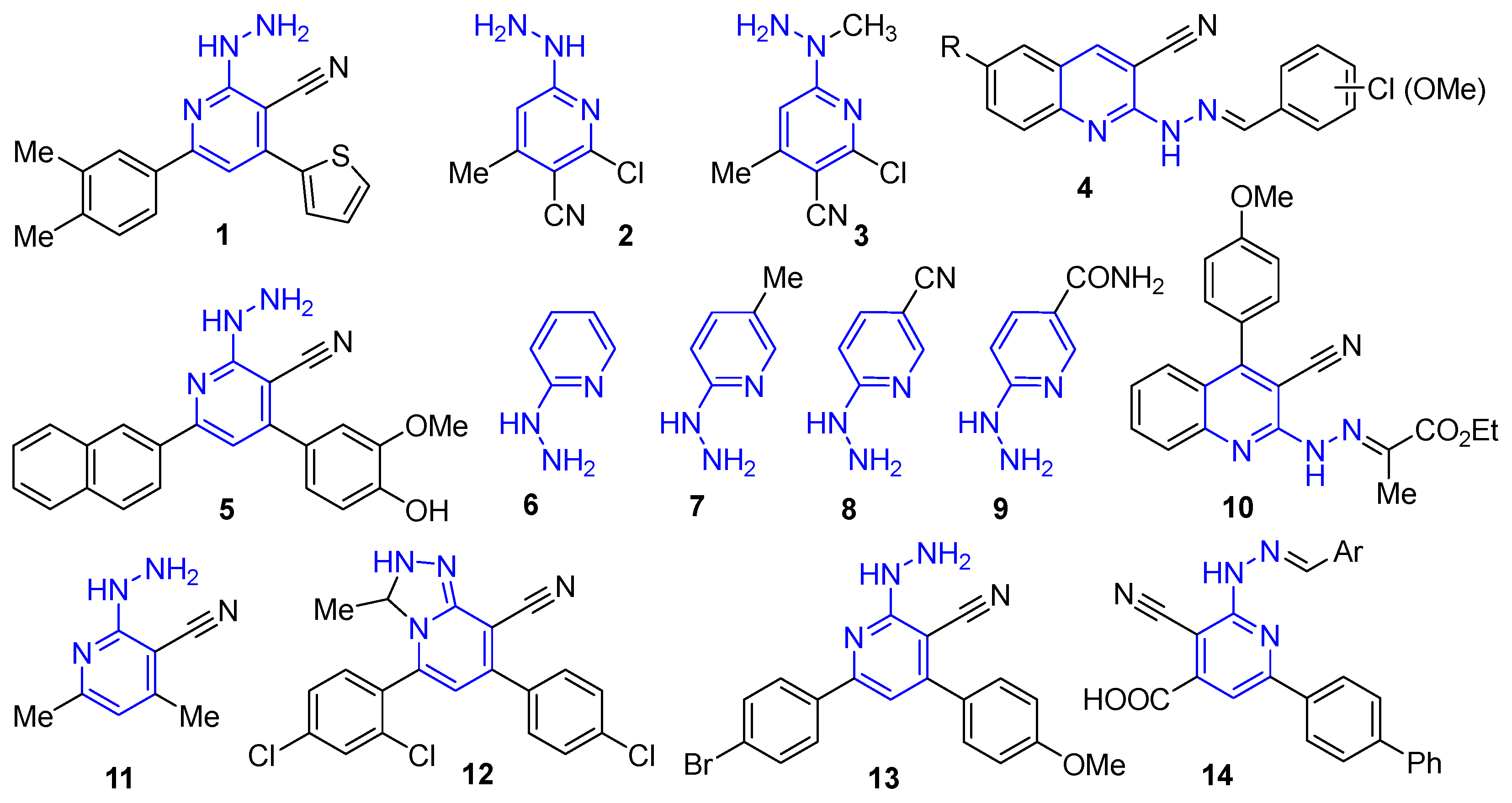
Figure 1. Biologically active and practically useful 2-hydrazinylpyridines.
Ijms 26 11874 g001
Figure 2. (2-Hetaryl)hydrazones with agrochemical activity.
Ijms 26 11874 g002
Scheme 1. The reported synthetic approaches to 2-hydrazinylnicotinonitriles.
Ijms 26 11874 sch001
Scheme 2. Competing processes in hydrazinolysis reactions with chloro/alkoxy-substituted nicotinonitriles (see Refs. [3,101,102,103,104,105]).
Ijms 26 11874 sch002
Scheme 3. The reactions of highly electrophilic 2-chloronicotinonitriles with hydrazine (see Refs. [106,107,108,109,110]).
Ijms 26 11874 sch003
Scheme 4. The formation of 3-amino-1H-pyrazolo[3,4-b]pyridines in the reactions of hydrazine hydrate with 2-halonicotinonitriles (see Refs. [90,111,112,113,114,115,116,118]).
Ijms 26 11874 sch004
Scheme 5. The preparation of 2-hydrazinylnicotinonitriles from 2-bromo-3-cyanopyridines (see Refs. [78,119,120]).
Ijms 26 11874 sch005
Figure 3. ORTEP drawing of the X-ray structure for 2-bromo-4-(4-chlorophenyl)-6-phenyl-nicotinonitrile 15a with a numbering system (not the IUPAC standard) and ellipsoids with 50% probability (CCDC deposition number 2499675).
Ijms 26 11874 g003
Scheme 6. Synthesis of 4,6-diaryl-2-bromo-3-cyanopyridines 15.
Ijms 26 11874 sch006
Figure 4. ORTEP drawing of the X-ray structure for (2S*,3R*,4S*,6R*)-3-benzoyl-5-bromo-4-hydroxy-4-phenyl-2,6-di-p-tolylcyclohexane-1,1-dicarbonitrile 17-Br (upper image) and (2S*,3R*,4S*,6R*)-3-benzoyl-4-hydroxy-4-phenyl-2,6-di-p-tolylcyclohexane-1,1-dicarbonitrile 17 (bottom image) with solvate molecules of AcOH. Ellipsoids are given with 50% probability (CCDC deposition number 2499676).
Ijms 26 11874 g004
Scheme 7. A plausible mechanism for the formation of cyclohexanols 17 and 17-Br.
Ijms 26 11874 sch007
Scheme 8. Synthesis, diversity, and yields of 2-hydrazinylnicotinonitriles 20.
Ijms 26 11874 sch008
Scheme 9. Synthesis, diversity, and yields of hydrazones 21.
Ijms 26 11874 sch009
Table 1. Protective effects of the most active compounds 20,21 against 2,4-D herbicide.
NPyridinePlant OrganAntidote Effect (A) at Different Concentrations, % 1
10−210−310−410−5
1Ijms 26 11874 i001
20a
roots141134178186
hypocotyls135134146130
2Ijms 26 11874 i002
20b
roots132113116136
hypocotyls140979396
3Ijms 26 11874 i003
20f
roots13093140134
hypocotyls1117310298
4Ijms 26 11874 i004
20i
roots170130180138
hypocotyls1041179288
5Ijms 26 11874 i005
21{1}
roots154154150184
hypocotyls123112101132
6Ijms 26 11874 i006
21{2}
roots163173167152
hypocotyls156119119122
7Ijms 26 11874 i007
21{17}
roots186171168161
hypocotyls148152138145
8Ijms 26 11874 i008
21{18}
roots188197180159
hypocotyls146152127137
1 The differences are reliable at p = 0.95.
Disclaimer/Publisher’s Note: The statements, opinions and data contained in all publications are solely those of the individual author(s) and contributor(s) and not of MDPI and/or the editor(s). MDPI and/or the editor(s) disclaim responsibility for any injury to people or property resulting from any ideas, methods, instructions or products referred to in the content.