


Characterization of Bacillus velezensis EV17 and K-3618 and Their Polyketide Antibiotic Oxydifficidin, an Inhibitor of Prokaryotic Translation with Low Cytotoxicity
 , , , , , , , , , , , , , , , , , , , , , ,
  , ,
, ,  , , , , , , and add
Show full author list
, , , , , , and add
Show full author list
Abstract

1. Introduction
2. Results and Discussion
2.1. Classification of Strains EV17 and K-3618
2.1.1. Genome Sequencing and Annotation
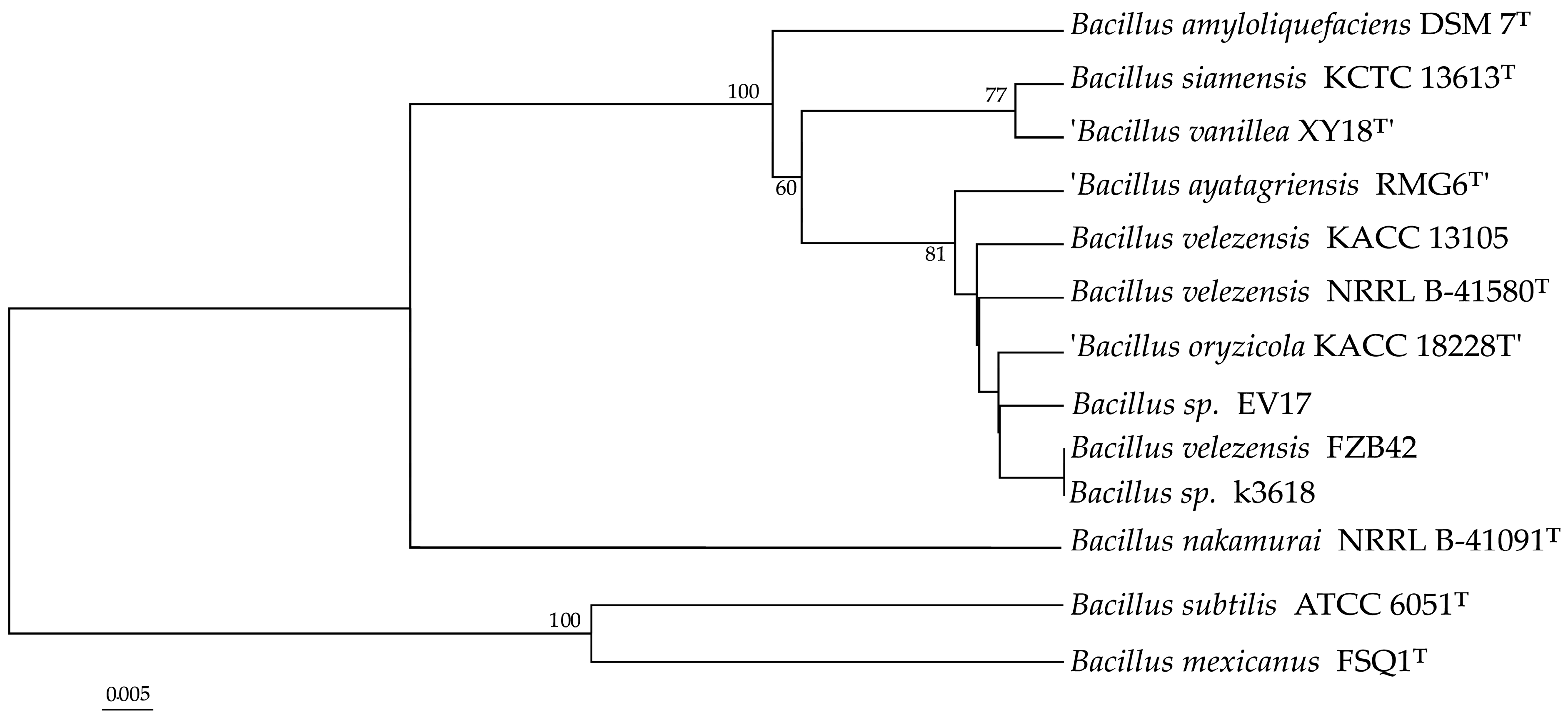
2.1.2. Whole Genome Phylogeny
2.2. Oxydifficidin Isolation
2.3. Identification of Antibacterial Compound Oxydifficidin Produced by Strains EV17 and K-3618
2.4. Biological Activity of Oxydifficidin
2.4.1. Oxydifficidin Exhibits Antibacterial Activity
2.4.2. Oxydifficidin Inhibits Prokaryotic In Vitro Translation
2.4.3. Oxydifficidin Cause Generalized Inhibition of Translation
2.4.4. Oxydifficidin Practically Does Not Inhibit Initiation Step of Bacterial Translation
2.4.5. Competition for the Thiostrepton Binding Site
2.4.6. Oxydifficidin Does Not Affect Eukaryotic Translation or Cell Viability
3. Materials and Methods
3.1. Producents’ Characterization
3.1.1. Collection, Isolation and Preservation
3.1.2. Cultivation
3.1.3. Phenotypic Characterization
3.1.4. Genome Sequencing and Annotation
3.1.5. Genome-Wide Taxonomy Classification
3.2. Purification and Isolation of Bioactive Compound
3.2.1. Solid-Phase Extraction
3.2.2. HPLC Separation
3.3. Identification of Bioactive Compound
3.3.1. Mass-Spectrometry
3.3.2. NMR Spectroscopy
3.3.3. Analysis of Antibiotic’s Biosynthetic Gene Clusters
3.4. Biological Activity Testing
3.4.1. Design of Reporter Strain E. coli Lptdmut pDualrep2.1
3.4.2. Reporter Antibacterial Assays on Agar Plates
3.4.3. MIC Determination
3.4.4. Bacterial In Vitro Translation Assay
3.4.5. Toeprinting Assay
3.4.6. Fluorescently Labeled Short Peptides
3.4.7. Mammalian Cell-Free System
3.4.8. Competition for the Thiostrepton Binding Site
3.4.9. MTT Cytotoxicity Test
4. Conclusions
Supplementary Materials
Author Contributions
Funding
Institutional Review Board Statement
Informed Consent Statement
Data Availability Statement
Acknowledgments
Conflicts of Interest
References
- Widmer, A.F. Emerging antibiotic resistance: Why we need new antibiotics! Swiss Med. Wkly. 2022, 152, 40032. [Google Scholar] [CrossRef]
- Boyd, N.K.; Teng, C.; Frei, C.R. Brief Overview of Approaches and Challenges in New Antibiotic Development: A Focus On Drug Repurposing. Front. Cell. Infect. Microbiol. 2021, 11, 684515. [Google Scholar] [CrossRef] [PubMed]
- Cook, M.A.; Wright, G.D. The past, present, and future of antibiotics. Sci. Transl. Med. 2022, 14, eabo7793. [Google Scholar] [CrossRef] [PubMed]
- Barry, S.M. Rethinking natural product discovery to unblock the antibiotic pipeline. Future Microbiol. 2025, 20, 179–182. [Google Scholar] [CrossRef]
- Theuretzbacher, U.; Van Bambeke, F.; Cantón, R.; Giske, C.G.; Mouton, J.W.; Nation, R.L.; Paul, M.; Turnidge, J.D.; Kahlmeter, G. Reviving old antibiotics. J. Antimicrob. Chemother. 2015, 70, 2177–2181. [Google Scholar] [CrossRef]
- Cassir, N.; Rolain, J.-M.; Brouqui, P. A new strategy to fight antimicrobial resistance: The revival of old antibiotics. Front. Microbiol. 2014, 5, 551. [Google Scholar] [CrossRef]
- Hutchings, M.I.; Truman, A.W.; Wilkinson, B. Antibiotics: Past, present and future. Curr. Opin. Microbiol. 2019, 51, 72–80. [Google Scholar] [CrossRef]
- Embley, T.M.; Stackebrandt, E. The molecular phylogeny and systematics of the actinomycetes. Annu. Rev. Microbiol. 1994, 48, 257–289. [Google Scholar] [CrossRef] [PubMed]
- Walsh, C.T.; Wencewicz, T.A. Prospects for new antibiotics: A molecule-centered perspective. J. Antibiot. 2014, 67, 7–22. [Google Scholar] [CrossRef]
- Zhao, P.; Xue, Y.; Gao, W.; Li, J.; Zu, X.; Fu, D.; Bai, X.; Zuo, Y.; Hu, Z.; Zhang, F. Bacillaceae-derived peptide antibiotics since 2000. Peptides 2018, 101, 10–16. [Google Scholar] [CrossRef]
- Khatoon, Z.; del Carmen Orozco-Mosqueda, M.; Huang, S.; Nascimento, F.X.; Santoyo, G. Peptide Antibiotics Produced by Bacillus Species: First Line of Attack in the Biocontrol of Plant Diseases. In Bacilli in Agrobiotechnology: Plant Stress Tolerance, Bioremediation, and Bioprospecting; Springer: Cham, Switzerland, 2022; pp. 31–46. [Google Scholar] [CrossRef]
- Sumi, C.D.; Yang, B.W.; Yeo, I.-C.; Hahm, Y.T. Antimicrobial peptides of the genus Bacillus: A new era for antibiotics. Can. J. Microbiol. 2015, 61, 93–103. [Google Scholar] [CrossRef] [PubMed]
- Olishevska, S.; Nickzad, A.; Déziel, E. Bacillus and Paenibacillus secreted polyketides and peptides involved in controlling human and plant pathogens. Appl. Microbiol. Biotechnol. 2019, 103, 1189–1215. [Google Scholar] [CrossRef] [PubMed]
- Martinez, A.F.; McMahon, R.D.; Horner, M.; Miller, W.M. A uniform-shear rate microfluidic bioreactor for real-time study of proplatelet formation and rapidly-released platelets. Biotechnol. Prog. 2017, 33, 1614–1629. [Google Scholar] [CrossRef]
- Rabbee, M.F.; Baek, K.-H. Antimicrobial Activities of Lipopeptides and Polyketides of Bacillus velezensis for Agricultural Applications. Molecules 2020, 25, 4973. [Google Scholar] [CrossRef]
- Saiyam, D.; Dubey, A.; Malla, M.A.; Kumar, A. Lipopeptides from Bacillus: Unveiling biotechnological prospects—Sources, properties, and diverse applications. Braz. J. Microbiol. 2024, 55, 281–295. [Google Scholar] [CrossRef] [PubMed]
- Ruiz, V.V.; Gándara-Ledezma, A.; Villarreal-Delgado, M.F.; Villa-Rodríguez, E.D.; Parra-Cota, F.I.; Santoyo, G.; Gómez-Godínez, L.J.; Chávez, L.A.C.; De Los Santos-Villalobos, S. Regulation, Biosynthesis, and Extraction of Bacillus-Derived Lipopeptides and Its Implications in Biological Control of Phytopathogens. Stresses 2024, 4, 107–132. [Google Scholar] [CrossRef]
- Penha, R.O.; Vandenberghe, L.P.S.; Faulds, C.; Soccol, V.T.; Soccol, C.R. Bacillus lipopeptides as powerful pest control agents for a more sustainable and healthy agriculture: Recent studies and innovations. Planta 2020, 251, 70. [Google Scholar] [CrossRef]
- Wang, L.; Lu, H.; Jiang, Y. Natural Polyketides Act as Promising Antifungal Agents. Biomolecules 2023, 13, 1572. [Google Scholar] [CrossRef]
- Li, S.; Yang, B.; Tan, G.-Y.; Ouyang, L.-M.; Qiu, S.; Wang, W.; Xiang, W.; Zhang, L. Polyketide pesticides from actinomycetes. Curr. Opin. Biotechnol. 2021, 69, 299–307. [Google Scholar] [CrossRef]
- Kan, J.; Morales-Amador, A.; Hernandez, Y.; Ternei, M.A.; Lemetre, C.; Maclntyre, L.W.; Biais, N.; Brady, S.F. Oxydifficidin, a potent Neisseria gonorrhoeae antibiotic due to DedA-assisted uptake and ribosomal protein RplL sensitivity. eLife 2025, 13, RP99281. [Google Scholar] [CrossRef]
- Parks, D.H.; Imelfort, M.; Skennerton, C.T.; Hugenholtz, P.; Tyson, G.W. CheckM: Assessing the quality of microbial genomes recovered from isolates, single cells, and metagenomes. Genome Res. 2015, 25, 1043–1055. [Google Scholar] [CrossRef] [PubMed]
- Guglya, E.; Belozerova, O.; Shikov, A.; Alferova, V.; Romanenko, M.; Chebotar, V.; Gancheva, M.; Baganova, M.; Vinogradova, E.; Lushpa, V.; et al. Bacillus-Based Biocontrol Agents Mediate Pathogen Killing by Biodegradable Antimicrobials from Macrolactin Family. Preprints, 2025; 2025090481. [Google Scholar] [CrossRef]
- Rodriguez-R, L.M.; Conrad, R.E.; Viver, T.; Feistel, D.J.; Lindner, B.G.; Venter, S.N.; Orellana, L.H.; Amann, R.; Rossello-Mora, R.; Konstantinidis, K.T. An ANI gap within bacterial species that advances the definitions of intra-species units. mBio 2024, 15, e02696-23. [Google Scholar] [CrossRef] [PubMed]
- Borriss, R.; Chen, X.-H.; Rueckert, C.; Blom, J.; Becker, A.; Baumgarth, B.; Fan, B.; Pukall, R.; Schumann, P.; Spröer, C.; et al. Relationship of Bacillus amyloliquefaciens clades associated with strains DSM 7T and FZB42T: A proposal for Bacillus amyloliquefaciens subsp. amyloliquefaciens subsp. nov. and Bacillus amyloliquefaciens subsp. plantarum subsp. nov. based on complete genome sequence comparisons. Int. J. Syst. Evol. Microbiol. 2011, 61, 1786–1801. [Google Scholar] [CrossRef] [PubMed]
- Ruiz-García, C.; Béjar, V.; Martínez-Checa, F.; Llamas, I.; Quesada, E. Bacillus velezensis sp. nov., a surfactant-producing bacterium isolated from the river Vélez in Málaga, southern Spain. Int. J. Syst. Evol. Microbiol. 2005, 55, 191–195. [Google Scholar] [CrossRef]
- Baysal, Ö.; Studholme, D.J.; Jimenez-Quiros, C.; Tör, M. Genome sequence of the plant-growth-promoting bacterium Bacillus velezensis EU07. Access Microbiol. 2024, 6, 000762.v3. [Google Scholar] [CrossRef]
- Rabbee, M.F.; Ali, M.S.; Choi, J.; Hwang, B.S.; Jeong, S.C.; Baek, K. Bacillus velezensis: A Valuable Member of Bioactive Molecules Within Plant Microbiomes. Molecules 2019, 24, 1046. [Google Scholar] [CrossRef]
- Aunkam, P.; Sibponkrung, S.; Limkul, S.; Seabkongseng, T.; Mahanil, K.; Umnajkitikorn, K.; Boonkerd, N.; Teaumroong, N.; Sato, S.; Tittabutr, P.; et al. Mechanisms of Cannabis Growth Promotion by Bacillus velezensis S141. Plants 2024, 13, 2971. [Google Scholar] [CrossRef]
- Chen, Z.; Zhang, H.; Lv, W.; Zhang, S.; Du, L.; Li, S.; Zhang, H.; Zheng, X.; Zhang, J.; Zhang, T.; et al. Bacillus velezensis SS-20 as a potential and efficient multifunctional agent in biocontrol, saline-alkaline tolerance, and plant-growth promotion. Appl. Soil Ecol. 2025, 205, 105772. [Google Scholar] [CrossRef]
- Chen, L.; Heng, J.; Qin, S.; Bian, K. A comprehensive understanding of the biocontrol potential of Bacillus velezensis LM2303 against Fusarium head blight. PLoS ONE 2018, 13, e0198560. [Google Scholar] [CrossRef]
- Cao, Y.; Pi, H.; Chandrangsu, P.; Li, Y.; Wang, Y.; Zhou, H.; Xiong, H.; Helmann, J.D.; Cai, Y. Antagonism of Two Plant-Growth Promoting Bacillus velezensis Isolates Against Ralstonia solanacearum and Fusarium oxysporum. Sci. Rep. 2018, 8, 4360. [Google Scholar] [CrossRef]
- Madhaiyan, M.; Poonguzhali, S.; Kwon, S.-W.; Sa, T.-M. Bacillus methylotrophicus sp. nov., a methanol-utilizing, plant-growth-promoting bacterium isolated from rice rhizosphere soil. Int. J. Syst. Evol. Microbiol. 2010, 60, 2490–2495. [Google Scholar] [CrossRef]
- Lefort, V.; Desper, R.; Gascuel, O. FastME 2.0: A Comprehensive, Accurate, and Fast Distance-Based Phylogeny Inference Program. Mol. Biol. Evol. 2015, 32, 2798–2800. [Google Scholar] [CrossRef]
- Farris, J.S. Estimating Phylogenetic Trees from Distance Matrices. Am. Nat. 1972, 106, 645–668. [Google Scholar] [CrossRef]
- Meier-Kolthoff, J.P.; Göker, M. TYGS is an automated high-throughput platform for state-of-the-art genome-based taxonomy. Nat. Commun. 2019, 10, 2182. [Google Scholar] [CrossRef]
- Richter, M.; Rosselló-Móra, R.; Glöckner, F.O.; Peplies, J. JSpeciesWS: A web server for prokaryotic species circumscription based on pairwise genome comparison. Bioinformatics 2016, 32, 929–931. [Google Scholar] [CrossRef] [PubMed]
- Osterman, I.A.; Komarova, E.S.; Shiryaev, D.I.; Korniltsev, I.A.; Khven, I.M.; Lukyanov, D.A.; Tashlitsky, V.N.; Serebryakova, M.V.; Efremenkova, O.V.; Ivanenkov, Y.A.; et al. Sorting Out Antibiotics’ Mechanisms of Action: A Double Fluorescent Protein Reporter for High-Throughput Screening of Ribosome and DNA Biosynthesis Inhibitors. Antimicrob. Agents Chemother. 2016, 60, 7481–7489. [Google Scholar] [CrossRef]
- Zimmerman, S.B.; Schwartz, C.D.; Monaghan, R.L.; Pelak, B.A.; Weissberger, B.; Gilfillan, E.C.; Mochales, S.; Hernandez, S.; Currie, S.A.; Tejera, E.; et al. Difficidin and oxydifficidin: Novel broad spectrum antibacterial antibiotics produced by Bacillus subtilis. I. Production, taxonomy and antibacterial activity. J. Antibiot. 1987, 40, 1677–1681. [Google Scholar] [CrossRef]
- Chen, X.-H.; Vater, J.; Piel, J.; Franke, P.; Scholz, R.; Schneider, K.; Koumoutsi, A.; Hitzeroth, G.; Grammel, N.; Strittmatter, A.W.; et al. Structural and Functional Characterization of Three Polyketide Synthase Gene Clusters in Bacillus amyloliquefaciens FZB 42. J. Bacteriol. 2006, 188, 4024–4036. [Google Scholar] [CrossRef] [PubMed]
- Suphantharika, M.; Ison, A.P.; Lilly, M.D.; Buckland, B.C. The influence of dissolved oxygen tension on the synthesis of the antibiotic difficidin by Bacillus subtilis. Biotech. Bioeng. 1994, 44, 1007–1012. [Google Scholar] [CrossRef] [PubMed]
- Gilchrist, C.L.M.; Chooi, Y.-H. clinker & clustermap.js: Automatic generation of gene cluster comparison figures. Bioinformatics 2021, 37, 2473–2475. [Google Scholar] [CrossRef]
- Orelle, C.; Carlson, S.; Kaushal, B.; Almutairi, M.M.; Liu, H.; Ochabowicz, A.; Quan, S.; Pham, V.C.; Squires, C.L.; Murphy, B.T.; et al. Tools for Characterizing Bacterial Protein Synthesis Inhibitors. Antimicrob. Agents Chemother. 2013, 57, 5994–6004. [Google Scholar] [CrossRef] [PubMed]
- Sarkar, P.; Stringer, E.A.; Maitra, U. Thiostrepton Inhibition of Initiation Factor 1 Activity in Polypeptide Chain Initiation in Escherichia coli. Proc. Natl. Acad. Sci. USA 1974, 71, 4986–4990. [Google Scholar] [CrossRef] [PubMed]
- Marina, V.I.; Bidzhieva, M.; Tereshchenkov, A.G.; Orekhov, D.; Sagitova, V.E.; Sumbatyan, N.V.; Tashlitsky, V.N.; Ferberg, A.S.; Maviza, T.P.; Kasatsky, P.; et al. An easy tool to monitor the elemental steps of in vitro translation via gel electrophoresis of fluorescently labeled small peptides. RNA 2024, 30, 298–307. [Google Scholar] [CrossRef]
- Carlson, M.A.; Haddad, B.G.; Weis, A.J.; Blackwood, C.S.; Shelton, C.D.; Wuerth, M.E.; Walter, J.D.; Spiegel, P.C. Ribosomal protein L7/L12 is required for GTP ase translation factors EF-G, RF 3, and IF 2 to bind in their GTP state to 70S ribosomes. FEBS J. 2017, 284, 1631–1643. [Google Scholar] [CrossRef]
- Diaconu, M.; Kothe, U.; Schlünzen, F.; Fischer, N.; Harms, J.M.; Tonevitsky, A.G.; Stark, H.; Rodnina, M.V.; Wahl, M.C. Structural Basis for the Function of the Ribosomal L7/12 Stalk in Factor Binding and GTPase Activation. Cell 2005, 121, 991–1004. [Google Scholar] [CrossRef]
- Harms, J.M.; Wilson, D.N.; Schluenzen, F.; Connell, S.R.; Stachelhaus, T.; Zaborowska, Z.; Spahn, C.M.T.; Fucini, P. Translational Regulation via L11: Molecular Switches on the Ribosome Turned On and Off by Thiostrepton and Micrococcin. Mol. Cell 2008, 30, 26–38. [Google Scholar] [CrossRef] [PubMed]
- Schoof, S.; Baumann, S.; Ellinger, B.; Arndt, H. A Fluorescent Probe for the 70 S-Ribosomal GTPase-Associated Center. ChemBioChem 2009, 10, 242–245. [Google Scholar] [CrossRef]
- Bertani, G. STUDIES ON LYSOGENESIS I: The Mode of Phage Liberation by Lysogenic Escherichia coli. J. Bacteriol. 1951, 62, 293–300. [Google Scholar] [CrossRef]
- Guglya, E.B.; Belozerova, O.A.; Shikov, A.E.; Alferova, V.A.; Romanenko, M.N.; Chebotar, V.K.; Gancheva, M.S.; Baganova, M.E.; Vinogradova, E.A.; Marenkova, E.A.; et al. Bacillus-Based Biocontrol Agents Mediate Pathogen Killing by Biodegradable Antimicrobials from Macrolactin Family. Int. J. Mol. Sci. 2025, 26, 11167. [Google Scholar] [CrossRef]
- Bankevich, A.; Nurk, S.; Antipov, D.; Gurevich, A.A.; Dvorkin, M.; Kulikov, A.S.; Lesin, V.M.; Nikolenko, S.I.; Pham, S.; Prjibelski, A.D.; et al. SPAdes: A New Genome Assembly Algorithm and Its Applications to Single-Cell Sequencing. J. Comput. Biol. 2012, 19, 455–477. [Google Scholar] [CrossRef]
- Chen, S.; Zhou, Y.; Chen, Y.; Gu, J. fastp: An ultra-fast all-in-one FASTQ preprocessor. Bioinformatics 2018, 34, i884–i890. [Google Scholar] [CrossRef] [PubMed]
- Babraham Bioinformatics—FastQC. A Quality Control Tool for High Throughput Sequence Data. Available online: https://www.bioinformatics.babraham.ac.uk/projects/fastqc/ (accessed on 16 May 2025).
- Gurevich, A.; Saveliev, V.; Vyahhi, N.; Tesler, G. QUAST: Quality assessment tool for genome assemblies. Bioinformatics 2013, 29, 1072–1075. [Google Scholar] [CrossRef]
- Seemann, T. Prokka: Rapid prokaryotic genome annotation. Bioinformatics 2014, 30, 2068–2069. [Google Scholar] [CrossRef] [PubMed]
- O’Leary, N.A.; Wright, M.W.; Brister, J.R.; Ciufo, S.; Haddad, D.; McVeigh, R.; Rajput, B.; Robbertse, B.; Smith-White, B.; Ako-Adjei, D.; et al. Reference sequence (RefSeq) database at NCBI: Current status, taxonomic expansion, and functional annotation. Nucleic Acids Res. 2016, 44, D733–D745. [Google Scholar] [CrossRef]
- Khrenova, M.G.; Panova, T.V.; Rodin, V.A.; Kryakvin, M.A.; Lukyanov, D.A.; Osterman, I.A.; Zvereva, M.I. Nanopore Sequencing for De Novo Bacterial Genome Assembly and Search for Single-Nucleotide Polymorphism. Int. J. Mol. Sci. 2022, 23, 8569. [Google Scholar] [CrossRef]
- De Coster, W.; D’Hert, S.; Schultz, D.T.; Cruts, M.; Van Broeckhoven, C. NanoPack: Visualizing and processing long-read sequencing data. Bioinformatics 2018, 34, 2666–2669. [Google Scholar] [CrossRef]
- Prjibelski, A.; Antipov, D.; Meleshko, D.; Lapidus, A.; Korobeynikov, A. Using SPAdes De Novo Assembler. Curr. Protoc. Bioinform. 2020, 70, e102. [Google Scholar] [CrossRef]
- Hu, J.; Fan, J.; Sun, Z.; Liu, S. NextPolish: A fast and efficient genome polishing tool for long-read assembly. Bioinformatics 2020, 36, 2253–2255. [Google Scholar] [CrossRef]
- Ondov, B.D.; Treangen, T.J.; Melsted, P.; Mallonee, A.B.; Bergman, N.H.; Koren, S.; Phillippy, A.M. Mash: Fast genome and metagenome distance estimation using MinHash. Genome Biol. 2016, 17, 132. [Google Scholar] [CrossRef]
- Lagesen, K.; Hallin, P.; Rødland, E.A.; Stærfeldt, H.-H.; Rognes, T.; Ussery, D.W. RNAmmer: Consistent and rapid annotation of ribosomal RNA genes. Nucleic Acids Res. 2007, 35, 3100–3108. [Google Scholar] [CrossRef] [PubMed]
- Camacho, C.; Coulouris, G.; Avagyan, V.; Ma, N.; Papadopoulos, J.; Bealer, K.; Madden, T.L. BLAST+: Architecture and applications. BMC Bioinform. 2009, 10, 421. [Google Scholar] [CrossRef]
- Meier-Kolthoff, J.P.; Auch, A.F.; Klenk, H.-P.; Göker, M. Genome sequence-based species delimitation with confidence intervals and improved distance functions. BMC Bioinform. 2013, 14, 60. [Google Scholar] [CrossRef]
- Meier-Kolthoff, J.P.; Carbasse, J.S.; Peinado-Olarte, R.L.; Göker, M. TYGS and LPSN: A database tandem for fast and reliable genome-based classification and nomenclature of prokaryotes. Nucleic Acids Res. 2022, 50, D801–D807. [Google Scholar] [CrossRef] [PubMed]
- Kreft, Ł.; Botzki, A.; Coppens, F.; Vandepoele, K.; Van Bel, M. PhyD3: A phylogenetic tree viewer with extended phyloXML support for functional genomics data visualization. Bioinformatics 2017, 33, 2946–2947. [Google Scholar] [CrossRef]
- Ben-Nissan, B.; Green, D.; Kannangara, G.; Chai, C.; Milev, A. 31P NMR Studies of Diethyl Phosphite Derived Nanocrystalline Hydroxyapatite. J. Sol-Gel Sci. Technol. 2001, 21, 27–37. [Google Scholar] [CrossRef]
- Blin, K.; Shaw, S.; Vader, L.; Szenei, J.; Reitz, Z.L.; Augustijn, H.E.; Cediel-Becerra, J.D.D.; de Crécy-Lagard, V.; Koetsier, R.A.; Williams, S.E.; et al. antiSMASH 8.0: Extended gene cluster detection capabilities and analyses of chemistry, enzymology, and regulation. Nucleic Acids Res. 2025, 53, W32–W38. [Google Scholar] [CrossRef]
- Baba, T.; Ara, T.; Hasegawa, M.; Takai, Y.; Okumura, Y.; Baba, M.; Datsenko, K.A.; Tomita, M.; Wanner, B.L.; Mori, H. Construction of Escherichia coli K-12 in-frame, single-gene knockout mutants: The Keio collection. Mol. Syst. Biol. 2006, 2, 2006.0008. [Google Scholar] [CrossRef] [PubMed]
- Osterman, I.A.; Wieland, M.; Maviza, T.P.; Lashkevich, K.A.; Lukianov, D.A.; Komarova, E.S.; Zakalyukina, Y.V.; Buschauer, R.; Shiriaev, D.I.; Leyn, S.A.; et al. Tetracenomycin X inhibits translation by binding within the ribosomal exit tunnel. Nat. Chem. Biol. 2020, 16, 1071–1077. [Google Scholar] [CrossRef]
- Rodnina, M.V.; Wintermeyer, W. GTP consumption of elongation factor Tu during translation of heteropolymeric mRNAs. Proc. Natl. Acad. Sci. USA 1995, 92, 1945–1949. [Google Scholar] [CrossRef]
- Wang, Z.-X. An exact mathematical expression for describing competitive binding of two different ligands to a protein molecule. FEBS Lett. 1995, 360, 111–114. [Google Scholar] [CrossRef]
- Mosmann, T. Rapid colorimetric assay for cellular growth and survival: Application to proliferation and cytotoxicity assays. J. Immunol. Methods 1983, 65, 55–63. [Google Scholar] [CrossRef] [PubMed]



| EV17 | FZB42 [25] | NRRL B-41580T [26] | K-3618 | |
|---|---|---|---|---|
| General features | ||||
| DNA GC content | 46.5% | 46.5% | 46.3% | 46.4% |
| Genome size (bp) | 3,978,967 | 3,918,589 | 4,034,335 | 3,864,632 |
| Protein CDS | 3829 | 3693 | 3790 | 3734 |
| Extracellular carbohydrate degrading enzymes | ||||
| Amylase AmyE | 98.23% | 100% | 96.41% | 100% |
| Non-ribosomal synthesis of lipopeptides and polyketide | ||||
| Bacillaene (GenBank ID: AJ634060.2) | 98.68% | 100% | 98.07% | 100% |
| Fengycin (AJ576102.1 1) | 98.36% | 100% | 97.92% | Low coverage |
| Macrolactin H (AJ634061.2) | 98.83% | 100% | 98.2% | 100% |
| Difficidin (AJ634062.2) | 98.64% | 100% | 98.06% | 100% |
| Strain | dDDH for Strains | ANI [37] for Strains | Diff. DNA GC Content | Accession No. | |||
|---|---|---|---|---|---|---|---|
| EV17 | K-3618 | EV17 | K-3618 | EV17 | K-3618 | ||
| EV17 | -- | 90.3% | -- | 98.82% | -- | 0.13% | CP199744.1 |
| K-3618 | 90.3% | -- | 98.82% | -- | 0.13% | -- | GCA_050472105.1 |
| B. velezensis FZB42 | 90.4% | 100% | 98.77% | 99.99% | 0.05% | 0.08% | GCA_000015785 |
| B. velezensis NRRL B-41580T | 85.8% | 85.8% | 98.19% | 98.25% | 0.21% | 0.08% | GCA_001461825 |
| B. velezensis KACC 13105 | 84.9% | 85.1% | 98.13% | 98.16% | 0.1% | 0.03% | GCA_000960265 |
Disclaimer/Publisher’s Note: The statements, opinions and data contained in all publications are solely those of the individual author(s) and contributor(s) and not of MDPI and/or the editor(s). MDPI and/or the editor(s) disclaim responsibility for any injury to people or property resulting from any ideas, methods, instructions or products referred to in the content. |
© 2025 by the authors. Licensee MDPI, Basel, Switzerland. This article is an open access article distributed under the terms and conditions of the Creative Commons Attribution (CC BY) license (https://creativecommons.org/licenses/by/4.0/).
Share and Cite
Chernyshova, A.P.; Marina, V.I.; Tereshchenkov, A.G.; Sagitova, V.E.; Kryakvin, M.A.; Dagaev, N.D.; Yurchenko, E.G.; Arzamazova, K.A.; Guglya, E.B.; Belozerova, O.A.; et al. Characterization of Bacillus velezensis EV17 and K-3618 and Their Polyketide Antibiotic Oxydifficidin, an Inhibitor of Prokaryotic Translation with Low Cytotoxicity. Int. J. Mol. Sci. 2025, 26, 11777. https://doi.org/10.3390/ijms262411777
Chernyshova AP, Marina VI, Tereshchenkov AG, Sagitova VE, Kryakvin MA, Dagaev ND, Yurchenko EG, Arzamazova KA, Guglya EB, Belozerova OA, et al. Characterization of Bacillus velezensis EV17 and K-3618 and Their Polyketide Antibiotic Oxydifficidin, an Inhibitor of Prokaryotic Translation with Low Cytotoxicity. International Journal of Molecular Sciences. 2025; 26(24):11777. https://doi.org/10.3390/ijms262411777
Chicago/Turabian StyleChernyshova, Alisa P., Valeriya I. Marina, Andrey G. Tereshchenkov, Vladislava E. Sagitova, Maksim A. Kryakvin, Nikolai D. Dagaev, Eugeniya G. Yurchenko, Kseniya A. Arzamazova, Elena B. Guglya, Olga A. Belozerova, and et al. 2025. "Characterization of Bacillus velezensis EV17 and K-3618 and Their Polyketide Antibiotic Oxydifficidin, an Inhibitor of Prokaryotic Translation with Low Cytotoxicity" International Journal of Molecular Sciences 26, no. 24: 11777. https://doi.org/10.3390/ijms262411777
APA StyleChernyshova, A. P., Marina, V. I., Tereshchenkov, A. G., Sagitova, V. E., Kryakvin, M. A., Dagaev, N. D., Yurchenko, E. G., Arzamazova, K. A., Guglya, E. B., Belozerova, O. A., Kovalchuk, S. I., Baranova, M. N., Kudzhaev, A. M., Shikov, A. E., Romanenko, M. N., Rudenko, A. Y., Chebotar, V. K., Gancheva, M. S., Baganova, M. E., ... Lukianov, D. A. (2025). Characterization of Bacillus velezensis EV17 and K-3618 and Their Polyketide Antibiotic Oxydifficidin, an Inhibitor of Prokaryotic Translation with Low Cytotoxicity. International Journal of Molecular Sciences, 26(24), 11777. https://doi.org/10.3390/ijms262411777



