Thioester-Containing Protein TEP27 in Culex quinquefasciatus Promotes JEV Infection by Modulating Host Immune Function
 , , , and
Abstract
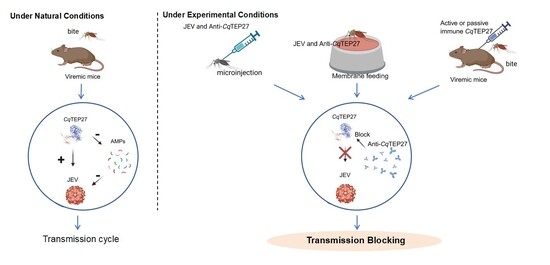
1. Introduction
2. Results
2.1. The Function of the CqTEP Family in C. quinquefasciatus Infections
2.2. CqTEP27 Facilitates JEV Infection of C. quinquefasciatus
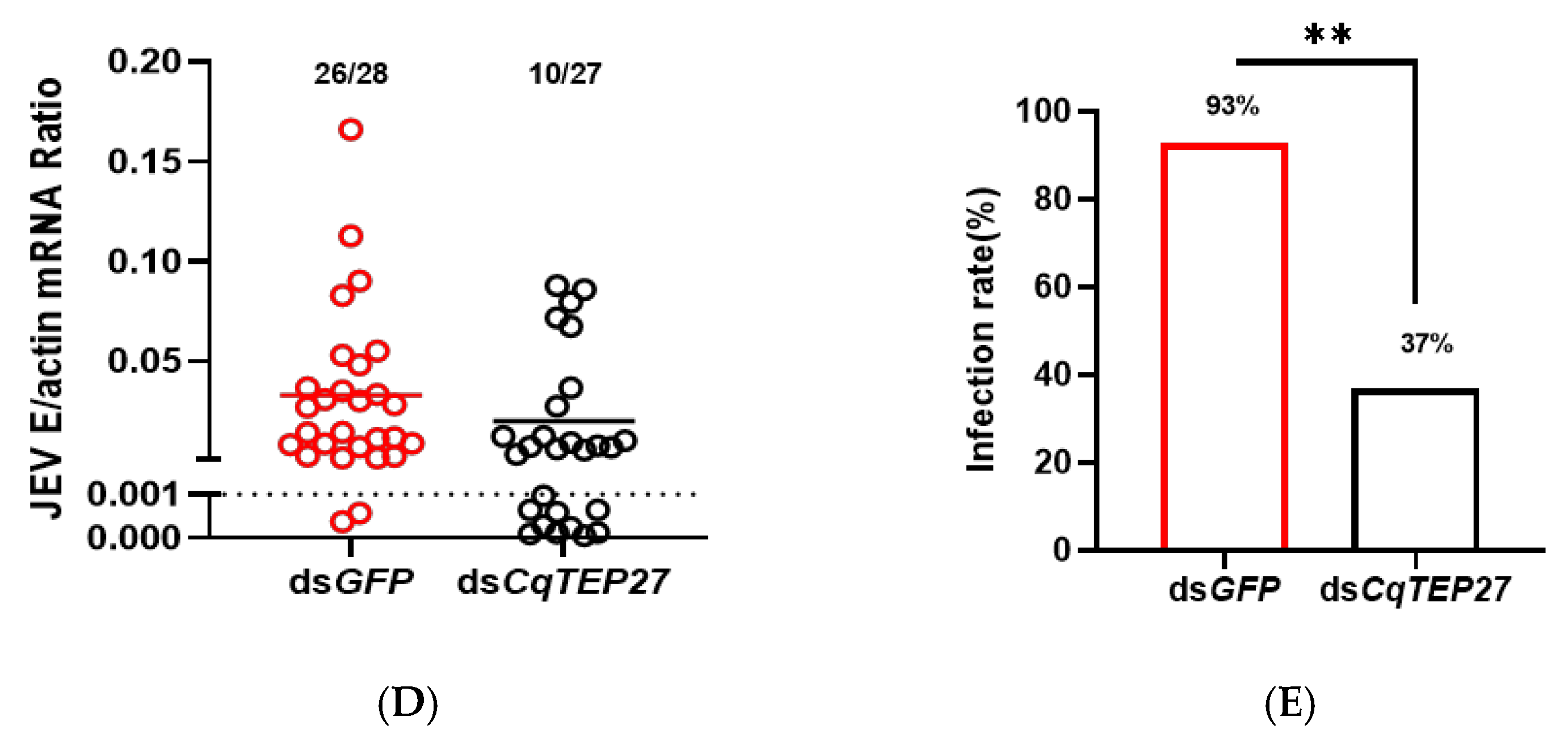
2.3. Interrupt CqTEP27 Impairs JEV Midgut Infection in C. quinquefasciatus
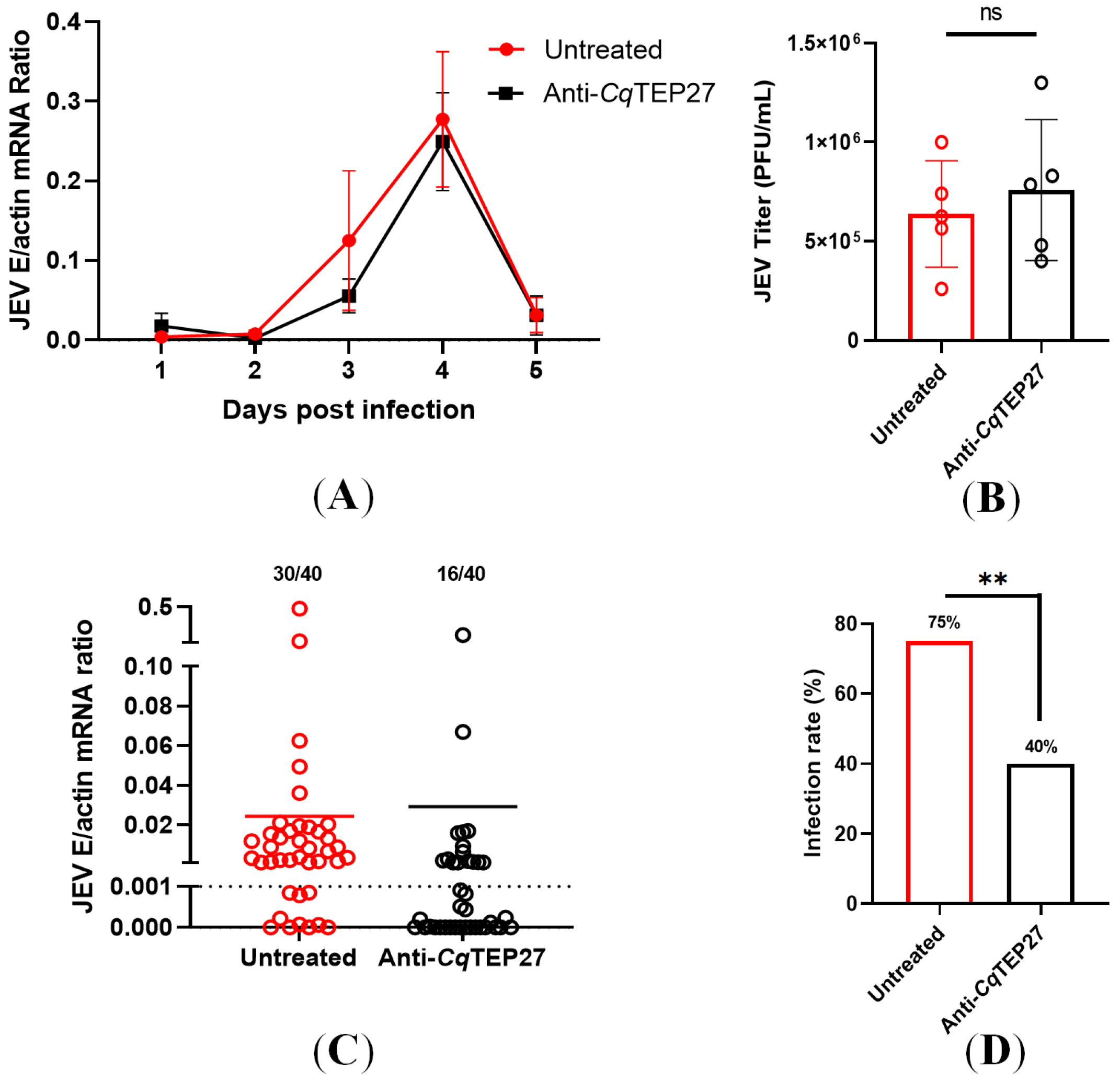
2.4. Immune-Blockade Against CqTEP27 in A129 Mice Prevents JEV Acquisition by C. quinquefasciatus
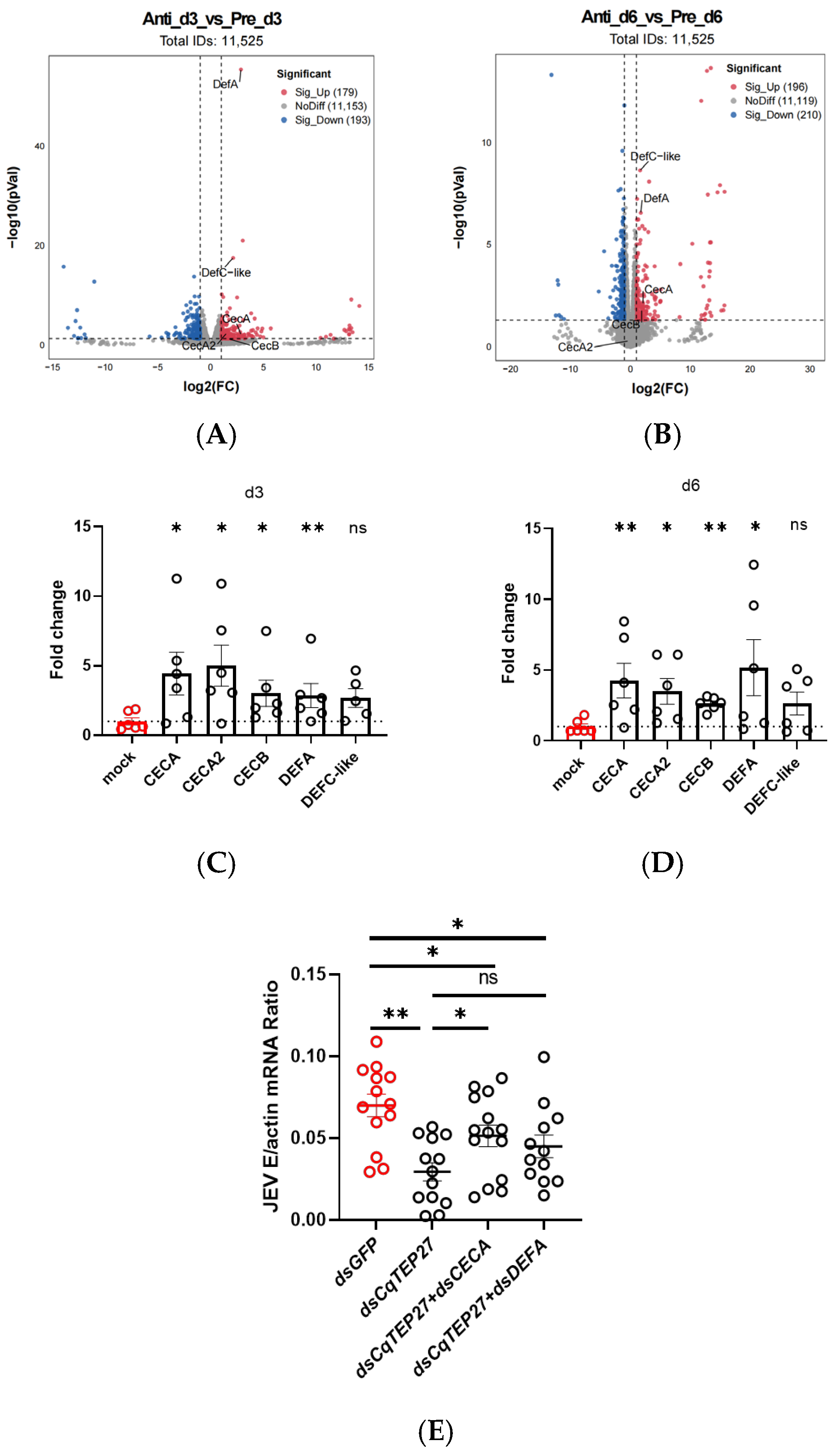
2.5. CqTEP27 Suppresses AMP Expression to Facilitate JEV Infection
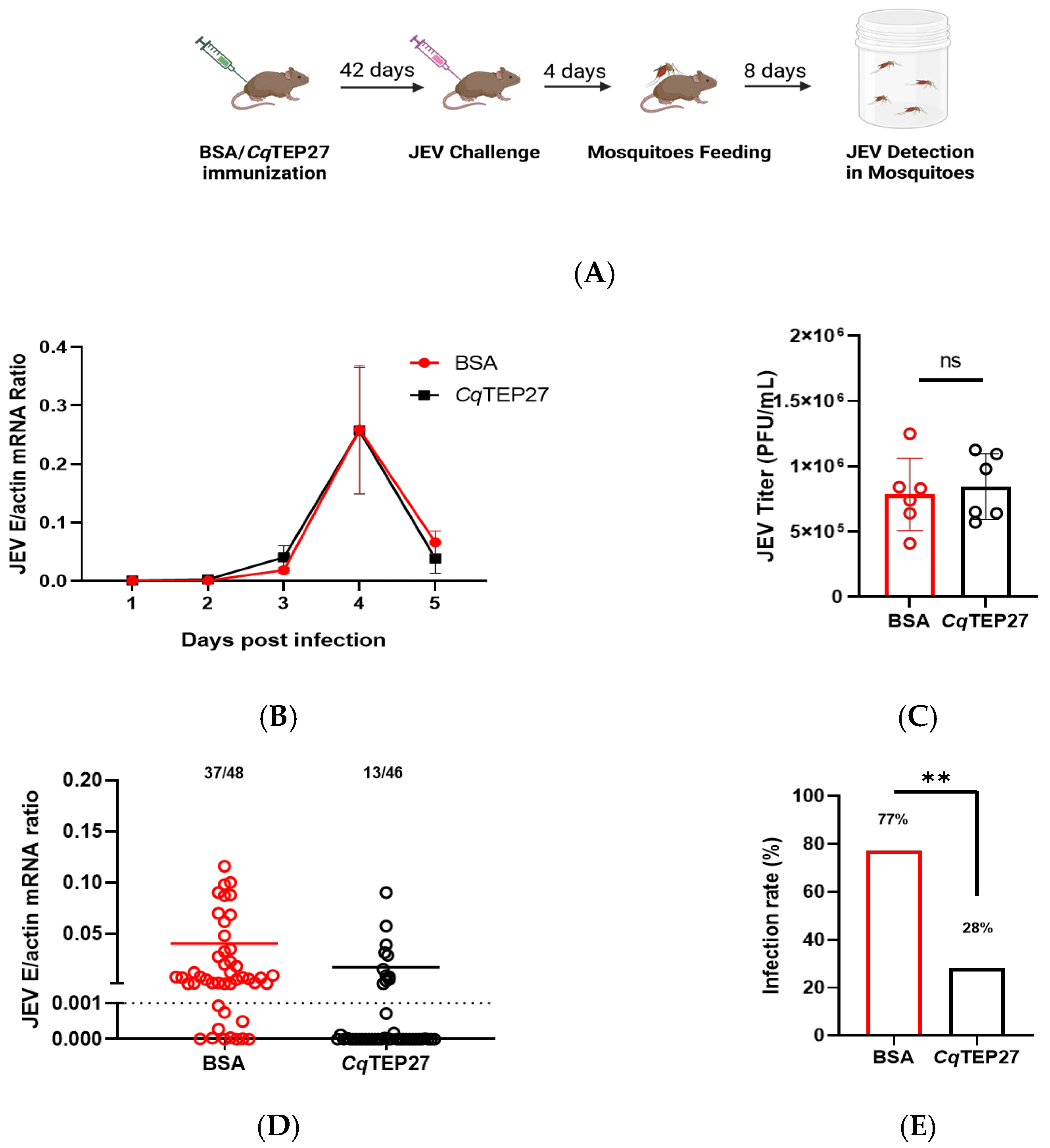
2.6. The Vaccine-Induced Immunity of CqTEP27 Disrupts the Transmission Cycle of JEV in C. quinquefasciatus
3. Discussion
4. Materials and Methods
4.1. Animals, Cells, and Virus Cultures
4.2. Phylogenetic Tree Analysis of TEP
4.3. Gene Silencing and Viral Challenge in Mosquitoes
4.4. Membrane Blood-Feeding Assay
4.5. Prokaryotic Expression and Antisera Production
4.6. Plaque Assay
4.7. RNA Extraction and RT-qPCR
4.8. Enzyme-Linked Immunosorbent Assay
4.9. RNA-Seq Analysis of Mosquitoes
4.10. Passive Immunization of A129 Mice with Anti-CqTEP27 Antisera for Blocking JEV Transmission
4.11. CqTEP27-Based Active Immunization of A129 for Blocking JEV Transmission
4.12. Statistical Analysis
Supplementary Materials
Author Contributions
Funding
Institutional Review Borad Statement
Informed Consent Statement
Data Availability Statement
Acknowledgments
Conflicts of Interest
References
- Arimurti, A.; Khairullah, A.; Artanti, D.; Rohmayani, V.; Rahmani, T.; Nugraha, A.; Furqoni, A.; Kusala, M.; Wardhani, B.; Ekawasti, F.; et al. The alarming spread of Japanese encephalitis: A growing public health concern. Open Vet. J. 2025, 1, 1505. [Google Scholar] [CrossRef] [PubMed]
- Mackenzie, J.S.; Williams, D.T.; Van Den Hurk, A.F.; Smith, D.W.; Currie, B.J. Japanese encephalitis virus: The emergence of genotype IV in Australia and its potential endemicity. Viruses 2022, 14, 2480. [Google Scholar] [CrossRef] [PubMed]
- Dixon, A.L.; Oliveira, A.R.S.; Cohnstaedt, L.W.; Mitzel, D.; Mire, C.; Cernicchiaro, N. Revisiting the risk of introduction of Japanese encephalitis virus (JEV) into the United States—An updated semi-quantitative risk assessment. One Health 2024, 19, 100879. [Google Scholar] [CrossRef] [PubMed]
- Cheng, Y.; Tran Minh, N.; Tran Minh, Q.; Khandelwal, S.; Clapham, H.E. Estimates of Japanese encephalitis mortality and morbidity: A systematic review and modeling analysis. PLoS Negl. Trop. Dis. 2022, 16, e0010361. [Google Scholar] [CrossRef]
- Mansfield, K.L.; Hernández-Triana, L.M.; Banyard, A.C.; Fooks, A.R.; Johnson, N. Japanese encephalitis virus infection, diagnosis and control in domestic animals. Vet. Microbiol. 2017, 201, 85–92. [Google Scholar] [CrossRef]
- Campbell, G.; Hills, S.; Fischer, M.; Jacobson, J.; Hoke, C.; Hombach, J.; Marfin, A.; Solomon, T.; Tsai, T.; Tsui, V.; et al. Estimated global incidence of Japanese encephalitis: A systematic review. Bull. World Health Organ. 2011, 89, 766–774. [Google Scholar] [CrossRef]
- Le Flohic, G.; Porphyre, V.; Barbazan, P.; Gonzalez, J.-P. Review of climate, landscape, and viral genetics as drivers of the Japanese encephalitis virus ecology. PLoS Negl. Trop. Dis. 2013, 7, e2208. [Google Scholar] [CrossRef]
- Kuno, G. Contrasting the practices of virus isolation and characterization between the early period in history and modern times: The case of Japanese encephalitis virus. Viruses 2022, 14, 2640. [Google Scholar] [CrossRef]
- Fan, Y.-C.; Chen, J.-M.; Chiu, H.-C.; Chen, Y.-Y.; Lin, J.-W.; Shih, C.-C.; Chen, C.-M.; Chang, C.-C.; Chang, G.-J.J.; Chiou, S.-S. Partially neutralizing potency against emerging genotype I virus among children received formalin-inactivated Japanese encephalitis virus vaccine. PLoS Negl. Trop. Dis. 2012, 6, e1834. [Google Scholar] [CrossRef]
- Teng, M.; Luo, J.; Fan, J.-M.; Chen, L.; Wang, X.-T.; Yao, W.; Wang, C.-Q.; Zhang, G.-P. Molecular characterization of Japanese encephalitis viruses circulating in pigs and mosquitoes on pig farms in the chinese province of henan. Virus Genes 2013, 46, 170–174. [Google Scholar] [CrossRef]
- Xia, Q.; Yang, Y.; Zhang, Y.; Zhou, L.; Ma, X.; Xiao, C.; Zhang, J.; Li, Z.; Liu, K.; Li, B.; et al. Shift in dominant genotypes of Japanese encephalitis virus and its impact on current vaccination strategies. Front. Microbiol. 2023, 14, 1302101. [Google Scholar] [CrossRef]
- Kim, J.-D.; Lee, A.-R.; Moon, D.-H.; Chung, Y.-U.; Hong, S.-Y.; Cho, H.J.; Kang, T.H.; Jang, Y.H.; Sohn, M.H.; Seong, B.-L.; et al. Efficacy of genotype-matched vaccine against re-emerging genotype V Japanese encephalitis virus. Emerg. Microbes Infect. 2024, 13, 2343910. [Google Scholar] [CrossRef]
- Lee, W.-S.; Webster, J.A.; Madzokere, E.T.; Stephenson, E.B.; Herrero, L.J. Mosquito antiviral defense mechanisms: A delicate balance between innate immunity and persistent viral infection. Parasites Vectors 2019, 12, 165. [Google Scholar] [CrossRef] [PubMed]
- Palmer, W.J.; Jiggins, F.M. Comparative genomics reveals the origins and diversity of arthropod immune systems. Mol. Biol. Evol. 2015, 32, 2111–2129. [Google Scholar] [CrossRef] [PubMed]
- Lu, Y.; Su, F.; Li, Q.; Zhang, J.; Li, Y.; Tang, T.; Hu, Q.; Yu, X.-Q. Pattern recognition receptors in Drosophila immune responses. Dev. Comp. Immunol. 2020, 102, 103468. [Google Scholar] [CrossRef] [PubMed]
- Li, C.; Li, H.; Xiao, B.; Chen, Y.; Wang, S.; Lǚ, K.; Yin, B.; Li, S.; He, J. Identification and functional analysis of a TEP gene from a crustacean reveals its transcriptional regulation mediated by NF-κB and JNK pathways and its broad protective roles against multiple pathogens. Dev. Comp. Immunol. 2017, 70, 45–58. [Google Scholar] [CrossRef]
- Law, S.K.A.; Dodds, A.W. The internal thioester and the covalent binding properties of the complement proteins C3 and C4. Protein Sci. 1997, 6, 263–274. [Google Scholar] [CrossRef]
- Williams, M.; Baxter, R. The structure and function of thioester-containing proteins in arthropods. Biophys. Rev. 2014, 6, 261–272. [Google Scholar] [CrossRef]
- Bou Aoun, R.; Hetru, C.; Troxler, L.; Doucet, D.; Ferrandon, D.; Matt, N. Analysis of thioester-containing proteins during the innate immune response of Drosophila melanogaster. J. Innate Immun. 2011, 3, 52–64. [Google Scholar] [CrossRef]
- Qin, X.; Li, J.; Zhu, F.; Zhang, J. Thioester-containing protein TEP15 promotes malaria parasite development in mosquitoes through negative regulation of melanization. Parasites Vectors 2025, 18, 124. [Google Scholar] [CrossRef]
- Blandin, S. Thioester-containing proteins and insect immunity. Mol. Immunol. 2004, 40, 903–908. [Google Scholar] [CrossRef] [PubMed]
- Baxter, R.H.G.; Chang, C.-I.; Chelliah, Y.; Blandin, S.; Levashina, E.A.; Deisenhofer, J. Structural basis for conserved complement factor-like function in the antimalarial protein TEP1. Proc. Natl. Acad. Sci. USA 2007, 104, 11615–11620. [Google Scholar] [CrossRef] [PubMed]
- Blandin, S.; Shiao, S.-H.; Moita, L.F.; Janse, C.J.; Waters, A.P.; Kafatos, F.C.; Levashina, E.A. Complement-like protein TEP1 is a determinant of vectorial capacity in the malaria vector Anopheles gambiae. Cell 2004, 116, 661–670. [Google Scholar] [CrossRef]
- Levashina, E.A.; Moita, L.F.; Blandin, S.; Vriend, G.; Lagueux, M.; Kafatos, F.C. Conserved role of a complement-like protein in phagocytosis revealed by dsRNA knockout in cultured cells of the mosquito, Anopheles gambiae. Cell 2001, 104, 709–718. [Google Scholar] [CrossRef] [PubMed]
- Xiao, X.; Liu, Y.; Zhang, X.; Wang, J.; Li, Z.; Pang, X.; Wang, P.; Cheng, G. Complement-related proteins control the flavivirus infection of Aedes aegypti by inducing antimicrobial peptides. PLoS Pathog. 2014, 10, e1004027. [Google Scholar] [CrossRef]
- Chowdhury, A.; Modahl, C.M.; Tan, S.T.; Wong Wei Xiang, B.; Missé, D.; Vial, T.; Kini, R.M.; Pompon, J.F. JNK pathway restricts DENV2, ZIKV and CHIKV infection by activating complement and apoptosis in mosquito salivary glands. PLoS Pathog. 2020, 16, e1008754. [Google Scholar] [CrossRef]
- Cheng, G.; Liu, L.; Wang, P.; Zhang, Y.; Zhao, Y.O.; Colpitts, T.M.; Feitosa, F.; Anderson, J.F.; Fikrig, E. An in vivo transfection approach elucidates a role for Aedes aegypti thioester-containing proteins in flaviviral infection. PLoS ONE 2011, 6, e22786. [Google Scholar] [CrossRef]
- Liu, Y.; Zhang, F.; Liu, J.; Xiao, X.; Zhang, S.; Qin, C.; Xiang, Y.; Wang, P.; Cheng, G. Transmission-blocking antibodies against mosquito C-type lectins for dengue prevention. PLoS Pathog. 2014, 10, e1003931. [Google Scholar] [CrossRef]
- Li, H.-H.; Cai, Y.; Li, J.-C.; Su, M.P.; Liu, W.-L.; Cheng, L.; Chou, S.-J.; Yu, G.-Y.; Wang, H.-D.; Chen, C.-H. C-type lectins link immunological and reproductive processes in Aedes aegypti. iScience 2020, 23, 101486. [Google Scholar] [CrossRef]
- Pinto, S.B.; Lombardo, F.; Koutsos, A.C.; Waterhouse, R.M.; McKay, K.; An, C.; Ramakrishnan, C.; Kafatos, F.C.; Michel, K. Discovery of plasmodium modulators by genome-wide analysis of circulating hemocytes in Anopheles gambiae. Proc. Natl. Acad. Sci. USA 2009, 106, 21270–21275. [Google Scholar] [CrossRef]
- Blandin, S.A.; Marois, E.; Levashina, E.A. Antimalarial responses in Anopheles gambiae: From a complement-like protein to a complement-like pathway. Cell Host Microbe 2008, 3, 364–374. [Google Scholar] [CrossRef]
- Yassine, H.; Osta, M.A. Anopheles gambiae innate immunity. Cell. Microbiol. 2010, 12, 1–9. [Google Scholar] [CrossRef] [PubMed]
- Johnson, R.M.; Stopard, I.J.; Byrne, H.M.; Armstrong, P.M.; Brackney, D.E.; Lambert, B. Investigating the dose-dependency of the midgut escape barrier using a mechanistic model of within-mosquito dengue virus population dynamics. PLoS Pathog. 2024, 20, e1011975. [Google Scholar] [CrossRef] [PubMed]
- Davis, E.H.; Beck, A.S.; Li, L.; White, M.M.; Greenberg, M.B.; Thompson, J.K.; Widen, S.G.; Barrett, A.D.T.; Bourne, N. Japanese encephalitis virus live attenuated vaccine strains display altered immunogenicity, virulence and genetic diversity. npj Vaccines 2021, 6, 112. [Google Scholar] [CrossRef] [PubMed]
- Vandooren, J.; Itoh, Y. Alpha-2-macroglobulin in inflammation, immunity and infections. Front. Immunol. 2021, 12, 803244. [Google Scholar] [CrossRef]
- Fraiture, M.; Baxter, R.H.G.; Steinert, S.; Chelliah, Y.; Frolet, C.; Quispe-Tintaya, W.; Hoffmann, J.A.; Blandin, S.A.; Levashina, E.A. Two mosquito LRR proteins function as complement control factors in the TEP1-mediated killing of plasmodium. Cell Host Microbe 2009, 5, 273–284. [Google Scholar] [CrossRef]
- Li, H.; Feng, Y.; Qian, Y.; Jiang, W.; Zhu, Y.; Xu, J.; Li, X.; Fei, X.; Wang, R.; Shao, Y.; et al. Comparative immunological roles of TEP1 in Anopheles gambiae and biomphalaria glabrata: Implications for malaria and schistosomiasis control. Front. Immunol. 2025, 16, 1629262. [Google Scholar] [CrossRef]
- Shokal, U.; Eleftherianos, I. Evolution and function of thioester-containing proteins and the complement system in the innate immune response. Front. Immunol. 2017, 8, 759. [Google Scholar] [CrossRef]
- Nakao, M.; Tsujikura, M.; Ichiki, S.; Vo, T.K.; Somamoto, T. The complement system in teleost fish: Progress of post-homolog-hunting researches. Dev. Comp. Immunol. 2011, 35, 1296–1308. [Google Scholar] [CrossRef]
- Povelones, M.; Waterhouse, R.M.; Kafatos, F.C.; Christophides, G.K. Leucine-rich repeat protein complex activates mosquito complement in defense against plasmodium parasites. Science 2009, 324, 258–261. [Google Scholar] [CrossRef]
- García-Longoria, L.; Ahrén, D.; Berthomieu, A.; Kalbskopf, V.; Rivero, A.; Hellgren, O. Immune gene expression in the mosquito vector Culex quinquefasciatus during an avian malaria infection. Mol. Ecol. 2023, 32, 904–919. [Google Scholar] [CrossRef] [PubMed]
- Stroschein-Stevenson, S.L.; Foley, E.; O’Farrell, P.H.; Johnson, A.D. Identification of Drosophila gene products required for phagocytosis of Candida albicans. PLoS Biol. 2005, 4, e4. [Google Scholar] [CrossRef]
- Buresova, V.; Hajdusek, O.; Franta, Z.; Loosova, G.; Grunclova, L.; Levashina, E.A.; Kopáček, P. Functional genomics of tick thioester-containing proteins reveal the ancient origin of the complement system. J. Innate Immun. 2011, 3, 623–630. [Google Scholar] [CrossRef] [PubMed]
- Waterhouse, R.M.; Kriventseva, E.V.; Meister, S.; Xi, Z.; Alvarez, K.S.; Bartholomay, L.C.; Barillas-Mury, C.; Bian, G.; Blandin, S.; Christensen, B.M.; et al. Evolutionary dynamics of immune-related genes and pathways in disease-vector mosquitoes. Science 2007, 316, 1738–1743. [Google Scholar] [CrossRef] [PubMed]
- Janssen, B.J.C.; Huizinga, E.G.; Raaijmakers, H.C.A.; Roos, A.; Daha, M.R.; Nilsson-Ekdahl, K.; Nilsson, B.; Gros, P. Structures of complement component C3 provide insights into the function and evolution of immunity. Nature 2005, 437, 505–511. [Google Scholar] [CrossRef]
- Janssen, B.J.C.; Christodoulidou, A.; McCarthy, A.; Lambris, J.D.; Gros, P. Structure of C3b reveals conformational changes that underlie complement activity. Nature 2006, 444, 213–216. [Google Scholar] [CrossRef]
- Zhang, J.; Huang, F.S.; Xu, W.Y.; Wang, Y.; Zhou, T.L.; Duan, J.H. Plasmodium yoelii: Correlation of TEP1 with mosquito melanization induced by nitroquine. Exp. Parasitol. 2011, 127, 52–57. [Google Scholar] [CrossRef]
- Habtewold, T.; Povelones, M.; Blagborough, A.M.; Christophides, G.K. Transmission blocking immunity in the malaria non-vector mosquito Anopheles quadriannulatus species a. PLoS Pathog. 2008, 4, e1000070. [Google Scholar] [CrossRef]
- Bakhshi, H.; Failloux, A.-B.; Zakeri, S.; Raz, A.; Dinparast Djadid, N. Mosquito-borne viral diseases and potential transmission blocking vaccine candidates. Infect. Genet. Evol. 2018, 63, 195–203. [Google Scholar] [CrossRef]
- Theisen, M.; Jore, M.M.; Sauerwein, R. Towards clinical development of a Pfs48/45-based transmission blocking malaria vaccine. Expert. Rev. Vaccines 2017, 16, 329–336. [Google Scholar] [CrossRef]
- Duffy, P.E. Transmission-blocking vaccines: Harnessing herd immunity for malaria elimination. Expert Rev. Vaccines 2021, 20, 185–198. [Google Scholar] [CrossRef]
- Armistead, J.S.; Morlais, I.; Mathias, D.K.; Jardim, J.G.; Joy, J.; Fridman, A.; Finnefrock, A.C.; Bagchi, A.; Plebanski, M.; Scorpio, D.G.; et al. Antibodies to a single, conserved epitope in Anopheles APN1 inhibit universal transmission of Plasmodium falciparum and Plasmodium vivax malaria. Infect. Immun. 2014, 82, 818–829. [Google Scholar] [CrossRef]
- Pal, U.; Li, X.; Wang, T.; Montgomery, R.R.; Ramamoorthi, N.; deSilva, A.M.; Bao, F.; Yang, X.; Pypaert, M.; Pradhan, D.; et al. TROSPA, an ixodes scapularis receptor for Borrelia burgdorferi. Cell 2004, 119, 457–468. [Google Scholar] [CrossRef]
- Cheng, G.; Cox, J.; Wang, P.; Krishnan, M.N.; Dai, J.; Qian, F.; Anderson, J.F.; Fikrig, E. A C-type lectin collaborates with a CD45 phosphatase homolog to facilitate west nile virus infection of mosquitoes. Cell 2010, 142, 714–725. [Google Scholar] [CrossRef]
- Willadsen, P.; Bird, P.; Cobon, G.S.; Hungerford, J. Commercialisation of a recombinant vaccine against Boophilus microplus. Parasitology 1995, 110 (Suppl. S1), S43–S50. [Google Scholar] [CrossRef] [PubMed]
- Rodríguez, M.; Penichet, M.L.; Mouris, A.E.; Labarta, V.; Lorenzo Luaces, L.; Rubiera, R.; Cordovés, C.; Sánchez, P.A.; Ramos, E.; Soto, A.; et al. Control of Boophilus microplus populations in grazing cattle vaccinated with a recombinant Bm86 antigen preparation. Vet. Parasitol. 1995, 57, 339–349. [Google Scholar] [CrossRef] [PubMed]
- Willadsen, P.; Riding, G.A.; McKenna, R.V.; Kemp, D.H.; Tellam, R.L.; Nielsen, J.N.; Lahnstein, J.; Cobon, G.S.; Gough, J.M. Immunologic control of a parasitic arthropod. Identification of a protective antigen from Boophilus microplus. J. Immunol. 1989, 143, 1346–1351. [Google Scholar] [CrossRef] [PubMed]
- Bono, M.F.; Mangold, A.J.; Baravalle, M.E.; Valentini, B.S.; Thompson, C.S.; Wilkowsky, S.E.; Echaide, I.E.; Farber, M.D.; Torioni De Echaide, S.M. Efficiency of a recombinant MSA-2c-based ELISA to establish the persistence of antibodies in cattle vaccinated with Babesia bovis. Vet. Parasitol. 2008, 157, 203–210. [Google Scholar] [CrossRef]
- Jonsson, N.N.; Matschoss, A.L.; Pepper, P.; Green, P.E.; Albrecht, M.S.; Hungerford, J.; Ansell, J. Evaluation of TickGARDPLUS, a novel vaccine against Boophilus microplus, in lactating holstein–friesian cows. Vet. Parasitol. 2000, 88, 275–285. [Google Scholar] [CrossRef]
- Delafuente, J. Field studies and cost-effectiveness analysis of vaccination with Gavac against the cattle tick Boophilus microplus. Vaccine 1998, 16, 366–373. [Google Scholar] [CrossRef]
- Erra, E.O.; Askling, H.H.; Yoksan, S.; Rombo, L.; Riutta, J.; Vene, S.; Lindquist, L.; Vapalahti, O.; Kantele, A. Cross-protective capacity of Japanese encephalitis (JE) vaccines against circulating heterologous JE virus genotypes. Clin. Infect. Dis. 2013, 56, 267–270. [Google Scholar] [CrossRef]
- Cao, L.; Fu, S.; Gao, X.; Li, M.; Cui, S.; Li, X.; Cao, Y.; Lei, W.; Lu, Z.; He, Y.; et al. Low protective efficacy of the current Japanese encephalitis vaccine against the emerging genotype 5 Japanese encephalitis virus. PLoS Negl. Trop. Dis. 2016, 10, e0004686. [Google Scholar] [CrossRef]
- Srivastava, K.S.; Jeswani, V.; Pal, N.; Bohra, B.; Vishwakarma, V.; Bapat, A.A.; Patnaik, Y.P.; Khanna, N.; Shukla, R. Japanese encephalitis virus: An update on the potential antivirals and vaccines. Vaccines 2023, 11, 742. [Google Scholar] [CrossRef]
- Yun, S.-I.; Lee, Y.-M. Japanese encephalitis virus (flaviviridae). In Encyclopedia of Virology; Elsevier: Amsterdam, The Netherlands, 2021; pp. 583–597. [Google Scholar] [CrossRef]
- Ladreyt, H.; Durand, B.; Dussart, P.; Chevalier, V. How central is the domestic pig in the epidemiological cycle of Japanese encephalitis virus? A review of scientific evidence and implications for disease control. Viruses 2019, 11, 949. [Google Scholar] [CrossRef]
- Zhang, D.; Zhang, M.; Wu, Y.; Gilles, J.R.L.; Yamada, H.; Wu, Z.; Xi, Z.; Zheng, X. Establishment of a medium-scale mosquito facility: Optimization of the larval mass-rearing unit for Aedes albopictus (diptera: Culicidae). Parasites Vectors 2017, 10, 569. [Google Scholar] [CrossRef] [PubMed]
- Rahuman, A.A.; Venkatesan, P.; Geetha, K.; Gopalakrishnan, G.; Bagavan, A.; Kamaraj, C. Mosquito larvicidal activity of gluanol acetate, a tetracyclic triterpenes derived from Ficus racemosa linn. Parasitol. Res. 2008, 103, 333–339. [Google Scholar] [CrossRef] [PubMed]
- Liu, J.; Liu, Y.; Nie, K.; Du, S.; Qiu, J.; Pang, X.; Wang, P.; Cheng, G. Flavivirus NS1 protein in infected host sera enhances viral acquisition by mosquitoes. Nat. Microbiol. 2016, 1, 16087. [Google Scholar] [CrossRef] [PubMed]
- Rossi, S.L.; Tesh, R.B.; Azar, S.R.; Muruato, A.E.; Hanley, K.A.; Auguste, A.J.; Langsjoen, R.M.; Paessler, S.; Vasilakis, N.; Weaver, S.C. Characterization of a novel murine model to study Zika virus. Am. Soc. Trop. Med. Hyg. 2016, 94, 1362–1369. [Google Scholar] [CrossRef]
- Stanek, O.; Masin, J.; Osicka, R.; Jurnecka, D.; Osickova, A.; Sebo, P. Rapid purification of endotoxin-free RTX toxins. Toxins 2019, 11, 336. [Google Scholar] [CrossRef]
- Liu, Y.; Liu, J.; Du, S.; Shan, C.; Nie, K.; Zhang, R.; Li, X.-F.; Zhang, R.; Wang, T.; Qin, C.-F.; et al. Evolutionary enhancement of zika virus infectivity in Aedes aegypti mosquitoes. Nature 2017, 545, 482–486. [Google Scholar] [CrossRef]
- Li, X.-F.; Dong, H.-L.; Wang, H.-J.; Huang, X.-Y.; Qiu, Y.-F.; Ji, X.; Ye, Q.; Li, C.; Liu, Y.; Deng, Y.-Q.; et al. Development of a chimeric zika vaccine using a licensed live-attenuated flavivirus vaccine as backbone. Nat. Commun. 2018, 9, 673. [Google Scholar] [CrossRef]
- He, Y.; Miao, C.; Yang, S.; Xu, C.; Liu, Y.; Zhu, X.; Wen, Y.; Wu, R.; Zhao, Q.; Huang, X.; et al. Sialic acids as attachment factors in mosquitoes mediating Japanese encephalitis virus infection. J. Virol. 2024, 98, e01959-23. [Google Scholar] [CrossRef]
- Liu, Y.; Huang, Y.; Li, R.; Miao, C.; He, Y.; Xu, C.; Zhu, X.; Li, B.; Wu, R.; Zhao, Q.; et al. The Japanese encephalitis virus NS1′ protein facilitates virus infection in mosquitoes. PLoS Negl. Trop. Dis. 2025, 19, e0012823. [Google Scholar] [CrossRef]


Disclaimer/Publisher’s Note: The statements, opinions and data contained in all publications are solely those of the individual author(s) and contributor(s) and not of MDPI and/or the editor(s). MDPI and/or the editor(s) disclaim responsibility for any injury to people or property resulting from any ideas, methods, instructions or products referred to in the content. |
© 2025 by the authors. Licensee MDPI, Basel, Switzerland. This article is an open access article distributed under the terms and conditions of the Creative Commons Attribution (CC BY) license (https://creativecommons.org/licenses/by/4.0/).
Share and Cite
Huang, Y.; Liu, Y.; Li, R.; Zhu, X.; Li, R.; Peng, S.; An, X.; Yang, Y.; Liu, Y.; Wen, Y.; et al. Thioester-Containing Protein TEP27 in Culex quinquefasciatus Promotes JEV Infection by Modulating Host Immune Function. Int. J. Mol. Sci. 2025, 26, 11727. https://doi.org/10.3390/ijms262311727
Huang Y, Liu Y, Li R, Zhu X, Li R, Peng S, An X, Yang Y, Liu Y, Wen Y, et al. Thioester-Containing Protein TEP27 in Culex quinquefasciatus Promotes JEV Infection by Modulating Host Immune Function. International Journal of Molecular Sciences. 2025; 26(23):11727. https://doi.org/10.3390/ijms262311727
Chicago/Turabian StyleHuang, Yutian, Yuwei Liu, Rongrong Li, Xi Zhu, Ruidong Li, Sihao Peng, Xin An, Yuxin Yang, Yuanyuan Liu, Yiping Wen, and et al. 2025. "Thioester-Containing Protein TEP27 in Culex quinquefasciatus Promotes JEV Infection by Modulating Host Immune Function" International Journal of Molecular Sciences 26, no. 23: 11727. https://doi.org/10.3390/ijms262311727
APA StyleHuang, Y., Liu, Y., Li, R., Zhu, X., Li, R., Peng, S., An, X., Yang, Y., Liu, Y., Wen, Y., Zhao, Q., Zhao, S., Zhao, F., Wu, R., Huang, X., Yan, Q., Lang, Y., Wang, Y., Hu, Y., ... Du, S. (2025). Thioester-Containing Protein TEP27 in Culex quinquefasciatus Promotes JEV Infection by Modulating Host Immune Function. International Journal of Molecular Sciences, 26(23), 11727. https://doi.org/10.3390/ijms262311727