Small-Molecule Detection in Biological Fluids: The Emerging Role of Potentiometric Biosensors


Abstract
1. Introduction
2. Fundamentals of Potentiometric Biosensing
2.1. Principles and Recognition Agents
2.2. Performance Parameters and Analytical Challenges
3. Target Analytes: Small Molecules in Biological Fluids
3.1. Classification of Small Molecules (Metabolites, Drugs, Biomarkers)
- (a)
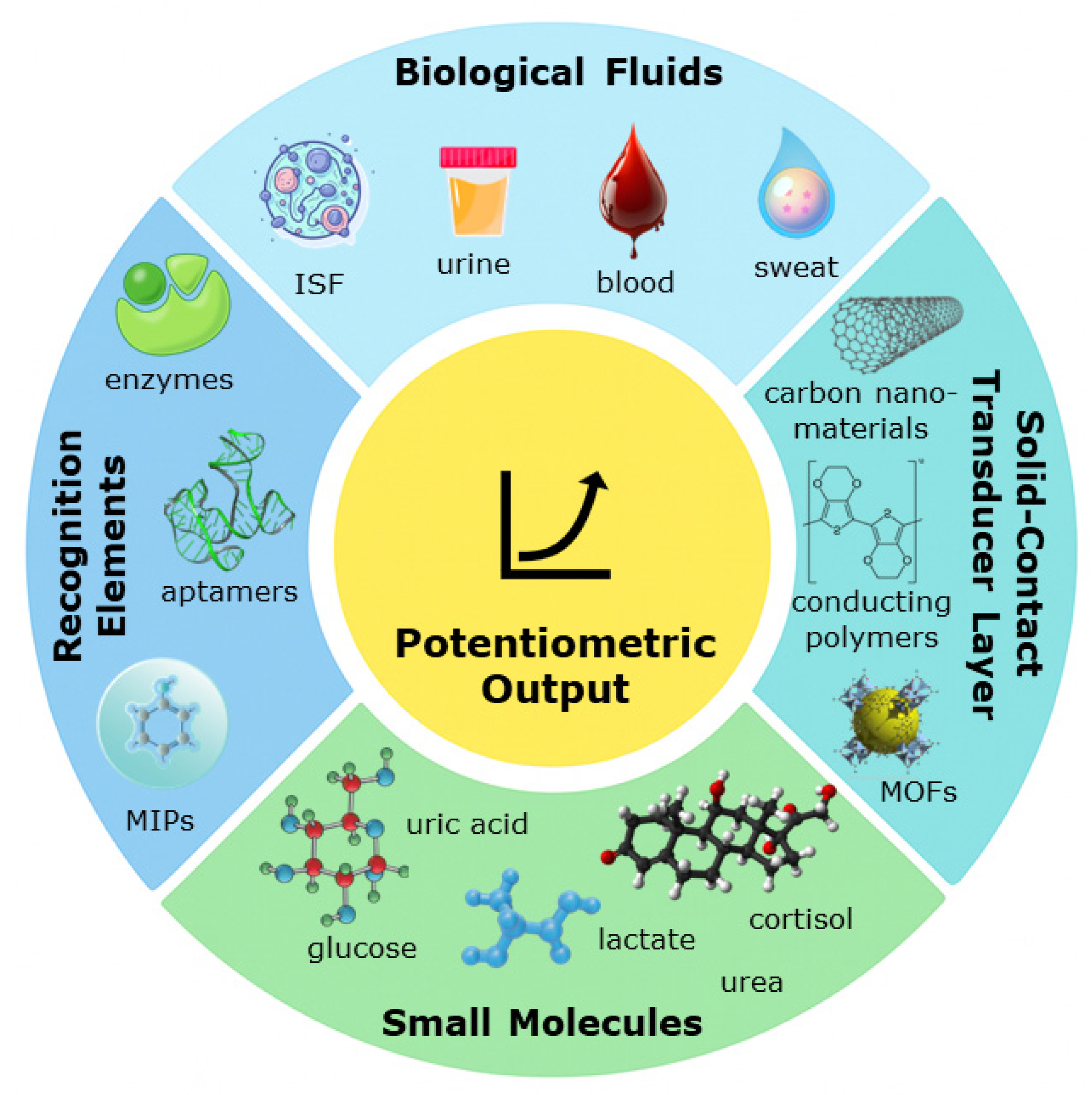
- Metabolic indicators, such as glucose, lactate, or uric acid, often serve as substrates in enzyme-based potentiometric biosensors, where ionic products of enzymatic reactions generate measurable potential shifts.
- (b)
- Pharmaceutical compounds, including antibiotics, anticancer drugs, and psychotropic agents, are typically detected through aptameric or MIP-based receptors that exploit molecular recognition and charge redistribution at the membrane interface.
- (c)
- Endogenous or exogenous biomarkers, such as hormones, neurotransmitters, and environmental toxins, are increasingly being targeted using hybrid nanostructured recognition layers that combine molecular selectivity with enhanced signal stability.
3.2. Biological Fluids
4. Materials and Design Strategies for Potentiometric Biosensors
4.1. Ion-Selective Membranes as Functional Recognition Interfaces
4.2. Solid-Contact Transducer Materials
4.3. Integration of Biorecognition Elements
4.3.1. Enzymes
4.3.2. Aptamers
4.3.3. Molecularly Imprinted Polymers (MIPs)
4.3.4. Integration of Elements
4.4. Substrate and Format Choices
4.4.1. Miniaturized and Microfabricated Platforms
4.4.2. Flexible and Wearable Potentiometric Biosensors
4.4.3. Paper-Based and Disposable Platforms
4.5. Comparative Summary and Discussion
5. Comparison with Other Biosensing Technologies
5.1. Comparison with Other Electrochemical Techniques
5.2. Comparison with Other Techniques
5.3. Discussion
6. Challenges and Limitations
6.1. Biofouling and Antifouling Strategies in Potentiometric Biosensing
6.2. Matrix Effects
6.3. Stability of Potentiometric Response
6.4. Wearable and Continuous Sensing: Sweat-Specific Issues
7. Future Perspectives
8. Conclusions
Author Contributions
Funding
Institutional Review Board Statement
Informed Consent Statement
Data Availability Statement
Conflicts of Interest
Abbreviations
| ISE | Ion-Selective Electrode |
| ISM | Ion-Selective Membrane |
| SC-ISE | Solid-Contact Ion-Selective Electrode |
| PVC | Poly(vinyl chloride) |
| POC | Point-of-Care |
| QCM | Quartz Crystal Microbalance |
| SAW | Surface Acoustic Wave |
| MIP | Molecularly Imprinted Polymer |
| NIP | Non-Imprinted Polymer |
| PEDOT:PSS | Poly(3,4-ethylenedioxythiophene):poly(styrene sulfonate) |
| CNT | Carbon Nanotube |
| rGo | Reduced Graphene Oxide |
| AuNP | Gold Nanoparticle |
| ZnO | Zinc Oxide |
| LOC | Lab-on-a-Chip |
| LOD | Limit of Detection |
| EIS | Electrochemical Impedance Spectroscopy |
| SEM | Scanning Electron Microscopy |
| PANI | Polyaniline |
| PPy | Polypyrrole |
| PEG | Poly(ethylene glycol) |
| PEO | Poly(ethylene oxide) |
| PS | Polystyrene |
| PDMS | Polydimethylsiloxane |
| PHEMA | Poly(2-hydroxyethyl methacrylate) |
| PMMA | Poly(methyl methacrylate) |
| FET | Field-Effect Transistor |
| SPE | Screen-Printed Electrode |
| DOX | Doxorubicin |
| PBS | Phosphate-Buffered Saline |
| AI | Artificial Intelligence |
| TDM | Therapeutic Drug Monitoring |
| PBA | Phenylboronic Acid |
| SC | Solid-Contact |
| WE | Working Electrode |
| RE | Reference Electrode |
References
- Singh, A.; Sharma, A.; Ahmed, A.; Sundramoorthy, A.K.; Furukawa, H.; Arya, S.; Khosla, A. Recent Advances in Electrochemical Biosensors: Applications, Challenges, and Future Scope. Biosensors 2021, 11, 336. [Google Scholar] [CrossRef]
- Liang, W.S.; Beaulieu-Jones, B.; Smalley, S.; Snyder, M.; Goetz, L.H.; Schork, N.J. Emerging Therapeutic Drug Monitoring Technologies: Considerations and Opportunities in Precision Medicine. Front. Pharmacol. 2024, 15, 1348112. [Google Scholar] [CrossRef]
- Zdrachek, E.; Bakker, E. Potentiometric Sensing. Anal. Chem. 2019, 91, 2–26. [Google Scholar] [CrossRef]
- Karimi-Maleh, H.; Orooji, Y.; Karimi, F.; Alizadeh, M.; Baghayeri, M.; Rouhi, J.; Tajik, S.; Beitollahi, H.; Agarwal, S.; Gupta, V.K.; et al. A Critical Review on the Use of Potentiometric Based Biosensors for Biomarkers Detection. Biosens. Bioelectron. 2021, 184, 113252. [Google Scholar] [CrossRef] [PubMed]
- Walker, N.L.; Roshkolaeva, A.B.; Chapoval, A.I.; Dick, J.E. Recent Advances in Potentiometric Biosensing. Curr. Opin. Electrochem. 2021, 28, 100735. [Google Scholar] [CrossRef]
- Gao, L.; Tian, Y.; Gao, W.; Xu, G. Recent Developments and Challenges in Solid-Contact Ion-Selective Electrodes. Sensors 2024, 24, 4289. [Google Scholar] [CrossRef] [PubMed]
- Almehizia, A.A.; Naglah, A.M.; Alanazi, M.G.; Amr, A.E.G.E.; Kamel, A.H. Paper-Based Analytical Device Based on Potentiometric Transduction for Sensitive Determination of Phenobarbital. ACS Omega 2023, 8, 43538–43545. [Google Scholar] [CrossRef] [PubMed]
- Chieng, A.; Wan, Z.; Wang, S. Recent Advances in Real-Time Label-Free Detection of Small Molecules. Biosensors 2024, 14, 80. [Google Scholar] [CrossRef]
- Bobacka, J.; Ivaska, A.; Lewenstam, A. Potentiometric Ion Sensors. Chem. Rev. 2008, 108, 329–351. [Google Scholar] [CrossRef]
- Bakker, E.; Pretsch, E. Potentiometric Sensors for Trace-Level Analysis. TrAC Trends Anal. Chem. 2005, 24, 199–207. [Google Scholar] [CrossRef]
- Wu, J.; Liu, H.; Chen, W.; Ma, B.; Ju, H. Device Integration of Electrochemical Biosensors. Nat. Rev. Bioeng. 2023, 1, 346–360. [Google Scholar] [CrossRef]
- Wardak, C.; Pietrzak, K.; Morawska, K.; Grabarczyk, M. Ion-Selective Electrodes with Solid Contact Based on Composite Materials: A Review. Sensors 2023, 23, 5839. [Google Scholar] [CrossRef]
- Aftab, S.; Koyyada, G.; Rubab, N.; Assiri, M.A.; Truong, N.T.N. Advances in Wearable Nanomaterial-Based Sensors for Environmental and Health Monitoring: A Comprehensive Review. J. Environ. Chem. Eng. 2025, 13, 115788. [Google Scholar] [CrossRef]
- Yin, T.; Qin, W. Applications of Nanomaterials in Potentiometric Sensors. TrAC Trends Anal. Chem. 2013, 51, 79–86. [Google Scholar] [CrossRef]
- Yang, M.; Ye, Z.; Ren, Y.; Farhat, M.; Chen, P.Y. Recent Advances in Nanomaterials Used for Wearable Electronics. Micromachines 2023, 14, 603. [Google Scholar] [CrossRef] [PubMed]
- Hemdan, M.; Abuelhaded, K.; Shaker, A.A.S.; Ashour, M.M.; Abdelaziz, M.M.; Dahab, M.I.; Nassar, Y.A.; Sarguos, A.M.M.; Zakaria, P.S.; Fahmy, H.A.; et al. Recent Advances in Nano-Enhanced Biosensors: Innovations in Design, Applications in Healthcare, Environmental Monitoring, and Food Safety, and Emerging Research Challenges. Sens. Biosens. Res. 2025, 48, 100783. [Google Scholar] [CrossRef]
- Kamel, A.H.; Amr, A.E.G.E.; Ashmawy, N.H.; Galal, H.R.; Al-Omar, M.A.; Sayed, A.Y.A. Solid-Contact Potentiometric Sensors Based on Stimulus-Responsive Imprinted Polymers for Reversible Detection of Neutral Dopamine. Polymers 2020, 12, 1406. [Google Scholar] [CrossRef]
- Bakker, E.; Bühlmann, P.; Pretsch, E. Polymer Membrane Ion-Selective Electrodes—What Are the Limits? Electroanalysis 1999, 11, 915–933. [Google Scholar] [CrossRef]
- Lyu, Y.; Gan, S.; Bao, Y.; Zhong, L.; Xu, J.; Wang, W.; Liu, Z.; Ma, Y.; Yang, G.; Niu, L. Solid-Contact Ion-Selective Electrodes: Response Mechanisms, Transducer Materials and Wearable Sensors. Membranes 2020, 10, 128. [Google Scholar] [CrossRef]
- Hussein, O.G.; Ahmed, D.A.; Abdelkawy, M.; Rezk, M.R.; Mahmoud, A.M.; Rostom, Y. Novel Solid-Contact Ion-Selective Electrode Based on a Polyaniline Transducer Layer for Determination of Alcaftadine in Biological Fluid. RSC Adv. 2023, 13, 7645–7655. [Google Scholar] [CrossRef]
- Chen, L.; Yang, G.; Qu, F. Advances of Aptamer-Based Small-Molecules Sensors in Body Fluids Detection. Talanta 2024, 268, 125348. [Google Scholar] [CrossRef] [PubMed]
- Wang, X.; Walt, D. Simultaneous Detection of Small Molecules, Proteins and MicroRNAs Using Single Molecule Arrays. Chem. Sci. 2020, 11, 7896–7903. [Google Scholar] [CrossRef] [PubMed]
- Daems, D.; De Wael, K.; Vissenberg, K.; Van Camp, G.; Nagels, L. Potentiometric Sensors Doped with Biomolecules as a New Approach to Small Molecule/Biomolecule Binding Kinetics Analysis. Biosens. Bioelectron. 2014, 54, 515–520. [Google Scholar] [CrossRef] [PubMed]
- Cabalar, I.; Le, T.H.; Silber, A.; O’Hara, M.; Abdallah, B.; Parikh, M.; Busch, R. The Role of Blood Testing in Prevention, Diagnosis, and Management of Chronic Diseases: A Review. Am. J. Med. Sci. 2024, 368, 274–286. [Google Scholar] [CrossRef]
- Murillo-de-Ozores, A.R.; Gamba, G. Molecular Mechanisms for the Regulation of Blood Pressure by Potassium. Curr. Top. Membr. 2019, 83, 285–313. [Google Scholar] [CrossRef]
- Tang, L.; Chang, S.J.; Chen, C.J.; Liu, J.T. Non-Invasive Blood Glucose Monitoring Technology: A Review. Sensors 2020, 20, 6925. [Google Scholar] [CrossRef]
- Ferrão, A.R.; Pestana, P.; Borges, L.; Palmeira-de-Oliveira, R.; Palmeira-de-Oliveira, A.; Martinez-de-Oliveira, J. Quantification of Ions in Human Urine—A Review for Clinical Laboratories. Biomedicines 2024, 12, 1848. [Google Scholar] [CrossRef]
- Ryan, D.; Robards, K.; Prenzler, P.D.; Kendall, M. Recent and Potential Developments in the Analysis of Urine: A Review. Anal. Chim. Acta 2011, 684, 17–29. [Google Scholar] [CrossRef]
- Prats-Alfonso, E.; Abad, L.; Casañ-Pastor, N.; Gonzalo-Ruiz, J.; Baldrich, E. Iridium Oxide pH Sensor for Biomedical Applications. Case Urea-Urease in Real Urine Samples. Biosens. Bioelectron. 2013, 39, 163–169. [Google Scholar] [CrossRef]
- Surdu, A.; Foia, L.G.; Luchian, I.; Trifan, D.; Tatarciuc, M.S.; Scutariu, M.M.; Ciupilan, C.; Budala, D.G. Saliva as a Diagnostic Tool for Systemic Diseases—A Narrative Review. Medicina 2025, 61, 243. [Google Scholar] [CrossRef]
- Villiger, M.; Stoop, R.; Vetsch, T.; Hohenauer, E.; Pini, M.; Clarys, P.; Pereira, F.; Clijsen, R. Evaluation and Review of Body Fluids Saliva, Sweat and Tear Compared to Biochemical Hydration Assessment Markers within Blood and Urine. Eur. J. Clin. Nutr. 2018, 72, 69–76. [Google Scholar] [CrossRef] [PubMed]
- Zafar, H.; Channa, A.; Jeoti, V.; Stojanović, G.M. Comprehensive Review on Wearable Sweat-Glucose Sensors for Continuous Glucose Monitoring. Sensors 2022, 22, 638. [Google Scholar] [CrossRef] [PubMed]
- Childs, A.; Mayol, B.; Lasalde-Ramírez, J.A.; Song, Y.; Sempionatto, J.R.; Gao, W. Diving into Sweat: Advances, Challenges, and Future Directions in Wearable Sweat Sensing. ACS Nano 2024, 18, 24605–24616. [Google Scholar] [CrossRef] [PubMed]
- Xuan, X.; Chen, C.; Molinero-Fernandez, A.; Ekelund, E.; Cardinale, D.; Swarén, M.; Wedholm, L.; Cuartero, M.; Crespo, G.A. Fully Integrated Wearable Device for Continuous Sweat Lactate Monitoring in Sports. ACS Sens. 2023, 8, 2401–2409. [Google Scholar] [CrossRef]
- Karachaliou, C.E.; Koukouvinos, G.; Goustouridis, D.; Raptis, I.; Kakabakos, S.; Petrou, P.; Livaniou, E. Cortisol Immunosensors: A Literature Review. Biosensors 2023, 13, 285. [Google Scholar] [CrossRef]
- Wu, Z.; Qiao, Z.; Chen, S.; Fan, S.; Liu, Y.; Qi, J.; Lim, C.T. Interstitial Fluid-Based Wearable Biosensors for Minimally Invasive Healthcare and Biomedical Applications. Commun. Mater. 2024, 5, 33. [Google Scholar] [CrossRef]
- Ma, S.; Li, J.; Pei, L.; Feng, N.; Zhang, Y. Microneedle-Based Interstitial Fluid Extraction for Drug Analysis: Advances, Challenges, and Prospects. J. Pharm. Anal. 2023, 13, 111–126. [Google Scholar] [CrossRef]
- Moreira, F.T.C.; Moreira-Tavares, A.P.M.; Sales, M.G.F.S. Sol-Gel-Based Biosensing Applied to Medicinal Science. Curr. Top. Med. Chem. 2015, 15, 245–255. [Google Scholar] [CrossRef]
- Song, Z.; Han, R.; Yu, K.; Li, R.; Luo, X. Antifouling Strategies for Electrochemical Sensing in Complex Biological Media. Microchim. Acta 2024, 191, 138. [Google Scholar] [CrossRef]
- Pilvenyte, G.; Ratautaite, V.; Boguzaite, R.; Ramanavicius, S.; Chen, C.F.; Viter, R.; Ramanavicius, A. Molecularly Imprinted Polymer-Based Electrochemical Sensors for the Diagnosis of Infectious Diseases. Biosensors 2023, 13, 620. [Google Scholar] [CrossRef]
- Hou, H.; Jin, Y.; Wei, H.; Ji, W.; Xue, Y.; Hu, J.; Zhang, M.; Jiang, Y.; Mao, L. A Generalizable and Noncovalent Strategy for Interfacing Aptamers with a Microelectrode for the Selective Sensing of Neurotransmitters In Vivo. Angew. Chem. Int. Ed. Engl. 2020, 59, 18996–19000. [Google Scholar] [CrossRef] [PubMed]
- Bobacka, J. Potential Stability of All-Solid-State Ion-Selective Electrodes Using Conducting Polymers as Ion-to-Electron Transducers. Anal. Chem. 1999, 71, 4932–4937. [Google Scholar] [CrossRef] [PubMed]
- Guzinski, M.; Jarvis, J.M.; D’Orazio, P.; Izadyar, A.; Pendley, B.D.; Lindner, E. Solid-Contact pH Sensor without CO2 Interference with a Superhydrophobic PEDOT-C14 as Solid Contact: The Ultimate “Water Layer” Test. Anal. Chem. 2017, 89, 8468–8475. [Google Scholar] [CrossRef] [PubMed]
- Guzinski, M.; Jarvis, J.M.; Pendley, B.D.; Lindner, E. Equilibration Time of Solid Contact Ion-Selective Electrodes. Anal. Chem. 2015, 87, 6654–6659. [Google Scholar] [CrossRef]
- Manjakkal, L.; Szwagierczak, D.; Dahiya, R. Metal Oxides Based Electrochemical pH Sensors: Current Progress and Future Perspectives. Prog. Mater. Sci. 2020, 109, 100635. [Google Scholar] [CrossRef]
- Clark, L.C., Jr. Electrode Systems for Continuous Monitoring in Cardiovascular Surgery. Ann. N. Y. Acad. Sci. 1962, 102, 29–45. [Google Scholar] [CrossRef]
- Caras, S.D.; Petelenz, D.; Janata, J. pH-Based Enzyme Potentiometric Sensors. Part 2: Glucose-Sensitive Field Effect Transistor Scheme. Anal. Chem. 1985, 57, 1920–1923. [Google Scholar] [CrossRef]
- Ali, S.M.U.; Ibupoto, Z.H.; Kashif, M.; Hashim, U.; Willander, M. A Potentiometric Indirect Uric Acid Sensor Based on ZnO Nanoflakes and Immobilized Uricase. Sensors 2012, 12, 2787–2797. [Google Scholar] [CrossRef]
- Lakard, B.; Magnin, D.; Deschaume, O.; Vanlancker, G.; Glinel, K.; Demoustier-Champagne, S.; Nysten, B.; Jonas, A.M.; Bertrand, P.; Yunus, S. Urea Potentiometric Enzymatic Biosensor Based on Charged Biopolymers and Electrodeposited Polyaniline. Biosens. Bioelectron. 2011, 26, 4139–4145. [Google Scholar] [CrossRef]
- Liu, Y.; Cánovas, R.; Crespo, G.A.; Cuartero, M. Thin-Layer Potentiometry for Creatinine Detection in Undiluted Human Urine Using Ion-Exchange Membranes as Barriers for Charged Interferences. Anal. Chem. 2020, 92, 3315–3323. [Google Scholar] [CrossRef]
- Ellington, A.D.; Szostak, J.W. In Vitro Selection of RNA Molecules That Bind Specific Ligands. Nature 1990, 346, 818–822. [Google Scholar] [CrossRef] [PubMed]
- Tuerk, C.; Gold, L. Systematic Evolution of Ligands by Exponential Enrichment: RNA Ligands to Bacteriophage T4 DNA Polymerase. Science 1990, 249, 505–510. [Google Scholar] [CrossRef] [PubMed]
- Numnuam, A.; Chumbimuni-Torres, K.Y.; Xiang, Y.; Bash, R.; Thavarungkul, P.; Kanatharana, P.; Pretsch, E.; Wang, J.; Bakker, E. Aptamer-Based Potentiometric Measurements of Proteins Using Ion-Selective Microelectrodes. Anal. Chem. 2008, 80, 707–712. [Google Scholar] [CrossRef]
- Goda, T.; Higashi, D.; Matsumoto, A.; Hoshi, T.; Sawaguchi, T.; Miyahara, Y. Dual Aptamer-Immobilized Surfaces for Improved Affinity through Multiple Target Binding in Potentiometric Thrombin Biosensing. Biosens. Bioelectron. 2015, 73, 174–180. [Google Scholar] [CrossRef]
- Ni, J.; Wei, H.; Ji, W.; Xue, Y.; Zhu, F.; Wang, C.; Jiang, Y.; Mao, L. Aptamer-Based Potentiometric Sensor Enables Highly Selective and Neurocompatible Neurochemical Sensing in Rat Brain. ACS Sens. 2024, 9, 2447–2454. [Google Scholar] [CrossRef]
- Zhang, C.; Chen, T.; Ying, Y.; Wu, J. Detection of Dopamine Based on Aptamer-Modified Graphene Microelectrode. Sensors 2024, 24, 2934. [Google Scholar] [CrossRef]
- Wulff, G.; Sarhan, A.W. The Use of Polymers with Enzyme-Analogous Structures for the Resolution of Racemates. Angew. Chem. Int. Ed. 1972, 11, 341–342. [Google Scholar]
- Vasapollo, G.; Del Sole, R.; Mergola, L.; Lazzoi, M.R.; Scardino, A.; Scorrano, S.; Mele, G. Molecularly Imprinted Polymers: Present and Future Prospective. Int. J. Mol. Sci. 2011, 12, 5908–5945. [Google Scholar] [CrossRef]
- Mosbach, K. Molecular Imprinting. Trends Biochem. Sci. 1994, 19, 9–14. [Google Scholar] [CrossRef]
- Wang, C.; Qi, L.; Liang, R. A Molecularly Imprinted Polymer-Based Potentiometric Sensor Based on Covalent Recognition for the Determination of Dopamine. Anal. Methods 2021, 13, 620–625. [Google Scholar] [CrossRef]
- Zhang, H.; Yao, R.; Wang, N.; Liang, R.; Qin, W. Soluble Molecularly Imprinted Polymer-Based Potentiometric Sensor for Determination of Bisphenol AF. Anal. Chem. 2018, 90, 657–662. [Google Scholar] [CrossRef] [PubMed]
- Zanoni, C.; Spina, S.; Magnaghi, L.R.; Guembe-Garcia, M.; Biesuz, R.; Alberti, G. Potentiometric MIP-Modified Screen-Printed Cell for Phenoxy Herbicides Detection. Int. J. Environ. Res. Public Health 2022, 19, 16488. [Google Scholar] [CrossRef] [PubMed]
- Moret, J.; Moreira, F.T.C.; Almeida, S.A.A.; Sales, M.G.F. New Molecularly-Imprinted Polymer for Carnitine and Its Application as Ionophore in Potentiometric Selective Membranes. Mater. Sci. Eng. C 2014, 43, 481–487. [Google Scholar] [CrossRef] [PubMed]
- Moreira, F.T.C.; Dutra, R.A.F.; Noronha, J.P.C.; Sales, M.G.F. Myoglobin-Biomimetic Electroactive Materials Made by Surface Molecular Imprinting on Silica Beads and Their Use as Ionophores in Polymeric Membranes for Potentiometric Transduction. Biosens. Bioelectron. 2011, 26, 4760–4766. [Google Scholar] [CrossRef]
- Al-Mustafa, J.I.; Abu-Dalo, M.A.; Nassory, N.S. Liquid Selective Electrodes for Dextromethorphan Hydrobromide Based on a Molecularly Imprinted Polymer in PVC Matrix Membrane. Int. J. Electrochem. Sci. 2014, 9, 292–303. [Google Scholar] [CrossRef]
- Bangaleh, Z.; Bagheri Sadeghi, H.; Ebrahimi, S.A.; Najafizadeh, P. A New Potentiometric Sensor for Determination and Screening Phenylalanine in Blood Serum Based on Molecularly Imprinted Polymer. Iran. J. Pharm. Res. 2019, 18, 61–71. [Google Scholar] [CrossRef]
- Radi, A.-E.; Abd-Egawad, T.W. Electrochemical Sensors Based on Molecularly Imprinted Polymers for Pharmaceuticals Analysis. Curr. Anal. Chem. 2019, 15, 219–239. [Google Scholar] [CrossRef]
- Mirzajani, R.; Arefiyan, E. Construction and Evaluation of a Graphene Oxide Functionalized Aminopropyltriethoxy Silane Surface Molecularly Imprinted Polymer Potentiometric Sensor for Dipyridamole Detection in Urine and Pharmaceutical Samples. J. Braz. Chem. Soc. 2019, 30, 1874–1886. [Google Scholar] [CrossRef]
- Hassan, S.S.M.; Amr, A.E.G.E.; El-Naby, H.A.; Al-Omar, M.A.; Kamel, A.H.; Khalifa, N.M. Potentiometric PVC-Membrane-Based Sensor for Dimethylamine Assessment Using a Molecularly Imprinted Polymer as a Sensory Recognition Element. Polymers 2019, 11, 1695. [Google Scholar] [CrossRef]
- Babanejad, M.; Tehrani, M.S.; Mafakheri, M.; Sardari, S. Potentiometric Determination of Clonazepam Using Carbon Paste Electrode Based on Molecular Imprinted Polymer (MIP) in Solution and in a Biological Fluid Model. Pharm. Anal. Acta 2016, 7, 1000499. [Google Scholar] [CrossRef]
- Sheydaei, O.; Khajehsharifi, H.; Rajabi, H.R. Rapid and Selective Diagnose of Sarcosine in Urine Samples as Prostate Cancer Biomarker by Mesoporous Imprinted Polymeric Nanobeads Modified Electrode. Sens. Actuators B Chem. 2020, 309, 127559. [Google Scholar] [CrossRef]
- Ibupoto, Z.H. A Selective Iodide Ion Sensor Electrode Based on Functionalized ZnO Nanotubes. Sensors 2013, 13, 1984–1997. [Google Scholar] [CrossRef]
- Ferreira, C.; Palmeira, A.; Sousa, E.; Amorim, C.G.; Araújo, A.N.; Montenegro, M.C. Supramolecular Atropine Potentiometric Sensor. Sensors 2021, 21, 5879. [Google Scholar] [CrossRef]
- Ibáñez-Redín, G.; Rosso Cagnani, G.; Gomes, N.O.; Raymundo-Pereira, P.A.; Sergio, S.A.; Gutierrez, M.A.; Krieger, J.E.; Oliveira, O.N. Wearable Potentiometric Biosensor for Analysis of Urea in Sweat. Biosens. Bioelectron. 2023, 223, 114994. [Google Scholar] [CrossRef] [PubMed]
- Molinero-Fernández, Á.; Casanova, A.; Wang, Q.; Cuartero, M.; Crespo, G.A. In Vivo Transdermal Multi-Ion Monitoring with a Potentiometric Microneedle-Based Sensor Patch. ACS Sens. 2023, 8, 158–166. [Google Scholar] [CrossRef] [PubMed]
- Kamel, A.H.; Jiang, X.; Li, P.; Liang, R. A Paper-Based Potentiometric Sensing Platform Based on Molecularly Imprinted Nanobeads for Determination of Bisphenol A. Anal. Methods 2018, 10, 3890–3895. [Google Scholar] [CrossRef]
- Xu, S.; Xu, Z.; Liu, Z. Paper-Based Molecular-Imprinting Technology and Its Application. Biosensors 2022, 12, 595. [Google Scholar] [CrossRef]
- Hashem, H.M.; Abdallah, A.B. A Rational Study of Transduction Mechanisms of Different Materials for All Solid Contact-ISEs. Sci. Rep. 2024, 14, 5405. [Google Scholar] [CrossRef]
- Kim, J.; Valdés-Ramírez, G.; Bandodkar, A.J.; Jia, W.; Martinez, A.G.; Ramírez, J.; Mercier, P.; Wang, J. Non-Invasive Mouthguard Biosensor for Continuous Salivary Monitoring of Metabolites. Analyst 2014, 139, 1632–1636. [Google Scholar] [CrossRef]
- Jia, W.; Valdés-Ramírez, G.; Bandodkar, A.J.; Windmiller, J.R.; Yang, Z.; Ramírez, J.; Chan, G.; Wang, J. Epidermal Biofuel Cells: Energy Harvesting from Human Perspiration. Angew. Chem. Int. Ed. 2013, 52, 7233–7236. [Google Scholar] [CrossRef]
- Dortez, S.; De Gregorio-Rocasolano, N.; Millán, M.; Gasull, T.; Crevillen, A.G.; Escarpa, A. Paper-Based Analytical Devices for Accurate Assessment of Transferrin Saturation in Clinical Samples from Ischemic Stroke Patients. Anal. Chem. 2023, 95, 12391–12397. [Google Scholar] [CrossRef] [PubMed]
- Arduini, F. Electrochemical Paper-Based Devices: When the Simple Replacement of the Support to Print Ecodesigned Electrodes Radically Improves Device Features. Curr. Opin. Electrochem. 2022, 35, 101090. [Google Scholar] [CrossRef]
- Noviana, E.; Carrão, D.B.; Pratiwi, R.; Henry, C.S. Microfluidic Paper-Based Analytical Devices: From Design to Applications. Chem. Rev. 2021, 121, 11835–11885. [Google Scholar] [CrossRef] [PubMed]
- Noviana, E.; McCord, C.P.; Clark, K.M.; Jang, I.; Henry, C.S. Electrochemical Paper-Based Devices: Sensing Approaches and Progress Toward Practical Applications. Lab A Chip 2020, 20, 9–34. [Google Scholar] [CrossRef]
- Schachinger, F.; Chang, H.; Scheiblbrandner, S.; Ludwig, R. Amperometric Biosensors Based on Direct Electron Transfer Enzymes. Molecules 2021, 26, 4525. [Google Scholar] [CrossRef]
- Pedersen, T.; Fojan, P.; Pedersen, A.K.N.; Magnusson, N.E.; Gurevich, L. Amperometric Biosensor for Quantitative Measurement Using Sandwich Immunoassays. Biosensors 2023, 13, 519. [Google Scholar] [CrossRef]
- Li, H.; Liu, X.; Li, L.; Mu, X.; Genov, R.; Mason, A.J. CMOS Electrochemical Instrumentation for Biosensor Microsystems: A Review. Sensors 2017, 17, 74. [Google Scholar] [CrossRef]
- Wu, A.; Khan, W.S. (Eds.) Nanobiosensors: From Design to Applications; Wiley-VCH: Weinheim, Germany, 2020; ISBN 978-3-527-34510-6. [Google Scholar]
- Ahmed, I.; Jiang, N.; Shao, X.; Elsherif, M.; Alam, F.; Salih, A.; Butta, H.; Yetisen, A.K. Recent Advances in Optical Sensors for Continuous Glucose Monitoring. Sens. Diagn. 2022, 1, 1098–1125. [Google Scholar] [CrossRef]
- John, R.V.; Devasiya, T.; Nair, V.R.; Adigal, S.; Lukose, J.; Kartha, V.B.; Chidangil, S. Cardiovascular Biomarkers in Body Fluids: Progress and Prospects in Optical Sensors. Biophys. Rev. 2022, 14, 1023–1050. [Google Scholar] [CrossRef]
- Worsley, G.J.; Tourniaire, G.A.; Medlock, K.E.S.; Sartain, F.K.; Harmer, H.E.; Thatcher, M.; Horgan, A.M.; Pritchard, J. Continuous Blood Glucose Monitoring with a Thin-Film Optical Sensor. Clin. Chem. 2007, 53, 1820–1826. [Google Scholar] [CrossRef]
- Shaukat, H.; Ali, A.; Bibi, S.; Altabey, W.A.; Noori, M.; Kouritem, S.A. A Review of the Recent Advances in Piezoelectric Materials, Energy Harvester Structures, and Their Applications in Analytical Chemistry. Appl. Sci. 2023, 13, 1300. [Google Scholar] [CrossRef]
- Wang, M.; Zi, G.; Liu, J.; Song, Y.; Zhao, X.; Wang, Q.; Zhao, T. Self-Powered Biosensor for Specifically Detecting Creatinine in Real Time Based on the Piezo-Enzymatic-Reaction Effect of Enzyme-Modified ZnO Nanowires. Biosensors 2021, 11, 342. [Google Scholar] [CrossRef]
- Skládal, P. Piezoelectric Biosensors: Shedding Light on Principles and Applications. Microchim. Acta 2024, 191, 184. [Google Scholar] [CrossRef]
- Brazaca, L.C.; Imamura, A.H.; Blasques, R.V.; Camargo, J.R.; Janegitz, B.C.; Carrilho, E. The Use of Biological Fluids in Microfluidic Paper-Based Analytical Devices (µPADs): Recent Advances, Challenges and Future Perspectives. Biosens. Bioelectron. 2024, 246, 115846. [Google Scholar] [CrossRef]
- Hu, J.; Zhao, W.; Buhlmann, P.; Stein, A. Paper-Based All-Solid-State Ion-Sensing Platform with a Solid Contact Comprising Colloid-Imprinted Mesoporous Carbon and a Redox Buffer. ACS Appl. Nano Mater. 2018, 1, 293–301. [Google Scholar] [CrossRef]
- Fathy, M.A.; Bühlmann, P. Next-Generation Potentiometric Sensors: A Review of Flexible and Wearable Technologies. Biosensors 2025, 15, 51. [Google Scholar] [CrossRef]
- Wisniewski, N.; Reichert, M. Methods for Reducing Biosensor Membrane Biofouling. Colloids Surf. B Biointerfaces 2000, 18, 197–219. [Google Scholar] [CrossRef] [PubMed]
- Carroll, D.P.; Mendes, P.M. Recent Advances in Surface Modification and Antifouling Strategies for Electrochemical Sensing in Complex Biofluids. Curr. Opin. Electrochem. 2023, 40, 101319. [Google Scholar] [CrossRef]
- Bakker, E. Can Calibration-Free Sensors Be Realized? ACS Sens. 2016, 1, 838–841. [Google Scholar] [CrossRef]
- Rousseau, C.R.; Bühlmann, P. Calibration-Free Potentiometric Sensing with Solid-Contact Ion-Selective Electrodes. TrAC Trends Anal. Chem. 2021, 140, 116277. [Google Scholar] [CrossRef]
- Rumpf, G.; Spichiger-Keller, U.; Bühler, H.; Simon, W. Calibration-Free Measurement of Sodium and Potassium in Undiluted Human Serum with an Electrically Symmetric Measuring System. Anal. Sci. 1992, 8, 553–559. [Google Scholar] [CrossRef][Green Version]
- Zheng, L.; Ye, Q.; Wang, M.; Sun, F.; Chen, Q.; Yu, X.; Wang, Y.; Liang, P. Research Progress in Small-Molecule Detection Using Aptamer-Based SERS Techniques. Biosensors 2025, 15, 29. [Google Scholar] [CrossRef] [PubMed]
- Ghoorchian, A.; Kamalabadi, M.; Moradi, M.; Madrakian, T.; Afkhami, A.; Bagheri, H.; Ahmadi, M.; Khoshsafar, H. Wearable Potentiometric Sensor Based on Na0.44MnO2 for Non-invasive Monitoring of Sodium Ions in Sweat. Anal. Chem. 2022, 94, 2263–2270. [Google Scholar] [CrossRef] [PubMed]
- Shao, Y.; Ying, Y.; Ping, J. Recent advances in solid-contact ion-selective electrodes: Functional materials, transduction mechanisms, and development trends. Chem. Soc. Rev. 2020, 49, 4405–4465. [Google Scholar] [CrossRef]
- Cuartero, M.; Parrilla, M.; Crespo, G.A. Wearable Potentiometric Sensors for Medical Applications. Sensors 2019, 19, 363. [Google Scholar] [CrossRef]
- Fiore, L.; Mazzaracchio, V.; Antinucci, A.; Ferrara, R.; Sciarra, T.; Lista, F.; Shen, A.Q.; Arduini, F. Wearable electrochemical device based on butterfly-like paper-based microfluidics for pH and Na+ monitoring in sweat. Microchim. Acta 2024, 191, 580. [Google Scholar] [CrossRef]
- Kim, J.; Campbell, A.S.; de Ávila, B.E.F.; Wang, J. Wearable Biosensors for Healthcare Monitoring. Nat. Biotechnol. 2019, 37, 389–406. [Google Scholar] [CrossRef]
- Vitabile, S.; Marks, M.; Stojanovic, D.; Pllana, S.; Molina, J.M.; Krzyszton, M.; Sikora, A.; Jarynowski, A.; Hosseinpour, F.; Jakobik, A.; et al. Medical Data Processing and Analysis for Remote Health and Activities Monitoring. In High-Performance Modelling and Simulation for Big Data Applications: Selected Results of the COST Action IC1406 cHiPSet; Lecture Notes in Computer Science; Springer: Cham, Switzerland, 2019; Volume 11400, pp. 186–220. [Google Scholar] [CrossRef]
- Palanisamy, P.; Padmanabhan, A.; Ramasamy, A.; Subramaniam, S. Remote Patient Activity Monitoring System by Integrating IoT Sensors and Artificial Intelligence Techniques. Sensors 2023, 23, 5869. [Google Scholar] [CrossRef]
- Wang, W.H.; Hsu, W.S. Integrating Artificial Intelligence and Wearable IoT System in Long-Term Care Environments. Sensors 2023, 23, 5913. [Google Scholar] [CrossRef]
- Ghorbian, M.; Ghobaei-Arani, M.; Babaei, M.R.; Ghorbian, S. Nanotechnology and Nanosensors in Personalized Healthcare: A Comprehensive Review. Sens. Biosens. Res. 2025, 47, 100780. [Google Scholar] [CrossRef]



| Biological Fluid | Typical Analytes (Examples) | Concentration Range | Advantages for Biosensing | Challenges/Limitations |
|---|---|---|---|---|
| Blood/Plasma | Glucose, uric acid, creatinine, electrolytes, hormones, drugs | µM–mM | Gold standard; directly reflects systemic physiology; broad range of clinically relevant analytes | Invasive sampling; high protein content; fouling and drift; high ionic strength; need for calibration and pretreatment |
| Urine | Creatinine, urea, uric acid, drugs/metabolites | µM–mM | Non-invasive collection; relatively low protein content; suitable for point-of-care testing | Variable dilution; pH and ionic composition vary; temporal variability; storage instability |
| Saliva | Cortisol, lactate, glucose, drugs | nM–µM | Non-invasive, easy sampling; potential for wearable or home monitoring | Low analyte concentrations; secretion rate variability; contamination (food, oral bacteria); temperature effects |
| Sweat | Lactate, glucose, small metabolites | µM–mM | Real-time, continuous monitoring via wearables; reflects metabolic changes during activity | Low volume; evaporation; contamination; lag time vs. blood concentration; variable secretion |
| Interstitial Fluid (ISF) | Glucose, lactate, small drugs | µM–mM | Composition close to plasma; accessible via minimally invasive methods (microneedles, iontophoresis); continuous monitoring potential | Requires specialized extraction; slow equilibration; limited standardization |
| Target/Matrix | Recognition Element | Analytical Parameters | Design | Refs. |
|---|---|---|---|---|
| Uric acid | Uricase (enzyme) | Linear 500 nM–1.5 mM | Solid-contact enzymatic electrode | [48] |
| Urea (urine) | Urease (enzyme) | Linear 10−6–10−1 M | Flexible/wearable patch | [49] |
| Creatinine (urine) | Creatinine deiminase (enzyme) | Linear 1–50 mM | Thin-layer microfluidic chip | [50] |
| Dopamine (rat brain, in vivo) | Phosphorothioate aptamer | Sub-nM—nM | Implantable in vivo probe | [55] |
| Dopamine (serum) | Dopamine aptamer | LOD 0.5 µM; Linear 1–100 µM | Graphene-based flexible microelectrode | [56] |
| Dopamine | MIP | LOD 2.1 µM | Solid-contact MIP electrode | [60] |
| Carnitine (urine) | MIP | LOD 80 µM | Potentiometric sensor with MIP as ionophore | [63] |
| Dextromethorphan hydrobromide | MIP | LOD 6 × 10⁻⁵ M; Linear 0.01–5 × 10⁻⁶ M | Coated electrodes of polymers imprinted with dextromethorphan hydrobromide | [65] |
| Phenylalanine (serum) | MIP | LOD 5 × 10⁻⁹ M; Linear 10−8–10−4 M | Potentiometric MIP electrode | [66] |
| Dipyridamole (urine) | MIP | LOD 10−8 M; Linear 2.5 × 10⁻⁸–1.1 × 10⁻² M | Modified potentiometric carbon paste electrode | [68] |
| Clonazepam (biological fluid model) | MIP | LOD 7.3 × 10⁻⁷ M; Linear 10−7–10−1 M | Modified potentiometric carbon paste electrode | [70] |
| Sarcosine (urine) | MIP | LOD 0.38 µM; Linear 5 µM–1.1 mM | MIP-based prostate cancer biomarker sensor | [71] |
| Urea (sweat) | Urease (enzyme) | Linear 5–200 mM | Wearable enzymatic patch | [74] |
| Bisphenol A | MIP | LOD 0.15 µM; Linear 0.5–13 µM | Disposable paper sensor | [76] |
| Phenobarbital (urine) | MIP | LOD 5 × 10⁻⁷ M Linear 10−6–10−3 M | Paper-based POC device | [7] |
Disclaimer/Publisher’s Note: The statements, opinions and data contained in all publications are solely those of the individual author(s) and contributor(s) and not of MDPI and/or the editor(s). MDPI and/or the editor(s) disclaim responsibility for any injury to people or property resulting from any ideas, methods, instructions or products referred to in the content. |
© 2025 by the authors. Licensee MDPI, Basel, Switzerland. This article is an open access article distributed under the terms and conditions of the Creative Commons Attribution (CC BY) license (https://creativecommons.org/licenses/by/4.0/).
Share and Cite
Lenar, N.; Paczosa-Bator, B. Small-Molecule Detection in Biological Fluids: The Emerging Role of Potentiometric Biosensors. Int. J. Mol. Sci. 2025, 26, 11604. https://doi.org/10.3390/ijms262311604
Lenar N, Paczosa-Bator B. Small-Molecule Detection in Biological Fluids: The Emerging Role of Potentiometric Biosensors. International Journal of Molecular Sciences. 2025; 26(23):11604. https://doi.org/10.3390/ijms262311604
Chicago/Turabian StyleLenar, Nikola, and Beata Paczosa-Bator. 2025. "Small-Molecule Detection in Biological Fluids: The Emerging Role of Potentiometric Biosensors" International Journal of Molecular Sciences 26, no. 23: 11604. https://doi.org/10.3390/ijms262311604
APA StyleLenar, N., & Paczosa-Bator, B. (2025). Small-Molecule Detection in Biological Fluids: The Emerging Role of Potentiometric Biosensors. International Journal of Molecular Sciences, 26(23), 11604. https://doi.org/10.3390/ijms262311604