Human miRNAs in Cancer: Statistical Trends and Cross Kingdom Approach

 , , , ,
  , and
, and
Abstract
1. Introduction
2. Results
3. Discussion
4. Materials and Methods
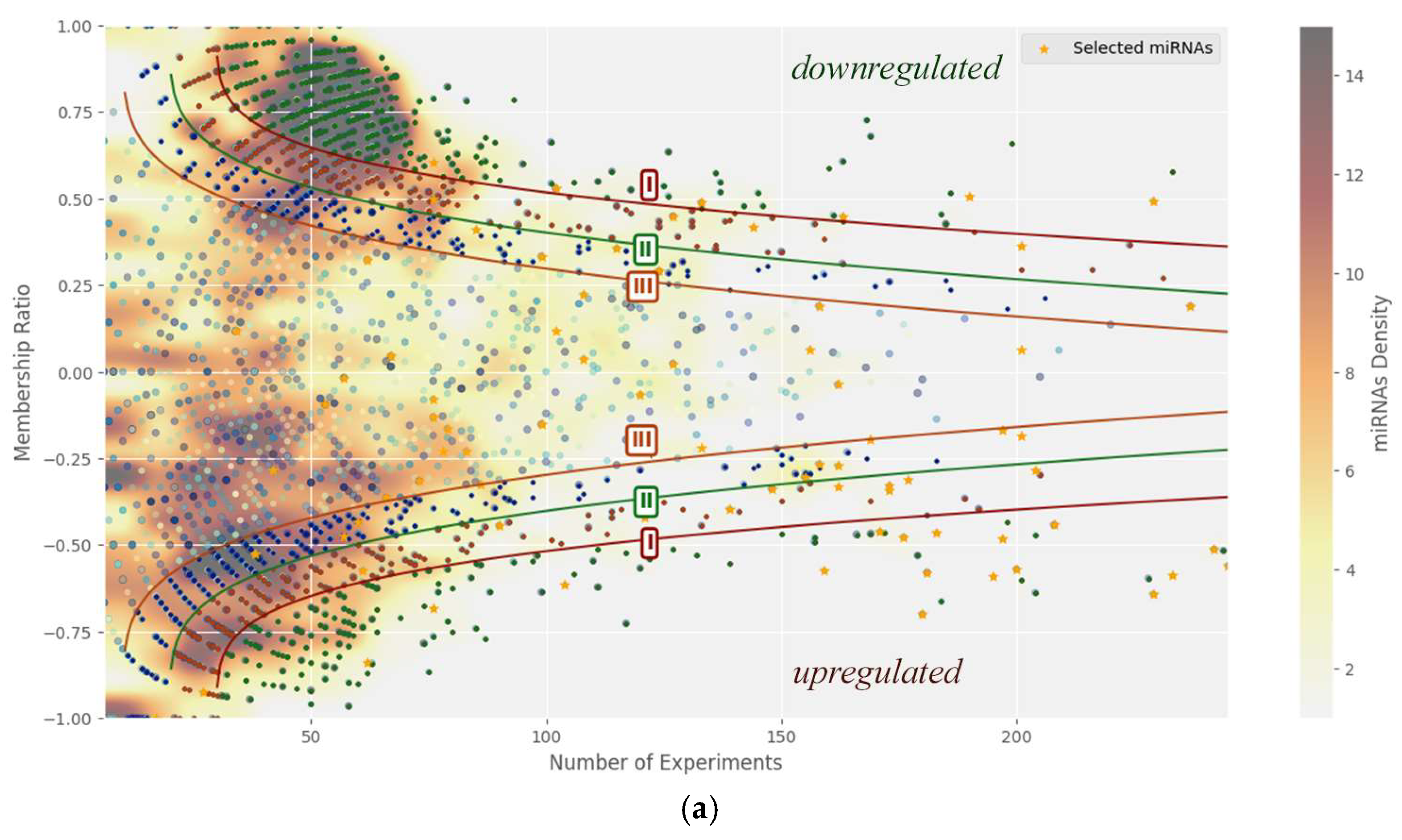
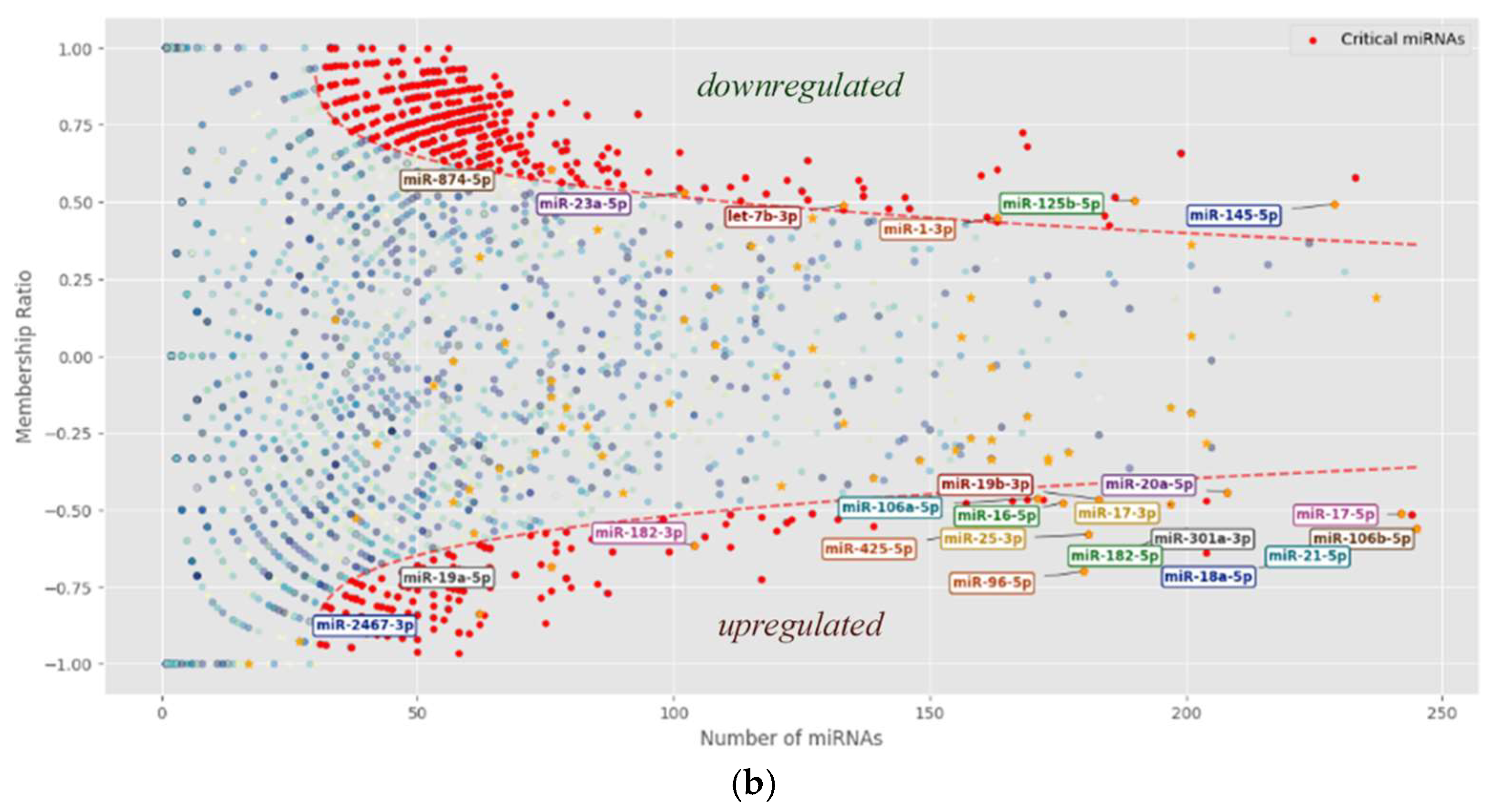
- The full set of 786 underexpressed and 607 overexpressed miRNAs from the III threshold analysis.
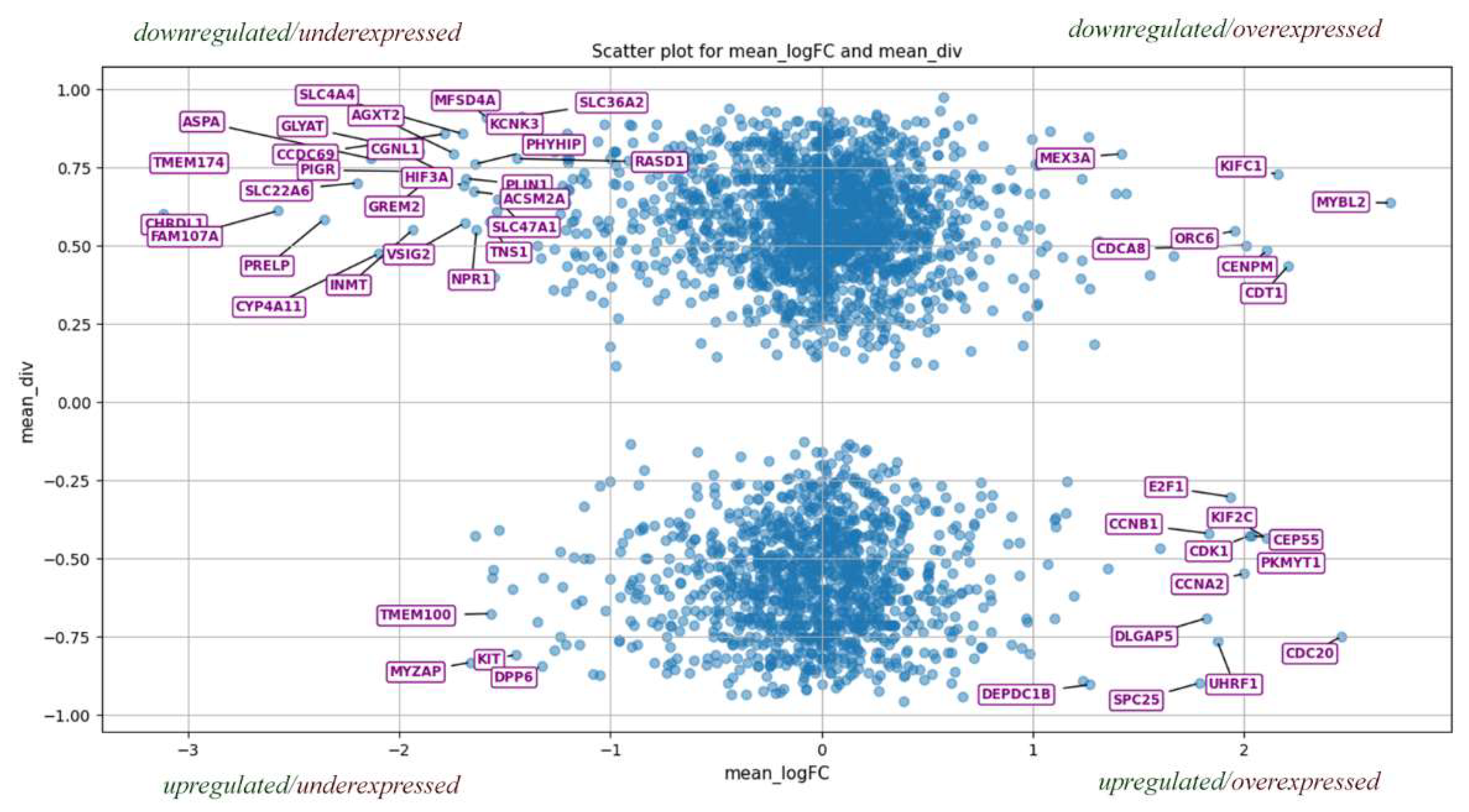
- A selective set of 115 underexpressed and 93 overexpressed miRNAs that target the 200 most critical cancer-related genes.
5. Conclusions
Supplementary Materials
Author Contributions
Funding
Data Availability Statement
Acknowledgments
Conflicts of Interest
Appendix A

| miRNA | Sum_logFC | Num_of_Down | Num_of_Up | Expression_Rate | References | Known_Oncomir/Tumor_Suppressor |
|---|---|---|---|---|---|---|
| hsa-miR-17-5p | 181.967 | 59 | 183 | UP | [18,19,20,21] overexpressed | oncomir |
| hsa-miR-17-3p | 221.214 | 51 | 146 | UP | [18,19,20] overexpressed | oncomir |
| hsa-miR-21-3p | 122.420 | 39 | 95 | UP | [18,22,23,24,25,26,27,28,29,30] overexpressed | oncomir |
| hsa-miR-25-3p | 105.474 | 38 | 143 | UP | [18,34] overexpressed | oncomir |
| hsa-miR-92a-2-5p | −96.775 | 57 | 19 | DOWN | [18] overexpressed | oncomir |
| hsa-miR-1-3p | −163.067 | 118 | 45 | DOWN | [35] underexpressed | tumor suppressor |
| hsa-miR-146b-5p | 83.355 | 58 | 100 | UP (EVEN) | [25,36,37,38,39] overexpressed | oncomir |
| hsa-miR-210-5p | 138.099 | 46 | 126 | UP | [40,41,42,43,44,45,46,47,48,49,50,51] overexpressed | oncomir |
| hsa-miR-155-3p | 26.049 | 30 | 48 | UP (EVEN) | [40,41,42,43,45,46,47,48,49,50,51] overexpressed | oncomir |
| hsa-miR-20a-3p | 30.730 | 32 | 51 | UP (EVEN) | [19,20] overexpressed | oncomir |
| hsa-miR-20a-5p | 128.094 | 58 | 150 | UP (EVEN) | [19,20] overexpressed | oncomir |
| hsa-miR-20b-3p | 18.138 | 25 | 48 | UP (EVEN) | [19,20] overexpressed | unknown |
| hsa-miR-20b-5p | 89.189 | 73 | 131 | UP (EVEN) | [19,20,52] overexpressed | oncomir |
| hsa-miR-92b-5p | 33.468 | 35 | 86 | UP | [19,20,53] overexpressed | oncomir |
| hsa-miR-92b-3p | 55.903 | 42 | 97 | UP (EVEN) | [19,20,53] overexpressed | oncomir |
| hsa-miR-106a-5p | 109.437 | 46 | 125 | UP | [19,20] overexpressed | unknown |
| hsa-miR-106a-3p | 55.146 | 17 | 43 | UP | [19,20] overexpressed | unknown |
| hsa-miR-106b-5p | 162.206 | 54 | 191 | UP | [19,20] overexpressed | oncomir |
| hsa-miR-106b-3p | 28.655 | 29 | 57 | UP (EVEN) | [19,20] overexpressed | oncomir |
| hsa-miR-574-3p | −89.761 | 102 | 42 | DOWN (EVEN) | [54,55] underexpressed | unknown |
| hsa-miR-100-5p | −42.845 | 141 | 96 | DOWN (EVEN) | [56,57,58] underexpressed | oncomir |
| hsa-miR-100-3p | 18.257 | 33 | 46 | EVEN | [56,57] underexpressed | oncomir |
| hsa-miR-125b-5p | −155.058 | 143 | 47 | DOWN | [56,57,59] underexpressed | tumor suppressor |
| hsa-miR-10a-5p | 18.033 | 65 | 62 | EVEN | [60] | oncomir |
| hsa-miR-10a-3p | 33.941 | 35 | 41 | EVEN | [60] overexpressed | unknown |
| hsa-miR-302c-3p | 35.479 | 15 | 42 | UP | [61,62] overexpressed | unknown |
| hsa-miR-302c-5p | 2.791 | 35 | 32 | EVEN | [61,62] overexpressed | unknown |
| hsa-miR-520c-3p | 14.080 | 24 | 29 | EVEN | [61,62] overexpressed | unknown |
| hsa-miR-181b-3p | 18.138 | 9 | 29 | UP | [37,38] overexpressed | unknown |
| hsa-miR-181b-5p | 56.004 | 49 | 99 | UP (EVEN) | [37,38] overexpressed | oncomir |
| hsa-miR-874-5p | −53.671 | 61 | 15 | DOWN | [63] underexpressed | tumor suppressor |
| hsa-miR-874-3p | −43.857 | 78 | 37 | DOWN | [63] underexpressed | unknown |
| hsa-miR-206 | −43.896 | 66 | 33 | DOWN | [64] underexpressed | tumor suppressor |
| hsa-miR-192-5p | −14.939 | 83 | 73 | EVEN | [65] underexpressed | tumor suppressor |
| hsa-miR-34a-5p | 78.603 | 54 | 101 | UP | [37,38,66,67,68] | tumor suppressor |
| hsa-miR-34a-3p | 32.856 | 42 | 57 | EVEN | [37,38,68] | tumor suppressor |
| hsa-miR-16-5p | 122.04 | 46 | 130 | UP | [37,38,69] overexpressed | oncomir |
| hsa-miR-222-3p | 79.537 | 82 | 119 | UP (EVEN) | [58,70] underexpressed | oncomir |
| hsa-let-7b-3p | −131.509 | 99 | 34 | DOWN | [71] underexpressed | tumor suppressor |
| hsa-let-7b-5p | −28.172 | 94 | 64 | DOWN (EVEN) | [71] underexpressed | tumor suppressor |
| hsa-miR-145-5p | −181.286 | 171 | 58 | DOWN | [72,73,74] overexpressed | tumor suppressor |
| hsa-miR-145-3p | −124.148 | 92 | 35 | DOWN | [72,73,74] overexpressed | tumor suppressor |
| hsa-miR-27a-3p | 73.096 | 57 | 116 | UP | [69,75,76,77] overexpressed | oncomir |
| hsa-miR-96-5p | 268.836 | 27 | 153 | UP | [78,79] overexpressed | oncomir |
| hsa-miR-483-3p | −67.676 | 80 | 44 | DOWN (EVEN) | [80] overexpressed | oncomir |
| hsa-miR-19b-3p | 122.182 | 49 | 134 | UP | [37,38,81] overexpressed | oncomir |
| hsa-miR-125b-5p | −155.058 | 143 | 47 | DOWN | [56,57,59,82], underexpressed | tumor suppressor |
| hsa-miR-4649-5p | 30.756 | 13 | 48 | UP | [83] overexpressed | unknown |
| hsa-miR-2467-3p | 109.959 | 5 | 57 | UP | [83] overexpressed | unknown |
| hsa-miR-543 | −23.65 | 57 | 45 | EVEN | [83] overexpressed | oncomir |
| hsa-miR-301a-3p | 197.374 | 43 | 157 | UP | [83] overexpressed | oncomir |
| hsa-miR-3132 | −6.754 | 19 | 15 | EVEN | [83] overexpressed | unknown |
| hsa-miR-19a-5p | 82.647 | 12 | 64 | UP | [37,38,83] overexpressed | oncomir |
| hsa-miR-495-3p | −27.556 | 66 | 42 | EVEN | [83] overexpressed | tumor suppressor |
| hsa-miR-21-5p | 232.095 | 48 | 185 | UP | [18,22,23,24,25,26,27,28,29,30,31,32,33,84,85,86] overexpressed | oncomir |
| hsa-miR-30a-5p | −105.284 | 137 | 64 | DOWN | [32,33] underexpressed | tumor suppressor |
| hsa-miR-10b-5p | 15.38 | 107 | 94 | EVEN | [86,87] overexpressed | oncomir |
| hsa-miR-221-3p | 104.84 | 82 | 115 | UP (EVEN) | [87,88] overexpressed | oncomir |
| hsa-miR-223-5p | 5.103 | 28 | 29 | EVEN | [87] overexpressed | oncomir |
| hsa-miR-223-3p | 12.148 | 78 | 84 | EVEN | [87] overexpressed | oncomir |
| hsa-miR-410-3p | −9.097 | 56 | 52 | EVEN | [89,90,91] overexpressed | oncomir |
| hsa-miR-182-5p | 269.607 | 40 | 155 | UP | [79,89,90] overexpressed | oncomir |
| hsa-miR-182-3p | 72.725 | 20 | 84 | UP | [89,90] overexpressed | oncomir |
| hsa-miR-29b-3p | 139.84 | 61 | 116 | UP | [50,51] overexpressed | oncomir |
| hsa-miR-372-5p | 16.601 | 0 | 17 | UP | [50,51] overexpressed | oncomir |
| hsa-miR-372-3p | 7.443 | 33 | 43 | EVEN | [50,51] overexpressed | oncomir |
| hsa-miR-9-3p | 34.288 | 56 | 64 | EVEN | [92] overexpressed | oncomir |
| hsa-miR-9-5p | 96.301 | 52 | 81 | UP | [92] overexpressed | oncomir |
| hsa-miR-146a-3p | 48.769 | 21 | 45 | UP | [93,94] overexpressed | oncomir |
| hsa-miR-146a-5p | 58.148 | 68 | 101 | UP (EVEN) | [93] overexpressed | oncomir |
| hsa-miR-23a-3p | 89.97 | 59 | 103 | UP | [69,95,96,97] overexpressed | oncomir |
| hsa-miR-23a-5p | −73.666 | 78 | 24 | DOWN | [69,97] overexpressed | oncomir |
| hsa-miR-24-3p | 65.578 | 54 | 108 | UP | [69] overexpressed | oncomir |
| hsa-miR-519a-3p | 57.869 | 25 | 65 | UP | [98] overexpressed | oncomir |
| hsa-miR-425-5p | 120.239 | 34 | 125 | UP | [69,99] overexpressed | oncomir |
| hsa-miR-208b-5p | 23.336 | 1 | 26 | UP | [100] overexpressed | oncomir |
| hsa-miR-208b-3p | 10.431 | 15 | 27 | UP | [100] overexpressed | oncomir |
| hsa-miR-18a-5p | 246.503 | 41 | 188 | UP | [101] overexpressed | oncomir |
| miRNA | Sum_logFC | Num_of_ Down | Num_of_ Up | miRNA | Sum_logFC | Num_of_ Down | Num_of_ Up |
|---|---|---|---|---|---|---|---|
| hsa-miR-139-5p | −256.8886988 | 165 | 34 | hsa-miR-429 | 148.5189271 | 40 | 110 |
| hsa-miR-139-3p | −253.6689636 | 145 | 23 | hsa-miR-93-5p | 161.3206615 | 59 | 185 |
| hsa-miR-125b-1-3p | −239.8640174 | 104 | 33 | hsa-miR-106b-5p | 162.2069637 | 54 | 191 |
| hsa-miR-133b | −224.7014228 | 142 | 27 | hsa-miR-135b-5p | 164.7171991 | 40 | 117 |
| hsa-miR-378a-3p | −218.0534439 | 184 | 49 | hsa-miR-142-3p | 167.0549993 | 45 | 124 |
| hsa-miR-125a-3p | −200.0807663 | 105 | 37 | hsa-miR-191-5p | 167.9664181 | 53 | 116 |
| hsa-miR-486-5p | −183.1454502 | 131 | 32 | hsa-miR-5100 | 168.399075 | 15 | 65 |
| hsa-miR-873-3p | −182.7628861 | 72 | 7 | hsa-miR-7-5p | 168.4722294 | 44 | 122 |
| hsa-miR-145-5p | −181.2865379 | 171 | 58 | hsa-miR-103a-3p | 171.422429 | 40 | 161 |
| hsa-miR-30b-3p | −173.559201 | 106 | 31 | hsa-miR-17-5p | 181.9678752 | 59 | 183 |
| hsa-miR-508-5p | −170.7541897 | 85 | 30 | hsa-miR-99a-5p | 187.435229 | 888 | 912 |
| hsa-miR-4648 | −168.3359797 | 56 | 10 | hsa-miR-1290 | 188.4010193 | 21 | 90 |
| hsa-miR-575 | −165.7760472 | 96 | 35 | hsa-miR-301a-3p | 197.3741224 | 43 | 157 |
| hsa-miR-6501-5p | −164.5701385 | 69 | 16 | hsa-miR-130b-3p | 205.3449082 | 46 | 182 |
| hsa-miR-134-3p | −163.1082517 | 76 | 19 | hsa-miR-17-3p | 221.2149965 | 51 | 146 |
| hsa-miR-1-3p | −163.0672057 | 118 | 45 | hsa-miR-21-5p | 232.0956337 | 48 | 185 |
| hsa-miR-497-5p | −161.7553736 | 141 | 45 | hsa-miR-18a-5p | 246.50339 | 41 | 188 |
| hsa-miR-6127 | −158.2358922 | 51 | 2 | hsa-miR-210-3p | 258.2379838 | 37 | 167 |
| hsa-miR-6751-5p | −157.8749887 | 61 | 7 | hsa-miR-96-5p | 268.8365613 | 27 | 153 |
| hsa-miR-887-5p | −157.4227012 | 83 | 10 | hsa-miR-183-5p | 269.522949 | 31 | 153 |
| hsa-miR-125b-5p | −155.0589238 | 143 | 47 | hsa-miR-182-5p | 269.6076375 | 40 | 155 |
References
- Kaikkonen, M.U.; Lam, M.T.; Glass, C.K. Non-coding RNAs as regulators of gene expression and epigenetics. Cardiovasc. Res. 2011, 90, 430–440. [Google Scholar] [CrossRef] [PubMed] [PubMed Central]
- Kilikevicius, A.; Meister, G.; Corey, D.R. Reexamining assumptions about miRNA-guided gene silencing. Nucleic Acids Res. 2022, 50, 617–634. [Google Scholar] [CrossRef]
- Lou, S.; Sun, T.; Li, H.; Hu, Z. Mechanisms of microRNA-mediated gene regulation in unicellular model alga Chlamydomonas reinhardtii. Biotechnol. Biofuels 2018, 11, 244. [Google Scholar] [CrossRef] [PubMed]
- Axtell, M.J.; Westholm, J.O.; Lai, E.C. Vive la différence: Biogenesis and evolution of microRNAs in plants and animals. Genome Biol. 2011, 12, 221. [Google Scholar] [CrossRef] [PubMed]
- Narjala, A.; Nair, A.; Tirumalai, V.; Hari Sundar, G.V.; Shivaprasad, P.V. A conserved sequence signature is essential for robust plant miRNA biogenesis. Nucleic Acids Res. 2020, 48, 3103–3118. [Google Scholar] [CrossRef] [PubMed]
- Pang, L.Y.; Gatenby, E.L.; Kamida, A.; Whitelaw, B.A.; Hupp, T.R.; Argyle, D.J. Global gene expression analysis of canine osteosarcoma stem cells reveals a novel role for COX-2 in tumour initiation. PLoS ONE 2014, 9, e83144. [Google Scholar] [CrossRef] [PubMed] [PubMed Central]
- Zheng, Y.; Liu, L.; Shukla, G.C. A comprehensive review of web-based non-coding RNA resources for cancer research. Cancer Lett. 2017, 407, 1–8. [Google Scholar] [CrossRef] [PubMed]
- O’Neill, J.R.; Yébenes Mayordomo, M.; Mitulović, G.; Al Shboul, S.; Bedran, G.; Faktor, J.; Hernychova, L.; Uhrik, L.; Gomez-Herranz, M.; Kocikowski, M.; et al. Multi-omic analysis of Esophageal Adenocarcinoma uncovers candidate therapeutic targets and cancer-selective post-transcriptional regulation. Mol. Cell. Proteom. 2024, 23, 100764. [Google Scholar] [CrossRef] [PubMed]
- Ali Syeda, Z.; Langden, S.S.S.; Munkhzul, C.; Lee, M.; Song, S.J. Regulatory Mechanism of MicroRNA Expression in Cancer. Int. J. Mol. Sci. 2020, 21, 1723. [Google Scholar] [CrossRef]
- Otmani, K.; Lewalle, P. Tumor Suppressor miRNA in Cancer Cells and the Tumor Microenvironment: Mechanism of Deregulation and Clinical Implications. Front. Oncol. 2021, 11, 708765. [Google Scholar] [CrossRef]
- Zheng, Y.; Zhu, Z. Editorial: Retrieving meaningful patterns from big biomedical data with machine learning approaches. Front. Genet. 2023, 14, 1177996. [Google Scholar] [CrossRef] [PubMed] [PubMed Central]
- Xu, F.; Wang, Y.; Ling, Y.; Zhou, C.; Wang, H.; Teschendorff, A.E.; Zhao, Y.; Zhao, H.; He, Y.; Zhang, G.; et al. dbDEMC 3.0: Functional exploration of differentially expressed miRNAs in cancers of human and model organisms. Genom. Proteom. Bioinform. 2022, 20, 446–454. [Google Scholar] [CrossRef] [PubMed]
- Przybyszewski, J.; Malawski, M.; Lichołai, S. GraphTar: Applying word2vec and graph neural networks to miRNA target prediction. BMC Bioinform. 2023, 24, 436. [Google Scholar] [CrossRef]
- Hu, H.; Zhao, H.; Zhong, T.; Dong, X.; Wang, L.; Han, P.; Li, Z. Adaptive deep propagation graph neural network for predicting miRNA–disease associations. Brief. Funct. Genom. 2023, 22, 453–462. [Google Scholar] [CrossRef] [PubMed]
- Min, S.; Lee, B.; Yoon, S. TargetNet: Functional microRNA target prediction with deep neural networks. Bioinformatics 2022, 38, 671–677. [Google Scholar] [CrossRef]
- Koroliouk, D.; Mattei, M.; Zoziuk, M.; Montesano, C.; Bernardini, R.; Potestà, M.; Pirrò, S.; Galgani, A.; Colizzi, V. Artificial Intelligence and MicroRNA: Role in Cancer Evolution. In Digital Ecosystems: Interconnecting Advanced Networks with AI Applications; Springer: Cham, Switzerland, 2024; Volume 11, Available online: https://link.springer.com/book/9783031612206 (accessed on 30 July 2024).
- Tang, G.; Cho, M.; Wang, X. OncoDB: An interactive online database for analysis of gene expression and viral infection in cancer. Nucleic Acids Res. 2022, 50, D1334–D1339. [Google Scholar] [CrossRef]
- Cadieux, Z.; Lewis, H.; Esquela-Kerscher, A. Role of Nutrition, the Epigenome, and microRNAs in Cancer Pathogenesis; The Royal Society of Chemistry: London, UK, 2019; Volume 1, pp. 1–35. [Google Scholar]
- Dhar, S.; Hicks, C.; Levenson, A.S. Resveratrol and prostate cancer: Promising role for microRNAs. Mol. Nutr. Food Res. 2011, 55, 1219–1229. [Google Scholar] [CrossRef]
- Maleki Dana, P.; Sadoughi, F.; Asemi, Z.; Yousefi, B. The role of polyphenols in overcoming cancer drug resistance: A comprehensive review. Cell Mol. Biol. Lett. 2022, 27, 1. [Google Scholar] [CrossRef]
- Dhawan, A.; Scott, J.G.; Harris, A.L.; Buffa, F.M. Pan-cancer characterisation of microRNA across cancer hallmarks reveals microRNA-mediated downregulation of tumour suppressors. Nat. Commun. 2018, 9, 5228. [Google Scholar] [CrossRef]
- Melnik, B.C. Synergistic Effects of Milk-Derived Exosomes and Galactose on α-Synuclein Pathology in Parkinson’s Disease and Type 2 Diabetes Mellitus. Int. J. Mol. Sci. 2021, 22, 1059. [Google Scholar] [CrossRef]
- Melnik, B.C. Lifetime Impact of Cow’s Milk on Overactivation of mTORC1: From Fetal to Childhood Overgrowth, Acne, Diabetes, Cancers, and Neurodegeneration. Biomolecules 2021, 11, 404. [Google Scholar] [CrossRef]
- Melnik, B.C.; Schmitz, G. Exosomes of pasteurized milk: Potential pathogens of Western diseases. J. Transl. Med. 2019, 17, 3. [Google Scholar] [CrossRef]
- Roessler, C.; Kuhlmann, K.; Hellwing, C.; Leimert, A.; Schumann, J. Impact of Polyunsaturated Fatty Acids on miRNA Profiles of Monocytes/Macrophages and Endothelial Cells-A Pilot Study. Int. J. Mol. Sci. 2017, 18, 284. [Google Scholar] [CrossRef] [PubMed]
- Cannataro, R.; Carbone, L.; Petro, J.L.; Cione, E.; Vargas, S.; Angulo, H.; Forero, D.A.; Odriozola-Martнnez, A.; Kreider, R.B.; Bonilla, D.A. Sarcopenia: Etiology, Nutritional Approaches, and miRNAs. Int. J. Mol. Sci. 2021, 22, 9724. [Google Scholar] [CrossRef] [PubMed]
- El-Sayed, N.S.; Elatrebi, S.; Said, R.; Ibrahim, H.F.; Omar, E.M. Potential mechanisms underlying the association between type II diabetes mellitus and cognitive dysfunction in rats: A link between miRNA-21 and Resveratrol’s neuroprotective action. Metab. Brain Dis. 2022, 37, 2375–2388. [Google Scholar] [CrossRef] [PubMed]
- Wang, X.; Hang, Y.; Liu, J.; Hou, Y.; Wang, N.; Wang, M. Anticancer effect of curcumin inhibits cell growth through miR-21/PTEN/Akt pathway in breast cancer cell. Oncol. Lett. 2017, 13, 4825–4831. [Google Scholar] [CrossRef]
- Li, H.; Jia, Z.; Li, A.; Jenkins, G.; Yang, X.; Hu, J.; Guo, W. Resveratrol repressed viability of U251 cells by miR-21 inhibiting of NF-κB pathway. Mol. Cell Biochem. 2013, 382, 137–143. [Google Scholar] [CrossRef]
- Rendina, D.; D′Elia, L.; Abate, V.; Rebellato, A.; Buondonno, I.; Succoio, M.; Martinelli, F.; Muscariello, R.; De Filippo, G.; D′Amelio, P.; et al. Vitamin D Status, Cardiovascular Risk Profile, and miRNA-21 Levels in Hypertensive Patients: Results of the HYPODD Study. Nutrients 2022, 14, 2683. [Google Scholar] [CrossRef]
- Melnik, B.C.; John, S.M.; Carrera-Bastos, P.; Cordain, L.; Leitzmann, C.; Weiskirchen, R.; Schmitz, G. The Role of Cow’s Milk Consumption in Breast Cancer Initiation and Progression. Curr. Nutr. Rep. 2023, 12, 122–140. [Google Scholar] [CrossRef]
- Baier, S.R.; Nguyen, C.; Xie, F.; Wood, J.R.; Zempleni, J. MicroRNAs are absorbed in biologically meaningful amounts from nutritionally relevant doses of cow milk and affect gene expression in peripheral blood mononuclear cells, HEK-293 kidney cell cultures, and mouse livers. J. Nutr. 2014, 144, 1495–1500. [Google Scholar] [CrossRef]
- Wang, L.; Sadri, M.; Giraud, D.; Zempleni, J. RNase H2-Dependent Polymerase Chain Reaction and Elimination of Confounders in Sample Collection, Storage, and Analysis Strengthen Evidence That microRNAs in Bovine Milk Are Bioavailable in Humans. J. Nutr. 2018, 148, 153–159. [Google Scholar] [CrossRef]
- Zan, L.; Chen, Q.; Zhang, L.; Li, X. Epigallocatechin gallate (EGCG) suppresses growth and tumorigenicity in breast cancer cells by downregulation of miR-25. Bioengineered 2019, 10, 374–382. [Google Scholar] [CrossRef]
- Wang, Y.; Chen, X.; Li, J.; Xia, C. Quercetin Antagonizes Esophagus Cancer by Modulating miR-1-3p/TAGLN2 Pathway-Dependent Growth and Metastasis. Nutr. Cancer 2022, 74, 1872–1881. [Google Scholar] [CrossRef]
- Farooqi, A.A.; Khalid, S.; Ahmad, A. Regulation of Cell Signaling Pathways and miRNAs by Resveratrol in Different Cancers. Int. J. Mol. Sci. 2018, 19, 652. [Google Scholar] [CrossRef]
- Kronski, E.; Fiori, M.E.; Barbieri, O.; Astigiano, S.; Mirisola, V.; Killian, P.H.; Bruno, A.; Pagani, A.; Rovera, F.; Pfeffer, U.; et al. miR181b is induced by the chemopreventive polyphenol curcumin and inhibits breast cancer metastasis via down-regulation of the inflammatory cytokines CXCL1 and -2. Mol. Oncol. 2014, 8, 581–595. [Google Scholar] [CrossRef]
- Norouzi, S.; Majeed, M.; Pirro, M.; Generali, D.; Sahebkar, A. Curcumin as an Adjunct Therapy and microRNA Modulator in Breast Cancer. Curr. Pharm. Des. 2018, 24, 171–177. [Google Scholar] [CrossRef] [PubMed]
- Al-Ansari, M.M.; Aboussekhra, A. miR-146b-5p mediates p16-dependent repression of IL-6 and suppresses paracrine procarcinogenic effects of breast stromal fibroblasts. Oncotarget 2015, 6, 30006–30016. [Google Scholar] [CrossRef] [PubMed]
- Javaid, A.; Zahra, D.; Rashid, F.; Mashraqi, M.; Alzamami, A.; Khurshid, M.; Ali Ashfaq, U. Regulation of micro-RNA, epigenetic factor by natural products for the treatment of cancers: Mechanistic insight and translational association. Saudi J. Biol. Sci. 2022, 29, 103255. [Google Scholar] [CrossRef]
- Song, J.; Jun, M.; Ahn, M.R.; Kim, O.Y. Involvement of miR-Let7A in inflammatory response and cell survival/apoptosis regulated by resveratrol in THP-1 macrophage. Nutr. Res. Pract. 2016, 10, 377–384. [Google Scholar] [CrossRef]
- Tili, E.; Michaille, J.J.; Adair, B.; Alder, H.; Limagne, E.; Taccioli, C.; Ferracin, M.; Delmas, D.; Latruffe, N.; Croce, C.M. Resveratrol decreases the levels of miR-155 by upregulating miR-663, a microRNA targeting JunB and JunD. Carcinogenesis 2010, 31, 1561–1566. [Google Scholar] [CrossRef] [PubMed]
- Ma, F.; Liu, F.; Ding, L.; You, M.; Yue, H.; Zhou, Y.; Hou, Y. Anti-inflammatory effects of curcumin are associated with down regulating microRNA-155 in LPS-treated macrophages and mice. Pharm. Biol. 2017, 55, 1263–1273. [Google Scholar] [CrossRef]
- Su, N.; Li, L.; Zhou, E.; Li, H.; Wu, S.; Cao, Z. Resveratrol Downregulates miR-155-5p to Block the Malignant Behavior of Gastric Cancer Cells. BioMed Res. Int. 2022, 2022, 6968641. [Google Scholar] [CrossRef]
- de la Parra, C.; Castillo-Pichardo, L.; Cruz-Collazo, A.; Cubano, L.; Redis, R.; Calin, G.A.; Dharmawardhane, S. Soy Isoflavone Genistein-Mediated Downregulation of miR-155 Contributes to the Anticancer Effects of Genistein. Nutr. Cancer 2016, 68, 154–164. [Google Scholar] [CrossRef] [PubMed]
- Javed, Z.; Khan, K.; Herrera-Bravo, J.; Naeem, S.; Iqbal, M.J.; Sadia, H.; Qadri, Q.R.; Raza, S.; Irshad, A.; Akbar, A.; et al. Genistein as a regulator of signaling pathways and microRNAs in different types of cancers. Cancer Cell Int. 2021, 21, 388, Correction in Cancer Cell Int. 2022, 22, 256. [Google Scholar] [CrossRef] [PubMed]
- Marques-Rocha, J.L.; Milagro, F.I.; Mansego, M.L.; Zulet, M.A.; Bressan, J.; Martнnez, J.A. Expression of inflammation-related miRNAs in white blood cells from subjects with metabolic syndrome after 8 wk of following a Mediterranean diet-based weight loss program. Nutrition 2016, 32, 48–55. [Google Scholar] [CrossRef]
- Gulei, D.; Raduly, L.; Broseghini, E.; Ferracin, M.; Berindan-Neagoe, I. The extensive role of miR-155 in malignant and non-malignant diseases. Mol. Asp. Med. 2019, 70, 33–56. [Google Scholar] [CrossRef]
- Lei, Q.Q.; Huang, Y.; Li, B.; Han, L.; Lv, C. MiR-155-5p promotes metastasis and epithelial-mesenchymal transition of renal cell carcinoma by targeting apoptosis-inducing factor. Int. J. Biol. Markers 2020, 36, 20–27. [Google Scholar] [CrossRef] [PubMed]
- Polytarchou, C.; Iliopoulos, D.; Hatziapostolou, M.; Kottakis, F.; Maroulakou, I.; Struhl, K.; Tsichlis, P.N. Akt2 regulates all akt isoforms and promotes resistance to hypoxia through induction of miR-21 upon oxygen deprivation. Cancer Res. 2011, 7113, 4720–4731. [Google Scholar] [CrossRef]
- Jafarifar, F.; Yao, P.; Eswarappa, S.M.; Fox, P.L. Repression of VEGFA by CA-rich element-binding microRNAs is modulated by hnRNP l. EMBO J. 2011, 307, 1324–1334. [Google Scholar] [CrossRef]
- Wang, M.; Liu, K.; Bu, H.; Cong, H.; Dong, G.; Xu, N.; Li, C.; Zhao, Y.; Jiang, F.; Zhang, Y.; et al. Purple sweet potato delphinidin-3-rutin represses glioma proliferation by inducing miR-20b-5p/Atg7-dependent cytostatic autophagy. Mol. Ther. Oncolytics 2022, 26, 314–329. [Google Scholar] [CrossRef]
- Nakano, T.; Chen, I.-H.; Wang, C.-C.; Chen, P.-J.; Tseng, H.-P.; Huang, K.-T.; Hu, T.-H.; Li, L.-C.; Goto, S.; Cheng, Y.-F.; et al. Circulating exosomal miR-92b: Its role for cancer immunoediting and clinical value for prediction of posttransplant hepatocellular carcinoma recurrence. Am. J. Transplant. 2019, 19, 3250–3262. [Google Scholar] [CrossRef]
- Chiyomaru, T.; Yamamura, S.; Fukuhara, S.; Hidaka, H.; Majid, S.; Saini, S.; Arora, S.; Deng, G.; Shahryari, V.; Chang, I.; et al. Genistein up-regulates tumor suppressor microRNA-574-3p in prostate cancer. PLoS ONE 2013, 8, e58929. [Google Scholar] [CrossRef]
- Ji, X.; Liu, K.; Li, Q.; Shen, Q.; Han, F.; Ye, Q.; Zheng, C. A Mini-Review of Flavone Isomers Apigenin and Genistein in Prostate Cancer Treatment. Front. Pharmacol. 2022, 13, 851589. [Google Scholar] [CrossRef]
- Giangreco, A.A.; Vaishnav, A.; Wagner, D.; Finelli, A.; Fleshner, N.; Van der Kwast, T.; Vieth, R.; Nonn, L. Tumor suppressor microRNAs, miR-100 and -125b, are regulated by 1,25-dihydroxyvitamin D in primary prostate cells and in patient tissue. Cancer Prev. Res. 2013, 6, 483–494. [Google Scholar] [CrossRef]
- Stephan, C.; Ralla, B.; Bonn, F.; Diesner, M.; Lein, M.; Jung, K. Vitamin D Metabolites in Nonmetastatic High-Risk Prostate Cancer Patients with and without Zoledronic Acid Treatment after Prostatectomy. Cancers 2022, 14, 1560. [Google Scholar] [CrossRef]
- Margolis, L.M.; Carrigan, C.T.; Murphy, N.E.; DiBella, M.N.; Wilson, M.A.; Whitney, C.C.; Howard, E.E.; Pasiakos, S.M.; Rivas, D.A. Carbohydrate intake in recovery from aerobic exercise differentiates skeletal muscle microRNA expression. Am. J. Physiol. Endocrinol. Metab. 2022, 323, E435–E447. [Google Scholar] [CrossRef] [PubMed]
- Benameur, T.; Soleti, R.; Porro, C. The Potential Neuroprotective Role of Free and Encapsulated Quercetin Mediated by miRNA against Neurological Diseases. Nutrients 2021, 13, 1318. [Google Scholar] [CrossRef] [PubMed]
- Khan, S.; Wall, D.; Curran, C.; Newell, J.; Kerin, M.J.; Dwyer, R.M. MicroRNA-10a is reduced in breast cancer and regulated in part through retinoic acid. BMC Cancer 2015, 15, 345. [Google Scholar] [CrossRef] [PubMed]
- Min, D.; Lv, X.B.; Wang, X.; Zhang, B.; Meng, W.; Yu, F.; Hu, H. Downregulation of miR-302c and miR-520c by 1,25(OH)2D3 treatment enhances the susceptibility of tumour cells to natural killer cell-mediated cytotoxicity. Br. J. Cancer 2013, 109, 723–730. [Google Scholar] [CrossRef]
- Mucoz, A.; Grant, W.B. Vitamin D and Cancer: An Historical Overview of the Epidemiology and Mechanisms. Nutrients 2022, 14, 1448. [Google Scholar]
- Wan Mohd Tajuddin, W.N.B.; Lajis, N.H.; Abas, F.; Othman, I.; Naidu, R. Mechanistic Understanding of Curcumin’s Therapeutic Effects in Lung Cancer. Nutrients 2019, 11, 2989. [Google Scholar] [CrossRef] [PubMed]
- Wang, N.; Feng, T.; Liu, X.; Liu, Q. Curcumin inhibits migration and invasion of non-small cell lung cancer cells through up-regulation of miR-206 and suppression of PI3K/AKT/mTOR signaling pathway. Acta Pharm. 2020, 70, 399–409. [Google Scholar] [CrossRef]
- Pan, Y.; Sun, Y.; Liu, Z.; Zhang, C. miR-192-5p upregulation mediates the suppression of curcumin in human NSCLC cell proliferation, migration and invasion by targeting c-Myc and inactivating the Wnt/β-catenin signaling pathway. Mol. Med. Rep. 2020, 22, 1594–1604. [Google Scholar] [CrossRef]
- Monraz-Mendez, C.A.; Escutia-Gutierrez, R.; Rodriguez-Sanabria, J.S.; Galicia-Moreno, M.; Monroy-Ramнrez, H.C.; Sanchez-Orozco, L.; Garcia-Bacuelos, J.; De la Rosa-Bibiano, R.; Santos, A.; Armendariz-Borunda, J.; et al. Moringa oleifera Improves MAFLD by Inducing Epigenetic Modifications. Nutrients 2022, 14, 4225. [Google Scholar] [CrossRef]
- Chai, R.; Xu, C.; Lu, L.; Liu, X.; Ma, Z. Quercetin inhibits proliferation of and induces apoptosis in non-small-cell lung carcinoma via the lncRNA SNHG7/miR-34a-5p pathway. Immunopharmacol. Immunotoxicol. 2021, 43, 693–703. [Google Scholar] [CrossRef]
- Hsieh, P.L.; Liao, Y.W.; Hsieh, C.W.; Chen, P.N.; Yu, C.C. Soy Isoflavone Genistein Impedes Cancer Stemness and Mesenchymal Transition in Head and Neck Cancer through Activating miR-34a/RTCB Axis. Nutrients 2020, 12, 1924. [Google Scholar] [CrossRef] [PubMed]
- Cheng, L.; Xia, T.-S.; Shi, L.; Xu, L.; Chen, W.; Zhu, Y.; Ding, Q. D rhamnose β-hederin inhibits migration and invasion of human breast cancer cell line MDA-MB-231. Biochem. Biophys. Res. Commun. 2018, 495, 775–780. [Google Scholar] [CrossRef] [PubMed]
- Tang, Y.; Cao, Y. Curcumin Inhibits the Growth and Metastasis of Melanoma via miR-222-3p/SOX10/Notch Axis. Dis. Markers 2022, 2022, 3129781. [Google Scholar] [CrossRef]
- Yamada, S.; Tsukamoto, S.; Huang, Y.; Makio, A.; Kumazoe, M.; Yamashita, S.; Tachibana, H. Epigallocatechin-3-O-gallate up-regulates microRNA-let-7b expression by activating 67-kDa laminin receptor signaling in melanoma cells. Sci. Rep. 2016, 6, 19225. [Google Scholar] [CrossRef]
- Mlotshwa, S.; Pruss, G.J.; MacArthur, J.L.; Endres, M.W.; Davis, C.; Hofseth, L.J.; Peca, M.M.; Vance, V. A novel chemopreventive strategy based on therapeutic microRNAs produced in plants. Cell Res. 2015, 25, 521–524. [Google Scholar] [CrossRef]
- Xu, J.; Tan, Y.L.; Liu, Q.Y.; Huang, Z.C.; Qiao, Z.H.; Li, T.; Hu, Z.Q.; Lei, L. Quercetin regulates fibrogenic responses of endometrial stromal cell by upregulating miR-145 and inhibiting the TGF-β1/Smad2/Smad3 pathway. Acta Histochem. 2020, 122, 151600. [Google Scholar] [CrossRef] [PubMed]
- Wei, D.; Yang, L.; Lv, B.; Chen, L. Genistein suppresses retinoblastoma cell viability and growth and induces apoptosis by upregulating miR-145 and inhibiting its target ABCE1. Mol. Vis. 2017, 23, 385–394. [Google Scholar] [PubMed]
- Liu, H.; Guan, H.; Tan, X.; Jiang, Y.; Li, F.; Sun-Waterhouse, D.; Li, D. Enhanced alleviation of insulin resistance via the IRS-1/Akt/FOXO1 pathway by combining quercetin and EGCG and involving miR-27a-3p and miR-96-5p. Free Radic. Biol. Med. 2022, 181, 105–117. [Google Scholar] [CrossRef]
- Regis, S.; Caliendo, F.; Dondero, A.; Casu, B.; Romano, F.; Loiacono, F.; Moretta, A.; Bottino, C.; Castriconi, R. TGF-ß1 downregulates the expression of CX3CR1 by inducing miR-27a-5p in primary human NK cells. Front. Immunol. 2017, 8, 868. [Google Scholar] [CrossRef]
- Donatelli, S.S.; Zhou, J.-M.; Gilvary, D.L.; Eksioglu, E.A.; Chen, X.; Cress, W.D.; Haura, E.B.; Schabath, M.B.; Coppola, D.; Wei, S.; et al. TGF-β-inducible microRNA-183 silences tumor-associated natural killer cells. Proc. Natl. Acad. Sci. USA 2014, 111, 4203–4208. [Google Scholar] [CrossRef] [PubMed]
- Chen, W.T.; Yang, M.J.; Tsuei, Y.W.; Su, T.C.; Siao, A.C.; Kuo, Y.C.; Huang, L.R.; Chen, Y.; Chen, S.J.; Chen, P.C.; et al. Green Tea Epigallocatechin Gallate Inhibits Preadipocyte Growth via the microRNA-let-7a/HMGA2 Signaling Pathway. Mol. Nutr. Food Res. 2023, 67, e2200336. [Google Scholar] [CrossRef]
- Soheilifar, M.H.; Vaseghi, H.; Seif, F.; Ariana, M.; Ghorbanifar, S.; Habibi, N.; Barjasteh, F.P.; Pornour, M. Concomitant overexpression of mir-182-5p and mir-182-3p raises the possibility of IL-17–producing treg formation in breast cancer by targeting CD3d, ITK, FOXO1, and NFATs: A meta-analysis and experimental study. Cancer Sci. 2021, 112, 589–603. [Google Scholar] [CrossRef]
- Kang, Q.; Tong, Y.; Gowd, V.; Wang, M.; Chen, F.; Cheng, K.W. Oral administration of EGCG solution equivalent to daily achievable dosages of regular tea drinkers effectively suppresses miR483-3p induced metastasis of hepatocellular carcinoma cells in mice. Food Funct. 2021, 12, 3381–3392. [Google Scholar] [CrossRef]
- Tang, Y.; Yang, J.; Wang, Y.; Tang, Z.; Liu, S.; Tang, Y. MiR-19b-3p facilitates the proliferation and epithelial-mesenchymal transition, and inhibits the apoptosis of intrahepatic cholangiocarcinoma by suppressing coiled-coil domain containing 6. Arch. Biochem. Biophys. 2020, 6866, 108367. [Google Scholar] [CrossRef]
- Duchnik, E.; Kruk, J.; Tuchowska, A.; Marchlewicz, M. The Impact of Diet and Physical Activity on Psoriasis: A Narrative Review of the Current Evidence. Nutrients 2023, 15, 840. [Google Scholar] [CrossRef]
- Saini, S.K.; Singh, A.; Saini, M.; Gonzalez-Freire, M.; Leeuwenburgh, C.; Anton, S.D. Time-Restricted Eating Regimen Differentially Affects Circulatory miRNA Expression in Older Overweight Adults. Nutrients 2022, 14, 1843. [Google Scholar] [CrossRef]
- Luan, G.; Wang, M.; Yuan, J.; Bu, X.; Song, J.; Wang, C.; Zhang, L. Regulatory network identified by pulmonary transcriptome and proteome profiling reveals extensive change of tumor-related genes in microRNA-21 knockout mice. J. Cancer Res. Clin. Oncol. 2022, 148, 1919–1929. [Google Scholar] [CrossRef]
- Hu, Y.; Wang, C.; Li, Y.; Zhao, J.; Chen, C.; Zhou, Y.; Tao, Y.; Guo, M.; Qin, N.; Ren, T.; et al. MiR-21 controls in situ expansion of CCR6+ regulatory T cells through PTEN/AKT pathway in breast cancer. Immunol. Cell Biol. 2015, 93, 753–764. [Google Scholar] [CrossRef]
- Levens, D. Disentangling the MYC web. Proc. Natl. Acad. Sci. USA 2002, 999, 5757–5759. [Google Scholar] [CrossRef]
- Ghosh, S.; Bhowmik, S.; Majumdar, S.; Goswami, A.; Chakraborty, J.; Gupta, S.; Aggarwal, S.; Ray, S.; Chatterjee, R.; Bhattacharyya, S.; et al. The exosome encapsulated microRNAs as circulating diagnostic marker for hepatocellular carcinoma with low alpha-fetoprotein. Int. J. Cancer 2020, 147, 2934–2947. [Google Scholar] [CrossRef] [PubMed]
- Liang, Y.-K.; Lin, H.-Y.; Dou, X.-W.; Chen, M.; Wei, X.-L.; Zhang, Y.-Q.; Wu, Y.; Chen, C.-F.; Bai, J.-W.; Xiao, Y.-S.; et al. MiR-221/222 promote epithelial-mesenchymal transition by targeting Notch3 in breast cancer cell lines. npj Breast Cancer 2018, 4, 20. [Google Scholar] [CrossRef] [PubMed]
- Zhang, Y.; Zhang, D.; Lv, J.; Wang, S.; Zhang, Q. miR-410–3p promotes prostate cancer progression via regulating PTEN/AKT/mTOR signaling pathway. Biochem. Biophys. Res. Commun. 2018, 503, 2459–2465. [Google Scholar] [CrossRef] [PubMed]
- Souza, M.F.; Cólus, I.M.S.; Fonseca, A.S.; Antunes, V.C.; Kumar, D.; Cavalli, L.R. MiR-182-5p modulates prostate cancer aggressive phenotypes by targeting EMT associated pathways. Biomolecules 2022, 12, 187. [Google Scholar] [CrossRef]
- Ma, Z.H.; Shi, P.D.; Wan, B.S. MiR-410-3p activates the NF-κB pathway by targeting ZCCHC10 to promote migration, invasion and EMT of colorectal cancer. Cytokine 2021, 1401, 155433. [Google Scholar] [CrossRef]
- Gao, F.; Zhao, Z.-L.; Zhao, W.-T.; Fan, Q.-R.; Wang, S.-C.; Li, J.; Zhang, Y.-Q.; Shi, J.-W.; Lin, X.-L.; Yang, S.; et al. MiR-9 modulates the expression of interferon-regulated genes and MHC class I molecules in human nasopharyngeal carcinoma cells. Biochem. Biophys. Res. Commun. 2013, 431, 610–616. [Google Scholar] [CrossRef]
- Cheng, W.C.; Liao, T.-T.; Lin, C.-C.; Yuan, L.-T.E.; Lan, H.-Y.; Lin, H.-H.; Teng, H.W.; Chang, H.C.; Lin, C.H.; Yang, C.Y.; et al. RAB27B-activated secretion of stem-like tumor exosomes delivers the biomarker microRNA-146a-5p, which promotes tumorigenesis and associates with an immunosuppressive tumor microenvironment in colorectal cancer. Int. J. Cancer 2019, 145, 2209–2224. [Google Scholar] [CrossRef] [PubMed]
- Xu, D.; Han, Q.; Hou, Z.; Zhang, C.; Zhang, J. MIR-146a negatively regulates NK cell functions via STAT1 signaling. Cell Mol. Immunol. 2017, 14, 712–720. [Google Scholar] [CrossRef] [PubMed]
- Yang, W.; Yang, S.; Zhang, F.; Cheng, F.; Wang, X.; Rao, J. Influence of the hippo-YAP signaling pathway on tumor associated macrophages (TAMs) and its implications on cancer immunosuppressive microenvironment. Ann. Transl. Med. 2020, 8, 399. [Google Scholar] [CrossRef]
- Liu, J.; Fan, L.; Yu, H.; Zhang, J.; He, Y.; Feng, D.; Wang, F.; Li, X.; Liu, Q.; Li, Y.; et al. Endoplasmic reticulum stress causes liver cancer cells to release exosomal miR-23a-3p and up-regulate programmed death ligand 1 expression in macrophages. Hepatology 2019, 70, 241–258. [Google Scholar] [CrossRef]
- Stern-Ginossar, N.; Gur, C.; Biton, M.; Horwitz, E.; Elboim, M.; Stanietsky, N.; Mandelboim, M.; Mandelboim, O. Human microRNAs regulate stress-induced immune responses mediated by the receptor NKG2D. Nat. Immunol. 2008, 9, 1065–1073. [Google Scholar] [CrossRef]
- Breunig, C.; Pahl, J.; Küblbeck, M.; Miller, M.; Antonelli, D.; Erdem, N.; Wirth, C.; Will, R.; Bott, A.; Cerwenka, A.; et al. MicroRNA-519a-3p mediates apoptosis resistance in breast cancer cells and their escape from recognition by natural killer cells. Cell Death Dis. 2017, 8, e2973. [Google Scholar] [CrossRef]
- Chen, W.X.; Cheng, L.; Pan, M.; Qian, Q.; Zhu, Y.-L.; Xu, L.-Y.; Ding, Q. D rhamnose β-hederin against human breast cancer by reducing tumor-derived exosomes. Oncol. Lett. 2018, 16, 5172–5178. [Google Scholar] [CrossRef]
- Ning, T.; Li, J.; He, Y.; Zhang, H.; Wang, X.; Deng, T.; Liu, R.; Li, H.; Bai, M.; Fan, Q.; et al. Exosomal miR-208b related with oxaliplatin resistance promotes treg expansion in colorectal cancer. Mol. Ther. 2021, 29, 2723–2736. [Google Scholar] [CrossRef]
- Kahroba, H.; Samadi, N.; Mostafazadeh, M.; Hejazi, M.S.; Sadeghi, M.R.; Hashemzadeh, S.; Sadat, A.T.E.; Karimi, A. Evaluating the presence of deregulated tumoral onco-microRNAs in serum-derived exosomes of gastric cancer patients as noninvasive diagnostic biomarkers. BioImpacts 2021, 12, 127–138. [Google Scholar] [CrossRef] [PubMed]
- Huang, H.Y.; Lin, Y.-C.-D.; Cui, S.; Huang, Y.; Tang, Y.; Xu, J.; Bao, J.; Li, Y.; Wen, J.; Zuo, H.; et al. miRTarBase update 2022: An informative resource for experimentally validated miRNA–target interactions. Nucleic Acids Res. 2022, 50, D222–D230. [Google Scholar] [CrossRef] [PubMed]
- Zoziuk, M.; Colizzi, V.; Krysenko, P.; Mattei, M.; Bernardini, R.; Zanzotto, F.M.; Marini, S.; Koroliouk, D. Plant miRNAs for Improved Gene Regulation in a Wide Range of Human Cancers. Curr. Issues Mol. Biol. 2025, 47, 42. [Google Scholar] [CrossRef]
- Zhang, Z.; Yu, J.; Li, D.; Zhang, Z.; Liu, F.; Zhou, X.; Wang, T.; Ling, Y.; Su, Z. PMRD: Plant microRNA database. Nucleic Acids Res. 2010, 38, D806–D813. [Google Scholar] [CrossRef]
- Oliveto, S.; Mancino, M.; Manfrini, N.; Biffo, S. Role of microRNAs in translation regulation and cancer. World J. Biol. Chem. 2017, 8, 45–56. [Google Scholar] [CrossRef] [PubMed] [PubMed Central]
- Pekarek, L.; Torres-Carranza, D.; Fraile-Martinez, O.; García-Montero, C.; Pekarek, T.; Saez, M.A.; Rueda-Correa, F.; Pimentel-Martinez, C.; Guijarro, L.G.; Diaz-Pedrero, R.; et al. An Overview of the Role of MicroRNAs on Carcinogenesis: A Focus on Cell Cycle, Angiogenesis and Metastasis. Int. J. Mol. Sci. 2023, 24, 7268. [Google Scholar] [CrossRef] [PubMed] [PubMed Central]
- Hata, A.; Kashima, R. Dysregulation of microRNA biogenesis machinery in cancer. Crit. Rev. Biochem. Mol. Biol. 2016, 51, 121–134. [Google Scholar] [CrossRef] [PubMed] [PubMed Central]
- Smolarz, B.; Durczyński, A.; Romanowicz, H.; Szyłło, K.; Hogendorf, P. miRNAs in Cancer (Review of Literature). Int. J. Mol. Sci. 2022, 23, 2805. [Google Scholar] [CrossRef] [PubMed] [PubMed Central]
- Li, D.; Yang, J.; Yang, Y.; Liu, J.; Li, H.; Li, R.; Cao, C.; Shi, L.; Wu, W.; He, K. A Timely Review of Cross-Kingdom Regulation of Plant-Derived MicroRNAs. Front. Genet. 2021, 12, 613197. [Google Scholar] [CrossRef]
- Samad, A.F.A.; Kamaroddin, M.F.; Sajad, M. Cross-Kingdom Regulation by Plant microRNAs Provides Novel Insight into Gene Regulation. Adv. Nutr. 2021, 12, 197–211. [Google Scholar] [CrossRef] [PubMed] [PubMed Central]
- Alshehri, B. Plant-derived xenomiRs and cancer: Cross-kingdom gene regulation. Saudi J. Biol. Sci. 2021, 28, 2408–2422. [Google Scholar] [CrossRef] [PubMed] [PubMed Central]
- Miretti, S.; Lecchi, C.; Ceciliani, F.; Baratta, M. MicroRNAs as Biomarkers for Animal Health and Welfare in Livestock. Front. Vet. Sci. 2020, 7, 578193. [Google Scholar] [CrossRef]
- Bartel, D.P. MicroRNAs: Target recognition and regulatory functions. Cell 2009, 136, 215–233. [Google Scholar] [CrossRef] [PubMed] [PubMed Central]



| miRNA | Coefficient_Similarity_Up | Coefficient_Similarity_Down | Diff |
|---|---|---|---|
| ptc-miRf12120-akr | 0.567818 | 0.680251 | 0.112433 |
| cre-miR914 | 0.460989 | 0.573858 | 0.11287 |
| ptc-miRf10479-akr | 0.493849 | 0.607797 | 0.113949 |
| ptc-miRf10488-akr | 0.529684 | 0.645046 | 0.115362 |
| ptc-miRf10495-akr | 0.486887 | 0.603567 | 0.11668 |
| osa-miR531b | 0.459638 | 0.576326 | 0.116688 |
| tae-miR2019 | 0.467059 | 0.584464 | 0.117405 |
| peu-miR2911 | 0.412766 | 0.542227 | 0.129461 |
| osa-miR1848 | 0.442845 | 0.57365 | 0.130805 |
| osa-miR531 | 0.495555 | 0.635791 | 0.140237 |
Disclaimer/Publisher’s Note: The statements, opinions and data contained in all publications are solely those of the individual author(s) and contributor(s) and not of MDPI and/or the editor(s). MDPI and/or the editor(s) disclaim responsibility for any injury to people or property resulting from any ideas, methods, instructions or products referred to in the content. |
© 2025 by the authors. Licensee MDPI, Basel, Switzerland. This article is an open access article distributed under the terms and conditions of the Creative Commons Attribution (CC BY) license (https://creativecommons.org/licenses/by/4.0/).
Share and Cite
Zoziuk, M.; Colizzi, V.; Mattei, M.; Krysenko, P.; Bernandini, R.; Zanzotto, F.M.; Marini, S.; Koroliouk, D. Human miRNAs in Cancer: Statistical Trends and Cross Kingdom Approach. Int. J. Mol. Sci. 2025, 26, 11594. https://doi.org/10.3390/ijms262311594
Zoziuk M, Colizzi V, Mattei M, Krysenko P, Bernandini R, Zanzotto FM, Marini S, Koroliouk D. Human miRNAs in Cancer: Statistical Trends and Cross Kingdom Approach. International Journal of Molecular Sciences. 2025; 26(23):11594. https://doi.org/10.3390/ijms262311594
Chicago/Turabian StyleZoziuk, Maksym, Vittorio Colizzi, Maurizio Mattei, Pavlo Krysenko, Roberta Bernandini, Fabio Massimo Zanzotto, Stefano Marini, and Dmitri Koroliouk. 2025. "Human miRNAs in Cancer: Statistical Trends and Cross Kingdom Approach" International Journal of Molecular Sciences 26, no. 23: 11594. https://doi.org/10.3390/ijms262311594
APA StyleZoziuk, M., Colizzi, V., Mattei, M., Krysenko, P., Bernandini, R., Zanzotto, F. M., Marini, S., & Koroliouk, D. (2025). Human miRNAs in Cancer: Statistical Trends and Cross Kingdom Approach. International Journal of Molecular Sciences, 26(23), 11594. https://doi.org/10.3390/ijms262311594