Structural Characterization of Protein–Nucleic Acid Complexes: An Overview of the Recent Innovation in the Analytic Methods

 and
and
Abstract
1. Introduction
2. Microscopy-Based Methods
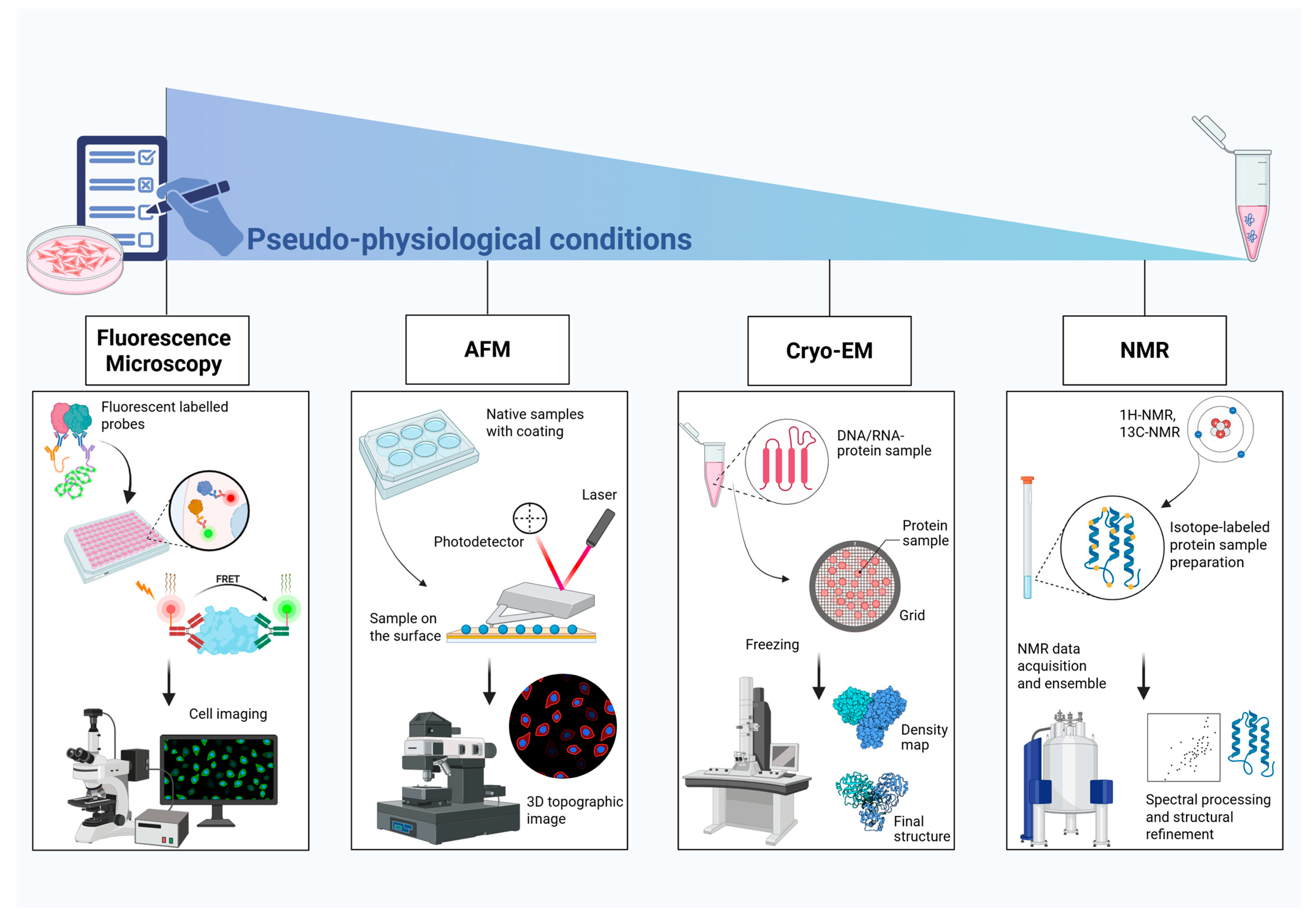
2.1. Fluorescence Microscopy
2.1.1. Immunofluorescence
2.1.2. Single Molecule Fluorescence
2.1.3. Total Internal Reflection Fluorescence Microscopy
2.1.4. Fluorescent Resonance Energy Transfer
2.1.5. Aptamers
2.1.6. Molecular Fluorescence Complementation Systems (BiFC, TriFC)
2.2. Probe Microscopy
2.3. Electron Microscopy
2.3.1. Cryo-Electron Microscopy (Cryo-EM)
2.3.2. Correlative Light and Electron Microscopy (CLEM)
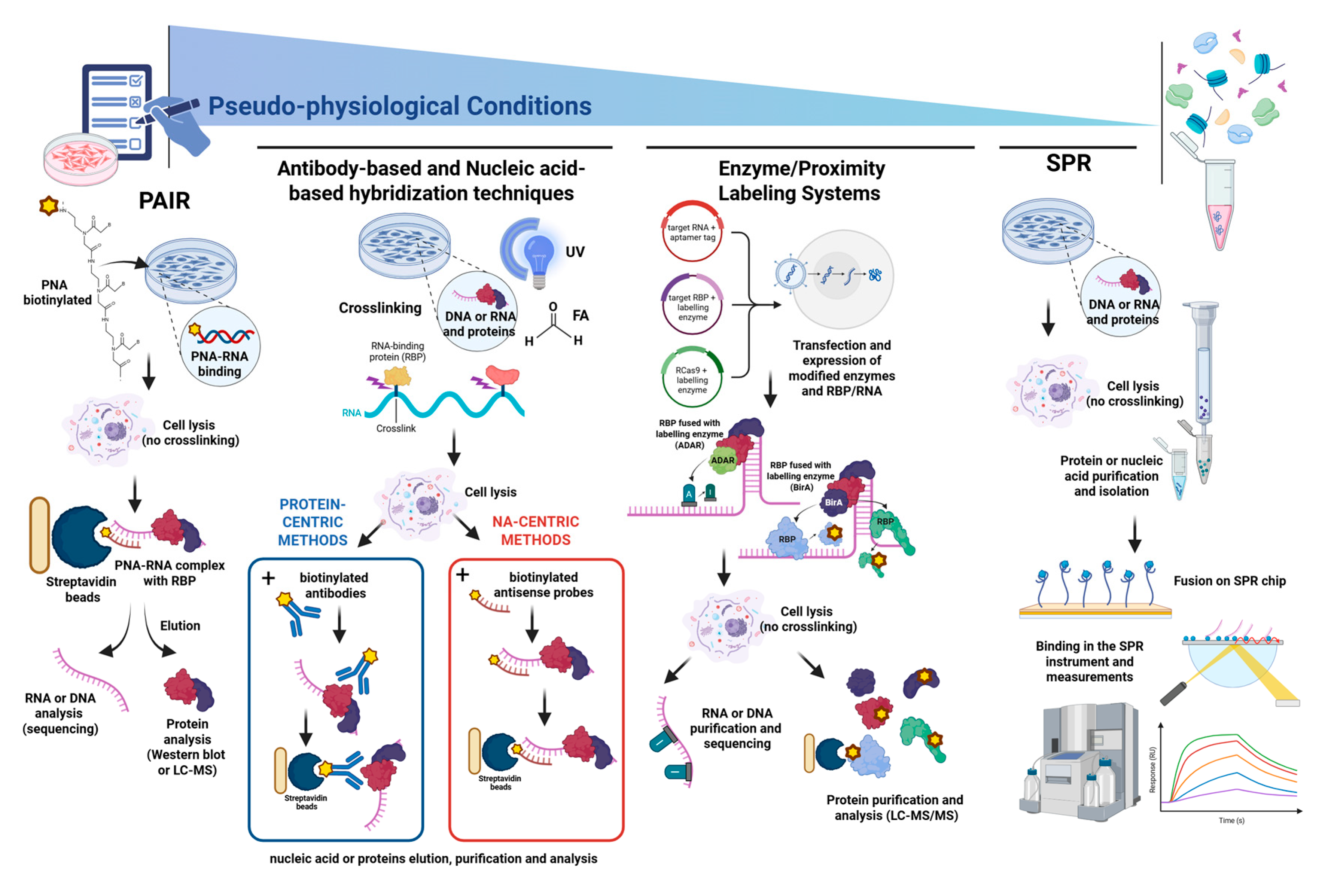
3. Immunocapture Systems: RNA and Protein-Centric Methods
3.1. Protein-Centric Approaches
3.2. RNA-Centric Approaches
4. Surface Plasmon Resonance to Study Protein–Nucleic Acid Interactions
5. Alternative RNA-Centric Capturing Techniques
5.1. Crosslink-Hybridization Capture Techniques
5.1.1. Chromatine Isolation by RNA Purification (ChIRP)
5.1.2. Capture Hybridization Analysis of RNA Targets (CHART)
5.1.3. RNA Antisense Purification (RAP)
5.1.4. HyPR-MS (Hybridization Purification Followed by Mass Spectrometry)
5.2. RNA-Targeting Systems
5.2.1. MS2/PP7/BoxB Aptamer Systems for RNA Capture and Visualization
5.2.2. SELEX (Systematic Evolution of Ligands by Exponential Enrichment)
5.2.3. PNA-Assisted RNA Capture (PAIR)
5.2.4. CRISPR-Cas-Based RNA Targeting and Visualization (dCas13/RCas9)
5.3. Enzyme/Proximity Labeling Systems (TRIBE, RaPID, BioID/TurboID/APEX)
5.3.1. TRIBE (Targeted RNA Interactions and Binding Evaluator)
5.3.2. BioID and TurboID (Proximity Biotinylation)
5.3.3. RaPID (RNA-Proximal Interactions Detected)
5.3.4. APEX (Avidity-Based Protein Enrichment)
6. X-Ray Crystallography
7. Nuclear Magnetic Resonance (NMR)
8. Conclusions
Funding
Data Availability Statement
Conflicts of Interest
References
- Nath, D.; Shadan, S. Dynamics of the cell. Nature 2011, 475, 307. [Google Scholar] [CrossRef] [PubMed]
- Cozzolino, F.; Iacobucci, I.; Monaco, V.; Monti, M. Protein-DNA/RNA Interactions: An Overview of Investigation Methods in the -Omics Era. J. Proteome Res. 2021, 20, 3018–3030. [Google Scholar] [CrossRef]
- Stedman, E. Cell specificity of histones. Nature 1950, 166, 780–781. [Google Scholar] [CrossRef]
- Smith, N.C.; Matthews, J.M. Mechanisms of DNA-binding specificity and functional gene regulation by transcription factors. Curr. Opin. Struct. Biol. 2016, 38, 68–74. [Google Scholar] [CrossRef]
- Siggers, T.; Gordân, R. Protein-DNA binding: Complexities and multi-protein codes. Nucleic Acids Res. 2014, 42, 2099–2111. [Google Scholar] [CrossRef]
- Wang, D.; Farhana, A. Biochemistry, RNA Structure; StatPearls Publishing: Treasure Island, FL, USA, 2023. [Google Scholar]
- Li, Q.; Li, B.; Li, Q.; Wei, S.; He, Z.; Huang, X.; Wang, L.; Xia, Y.; Xu, Z.; Li, Z.; et al. Exosomal miR-21-5p derived from gastric cancer promotes peritoneal metastasis via mesothelial-to-mesenchymal transition. Cell Death Dis. 2018, 9, 854. [Google Scholar] [CrossRef]
- Ortiz-Sánchez, P.; Villalba-Orero, M.; López-Olañeta, M.M.; Larrasa-Alonso, J.; Sánchez-Cabo, F.; Martí-Gómez, C.; Camafeita, E.; Gómez-Salinero, J.M.; Ramos-Hernández, L.; Nielsen, P.J.; et al. Loss of SRSF3 in Cardiomyocytes Leads to Decapping of Contraction-Related mRNAs and Severe Systolic Dysfunction. Circ. Res. 2019, 125, 170–183. [Google Scholar] [CrossRef]
- Chua, G.N.L.; Liu, S. When Force Met Fluorescence: Single-Molecule Manipulation and Visualization of Protein-DNA Interactions. Annu. Rev. Biophys. 2024, 53, 169–191. [Google Scholar] [CrossRef] [PubMed]
- Ray, S.; Widom, R.J.; Walter, N.G. Life under the Microscope: Single-Molecule Fluorescence Highlights the RNA World. Chem. Rev. 2018, 118, 4120–4155. [Google Scholar] [CrossRef] [PubMed]
- Rotman, B. Measurement of Activity of Single Molecules of β-D-Galactosidase. Proc. Natl. Acad. Sci. USA 1961, 47, 1981–1991. [Google Scholar] [CrossRef]
- Im, K.; Mareninov, S.; Diaz, M.F.P.; Yong, W.H. An Introduction to Performing Immunofluorescence Staining. Methods Mol. Biol. 2019, 1897, 299–311. [Google Scholar]
- Vasantha Niranjan, C.; Retnaraj Samue, S.J.; Saravanakumar, V.; Jackson Durairaj, S. Novel and Efficient Protocol for DNA Coating-Based Identification of DNA-Protein Interaction by Antibody-Mediated Immunodetection. Rep. Biochem. Mol. Biol. 2020, 9, 264–269. [Google Scholar]
- Pile, L.A.; Wassarman, D.A. Localizing transcription factors on chromatin by immunofluorescence. Methods 2002, 26, 3–9. [Google Scholar] [CrossRef]
- Grande, M.A.; van der Kraan, I.; de Jong, L.; van Driel, R. Nuclear distribution of transcription factors in relation to sites of transcription and RNA polymerase II. J. Cell Sci. 1997, 110, 1781–1791. [Google Scholar] [CrossRef]
- Castillo, F.; Mackenzie, T.A.; Cautain, B. Immunofluorescence Analysis by Confocal Microscopy for Detecting Endogenous FOXO. Methods Mol. Biol. 2019, 1890, 143–149. [Google Scholar]
- Govindan, M.V. Immunofluorescence microscopy of the intracellular translocation of glucocorticoid-receptor complexes in rat hepatoma (HTC) cells. Exp. Cell Res. 1980, 127, 293–297. [Google Scholar] [CrossRef] [PubMed]
- Seo, H.Y.; Kim, Y.D.; Lee, K.M.; Min, A.K.; Kim, M.K.; Kim, H.S.; Won, K.C.; Park, J.Y.; Lee, K.U.; Choi, H.S.; et al. Endoplasmic reticulum stress-induced activation of activating transcription factor 6 decreases insulin gene expression via up-regulation of orphan nuclear receptor small heterodimer partner. Endocrinology 2008, 149, 3832–3841. [Google Scholar] [CrossRef] [PubMed]
- Clavel, S.; Siffroi-Fernandez, S.; Coldefy, A.S.; Boulukos, K.; Pisani, D.F.; Dérijard, B. Regulation of the intracellular localization of Foxo3a by stress-activated protein kinase signaling pathways in skeletal muscle cells. Mol. Cell. Biol. 2010, 30, 470–480. [Google Scholar] [CrossRef] [PubMed]
- Thorn, K. Genetically encoded fluorescent tags. Mol. Biol. Cell 2017, 28, 848–857. [Google Scholar] [CrossRef]
- Tsai, A.; Puglisi, J.D.; Uemura, S. Probing the Translation Dynamics of Ribosomes Using Zero-Mode Waveguides. Prog. Mol. Biol. Transl. Sci. 2016, 139, 1–43. [Google Scholar]
- Iizuka, R.; Yamazaki, H.; Uemura, S. Zero-mode waveguides and nanopore-based sequencing technologies accelerate single-molecule studies. Biophys. Physicobiol. 2022, 19, e190032. [Google Scholar] [CrossRef] [PubMed]
- Snead, W.T.; Jalihal, A.P. Membrane surfaces regulate assembly of ribonucleoprotein condensates. Nat. Cell Biol. 2022, 24, 461–470. [Google Scholar] [CrossRef] [PubMed]
- Mekonnen, G.; Djaja, N.; Yuan, X.; Myong, S. Advanced imaging techniques for studying protein phase separation in living cells and at single-molecule level. Curr. Opin. Chem. Biol. 2023, 76, 102371. [Google Scholar] [CrossRef] [PubMed]
- Cutrale, F.; Rodriguez, D.; Hortigüela, V.; Chiu, C.L.; Otterstrom, J.; Mieruszynski, S.; Seriola, A.; Larrañaga, E.; Raya, A.; Lakadamyali, M.; et al. Using enhanced number and brightness to measure protein oligomerization dynamics in live cells. Nat. Protoc. 2019, 14, 616–638. [Google Scholar] [CrossRef]
- Lee, R.; Kang, M.K.; Kim, Y.J.; Yang, B.; Shim, H.; Kim, S.; Kim, K.; Yang, C.M.; Min, B.G.; Jung, W.J.; et al. CTCF-mediated chromatin looping provides a topological framework for the formation of phase-separated transcriptional condensates. Nucleic Acids Res. 2022, 50, 207–226. [Google Scholar]
- Peng, S.; Li, W.; Yao, Y.; Xing, W.; Li, P.; Chen, C. Phase separation at the nanoscale quantified by dcFCCS. Proc. Natl. Acad. Sci. USA 2020, 117, 27124–27131. [Google Scholar] [CrossRef]
- Xu, J.; Ma, H.; Jin, J.; Uttam, S.; Fu, R.; Huang, Y.; Liu, Y. Super-Resolution Imaging of Higher-Order Chromatin Structures at Different Epigenomic States in Single Mammalian Cells. Cell Rep. 2018, 24, 873–882. [Google Scholar] [CrossRef]
- Huang, Z.; Kaltenbrunner, S.; Šimková, E.; Stanĕk, D.; Lukeš, J.; Hashimi, H. Dynamics of mitochondrial RNA-binding protein complex in Trypanosoma brucei and its petite mutant under optimized immobilization conditions. Eukaryot. Cell 2014, 13, 1232–1240. [Google Scholar] [CrossRef]
- Asamitsu, S.; Yabuki, Y.; Matsuo, K.; Kawasaki, M.; Hirose, Y.; Kashiwazaki, G.; Chandran, A.; Bando, T.; Wang, D.O.; Sugiyama, H.; et al. RNA G-quadruplex organizes stress granule assembly through DNAPTP6 in neurons. Sci. Adv. 2023, 9, eade2035. [Google Scholar] [CrossRef]
- Parker, D.M.; Parker, R. Protocol for determining the contribution of protein and RNA to condensate organization by permeabilizing and enzyme-treating live U-2 OS cells. STAR Protoc. 2025, 6, 103744. [Google Scholar] [CrossRef]
- Gorman, J.; Wang, F.; Redding, S.; Plys, A.J.; Fazio, T.; Wind, S.; Alani, E.E.; Greene, E.C. Single-molecule imaging reveals target-search mechanisms during DNA mismatch repair. Proc. Natl. Acad. Sci. USA 2012, 109, E3074–E3083. [Google Scholar] [CrossRef] [PubMed]
- de Torres, J.; Mivelle, M.; Moparthi, S.B.; Rigneault, H.; Van Hulst, N.F.; García-Parajó, M.F.; Margeat, E.; Wenger, J. Plasmonic Nanoantennas Enable Forbidden Förster Dipole-Dipole Energy Transfer and Enhance the FRET Efficiency. Nano Lett. 2016, 16, 6222–6230. [Google Scholar] [CrossRef]
- Joo, C.; Balci, H.; Ishitsuka, Y.; Buranachai, C.; Ha, T. Advances in single-molecule fluorescence methods for molecular biology. Annu. Rev. Biochem. 2008, 77, 51–76. [Google Scholar] [CrossRef]
- Duran, E.; Schmidt, A.; Welty, R.; Jalihal, A.P.; Pitchiaya, S.; Walter, N.G. Utilizing functional cell-free extracts to dissect ribonucleoprotein complex biology at single-molecule resolution. Wiley Interdiscip. Rev. RNA 2023, 14, e1787. [Google Scholar] [CrossRef]
- Enders, M.; Ficner, R.; Adio, S. Regulation of the DEAH/RHA helicase Prp43 by the G-patch factor Pfa1. Proc. Natl. Acad. Sci. USA 2022, 119, e2203567119. [Google Scholar] [CrossRef]
- Jalihal, A.P.; Lund, P.E.; Walter, N.G. Coming Together: RNAs and Proteins Assemble under the Single-Molecule Fluorescence Microscope. Cold Spring Harb. Perspect. Biol. 2019, 11, a032441. [Google Scholar] [CrossRef]
- Blanco, M.R.; Martin, J.S.; Kahlscheuer, M.L.; Krishnan, R.; Abelson, J.; Laederach, A.; Walter, N.G. Single Molecule Cluster Analysis dissects splicing pathway conformational dynamics. Nat. Methods 2015, 12, 1077–1084. [Google Scholar] [CrossRef]
- Lee, J.; Crickard, J.B.; Reese, J.C.; Lee, T.H. Single-molecule FRET method to investigate the dynamics of transcription elongation through the nucleosome by RNA polymerase II. Methods 2019, 159–160, 51–58. [Google Scholar] [CrossRef] [PubMed]
- Paul, T.; Lee, I.R.; Pangeni, S.; Rashid, F.; Yang, O.; Antony, E.; Berger, J.M.; Myong, S.; Ha, T. Mechanistic insights into direct DNA and RNA strand transfer and dynamic protein exchange of SSB and RPA. Nucleic Acids Res. 2025, 53, gkaf642. [Google Scholar] [CrossRef]
- Neubacher, S.; Hennig, S. RNA Structure and Cellular Applications of Fluorescent Light-Up Aptamers. Angew. Chem. Int. Ed. Engl. 2019, 58, 1266–1279. [Google Scholar] [CrossRef] [PubMed]
- Ghosh, I.; Hamilton, A.D.; Regan, L. Antiparallel Leucine Zipper-Directed Protein Reassembly: Application to the Green Fluorescent Protein. J. Am. Chem. Soc. 2000, 122, 5658–5659. [Google Scholar] [CrossRef]
- Hu, C.D.; Chinenov, Y.; Kerppola, T.K. Visualization of interactions among bZIP and Rel family proteins in living cells using bimolecular fluorescence complementation. Mol. Cell 2002, 9, 789–798. [Google Scholar] [CrossRef]
- Zhang, X.E.; Cui, Z.; Wang, D. Sensing of biomolecular interactions using fluorescence complementing systems in living cells. Biosens. Bioelectron. 2016, 76, 243–250. [Google Scholar] [CrossRef]
- Nagai, T.; Ibata, K.; Park, E.S.; Kubota, M.; Mikoshiba, K.; Miyawaki, A. A variant of yellow fluorescent protein with fast and efficient maturation for cell-biological applications. Nat. Biotechnol. 2002, 20, 87–90. [Google Scholar] [CrossRef]
- Yin, J.; Zhu, D.; Zhang, Z.; Wang, W.; Fan, J.; Men, D.; Deng, J.; Wei, H.; Zhang, X.E.; Cui, Z. Imaging of mRNA-protein interactions in live cells using novel mCherry trimolecular fluorescence complementation systems. PLoS ONE 2013, 8, e80851. [Google Scholar] [CrossRef]
- Huranová, M.; Jablonski, J.A.; Benda, A.; Hof, M.; Stanek, D.; Caputi, M. In vivo detection of RNA-binding protein interactions with cognate RNA sequences by fluorescence resonance energy transfer. RNA 2009, 15, 2063–2071. [Google Scholar] [CrossRef]
- Karpova, T.S.; Baumann, C.T.; He, L.; Wu, X.; Grammer, A.; Lipsky, P.; Hager, G.L.; McNally, J.G. Fluorescence resonance energy transfer from cyan to yellow fluorescent protein detected by acceptor photobleaching using confocal microscopy and a single laser. J. Microsc. 2003, 209, 56–70. [Google Scholar] [CrossRef] [PubMed]
- Ratcliff, G.C.; Erie, D.A. A Novel Single-Molecule Study To Determine Protein-Protein Association Constants. J. Am. Chem. Soc. 2001, 123, 5632–5635. [Google Scholar] [CrossRef]
- Hansma, H.G.; Bezanilla, M.; Zenhausern, F.; Adrian, M.; Sinsheimer, R.L. Atomic force microscopy of DNA in aqueous solutions. Nucleic Acids Res. 1993, 21, 505–512. [Google Scholar] [CrossRef]
- Beckwitt, E.C.; Kong, M.; Van Houten, B. Studying protein-DNA interactions using atomic force microscopy. Semin. Cell Dev. Biol. 2018, 73, 220–230. [Google Scholar] [CrossRef]
- Schön, P. Atomic force microscopy of RNA: State of the art and recent advancements. Semin. Cell Dev. Biol. 2018, 73, 209–219. [Google Scholar] [CrossRef]
- Fuhrmann, A.; Schoening, J.C.; Anselmetti, D.; Staiger, D.; Ros, R. Quantitative analysis of single-molecule RNA-protein interaction. Biophys. J. 2009, 96, 5030–5039. [Google Scholar] [CrossRef]
- Heus, H.A.; Puchner, E.M.; van Vugt-Jonker, A.J.; Zimmermann, J.L.; Gaub, H.E. Atomic force microscope-based single-molecule force spectroscopy of RNA unfolding. Anal. Biochem. 2011, 414, 1–6. [Google Scholar] [CrossRef] [PubMed]
- Tripepi, A.; Shakoor, H.; Klapetek, P. A Simple Protocol for Visualization of RNA-Protein Complexes by Atomic Force Microscopy. Curr Protoc. 2025, 5, 1. [Google Scholar] [CrossRef] [PubMed]
- Yang, Y.; Sass, L.E.; Du, C.; Hsieh, P.; Erie, D.A. Determination of protein-DNA binding constants and specificities from statistical analyses of single molecules: MutS-DNA interactions. Nucleic Acids Res. 2005, 33, 4322–4334. [Google Scholar] [CrossRef]
- Nettikadan, S.; Tokumasu, F.; Takeyasu, K. Quantitative analysis of the transcription factor AP2 binding to DNA by atomic force microscopy. Biochem. Biophys. Res. Commun. 1996, 226, 645–649. [Google Scholar] [CrossRef] [PubMed]
- Chen, L.; Haushalter, K.A.; Lieber, C.M.; Verdine, G.L. Direct visualization of a DNA glycosylase searching for damage. Chem. Biol. 2002, 9, 345–350. [Google Scholar] [CrossRef]
- Wang, H.; Yang, Y.; Schofield, M.J.; Du, C.; Fridman, Y.; Lee, S.D.; Larson, E.D.; Drummond, J.T.; Alani, E.; Hsieh, P.; et al. DNA bending and unbending by MutS govern mismatch recognition and specificity. Proc. Natl. Acad. Sci. USA 2003, 100, 14822–14827. [Google Scholar] [CrossRef]
- Szpotkowski, K.; Wójcik, K.; Kurzyńska-Kokorniak, A. Structural studies of protein-nucleic acid complexes: A brief overview of the selected techniques. Comput. Struct. Biotechnol. J. 2023, 21, 2858–2872. [Google Scholar]
- Hillen, H.S.; Kokic, G.; Farnung, L.; Dienemann, C.; Tegunov, D.; Cramer, P. Structure of replicating SARS-CoV-2 polymerase. Nature 2020, 584, 154–156. [Google Scholar] [CrossRef]
- Chenavier, F.; Estrozi, L.F.; Teulon, J.M.; Zarkadas, E.; Freslon, L.L.; Pellequer, J.L.; Ruigrok, R.W.H.; Schoehn, G.; Ballandras-Colas, A.; Crépin, T. Cryo-EM structure of influenza helical nucleocapsid reveals NP-NP and NP-RNA interactions as a model for the genome encapsidation. Sci. Adv. 2023, 9, eadj9974. [Google Scholar] [CrossRef]
- He, Y.; Fang, J.; Taatjes, D.J.; Nogales, E. Structural visualization of key steps in human transcription initiation. Nature 2013, 495, 481–486. [Google Scholar] [CrossRef]
- Plaschka, C.; Larivière, L.; Wenzeck, L.; Seizl, M.; Hemann, M.; Tegunov, D.; Petrotchenko, E.V.; Borchers, C.H.; Baumeister, W.; Herzog, F.; et al. Architecture of the RNA polymerase II-Mediator core initiation complex. Nature 2015, 518, 376–380. [Google Scholar] [CrossRef]
- Chari, A.; Stark, H. Prospects and Limitations of High-Resolution Single-Particle Cryo-Electron Microscopy. Annu. Rev. Biophys. 2023, 52, 391–411. [Google Scholar] [CrossRef]
- Erni, R.; Rossell, M.D.; Kisielowski, C.; Dahmen, U. Atomic-resolution imaging with a sub-50-pm electron probe. Phys. Rev. Lett. 2009, 102, 096101. [Google Scholar] [CrossRef] [PubMed]
- Smigová, J.; Juda, P.; Cmarko, D.; Raška, I. Fine structure of the “PcG body” in human U-2 OS cells established by correlative light-electron microscopy. Nucleus 2011, 2, 219–228. [Google Scholar] [CrossRef]
- Tonnemacher, S.; Eltsov, M.; Jakob, B. Correlative Light and Electron Microscopy (CLEM) Analysis of Nuclear Reorganization Induced by Clustered DNA Damage Upon Charged Particle Irradiation. Int. J. Mol. Sci. 2020, 21, 1911. [Google Scholar] [CrossRef]
- Wolff, G.; Hagen, C.; Grünewald, K.; Kaufmann, R. Towards correlative super-resolution fluorescence and electron cryo-microscopy. Biol. Cell 2016, 108, 245–258. [Google Scholar] [CrossRef] [PubMed]
- Klein, S.; Wimmer, B.H.; Winter, S.L.; Kolovou, A.; Laketa, V.; Chlanda, P. Post-correlation on-lamella cryo-CLEM reveals the membrane architecture of lamellar bodies. Commun. Biol. 2021, 4, 137. [Google Scholar] [CrossRef] [PubMed]
- Marchese, D.; de Groot, N.S.; Lorenzo Gotor, N.; Livi, C.M.; Tartaglia, G.G. Advances in the characterization of RNA-binding proteins. Wiley Interdiscip. Rev. RNA 2016, 7, 793–810. [Google Scholar] [CrossRef]
- Ule, J.; Jensen, K.; Mele, A.; Darnell, R.B. CLIP: A method for identifying protein-RNA interaction sites in living cells. Methods 2005, 37, 376–386. [Google Scholar] [CrossRef]
- Majumder, M.; Palanisamy, V. Compendium of methods to uncover RNA–protein interactions in vivo. Methods Protoc. 2021, 4, 22. [Google Scholar] [CrossRef]
- Licatalosi, D.D.; Mele, A.; Fak, J.J.; Ule, J.; Kayikci, M.; Chi, S.W.; Clark, T.A.; Schweitzer, A.C.; Blume, J.E.; Wang, X.; et al. HITS-CLIP yields genome-wide insights into brain alternative RNA processing. Nature 2008, 456, 464–469. [Google Scholar] [CrossRef]
- Danan, C.; Manickavel, S.; Hafner, M. PAR-CLIP: A method for transcriptome-wide identification of RNA binding protein interaction sites. Methods Mol. Biol. 2016, 1358, 153–173. [Google Scholar] [PubMed]
- König, J.; Zarnack, K.; Rot, G.; Curk, T.; Kayikci, M.; Zupan, B.; Turner, D.J.; Luscombe, N.M.; Ule, J. iCLIP reveals the function of hnRNP particles in splicing at individual nucleotide resolution. Nat. Struct. Mol. Biol. 2010, 17, 909–915. [Google Scholar] [CrossRef] [PubMed]
- Wang, T.; Xiao, G.; Chu, Y.; Zhang, M.Q.; Corey, D.R.; Xie, Y. Design and bioinformatics analysis of genome-wide CLIP experiments. Nucleic Acids Res. 2015, 43, 5263–5274. [Google Scholar] [CrossRef]
- Huppertz, I.; Attig, J.; D’Ambrogio, A.; Easton, L.E.; Sibley, C.R.; Sugimoto, Y.; Tajnik, M.; König, J.; Ule, J. iCLIP: Protein-RNA interactions at nucleotide resolution. Methods 2014, 65, 274–287. [Google Scholar] [CrossRef]
- Rhee, H.S.; Pugh, B.F. Comprehensive genome-wide protein –DNA interactions detected at single-nucleotide resolution. Cell 2011, 147, 1408–1419. [Google Scholar] [CrossRef]
- Park, P.J. ChIP–seq: Advantages and challenges of a maturing technology. Nat. Rev. Genet. 2009, 10, 669–680. [Google Scholar] [CrossRef]
- Rossi, M.J.; Lai, W.K.M.; Pugh, B.F. Simplified ChIP-exo assays. Nat. Commun. 2018, 9, 2842. [Google Scholar] [CrossRef] [PubMed]
- Skene, P.J.; Henikoff, S. An efficient targeted nuclease strategy for high-resolution mapping of DNA binding sites. eLife 2017, 6, e21856. [Google Scholar] [CrossRef]
- Kaya-Okur, H.S.; Wu, S.J.; Codomo, C.A.; Pledger, E.S.; Bryson, T.D.; Henikoff, J.G.; Ahmad, K.; Henikoff, S. CUT&Tag for efficient epigenomic profiling of small samples and single cells. Nat. Commun. 2019, 10, 1930. [Google Scholar] [CrossRef]
- Ferrè, F.; Colantoni, A.; Helmer-Citterich, M. Revealing protein–lncRNA interaction. Brief. Bioinform. 2016, 17, 106–116. [Google Scholar] [CrossRef]
- Engreitz, J.M.; Pandya-Jones, A.; McDonel, P.; Shishkin, A.; Sirokman, K.; Surka, C.; Kadri, S.; Xing, J.; Goren, A.; Lander, E.S.; et al. The Xist lncRNA exploits three-dimensional genome architecture to spread across the X chromosome. Science 2013, 341, 1237973. [Google Scholar] [CrossRef] [PubMed]
- Chu, C.; Quinn, J.; Chang, H.Y. Chromatin isolation by RNA purification (ChIRP). J. Vis. Exp. 2012, 61, e3912. [Google Scholar] [PubMed]
- McHugh, C.A.; Chen, C.-K.; Chow, A.; Surka, C.F.; Tran, C.; McDonel, P.; Pandya-Jones, A.; Blanco, M.; Burghard, C.; Moradian, A.; et al. The Xist lncRNA interacts directly with SHARP to silence transcription through HDAC3. Nature 2015, 521, 232–236. [Google Scholar] [CrossRef] [PubMed]
- Simon, M.D. Capture hybridization analysis of RNA targets (CHART). Curr. Protoc. Mol. Biol. 2013, 21, 21–25. [Google Scholar] [CrossRef]
- West, J.A.; Davis, C.P.; Sunwoo, H.; Simon, M.D.; Sadreyev, R.I.; Wang, P.I.; Tolstorukov, M.Y.; Kingston, R.E. The long noncoding RNAs NEAT1 and MALAT1 bind active chromatin sites. Mol. Cell 2014, 55, 791–802. [Google Scholar] [CrossRef]
- Reichertspr.com. Available online: https://www.reichertspr.com/insights/blog-posts/spr-unparalleled-in-the-study-of-nucleic-acid-interactions (accessed on 31 October 2025).
- Association for Diagnostics & Laboratory Medicine ADLM. Available online: https://myadlm.org/cln/articles/2019/may/the-role-of-surface-plasmon-resonance-in-clinical-laboratories#:~:text=SPR%20offers%20several%20types%20of,analyte%20interacts%20with%20another%20biomolecule (accessed on 31 October 2025).
- Cooper, M.A. Optical biosensors in drug discovery. Nat. Rev. Drug Discov. 2002, 1, 515–528. [Google Scholar] [CrossRef]
- The, H.F.; Peh, W.Y.X.; Su, X.; Thomsen, J.S. Characterization of Protein−DNA Interactions Using Surface Plasmon Resonance Spectroscopy with Various Assay Schemes. Biochemistry 2007, 46, 2127–2135. [Google Scholar] [CrossRef]
- Leontiou, C.; Lightowlers, R.; Lakey, J.H.; Austin, C.A. Kinetic analysis of human topoisomerase II alpha and beta DNA binding by surface plasmon resonance. FEBS Lett. 2003, 554, 206–210. [Google Scholar] [CrossRef]
- Alam, K.K.; Chang, J.L.; Burke, D.H. FASTAptamer: A Bioinformatic Toolkit for High-throughput Sequence Analysis of Combinatorial Selections. Mol. Ther. Nucleic Acids 2015, 4, e230. [Google Scholar] [CrossRef]
- Stockley, P.G.; Persson, B. Surface plasmon resonance assays of DNA-protein interactions. Methods Mol. Biol. 2009, 543, 653–669. [Google Scholar]
- Stevenson, C.E.M.; Lawson, D.M. Analysis of Protein-DNA Interactions Using Surface Plasmon Resonance and a ReDCaT Chip. Methods Mol. Biol. 2021, 2263, 369–379. [Google Scholar]
- Šípová, H.; Homola, J. Surface plasmon resonance sensing of nucleic acids: A review. Anal. Chim. Acta 2013, 773, 9–23. [Google Scholar] [CrossRef]
- Pranger, K.; Rosas, K.; Khon, D.; Khisamutdinov, E.F. Applications of Surface Plasmon Resonance for Advanced Studies Involving Nucleic Acids. RNA Nanomed. 2024, 1, 44–60. [Google Scholar] [CrossRef] [PubMed]
- Giamblanco, N.; Petralia, S.; Conoci, S.; Messineo, C.; Marletta, G. Ionic strength-controlled hybridization and stability of hybrids of KRAS DNA single-nucleotides: A surface plasmon resonance study. Colloids Surf. B Biointerfaces 2017, 158, 41–46. [Google Scholar] [CrossRef] [PubMed]
- Guide to Running an SPR Experiment. Available online: https://dhvi.duke.edu/sites/default/files/2022-08/SPR%20Experiment%20Guide%20v1.3.pdf (accessed on 31 October 2025).
- Henriksson-Peltola, P.; Sehlén, W.; Haggård-Ljungquist, E. Determination of the DNA-binding kinetics of three related but heteroimmune bacteriophage repressors using EMSA and SPR analysis. Nucleic Acids Res. 2007, 35, 3181–3191. [Google Scholar] [CrossRef] [PubMed]
- Statello, L.; Guo, C.J.; Chen, L.L.; Huarte, M. Gene regulation by long non-coding RNAs and its biological functions. Nat. Rev. Mol. Cell Biol. 2021, 2, 96–118, Correction in Nat. Rev. Mol. Cell Biol. 2021, 22, 159. [Google Scholar]
- Spiniello, M.; Scalf, M.; Casamassimi, A.; Abbondanza, C.; Smith, L.M. Towards an Ideal In Cell Hybridization-Based Strategy to Discover Protein Interactomes of Selected RNA Molecules. Int. J. Mol. Sci. 2022, 23, 942. [Google Scholar] [CrossRef]
- Smith, J.M.; Sandow, J.J.; Webb, A.I. The search for RNA-binding proteins: A technical and interdisciplinary challenge. Biochem. Soc. Trans. 2021, 49, 393–403. [Google Scholar] [CrossRef] [PubMed]
- Tao, X.; Li, S.; Chen, G.; Wang, J.; Xu, S. Approaches for Modes of Action Study of Long Non-Coding RNAs: From Single Verification to Genome-Wide Determination. Int. J. Mol. Sci. 2023, 24, 5562. [Google Scholar] [CrossRef]
- Ramanathan, M.; Porter, D.F.; Khavari, P.A. Methods to study RNA-protein interactions. Nat. Methods 2019, 3, 225–234, Correction in Nat. Methods 2019, 16, 351. [Google Scholar]
- Zhang, M.X.; Jing, L.Y.; Tan, H.T.; Dai, Z.R.; Long, D.Z.; Liu, H.C.; Yu, A.Z.; Wang, B.; Chen, Z.Y.; Luo, J.H.; et al. MIAT promotes tumor-infiltrating CD8+ T-cell exhaustion and malignant progression of renal cell carcinoma via activating JAK3/STAT3 pathway. J. Immunother. Cancer 2025, 13, e011162. [Google Scholar] [CrossRef] [PubMed]
- Wei, H.; Pu, C.; Zeng, M.; Rongzhou, L.; Yunyu, W.; Yanyan, H.; Huang, Z.; Huang, L.; Xu, Z.; Wang, J.; et al. m6A-modified CTC-297N7.9 inhibits hepatocellular carcinoma metastasis via epigenetically downregulating CCL2 and CD47. Cancer Cell Int. 2025, 25, 290. [Google Scholar] [CrossRef] [PubMed]
- Wang, C.; Ju, C.; Du, D.; Zhu, P.; Yin, J.; Jia, J.; Wang, X.; Xu, X.; Zhao, L.; Wan, J.; et al. CircNF1 modulates the progression and immune evasion of esophageal squamous cell carcinoma through dual regulation of PD-L1. Cell. Mol. Biol. Lett. 2025, 30, 37. [Google Scholar] [CrossRef]
- Davis, C.P.; West, J.A. Purification of specific chromatin regions using oligonucleotides: Capture hybridization analysis of RNA targets (CHART). Methods Mol. Biol. 2015, 1262, 167–182. [Google Scholar]
- Zhang, D.Y.; Seelig, G. Dynamic DNA nanotechnology using strand-displacement reactions. Nat. Chem. 2011, 3, 103–113. [Google Scholar] [CrossRef]
- Spiniello, M.; Knoener, R.A.; Steinbrink, M.I.; Yang, B.; Cesnik, A.J.; Buxton, K.E.; Scalf, M.; Jarrard, D.F.; Smith, L.M. HyPR-MS for Multiplexed Discovery of MALAT1, NEAT1, and NORAD lncRNA Protein Interactomes. J. Proteome Res. 2018, 17, 3022–3038. [Google Scholar] [CrossRef]
- Dai, Y.; Kim, J.A.; Whitworth, I.T.; Scalf, M.; Jung, M.M.; Frey, B.L.; Bresnick, E.H.; Smith, L.M. Identifying lncRNA-Protein Interactions in Hematopoietic Progenitor Cells by Hybridization Capture and Mass Spectrometry. J. Proteome Res. 2025, 24, 4586–4596. [Google Scholar] [CrossRef]
- Liu, J.; Yang, L.Z.; Chen, L.L. Understanding lncRNA-protein assemblies with imaging and single-molecule approaches. Curr. Opin. Genet. Dev. 2022, 72, 128–137. [Google Scholar] [CrossRef]
- Jazurek, M.; Ciesiolka, A.; Starega-Roslan, J.; Bilinska, K.; Krzyzosiak, W.J. Identifying proteins that bind to specific RNAs—Focus on simple repeat expansion diseases. Nucleic Acids Res. 2016, 44, 9050–9070. [Google Scholar] [CrossRef]
- Graindorge, A.; Pinheiro, I.; Nawrocka, A.; Mallory, A.C.; Tsvetkov, P.; Gil, N.; Carolis, C.; Buchholz, F.; Ulitsky, I.; Heard, E.; et al. In-cell identification and measurement of RNA-protein interactions. Nat Commun. 2019, 10, 5317, Correction in Nat. Commun. 2020, 11, 3498. [Google Scholar]
- Leppek, K.; Stoecklin, G. An optimized streptavidin-binding RNA aptamer for purification of ribonucleoprotein complexes identifies novel ARE-binding proteins. Nucleic Acids Res. 2014, 42, e13. [Google Scholar]
- Urak, K.T.; Shore, S.; Rockey, W.M.; Chen, S.J.; McCaffrey, A.P.; Giangrande, P.H. In vitro RNA SELEX for the generation of chemically-optimized therapeutic RNA drugs. Methods 2016, 103, 167–174. [Google Scholar] [CrossRef]
- Dasti, A.; Cid-Samper, F.; Bechara, E.; Tartaglia, G.G. RNA-centric approaches to study RNA-protein interactions in vitro and in silico. Methods 2020, 178, 11–18. [Google Scholar] [CrossRef]
- Yang Lin, Y.; Chen, C.Y.; Ku, Y.C.; Wang, L.C.; Hung, C.C.; Lin, Z.Q.; Chen, B.H.; Hung, J.T.; Sunef, Y.C.; Hung, K.F. A modified SELEX approach to identify DNA aptamers with binding specificity to the major histocompatibility complex presenting ovalbumin model antigen. RCS Adv. 2023, 13, 32681–32693. [Google Scholar]
- Tsai, H.J.; Cheng, K.W.; Li, J.C.; Ruan, T.X.; Chang, T.H.; Wang, J.R.; Tseng, C.P. Identification of Podoplanin Aptamers by SELEX for Protein Detection and Inhibition of Platelet Aggregation Stimulated by C-Type Lectin-like Receptor 2. Biosensors 2024, 14, 464. [Google Scholar] [CrossRef]
- Ye, X.; Jankowsky, E. High throughput approaches to study RNA-protein interactions in vitro. Methods 2020, 178, 3–10. [Google Scholar] [CrossRef]
- Zielinski, J.; Kilk, K.; Peritz, T.; Kannanayakal, T.; Miyashiro, K.Y.; Eiríksdóttir, E.; Jochems, J.; Langel, U.; Eberwine, J. In vivo identification of ribonucleoprotein-RNA interactions. Proc. Natl. Acad. Sci. USA 2006, 103, 1557–1562. [Google Scholar] [CrossRef]
- Li, Y.; Liu, S.; Cao, L.; Luo, Y.; Du, H.; Li, S.; Zhang, Z.; Guo, X.; Tian, W.; Wong, C.C.; et al. CBRPP: A new RNA-centric method to study RNA-protein interactions. RNA Biol. 2021, 18, 1608–1621. [Google Scholar] [CrossRef]
- Sheppard, T. RCas9 lights the way. Nat. Chem. Biol. 2016, 12, 305. [Google Scholar] [CrossRef]
- Yi, W.; Li, J.; Zhu, X.; Wang, X.; Fan, L.; Sun, W.; Liao, L.; Zhang, J.; Li, X.; Ye, J.; et al. CRISPR-assisted detection of RNA-protein interactions in living cells. Nat. Methods 2020, 17, 685–688, Correction in Nat. Methods 2021, 18, 219. [Google Scholar]
- Nechay, M.; Kleiner, R.E. High-throughput approaches to profile RNA-protein interactions. Curr. Opin. Chem. Biol. 2020, 54, 37–44. [Google Scholar] [CrossRef]
- Giambruno, R.; Nicassio, F. Proximity-dependent biotinylation technologies for mapping RNA-protein interactions in live cells. Front. Mol. Biosci. 2022, 9, 1062448. [Google Scholar] [CrossRef]
- Biswas, J.; Rahman, R.; Gupta, V.; Rosbash, M.; Singer, R.H. MS2-TRIBE Evaluates Both Protein-RNA Interactions and Nuclear Organization of Transcription by RNA Editing. iScience 2020, 23, 101318. [Google Scholar] [CrossRef]
- Piao, W.; Li, C.; Sun, P.; Yang, M.; Ding, Y.; Song, W.; Jia, Y.; Yu, L.; Lu, Y.; Jin, H. Identification of RNA-Binding Protein Targets with HyperTRIBE in Saccharomyces cerevisiae. Int. J. Mol. Sci. 2023, 24, 9033. [Google Scholar] [CrossRef]
- Mukherjee, J.; Hermesh, O.; Eliscovich, C.; Nalpas, N.; Franz-Wachtel, M.; Maček, B.; Jansen, R.P. β-Actin mRNA interactome mapping by proximity biotinylation. Proc. Natl. Acad. Sci. USA 2019, 116, 12863–12872. [Google Scholar] [CrossRef]
- Cole, A.; Wang, Z.; Coyaud, E.; Voisin, V.; Gronda, M.; Jitkova, Y.; Mattson, R.; Hurren, R.; Babovic, S.; Maclean, N.; et al. Inhibition of the Mitochondrial Protease ClpP as a Therapeutic Strategy for Human Acute Myeloid Leukemia. Cancer Cell 2015, 27, 864–876. [Google Scholar] [CrossRef]
- Van Itallie, C.M.; Tietgens, A.J.; Aponte, A.; Fredriksson, K.; Fanning, A.S.; Gucek, M.; Anderson, J.M. Biotin ligase tagging identifies proteins proximal to E-cadherin, including lipoma preferred partner, a regulator of epithelial cell-cell and cell-substrate adhesion. J. Cell Sci. 2014, 127, 885–895. [Google Scholar] [CrossRef]
- Firat-Karalar, E.N.; Stearns, T. Probing mammalian centrosome structure using BioID proximity-dependent biotinylation. Methods Cell Biol. 2015, 129, 153–170. [Google Scholar]
- McAllaster, M.R.; Ikeda, K.N.; Lozano-Núñez, A.; Anrather, D.; Unterwurzacher, V.; Gossenreiter, T.; Perry, J.A.; Crickley, R.; Mercadante, C.J.; Vaughan, S.; et al. Proteomic identification of novel cytoskeletal proteins associated with TbPLK, an essential regulator of cell morphogenesis in Trypanosoma brucei. Mol. Biol. Cell 2015, 26, 3013–3029. [Google Scholar] [CrossRef]
- Branon, T.; Bosch, J.; Sanchez, A.; Udeshi, N.D.; Svinkina, T.; Carr, S.A.; Feldman, J.L.; Perrimon, N.; Ting, A.Y. Efficient proximity labeling in living cells and organisms with TurboID. Nat. Biotechnol. 2018, 36, 880–887, Correction in Nat. Biotechnol. 2020, 38, 108. [Google Scholar]
- Li, K.; Feng, X.; Wang, K.; Huang, X.; Liu, L.; Yan, C.; Huang, X.; Zhu, C.; Wen, Q.; Guang, S.; et al. TurboID-based proximity labeling identifies novel germline proteins that maintain E granule integrity and small RNA homeostasis in C. elegans. Sci. China Life Sci. 2025. [Google Scholar] [CrossRef]
- Ramanathan, M.; Majzoub, K.; Rao, D.S.; Neela, P.H.; Zarnegar, B.J.; Mondal, S.; Roth, J.G.; Gai, H.; Kovalski, J.R.; Siprashvili, Z.; et al. RNA-protein interaction detection in living cells. Nat. Methods 2018, 15, 207–212, Correction in Nat. Methods 2018, 15, 394. [Google Scholar]
- Lin, X.; Fonseca, M.A.S.; Breunig, J.J.; Corona, R.I.; Lawrenson, K. In vivo discovery of RNA proximal proteins via proximity-dependent biotinylation. RNA Biol. 2021, 18, 2203–2217. [Google Scholar] [CrossRef]
- Han, S.; Zhao, B.S.; Myers, S.A.; Carr, S.A.; He, C.; Ting, A.Y. RNA-protein interaction mapping via MS2- or Cas13-based APEX targeting. Proc. Natl. Acad. Sci. USA 2020, 117, 22068–22079. [Google Scholar] [CrossRef]
- Watson, J.D.; Crick, F.H. Molecular structure of nucleic acids; a structure for deoxyribose nucleic acid. Nature 1953, 171, 737–738. [Google Scholar] [CrossRef]
- Reményi, A.; Lins, K.; Nissen, L.J.; Reinbold, R.; Schöler, H.R.; Wilmanns, M. Crystal structure of a POU/HMG/DNA ternary complex suggests differential assembly of Oct4 and Sox2 on two enhancers. Genes Dev. 2003, 17, 2048–2059. [Google Scholar] [CrossRef]
- Eladl, O. In-cell NMR reveals the first direct observation of endogenous interaction between HIV Tat protein and Tat RNA aptamer in human cells. Sci. Rep. 2025, 15, 29373. [Google Scholar] [CrossRef]



| Technique | Main Advantages | Main Disadvantages | Resolution | Applicability | Quantity of Sample | Costs | Paragraphs |
|---|---|---|---|---|---|---|---|
| Fluorescence microscopy (incl. IF, TriFC, RB-FRET) |
|
| Low to medium resolution; detects proximity or co-localization, but not precise atomic contacts | Both in cells and in vitro | Low-moderate; depends on labeling strategy and fluorophores | Moderate; requires fluorescence microscopes, sometimes FRET-capable systems | Section 2.1 and Section 2.1.6 |
| Atomic force microscopy (AFM) |
|
| High (few nm); can determine binding position along DNA by contour-length measurements | Mainly in in vitro conditions | Very low sample amount per scan | Moderate; AFM instruments are specialized but not as costly as EM | Section 2.2 |
| Cryo-Electron Microscopy (Cryo-EM) |
|
| High resolution (<5 Å), approaching atomic for suitable samples | In in vitro (in frozen hydrated samples) | Very low-moderate | Very high; expensive equipment and computational resources | Section 2.3.1 |
| Correlative light and electron Microscopy (CLEM/Cryo-CLEM) |
|
| High resolution, down to nanometer or sub-nanometer range (via EM) | In in cells (samples are fixed or cryo-frozen | Low-moderate | High; requires both fluorescence and EM platforms | Section 2.3.2 |
| X-ray crystallography |
|
| Atomic resolution (<2 Å) | In in vitro (samples are crystallized and frozen) | Moderate-high; depends on crystallization success | High; requires crystallography facility and often synchrotron access | Section 6 |
| Nuclear magnetic resonance (NMR) |
|
| Atomic resolution (<2 Å) | in vitro | High sample concentration required | Very high; spectrometers and isotope-labeled samples are costly | Section 7 |
| Technique | Main Advantages | Main Disadvantages | Resolution | Applicability | Quantity of Sample | Costs | Paragraphs |
|---|---|---|---|---|---|---|---|
| Aptamer-based tagging (MS2, TriFC, RB-FRET, PP7) |
|
| Low-medium resolution; detects binding events but not nucleotide-level contact points | TriFC/FRET is performed in cell; in vitro for purified components | Low | Low-moderate depending on fluorescent labeling | Section 2.1.5, Section 2.1.6 and Section 5.2.1 |
| Immunoprecipitation-based methods (CLIP, RIP and related) |
|
| High resolution for CLIP (precise crosslink sites). Low-medium for RIP (region-level) | CLIP is performed in cell; RIP is performed in cell/in vitro conditions | Moderate; depends on immunoprecipitation efficiency | Moderate; sequencing adds extra cost | Section 3.1 |
| Crosslink-hybridization capture techniques (ChIRP, CHART, RAP) |
|
| High resolution for genomic/nucleic interaction maps (hybridization-guided) | Mainly in crosslinked cells | Moderate-high depending on probe sets | Moderate. | Section 3.2 |
| Surface plasmon resonance (SPR) |
|
| Medium resolution (binding affinity, not nucleotide-level positions) | In vitro conditions | Low-moderate | Moderate; requires SPR sensor system | Section 4 |
| Enzyme/proximity labeling systems (APEX, BioID, TurboID) |
|
| Medium resolution (proximity window, not direct contact) | In live-cell labeling | Low-moderate | High; requires enzymes, substrates, and MS readout | Section 5.3 |
Disclaimer/Publisher’s Note: The statements, opinions and data contained in all publications are solely those of the individual author(s) and contributor(s) and not of MDPI and/or the editor(s). MDPI and/or the editor(s) disclaim responsibility for any injury to people or property resulting from any ideas, methods, instructions or products referred to in the content. |
© 2025 by the authors. Licensee MDPI, Basel, Switzerland. This article is an open access article distributed under the terms and conditions of the Creative Commons Attribution (CC BY) license (https://creativecommons.org/licenses/by/4.0/).
Share and Cite
Bellone, M.L.; Mensitieri, F.; Marmo, E.; Calabrese, A.N.; Gaudino, G.; Izzo, V.; Dal Piaz, F. Structural Characterization of Protein–Nucleic Acid Complexes: An Overview of the Recent Innovation in the Analytic Methods. Int. J. Mol. Sci. 2025, 26, 11465. https://doi.org/10.3390/ijms262311465
Bellone ML, Mensitieri F, Marmo E, Calabrese AN, Gaudino G, Izzo V, Dal Piaz F. Structural Characterization of Protein–Nucleic Acid Complexes: An Overview of the Recent Innovation in the Analytic Methods. International Journal of Molecular Sciences. 2025; 26(23):11465. https://doi.org/10.3390/ijms262311465
Chicago/Turabian StyleBellone, Maria Laura, Francesca Mensitieri, Elvira Marmo, Alessia Nunzia Calabrese, Giulia Gaudino, Viviana Izzo, and Fabrizio Dal Piaz. 2025. "Structural Characterization of Protein–Nucleic Acid Complexes: An Overview of the Recent Innovation in the Analytic Methods" International Journal of Molecular Sciences 26, no. 23: 11465. https://doi.org/10.3390/ijms262311465
APA StyleBellone, M. L., Mensitieri, F., Marmo, E., Calabrese, A. N., Gaudino, G., Izzo, V., & Dal Piaz, F. (2025). Structural Characterization of Protein–Nucleic Acid Complexes: An Overview of the Recent Innovation in the Analytic Methods. International Journal of Molecular Sciences, 26(23), 11465. https://doi.org/10.3390/ijms262311465