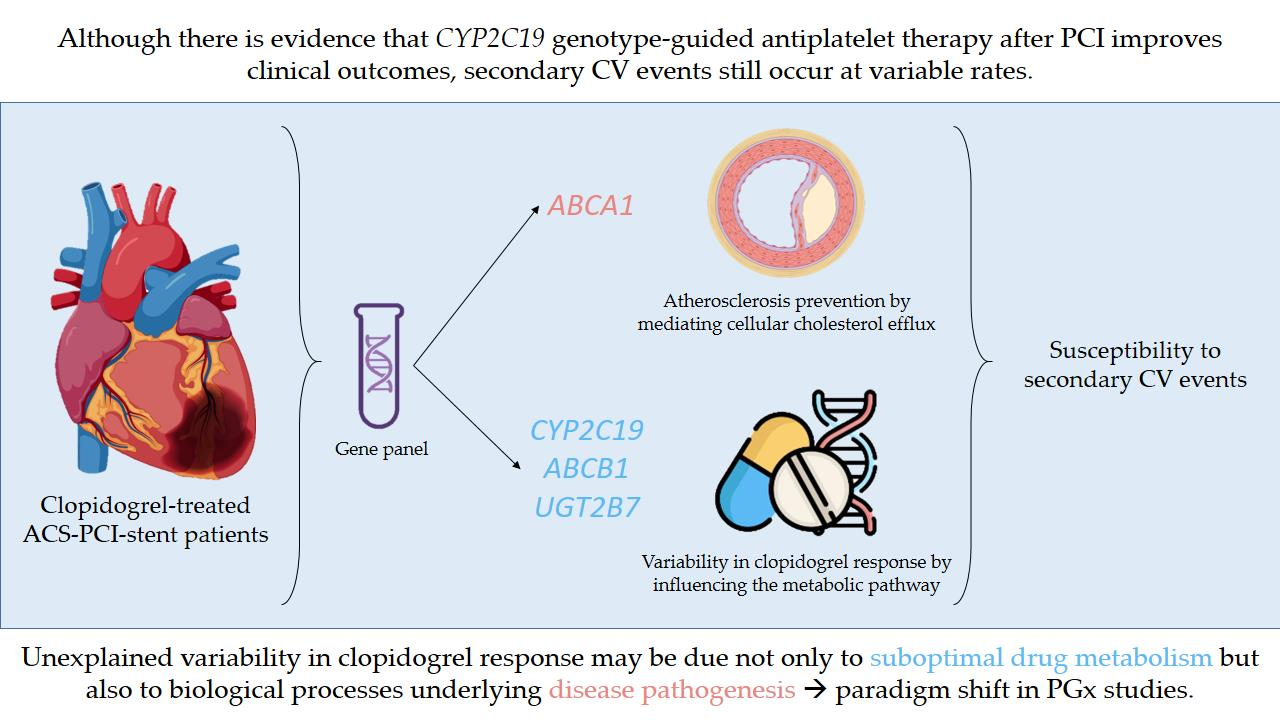
Custom Gene Panel Analysis Identifies Novel Polymorphisms Associated with Clopidogrel Response in Patients Undergoing Percutaneous Coronary Intervention with Stent
 , , , , , ,
  ,
,  and
and Abstract
Share and Cite
Antúnez-Rodríguez, A.; García-Rodríguez, S.; Pozo-Agundo, A.; Sánchez-Ramos, J.G.; Moreno-Escobar, E.; Triviño-Juárez, J.M.; Álvarez-Cubero, M.J.; Martínez-González, L.J.; Dávila-Fajardo, C.L. Custom Gene Panel Analysis Identifies Novel Polymorphisms Associated with Clopidogrel Response in Patients Undergoing Percutaneous Coronary Intervention with Stent. Int. J. Mol. Sci. 2025, 26, 9766. https://doi.org/10.3390/ijms26199766
Antúnez-Rodríguez A, García-Rodríguez S, Pozo-Agundo A, Sánchez-Ramos JG, Moreno-Escobar E, Triviño-Juárez JM, Álvarez-Cubero MJ, Martínez-González LJ, Dávila-Fajardo CL. Custom Gene Panel Analysis Identifies Novel Polymorphisms Associated with Clopidogrel Response in Patients Undergoing Percutaneous Coronary Intervention with Stent. International Journal of Molecular Sciences. 2025; 26(19):9766. https://doi.org/10.3390/ijms26199766
Chicago/Turabian StyleAntúnez-Rodríguez, Alba, Sonia García-Rodríguez, Ana Pozo-Agundo, Jesús Gabriel Sánchez-Ramos, Eduardo Moreno-Escobar, José Matías Triviño-Juárez, María Jesús Álvarez-Cubero, Luis Javier Martínez-González, and Cristina Lucía Dávila-Fajardo. 2025. "Custom Gene Panel Analysis Identifies Novel Polymorphisms Associated with Clopidogrel Response in Patients Undergoing Percutaneous Coronary Intervention with Stent" International Journal of Molecular Sciences 26, no. 19: 9766. https://doi.org/10.3390/ijms26199766
APA StyleAntúnez-Rodríguez, A., García-Rodríguez, S., Pozo-Agundo, A., Sánchez-Ramos, J. G., Moreno-Escobar, E., Triviño-Juárez, J. M., Álvarez-Cubero, M. J., Martínez-González, L. J., & Dávila-Fajardo, C. L. (2025). Custom Gene Panel Analysis Identifies Novel Polymorphisms Associated with Clopidogrel Response in Patients Undergoing Percutaneous Coronary Intervention with Stent. International Journal of Molecular Sciences, 26(19), 9766. https://doi.org/10.3390/ijms26199766