Review

Gene Therapy for Achromatopsia

by
Megan F. Baxter
1,2 and
Grace A. Borchert
2,3,4,*
1
Wellcome Trust Centre for Human Genetics, University of Oxford, Oxford OX3 9DU, UK
2
School of Medicine and Dentistry, Griffith University, Gold Coast 4215, Australia
3
Nuffield Laboratory of Ophthalmology, Nuffield Department of Clinical Neurosciences, University of Oxford, Oxford OX3 9DU, UK
4
Oxford Eye Hospital, Oxford University NHS Foundation Trust, Oxford OX3 9DU, UK
*
Author to whom correspondence should be addressed.
Int. J. Mol. Sci. 2024, 25(17), 9739; https://doi.org/10.3390/ijms25179739
Submission received: 8 July 2024 / Revised: 23 August 2024 / Accepted: 1 September 2024 / Published: 9 September 2024
(This article belongs to the Special Issue Advances in Gene and Cell Therapy—2nd Edition)

Abstract

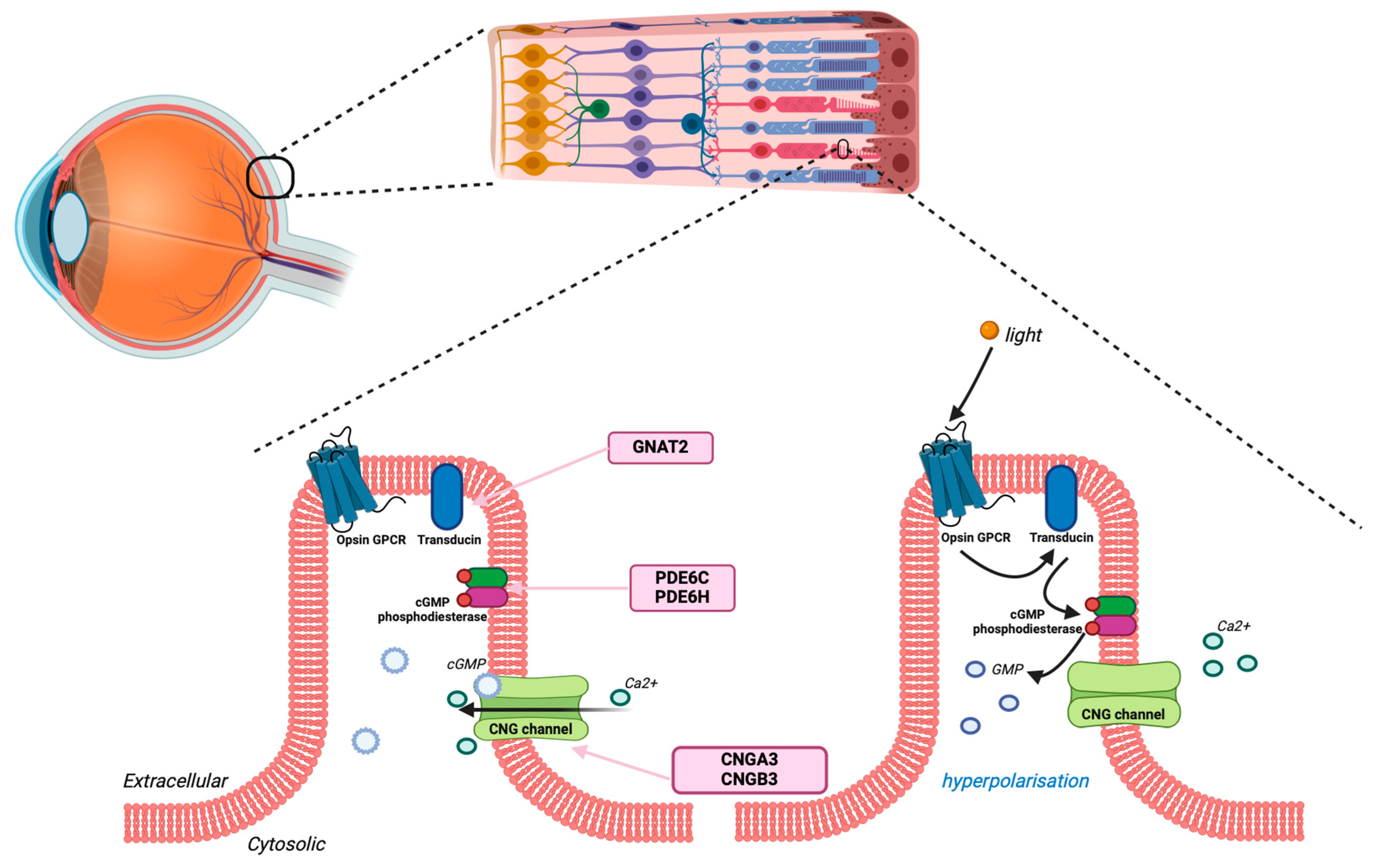
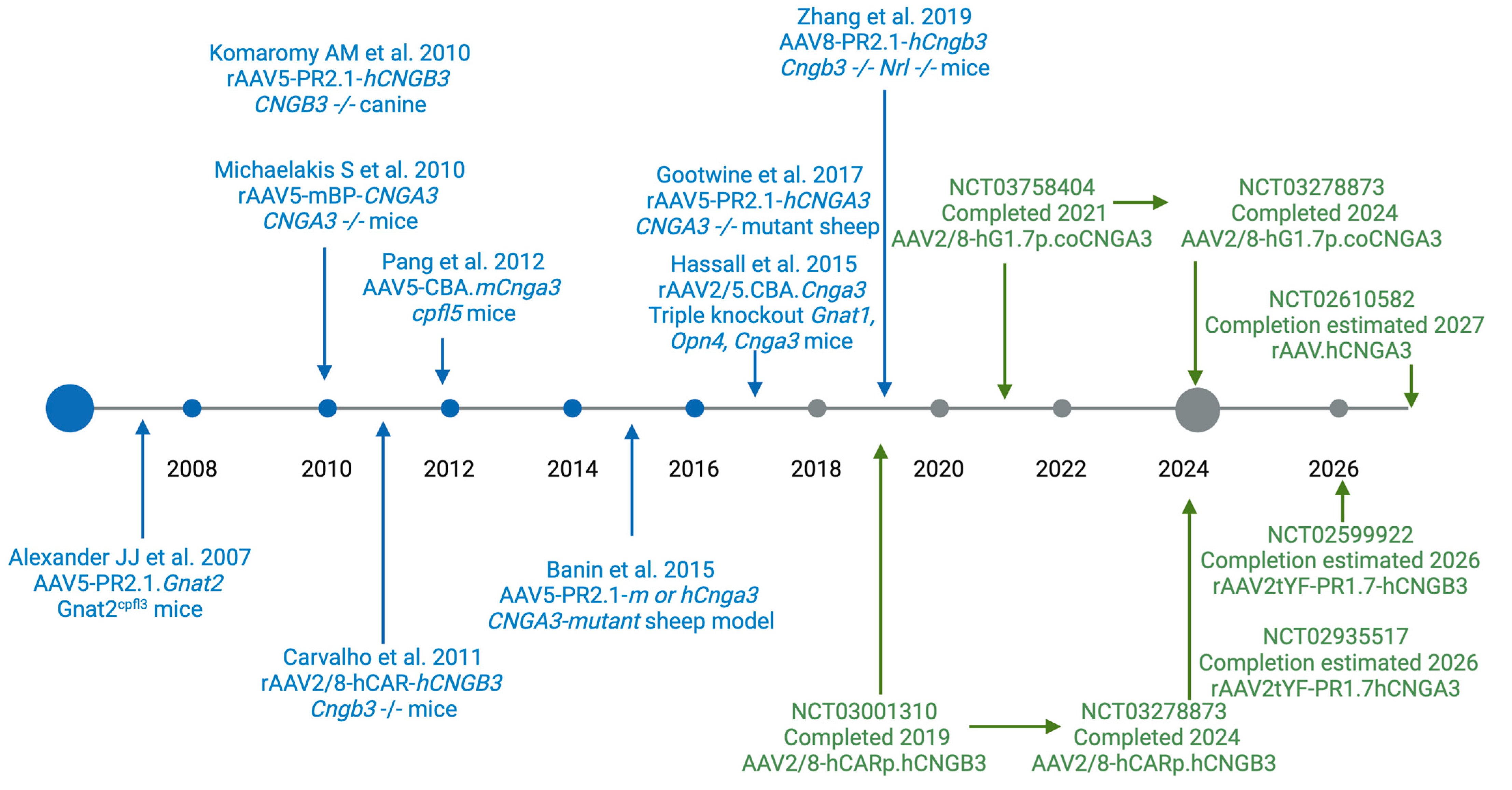
Achromatopsia is the most common cone dysfunction syndrome, affecting 1 in 30,000 people. It is an autosomal recessive disorder with a heterogeneous genetic background with variants reported in CNGA3, CNGB3, GNAT2, PDE6C, PDE6H, and ATF6. Up to 90% of achromatopsia patients harbour mutations in CNGA3 or CNB3, which encode for the alpha and beta subunits of the cone cyclic nucleotide-gated (CNG) channel in cone-specific phototransduction. The condition presents at birth or early infancy with poor visual acuity, nystagmus, photophobia, and colour vision loss in all axes. Multimodal retinal imaging has provided insightful information to characterise achromatopsia patients based on their genotype. There is no FDA-approved treatment for achromatopsia; however, studies have reported several preclinical gene therapies with anatomical and functional improvements reported in vivo. There are currently five gene therapy clinical trials registered for human patients at the phase I/II stage and for CNGA3 or CNGB3 causing achromatopsia. This review aims to discuss the genetics of achromatopsia, genotypic and phenotypic correlations in multimodal retinal imaging, and the developments and challenges in gene therapy clinical trials.
Keywords: achromatopsia; gene therapy; cone dysfunction achromatopsia; gene therapy; cone dysfunction