Article

De Novo Antimicrobial Peptide Design with Feedback Generative Adversarial Networks

by
Michaela Areti Zervou
1,2,*,
Effrosyni Doutsi
2,
Yannis Pantazis
3 and
Panagiotis Tsakalides
1,2,*
1
Department of Computer Science, University of Crete, 700 13 Heraklion, Greece
2
Institute of Computer Science, Foundation for Research and Technology-Hellas, 700 13 Heraklion, Greece
3
Institute of Applied and Computational Mathematics, Foundation for Research and Technology-Hellas, 700 13 Heraklion, Greece
*
Authors to whom correspondence should be addressed.
Int. J. Mol. Sci. 2024, 25(10), 5506; https://doi.org/10.3390/ijms25105506
Submission received: 15 April 2024 / Revised: 10 May 2024 / Accepted: 15 May 2024 / Published: 18 May 2024
(This article belongs to the Special Issue Molecular Advances in Bioinformatics Analysis of Protein Properties)

Abstract

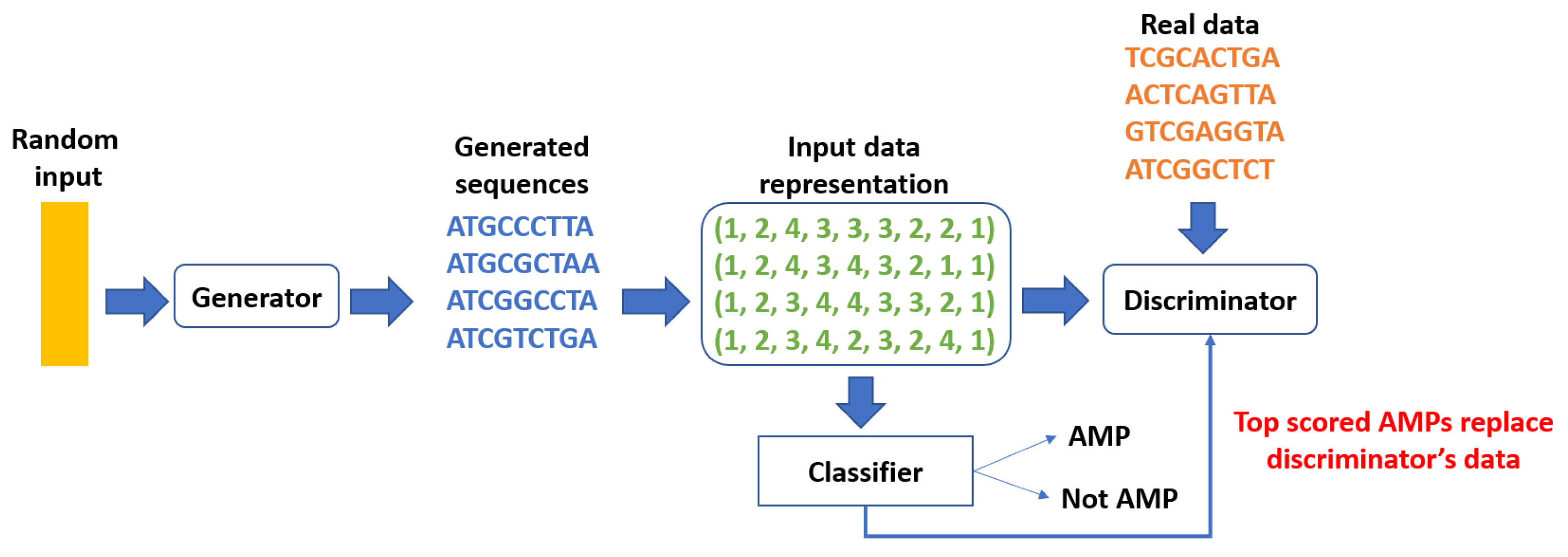
Antimicrobial peptides (AMPs) are promising candidates for new antibiotics due to their broad-spectrum activity against pathogens and reduced susceptibility to resistance development. Deep-learning techniques, such as deep generative models, offer a promising avenue to expedite the discovery and optimization of AMPs. A remarkable example is the Feedback Generative Adversarial Network (FBGAN), a deep generative model that incorporates a classifier during its training phase. Our study aims to explore the impact of enhanced classifiers on the generative capabilities of FBGAN. To this end, we introduce two alternative classifiers for the FBGAN framework, both surpassing the accuracy of the original classifier. The first classifier utilizes the k-mers technique, while the second applies transfer learning from the large protein language model Evolutionary Scale Modeling 2 (ESM2). Integrating these classifiers into FBGAN not only yields notable performance enhancements compared to the original FBGAN but also enables the proposed generative models to achieve comparable or even superior performance to established methods such as AMPGAN and HydrAMP. This achievement underscores the effectiveness of leveraging advanced classifiers within the FBGAN framework, enhancing its computational robustness for AMP de novo design and making it comparable to existing literature.
Keywords: antimicrobial peptides (AMP); protein function classification; gated recurrent neural networks; k-mers; protein transfer learning; generative adversarial networks antimicrobial peptides (AMP); protein function classification; gated recurrent neural networks; k-mers; protein transfer learning; generative adversarial networks