


Abstract
A simulation of the effect of metal nano-oxides at various concentrations (25, 50, 100, and 200 milligrams per millilitre) on cell viability in THP-1 cells (%) based on data on the molecular structure of the oxide and its concentration is proposed. We used a simplified molecular input-line entry system (SMILES) to represent the molecular structure. So-called quasi-SMILES extends usual SMILES with special codes for experimental conditions (concentration). The approach based on building up models using quasi-SMILES is self-consistent, i.e., the predictive potential of the model group obtained by random splits into training and validation sets is stable. The Monte Carlo method was used as a basis for building up the above groups of models. The CORAL software was applied to building the Monte Carlo calculations. The average determination coefficient for the five different validation sets was R2 = 0.806 ± 0.061.
1. Introduction
Nano-safety assessments are often conducted in live organisms, including fish, mice, and rats [1,2]. However, since the European Union and US regulatory authorities consider the development of alternative animal-free testing strategies as the most important challenge for future chemical risk assessment of nano-materials, interest in developing in silico approaches to solving the above task has increased considerably [3]. The lack of structured and systematized databases remains a factor that hinders the development of methods for the simulation of the physicochemical and biochemical behaviour of nano-materials [4,5,6,7,8,9,10]. Nevertheless, work on the creation of methods for assessing nano-safety is being carried out, and their flow is growing [11,12,13,14,15,16,17,18,19,20,21,22]. Nano-safety assessments are in high demand and refer to a wide variety of nano-materials that are increasingly penetrating the everyday life of modern society. One of the main directions of these studies is the development of models of environmental consequences of the use of nano-substances in industry, medicine, and everyday life.
The first attempts to develop in silico approaches to solving the above problem were based on the set of developed molecular descriptors used for traditional substances (organic, inorganic, coordination). At the same time, the combined use of calculated molecular descriptors and experimentally determined numerical data on various physicochemical and biochemical characteristics of nano-materials was used for the development of in silico models of the properties of nano-materials [7].
The development of a special format for presenting data on nano-materials is another concept for building in silico models for nano-materials. This format would be abbreviated ISO-TAB-nano (Investigation/Study/Assay Tabular) [8].
A convenient compromise between the need to have expensive experimental data on nano-materials and the need to quickly evaluate a rapidly expanding list of nano-materials in practical use is the “read-across” approach [9].
Finally, the quasi-SMILES method is an effective method for constructing models of nano-materials’ physicochemical and biochemical behaviour in the absence of systematized databases [23,24,25,26,27,28,29,30,31,32,33,34,35]. The essence of this method in the first approximation is two steps. First, a list of conditions (for example, concentrations of reagents) and circumstances (presence of certain chemical elements) is made, designating each of them with a special code; and secondly, the correlation contribution of each code to some stochastic model of a given endpoint is evaluated using the Monte Carlo method.
The advantages of using quasi-SMILES are the convenience of formulating problems for in silico modelling and the clarity of the results obtained. The disadvantage of this approach is a significant variance in the results, as a result of which practical reliability can be achieved only when conducting a large number of stochastic computer experiments. It is to be noted that, previously, the index of ideality of correlation and the correlation intensity index have not been used in building models.
Here, the possibility of using the above-mentioned approach to simulate the impact of nano-oxide metals (in different concentrations) on cell viability in THP-1 cells expressed by a percentage was examined. The calculations described here were carried out with the CORAL software (http://www.insilico.eu/coral, accessed on 10 January 2023, Italy).
2. Results
2.1. Models
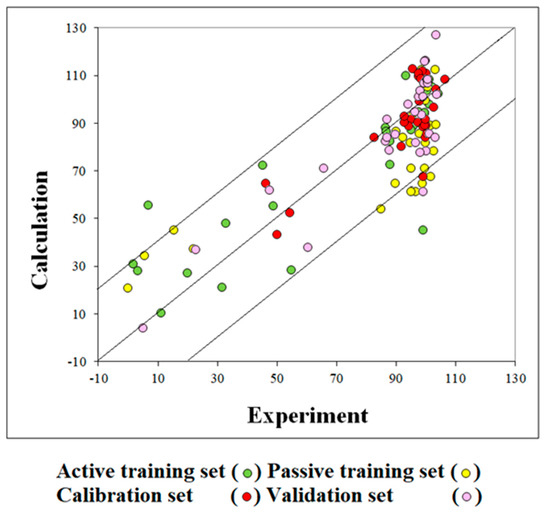
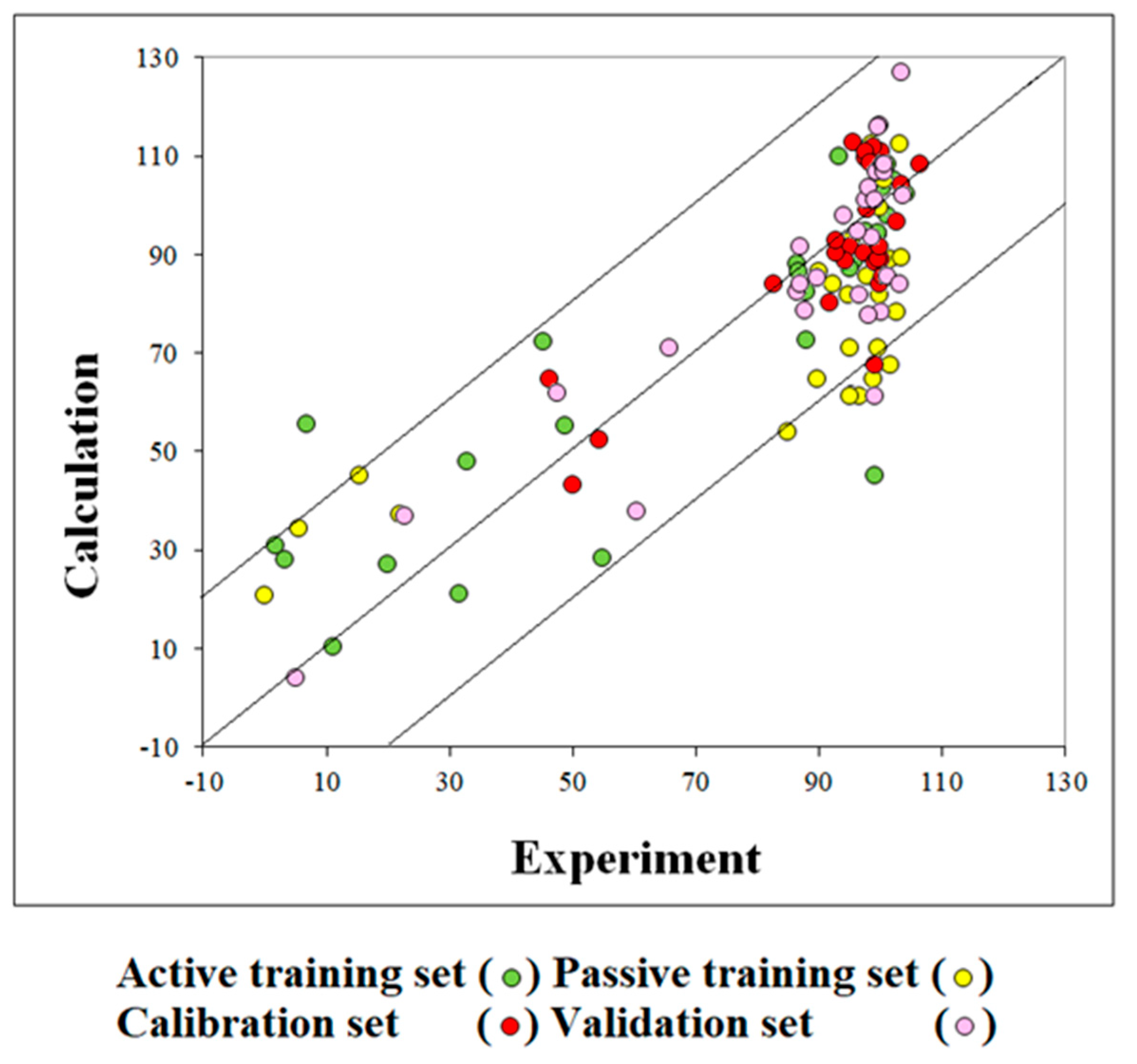
The computational experiments with five random splits gave models characterized by quite close predictive potential (average determination coefficient R2 = 0.806 ± 0.061). Table 1 shows the statistical characteristics of the models. Figure 1 shows the graphical representation of the model for cell viability in THP-1 cells observed for split-1.
Table 1.
The statistical characteristics of models for cell viability were observed for five random splits.
Figure 1.
Graphical representation of the model for cell viability in THP-1 cells, which is influenced by different metal nano-oxides under different concentrations.
2.2. Mechanistic Interpretation
Having the numerical data on the correlation weights of codes applied in quasi-SMILES, which was observed in several runs of the Monte Carlo optimization, one is able to detect three categories of these codes:
- I.
- Codes that have a positive value of the correlation weight in all runs. These are promoters of endpoint increase;
- II.
- Codes that have a negative value of the correlation weight in all runs. These are promoters of endpoint decrease;
- III.
- Codes that have both negative and positive values of the correlation weight in different optimization runs. These codes have an unclear role (one cannot classify these features as a promoter of endpoint increase or decrease).
In the case of the analysis of cell viability, promoters of decrease have a practical significance. Table 2 shows the collection of promoters of decrease in cell viability.
Table 2.
Promoters (↓) of decreased cell viability in THP-1 cells, according to computational experiments with five random splits.
2.3. Applicability Domain
The applicability domain for the described model calculated with Equation (1) is defined by the so-called statistical defects of quasi-SMILES codes [36]. The percentage of outliers according to the criterion equals 27%, 13%, 17%, 10%, and 13% for split 1, split 2 … split 5, respectively.
3. Discussion
In this study, only one additional parameter was available for model development in addition to the molecular structure (transmitted via SMILES), namely the concentration of metal oxide nano-particles. Nevertheless, the results obtained are, in fact, quite reliable models of cell viability in THP-1 cells.
It should be noted that the present approach makes it possible to quite easily improve the predictive potential of the model if additional experimental data are available that can be represented as additional codes for the quasi-SMILES extension. There are examples of works where representative lists of codes for quasi-SMILES are applied in practice [36,37]. Thus, simulation by means of the quasi-SMILES technique claims both simplicity and universality. Consequently, quasi-SMILES can find numerous applications as a tool for developing models for phenomena characterized by an eclectic set of factors influencing them.
It is possible to use the optimal descriptors considered here in conjunction with classical descriptors developed based on information theory ideas, physicochemical parameters (solubility, density, octanol/water distribution coefficient), biochemical characteristics (toxicity, drug effects), or the invariants of the molecular graph (multigraph). The above abilities of the quasi-SMILES technique are especially convenient for a situation related to non-standard objects for the simulation, such as mixtures, peptides, and nano-materials.
No less interesting are the prospects for the development of the objective functions described here used for optimization by the Monte Carlo method. Currently, objective functions based on correlations have been studied, but instead of correlations, the basis for them can be selected entropy values of fuzzy sets generated by various divisions of available data into training and verification subsets.
Like most stochastic approaches, the quasi-SMILES technique makes it possible to analyse existing experimental data, but the possibilities for extrapolating the considered approach are limited. In other words, this approach can be useful only for situations close to those that have been studied in detail in a direct experiment. At the same time, work with experimentally determined data sets can be used for the inverse problem, that is, the selection of experimental characteristics that are promising or, on the contrary, useless, according to the number of available experimental states of the data system under study.
Supplementary materials contain input files for the five splits examined here, together with the CORAL method used in this work.
4. Materials and Methods
4.1. Data
In [3], data on the impact of nano-oxide nano-particles on cell viability in THP-1 cells was tested at eight dilutions (0, 3.1, 6.2, 13, 25, 50, 100, and 200 μg/mL). Non-zero effects of impact on cell viability in THP-1 cells by the mentioned nano-particles were observed starting from a concentration of just 25. Only non-zero effects were used to build the model. Under such circumstances, the total number of situations (oxide–concentration–cell viability) equals 120. Quasi-SMILES represents each situation. These quasi-SMILES are distributed into four special sub-sets: (i) active training set; (ii) passive training set; (iii) calibration set; and (iv) validation set. Five random splits were examined here as a basis to build up the model of cell viability in THP-1 cells. Each above sub-set contains about 25% of the total list of quasi-SMILES.
Each of the above sets had a defined task. The active training set was used to build the model. Molecular features extracted from quasi-SMILES of the active training set were involved in the process of Monte Carlo optimization aimed to provide correlation weights for the above features, which give maximal target function value, which was calculated using descriptors (the sum of the correlation weights), and endpoint values on the active training set. The task of the passive training set is to check whether the model obtained for the active training set is satisfactory for quasi-SMILES which were not involved in the active training set. The calibration set should detect the start of overtraining (overfitting). The optimization must stop if overtraining starts. After stopping the optimization procedure, the validation set was used to assess the predictive potential of the obtained model.
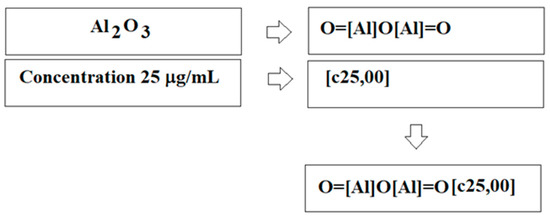
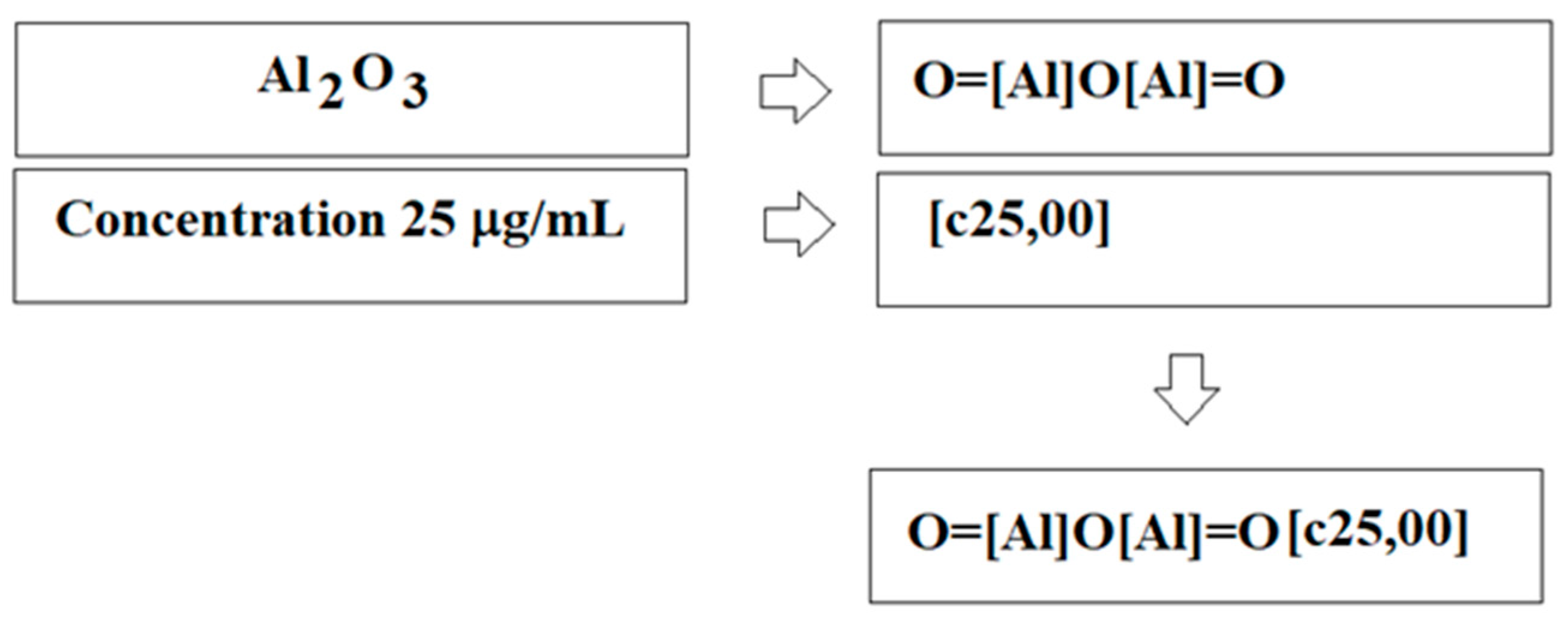
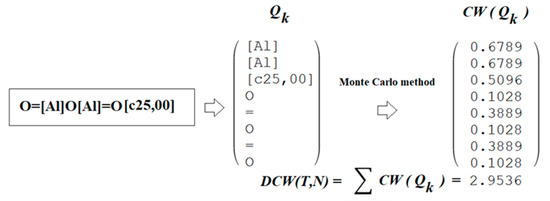
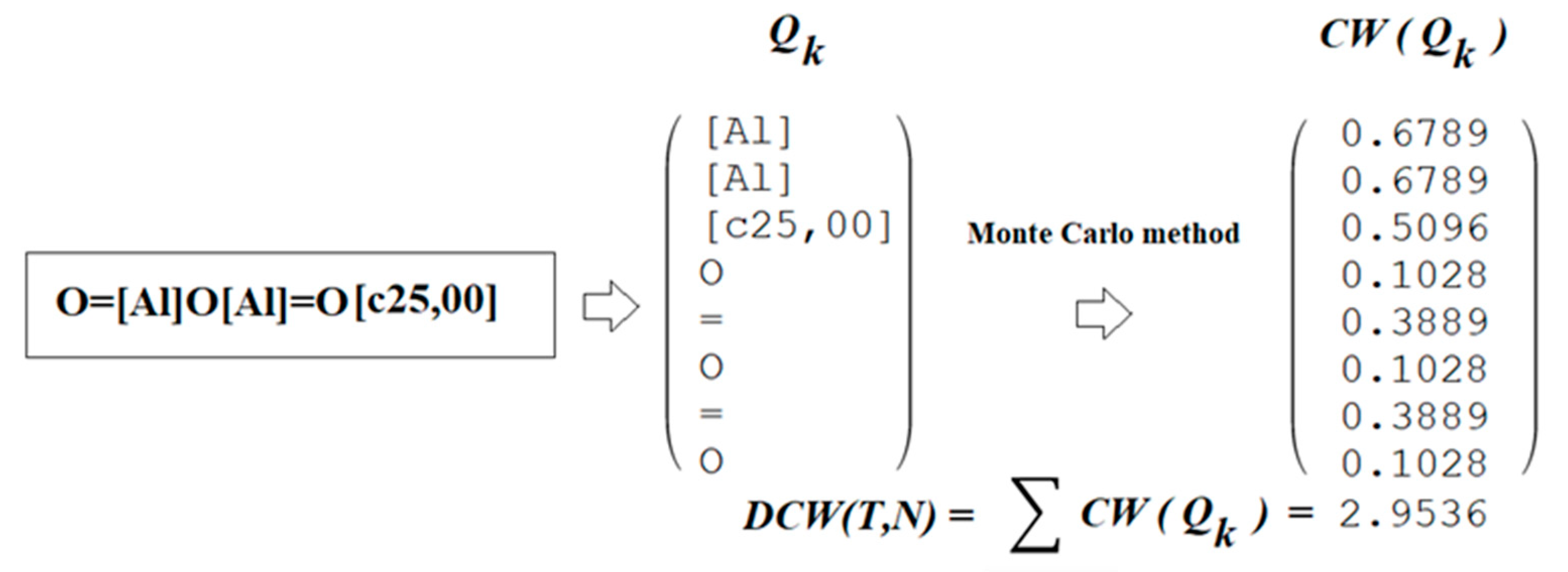
Figure 2 demonstrates the generalized scheme of construction of quasi-SMILES for the above-mentioned arbitrary situation. Figure 3 includes the general scheme of applying quasi-SMILES (Qk) codes to calculate the optimal descriptor for a defined arbitrary situation.
Figure 2.
The scheme of building up quasi-SMILES for the situation where the impact of nano-oxide of aluminium in concentration 25 mg/mL is examined.
Figure 3.
The generalized scheme of calculation of the optimal descriptor based on the correlation weights (CW) of codes of quasi-SMILES (i.e., Qk); the correlation weights CW(Qk) are obtained by the Monte Carlo method.
Table 3 contains split-1 for the total list of quasi-SMILES together with experimental and calculated values of cell viability in THP-1 cells.
Table 3.
The list of quasi-SMILES, experimental and calculated percentage of cell viability in THP-1 cells. A = active training set; P = passive training set; C = calibration set; V = validation set.
4.2. Optimal Descriptor
The optimal descriptor is the sum of the correlation weights of the quasi-SMILES codes obtained by the Monte Carlo method (Figure 3). The values of the optimal descriptor serve as the basis for the model of cell viability calculated by the formula
The optimal descriptor depends on the style of the Monte Carlo optimization. T and N are parameters of the optimization procedure. T is a threshold applied to define rare codes; if T = 1, this means that codes absent in the active training set are rare. The rare codes are not involved in the modelling process (their correlation weights are zero). N is the number of epochs in the Monte Carlo optimization.
4.3. Monte Carlo Method
Equation (1) needs the numerical data of the above correlation weights. Monte Carlo optimization is a tool to calculate those correlation weights. Here, two target functions for the Monte Carlo optimization are examined:
The and are correlation coefficients between the observed and predicted endpoints for the active and passive training sets, respectively. The IIC is the index of ideality of correlation [33,34]. The IIC is calculated using data from the calibration set as follows:
The observedk and calculatedk are corresponding values of the endpoint.
The correlation intensity index (CII), similar to the above IIC, was developed as a tool to improve the quality of the Monte Carlo optimization aimed at building up QSPR/QSAR models. The CII is calculated as follows:
R2 is the correlation coefficient for a set that contains n substances. is the correlation coefficient for n − 1 substances of a set after removal of the k-th substance. Hence, if () is larger than zero, the k-th substance is an “oppositionist” for the correlation between experimental and predicted values of the set. A small sum of “protests” means a more “intensive” correlation.
The Monte Carlo method aims to minimize the target functions [37], TF1, based on the application of two new criteria of predictive potential: the index of ideality of correlation [33,34] and correlation intensity index [38,39].
5. Conclusions
The quasi-SMILES technique gives quite satisfactory models for cell viability in THP-1 cells, as we have shown the reproducibility of the predictive potential of corresponding models obtained for different splits into sets of training and validation sets. There is variation in the statistical characteristics of the above models; however, this variation is not too large. In other words, the results can be assessed as acceptable for practical use. In addition, that the predictive potential of models can be improved by applying the index of ideality of correlation and the correlation intensity index is confirmed.
Supplementary Materials
The following supporting information can be downloaded at: https://www.mdpi.com/article/10.3390/ijms24032058/s1.
Author Contributions
Conceptualization, A.A.T., A.P.T. and N.F.; Data curation, A.A.T., A.P.T. and N.F.; Writing—original draft, A.A.T., A.P.T. and N.F.; Review and editing, A.A.T., A.P.T. and N.F. All authors have read and agreed to the published version of the manuscript.
Funding
This work was supported by CONCERT REACH, grant agreement LIFE17 GIE/IT/000461.
Institutional Review Board Statement
Not applicable.
Informed Consent Statement
Not applicable.
Data Availability Statement
Technical details on the five models are available in the Supplementary materials section.
Conflicts of Interest
The authors declare no conflict of interest.
References
- Toropova, A.P.; Toropov, A.A. Nano-QSAR in cell biology: Model of cell viability as a mathematical function of available eclectic data. J. Theor. Biol. 2017, 416, 113–118. [Google Scholar] [CrossRef] [Scilit]
- Li, J.; Wang, C.; Yue, L.; Chen, F.; Cao, X.; Wang, Z. Nano-QSAR modeling for predicting the cytotoxicity of metallic and metal oxide nanoparticles: A review. Ecotoxicol. Environ. Saf. 2022, 243, 113955. [Google Scholar] [CrossRef] [Scilit]
- Huang, Y.; Li, X.; Cao, J.; Wei, X.; Li, Y.; Wang, Z.; Cai, X.; Li, R.; Chen, J. Use of dissociation degree in lysosomes to predict metal oxide nanoparticle toxicity in immune cells: Machine learning boosts nano-safety assessment. Environ. Int. 2022, 164, 107258. [Google Scholar] [CrossRef] [Scilit] [PubMed]
- Yan, X.; Sedykh, A.; Wang, W.; Yan, B.; Zhu, H. Construction of a web-based nanomaterial database by big data curation and modeling friendly nanostructure annotations. Nat. Commun. 2020, 11, 2519. [Google Scholar] [CrossRef] [Scilit] [PubMed]
- Mills, K.C.; Murry, D.; Guzan, K.A.; Ostraat, M.L. Nanomaterial registry: Database that captures the minimal information about nanomaterial physico-chemical characteristics. J. Nanoparticle Res. 2014, 16, 2219. [Google Scholar] [CrossRef] [Scilit]
- Panneerselvam, S.; Choi, S. Nanoinformatics: Emerging databases and available tools. Int. J. Mol. Sci. 2014, 15, 7158–7182. [Google Scholar] [CrossRef] [Scilit]
- Fourches, D.; Pu, D.; Tassa, C.; Weissleder, R.; Shaw, S.Y.; Mumper, R.J.; Tropsha, A. Quantitative nanostructure-Activity relationship modeling. ACS Nano. 2010, 4, 5703–5712. [Google Scholar] [CrossRef] [Scilit] [PubMed]
- Thomas, D.G.; Gaheen, S.; Harper, S.L.; Fritts, M.; Klaessig, F.; Hahn-Dantona, E.; Paik, D.; Pan, S.; Stafford, G.A.; Freund, E.T.; et al. ISA-TAB-Nano: A Specification for Sharing Nanomaterial Research Data in Spreadsheet-based Format. BMC Biotechnol. 2013, 13, 2. [Google Scholar] [CrossRef] [Scilit]
- Gajewicz, A.; Jagiello, K.; Cronin, M.T.D.; Leszczynski, J.; Puzyn, T. Addressing a bottle neck for regulation of nanomaterials: Quantitative read-across (Nano-QRA) algorithm for cases when only limited data is available. Environ. Sci. Nano 2017, 4, 346–358. [Google Scholar] [CrossRef] [Scilit]
- Krug, H.F. Collection of Controlled Nanosafety Data—The CoCoN-Database, a Tool to Assess Nanomaterial Hazard. Nanomaterials 2022, 12, 441. [Google Scholar] [CrossRef] [Scilit] [PubMed]
- Jimenez-Cruz, C.A.; Kang, S.-g.; Zhou, R. Large scale molecular simulations of nanotoxicity. WIREs Syst. Biol. Med. 2014, 6, 329–343. [Google Scholar] [CrossRef] [Scilit] [PubMed]
- Toropova, A.P.; Toropov, A.A.; Veselinović, A.M.; Veselinović, J.B.; Benfenati, E.; Leszczynska, D.; Leszczynski, J. Nano-QSAR: Model of mutagenicity of fullerene as a mathematical function of different conditions. Ecotoxicol. Environ. Saf. 2016, 124, 32–36. [Google Scholar] [CrossRef] [Scilit] [PubMed]
- Piane, M.D.; Potthoff, S.; Brinker, C.J.; Colombi Ciacchi, L. Molecular Dynamics Simulations of the Silica-Cell Membrane Interaction: Insights on Biomineralization and Nanotoxicity. J. Phys. Chem. C 2018, 122, 21330–21343. [Google Scholar] [CrossRef] [Scilit]
- Buglak, A.A.; Zherdev, A.V.; Dzantiev, B.B. Nano-(Q)SAR for Cytotoxicity Prediction of Engineered Nanomaterials. Molecules 2019, 24, 4537. [Google Scholar] [CrossRef] [Scilit] [PubMed]
- González-Durruthy, M.; Giri, A.K.; Moreira, I.; Concu, R.; Melo, A.; Ruso, J.M.; Cordeiro, M.N.D.S. Computational modeling on mitochondrial channel nanotoxicity. Nano Today 2020, 34, 100913. [Google Scholar] [CrossRef] [Scilit]
- Toropova, A.P.; Toropov, A.A. Fullerenes C60 and C70: A model for solubility by applying the correlation intensity index. Fuller. Nanotub. Carbon Nanostruct. 2020, 28, 900–906. [Google Scholar] [CrossRef] [Scilit]
- Wu, Y.-H.; Ho, S.-Y.; Wang, B.-J.; Wang, Y.-J. The recent progress in nanotoxicology and nanosafety from the point of view of both toxicology and ecotoxicology. Int. J. Mol. Sci. 2020, 21, 4209. [Google Scholar] [CrossRef] [Scilit]
- Mukhopadhyay, T.K.; Ghosh, A.; Datta, A. Molecular Dynamics Simulations Reveal Orientation-Dependent Nanotoxicity of Black Phosphorene toward Dimeric Proteins. ACS Appl. Nano Mater. 2021, 4, 3095–3107. [Google Scholar] [CrossRef] [Scilit]
- Huang, H.-J.; Lee, Y.-H.; Hsu, Y.-H.; Liao, C.-T.; Lin, Y.-F.; Chiu, H.-W. Current strategies in assessment of nanotoxicity: Alternatives to in vivo animal testing. Int. J. Mol. Sci. 2021, 22, 4216. [Google Scholar] [CrossRef] [Scilit]
- Tsukanov, A.A.; Turk, B.; Vasiljeva, O.; Psakhie, S.G. Computational Indicator Approach for Assessment of Nanotoxicity of Two-Dimensional Nanomaterials. Nanomaterials 2022, 12, 650. [Google Scholar] [CrossRef] [Scilit]
- Thwala, M.M.; Afantitis, A.; Papadiamantis, A.G.; Tsoumanis, A.; Melagraki, G.; Dlamini, L.N.; Ouma, C.N.M.; Ramasami, P.; Harris, R.; Puzyn, T.; et al. Using the Isalos platform to develop a (Q)SAR model that predicts metal oxide toxicity utilizing facet-based electronic, image analysis-based, and periodic table derived properties as descriptors. Struct. Chem. 2022, 33, 527–538. [Google Scholar] [CrossRef] [Scilit]
- Fjodorova, N.; Novič, M.; Venko, K.; Drgan, V.; Rasulev, B.; Türker Saçan, M.; Sağ Erdem, S.; Tugcu, G.; Toropova, A.P.; Toropov, A.A. How fullerene derivatives (FDs) act on therapeutically important targets associated with diabetic diseases. Comput. Struct. Biotechnol. J. 2022, 20, 913–924. [Google Scholar] [CrossRef] [Scilit] [PubMed]
- Ahmadi, S.; Aghabeygi, S.; Farahmandjou, M.; Azimi, N. The predictive model for band gap prediction of metal oxide nanoparticles based on quasi-SMILES. Struct. Chem. 2021, 32, 1893–1905. [Google Scholar] [CrossRef] [Scilit]
- Ahmadi, S. Mathematical modeling of cytotoxicity of metal oxide nanoparticles using the index of ideality correlation criteria. Chemosphere 2020, 242, 125192. [Google Scholar] [CrossRef] [Scilit] [PubMed]
- Trinh, T.X.; Choi, J.-S.; Jeon, H.; Byun, H.-G.; Yoon, T.-H.; Kim, J. Quasi-SMILES-Based Nano-Quantitative Structure-Activity Relationship Model to Predict the Cytotoxicity of Multiwalled Carbon Nanotubes to Human Lung Cells. Chem. Res. Toxicol. 2018, 31, 183–190. [Google Scholar] [CrossRef] [Scilit] [PubMed]
- Choi, J.-S.; Ha, M.K.; Trinh, T.X.; Yoon, T.-H.; Byun, H.-G. Towards a generalized toxicity prediction model for oxide nanomaterials using integrated data from different sources. Sci. Rep. 2018, 8, 6110. [Google Scholar] [CrossRef] [Scilit]
- Choi, J.-S.; Trinh, T.X.; Yoon, T.-H.; Kim, J.; Byun, H.-G. Quasi-QSAR for predicting the cell viability of human lung and skin cells exposed to different metal oxide nanomaterials. Chemosphere 2019, 217, 243–249. [Google Scholar] [CrossRef] [Scilit]
- Toropova, A.P.; Toropov, A.A. Optimal descriptor as a translator of eclectic information into the prediction of membrane damage by means of various TiO2 nanoparticles. Chemosphere 2013, 93, 2650–2655. [Google Scholar] [CrossRef] [Scilit]
- Toropov, A.A.; Toropova, A.P. Optimal descriptor as a translator of eclectic data into endpoint prediction: Mutagenicity of fullerene as a mathematical function of conditions. Chemosphere 2014, 104, 262–264. [Google Scholar] [CrossRef] [Scilit]
- Jafari, K.; Fatemi, M.H. A new approach to model isobaric heat capacity and density of some nitride-based nanofluids using Monte Carlo method. Adv. Powder Technol. 2020, 31, 3018–3027. [Google Scholar] [CrossRef] [Scilit]
- Jafari, K.; Fatemi, M.H. Application of nano-quantitative structure–property relationship paradigm to develop predictive models for thermal conductivity of metal oxide-based ethylene glycol nanofluids. J. Therm. Anal. Calorim. 2020, 142, 1335–1344. [Google Scholar] [CrossRef] [Scilit]
- Manganelli, S.; Benfenati, E. Nano-QSAR model for predicting cell viability of human embryonic kidney cells. In Cell Viability Assays. Methods in Molecular Biology; Gilbert, D., Friedrich, O., Eds.; Humana Press: New York, NY, USA, 2017; Volume 1601, pp. 275–290. [Google Scholar] [CrossRef] [Scilit]
- Toropova, A.P.; Toropov, A.A. Does the Index of Ideality of Correlation Detect the Better Model Correctly? Mol. Inform. 2019, 38, 1800157. [Google Scholar] [CrossRef] [Scilit] [PubMed]
- Toropova, A.P.; Toropov, A.A. QSPR and nano-QSPR: What is the difference? J. Mol. Struct. 2019, 1182, 141–149. [Google Scholar] [CrossRef] [Scilit]
- Toropova, A.P.; Toropov, A.A.; Benfenati, E. QSPR as a random event: Solubility of fullerenes C [60] and C [70]. Fuller. Nanotub. Carbon Nanostruct. 2019, 27, 816–821. [Google Scholar] [CrossRef] [Scilit]
- Toropov, A.A.; Kjeldsen, F.; Toropova, A.P. Use of quasi-SMILES to build models based on quantitative results from experiments with nanomaterials. Chemosphere 2022, 303, 135086. [Google Scholar] [CrossRef] [Scilit]
- Toropova, A.P.; Toropov, A.A.; Fjodorova, N. Quasi-SMILES for predicting toxicity of Nano-mixtures to Daphnia Magna. NanoImpact 2022, 28, 100427. [Google Scholar] [CrossRef] [Scilit]
- Toropov, A.A.; Toropova, A.P. Correlation intensity index: Building up models for mutagenicity of silver nanoparticles. Sci. Total Environ. 2020, 737, 139720. [Google Scholar] [CrossRef] [Scilit]
- Selvestrel, G.; Lavado, G.J.; Toropova, A.P.; Toropov, A.A.; Gadaleta, D.; Marzo, M.; Baderna, D.; Benfenati, E. Monte Carlo Models for Sub-Chronic Repeated-Dose Toxicity: Systemic and Organ-Specific Toxicity. Int. J. Mol. Sci. 2022, 23, 6615. [Google Scholar] [CrossRef] [Scilit]

Disclaimer/Publisher’s Note: The statements, opinions and data contained in all publications are solely those of the individual author(s) and contributor(s) and not of MDPI and/or the editor(s). MDPI and/or the editor(s) disclaim responsibility for any injury to people or property resulting from any ideas, methods, instructions or products referred to in the content. |
© 2023 by the authors. Licensee MDPI, Basel, Switzerland. This article is an open access article distributed under the terms and conditions of the Creative Commons Attribution (CC BY) license (https://creativecommons.org/licenses/by/4.0/).