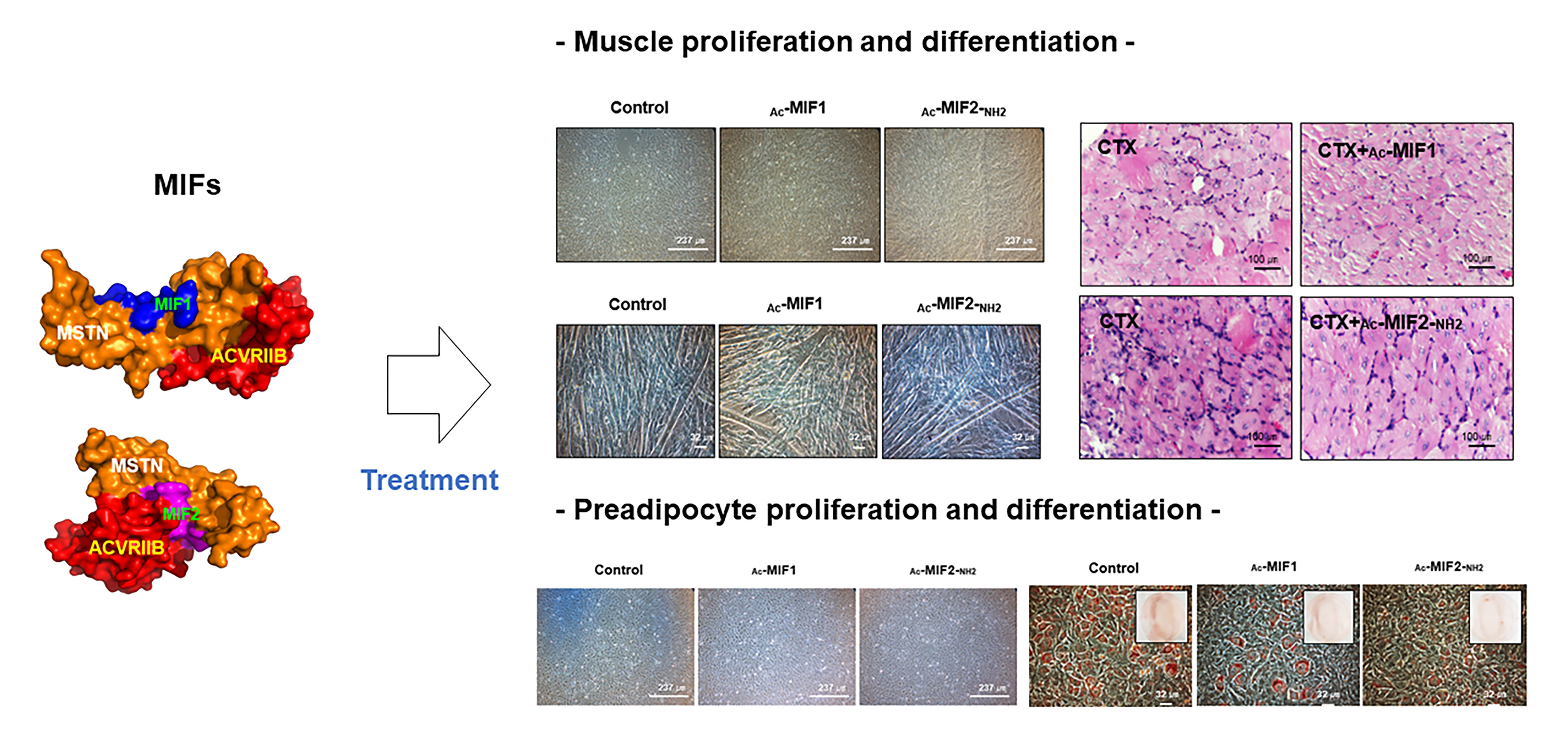
MIF1 and MIF2 Myostatin Peptide Inhibitors as Potent Muscle Mass Regulators
 , , ,
, , ,  , , ,
, , ,  and
and Abstract
Share and Cite
Lee, E.J.; Shaikh, S.; Baig, M.H.; Park, S.-Y.; Lim, J.H.; Ahmad, S.S.; Ali, S.; Ahmad, K.; Choi, I. MIF1 and MIF2 Myostatin Peptide Inhibitors as Potent Muscle Mass Regulators. Int. J. Mol. Sci. 2022, 23, 4222. https://doi.org/10.3390/ijms23084222
Lee EJ, Shaikh S, Baig MH, Park S-Y, Lim JH, Ahmad SS, Ali S, Ahmad K, Choi I. MIF1 and MIF2 Myostatin Peptide Inhibitors as Potent Muscle Mass Regulators. International Journal of Molecular Sciences. 2022; 23(8):4222. https://doi.org/10.3390/ijms23084222
Chicago/Turabian StyleLee, Eun Ju, Sibhghatulla Shaikh, Mohammad Hassan Baig, So-Young Park, Jeong Ho Lim, Syed Sayeed Ahmad, Shahid Ali, Khurshid Ahmad, and Inho Choi. 2022. "MIF1 and MIF2 Myostatin Peptide Inhibitors as Potent Muscle Mass Regulators" International Journal of Molecular Sciences 23, no. 8: 4222. https://doi.org/10.3390/ijms23084222
APA StyleLee, E. J., Shaikh, S., Baig, M. H., Park, S.-Y., Lim, J. H., Ahmad, S. S., Ali, S., Ahmad, K., & Choi, I. (2022). MIF1 and MIF2 Myostatin Peptide Inhibitors as Potent Muscle Mass Regulators. International Journal of Molecular Sciences, 23(8), 4222. https://doi.org/10.3390/ijms23084222