


The Causes and Potential Injurious Effects of Elevated Serum Leptin Levels in Chronic Kidney Disease Patients
 , ,
, ,
Abstract
1. Introduction
2. Leptin—Chemical Structure, Biosynthesis, Secretion and Functions
3. Effects of Kidney Function on Blood Leptin Levels in Patients with CKD
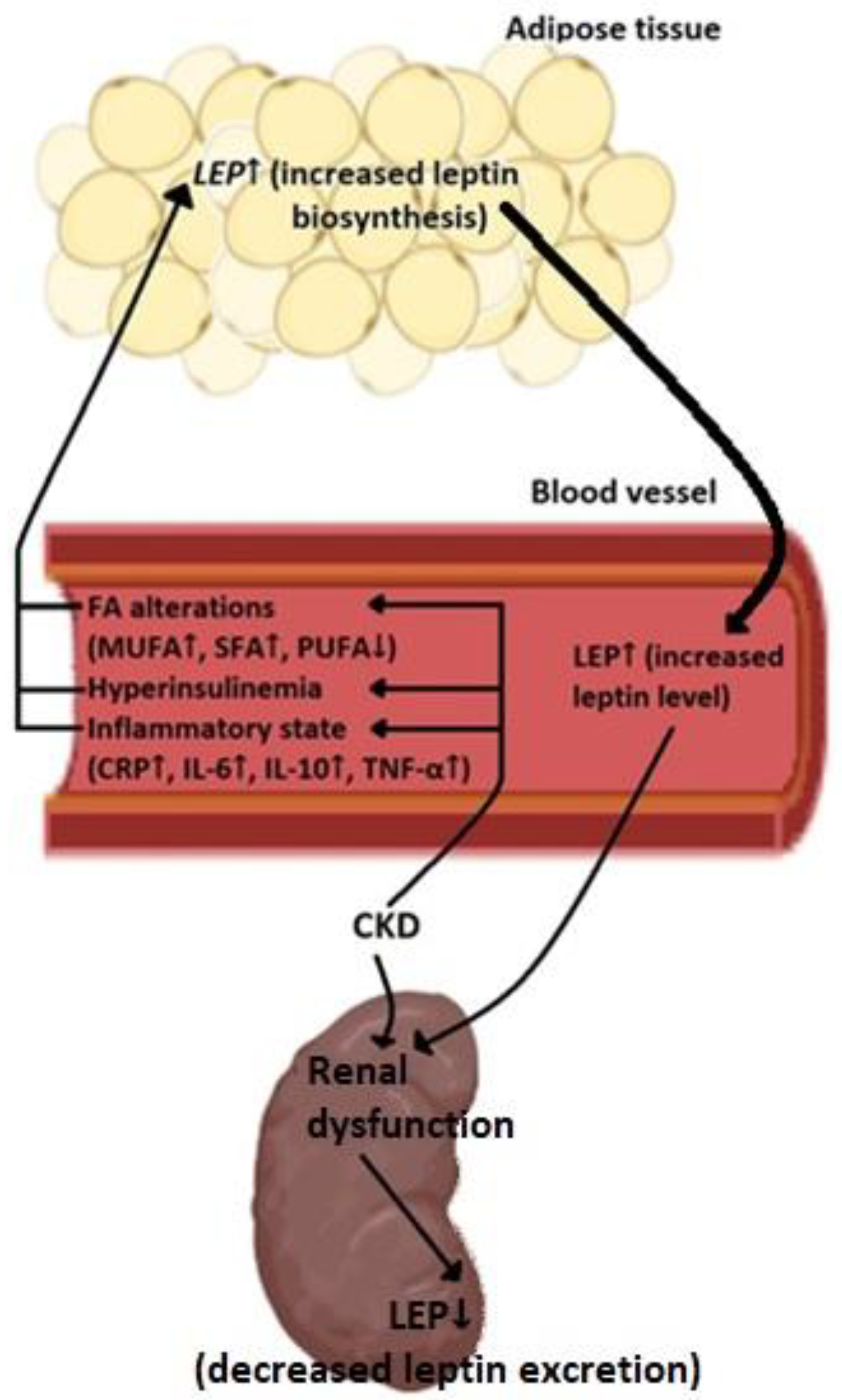
4. Effects of Leptin Gene Expression in Adipose Tissue on Blood Leptin Levels in CKD Patients
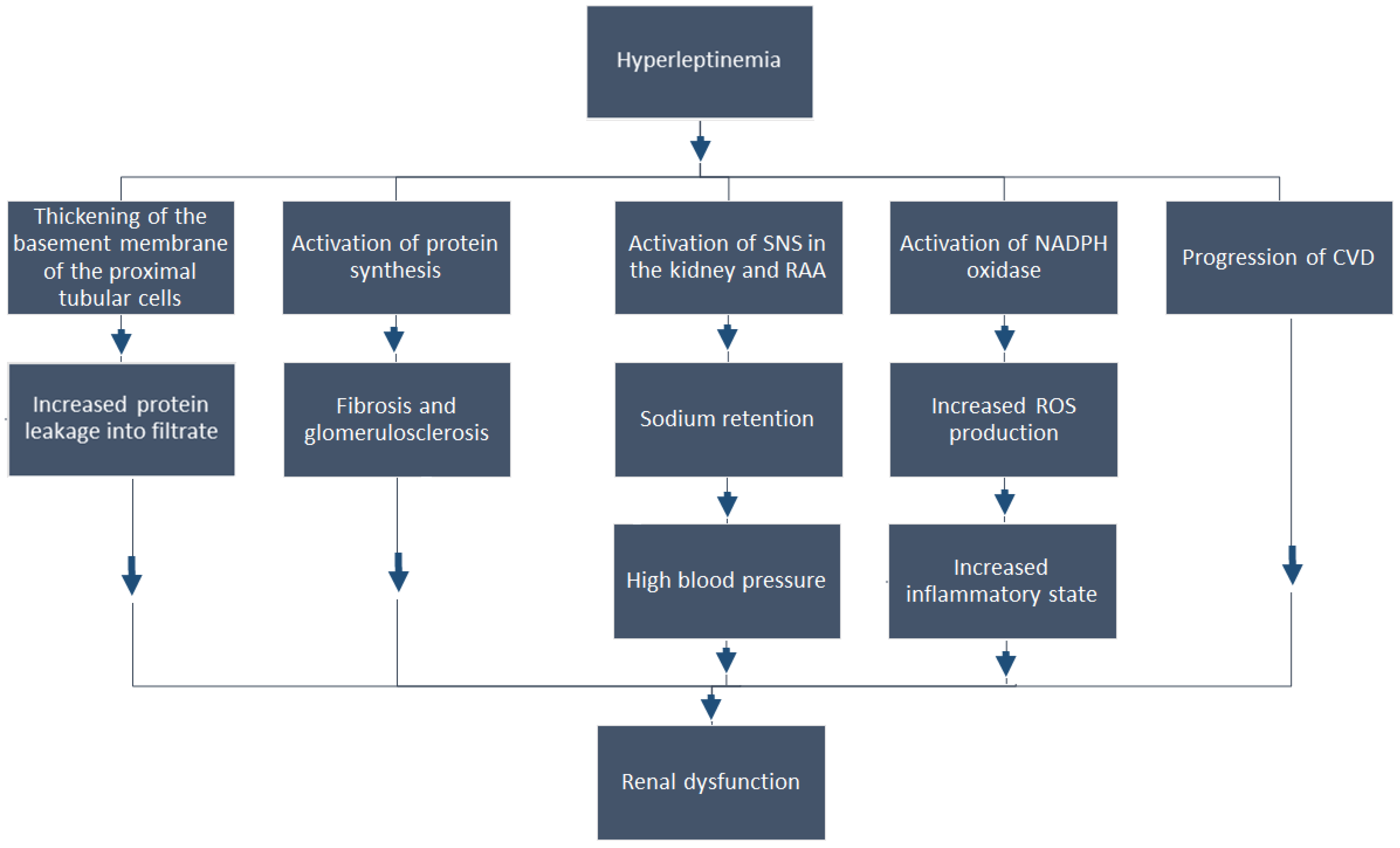
5. The Harmful Effects of Elevated Leptin Levels on Renal Function in CKD Patients
6. Effects of Increased Leptin Concentrations on the Risk of Cardiovascular Disease in Patients with CKD
7. Conclusions
Author Contributions
Funding
Conflicts of Interest
References
- Chang, Y.; Ryu, S.; Choi, Y.; Zhang, Y.; Cho, J.; Kwon, M.J.; Hyun, Y.Y.; Lee, K.B.; Kim, H.; Jung, H.S.; et al. Metabolically healthy obesity and development of chronic kidney disease: A cohort study. Ann. Intern. Med. 2016, 164, 305–312. [Google Scholar] [CrossRef] [PubMed]
- Mota-Zamorano, S.; Luna, E.; Garcia-Pino, G.; González, L.M.; Gervasini, G. Combined donor-recipient genotypes of leptin receptor and adiponectin gene polymorphisms affect the incidence of complications after renal transplantation. Mol. Genet. Metab. Rep. 2020, 25, 100648. [Google Scholar] [CrossRef] [PubMed]
- Tonelli, M.; Wiebe, N.; Culleton, B.; House, A.; Rabbat, C.; Fok, M.; McAlister, F.; Garg, A.X. Chronic Kidney Disease and Mortality Risk: A Systematic Review. J. Am. Soc. Nephrol. 2006, 17, 2034–2047. [Google Scholar] [CrossRef] [PubMed]
- Swierczynski, J.; Sledzinski, T. The role of adipokines and gastrointestinal tract hormones in obesity. In Principles of Metabolic Surgery; Springer: Berlin/Heidelberg, Germany, 2012; pp. 53–80. ISBN 9783642024115. [Google Scholar]
- Trayhurn, P. Endocrine and signalling role of adipose tissue: New perspectives on fat. Acta Physiol. Scand. 2005, 184, 285–293. [Google Scholar] [CrossRef] [PubMed]
- Trayhurn, P.; Wood, I.S. Signalling role of adipose tissue: Adipokines and inflammation in obesity. Biochem. Soc. Trans. 2005, 33, 1078–1081. [Google Scholar] [CrossRef] [PubMed]
- Katsiki, N.; Mikhailidis, D.P.; Banach, M. Leptin, cardiovascular diseases and type 2 diabetes mellitus review-article. Acta Pharmacol. Sin. 2018, 39, 1176–1188. [Google Scholar] [CrossRef]
- Sasso, F.C.; Pafundi, P.C.; Marfella, R.; Calabrò, P.; Piscione, F.; Furbatto, F.; Esposito, G.; Galiero, R.; Gragnano, F.; Rinaldi, L.; et al. Adiponectin and insulin resistance are related to restenosis and overall new PCI in subjects with normal glucose tolerance: The prospective AIRE Study. Cardiovasc. Diabetol. 2019, 18, 24. [Google Scholar] [CrossRef]
- Zhu, Q.; Scherer, P.E. Immunologic and endocrine functions of adipose tissue: Implications for kidney disease. Nat. Rev. Nephrol. 2018, 14, 105–120. [Google Scholar] [CrossRef]
- Da Silva Junior, G.B.; Bentes, A.C.S.N.; Daher, E.D.F.; de Matos, S.M.A. Obesity and kidney disease. J. Bras. Nefrol. 2017, 39, 65–69. [Google Scholar] [CrossRef]
- Akchurin, O.M.; Kaskel, F. Update on Inflammation in Chronic Kidney Disease. Blood Purif. 2015, 39, 84–92. [Google Scholar] [CrossRef]
- Abella, V.; Scotece, M.; Conde, J.; Pino, J.; Gonzalez-Gay, M.A.; Gómez-Reino, J.J.; Mera, A.; Lago, F.; Gómez, R.; Gualillo, O. Leptin in the interplay of inflammation, metabolism and immune system disorders. Nat. Rev. Rheumatol. 2017, 13, 100–109. [Google Scholar] [CrossRef]
- Canpolat, N.; Sever, L.; Agbas, A.; Tasdemir, M.; Oruc, C.; Ekmekci, O.B.; Caliskan, S. Leptin and ghrelin in chronic kidney disease: Their associations with protein-energy wasting. Pediatr. Nephrol. 2018, 33, 2113–2122. [Google Scholar] [CrossRef]
- D’Marco, L.; Puchades, M.J.; Gorriz, J.L.; Romero-Parra, M.; Lima-Martínez, M.; Soto, C.; Bermúdez, V.; Raggi, P. Epicardial adipose tissue, adiponectin and leptin: A potential source of cardiovascular risk in chronic kidney disease. Int. J. Mol. Sci. 2020, 21, 978. [Google Scholar] [CrossRef]
- Marchelek-Mysliwiec, M.; Wisniewska, M.; Nowosiad-Magda, M.; Safranow, K.; Kwiatkowska, E.; Banach, B.; Dołegowska, B.; Dołegowska, K.; Stepniewska, J.; Domanski, L.; et al. Association Between Plasma Concentration of Klotho Protein, Osteocalcin, Leptin, Adiponectin, and Bone Mineral Density in Patients with Chronic Kidney Disease. Horm. Metab. Res. 2018, 50, 816–821. [Google Scholar] [CrossRef]
- Alix, P.M.; Guebre-Egziabher, F.; Soulage, C.O. Leptin as an uremic toxin: Deleterious role of leptin in chronic kidney disease. Biochimie 2014, 105, 12–21. [Google Scholar] [CrossRef] [PubMed]
- Frühbeck, G.; Catalán, V.; Rodríguez, A.; Ramírez, B.; Becerril, S.; Salvador, J.; Portincasa, P.; Colina, I.; Gómez-Ambrosi, J. Involvement of the leptin-adiponectin axis in inflammation and oxidative stress in the metabolic syndrome. Sci. Rep. 2017, 7, 1–8. [Google Scholar] [CrossRef]
- Mao, S.; Fang, L.; Liu, F.; Jiang, S.; Wu, L.; Zhang, J. Leptin and chronic kidney diseases. J. Recept. Signal. Transduct. 2018, 38, 89–94. [Google Scholar] [CrossRef]
- Zhao, S.; Kusminski, C.M.; Elmquist, J.K.; Scherer, P.E. Leptin: Less is more. Diabetes 2020, 69, 823–829. [Google Scholar] [CrossRef]
- Friedman, J. The long road to leptin. J. Clin. Investig. 2016, 126, 4727–4734. [Google Scholar] [CrossRef]
- Akoumianakis, I.; Antoniades, C. The interplay between adipose tissue and the cardiovascular system: Is fat always bad? Cardiovasc. Res. 2017, 113, 999–1008. [Google Scholar] [CrossRef]
- Kershaw, E.E.; Flier, J.S. Adipose Tissue as an Endocrine Organ. J. Clin. Endocrinol. Metab. 2004, 89, 2548–2556. [Google Scholar] [CrossRef] [PubMed]
- Tsai, J.P. The association of serum leptin levels with metabolic diseases. Tzu Chi Med. J. 2017, 29, 192–196. [Google Scholar] [CrossRef] [PubMed]
- Zabrocka, L.; Raczynska, S.; Goyke, E.; Sledzinski, Z.; Swierczynski, J. BMI is the main determinant of the circulating leptin in women after vertical banded gastroplasty. Obes. Res. 2004, 12, 505–512. [Google Scholar] [CrossRef]
- Almabhouh, F.A.; Ahmad Muhammad, F.I.; Ibrahim, H.; Singh, H. Leptin: A pleitropic factor in physiology. J. Clin. Health Sci. 2019, 4, 31–57. [Google Scholar] [CrossRef]
- Briley, L.P.; Szczech, L.A. Leptin and renal disease. Semin. Dial. 2006, 19, 54–59. [Google Scholar] [CrossRef]
- Noor, S.; Alam, F.; Fatima, S.S.; Khan, M.; Rehman, R. Role of leptin and dyslipidemia in chronic kidney disease. Pak. J. Pharm. Sci. 2018, 31, 893–897. [Google Scholar]
- Nasrallah, M.P.; Ziyadeh, F.N. Overview of the Physiology and Pathophysiology of Leptin With Special Emphasis on its Role in the Kidney. Semin. Nephrol. 2013, 33, 54–65. [Google Scholar] [CrossRef]
- Mantzoros, C.S.; Magkos, F.; Brinkoetter, M.; Sienkiewicz, E.; Dardeno, T.A.; Kim, S.Y.; Hamnvik, O.P.R.; Koniaris, A. Leptin in human physiology and pathophysiology. Am. J. Physiol.-Endocrinol. Metab. 2011, 301, E567–E584. [Google Scholar] [CrossRef] [PubMed]
- Zhang, J.; Wang, N. Leptin in chronic kidney disease: A link between hematopoiesis, bone metabolism, and nutrition. Int. Urol. Nephrol. 2014, 46, 1169–1174. [Google Scholar] [CrossRef]
- Briffa, J.F.; Mcainch, A.J.; Poronnik, P.; Hryciw, D.H. Adipokines as a link between obesity and chronic kidney disease. Am. J. Physiol. Ren. Physiol. 2013, 305, 1629–1636. [Google Scholar] [CrossRef]
- Nogalska, A.; Sucajtys-Szulc, E.; Swierczynski, J. Leptin decreases lipogenic enzyme gene expression through modification of SREBP-1c gene expression in white adipose tissue of aging rats. Metabolism 2005, 54, 1041–1047. [Google Scholar] [CrossRef]
- Nogalska, A.; Swierczynski, J. Potential role of high serum leptin concentration in age-related decrease of fatty acid synthase gene expression in rat white adipose tissue. Exp. Gerontol. 2004, 39, 147–150. [Google Scholar] [CrossRef]
- Nogalska, A.; Pankiewicz, A.; Goyke, E.; Swierczynski, J. The age-related inverse relationship between ob and lipogenic enzymes genes expression in rat white adipose tissue. Exp. Gerontol. 2003, 38, 415–422. [Google Scholar] [CrossRef]
- Barreto, F.C.; Stinghen, A.E.M.; de Oliveira, R.B.; Franco, A.T.B.; Moreno, A.N.; Barreto, D.V.; Pecoits-Filho, R.; Drüeke, T.B.; Massy, Z.A. The quest for a better understanding of chronic kidney disease complications: An update on uremic toxins. Braz. J. Nephrol. 2014, 36, 221–235. [Google Scholar] [CrossRef] [PubMed]
- Dalamaga, M.; Chou, S.H.; Shields, K.; Papageorgiou, P.; Polyzos, S.A.; Mantzoros, C.S. Leptin at the intersection of neuroendocrinology and metabolism: Current evidence and therapeutic perspectives. Cell Metab. 2013, 18, 29–42. [Google Scholar] [CrossRef]
- Frühbeck, G.; Catalán, V.; Rodríguez, A.; Gómez-Ambrosi, J. Adiponectin-leptin ratio: A promising index to estimate adipose tissue dysfunction. Relation with obesity-associated cardiometabolic risk. Adipocyte 2018, 7, 57–62. [Google Scholar] [CrossRef] [PubMed]
- Wauman, J.; Zabeau, L.; Tavernier, J. The leptin receptor complex: Heavier than expected? Front. Endocrinol. (Lausanne) 2017, 8, 30. [Google Scholar] [CrossRef]
- Cumin, F.; Baum, H.P.; De Gasparo, M.; Levens, N. Removal of endogenous leptin from the circulation by the kidney. Int. J. Obes. 1997, 21, 495–504. [Google Scholar] [CrossRef][Green Version]
- Verroust, P.J.; Christensen, E.I. Editorial Comments Megalin and cubilin-the story of two multipurpose receptors unfolds. Nephrol. Dial. Transplant. 2002, 17, 1867–1871. [Google Scholar] [CrossRef]
- Hama, H.; Saito, A.; Takeda, T.; Tanuma, A.; Xie, Y.; Sato, K.; Kazama, J.J.; Gejyo, F. Evidence indicating that renal tubular metabolism of leptin is mediated by megalin but not by the leptin receptors. Endocrinology 2004, 145, 3935–3940. [Google Scholar] [CrossRef]
- Briffa, J.F.; Grinfeld, E.; Poronnik, P.; McAinch, A.J.; Hryciw, D.H. Uptake of leptin and albumin via separate pathways in proximal tubule cells. Int. J. Biochem. Cell Biol. 2016, 79, 194–198. [Google Scholar] [CrossRef]
- Heimburger, O.; Lonnqvist, F.; Danielsson, A.; Nordenstrom, J.; Stenvinkel, P. Serum Immunoreactive Leptin Concentration and its Relation to the Body Fat Content in Chronic Renal Failure. J. Am. Soc. Nephrol. 1997, 8, 1423–1430. [Google Scholar] [CrossRef] [PubMed]
- Nordfors, L.; Lönnqvist, F.L.; Heimbürger, O.H.; Danielsson, A.; Schalling, M.; Stenvinkel, P. Clinical Nephrology-Epidemiology-Clinical Trials Low leptin gene expression and hyperleptinemia in chronic renal failure. Kidney Int. 1998, 54, 1267–1275. [Google Scholar] [CrossRef] [PubMed]
- Lim, C.C.; Teo, B.W.; Tai, E.S.; Lim, S.C.; Chan, C.M.; Sethi, S.; Wong, T.Y.; Sabanayagam, C. Elevated Serum Leptin, Adiponectin and Leptin to Adiponectin Ratio Is Associated with Chronic Kidney Disease in Asian Adults. PLoS ONE 2015, 10, e0122009. [Google Scholar] [CrossRef] [PubMed]
- Zhang, J.; Jiang, Y.; Zhang, J.; Yuan, Y.; Zha, X.; Xing, C.; Shen, C.; Shen, Z.; Qin, C.; Zeng, M.; et al. Association of Increased Serum Leptin with Ameliorated Anemia and Malnutrition in Stage 5 Chronic Kidney Disease Patients after Parathyroidectomy. Sci. Rep. 2016, 6, 1–13. [Google Scholar] [CrossRef]
- Korczyńska, J.; Czumaj, A.; Chmielewski, M.; Śledziński, M.; Mika, A.; Śledziński, T. Increased expression of the leptin gene in adipose tissue of patients with chronic kidney disease–the possible role of an abnormal serum fatty acid profile. Metabolites 2020, 10, 98. [Google Scholar] [CrossRef]
- Miricescu, D.; Balan, D.; Tulin, A.; Stiru, O.; Vacaroiu, I.; Mihai, D.; Popa, C.; Enyedi, M.; Nedelea, A.; Nica, A.; et al. Impact of adipose tissue in chronic kidney disease development (Review). Exp. Ther. Med. 2021, 21, 1–8. [Google Scholar] [CrossRef]
- Stenvinkel, P.; Heimbürger, O.; Lö, F. Nephrology Dialysis Transplantation Rapid Communication Serum leptin concentrations correlate to plasma insulin concentrations independent of body fat content in chronic renal failure. Nephrol. Dial. Transplant. 1997, 12, 1321–1325. [Google Scholar] [CrossRef][Green Version]
- Aminzadeh, M.A.; Pahl, M.V.; Barton, C.H.; Doctor, N.S.; Vaziri, N.D. Human uraemic plasma stimulates release of leptin and uptake of tumour necrosis factor-α in visceral adipocytes. Nephrol. Dial. Transplant. 2009, 24, 3626–3631. [Google Scholar] [CrossRef]
- Navaneethan, S.D.; Kirwan, J.P.; Remer, E.M.; Schneider, E.; Addeman, B.; Arrigain, S.; Horwitz, E.; Fink, J.C.; Lash, J.P.; McKenzie, C.A.; et al. Adiposity, Physical Function, and Their Associations With Insulin Resistance, Inflammation, and Adipokines in CKD. Am. J. Kidney Dis. 2021, 77, 44–55. [Google Scholar] [CrossRef]
- Ghazaly, E.A.; EL-Saeed, A.M.; Abdelsalam, M.; Seoudi, D.M. Potential protective effect of leptin and uncoupling protein-2 genes polymorphism in Egyptian patients with chronic kidney disease. Int. Urol. Nephrol. 2020, 52, 2153–2160. [Google Scholar] [CrossRef] [PubMed]
- Okpechi, I.G.; Rayner, B.L.; van der Merwe, L.; Mayosi, B.M.; Adeyemo, A.; Tiffin, N.; Ramesar, R. Genetic Variation at Selected SNPs in the Leptin Gene and Association of Alleles with Markers of Kidney Disease in a Xhosa Population of South Africa. PLoS ONE 2010, 5, e9086. [Google Scholar] [CrossRef]
- Folkersen, L.; Gustafsson, S.; Wang, Q.; Hansen, D.H.; Hedman, Å.K.; Schork, A.; Page, K.; Zhernakova, D.V.; Wu, Y.; Peters, J.; et al. Genomic and drug target evaluation of 90 cardiovascular proteins in 30,931 individuals. Nat. Metab. 2020, 2, 1135–1148. [Google Scholar] [CrossRef]
- Kilpeläinen, T.O.; Carli, J.F.M.; Skowronski, A.A.; Sun, Q.; Kriebel, J.; Feitosa, M.F.; Hedman, Å.K.; Drong, A.W.; Hayes, J.E.; Zhao, J.; et al. Genome-wide meta-analysis uncovers novel loci influencing circulating leptin levels. Nat. Commun. 2016, 7, 1–14. [Google Scholar] [CrossRef]
- Yaghootkar, H.; Zhang, Y.; Spracklen, C.N.; Karaderi, T.; Huang, L.O.; Bradfield, J.; Schurmann, C.; Fine, R.S.; Preuss, M.H.; Kutalik, Z.; et al. Genetic studies of leptin concentrations implicate leptin in the regulation of early adiposity. Diabetes 2020, 69, 2806–2818. [Google Scholar] [CrossRef]
- Wu, L.; Sun, D. Leptin receptor gene polymorphism and the risk of cardiovascular disease: A systemic review and meta-analysis. Int. J. Environ. Res. Public Health 2017, 14, 375. [Google Scholar] [CrossRef] [PubMed]
- Nowzari, Z.; Masoumi, M.; Nazari-Robati, M.; Akbari, H.; Shahrokhi, N.; Asadikaram, G. Association of polymorphisms of leptin, leptin receptor and apelin receptor genes with susceptibility to coronary artery disease and hypertension. Life Sci. 2018, 207, 166–171. [Google Scholar] [CrossRef] [PubMed]
- Paula De Faria, A.; Ritter, A.M.V.; Sabbatini, A.R.; Modolo, R.; Moreno, H.; Sabbatini, R. Effects of leptin and leptin receptor SNPs on clinical-and metabolic-related traits in apparent treatment-resistant hypertension. Blood Press. 2016, 26, 74–80. [Google Scholar] [CrossRef]
- Ortega-Azorín, C.; Coltell, O.; Asensio, E.M.; Sorlí, J.V.; González, J.I.; Portolés, O.; Saiz, C.; Estruch, R.; Ramírez-Sabio, J.B.; Pérez-Fidalgo, A.; et al. Candidate gene and genome-wide association studies for circulating leptin levels reveal population and sex-specific associations in high cardiovascular risk mediterranean subjects. Nutrients 2019, 11, 2751. [Google Scholar] [CrossRef]
- Kalbacher, E.; Koppe, L.; Zarrouki, B.; Pillon, N.J.; Fouque, D.; Soulage, C.O. Human uremic plasma and not urea induces exuberant secretion of leptin in 3T3-L1 adipocytes. J. Ren. Nutr. 2011, 21, 72–75. [Google Scholar] [CrossRef] [PubMed]
- Swierczynski, J.; Korczynska, J.; Szolkiewicz, M.; Karbowska, J.; Kochan, Z.; Nieweglowski, T.; Kusiak, E.; Rutkowski, B. Low leptin mRNA level in adipose tissue and normoleptinemia in experimental chronic renal failure. Exp. Nephrol. 2001, 9, 54–59. [Google Scholar] [CrossRef] [PubMed]
- Mikolasevic, I.; Žutelija, M.; Mavrinac, V.; Orlic, L. Dyslipidemia in patients with chronic kidney disease: Etiology and management. Int. J. Nephrol. Renovasc. Dis. 2017, 10, 35–45. [Google Scholar] [CrossRef] [PubMed]
- Czumaj, A.; Śledziński, T.; Carrero, J.-J.; Stepnowski, P.; Sikorska-Wisniewska, M.; Chmielewski, M.; Mika, A. Alterations of Fatty Acid Profile May Contribute to Dyslipidemia in Chronic Kidney Disease by Influencing Hepatocyte Metabolism. Int. J. Mol. Sci. 2019, 20, 2470. [Google Scholar] [CrossRef] [PubMed]
- Szczuko, M.; Kaczkan, M.; Drozd, A.; Maciejewska, D.; Palma, J.; Owczarzak, A.; Marczuk, N.; Rutkowski, P.; Małgorzewicz, S. Comparison of Fatty Acid Profiles in a Group of Female Patients with Chronic Kidney Diseases (CKD) and Metabolic Syndrome (MetS)–Similar Trends of Changes, Different Pathophysiology. Int. J. Mol. Sci. 2019, 20, 1719. [Google Scholar] [CrossRef]
- Mika, A.; Stepnowski, P.; Chmielewski, M.; Malgorzewicz, S.; Kaska, L.; Proczko, M.; Ratnicki-Sklucki, K.; Sledzinski, M.; Sledzinski, T. Increased Serum Level of Cyclopropaneoctanoic Acid 2-Hexyl in Patients with Hypertriglyceridemia-Related Disorders. Lipids 2016, 51, 867–873. [Google Scholar] [CrossRef]
- Mika, A.; Sikorska-Wiśniewska, M.; Małgorzewicz, S.; Stepnowski, P.; Dȩbska-Ślizień, A.; Śledziński, T.; Chmielewski, M. Potential contribution of monounsaturated fatty acids to cardiovascular risk in chronic kidney disease. Pol. Arch. Intern. Med. 2018, 128, 755–763. [Google Scholar] [CrossRef]
- Moradi, H.; Vaziri, N.D. Molecular mechanisms of disorders of lipid metabolism in chronic kidney disease Publication Date. Front. Biosci. 2018, 23, 146–161. [Google Scholar]
- Briffa, J.F.; Grinfeld, E.; Mathai, M.L.; Poronnik, P.; McAinch, A.J.; Hryciw, D.H. Acute leptin exposure reduces megalin expression and upregulates TGFβ1 in cultured renal proximal tubule cells. Mol. Cell. Endocrinol. 2015, 401, 25–34. [Google Scholar] [CrossRef]
- Wolf, G.; Chen, S.; Han, D.C.; Ziyadeh, F.N. Leptin and renal disease. Am. J. Kidney Dis. 2002, 39, 1–11. [Google Scholar] [CrossRef]
- Wolf, G.; Hamann, A.; Cheol Han, D.; Helmchen, U.; Thaiss, F.; Ziyadeh, F.N.; Stahl, R.A. Leptin stimulates proliferation and TGF-expression in renal glomerular endothelial cells: Potential role in glomerulosclerosis. Kidney Int. 1999, 56, 860–872. [Google Scholar] [CrossRef]
- Briffa, J.F.; Grinfeld, E.; McAinch, A.J.; Poronnik, P.; Hryciw, D.H. Short term exposure to elevated levels of leptin reduces proximal tubule cell metabolic activity. Mol. Cell. Endocrinol. 2014, 382, 38–45. [Google Scholar] [CrossRef] [PubMed]
- Hall, J.E.; Mouton, A.J.; da Silva, A.A.; Omoto, A.C.M.; Wang, Z.; Li, X.; do Carmo, J.M. Obesity, kidney dysfunction, and inflammation: Interactions in hypertension. Cardiovasc. Res. 2020, 1–18. [Google Scholar] [CrossRef]
- Lakkis, J.I.; Weir, M.R. Obesity and Kidney Disease. Prog. Cardiovasc. Dis. 2018, 61, 157–167. [Google Scholar] [CrossRef] [PubMed]
- Podkowińska, A.; Formanowicz, D. Chronic kidney disease as oxidative stress-and inflammatory-mediated cardiovascular disease. Antioxidants 2020, 9, 752. [Google Scholar] [CrossRef] [PubMed]
- Ambarkar, M.; Pemmaraju, S.V.L.N.; Gouroju, S.; Manohar, S.M.; Bitla, A.R.; Yajamanam, N.; Vishnubhotla, S. Adipokines and their relation to endothelial dysfunction in patients with chronic kidney disease. J. Clin. Diagn. Res. 2016, 10, BC04–BC08. [Google Scholar] [CrossRef] [PubMed]
- Ocak, N.; Dirican, M.; Ersoy, A.; Sarandol, E. Adiponectin, leptin, nitric oxide, and C-reactive protein levels in kidney transplant recipients: Comparison with the hemodialysis and chronic renal failure. Ren. Fail. 2016, 38, 1639–1646. [Google Scholar] [CrossRef] [PubMed]
- D’Elia, L.; Manfredi, M.; Perna, L.; Iacone, R.; Russo, O.; Strazzullo, P.; Galletti, F. Circulating leptin levels predict the decline in renal function with age in a sample of adult men (The Olivetti Heart Study). Intern. Emerg. Med. 2019, 14, 507–513. [Google Scholar] [CrossRef]
- Ross, W.R.; McGill, J.B. Epidemiology of Obesity and Chronic Kidney Disease. Adv. Chronic Kidney Dis. 2006, 13, 325–335. [Google Scholar] [CrossRef]
- Minutolo, R.; Gabbai, F.B.; Provenzano, M.; Chiodini, P.; Borrelli, S.; Garofalo, C.; Sasso, F.C.; Santoro, D.; Bellizzi, V.; Conte, G.; et al. Cardiorenal prognosis by residual proteinuria level in diabetic chronic kidney disease: Pooled analysis of four cohort studies. Nephrol. Dial. Transplant. 2018, 33, 1942–1949. [Google Scholar] [CrossRef]
- Lees, J.S.; Welsh, C.E.; Celis-Morales, C.A.; Mackay, D.; Lewsey, J.; Gray, S.R.; Lyall, D.M.; Cleland, J.G.; Gill, J.M.R.; Jhund, P.S.; et al. Glomerular filtration rate by differing measures, albuminuria and prediction of cardiovascular disease, mortality and end-stage kidney disease. Nat. Med. 2019, 25, 1753–1760. [Google Scholar] [CrossRef]
- Kovesdy, C.P.; Furth, S.L.; Zoccali, C.; Li, P.K.T.; Garcia-Garcia, G.; Benghanem-Gharbi, M.; Bollaert, R.; Dupuis, S.; Erk, T.; Kalantar-Zadeh, K.; et al. Obesity and kidney disease: Hidden consequences of the epidemic. J. Ren. Care 2017, 43, 3–10. [Google Scholar] [CrossRef] [PubMed][Green Version]
- Korolczuk, A.; Dudka, J. Increased Risk of Cardiovascular Complications in Chronic Kidney Disease: A Possible Role of Leptin. Curr. Pharm. Des. 2014, 20, 666–674. [Google Scholar] [CrossRef] [PubMed]
- Lu, J.W.; Chi, P.J.; Lin, Y.L.; Wang, C.H.; Hsu, B.G. Serum leptin levels are positively associated with aortic stiffness in patients with chronic kidney disease stage 3–5. Adipocyte 2020, 9, 206–211. [Google Scholar] [CrossRef]
- Kamińska, J.; Stopiński, M.; Mucha, K.; Jędrzejczak, A.; Gołębiowski, M.; Niewczas, M.A.; Pączek, L.; Foroncewicz, B. IL 6 but not TNF is linked to coronary artery calcification in patients with chronic kidney disease. Cytokine 2019, 120, 9–14. [Google Scholar] [CrossRef] [PubMed]
- Liu, B.; Qiao, J.; Hu, J.; Fan, M.; Zhao, Y.; Su, H.; Wang, Z.; Yu, Q.; Ma, Q.; Li, Y.; et al. Leptin promotes endothelial dysfunction in chronic kidney disease by modulating the MTA1-mediated WNT/β-catenin pathway. Mol. Cell. Biochem. 2020, 473, 155–166. [Google Scholar] [CrossRef]
- Ding, N.; Liu, B.; Song, J.; Bao, S.; Zhen, J.; Lv, Z.; Wang, R. Leptin promotes endothelial dysfunction in chronic kidney disease through AKT/GSK3β and β-catenin signals. Biochem. Biophys. Res. Commun. 2016, 480, 544–551. [Google Scholar] [CrossRef]
Publisher’s Note: MDPI stays neutral with regard to jurisdictional claims in published maps and institutional affiliations. |
© 2021 by the authors. Licensee MDPI, Basel, Switzerland. This article is an open access article distributed under the terms and conditions of the Creative Commons Attribution (CC BY) license (https://creativecommons.org/licenses/by/4.0/).
Share and Cite
Korczynska, J.; Czumaj, A.; Chmielewski, M.; Swierczynski, J.; Sledzinski, T. The Causes and Potential Injurious Effects of Elevated Serum Leptin Levels in Chronic Kidney Disease Patients. Int. J. Mol. Sci. 2021, 22, 4685. https://doi.org/10.3390/ijms22094685
Korczynska J, Czumaj A, Chmielewski M, Swierczynski J, Sledzinski T. The Causes and Potential Injurious Effects of Elevated Serum Leptin Levels in Chronic Kidney Disease Patients. International Journal of Molecular Sciences. 2021; 22(9):4685. https://doi.org/10.3390/ijms22094685
Chicago/Turabian StyleKorczynska, Justyna, Aleksandra Czumaj, Michal Chmielewski, Julian Swierczynski, and Tomasz Sledzinski. 2021. "The Causes and Potential Injurious Effects of Elevated Serum Leptin Levels in Chronic Kidney Disease Patients" International Journal of Molecular Sciences 22, no. 9: 4685. https://doi.org/10.3390/ijms22094685
APA StyleKorczynska, J., Czumaj, A., Chmielewski, M., Swierczynski, J., & Sledzinski, T. (2021). The Causes and Potential Injurious Effects of Elevated Serum Leptin Levels in Chronic Kidney Disease Patients. International Journal of Molecular Sciences, 22(9), 4685. https://doi.org/10.3390/ijms22094685

