Review

Current Perspective Regarding the Immunopathogenesis of Drug-Induced Hypersensitivity Syndrome/Drug Reaction with Eosinophilia and Systemic Symptoms (DIHS/DRESS)

Department of Dermatology, Nara Medical University School of Medicine, Nara 634-8522, Japan
*
Author to whom correspondence should be addressed.
Int. J. Mol. Sci. 2021, 22(4), 2147; https://doi.org/10.3390/ijms22042147
Submission received: 1 February 2021 / Revised: 16 February 2021 / Accepted: 19 February 2021 / Published: 21 February 2021
(This article belongs to the Special Issue Skin Allergy and Immunology)

Abstract

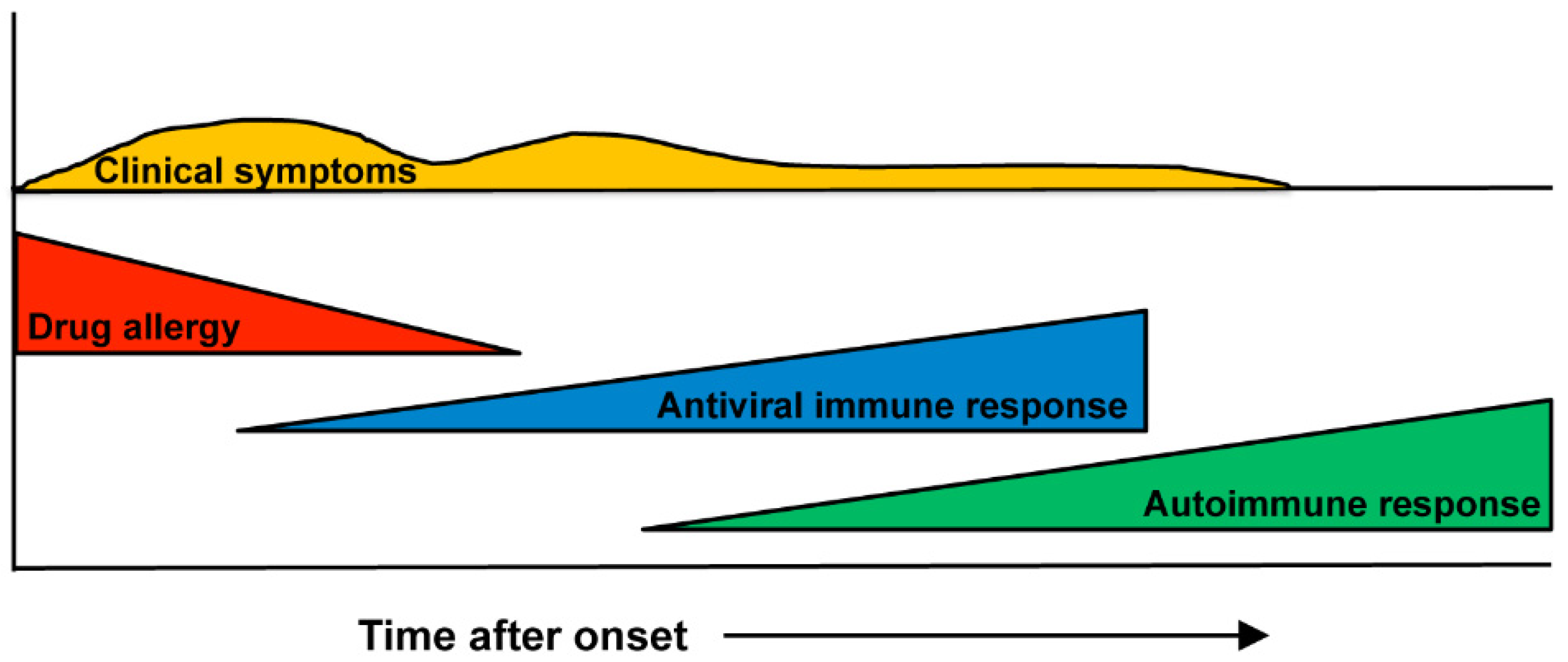
Drug-induced hypersensitivity syndrome/drug reaction with eosinophilia and systemic symptoms (DIHS/DRESS) is a severe type of adverse drug eruption associated with multiorgan involvement and the reactivation of human herpesvirus 6, which arises after prolonged exposure to certain drugs. Typically, two waves of disease activity occur during the course of DIHS/DRESS; however, some patients experience multiple waves of exacerbation and remission of the disease. Severe complications, some of which are related to cytomegalovirus reactivation, can be fatal. DIHS/DRESS is distinct from other drug reactions, as it involves herpes virus reactivation and can lead to the subsequent development of autoimmune diseases. The association between herpesviruses and DIHS/DRESS is now well established, and DIHS/DRESS is considered to arise as a result of complex interactions between several herpesviruses and comprehensive immune responses, including drug-specific immune responses and antiviral immune responses, each of which may be mediated by distinct types of immune cells. It appears that both CD4 and CD8 T cells are involved in the pathogenesis of DIHS/DRESS but play distinct roles. CD4 T cells mainly initiate drug allergies in response to drug antigens, and then herpesvirus-specific CD8 T cells that target virus-infected cells emerge, resulting in tissue damage. Regulatory T-cell dynamics are also suggested to contribute to the diverse symptoms of DIHS/DRESS. However, the pathomechanisms of this complex disease remain largely unknown. In particular, how viral infections contribute to the pathogenesis of DIHS/DRESS and why autoimmune sequelae arise in DIHS/DRESS are yet to be elucidated. This review describes the clinical features of DIHS/DRESS, including the associated complications and sequelae, and discusses recent advances in our understanding of the immunopathogenic mechanisms of DIHS/DRESS.
Keywords: severe cutaneous adverse reactions; drug-induced hypersensitivity syndrome; drug reaction with eosinophilia and systemic symptoms; herpesvirus; autoimmune disease; pathomechanism severe cutaneous adverse reactions; drug-induced hypersensitivity syndrome; drug reaction with eosinophilia and systemic symptoms; herpesvirus; autoimmune disease; pathomechanism