Review

The Circadian Physiology: Implications in Livestock Health
1
Key Laboratory of Animal Breeding Reproduction and Molecular Design for Jiangsu Province, College of Animal Science and Technology, Yangzhou University, Yangzhou 225009, China
2
College of Animal Science and Technology, Yangzhou University, Yangzhou 225009, China
*
Authors to whom correspondence should be addressed.
These authors contributed equally to this work.
Int. J. Mol. Sci. 2021, 22(4), 2111; https://doi.org/10.3390/ijms22042111
Submission received: 28 December 2020 / Revised: 11 February 2021 / Accepted: 16 February 2021 / Published: 20 February 2021
(This article belongs to the Special Issue Genetics of Circadian Rhythms and Sleep)

Abstract

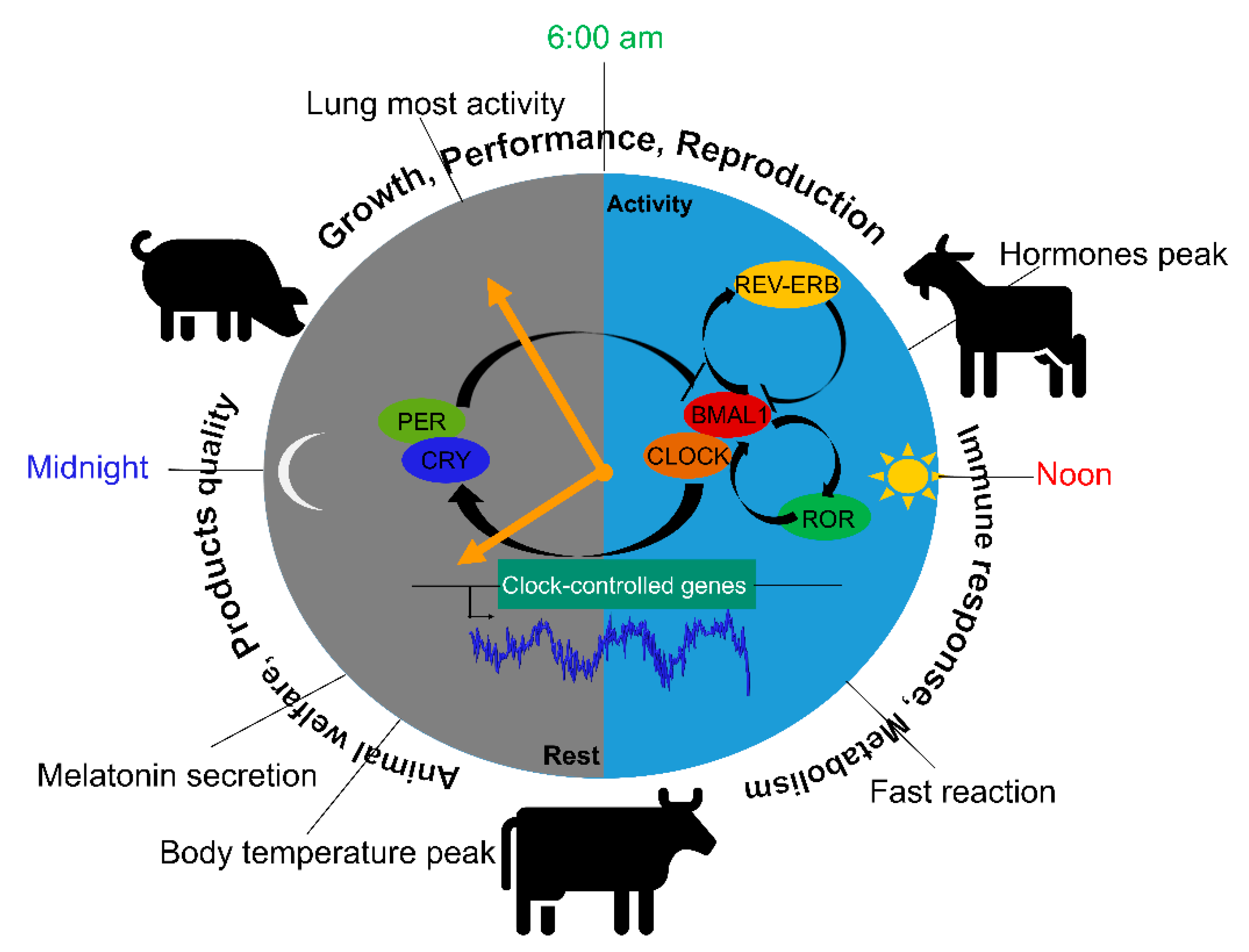
Circadian rhythms exist in almost all types of cells in mammals. Thousands of genes exhibit approximately 24 h oscillations in their expression levels, making the circadian clock a crucial regulator of their normal functioning. In this regard, environmental factors to which internal physiological processes are synchronized (e.g., nutrition, feeding/eating patterns, timing and light exposure), become critical to optimize animal physiology, both by managing energy use and by realigning the incompatible processes. Once the circadian clock is disrupted, animals will face the increased risks of diseases, especially metabolic phenotypes. However, little is known about the molecular components of these clocks in domestic species and by which they respond to external stimuli. Here we review evidence for rhythmic control of livestock production and summarize the associated physiological functions, and the molecular mechanisms of the circadian regulation in pig, sheep and cattle. Identification of environmental and physiological inputs that affect circadian gene expressions will help development of novel targets and the corresponding approaches to optimize production efficiency in farm animals.
Keywords: circadian physiology; clock gene; lipid metabolism; livestock; melatonin circadian physiology; clock gene; lipid metabolism; livestock; melatonin