Article

Evaluation of Floxuridine Oligonucleotide Conjugates Carrying Potential Enhancers of Cellular Uptake
1
Institute for Advanced Chemistry of Catalonia (IQAC-CSIC), Jordi Girona 18-26, E-08034 Barcelona, Spain
2
Networking Center on Bioengineering, Biomaterials and Nanomedicine (CIBER-BBN), Jordi Girona 18-26, E-08034 Barcelona, Spain
*
Authors to whom correspondence should be addressed.
Int. J. Mol. Sci. 2021, 22(11), 5678; https://doi.org/10.3390/ijms22115678
Submission received: 31 March 2021 / Revised: 21 May 2021 / Accepted: 25 May 2021 / Published: 26 May 2021
(This article belongs to the Special Issue Oligonucleotide, Therapy, and Applications 2.0)

Abstract

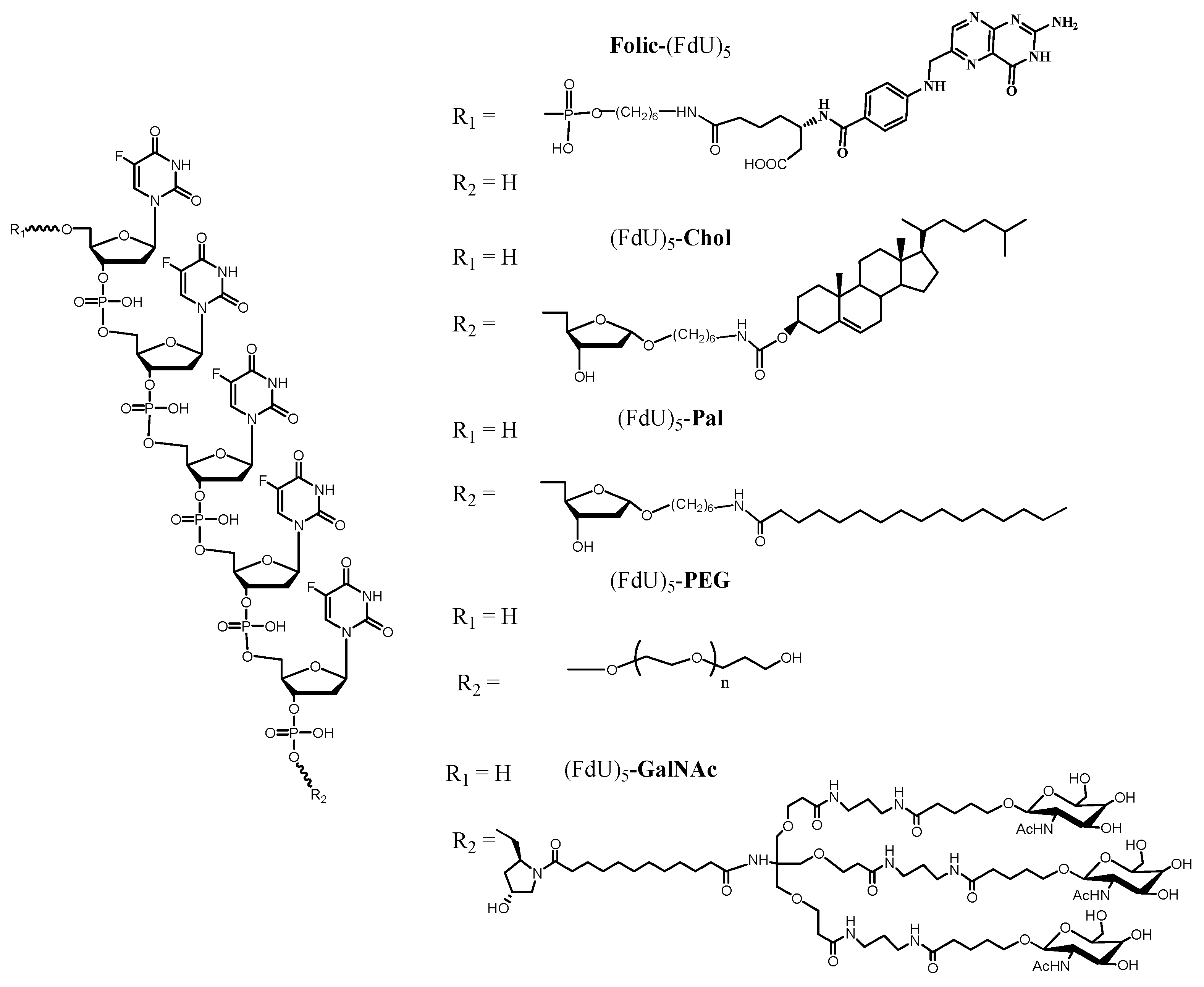
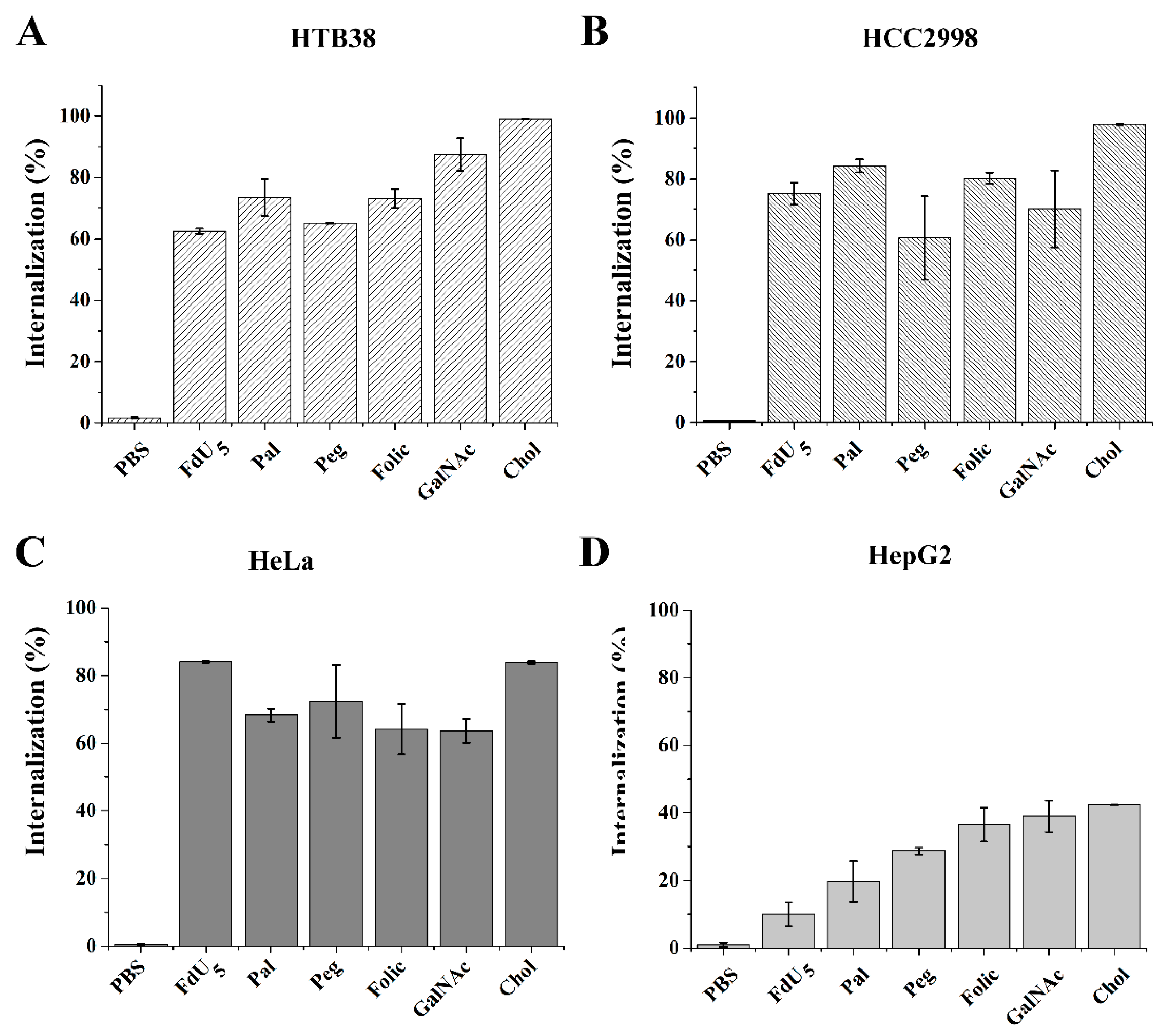
Conjugation of small molecules such as lipids or receptor ligands to anti-cancer drugs has been used to improve their pharmacological properties. In this work, we studied the biological effects of several small-molecule enhancers into a short oligonucleotide made of five floxuridine units. Specifically, we studied adding cholesterol, palmitic acid, polyethyleneglycol (PEG 1000), folic acid and triantennary N-acetylgalactosamine (GalNAc) as potential enhancers of cellular uptake. As expected, all these molecules increased the internalization efficiency with different degrees depending on the cell line. The conjugates showed antiproliferative activity due to their metabolic activation by nuclease degradation generating floxuridine monophosphate. The cytotoxicity and apoptosis assays showed an increase in the anti-cancer activity of the conjugates related to the floxuridine oligomer, but this effect did not correlate with the internalization results. Palmitic and folic acid conjugates provide the highest antiproliferative activity without having the highest internalization results. On the contrary, cholesterol oligomers that were the best-internalized oligomers had poor antiproliferative activity, even worse than the unmodified floxuridine oligomer. Especially relevant is the effect induced by palmitic and folic acid derivatives generating the most active drugs. These results are of special interest for delivering other therapeutic oligonucleotides.
Keywords: 5-fluoro-2′-deoxyuridine; delivery enhancers; cholesterol; palmitic acid; folic acid; GalNAc; conjugation; cancer treatment 5-fluoro-2′-deoxyuridine; delivery enhancers; cholesterol; palmitic acid; folic acid; GalNAc; conjugation; cancer treatment
Graphical Abstract