Review

Mechanisms of TP53 Pathway Inactivation in Embryonic and Somatic Cells—Relevance for Understanding (Germ Cell) Tumorigenesis

by
Dennis M. Timmerman
,
Tessa L. Remmers
,
Sanne Hillenius
and
Leendert H. J. Looijenga
*
Princess Máxima Center for Pediatric Oncology, Heidelberglaan 25, 3584 CS Utrecht, The Netherlands
*
Author to whom correspondence should be addressed.
These authors contributed equally.
Int. J. Mol. Sci. 2021, 22(10), 5377; https://doi.org/10.3390/ijms22105377
Submission received: 14 April 2021 / Revised: 14 May 2021 / Accepted: 15 May 2021 / Published: 20 May 2021
(This article belongs to the Special Issue Germ Cells and Genitourinary Cancers)

Abstract

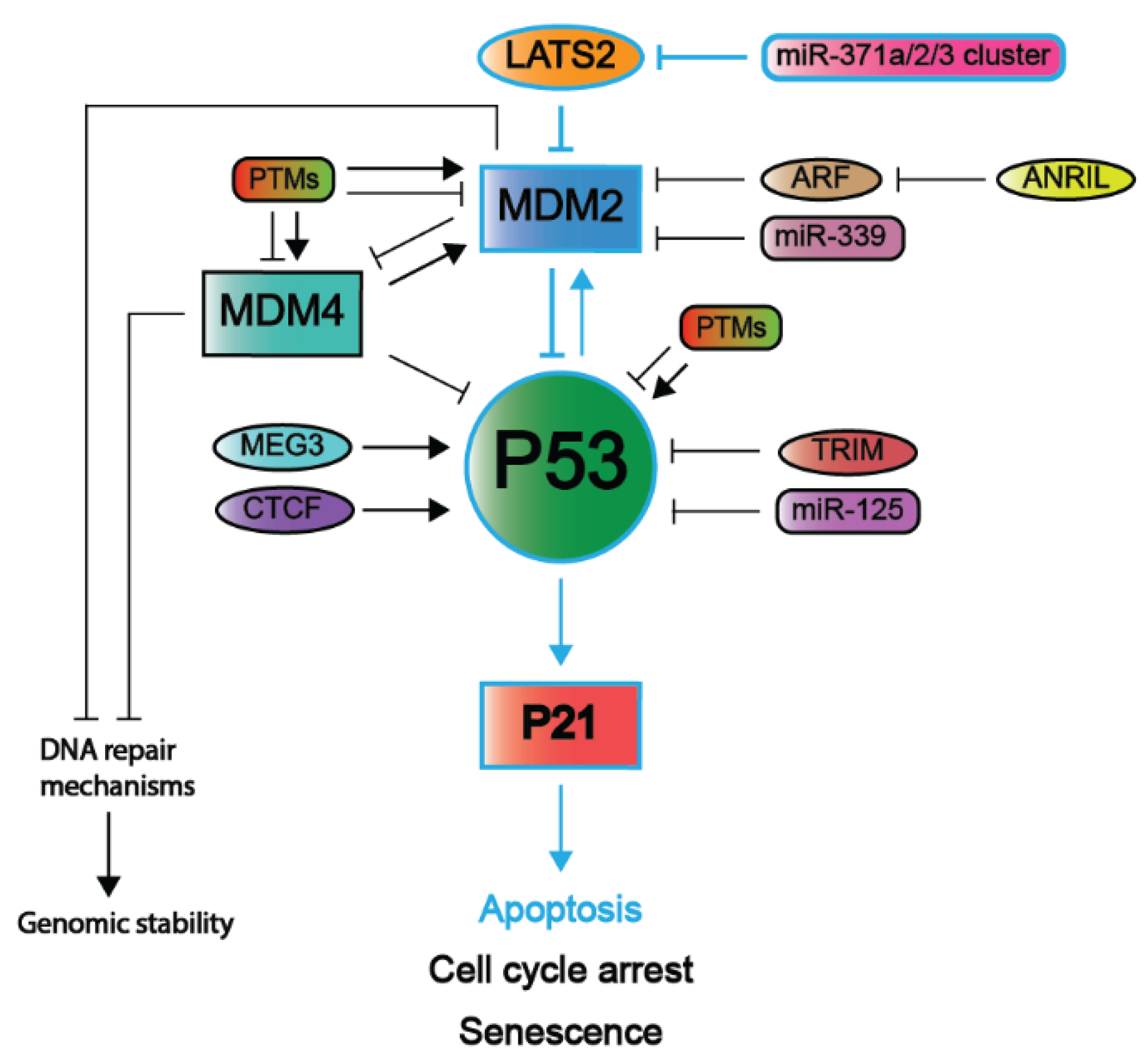
The P53 pathway is the most important cellular pathway to maintain genomic and cellular integrity, both in embryonic and non-embryonic cells. Stress signals induce its activation, initiating autophagy or cell cycle arrest to enable DNA repair. The persistence of these signals causes either senescence or apoptosis. Over 50% of all solid tumors harbor mutations in TP53 that inactivate the pathway. The remaining cancers are suggested to harbor mutations in genes that regulate the P53 pathway such as its inhibitors Mouse Double Minute 2 and 4 (MDM2 and MDM4, respectively). Many reviews have already been dedicated to P53, MDM2, and MDM4, while this review additionally focuses on the other factors that can deregulate P53 signaling. We discuss that P14ARF (ARF) functions as a negative regulator of MDM2, explaining the frequent loss of ARF detected in cancers. The long non-coding RNA Antisense Non-coding RNA in the INK4 Locus (ANRIL) is encoded on the same locus as ARF, inhibiting ARF expression, thus contributing to the process of tumorigenesis. Mutations in tripartite motif (TRIM) proteins deregulate P53 signaling through their ubiquitin ligase activity. Several microRNAs (miRNAs) inactivate the P53 pathway through inhibition of translation. CCCTC-binding factor (CTCF) maintains an open chromatin structure at the TP53 locus, explaining its inactivation of CTCF during tumorigenesis. P21, a downstream effector of P53, has been found to be deregulated in different tumor types. This review provides a comprehensive overview of these factors that are known to deregulate the P53 pathway in both somatic and embryonic cells, as well as their malignant counterparts (i.e., somatic and germ cell tumors). It provides insights into which aspects still need to be unraveled to grasp their contribution to tumorigenesis, putatively leading to novel targets for effective cancer therapies.
Keywords: P53 pathway; cancers; mutations; embryonic and somatic cells P53 pathway; cancers; mutations; embryonic and somatic cells