

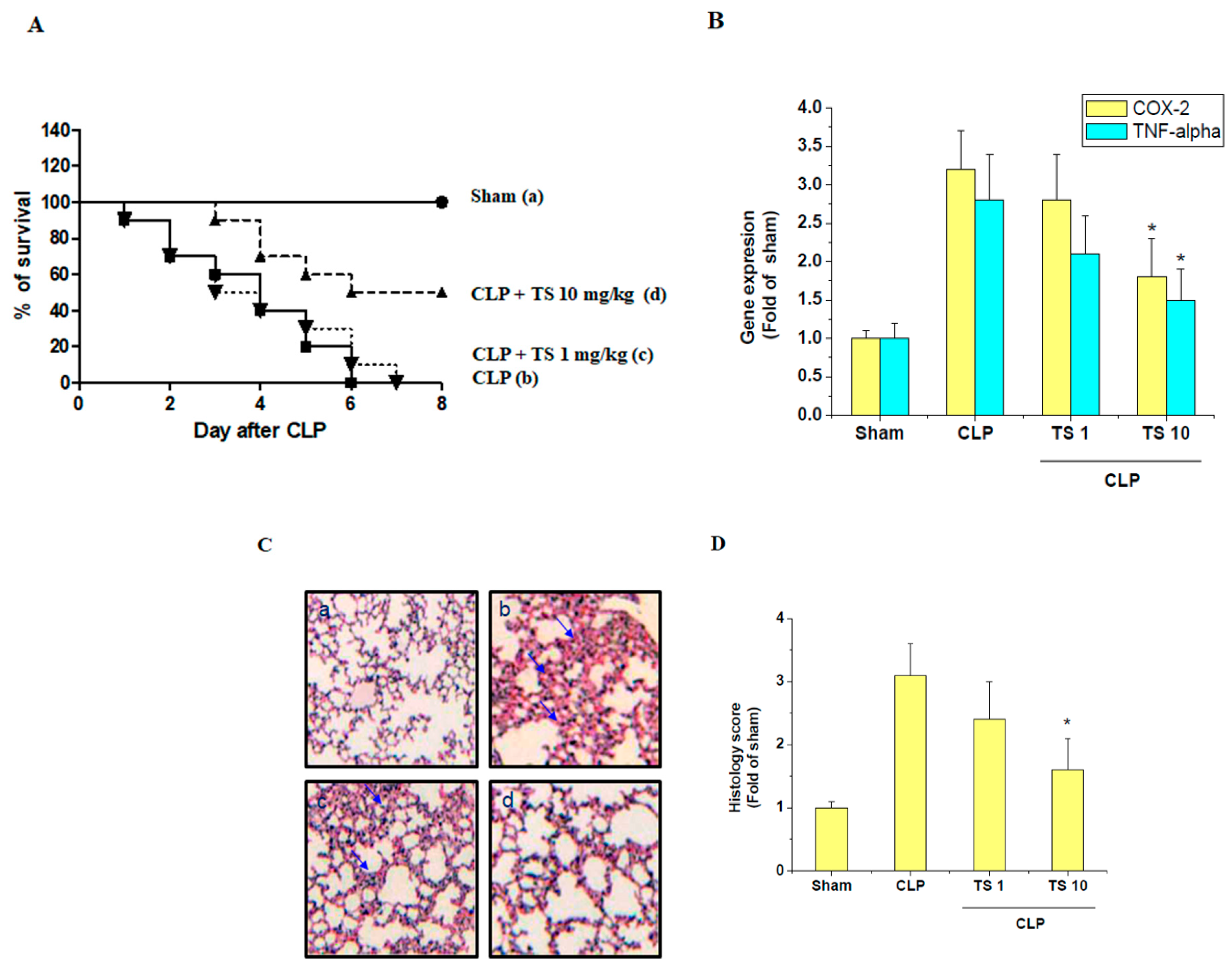
Correction: Kim, Y. K. et al. Tussilagone Inhibits the Inflammatory Response and Improves Survival in CLP-Induced Septic Mice. Int. J. Mol. Sci. 2017, 18, 2744

 ,
,  ,
, 
Conflicts of Interest
References
- Kim, Y.K.; Yeo, M.G.; Oh, B.K.; Kim, H.Y.; Yang, H.J.; Cho, S.S.; Gil, M.; Lee, K.J. Tussilagone Inhibits the Inflammatory Response and Improves Survival in CLP-Induced Septic Mice. Int. J. Mol. Sci. 2017, 18, 2744. [Google Scholar] [CrossRef] [PubMed]
- Gil, M.; Kim, Y.K.; Hong, S.B.; Lee, K.J. Naringin Decreases TNF-α and HMGB1 Release from LPS-Stimulated Macrophages and Improves Survival in a CLP-Induced Sepsis Mice. PLoS ONE 2016, 11, e0164186. [Google Scholar] [CrossRef] [PubMed]
© 2019 by the authors. Licensee MDPI, Basel, Switzerland. This article is an open access article distributed under the terms and conditions of the Creative Commons Attribution (CC BY) license (http://creativecommons.org/licenses/by/4.0/).
Share and Cite
Kim, Y.K.; Yeo, M.G.; Oh, B.K.; Kim, H.Y.; Yang, H.J.; Cho, S.-S.; Gil, M.; Lee, K.J. Correction: Kim, Y. K. et al. Tussilagone Inhibits the Inflammatory Response and Improves Survival in CLP-Induced Septic Mice. Int. J. Mol. Sci. 2017, 18, 2744. Int. J. Mol. Sci. 2020, 21, 174. https://doi.org/10.3390/ijms21010174
Kim YK, Yeo MG, Oh BK, Kim HY, Yang HJ, Cho S-S, Gil M, Lee KJ. Correction: Kim, Y. K. et al. Tussilagone Inhibits the Inflammatory Response and Improves Survival in CLP-Induced Septic Mice. Int. J. Mol. Sci. 2017, 18, 2744. International Journal of Molecular Sciences. 2020; 21(1):174. https://doi.org/10.3390/ijms21010174
Chicago/Turabian StyleKim, Yun Kyu, Myeong Gu Yeo, Bo Kang Oh, Ha Yeong Kim, Hun Ji Yang, Seung-Sik Cho, Minchan Gil, and Kyung Jin Lee. 2020. "Correction: Kim, Y. K. et al. Tussilagone Inhibits the Inflammatory Response and Improves Survival in CLP-Induced Septic Mice. Int. J. Mol. Sci. 2017, 18, 2744" International Journal of Molecular Sciences 21, no. 1: 174. https://doi.org/10.3390/ijms21010174
APA StyleKim, Y. K., Yeo, M. G., Oh, B. K., Kim, H. Y., Yang, H. J., Cho, S.-S., Gil, M., & Lee, K. J. (2020). Correction: Kim, Y. K. et al. Tussilagone Inhibits the Inflammatory Response and Improves Survival in CLP-Induced Septic Mice. Int. J. Mol. Sci. 2017, 18, 2744. International Journal of Molecular Sciences, 21(1), 174. https://doi.org/10.3390/ijms21010174

