Review

Molecular Interactions between Pathogens and the Circadian Clock

3780 Pelham Drive, Mobile, AL 36619, USA
Int. J. Mol. Sci. 2019, 20(23), 5824; https://doi.org/10.3390/ijms20235824
Submission received: 13 October 2019 / Revised: 17 November 2019 / Accepted: 17 November 2019 / Published: 20 November 2019
(This article belongs to the Special Issue Crosstalk between Circadian Rhythm and Diseases)

Abstract

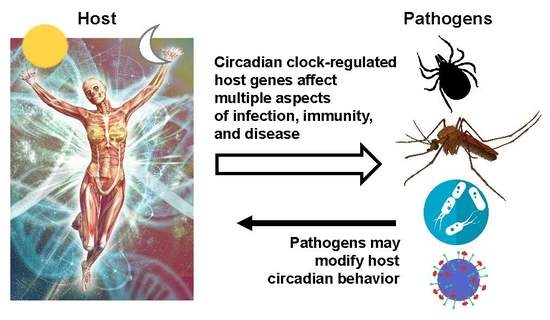
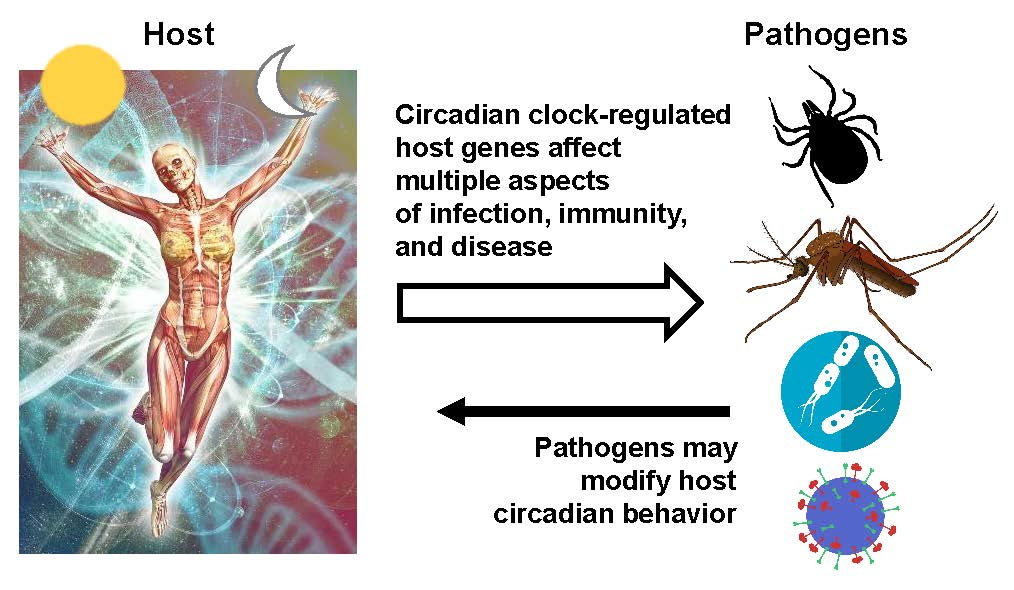
The daily periodicity of the Earth’s rotation around the Sun, referred to as circadian (Latin “circa” = about, and “diem” = day), is also mirrored in the behavior and metabolism of living beings. The discovery that dedicated cellular genes control various aspects of this periodicity has led to studies of the molecular mechanism of the circadian response at the cellular level. It is now established that the circadian genes impact on a large network of hormonal, metabolic, and immunological pathways, affecting multiple aspects of biology. Recent studies have extended the role of the circadian system to the regulation of infection, host–pathogen interaction, and the resultant disease outcome. This critical review summarizes our current knowledge of circadian-pathogen interaction at both systemic and cellular levels, but with emphasis on the molecular aspects of the regulation. Wherever applicable, the potential of a direct interaction between circadian factors and pathogenic macromolecules is also explored. Finally, this review offers new directions and guidelines for future research in this area, which should facilitate progress.
Keywords: circadian clock; bacteria; virus; immunity; infection; host–pathogen; BMAL1; sleep cycle circadian clock; bacteria; virus; immunity; infection; host–pathogen; BMAL1; sleep cycle
Graphical Abstract