Review

Signal Transduction in Plant–Nematode Interactions


by
Muhammad Amjad Ali
1,2,*,
Muhammad Shahzad Anjam
3,
Muhammad Amjad Nawaz
4,
Hon-Ming Lam
5 and
Gyuhwa Chung
4,*
1
Department of Plant Pathology, University of Agriculture, Faisalabad 38040, Pakistan
2
Centre of Agricultural Biochemistry and Biotechnology, University of Agriculture, Faisalabad 38040, Pakistan
3
Institute of Molecular Biology & Biotechnology, Bahauddin Zakariya University, Multan 66000, Pakistan
4
Department of Biotechnology, Chonnam National University, Yeosu 59626, Korea
5
School of Life Sciences and Centre for Soybean Research of the Partner State Key Laboratory of Agrobiotechnology, The Chinese University of Hong Kong, Shatin, Hong Kong SAR, China
*
Authors to whom correspondence should be addressed.
Int. J. Mol. Sci. 2018, 19(6), 1648; https://doi.org/10.3390/ijms19061648
Submission received: 26 April 2018 / Revised: 26 May 2018 / Accepted: 29 May 2018 / Published: 2 June 2018

Abstract

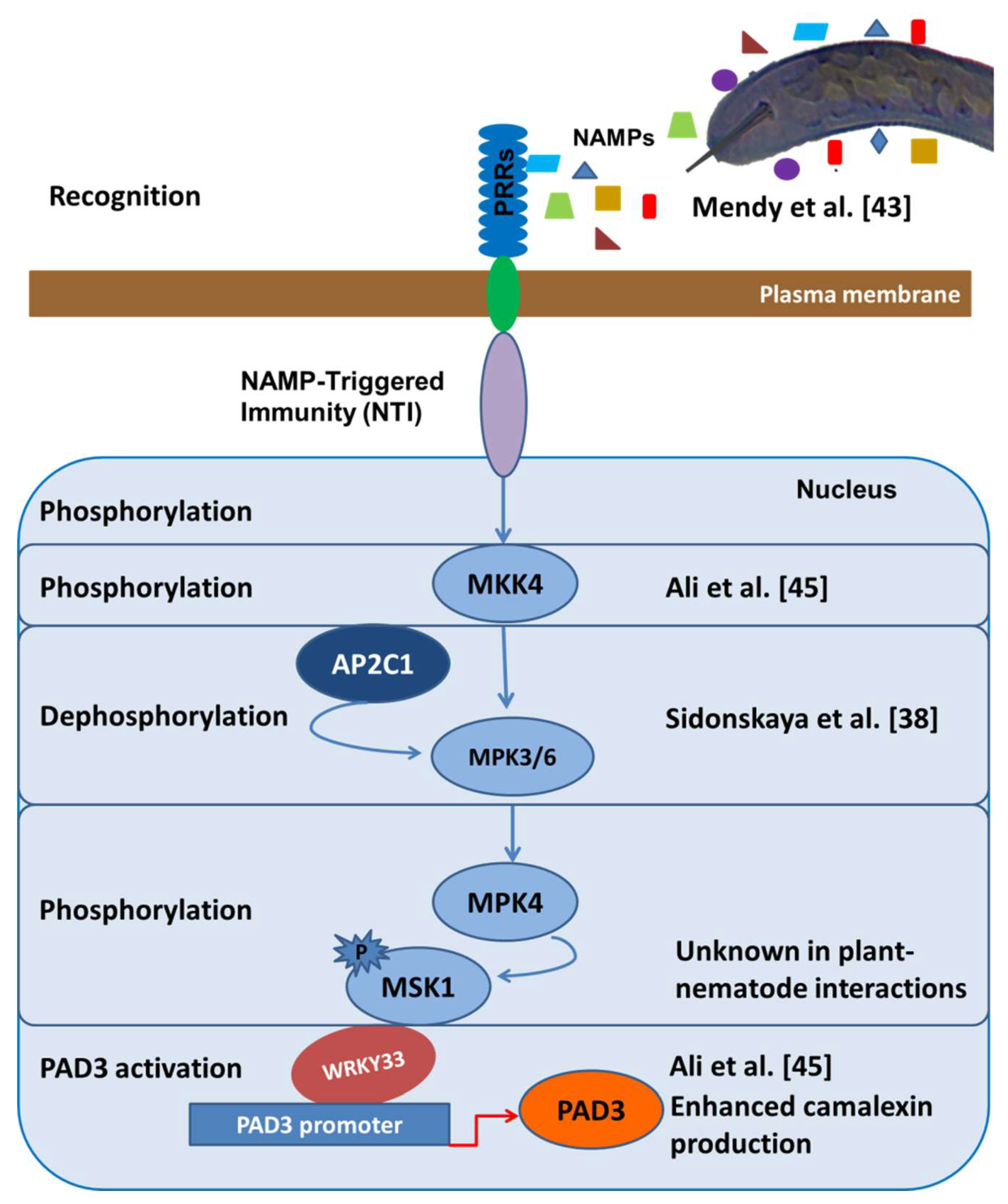
To successfully invade and infect their host plants, plant parasitic nematodes (PPNs) need to evolve molecular mechanisms to overcome the defense responses from the plants. Nematode-associated molecular patterns (NAMPs), including ascarosides and certain proteins, while instrumental in enabling the infection, can be perceived by the host plants, which then initiate a signaling cascade leading to the induction of basal defense responses. To combat host resistance, some nematodes can inject effectors into the cells of susceptible hosts to reprogram the basal resistance signaling and also modulate the hosts’ gene expression patterns to facilitate the establishment of nematode feeding sites (NFSs). In this review, we summarized all the known signaling pathways involved in plant–nematode interactions. Specifically, we placed particular focus on the effector proteins from PPNs that mimic the signaling of the defense responses in host plants. Furthermore, we gave an updated overview of the regulation by PPNs of different host defense pathways such as salicylic acid (SA)/jasmonic acid (JA), auxin, and cytokinin and reactive oxygen species (ROS) signaling to facilitate their parasitic successes in plants. This review will enhance the understanding of the molecular signaling pathways involved in both compatible and incompatible plant–nematode interactions.
Keywords: plant parasitic nematode; PPN; nematode effector protein; nematode-associated molecular pattern; NAMP; plant defense signaling pathway; NAMP-triggered immunity; NTI plant parasitic nematode; PPN; nematode effector protein; nematode-associated molecular pattern; NAMP; plant defense signaling pathway; NAMP-triggered immunity; NTI