Review

MicroRNA-146b: A Novel Biomarker and Therapeutic Target for Human Papillary Thyroid Cancer
1
Division of Endocrinology and Metabolism, Department of Internal Medicine, Kaohsiung Chang Gung Memorial Hospital, Chang Gung University College of Medicine, Kaohsiung City 833, Taiwan
2
Graduate Institute of Clinical Medical Sciences, Chang Gung University, Kaohsiung City 833, Taiwan
3
Hormone Research Center and Department of Obstetrics and Gynecology, Kaohsiung Chang Gung Memorial Hospital, Chang Gung University College of Medicine, Kaohsiung City 833, Taiwan
*
Author to whom correspondence should be addressed.
Int. J. Mol. Sci. 2017, 18(3), 636; https://doi.org/10.3390/ijms18030636
Submission received: 26 January 2017 / Revised: 6 March 2017 / Accepted: 8 March 2017 / Published: 15 March 2017
(This article belongs to the Special Issue microRNA Regulation 2017)

Abstract

Papillary thyroid cancer (PTC) is the most common tumor subtype of thyroid cancer. However, not all PTCs are responsive to current surgical and radioiodine treatment. The well-established clinical prognostic factors include tumor size, lymph node/distal metastasis, and extrathyroidal invasion. The RET/PTC-RAS-BRAF linear molecular signaling cascade is known to mediate PTC pathogenesis. However, whether presence of BRAF mutation, the most common genetic alteration in PTC, can affect PTC behavior and prognosis is controversial. MicroRNAs (miRNAs) have been labeled as promising molecular prognostic markers in several tumor types. Our recent studies demonstrated that microRNA-146b (miR-146b) deregulation is associated with PTC aggressiveness and prognosis. Here we summarize the current knowledge related to the functional roles, regulated target genes, and clinical applications of miR-146b in PTC and discuss how these studies provide insights into the key role of miR-146b as an oncogenic regulator promoting cellular transformation as well as a prognosis marker for tumor recurrence in PTC. In conjunction with the current perspectives on miRNAs in a wide variety of human cancers, this review will hopefully translate these updated findings on miR-146b into more comprehensive diagnostic or prognostic information regarding treatment in PTC patients before surgical intervention and follow up strategies.
Keywords: papillary thyroid carcinoma; microRNA-146b; target gene; tumorigenesis papillary thyroid carcinoma; microRNA-146b; target gene; tumorigenesis
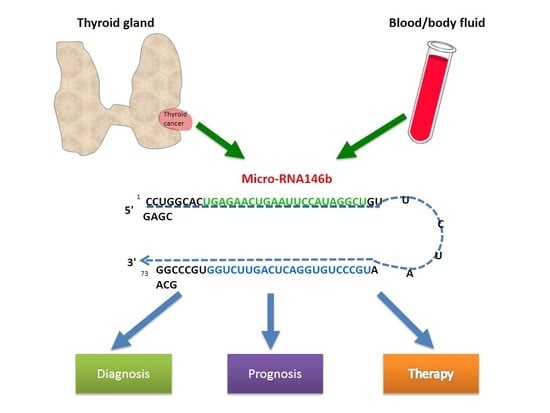
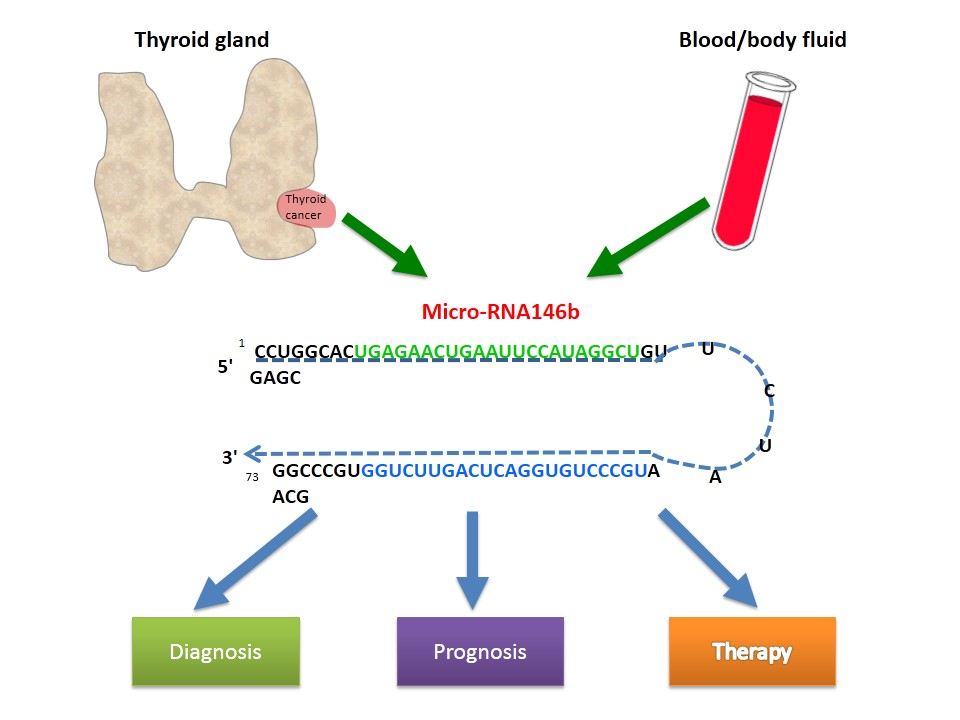
Graphical Abstract