A New Ligustrazine Derivative-Selective Cytotoxicity by Suppression of NF-κB/p65 and COX-2 Expression on Human Hepatoma Cells. Part 3
 , , , and
 Abstract
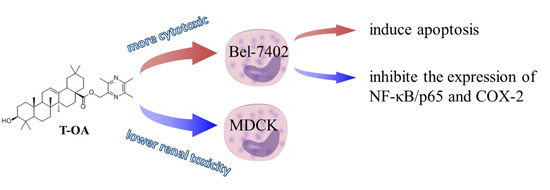
Share and Cite
Zhang, C.; Yan, W.; Li, B.; Xu, B.; Gong, Y.; Chu, F.; Zhang, Y.; Yao, Q.; Wang, P.; Lei, H. A New Ligustrazine Derivative-Selective Cytotoxicity by Suppression of NF-κB/p65 and COX-2 Expression on Human Hepatoma Cells. Part 3. Int. J. Mol. Sci. 2015, 16, 16401-16413. https://doi.org/10.3390/ijms160716401
Zhang C, Yan W, Li B, Xu B, Gong Y, Chu F, Zhang Y, Yao Q, Wang P, Lei H. A New Ligustrazine Derivative-Selective Cytotoxicity by Suppression of NF-κB/p65 and COX-2 Expression on Human Hepatoma Cells. Part 3. International Journal of Molecular Sciences. 2015; 16(7):16401-16413. https://doi.org/10.3390/ijms160716401
Chicago/Turabian StyleZhang, Chenze, Wenqiang Yan, Bi Li, Bing Xu, Yan Gong, Fuhao Chu, Yuzhong Zhang, Qiuli Yao, Penglong Wang, and Haimin Lei. 2015. "A New Ligustrazine Derivative-Selective Cytotoxicity by Suppression of NF-κB/p65 and COX-2 Expression on Human Hepatoma Cells. Part 3" International Journal of Molecular Sciences 16, no. 7: 16401-16413. https://doi.org/10.3390/ijms160716401
APA StyleZhang, C., Yan, W., Li, B., Xu, B., Gong, Y., Chu, F., Zhang, Y., Yao, Q., Wang, P., & Lei, H. (2015). A New Ligustrazine Derivative-Selective Cytotoxicity by Suppression of NF-κB/p65 and COX-2 Expression on Human Hepatoma Cells. Part 3. International Journal of Molecular Sciences, 16(7), 16401-16413. https://doi.org/10.3390/ijms160716401