Article

Phase Equilibrium Calculations of Solid–Liquid Quaternary System Na2CO3-Na2SO4-H2O2-H2O at 5 °C


1
Department of Environmental and Chemical Engineering, Hebei Vocational University of Industry and Technology, Shijiazhuang 050091, China
2
Department of Chemical and Environmental Engineering, Hebei Chemical & Pharmaceutical Vocational Technology College, Shijiazhuang 050026, China
*
Author to whom correspondence should be addressed.
These authors contributed equally to this work.
Molecules 2026, 31(9), 1497; https://doi.org/10.3390/molecules31091497
Submission received: 23 March 2026 / Revised: 17 April 2026 / Accepted: 27 April 2026 / Published: 30 April 2026

Abstract

Red mud discharged during alumina production via the Bayer process is characterized by high contents of sodium carbonate, sodium sulfate, and other soluble salts, and it remains poorly utilized and accumulates in long-term stockpiles. Sodium percarbonate has found extensive industrial applications, and its synthesis via the salting-out method represents one of the dominant industrial routes. In this context, sodium sulfate was employed as a salting-out agent. On the basis of relevant ternary systems, the phase equilibrium of the quaternary system Na2CO3–Na2SO4–H2O2–H2O at 5 °C was systematically investigated and calculated. The objective was to utilize red mud as a waste resource and develop a novel integrated process that favored the wet synthesis of sodium percarbonate while enabling the efficient separation of sodium salts. The solubility data for the ternary subsystems constituting the above quaternary system were correlated using the Pitzer model, yielding the corresponding ion interaction parameters and activity coefficients. The validated model was then applied to predict the phase equilibrium data of the quaternary system. Verification results indicate that the calculated values are in satisfactory agreement with the experimental data. On the basis of the phase equilibrium data of the Na2CO3–Na2SO4–H2O2–H2O system at 5 °C, a phase diagram was constructed. Along with five solid-phase crystallization fields, three invariant points were identified: the co-saturation point of Na2SO4·10H2O, Na2CO3·10H2O, and Na2CO3·1.5H2O2·H2O; the co-saturation point of Na2SO4·10H2O, Na2CO3·1.5H2O2·H2O, and Na2SO4·0.5H2O2·H2O; and the co-saturation point of Na2CO3·1.5H2O2·H2O, Na2SO4·0.5H2O2·H2O, and Na2CO3·2H2O2·H2O. From phase diagram analysis, a novel wet process route for sodium percarbonate production using waste red mud is proposed. The process involves chemical reaction, crystallization, separation, and drying to obtain the final product. A new process flow diagram for the value-added production of sodium percarbonate is also presented.

1. Introduction

In the technological process of alumina production via the Bayer process, various carbonate minerals (CaCO3, CaCO3·MgCO3) are present in the raw materials (bauxite, lime, and alkali) [1,2,3,4,5,6,7,8]. These minerals tend to decompose during the digestion process, which can convert sodium hydroxide in the production process into sodium carbonate. Meanwhile, due to the influence of air during the stirring process, sodium aluminate in the solution is also prone to acidification by CO2 in the air, resulting in the generation of a large amount of sodium carbonate. Owing to the high content of sulfur in bauxite and coupled with the use of materials such as alkali and water, the concentration of sodium sulfate in the solution continuously increases [9,10,11,12,13]. During the evaporation of mother liquor, the concentrations of sodium carbonate and sodium sulfate increase rapidly and precipitate in a crystalline state, leading to the accumulation of a large amount of sodium salt crystals. These sodium salt crystals are mainly discharged along with red mud; therefore, a large amount of sodium carbonate and sodium sulfate in red mud cannot be rationally utilized and separated, which has become a common problem faced by alumina production via the Bayer process [14,15].
Given the high content of Na2CO3 in red mud, the synthesis of sodium percarbonate has become a viable option for its rational utilization [16,17,18]. Sodium percarbonate is a widely used inorganic fine chemical product, which has found extensive applications in fields such as the washing of synthetic fibers, disinfection of tableware and food, preservation of fruits, and sewage treatment [19,20,21]. Its production methods include dry and wet processes, among which the wet process is currently the most commonly used industrial production method. The wet synthesis of sodium percarbonate is achieved by combining solid Na2CO3 with a certain concentration of H2O2. It is non-toxic and does not cause any irritation under diluted conditions, thus posing no pollution to the environment in practical applications. Sodium sulfate, also known as anhydrous Glauber’s salt, is a white, odorless, and slightly bitter powder or crystal. In organic synthesis laboratories, sodium sulfate is a commonly used post-treatment desiccant and is also often used to remove barium salts [22,23]. In chemical production, it can also be used in the manufacture of sodium sulfide, sodium silicate, and other products. Taking advantage of the significant difference in solubility between sodium percarbonate and Na2SO4, there is a difference in the sequence of crystallization precipitation, thereby realizing the separation of Na2SO4 and significantly reducing the H2O2 content in the mother liquor [8,24,25].
The Na2SO4 salting-out method is an effective approach to improve the traditional wet synthesis process of sodium percarbonate, and its theoretical basis is the phase diagram of the Na2CO3-Na2SO4-H2O2-H2O quaternary system. At present, Guo-en Li and Yue Liu et al. have conducted research on the phase equilibrium of this quaternary system [17,18]. For the purpose of better guiding the practical production design through the solubility of this system, this paper calculates the phase equilibrium of the Na2CO3-Na2SO4-H2O2-H2O quaternary system.

2. Derivation of the Pitzer Model

2.1. Selection of the Model

The Pitzer electrolyte solution activity model and its modified models are the most widely used theoretical models for electrolyte solutions nowadays. The calculation formulas of this model can be applied to more than 280 types of high-concentration electrolyte solutions, including the calculation of mixed electrolytes. In the Na2CO3-Na2SO4-H2O2-H2O quaternary system studied in this paper, H2O2 has an extremely small ionization constant and can be regarded as a non-electrolyte. Therefore, this quaternary system is an electrolyte–electrolyte–non-electrolyte–water system, and thus this model can be selected for the phase equilibrium calculation in this paper.

2.2. Calculation Expression of Activity Coefficient

Assuming that the solution contains nw kilograms of water as well as moles ni and nj of solute ions i and j, the expression for the total excess Gibbs energy in this system is as follows:
G E R T = G E R T i i + G E R T A i + G E R T A A = n w f ( I ) + 1 n w i j λ i j ( I ) n i n j + 1 n w 2 i j k μ i j k n i n j n k + 1 n w i θ A i n A n i + 1 n w 2 i j ψ A i j I n A n i n j + 1 n w λ A A n A 2 + 1 n w 2 μ A A A n A 3
In the above equation:
  • G E R T —the total excess Gibbs energy of the solution;
  • G E R T i i —the increment of excess Gibbs energy caused by the interactions between ions in the solution;
  • G E R T i A —the increment of excess Gibbs energy caused by the interactions between ions and non-electrolyte molecules in the solution;
  • G E R T A A —the increment of excess Gibbs energy caused by the interactions between non-electrolyte molecules in the solution.
By taking the partial derivatives of Equation (1) with respect to ni and nA, the general formulas for the activity coefficients of ion i and non-electrolyte molecule A in any electrolyte–non-electrolyte–water system can be obtained. Since the system studied in this paper is an electrolyte–electrolyte–non-electrolyte–water system, only the simplified form of the Pitzer equation suitable for this system is derived here [26,27,28,29].
We assume that the studied system is MX-MY-A-H2O, where MX and MY are a pair of electrolytes with a common cation. We let νM and νX as well as ν’M and νY be the numbers of cations and anions per molecule of MX and MY, respectively, while A denotes the non-electrolyte. By letting the molalities of MX and MY be mMX and mMY, respectively, then it can be obtained that:
m M = ν M m M X + ν M m M Y m X = ν X m M X m Y = ν Y m M Y
We take the partial derivatives of Equation (1) with respect to nM and nX, multiply the obtained results by νM and νX correspondingly, then sum them up, and substitute Equation (2) into Equation (1). Then we let:
B M X = β M X ( 0 ) + 2 β M X ( 1 ) α 2 I 1 1 + α I 1 2 exp α I 1 2
B M X = 2 β M X ( 1 ) α 2 I 2 1 + 1 + α I 1 2 + 1 2 α 2 I exp α I 1 2
C M X = C M X ϕ 2 Z M Z X 1 2
In the above equation, β MX 0 , β MX 1 , and C MX φ are the virial coefficients of the electrolyte MX; thus, we obtain:
ln γ ± M X = 1 2 Z M Z X f I + 2 ν M ν a m a B M a + m z C M a + 2 ν X ν c m c B c X + m z C c X + c a m c m a Z M Z X B c a + 2 ν M Z M ν C c a + 2 ν X ν a m a θ X a I + c a m c m a 1 ν ν M ψ M c a + ν X ψ c a X + 1 2 a a m a m a ν M ν ψ M a a + Z M Z X θ a a I + m A ν ν M θ A M + ν X θ A X + 1 ν 2 ν M j ψ A M j I + 2 ν X j ψ A X j I m A m j + Z M 2 ν M 2 ν j k ψ A k j m A m j m k + Z X 2 ν X 2 ν j k ψ A k j m A m j m k
By taking the partial derivative of Equation (1) with respect to nA, the expression for the activity coefficient of the non-electrolyte A is as follows:
ln γ A = 2 λ A A m A + 3 μ A A A m A 2 + i θ A i m i + i j ψ A i j m i m j
Here, λAA and μAAA are the two-particle and three-particle interaction coefficients between H2O2 molecules, respectively. In the equation for mz = a m a | z a | = c m c z c , the subscript c denotes the cation and a denotes the anion, with ν = νM + νX.
In the above equation, i, j, and k include all ions while excluding non-electrolyte molecules; θ and λ are the two-particle interaction parameters; μ and Ψ are the three-particle interaction parameters; ΨAij(I) is a function of ionic strength; F(I) is the intensity function of ions; and λAA, μAAA, θAi, and μijk are assumed to be independent of ionic strength, as follows:
ψ A i j ( I ) = ψ ( 0 ) A i j + F ( I ) ψ ( 1 ) A i j
F I = 2 α 2 I 1 1 + α I 0.5 exp α I 0.5 α = 2
Here, f(I) is the long-range electrostatic interaction term in the Pitzer model; by taking the partial derivatives of the above equation with respect to ni and nA to obtain f’(I), the general formulas for the activity coefficients of ion i and non-electrolyte molecule A in any non-electrolyte–electrolyte–electrolyte–water system can be obtained. From this, the expressions for the activity coefficients of each substance in the system studied in this paper can be derived as follows:
ln γ N a 2 C O 3 = f I + 2 3 m Na + 2 m C O 3 B N a 2 C O 3 + m z C N a 2 C O 3 + 4 3 m S O 4 B Na 2 S O 4 + m z C Na 2 S O 4 + m Na m S O 4 2 B Na 2 S O 4 + 4 3 C Na 2 S O 4 + m Na m C O 3 2 B N a 2 C O 3 + 4 3 C N a 2 C O 3 + 2 3 m S O 4 θ S O 4 , C O 3 ( 0 ) + F I θ S O 4 , C O 3 ( 1 ) + 2 m S O 4 m C O 3 F I θ S O 4 , C O 3 ( 1 ) + 1 3 2 m C O 3 m S O 4 + m Na m S O 4 ψ Na , S O 4 , C O 3 + 1 3 m A θ Na , C O 3 , A + 4 3 m A m C O 3 ψ Na , C O 3 , A ( 0 ) + F I ψ Na , C O 3 , A ( 1 ) 4 3 m A m S O 4 ψ Na , S O 4 , A ( 0 ) + F I ψ Na , S O 4 , A ( 1 ) + 4 3 m A m Na ψ Na , C O 3 , A ( 0 ) + F I ψ Na , C O 3 , A ( 1 ) + 2 m A m Na m S O 4 F I ψ Na , S O 4 , A ( 1 ) + 2 m A m Na m C O 3 F I ψ Na , C O 3 , A ( 1 )
ln γ N Na 2 S O 4 = f I + 2 3 m Na + 2 m S O 4 B N a 2 S O 4 + m z C N a 2 S O 4 + 4 3 m C O 3 B Na 2 C O 3 + m z C Na 2 C O 3 + m Na m C O 3 2 B Na 2 C O 3 + 4 3 C Na 2 C O 3 + m Na m S O 4 2 B N a 2 S O 4 + 4 3 C N a 2 S O 4 + 2 3 m C O 3 θ C O 3 , S O 4 ( 0 ) + F I θ C O 3 , S O 4 ( 1 ) + 2 m S O 4 m C O 3 F I θ S O 4 , C O 3 ( 1 ) + 1 3 2 m C O 3 m S O 4 + m Na m C O 3 ψ Na , S O 4 , C O 3 + 1 3 m A θ Na , S O 4 , A + 4 3 m A m C O 3 ψ Na , S O 4 , A ( 0 ) + F I ψ Na , S O 4 , A ( 1 ) 4 3 m A m C O 3 ψ Na , C O 3 , A ( 0 ) + F I ψ Na , C O 3 , A ( 1 ) + 4 3 m A m Na ψ Na , S O 4 , A ( 0 ) + F I ψ Na , S O 4 , A ( 1 ) + 2 m A m Na m C O 3 F I ψ Na , C O 3 , A ( 1 ) + 2 m A m Na m S O 4 F I ψ Na , S O 4 , A ( 1 )
ln γ H 2 O 2 = m S O 4 θ Na , S O 4 , A + m C O 3 θ Na , C O 3 , A + 2 m Na m C O 3 ψ Na , C O 3 , A ( 0 ) + F I ψ Na , C O 3 , A ( 1 ) + 2 m Na m S O 4 ψ Na , S O 4 , A ( 0 ) + F I ψ Na , S O 4 , A ( 1 ) + 2 m A λ A A + 3 m A 2 μ A A A

2.3. Calculation of Water Activity

The activity of water aH2O is calculated from the osmotic coefficient as follows:
ln a H 2 O = i m i 55.51 φ
In the above equation, mi is the molality of ion i, m i denotes the summation over all ions except non-electrolytes, and 55.51 is the molar number of 1000 g of water.
The osmotic coefficient is obtained from the following equation:
ϕ 1 = 1 i m i I f I f I + 2 c a m c m a B c a + I B c a + 2 m z C c a
Using Equations (7)–(11), the activity coefficients of electrolytes MX, MY, and non-electrolyte A in the liquid phase of the MX-MY-A-H2O system, as well as the activity of solvent H2O, can be calculated. According to the principle that when the system reaches liquid–solid phase equilibrium—the activity of the liquid phase that precipitates the same solid phase must be equal—calculations can be carried out. For example, by calculating equation a N a 2 S O 4 · 10 H 2 O = m N a 2 S O 4 γ N a 2 S O 4 a H 2 O 10 , the activity expression of solid phase Na2SO4·10H2O can be calculated; by calculating equation a N a 2 C O 3 · 1.5 H 2 O 2 · H 2 O = m N a 2 C O 3 γ N a 2 C O 3 m H 2 O 2 1.5 γ H 2 O 2 1.5 a H 2 O , the activity expression of solid phase Na2CO3·1.5H2O2·H2O can be calculated; and by calculating equation a N a 2 C O 3 · 10 H 2 O = m N a 2 C O 3 γ N a 2 C O 3 a H 2 O 10 , the activity expression of solid phase Na2CO3·10H2O can be calculated. Similar methods are used in other situations, so we will not list them one by one here. Furthermore, the solubility of each salt in the liquid phase can be calculated and correlated.

3. Results and Discussion

3.1. Model Parameters

The activity coefficient of H2O2 at 5 °C is not available in the literature. In this study, the molecular interaction parameters in the activity coefficient model were treated as unknowns and regressed from the solubility data, which is consistent with the derivation requirements of the Pitzer model. Moreover, the correlation results indicate that this approach is indeed feasible. The Pitzer parameters of Na2CO3 and Na2SO4 at 25 °C, the temperature-dependent analytical expressions of the parameters, and the relational expressions of the parameters with temperature have been reported in the literature [29].
X T = X T r + X T T = T r ( T T r ) + 1 2 2 X T 2 T = T r ( T T r ) 2 T r = 298.15   K
Based on the above equation, the Pitzer parameters of Na2CO3 and Na2SO4 at 5 °C were thus calculated, and the calculated values are presented in Table 1.

3.2. Parameter Correlation for Phase Equilibrium Calculation of Ternary Subsystems

Based on the phase equilibrium data of the ternary systems Na2CO3-H2O2-H2O, Na2SO4-H2O2-H2O, and Na2CO3-Na2SO4-H2O at 5 °C, the interaction parameters of the ternary systems were regressed, and the results are presented in Table 2.

3.3. Prediction of Solubility of Quaternary System

In the quaternary system, five solid phases precipitate at 5 °C, namely Na2CO3·1.5H2O2·H2O, Na2CO3·10H2O, Na2SO4·10H2O, Na2CO3·2H2O2·10H2O, and Na2SO4·0.5H2O2·H2O, with no double salts formed. According to the principle that the activity of the same solid phase precipitated from the quaternary system must be equal to that when the salt is saturated alone, the activity coefficient model was applied to predict the solubility of the Na2CO3-Na2SO4-H2O2-H2O quaternary system at 5 °C. The calculated results and their comparison with the experimental values [18] are presented in Table 3.
Data in Table 3 indicate that the solubility data of the quaternary system calculated by the regressed parameters are basically consistent with the experimental values. This indicates that it is feasible to use the Pitzer model to calculate the liquid–solid phase equilibrium of this system.

3.4. Analysis of Sodium Percarbonate Production Process at 5 °C

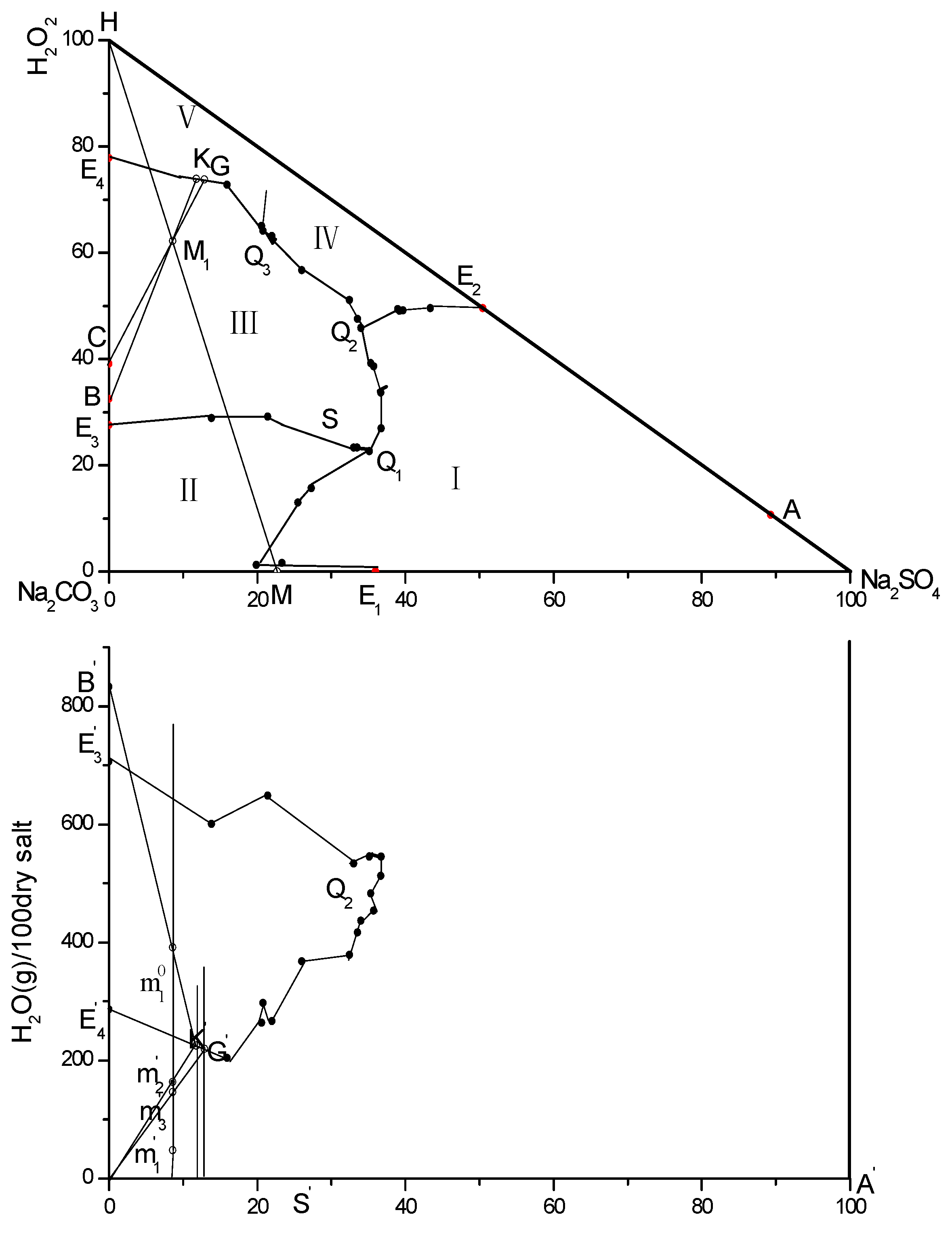
Based on the data in Table 3, the phase diagram and water diagram of the Na2CO3-Na2SO4-H2O2-H2O quaternary system were plotted, as shown in Figure 1. It is determined that there are three eutectic points in this system, which are the eutectic points of Na2SO4·10H2O, Na2CO3·10H2O, and Na2CO3·1.5H2O2·H2O; the eutectic points of Na2SO4·10H2O, Na2CO3·1.5H2O2·H2O, and Na2SO4·0.5H2O2·H2O; and the eutectic points of Na2CO3·1.5H2O2·H2O, Na2SO4·0.5H2O2·H2O, and Na2CO3·2H2O2·H2O. In addition, the system contains five solid-phase crystallization regions corresponding to the above solid phases.
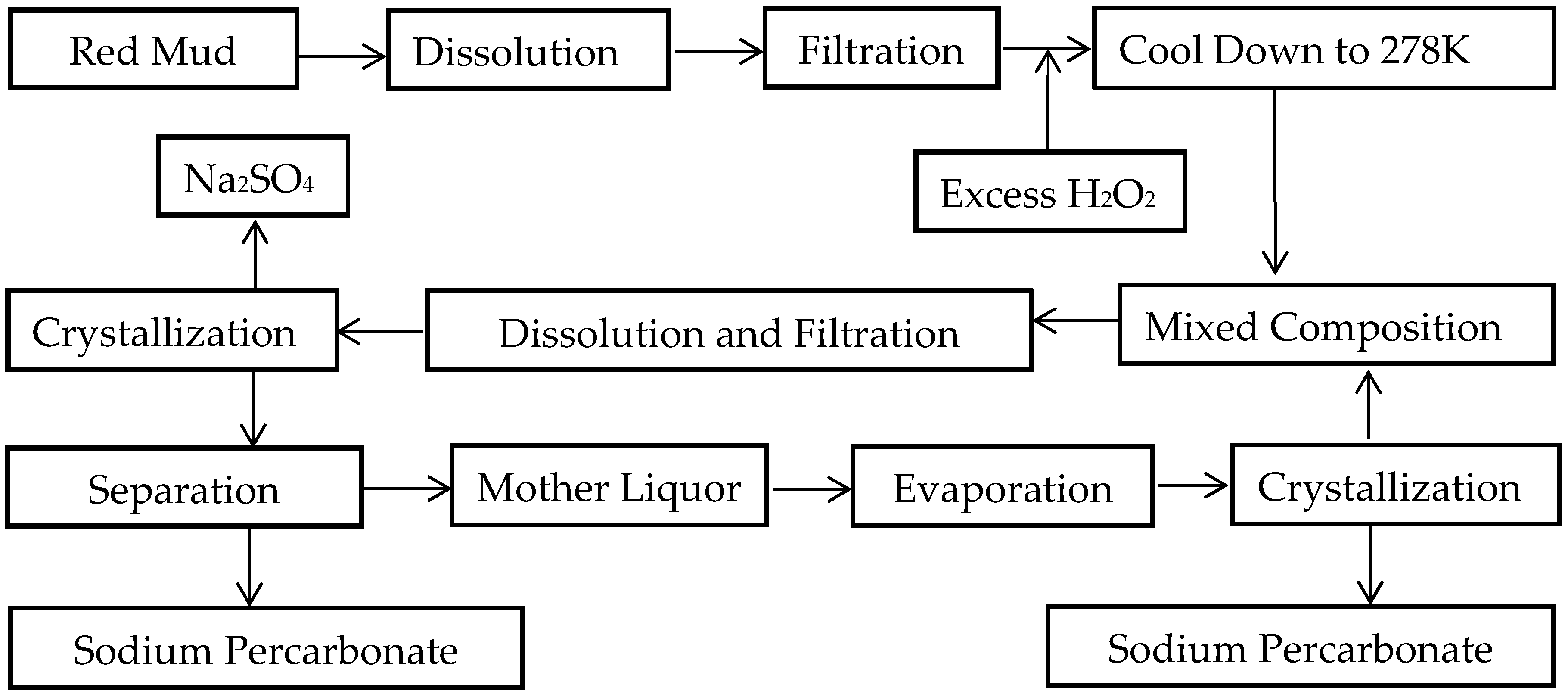
As a common theory for discussing the deposition and transformation rules of natural salts, the phase equilibrium theory of aqueous salt systems can serve as a methodological theory for determining the concentration route of the liquid phase and the sequence of salt precipitation during the evaporation or cooling process of brine, on the premise of applying phase chemistry theory and phase diagram data. Therefore, the direction and limit of a series of changes that will occur in the system when its external conditions change can be pre-analyzed through the phase diagram. By analyzing the above-mentioned phase diagram, the following production process can be formulated: first, separate pure substances from the mixed solution; second, prepare hydrates, double salts or solid solutions using single salts; and finally, explore a reasonable method for the cyclic utilization of part or all of the recovered mother liquor to improve the product recovery rate. The details are shown in Figure 2.

4. Conclusions

The Pitzer model was applied to regress the solubility data of the ternary sub-systems contained in the quaternary system, yielding the corresponding interparticle interaction parameters and activities. Subsequently, the established model was used to predict the solubility data of the quaternary system. Verification results indicated that the calculated data were in good agreement with the experimental data. Based on the phase equilibrium data of the Na2CO3-Na2SO4-H2O2-H2O quaternary system at 5 °C, a phase diagram was constructed. It was confirmed that there were three eutectic points in the system, which corresponded to the co-saturation of Na2SO4·10H2O, Na2CO3·10H2O, and Na2CO3·1.5H2O2·H2O; the co-saturation of Na2SO4·10H2O, Na2CO3·1.5H2O2·H2O, and Na2SO4·0.5H2O2·H2O; and the co-saturation of Na2CO3·1.5H2O2·H2O, Na2SO4·0.5H2O2·H2O, and Na2CO3·2H2O2·H2O. Additionally, five solid-phase crystallization regions were identified in the system. Through the analysis of the phase diagram, a process was proposed where sodium percarbonate product was synthesized via a wet process reaction using waste red mud as the raw material at an appropriate temperature, followed by further crystallization, separation, and drying processes to obtain the final product. A new process flow diagram for value-added sodium percarbonate chemical products was also established. This work provides a certain theoretical and technical basis for the production process of synthesizing sodium percarbonate via the wet method using waste red mud.

Author Contributions

G.-E.L.: Conceptualization; data curation; formal analysis, investigation; writing—original draft; writing—review and editing; project administration; software. F.S.: Resources, methodology, writing—original draft. Y.L.: Formal analysis; investigation; writing—original draft; writing—review and editing; funding acquisition. Y.-L.L.: Data curation; formal analysis; software. All authors have read and agreed to the published version of the manuscript.

Funding

This research was funded by Science Research Project of Hebei Education Department (QN2026587).

Institutional Review Board Statement

Not applicable.

Informed Consent Statement

Not applicable.

Data Availability Statement

The original contributions presented in this study are included in the article. Further inquiries can be directed to the corresponding author.

Conflicts of Interest

The authors declare no conflicts of interest.

References

  1. Nan, X.L.; Zhang, T.A.; Liu, Y.; Dou, Z.H. Analysis of comprehensive utilization of red mud in China. Chin. J. Process Eng. 2010, 10, 264–269. [Google Scholar]
  2. Ma, X.E.; Guo, H.; Xing, B.L. Experimental study on comprehensive utilization of red mud and fly ash. Mater. Sci. 2007, 1, 35–36. [Google Scholar]
  3. Xing, G.; Yang, J.K.; Hou, J. Study on the compositions of raw materials of the no-fired brick made from red mud and fly ash. Light. Met. 2006, 3, 24–27. [Google Scholar]
  4. Nan, X.L.; Zhang, T.A.; Liu, Y.; Dou, Z.; Zhao, Q.Y.; Jiang, X.L. Main Categories of Red Mud and Its Environmental Impacts. J. Process Eng. 2009, 9, 459–463. [Google Scholar]
  5. Xu, J.X. Review on Comprehensive Utilization of Red Mud and Recovery Process of Valuable Metals. Guangxi Metall. 1994, 2, 22. [Google Scholar]
  6. Yao, W.J.; Fang, B. Present Research Status of Comprehensive Utilization of Red Mud from Bayer Process. Inorg. Chem. Ind. 2010, 42, 9–11. [Google Scholar]
  7. Yang, G.L.; Lou, S.B. Experiment Studies on Precipitation of Natrium Salt During the Evaporation Process of Bayer Spent Liquor. Light. Met. 2006, 9, 18–20. [Google Scholar]
  8. Wang, L.; Lu, Y.; Mao, P.; Wang, J.W. Reasons about Rising of the Sodium Carbonate in Bayer Process and Measures. Eng. Technol. Res. 2011, 1, 14–15+27. [Google Scholar]
  9. Wang, C.H.; Zeng, Z.P.; Zhang, H.L. Review on Production, Application and Development Prospect of Sodium Percarbonate. J. Zhengzhou Inst. Technol. 1995, 16, 81–86. [Google Scholar]
  10. Zhang, H.Y. Application of Sodium Percarbonate in Detergents. Zhejiang Chem. Ind. 2005, 36, 34–37. [Google Scholar]
  11. Zhang, K.S.; Zeng, F.C. The Production and Research Progress of Sodium Percarbonate. Inorg. Salt Process. 2005, 37, 18–20. [Google Scholar]
  12. Hu, Y.S. A Study on Reactive Crystallization Process and Agglomeration Behavior of Sodium Percarbonate; Tianjin University: Tianjin, China, 2005. [Google Scholar]
  13. Zheng, H.; Zhao, G.T.; Yan, M. Progress in Production and Application of Sodium Percarbonate. J. Yunnan Minzu Univ. (Nat. Sci. Ed.) 2002, 11, 103–105. [Google Scholar]
  14. Huang, F.; Yuan, H.J.; Chen, Y.; Li, H.B. The Mechanism Research on the Crystal Degeneracy of Sodium Carbonate in Alumina Production Flow. Light. Met. 2006, 9, 12–17. [Google Scholar]
  15. Luan, X.H.; Hui, J.Y.; Gao, J.; Liang, M.; Zhao, X.C.; Wang, X.; Su, L.P. Utilization of sintering red mud as a solid waste-based foaming agent for warm mix asphalt: Modification mechanism and performance evaluation. J. Clean. Prod. 2026, 552, 147963. [Google Scholar] [CrossRef]
  16. Cao, J.L.; Hou, L.H.; Liu, X.W. Phase Diagrams of Na2CO3-NaCl-H2O2-H2O System at 15 °C and 25 °C and Their Applications. J. Chem. Eng. Chin. Univ. 2009, 23, 743–747. [Google Scholar]
  17. Liu, Y. Determination and analysis of solid–liquid equilibria for ternary systems Na2SO4–H2O2–H2O and Na2CO3–H2O2–H2O at 5 °C. J. Chem. Res. 2024, 48, 1–8. [Google Scholar] [CrossRef]
  18. Li, G.E.; Liu, Y. Determination and analysis of solid-liquid equilibria for quaternary system Na2CO3-Na2SO4-H2O2-H2O at 5 °C. J. Chem. Eng. Data 2025, 70, 470–476. [Google Scholar] [CrossRef]
  19. Wu, X.Y.; He, C.; Liang, Y.W.; Liu, Y. Research on the Application of Sodium Percarbonate in Concentrated Laundry Detergent Powder. China Deterg. Cosmet. Ind. 2024, 4, 13–19. [Google Scholar]
  20. Ge, J.B. Application of sodium percarbonate in low temperature scouring and bleaching process of cotton knitting. Text. Aux. 2023, 40, 48–52. [Google Scholar]
  21. Wang, A.Q.; Wei, Y.B.; Yang, P.; Hu, J.Q. The Applied Research of Sodium Percarbonate—Fe3O4 Synergistic Catalytic Oxidation in Degradation of Petroleum Contaminated Soil. Guangdong Chem. Ind. 2023, 50, 10–12. [Google Scholar]
  22. Chen, Z.L. Application of the sodium sulfite stabilizer FK-W12 in reactive printing. Text. Sci. Res. 2025, Z1, 43–46. [Google Scholar]
  23. Qiao, D.Z. Preliminary Approach to the Comprehensive Utilization of Glauber’s Salt Lake in Yuncheng. Shanxi Chem. Ind. 2002, 22, 17–19. [Google Scholar]
  24. Gao, Z.W.; Tang, S.T. Study and Calculation of Salt Balance in Bayer Production. Alumina Prod. 1998, 11, 14–19. [Google Scholar]
  25. Peng, Z.H.; Deng, Y.C.; Zhou, Q.S.; Liu, G.H.; Li, X.B. Influence of Inorganic Salt Impurities on Seed Decomposition Rate in Sodium Aluminate Solutions. Min. Metall. Eng. 2010, 30, 57–61. [Google Scholar]
  26. Pitzer, K.S. Thermodynamics of Electrolytes. I. Theoretical Basis and General Equations. J. Phys. Chem. 1973, 77, 268–277. [Google Scholar] [CrossRef]
  27. Pitzer, K.S.; Kim, J.J. Thermodynamics of Electrolytes. IV. Activity and Osmotic Coefficients for Mixed Electrolytes. J. Am. Chem. Soc. 1974, 96, 5701–5707. [Google Scholar] [CrossRef]
  28. Marshall, S.L.; May, P.M.; Hefter, G.T. Least-Squares Analysis of Osmotic Coefficient Data at 25 °C According to Pitzer’s Equation. 1. 1:1 Electrolytes. J. Chem. Eng. Data 1995, 40, 1041–1052. [Google Scholar]
  29. Li, Y.G. Thermodynamics of Metal Solvent Extraction; Tsinghua University Press: Beijing, China, 1988; Volume 5. [Google Scholar]
Figure 1. Analytical calculations of the phase diagram and water diagram for Na2CO3-Na2SO4-H2O2-H2O quaternary system.
Molecules 31 01497 g001
Figure 2. Process flowchart for the production and separation of sodium bicarbonate and sodium sulfate.
Molecules 31 01497 g002
Table 1. Virial coefficients of Na2CO3 and Na2SO4 at 5 °C.
Electrolyteβ(0)β(1)Cϕ
Na2CO30.036201.51010.00520
Na2SO4−0.027970.83530.05607
Table 2. Interaction parameters of particles in ternary system at 5 °C.
SystemInteraction Parameters of Particles
Na2CO3-H2O2-H2O λ A A μ A A A θ Na , C O 3 , A ψ Na , C O 3 , A ( 0 ) ψ Na , C O 3 , A ( 1 )
−0.7683990.0091285−2.936690−0.4376809.342605
Na2SO4-H2O2-H2O θ Na , S O 4 , A ψ Na , S O 4 , A ( 0 ) ψ Na , S O 4 , A ( 1 )
−0.015501−0.0071240.074320
Na2CO3-Na2SO4-H2O θ S O 4 , C O 3 ( 0 ) θ S O 4 , C O 3 ( 1 ) ψ Na , S O 4 , C O 3
0.1575001.712401−0.074510
Table 3. Calculated and measured values of solubility for Na2CO3-Na2SO4-H2O2-H2O system at 5 °C a.
Measured Values of Equilibrium Liquid Phase Composition (wt%)Calculated Values of Equilibrium Liquid Phase Composition (wt%)Fitting Error (%) cEquilibrium Solid Phase
Na2SO4H2O2Na2CO3Na2SO4H2O2Na2CO3Na2SO4H2O2Na2CO3
2.86 b3.896.622.873.9193.220.350.510.03N10 + B
3.47 b7.2514.373.447.2289.340.860.410.07N10 + B
3.78 b1.929.133.711.9594.341.851.560.04S10 + N10
3.86 b0.24 b15.303.950.2595.802.334.170.10S10 + N10
4.532.619.464.562.5392.910.663.070.05S10 + N10
5.123.566.625.233.4191.362.154.210.04S10 + N10 + B
5.793.730.685.983.5590.473.284.830.01S10 + N10 + B
5.5612.113.705.6112.4981.900.903.140.52A + B
5.694.175.645.444.0290.544.393.600.44S10 +B
5.2523.933.705.0324.3270.654.191.630.24B + C
5.985.54.836.075.2288.711.515.090.21S10 + B
6.456.974.636.366.7486.901.403.300.37S10 + B
6.066.724.376.356.9886.674.793.870.63S10 + B
6.338.543.765.998.1785.845.374.330.83B + S10 + A
6.499.193.676.028.9485.047.242.720.85B + S10 + A
6.7810.663.466.459.8683.694.877.501.37A + B
14.7118.214.1414.0817.5968.334.283.401.86S10 + A
5.2316.113.785.4117.0277.573.445.651.39A + B + C
5.6617.873.935.8818.3375.793.892.570.89A + B + C
6.0017.224.086.2116.9176.883.501.800.13A + B + C
19.4722.223.2020.0721.8658.073.081.620.41S10 +A
4.400.30 b14.164.290.2995.422.503.330.13S10 + N10
12.9816.233.8813.0515.9371.020.541.850.32S10 + A
9.9112.562.969.5512.0578.403.634.061.12S10 + A
5.213.686.895.543.8290.646.333.800.52S10 + B
A: Na2SO4·0.5H2O2·H2O; B: Na2CO3·1.5H2O2·H2O; C: Na2CO3·2H2O2·H2O. S10: Na2SO4·10H2O; N10: Na2CO3·10H2O. a Standard uncertainty: u(T) = 0.05 °C; relative standard uncertainties: ur(Na2SO4 wt%) = 0.007; ur(Na2CO3 wt%) = 0.011; and ur(H2O2 wt%) = 0.004 without those labeled with superscript. The quantity wt% means mass percentage. b Relative standard uncertainties: ur(Na2SO4 wt%) = 0.053; ur(Na2CO3 wt%) = 0.052; and ur(H2O2 wt%) = 0.053. c Note: Fitting error (%) = |(calculated values − measured values)/measured values|.
Disclaimer/Publisher’s Note: The statements, opinions and data contained in all publications are solely those of the individual author(s) and contributor(s) and not of MDPI and/or the editor(s). MDPI and/or the editor(s) disclaim responsibility for any injury to people or property resulting from any ideas, methods, instructions or products referred to in the content.