Identification of Emerging Organic Pollutants in Aquatic Environments Under the Omics-Based Framework: A Review



Abstract
1. Introduction
2. Omics-Based Analytical Framework for Emerging Pollutants in Aquatic Environments
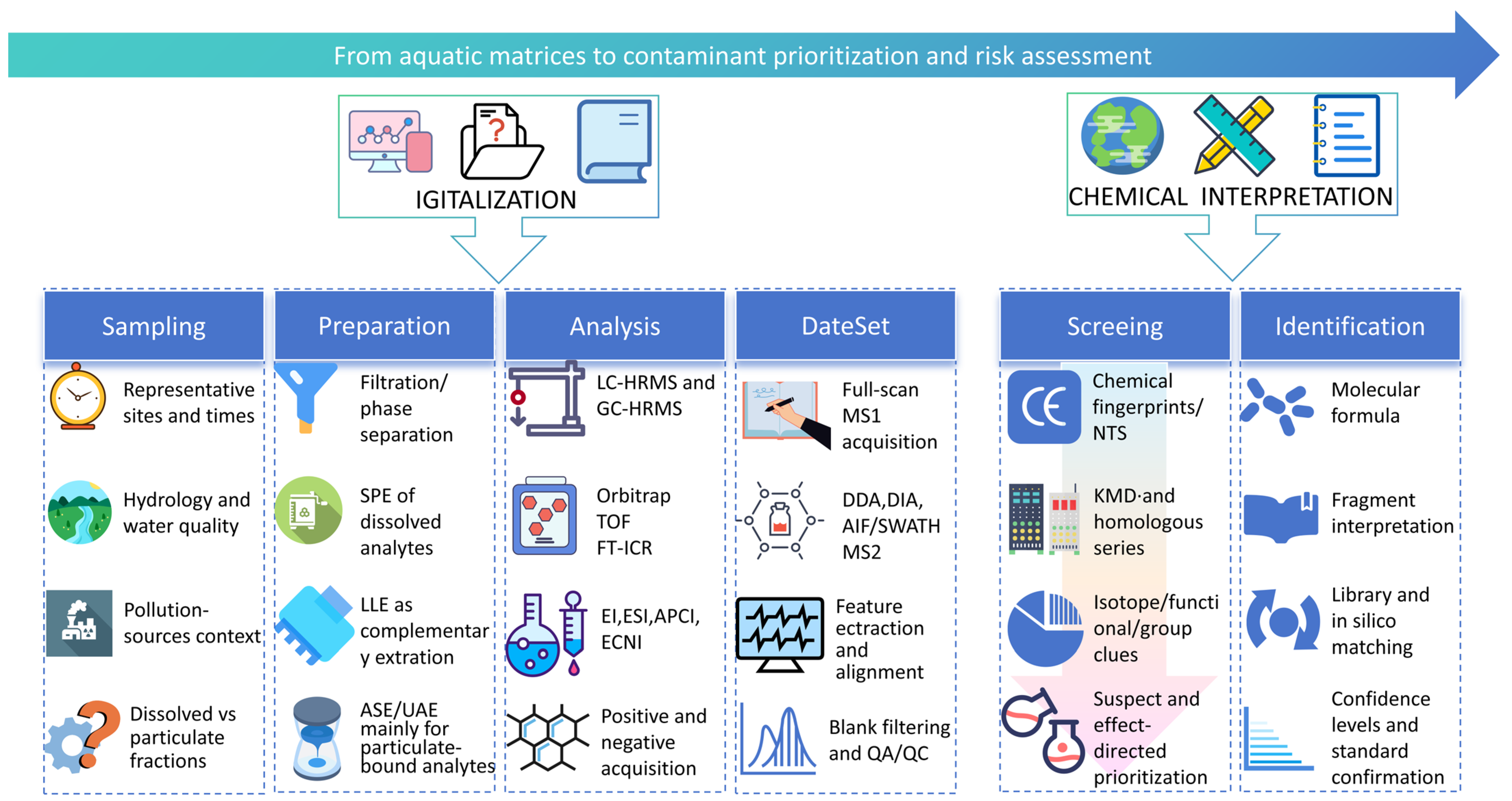
2.1. Digital Characterization of Aquatic Environmental Samples Using HRMS
2.1.1. Sample Collection and Pre-Treatment Techniques
2.1.2. Instrument Analysis, Data Acquisition, and Data Mining
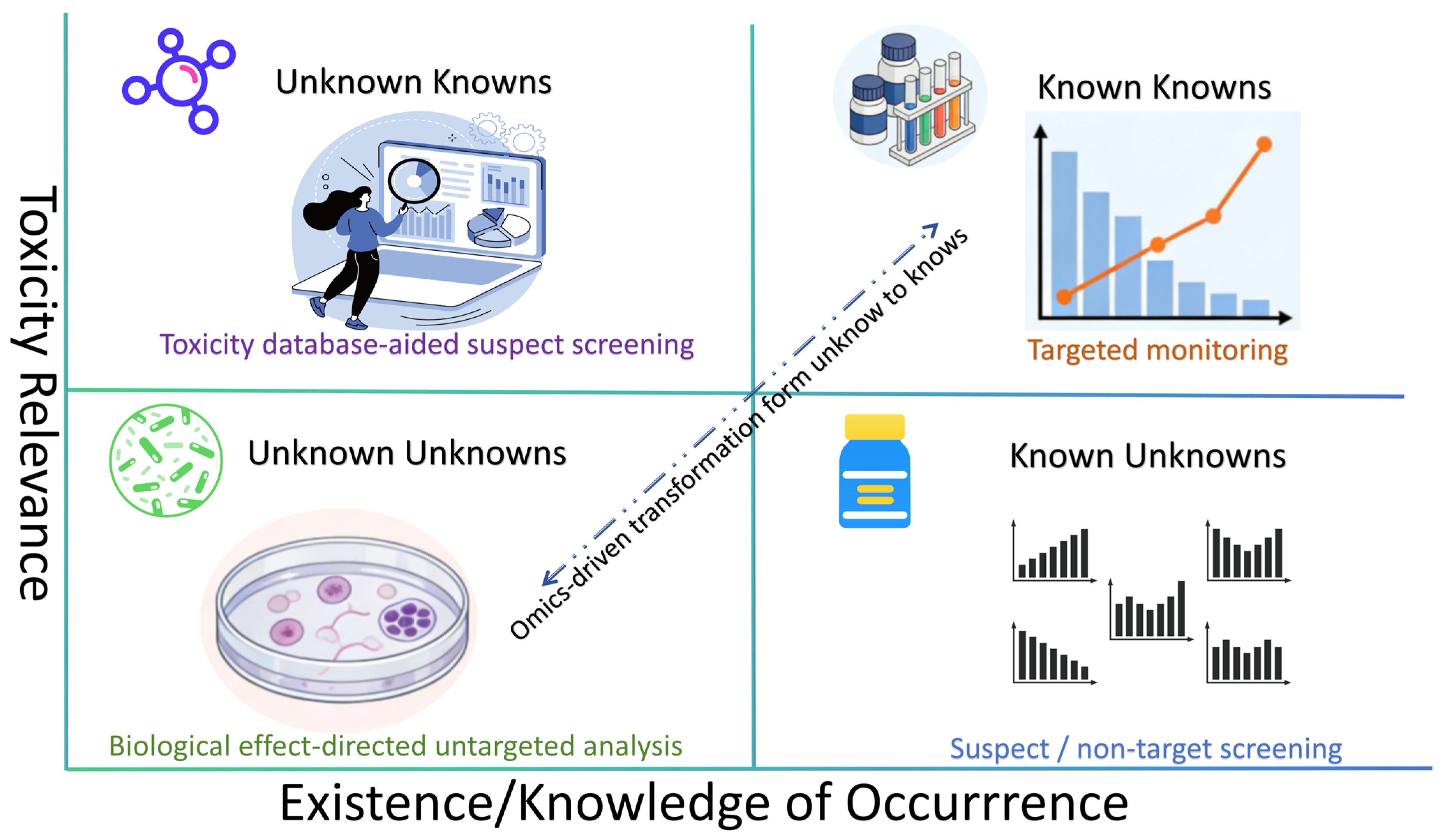
2.2. Priority Screening Strategies for Emerging Pollutants in Aquatic Environments
2.2.1. Chemical Fingerprint Screening and Feature-Driven NTS
2.2.2. Suspect Screening
2.2.3. Biological Effect-Directed Screening
2.3. Chemical Structure Identification of Emerging Pollutants in Aquatic Environments
2.4. Current Limitations and Practical Challenges
3. Conclusions and Perspectives
- Synergistic Development of Instrumental Technologies: Promote the deeper integration of chromatographic separation and HRMS to improve analytical coverage, selectivity, and confidence in structure elucidation. The development of fully two-dimensional chromatography systems, such as GC × GC-HRMS and LC × LC-HRMS, can enhance the separation of isomers and complex mixtures. Online analytical technologies may also improve the monitoring of unstable and trace contaminants in aquatic environments. In addition, combining HRMS with orthogonal techniques such as ion mobility, nuclear magnetic resonance, Raman spectroscopy, or element-specific detection would provide more robust multidimensional evidence for pollutant characterization, especially for challenging contaminant classes such as organometallic compounds and transformation products [34,35,51,78,79].
- Refinement of Data Processing and Database Systems: Develop more robust, transparent, and automated data-processing strategies for feature extraction, deconvolution, adduct and isotope annotation, blank subtraction, and cross-platform comparability, so as to improve the reliability of full-component data interpretation. At the same time, dedicated spectral libraries and pollutant databases for aquatic environments should be continuously strengthened by integrating accurate mass, molecular formula, fragmentation behavior, retention-related information, environmental occurrence, transformation pathways, and toxicological relevance. Better curation and standardization of such databases will be critical for reducing false positives and false negatives in both suspect screening and non-target workflows [10,16,35,36,83].
- Integrated Application of Multidimensional Screening Strategies: Future studies should place greater emphasis on workflow integration at the prioritization stage rather than simply expanding the number of detected features. In practical terms, chemistry-driven NTS, suspect screening, and EDA should be combined according to study objectives, sample complexity, and available confirmation capacity. In this context, chemometric and artificial-intelligence tools may support feature ranking, source identification, and pattern recognition, but only when preprocessing procedures, training data, and validation strategies are clearly reported. Optimization strategies developed in complex decision-making systems, such as receding horizon optimization and differential evolution algorithms, may also provide methodological inspiration for adaptive feature prioritization and multi-objective decision support in future environmental omics workflows. However, their application should be validated using domain-specific environmental datasets before they are introduced into practical screening or risk-assessment workflows [89]. Greater methodological attention is also needed for under-characterized contaminant spaces, particularly organometallic pollutants and microplastic-associated chemical mixtures, where current omics workflows remain promising but still analytically fragmented [37,38,39,40,41,51,52,53,54,74,75,90].
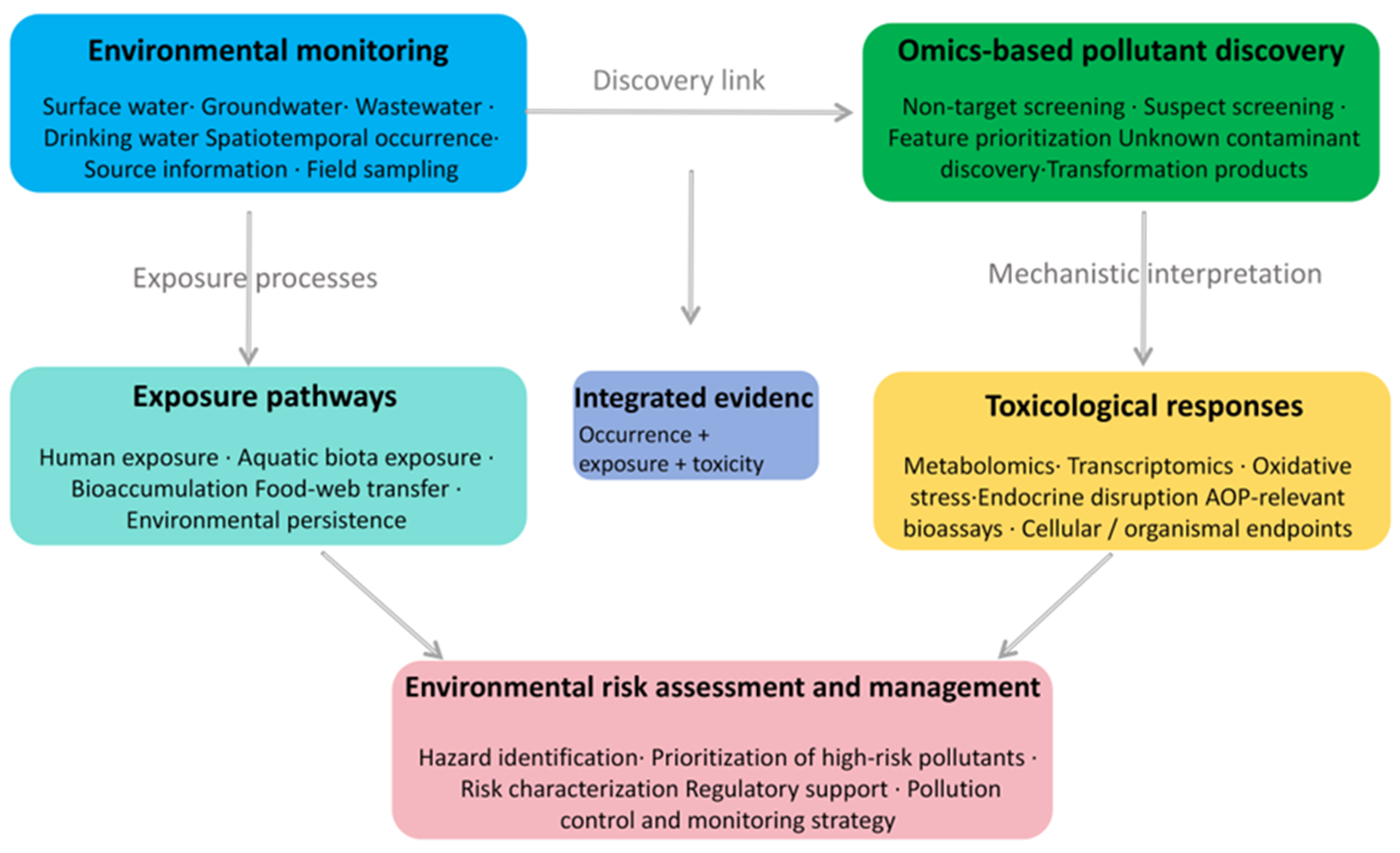
- Integration of Identification and Risk Assessment: A major next step is to narrow the gap between contaminant identification and risk interpretation. Rather than treating HRMS outputs as self-sufficient evidence, future studies should connect prioritized contaminants with source information, environmental fate, bioaccumulation potential, mixture toxicity, and exposure-relevant endpoints to support more defensible environmental decision-making [40,53,77,91,92]. As illustrated in Figure 3, the proposed pollutant discovery–risk conceptual framework should be understood as a stepwise structure for linking monitoring data, omics-based discovery, exposure pathways, and toxicological responses, rather than as a universal solution. Its practical value will depend on case-specific implementation, especially through targeted confirmation, effect-based validation, and transparent prioritization criteria.
Author Contributions
Funding
Institutional Review Board Statement
Informed Consent Statement
Data Availability Statement
Conflicts of Interest
Abbreviations
| AIF | all-ions fragmentation |
| AOP | adverse outcome pathway |
| APCI | atmospheric-pressure chemical ionization |
| ASE | accelerated solvent extraction |
| DDA | data-dependent acquisition |
| DIA | data-independent acquisition |
| EDA | effect-directed analysis |
| ECNI | electron capture negative ionization |
| EI | electron ionization |
| EOPs | emerging organic pollutants |
| ESI | electrospray ionization |
| FT-ICR | Fourier transform ion cyclotron resonance |
| GC-HRMS | gas chromatography-high-resolution mass spectrometry |
| HRMS | high-resolution mass spectrometry |
| KMD | Kendrick mass defect |
| LC-HRMS | liquid chromatography-high-resolution mass spectrometry |
| LLE | liquid–liquid extraction |
| NIAS | non-intentionally added substances |
| NTS | non-target screening |
| PFAS | per- and polyfluoroalkyl substances |
| PLE | pressurized liquid extraction |
| QA/QC | quality assurance/quality control |
| SPE | solid-phase extraction |
| SWATH | sequential window acquisition of all theoretical fragment-ion spectra |
| UAE | ultrasonic-assisted extraction |
References
- Ducci, L.; Rizzo, P.; Pinardi, R.; Celico, F. An Interdisciplinary Assessment of the Impact of Emerging Contaminants on Groundwater from Wastewater Containing Disodium EDTA. Sustainability 2024, 16, 8624. [Google Scholar] [CrossRef] [Scilit]
- Pourchet, M.; Debrauwer, L.; Klanova, J.; Price, E.J.; Covaci, A.; Caballero-Casero, N.; Oberacher, H.; Lamoree, M.; Damont, A.; Fenaille, F.; et al. Suspect and non-targeted screening of chemicals of emerging concern for human biomonitoring, environmental health studies and support to risk assessment: From promises to challenges and harmonisation issues. Environ. Int. 2020, 139, 105545. [Google Scholar] [CrossRef] [Scilit]
- Brack, W.; Ait-Aissa, S.; Burgess, R.M.; Busch, W.; Creusot, N.; Di Paolo, C.; Escher, B.I.; Mark Hewitt, L.; Hilscherova, K.; Hollender, J.; et al. Effect-directed analysis supporting monitoring of aquatic environments—An in-depth overview. Sci. Total Environ. 2016, 544, 1073–1118. [Google Scholar] [CrossRef] [Scilit] [PubMed]
- Lautan, O.; Chen, S.N.; Lu, C.C.; Huang, Y.H.; Chen, H.L.; Chih, P.S.; Chen, R.J. Effect-based high-throughput screening of environmental water samples: Focus on liver toxicity pathways and endocrine disruption. J. Hazard. Mater. 2025, 496, 139432. [Google Scholar] [CrossRef] [Scilit] [PubMed]
- Tkalec, Ž.; Antignac, J.P.; Bandow, N.; Béen, F.M.; Belova, L.; Bessems, J.; Le Bizec, B.; Brack, W.; Cano-Sancho, G.; Chaker, J.; et al. Innovative analytical methodologies for characterizing chemical exposure with a view to next-generation risk assessment. Environ. Int. 2024, 186, 108585. [Google Scholar] [CrossRef] [Scilit] [PubMed]
- Teng, M.; Zhao, X.; Zhao, L.; Shi, D.; Li, Y.; Sun, J.; Zhao, W.; Zhou, L.; Wang, X.; Giesy, J.P.; et al. Zebrafish (Danio rerio) Reproduction Is Affected by Life-Cycle Exposure to Differently Charged Polystyrene Nanoplastics with Sex-Specific Responses. ACS EST Water 2022, 2, 2558–2566. [Google Scholar] [CrossRef] [Scilit]
- Yu, Y.; Wang, Z.; Yao, B.; Zhou, Y. Occurrence, bioaccumulation, fate, and risk assessment of emerging pollutants in aquatic environments: A review. Sci. Total Environ. 2024, 923, 171388. [Google Scholar] [CrossRef] [Scilit]
- Hoh, E.; Zhu, L.; Hites, R.A. Dechlorane plus, a chlorinated flame retardant, in the Great Lakes. Environ. Sci. Technol. 2006, 40, 1184–1189. [Google Scholar] [CrossRef] [Scilit]
- Helwig, K.; Niemi, L.; Stenuick, J.Y.; Alejandre, J.C.; Pfleger, S.; Roberts, J.; Harrower, J.; Nafo, I.; Pahl, O. Broadening the Perspective on Reducing Pharmaceutical Residues in the Environment. Environ. Toxicol. Chem. 2024, 43, 653–663. [Google Scholar] [CrossRef] [Scilit]
- Manz, K.E.; Feerick, A.; Braun, J.M.; Feng, Y.L.; Hall, A.; Koelmel, J.; Manzano, C.; Newton, S.R.; Pennell, K.D.; Place, B.J.; et al. Non-targeted analysis (NTA) and suspect screening analysis (SSA): A review of examining the chemical exposome. J. Expo. Sci. Environ. Epidemiol. 2023, 33, 524–536. [Google Scholar] [CrossRef] [Scilit]
- Schymanski, E.L.; Singer, H.P.; Slobodnik, J.; Ipolyi, I.M.; Oswald, P.; Krauss, M.; Schulze, T.; Haglund, P.; Letzel, T.; Grosse, S.; et al. Non-target screening with high-resolution mass spectrometry: Critical review using a collaborative trial on water analysis. Anal. Bioanal. Chem. 2015, 407, 6237–6255. [Google Scholar] [CrossRef] [Scilit]
- Peter, K.T.; Phillips, A.L.; Knolhoff, A.M.; Gardinali, P.R.; Manzano, C.A.; Miller, K.E.; Pristner, M.; Sabourin, L.; Sumarah, M.W.; Warth, B.; et al. Nontargeted Analysis Study Reporting Tool: A Framework to Improve Research Transparency and Reproducibility. Anal. Chem. 2021, 93, 13870–13879. [Google Scholar] [CrossRef] [Scilit]
- Phillips, A.L.; Peter, K.T.; Sobus, J.R.; Fisher, C.M.; Manzano, C.A.; McEachran, A.D.; Williams, A.J.; Knolhoff, A.M.; Ulrich, E.M. Standardizing non-targeted analysis reporting to advance exposure science and environmental epidemiology. J. Expo. Sci. Environ. Epidemiol. 2023, 33, 501–504. [Google Scholar] [CrossRef] [Scilit]
- Martínez-Pérez-Cejuela, H.; Gionfriddo, E. Innovative Sample Preparation Strategies for Emerging Pollutants in Environmental Samples. Annu. Rev. Anal. Chem. 2025, 18, 73–95. [Google Scholar] [CrossRef] [Scilit]
- Ducrocq, T.; Merel, S.; Miège, C. Review on analytical methods and occurrence of organic contaminants in continental water sediments. Chemosphere 2024, 365, 143275. [Google Scholar] [CrossRef] [Scilit] [PubMed]
- Mofijur, M.; Hasan, M.M.; Ahmed, S.F.; Djavanroodi, F.; Fattah, I.M.R.; Silitonga, A.S.; Kalam, M.A.; Zhou, J.L.; Khan, T.M.Y. Advances in identifying and managing emerging contaminants in aquatic ecosystems: Analytical approaches, toxicity assessment, transformation pathways, environmental fate, and remediation strategies. Environ. Pollut. 2024, 341, 122889. [Google Scholar] [CrossRef] [Scilit] [PubMed]
- Vosough, M.; Schmidt, T.C.; Renner, G. Non-target screening in water analysis: Recent trends of data evaluation, quality assurance, and their future perspectives. Anal. Bioanal. Chem. 2024, 416, 2125–2136. [Google Scholar] [CrossRef] [Scilit]
- Meher, A.K.; Zarouri, A. Environmental Applications of Mass Spectrometry for Emerging Contaminants. Molecules 2025, 30, 364. [Google Scholar] [CrossRef] [Scilit] [PubMed]
- Cheng, Z.; Qiu, X.; Shi, X.; Zhu, T. Identification of organosiloxanes in ambient fine particulate matters using an untargeted strategy via gas chromatography and time-of-flight mass spectrometry. Environ. Pollut. 2021, 271, 116128. [Google Scholar] [CrossRef] [Scilit]
- Shi, X.; Qiu, X.; Chen, Q.; Chen, S.; Hu, M.; Rudich, Y.; Zhu, T. Organic Iodine Compounds in Fine Particulate Matter from a Continental Urban Region: Insights into Secondary Formation in the Atmosphere. Environ. Sci. Technol. 2021, 55, 1508–1514. [Google Scholar] [CrossRef] [Scilit]
- Jiang, X.; Han, Y.; Qiu, X.; Chai, Q.; Zhang, H.; Chen, X.; Cheng, Z.; Wang, Y.; Fan, Y.; Xue, T.; et al. Organic Components of Personal PM2.5 Exposure Associated with Inflammation: Evidence from an Untargeted Exposomic Approach. Environ. Sci. Technol. 2021, 55, 10589–10596. [Google Scholar] [CrossRef] [Scilit]
- Handl, S.; Kutlucinar, K.G.; Allabashi, R.; Troyer, C.; Mayr, E.; Perfler, R.; Hann, S. Assessment of dynamics and variability of organic substances in river bank filtration for prioritisation in analytical workflows. Environ. Sci. Pollut. Res. Int. 2024, 31, 53410–53423. [Google Scholar] [CrossRef] [Scilit] [PubMed]
- Dulio, V.; van Bavel, B.; Brorström-Lundén, E.; Harmsen, J.; Hollender, J.; Schlabach, M.; Slobodnik, J.; Thomas, K.; Koschorreck, J. Emerging pollutants in the EU: 10 years of NORMAN in support of environmental policies and regulations. Environ. Sci. Eur. 2018, 30, 5. [Google Scholar] [CrossRef] [Scilit] [PubMed]
- Silva, S.; Rodrigues, J.; Cardoso, V.V.; Carneiro, R.N.; Almeida, C.M.M. Analysis of Pharmaceutical Active Compounds in Complex Water Samples: Sample Filtration as an Option. Molecules 2025, 30, 1609. [Google Scholar] [CrossRef] [Scilit] [PubMed]
- Orlando-Véliz, D.; Bonansea, R.I.; García-Vara, M.; Nikolopoulou, V.; López de Alda, M. Evaluation of Three Sample Preparation Methods for LC-HRMS Suspect Screening of Contaminants of Emerging Concern in Effluent Wastewater. Anal. Chem. 2025, 97, 25946–25957. [Google Scholar] [CrossRef] [Scilit]
- Kachhawaha, A.S.; Nagarnaik, P.M.; Labhasetwar, P.; Banerjee, K. A Review of Recently Developed LC-MS/MS Methods for the Analysis of Pharmaceuticals and Personal Care Products in Water. J. AOAC Int. 2020, 103, 9–22. [Google Scholar] [CrossRef] [Scilit]
- Meng, W.; Li, J.; Shen, J.; Deng, Y.; Letcher, R.J.; Su, G. Functional Group-Dependent Screening of Organophosphate Esters (OPEs) and Discovery of an Abundant OPE Bis-(2-ethylhexyl)-phenyl Phosphate in Indoor Dust. Environ. Sci. Technol. 2020, 54, 4455–4464. [Google Scholar] [CrossRef] [Scilit]
- Ye, L.; Meng, W.; Huang, J.; Li, J.; Su, G. Establishment of a Target, Suspect, and Functional Group-Dependent Screening Strategy for Organophosphate Esters (OPEs): “Into the Unknown” of OPEs in the Sediment of Taihu Lake, China. Environ. Sci. Technol. 2021, 55, 5836–5847. [Google Scholar] [CrossRef] [Scilit]
- Ouyang, X.; Weiss, J.M.; de Boer, J.; Lamoree, M.H.; Leonards, P.E.G. Non-target analysis of household dust and laundry dryer lint using comprehensive two-dimensional liquid chromatography coupled with time-of-flight mass spectrometry. Chemosphere 2017, 166, 431–437. [Google Scholar] [CrossRef] [Scilit]
- Li, B.; Wang, M.; Cheng, K.; Guo, X.; Dong, R.; Yun, K.; Ma, D. Rapid Determination of 12 Classes of Per- and Polyfluoroalkyl Substances in Water Samples from Environmental Forensic Cases. Molecules 2024, 29, 3881. [Google Scholar] [CrossRef] [Scilit]
- Nannou, C.; Gkountouras, D.; Boti, V.; Albanis, T. An Efficient LC–HRMS-Based Approach to Evaluate Pesticide Contamination in Water Bodies with Measurement Uncertainty Considerations. Appl. Sci. 2024, 14, 10329. [Google Scholar] [CrossRef] [Scilit]
- Shi, X.; Langberg, H.A.; Sobek, A.; Benskin, J.P. Exploiting Molecular Ions for Screening Hydrophobic Contaminants in Sediments Using Gas Chromatography-Atmospheric Pressure Chemical Ionization-Ion Mobility-Mass Spectrometry. Environ. Sci. Technol. 2025, 59, 4699–4708. [Google Scholar] [CrossRef] [Scilit]
- Drakopoulou, S.K.; Kokolakis, S.E.; Karagiannidis, A.L.; Dasenaki, M.E.; Maragou, N.C.; Thomaidis, N.S. A comprehensive HRMS methodology using LC-(ESI)-/GC-(APCI)-QTOF MS complementary platforms for wide-scope target screening of >750 pesticides in olive oil. Anal. Methods 2024, 16, 2684–2692. [Google Scholar] [CrossRef] [Scilit]
- De, O.S.R.; De Menezes, M.G.G.; De Castro, R.C.; De, A.N.C.; Milhome, M.A.L.; Do Nascimento, R.F. Efficiency of ESI and APCI ionization sources in LC-MS/MS systems for analysis of 22 pesticide residues in food matrix. Food Chem. 2019, 297, 124934. [Google Scholar] [CrossRef] [Scilit]
- Caño-Carrillo, I.; Gilbert-López, B.; Moreno-González, D.; Franzke, J.; García-Reyes, J.F. Efficient and Wide Chemical-Space Ionization of Organic Contaminants Using LC–MS with a Miniaturized Plasma Source Applying Different Discharge Gases. Anal. Chem. 2025, 97, 20962–20972. [Google Scholar] [CrossRef] [Scilit] [PubMed]
- Yang, Y.; Yang, L.; Zheng, M.; Cao, D.; Liu, G. Data acquisition methods for non-targeted screening in environmental analysis. TrAC Trends Anal. Chem. 2023, 160, 116966. [Google Scholar] [CrossRef] [Scilit]
- Renner, G.; Reuschenbach, M. Critical review on data processing algorithms in non-target screening: Challenges and opportunities to improve result comparability. Anal. Bioanal. Chem. 2023, 415, 4111–4123. [Google Scholar] [CrossRef] [Scilit] [PubMed]
- Drees, F.; Vosough, M.; Schmidt, T.C. Unraveling non-target screening variability for LC-HRMS data: A chemometric comparative analysis of river water samples impacted by treated wastewater. Anal. Bioanal. Chem. 2025, 417, 6075–6088. [Google Scholar] [CrossRef] [Scilit]
- Zweigle, J.; Tisler, S.; Bevilacqua, M.; Tomasi, G.; Nielsen, N.J.; Gawlitta, N.; Lübeck, J.S.; Smilde, A.K.; Christensen, J.H. Prioritization strategies for non-target screening in environmental samples by chromatography—High-resolution mass spectrometry: A tutorial. J. Chromatogr. A 2025, 1751, 465944. [Google Scholar] [CrossRef] [Scilit]
- Kavianpour, B.; Piadeh, F.; Gheibi, M.; Ardakanian, A.; Behzadian, K.; Campos, L.C. Applications of artificial intelligence for chemical analysis and monitoring of pharmaceutical and personal care products in water and wastewater: A review. Chemosphere 2024, 368, 143692. [Google Scholar] [CrossRef] [Scilit] [PubMed]
- Canchola, A.; Tran, L.N.; Woo, W.; Tian, L.; Lin, Y.H.; Chou, W.C. Advancing non-target analysis of emerging environmental contaminants with machine learning: Current status and future implications. Environ. Int. 2025, 198, 109404. [Google Scholar] [CrossRef] [Scilit]
- Vosough, M.; Drees, F.; Sieber, G.; Stach, T.L.; Beisser, D.; Probst, A.J.; Boenigk, J.; Schmidt, T.C. Integrative Analysis of Nontargeted LC-HRMS and High-Throughput Metabarcoding Data for Aquatic Environmental Studies Using Combined Multivariate Statistical Approaches. Anal. Chem. 2025, 97, 11563–11571. [Google Scholar] [CrossRef] [Scilit]
- Liu, P.; Pan, D.; Jiao, X.-Y.; Liu, J.-N.; Du, P.-H.; Li, P.-C.; Xue, M.-Z.; Jin, Y.-C.; Wang, C.-S.; Wang, X.-R.; et al. Integrating non-target analysis and machine learning: A framework for contaminant source identification. npj Clean. Water 2025, 8, 78. [Google Scholar] [CrossRef] [Scilit]
- Kuang, B.Y.; Yeung, H.S.; Lee, C.C.; Griffith, S.M.; Yu, J.Z. Aromatic formulas in ambient PM2.5 samples from Hong Kong determined using FT-ICR ultrahigh-resolution mass spectrometry. Anal. Bioanal. Chem. 2018, 410, 6289–6304. [Google Scholar] [CrossRef] [Scilit] [PubMed]
- Manzano, C.A.; Marvin, C.; Muir, D.; Harner, T.; Martin, J.; Zhang, Y. Heterocyclic Aromatics in Petroleum Coke, Snow, Lake Sediments, and Air Samples from the Athabasca Oil Sands Region. Environ. Sci. Technol. 2017, 51, 5445–5453. [Google Scholar] [CrossRef] [Scilit] [PubMed]
- Yu, N.; Wen, H.; Wang, X.; Yamazaki, E.; Taniyasu, S.; Yamashita, N.; Yu, H.; Wei, S. Nontarget Discovery of Per- and Polyfluoroalkyl Substances in Atmospheric Particulate Matter and Gaseous Phase Using Cryogenic Air Sampler. Environ. Sci. Technol. 2020, 54, 3103–3113. [Google Scholar] [CrossRef] [Scilit]
- Shen, Y.; Wang, L.; Ding, Y.; Liu, S.; Li, Y.; Zhou, Z.; Liang, Y. Trends in the Analysis and Exploration of per- and Polyfluoroalkyl Substances (PFAS) in Environmental Matrices: A Review. Crit. Rev. Anal. Chem. 2024, 54, 3171–3195. [Google Scholar] [CrossRef] [Scilit]
- Yu, N.; Guo, H.; Yang, J.; Jin, L.; Wang, X.; Shi, W.; Zhang, X.; Yu, H.; Wei, S. Non-Target and Suspect Screening of Per- and Polyfluoroalkyl Substances in Airborne Particulate Matter in China. Environ. Sci. Technol. 2018, 52, 8205–8214. [Google Scholar] [CrossRef] [Scilit]
- Peng, H.; Chen, C.; Cantin, J.; Saunders, D.M.; Sun, J.; Tang, S.; Codling, G.; Hecker, M.; Wiseman, S.; Jones, P.D.; et al. Untargeted Screening and Distribution of Organo-Iodine Compounds in Sediments from Lake Michigan and the Arctic Ocean. Environ. Sci. Technol. 2016, 50, 10097–10105. [Google Scholar] [CrossRef] [Scilit]
- Shi, X.; Qiu, X.; Cheng, Z.; Chen, Q.; Rudich, Y.; Zhu, T. Isomeric Identification of Particle-Phase Organic Nitrates through Gas Chromatography and Time-of-Flight Mass Spectrometry Coupled with an Electron Capture Negative Ionization Source. Environ. Sci. Technol. 2020, 54, 707–713. [Google Scholar] [CrossRef] [Scilit] [PubMed]
- Shi, X.; Qiu, X.; Jiang, X.; Rudich, Y.; Zhu, T. Comprehensive detection of nitrated aromatic compounds in fine particulate matter using gas chromatography and tandem mass spectrometry coupled with an electron capture negative ionization source. J. Hazard. Mater. 2021, 407, 124794. [Google Scholar] [CrossRef] [Scilit] [PubMed]
- Xu, C.; Gao, L.; Zheng, M.; Qiao, L.; Wang, K.; Huang, D.; Wang, S. Nontarget Screening of Polycyclic Aromatic Compounds in Atmospheric Particulate Matter Using Ultrahigh Resolution Mass Spectrometry and Comprehensive Two-Dimensional Gas Chromatography. Environ. Sci. Technol. 2021, 55, 109–119. [Google Scholar] [CrossRef] [Scilit]
- Cläsgens, C.; Schwank, T.; Pitzke, K. Occupational exposure to organotin substances: Development of a liquid chromatographic separation method for 11 organotin compounds in workplace air samples via HPLC-ICP-MS. J. Chromatogr. A 2024, 1718, 464695. [Google Scholar] [CrossRef] [Scilit]
- Tran, T.M.; Hoang, A.Q.; Le, S.T.; Minh, T.B.; Kannan, K. A review of contamination status, emission sources, and human exposure to volatile methyl siloxanes (VMSs) in indoor environments. Sci. Total Environ. 2019, 691, 584–594. [Google Scholar] [CrossRef] [Scilit] [PubMed]
- Aib, H.; Parvez, M.S.; Czédli, H.M. Pharmaceuticals and Microplastics in Aquatic Environments: A Comprehensive Review of Pathways and Distribution, Toxicological and Ecological Effects. Int. J. Environ. Res. Public. Health 2025, 22, 799. [Google Scholar] [CrossRef] [Scilit]
- Menger, F.; Römerscheid, M.; Lips, S.; Klein, O.; Nabi, D.; Gandrass, J.; Joerss, H.; Wendt-Potthoff, K.; Bedulina, D.; Zimmermann, T.; et al. Screening the release of chemicals and microplastic particles from diverse plastic consumer products into water under accelerated UV weathering conditions. J. Hazard. Mater. 2024, 477, 135256. [Google Scholar] [CrossRef] [Scilit]
- Gago-Ferrero, P.; Krettek, A.; Fischer, S.; Wiberg, K.; Ahrens, L. Suspect Screening and Regulatory Databases: A Powerful Combination to Identify Emerging Micropollutants. Environ. Sci. Technol. 2018, 52, 6881–6894. [Google Scholar] [CrossRef] [Scilit]
- Schymanski, E.L.; Singer, H.P.; Longrée, P.; Loos, M.; Ruff, M.; Stravs, M.A.; Ripollés Vidal, C.; Hollender, J. Strategies to characterize polar organic contamination in wastewater: Exploring the capability of high resolution mass spectrometry. Environ. Sci. Technol. 2014, 48, 1811–1818. [Google Scholar] [CrossRef] [Scilit]
- Qian, Z.; Feng, C.; Chen, Y.; Lin, Y.; Liang, Z.; Qian, H.; Zhou, J.; Ma, J.; Jin, Y.; Lu, D.; et al. Occurrence, Sources, and Prioritization of Per- and Polyfluoroalkyl Substances (PFASs) in Drinking Water from Yangtze River Delta, China: Focusing on Emerging PFASs. Molecules 2025, 30, 2313. [Google Scholar] [CrossRef] [Scilit] [PubMed]
- Gao, K.; Zhang, Y.; Liu, Y.; Yang, M.; Zhu, T. Screening of imidazoles in atmospheric aerosol particles using a hybrid targeted and untargeted method based on ultra-performance liquid chromatography-quadrupole time-of-flight mass spectrometry. Anal. Chim. Acta 2021, 1163, 338516. [Google Scholar] [CrossRef] [Scilit]
- Dolkar, P.; Sharma, M.; Modeel, S.; Yadav, S.; Siwach, S.; Bharti, M.; Yadav, P.; Lata, P.; Negi, T.; Negi, R.K. Challenges and effective tracking down strategies of antibiotic contamination in aquatic ecosystem. Environ. Sci. Pollut. Res. Int. 2024, 31, 55935–55957. [Google Scholar] [CrossRef] [Scilit]
- Avagyan, R.; Åberg, M.; Westerholm, R. Suspect screening of OH-PAHs and non-target screening of other organic compounds in wood smoke particles using HR-Orbitrap-MS. Chemosphere 2016, 163, 313–321. [Google Scholar] [CrossRef] [Scilit] [PubMed]
- Williams, A.J.; Grulke, C.M.; Edwards, J.; McEachran, A.D.; Mansouri, K.; Baker, N.C.; Patlewicz, G.; Shah, I.; Wambaugh, J.F.; Judson, R.S.; et al. The CompTox Chemistry Dashboard: A community data resource for environmental chemistry. J. Cheminform. 2017, 9, 61. [Google Scholar] [CrossRef] [Scilit]
- Phillips, K.A.; Yau, A.; Favela, K.A.; Isaacs, K.K.; McEachran, A.; Grulke, C.; Richard, A.M.; Williams, A.J.; Sobus, J.R.; Thomas, R.S.; et al. Suspect Screening Analysis of Chemicals in Consumer Products. Environ. Sci. Technol. 2018, 52, 3125–3135. [Google Scholar] [CrossRef] [Scilit]
- Lin, Y.; Yang, J.; Fu, Q.; Ruan, T.; Jiang, G. Exploring the Occurrence and Temporal Variation of ToxCast Chemicals in Fine Particulate Matter Using Suspect Screening Strategy. Environ. Sci. Technol. 2019, 53, 5687–5696. [Google Scholar] [CrossRef] [Scilit]
- Hong, S.; Lee, J.; Cha, J.; Gwak, J.; Khim, J.S. Effect-Directed Analysis Combined with Nontarget Screening to Identify Unmonitored Toxic Substances in the Environment. Environ. Sci. Technol. 2023, 57, 19148–19155. [Google Scholar] [CrossRef] [Scilit] [PubMed]
- Lopez-Herguedas, N.; Mijangos, L.; Alvarez-Mora, I.; González-Gaya, B.; Uribe-Echeverria, T.; Etxebarria, N.; Zuloaga, O.; Olivares, M.; Prieto, A. Suspect Screening of Chemicals in Hospital Wastewaters Using Effect-Directed Analysis Approach as Prioritization Strategy. Molecules 2023, 28, 1212. [Google Scholar] [CrossRef] [Scilit]
- Jonkers, T.J.H.; Meijer, J.; Vlaanderen, J.J.; Vermeulen, R.C.H.; Houtman, C.J.; Hamers, T.; Lamoree, M.H. High-Performance Data Processing Workflow Incorporating Effect-Directed Analysis for Feature Prioritization in Suspect and Nontarget Screening. Environ. Sci. Technol. 2022, 56, 1639–1651. [Google Scholar] [CrossRef] [Scilit]
- Fay, K.A.; Villeneuve, D.L.; LaLone, C.A.; Song, Y.; Tollefsen, K.E.; Ankley, G.T. Practical approaches to adverse outcome pathway development and weight-of-evidence evaluation as illustrated by ecotoxicological case studies. Environ. Toxicol. Chem. 2017, 36, 1429–1449. [Google Scholar] [CrossRef] [Scilit]
- Razak, M.R.; Wee, S.Y.; Yusoff, F.M.; Yusof, Z.N.B.; Aris, A.Z. Zooplankton-based adverse outcome pathways: A tool for assessing endocrine disrupting compounds in aquatic environments. Environ. Res. 2024, 252, 119045. [Google Scholar] [CrossRef] [Scilit] [PubMed]
- Young, T.M.; Black, G.P.; Wong, L.; Bloszies, C.S.; Fiehn, O.; He, G.; Denison, M.S.; Vogel, C.F.A.; Durbin-Johnson, B. Identifying Toxicologically Significant Compounds in Urban Wildfire Ash Using In Vitro Bioassays and High-Resolution Mass Spectrometry. Environ. Sci. Technol. 2021, 55, 3657–3667. [Google Scholar] [CrossRef] [Scilit]
- Tufi, S.; Wassenaar, P.N.; Osorio, V.; de Boer, J.; Leonards, P.E.; Lamoree, M.H. Pesticide Mixture Toxicity in Surface Water Extracts in Snails (Lymnaea stagnalis) by an in Vitro Acetylcholinesterase Inhibition Assay and Metabolomics. Environ. Sci. Technol. 2016, 50, 3937–3944. [Google Scholar] [CrossRef] [Scilit]
- Huang, K.; Wang, X.; Zhang, H.; Zeng, L.; Zhang, X.; Wang, B.; Zhou, Y.; Jing, T. Structure-Directed Screening and Analysis of Thyroid-Disrupting Chemicals Targeting Transthyretin Based on Molecular Recognition and Chromatographic Separation. Environ. Sci. Technol. 2020, 54, 5437–5445. [Google Scholar] [CrossRef] [Scilit]
- Lin, S.; Zhang, H.; Wang, C.; Su, X.L.; Song, Y.; Wu, P.; Yang, Z.; Wong, M.H.; Cai, Z.; Zheng, C. Metabolomics Reveal Nanoplastic-Induced Mitochondrial Damage in Human Liver and Lung Cells. Environ. Sci. Technol. 2022, 56, 12483–12493. [Google Scholar] [CrossRef] [Scilit]
- Luo, W.; Chou, L.; Cui, Q.; Wei, S.; Zhang, X.; Guo, J. High-efficiency effect-directed analysis (EDA) advancing toxicant identification in aquatic environments: Latest progress and application status. Environ. Int. 2024, 190, 108855. [Google Scholar] [CrossRef] [Scilit] [PubMed]
- Alvarez-Mora, I.; Arturi, K.; Béen, F.; Buchinger, S.; El Mais, A.E.R.; Gallampois, C.; Hahn, M.; Hollender, J.; Houtman, C.; Johann, S.; et al. Progress, applications, and challenges in high-throughput effect-directed analysis for toxicity driver identification—Is it time for HT-EDA? Anal. Bioanal. Chem. 2025, 417, 451–472. [Google Scholar] [CrossRef] [Scilit]
- Liu, J.; Xiang, T.; Song, X.C.; Zhang, S.; Wu, Q.; Gao, J.; Lv, M.; Shi, C.; Yang, X.; Liu, Y.; et al. High-Efficiency Effect-Directed Analysis Leveraging Five High Level Advancements: A Critical Review. Environ. Sci. Technol. 2024, 58, 9925–9944. [Google Scholar] [CrossRef] [Scilit] [PubMed]
- Liu, Y.; Li, M.; Wan, Q.L.; Wang, X.; Mortimer, M.; Fang, W.D.; Guo, L.H. Recent advances in bioassays for assessing the toxicity of environmental contaminants in effect-directed analysis. J. Environ. Sci. 2025, 155, 343–358. [Google Scholar] [CrossRef] [Scilit] [PubMed]
- Schymanski, E.L.; Jeon, J.; Gulde, R.; Fenner, K.; Ruff, M.; Singer, H.P.; Hollender, J. Identifying Small Molecules via High Resolution Mass Spectrometry: Communicating Confidence. Environ. Sci. Technol. 2014, 48, 2097–2098. [Google Scholar] [CrossRef] [Scilit]
- Hollender, J.; Schymanski, E.L.; Singer, H.P.; Ferguson, P.L. Nontarget Screening with High Resolution Mass Spectrometry in the Environment: Ready to Go? Environ. Sci. Technol. 2017, 51, 11505–11512. [Google Scholar] [CrossRef] [Scilit]
- Charbonnet, J.A.; McDonough, C.A.; Xiao, F.; Schwichtenberg, T.; Cao, D.; Kaserzon, S.; Thomas, K.V.; Dewapriya, P.; Place, B.J.; Schymanski, E.L.; et al. Communicating Confidence of Per- and Polyfluoroalkyl Substance Identification via High-Resolution Mass Spectrometry. Environ. Sci. Technol. Lett. 2022, 9, 473–481. [Google Scholar] [CrossRef] [Scilit] [PubMed]
- Gago-Ferrero, P.; Schymanski, E.L.; Bletsou, A.A.; Aalizadeh, R.; Hollender, J.; Thomaidis, N.S. Extended Suspect and Non-Target Strategies to Characterize Emerging Polar Organic Contaminants in Raw Wastewater with LC-HRMS/MS. Environ. Sci. Technol. 2015, 49, 12333–12341. [Google Scholar] [CrossRef] [Scilit] [PubMed]
- Aceña, J.; Stampachiacchiere, S.; Pérez, S.; Barceló, D. Advances in liquid chromatography-high-resolution mass spectrometry for quantitative and qualitative environmental analysis. Anal. Bioanal. Chem. 2015, 407, 6289–6299. [Google Scholar] [CrossRef] [Scilit] [PubMed]
- Koelmel, J.P.; Xie, H.; Price, E.J.; Lin, E.Z.; Manz, K.E.; Stelben, P.; Paige, M.K.; Papazian, S.; Okeme, J.; Jones, D.P.; et al. An actionable annotation scoring framework for gas chromatography-high-resolution mass spectrometry. Exposome 2022, 2, osac007. [Google Scholar] [CrossRef] [Scilit]
- Sadutto, D.; Picó, Y. Sample Preparation to Determine Pharmaceutical and Personal Care Products in an All-Water Matrix: Solid Phase Extraction. Molecules 2020, 25, 5204. [Google Scholar] [CrossRef] [Scilit]
- Yang, G.; Ni, L.; Geng, J.; Peng, X. FedLTN-CubeSat: Neuro-Symbolic Federated Learning for Intrusion Detection in LEO CubeSat Constellations. Mathematics 2026, 14, 1047. [Google Scholar] [CrossRef] [Scilit]
- Li, X.; Shen, X.; Jiang, W.; Xi, Y.; Li, S. Comprehensive review of emerging contaminants: Detection technologies, environmental impact, and management strategies. Ecotoxicol. Environ. Saf. 2024, 278, 116420. [Google Scholar] [CrossRef] [Scilit]
- Derco, J.; Guľašová, P.; Legan, M.; Zakhar, R.; Žgajnar Gotvajn, A. Sustainability Strategies in Municipal Wastewater Treatment. Sustainability 2024, 16, 9038. [Google Scholar] [CrossRef] [Scilit]
- Zhai, S.; Li, G.; Wu, G.; Nan, K.; Zhang, H.; Hou, M. Cooperative 4D trajectory planning for multi aerial vehicles combining receding horizon optimization and differential evolution algorithm in dynamic battlefield environment. Appl. Soft Comput. 2026, 197, 115169. [Google Scholar] [CrossRef] [Scilit]
- Huang, J.; Zong, Z.; Wang, P.; Zhang, Y.; Gao, D.; Wang, Y.; Li, Z. Machine learning-driven simulation and optimization of phosphate adsorption on metal-organic frameworks. Sep. Purif. Technol. 2026, 394, 137479. [Google Scholar] [CrossRef] [Scilit]
- Liu, P.; Boffa, L.; Cravotto, G. Biochar Derived from Agricultural Residues for Wastewater Contaminant Removal. Sustainability 2026, 18, 435. [Google Scholar] [CrossRef] [Scilit]
- Yang, C.; Yang, J.; Lv, Y.; Shi, Y.; Cui, D.; Yin, M.; Li, L.; Zhang, J.; Xu, C. Suspect and non-target screening for emerging contaminants of potential concern and risk assessment in wastewater treatment plants: A case study of a typical industrial city in China. Sci. Total Environ. 2025, 989, 179857. [Google Scholar] [CrossRef] [Scilit] [PubMed]



| Strategy | Main Question | Key Strengths | Main Limitations | Typical Best-Use Scenarios |
|---|---|---|---|---|
| Chemical fingerprint/NTS | What unexpected features are present? | Broad discovery power; retrospective re-analysis; useful for homologous series and unusual compounds | High annotation burden; feature inflation; matrix and platform dependence | Exploratory surveys, transformation-product discovery, previously unrecognized contaminants |
| Suspect screening | Are the expected candidate compounds present? | Higher interpretability; easier prioritization; efficient for regulatory and knowledge-guided monitoring | Database incompleteness; false negatives for compounds absent from lists; confirmation still needed | Routine surveillance, targeted expansion lists, source-informed monitoring, known classes such as PFAS or additives |
| Effect-directed analysis | Which fractions or features are linked to biological activity? | Risk relevance; highlights toxicologically important unknowns; supports prioritization beyond occurrence | Fractionation complexity; assay throughput constraints; causality between effect and compound can remain ambiguous | Mixture toxicity studies, wastewater or leachate prioritization, hazard-oriented discovery |
Disclaimer/Publisher’s Note: The statements, opinions and data contained in all publications are solely those of the individual author(s) and contributor(s) and not of MDPI and/or the editor(s). MDPI and/or the editor(s) disclaim responsibility for any injury to people or property resulting from any ideas, methods, instructions or products referred to in the content. |
© 2026 by the authors. Licensee MDPI, Basel, Switzerland. This article is an open access article distributed under the terms and conditions of the Creative Commons Attribution (CC BY) license.
Share and Cite
Zhang, X.; Wang, B.; Tu, X.; Zhang, Q.; Song, D.; Liu, S. Identification of Emerging Organic Pollutants in Aquatic Environments Under the Omics-Based Framework: A Review. Molecules 2026, 31, 1495. https://doi.org/10.3390/molecules31091495
Zhang X, Wang B, Tu X, Zhang Q, Song D, Liu S. Identification of Emerging Organic Pollutants in Aquatic Environments Under the Omics-Based Framework: A Review. Molecules. 2026; 31(9):1495. https://doi.org/10.3390/molecules31091495
Chicago/Turabian StyleZhang, Xiaotian, Biao Wang, Xingyue Tu, Qin Zhang, Dan Song, and Shasha Liu. 2026. "Identification of Emerging Organic Pollutants in Aquatic Environments Under the Omics-Based Framework: A Review" Molecules 31, no. 9: 1495. https://doi.org/10.3390/molecules31091495
APA StyleZhang, X., Wang, B., Tu, X., Zhang, Q., Song, D., & Liu, S. (2026). Identification of Emerging Organic Pollutants in Aquatic Environments Under the Omics-Based Framework: A Review. Molecules, 31(9), 1495. https://doi.org/10.3390/molecules31091495