Article

Design, Synthesis and Antiviral Evaluation of Pyrido[1,2-c]pyrimidin-1-one Derivatives Against Porcine Epidemic Diarrhea Virus (PEDV)


1
School of Pharmacy, Anhui University of Chinese Medicine, Hefei 230012, China
2
Shandong Laboratory of Yantai Drug Discovery, Bohai Rim Advanced Research Institute for Drug Discovery, Yantai 264117, China
3
College of Chemistry, Huazhong Agricultural University, Wuhan 430070, China
4
Key Laboratory of Structure-Based Drug Design and Discovery of Ministry of Education, Shenyang Pharmaceutical University, Shenyang 110016, China
5
Shanghai Institute of Materia Medica, Chinese Academy of Sciences, Shanghai 201203, China
6
University of Chinese Academy of Sciences, Beijing 100049, China
*
Authors to whom correspondence should be addressed.
These authors contributed equally to this work.
Molecules 2026, 31(9), 1480; https://doi.org/10.3390/molecules31091480
Submission received: 25 March 2026 / Revised: 22 April 2026 / Accepted: 27 April 2026 / Published: 29 April 2026
(This article belongs to the Section Medicinal Chemistry)

Abstract

Porcine epidemic diarrhea virus (PEDV) is the pathogen responsible for porcine epidemic diarrhea, causing significant economic losses to the swine industry. During the replication of PEDV, the genome mutates rapidly, making the effectiveness of commercial vaccines uncertain when facing newly emerging prevalent variants. More importantly, there are currently no safe and effective specific antiviral drugs available. YT1418, a pyrido[1,2-c]pyrimidin-1-one (PPO) compound, exhibited anti-PEDV activity in a previous study. To expand the chemical space of the PPO scaffold and clarify the influence of substituents at different positions on the antiviral activity of the compounds, 36 new compounds were designed and synthesized, and then their abilities to inhibit viral replication in a PEDV-infected cell model were evaluated. Furthermore, the hepatic microsomal metabolic stabilities of compounds with potent antiviral activity were assessed. The results showed that compounds N1 and N2 exhibited antiviral activity (EC50 = 0.32, 0.37 μM, respectively) superior to that of YT1418, with selective index values of 43.78 and 42.89, respectively. Meanwhile, compound J4 demonstrated good hepatic microsomal stability and low cytotoxicity, which requires further investigation. This study identified lead compounds featuring a novel PPO core and established their structure–activity relationships, providing important insights for the development of anti-PEDV drugs.

1. Introduction

Porcine epidemic diarrhea (PED) is a severe swine intestinal disease that was first reported in the UK in 1971 [1]. In 1978, its causative pathogen was identified and designated as porcine epidemic diarrhea virus (PEDV), a single-stranded positive-sense RNA virus belonging to the genus α-Coronavirus, with a diameter of 95–190 nm and typical crown-shaped surface morphology [2,3,4,5,6]. PEDV primarily infects piglets, with typical symptoms including vomiting, watery diarrhea, severe dehydration, anorexia and rapid weight loss. The incidence rate reaches 80–100% and mortality up to 50–90%, causing substantial economic losses to the swine industry [7,8,9,10,11,12,13,14]. The highly pathogenic GII PEDV variant, emerging in 2010, spread rapidly across Asia, North America and Europe [15,16,17,18,19]. Its genome is prone to replication-associated mutations, driving the constant emergence of new variants and compromising the immunoprotective efficacy and safety of traditional attenuated and inactivated vaccines [20,21,22,23]. Although next-generation vaccines including mRNA, viral vector and subunit vaccines are under development, they are not yet commercially available [24,25]. Given such limitations, the development of safe and effective novel small-molecule inhibitors against viral replication is of great importance [26,27].
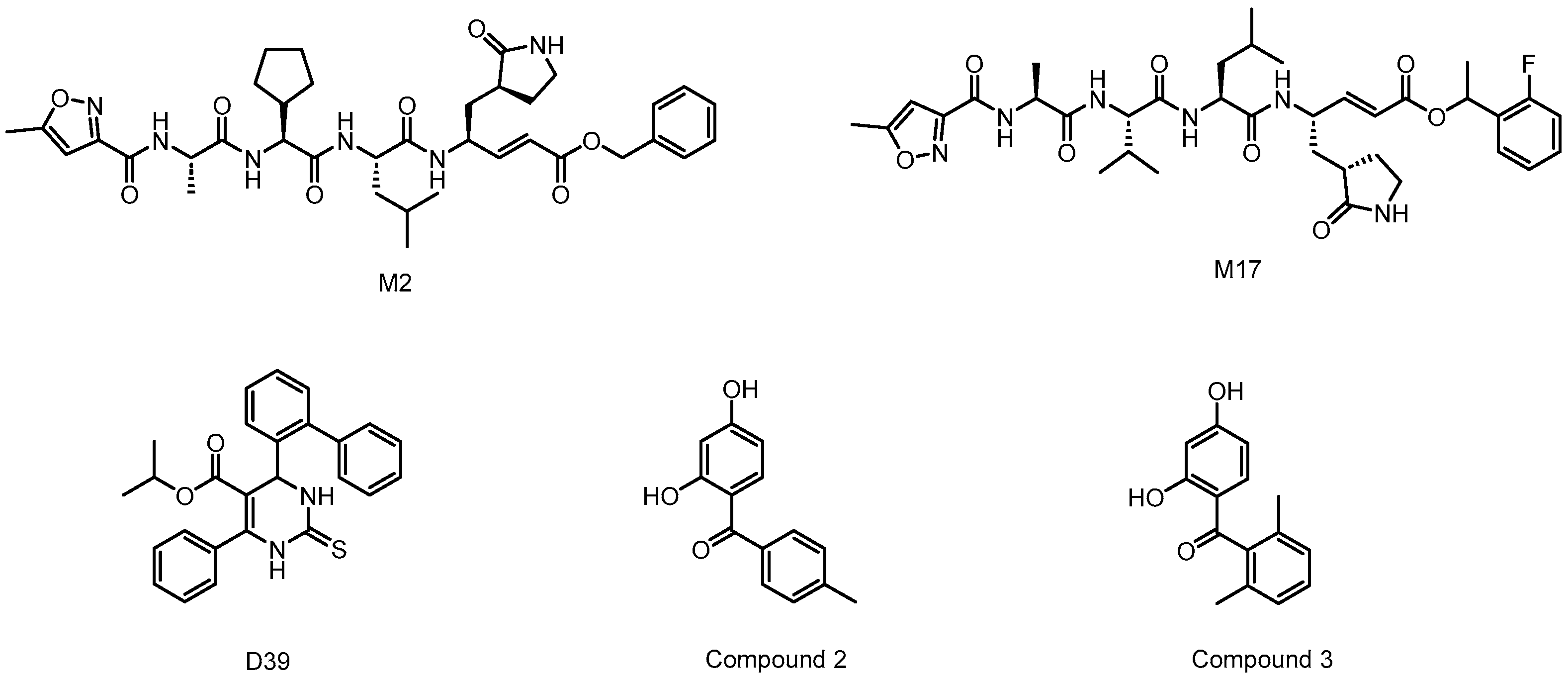
Anti-PEDV drug development has made significant progress; in particular, small-molecule synthetic compounds have shown promise [28,29,30]. Several representative small-molecule inhibitors against porcine epidemic diarrhea virus (PEDV) that have been reported to date are shown in Figure 1. In 2017, Wang F. et al. optimized Michael acceptor-containing peptide inhibitors targeting PEDV Mpro. Compounds M2 and M17 exhibited inhibition rates of 96% and 93% against PEDV Mpro, respectively, demonstrating excellent inhibitory activity [31]. Lv S. et al. designed and synthesized a series of 3,4-dihydropyrimidine derivatives, with compound D39 selected as the preferred candidate. It blocks early PEDV internalization by regulating calcium homeostasis, exhibiting an EC50 of 0.09 μM and a selectivity index (SI) of 358.9, exhibiting 35-fold higher activity than remdesivir. It demonstrates broad-spectrum inhibition against coronaviruses including FIPV and maintains metabolic stability in vitro [32]. Shi Y. et al. targeted the PEDV 3CLpro and identified compound 2 and compound 3 as PEDV 3CLpro inhibitors from a library of 1000 compounds, with the aforementioned compounds inhibiting PEDV replication with EC50 values of 100 μM and 57.9 μM, respectively [33].
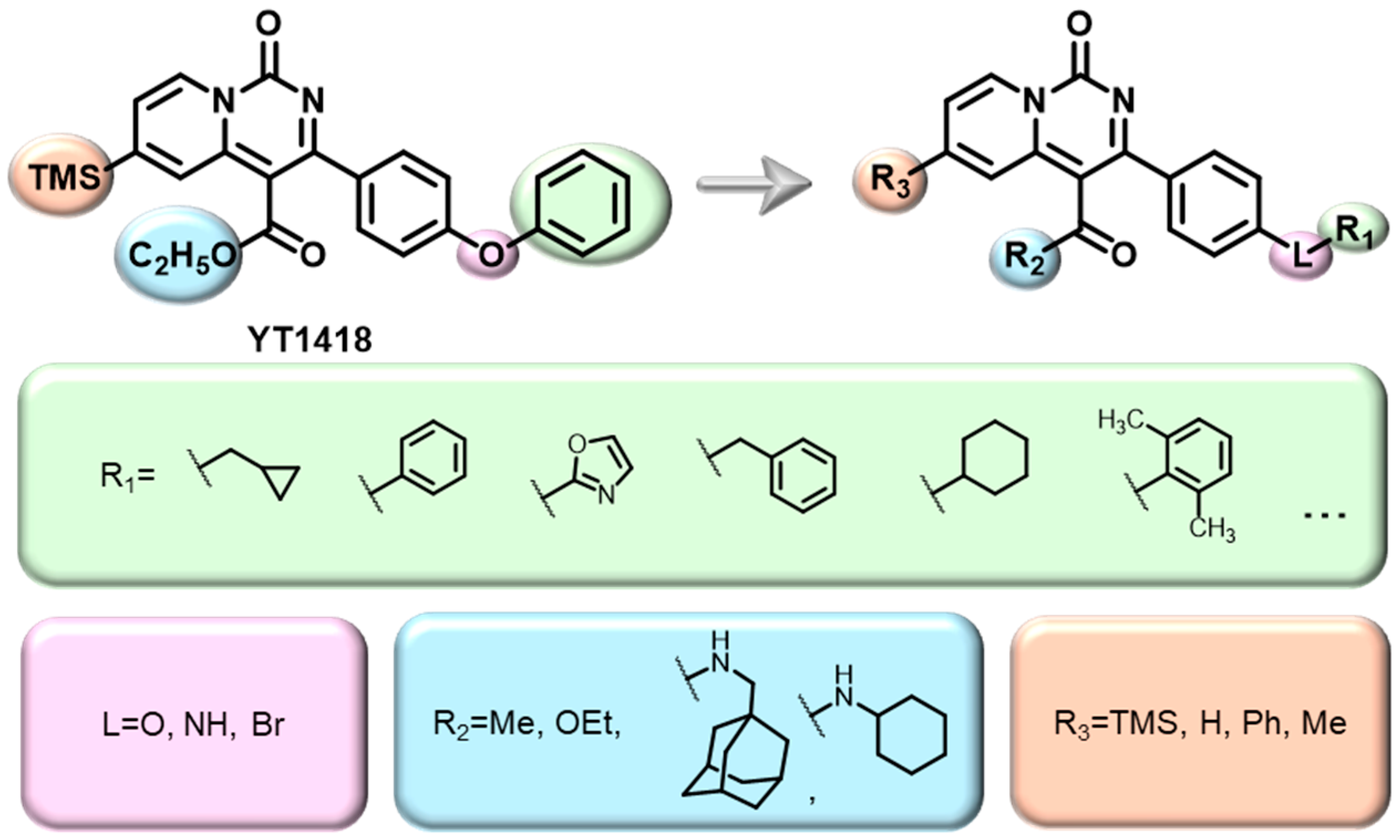
A series of small-molecule compounds with promising anti-PEDV activity has been previously synthesized. Among them, compound YT1418 (Figure 2) demonstrates the most potent antiviral activity against PEDV, with an EC50 value of 1.76 μM. This compound features a Pyrido[1,2-c]pyrimidin-1-one (PPO) core scaffold, which was initially constructed in the corresponding research group. To further extend the chemical space of this unique scaffold and identify more potent anti-PEDV agents, 36 derivatives bearing diverse substituents at the R1, R2, R3, and L positions of YT1418 were designed and synthesized. The structures of all compounds are shown in Table S1. Their anti-PEDV activities and structure–activity relationships (SARs) were systematically evaluated. In addition, the hepatic microsomal metabolic stability of several representative derivatives was determined.

2. Results and Discussion

2.1. Chemical Synthesis and NMR Characterization

2.1.1. Chemical Synthesis

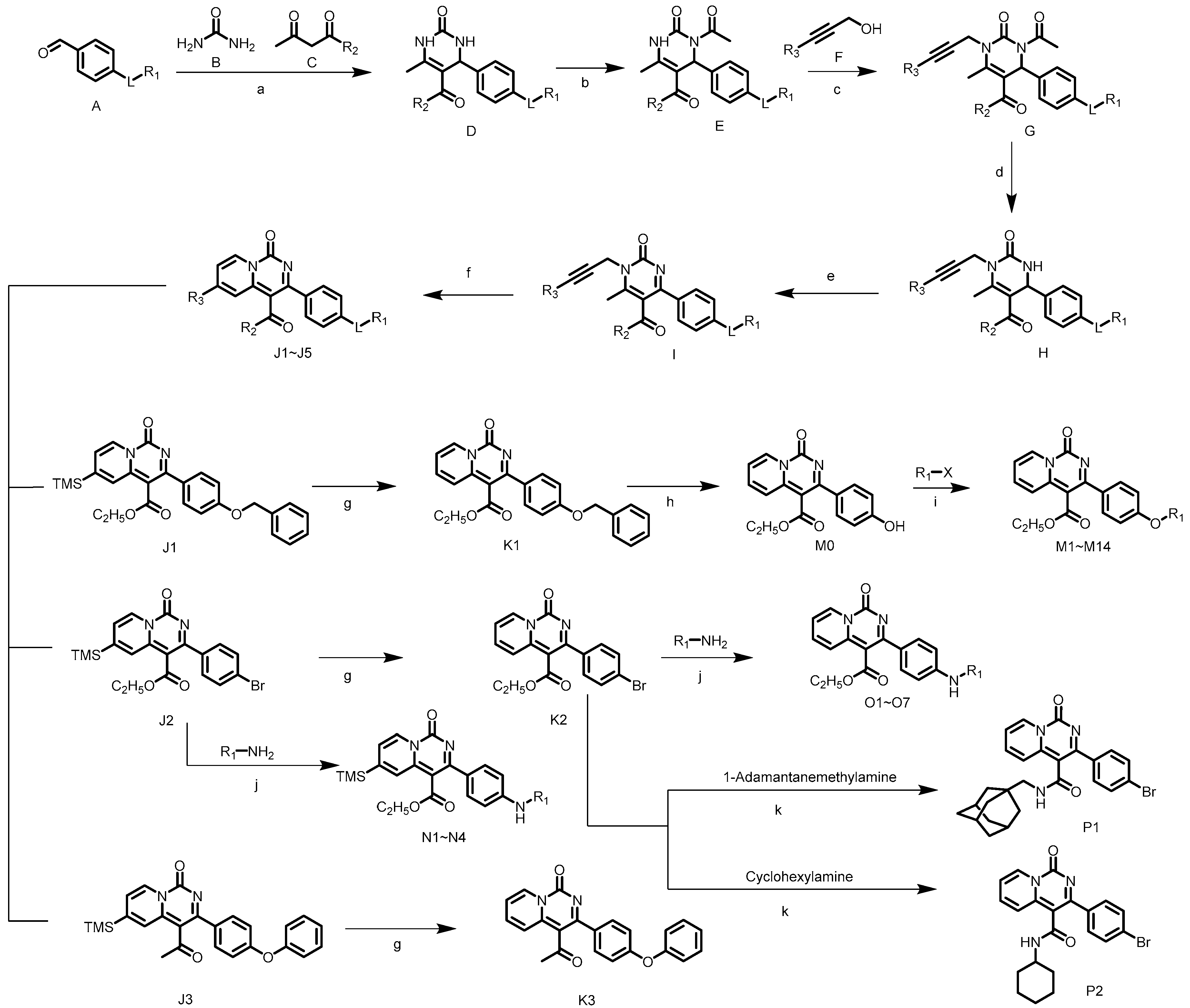
The synthesis of PPO derivatives is illustrated in Scheme 1. All target compounds were prepared via a multistep sequential synthetic route, and the detailed procedures are described below. The pyrimidine core was first constructed via the Biginelli reaction. Ethyl acetoacetate, urea, and the corresponding aldehyde (1:1:1 molar ratio) were heated at 80 °C using Cu(NO3)2·3H2O as the catalyst to afford intermediate D [34]. Acetylation of D with acetic anhydride at 140 °C gave intermediate E [35]. Intermediate E was then converted to intermediate G via a Mitsunobu reaction with alkynyl alcohols [35]. Deacetylation of G in the presence of piperidine furnished intermediate H [35]. Aromatization of the pyrimidinone ring was achieved with benzoyl peroxide (BPO) as the oxidant. Finally, annulation between the pyridine and pyrimidinone rings was accomplished with HAuCl4·3H2O as a Lewis acid catalyst [35]. After purification by column chromatography, compounds J1J5 were efficiently obtained. Compounds K1K3 were prepared by desilylation of J1J3 with 1.0 equiv of tetra-n-butylammonium fluoride (TBAF, 1 mol/L in THF). Debenzylation of K1 with trifluoroacetic acid (TFA) at 80 °C provided the key intermediate M0. Nucleophilic substitution of M0 with commercially available aryl or alkyl halides under basic conditions afforded compounds M1M14. Compounds N1N4 and O1O7 were synthesized from J2/K2 and commercially available substituted anilines or benzylamines via the Buchwald–Hartwig C–N cross-coupling reaction. Compounds P1 and P2 were obtained by aminolysis of the ethyl ester group.

2.1.2. NMR Characterization

Compound M0 was taken as a representative example to analyze the 1H NMR and 13C NMR spectral data. (1) 1H NMR analysis: due to the influence of the conjugated system of the PPO core and the electronic effects of the substituents, the aromatic hydrogens on the core exhibit a characteristic distribution of chemical shifts: The proton at the 8-position appears as a doublet at 9.12 ppm with J = 7.0 Hz. The proton at the 7-position appears as a triplet of doublets at 7.55 ppm with J = 6.5 Hz and J = 2.2 Hz. The two protons at the 5- and 6-positions of the parent nucleus overlap due to their similar chemical shifts and appear as a multiplet from 8.08 to 8.14 ppm. In the 4-substituted ethyl ester group, the methylene group exhibits a quartet at 4.09 ppm, and the methyl group exhibits a triplet at 0.96 ppm with the same J = 7.1 Hz. In the 3-substituted para-hydroxyphenyl group, the two sets of aromatic hydrogens on the benzene ring appear as doublets at 6.86 ppm and 7.45 ppm, respectively. The active hydrogen of the phenolic hydroxyl group appears as a singlet at 9.96 ppm. (2) 13C NMR analysis: Sp2-hybridized carbon atoms bonded to N and O heteroatoms on the parent nucleus are affected by the de-shielding effect of the heteroatoms. Their chemical shifts are distributed in the range of 146.99–166.75 ppm. The signals of the remaining aromatic carbon atoms on the parent nucleus and the benzene ring are distributed in the range of 102.45–139.57 ppm. The signals corresponding to the methyl and methylene carbon atoms appear at 61.16 ppm and 13.44 ppm, respectively.

2.2. Analysis of Anti-PEDV Activity and Structure–Activity Relationship

2.2.1. Anti-PEDV Activity

To investigate the effects of R1, R2, and R3 substituents of the PPO skeleton on the anti-PEDV activity, the present study designed and synthesized 36 target compounds and assessed their anti-PEDV activity at a concentration of 10 μM (Table 1).

2.2.2. Analysis of Structure–Activity Relationship (SAR)

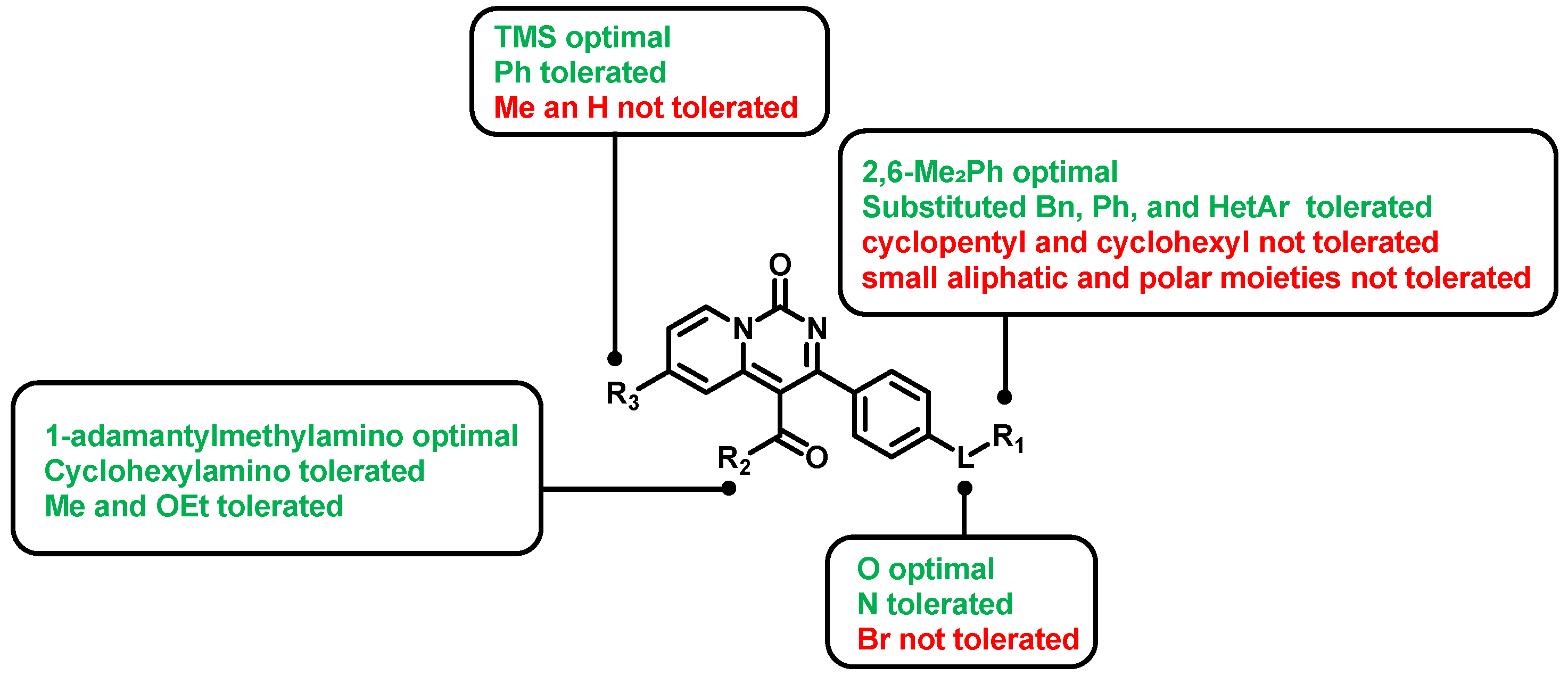
A systematic structure–activity relationship (SAR) analysis was performed on this series of derivatives, and the results are shown in Figure 3.
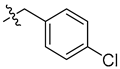
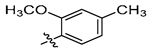
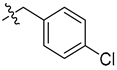
We first investigated the effect of substituents at the R1 position. When the linker L is O, replacement of the phenyl group at R1 with small aliphatic or polar moieties (M0, M1, M2, M3) led to a marked loss of antiviral activity. Although the introduction of five-membered aromatic heterocycles (M4, M5) or alicyclic groups (M13, M14) partially restored activity, it remained weaker than that observed with the bulky biaryl group (M6). Moreover, when R1 is a benzyl group (K1), introducing substituents with different electronic properties onto the benzyl aromatic ring (M7M11) or replacing the benzene ring with a pyridine ring (M12) is beneficial to improving antiviral activity. When L is NH and R3 is H, the electronegativity of substituents on the phenyl ring of R1 significantly influences activity: the introduction of electron-withdrawing groups (O2 > O1) markedly improved the inhibition rate. Replacing R1 with an unsubstituted benzyl group (O1 > O6) was detrimental to activity, whereas antiviral potency was substantially restored when an electron-withdrawing group was attached to the benzyl moiety (O7 > O1 > O6). When L is NH and R3 is TMS, and both the positional distribution and electronic properties of substituents on the phenyl ring of R1 also markedly modulate antiviral activity: For 2,6-disubstituted phenyl analogs, the introduction of either electron-donating groups (N1) or halogen substituents (N2) favorably enhances potency. In contrast, in 2,4-disubstituted phenyl derivatives, improved activity is observed with electron-withdrawing groups and halogens (N4), whereas electron-donating substitution (N3) exerts a detrimental effect. By comparing compounds that differ only in the linking atom L, we found that antiviral activity is generally higher when L is O rather than NH (K1 > O6; M8 > O7). Furthermore, when L is Br, the anti-PEDV activity decreases significantly (J2 and K2). These results indicate that the introduction of a large, aromatic, hydrophobic group at the R1 position favors enhanced antiviral activity and that the electronic and steric properties of aromatic substituents strongly modulate potency.
Next, the influence of the steric volume of the R3 substituent (TMS, Ph, Me, H) on activity was evaluated. The results demonstrated that compounds with TMS or phenyl at R3 exhibited significantly higher activity than analogs substituted with hydrogen or methyl (J1 > K1; J2 > K2; J3 > K3; J4 > J5; N2 > O4; N3 > O3; N4 > O2). This indicates that the introduction of a bulky hydrophobic group at the R3 position is also critical for enhancing anti-PEDV activity.
Finally, the effect of substituents at R2 was explored. When the ethoxy group at R2 was replaced by methyl (J5), the inhibition rate remained at 99.99% at the concentration of 10 μM, suggesting that the ester moiety at this position is not essential for activity. When the ethoxy group at R2 of K2 was replaced by adamantylmethylamine (P1) and cyclohexylamine (P2), the antiviral activity of the compound was significantly enhanced (P1 > P2 > K2). These findings further confirm that the installation of a bulky hydrophobic group at the R2 position is crucial for improving anti-PEDV activity, offering valuable clues for further structure optimization.

2.3. Antiviral Activity, Cell Cytotoxicity and Metabolic Stability Assays of the Preferred Compounds

2.3.1. Antiviral Activity and Cell Cytotoxicity of the Preferred Compounds

To further quantify the anti-PEDV activity of hit compounds identified in the primary screening, we determined the half-maximal effective concentration (EC50) to assess antiviral potency and the half-maximal cytotoxic concentration (CC50) to evaluate cytotoxicity against normal host cells. The selective index (SI), calculated as the ratio of CC50 to EC50, was used to evaluate the therapeutic safety window of each compound. All data are presented as mean ± standard error (SE) from three independent experiments (n = 3), with results summarized in Table 2.
Among the tested compounds, compounds N1 and N2 exhibited the most potent anti-PEDV activity, with EC50 values of 0.32 μM and 0.37 μM, respectively. However, the aforementioned compounds demonstrated non-favorable safety profiles, with CC50 values of 14.01 μM and 15.87 μM yielding SI values of 43.78 and 42.89, respectively. Furthermore, although compound J4 did not exhibit the most potent anti-PEDV activity (EC50 = 1.77 μM), it showed markedly lower cytotoxicity than the other tested compounds (CC50 = 60.47 μM), with a SI value of 34.16. Further SAR analysis revealed that the introduction of the TMS group at the R3 position of the PPO skeleton enhanced antiviral activity but simultaneously increased cytotoxicity. Subsequent structural optimization will focus on the R3 substituent to improve potency and reduce cellular toxicity.

2.3.2. Metabolic Stability Assays of the Preferred Compounds

Metabolic stability of compounds J1, J3, J4, N1, and N2 was evaluated in human and mouse liver microsomes based on their antiviral activity (Table 3). Compounds J3 and J4 displayed moderate metabolic stability in mouse liver microsomes. In contrast, compounds J1, N1, and N2 exhibited poor metabolic stability in both human and mouse liver microsomes.

3. Materials and Methods

3.1. General Experimental Information

All reagents and solvents were used as received from commercial suppliers without further purification. Unless otherwise stated, all reagents were of at least chemically pure (CP) grade, and all solvents were of analytical reagent (AR) grade; solvents dedicated to high-performance liquid chromatography (HPLC) were of chromatographic grade. Reaction progress was monitored by analytical thin-layer chromatography (TLC) on pre-coated silica gel plates (Yantai Jiangyou Silica Gel Development Co., Ltd., Yantai, China), with visualization under UV irradiation at 254 nm. Flash column chromatography was performed using 200–300 mesh silica gel (Yantai Jiangyou Silica Gel Co., Ltd.), and preparative TLC (PTLC) was conducted using 1 mm thick pre-coated silica gel plates (Yantai Jiangyou Silica Gel Co., Ltd.). 1H and 13C nuclear magnetic resonance (NMR) spectra of key intermediates and final target compounds were acquired on a Bruker 600 MHz NMR spectrometer (Bruker Corporation, Billerica, MA, USA). Residual non-deuterated solvent peaks were used as internal references: CDCl3 (1H NMR: δ 7.26 ppm, 13C NMR: δ 77.06 ppm), DMSO-d6 (1H NMR: δ 2.50 ppm, 13C NMR: δ 39.6 ppm), and CD3OD (1H NMR: δ 3.31 ppm, 13C NMR: δ 49.03 ppm). Chemical shifts (δ) are reported in parts per million (ppm), and coupling constants (J) are expressed in hertz (Hz). High-resolution electrospray ionization mass spectrometry (ESI-HRMS) characterization of selected key target compounds was performed on a Sciex ZenoTOFTM 7600 system (AB Sciex Pte. Ltd., Singapore). All compounds are >95% pure, as determined by HPLC.

3.2. Synthesis of Compounds

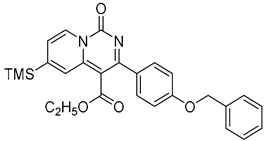
3.2.1. Synthesis of Ethyl 3-(4-(Benzyloxy)phenyl)-1-oxo-6-(trimethylsilyl)-1H-pyrido[1,2-c]pyrimidine-4-carboxylate (J1)

  • Synthesis of ethyl 4-(4-(benzyloxy)phenyl)-6-methyl-2-oxo-1,2,3,4-tetrahydropyrimidine-5-carboxylate (J1-1).
4-(Benzyloxy)benzaldehyde (30 g, 1.0 equiv), ethyl acetoacetate (20 mL, 1.1 equiv), urea (9.3 g, 1.1 equiv), and Cu(NO3)2·3H2O (3.4 g, 0.1 equiv) were added to a 100 mL round-bottom flask. The mixture was stirred at 80 °C until a solid formed, at which point the reaction was terminated. For workup, the solid was washed with water, filtered, and the filter cake was washed with MTBE. The solid was dried under vacuum to afford 49.2 g of compound J1-1 as a pale green powder in a 95% yield. 1H NMR (600 MHz, DMSO-d6) δ 9.16 (d, J = 2.4 Hz, 1H), 7.67 (dd, J = 3.5, 2.1 Hz, 1H), 7.45–7.41 (m, 2H), 7.38 (dd, J = 8.4, 6.8 Hz, 2H), 7.34–7.30 (m, 1H), 7.18–7.12 (m, 2H), 6.98–6.93 (m, 2H), 5.10 (d, J = 3.4 Hz, 1H), 5.07 (s, 2H), 3.98 (q, J = 7.1 Hz, 2H), 2.25 (s, 3H), 1.09 (t, J = 7.1 Hz, 3H). ESI-MS m/z 367.40 [M + H]+.
  • Synthesis of ethyl 3-acetyl-4-(4-(benzyloxy)phenyl)-6-methyl-2-oxo-1,2,3,4-tetrahydropyrimidine-5-carboxylate (J1-2).
J1-1 (40 g, 1.0 equiv) and acetic anhydride (100 mL) were added to a 250 mL round-bottom flask. The mixture was stirred at 140 °C under reflux for 2 h until TLC indicated the reaction was complete. For workup, the mixture was cooled to room temperature, and saturated aqueous sodium bicarbonate and ethyl acetate (EA) were added. The organic layer was washed with saturated aqueous sodium chloride, dried over anhydrous sodium sulfate, filtered, and concentrated. The residue was triturated with MTBE to afford 37.5 g of compound J1-2 as a pale yellow powder in an 84% yield. 1H NMR (600 MHz, Chloroform-d) δ 8.76–8.61 (m, 1H), 7.43–7.35 (m, 4H), 7.34–7.31 (m, 1H), 7.28 (dd, J = 9.7, 2.9 Hz, 2H), 6.92–6.87 (m, 2H), 6.60 (d, J = 4.5 Hz, 1H), 5.03 (d, J = 2.2 Hz, 2H), 4.17 (qd, J = 7.0, 2.7 Hz, 2H), 2.59–2.54 (m, 3H), 2.41 (d, J = 3.0 Hz, 3H), 1.25 (td, J = 7.2, 2.1 Hz, 3H). ESI-MS m/z 409.41 [M + H]+.
  • Synthesis of ethyl 3-acetyl-4-(4-(benzyloxy)phenyl)-6-methyl-2-oxo-1-(3-(trimethylsilyl)prop-2-yn-1-yl)-1,2,3,4-tetrahydropyrimidine-5-carboxylate (J1-3).
J1-2 (32 g, 1.0 equiv), PPh3 (22.6 g, 1.1 equiv), and THF (150 mL) were added to a 250 mL round-bottom flask. Then DIAD (17.5 g, 1.1 equiv) and 3-(trimethylsilyl)prop-2-yn-1-ol (12.8 mL, 1.1 equiv) were added, and the mixture was stirred at room temperature for 8 h until TLC indicated the reaction was complete. For workup, water and ethyl acetate (EA) were added, and the mixture was separated into layers. The organic phase was washed with saturated aqueous NaCl, dried over anhydrous Na2SO4, filtered, and concentrated. Purification by silica gel column chromatography (dry packing, eluent: PE/EA = 30:1 to 20:1) afforded 38 g of compound J1-3 as a colorless oil in a 94% yield. 1H NMR (600 MHz, Chloroform-d) δ 7.41–7.35 (m, 4H), 7.33–7.29 (m, 1H), 7.24–7.21 (m, 2H), 6.88–6.83 (m, 2H), 6.60 (s, 1H), 5.01 (s, 2H), 4.77 (d, J = 18.2 Hz, 1H), 4.33 (d, J = 18.2 Hz, 1H), 4.18 (qd, J = 7.1, 3.8 Hz, 2H), 2.70 (s, 3H), 2.51 (s, 3H), 1.24 (t, J = 7.1 Hz, 3H), 0.17 (d, J = 1.4 Hz, 9H). ESI-MS m/z 520.04 [M + H]+.
  • Synthesis of ethyl 4-(4-(benzyloxy)phenyl)-6-methyl-2-oxo-1-(3-(trimethylsilyl)prop-2-yn-1-yl)-1,2,3,4-tetrahydropyrimidine-5-carboxylate (J1-4).
J1-3 (24 g, 1.0 equiv), piperidine (19.7 g, 5.0 equiv), and THF (100 mL) were added to a 250 mL round-bottom flask. The mixture was stirred at 45 °C for 6 h until TLC indicated the reaction was complete. For workup, water and ethyl acetate (EA) were added, and the layers were separated. The organic phase was washed with saturated aqueous NaCl, dried over anhydrous Na2SO4, filtered, and concentrated. The residue was triturated with MTBE/hexane (1:3) to afford 18.6 g of compound J1-4 as a white powder in an 84% yield. 1H NMR (600 MHz, Chloroform-d) δ 7.43–7.36 (m, 4H), 7.34–7.30 (m, 1H), 7.22–7.18 (m, 2H), 6.91–6.86 (m, 2H), 5.51–5.43 (m, 1H), 5.29 (d, J = 2.9 Hz, 1H), 5.03 (s, 2H), 4.82 (d, J = 18.2 Hz, 1H), 4.40 (d, J = 18.1 Hz, 1H), 4.09 (qd, J = 7.1, 2.8 Hz, 2H), 2.66 (d, J = 0.8 Hz, 3H), 1.18 (t, J = 7.1 Hz, 3H), 0.17 (s, 9H). ESI-MS m/z 477.44 [M + H]+.
  • Synthesis of ethyl 4-(4-(benzyloxy)phenyl)-6-methyl-2-oxo-1-(3-(trimethylsilyl)prop-2-yn-1-yl)-1,2-dihydropyrimidine-5-carboxylate (J1-5).
J1-4 (18 g, 1.0 equiv), BPO (32 g, 3.5 equiv), and ethanol (80 mL) were added to a 250 mL round-bottom flask. The mixture was stirred at 100 °C for 2 h until TLC indicated the reaction was complete. For workup, the mixture was cooled to room temperature, and saturated aqueous sodium sulfite solution and ethyl acetate (EA) were added. The organic layer was washed with saturated aqueous NaCl, dried over anhydrous Na2SO4, filtered, and concentrated. Purification by silica gel column chromatography (wet packing, eluent: PE/EA = 10:1 to 3:1) afforded 9.8 g of compound J1-5 as a brown oil in a 55% yield. 1H NMR (600 MHz, Chloroform-d) δ 7.63–7.59 (m, 2H), 7.41 (d, J = 7.2 Hz, 2H), 7.37 (t, J = 7.5 Hz, 2H), 7.32 (t, J = 7.2 Hz, 1H), 6.98 (d, J = 8.7 Hz, 2H), 5.10 (s, 2H), 4.94 (s, 2H), 4.07 (q, J = 7.1 Hz, 2H), 2.67 (s, 3H), 0.97 (t, J = 7.1 Hz, 3H), 0.16 (d, J = 1.0 Hz, 9H). ESI-MS m/z 475.44 [M + H]+.
  • Synthesis of ethyl 3-(4-(benzyloxy)phenyl)-1-oxo-6-(trimethylsilyl)-1H-pyrido[1,2-c]pyrimidine-4-carboxylate (J1).
J1-5 (6.1 g, 1.0 equiv), hydrogen tetrachloroaurate (III) trihydrate (1.4 g, 0.3 equiv), and 1,2-dichloroethane (DCE, 30 mL) were placed in a 100 mL round-bottom flask. The mixture was stirred at 80 °C for 8 h. Then, dichloromethane (DCM) and saturated aqueous sodium sulfite solution were added, and the layers were separated. The organic phase was washed with saturated aqueous NaCl, dried over anhydrous Na2SO4, filtered, and concentrated. Purification by silica gel column chromatography (dry packing, eluent: PE/EA = 20:1 to 3:1) afforded 2.6 g of compound J1 as a pale yellow powder in a 43% yield. 1H NMR (600 MHz, Chloroform-d) δ 9.18 (dd, J = 6.8, 0.9 Hz, 1H), 8.37 (t, J = 1.1 Hz, 1H), 7.68–7.64 (m, 2H), 7.44 (d, J = 7.0 Hz, 2H), 7.38 (tt, J = 6.1, 1.0 Hz, 3H), 7.34–7.31 (m, 1H), 7.04–7.00 (m, 2H), 5.13 (s, 2H), 4.10 (q, J = 7.2 Hz, 2H), 0.96 (t, J = 7.1 Hz, 3H), 0.38 (s, 9H). 13C NMR (151 MHz, Chloroform-d) δ 167.37, 166.52, 160.62, 155.93, 150.28, 145.93, 136.69, 132.15, 130.45, 128.80, 128.75, 128.20, 127.57, 127.21, 121.77, 114.71, 103.27, 70.16, 61.69, 13.72, −1.91. HRMS (ESI): m/z calced for C27H29N2O4Si [M + H]+: 473.18911, found: 473.18845. Compounds J2J5 were prepared according to the synthetic procedure for compound J1.

3.2.2. Synthesis of Ethyl 3-(4-Bromophenyl)-1-oxo-6-(trimethylsilyl)-1H-pyrido[1,2-c]pyrimidine-4-carboxylate (J2)

  • Synthesis of ethyl 4-(4-bromophenyl)-6-methyl-2-oxo-1,2,3,4-tetrahydropyrimidine-5-carboxylate (J2-1).
The title compound J2-1 was prepared via a procedure similar to that for J1-1, yielding 33.3 g in a 96% yield. 1H NMR (600 MHz, DMSO-d6) δ 9.24 (s, 1H), 7.76 (s, 1H), 7.57–7.47 (m, 2H), 7.23–7.13 (m, 2H), 5.13 (s, 1H), 4.05–3.92 (m, 2H), 2.25 (s, 3H), 1.09 (s, 3H). ESI-MS m/z 339.34 [M + H]+.
  • Synthesis of ethyl 3-acetyl-4-(4-bromophenyl)-6-methyl-2-oxo-1,2,3,4-tetrahydropyrimidine-5-carboxylate (J2-2).
The title compound J2-2 was prepared according to a procedure similar to that for J1-2, affording 19.256 g of a white solid in a 57.1% yield. 1H NMR (600 MHz, DMSO-d6) δ 10.21 (s, 1H), 7.55–7.52 (m, 2H), 7.16–7.12 (m, 2H), 6.40 (s, 1H), 4.11 (qq, J = 7.1, 3.8 Hz, 2H), 2.43 (s, 3H), 2.31 (s, 3H), 1.17 (t, J = 7.1 Hz, 3H).
  • Synthesis of ethyl 3-acetyl-4-(4-bromophenyl)-6-methyl-2-oxo-1-(3-(trimethylsilyl)prop-2-yn-1-yl)-1,2,3,4-tetrahydropyrimidine-5-carboxylate (J2-3).
Compound J2-3 was prepared via a procedure similar to that for J1-3, affording 19.3 g of a white solid in a 90% yield. 1H NMR (600 MHz, DMSO-d6) δ 7.51–7.48 (m, 2H), 7.14–7.10 (m, 2H), 6.45 (s, 1H), 4.78 (d, J = 18.6 Hz, 1H), 4.41 (s, 1H), 4.16 (qd, J = 7.1, 2.0 Hz, 2H), 2.61 (s, 3H), 2.41 (s, 3H), 1.19 (t, J = 7.1Hz,4H), 0.11 (s,9H).
  • Synthesis of ethyl 4-(4-bromophenyl)-6-methyl-2-oxo-1-(3-(trimethylsilyl)prop-2-yn-1-yl)-1,2,3,4-tetrahydropyrimidine-5-carboxylate (J2-4).
Compound J2-4 was prepared by a procedure similar to that for J1-4, affording 13.4 g of a white solid in a 86% yield. 1H NMR (600 MHz, DMSO-d6) δ 8.14 (d, J = 3.8 Hz, 1H), 7.51–7.48 (m, 2H), 7.19–7.16 (m, 2H), 5.13 (d, J = 3.7 Hz, 1H), 4.66 (d, J = 18.4 Hz, 1H), 4.44 (d, J = 18.4 Hz, 1H), 4.03 (qd, J = 7.1, 4.0 Hz, 2H), 2.59 (s, 3H), 1.12 (t, J = 7.1 Hz, 3H), 0.14 (s, 9H).
  • Synthesis of ethyl 4-(4-bromophenyl)-6-methyl-2-oxo-1-(3-(trimethylsilyl)prop-2-yn-1-yl)-1,2-dihydropyrimidine-5-carboxylate (J2-5).
Compound J2-5 was prepared via a procedure similar to that for J1-5, affording 4.15 g of a white solid in a 34% yield. 1H NMR (600 MHz, Methanol-d4) δ 7.67–7.64 (m, 2H), 7.50–7.47 (m, 2H), 5.03 (s, 2H),4.08 (q, J = 7.2Hz,2H),0.97(t, J = 7.1Hz,3H),0.17(s,9H). ESI-MS m/z 447.45 [M + H]+.
  • Synthesis of ethyl 3-(4-bromophenyl)-1-oxo-6-(trimethylsilyl)-1H-pyrido[1,2-c]pyrimidine-4-carboxylate (J2).
Compound J2 was prepared according to a procedure similar to that for J1, affording 942 mg of a white-green solid in a 46% yield. 1H NMR (600 MHz, DMSO-d6) δ 9.11 (dd, J = 6.8, 0.9 Hz, 1H), 8.36 (t, J = 1.1 Hz, 1H), 7.76 (dd, J = 6.9, 1.3 Hz, 1H), 7.727.69 (m, 2H), 7.49–7.46 (m, 2H), 4.08 (q, J = 7.1 Hz, 2H), 0.91 (t, J = 7.1Hz, 3H), 0.36 (s,9H). HRMS (ESI): m/z calced for C20H22BrN2O3Si [M + H]+: 445.0577, found: 445.0559.

3.2.3. Synthesis of 4-Acetyl-3-(4-phenoxyphenyl)-6-(trimethylsilyl)-1H-pyrido[1,2-c]pyrimidin-1-one (J3)

  • Synthesis of 5-acetyl-6-methyl-4-(4-phenoxyphenyl)-3,4-dihydropyrimidin-2(1H)-one (J3-1).
Compound J3-1 was prepared by a procedure similar to that for J1-1, affording 7.8 g of a brown powder in a 96% yield. 1H NMR (600 MHz, DMSO-d6) δ 9.18 (d, J = 2.0 Hz, 1H), 7.82 (dd, J = 3.7, 2.0 Hz, 1H), 7.40–7.35 (m, 2H), 7.28–7.23 (m, 2H), 7.14–7.10 (m, 1H), 6.97 (td, J = 8.7, 3.8 Hz, 4H), 5.25 (d, J = 3.4 Hz, 1H), 2.29 (s, 3H), 2.12 (s, 3H). ESI-MS m/z 323.50 [M + H]+.
  • Synthesis of 1,1’-(4-methyl-2-oxo-6-(4-phenoxyphenyl)-3,6-dihydropyrimidine-1,5(2H)-diyl)bis(ethan-1-one) (J3-2).
Compound J3-2 was prepared via a procedure similar to that for J1-2, affording 4.4 g of a brown powder in an 80% yield. 1H NMR (600 MHz, Chloroform-d) δ 7.54 (s, 1H), 7.35–7.32 (m, 2H), 7.30–7.27 (m, 2H), 7.13–7.10 (m, 1H), 7.01–6.98 (m, 2H), 6.93–6.90 (m, 2H), 6.69 (s, 1H), 2.56 (s, 3H), 2.42 (s, 3H), 2.23 (s, 3H). ESI-MS m/z 365.45 [M + H]+.
  • Synthesis of 1,1’-(4-methyl-2-oxo-6-(4-phenoxyphenyl)-3-(3-(trimethylsilyl)prop-2-yn-1-yl)-3,6-dihydropyrimidine-1,5(2H)-diyl)bis(ethan-1-one) (J3-3).
Compound J3-3 was prepared by a procedure similar to that for J1-3, affording 1.3 g of a pale yellow oil in a 50% yield. 1H NMR (600 MHz, Chloroform-d) δ 7.34 (dd, J = 8.5, 7.3 Hz, 2H), 7.30–7.27 (m, 2H), 7.14–7.10 (m, 1H), 7.02–6.99 (m, 2H), 6.90–6.87 (m, 2H), 6.63 (s, 1H), 4.80 (d, J = 18.1 Hz, 1H), 4.31 (d, J = 18.2 Hz, 1H), 2.67 (d, J = 0.8 Hz, 3H), 2.52 (s, 3H), 2.24 (s, 3H), 0.13 (s, 9H). ESI-MS m/z 474.55 [M + H]+.
  • Synthesis of 5-acetyl-6-methyl-4-(4-phenoxyphenyl)-1-(3-(trimethylsilyl)prop-2-yn-1-yl)-3,4-dihydropyrimidin-2(1H)-one (J3-4).
Compound J3-4 was prepared by a procedure similar to that for J1-4, affording 986 mg of a white powder in an 85% yield. 1H NMR (600 MHz, Chloroform-d) δ 7.36–7.32 (m, 2H), 7.24–7.22 (m, 2H), 7.14–7.11 (m, 1H), 7.02–6.99 (m, 2H), 6.94–6.91 (m, 2H), 5.55 (d, J = 11.6 Hz, 1H), 5.28–5.26 (m, 1H), 4.83 (d, J = 18.3 Hz, 1H), 4.38 (d, J = 18.2 Hz, 1H), 2.62 (s, 3H), 2.16 (s, 3H), 0.14 (s, 9H). ESI-MS m/z 433.60 [M + H]+.
  • Synthesis of 5-acetyl-6-methyl-4-(4-phenoxyphenyl)-1-(3-(trimethylsilyl)prop-2-yn-1-yl)pyrimidin-2(1H)-one (J3-5).
Compound J3-5 was prepared by a procedure similar to that for J1-5, affording 352 mg of a pale yellow powder in a 71% yield. 1H NMR (600 MHz, Chloroform-d) δ 7.67–7.64 (m, 2H), 7.42–7.37 (m, 2H), 7.19 (tt, J = 7.5, 1.1 Hz, 1H), 7.08–7.05 (m, 2H), 7.04–7.01 (m, 2H), 4.97 (s, 2H), 2.62 (d, J = 6.6 Hz, 3H), 2.03 (s, 3H), 0.17 (s, 9H). ESI-MS m/z 431.65 [M + H]+.
  • Synthesis of 4-acetyl-3-(4-phenoxyphenyl)-6-(trimethylsilyl)-1H-pyrido[1,2-c]pyrimidin-1-one (J3).
Compound J3 was prepared via a procedure similar to that for J1, affording 107 mg of a pale yellow powder in a 43% yield. 1H NMR (600 MHz, Chloroform-d) δ 9.24–9.22 (m, 1H), 8.40 (t, J = 1.0 Hz, 1H), 7.72–7.69 (m, 2H), 7.43 (dd, J = 6.9, 1.2 Hz, 1H), 7.40–7.37 (m, 2H), 7.18 (tt, J = 7.4, 1.1 Hz, 1H), 7.09–7.05 (m, 4H), 2.06 (s, 3H), 0.38 (s, 9H). 13C NMR (151 MHz, Chloroform-d) δ 201.61, 165.47, 160.52, 156.73, 156.05, 150.17, 144.99, 133.33, 131.48, 130.14, 128.94, 127.08, 124.45, 122.33, 119.96, 118.34, 111.95, 33.17, −1.89. HRMS (ESI): m/z calced for C25H25N2O3Si [M + H]+: 429.16290, found: 429.16253.

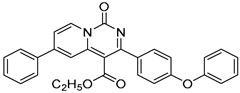
3.2.4. Synthesis of Ethyl 1-Oxo-3-(4-phenoxyphenyl)-6-phenyl-1H-pyrido[1,2-c]pyrimidine-4-carboxylate (J4)

  • Synthesis of ethyl 6-methyl-2-oxo-4-(4-phenoxyphenyl)-1,2,3,4-tetrahydropyrimidine-5-carboxylate (J4-1).
Compound J4-1 was prepared by a procedure similar to that for J1-1, affording 14.2 g of a pale green powder in an 80% yield. ESI-MS m/z 353.53 [M + H]+.
  • Synthesis of ethyl 3-acetyl-6-methyl-2-oxo-4-(4-phenoxyphenyl)-1,2,3,4-tetrahydropyrimidine-5-carboxylate (J4-2).
Compound J4-2 was prepared by a procedure similar to that for J1-2, affording 7.4 g of a pale yellow powder in a 66% yield. ESI-MS m/z 395.25 [M + H]+.
  • Synthesis of ethyl 3-acetyl-6-methyl-2-oxo-4-(4-phenoxyphenyl)-1-(3-phenylprop-2-yn-1-yl)-1,2,3,4-tetrahydropyrimidine-5-carboxylate (J4-3).
Compound J4-3 was prepared by a procedure similar to that for J1-3, affording 990 mg of a colorless oil in a 77% yield. 1H NMR (600 MHz, Chloroform-d) δ 7.37–7.35 (m, 2H), 7.33–7.28 (m, 5H), 7.25 (dd, J = 8.1, 6.7 Hz, 2H), 7.13–7.07 (m, 1H), 6.98–6.94 (m, 2H), 6.83–6.79 (m, 2H), 6.65 (s, 1H), 5.03 (d, J = 18.1 Hz, 1H), 4.54 (d, J = 18.1 Hz, 1H), 4.19 (q, J = 7.1 Hz, 2H), 2.77 (s, 3H), 2.55 (s, 3H), 1.25 (t, J = 7.1 Hz, 3H). ESI-MS m/z 509.59 [M + H]+.
  • Synthesis of ethyl 6-methyl-2-oxo-4-(4-phenoxyphenyl)-1-(3-phenylprop-2-yn-1-yl)-1,2,3,4-tetrahydropyrimidine-5-carboxylate (J4-4).
Compound J4-4 was prepared by a procedure similar to that for J1-4, affording 861 mg of a white powder in a 95% yield. 1H NMR (600 MHz, Chloroform-d) δ 7.42–7.37 (m, 2H), 7.35–7.29 (m, 3H), 7.31–7.22 (m, 6H), 7.10 (tt, J = 7.4, 1.1 Hz, 1H), 7.00–6.94 (m, 2H), 6.89–6.84 (m, 2H), 5.78 (d, J = 3.3 Hz, 1H), 5.35 (d, J = 3.0 Hz, 1H), 5.00 (d, J = 18.1 Hz, 1H), 4.63 (d, J = 18.1 Hz, 1H), 4.11 (q, J = 7.1 Hz, 2H), 2.73 (d, J = 0.8 Hz, 3H), 1.19 (t, J = 7.1 Hz, 3H). ESI-MS m/z 467.41 [M + H]+.
  • Synthesis of ethyl 6-methyl-2-oxo-4-(4-phenoxyphenyl)-1-(3-phenylprop-2-yn-1-yl)-1,2-dihydropyrimidine-5-carboxylate (J4-5).
Compound J4-5 was prepared by a procedure similar to that for J1-5, affording 220 mg of a pale yellow powder in a 44% yield. 1H NMR (600 MHz, Chloroform-d) δ 7.66–7.62 (m, 2H), 7.46–7.42 (m, 2H), 7.39–7.36 (m, 2H), 7.32 (ddd, J = 14.3, 7.9, 6.2 Hz, 3H), 7.17 (t, J = 7.4 Hz, 1H), 7.06–7.03 (m, 2H), 7.02–7.00 (m, 2H), 5.19 (s, 2H), 4.10 (q, J = 7.1 Hz, 2H), 2.78 (s, 3H), 1.03 (t, J = 7.1 Hz, 3H). ESI-MS m/z 465.58 [M + H]+.
  • Synthesis of ethyl 1-oxo-3-(4-phenoxyphenyl)-6-phenyl-1H-pyrido[1,2-c]pyrimidine-4-carboxylate (J4).
Compound J4 was prepared via a procedure similar to that for J1, affording 107 mg of a pale yellow powder in a 54% yield. 1H NMR (600 MHz, Chloroform-d) δ 9.33 (d, J = 7.1 Hz, 1H), 8.56 (d, J = 1.8 Hz, 1H), 7.81–7.75 (m, 2H), 7.71–7.66 (m, 2H), 7.62 (dd, J = 7.3, 2.0 Hz, 1H), 7.57 (dd, J = 5.0, 1.9 Hz, 3H), 7.40–7.35 (m, 2H), 7.16 (t, J = 7.4 Hz, 1H), 7.09–7.02 (m, 4H), 4.12 (q, J = 7.2 Hz, 2H), 0.99 (t, J = 7.1 Hz, 3H). 13C NMR (151 MHz, Chloroform-d) δ 167.28, 166.77, 159.50, 156.58, 150.81, 150.07, 148.01, 135.85, 134.35, 131.72, 131.17, 130.52, 130.05, 129.74, 127.64, 124.07, 119.58, 118.71, 118.14, 117.46, 103.58, 61.70, 13.68. HRMS (ESI): m/z calced for C29H23N2O4 [M + H]+: 463.16523, found: 463.16437.

3.2.5. Synthesis of Ethyl 6-Methyl-1-oxo-3-(4-phenoxyphenyl)-1H-pyrido[1,2-c]pyrimidine-4-carboxylate (J5)

  • Synthesis of ethyl 3-acetyl-1-(but-2-yn-1-yl)-6-methyl-2-oxo-4-(4-phenoxyphenyl)-1,2,3,4-tetrahydropyrimidine-5-carboxylate (J5-1).
Compound J5-1 was prepared via a procedure similar to that for J1-3, affording 815 mg of a colorless oil in a 72% yield. 1H NMR (600 MHz, Chloroform-d) δ 7.32 (dd, J = 8.6, 7.3 Hz, 2H), 7.26 (d, J = 8.7 Hz, 2H), 7.12–7.07 (m, 1H), 7.01–6.96 (m, 2H), 6.90–6.85 (m, 2H), 6.62 (s, 1H), 4.60 (dd, J = 17.8, 2.5 Hz, 1H), 4.35–4.28 (m, 1H), 4.19 (q, J = 7.1 Hz, 2H), 2.69 (s, 3H), 2.53 (s, 3H), 1.79 (t, J = 2.4 Hz, 3H), 1.25 (t, J = 7.1 Hz, 3H). ESI-MS m/z 447.52 [M + H]+.
  • Synthesis of ethyl 1-(but-2-yn-1-yl)-6-methyl-2-oxo-4-(4-phenoxyphenyl)-1,2,3,4-tetrahydropyrimidine-5-carboxylate (J5-2).
Compound J5-2 was prepared by a procedure similar to that for J1-4, affording 631 mg of a white powder in an 85% yield. 1H NMR (600 MHz, Chloroform-d) δ 7.35–7.31 (m, 2H), 7.26–7.23 (m, 2H), 7.10 (tt, J = 7.4, 1.1 Hz, 1H), 7.00–6.97 (m, 2H), 6.93–6.90 (m, 2H), 5.49 (d, J = 3.1 Hz, 1H), 5.33 (d, J = 2.8 Hz, 1H), 4.63–4.57 (m, 1H), 4.45–4.40 (m, 1H), 4.11 (q, J = 7.1 Hz, 2H), 2.66 (d, J = 0.8 Hz, 3H), 1.81 (t, J = 2.3 Hz, 3H), 1.19 (t, J = 7.1 Hz, 3H). ESI-MS m/z 405.57 [M + H]+.
  • Synthesis of ethyl 1-(but-2-yn-1-yl)-6-methyl-2-oxo-4-(4-phenoxyphenyl)-1,2-dihydropyrimidine-5-carboxylate (J5-3).
Compound J5-3 was prepared via a procedure similar to that for J1-5, affording 160 mg of a pale yellow powder in a 32% yield. 1H NMR (600 MHz, Chloroform-d) δ 7.65–7.60 (m, 2H), 7.39–7.35 (m, 2H), 7.18–7.15 (m, 1H), 7.05–7.02 (m, 2H), 7.02–6.99 (m, 2H), 4.88 (s, 2H), 4.13–4.08 (m, 2H), 2.70 (s, 3H), 1.82 (d, J = 2.0 Hz, 3H), 1.03 (t, J = 7.1 Hz, 3H). ESI-MS m/z 403.68 [M + H]+.
  • Synthesis of ethyl 6-methyl-1-oxo-3-(4-phenoxyphenyl)-1H-pyrido[1,2-c]pyrimidine-4-carboxylate (J5).
Compound J5 was prepared via a procedure similar to that for J1, affording 28 mg of a pale yellow powder in an 18% yield. 1H NMR (600 MHz, Chloroform-d) δ 9.20 (d, J = 7.1 Hz, 1H), 8.11 (s, 1H), 7.68–7.63 (m, 2H), 7.37 (t, J = 7.8 Hz, 2H), 7.21 (dd, J = 7.2, 1.8 Hz, 1H), 7.15 (t, J = 7.4 Hz, 1H), 7.07–7.03 (m, 4H), 4.10 (q, J = 7.2 Hz, 2H), 2.57 (s, 3H), 0.98 (t, J = 7.2 Hz, 3H). 13C NMR (151 MHz, Chloroform-d) δ 159.47, 156.58, 151.88, 149.92, 147.64, 131.00, 130.47, 130.05, 124.07, 121.08, 120.97, 119.57, 118.15, 102.99, 61.70, 27.12, 22.38, 13.67. HRMS (ESI): m/z calced for C24H21N2O4 [M + H]+: 401.14958, found: 401.14815.

3.2.6. Synthesis of Ethyl 3-(4-(Benzyloxy)phenyl)-1-oxo-1H-pyrido[1,2-c]pyrimidine-4-carboxylate (K1)

To a 25 mL round-bottom flask were added J1 (460 mg, 1.0 eq.), TBAF (978 μL, 1 M in THF, 1.0 eq.), and THF (2.5 mL). The mixture was stirred at room temperature for 1 h and was then quenched with water and extracted with DCM. The organic layer was washed with saturated brine, dried over anhydrous sodium sulfate, filtered, and concentrated in vacuo. Purification by silica gel column chromatography (dry loading, eluent: PE/EA = 20:1 → 10:1 → 5:1 → 3:1 → 1:1) afforded 193 mg of K1 as a pale yellow powder in a 49% yield. 1H NMR (600 MHz, Chloroform-d) δ 9.28 (d, J = 7.0 Hz, 1H), 8.30 (d, J = 9.0 Hz, 1H), 7.91–7.85 (m, 1H), 7.67 (d, J = 8.4 Hz, 2H), 7.44 (d, J = 7.6 Hz, 2H), 7.39 (t, J = 7.5 Hz, 2H), 7.36–7.31 (m, 2H), 7.02 (d, J = 8.5 Hz, 2H), 5.14 (s, 2H), 4.08 (q, J = 7.2 Hz, 2H), 0.93 (t, J = 7.1 Hz, 3H). 13C NMR (151 MHz, Chloroform-d) δ 167.26, 166.54, 160.75, 150.07, 147.91, 138.36, 136.66, 131.88, 131.32, 130.53, 128.77, 128.24, 127.60, 122.47, 118.17, 114.75, 103.56, 70.19, 61.77, 13.69. HRMS (ESI): m/z calced for C24H21N2O4 [M + H]+: 401.14958, found: 401.14869. Compounds K2K3 were prepared by referring to the synthetic procedure of compound K1.

3.2.7. Synthesis of Ethyl 3-(4-Bromophenyl)-1-oxo-1H-pyrido[1,2-c]pyrimidine-4-carboxylate (K2)

Compound K2 was prepared by a procedure similar to that for K1, affording 503 mg of a yellow solid in a 73% yield. 1H NMR (600 MHz, Chloroform-d) δ 9.33 (dt, J = 7.0, 1.2 Hz, 1H), 8.39 (dt, J = 9.0, 1.0 Hz, 1H), 7.95 (ddd, J = 8.8, 6.9, 1.4 Hz, 1H), 7.60–7.52 (m, 4H), 7.42 (td, J = 7.0, 1.3 Hz, 1H), 4.08 (q, J = 7.1 Hz, 2H), 0.94 (t, J = 7.1 Hz, 3H). 13C NMR (151 MHz, Chloroform-d) δ 166.48, 166.10, 149.77, 147.95, 138.77, 138.26, 131.40, 131.37, 130.07, 124.65, 122.63, 118.72, 103.60, 61.73, 13.44.

3.2.8. Synthesis of 4-Acetyl-3-(4-phenoxyphenyl)-1H-pyrido[1,2-c]pyrimidin-1-one (K3)

Compound K3 was prepared by a procedure similar to that for K1, affording 40 mg of a pale yellow powder in a 65% yield. 1H NMR (600 MHz, Chloroform-d) δ 9.33 (d, J = 6.9 Hz, 1H), 8.31 (d, J = 9.0 Hz, 1H), 7.90 (ddd, J = 8.7, 6.8, 1.4 Hz, 1H), 7.73–7.69 (m, 2H), 7.38 (dtd, J = 9.3, 7.3, 1.6 Hz, 3H), 7.19 (tt, J = 7.4, 1.1 Hz, 1H), 7.09–7.05 (m, 4H), 2.06 (s, 3H). 13C NMR (151 MHz, Chloroform-d) δ 201.45, 165.61, 160.66, 156.00, 150.05, 146.98, 138.83, 133.12, 131.53, 131.45, 130.17, 124.51, 122.40, 120.00, 118.64, 118.34, 112.25, 33.08. HRMS (ESI): m/z calced for C22H17N2O3 [M + H]+: 357.12337, found: 357.12315.

3.2.9. Synthesis of Ethyl 3-(4-Hydroxyphenyl)-1-oxo-1H-pyrido[1,2-c]pyrimidine-4-carboxylate (M0)

To a 25 mL round-bottom flask were added K1 (140 mg) and TFA (2 mL). The mixture was stirred at 80 °C for 1 h, and the reaction was complete as indicated by TLC. For workup: the reaction was quenched with saturated aqueous NaHCO3 solution, and the mixture was extracted with ethyl acetate (EA). The organic layer was washed with brine, dried over anhydrous sodium sulfate, filtered, and concentrated in vacuo to afford 110 mg of compound M0 as a brown powder in a 99% yield. 1H NMR (600 MHz, DMSO-d6) δ 9.96 (s, 1H), 9.12 (d, J = 7.0 Hz, 1H), 8.14–8.08 (m, 2H), 7.55 (td, J = 6.5, 2.2 Hz, 1H), 7.45 (d, J = 8.5 Hz, 2H), 6.86 (d, J = 8.5 Hz, 2H), 4.09 (q, J = 7.1 Hz, 2H), 0.96 (t, J = 7.1 Hz, 3H). 13C NMR (151 MHz, DMSO-d6) δ 166.75, 164.61, 159.45, 149.25, 146.99, 139.57, 130.88, 130.02, 129.78, 121.51, 118.99, 115.02, 102.45, 61.16, 13.44. HRMS (ESI): m/z calced for C17H15N2O4 [M + H]+: 311.10263, found: 311.10177.

3.2.10. Synthesis of Ethyl 3-(4-(Cyclopropylmethoxy)phenyl)-1-oxo-1H-pyrido[1,2-c]pyrimidine-4-carboxylate (M1)

Compound M0 (30 mg), (bromomethyl)cyclopropane (26 mg), Cs2CO3 (63 mg), and DMF (1.5 mL) were placed in a 10 mL round-bottom flask. The mixture was stirred at 80 °C for 12 h until the reaction was complete, as indicated by TLC. For workup, the reaction was quenched with water and extracted with ethyl acetate (EA). The organic layer was washed with saturated brine, dried over anhydrous Na2SO4, filtered, and concentrated. Purification by preparative TLC afforded 11 mg of compound M1 as a yellow powder in a 31% yield. 1H NMR (600 MHz, Chloroform-d) δ 9.29 (dt, J = 7.0, 1.2 Hz, 1H), 8.29 (dt, J = 9.0, 1.1 Hz, 1H), 7.93–7.87 (m, 1H), 7.69–7.65 (m, 2H), 7.37 (dd, J = 6.9, 1.3 Hz, 1H), 6.97–6.93 (m, 2H), 4.11 (q, J = 7.2 Hz, 2H), 3.86 (d, J = 6.9 Hz, 2H), 1.33–1.28 (m, 1H), 0.98 (t, J = 7.1 Hz, 3H), 0.69–0.65 (m, 2H), 0.37 (dt, J = 6.1, 4.7 Hz, 2H). 13C NMR (151 MHz, Chloroform-d) δ 167.15, 165.93, 161.30, 149.71, 147.89, 138.69, 131.44, 130.87, 130.64, 122.52, 118.35, 114.45, 103.61, 73.09, 61.86, 13.74, 10.31, 3.37. HRMS (ESI): m/z calced for C21H21N2O4 [M + H]+: 365.14958, found: 365.14981. Compounds M2M14 were prepared according to the synthetic procedure of compound M1.

3.2.11. Synthesis of Ethyl 3-(4-(But-2-yn-1-yloxy)phenyl)-1-oxo-1H-pyrido[1,2-c]pyrimidine-4-carboxylate (M2)

Compound M2 was prepared by a procedure similar to that for M1, affording 12 mg of a yellow powder in a 34% yield. 1H NMR (600 MHz, Chloroform-d) δ 9.29 (dt, J = 7.1, 1.2 Hz, 1H), 8.31 (dt, J = 9.0, 1.1 Hz, 1H), 7.90 (ddd, J = 8.5, 6.7, 1.4 Hz, 1H), 7.69–7.65 (m, 2H), 7.36 (td, J = 6.9, 1.3 Hz, 1H), 7.04–7.00 (m, 2H), 4.71 (q, J = 2.3 Hz, 2H), 4.10 (q, J = 7.1 Hz, 2H), 1.86 (t, J = 2.3 Hz, 3H), 0.95 (t, J = 7.1 Hz, 3H). 13C NMR (151 MHz, Chloroform-d) δ 167.12, 166.20, 159.85, 149.82, 147.92, 138.63, 131.82, 131.41, 130.45, 122.54, 118.37, 114.75, 103.63, 84.33, 61.81, 56.64, 13.64, 3.80. HRMS (ESI): m/z calced for C21H19N2O4 [M + H]+: 363.13393, found: 363.13549.

3.2.12. Synthesis of Ethyl 3-(4-(Cyanomethoxy)phenyl)-1-oxo-1H-pyrido[1,2-c]pyrimidine-4-carboxylate (M3)

Compound M3 was prepared by a procedure similar to that for M1, affording 10 mg of a yellow powder in a 30% yield. 1H NMR (600 MHz, Chloroform-d) δ 9.36 (d, J = 6.8 Hz, 1H), 8.38 (d, J = 8.9 Hz, 1H), 8.06–8.01 (m, 1H), 7.74–7.71 (m, 2H), 7.50 (t, J = 6.9 Hz, 1H), 7.09–7.05 (m, 2H), 4.85 (s, 2H), 4.10 (q, J = 7.1 Hz, 2H), 0.95 (t, J = 7.1 Hz, 3H). 13C NMR (151 MHz, Chloroform-d) δ 166.30, 158.46, 147.97, 140.07, 131.98, 130.93, 122.98, 119.50, 114.80, 104.12, 62.14, 53.60, 13.68. HRMS (ESI): m/z calced for C19H16N3O4+ [M + H]+: 350.11353, found: 350.11357.

3.2.13. Ethyl 3-(4-(Oxazol-2-yloxy)phenyl)-1-oxo-1H-pyrido[1,2-c]pyrimidine-4-carboxylate (M4)

Compound M4 was prepared by a procedure similar to that for M1, affording 23 mg of a yellow powder in a 45% yield. 1H NMR (600 MHz, Chloroform-d) δ 9.34 (d, J = 6.8 Hz, 1H), 8.40 (d, J = 8.9 Hz, 1H), 7.97 (ddd, J = 8.7, 6.8, 1.4 Hz, 1H), 7.77–7.72 (m, 2H), 7.47–7.41 (m, 3H), 7.36 (d, J = 1.1 Hz, 1H), 6.93 (d, J = 1.1 Hz, 1H), 4.09 (q, J = 7.1 Hz, 2H), 0.96 (t, J = 7.2 Hz, 3H). 13C NMR (151 MHz, Chloroform-d) δ 166.62, 165.51, 159.67, 155.06, 149.56, 148.06, 139.17, 136.09, 134.73, 131.63, 130.38, 126.90, 122.83, 118.99, 118.98, 103.96, 61.99, 29.85, 13.61. HRMS (ESI): m/z calced for C20H16N3O5 [M + H]+: 378.10845, found: 378.10741.

3.2.14. Ethyl 1-Oxo-3-(4-(thiazol-2-yloxy)phenyl)-1H-pyrido[1,2-c]pyrimidine-4-carboxylate (M5)

Compound M5 was prepared by a procedure similar to that for M1, affording 12 mg of a pale yellow powder in a 31% yield. 1H NMR (600 MHz, Chloroform-d) δ 9.36 (dd, J = 7.1, 1.4 Hz, 1H), 8.43–8.38 (m, 1H), 8.02–7.98 (m, 1H), 7.77–7.72 (m, 2H), 7.47 (t, J = 6.9 Hz, 1H), 7.40–7.36 (m, 2H), 7.29 (d, J = 3.8 Hz, 1H), 6.89 (d, J = 3.8 Hz, 1H), 4.10 (q, J = 7.1 Hz, 2H), 0.97 (t, J = 7.2 Hz, 3H). 13C NMR (151 MHz, Chloroform-d) δ 172.80, 166.51, 157.33, 149.32, 148.05, 139.44, 137.79, 135.78, 131.74, 130.59, 130.04, 122.89, 119.61, 119.15, 113.85, 104.01, 62.03, 29.47, 13.66. HRMS (ESI): m/z calced for C20H16N3O4S [M + H]+: 394.08560, found: 394.08599.

3.2.15. Ethyl 1-Oxo-3-(4-((4-phenylthiazol-2-yl)oxy)phenyl)-1H-pyrido[1,2-c]pyrimidine-4-carboxylate (M6)

Compound M6 was prepared by a procedure similar to that for M1, affording 15 mg of a yellow powder in a 33% yield. 1H NMR (600 MHz, Chloroform-d) δ 9.39 (d, J = 5.9 Hz, 1H), 8.44 (d, J = 8.7 Hz, 1H), 8.05 (t, J = 7.6 Hz, 1H), 7.83–7.79 (m, 2H), 7.79–7.75 (m, 2H), 7.55–7.50 (m, 1H), 7.48 (d, J = 8.4 Hz, 2H), 7.39 (dd, J = 8.4, 6.9 Hz, 2H), 7.34–7.30 (m, 1H), 7.06 (s, 1H), 4.11 (q, J = 7.1 Hz, 2H), 0.98 (t, J = 7.1 Hz, 3H). 13C NMR (151 MHz, Chloroform-d) δ 171.70, 166.22, 157.36, 149.99, 148.05, 140.15, 134.21, 132.06, 130.63, 128.82, 128.36, 126.08, 123.09, 119.84, 119.64, 107.00, 104.19, 62.18, 13.69. HRMS (ESI): m/z calced for C26H20N3O4S [M + H]+: 470.11690, found: 470.11711.

3.2.16. Ethyl 3-(4-((3-Chlorobenzyl)oxy)phenyl)-1-oxo-1H-pyrido[1,2-c]pyrimidine-4-carboxylate (M7)

Compound M7 was prepared by a procedure similar to that for M1, affording 15 mg of a yellow powder in a 36% yield. 1H NMR (600 MHz, Chloroform-d) δ 9.32 (d, J = 6.8 Hz, 1H), 8.33 (d, J = 8.9 Hz, 1H), 7.96 (t, J = 7.8 Hz, 1H), 7.71–7.66 (m, 2H), 7.45 (d, J = 2.0 Hz, 1H), 7.42 (t, J = 6.9 Hz, 1H), 7.34–7.29 (m, 3H), 7.04–7.00 (m, 2H), 5.12 (s, 2H), 4.09 (q, J = 7.1 Hz, 2H), 0.94 (t, J = 7.1 Hz, 3H). 13C NMR (151 MHz, Chloroform-d) δ 166.81, 160.64, 147.92, 139.30, 138.69, 134.75, 131.68, 130.77, 130.08, 128.39, 127.53, 125.50, 122.70, 118.82, 114.79, 103.77, 69.32, 61.96, 27.13, 13.68. HRMS (ESI): m/z calced for C24H20ClN2O4 [M + H]+: 435.11061, found: 435.11094.

3.2.17. Ethyl 3-(4-((4-Chlorobenzyl)oxy)phenyl)-1-oxo-1H-pyrido[1,2-c]pyrimidine-4-carboxylate (M8)

Compound M8 was prepared by a procedure similar to that for M1, affording 16 mg of a yellow powder in a 38% yield. 1H NMR (600 MHz, Chloroform-d) δ 9.32–9.29 (m, 1H), 8.31 (dt, J = 9.0, 1.1 Hz, 1H), 7.92 (ddd, J = 8.6, 6.8, 1.4 Hz, 1H), 7.69–7.66 (m, 2H), 7.41–7.34 (m, 5H), 7.03–6.99 (m, 2H), 5.10 (s, 2H), 4.09 (q, J = 7.2 Hz, 2H), 0.93 (t, J = 7.1 Hz, 3H). 13C NMR (151 MHz, Chloroform-d) δ 166.99, 165.68, 160.60, 149.56, 147.91, 138.90, 135.13, 134.08, 131.52, 131.38, 130.67, 128.96, 128.94, 122.59, 118.55, 114.76, 103.67, 69.42, 61.86, 13.68. HRMS (ESI): m/z calced for C24H20ClN2O4 [M + H]+: 435.11061, found: 435.11152.

3.2.18. Ethyl 3-(4-((2-Chlorobenzyl)oxy)phenyl)-1-oxo-1H-pyrido[1,2-c]pyrimidine-4-carboxylate (M9)

Compound M9 was prepared by a procedure similar to that for M1, affording 15 mg of a yellow powder in a 50% yield. 1H NMR (600 MHz, Chloroform-d) δ 9.32 (d, J = 6.8 Hz, 1H), 8.33 (d, J = 8.9 Hz, 1H), 7.95 (t, J = 7.9 Hz, 1H), 7.71–7.68 (m, 2H), 7.54 (dd, J = 6.7, 2.7 Hz, 1H), 7.41 (dd, J = 6.3, 3.1 Hz, 2H), 7.29 (td, J = 6.9, 6.1, 4.0 Hz, 2H), 7.05 (d, J = 8.5 Hz, 2H), 5.24 (s, 2H), 4.10 (q, J = 7.1 Hz, 2H), 0.94 (t, J = 7.1 Hz, 3H). 13C NMR (151 MHz, Chloroform-d) δ 166.84, 160.73, 147.92, 139.25, 134.33, 132.80, 131.66, 130.76, 129.61, 129.30, 128.91, 127.14, 122.69, 118.77, 114.80, 103.76, 67.33, 61.95, 13.69. HRMS (ESI): m/z calced for C24H20ClN2O4 [M + H]+: 435.11061, found: 435.11136.

3.2.19. Ethyl 1-Oxo-3-(4-((2-(trifluoromethyl)benzyl)oxy)phenyl)-1H-pyrido[1,2-c]pyrimidine-4-carboxylate (M10)

Compound M10 was prepared by a procedure similar to that for M1, affording 15 mg of a yellow powder in a 33% yield. 1H NMR (600 MHz, Chloroform-d) δ 9.30 (d, J = 6.9 Hz, 1H), 8.32 (d, J = 8.9 Hz, 1H), 7.92 (ddd, J = 8.7, 6.7, 1.3 Hz, 1H), 7.72 (t, J = 8.3 Hz, 2H), 7.70–7.65 (m, 2H), 7.57 (t, J = 7.6 Hz, 1H), 7.44 (t, J = 7.6 Hz, 1H), 7.37 (t, J = 6.9 Hz, 1H), 7.04–7.00 (m, 2H), 5.34 (s, 2H), 4.09 (q, J = 7.2 Hz, 2H), 0.93 (t, J = 7.1 Hz, 3H). 13C NMR (151 MHz, Chloroform-d) δ 166.89, 160.22, 149.56, 147.81, 138.62, 135.14, 132.17, 131.66, 131.34, 130.52, 128.66, 127.91, 126.06, 126.02, 122.45, 118.32, 114.60, 103.53, 66.21, 61.70, 13.50. HRMS (ESI): m/z calced for C25H20F3N2O4 [M + H]+: 469.13697, found: 469.13685.

3.2.20. Ethyl 3-(4-((4-Methoxybenzyl)oxy)phenyl)-1-oxo-1H-pyrido[1,2-c]pyrimidine-4-carboxylate (M11)

Compound M11 was prepared by a procedure similar to that for M1, affording 12 mg of a yellow powder in a 29% yield. 1H NMR (600 MHz, Chloroform-d) δ 9.29 (dt, J = 7.1, 1.1 Hz, 1H), 8.30 (dt, J = 9.0, 1.1 Hz, 1H), 7.92–7.88 (m, 1H), 7.69–7.65 (m, 2H), 7.38–7.34 (m, 3H), 7.04–7.00 (m, 2H), 6.94–6.90 (m, 2H), 5.06 (s, 2H), 4.09 (q, J = 7.1 Hz, 2H), 3.82 (s, 3H), 0.94 (t, J = 7.2 Hz, 3H). 13C NMR (151 MHz, Chloroform-d) δ 167.15, 166.10, 160.95, 159.71, 149.79, 147.90, 138.62, 131.41, 131.32, 130.58, 129.41, 128.64, 122.52, 118.33, 114.79, 114.19, 103.61, 70.04, 61.83, 55.47, 13.70. HRMS (ESI): m/z calced for C25H23N2O5 [M + H]+: 431.16015, found: 431.16140.

3.2.21. Ethyl 1-Oxo-3-(4-(pyridin-3-ylmethoxy)phenyl)-1H-pyrido[1,2-c]pyrimidine-4-carboxylate (M12)

Compound M12 was prepared by a procedure similar to that for M1, affording 14 mg of a pale yellow powder in a 36% yield. 1H NMR (600 MHz, Chloroform-d) δ 9.28 (dt, J = 7.0, 1.2 Hz, 1H), 8.73 (d, J = 2.2 Hz, 1H), 8.64–8.59 (m, 1H), 8.31 (dt, J = 9.1, 1.1 Hz, 1H), 7.90–7.85 (m, 2H), 7.71–7.67 (m, 2H), 7.40 (dd, J = 7.8, 4.9 Hz, 1H), 7.34 (td, J = 6.9, 1.3 Hz, 1H), 7.04–7.01 (m, 2H), 5.17 (s, 2H), 4.10 (q, J = 7.1 Hz, 2H), 0.95 (t, J = 7.1 Hz, 3H). 13C NMR (151 MHz, Chloroform-d) δ 167.25, 166.66, 160.08, 150.27, 148.75, 148.15, 147.95, 138.28, 136.26, 132.81, 131.29, 130.61, 128.74, 124.02, 122.47, 118.19, 114.61, 103.57, 67.55, 61.74, 13.73. HRMS (ESI): m/z calced for C23H20N3O4 [M + H]+: 402.14483, found: 402.14530.

3.2.22. Ethyl 3-(4-(Cyclohexyloxy)phenyl)-1-oxo-1H-pyrido[1,2-c]pyrimidine-4-carboxylate (M13)

Compound M13 was prepared by a procedure similar to that for M1, affording 18 mg of a pale yellow powder in a 47% yield. 1H NMR (600 MHz, Chloroform-d) δ 9.30 (d, J = 6.9 Hz, 1H), 8.31 (d, J = 8.9 Hz, 1H), 7.94 (t, J = 7.7 Hz, 1H), 7.69–7.64 (m, 2H), 7.40 (t, J = 5.6 Hz, 1H), 6.97–6.92 (m, 2H), 4.34 (tt, J = 8.7, 3.8 Hz, 1H), 4.11 (q, J = 7.1 Hz, 2H), 2.00 (dd, J = 13.2, 5.2 Hz, 2H), 1.81 (ddd, J = 10.1, 6.5, 3.2 Hz, 2H), 1.63–1.54 (m, 2H), 1.43–1.31 (m, 4H), 0.97 (t, J = 7.1 Hz, 3H). 13C NMR (151 MHz, Chloroform-d) δ 166.97, 160.36, 147.90, 139.15, 131.62, 130.75, 130.72, 122.62, 118.62, 115.69, 103.67, 61.96, 31.77, 25.70, 23.82, 13.67. HRMS (ESI): m/z calced for C23H25N2O4 [M + H]+: 393.18088, found: 393.18096.

3.2.23. Ethyl 3-(4-(Cyclopentyloxy)phenyl)-1-oxo-1H-pyrido[1,2-c]pyrimidine-4-carboxylate (M14)

Compound M14 was prepared by a procedure similar to that for M1, affording 13 mg of a pale yellow powder in a 35% yield. 1H NMR (600 MHz, Chloroform-d) δ 9.29 (dt, J = 6.9, 1.2 Hz, 1H), 8.30 (dt, J = 9.0, 1.1 Hz, 1H), 7.90 (ddd, J = 8.7, 6.8, 1.4 Hz, 1H), 7.67–7.64 (m, 2H), 7.36 (td, J = 6.9, 1.3 Hz, 1H), 6.94–6.90 (m, 2H), 4.83 (tt, J = 6.0, 2.7 Hz, 1H), 4.11 (q, J = 7.2 Hz, 2H), 1.98–1.90 (m, 2H), 1.88–1.76 (m, 4H), 1.69–1.58 (m, 2H), 0.97 (t, J = 7.1 Hz, 3H). 13C NMR (151 MHz, Chloroform-d) δ 167.17, 160.50, 149.64, 147.90, 138.72, 131.46, 130.60, 130.37, 122.52, 118.34, 115.40, 103.57, 61.86, 32.97, 24.20, 13.70. HRMS (ESI): m/z calced for C22H23N2O4 [M + H]+: 379.16523, found: 379.16651.

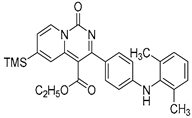
3.2.24. Ethyl 3-(4-((2,6-Dimethylphenyl)amino)phenyl)-1-oxo-6-(trimethylsilyl)-1H-pyrido[1,2-c]pyrimidine-4-carboxylate (N1)

To a 10 mL single-necked flask, J2 (50 mg, 1.0 eq.), 2,6-dimethylaniline (17 µL, 1.2 eq.), Pd2(dba)3 (5 mg, 0.05 eq.), Xantphos (13 mg, 0.2 eq.), Cs2CO3 (44 mg, 1.2 eq.), and toluene (2 mL) were added. The flask was purged with N2, and the mixture was stirred at 100 °C for 12 h until the reaction was complete, as monitored by TLC. The reaction mixture was filtered, washed with EA, and the filtrate was concentrated. Purification by preparative TLC afforded 30.2 mg of compound N1 as a yellow solid in a 55% yield. 1H NMR (600 MHz, Chloroform-d) δ 9.14–9.12 (m, 1H), 8.32 (d, J = 1.1 Hz, 1H), 7.56 (d, J = 8.4 Hz, 2H), 7.32 (dd, J = 6.9, 1.2 Hz, 1H), 7.13 (d, J = 2.0 Hz, 3H), 6.52–6.49 (m, 2H), 5.47 (s, 1H), 4.14 (q, J = 7.2 Hz, 2H), 2.21 (s, 6H), 1.01 (t, J = 7.2 Hz, 3H), 0.37 (s, 9H). 13C NMR (151 MHz, Chloroform-d) δ 167.61, 148.65, 145.79, 137.09, 136.41, 130.61, 128.65, 126.91, 126.54, 121.11, 112.56, 102.58, 61.50, 18.26, 13.57, −2.05. HRMS (ESI): m/z calced for C28H32N3O3Si [M + H]+: 486.2207, found: 486.2196. Compounds N2N4 were prepared according to the synthetic procedure of compound N1.

3.2.25. Ethyl 3-(4-((2,6-Dichlorophenyl)amino)phenyl)-1-oxo-6-(trimethylsilyl)-1H-pyrido[1,2-c]pyrimidine-4-carboxylate (N2)

Compound N2 was prepared by a procedure similar to that for N1, affording 36.5 mg of a yellow solid in a 62% yield. 1H NMR (600 MHz, Chloroform-d) δ 9.16 (dd, J = 6.9, 0.9 Hz, 1H), 8.37 (d, J = 1.1 Hz, 1H), 7.62–7.59 (m, 2H), 7.40 (d, J = 8.1 Hz, 2H), 7.36 (dd, J = 6.9, 1.2 Hz, 1H), 7.12 (t, J = 8.1 Hz, 1H), 6.72–6.69 (m, 2H), 5.94 (s, 1H), 4.12 (q, J = 7.2 Hz, 2H), 0.99 (t, J = 7.2 Hz, 3H), 0.38 (s, 9H). 13C NMR (151 MHz, Chloroform-d) δ 167.42, 145.82, 145.68, 135.64, 132.10, 129.97, 128.96, 128.68, 127.03, 126.29, 121.45, 115.07, 102.92, 61.64, 13.55, -2.04. HRMS (ESI): m/z calced for C26H26Cl2N3O3Si [M + H]+: 526.1115, found: 526.1098.

3.2.26. Ethyl 3-(4-((2-Methoxy-4-methylphenyl)amino)phenyl)-1-oxo-6-(trimethylsilyl)-1H-pyrido[1,2-c]pyrimidine-4-carboxylate (N3)

Compound N3 was prepared by a procedure similar to that for N1, affording 32.7 mg of a yellow solid in a 58% yield. 1H NMR (600 MHz, Chloroform-d) δ 9.15 (d, J = 6.8 Hz, 1H), 8.33 (s, 1H), 7.66–7.62 (m, 2H), 7.34 (dd, J = 6.9, 1.3 Hz, 1H), 7.26 (d, J = 8.5 Hz, 2H), 7.09–7.06 (m, 2H), 6.76–6.72 (m, 2H), 4.18 (q, J = 7.1 Hz, 2H), 3.87 (s, 3H), 2.34 (s, 3H), 1.06 (t, J = 7.1 Hz, 3H), 0.38 (s, 9H). 13C NMR (151 MHz, Chloroform-d) δ 167.51, 149.45, 146.03, 145.77, 131.76, 130.42, 128.68, 128.41, 126.99, 121.29, 121.01, 117.53, 115.57, 111.89, 102.84, 61.62, 55.61, 21.28, 13.73, −2.04. HRMS (ESI): m/z calced for C28H32N3O4Si [M + H]+: 502.2156, found: 502.2142.

3.2.27. Ethyl 3-(4-((2-Chloro-4-(trifluoromethoxy)phenyl)amino)phenyl)-1-oxo-6-(Trimethylsilyl)-1H-pyrido[1,2-c]pyrimidine-4-carboxylate (N4)

Compound N4 was prepared by a procedure similar to that for N1, affording 21 mg of a yellow solid in a 33% yield. 1H NMR (600 MHz, Chloroform-d) δ 9.20 (dt, J = 6.9, 0.9 Hz, 1H), 8.39 (t, J = 1.0 Hz, 1H), 7.71–7.67 (m, 2H), 7.41 (dt, J = 7.0, 1.4 Hz, 1H), 7.35 (d, J = 9.0 Hz, 1H), 7.31 (d, J = 2.7 Hz, 1H), 7.18–7.15 (m, 2H), 7.09–7.06 (m, 1H), 6.23 (s, 1H), 4.17 (q, J = 7.1 Hz, 2H), 1.05 (t, J = 7.1 Hz, 3H), 0.39 (s, 9H). 13C NMR (151 MHz, Chloroform-d) δ 167.14, 145.83, 143.33, 142.30, 138.22, 130.38, 128.77, 127.13, 123.18, 122.68, 121.82, 120.75, 118.21, 117.01, 103.10, 61.61, 13.71, −2.04. HRMS (ESI): m/z calced for C27H26ClF3N3O4Si [M + H]+: 576.1328, found: 576.1328.

3.2.28. Ethyl 1-Oxo-3-(4-(phenylamino)phenyl)-1H-pyrido[1,2-c]pyrimidine-4-carboxylate (O1)

To a 10 mL single-necked flask were added K2 (30 mg, 1.0 eq.), aniline (9 mg, 1.2 eq.), Pd2(dba)3 (4 mg, 0.05 eq.), Xantphos (9 mg, 0.2 eq.), Cs2CO3 (32 mg, 1.2 eq.), and toluene (2 mL). The flask was purged with N2, and the mixture was stirred at 100 °C for 12 h until the reaction was complete, as monitored by TLC. The reaction mixture was filtered, washed with ethyl acetate (EA), and the filtrate was concentrated. Purification by preparative TLC afforded 18 mg of the product as a yellow solid in a 58% yield. 1H NMR (600 MHz, Chloroform-d) δ 9.25 (dt, J = 7.0, 1.1 Hz, 1H), 8.26 (dt, J = 9.0, 1.1 Hz, 1H), 7.85 (ddd, J = 8.6, 6.7, 1.4 Hz, 1H), 7.65–7.62 (m, 2H), 7.34–7.28 (m, 3H), 7.17–7.13 (m, 2H), 7.08–7.05 (m, 2H), 7.01 (tt, J = 7.3, 1.1 Hz, 1H), 4.15 (q, J = 7.1 Hz, 2H), 1.04 (t, J = 7.1 Hz, 3H). 13C NMR (151 MHz, Chloroform-d) δ 167.36, 150.01, 147.74, 145.85, 141.57, 138.04, 131.15, 130.47, 129.47, 122.36, 122.22, 119.38, 117.74, 115.58, 103.13, 61.65, 13.69. HRMS (ESI): m/z calced for C23H20N3O3 [M + H]+: 386.1499, found: 386.1482. Compounds O2O7 were prepared according to the synthetic procedure of compound O1.

3.2.29. Ethyl 3-(4-((2-Chloro-4-(trifluoromethoxy)phenyl)amino)phenyl)-1-oxo-1H-pyrido[1,2-c]pyrimidine-4-carboxylate (O2)

Compound O2 was prepared by a procedure similar to that for O1, affording 6.4 mg of a yellow solid in a 43% yield. 1H NMR (600 MHz, Chloroform-d) δ 9.31 (d, J = 7.0 Hz, 1H), 8.33 (d, J = 9.0 Hz, 1H), 7.91 (ddd, J = 8.7, 6.8, 1.5 Hz, 1H), 7.74–7.69 (m, 2H), 7.38–7.35 (m, 2H), 7.33 (d, J = 2.7 Hz, 1H), 7.20–7.17 (m, 2H), 7.10 (dd, J = 8.9, 2.7 Hz, 1H), 6.25 (s, 1H), 4.17 (q, J = 7.1 Hz, 2H), 1.05 (t, J = 7.1 Hz, 3H). 13C NMR (151 MHz, Chloroform-d) δ 167.12, 166.28, 150.08, 147.83, 143.36, 142.32, 142.31, 138.19, 133.21, 131.20, 130.38, 123.19, 122.69, 122.33, 120.75, 118.18, 118.05, 116.98, 103.31, 61.63, 13.68. HRMS (ESI): m/z calced for C24H18ClF3N3O4 [M + H]+: 504.0932, found: 504.0916.

3.2.30. Ethyl 3-(4-((2-Methoxy-4-methylphenyl)amino)phenyl)-1-oxo-1H-pyrido[1,2-c]pyrimidine-4-carboxylate (O3)

Compound O3 was prepared by a procedure similar to that for O1, affording 8 mg of a yellow solid in a 31% yield. 1H NMR (600 MHz, Chloroform-d) δ 9.24 (d, J = 7.0 Hz, 1H), 8.25 (d, J = 9.0 Hz, 1H), 7.83 (ddd, J = 8.5, 6.8, 1.4 Hz, 1H), 7.64 (d, J = 8.5 Hz, 2H), 7.28 (d, J = 7.1 Hz, 1H), 7.08 (d, J = 8.6 Hz, 2H), 6.74 (d, J = 6.5 Hz, 2H), 4.15 (q, J = 7.1 Hz, 2H), 3.87 (s, 3H), 2.34 (s, 3H), 1.04 (t, J = 7.1 Hz, 3H). 13C NMR (151 MHz, Chloroform-d) δ 167.51, 166.38, 150.14, 149.45, 147.72, 146.05, 137.84, 131.79, 131.10, 130.43, 130.07, 128.38, 122.15, 121.01, 117.56, 117.51, 115.54, 111.90, 103.07, 61.64, 55.61, 21.28, 13.70. HRMS (ESI): m/z calced for C25H24N3O4 [M + H]+: 430.1761, found: 430.1747.

3.2.31. Ethyl 3-(4-((2,6-Dichlorophenyl)amino)phenyl)-1-oxo-1H-pyrido[1,2-c]pyrimidine-4-carboxylate (O4)

Compound O4 was prepared by a procedure similar to that for O1, affording 4 mg of a yellow solid in a 17% yield. 1H NMR (600 MHz, Chloroform-d) δ 9.38 (t, J = 7.2 Hz, 1H), 8.72 (d, J = 5.9 Hz, 1H), 7.94 (d, J = 7.0 Hz, 1H), 7.51–7.46 (m, 3H), 7.42 (d, J = 7.8 Hz, 1H), 7.19 (q, J = 7.8 Hz, 2H), 6.71 (t, J = 7.4 Hz, 2H), 4.17 (p, J = 7.0 Hz, 2H), 0.99 (q, J = 7.2 Hz, 3H). HRMS (ESI): m/z calced for C23H18Cl2N3O3 [M + H]+: 454.0719, found: 454.0717.

3.2.32. Ethyl 3-(4-((2,6-Dimethylphenyl)amino)phenyl)-1-oxo-1H-pyrido[1,2-c]pyrimidine-4-carboxylate (O5)

Compound O5 was prepared by a procedure similar to that for O1, affording 4.3 mg of a yellow solid in a 22% yield. 1H NMR (600 MHz, Chloroform-d) δ 9.23 (d, J = 7.0 Hz, 1H), 8.25 (d, J = 9.0 Hz, 1H), 7.82 (ddd, J = 8.8, 6.8, 1.4 Hz, 1H), 7.57 (d, J = 8.4 Hz, 2H), 7.28–7.26 (m, 1H), 7.15–7.13 (m, 3H), 6.51 (d, J = 8.4 Hz, 2H), 4.12 (q, J = 7.2 Hz, 2H), 2.21 (s, 6H), 1.00 (t, J = 7.1 Hz, 3H). 13C NMR (151 MHz, Chloroform-d) δ167.52, 148.76, 147.73, 137.90, 137.02, 136.41, 131.13, 130.67, 128.67, 126.59, 122.12, 117.49, 112.55, 102.85, 61.55, 18.25, 13.54. HRMS (ESI): m/z calced for C25H24N3O3 [M + H]+: 414.1812, found: 414.1803.

3.2.33. Ethyl 3-(4-(Benzylamino)phenyl)-1-oxo-1H-pyrido[1,2-c]pyrimidine-4-carboxylate (O6)

Compound O6 was prepared by a procedure similar to that for O1, affording 6 mg of a yellow solid in a 19% yield. 1H NMR (600 MHz, Chloroform-d) δ 9.23–9.20 (m, 1H), 8.21 (dt, J = 9.0, 1.1 Hz, 1H), 7.79 (ddd, J = 9.1, 6.8, 1.5 Hz, 1H), 7.61–7.58 (m, 2H), 7.36–7.33 (m, 4H), 7.30–7.27 (m, 2H), 7.25–7.22 (m, 1H), 6.65–6.63 (m, 2H), 4.41 (s, 2H), 4.12 (q, J = 7.1 Hz, 2H), 1.01 (t, J = 7.1 Hz, 3H). 13C NMR (151 MHz, Chloroform-d) δ 167.71, 166.63, 150.24, 150.12, 147.67, 138.67, 137.58, 131.03, 130.66, 128.82, 128.72, 127.87, 127.84, 127.43, 127.41, 122.03, 117.26, 112.11, 102.84, 61.55, 47.78, 29.71, 18.46, 13.68. HRMS (ESI): m/z calced for C24H22N3O3 [M + H]+: 400.1656, found: 400.1638.

3.2.34. Ethyl 3-(4-((4-Chlorobenzyl)amino)phenyl)-1-oxo-1H-pyrido[1,2-c]pyrimidine-4-carboxylate (O7)

Compound O7 was prepared by a procedure similar to that for O1, affording 9 mg of a yellow solid in a 26% yield. 1H NMR (600 MHz, Chloroform-d) δ 9.22 (dt, J = 7.0, 1.2 Hz, 1H), 8.21 (dt, J = 9.1, 1.1 Hz, 1H), 7.80 (ddd, J = 8.7, 6.8, 1.5 Hz, 1H), 7.60–7.57 (m, 2H), 7.32–7.27 (m, 4H), 7.24 (dd, J = 7.0, 1.3 Hz, 1H), 6.63–6.60 (m, 2H), 4.40–4.37 (m, 2H), 4.11 (q, J = 7.1 Hz, 2H), 0.99 (t, J = 7.1 Hz, 3H). 13C NMR (151 MHz, Chloroform-d) δ 167.64, 166.57, 150.23, 147.67, 137.64, 137.25, 133.11, 131.03, 130.64, 128.83, 128.63, 128.16, 122.06, 117.35, 112.17, 102.87, 61.54, 47.09, 13.65. HRMS (ESI): m/z calced for C24H21ClN3O3 [M + H]+: 434.1266, found: 434.1245.

3.2.35. N-(((1s,3s)-Adamantan-1-yl)methyl)-3-(4-bromophenyl)-1-oxo-1H-pyrido[1,2-c]pyrimidine-4-carboxamide (P1)

Compound K2 (30 mg, 1.0 eq.), ((1s,3s)-adamantan-1-yl)methanamine (16 mg, 1.2 eq.), Cs2CO3 (32 mg, 1.2 eq.), and THF (2 mL) were added to a 10 mL single-necked flask. The mixture was stirred at reflux at 70 °C for 12 h, and the reaction was monitored by TLC until completion. Water and ethyl acetate (EA) were added to the reaction mixture for liquid–liquid extraction. The organic phase was washed with saturated aqueous NaCl solution, dried over anhydrous sodium sulfate, filtered, and concentrated. Purification by preparative thin-layer chromatography (DCM/MeOH = 30/1) afforded 12.7 mg of compound P1 as a yellow solid, with a yield of 32%. 1H NMR (600 MHz, Chloroform-d) δ 8.47–8.45 (m, 1H), 7.69–7.63 (m, 1H), 7.63–7.57 (m, 1H), 7.44–7.41 (m, 2H), 7.38 (d, J = 8.1 Hz, 1H), 7.20 (d, J = 8.2 Hz, 1H), 7.13 (d, J = 8.1 Hz, 2H), 3.72 (q, J = 7.0 Hz, 2H), 1.95–1.91 (m, 3H), 1.69–1.59 (m, 9H), 1.24 (t, J = 7.0 Hz, 4H). 13C NMR (151 MHz, Chloroform-d) δ 131.96, 130.13, 128.99, 58.50, 51.89, 41.09, 36.78, 35.93, 28.41, 18.45. HRMS (ESI): m/z calced for C26H27BrN3O2 [M + H]+: 492.1281, found: 492.1258.

3.2.36. 3-(4-Bromophenyl)-N-cyclohexyl-1-oxo-1H-pyrido[1,2-c]pyrimidine-4-carboxamide (P2)

The preparation procedure was similar to that of compound P1, affording 12 mg of compound P2 as a yellow solid, with a yield of 26%. 1H NMR (600 MHz, Chloroform-d) δ 9.82 (s, 1H), 8.51 (d, J = 5.0 Hz, 1H), 7.73 (s, 1H), 7.45–7.41 (m, 2H), 7.36 (s, 1H), 7.14 (d, J = 8.1 Hz, 2H), 4.80–4.73 (m, 1H), 2.25 (d, J = 12.8 Hz, 2H), 1.81 (d, J = 13.1 Hz, 2H), 1.70–1.61 (m, 3H), 1.33 (dddd, J = 16.9, 13.3, 8.5, 3.7 Hz, 2H), 1.14 (dtd, J = 13.2, 9.6, 3.6 Hz, 1H). 13C NMR (151 MHz, Chloroform-d) δ 151.88, 131.97, 130.20, 28.44, 26.28, 25.25. HRMS (ESI): m/z calced for C21H21BrN3O2 [M + H]+: 426.0812, found: 426.0792.

3.3. Biological Experimental Methods

3.3.1. Cell and Virus

African green monkey kidney (Vero) cells were purchased (Procell, CN, Wuhan, China). Cells were preserved at 37 °C in 5% CO2 atmosphere as adherent culture in Dulbecco’s modified Eagle’s medium (DMEM/High glucose, Cytiva, Marlborough, MA, USA) mixed with 10% fetal bovine serum (FBS, TransGen Biotech, CN, Beijing, China). Upon reaching confluence of 90–100%, the cells were washed with PBS and harvested from the culture vessel surface using 0.06% trypsin.
The PEDV strain AJ1102 (GenBank accession No. JX188454) (isolated in China in 2011 from a sucking piglet suffering from acute diarrhea) was transfected into Vero cells in DMEM containing 10 µg·mL−1 trypsin [36].

3.3.2. In Vitro Anti-PEDV Activity Evaluation

Vero cells were incubated in DMEM supplemented with 2% FBS for 2 h. Then the cells were infected with PEDV at a multiplicity of infection (MOI) of 0.01, and the infection was maintained at 37 °C for 1 h. After virus adsorption for 1h, the supernatant was discarded, and the cells were washed twice with DMEM, followed by incubation separately for 24 h. The antiviral effect of test compounds was evaluated using an RT-qPCR assay. Total RNA was extracted from cell samples with RNAiso Plus reagent (Takara Bio Inc., JPN, Kusatsu, Japan) and was transcribed into cDNA by using PrimeScriptTM FAST RT reagent Kit (Takara Bio Inc., JPN). The copy number of viral genomic RNA was detected with TB Green® Premix Ex TaqTM II (Tli RNaseH Plus) (Takara Bio Inc., JPN) and specific primer pairs (PEDV-N-F: 5′-GAATGCAAAACCCCAGAGAA-3′ and PEDV-N-R: 5′-GTGTCACCACCATCAACAGC-3′.
The titer of PEDV was determined using trypsin-containing DMEM via the 50% tissue culture infectious dose (TCID50) assay. Vero cells were seeded in 96-well plates and cultured at 37 °C under 5% CO2 until 90% confluence was attained. The viral suspension was serially diluted from 10−1 to 10−10 in 1.5 mL Eppendorf tubes on ice. A 100 µL volume of each dilution was added to columns 2 to 11 of the plate, with eight replicates per dilution. Columns 1 and 12 were used as uninfected negative controls. All experiments were performed in triplicate. Plates were incubated at 37 °C under 5% CO2, and the number of wells displaying cytopathic effect (CPE) was recorded daily until no additional CPE was observed. Viral titers were calculated using the Reed–Muench method.

3.3.3. In Vitro Cytotoxicity Assay

Vero cells were seeded into 96-well cell culture plates and cultured until they formed a confluent monolayer. The concentrations of J3 and J4 were 0, 5, 10, 20, 40, 80, 160 µM; the concentrations of J1 and N1 were 0, 2.5, 5, 10, 20, 40, 80 µM; the concentrations of N2 and N4 were 0, 1, 2, 4, 8, 16, 32 µM. Normal cells were used as the blank group, and PEDV was added as the infection group. PEDV (MOI = 0.01) was added, and the cells were incubated for 2 h. After this, the maintenance medium supplemented with the same concentration of compounds was added, and the cells were cultured for 24 h. The medium was discarded, 10 μL of CCK-8 solution and 90 μL of medium were added to each well, the plate was placed in an incubator for 1–4 h, the absorbance of the samples was measured at a wavelength of 450 nm, and the data were recorded. Cell viability = (Treatment group OD value − Blank control group OD value)/(Negative control group OD value − Blank control group OD value) × 100%.

3.4. Microsomal Stability Assay

3.4.1. Preparation of Solutions

Stock solution (10 mM) of test compounds was prepared in DMSO. The stock solution for the test compound was then diluted to 200 μM with acetonitrile.

3.4.2. Microsome Incubations

Incubation mixtures were prepared in a total volume of 200 μL with final component concentrations as follows: 0.1 M PBS (pH 7.4), 3 mM MgCl2, NADPH (2 mM), liver microsomes (0.2 mg/mL) and test compound (1 μM) or positive control (1 μM). NADPH or buffer (negative control) was added after a 5-min preincubation of all other components at 37 °C. This was pipette-mixed to achieve a homogenous suspension and immediately transferred 20 µL incubate as a 0 min sample to wells in a “Quenching” plate, followed by pipette-mixing. At 5, 15, 30, and 60 min, pipette-mixed the incubate and serially transferred samples of 20 µL incubate per time point to wells in a separate “Quenching” plate, followed by pipette-mixing. In ‘Quenching’ plates, 200 µL of acetonitrile was added with IS.

3.4.3. Sample Analysis

The 96-well plate was centrifuged at 4000 rpm, 4 °C for 10 min. 30 μL of supernatant was mixed with 90 μL of ddH2O and then injected onto the LC-MS/MS system for analysis.

4. Conclusions

In summary, building upon the novel PPO scaffold identified in our previous study, we designed and synthesized a diverse array of derivatives and systematically investigated the SAR governing their anti-PEDV potential. The incorporation of bulky hydrophobic substituents at the R1, R2, and R3 positions emerged as the core determinant for potent antiviral activity. Specifically, sterically demanding hydrophobic moieties at these sites—including aromatic rings at R1, adamantyl at R2, and trimethylsilyl (TMS) at R3—markedly enhanced antiviral efficacy. Furthermore, the steric and electronic properties of substituents on the R1 aromatic ring served as critical modulators, enabling fine-tuning of the antiviral activity within this scaffold. Among all synthesized derivatives, compounds N1 and N2 exhibited exceptional in vitro anti-PEDV potency with EC50 values of 0.32 μM and 0.37 μM and SI values of 43.78 and 42.89, respectively. However, both compounds exhibited high metabolism in human and mouse liver microsomes. Furthermore, although compound J4 did not possess the most potent antiviral activity, it exhibited moderate metabolic stability in mouse liver microsomes along with low cytotoxicity. Further structural optimization of this series will be carried out to improve druggability, including metabolic stability and safety profiles.

Supplementary Materials

The following supporting information can be downloaded at: https://www.mdpi.com/article/10.3390/molecules31091480/s1, Table S1: Structures of Target Compounds; 1H NMR, 13C NMR and HRMS Spectrums of target compounds; Analytical Report of HPLC Chromatograms of the Preferred Compounds; Dose–Response Curves.

Author Contributions

W.X., Z.Z., S.P. and X.J. designed the target compounds and experiments. W.X., Z.Z. and Z.J. performed the synthesis, purification and characterization of the title compounds. W.N. and S.L. designed and performed the antiviral activity assays. W.X., S.P. and X.J. analyzed the data and wrote the manuscript. All authors have read and agreed to the published version of the manuscript.

Funding

This research was funded by the Strategic Priority Research Program of the Chinese Academy of Sciences, Grant No. XDA0530201, Key R&D Program of Shandong Province, China (2024CXPT029), the Shanghai Institute of Materia Medica, Chinese Academy of Sciences (SIMM0120231003), Yantai High-End Talent Introduction and Cultivation “Double-Hundred Plan” and the start-up funding (to X.J.) provided by Shandong Laboratory of Yantai Drug Discovery, Bohai Rim Advanced Research Institute for Drug Discovery.

Institutional Review Board Statement

Not applicable.

Informed Consent Statement

Not applicable.

Data Availability Statement

All data presented in this study are available in the article and in the Supplementary Material.

Conflicts of Interest

The authors declare no conflicts of interest.

Abbreviations

The following abbreviations are used in this manuscript:
PEDVPorcine Epidemic Diarrhea Virus
PPOPyrido[1,2-c]pyrimidin-1-one
SARStructure–Activity Relationships
PEDPorcine Epidemic Diarrhea
EC50Half-maximal Inhibitory Concentration
SISelectivity Index
MproMain Protease
3CLpro3C-like Protease
FIPVFeline Infectious Peritonitis Virus
TMSTrimethylsilyl
PhPhenyl
MeMethyl
OEtEthoxy
THFTetrahydrofuran
TBAFTetra-n-butylammonium Fluoride
TFATrifluoroacetic Acid
DMFN,N-Dimethylformamide
DIADDiisopropyl Azodicarboxylate
PPh3Triphenylphosphine
BPOBenzoyl Peroxide
HAuCl4·3H2OChloroauric Acid Trihydrate
Cs2CO3Cesium Carbonate
Pd2(dba)3Tris(dibenzylideneacetone)dipalladium(0)
DCE1,2-Dichloroethane
Ac2OAcetic Anhydride
ClintIntrinsic Clearance
EhHepatic Extraction Ratio
VeroAfrican green monkey kidney cells
DMEMDulbecco’s Modified Eagle Medium
FBSFetal Bovine Serum
PBSPhosphate Buffered Saline
RT-qPCRReal-time Quantitative Polymerase Chain Reaction
RNARibonucleic Acid
cDNAComplementary DNA
NMRNuclear Magnetic Resonance
HRMSHigh-Resolution Mass Spectrometry
ESIElectrospray Ionization
HPLCHigh-Performance Liquid Chromatography
TLCThin-Layer Chromatography
MOIMultiplicity of Infection
SDStandard Deviation
NADPHReduced Nicotinamide Adenine Dinucleotide Phosphate

References

  1. Wood, E.N. An apparently new syndrome of porcine epidemic diarrhoea. Vet. Rec. 1977, 100, 243–244. [Google Scholar] [CrossRef] [Scilit] [PubMed]
  2. Pensaert, M.B.; de Bouck, P. A new coronavirus-like particle associated with diarrhea in swine. Arch. Virol. 1978, 58, 243–247. [Google Scholar] [CrossRef] [Scilit]
  3. Chasey, D.; Cartwright, S.F. Virus-like particles associated with porcine epidemic diarrhoea. Res. Vet. Sci. 1978, 25, 255–256. [Google Scholar] [CrossRef] [Scilit]
  4. Kocherhans, R.; Bridgen, A.; Ackermann, M.; Tobler, K. Completion of the Porcine Epidemic Diarrhoea Coronavirus (PEDV) Genome Sequence. Virus Genes 2001, 23, 137–144. [Google Scholar] [CrossRef] [Scilit]
  5. Cavanagh, D. Nidovirales: A new order comprising Coronaviridae and Arteriviridae. Arch. Virol. 1997, 142, 629–633. [Google Scholar] [PubMed]
  6. Saif, L.J.; Wang, Q.; Vlasova, A.N.; Jung, K.; Xiao, S. Coronaviruses. In Diseases of Swine; John Wiley & Sons Ltd.: Hoboken, NJ, USA, 2019; pp. 488–523. [Google Scholar]
  7. Shibata, I.; Tsuda, T.; Mori, M.; Ono, M.; Sueyoshi, M.; Uruno, K. Isolation of porcine epidemic diarrhea virus in porcine cell cultures and experimental infection of pigs of different ages. Vet. Microbiol. 2000, 72, 173–182. [Google Scholar] [CrossRef] [Scilit]
  8. Have, P.; Moving, V.; Svansson, V.; Uttenthal, Å.; Bloch, B. Coronavirus infection in mink (Mustela vision). Serological evidence of infection with a coronavirus related to transmissible gastroenteritis virus and porcine epidemic diarrhea virus. Vet. Microbiol. 1992, 31, 1–10. [Google Scholar] [CrossRef] [Scilit] [PubMed]
  9. Zhang, Y.; Chen, Y.; Zhou, J.; Wang, X.; Ma, L.; Li, J.; Yang, L.; Yuan, H.; Pang, D.; Ouyang, H. Porcine Epidemic Diarrhea Virus: An Updated Overview of Virus Epidemiology, Virulence Variation Patterns and Virus–Host Interactions. Viruses 2022, 14, 2434. [Google Scholar] [CrossRef] [Scilit]
  10. Lin, C.N.; Chung, W.B.; Chang, S.W.; Wen, C.C.; Liu, H.; Chien, C.H.; Chiou, M.T. US-like strain of porcine epidemic diarrhea virus outbreaks in Taiwan, 2013–2014. J. Vet. Med. Sci. 2014, 76, 1297–1299. [Google Scholar] [CrossRef] [Scilit]
  11. Stevenson, G.W.; Hoang, H.; Schwartz, K.J.; Burrough, E.R.; Sun, D.; Madson, D.; Cooper, V.L.; Pillatzki, A.; Gauger, P.; Schmitt, B.J.; et al. Emergence of Porcine epidemic diarrhea virus in the United States: Clinical signs, lesions, and viral genomic sequences. J. Vet. Diagn. Investig. 2013, 25, 649–654. [Google Scholar] [CrossRef] [Scilit]
  12. Song, D.; Park, B. Porcine epidemic diarrhoea virus: A comprehensive review of molecular epidemiology, diagnosis, and vaccines. Virus Genes 2012, 44, 167–175. [Google Scholar] [CrossRef] [Scilit]
  13. Debouck, P.; Pensaert, M. Experimental infection of pigs with a new porcine enteric coronavirus, CV 777. Am. J. Vet. Res. 1980, 41, 219–223. [Google Scholar] [CrossRef] [Scilit] [PubMed]
  14. Fan, H.; Zhang, J.; Ye, Y.; Tong, T.; Xie, K.; Liao, M. Complete genome sequence of a novel porcine epidemic diarrhea virus in south China. J. Virol. 2012, 86, 10248–10249. [Google Scholar] [CrossRef] [Scilit] [PubMed]
  15. Sun, R.Q.; Cai, R.J.; Chen, Y.Q.; Liang, P.S.; Chen, D.K.; Song, C.X. Outbreak of porcine epidemic diarrhea in suckling piglets, China. Emerg. Infect. Dis. 2012, 18, 161–163. [Google Scholar] [CrossRef] [Scilit]
  16. Wang, X.M.; Niu, B.B.; Yan, H.; Gao, D.S.; Yang, X.; Chen, L.; Chang, H.T.; Zhao, J.; Wang, C.Q. Genetic properties of endemic Chinese porcine epidemic diarrhea virus strains isolated since 2010. Arch. Virol. 2013, 158, 2487–2494. [Google Scholar] [CrossRef] [Scilit]
  17. Huang, Y.W.; Dickerman, A.W.; Piñeyro, P.; Li, L.; Fang, L.; Kiehne, R.; Opriessnig, T.; Meng, X.J. Origin, evolution, and genotyping of emergent porcine epidemic diarrhea virus strains in the United States. mBio 2013, 4, e00737-13. [Google Scholar] [CrossRef] [Scilit]
  18. Chen, Q.; Li, G.; Stasko, J.; Thomas, J.T.; Stensland, W.R.; Pillatzki, A.E.; Gauger, P.C.; Schwartz, K.J.; Madson, D.; Yoon, K.J.; et al. Isolation and characterization of porcine epidemic diarrhea viruses associated with the 2013 disease outbreak among swine in the United States. J. Clin. Microbiol. 2014, 52, 234–243. [Google Scholar] [CrossRef] [Scilit]
  19. Hanke, D.; Pohlmann, A.; Sauter-Louis, C.; Höper, D.; Stadler, J.; Ritzmann, M.; Steinrigl, A.; Schwarz, B.A.; Akimkin, V.; Fux, R.; et al. Porcine Epidemic Diarrhea in Europe: In-Detail Analyses of Disease Dynamics and Molecular Epidemiology. Viruses 2017, 9, 177. [Google Scholar] [CrossRef] [Scilit]
  20. Yao, X.; Qiao, W.T.; Zhang, Y.Q.; Lu, W.H.; Wang, Z.W.; Li, H.X.; Li, J.L. A new PEDV strain CH/HLJJS/2022 can challenge current detection methods and vaccines. Virol. J. 2023, 20, 13. [Google Scholar] [CrossRef] [Scilit]
  21. Opriessnig, T.; Gerber, P.F.; Shen, H.; de Castro, A.; Zhang, J.; Chen, Q.; Halbur, P. Evaluation of the efficacy of a commercial inactivated genogroup 2b-based porcine epidemic diarrhea virus (PEDV) vaccine and experimental live genogroup 1b exposure against 2b challenge. Vet. Res. 2017, 48, 69. [Google Scholar] [CrossRef] [Scilit] [PubMed]
  22. Gao, Q.; Zheng, Z.; Wang, H.; Yi, S.; Zhang, G.; Gong, L. The New Porcine Epidemic Diarrhea Virus Outbreak May Mean That Existing Commercial Vaccines Are Not Enough to Fully Protect Against the Epidemic Strains. Front. Vet. Sci. 2021, 8, 697839. [Google Scholar] [CrossRef] [Scilit]
  23. Chen, N.; Li, S.; Zhou, R.; Zhu, M.; He, S.; Ye, M.; Huang, Y.; Li, S.; Zhu, C.; Xia, P.; et al. Two novel porcine epidemic diarrhea virus (PEDV) recombinants from a natural recombinant and distinct subtypes of PEDV variants. Virus Res. 2017, 242, 90–95. [Google Scholar] [CrossRef] [Scilit]
  24. Tian, Y.; Yang, X.; Li, H.; Ma, B.; Guan, R.; Yang, J.; Chen, D.; Han, X.; Zhou, L.; Song, Z.; et al. Molecular characterization of porcine epidemic diarrhea virus associated with outbreaks in southwest China during 2014–2018. Transbound. Emerg. Dis. 2021, 68, 3482–3497. [Google Scholar] [CrossRef] [Scilit] [PubMed]
  25. Tran, M.T.; Doan, T.-D.; Wu, H.-C.; Chu, C.-Y. Vaccine Development for Porcine Epidemic Diarrhea Virus and Porcine Deltacoronavirus: Updated Progress, Challenges, and Future Perspectives. Microb. Pathog. 2026, 212, 108286. [Google Scholar] [CrossRef] [Scilit] [PubMed]
  26. Pathak, R.K.; Kim, W.I.; Kim, J.M. Targeting the PEDV 3CL protease for identification of small molecule inhibitors: An insight from virtual screening, ADMET prediction, molecular dynamics, free energy landscape, and binding energy calculations. J. Biol. Eng. 2023, 17, 29. [Google Scholar] [CrossRef] [Scilit]
  27. Jung, K.; Saif, L.J.; Wang, Q. Porcine epidemic diarrhea virus (PEDV): An update on etiology, transmission, pathogenesis, and prevention and control. Virus Res. 2020, 286, 198045. [Google Scholar] [CrossRef] [Scilit] [PubMed]
  28. Yang, J.-L.; Dhodary, B.; Quy Ha, T.K.; Kim, J.; Kim, E.; Oh, W.K. Three new coumarins from Saposhnikovia divaricata and their porcine epidemic diarrhea virus (PEDV) inhibitory activity. Tetrahedron 2015, 71, 4651–4658. [Google Scholar] [CrossRef] [Scilit]
  29. Cho, H.-M.; Ha, T.-K.-Q.; Dang, L.-H.; Pham, H.-T.-T.; Tran, V.-O.; Huh, J.; An, J.-P.; Oh, W.-K. Prenylated Phenolic Compounds from the Leaves of Sabia limoniacea and Their Antiviral Activities against Porcine Epidemic Diarrhea Virus. J. Nat. Prod. 2019, 82, 702–713. [Google Scholar] [CrossRef] [Scilit]
  30. Wang, P.; Bai, J.; Liu, X.; Wang, M.; Wang, X.; Jiang, P. Tomatidine inhibits porcine epidemic diarrhea virus replication by targeting 3CL protease. Vet. Res. 2020, 51, 136. [Google Scholar] [CrossRef] [Scilit]
  31. Wang, F.; Chen, C.; Yang, K.; Xu, Y.; Liu, X.; Gao, F.; Liu, H.; Chen, X.; Zhao, Q.; Liu, X.; et al. Michael Acceptor-Based Peptidomimetic Inhibitor of Main Protease from Porcine Epidemic Diarrhea Virus. J. Med. Chem. 2017, 60, 3212–3216. [Google Scholar] [CrossRef] [Scilit]
  32. Lv, S.; Ma, R.; Tang, Q.; Wang, X.; Wang, C.; Zhang, K.; Li, H.; Ye, W.; Zhou, W. Discovery of 3,4-dihydropyrimidine derivatives as novel Anti-PEDV agents targeting viral internalization through a unique calcium homeostasis disruption mechanism. Eur. J. Med. Chem. 2025, 291, 117637. [Google Scholar] [CrossRef] [Scilit] [PubMed]
  33. Shi, Y.; Lei, Y.; Ye, G.; Sun, L.; Fang, L.; Xiao, S.; Fu, Z.F.; Yin, P.; Song, Y.; Peng, G. Identification of two antiviral inhibitors targeting 3C-like serine/3C-like protease of porcine reproductive and respiratory syndrome virus and porcine epidemic diarrhea virus. Vet. Microbiol. 2018, 213, 114–122. [Google Scholar] [CrossRef] [Scilit]
  34. Wang, M.; Jiang, H.; Song, Z.; Gong, H. Copper Nitrate Catalyzed Three-Component One-Pot Synthesis of 3,4-Dihydropyrimidin-2(1H)-Ones. Prep. Biochem. Biotechnol. 2009, 39, 372–379. [Google Scholar] [CrossRef] [Scilit] [PubMed]
  35. Brown, L.E.; Dai, P.; Porco, J.A., Jr.; Schaus, S.E. Gold Catalyzed Cyclization of Alkyne-Tethered Dihydropyrimidones. Org. Lett. 2011, 13, 4228–4231. [Google Scholar] [CrossRef] [Scilit] [PubMed]
  36. Wei, Z.Y.; Lu, W.H.; Li, Z.L.; Mo, J.Y.; Zeng, X.D.; Zeng, Z.L.; Sun, B.L.; Chen, F.; Xie, Q.M.; Bee, Y.Z.; et al. Complete genome sequence of novel porcine epidemic diarrhea virus strain GD-1 in China. J. Virol. 2012, 86, 13824–13825. [Google Scholar] [CrossRef] [Scilit]
Figure 1. Representative Small-Molecule Inhibitors against PEDV.
Molecules 31 01480 g001
Figure 2. Design of PPO Derivatives.
Molecules 31 01480 g002
Scheme 1. Synthetic Route of the Target Compound, Reagents and conditions: (a) Cu(NO3)2·3H2O, 80 °C, 1–2 h, 80–96%; (b) Ac2O, refluxing, 2 h, 57–84%; (c) PPh3, DIAD, THF, r.t., 2 h, 50–94%; (d) Piperidine, THF, 40 °C, 6 h, 84–95%; (e) BPO, EtOH, 100 °C, 8 h, 32–71%; (f) HAuCl4·3H2O, DCE, 80 °C, overnight, 18–54%; (g) TBAF (1 M in THF), THF, r.t., 1 h, 49–73%; (h) TFA, 80 °C, 1 h, 99%; (i) Cs2CO3, DMF, 80 °C, overnight, 29–50%; (j) Pd2(dba)3, Xantphos, Cs2CO3, toluene, 100 °C, overnight, 17–62%; (k) Cs2CO3, THF, 80 °C, overnight, 26–32%.
Molecules 31 01480 sch001
Figure 3. Summary of the SAR for the PPO derivatives.
Molecules 31 01480 g003
Table 1. The Antiviral Activities of Target Compounds against PEDV.
Molecules 31 01480 i001
Compd.LR1R2R3Inhibition Rate
(%) a
Viral Yield Reduction b
J1OMolecules 31 01480 i002OEtTMS99.99 ± 0.014.49 ± 0.74
J2Br/OEtTMS78.12 ± 10.180.70 ± 0.21
J3OMolecules 31 01480 i003MeTMS99.99 ± 0.004.09 ± 0.13
J4OMolecules 31 01480 i004OEtPh100.00 ± 0.004.64 ± 0.29
J5OMolecules 31 01480 i005OEtMe93.47 ± 1.641.20 ± 0.10
K1OMolecules 31 01480 i006OEtH86.86 ± 5.450.92 ± 0.21
K2Br/OEtH35.96 ± 9.370.20 ± 0.06
K3OMolecules 31 01480 i007MeH98.46 ± 0.171.81 ± 0.04
M0OHOEtH38.90 ± 3.490.22 ± 0.07
M1OMolecules 31 01480 i008OEtH40.14 ± 9.440.23 ± 0.07
M2OMolecules 31 01480 i009OEtH45.91 ± 7.230.27 ± 0.06
M3OMolecules 31 01480 i010OEtH4.85 ± 1.380.02 ± 0.01
M4OMolecules 31 01480 i011OEtH51.47 ±17.000.34 ± 0.16
M5OMolecules 31 01480 i012OEtH96.19 ± 2.191.48 ± 0.27
M6OMolecules 31 01480 i013OEtH99.86 ± 0.032.85 ± 0.09
M7OMolecules 31 01480 i014OEtH99.26 ± 0.112.14 ± 0.06
M8OMolecules 31 01480 i015OEtH99.21 ± 0.232.12 ± 0.13
M9OMolecules 31 01480 i016OEtH99.61 ± 0.042.41 ± 0.04
M10OMolecules 31 01480 i017OEtH99.86 ± 0.042.87 ± 0.14
M11OMolecules 31 01480 i018OEtH99.53 ± 0.052.33 ± 0.05
M12OMolecules 31 01480 i019OEtH97.86 ± 1.931.92 ± 0.56
M13OMolecules 31 01480 i020OEtH92.61 ± 2.221.15 ± 0.13
M14OMolecules 31 01480 i021OEtH68.51 ± 13.120.53 ± 0.19
N1NHMolecules 31 01480 i022OEtTMS99.99 ± 0.013.88 ± 0.01
N2NHMolecules 31 01480 i023OEtTMS100.00 ± 0.004.48 ± 0.47
N3NHMolecules 31 01480 i024OEtTMS97.31 ± 0.851.59 ± 0.16
N4NHMolecules 31 01480 i025OEtTMS99.98 ± 0.013.78 ± 0.14
O1NHMolecules 31 01480 i026OEtH90.80 ± 2.081.05 ± 0.09
O2NHMolecules 31 01480 i027OEtH99.78 ± 0.082.68 ± 0.20
O3NHMolecules 31 01480 i028OEtH88.43 ± 1.720.94 ± 0.07
O4NHMolecules 31 01480 i029OEtH84.79 ± 6.820.86 ± 0.21
O5NHMolecules 31 01480 i030OEtH80.59 ± 4.970.72 ± 0.11
O6NHMolecules 31 01480 i031OEtH27.44 ± 10.940.14 ± 0.06
O7NHMolecules 31 01480 i032OEtH96.02 ± 3.291.60 ± 0.49
P1Br/Molecules 31 01480 i033H98.79 ± 0.892.11 ± 0.49
P2Br/Molecules 31 01480 i034H43.08 ± 6.280.25 ± 0.05
Lycorine cMolecules 31 01480 i03599.94 ± 0.043.69 ± 0.28
a The target compounds were evaluated at a concentration of 10 μM, Values are given as mean ± SE of three replicates (n = 3). b Viral yield reduction, obtained from three replicates in independent experiments, is calculated based on the averaged log10-transformed virus titer of the mock-treated group divided by that of the compound-treated group. c The positive control and it was evaluated at a concentration of 3 μM.
Table 2. EC50, CC50, and SI of Preferred Compounds.
Compd.StructureEC50 (μM) aCC50 (μM) aSI b
J1Molecules 31 01480 i0360.70 ± 0.0610.80 ± 0.8115.43
J3Molecules 31 01480 i0371.37 ± 0.0718.28 ± 1.4113.64
J4Molecules 31 01480 i0381.77 ± 0.2060.47 ± 9.9034.16
N1Molecules 31 01480 i0390.32 ± 0.0214.01 ± 1.1743.78
N2Molecules 31 01480 i0400.37 ± 0.0215.87 ± 2.1442.89
N4Molecules 31 01480 i0410.79 ± 0.0818.16 ± 2.5923.54
a Values are given as mean ± SE of three replicates (n = 3). b SI = CC50/EC50.
Table 3. Microsomal Stability of the Preferred Compounds.
Compd.SpeciesT1/2 (min)Clint (mL/min/mg)Eh (%)Clearance Classified
J1Human12.70.27393.9High
Mouse8.580.40494.7High
J3Human30.40.11486.6High
Mouse72.70.047767.7Medium
J4Human71.90.048273.1High
Mouse92.00.037762.4Medium
N1Human13.70.25293.4High
Mouse18.00.19289.4High
N2Human50.80.068279.4High
Mouse39.00.088879.6High
Disclaimer/Publisher’s Note: The statements, opinions and data contained in all publications are solely those of the individual author(s) and contributor(s) and not of MDPI and/or the editor(s). MDPI and/or the editor(s) disclaim responsibility for any injury to people or property resulting from any ideas, methods, instructions or products referred to in the content.