Article

Isoreticular Synthesis of Ionic Covalent Organic Frameworks for Enhanced SO2 Adsorption and Separation

1
Hebei Key Laboratory of Functional Polymer, School of Chemical Engineering and Technology, Hebei University of Technology, Tianjin 300401, China
2
State Key Laboratory of Structural Chemistry, Fujian Institute of Research on the Structure of Matter, Chinese Academy of Sciences, Fuzhou 350002, China
*
Authors to whom correspondence should be addressed.
Molecules 2026, 31(9), 1445; https://doi.org/10.3390/molecules31091445
Submission received: 25 March 2026 / Revised: 19 April 2026 / Accepted: 24 April 2026 / Published: 27 April 2026
(This article belongs to the Section Materials Chemistry)

Abstract

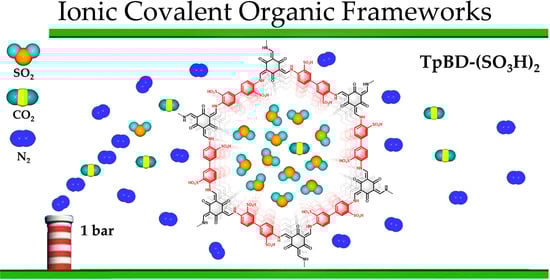
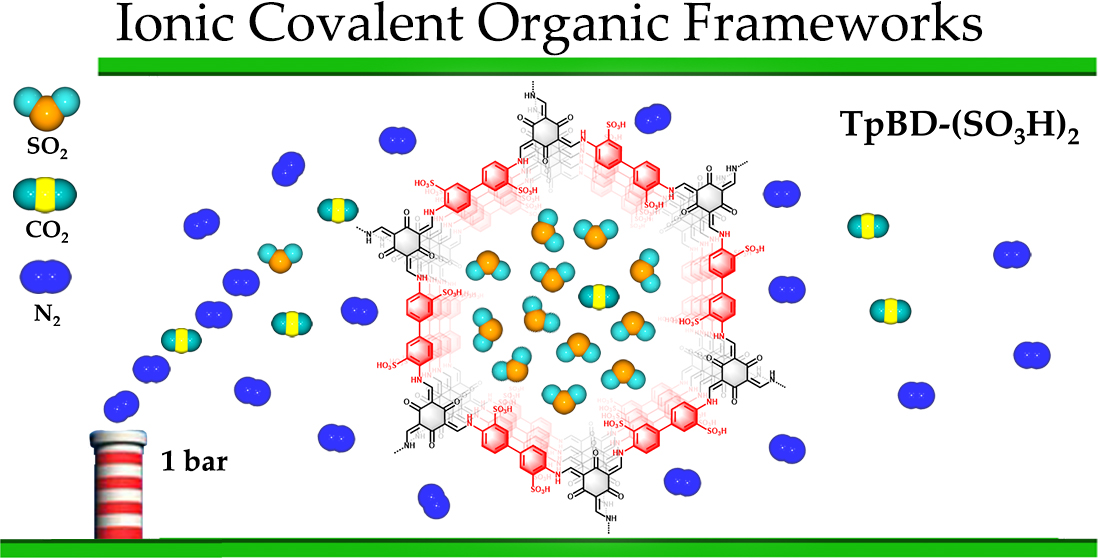
Achieving selective SO2 capture at low pressures is pivotal and challenging for possible flue gas desulfurization and air pollution control. In this study, we synthesized a series of ionic covalent organic frameworks (iCOFs) with β-ketoenamine linkages and sulfonic acid groups using a solvothermal method. TpPa-SO3H and TpBD-(SO3H)2 show a higher SO2 uptake of 4.46 and 5.24 mmol g−1 than TpPa-1 (4.24 mmol g−1) at 1 bar and 298 K, respectively, due to the combination of the good SO2 affinity of the polar sulfonic acid groups, higher pore volumes, and the good stability of β-ketoenamine COFs. TpBD-(SO3H)2 captured 2.83 mmol g−1 of SO2 at 0.1 bar and 298 K, which is 1.6 times higher than TpPa-1 (1.82 mmol g−1) under the same conditions. Notably, the IAST SO2/CO2 selectivity of TpBD-(SO3H)2 and TpPa-1 are 61 and 51, respectively, reflecting the impact of the incorporated SO3H groups’ higher affinity toward SO2. Notably, the multicomponent gas mixture breakthrough experiments confirm that TpBD-(SO3H)2 displays longer breakthrough time than TpPa-1 (987 vs. 311 min g−1). These β-ketoenamine iCOFs demonstrate nearly complete retention of crystallinity and porosity after exposure to dry or humid SO2. This work demonstrates that iCOFs are promising adsorbents for SO2 capture due to their high capacity, stability, and affinity for SO2 at low pressure.

Graphical Abstract

1. Introduction

Sulfur dioxide (SO2) is a colorless, non-flammable gaseous species characterized by a pungent odor. Classified by the World Health Organization (WHO) as a highly toxic substance to human health, SO2 can be readily absorbed via respiratory inhalation and skin contact, and exposure to concentrations exceeding 100 ppm for merely a few minutes can be fatal [1,2]. SO2 released by the combustion of fossil fuels has caused serious impacts on human health and ecosystems [3,4,5]. It is challenging to selectively capture SO2 instead of CO2 with higher concentration (0.05–0.3% vs. 10–15 vol%) from flue gas [6]. To date, advanced flue gas desulfurization (FGD) technologies utilizing limestone scrubbing or amine scrubbing processes can remove approximately 90–95% of sulfur dioxide, but they are extremely energy-intensive [7]. Furthermore, the residual low-concentration SO2 (<500 ppm) may still contaminate downstream carbon dioxide scrubbing units [8,9,10] and irreversibly poison NOx reduction catalysts [11] and CH4 combustion catalysts [12]. Thus, the development of new porous adsorbents for SO2 removal at low pressures is of great significance.
Given that SO2 possesses a larger kinetic diameter than CO2 (4.1 Å vs. 3.3 Å), a molecular sieving mechanism based on size exclusion is unattainable. Therefore, adsorption effect should be emphasized in the design of porous adsorbents for SO2 capture based on the different and superior physical properties of SO2 over CO2: dipole moment (1.63 vs. 0 D) and polarizability (47.7 × 10⁻²⁵ vs. 26.5 × 10⁻²⁵ cm3). Currently, activated carbon [13] adsorbents exhibit insufficient selectivity. Metal oxides [14] and zeolites [15] are difficult to be regenerated. Metal–organic frameworks (MOFs) demonstrate excellent adsorption capacity and selectivity; nevertheless, most MOFs suffer from poor stability [16,17,18,19,20]. Therefore, developing porous adsorbents with high SO2/CO2 selectivity and good stability presents a big challenge.
Covalent organic frameworks (COFs) represent a class of porous crystalline polymers featuring ultrahigh specific surface areas and highly designable structural units [21,22]. Their well-defined ordered architectures, unform open channels, and tunable skeletons render COFs as an ideal platform for elucidating structure–property relationships [23,24,25]. N-heterocyclic moieties [26,27,28], hydroxyl [29], and carboxylate groups [30] have been incorporated in COFs for SO2 adsorption and separation as well as SO2 sensing [31,32]. For example, Zhang et al. have reported an olefin-linked COF named NKCOF-12 featured with ultramicroporous structures and abundant nitrogen sites, thereby achieving high SO2 adsorption capacity and good desulfuration performance [32]. However, anionic COFs have not been explored for SO2 removal in this field. These iCOFs can be constructed from ionic monomers with sulfonic acid groups (–SO3H), which should be advantageous for preferential SO2 affinity and selective adsorption of SO2 due to the polarization capability of –SO3H groups. To the best of our knowledge, sulfonic acid functionalized COFs for the adsorption and separation of SO2 has not been reported.
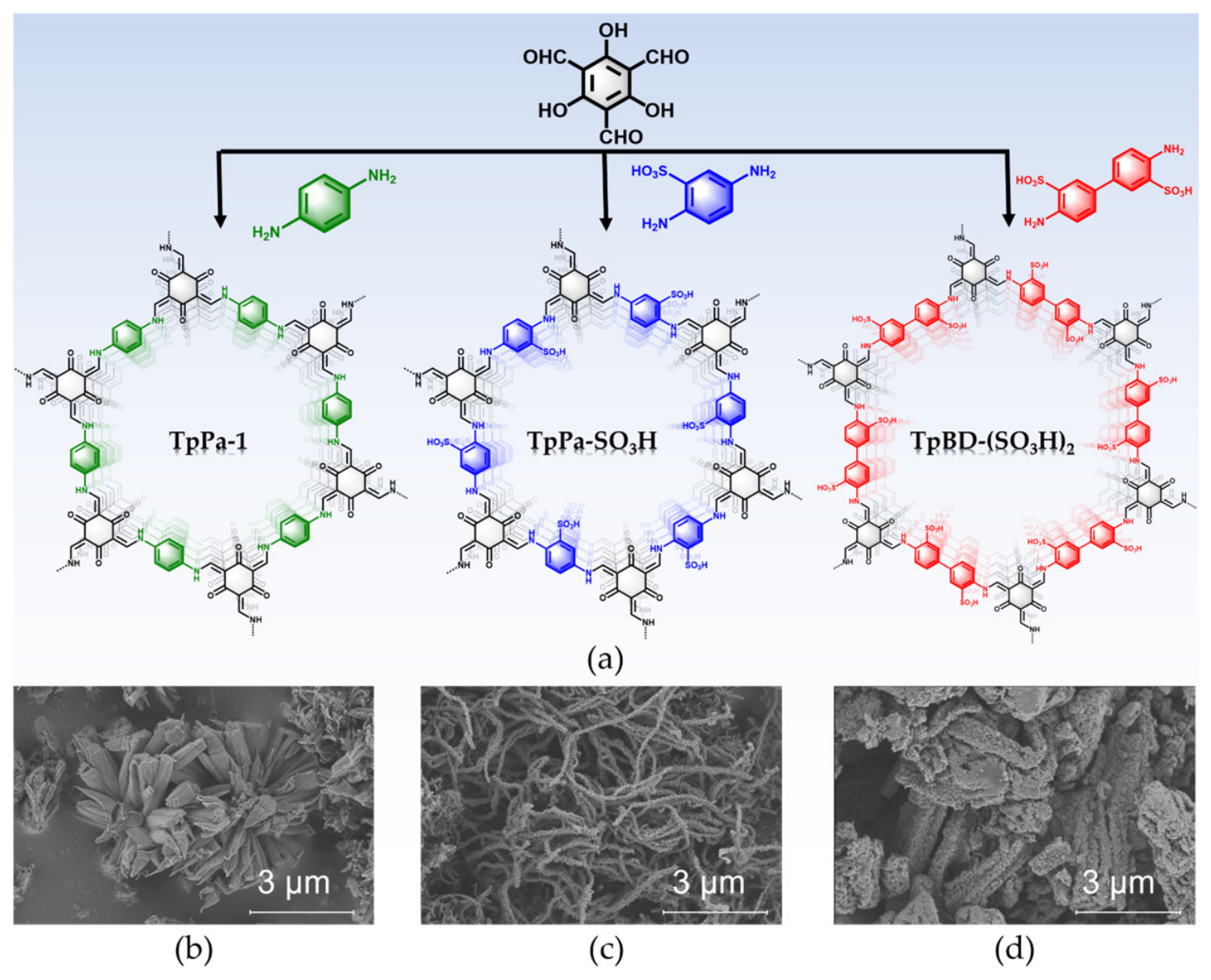
As a proof-of-concept study, herein, we report the isoreticular synthesis and structures of two sulfonic acid-functionalized COFs, namely TpPa-SO3H and TpBD-(SO3H)2 (Figure 1a), and their performance for the selective adsorption of SO2 over CO2, N2 and CH4. We introduced the –SO3H group into β-ketoenamine-based COFs via pre-synthetic strategy. This not only enhanced the interfacial polarity of the framework but also strengthened the interactions with SO2 molecules, thereby improving the affinity for SO2, especially under low-pressure conditions. Moreover, although the humid SO2 environmental conditions are of great significance in actual desulfurization scenarios, there are relatively few studies on the structural stability assessment in the literature regarding the use of COFs for SO2 removal. Our work demonstrated that these β-ketoenamine-based COFs exhibited good structural stability under both dry and humid SO2 conditions.

2. Results and Discussion

The synthetic routes of TpPa-1, TpPa-SO3H and TpBD-(SO3H)2 are depicted in Figure 1a, and all of them were prepared separately under similar solvothermal reaction conditions. Scanning electron microscopy (SEM) images show that TpPa-1 displays the flower-shaped morphology resulting from the aggregation of petals with lengths in the micrometer range (1–1.5 μm) (Figure 1b). TpPa-SO3H has nanofibrous morphology consisting of the interconnected tiny nanoparticles (Figure 1c). Moreover, TpBD-(SO3H)2 is composed of micrometer particles (Figure 1d).
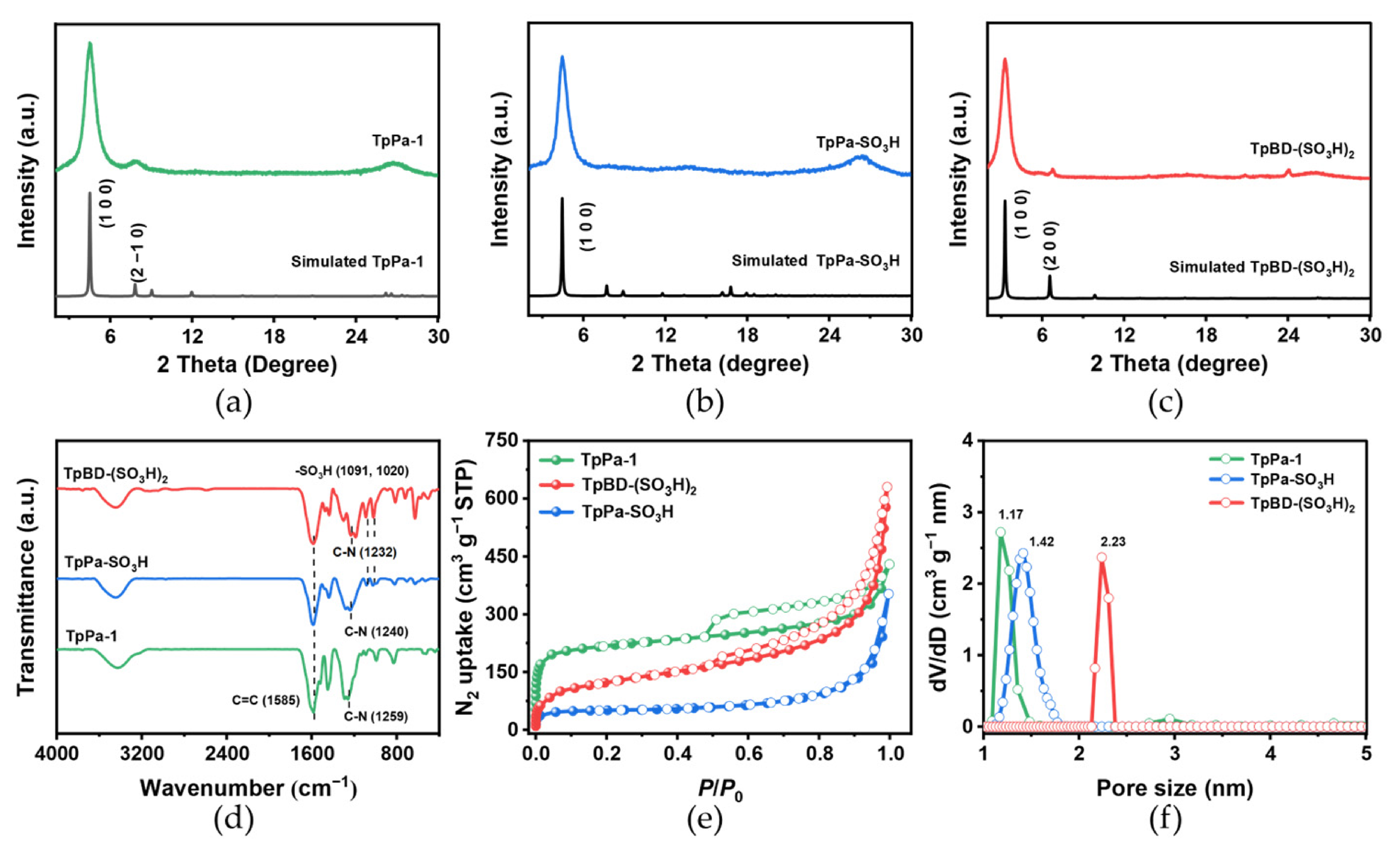
The powder XRD pattern of TpPa-1 shows typical diffraction peaks at 2θ values of 4.7° and 8.1° (Figure 2a), which are assigned to the (100) and (2−10) planes from the A-A stacking model [33], while TpPa-SO3H exhibits intense peaks of (100) facet at 4.9° (Figure 2b) [34]. TpBD-(SO3H)2 exhibits intense peaks of (100) and (200) facets at 3.7° and 7.2° (Figure 2c) [35], respectively. These results confirm the good crystallinity of the obtained three COFs. The reference XRD patterns were taken from the literature [33,34,35].
The Fourier transform infrared (FT-IR) spectra of TpPa-SO3H and TpBD-(SO3H)2 are different from that of TpPa-1 (Figure 2d and Figures S1–S3). The C=C and C–N stretching bands occur at 1585 and 1232–1259 cm−1, respectively, which clearly corroborates the formation of the β-ketoenamine configuration in TpPa-1, TpPa-SO3H and TpBD-(SO3H)2. Furthermore, new bands at 1091 and 1020 cm−1 can be attributed to the stretching vibrations of -SO3H in TpPa-SO3H and TpBD-(SO3H)2.
To further probe the surface properties of these iCOFs with –SO3H groups, zeta potential measurements were carried out in pure water. TpPa-1 shows a slightly positive zeta potential of 5.5 mV, whereas TpPa-SO3H and TpBD-(SO3H)2 exhibit obviously negative zeta potentials of −31 mV and −36 mV, respectively (Figure S4). These results indicate that the presence of –SO3H groups markedly changes the surface charge properties of the frameworks and increases the surface polarity of the two iCOFs. Such polar surfaces should be advantageous to provide more adsorption sites and strengthen the interactions with polar SO2 molecules, especially under low-pressure conditions.
The permanent porosities were assessed by N2 sorption measurements at 77 K (Figure 2e). The N2 adsorption–desorption isotherms of all samples exhibited a combination pattern of type I and type IV [36]. The Brunauer–Emmett–Teller (BET) specific surface area of TpPa-1 is calculated to be 687 m2 g−1. With integrated –SO3H groups, the BET surface areas of TpPa-SO3H and TpBD-(SO3H)2 are determined to be 195 and 430 m2 g−1 (Table 1). The pore size distribution analyses show that the dominant pores are centered at 11.7, 14.2, 22.3 Å for TpPa-1, TpPa-SO3H and TpBD-(SO3H)2 (Figure 2f, Table 1), respectively. Thermogravimetric analysis (TGA) curves show that TpPa-1 is stable before 330 °C under N2 atmosphere (Figure S5). Compared to TpPa-1, TpPa-SO3H and TpBD-(SO3H)2 display a slightly higher thermal stability, remaining stable up to 400 °C.
The water contact angle measurements were performed to investigate the wettability of all samples in the form of pellets (Figure S6). The results indicate that all materials possess hydrophilic surfaces. It is noticed that after the incorporation of –SO3H groups in the two iCOFs, these frameworks become more hydrophilic than TpPa-1, probably due to the increased polarity of the two iCOFs’ surfaces, which is consistent with the results of zeta potential measurements (Figure S4). These polar iCOFs are expected to show selective adsorption performance toward SO2.
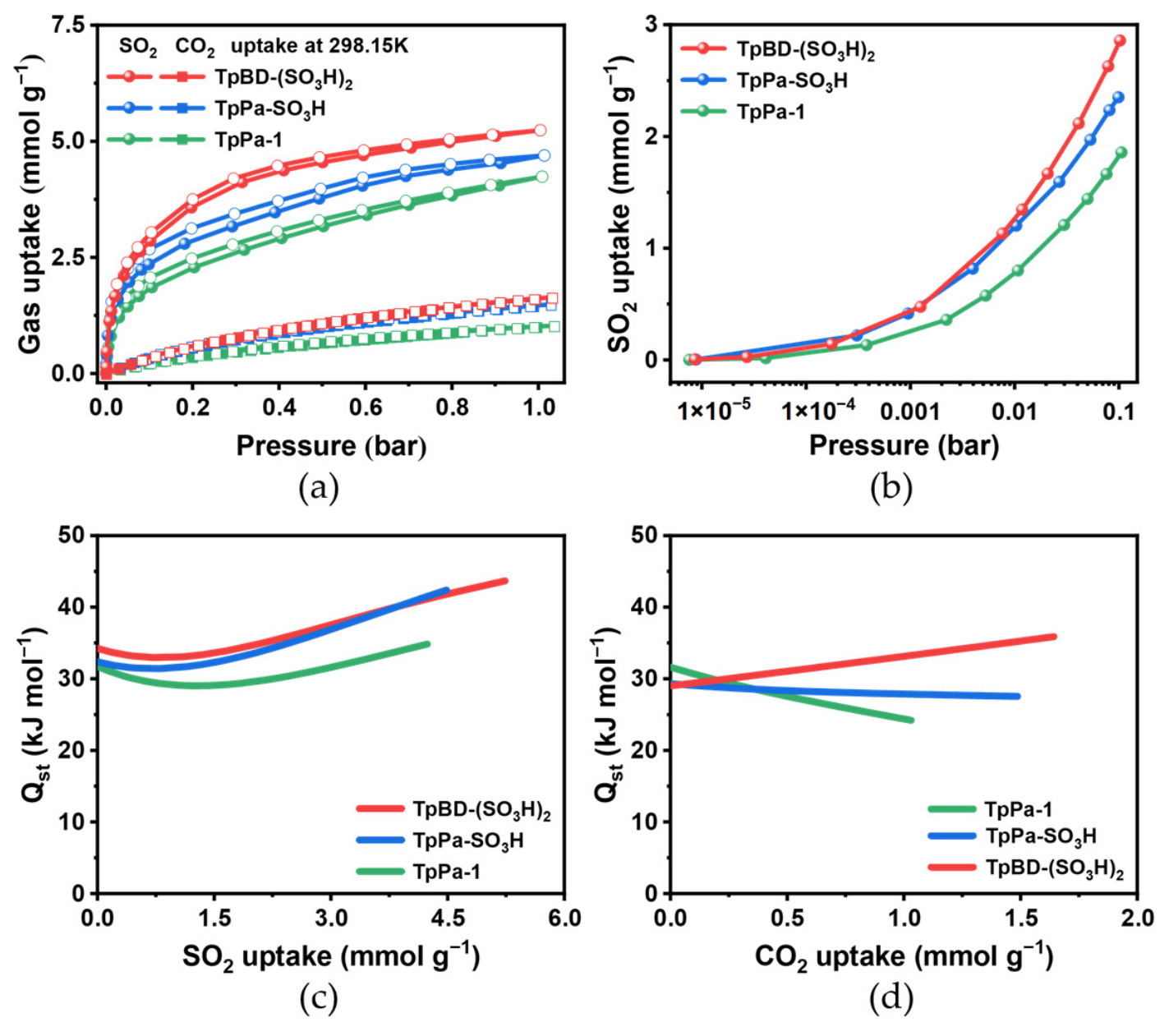
The SO2 adsorption isotherms of TpPa-1, TpPa-SO3H and TpBD-(SO3H)2 were collected at 298 K. At 1.0 bar, the SO2 adsorption capacities of TpPa-1, TpPa-SO3H and TpBD-(SO3H)2 were 4.24, 4.46, and 5.24 mmol g−1 (Figure 3a, Table 1). At 0.01 bar, TpPa-SO3H and TpBD-(SO3H)2 with –SO3H groups show significantly higher SO2 uptake capacities than TpPa-1 (1.19 mmol g−1 for TpPa-SO3H, 1.27 mmol g−1 for TpBD-(SO3H)2 and 0.78 mmol g−1 for TpPa-1) (Figure 3b, Table 1). Notably, the SO2 uptake of TpBD-(SO3H)2 at 298 K and 0.01 bar surpass the uptake in some well-known COFs, such as COF-701 [32] and TMT-TA [32]. As the pressure increased to 0.1 bar, the SO2 uptake of TpBD-(SO3H)2 rapidly rise to 2.83 mmol g−1, accounting for about 54% of the SO2 uptake. Similarly, TpPa-SO3H displays an adsorption capacity of 2.25 mmol g−1 at 0.1 bar, 50% of the total adsorption capacity. In contrast, TpPa-1 exhibits an adsorption capacity of 1.82 mmol g−1 at 0.1 bar, approximately 43% of the total adsorption capacity (Table 1). The observed relatively high SO2 uptake of TpBD-(SO3H)2 at low pressure (<0.1 bar) meets a prerequisite of potential adsorptive flue-gas desulfurization processes. The enhanced SO2 uptake of TpPa-SO3H and TpBD-(SO3H)2 in the low-pressure region should be reasonably associated with the introduction of polar –SO3H groups into the frameworks. This interpretation is further supported by the significantly negative zeta potentials of the sulfonated iCOFs (Figure S4). Compared with the non-sulfonated TpPa-1, the –SO3H-functionalized iCOFs provide more polar pore surfaces, which are favorable for strengthening the interactions with the polarizable SO2 molecules. Therefore, multiple adsorption sites (likely both carbonyl groups and sulfonate groups) might be responsible for the improved SO2 adsorption behavior under low pressures.
The SO2 adsorption isotherms at 273 K and 298 K were used to determine the isosteric enthalpy of SO2 adsorption (ΔHads = −Qst) by virial analysis (Figures S7 and S8) [37]. The −∆Hads values near zero coverage (−ΔHads0) in TpPa-1, TpPa-SO3H and TpBD-(SO3H)2 are 31.72, 32.36 and 34.26 kJ mol−1, respectively (Figure 3c). The −ΔHads values of the SO3H-functionalized COFs are slightly higher than that of TpPa-1, suggesting efficient host-guest interactions arising from the increased polarity of the two iCOFs.
The single-component CO2, CH4, and N2 adsorption isotherms for TpPa-1, TpPa-SO3H and TpBD-(SO3H)2 were measured at 298 K (Figures S9, S11 and S12). As expected, the two iCOFs exhibit slightly improved CO2 and CH4 adsorption performance than TpPa-1 up to 1 bar at 298K. Nevertheless, compared to TpPa-1, less N2 are adsorbed by TpPa-SO3H and TpBD-(SO3H)2 (Table S1). Notably, the SO2 adsorption curves of all COFs are much steeper than those of CO2 and CH4 probably due to the higher polarizability (47.7 × 10⁻²⁵ cm3) and higher dipole moment (1.63 D) of SO2 [5]. It should be noted that the uptake amounts of CO2 and CH4 were much lower than the SO2 uptake on these COFs at 1.0 bar (Table S1). Through virial analysis of CO2 adsorption isotherms at 273 K and 298 K, the −ΔHads0 of CO2 are determined to be 29.00, 29.32 and 31.61 kJ mol−1, respectively (Figure 3d and Figure S10). The generally higher −ΔHads values and steeper adsorption curves of SO2 than those of CO2 indicate the potential of these COFs for selective SO2 adsorption from gas mixtures. Overall, both the adsorption capacity of SO2 and isosteric heat of adsorption (−ΔHads) by iCOFs are slightly increased than those of TpPa-1 under low-pressure conditions. These indicate that the introduction of the −SO3H groups helps to enhance the polarity of the framework and providing more electron-rich adsorption sites and higher pore volumes for SO2, thereby significantly improving the affinity and uptake amount of SO2 by these iCOFs.
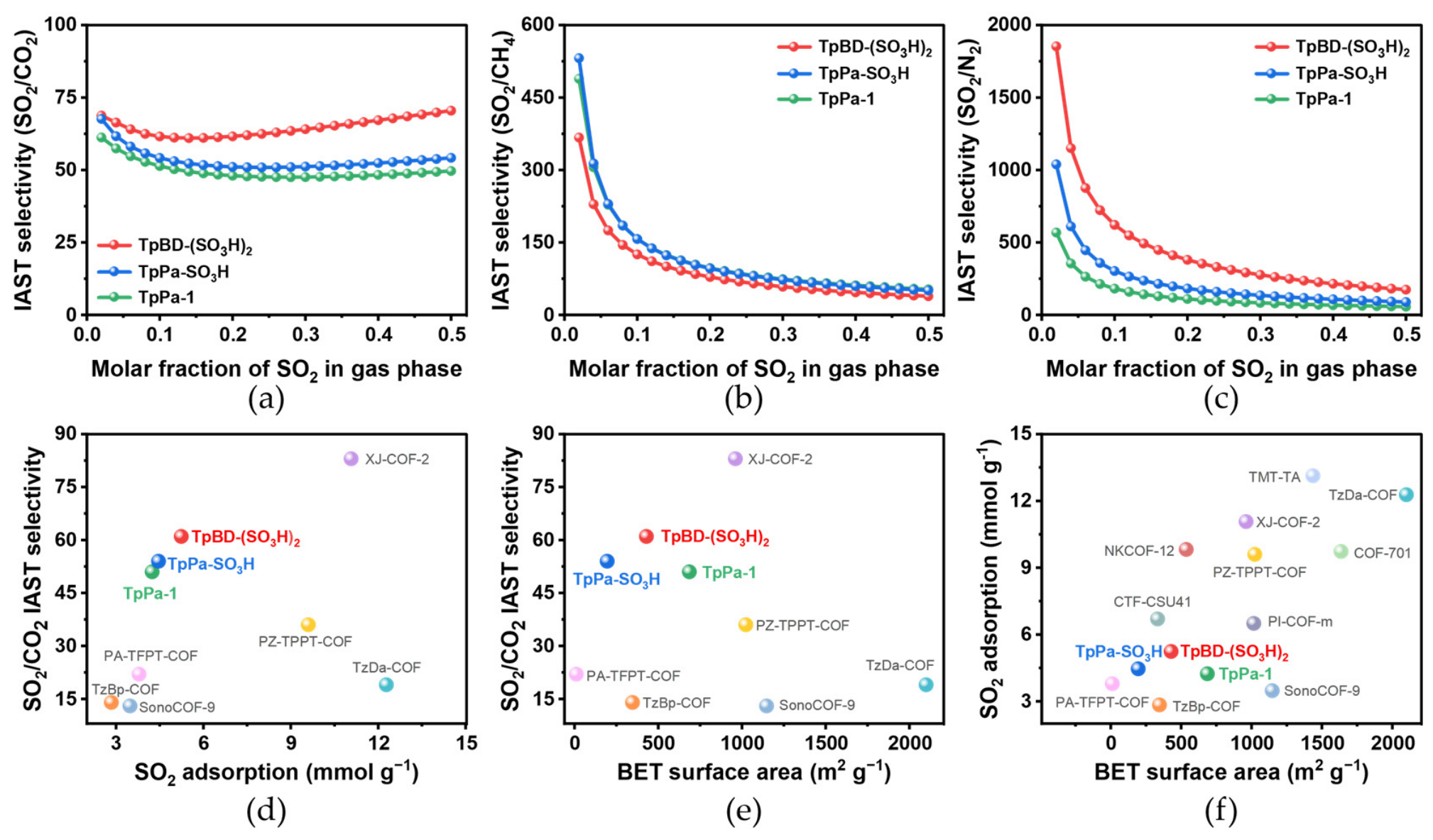
To evaluate the selectivity of SO2 over CO2, CH4, and N2, ideal adsorbed solution theory (IAST) calculations were performed for binary gas mixtures as a function of variable SO2 molar fractions from 0.02 to 0.5 at 1 bar and 298 K. Considering the trace SO2 amount present in the flue gas, high SO2 selectivity over these gases is required for a realistic adsorptive gas desulfurization process. For a molar SO2/CO2 ratio of 10:90, the selectivity of TpPa-1 is 51, while TpPa-SO3H and TpBD-(SO3H)2 display an increased selectivity of 54 and 61 (Figure 4a and Table S3). To the best of our knowledge, the IAST SO2/CO2 selectivity value of TpBD-(SO3H)2 is relatively high among all the COFs materials reported so far (Figure 4d,f and Table S4). Meanwhile, TpBD-(SO3H)2 also possesses a high SO2/CH4 and SO2/N2 selectivity of 124 and 621, respectively, when the SO2/CH4 or SO2/N2 ratio is 10:90 (Figure 4b,c). Furthermore, at a CO2/N2 ratio of 10:90, the CO2/N2 selectivity of TpBD-(SO3H)2 and TpPa-SO3H are 70 and 355, respectively (Figure S13 and Table S3). Therefore, the experimental results have demonstrated the superiority of these iCOFs with SO3H groups over neutral TpPa-1 for enhanced selective SO2 capture in flue gas containing SO2, CO2 and N2. TpPa-SO3H and TpBD-(SO3H)2 also show enhanced selective CO2 capture performance than TpPa-1 (Figure S13).
For porous materials, it is reported that BET surface area and the pore volume are the main factors contributing to high SO2 adsorption capacity at high pressure. However, unlike high-pressure SO2 adsorption, the uptake at low pressure correlates with the affinity between SO2 and the adsorbent pore surface [18]. In our work, TpPa-1, TpPa-SO3H and TpBD-(SO3H)2 show moderate surface areas and an increased pore volume of 0.42, 0.51, and 0.96 cm3 g−1, which explains their moderate and enhanced SO2 uptake capacity at 1 bar and 298 K (Figure 4e). Moreover, the incorporation of SO3H in these iCOFs efficiently enhanced the SO2 uptake at low pressure range (<0.1 bar) by providing polar surfaces, leading to improved SO2/CO2 selectivities, which are even higher than some COFs with higher BET surface areas (Figure 4f).
To investigate the structural stability of TpPa-1, TpPa-SO3H and TpBD-(SO3H)2 towards SO2, all activated materials were exposed to dry SO2 and to humid SO2 for 6 h. The humid SO2 condition corresponds to a sealed air atmosphere containing 35 ppm SO2 and 75% RH (please see Section S5 and Figure S14 for details). The XRD patterns of all materials after dry and humid SO2 exposure remained, suggesting the retention of crystallinity without noticeable phase transformation (Figure S15). After all the materials were exposed to dry and humid SO2 environments, the FT-IR spectra showed very little change. This indicates that their structures were maintained and no obvious covalent bond breakage occurred (Figure S16). Interestingly, a new peak at 1350~1326 cm−1 in TpPa-1, TpPa-SO3H, and TpBD-(SO3H)2 after humid SO2 exposure is observed, which might be assigned to the asymmetric stretching vibrations of residual SO2 molecules [38,39]. The symmetric stretch of adsorbed SO2 (around 1144 cm−1) are not observed due to overlap with the strong vibration bands of TpBD-(SO3H)2 [40]. The BET surface areas of TpPa-1, TpPa-SO3H, and TpBD-(SO3H)2 after exposure to dry and humid SO2 remained 98%, 97% and 95% of the pristine COFs after dry and humid SO2 adsorption (Figures S17 and S18). To further evaluate the structural robustness, the materials were also exposed to humid SO2 for extended durations of 24 h and 72 h. No significant changes can be observed in the XRD patterns (Figure S15), FT-IR spectra (Figure S16), and BET surface areas (Figures S17 and S18). These results indicate that the frameworks can maintain their crystallinity, chemical integrity, and porosity under prolonged humid SO2 conditions, suggesting their potential for stable adsorption performance.
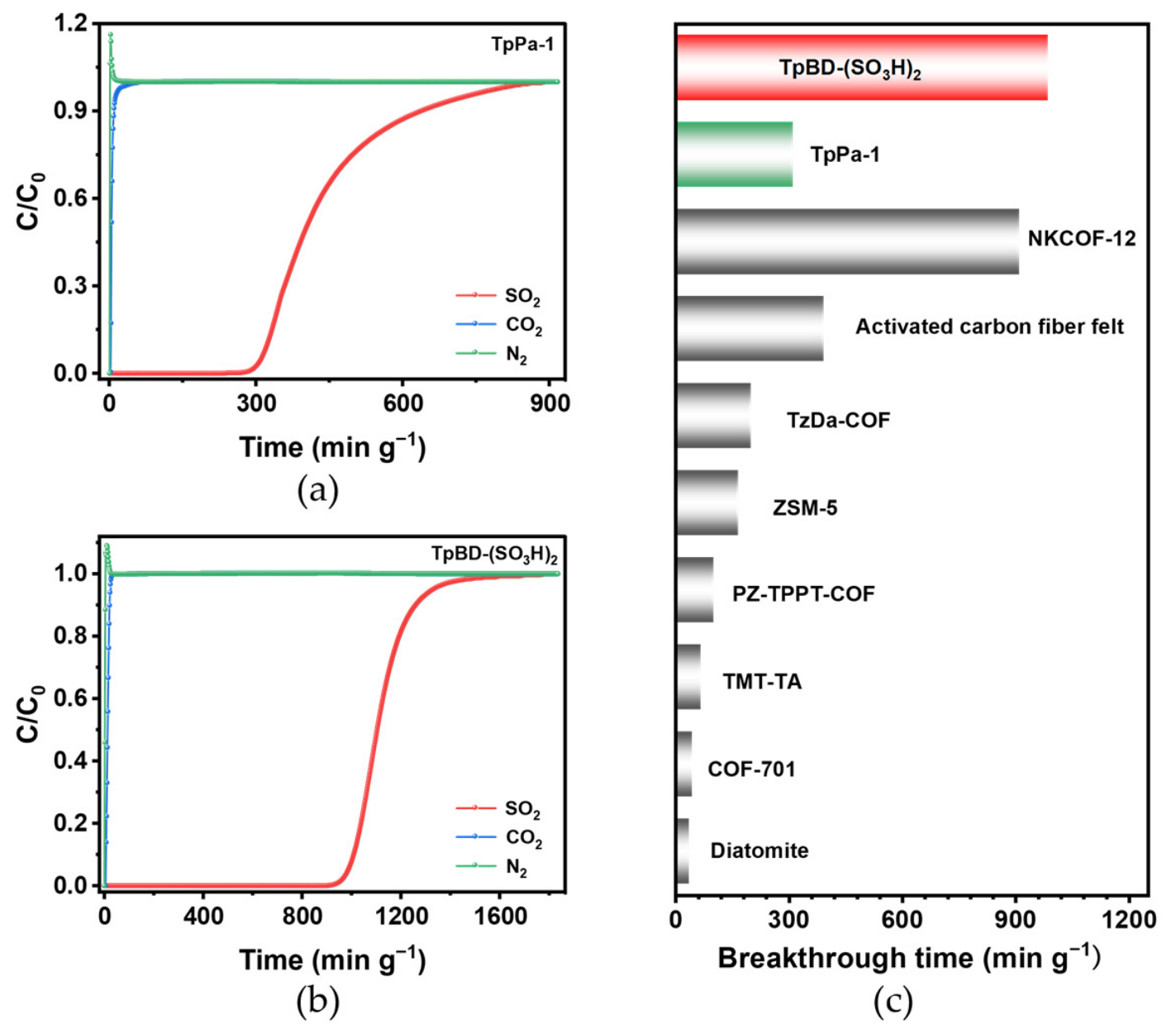
Furthermore, the selective capture of SO2 from mixed gases is of great importance for practical applications. To further evaluate the separation performance under competitive conditions, dynamic breakthrough experiments were conducted. A typical gas mixture of SO2/CO2/N2 (2000 ppm of SO2 + 14.8% CO2 + 85% N2) was purged into a COF-packed column with an inlet flow rate of 8 mL min−1 at 298 K and 1 bar. As shown in Figure 5, N2 and CO2 broke through the column rapidly, while SO2 was retained in the adsorption bed for a significantly longer time, indicating the preferential adsorption of SO2. TpPa-1 exhibited an SO2 breakthrough time of ~311 min g−1 with a saturated breakthrough capacity of 0.31 mmol g−1 (Figure 5a). Notably, TpBD-(SO3H)2 displayed a much longer breakthrough time of 987 min g−1 and a higher saturated breakthrough capacity of 0.80 mmol g−1 (Figure 5b). Compared to the microporous neutral TpPa-1, the significantly enhanced breakthrough performance of TpBD-(SO3H)2 can be ascribed to the presence of –SO3H groups and higher pore volumes under competitive conditions. Moreover, TpBD-(SO3H)2 compares favorably with representative SO2 adsorbents reported in the literature (Figure 5c, Table S5). These results are consistent with the selectivity trend predicted from the IAST analysis.

3. Materials and Methods

3.1. Instrumentation

Powder X-ray diffraction (PXRD) patterns were collected on an X-ray diffractometer (Cu Kα radiation source, Miniflex600, Rigaku, Tokyo, Japan). Fourier transform infrared (FT-IR) spectra were recorded with KBr pellets using a Bruker TENSOR 27 (Bruker Corporation, Karlsruhe, Germany) spectrometer. The surface charge characteristics of the samples were characterized using the SURPASS 3 type Zeta potential analyzer (Anton Paar GmbH, Shanghai, China). Nitrogen adsorption and desorption isotherms were measured at 77 K using a surface area and porosity analyzer (JW-BK200, Jingwei Gaobo Instrument Co., Ltd., Beijing, China). The samples were degassed at 120 °C for 10 h before the measurements. Specific surface areas were calculated from the adsorption data using the Brunauer–Emmett–Teller (BET) equation. The pore size distributions were obtained using nonlocal density functional theory (NLDFT) calculations with an “N2-Tarazona, cylinder” model. Thermogravimetric analysis (TGA) was carried out on a TG209F1 Libra instrument (NETZSCH Group, Bayern, Germany) by heating the samples from 30 to 800 °C in a dynamic nitrogen atmosphere with a heating rate of 10 °C min−1. The water contact angle was observed using a water contact angle analyzer (DSA100, KRÜSS, Hamburg, Germany). Scanning electron microscopy (SEM) images were obtained on a MIRA LMS microscope (Tescan Group a.s., Bohunice, Czech Republic) operated at an accelerating voltage of 3.0 kV. The humid SO2 atmosphere was monitored using a portable SO2 detector (GT903-SO2-B, Kornuo Electronic Technology Co., Ltd., Shenzhen, China).
Comparative SO2, CO2, CH4 and N2 gas adsorption experiments at 273 and 298 K:
Before each experiment, samples were activated for 12 h and at a minimum of 393 K under a vacuum < 5 × 10⁻³ mbar. SO2, and CH4 sorption experiments were measured at 273 and 298 K on an advanced corrosive gas adsorption and micropore analyzer (BSD-660MC, Beishide Instrument Technology Co., Ltd., Beijing, China) instrument within a pressure range of 1 × 10⁻³ to 1.0 bar. CO2, and N2 sorption experiments were measured at 273 and 298 K on an advanced measurement instrument (JW-BK330C, Jingwei Gaobo Instrument Co., Ltd., Beijing, China) within a pressure range of 1 × 10⁻³ to 1.0 bar. The breakthrough separation experiments were conducted in a multi-constituent adsorption breakthrough curve analyzer (BSD-MAB, Beishide Instrument Technology Co., Ltd., Beijing, China) under ambient conditions (298 K, 1 bar) using a gas mixture of 2000 ppm SO2 + 14.8% CO2 +85% N2. All used gases were of ultra-high purity (99.999%) and supplied by Sizhiqiti, Tianjin, China.

3.2. Chemicals

The 2,4,6-Triformylphloroglucinol (Tp) (98%), p-Phenylenediamine (Pa) (99%), 2,5-Diaminobenzenesulfonic acid (Pa-SO3H) (98%) and 4,4′-diamino-3,3′-biphenyl-disulfonic acid (BD-(SO3H)2) (97%) were obtained from the commercial supplier Adamas-beta (China), and were used without further purification. All solvents were purchased from commercial suppliers with a minimum purity of 99.8%.

3.3. Synthesis of TpPa-1

TpPa-1 was synthesized according to the modified literature procedures [33]. Tp (63.00 mg, 0.30 mmol), Pa (48.70 mg, 0.45 mmol), 1.5 mL of mesitylene and 1.5 mL of 1,4-dioxane were successively added to a Pyrex tube. This mixture was dispersed by ultrasonication for 10 min to get homogenous dispersion. Subsequently, 0.5 mL of CH3CO2H (3 mol L−1) was added to the tube. After the mixture was sonicated for 10 min, the tube was frozen under liquid N2 bath, and air was removed through three-pump-thaw cycles. Then, the tube was sealed off and put in an oven at 120 °C for 72 h. Reddish-brown powder was obtained by filtration after the mixture cooling down to room temperature. The powder was washed with tetrahydrofuran (THF), and further purified by Soxhlet extraction with THF over 24 h. The resultant reddish-brown solid was dried in a vacuum oven at 60 °C for 24 h.

3.4. Synthesis of TpPa-SO3H

TpPa-SO3H was synthesized according to the modified literature procedures [34]. Tp (63.00 mg, 0.30 mmol), Pa-SO3H (84.70 mg, 0.45 mmol), 2.7 mL of mesitylene and 0.3 mL of 1,4-dioxane were successively added to a Pyrex tube. This mixture was dispersed by ultrasonication for 10 min to get homogenous dispersion. Subsequently, 0.3 mL of CH3CO2H (6 mol L−1) was added to the tube. After the mixture was sonicated for 10 min, the tube was frozen under liquid N2 bath, and air was removed through three-pump-thaw cycles. Then, the tube was sealed off and put in an oven at 120 °C for 72 h. Reddish-brown powder was obtained by filtration after the mixture cooled down to room temperature. The powder was washed with acetone, and further purified by Soxhlet extraction with acetone over 24 h. The resultant reddish-brown solid was dried in a vacuum oven at 60 °C for 24 h.

3.5. Synthesis of TpBD-(SO3H)2

TpBD-(SO3H)2 was synthesized according to the modified literature procedures [35]. Tp (63.00 mg, 0.30 mmol), BD-(SO3H)2 (155.00 mg, 0.45 mmol), 2.4 mL of mesitylene and 0.6 mL of 1,4-dioxane were successively added to a Pyrex tube. This mixture was dispersed by ultrasonication for 10 min to get homogenous dispersion. Subsequently, 0.5 mL of CH3CO2H (6 mol L−1) was added to the tube. After the mixture was sonicated for 10 min, the tube was frozen under liquid N2 bath, and air was removed through three-pump-thaw cycles. Then, the tube was sealed off and put in an oven at 120 °C for 72 h. Reddish brown powder was obtained by filtration after the mixture cooling down to room temperature. The powder was washed with acetone, and further purified by Soxhlet extraction with acetone over 24 h. The resultant reddish-brown solid was dried in a vacuum oven at 60 °C for 24 h.

4. Conclusions

We have synthesized two β-ketoenamine-based ionic COFs with high thermal and chemical stability for the demanding selective SO2 capture at low pressures. Compared to the neutral COF without sulfonic acid group, it is found that the incorporation of sulfonic acid groups in these iCOFs could provide more polar surfaces for SO2 adsorption, and achieve higher SO2 affinity, higher SO2 uptake capacity (5.24 mmol g−1, 298 K, 1 bar) and improved SO2/CO2 selectivity (61, 298 K) in TpBD-(SO3H)2. The iCOFs also display enhanced SO2 capture performance than the neutral counterpart COF at low pressures of 0.001–0.01 bar. Additionally, all β-ketoenamine COFs exhibit excellent structural stability toward both dry and humid SO2. Considering the synthetic scalability, excellent stability and tunability of β-ketoenamine COFs [41], we believe that more ionic COFs can be developed for SO2 capture.

Supplementary Materials

The following supporting information can be downloaded at: https://www.mdpi.com/article/10.3390/molecules31091445/s1, Section S1: Isosteric enthalpy of adsorption; Section S2: Ideal adsorbed solution theory (IAST) Selectivity; Section S3: Characterization and analysis; Section S4: SO2, CO2, CH4 and N2 gas adsorption experiments; Section S5: Stability of crystallinity and porosity after dry and humid SO2 exposure; Section S6: Breakthrough performance; Section S7: References [26,27,28,29,30,31,32,37,42]; Figure S1: FT-IR spectra of Tp, Pa and TpPa-1; Figure S2: FT-IR spectra of Tp, Pa-SO3H and TpPa-SO3H; Figure S3: FT-IR spectra of Tp, BD-(SO3H)2 and TpBD-(SO3H)2; Figure S4: Zeta potential of TpPa-1, TpPa-SO3H and TpBD-(SO3H)2; Figure S5: TGA curves of TpPa-1, TpPa-SO3H and TpBD-(SO3H)2 under N2 atmosphere; Figure S6: Photographs demonstrating the hydrophilicity of TpPa-1, TpPa-SO3H and TpBD-(SO3H)2 with a water contact angle of 40°, 35°, 31°, respectively; Figure S7: SO2 sorption isotherms of (a) TpPa-1, (b) TpPa-SO3H and (c) TpBD-(SO3H)2 at 273 K and 298 K. Filled and open symbols indicate the adsorption and desorption, respectively; Figure S8: Virial analysis for SO2 adsorption isotherms of TpPa-1, TpPa-SO3H and TpBD-(SO3H)2 at 273 and 298 K with the fitting parameters (virial coefficients) ai and bj. The virial coefficients ai have the unit [K·mol−1]; Figure S9: CO2 sorption isotherms of (a) TpPa-1, (b) TpPa-SO3H and (c) TpBD-(SO3H)2 at 273 and 298 K. Filled and open symbols indicate the adsorption and desorption isotherms, respectively; Figure S10: Virial analysis for CO2 adsorption isotherms of TpPa-1, TpPa-SO3H and TpBD-(SO3H)2 at 273 and 298 K with the fitting parameters (virial coefficients) ai and bj. The virial coefficients ai have the unit [K·mol−1]; Figure S11: CH4 sorption isotherms of TpPa-1, TpPa-SO3H and TpBD-(SO3H)2 at 298 K. Filled and open symbols indicate the adsorption and desorption isotherms, respectively; Figure S12: N2 sorption isotherms of TpPa-1, TpPa-SO3H and TpBD-(SO3H)2 at 298 K. Filled and open symbols indicate the adsorption and desorption isotherms, respectively; Figure S13: IAST selectivity for CO2/N2 mixtures with varying CO2 molar fractions in the gas phase at 298 K and 1 bar; Figure S14: Setup for humid SO2 exposure experiments. Note: a, SO2 sensor and hygrometer; b, N2 flowmeter; c, natrium metabisulfite solution (Na2S2O5); d, sodium chloride solution; e, sample; f, NaOH aqueous solution; Figure S15: Comparison of PXRD patterns of (a) TpPa-1, (b) TpPa-SO3H and (c) TpBD-(SO3H)2 before and after exposure to dry or humid SO2 for different durations; Figure S16: Comparison of FT-IR patterns of (a) TpPa-1, (b) TpPa-SO3H and (c) TpBD-(SO3H)2 before and after exposure to dry or humid SO2 for different durations; Figure S17: Comparison of N2 adsorption isotherms of (a) TpPa-1, (b) TpPa-SO3H and (c) TpBD-(SO3H)2 before and after exposure to dry or humid SO2 for different durations; Figure S18: The retained BET surface area percentages of TpPa-1, TpPa-SO3H and TpBD-(SO3H)2 after exposure to dry or humid SO2 for different durations relative to corresponding pristine COFs; Table S1: CO2, CH4 and N2 uptakes at different partial pressures and isosteric enthalpies of adsorption on TpPa-1, TpPa-SO3H and TpBD-(SO3H)2 at 298 K; Table S2: Parameters of DSLAI Sips model fitted adsorption isotherms; Table S3: The result of IAST selectivity of TpPa-1, TpPa-SO3H and TpBD-(SO3H)2 at 298 K at 1 bar; Table S4: Comparison of SO2 sorption data in this work with reported COFs; Table S5: The breakthrough time of TpPa-1, TpBD-(SO3H)2 and representative adsorbents.

Author Contributions

Conceptualization, Z.L.; data curation, Z.L.; formal analysis, Z.L.; funding acquisition, J.L., Q.W. and R.W.; investigation, Z.L. and S.L.; methodology, Z.L., S.L. and Q.W.; project administration, J.L. and R.W.; resources, J.L. and R.W.; software, Z.L.; supervision, J.L., Q.W. and R.W.; validation, J.L. and Q.W.; visualization, Z.L.; writing—original draft preparation, Z.L.; writing—review and editing, J.L. and R.W. All authors have read and agreed to the published version of the manuscript.

Funding

This research was funded by the National Natural Science Foundation of China, grant number 22001178, 22471055, 22201286; Natural Science Foundation of Hebei Province, grant number B2021202077, B2024202021, B2024202073; S&T Program of Hebei, grant number 236Z4308G; the Scientific Research Projects of Higher Education Institutions in Hebei Province (QN2025257); and Postdoctoral Fellowship Program of CPSF, grant number GZC20240369.

Institutional Review Board Statement

Not applicable.

Informed Consent Statement

Not applicable.

Data Availability Statement

The original contributions presented in this study are included in the article/Supplementary Materials. Further inquiries can be directed to the corresponding author.

Acknowledgments

Special thanks go to Jie Li at the Hebei University of Technology for the water contact angle measurements.

Conflicts of Interest

The authors declare no conflicts of interest.

References

  1. Meng, Z.; Liu, Y.; Wu, D. Effect of sulfur dioxide inhalation on cytokine levels in lungs and serum of mice. Inhal. Toxicol. 2005, 17, 303–307. [Google Scholar] [CrossRef] [Scilit]
  2. Bernstein, J.; Alexis, N.; Barnes, C.; Bernstein, I.; Nel, A.; Peden, D.; Diaz-Sanchez, D.; Tarlo, S.; Williams, P.; Bernstein, J. Health effects of air pollution. J. Allergy Clin. Immun. 2004, 114, 1116–1123. [Google Scholar] [CrossRef] [Scilit]
  3. Keith, D. Why Capture CO2 from the Atmosphere? Science 2009, 325, 1654–1655. [Google Scholar] [CrossRef] [Scilit]
  4. Smith, G.; Eyley, J.; Han, X.; Zhang, X.; Li, J.; Jacques, N.; Godfrey, H.; Argent, S.; Mcpherson, L.; Teat, S.; et al. Reversible coordinative binding and separation of sulfur dioxide in a robust metal-organic framework with open copper sites. Nat. Chem. 2019, 18, 1358–1365. [Google Scholar] [CrossRef] [Scilit]
  5. Yang, S.; Sun, J.; Ramirez-Cuesta, A.; Callear, S.; David, W.; Anderson, D.; Newby, R.; Blake, A.; Parker, J.; Tang, C.; et al. Selectivity and direct visualization of carbon dioxide and sulfur dioxide in a decorated porous host. Nat. Chem. 2012, 4, 887–894. [Google Scholar] [CrossRef] [Scilit] [PubMed]
  6. Hou, Y.; Chen, Y.; He, X.; Wang, F.; Cai, Q.; Shen, B. Insights into the adsorption of CO2, SO2 and NOx in flue gas by carbon materials: A critical review. Chem. Eng. J. 2024, 490, 151424. [Google Scholar] [CrossRef] [Scilit]
  7. Xu, W.; Li, L.; Guo, M.; Zhang, F.; Dai, P.; Gu, X.; Liu, D.; Liu, T.; Zhang, K.; Xing, T.; et al. Fabrication of pillar-cage fluorinated anion pillared metal-organic frameworks via a pillar embedding strategy and efficient separation of so2 through multi-site trapping. Angew. Chem. Int. Ed. 2023, 62, e202312029. [Google Scholar] [CrossRef] [Scilit] [PubMed]
  8. Martínez-Ahumada, E.; He, D.; Berryman, V.; López-Olvera, A.; Hernandez, M.; Jancik, V.; Martis, V.; Vera, M.A.; Lima, E.; Parker, D.; et al. SO2 capture using porous organic cages. Angew. Chem. Int. Ed. 2021, 60, 17556–17563. [Google Scholar] [CrossRef] [Scilit]
  9. Cui, X.; Yang, Q.; Krishna, R.; Wu, H.; Zhou, W.; Chen, B.; Xing, H. Ultrahigh and selective SO2 uptake in inorganic anion-pillared hybrid porous materials. Adv. Mater. 2017, 29, 1606929. [Google Scholar] [CrossRef] [Scilit]
  10. Han, Z.; Li, J.; Lu, W.; Wang, K.; Chen, Y.; Zhang, X.; Lin, L.; Han, X.; Teat, S.; Frogley, M.; et al. A {Ni12}-wheel-based metal-organic framework for coordinative binding of sulphur dioxide and nitrogen dioxide. Angew. Chem. Int. Ed. 2022, 61, e202115585. [Google Scholar] [CrossRef] [Scilit] [PubMed]
  11. Ding, S.; Liu, F.; Shi, X.; Liu, K.; Lian, Z.; Xie, L.; He, H. Significant promotion effect of mo additive on a novel ce-zr mixed oxide catalyst for the selective catalytic reduction of NOx with NH3. ACS Appl. Mater. Interfaces 2015, 7, 9497–9506. [Google Scholar] [CrossRef] [Scilit]
  12. Kinnunen, N.; Hirvi, J.; Kallinen, K.; Maunula, T.; Keenan, M.; Suvanto, M. Case study of a modern lean-burn methane combustion catalyst for automotive applications: What are the deactivation and regeneration mechanisms? Appl. Catal. B Environ. 2017, 207, 114–119. [Google Scholar] [CrossRef] [Scilit]
  13. Kan, X.; Yuan, J.; Zhu, Q.; Qiu, Y.; Zhong, S.; Liu, Z.; Zheng, A.; Liu, F.; Jiang, L. Edge-nitrogen rich porous carbons for acid gases capture. Chem. Eng. J. 2025, 512, 162353. [Google Scholar] [CrossRef] [Scilit]
  14. Yang, Y.; Hao, X.; Sun, Z.; Chen, Y.; Xu, Z.; Zhao, W. Fabrication of metal oxides-based adsorbents for SO2 capture with equimolar adsorption. Chem. Eng. J. 2024, 486, 150106. [Google Scholar] [CrossRef] [Scilit]
  15. Zhang, Q.; Ye, M.; Lei, Y.; Wang, H.; Zheng, Y.; Xiao, Y.; Liu, F.; Jiang, L. Additive-free synthesis of house-of-card NaX zeolite for supporting amine: An efficient adsorbent for SO2 removal. Sep. Purif. Technol. 2025, 354, 129481. [Google Scholar] [CrossRef] [Scilit]
  16. Chen, F.; Lai, D.; Guo, L.; Wang, J.; Zhang, P.; Wu, K.; Zhang, Z.; Yang, Q.; Yang, Y.; Chen, B.; et al. Deep desulfurization with record SO2 adsorption on the metal–organic frameworks. J. Am. Chem. Soc. 2021, 143, 9040–9047. [Google Scholar] [CrossRef] [Scilit]
  17. Xiong, X.; Song, L.; Liang, J.; Qin, Z.; Huo, X.; Liang, Z.; Tan, L.; Wei, Z.; Li, M.; Huang, X.; et al. Synthesis of single-crystal UiO-67-(NH2)2 for effective SO2 adsorption and separation from flue gas. Sep. Purif. Technol. 2025, 361, 131642. [Google Scholar] [CrossRef] [Scilit]
  18. Obeso, J.; Flores, C.; Peralta, R.; Viniegra, M.; Martín-Guaregua, N.; Huxley, M.; Solis-Ibarra, D.; Ibarra, I.; Janiak, C. Metal-organic frameworks (MOFs) toward SO2 detection. Chem. Soc. Rev. 2025, 54, 4135–4163. [Google Scholar] [CrossRef] [Scilit] [PubMed]
  19. Li, Y.; Sun, Y.; Bai, X.; Song, H.; Guo, W.; Zhao, S.; Chen, Q. Improvement of SO2/CO2 separation performance in a Hofmann-type metal-organic framework with functional amino groups. Sep. Purif. Technol. 2025, 364, 132492. [Google Scholar] [CrossRef] [Scilit]
  20. Li, J.; Shi, G.; Shi, Z.; Feng, B.; Li, W.; Li, G.; Zhang, L.; Liu, X.; Liu, Y. Function-oriented synthesis of zirconium-based metal–organic framework with a novel topology for efficient flue gas desulfurization. Chem. Eng. J. 2025, 509, 161163. [Google Scholar] [CrossRef] [Scilit]
  21. Wang, S.; Yang, Y.; Zhang, Z. Designing and molding covalent organic frameworks for separation applications. Acc. Mater. Res. 2023, 4, 953–967. [Google Scholar] [CrossRef] [Scilit]
  22. Li, J.; Jing, X.; Li, Q.; Li, S.; Gao, X.; Feng, X.; Wang, B. Bulk COFs and COF nanosheets for electrochemical energy storage and conversion. Chem. Soc. Rev. 2020, 49, 3565–3604. [Google Scholar] [CrossRef] [Scilit]
  23. Zhang, P.; Wang, Z.; Yang, Y.; Wang, S.; Wang, T.; Liu, J.; Cheng, P.; Chen, Y.; Zhang, Z. Melt polymerization synthesis of a class of robust self-shaped olefin-linked COF foams as high-efficiency separators. Sci. China Chem. 2022, 65, 1173–1184. [Google Scholar] [CrossRef] [Scilit]
  24. Jadhav, T.; Fang, Y.; Liu, C.; Dadvand, A.; Hamzehpoor, E.; Patterson, W.; Jonderian, A.; Stein, R.; Perepichka, D. Transformation between 2D and 3D covalent organic frameworks via Reversible [2 + 2] Cycloaddition. J. Am. Chem. Soc. 2020, 142, 8862–8870. [Google Scholar] [CrossRef] [Scilit]
  25. Acharjya, A.; Pachfule, P.; Roeser, J.; Schmitt, F.; Thomas, A. Vinylene-linked covalent organic frameworks by base-catalyzed aldol condensation. Angew. Chem. Int. Ed. 2019, 58, 14865–14870. [Google Scholar] [CrossRef] [Scilit] [PubMed]
  26. Lee, G.; Lee, J.; Vo, H.; Kim, S.; Lee, H.; Park, T. Amine-functionalized covalent organic framework for efficient SO2 capture with high reversibility. Sci. Rep. 2017, 7, 557. [Google Scholar] [CrossRef] [Scilit] [PubMed]
  27. Fu, Y.; Wu, Y.; Chen, S.; Zhang, W.; Zhang, Y.; Yan, T.; Yang, B.; Ma, H. Zwitterionic covalent organic frameworks: Attractive porous host for gas separation and anhydrous proton conduction. ACS Nano 2021, 15, 19743–19755. [Google Scholar] [CrossRef] [Scilit] [PubMed]
  28. Qu, Y.; Liu, F.; Zhuo, L.; Zheng, L.; Zhong, S.; Xiao, Y.; Zheng, Y.; Zheng, A.; Liu, F.; Jiang, L. Pyrazine-functionalized sp2 carbon-conjugated covalent organic frameworks for selective capture of sulfur dioxide. Sep. Purif. Technol. 2025, 371, 133402. [Google Scholar] [CrossRef] [Scilit]
  29. Zhuo, L.; Qu, Y.; Zhong, S.; Zheng, L.; Xiao, Y.; Zheng, Y.; Liu, F.; Jiang, L. Covalent organic framework for room-temperature pressure swing adsorption of SO2. Chem. Eng. Sci. 2026, 320, 122593. [Google Scholar] [CrossRef] [Scilit]
  30. Fu, Y.; Wang, Z.; Li, S.; He, X.; Pan, C.; Yan, J.; Yu, G. Functionalized covalent triazine frameworks for effective CO2 and SO2 removal. ACS Appl. Mater. Interfaces 2018, 10, 36002–36009. [Google Scholar] [CrossRef] [Scilit]
  31. Zhao, W.; Obeso, J.; López-Cervantes, V.; Bahri, M.; Sánchez-González, E.; Amador-Sánchez, Y.; Ren, J.; Browning, N.; Peralta, R.; Barcaro, G.; et al. Achieving sub-ppm sensitivity in SO2 detection with a chemically stable covalent organic framework. Angew. Chem. Int. Ed. 2025, 64, e202415088. [Google Scholar] [CrossRef] [Scilit]
  32. Wang, S.; Fu, Y.; Wang, F.; Wang, X.; Yang, Y.; Wang, M.; Wang, J.; Lin, E.; Ma, H.; Chen, Y.; et al. Scalable melt polymerization synthesis of covalent organic framework films for room temperature low-concentration SO2 detection. J. Am. Chem. Soc. 2024, 146, 33509–33517. [Google Scholar] [CrossRef] [Scilit]
  33. Kandambeth, S.; Mallick, A.; Lukose, B.; Mane, M.; Heine, T.; Banerjee, R. Construction of crystalline 2D covalent organic frameworks with remarkable chemical (acid/base) stability via a combined reversible and irreversible route. J. Am. Chem. Soc. 2012, 134, 19524–19527. [Google Scholar] [CrossRef] [Scilit] [PubMed]
  34. Shi, Z.; Guo, Y.; Zou, X.; Zhang, J.; Chen, Z.; Shan, M.; Zhang, Z.; Guo, S.; Yan, F. Low evaporation enthalpy ionic covalent organic frameworks for efficient atmospheric water harvesting at low humidity. Angew. Chem. Int. Ed. 2025, 64, e202420619. [Google Scholar] [CrossRef] [Scilit]
  35. Biswal, B.; Chandra, S.; Kandambeth, S.; Lukose, B.; Heine, T.; Banerjeet, R. Mechanochemical synthesis of chemically stable isoreticular covalent organic frameworks. J. Am. Chem. Soc. 2013, 135, 5328–5331. [Google Scholar] [CrossRef] [Scilit]
  36. Thommes, M.; Kaneko, K.; Neimark, A.V.; Olivier, J.P.; Rodriguez-Reinoso, F.; Rouquerol, J.; Sing, K.S.W. Physisorption of gases, with special reference to the evaluation of surface area and pore size distribution (IUPAC Technical Report). Pure Appl. Chem. 2015, 87, 1051–1069. [Google Scholar] [CrossRef] [Scilit]
  37. Nuhnen, A.; Janiak, C. A practical guide to calculate the isosteric heat/enthalpy of adsorption via adsorption isotherms in metal–organic frameworks, MOFs. Dalton Trans. 2020, 49, 10295–10307. [Google Scholar] [CrossRef] [Scilit] [PubMed]
  38. Goodman, A.; Li, P.; Usher, C.; Grassian, V. Heterogeneous uptake of sulfur dioxide on aluminum and magnesium oxide particles. J. Phys. Chem. A 2001, 105, 6109–6120. [Google Scholar] [CrossRef] [Scilit]
  39. Tan, K.; Canepa, P.; Gong, Q.; Liu, J.; Johnson, D.; Dyevoich, A.; Thallapally, P.; Thonhauser, T.; Li, J.; Chabal, Y. Mechanism of preferential adsorption of SO2 into two microporous paddle wheel frameworks M(bdc)(ted)0.5. Chem. Mater. 2013, 25, 4653–4662. [Google Scholar] [CrossRef] [Scilit]
  40. Liang, J.; Xing, S.; Brandt, P.; Nuhnen, A.; Schlüsener, C.; Sun, Y.; Janiak, C. A chemically stable cucurbit [6]uril-based hydrogen-bonded organic framework for potential SO2/CO2 separation. J. Mater. Chem. A 2020, 8, 19799–19804. [Google Scholar] [CrossRef] [Scilit]
  41. Wang, K.; Qiao, X.; Ren, H.; Chen, Y.; Zhang, Z. Industrialization of covalent organic frameworks. J. Am. Chem. Soc. 2025, 147, 8063–8082. [Google Scholar] [CrossRef] [Scilit] [PubMed]
  42. Mounfield, W., III; Han, C.; Pang, S.; Tumuluri, U.; Jiao, Y.; Bhattacharyya, S.; Dutzer, M.; Nair, S.; Wu, Z.; Lively, R.; et al. Synergistic effects of water and SO2 on degradation of MIL-125 in the presence of acid gases. J. Phys. Chem. C 2016, 120, 27230–27240. [Google Scholar] [CrossRef] [Scilit]
Figure 1. (a) Schematic representation of the synthesis of TpPa-1, TpPa-SO3H and TpBD-(SO3H)2 with hexagonal pores. SEM images of (b) TpPa-1, (c) TpPa-SO3H and (d) TpBD-(SO3H)2.
Molecules 31 01445 g001
Figure 2. PXRD patterns of as-synthesized and simulated (a) TpPa-1, (b) TpPa-SO3H and (c) TpBD-(SO3H)2. (d) FT-IR spectra, (e) N2 adsorption-desorption isotherms with solid dots and white dots, respectively, and (f) pore size distributions based on nonlocal density functional theory (NLDFT) calculations for TpPa-1, TpPa-SO3H and TpBD-(SO3H)2.
Molecules 31 01445 g002
Figure 3. (a) SO2 and CO2 sorption isotherms of TpPa-1, TpPa-SO3H and TpBD-(SO3H)2 measured up to 1 bar at 298 K. (b) The enlarged SO2 adsorption at low pressure of 0–0.1 bar for better clarity of the onset of steep uptake. Isosteric enthalpy of adsorption of (c) SO2 and (d) CO2 on TpPa-1, TpPa-SO3H and TpBD-(SO3H)2 calculated by virial fitting of the single-component adsorption isotherms measured at 273 and 298 K, respectively (Figures S7–S10).
Molecules 31 01445 g003
Figure 4. IAST selectivity of (a) SO2/CO2, (b) SO2/CH4 and (c) SO2/N2 for TpPa-1, TpPa-SO3H and TpBD-(SO3H)2 series as a function of SO2 molar fractions (0.02–0.5) at 1 bar and 298 K. Comparison of SO2 adsorption performance of TpPa-1, TpPa-SO3H, TpBD-(SO3H)2 and representative COFs. (d) Plot of SO2/CO2 selectivity against SO2 adsorption capacity at 1.0 bar. (e) Plot of SO2 adsorption capacity against BET surface area. (f) Plot of SO2/CO2 selectivity against BET surface area. Temperature for TpPa-1, TpPa-SO3H, TpBD-(SO3H)2 is at 298 K (Table S4).
Molecules 31 01445 g004
Figure 5. Experimental breakthrough curves of mixture gas SO2/CO2/N2 (2000 ppm + 14.8% + 85%) for (a) TpPa-1 and (b) TpBD-(SO3H)2. (c) The breakthrough time of TpPa-1, TpBD-(SO3H)2 and representative adsorbents.
Molecules 31 01445 g005
Table 1. Porosity characteristics of TpPa-1, TpPa-SO3H and TpBD-(SO3H)2 and the results of SO2 adsorption at 298 K.
MaterialBET-Surface Area 1
[m2 g−1]
Pore Width 2
[Å]
SO2 Uptake (298 K)
[mmol g−1] at:
SO2/CO2 Selectivity 3 at
SO2/CO2 Molar Ratio:
0.01 Bar0.1 Bar1.0 Bar0.10.5
TpPa-16871.00–1.590.781.824.245149
TpPa-SO3H1951.12–1.811.192.254.465454
TpBD-(SO3H)24302.13–2.381.272.835.246170
1 Obtained from five adsorption points in the pressure range 0.001 < P/P0 < 0.05. 2 Pore widths from pore size distribution are measured by N2 sorption at 77 K. 3 See Section S4 in the SI for the CO2 sorption data.
Disclaimer/Publisher’s Note: The statements, opinions and data contained in all publications are solely those of the individual author(s) and contributor(s) and not of MDPI and/or the editor(s). MDPI and/or the editor(s) disclaim responsibility for any injury to people or property resulting from any ideas, methods, instructions or products referred to in the content.