Research Progress on Nano-TiO2 Photocatalytic Degradation of Automobile Exhaust


Abstract
1. Introduction
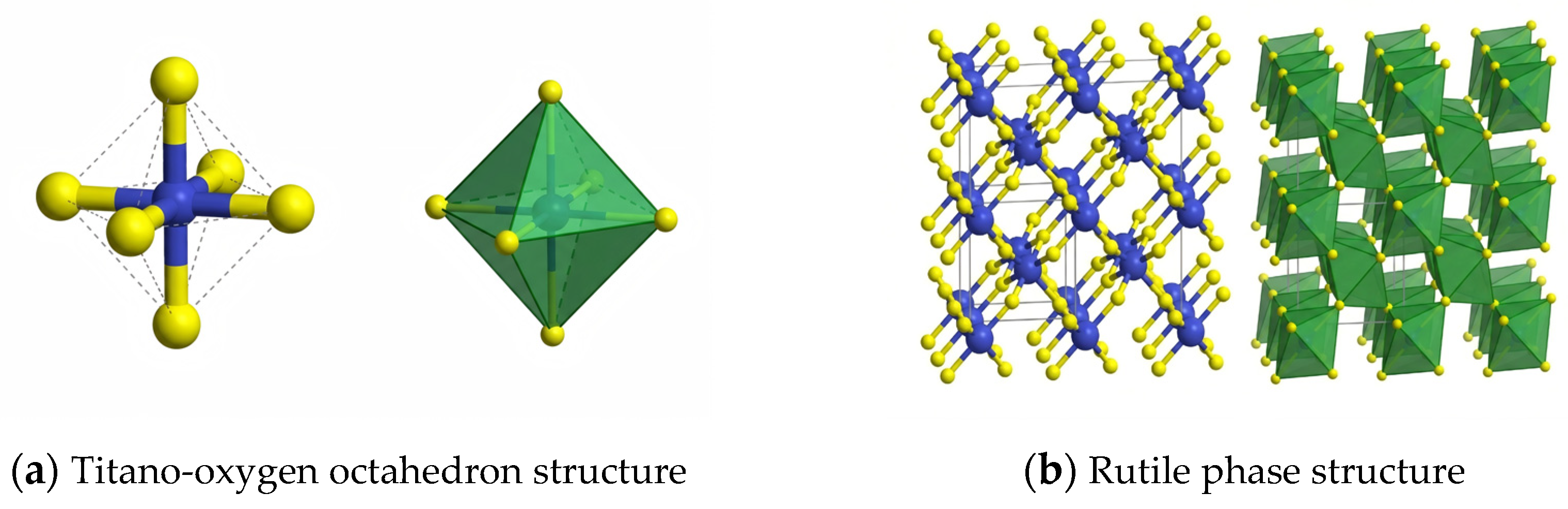
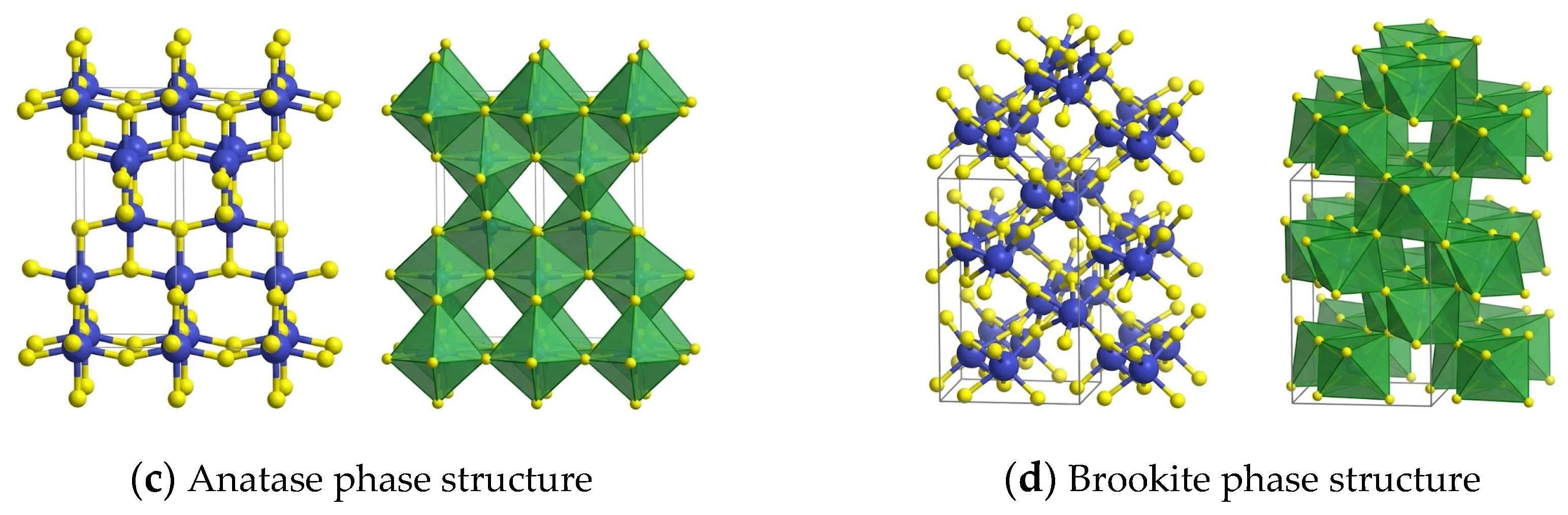
2. Structure and Physicochemical Properties of Nano-TiO2
2.1. Structure of Nano-TiO2
2.2. Physicochemical Properties of Nano-TiO2
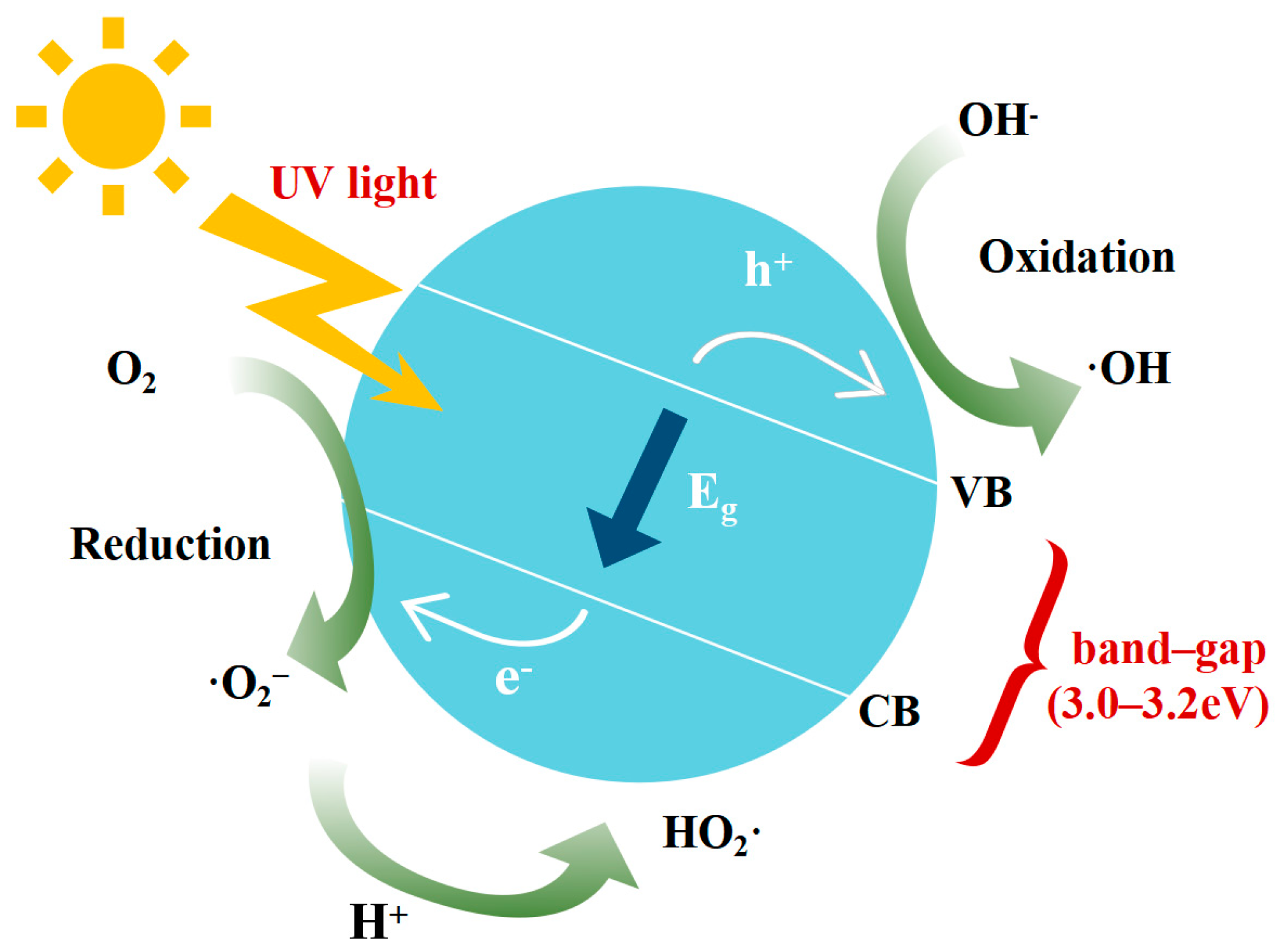
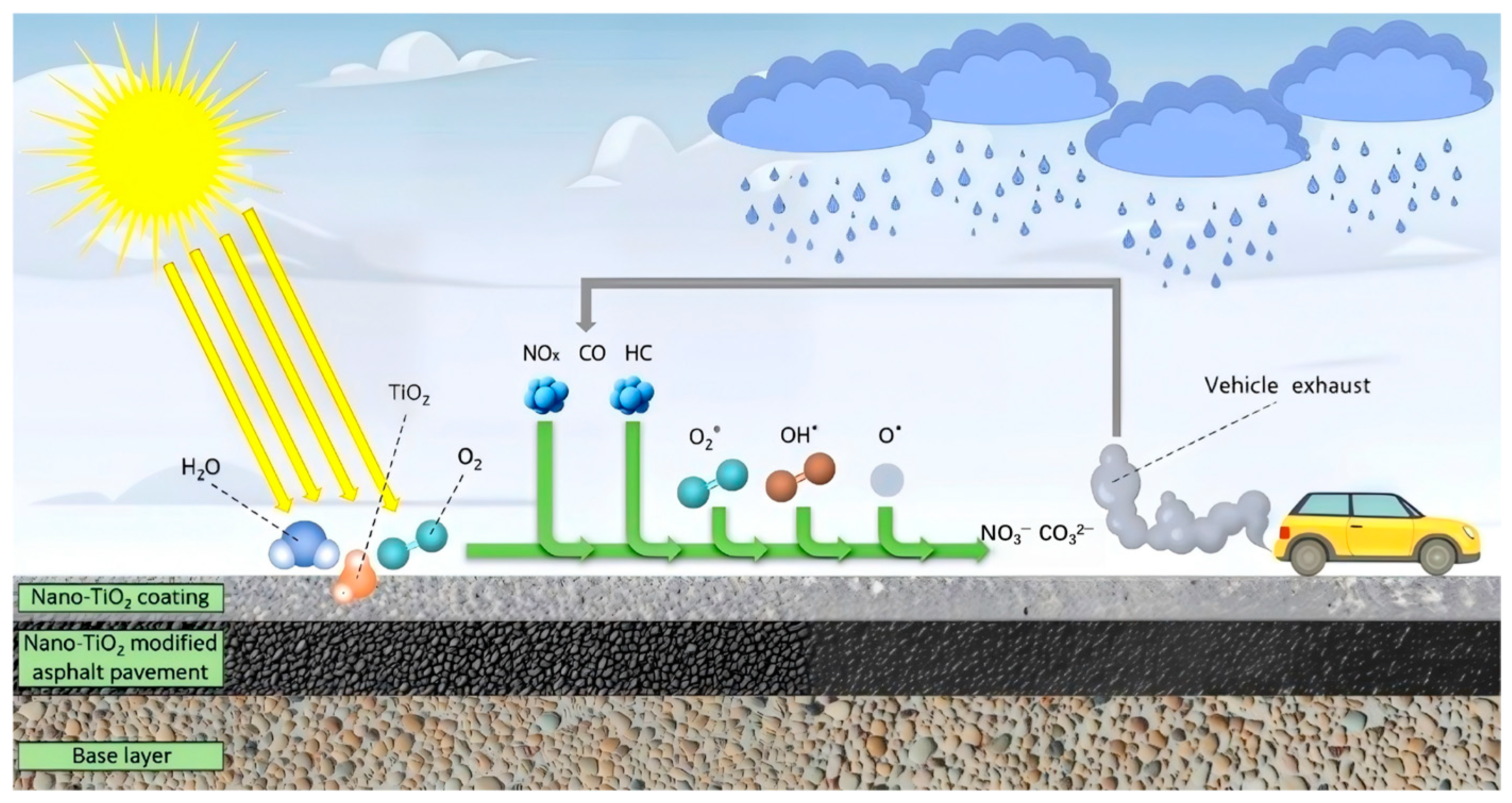
3. Mechanism of Nano-TiO2 Photocatalytic Degradation of Automobile Exhaust
4. Research on the Application of Nano-TiO2 Photocatalytic Degradation of Automobile Exhaust
4.1. Optimization Methods to Improve Durability and Engineering Adaptability
4.2. Efficiency Improvement Strategies of Porous Carrier and Structural Design
4.3. Modification Methods and Efficiency Comparison for Expanding Visible Light Response
4.4. Analysis of Influencing Factors of Photocatalytic Degradation Reaction
5. Conclusions and Prospects
- (1)
- The nano-TiO2 photocatalyst itself does not participate in the redox reaction and is not consumed with time, which is theoretically permanent. However, in the actual application process, it will be lost due to the influence of pavement wear and surrounding environmental factors, and there is no substrate-catalyst matching scheme that takes into account strong adhesion and catalytic activity, which is difficult to meet the pavement durability cycle. In the future, we can focus on developing adhesives with self-healing functions to extend the service life of catalysts. For example, microcapsule repair agents are compounded with nano-TiO2. When microcracks appear in the coating due to abrasion, the microcapsules rupture and release the repair agents to realize the secondary bonding of the interface and reduce the annual loss rate. At the same time, explore new carriers such as porous ceramics and basalt fibers, and lock nano-TiO2 particles through pore structure to take into account high specific surface area and wear resistance.
- (2)
- The compatibility between nano materials and asphalt is generally poor, and nano particles have agglomeration effect. How to effectively disperse nano materials into asphalt mixture in the production process is still a great challenge, and how to maximize the role of nano-TiO2 in the pavement. In the future, ultrasonic assistance, silane coupling agent surface modification and other technologies can be used to reduce the particle agglomeration effect and improve the dispersion uniformity. At the same time, carry out research on the synergistic effect of multiple additives, screen anti-rutting agents, anti-aging agents and other additives compatible with nano-TiO2, and realize the double improvement of degradation efficiency and road performance.
- (3)
- Most of the existing studies are based on laboratory conditions such as high concentration exhaust and constant temperature and humidity, which are far from the actual road conditions. There is also a lack of efficiency prediction models under the coupling of multiple factors such as temperature, humidity and irradiance, which cannot accurately predict the actual degradation effect. In the future, it is necessary to carry out special degradation experiments for unconventional environments such as low temperature, high humidity and high dust. At the same time, introduce machine learning methods, integrate multi-dimensional data to build a high-precision efficiency prediction model, and provide support for the parameter design of different climate zones such as the cold region in Northeast China and the high humidity region in South China.
- (4)
- Current research focuses on exhaust degradation efficiency, but ignores the potential impacts of the whole technology chain, such as the pollution risk of nano-TiO2 particle shedding on soil or water bodies, and the recycling path of materials after pavement abandonment. A practical engineering technology should not only emphasize the advantages of improving the environment and prospering the economy, but also consider the relevant adverse effects from a long-term perspective. An ecological risk early warning model can be developed at the same time to ensure that the technology meets the requirements of ecological security while exerting environmental benefits, and promoting the nano-TiO2 photocatalytic pavement from laboratory verification to large-scale engineering application.
Author Contributions
Funding
Institutional Review Board Statement
Informed Consent Statement
Data Availability Statement
Conflicts of Interest
Abbreviations
| XRD | X-ray Diffraction |
| XPS | X-ray photoelectric spectroscopy |
References
- Song, C.; Xiao, L.; Chen, Y.; Yang, F.; Meng, H.; Zhang, W.; Zhang, Z.; Wu, Y. TiO2-based catalysts with various structures for photocatalytic application: A review. Catalysts 2024, 14, 366. [Google Scholar] [CrossRef]
- Li, Z.; Li, Z.; Zuo, C.; Fang, X. Application of nanostructured TiO2 in UV photodetectors: A review. Adv. Mater. 2022, 34, 2109083. [Google Scholar] [CrossRef] [PubMed]
- Mao, C.; Sun, J.; Zhang, C.; Gu, J. Researchprogress in the application of compositephotocatalysts based on TiO2. Appl. Chem. Ind. 2024, 53, 911–913. [Google Scholar]
- Yang, Y.; Liu, H.; Qian, G.; Wu, H.; Wang, G. Experimental Study on Degradation Efficiency of Automotive Exhaust by Nano-TiO2 Spraying on Pavement in Low Temperature Environment. For. Eng. 2019, 35, 72–76. [Google Scholar]
- Cheng, C.; Teng, Y.; Li, K.; Xue, C. Research progress in enhanced wastewater treatment performanceofmodified TiO2 photocatalyst. New Chem. Mater. 2022, 50, 36–39. [Google Scholar]
- Stancu, A.G.; Râpă, M.; Popa, C.L.; Donțu, S.I.; Matei, E.; Covaliu-Mirelă, C. Degradation of Emerging Plastic Pollutants from Aquatic Environments Using TiO2 and Their Composites in Visible Light Photocatalysis. Molecules 2025, 30, 3186. [Google Scholar] [CrossRef]
- Shi, P.; Sun, H.; Yi, G. Tribological behavior and mechanical properties of thermal sprayed TiO2-ZnO -and TiOx ceramic coatings. Ceram. Int. 2023, 49, 18662–18670. [Google Scholar] [CrossRef]
- Wang, J.; Liu, D.; Liu, W.; Wang, L.; Dong, B. Research Progress on Photocatalytic Antibacterial Application of TiO2 Nano Materials. Chin. J. Appl. Chem. 2022, 39, 629–646. [Google Scholar]
- Bousiakou, L.G.; Dobson, P.J.; Jurkin, T.; Marić, I.; Aldossary, O.; Ivanda, M. Optical, structural and semiconducting properties of Mn doped TiO2 nanoparticles for cosmetic applications. J. King Saud Univ.-Sci. 2022, 34, 101818. [Google Scholar] [CrossRef]
- Li, H.; Lin, X.; Wang, H.; Liu, Y. Fabrication and Properties of Nano-TiO2 Superhydrophobic Coating. For. Eng. 2021, 37, 111–117. [Google Scholar]
- Li, W.; Ding, H.; Ji, H.; Dai, W.; Guo, J.; Du, G. Photocatalytic Degradation of Tetracycline Hydrochloride Via a CdS-TiO2 Heterostructure Composite under Visible Light Irradiation. Nanomaterials 2018, 8, 415–427. [Google Scholar] [CrossRef]
- Nakata, K.; Fujishima, A. TiO2 photocatalysis: Design and applications. J. Photochem. Photobiol. C Photochem. Rev. 2012, 13, 169–189. [Google Scholar] [CrossRef]
- Schneider, J.; Matsuoka, M.; Takeuchi, M.; Zhang, J.; Horiuchi, Y.; Anpo, M.; Bahnemann, D.W. Understanding TiO2 photocatalysis: Mechanisms and materials. Chem. Rev. 2014, 114, 9919–9986. [Google Scholar] [CrossRef]
- Ayar, P.; Ruhi, A.; Baibordy, A.; Asadi Azadgoleh, M.; Mohammadi, M.M.; Abdipour, S.V. Toward sustainable roads: A critical review on nano-TiO2 application in asphalt pavement. Innov. Infrastruct. Solut. 2024, 9, 148. [Google Scholar] [CrossRef]
- Luan, J.; Liu, X.; Jiang, P.; Sun, D.; Fang, L. Design and practice of comprehensive experimentfor nano-TiO2 photocatalysis. Exp. Technol. Manag. 2023, 40, 199–204. [Google Scholar]
- Liu, B.; Gong, H.; Liu, R.; Hu, C. One-Step Synthesis of TiO2 -Au Composite andIts Performance for Photocatalytic Hydrogen Evolution. Chin. J. Appl. Chem. 2019, 36, 1076–1084. [Google Scholar]
- Li, R.; Xiao, F.; Amirkhanian, S.; You, Z.; Huang, J. Developments of nano materials and technologies on asphalt materials—A review. Constr. Build. Mater. 2017, 143, 633–648. [Google Scholar] [CrossRef]
- Noman, M.T.; Ashraf, M.A.; Ali, A. Synthesis and applications of nano-TiO2: A review. Environ. Sci. Pollut. Res. 2019, 26, 3262–3291. [Google Scholar] [CrossRef] [PubMed]
- Bourikas, K.; Kordulis, C.; Lycourghiotis, A. Titanium dioxide (anatase and rutile): Surface chemistry, liquid–solid interface chemistry, and scientific synthesis of supported catalysts. Chem. Rev. 2014, 114, 9754–9823. [Google Scholar] [CrossRef] [PubMed]
- Zhang, H.; Banfield, J.F. Structural characteristics and mechanical and thermodynamic properties of nanocrystalline TiO2. Chem. Rev. 2014, 114, 9613–9644. [Google Scholar] [CrossRef]
- Hsu, C.Y.; Mahmoud, Z.H.; Abdullaev, S.; Ali, F.K.; Naeem, Y.A.; Mizher, R.M.; Karim, M.M.; Abdulwahid, A.S.; Ahmadi, Z.; Habibzadeh, S.; et al. Nano titanium oxide (nano-TiO2): A review of synthesis methods, properties, and applications. Case Stud. Chem. Environ. Eng. 2024, 9, 100626. [Google Scholar] [CrossRef]
- Ghamarpoor, R.; Fallah, A.; Jamshidi, M. Investigating the use of titanium dioxide (TiO2) nanoparticles on the amount of protection against UV irradiation. Sci. Rep. 2023, 13, 9793. [Google Scholar] [CrossRef] [PubMed]
- Li, Z.; Wang, S.; Wu, J.; Zhou, W. Recent progress in defective TiO2 photocatalysts for energy and environmental applications. Renew. Sustain. Energy Rev. 2022, 156, 111980. [Google Scholar] [CrossRef]
- Liang, Y. Application of Photocatalytic Degradation of Automobile Exhaust Road Materials. Highway 2020, 65, 279–282. [Google Scholar]
- Yu, H.; Dai, W.; Qian, G.; Gong, X.; Zhou, D.; Li, X.; Zhou, X. The NOx degradation performance of nano-TiO2 coating for asphalt pavement. Nanomaterials 2020, 10, 897. [Google Scholar] [CrossRef]
- Wang, H.; Jin, K.; Dong, X.; Zhan, S.; Liu, C. Preparation technique and properties of nano-TiO2 photocatalytic coatings for asphalt pavement. Appl. Sci. 2018, 8, 2049. [Google Scholar] [CrossRef]
- Liu, S.; Shi, Z. Study on catalytic decomposition of vehicle exhaust pavement materials by TiO2. Energy Rep. 2022, 8, 161–170. [Google Scholar] [CrossRef]
- Ochiai, T.; Fujishima, A. Photoelectrochemical properties of TiO2 photocatalyst and its applications for environmental purification. J. Photochem. Photobiol. C Photochem. Rev. 2012, 13, 247–262. [Google Scholar] [CrossRef]
- Abdullah, H.; Khan, M.M.R.; Ong, H.R.; Yaakob, Z. Modified TiO2 photocatalyst for CO2 photocatalytic reduction: An overview. J. CO2 Util. 2017, 22, 15–32. [Google Scholar] [CrossRef]
- Zhao, J.; Sun, J.; Meng, X.; Li, Z. Recent advances in vehicle exhaust treatment with photocatalytic technology. Catalysts 2022, 12, 1051. [Google Scholar] [CrossRef]
- Poulakis, E.; Philippopoulos, C. Photocatalytic treatment of automotive exhaust emissions. Chem. Eng. J. 2017, 309, 178–186. [Google Scholar] [CrossRef]
- Li, X.; Wang, F.; You, L.; Wu, S.; Yang, C.; Zhang, L.; Barbieri, D.M. A review on photocatalytic asphalt pavement designed for degradation of vehicle exhausts. Transp. Res. Part D Transp. Environ. 2023, 115, 103605. [Google Scholar] [CrossRef]
- Tan, Y.; Li, L.; Wei, P.; Sun, Z. Application Performance Evaluation on Material of Automobile Exhaust Degradation in Asphalt Pavement. China J. Highw. Transp. 2010, 23, 21–27. [Google Scholar]
- Li, J.; Wang, D.; Jiao, Y. Effect of different titanium dioxide addition methods on the performance of road surface sustainable degradation exhaust. Transp. World 2024, 31, 30–32. [Google Scholar]
- Guo, L.; Xu, S.; Huang, Y.; Xu, Y. Effect Evaluation of Automobile Exhaust Decomposition by Using Fog Seal Containing Nano-TiO2. J. Beijing Univ. Civ. Eng. Archit. 2017, 33, 27–32. [Google Scholar]
- Fang, M.; Peng, L.; Li, Y.; Cheng, Y.; Zhan, L. Evaluation test of NO degradation by nano-TiO2 coatings on road pavements under natural light. Coatings 2022, 12, 1200. [Google Scholar] [CrossRef]
- Liu, W.; Wang, S.Y.; Zhang, J.; Fan, J. Photocatalytic degradation of vehicle exhausts on asphalt pavement by TiO2/rubber composite structure. Constr. Build. Mater. 2015, 81, 224–232. [Google Scholar] [CrossRef]
- Li, W.; Peng, G.; Wu, Y.; Dong, X.; Xu, S. Automobile Exhaust Degradable Asphalt Mixture Development and Engineering Application. Bull. Chin. Ceram. Soc. 2021, 40, 1405–1412. [Google Scholar]
- Xu, S.; Li, S.; Li, S.; Li, Z.; Li, J.; Niu, Y. Development and Evaluation of Stabilizer for Automobile Exhaust GasDegradation Materials Application in Pavement. China Highw. J. 2019, 32, 114–121. [Google Scholar]
- Mousavi Rad, S.; Kamboozia, N.; Ameri, M.; Mirabdolazimi, S.M. Feasibility of concurrent improvement of pollutants-absorption ability from surface runoff and mechanical performance of asphalt mixtures by using photocatalytic nanomodified porous asphalt. J. Mater. Civ. Eng. 2023, 35, 04023248. [Google Scholar] [CrossRef]
- Yan, W.; Bi, C.; Lu, C.; Fu, J.; Zheng, M.; Ding, Q.; Liu, J. Investigation on the Factors Affecting the Exhaust Degradation Performance of Porous Pavement Mixtures with Nano-TiO2 Photocatalysts. Materials 2025, 18, 1139. [Google Scholar] [CrossRef] [PubMed]
- Jimenez-Relinque, E.; Rubiano, F.; Hingorani, R.; Grande, M.; Castillo, A.; Nevshupa, R.; Castellote, M. New holistic conceptual framework for the assessment of the performance of photocatalytic pavement. Front. Chem. 2020, 8, 743. [Google Scholar] [CrossRef]
- Luo, G.; Liu, H.; Li, W.; Lyu, X. Automobile exhaust removal performance of pervious concrete with nano TiO2 under photocatalysis. Nanomaterials 2020, 10, 2088. [Google Scholar] [CrossRef]
- Li, X.; Zhang, L.; Wang, Y.; Yang, X.; Zhao, N.; Zhang, X.; Xu, J. A bottom-up approach to fabricate patterned surfaces with asymmetrical TiO2 microparticles trapped in the holes of honeycomblike polymer film. J. Am. Chem. Soc. 2011, 133, 3736–3739. [Google Scholar] [CrossRef]
- Leng, Z.; Yu, H. Novel method of coating titanium dioxide on to asphalt mixture based on the breath figure process for air-purifying purpose. J. Mater. Civ. Eng. 2016, 28, 04015188. [Google Scholar] [CrossRef]
- Zhang, S.; Zhang, Z.; Pei, J.; Li, R.; Zhang, J.; Cai, J.; Cui, J. A novel TiO2-SiO2 aerogel nanocomposite absorbent: Preparation, characterization and photocatalytic degradation effects on automobile exhaust. Mater. Res. Express 2018, 5, 025036. [Google Scholar] [CrossRef]
- Wang, T.; Shen, D.; Xu, T.; Jiang, R. Photocatalytic degradation properties of V-doped TiO2 to automobile exhaust. Sci. Total Environ. 2017, 586, 347–354. [Google Scholar] [CrossRef]
- Reñones, P.; Fresno, F.; Oropeza, F.E.; Gorni, G. Structural and Electronic Insight into the Effect of Indium Doping on the Photocatalytic Performance of TiO2 for CO2 Conversion. J. Mater. Chem. A 2022, 10, 6054–6064. [Google Scholar] [CrossRef]
- Liu, B.; Su, S.; Zhou, W.; Wang, Y.; Wei, D.; Yao, L.; Ni, Y.; Cao, M.; Hu, C. Photo-Reduction Assisted Synthesis of W-Doped TiO2 Coupled with Au Nanoparticles for Highly Efficient Photocatalytic Hydrogen Evolution. CrystEngComm 2017, 19, 675–683. [Google Scholar] [CrossRef]
- Kovalevskiy, N.; Selishchev, D.; Svintsitskiy, D.; Selishcheva, S.; Berezin, A.; Kozlov, D. Synergistic Effect of Polychromatic Radiation on Visible Light Activity of N-Doped TiO2 Photocatalyst. Catal. Commun. 2020, 134, 105841. [Google Scholar] [CrossRef]
- Zhang, L.; Lu, Q.; Shan, R.; Zhang, F.; Muhammad, Y.; Huang, K. Photocatalytic Degradation of Vehicular Exhaust by Nitrogen-Doped Titanium Dioxide Modified Pavement Material. Transp. Res. Part D Transp. Environ. 2021, 91, 102690. [Google Scholar] [CrossRef]
- Lim, C.; An, H.R.; Lee, H.; Lee, R.; Choi, Y.; Park, J.I.; Yoon, J.; Lee, H.U.; Lee, Y.S. Carbon-Titanium Dioxide Heterogeneous (Photo) Catalysts (C–TiO2) for Highly Efficient Visible Light Photocatalytic Application. Compos. Part B Eng. 2022, 241, 109997. [Google Scholar] [CrossRef]
- Liu, D.; Wang, J.; Zhou, J.; Xi, Q.; Li, X.; Nie, E.; Piao, X.; Sun, Z. Fabricating I Doped TiO2 Photoelectrode for the Degradation of Diclofenac: Performance and Mechanism Study. Chem. Eng. J. 2019, 369, 968–978. [Google Scholar] [CrossRef]
- Zhu, P.; Ren, Z.; Wang, R.; Duan, M.; Xie, L.; Xu, J.; Tian, Y. Preparation and Visible Photocatalytic Dye Degradation of Mn-TiO2/Sepiolite Photocatalysts. Front. Mater. Sci. 2020, 14, 33–42. [Google Scholar] [CrossRef]
- Malakootian, M.; Nasiri, A.; Amiri Gharaghani, M. Photocatalytic Degradation of Ciprofloxacin Antibiotic by TiO2 Nanoparticles Immobilized on a Glass Plate. Chem. Eng. Commun. 2020, 207, 56–72. [Google Scholar] [CrossRef]
- Pierpaoli, M.; Lewkowicz, A.; Rycewicz, M.; Szczodrowski, K.; Ruello, M.L.; Bogdanowicz, R. Enhanced Photocatalytic Activity of Transparent Carbon Nanowall/TiO2 Heterostructures. Mater. Lett. 2020, 262, 127155. [Google Scholar] [CrossRef]
- Abreu-Jaureguí, C.; Andronic, L.; Sepúlveda-Escribano, A.; Silvestre-Albero, J. Improved Photocatalytic Performance of TiO2/Carbon Photocatalysts: Role of Carbon Additive. Environ. Res. 2024, 251, 118672. [Google Scholar] [CrossRef]
- Ni, Y.; Yan, K.; Xu, F.; Zhong, W.; Zhao, Q.; Liu, K.; Yan, K.; Wang, D. Synergistic Effect on TiO2 Doped Poly (Vinyl Alcohol-Co-Ethylene) Nanofibrous Film for Filtration and PhotocatalyticDegradation of Methylene Blue. Compos. Commun. 2019, 12, 112–116. [Google Scholar] [CrossRef]
- Lapidus, A.; Korolev, E.; Topchiy, D.; Kuzmina, T.; Shekhovtsova, S.; Shestakov, N. Self-Cleaning Cement-Based Building Materials. Buildings 2022, 12, 606. [Google Scholar] [CrossRef]
- Wang, J.; Wang, Z.; Wang, W.; Wang, Y.; Hu, X.; Liu, J.; Gong, X.; Miao, W.; Ding, L.; Li, X.; et al. Synthesis, Modification and Application of Titanium Dioxide Nanoparticles: A Review. Nanoscale 2022, 14, 6709–6734. [Google Scholar] [CrossRef] [PubMed]
- Pawar, T.J.; Contreras López, D.; Olivares Romero, J.L.; Vallejo Montesinos, J. Surface Modification of Titanium Dioxide. J. Mater. Sci. 2023, 58, 6887–6930. [Google Scholar] [CrossRef]
- Choi, W.; Termin, A.; Hoffmann, M.R. The Role of Metal Ion Dopants in Quantum-Sized TiO2: Correlation Between Photoreactivity and Charge Carrier Recombination Dynamics. J. Phys. Chem. 2002, 98, 13669–13679. [Google Scholar] [CrossRef]
- Matias, M.L.; Pimentel, A.; Reis-Machado, A.S.; Rodrigues, J.; Deuermeier, J.; Fortunato, E.; Martins, R.; Nunes, D. Enhanced Fe-TiO2 Solar Photocatalysts on Porous Platforms for Water Purification. Nanomaterials 2022, 12, 1005. [Google Scholar] [CrossRef] [PubMed]
- Ding, W.; Yang, Y.; Li, X.; Yuan, S.; Shi, R.; Liu, Z.; Luo, M. Single-Atom Mo Supported by TiO2 for Photocatalytic Nitrogen Fixation. Langmuir 2024, 41, 340–349. [Google Scholar] [CrossRef]
- Hu, Z.; Xu, T.; Liu, P.; Jin, G. Developed photocatalytic semi-flexible pavement for automobile exhaust purification using iron-doped titanium dioxide. Constr. Build. Mater. 2020, 262, 119924. [Google Scholar] [CrossRef]
- She, H.; Hua, R.; Zhao, J.; Xia, Y.; Wang, L.; Huang, J.; Wang, Q. Synergetic Regulation of Interfacial Electronic Structure of Cu, N Co-Doped Carbon Modified TiO2 for Efficient Photocatalytic CO2 Reduction. Chem. Eng. J. 2024, 496, 153799. [Google Scholar] [CrossRef]
- Singh, I.; Birajdar, B. Effective La-Na Co-doped TiO2 Nano-Particles for Dye Adsorption: Synthesis, Characterization and Study on Adsorption Kinetics. Nanomaterials 2019, 9, 400. [Google Scholar] [CrossRef]
- Eldoma, M.A.; Alaswad, S.O.; Mahmoud, M.A.; Qudsieh, I.Y.; Hassan, M.; Bakather, O.Y.; Elawadi, G.A.; Abouatiaa, A.F.; Alomar, M.S.; Elhassan, M.S.; et al. Enhancing Photocatalytic Performance of Co-TiO2 and Mo-TiO2-Based Catalysts Through Defect Engineering and Doping: A Study on the Degradation of Organic Pollutants under UV Light. J. Photochem. Photobiol. A Chem. 2024, 446, 115164. [Google Scholar] [CrossRef]
- Hu, Q.; Liu, Y.; Li, W.; Wang, Y.; Liao, W.; Zou, H.; Li, J.; Huang, X. Enhanced Photocatalytic Hydrogen Evolution under Visible-Light Using C, N Co-Doped Mesoporous TiO2 Nanocrystals Templated by Ionic Liquids. Chem. Eng. J. 2023, 451, 138670. [Google Scholar] [CrossRef]
- Fu, Y.; Liu, L.; Han, B.; Wang, J.; Liu, Y.; Liu, S. Researchphotocatalytic performance ofprogressnano0ntitanium dioxide modified high efficiency catalyst in degradingpollutants in water. J. Shenyang Norm. Univ. (Nat. Sci. Ed.) 2025, 43, 109–114. [Google Scholar]
- Low, J.; Yu, J.; Jaroniec, M.; Wageh, S.; Al-Ghamdi, A.A. Heterojunction Photocatalysts. Adv. Mater. 2017, 29, 1601694. [Google Scholar] [CrossRef]
- Kaur, K.; Badru, R.; Singh, P.P.; Kaushal, S. Photodegradation of Organic Pollutants Using Heterojunctions: A Review. J. Environ. Chem. Eng. 2020, 8, 103666. [Google Scholar]
- Kumar, A.; Khan, M.; He, J.; Lo, I.M. Recent Developments and Challenges inPractical Application of Visible–Light–Driven TiO2–Based Heterojunctionsfor PPCP Degradation: A Critical Review. Water Res. 2020, 170, 115356. [Google Scholar] [CrossRef] [PubMed]
- Qi, K.; Imparato, C.; Almjasheva, O.; Khataee, A.; Zheng, W. TiO2-Based Photocatalysts from Type-II to S-Scheme Heterojunction and Their Applications. J. Colloid Interface Sci. 2024, 675, 150–191. [Google Scholar] [CrossRef] [PubMed]
- Ganguly, P.; Mathew, S.; Clarizia, L.; Akande, A.; Hinder, S.; Breen, A.; Pillai, S.C. Theoretical and Experimental Investigation of Visible Light Responsive AgBiS2-TiO2 Heterojunctions for Enhanced Photocatalytic Applications. Appl. Catal. B Environ. 2019, 253, 401–418. [Google Scholar] [CrossRef]
- Liu, Z.; Tian, J.; Zeng, D.; Yu, C.; Huang, W.; Yang, K.; Liu, X.; Liu, H. Binary-Phase TiO2 Modified Bi2MoO6 Crystal for Effective Removal of Antibiotics under Visible Light Illumination. Mater. Res. Bull. 2019, 112, 336–345. [Google Scholar] [CrossRef]
- Yu, J.; Wang, S.; Low, J.; Xiao, W. Enhanced Photocatalytic Performance of Direct Z-Scheme gC3N4-TiO2 Photocatalysts for the Decomposition of Formaldehyde in Air. Phys. Chem. Chem. Phys. 2013, 15, 16883–16890. [Google Scholar] [CrossRef]
- Hao, J.; Zhang, S.; Ren, F.; Wang, Z.; Lei, J.; Wang, X.; Cheng, T.; Li, L. Synthesis of TiO2@ g-C3N4 Core-Shell Nanorod Arrays with Z-Scheme Enhanced Photocatalytic Activity under Visible Light. J. Colloid Interface Sci. 2017, 508, 419–425. [Google Scholar] [CrossRef]
- Wang, F.; Wu, Y.; Wang, Y.; Li, J.; Jin, X.; Zhang, Q.; Li, R.; Yan, S.; Liu, H.; Feng, Y. Construction of Novel Z-Scheme Nitrogen-Doped Carbon Dots/{001} TiO2 Nanosheet Photocatalysts for Broad-Spectrum-Driven Diclofenac Degradation: Mechanism Insight, Products and Effects of Natural Water Matrices. Chem. Eng. J. 2019, 356, 857–868. [Google Scholar] [CrossRef]
- Wang, W.; Mei, S.; Jiang, H.; Wang, L.; Tang, H.; Liu, Q. Recent Advances in TiO2-Based S-Scheme Heterojunction Photocatalysts. Chin. J. Catal. 2023, 55, 137–158. [Google Scholar] [CrossRef]
- Su, H.; Wang, W.; Jiang, H.; Sun, L.; Kong, T.; Lu, Z.; Tang, H.; Wang, L.; Liu, Q. Boosting Interfacial Charge Transfer with a Giant Internal Electric Field in a TiO2 Hollow-Sphere-Based S-Scheme Heterojunction for Efficient CO2 Photoreduction. Inorg. Chem. 2022, 61, 13608–13617. [Google Scholar] [CrossRef]
- Cui, H.; Cao, J.; Zhao, Y.; Wang, J.; Li, S.; Ge, K.; Chen, J.; Yang, Y. Construction of IO-B-TiO2/In2O3 S-SchemeHeterojunction with Photothermal Effects and its Highly Efficient Photocatalytic Reduction of CO2 under Full-Spectrum Light. Chem. Eng. J. 2024, 479, 147618. [Google Scholar] [CrossRef]
- Zhang, P.; Qin, T.; Li, D.; Wu, X.; Ma, Y.; Guo, H.; Xiong, J.; Liu, X.; Zhao, Z.; Chen, L.; et al. Temperature-induced evolution of CuOx clusters in CuOx/TiO2 catalyst for boosting auto-exhaust oxidation. Appl. Catal. B Environ. Energy 2025, 361, 124674. [Google Scholar] [CrossRef]
- Wu, J.; Luo, Y.; Qin, Z. Composite-modified nano-TiO2 for the degradation of automobile exhaust in tunnels. Constr. Build. Mater. 2023, 408, 133805. [Google Scholar] [CrossRef]
- Knapik, M.; Zając, W.; Wojteczko, A.; Trenczek-Zając, A. Loading-Controlled Photoactivity in TiO2@ BiVO4 Heterostructures. Molecules 2026, 31, 353. [Google Scholar] [CrossRef]
- Huang, H.; Liu, S.; Liang, B.; Liang, J.; Lin, J. Research on rapid treatment of low mass concentration ammonia nitrogenwastewater with Ag doped TiO2. Mod. Salt Chem. Ind. 2021, 48, 41–42. [Google Scholar]
- Ji, L.; Qin, X.; Zheng, J.; Zhou, S.; Xu, T.; Shi, G. Synthesis of Ag–Carbon–TiO2 Composite Tubes and their Antibacterial and Organic Degradation Properties. J. Sol-Gel Sci. Technol. 2020, 93, 291–301. [Google Scholar] [CrossRef]
- Shan, R.; Lu, L.; Gu, J.; Zhang, Y.; Yuan, H.; Chen, Y.; Luo, B. Photocatalytic Degradation of Methyl Orange by Ag/TiO2/Biochar Composite Catalysts in Aqueous Solutions. Mater. Sci. Semicond. Process. 2020, 114, 105088. [Google Scholar] [CrossRef]
- Ding, Z.; Tian, L.; Yang, Q.; Lu, P.; Li, D.; Li, L.; Yang, N.; Xie, G.; Hou, Y. Research progress of TiO2-based photocatalysts for hydrogen evolution reaction. China Nonferrous Metall. 2023, 52, 153–159. [Google Scholar]
- Huang, L.; Ai, Z.; Fan, Y.; Li, P. Photodegradation of Glyphosate on Carbon Quantum Dot SensitizedTitanium Dioxide Nanotube Arrays. Guangzhou Chem. Ind. 2023, 51, 139–141+148. [Google Scholar]
- Murcia, J.J.; Ávila-Martínez, E.G.; Rojas, H.; Cubillos, J.; Ivanova, S.; Penkova, A.; Laguna, O.H. Powder and NanotubesTitania Modified by Dye Sensitization as Photocatalysts for the OrganicPollutants Elimination. Nanomaterials 2019, 9, 517. [Google Scholar] [CrossRef] [PubMed]
- Guo, G.; Guo, H.; Wang, F.; France, L.J.; Yang, W.; Mei, Z.; Yu, Y. Dye-Sensitized TiO2@ SBA-15 Composites: Preparation and their Application in Photocatalytic Desulfurization. Green Energy Environ. 2020, 5, 114–120. [Google Scholar] [CrossRef]
- Cordero, J.M.; Hingorani, R.; Jiménez-Relinque, E.; Grande, M.; Borge, R.; Narros, A.; Castellote, M. NOx removal efficiency of urban photocatalytic pavements at pilot scale. Sci. Total Environ. 2020, 719, 137459. [Google Scholar] [CrossRef] [PubMed]
- Zhang, W.; Zhang, Y.X.; Jia, Z.; Wang, F.; Ding, L. Test method and material design of asphalt mixture with the function of photocatalytic decomposition of automobile exhaust. Constr. Build. Mater. 2019, 215, 298–309. [Google Scholar] [CrossRef]
- Hassan, M.; Mohammad, L.N.; Dylla, H.; Cooper, S.B.; Mokhtar, A.; Asadi, S. A breakthrough concept in the preparation of highly-sustainable photocatalytic warm asphalt mixtures. In Proceedings of the NSF Engineering Research and Innovation Conference, Atlanta, Georgia, 4–7 January 2011. [Google Scholar]
- Xiao, Q.; Yang, Y.; Zhao, J. Effect of Diffreent Adding Methods of Nano-TiO2 on Photocatalytic Degradation of Automobile Exhaust on Asphalt Mixture. In Testing and Characterization of Asphalt Materials and Pavement Structures: Proceedings of the 5th GeoChina International Conference 2018–Civil Infrastructures Confronting Severe Weathers and Climate Changes: From Failure to Sustainability, Hangzhou, China, 23–25 July 2018; Springer: Berlin/Heidelberg, Germany, 2018; p. 79. [Google Scholar]
- Xie, X.; Hao, C.; Huang, Y.; Huang, Z. Influence of TiO2-based photocatalytic coating road on traffic-related NOx pollutants in urban street canyon by CFD modeling. Sci. Total Environ. 2020, 724, 138059. [Google Scholar] [CrossRef] [PubMed]
- Kuang, Y.; Ding, F.; Peng, Z.; Fan, F.; Zhang, Z.; Ji, X. Photocatalytic Degradation of Vehicle Exhaust by Nano-TiO2 Cement Slurry: Experimental Factors and Field Application. Catalysts 2023, 14, 21. [Google Scholar] [CrossRef]
- Chen, M.; Liu, Y. NOx removal from vehicle emissions by functionality surface of asphalt road. J. Hazard. Mater. 2010, 174, 375–379. [Google Scholar] [CrossRef]
- Yasmina, M.; Mourad, K.; Mohammed, S.H.; Khaoula, C. Treatment heterogeneous photocatalysis; factors influencing the photocatalytic degradation by TiO2. Energy Procedia 2014, 50, 559–566. [Google Scholar] [CrossRef]
- He, K.; Chen, Y.; Mei, M. Study on influencing factors of photocatalytic performance of CdS/TiO2 nanocomposite concrete. Nanotechnol. Rev. 2020, 9, 1160–1169. [Google Scholar] [CrossRef]
- Pinho, L.; Mosquera, M.J. Photocatalytic activity of TiO2–SiO2 nanocomposites applied to buildings: Influence of particle size and loading. Appl. Catal. B Environ. 2013, 134, 205–221. [Google Scholar] [CrossRef]
- Surówka, M.; Kobielusz, M.; Trochowski, M.; Buchalska, M.; Kruczała, K.; Broś, P.; Macyk, W. Iron and other metal species as phase-composition controllers influencing the photocatalytic activity of TiO2 materials. Appl. Catal. B Environ. 2019, 247, 173–181. [Google Scholar] [CrossRef]



| Modification Type | Typical Solution | Core Mechanism | Limitations |
|---|---|---|---|
| Nonmetallic element doping [50,51,52,53] | S, N, C, I, B, F | Nonmetallic atoms replace O atoms in the TiO2 lattice or dope into the lattice interstitially. This introduces new impurity levels and reduces the band gap so that the material can absorb visible light. | High concentration doping easily forms carrier recombination centers and reduces quantum efficiency. Doped elements tend to desorb at high temperatures and show poor long-term stability. |
| Nonmetallic material loading [54,55,56,57,58,59] | Porous nonmetallic minerals, Glass, Carbon materials, Polymer materials | A porous nonmetallic TiO2 composite system is formed to solve the agglomeration of nano TiO2 particles. Porous mineral composites have strong adsorption ability for pollutants. | Most nonmetallic supports have no catalytic activity and only play a physical supporting role. Some supports have poor light transmittance and affect light absorption efficiency. |
| Metal ion doping [60,61,62,63,64,65] | Fe3+, Mo5+, Os3+, Rh3+ | After metal ions enter the TiO2 lattice, they cause lattice distortion and form local energy levels. Metal ions can also act as electron trapping centers to restrain the recombination of photogenerated electron hole pairs. | Metal ions easily undergo photochemical migration and cause agglomeration of active sites. Noble metal ions have high cost and are hard to be used on a large scale. High doping content easily leads to excessive lattice defects and reduces material stability. |
| Multi element co doping [66,67,68,69] | Co doping of different metal elements, Doping of metal elements with nonmetallic elements, Co doping of different nonmetallic elements | The synergistic effect among multiple dopants makes co doped TiO2 show higher visible light absorption than single doped TiO2 and effectively improves photocatalytic performance. | The type and proportion of doped elements are difficult to control accurately. Uneven doping and excessive lattice defects may become recombination centers of photogenerated carriers and reduce catalytic efficiency. |
| Semiconductor composite [70,71,72,73,74,75,76,77,78,79,80,81,82,83,84,85] | Traditional types (type I cross band gap, type II staggered band gap and type III broken band gap), Z scheme and S scheme | Heterojunctions are constructed to realize the separation and transfer of photogenerated carriers by using the energy level difference in different semiconductors. The light response range can also be broadened synergistically. | Poor interface compatibility of heterojunctions easily increases the resistance of interface charge transfer. The composite ratio is difficult to control and excessive compounding may lead to decreased activity. |
| Noble metal deposition [61,86,87,88] | Pt, Ag, Au, Pd | Electrons transfer from the TiO2 surface with higher energy levels to the noble metal surface with lower energy levels. When the energy levels of the two surfaces are equal, electron transfer stops and a Schottky barrier is formed. This effectively separates photogenerated electron hole pairs and improves the photocatalytic activity of TiO2. | The cost of noble metal deposition is very high. TiO2 modified by noble metal deposition has high selectivity in photocatalytic degradation of organic matters, which limits the application of these materials in pollution control to a certain extent. |
| Dye sensitization [89,90,91,92] | organometallic dyes containing transition metals and organic dyes composed of organic chromophores | Sensitizer dyes bind to the TiO2 surface through chemical or physical adsorption, which shifts the absorption wavelength of visible light to long waves. Thus the wavelength response range of TiO2 is expanded and solar energy utilization efficiency is improved. | Organic dye molecules degrade gradually under photocatalysis. Most sensitizers have weak absorption in the near-infrared band and easily compete with pollutants for adsorption. |
| Influencing Factor | Relationship Trend with Degradation Efficiency | Core Influence Mechanism |
|---|---|---|
| Crystal structure | Mixed crystal (anatase: rutile = 3:1) > anatase > rutile | The anatase crystal structure is open with many active sites. The 3:1 mixed crystal form has intercrystalline synergy to accelerate the separation of electron-hole pairs. |
| Material physical properties | The increase in specific surface area, the decrease in particle size with the optimal range of 10 to 20 nm and the rich surface hydroxyl groups all lead to the improvement of efficiency | Specific surface area and particle size determine the number of active sites, and surface hydroxyl groups are the main source of ·OH free radicals. |
| Relative humidity | The efficiency decreases significantly with the increase in humidity when the humidity is higher than 40% | Under high humidity, water competes with nitrogen oxides for adsorption sites on the catalyst surface and forms a water film to prevent pollutants from contacting the active center. |
| Temperature | It shows a parabolic relationship, and the efficiency decreases when the temperature is lower or higher than the optimal temperature | Low temperature inhibits reaction kinetics, and high temperature destroys the adsorption balance of pollutants. Both lead to the increase in efficiency first and then decrease. The performance is more stable in warm seasons. |
| Ultraviolet irradiance | Positive correlation at low irradiance and negative correlation at high irradiance | At the low irradiance stage, the generation of electron-hole pairs is dominant, and the higher the irradiance, the higher the efficiency. At the high irradiance stage, irradiance causes temperature rise and humidity reduction, which in turn inhibits the generation of ·OH free radicals, forming a linear to nonlinear transformation. |
| Additive incorporation amount | Positive correlation when less than the optimal amount and the efficiency tends to be stable when more than the optimal amount | The number of active sites increases with the increase in incorporation amount at low amount, and the marginal benefit decreases due to particle agglomeration at high amount. |
| Mixture form | The efficiency of porous type is higher than that of dense type | The porous structure expands the contact area between photocatalyst and ultraviolet light and exhaust gas and promotes the diffusion of pollutants at the same time. |
| Carbon deposition on TiO2 surface | Negative correlation: the more carbon deposits, the lower the degradation efficiency | Carbon deposits formed by incomplete oxidation of HC during redox reaction cover the active sites of TiO2, block the contact between TiO2 and ultraviolet light, lead to catalyst poisoning and deactivation, and reduce long-term photocatalytic efficiency. The degree of deactivation is affected by reaction conditions and TiO2 material properties. |
| Construction process | The efficiency of dry method is significantly higher than that of wet method | The dry method can reduce the agglomeration of nano particles, improve their dispersion uniformity in the mixture and avoid the active sites being wrapped. |
Disclaimer/Publisher’s Note: The statements, opinions and data contained in all publications are solely those of the individual author(s) and contributor(s) and not of MDPI and/or the editor(s). MDPI and/or the editor(s) disclaim responsibility for any injury to people or property resulting from any ideas, methods, instructions or products referred to in the content. |
© 2026 by the authors. Licensee MDPI, Basel, Switzerland. This article is an open access article distributed under the terms and conditions of the Creative Commons Attribution (CC BY) license.
Share and Cite
Yang, Y.; Bie, S.; Liu, H.; Li, J.; Zhang, X.; Zhang, Z. Research Progress on Nano-TiO2 Photocatalytic Degradation of Automobile Exhaust. Molecules 2026, 31, 1439. https://doi.org/10.3390/molecules31091439
Yang Y, Bie S, Liu H, Li J, Zhang X, Zhang Z. Research Progress on Nano-TiO2 Photocatalytic Degradation of Automobile Exhaust. Molecules. 2026; 31(9):1439. https://doi.org/10.3390/molecules31091439
Chicago/Turabian StyleYang, Yang, Sitong Bie, Haiping Liu, Jie Li, Xiaoxue Zhang, and Zijun Zhang. 2026. "Research Progress on Nano-TiO2 Photocatalytic Degradation of Automobile Exhaust" Molecules 31, no. 9: 1439. https://doi.org/10.3390/molecules31091439
APA StyleYang, Y., Bie, S., Liu, H., Li, J., Zhang, X., & Zhang, Z. (2026). Research Progress on Nano-TiO2 Photocatalytic Degradation of Automobile Exhaust. Molecules, 31(9), 1439. https://doi.org/10.3390/molecules31091439