Article

SERS Mixture Recognition from Pure-Substance Spectra via Component Evidence Learning and Two-Stage Inference

1
Aerospace Information Research Institute, Chinese Academy of Sciences, Beijing 100094, China
2
Key Laboratory of Target Cognition and Application Technology (TCAT), Aerospace Information Research Institute, Chinese Academy of Sciences, Beijing 100190, China
3
School of Electronic, Electrical and Communication Engineering, University of Chinese Academy of Sciences, Beijing 100049, China
4
Keqiao Branch, Shaoxing Municipal Public Security Bureau, Shaoxing 312000, China
5
Key Laboratory of Drug Prevention and Control Technology of Zhejiang Province, Zhejiang Police College, 555 Binwen Road, Binjiang District, Hangzhou 310053, China
*
Author to whom correspondence should be addressed.
Molecules 2026, 31(9), 1412; https://doi.org/10.3390/molecules31091412

Submission received: 31 March 2026 / Revised: 21 April 2026 / Accepted: 21 April 2026 / Published: 24 April 2026
(This article belongs to the Special Issue Advanced Vibrational Spectroscopy)

Abstract

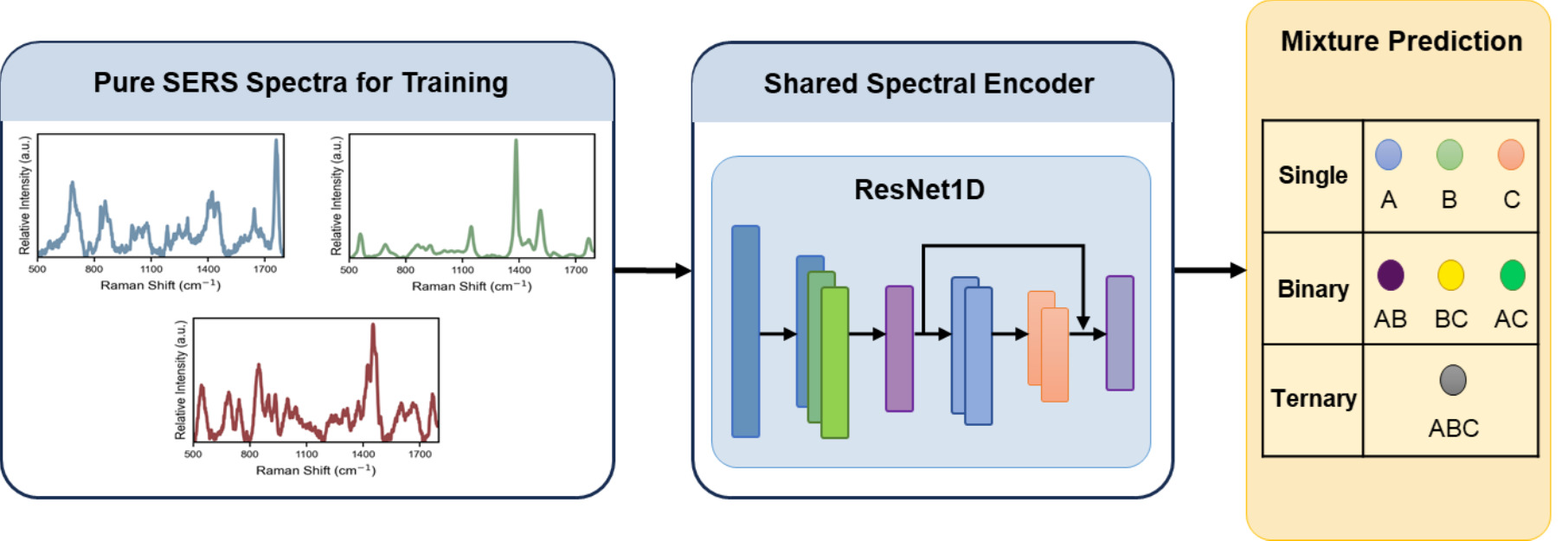
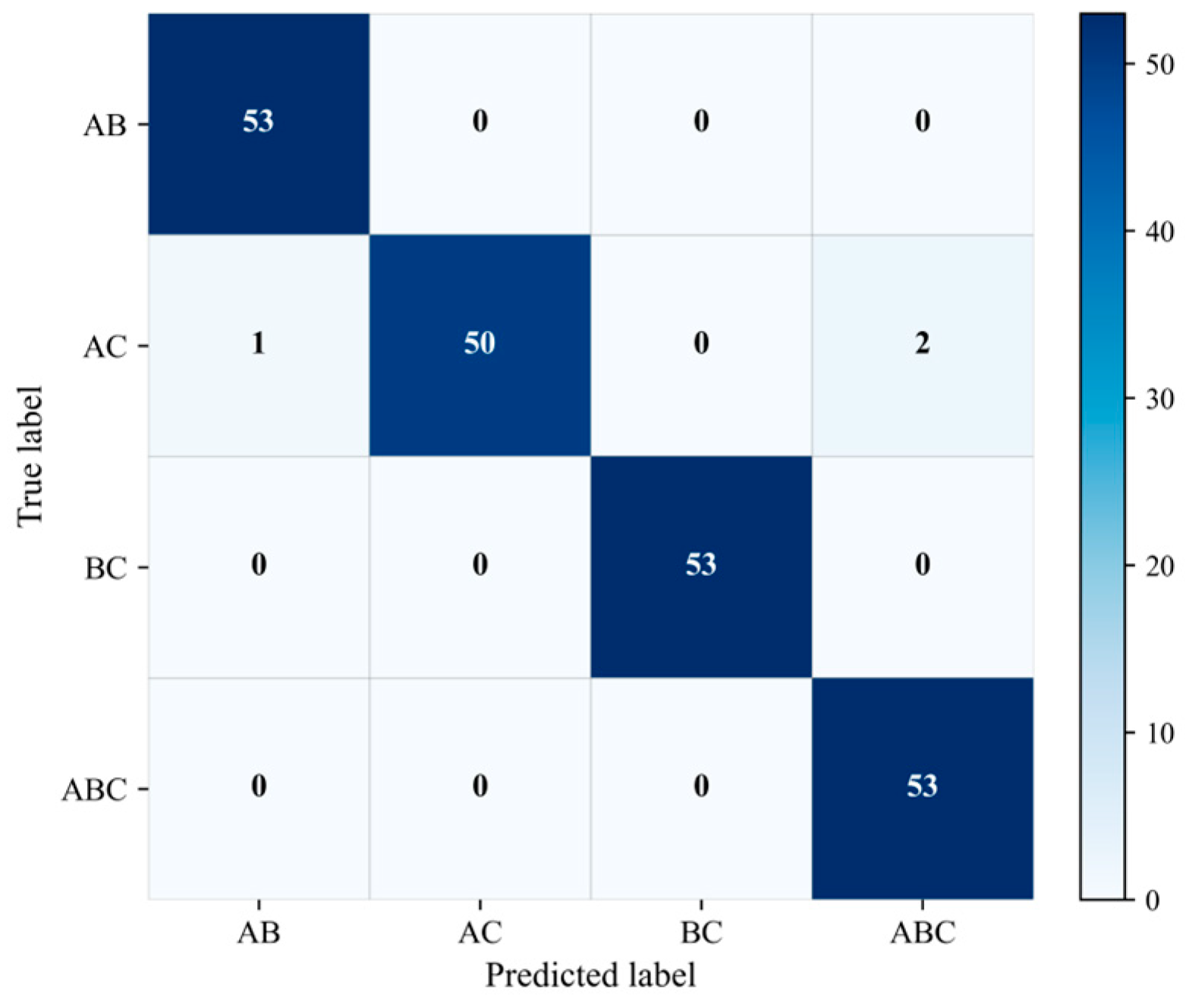
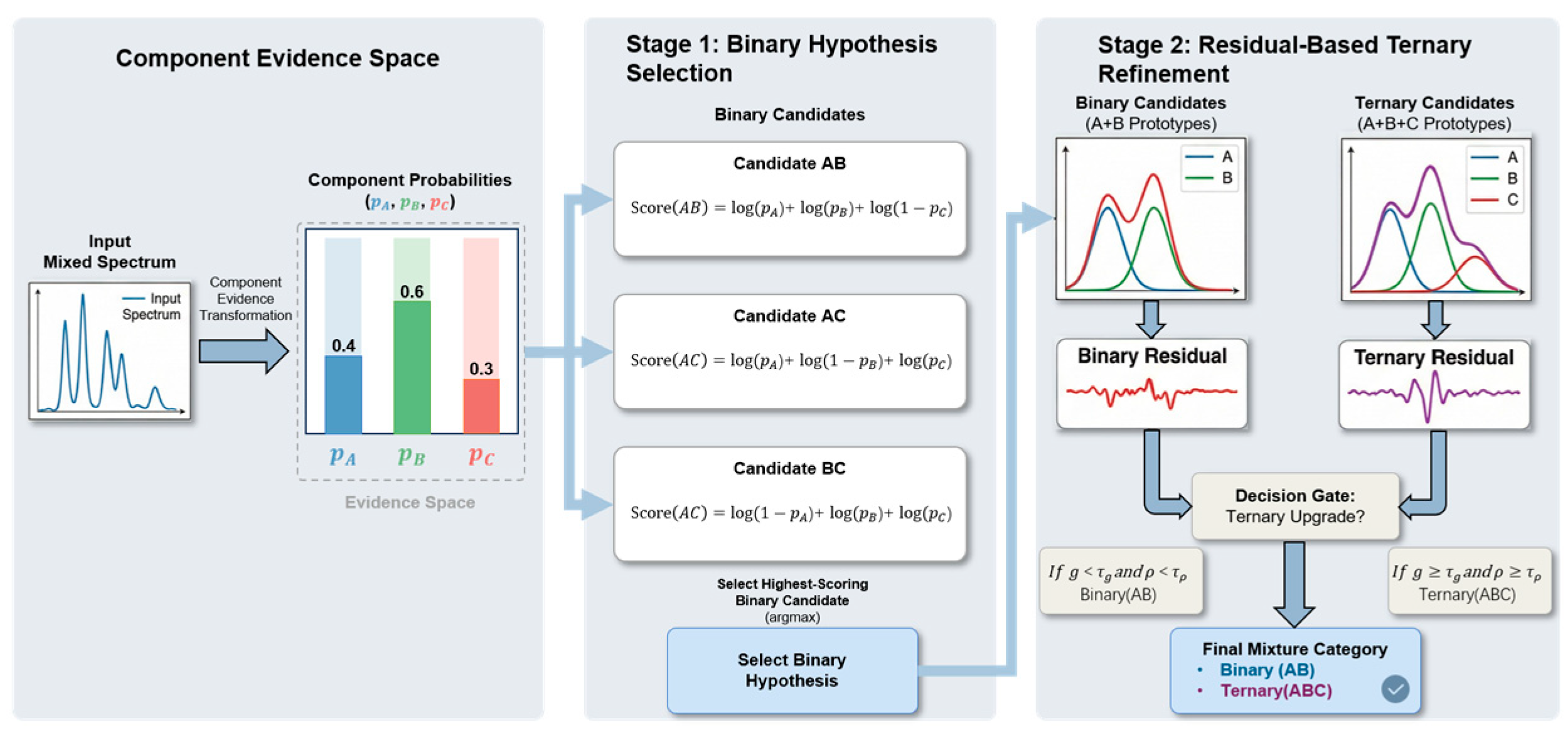
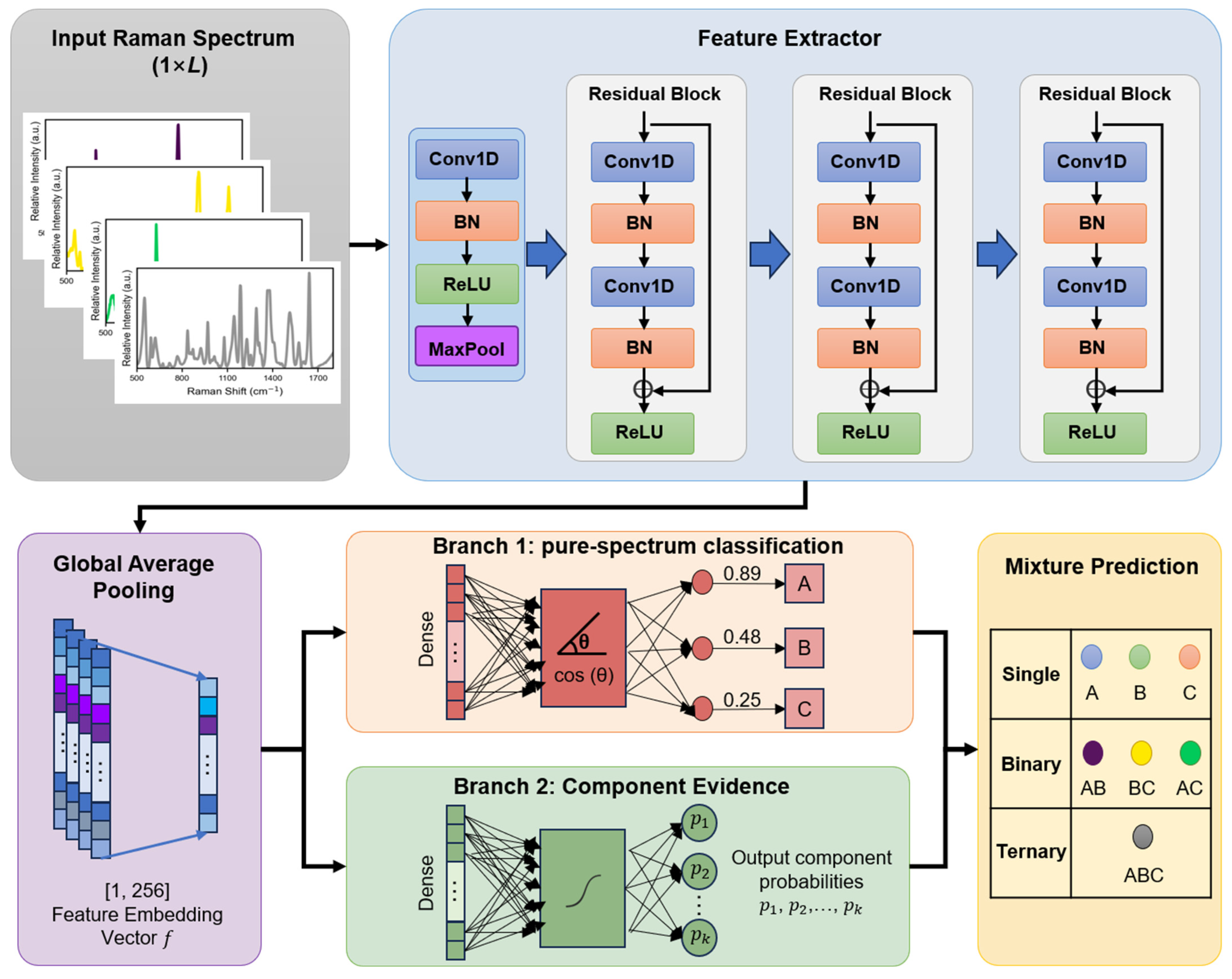
Surface-enhanced Raman spectroscopy (SERS) is a powerful tool for molecular analysis, yet the recognition of mixed spectra remains challenging because severe peak overlap makes mixture-specific data expensive to acquire and difficult to cover exhaustively. Current machine-learning approaches often rely on labeled mixture datasets, synthetic mixed spectra, or prior component-matching schemes, making their performance strongly dependent on task-specific mixture data. A pure-spectrum-trained framework for SERS mixture recognition is presented here based on component evidence learning and two-stage inference. Using paraquat, thiram, and tricyclazole as representative target compounds, the framework learns reusable constituent-level evidence directly from pure-substance spectra and converts it into mixture-category predictions within a unified recognition model. This design avoids mixture-specific parameter training while enabling direct recognition of binary and ternary mixtures. Experiments on SERS spectral datasets yielded a mixture recognition accuracy of 98.58%. The results show that pure-substance spectral learning can support accurate recognition of complex SERS mixtures and provide a scalable strategy for mixture analysis when labeled mixture data are limited.
Keywords: surface-enhanced Raman spectroscopy (SERS); spectral mixture recognition; component evidence learning; two-stage inference surface-enhanced Raman spectroscopy (SERS); spectral mixture recognition; component evidence learning; two-stage inference
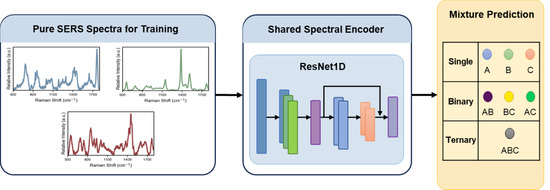
Graphical Abstract