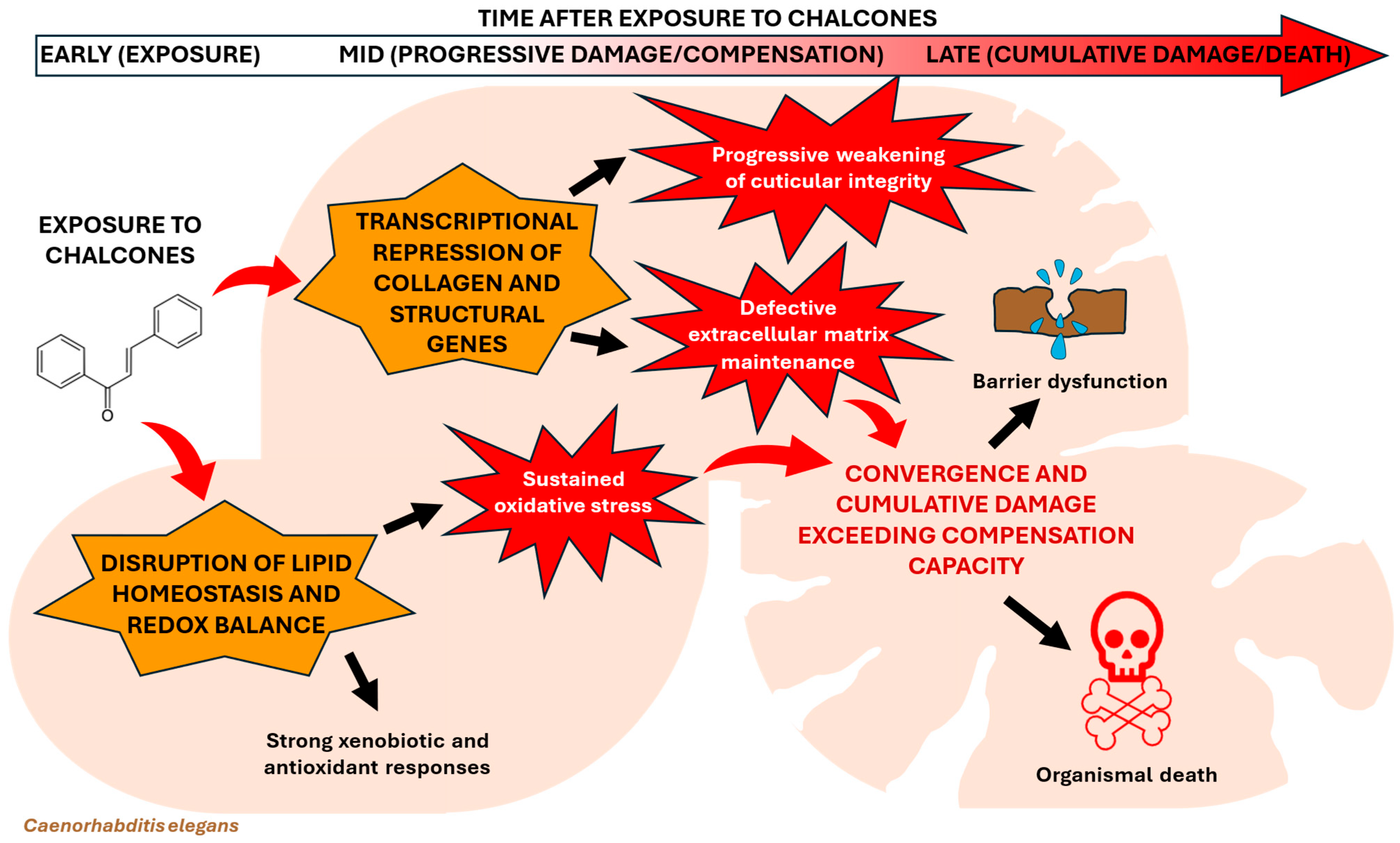
Chalcone and Trans-Chalcone Induce Transcriptomic Changes in Caenorhabditis elegans Compatible with a Novel Cumulative Damage Mode of Action

 ,
, 
 , ,
, ,  and
and
Abstract
1. Introduction
2. Results
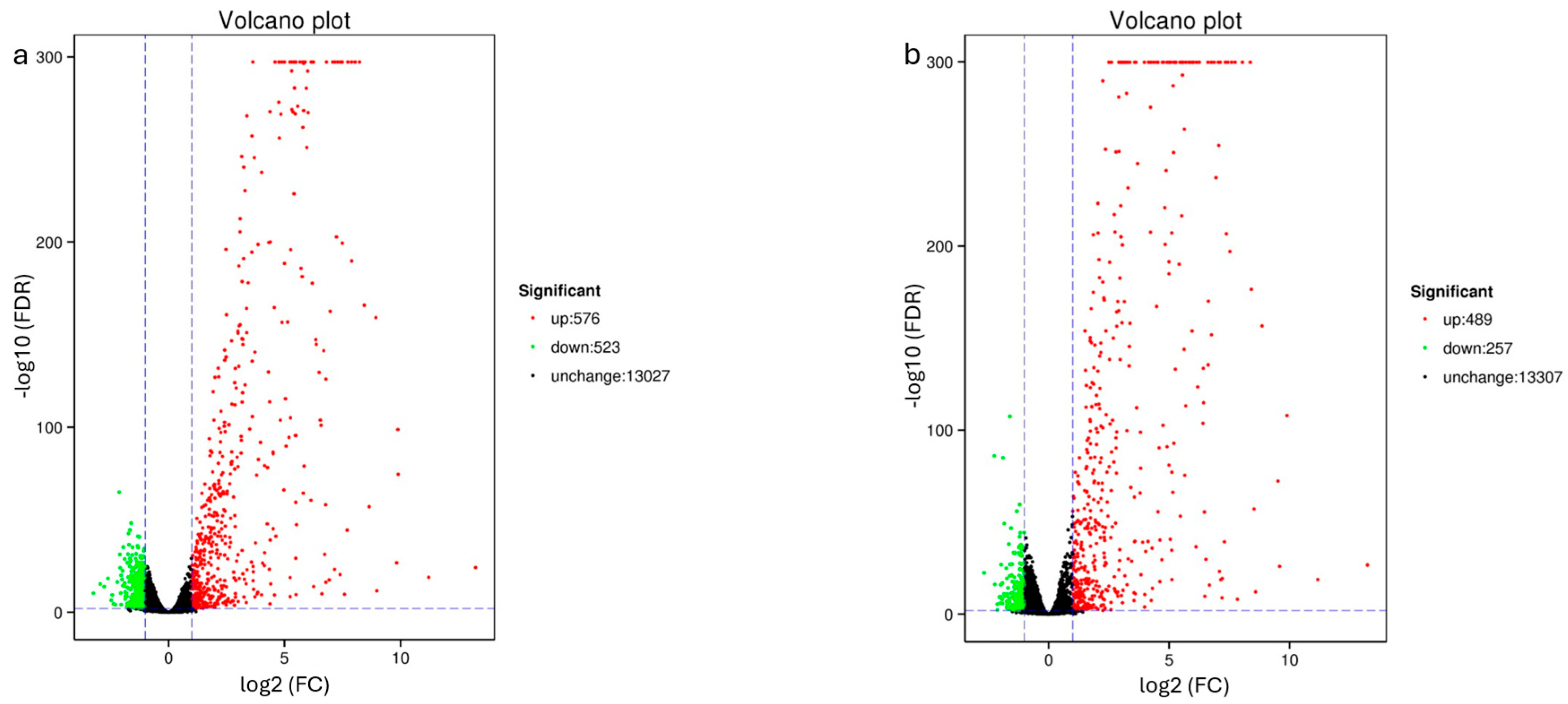
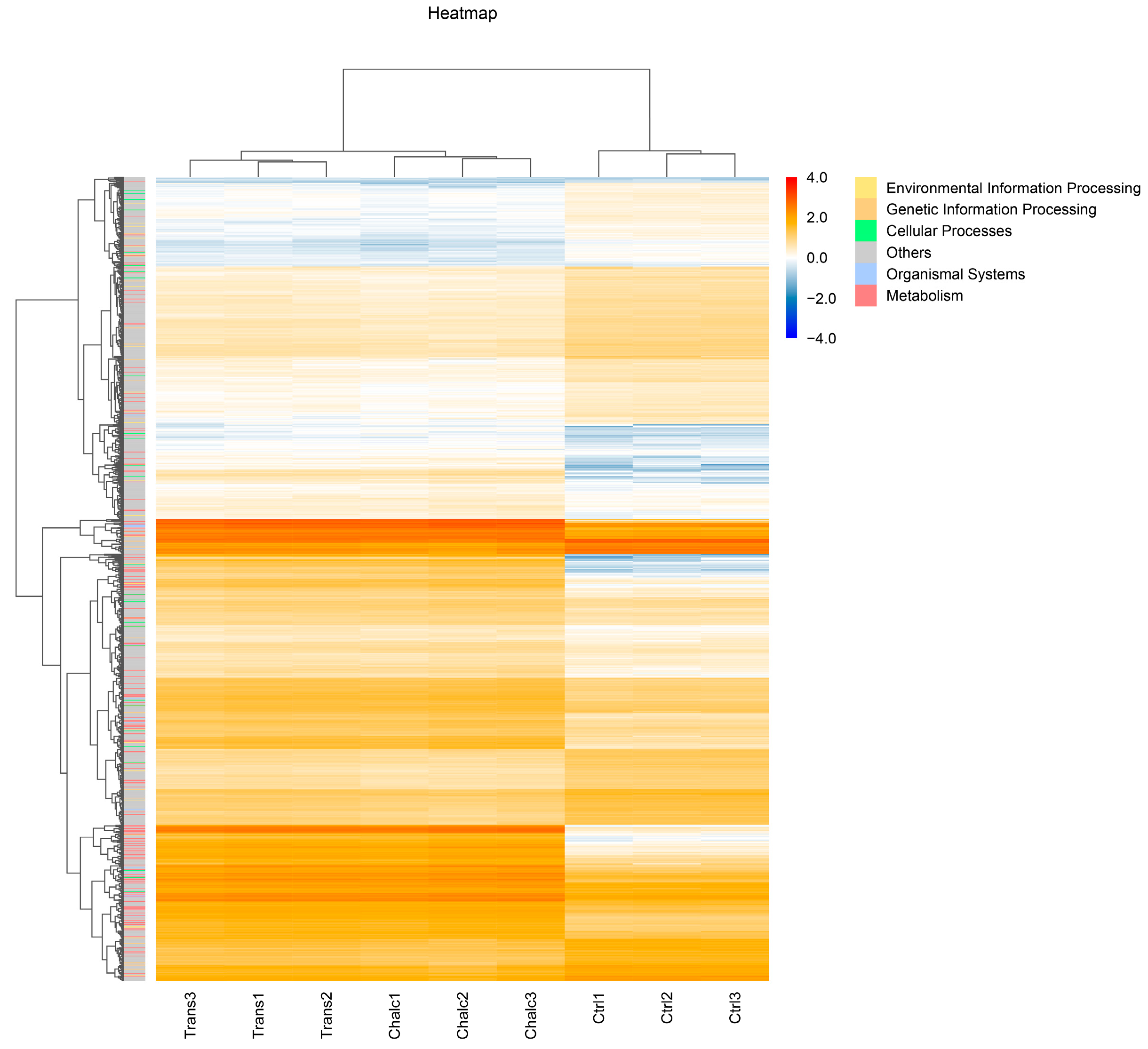
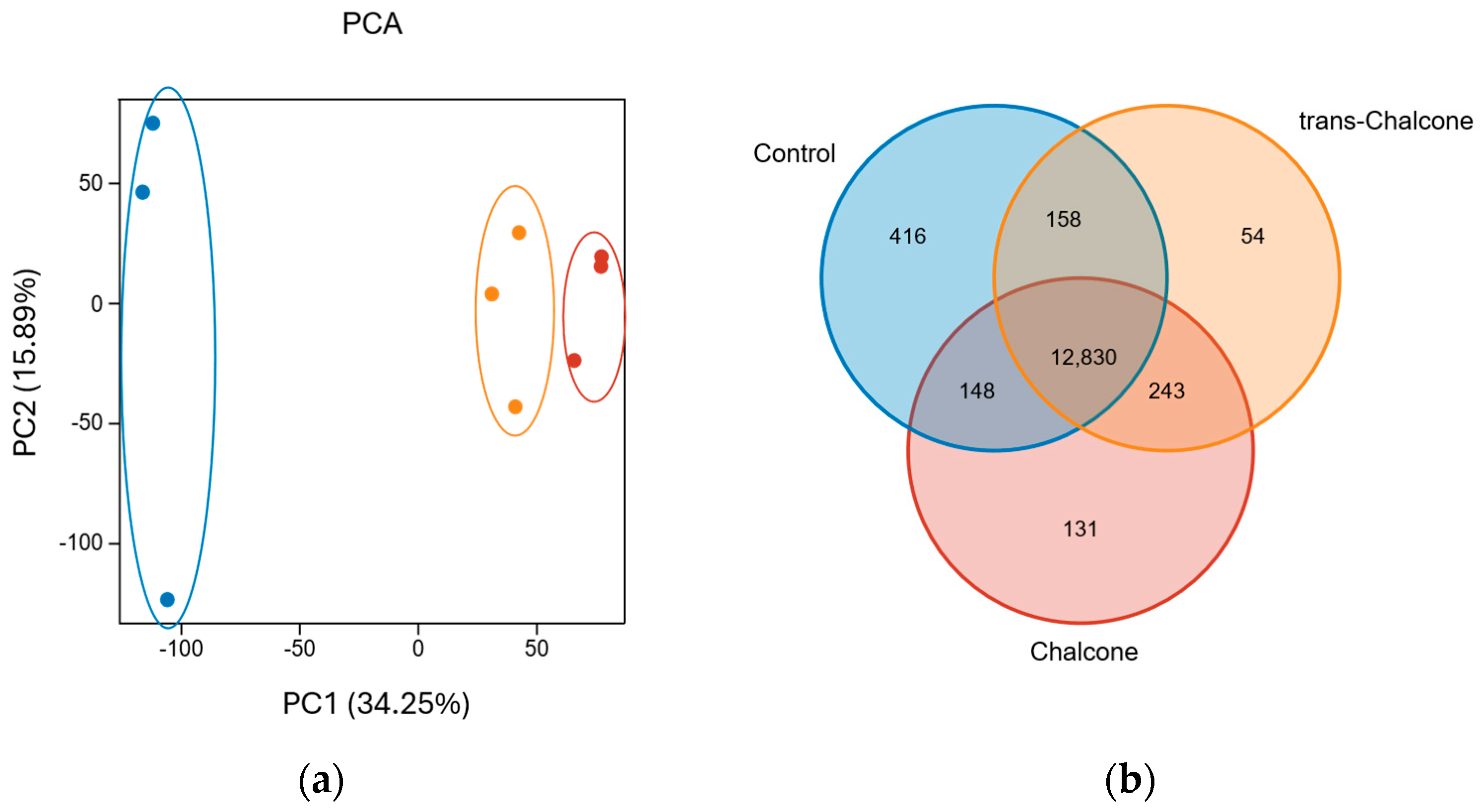
2.1. Chalcone Isomers Induce Distinct Global Transcriptomic Responses in C. elegans
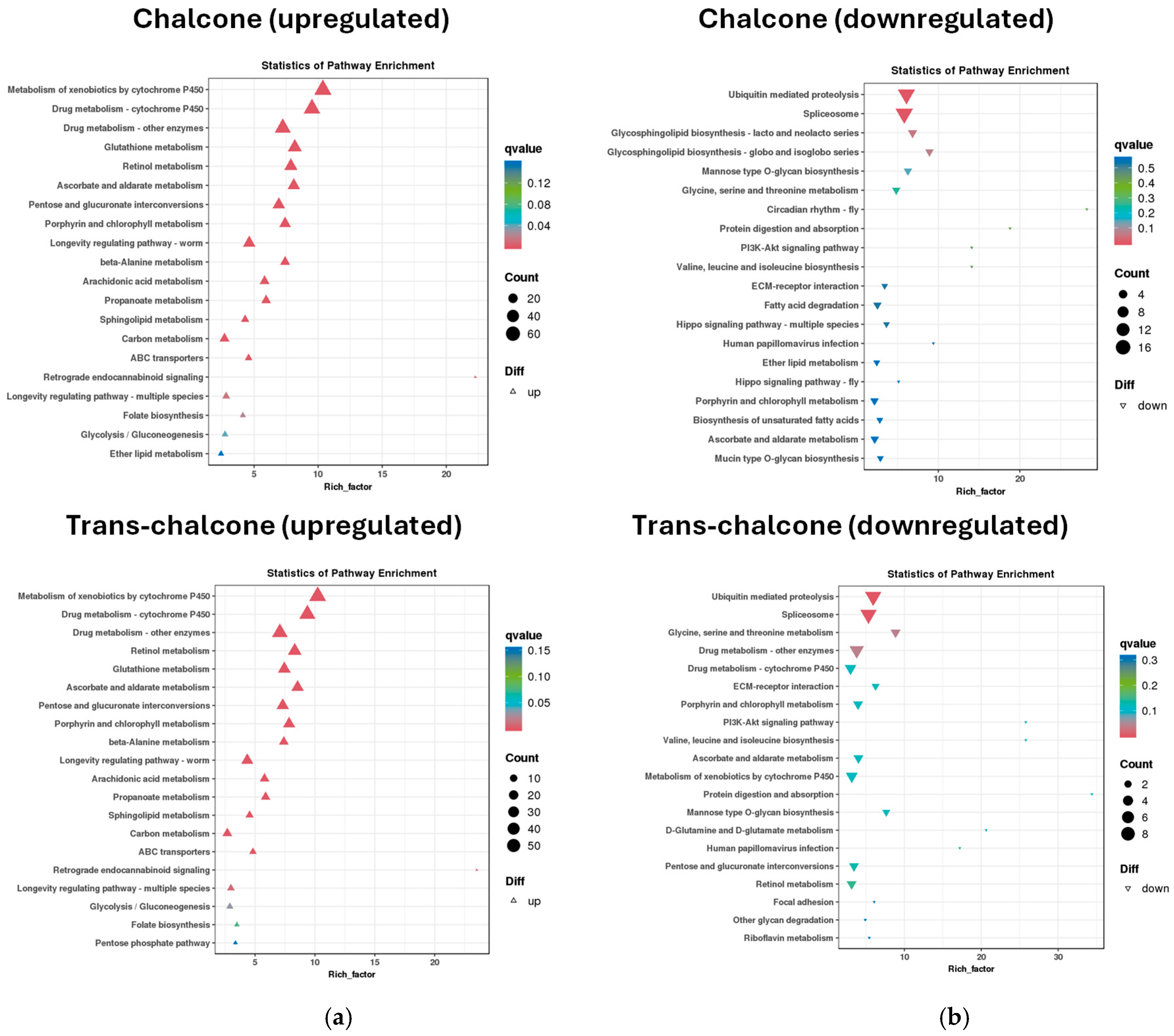
2.2. Chalcone Isomers Promote Detoxification and Lipid Remodeling in C. elegans
3. Discussion
4. Materials and Methods
4.1. Test Compounds
4.2. C. elegans Culture
4.3. Compound Exposure and RNA Extraction from C. elegans L4
4.4. RNA Sequencing and Bioinformatic Analysis
5. Conclusions
Supplementary Materials
Author Contributions
Funding
Institutional Review Board Statement
Informed Consent Statement
Data Availability Statement
Acknowledgments
Conflicts of Interest
Abbreviations
| MoA | Mechanism of Action |
| L4 | Larval stage 4 |
| PCA | Principal Component Analysis |
| KEGG | Kyoto Encyclopedia of Genes and Genomes |
| GO | Gene Ontology |
| CYP | Cytochrome P450 |
| eggNOG | Evolutionary genealogy of genes: Non-supervised Orthologous Groups |
| ROS | Reactive Oxygen Species |
| RNAP | RNA Polymerase |
| FASN | Fatty Acid Synthase |
| FA | Fatty Acids |
| UFA | Unsaturated Fatty Acids |
| ECM | Extracellular Matrix |
| EC50 | Effective Concentration 50 |
| CGC | Caenorhabditis Genetics Centre |
References
- Adhikari, S.; Nath, P.; Deb, V.K.; Das, N.; Banerjee, A.; Pathak, S.; Duttaroy, A.K. Pharmacological potential of natural chalcones: A recent studies and future perspective. Front. Pharmacol. 2025, 16, 1570385. [Google Scholar] [CrossRef] [Scilit]
- Villa, S.M.; Heckman, J.; Bandyopadhyay, D. Medicinally privileged natural chalcones: Abundance, mechanisms of action, and clinical trials. Int. J. Mol. Sci. 2024, 25, 9623. [Google Scholar] [CrossRef] [Scilit]
- Santos, A.M.; Carvalho Nascimento Júnior, J.A.; Silva Cezar, S.V.; Santana Júnior, C.C.; Santos Oliveira, A.M.; Picot, L.; Passos Menezes, P.D.; Serafini, M.R. Exploring the therapeutic potential and chemical properties of trans-chalcone: A comprehensive review. Future Med. Chem. 2024, 16, 2547–2562. [Google Scholar] [CrossRef] [Scilit] [PubMed]
- de Oliveira, A.S.; Cenci, A.R.; Gonçalves, L.; Thedy, M.E.C.; Justino, A.; Braga, A.L.; Meier, L. Chalcone derivatives as antibacterial agents: An updated overview. Curr. Med. Chem. 2024, 31, 2314–2329. [Google Scholar] [CrossRef] [Scilit] [PubMed]
- Dasgupta, A.; Rajesh, R.; Das, P.K.; Matada, G.S.P.; Dhiwar, P.S.; Paik, A. Medicinal chemistry perspective of chalcone derivatives as anticancer agents: Synthetic strategy, biological activity, and structure-activity relationship. Mol. Divers. 2026. [Google Scholar] [CrossRef] [Scilit]
- Calderón-Urrea, A.; Shinde, S.; Kendoyan, S.; Jovanovic, V.M.; Ryu, S.; Tristan, C.A. Nematicide chalcones act synergistically on Caenorhabditis elegans and Meloidogyne incognita without disrupting soil microbial diversity and with limited toxicity to human cells. Molecules 2025, 30, 3624. [Google Scholar] [CrossRef] [Scilit]
- Barbosa, M.L.F.; Braga, A.P.; Ferreira, K.V.M.M.; Oliveira, R.F.; Pereira, R.D.S.; Rocha, L.O.D.; Dias, J.M.L.; Guedes, J.M.; Santos, H.S.D.; Nascimento, J.F.D.; et al. Synthesis and anthelmintic activity of aminochalcones against multiresistant Haemonchus contortus. Rev. Bras. Parasitol. Vet. 2025, 34, e005825. [Google Scholar] [CrossRef] [Scilit]
- Turani, O.; Castro, M.J.; Vazzana, J.; Mendioroz, P.; Volpe, M.A.; Gerbino, D.C.; Bouzat, C. Potent anthelmintic activity of chalcones synthesized by an effective green approach. ChemMedChem 2024, 19, e202400071. [Google Scholar] [CrossRef] [Scilit] [PubMed]
- Vázquez-Bravo, J.; Aguilar-Marcelino, L.; Castañeda-Ramírez, G.S.; De Los Santos-Pérez, I.; Arroyo-Carmona, R.E.; Bernès, S.; Hernández-Pareja, U.; Gómez-Rodríguez, O.; Rosas-Saito, G.H. In vitro nematicidal activity of two ferrocenyl chalcones against larvae of Haemonchus contortus (L3) and Nacobbus aberrans (J2). J. Helminthol. 2020, 94, e190. [Google Scholar] [CrossRef] [Scilit]
- Bahekar, S.P.; Hande, S.V.; Agrawal, N.R.; Chandak, H.S.; Bhoj, P.S.; Goswami, K.; Reddy, M.V.R. Sulfonamide chalcones: Synthesis and in vitro exploration for therapeutic potential against Brugia malayi. Eur. J. Med. Chem. 2016, 124, 262–269. [Google Scholar] [CrossRef] [Scilit]
- Sashidhara, K.V.; Rao, K.B.; Kushwaha, V.; Modukuri, R.K.; Verma, R.; Murthy, P.K. Synthesis and antifilarial activity of chalcone-thiazole derivatives against a human lymphatic filarial parasite, Brugia malayi. Eur. J. Med. Chem. 2014, 81, 473–480. [Google Scholar] [CrossRef] [Scilit]
- Galli, G.; Ruiz-Somacarrera, M.; González del Palacio, L.; Melcón-Fernández, E.; González-Pérez, R.; García-Estrada, C.; Martinez-Valladares, M.; Balaña-Fouce, R. High-throughput screening of five compound libraries for anthelmintic activity and toxicity leads to the discovery of two flavonoid compounds. Int. J. Mol. Sci. 2025, 26, 4. [Google Scholar] [CrossRef] [Scilit]
- Zhuang, C.; Zhang, W.; Sheng, C.; Zhang, W.; Xing, C.; Miao, Z. Chalcone: A privileged structure in medicinal chemistry. Chem. Rev. 2017, 117, 7762–7810. [Google Scholar] [CrossRef] [Scilit] [PubMed]
- Salinas, G.; Risi, G. Caenorhabditis elegans: Nature and nurture gift to nematode parasitologists. Parasitology 2018, 145, 979–987. [Google Scholar] [CrossRef] [Scilit]
- Sepúlveda-Crespo, D.; Reguera, R.M.; Rojo-Vázquez, F.; Balaña-Fouce, R.; Martínez-Valladares, M. Drug discovery technologies: Caenorhabditis elegans as a model for anthelmintic therapeutics. Med. Res. Rev. 2020, 40, 1715–1753. [Google Scholar] [CrossRef] [Scilit] [PubMed]
- Roy, P.J. Drug screens using the nematode Caenorhabditis elegans. Genetics 2025, 231, iyaf141. [Google Scholar] [CrossRef] [Scilit]
- O’Reilly, L.P.; Luke, C.J.; Perlmutter, D.H.; Silverman, G.A.; Pak, S.C. C. elegans in high-throughput drug discovery. Adv. Drug Deliv. Rev. 2014, 69–70, 247–253. [Google Scholar] [CrossRef] [Scilit] [PubMed]
- Risi, G.; Aguilera, E.; Ladós, E.; Suárez, G.; Carrera, I.; Álvarez, G.; Salinas, G. Caenorhabditis elegans infrared-based motility assay identified new hits for nematicide drug development. Vet. Sci. 2019, 6, 29. [Google Scholar] [CrossRef] [Scilit]
- Hahnel, S.R.; Dilks, C.M.; Heisler, I.; Andersen, E.C.; Kulke, D. Caenorhabditis elegans in anthelmintic research—Old model, new perspectives. Int. J. Parasitol. Drugs Drug Resist. 2020, 14, 237–248. [Google Scholar] [CrossRef] [Scilit]
- Dent, J.A.; Smith, M.M.; Vassilatis, D.K.; Avery, L. The genetics of ivermectin resistance in Caenorhabditis elegans. Proc. Natl. Acad. Sci. USA 2000, 97, 2674–2679. [Google Scholar] [CrossRef] [Scilit]
- Rufener, L.; Bedoni, N.; Baur, R.; Rey, S.; Glauser, D.A.; Bouvier, J.; Beech, R.; Sigel, E.; Puoti, A. acr-23 Encodes a monepantel-sensitive channel in Caenorhabditis elegans. PLoS Pathog. 2013, 9, e1003524. [Google Scholar] [CrossRef] [Scilit]
- Shaver, A.O.; Wit, J.; Dilks, C.M.; Crombie, T.A.; Li, H.; Aroian, R.V.; Andersen, E.C. Variation in anthelmintic responses are driven by genetic differences among diverse C. elegans wild strains. PLoS Pathog. 2023, 19, e1011285. [Google Scholar] [CrossRef] [Scilit]
- Doyle, S.R.; Laing, R.; Bartley, D.; Morrison, A.; Holroyd, N.; Maitland, K.; Antonopoulos, A.; Chaudhry, U.; Flis, I.; Howell, S.; et al. Genomic landscape of drug response reveals mediators of anthelmintic resistance. Cell Rep. 2022, 41, 111522. [Google Scholar] [CrossRef] [Scilit]
- Glendinning, S.K.; Buckingham, S.D.; Sattelle, D.B.; Wonnacott, S.; Wolstenholme, A.J. Glutamate-gated chloride channels of Haemonchus contortus restore drug sensitivity to ivermectin resistant Caenorhabditis elegans. PLoS ONE 2011, 6, e22390. [Google Scholar] [CrossRef] [Scilit] [PubMed]
- Miltsch, S.M.; Krücken, J.; Demeler, J.; Ramünke, S.; Harder, A.; Von Samson-Himmelstjerna, G. Interactions of anthelmintic drugs in Caenorhabditis elegans neuro-muscular ion channel mutants. Parasitol. Int. 2013, 62, 591–598. [Google Scholar] [CrossRef] [Scilit] [PubMed]
- Gally, C.; Eimer, S.; Richmond, J.E.; Bessereau, J.L. A transmembrane protein required for acetylcholine receptor clustering in Caenorhabditis elegans. Nature 2004, 431, 578–582. [Google Scholar] [CrossRef] [Scilit] [PubMed]
- Maglioni, S.; Arsalan, N.; Hamacher, A.; Afshar, S.; Schiavi, A.; Beller, M.; Ventura, N. High-Content C. elegans screen identifies natural compounds impacting mitochondria-lipid homeostasis and promoting healthspan. Cells 2021, 11, 100. [Google Scholar] [CrossRef] [Scilit]
- Holden-Dye, L.; Walker, R.J. Anthelmintic drugs and nematicides: Studies in Caenorhabditis elegans. In WormBook; The C. elegans Research Community, Ed.; WormBook: Pasadena, CA, USA, 2014; pp. 1–29. [Google Scholar]
- Hu, Y.; Ellis, B.L.; Yiu, Y.Y.; Miller, M.M.; Urban, J.F.; Shi, L.Z.; Aroian, R.V. An extensive comparison of the effect of anthelmintic classes on diverse nematodes. PLoS ONE 2013, 8, e70702. [Google Scholar] [CrossRef] [Scilit]
- Dube, F.; Hinas, A.; Delhomme, N.; Åbrink, M.; Svärd, S.; Tydén, E. Transcriptomics of ivermectin response in Caenorhabditis elegans: Integrating abamectin quantitative trait loci and comparison to the Ivermectin-exposed DA1316 strain. PLoS ONE 2023, 18, e0285262. [Google Scholar] [CrossRef] [Scilit]
- Qian, W.; Lu, J.; Wang, T.; Liu, Q.; Liu, N.; Chen, S.; Li, Y. Isobavachalcone confers protection against Cryptococcus neoformans-induced ferroptosis in Caenorhabditis elegans via lifespan extension and GSH-GPX-1 axis modulation. J. Hazard. Mater. 2025, 492, 137969. [Google Scholar] [CrossRef] [Scilit]
- Bowerman, B.; Kurz, T. Degrade to create: Developmental requirements for ubiquitin-mediated proteolysis during early C. elegans embryogenesis. Development 2006, 133, 773–784. [Google Scholar] [CrossRef] [Scilit]
- Suzuki, J.M.N.G.L.; Osterhoudt, K.; Cartwright-Acar, C.H.; Gomez, D.R.; Katzman, S.; Zahler, A.M. A genetic screen in C. elegans reveals roles for KIN17 and PRCC in maintaining 5′ splice site identity. PLoS Genet. 2022, 18, e1010028. [Google Scholar] [CrossRef] [Scilit]
- Liu, N.; Li, R.; Huang, X.; Lakso, M.; Wong, G. The C. elegans gba-3 gene encodes a glucocerebrosidase that exacerbates α-synuclein-mediated impairments in deletion mutants. Transl. Neurodegener. 2025, 14, 9. [Google Scholar] [CrossRef] [Scilit]
- Wilson, N.T.; Marie-Luise, E.; Rolf, D.W.; Kimberly, H.D. Identification of stress-responsive genes in Caenorhabditis elegans using RT-PCR differential display. Nucleic Acids Res. 1998, 26, 1621–1627. [Google Scholar]
- Schäfer, P.; Müller, M.; Krüger, A.; Steinberg, C.E.W.; Menzel, R. Cytochrome P450-dependent metabolism of PCB52 in the nematode Caenorhabditis elegans. Arch. Biochem. Biophys. 2009, 488, 60–68. [Google Scholar] [CrossRef] [Scilit]
- Lim, S.Y.M.; Pan, Y.; Alshagga, M.; Lim, W.; Cin, K.; Alshehade, S.A.; Alshawsh, M. CYP14 family in Caenorhabditis elegans: Mitochondrial function, detoxification, and lifespan. J. Appl. Toxicol. 2024, 44, 1647–1656. [Google Scholar] [CrossRef] [Scilit]
- Ferguson, G.D.; Bridge, W.J. The glutathione system and the related thiol network in Caenorhabditis elegans. Redox Biol. 2019, 24, 101171. [Google Scholar] [CrossRef] [Scilit]
- Perally, S.; Lacourse, E.J.; Campbell, A.M.; Brophy, P.M. Heme transport and detoxification in nematodes: Subproteomics evidence of differential role of glutathione transferases. J. Proteome Res. 2008, 7, 4557–4565. [Google Scholar] [CrossRef] [Scilit] [PubMed]
- Grad, L.I.; Lemire, B.D. Riboflavin enhances the assembly of mitochondrial cytochrome C oxidase in C. elegans NADH-ubiquinone oxidoreductase mutants. Biochim. Biophys. Acta 2006, 1757, 115–122. [Google Scholar] [CrossRef] [Scilit] [PubMed]
- Cutler, R.G.; Thompson, K.W.; Camandola, S.; Mack, K.T.; Mattson, M.P. Sphingolipid metabolism regulates development and lifespan in Caenorhabditis elegans. Mech. Ageing Dev. 2014, 143–144, 9–18. [Google Scholar] [CrossRef] [Scilit] [PubMed]
- Zhang, Y.; Zou, X.; Ding, Y.; Wang, H.; Wu, X.; Liang, B. Comparative genomics and functional study of lipid metabolic genes in Caenorhabditis elegans. BMC Genom. 2013, 14, 164. [Google Scholar] [CrossRef] [Scilit]
- Spilsbury, K.; Wu, J.; Reidy, M.; Kropp, P.A. The mitochondrial trans-2-enoyl-CoA reductase is necessary for mitochondrial homeostasis in C. elegans. Genetics 2025, 231, 166. [Google Scholar] [CrossRef] [Scilit]
- Gurvitz, A. A C. elegans model for mitochondrial fatty acid synthase II: The longevity-associated gene w09h1.5/mecr-1 encodes a 2-trans-enoylthioester reductase. PLoS ONE 2009, 4, 7791. [Google Scholar] [CrossRef] [Scilit]
- Zhang, H.; Qin, J.; Lan, X.; Lan, X.; Zeng, W.; Zhou, J.; Huang, T.E.; Xiao, W.L.; Wang, Q.Q.; Sun, S.; et al. Handelin extends lifespan and healthspan of Caenorhabditis elegans by reducing ROS generation and improving motor function. Biogerontology 2022, 23, 115–128. [Google Scholar] [CrossRef] [Scilit]
- Winter, A.D.; Tjahjono, E.; Beltrán, L.J.; Johnstone, I.L.; Bulleid, N.J.; Page, A.P. Dietary-derived vitamin B12 protects Caenorhabditis elegans from thiol-reducing agents. BMC Biol. 2022, 20, 228. [Google Scholar] [CrossRef] [Scilit]
- Gokul, G.; Jogender, S. Dithiothreitol causes toxicity in C. elegans by modulating the methionine–homocysteine cycle. eLife 2022, 11, e76021. [Google Scholar] [CrossRef] [Scilit] [PubMed]
- Holzapfel, R.; Prell, A.; Schumacher, F.; Perschin, V.; Friedmann Angeli, J.P.; Kleuser, B.; Stigloher, C.; Fazeli, G. Degradation of hexosylceramides is required for timely corpse clearance via formation of cargo-containing phagolysosomal vesicles. Eur. J. Cell Biol. 2024, 103, 151411. [Google Scholar] [CrossRef] [Scilit] [PubMed]
- Fajardo, C.; Martín, M.; Nande, M.; Botías, P.; García-Cantalejo, J.; Mengs, G.; Costa, G. Ecotoxicogenomic analysis of stress induced on Caenorhabditis elegans in heavy metal contaminated soil after nZVI treatment. Chemosphere 2020, 254, 126909. [Google Scholar] [CrossRef] [Scilit] [PubMed]
- Sandhu, A.; Badal, D.; Sheokand, R.; Tyagi, S.; Singh, V. Specific collagens maintain the cuticle permeability barrier in Caenorhabditis elegans. Genetics 2021, 217, iyaa047. [Google Scholar] [CrossRef] [Scilit]
- Johnstone, I.L. Cuticle collagen genes. Expression in Caenorhabditis elegans. Trends Genet. 2000, 16, 21–27. [Google Scholar] [CrossRef] [Scilit]
- Johnstone, I.L. The cuticle of the nematode Caenorhabditis elegans: A complex collagen structure. Bioessays 1994, 16, 171–178. [Google Scholar] [CrossRef] [Scilit] [PubMed]
- Page, A.P.; Johnstone, I.L. The cuticle. In WormBook; The C. elegans Research Community, Ed.; WormBook: Pasadena, CA, USA, 2007; pp. 1–43. [Google Scholar]
- Sundaram, M.V.; Pujol, N. The Caenorhabditis elegans cuticle and precuticle: A model for studying dynamic apical extracellular matrices in vivo. Genetics 2024, 227, iyae072. [Google Scholar] [CrossRef] [Scilit] [PubMed]
- Manrique, S.; Gómez, J.; Piñeiro, M.; Sampietro, B.A.; Peschiutta, M.L.; Tapia, A.; Simirgiotis, M.J.; Lima, B. Zuccagnia punctata Cav., a potential environmentally friendly and sustainable bionematicide for the control of Argentinean horticultural crops. Plants 2023, 12, 4104. [Google Scholar] [CrossRef] [Scilit] [PubMed]
- Stiernagle, T. Maintenance of C. elegans. In WormBook; The C. elegans Research Community, Ed.; WormBook: Pasadena, CA, USA, 2006; pp. 1–11. [Google Scholar]



| cis/trans-Chalcone | trans-Chalcone | ||||
|---|---|---|---|---|---|
| Gene | Log2 (FC) | −log10 (FDR) | Log2 (FC) | −log10 (FDR) | Function |
| gst37 | 13.23 | 6.74 × 10⁻²⁵ | 13.23 | 1.89 × 10⁻²⁷ | Glutathione S-transferase |
| CB08E8.2 | 11.22 | 1.30 × 10⁻¹⁹ | 11.17 | 1.62 × 10⁻¹⁹ | Unknown function |
| F12E12.12 | 9.90 | 3.14 × 10−75 | 9.52 | 4.81 × 10−73 | Enoyl-reductase |
| E02C12.10 | 9.88 | 1.91 × 10−99 | 9.89 | 1.34 × 10−108 | Unknown function |
| stdh-2 | 9.83 | 2.02 × 10⁻²⁷ | 9.58 | 1.03 × 10⁻²⁶ | Short-chain dehydrogenase |
| K12D9.1 | 8.98 | 2.52 × 10⁻¹² | 8.59 | 7.01 × 10⁻¹³ | Unknown function |
| Y73C8C.10 | 8.94 | 6.54 × 10−160 | 8.85 | 2.54 × 10−157 | NADH: flavin oxidoreductase |
| ZK697.14 | 8.65 | 9.34 × 10−58 | 8.52 | 7.48 × 10−58 | Unknown function |
| cyp-14A3 | 8.44 | 1.46 × 10−166 | 8.41 | 3.32 × 10−177 | Cytochrome P450 (CYP) |
| gba-2 | 8.23 | n.s. | 8.37 | 3.55 × 10−40 | Glycosylceramidases |
| cis/trans-Chalcone | trans-Chalcone | ||||
|---|---|---|---|---|---|
| Gene | Log2 (FC) | −log10 (FDR) | Log2 (FC) | −log10 (FDR) | Function |
| col-127 | −1.77 | 3.54 × 10⁻⁴ | −1.46 | 0.004 | Collagen metabolism |
| col-183 | −2.04 | 7.79 × 10⁻⁵ | −0.53 | n.s. | Collagen metabolism |
| col-157 | −1.63 | 1.74 × 10⁻⁵ | −1.50 | 3.58 × 10⁻⁵ | Collagen metabolism |
| col-145 | −2.37 | 3.09 × 10⁻⁵ | −1.67 | 0.001 | Collagen metabolism |
| col-43 | −0.45 | n.s. | −1.70 | 3.08 × 10⁻⁶ | Collagen metabolism |
| col-130 | −2.77 | 1.42 × 10⁻¹⁴ | −2.25 | 9.20 × 10−87 | Collagen metabolism |
| C54C8.4 | −2.94 | 5.25 × 10⁻¹⁶ | −2.01 | 2.91 × 10⁻¹⁰ | Unknown function |
| F48C1.11 | −3.24 | 4.73 × 10⁻¹¹ | −1.23 | 0.002 | Unknown function |
| ZC168.2 | −2.61 | 5.47 × 10⁻¹⁹ | −2.67 | 3.33 × 10⁻²³ | Unknown function |
| C07A4.2 | −2.21 | 4.25 × 10⁻¹⁷ | −2.23 | 6.18 × 10⁻¹⁷ | Unknown function |
Disclaimer/Publisher’s Note: The statements, opinions and data contained in all publications are solely those of the individual author(s) and contributor(s) and not of MDPI and/or the editor(s). MDPI and/or the editor(s) disclaim responsibility for any injury to people or property resulting from any ideas, methods, instructions or products referred to in the content. |
© 2026 by the authors. Licensee MDPI, Basel, Switzerland. This article is an open access article distributed under the terms and conditions of the Creative Commons Attribution (CC BY) license.
Share and Cite
Galli, G.; Bruun, C.S.; García-Estrada, C.; Balaña-Fouce, R.; Martinez-Valladares, M.; Hansen, T.V.A. Chalcone and Trans-Chalcone Induce Transcriptomic Changes in Caenorhabditis elegans Compatible with a Novel Cumulative Damage Mode of Action. Molecules 2026, 31, 1411. https://doi.org/10.3390/molecules31091411
Galli G, Bruun CS, García-Estrada C, Balaña-Fouce R, Martinez-Valladares M, Hansen TVA. Chalcone and Trans-Chalcone Induce Transcriptomic Changes in Caenorhabditis elegans Compatible with a Novel Cumulative Damage Mode of Action. Molecules. 2026; 31(9):1411. https://doi.org/10.3390/molecules31091411
Chicago/Turabian StyleGalli, Giulio, Carl S. Bruun, Carlos García-Estrada, Rafael Balaña-Fouce, María Martinez-Valladares, and Tina V. A. Hansen. 2026. "Chalcone and Trans-Chalcone Induce Transcriptomic Changes in Caenorhabditis elegans Compatible with a Novel Cumulative Damage Mode of Action" Molecules 31, no. 9: 1411. https://doi.org/10.3390/molecules31091411
APA StyleGalli, G., Bruun, C. S., García-Estrada, C., Balaña-Fouce, R., Martinez-Valladares, M., & Hansen, T. V. A. (2026). Chalcone and Trans-Chalcone Induce Transcriptomic Changes in Caenorhabditis elegans Compatible with a Novel Cumulative Damage Mode of Action. Molecules, 31(9), 1411. https://doi.org/10.3390/molecules31091411