C5-alkyl and C5-aryl Substituted 5-Deazaflavin as Sensitizers for Photodehalogenation of Aryl Halides



Abstract
1. Introduction
2. Results and Discussions
3. Materials and Methods
3.1. Materials and Synthesis
3.2. Theoretical Methods
4. Conclusions
Supplementary Materials
Author Contributions
Funding
Institutional Review Board Statement
Informed Consent Statement
Data Availability Statement
Acknowledgments
Conflicts of Interest
References
- Majek, M.; Jacobi von Wangelin, A. Mechanistic Perspectives on Organic Photoredox Catalysis for Aromatic Substitutions. Acc. Chem. Res. 2016, 49, 2316–2327. [Google Scholar] [CrossRef] [Scilit]
- Neumeier, M.; Sampedro, D.; Majek, M.; de la Pena O’Shea, V.A.; Jacobi von Wangelin, A.; Perez-Ruiz, R. Dichromatic Photocatalytic Substitutions of Aryl Halides with a Small Organic Dye. Chem.-Eur. J. 2018, 24, 105–108. [Google Scholar] [CrossRef] [Scilit]
- Yan, M.; Lo, J.C.; Edwards, J.T.; Baran, P.S. Radicals: Reactive Intermediates with Translational Potential. J. Am. Chem. Soc. 2016, 138, 12692–12714. [Google Scholar] [CrossRef] [Scilit] [PubMed]
- Studer, A.; Curran, D.P. Catalysis of Radical Reactions: A Radical Chemistry Perspective. Angew. Chem.-Int. Ed. 2016, 55, 58–102. [Google Scholar] [CrossRef] [Scilit] [PubMed]
- Ghosh, I.; Marzo, L.; Das, A.; Shaikh, R.; Konig, B. Visible Light Mediated Photoredox Catalytic Arylation Reactions. Acc. Chem. Res. 2016, 49, 1566–1577. [Google Scholar] [CrossRef] [Scilit] [PubMed]
- Hari, D.P.; Konig, B. The Photocatalyzed Meerwein Arylation: Classic Reaction of Aryl Diazonium Salts in a New Light. Angew. Chem.-Int. Ed. 2013, 52, 4734–4743. [Google Scholar] [CrossRef] [Scilit]
- Kvasovs, N.; Gevorgyan, V. Contemporary methods for generation of aryl radicals. Chem. Soc. Rev. 2021, 50, 2244–2259. [Google Scholar] [CrossRef] [Scilit]
- Ghosh, T.; Santra, S.; Zyryanov, G.V.; Ranu, B.C. Recent advances in visible light mediated photoinduced aryl radical generation and its application in synthesis. J. Photochem. Photobiol. 2023, 16, 100192. [Google Scholar] [CrossRef] [Scilit]
- Mo, F.Y.; Dong, G.B.; Zhang, Y.; Wang, J.B. Recent applications of arene diazonium salts in organic synthesis. Org. Biomol. Chem. 2013, 11, 1582–1593. [Google Scholar] [CrossRef] [Scilit]
- Wu, X.Y.; Gao, P.; Chen, F. Synthetic Applications of Sulfonium Salts as Aryl Radical Precursors. Eur. J. Org. Chem. 2023, 26, e202300864. [Google Scholar] [CrossRef] [Scilit]
- Luo, L.; Tang, S.; Wu, J.Y.; Jin, S.W.; Zhang, H. Transition Metal-Free Aromatic C-H, C-N, C-S and C-O Borylation. Chem. Rec. 2023, 23, e202300023. [Google Scholar] [CrossRef] [Scilit] [PubMed]
- Hari, D.P.; Schroll, P.; Konig, B. Metal-Free, Visible-Light-Mediated Direct C-H Arylation of Heteroarenes with Aryl Diazonium Salts. J. Am. Chem. Soc. 2012, 134, 2958–2961. [Google Scholar] [CrossRef] [Scilit] [PubMed]
- Pavlovska, T.; Lesny, D.K.; Svobodova, E.; Hoskovcova, I.; Archipowa, N.; Kutta, R.J.; Cibulka, R. Tuning Deazaflavins Towards Highly Potent Reducing Photocatalysts Guided by Mechanistic Understanding-Enhancement of the Key Step by the Internal Heavy Atom Effect. Chem.-Eur. J. 2022, 28, e202200768. [Google Scholar] [CrossRef] [Scilit] [PubMed]
- Weisheitelová, I.; Varma, N.; Simková, L.; Chudoba, J.; Pavlovska, T.; Gulaczyk, I.; Burdzinski, G.; Ludvík, J.; Sikorski, M.; Cibulka, R. Deazaalloxazines-Flavin Derivatives That Provide Reductive Photoredox Catalysis with Inert Substrates. Chem.-Eur. J. 2025, 31, e202502897. [Google Scholar] [CrossRef] [Scilit]
- Graml, A.; Nevesely, T.; Jan Kutta, R.; Cibulka, R.; Koenig, B. Deazaflavin reductive photocatalysis involves excited semiquinone radicals. Nat. Commun. 2020, 11, 3174. [Google Scholar] [CrossRef] [Scilit]
- Cibulka, R. Strong chemical reducing agents produced by light. Nature 2020, 580, 31–32. [Google Scholar] [CrossRef] [Scilit]
- Tay, N.E.S.; Lehnherr, D.; Rovis, T. Photons or Electrons? A Critical Comparison of Electrochemistry and Photoredox Catalysis for Organic Synthesis. Chem. Rev. 2022, 122, 2487–2649. [Google Scholar] [CrossRef] [Scilit]
- Liu, J.J.; Lu, L.X.; Wood, D.; Lin, S. New Redox Strategies in Organic Synthesis by Means of Electrochemistry and Photochemistry. ACS Cent. Sci. 2020, 6, 1317–1340. [Google Scholar] [CrossRef] [Scilit]
- Ghosh, I.; Ghosh, T.; Bardagi, J.I.; Koenig, B. Reduction of aryl halides by consecutive visible light-induced electron transfer processes. Science 2014, 346, 725–728. [Google Scholar] [CrossRef] [Scilit]
- Ghosh, I.; Koenig, B. Chromoselective Photocatalysis: Controlled Bond Activation through Light-Color Regulation of Redox Potentials. Angew. Chem.-Int. Ed. 2016, 55, 7676–7679. [Google Scholar] [CrossRef] [Scilit]
- Marzo, L.; Ghosh, I.; Esteban, F.; Konig, B. Metal-Free Photocatalyzed Cross Coupling of Bromoheteroarenes with Pyrroles. ACS Catal. 2016, 6, 6780–6784. [Google Scholar] [CrossRef] [Scilit]
- Bardagi, J.I.; Ghosh, I.; Schmalzbauer, M.; Ghosh, T.; Koenig, B. Anthraquinones as Photoredox Catalysts for the Reductive Activation of Aryl Halides. Eur. J. Org. Chem. 2018, 2018, 34–40. [Google Scholar] [CrossRef] [Scilit]
- MacKenzie, I.A.; Wang, L.; Onuska, N.P.R.; Williams, O.F.; Begam, K.; Moran, A.M.; Dunietz, B.D.; Nicewicz, D.A. Discovery and characterization of an acridine radical photoreductant. Nature 2020, 580, 76–80. [Google Scholar] [CrossRef] [Scilit] [PubMed]
- Xu, J.H.; Cao, J.L.; Wu, X.Y.; Wang, H.; Yang, X.N.; Tang, X.X.; Toh, R.W.; Zhou, R.; Yeow, E.K.L.; Wu, J. Unveiling Extreme Photoreduction Potentials of Donor-Acceptor Cyanoarenes to Access Aryl Radicals from Aryl Chlorides. J. Am. Chem. Soc. 2021, 143, 13266–13273. [Google Scholar] [CrossRef] [Scilit] [PubMed]
- Chmiel, A.F.; Williams, O.P.; Chernowsky, C.P.; Yeung, C.S.; Wickens, Z.K. Non-innocent Radical Ion Intermediates in Photoredox Catalysis: Parallel Reduction Modes Enable Coupling of Diverse Aryl Chlorides. J. Am. Chem. Soc. 2021, 143, 10882–10889. [Google Scholar] [CrossRef] [Scilit]
- Cowper, N.G.W.; Chernowsky, C.P.; Williams, O.P.; Wickens, Z.K. Potent Reductants via Electron-Primed Photoredox Catalysis: Unlocking Aryl Chlorides for Radical Coupling. J. Am. Chem. Soc. 2020, 142, 2093–2099. [Google Scholar] [CrossRef] [Scilit] [PubMed]
- Kim, H.; Kim, H.; Lambert, T.H.; Lin, S. Reductive Electrophotocatalysis: Merging Electricity and Light To Achieve Extreme Reduction Potentials. J. Am. Chem. Soc. 2020, 142, 2087–2092. [Google Scholar] [CrossRef] [Scilit]
- Cole, J.P.; Chen, D.F.; Kudisch, M.; Pearson, R.M.; Lim, C.H.; Miyake, G.M. Organocatalyzed Birch Reduction Driven by Visible Light. J. Am. Chem. Soc. 2020, 142, 13573–13581. [Google Scholar] [CrossRef] [Scilit]
- Prukala, D.; Zubova, E.; Svobodová, E.; Simková, L.; Varma, N.; Chudoba, J.; Ludvík, J.; Burdzinski, G.; Gulaczyk, I.; Sikorski, M.; et al. Introduction of flavin anions into photoredox catalysis: Acid-base equilibria of lumichrome allow photoreductions with an anion of an elusive 10-unsubstituted isoalloxazine. Chem. Sci. 2025, 16, 11255–11263. [Google Scholar] [CrossRef] [Scilit]
- Heelis, P.F. The photophysical and photochemical properties of flavines (Isoalloxazines). Chem. Soc. Rev. 1982, 11, 15–39. [Google Scholar] [CrossRef] [Scilit]
- Heelis, P.F.; Hartman, R.F.; Rose, S.D. Photoenzymic repair of UV-damaged DNA-A chemists perspective. Chem. Soc. Rev. 1995, 24, 289–297. [Google Scholar] [CrossRef] [Scilit]
- Guo, H.M.; Kottke, T.; Hegemann, P.; Dick, B. The Phot LOV2 domain and its interaction with LOV1. Biophys. J. 2005, 89, 402–412. [Google Scholar] [CrossRef] [Scilit]
- Kaim, W.; Schwederski, B. Cooperation of metals with electroactive ligands of biochemical relevance: Beyond metalloporphyrins. Pure Appl. Chem. 2004, 76, 351–364. [Google Scholar] [CrossRef] [Scilit]
- Walsh, C. Flavin Coenzymes-At the crossroads of biological redox chemistry. Acc. Chem. Res. 1980, 13, 148–155. [Google Scholar] [CrossRef] [Scilit]
- Bruice, T.C. Mechanisms of Flavin Catalysis. Acc. Chem. Res. 1980, 13, 256–262. [Google Scholar] [CrossRef] [Scilit]
- Murakami, M.; Ohkubo, K.; Fukuzumi, S. Inter- and Intramolecular Photoinduced Electron Transfer of Flavin Derivatives with Extremely Small Reorganization Energies. Chem.-Eur. J. 2010, 16, 7820–7832. [Google Scholar] [CrossRef] [Scilit]
- Iida, H.; Imada, Y.; Murahashi, S.I. Biomimetic flavin-catalysed reactions for organic synthesis. Org. Biomol. Chem. 2015, 13, 7599–7613. [Google Scholar] [CrossRef] [Scilit]
- Konig, B.; Kummel, S.; Svobodova, E.; Cibulka, R. Flavin photocatalysis. Phys. Sci. Rev. 2018, 3, 20170168. [Google Scholar] [CrossRef] [Scilit]
- Rehpenn, A.; Walter, A.; Storch, G. Molecular Editing of Flavins for Catalysis. Synthesis 2021, 53, 2583–2593. [Google Scholar] [CrossRef] [Scilit]
- Korvinson, K.A.; Hargenrader, G.N.; Stevanovic, J.; Xie, Y.; Joseph, J.; Maslak, V.; Hadad, C.M.; Glusac, K.D. Improved Flavin-Based Catalytic Photooxidation of Alcohols through Intersystem Crossing Rate Enhancement. J. Phys. Chem. A 2016, 120, 7294–7300. [Google Scholar] [CrossRef] [Scilit]
- Megerle, U.; Wenninger, M.; Kutta, R.J.; Lechner, R.; Konig, B.; Dick, B.; Riedle, E. Unraveling the flavin-catalyzed photooxidation of benzylic alcohol with transient absorption spectroscopy from sub-pico- to microseconds. Phys. Chem. Chem. Phys. 2011, 13, 8869–8880. [Google Scholar] [CrossRef] [Scilit]
- Dad’ova, J.; Svobodova, E.; Sikorski, M.; Konig, B.; Cibulka, R. Photooxidation of Sulfides to Sulfoxides Mediated by Tetra-O-Acetylriboflavin and Visible Light. ChemCatChem 2012, 4, 620–623. [Google Scholar] [CrossRef] [Scilit]
- Nevesely, T.; Svobodova, E.; Chudoba, J.; Sikorski, M.; Cibulka, R. Efficient Metal-Free Aerobic Photooxidation of Sulfides to Sulfoxides Mediated by a Vitamin B-2 Derivative and Visible Light. Adv. Synth. Catal. 2016, 358, 1654–1663. [Google Scholar] [CrossRef] [Scilit]
- Greening, C.; Ahmed, F.H.; Mohamed, A.E.; Lee, B.M.; Pandey, G.; Warden, A.C.; Scott, C.; Oakeshott, J.G.; Taylor, M.C.; Jackson, C.J. Physiology, Biochemistry, and Applications of F-420- and F-o-Dependent Redox Reactions. Microbiol. Mol. Biol. Rev. 2016, 80, 451–493. [Google Scholar] [CrossRef] [Scilit] [PubMed]
- Walsh, C. Naturally-occuring 5-deazaflavin coenzymes-Biological redox roles. Acc. Chem. Res. 1986, 19, 216–221. [Google Scholar] [CrossRef] [Scilit]
- Kiontke, S.; Gnau, P.; Haselsberger, R.; Batschauer, A.; Essen, L.O. Structural and Evolutionary Aspects of Antenna Chromophore Usage by Class II Photolyases. J. Biol. Chem. 2014, 289, 19659–19669. [Google Scholar] [CrossRef] [Scilit]
- Salzmann, S.; Martinez-Junza, V.; Zorn, B.; Braslavsky, S.E.; Mansurova, M.; Marian, C.M.; Gartner, W. Photophysical Properties of Structurally and Electronically Modified Flavin Derivatives Determined by Spectroscopy and Theoretical Calculations. J. Phys. Chem. A 2009, 113, 9365–9375. [Google Scholar] [CrossRef] [Scilit]
- Golczak, A.; Insinska-Rak, M.; Davoudpour, A.; Saeed, D.H.; Menova, P.; Mojr, V.; Cibulka, R.; Khmelinskii, I.; Mrowczynska, L.; Sikorski, M. Photophysical properties of alloxazine derivatives with extended aromaticity-Potential redox-sensitive fluorescent probe. Spectrochim. Acta Part A-Mol. Biomol. Spectrosc. 2022, 272, 120985. [Google Scholar] [CrossRef] [Scilit]
- Insinska-Rak, M.; Golczak, A.; Gierszewski, M.; Anwar, Z.; Cherkas, V.; Kwiatek, D.; Sikorska, E.; Khmelinskii, I.; Burdzinski, G.; Cibulka, R.; et al. 5-Deazaalloxazine as photosensitizer of singlet oxygen and potential redox-sensitive agent. Photochem. Photobiol. Sci. 2023, 22, 1655–1671. [Google Scholar] [CrossRef] [Scilit]
- Mojr, V.; Pitrova, G.; Strakova, K.; Prukala, D.; Brazevic, S.; Svobodova, E.; Hoskovcova, I.; Burdzinski, G.; Slanina, T.; Sikorski, M.; et al. Flavin Photocatalysts for Visible-Light 2+2 Cycloadditions: Structure, Reactivity and Reaction Mechanism. ChemCatChem 2018, 10, 849–858. [Google Scholar] [CrossRef] [Scilit]
- Mojr, V.; Svobodova, E.; Strakova, K.; Nevesely, T.; Chudoba, J.; Dvorakova, H.; Cibulka, R. Tailoring flavins for visible light photocatalysis: Organocatalytic 2+2 cycloadditions mediated by a flavin derivative and visible light. Chem. Commun. 2015, 51, 12036–12039. [Google Scholar] [CrossRef] [Scilit] [PubMed]
- Goldberg, M.; Pecht, I.; Kramer, H.E.A.; Traber, R.; Hemmerich, P. Structure and properties of 5-deazaflavin radicals as compared to natrual flavosemiquinones. Biochim. Biophys. Acta 1981, 673, 570–593. [Google Scholar] [CrossRef] [Scilit] [PubMed]
- Jirapanjawat, T.; Ney, B.; Taylor, M.C.; Warden, A.C.; Afroze, S.; Russell, R.J.; Lee, B.M.; Jackson, C.J.; Oakeshott, J.G.; Pandey, G.; et al. The Redox Cofactor F-420 Protects Mycobacteria from Diverse Antimicrobial Compounds and Mediates a Reductive Detoxification System. Appl. Environ. Microbiol. 2016, 82, 6810–6818. [Google Scholar] [CrossRef] [Scilit] [PubMed]
- Hemmerich, P.; Massey, V.; Fenner, H. Flavin and 5-deazaflavin-Chemical evaluation of modified flavoproteins with respect to mechanism of redox biocatalysis. FEBS Lett. 1977, 84, 5–21. [Google Scholar] [CrossRef] [Scilit]
- Holtmann, D.; Hollmann, F. The Oxygen Dilemma: A Severe Challenge for the Application of Monooxygenases? ChemBioChem 2016, 17, 1391–1398. [Google Scholar] [CrossRef] [Scilit]
- Su, Q.; Boucher, P.A.; Rokita, S.E. Conversion of a Dehalogenase into a Nitroreductase by Swapping its Flavin Cofactor with a 5-Deazaflavin Analogue. Angew. Chem.-Int. Ed. 2017, 56, 10862–10866. [Google Scholar] [CrossRef] [Scilit]
- Taglieber, A.; Schulz, F.; Hollmann, F.; Rusek, M.; Reetz, M.T. Light-driven biocatalytic oxidation and reduction reactions: Scope and limitations. ChemBioChem 2008, 9, 565–572. [Google Scholar] [CrossRef] [Scilit]
- Zilly, F.E.; Taglieber, A.; Schulz, F.; Hollmann, F.; Reetz, M.T. Deazaflavins as mediators in light-driven cytochrome P450 catalyzed hydroxylations. Chem. Commun. 2009, 45, 7152–7154. [Google Scholar] [CrossRef] [Scilit]
- Link, P.A.J.; Vanderplas, H.C.; Muller, F. Photoreduction of 5-deazaflavins 1,3,9-triaza-anthracene-2(3H), 4(10H)-diones. J. Chem. Soc.-Chem. Commun. 1986, 1385–1387. [Google Scholar] [CrossRef] [Scilit]
- van Schie, M.; Younes, S.H.H.; Rauch, M.C.R.; Pesic, M.; Paul, C.E.; Arends, I.; Hollmann, F. Deazaflavins as photocatalysts for the direct reductive regeneration of flavoenzymes. Mol. Catal. 2018, 452, 277–283. [Google Scholar] [CrossRef] [Scilit]
- Zhao, J.Z.; Wu, W.H.; Sun, J.F.; Guo, S. Triplet photosensitizers: From molecular design to applications. Chem. Soc. Rev. 2013, 42, 5323–5351. [Google Scholar] [CrossRef] [Scilit]
- Bell, J.D.; Murphy, J.A. Recent advances in visible light-activated radical coupling reactions triggered by (i) ruthenium, (ii) iridium and (iii) organic photoredox agents. Chem. Soc. Rev. 2021, 50, 9540–9685. [Google Scholar] [CrossRef] [Scilit] [PubMed]
- Feldmeier, C.; Bartling, H.; Magerl, K.; Gschwind, R.M. LED-Illuminated NMR Studies of Flavin-Catalyzed Photooxidations Reveal Solvent Control of the Electron-Transfer Mechanism. Angew. Chem.-Int. Ed. 2015, 54, 1347–1351. [Google Scholar] [CrossRef] [Scilit] [PubMed]
- Guo, H.; Zhu, L.J.; Dang, C.; Zhao, J.Z.; Dick, B. Synthesis and photophysical properties of ruthenium(ii) polyimine complexes decorated with flavin. Phys. Chem. Chem. Phys. 2018, 20, 17504–17516. [Google Scholar] [CrossRef] [Scilit]
- Guo, H.; Dang, C.; Zhao, J.Z.; Dick, B. Lighting the Flavin Decorated Ruthenium(II) Polyimine Complexes: A Theoretical Investigation. Inorg. Chem. 2019, 58, 8486–8493. [Google Scholar] [CrossRef] [Scilit] [PubMed]
- Dang, C.; Zhu, L.J.; Guo, H.M.; Xia, H.Y.; Zhao, J.Z.; Dick, B. Flavin Dibromide as an Efficient Sensitizer for Photooxidation of Sulfides. ACS Sustain. Chem. Eng. 2018, 6, 15254–15263. [Google Scholar] [CrossRef] [Scilit]
- Guo, H.; Qiu, Y.; Liu, S.; Zhang, X.; Zhao, J. Tailoring Flavin-based Photosensitizers for Efficient Photooxidative Coupling of Benzylic Amines. Phys. Chem. Chem. Phys. 2024, 26, 161–173. [Google Scholar] [CrossRef] [Scilit]
- Guo, H.; Xia, H.Y.; Ma, X.L.; Chen, K.P.; Dang, C.; Zhao, J.Z.; Dick, B. Efficient Photooxidation of Sulfides with Amidated Alloxazines as Heavy-atom-free Photosensitizers. ACS Omega 2020, 5, 10586–10595. [Google Scholar] [CrossRef] [Scilit]
- Guo, H.; Ma, X.L.; Lei, Z.W.; Qiu, Y.; Zhao, J.Z.; Dick, B. Photophysical properties of N-methyl and N-acetyl substituted alloxazines: A theoretical investigation. Phys. Chem. Chem. Phys. 2021, 23, 13734–13744. [Google Scholar] [CrossRef] [Scilit]
- Guo, H.; Lei, Z.W.; Ma, X.L.; Liu, S.Y.; Qiu, Y.; Zhao, J.Z. Boosting sulfides photooxidation by fusing naphthalimide and flavin together. Phys. Chem. Chem. Phys. 2022, 24, 15255–15264. [Google Scholar] [CrossRef] [Scilit]
- Guo, H.; Xie, Z.; Li, H.; Zhao, J. COOCH3-Modified Flavin as a Heavy-Atom-Free Sensitizer for Efficient Photocatalytic Oxidative Coupling of Benzylic Amines. J. Phys. Chem. C 2025, 129, 12927–12937. [Google Scholar] [CrossRef] [Scilit]
- Weigend, F. Accurate Coulomb-fitting basis sets for H to Rn. Phys. Chem. Chem. Phys. 2006, 8, 1057–1065. [Google Scholar] [CrossRef] [Scilit] [PubMed]
- Weigend, F.; Ahlrichs, R. Balanced basis sets of split valence, triple zeta valence and quadruple zeta valence quality for H to Rn: Design and assessment of accuracy. Phys. Chem. Chem. Phys. 2005, 7, 3297–3305. [Google Scholar] [CrossRef] [Scilit] [PubMed]
- Choe, Y.-K.; Nagase, S.; Nishimoto, K. Theoretical study of the electronic spectra of oxidized and reduced states of lumiflavin and its derivative. J. Comput. Chem. 2007, 28, 727–739. [Google Scholar] [CrossRef] [Scilit] [PubMed]
- Kar, R.K.; Chasen, S.; Mroginski, M.A.; Miller, A.F. Tuning the Quantum Chemical Properties of Flavins via Modification at C8. J. Phys. Chem. B 2021, 125, 12654–12669. [Google Scholar] [CrossRef] [Scilit]
- Etz, B.D.; DuClos, J.M.; Vyas, S. Investigating the Photochemistry of C7 and C8 Functionalized N(5)-Ethyl-flavinium Cation: A Computational Study. J. Phys. Chem. A 2020, 124, 4193–4201. [Google Scholar] [CrossRef] [Scilit]
- Ai, Y.J.; Zhao, C.F.; Xing, J.L.; Liu, Y.; Wang, Z.X.; Jin, J.R.; Xia, S.H.; Cui, G.L.; Wang, X.K. Excited-State Decay Pathways of Flavin Molecules in Five Redox Forms: The Role of Conical Intersections. J. Phys. Chem. A 2018, 122, 7954–7961. [Google Scholar] [CrossRef] [Scilit]
- Wang, J.Y.; Liu, Y.J. Vibrationally resolved absorption and fluorescence spectra of flavins: A theoretical simulation in the gas phase. J. Chin. Chem. Soc. 2023, 70, 669–679. [Google Scholar] [CrossRef] [Scilit]
- Vdovin, A.; Slenczka, A.; Dick, B. Electronic spectroscopy of lumiflavin in superfluid helium nanodroplets. Chem. Phys. 2013, 422, 195–203. [Google Scholar] [CrossRef] [Scilit]
- Yanai, T.; Tew, D.P.; Handy, N.C. A new hybrid exchange-correlation functional using the Coulomb-attenuating method (CAM-B3LYP). Chem. Phys. Lett. 2004, 393, 51–57. [Google Scholar] [CrossRef] [Scilit]
- Chai, J.D.; Head-Gordon, M. Systematic optimization of long-range corrected hybrid density functionals. J. Chem. Phys. 2008, 128, 084106. [Google Scholar] [CrossRef] [Scilit] [PubMed]
- Adamo, C.; Barone, V. Toward reliable density functional methods without adjustable parameters: The PBE0 model. J. Chem. Phys. 1999, 110, 6158–6170. [Google Scholar] [CrossRef] [Scilit]
- Kabir, M.P.; Ghosh, P.; Gozem, S. Electronic Structure Methods for Simulating Flavin’s Spectroscopy and Photophysics: Comparison of Multi-reference, TD-DFT, and Single-Reference Wave Function Methods. J. Phys. Chem. B 2024, 128, 7545–7557. [Google Scholar] [CrossRef] [Scilit] [PubMed]
- Guo, H.; Liu, S.; Liu, X.; Zhao, J. Improving Photophysical Properties of Deazaflavin Derivatives by Acrylaldehyde Bridging: A Theoretical Investigation. ChemPhotoChem 2024, 8, e202400053. [Google Scholar] [CrossRef] [Scilit]
- Koziolowa, A.; Visser, N.V.; Koziol, J.; Szafran, M.M. Phototautomerism of 5-deazalumichrome (in the presence of acetic acid). J. Photochem. Photobiol. A-Chem. 1996, 93, 157–163. [Google Scholar] [CrossRef] [Scilit]
- Guo, H.; Liu, S.; Liu, X.; Zhang, L. Lightening Flavin by Amination for Fluorescent Sensing. Phys. Chem. Chem. Phys. 2024, 26, 19554–19563. [Google Scholar] [CrossRef] [Scilit]
- Becke, A.D. Density-functional thermochemistry. III. The role of exact exchange. J. Chem. Phys. 1993, 98, 5648–5652. [Google Scholar] [CrossRef] [Scilit]
- Francl, M.M.; Pietro, W.J.; Hehre, W.J.; Binkley, J.S.; Gordon, M.S.; Defrees, D.J.; Pople, J.A. Self-Consistent Molecular-Orbital Methods. 23. A Polarization-Type Basis Set for 2nd-Row Elements. J. Chem. Phys. 1982, 77, 3654–3665. [Google Scholar] [CrossRef] [Scilit]
- Binning, R.C.; Curtiss, L.A. Compact Contracted Basis-Sets For 3rd-Row ATOMS-GA-KR. J. Comput. Chem. 1990, 11, 1206–1216. [Google Scholar] [CrossRef] [Scilit]
- Lee, C.T.; Yang, W.T.; Parr, R.G. Development of the Colle-Salvetti Correlation-Energy Formula into a Functional of the Electron-Density. Phys. Rev. B 1988, 37, 785–789. [Google Scholar] [CrossRef] [Scilit]
- Tomasi, J.; Mennucci, B.; Cammi, R. Quantum mechanical continuum solvation models. Chem. Rev. 2005, 105, 2999–3093. [Google Scholar] [CrossRef] [Scilit]
- Frisch, M.J.; Trucks, G.W.; Schlegel, H.B.; Scuseria, G.E.; Robb, M.A.; Cheeseman, J.R.; Scalmani, G.; Barone, V.; Petersson, G.A.; Nakatsuji, H.; et al. Gaussian 16 Rev. A.03; Gaussian, Inc.: Wallingford, CT, USA, 2016. [Google Scholar]

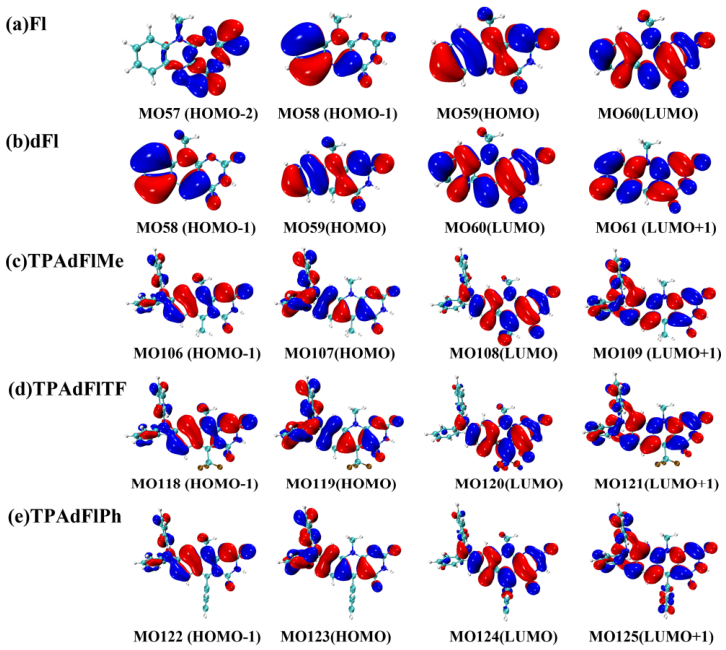



| Energy | f b | Composition | Percentage c | Character | |
|---|---|---|---|---|---|
| Fl: | |||||
| S0→S1 | 3.02 eV/410 nm | 0.2013 | 59→60 | 96.54% | π→π* |
| S0→S4 | 3.75 eV/331 nm | 0.1821 | 58→60 | 92.42% | n→π* |
| S0→T1 | 2.15 eV/576 nm | 0.0000 | 59→60 | 96.79% | π→π* |
| S0→T2 | 2.73 eV/454 nm | 0.0000 | 58→60 | 86.92% | n→π* |
| S0→T3 | 2.90 eV/428 nm | 0.0000 | 56→60 | 69.71% | n→π* |
| 57→60 | 18.76% | n→π* | |||
| 52→60 | 8.25% | n→π* | |||
| dFl: | |||||
| S0→S1 | 3.28 eV/378 nm | 0.2220 | 59→60 | 96.82% | π→π* |
| S0→S3 | 4.03 eV/307 nm | 0.1507 | 58→60 59→61 | 89.60% 7.99% | π→π* π→π* |
| S0→T1 | 2.53 eV/490 nm | 0.0000 | 59→60 | 94.62% | π→π* |
| S0→T2 | 2.92 eV/425 nm | 0.0000 | 58→60 | 84.28% | π→π* |
| 59→61 | 4.92% | π→π* | |||
| TPAdFlMe: | |||||
| S0→S1 | 2.86 eV/433 nm | 0.7205 | 107→108 | 98.30% | π→π* |
| S0→S4 | 3.93 eV/315 nm | 0.1137 | 58→60 | 84.28% | π→π* |
| 59→61 | 4.92% | π→π* | |||
| S0→T1 | 2.25 eV/551 nm | 0.0000 | 107→108 | 93.66% | π→π*, n→π* |
| S0→T2 | 2.84 eV/437 nm | 0.0000 | 118→120 | 90.23% | π→π*, n→π* |
| 119→120 | 2.32% | π→π*, n→π* | |||
| TPAdFlTF: | |||||
| S0→S1 | 2.56 eV/485 nm | 0.6648 | 119→120 | 98.80% | π→π* |
| S0→S2 | 3.06 eV/406 nm | 0.0405 | 118→120 | 97.40% | π→π*, n→π* |
| S0→T1 | 1.85 eV/671 nm | 0.0000 | 119→120 | 92.77% | π→π*, n→π* |
| S0→T2 | 2.51 eV/493 nm | 0.0000 | 118→120 | 90.23% | π→π*, n→π* |
| 119→120 | 2.32% | π→π*, n→π* | |||
| TPAdFlPh: | |||||
| S0→S1 | 2.86 eV/434 nm | 0.7562 | 123→124 | 98.24% | π→π* |
| S0→S4 | 3.91 eV/317 nm | 0.0708 | 123→125 | 66.26% | π→π*, n→π* |
| 120→124 | 28.16% | π→π*, n→π* | |||
| S0→T1 | 2.21 eV/561 nm | 0.0000 | 123→124 | 93.62% | π→π*, n→π* |
| S0→T2 | 2.82 eV/440 nm | 0.0000 | 122→124 | 87.17% | π→π*, n→π* |
| 123→125 | 2.59% | π→π*, n→π* |
| λabs /nm a | e /L·mol−1·cm−1 b | λem /nm c | ΦF /% d | ΦD /% e | τF /ns f | Ere /v g | |
|---|---|---|---|---|---|---|---|
| TPAdFlMe | 444 | 3.00 × 10⁴ | 491 | 82 | 42 | 3.97 | −1.75(−1.40) |
| TPAdFlTF | 490 | 1.68 × 10⁴ | 585 | 17 | 25 | 4.26 | −0.75(−0.40) |
| TPAdFlPh | 450 | 1.82 × 10⁴ | 500 | 63 | 39 | 4.20 | −1.71(−1.36) |
| Fl | 439 | 0.51 × 10⁴ | 524 | 42 | 38 | 6.13 | −0.64 h |
| RFTA | 447 h | 0.67 × 10⁴ h | 529 h | 30 h | 76 h | 6.28 h | −0.79 h |
 | |||||
|---|---|---|---|---|---|
| Entry | PS | Solvent | Time (h) | Substrate | Yield (%) b |
| 1 | TPAdFlMe | ACN | 18 | Bromobenzene | 80 |
| 2 | TPAdFlPh | ACN | 18 | Bromobenzene | 82 |
| 3 | Fl | ACN | 18 | Bromobenzene | 0 |
| 4 | RFTA | ACN | 18 | Bromobenzene | 0 |
| 5 | TPAdFlMe | Tol | 24 | Bromobenzene | 0 |
| 6 | TPAdFlMe | DCM | 24 | Bromobenzene | 0 |
| 7 | TPAdFlMe | ACN | 24 | Bromobenzene | 85 |
| 8 | TPAdFlMe | ACN:MeOH = 9:1 | 24 | Bromobenzene | 49 |
| 9 | TPAdFlMe | MeOH | 24 | Bromobenzene | 0 |
| 10 | TPAdFlMe | ACN | 6 | Bromobenzene | 37 |
| 11 | TPAdFlMe | ACN | 9 | Bromobenzene | 47 |
| 12 | TPAdFlMe | ACN | 12 | Bromobenzene | 49 |
| 13 | TPAdFlMe | ACN | 15 | Bromobenzene | 79 |
| 14 | TPAdFlPh | ACN | 6 | Bromobenzene | 44 |
| 15 | TPAdFlPh | ACN | 9 | Bromobenzene | 47 |
| 16 | TPAdFlPh | ACN | 12 | Bromobenzene | 73 |
| 17 | TPAdFlPh | ACN | 15 | Bromobenzene | 83 |
| 18 | TPAdFlPh | ACN | 24 | Bromobenzene | 88 |
| 19 | None | ACN | 24 | Bromobenzene | 0 |
| 20 c | TPAdFlPh | ACN | 24 | Bromobenzene | 0 |
| 21 c | TPAdFlPh | ACN | 24 | Chlorobenzene | 0 |
| 22 c | TPAdFlPh | ACN | 24 | Iodobenzene | 0 |
 | ||||
|---|---|---|---|---|
| Entry | PS | Time (h) | Substrate | Yield (%) b |
| 1 | TPAdFlMe | 24 | Chlorobenzene | 80 |
| 2 | TPAdFlPh | 24 | Chlorobenzene | 60 |
| 3 | TPAdFlMe | 24 | Bromobenzene | 85 |
| 4 | TPAdFlPh | 24 | Bromobenzene | 88 |
| 5 | TPAdFlMe | 18 | Iodobenzene | 100 |
| 6 | TPAdFlPh | 18 | Iodobenzene | 100 |
| 7 | TPAdFlMe | 18 | p-chloroanisole | 49 |
| 8 | TPAdFlPh | 18 | p-chloroanisole | 62 |
| 9 | TPAdFlMe | 18 | p-bromoanisole | 67 |
| 10 | TPAdFlPh | 18 | p-bromoanisole | 69 |
| 11 | TPAdFlMe | 24 | p-bromoanisole | 71 |
| 12 | TPAdFlPh | 24 | p-bromoanisole | 87 |
| 13 | TPAdFlMe | 18 | p-iodoanisole | 100 |
| 14 | TPAdFlPh | 18 | p-iodoanisole | 100 |
| 15 | TPAdFlMe | 18 | 3-bromopyridine | 92 |
| 16 | TPAdFlPh | 18 | 3-bromopyridine | 97 |
| 17 | TPAdFlMe | 18 | 1-bromonapthalene | 96 |
| 18 | TPAdFlPh | 18 | 1-bromonapthalene | 100 |
| 19 | TPAdFlMe | 18 | 4-bromopyrene | 96 |
| 20 | TPAdFlPh | 18 | 4-bromopyrene | 97 |
| 21 | TPAdFlMe | 18 | 1-benzhydryl-3-bromobenzene | 86 |
| 22 | TPAdFlPh | 18 | 1-benzhydryl-3-bromobenzene | 73 |
 | ||||||||
|---|---|---|---|---|---|---|---|---|
| Entry | PS | PS (mol%) | DIPEA (mmol) | Cs2CO3 (mmol) | Time (h) | Substrate | Yield A (%) b | Yield B (%) b |
| 1 | TPAdFlMe | 16 | 0.152 | 0.076 | 18 | 1,2-dichlorobenzene | 0 | 76 |
| 2 | TPAdFlPh | 16 | 0.152 | 0.076 | 18 | 1,2-dichlorobenzene | 0 | 95 |
| 3 | TPAdFlMe | 16 | 0.152 | 0.038 | 24 | 1,2-dichlorobenzene | 62 | 36 |
| 4 | TPAdFlPh | 16 | 0.152 | 0.038 | 24 | 1,2-dichlorobenzene | 94 | 6 |
| 5 | TPAdFlMe | 8 | 0.076 | 0.038 | 18 | 1,3-dichlorobenzene | 0 | 50 |
| 6 | TPAdFlPh | 8 | 0.076 | 0.038 | 18 | 1,3-dichlorobenzene | 59 | 13 |
| 7 | TPAdFlMe | 8 | 0.076 | 0.038 | 24 | 1,3-dichlorobenzene | 60 | 9 |
| 8 | TPAdFlPh | 8 | 0.076 | 0.038 | 24 | 1,3-dichlorobenzene | 61 | 17 |
| 9 | TPAdFlMe | 16 | 0.152 | 0.038 | 24 | 1,3-dichlorobenzene | 60 | 34 |
| 10 | TPAdFlPh | 16 | 0.152 | 0.038 | 24 | 1,3-dichlorobenzene | 33 | 63 |
| 11 | TPAdFlMe | 8 | 0.076 | 0.038 | 18 | 1,3-dibromobenzene | 0 | 96 |
| 12 | TPAdFlPh | 8 | 0.076 | 0.038 | 18 | 1,3-dibromobenzene | 0 | 100 |
| 13 | TPAdFlMe | 16 | 0.152 | 0.038 | 24 | 1,3-dibromobenzene | 53 | 47 |
| 14 | TPAdFlPh | 16 | 0.152 | 0.038 | 24 | 1,3-dibromobenzene | 0 | 100 |
| 15 | TPAdFlMe | 8 | 0.076 | 0.038 | 18 | 1,3-diiodobenzene | 94 | 0 |
| 16 | TPAdFlPh | 8 | 0.076 | 0.038 | 18 | 1,3-diiodobenzene | 100 | 0 |
 | |||||||
|---|---|---|---|---|---|---|---|
| Entry | PS | PS (mol%) | DIPEA (mmol) | Cs2CO3 (mmol) | Time (h) | Yield A (%) b | Yield B (%) b |
| 1 | TPAdFlMe | 16 | 0.152 | 0.038 | 24 | 100 | 0 |
| 2 | TPAdFlPh | 16 | 0.152 | 0.038 | 24 | 96 | 4 |
 | |||||||
|---|---|---|---|---|---|---|---|
| Entry | PS | PS (mol%) | DIPEA (mmol) | Cs2CO3 (mmol) | Time (h) | Yield A (%) b | Yield B (%) b |
| 1 | TPAdFlMe | 8 | 0.076 | 0.038 | 18 | 38 | 62 |
| 2 | TPAdFlPh | 8 | 0.076 | 0.038 | 18 | 28 | 72 |
| 3 | TPAdFlMe | 16 | 0.152 | 0.076 | 18 | 100 | 0 |
| 4 | TPAdFlPh | 16 | 0.152 | 0.076 | 18 | 100 | 0 |
 | ||||
|---|---|---|---|---|
| Entry | PS | Time (h) | TEMPO (mol%) | Yield (%) b |
| 1 | TPAdFlMe | 18 | 0 | 80 |
| 2 | TPAdFlMe | 18 | 8 | 82 |
| 3 | TPAdFlMe | 18 | 80 | 79 |
| 4 | TPAdFlMe | 18 | 160 | 62 |
| 5 | TPAdFlMe | 18 | 240 | 0 |
| 6 | TPAdFlPh | 18 | 0 | 82 |
| 7 | TPAdFlPh | 18 | 8 | 83 |
| 8 | TPAdFlPh | 18 | 80 | 74 |
| 9 | TPAdFlPh | 18 | 160 | 62 |
| 10 | TPAdFlPh | 18 | 240 | 18 |
Disclaimer/Publisher’s Note: The statements, opinions and data contained in all publications are solely those of the individual author(s) and contributor(s) and not of MDPI and/or the editor(s). MDPI and/or the editor(s) disclaim responsibility for any injury to people or property resulting from any ideas, methods, instructions or products referred to in the content. |
© 2026 by the authors. Licensee MDPI, Basel, Switzerland. This article is an open access article distributed under the terms and conditions of the Creative Commons Attribution (CC BY) license.
Share and Cite
Guo, H.; Guan, X.; Li, H.; Guo, W. C5-alkyl and C5-aryl Substituted 5-Deazaflavin as Sensitizers for Photodehalogenation of Aryl Halides. Molecules 2026, 31, 1400. https://doi.org/10.3390/molecules31091400
Guo H, Guan X, Li H, Guo W. C5-alkyl and C5-aryl Substituted 5-Deazaflavin as Sensitizers for Photodehalogenation of Aryl Halides. Molecules. 2026; 31(9):1400. https://doi.org/10.3390/molecules31091400
Chicago/Turabian StyleGuo, Huimin, Xing Guan, Heping Li, and Weihua Guo. 2026. "C5-alkyl and C5-aryl Substituted 5-Deazaflavin as Sensitizers for Photodehalogenation of Aryl Halides" Molecules 31, no. 9: 1400. https://doi.org/10.3390/molecules31091400
APA StyleGuo, H., Guan, X., Li, H., & Guo, W. (2026). C5-alkyl and C5-aryl Substituted 5-Deazaflavin as Sensitizers for Photodehalogenation of Aryl Halides. Molecules, 31(9), 1400. https://doi.org/10.3390/molecules31091400