Influence of Cherry Cultivar and Ethanol Concentration on the Oenological Properties of Fermented Cherry Wines


Abstract
1. Introduction
2. Results and Discussion
2.1. Physicochemical Properties of the Various Cherry Wines
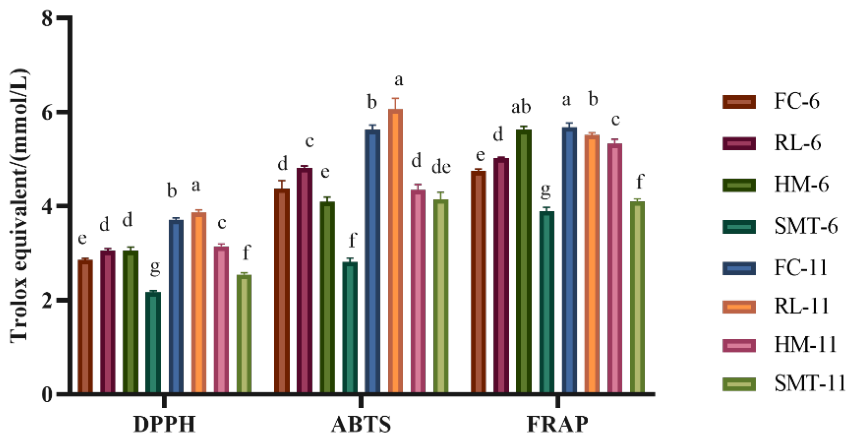
2.2. Antioxidant Capacity and Correlation Analysis
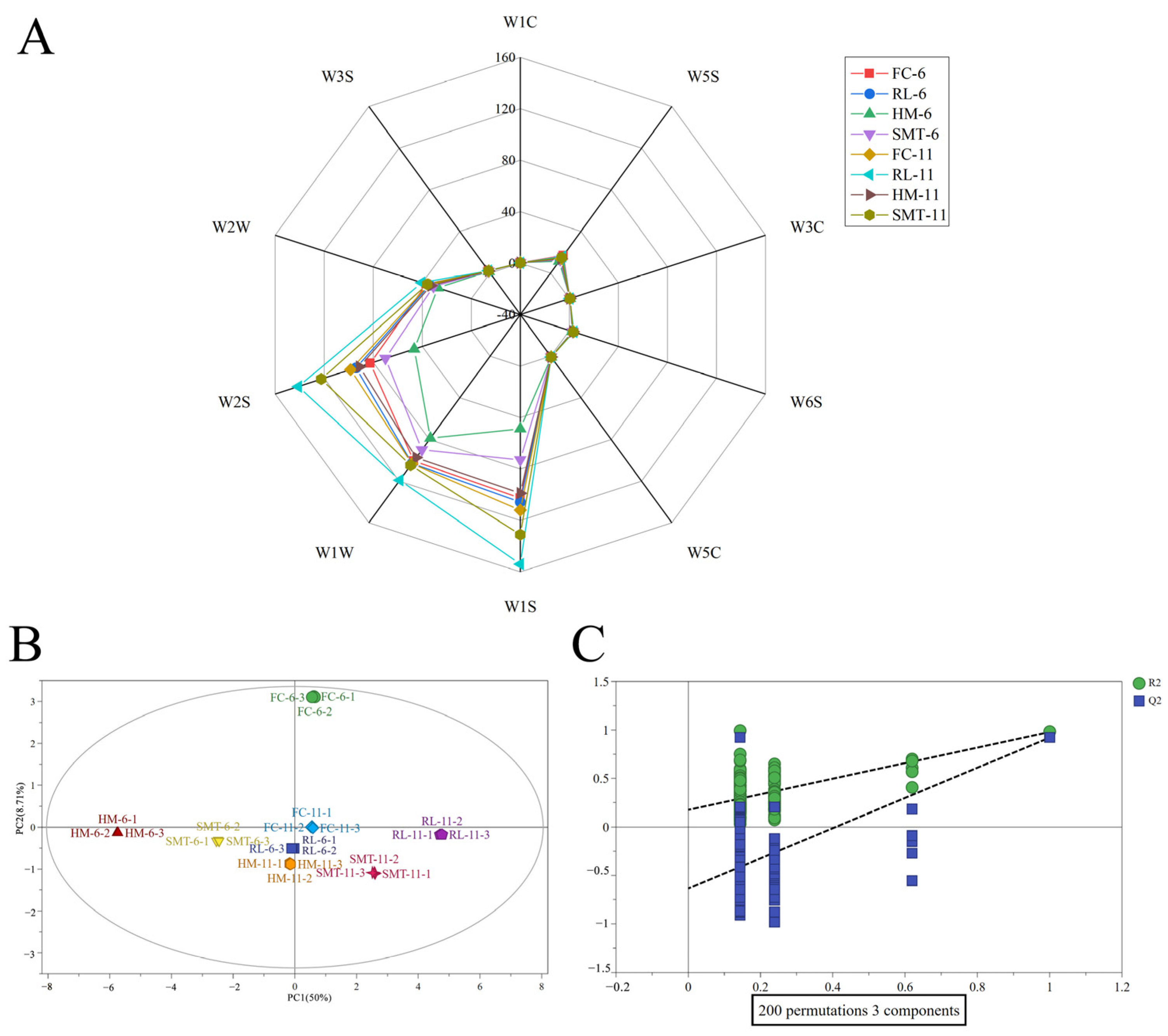
2.3. Electronic Nose Data
2.4. Volatile Compounds Analysis
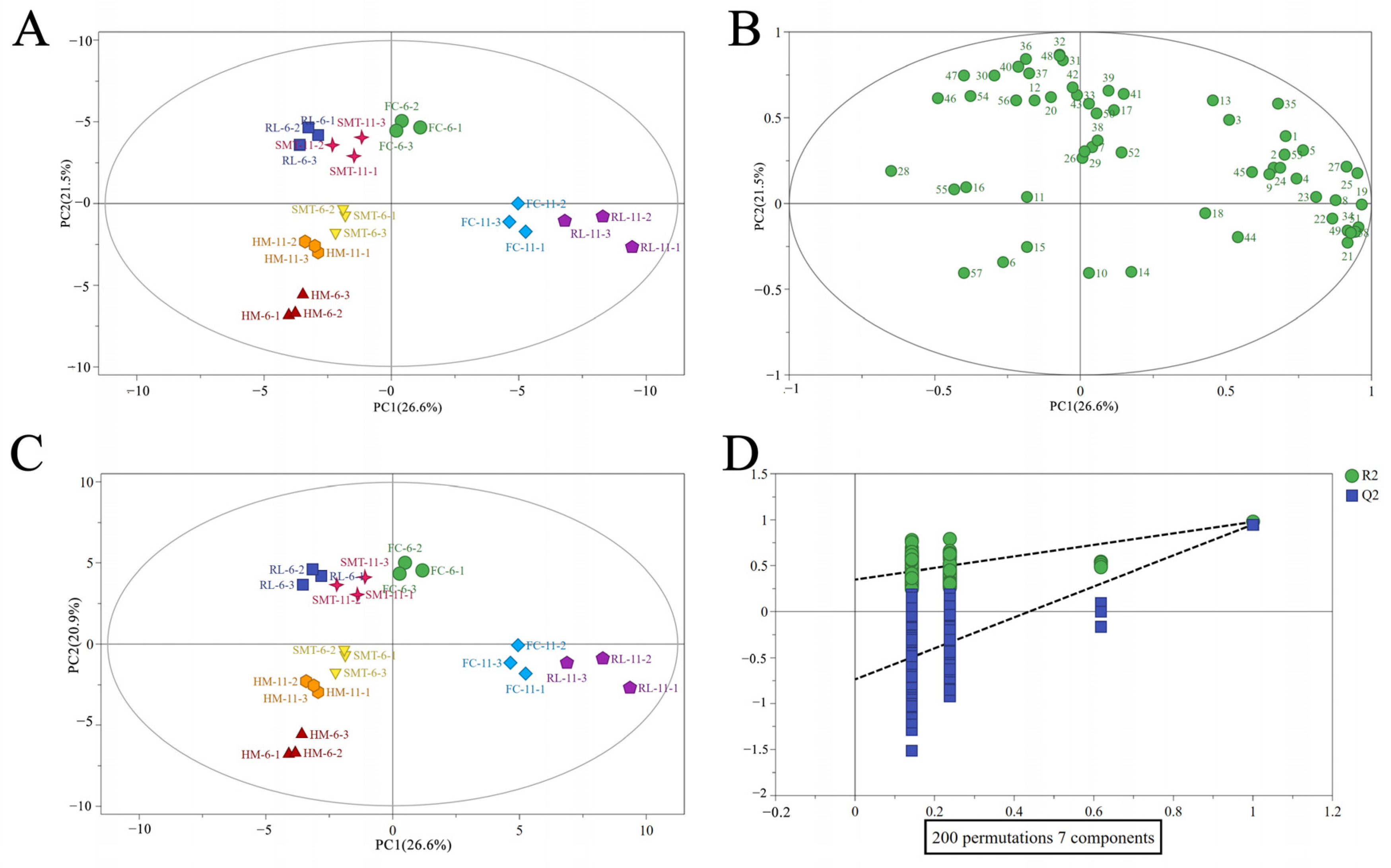
2.5. Multivariate Statistical Analysis
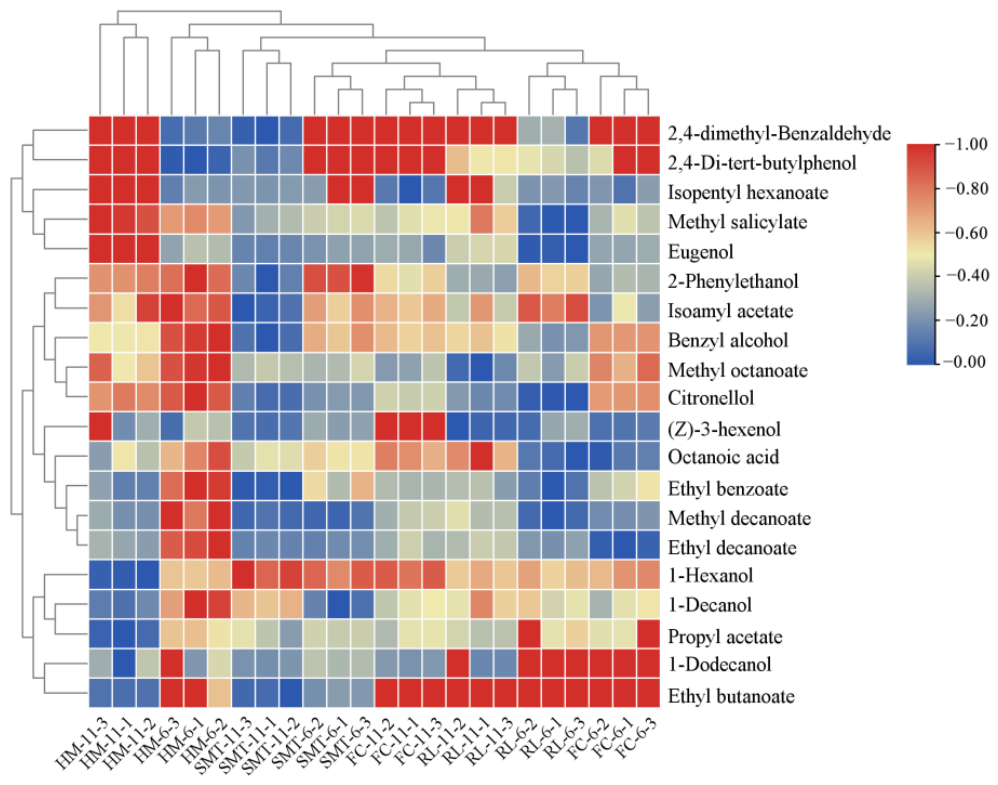
2.6. Comparison of Key Volatile Compounds
3. Materials and Methods
3.1. Materials and Reagents
3.2. Preparation of Cherry Wines
3.3. Physicochemical Analysis
3.4. Antioxidant Activity
3.4.1. DPPH Radical-Scavenging Activity
3.4.2. ABTS Radical-Scavenging Assay
3.4.3. Ferric Ion Reducing Antioxidant Power (FRAP) Assay
3.5. Detection of Volatile Compounds Using an Electronic Nose
3.6. Volatile Compound Analysis via HS-SPME-GC-MS
3.7. Analysis of Key Volatile Substances
3.8. Statistical Analysis
4. Conclusions
Supplementary Materials
Author Contributions
Funding
Data Availability Statement
Conflicts of Interest
References
- Vavoura, M.V.; Badeka, A.V.; Kontakos, S.; Kontominas, M.G. Characterization of four popular sweet cherry cultivars grown in Greece by volatile compound and physicochemical data analysis and sensory evaluation. Molecules 2015, 20, 1922–1940. [Google Scholar] [CrossRef]
- Heinonen, I.M.; Meyer, A.S.; Frankel, E.N. Antioxidant activity of berry phenolics on human low-density lipoprotein and liposome oxidation. J. Agric. Food Chem. 1998, 46, 4107–4112. [Google Scholar] [CrossRef]
- Čakar, U.; Petrović, A.; Pejin, B.; Čakar, M.; Živković, M.; Vajs, V.; Đorđević, B. Fruit as a substrate for a wine: A case study of selected berry and drupe fruit wines. Sci. Hortic. 2019, 244, 42–49. [Google Scholar] [CrossRef]
- Dong, W.; Chen, D.; Chen, Z.; Sun, H.; Xu, Z. Antioxidant capacity differences between the major flavonoids in cherry (Prunus pseudocerasus) in vitro and in vivo models. LWT Food Sci. Technol. 2021, 141, 110938. [Google Scholar] [CrossRef]
- Fonseca, L.R.S.; Silva, G.R.; Luís, Â.; Cardoso, H.J.; Correia, S.; Vaz, C.V.; Duarte, A.P.; Socorro, S. Sweet Cherries as Anti-Cancer Agents: From Bioactive Compounds to Function. Molecules 2021, 26, 2941. [Google Scholar] [CrossRef]
- Niu, Y.; Zhang, X.; Xiao, Z.; Song, S.; Jia, C.; Yu, H.; Xu, C. Characterization of taste-active compounds of various cherry wines and their correlation with sensory attributes. J. Chromatogr. B 2012, 902, 55–60. [Google Scholar] [CrossRef]
- Xiao, Z.; Fang, L.; Niu, Y.; Yu, H. Effect of cultivar and variety on phenolic compounds and antioxidant activity of cherry wine. Food Chem. 2015, 186, 69–73. [Google Scholar] [CrossRef]
- Su, Z.; Liu, B.; Ma, C. Analyses of the volatile compounds in cherry wine during fermentation and aging in bottle using HS-GC-IMS. Food Sci. Technol. Res. 2021, 27, 599–607. [Google Scholar] [CrossRef]
- Huang, J.; Wang, Y.; Ren, Y.; Wang, X.; Li, H.; Liu, Z.; Yue, T.; Gao, Z. Effect of inoculation method on the quality and nutritional characteristics nof low-alcohol kiwi wine. LWT 2022, 156, 113049. [Google Scholar] [CrossRef]
- Teng, B.; Petrie, P.R.; Nandorfy, D.E.; Smith, P.; Bindon, K. Pre-Fermentation water addition to high-sugar shiraz must: Effects on wine composition and sensory properties. Foods 2020, 9, 1193. [Google Scholar] [CrossRef]
- Pham, D.-T.; Ristic, R.; Stockdale, V.J.; Jeffery, D.W.; Tuke, J.; Wilkinson, K. Influence of partial dealcoholization on the composition and sensory properties of Cabernet Sauvignon wines. Food Chem. 2020, 325, 126869. [Google Scholar] [CrossRef]
- Maja, R.; Boris, P.; Krunoslav, D.; Nada, V.; Sinisa SVerica, D.-U.; Zorica, J.; Branka, L. Quality and sensory study of fresh sour cherry juices upon cultivar, growing area and weather conditions. J. Food Sci. 2019, 84, 3264–3274. [Google Scholar] [CrossRef] [PubMed]
- Silva, V.; Pereira, S.; Vilela, A.; Bacelar, E.; Guedes, F.; Ribeiro, C.; Silva, A.P.; Gonçalves, B. Preliminary insights in sensory profile of sweet cherries. Foods 2021, 10, 612. [Google Scholar] [CrossRef] [PubMed]
- Braga, C.M.; Zielinski, A.A.F.; da Silva, K.M.; de Souza, F.K.F.; Pietrowski, G.d.A.M.; Couto, M.; Granato, D.; Wosiacki, G.; Nogueira, A. Classification of juices and fermented beverages made from unripe, ripe and senescent apples based on the aromatic profile using chemometrics. Food Chem. 2013, 141, 967–974. [Google Scholar] [CrossRef] [PubMed]
- Jia, C.; Han, F.; Miao, X.; Yan, A.; Wu, P.; Sun, Y. Study on the changes of sugar and acid in fermentation process of different varieties of cherry wine. J. Food Sci. Nutr. 2019, 2, 15–19. [Google Scholar] [CrossRef]
- Liu, S.; Laaksonen, O.; Kortesniemi, M.; Kalpio, M.; Yang, B. Chemical composition of bilberry wine fermented with non-Saccharomyces yeasts (Torulaspora delbrueckii and Schizosaccharomyces pombe) and Saccharomyces cerevisiae in pure, sequential and mixed fermentations. Food Chem. 2018, 266, 262–274. [Google Scholar] [CrossRef]
- Li, M.; Zhao, X.; Sun, Y.; Yang, Z.; Han, G.; Yang, X. Evaluation of anthocyanin profile and color in sweet cherry wine: Effect of sinapic acid and grape tannins during aging. Molecules 2021, 26, 2923. [Google Scholar] [CrossRef]
- Chaovanalikit, A.; Wrolstad, R.E. Anthocyanin and polyphenolic composition of fresh and processed cherries. J. Food Sci. 2004, 69, FCT73–FCT83. [Google Scholar] [CrossRef]
- Toydemir, G.; Capanoglu, E.; Kamiloglu, S.; Boyacioglu, D.; de Vos, R.C.; Hall, R.D.; Beekwilder, J. Changes in sour cherry (Prunus cerasus L.) antioxidants during nectar processing and in vitro gastrointestinal digestion. J. Funct. Foods 2013, 5, 1402–1413. [Google Scholar] [CrossRef]
- Lingua, M.S.; Fabani, M.P.; Wunderlin, D.A.; Baroni, M.V. From grape to wine: Changes in phenolic composition and its influence on antioxidant activity. Food Chem. 2016, 208, 228–238. [Google Scholar] [CrossRef]
- Liang, H.; Gao, D.; Wang, C.; Gao, H.; Guo, Y.; Zhao, Z.; Shi, H. Effect of Fermentation Strategy on the Quality and Aroma Characteristics of Yellow Peach Wines. Fermentation 2022, 8, 604. [Google Scholar] [CrossRef]
- Arozarena, Í.; Ortiz, J.; Hermosín-Gutiérrez, I.; Urretavizcaya, I.; Salvatierra, S.; Córdova, I.; Marín-Arroyo, M.R.; Noriega, M.J.; Navarro, M. Color, ellagitannins, anthocyanins, and antioxidant activity of Andean blackberry (Rubus glaucus Benth.) wines. J. Agric. Food Chem. 2012, 60, 7463–7473. [Google Scholar] [CrossRef]
- Rupasinghe, H.V.; Clegg, S. Total antioxidant capacity, total phenolic content, mineral elements, and histamine concentrations in wines of different fruit sources. J. Food Compos. Anal. 2007, 20, 133–137. [Google Scholar] [CrossRef]
- Czyżowska, A.; Wilkowska, A.; Staszczak, A.; Nowak, A. Characterization of Phytochemicals in Berry Fruit Wines Analyzed by Liquid Chromatography Coupled to Photodiode-Array Detection and Electrospray Ionization/Ion Trap Mass Spectrometry (LC-DAD-ESI-MSn) and Their Antioxidant and Antimicrobial Activity. Foods 2020, 9, 1783. [Google Scholar] [CrossRef] [PubMed]
- Ljevar, A.; Ćurko, N.; Tomašević, M.; Radošević, K.; Gaurina Srček, V.; Kovačević Ganić, K. Phenolic composition, antioxidant capacity and in vitro cytotoxicity assessment of fruit wines. Food Technol. Biotechnol. 2016, 54, 145–155. [Google Scholar] [CrossRef] [PubMed]
- Yun, J.; Cui, C.; Zhang, S.; Zhu, J.; Peng, C.; Cai, H.; Yang, X.; Hou, R. Use of headspace GC/MS combined with chemometric analysis to identify the geographic origins of black tea. Food Chem. 2021, 360, 130033. [Google Scholar] [CrossRef] [PubMed]
- Droge, B. Phillip Good: Permutation, parametric, and bootstrap tests of hypotheses. Metrika 2006, 64, 249–250. [Google Scholar] [CrossRef]
- Li, H.M.; Jiang, D.Q.; Dai, Z.G.; Zhang, Y.S.; Zhang, Y.; Sun, S.Y.; Zhao, Y.P. Aromatic property of cherry wine produced by malolactic fermentation of controlled and spontaneous on the bacterial evolution. Int. J. Food Prop. 2019, 22, 1270–1282. [Google Scholar] [CrossRef]
- Xiao, Q.; Zhou, X.; Xiao, Z.; Niu, Y. Characterization of the differences in the aroma of cherry wines from different price segments using gas chromatography-mass spectrometry, odor activity values, sensory analysis, and aroma reconstitution. Food Sci. Biotechnol. 2017, 26, 331–338. [Google Scholar] [CrossRef]
- Yang, C.; Wang, Y.; Liang, Z.; Fan, P.; Wu, B.; Yang, L.; Li, S. Volatiles of grape berries evaluated at the germplasm level by headspace-SPME with GC-MS. Food Chem. 2009, 114, 1106–1114. [Google Scholar] [CrossRef]
- Gaborieau, S.; Cendrès, A.; Page, D.; Ginies, C.; Renard, C.M.G.C. Variability of free and glycosylated volatiles from strawberries destined for the fresh market and for processing, assessed using direct enzymatic hydrolysis. LWT-Food Sci. Technol. 2018, 98, 187–196. [Google Scholar] [CrossRef]
- Nikicevic, N.; Velickovic, M.; Jadranin, M.; Vuckovic, I.; Novakovic, M.; Vujisic, L.; Stankovic, M.; Urosevic, I.; Tesevic, V. The effects of the cherry variety on the chemical and sensorial characteristics of cherry brandy. J. Serbian Chem. Soc. 2011, 76, 1219–1228. [Google Scholar] [CrossRef]
- Hu, K.; Jin, G.-J.; Mei, W.-C.; Li, T.; Tao, Y.-S. Increase of medium-chain fatty acid ethyl ester content in mixed H. uvarum/S. cerevisiae fermentation leads to wine fruity aroma enhancement. Food Chem. 2018, 239, 495–501. [Google Scholar] [CrossRef] [PubMed]
- Ferreira, V.; Fernández, P.; Peña, C.; Escudero, A.; Cacho, J.F. Investigation on the role played by fermentation esters in the aroma of young Spanish wines by multivariate analysis. J. Sci. Food Agric. 1995, 67, 381–392. [Google Scholar] [CrossRef]
- Seung-Joo, L.; Bomi, A. Comparison of volatile components in fermented soybean pastes using simultaneous distillation and extraction (SDE) with sensory characterization. Food Chem. 2009, 114, 600–609. [Google Scholar] [CrossRef]
- Liu, C.; Li, M.; Ren, T.; Wang, J.; Niu, C.; Zheng, F.; Li, Q. Effect of Saccharomyces cerevisiae and non-Saccharomyces strains on alcoholic fermentation behavior and aroma profile of yellow-fleshed peach wine. LWT 2022, 155, 112993. [Google Scholar] [CrossRef]
- Liu, Q.; Weng, P.; Wu, Z. Quality and aroma characteristics of honey peach wines as influenced by different maturity. Int. J. Food Prop. 2020, 23, 445–458. [Google Scholar] [CrossRef]
- Wu, Y.; Zhang, W.; Yu, W.; Zhao, L.; Song, S.; Xu, W.; Zhang, C.; Ma, C.; Wang, L.; Wang, S. Study on the volatile composition of table grapes of three aroma types. LWT—Food Sci. Technol. 2019, 115, 108450. [Google Scholar] [CrossRef]
- Juan, F.S.; Cacho, J.; Ferreira, V.; Escudero, A. Aroma chemical composition of red wines from different price categories and its relationship to quality. J. Agric. Food Chem. 2012, 60, 5045–5056. [Google Scholar] [CrossRef]
- de Ovalle, S.; Brena, B.; González-Pombo, P. Influence of beta glucosidases from native yeast on the aroma of Muscat and Tannat wines. Food Chem. 2021, 346, 128899. [Google Scholar] [CrossRef]
- Mara, B.; Renata, P.; Draženka, K.; Karin, K.G. Aroma compounds of Marasca cherry wine. In Proceedings of the 4th Central European Congress on Food and 6th Croatian Congress of Food Technologists, Biotechnologists and Nutritionists, Cavtat, Croatia, 15–17 May 2008; Volume 5, pp. 15–17. [Google Scholar]
- Jiang, B.; Xi, Z.; Luo, M.; Zhang, Z. Comparison on aroma compounds in Cabernet Sauvignon and Merlot wines from four wine grape-growing regions in China. Food Res. Int. 2013, 51, 482–489. [Google Scholar] [CrossRef]
- Liu, T.T.; Ma, Y.S.; Li, N.; Zhao, X. Comparison of aroma characteristics of Cerasus humilis wines fermented from whole fruits and pomace. Food Sci. 2016, 37, 99–104. [Google Scholar]
- Meilgaard, M.C. Flavor chemistry of beer: Part II: Flavor and threshold of 239 aroma volatiles. Tech. Quart. Master Brew. Ass. Am. 1975, 12, 151–168. [Google Scholar]
- Pino, J.A.; Queris, O. Analysis of volatile compounds of mango wine. Food Chem. 2011, 125, 1141–1146. [Google Scholar] [CrossRef]
- Liu, M.; Gao, W.; Zhang, R.M. Effect of juice or pomace fermentation on aroma quality of apricot wine. Food Sci. 2021, 42, 193–200. [Google Scholar] [CrossRef]
- Zong, X.; Wang, W.; Wei, H.; Wang, J.; Yan, X.; Hammond, R.W.; Liu, Q. Incidence of sweet cherry viruses in Shandong Province, China and a case study on multiple infection with five viruses. J. Plant Pathol. 2015, 97, 61–68. [Google Scholar] [CrossRef]
- GB/T 15038-2006; Analytical Methods of Wine and Fruit Wine. Standardization Administration of China: Beijing, China, 2006.
- Huang, C.H.; Tao, J.J.; Liao, G.L.; Xie, M.; Qu, X.Y.; Chen, L.; Xu, X.B. Dynamic changes of phenol and antioxidant capacity during fruit development of three Actinidia species (kiwifruit). Sci. Hortic. 2020, 273, 109571. [Google Scholar] [CrossRef]
- Kim, D.-O.; Jeong, S.W.; Lee, C.Y. Antioxidant capacity of phenolic phytochemicals from various cultivars of plums. Food Chem. 2003, 81, 321–326. [Google Scholar] [CrossRef]
- Aramwit, P.; Bang, N.; Srichana, T. The properties and stability of anthocyanins in mulberry fruits. Food Res. Int. 2010, 43, 1093–1097. [Google Scholar] [CrossRef]
- Espín, J.C.; Soler-Rivas, C.; Wichers, H.J. Characterization of the total free radical scavenger capacity of vegetable oils and oil fractions using 2, 2-diphenyl-1-picrylhydrazyl radical. J. Agric. Food Chem. 2000, 48, 648–656. [Google Scholar] [CrossRef]
- Marfil, R.; Giménez, R.; Martínez, O.; Bouzas, P.R.; Rufián-Henares, J.A.; Mesías, M.; Cabrera-Vique, C. Determination of polyphenols, tocopherols, and antioxidant capacity in virgin argan oil (Argania spinosa, Skeels). Eur. J. Lipid Sci. Technol. 2011, 113, 886–893. [Google Scholar] [CrossRef]
- Szydłowska-Czerniak, A.; Karlovits, G.; Dianoczki, C.; Recseg, K.; Szłyk, E. Comparison of two analytical methods for assessing antioxidant capacity of rapeseed and olive oils. J. Am. Oil Chem. Soc. 2008, 85, 141–149. [Google Scholar] [CrossRef]
- Song, J.; Chen, Q.; Bi, J.; Meng, X.; Wu, X.; Qiao, Y.; Lyu, Y. GC/MS coupled with MOS e-nose and flash GC e-nose for volatile characterization of Chinese jujubes as affected by different drying methods. Food Chem. 2020, 331, 127201. [Google Scholar] [CrossRef]
- Ling, M.; Qi, M.; Li, S.; Shi, Y.; Pan, Q.; Cheng, C.; Yang, W.; Duan, C. The influence of polyphenol supplementation on ester formation during red wine alcoholic fermentation. Food Chem. 2022, 377, 131961. [Google Scholar] [CrossRef]
- Zhu, Y.; Chen, J.; Chen, X.; Chen, D.; Deng, S. Use of relative odor activity value (ROAV) to link aroma profiles to volatile compounds: Application to fresh and dried eel (Muraenesox cinereus). Int. J. Food Prop. 2020, 23, 2257–2270. [Google Scholar] [CrossRef]
- Wei, J.; Wang, S.; Zhang, Y.; Yuan, Y.; Yue, T. Characterization and screening of non-Saccharomyces yeasts used to produce fragrant cider. LWT 2019, 107, 191–198. [Google Scholar] [CrossRef]



| Physicochemical Indices | FC-6 | RL-6 | HM-6 | SMT-6 | FC-11 | RL-11 | HM-11 | SMT-11 |
|---|---|---|---|---|---|---|---|---|
| pH | 3.73 ± 0.03 d | 3.72 ± 0.01 d | 3.72 ± 0.01 d | 3.56 ± 0.02 f | 3.85 ± 0.01 a | 3.81 ± 0.01 b | 3.76 ± 0.01 c | 3.60 ± 0.02 e |
| Total acid/(g/L) | 7.11 ± 0.06 f | 8.22 ± 0.10 d | 8.09 ± 0.05 e | 8.48 ± 0.05 a | 7.99 ± 0.06 e | 8.91 ± 0.05 a | 8.53 ± 0.06 a | 8.47 ± 0.05 c |
| Volatile acid/(g/L) | 0.42 ± 0.02 abc | 0.45 ± 0.03 a | 0.43 ± 0.02 ab | 0.44 ± 0.02 ab | 0.39 ± 0.02 c | 0.43 ± 0.02 ab | 0.41 ± 0.02 bc | 0.45 ± 0.02 a |
| Reducing sugar/(g/L) | 2.69 ± 0.06 a | 1.96 ± 0.03 c | 1.75 ± 0.22 d | 0.98 ± 0.03 e | 2.77 ± 0.03 a | 1.98 ± 0.03 c | 2.48 ± 0.03 b | 1.94 ± 0.06 c |
| Alcohol/(v/v) | 6.54 ± 0.14 b | 6.92 ± 0.17 c | 6.08 ± 0.05 d | 6.21 ± 0.04 d | 11.45 ± 0.03 a | 11.22 ± 0.17 ab | 11.15 ± 0.09 b | 11.28 ± 0.20 ab |
| TPC/(mg GAE/L) | 729.50 ± 6.01 d | 834.83 ± 7.35 b | 706.07 ± 6.44 f | 628.23 ± 5.69 g | 832.37 ± 2.29 b | 900.90 ± 3.41 a | 718.70 ± 2.75 e | 809.13 ± 1.76 c |
| TFC/(mg CAE/L) | 60.57 ± 0.55 d | 73.77 ± 0.57 b | 40.00 ± 1.11 h | 50.73 ± 0.60 f | 72.00 ± 0.60 c | 82.20 ± 0.36 a | 44.00 ± 0.98 g | 52.40 ± 0.78 e |
| TAC/(mg/L) | 13.68 ± 0.97 c | 13.33 ± 1.90 c | 7.05 ± 0.71 d | 5.11 ± 0.47 e | 21.25 ± 1.25 a | 16.32 ± 1.48 b | 14.21 ± 0.20 c | 7.28 ± 0.40 d |
| Program | DPPH | ABTS | FRAP | TPC | TFC | TAC |
|---|---|---|---|---|---|---|
| DPPH | 1 | 0.945 ** | 0.886 ** | 0.736 * | 0.609 | 0.846 ** |
| ABTS | - | 1 | 0.725 * | 0.903 ** | 0.766 * | 0.847 ** |
| FRAP | - | - | 1 | 0.437 | 0.258 | 0.672 |
| TPC | - | - | - | 1 | 0.807 * | 0.637 |
| TFC | - | - | - | - | 1 | 0.637 |
| TAC | - | - | - | - | - | 1 |
| No. | Compounds | Odor Threshold (µg/L) | Odor Description | p | VIP | Relative Odor Activity Value (ROAV) | |||||||
|---|---|---|---|---|---|---|---|---|---|---|---|---|---|
| FC-6 | RL-6 | HM-6 | SMT-6 | FC-11 | RL-11 | HM-11 | SMT-11 | ||||||
| 1 | 1-Hexanol | 8000 a | Herbaceous | 0.006 | 1.219 | 0.04 | 0.05 | 0.05 | 0.04 | 0.04 | 0.05 | 0.08 | 0.04 |
| 2 | (Z)-3-hexenol | 400 b | Herbaceous | 0.002 | 1.210 | 0.02 | 0.01 | 0.01 | 0.00 | 0.02 | 0.01 | 0.01 | 0.02 |
| 3 | 1-Decanol | 400 a | Fruity, floral, special fatty | 0.004 | 1.083 | 0.09 | 0.08 | 0.05 | 0.14 | 0.08 | 0.07 | 0.13 | 0.07 |
| 4 | Benzyl alcohol | 200,000 a | Floral, rose, phenolic | 0.003 | 1.033 | 0.00 | 0.01 | 0.00 | 0.00 | 0.00 | 0.00 | 0.00 | 0.01 |
| 5 | 2-Phenylethanol | 14,000 a | Floral, rose | 0.002 | 1.004 | 0.05 | 0.04 | 0.03 | 0.03 | 0.04 | 0.05 | 0.03 | 0.05 |
| 6 | 1-Dodecanol | 1000 a | Floral | 0.046 | 1.021 | 0.00 | 0.00 | 0.00 | 0.00 | 0.01 | 0.00 | 0.01 | 0.01 |
| 7 | Propyl acetate | 30,000 c | Sweetish, perfumed | 0.015 | 1.151 | 0.00 | 0.00 | 0.00 | 0.00 | 0.00 | 0.00 | 0.00 | 0.00 |
| 8 | Ethyl butanoate | 20 e | Fruity, pineapple | 0.003 | 1.111 | 0.00 | 0.00 | 0.17 | 4.74 | 0.00 | 0.00 | 9.32 | 12.01 |
| 9 | Isoamyl acetate | 30 a | Fruity, banana | 0.008 | 1.051 | 63.73 | 23.65 | 21.91 | 33.40 | 35.45 | 46.44 | 31.06 | 100.00 |
| 10 | Methyl octanoate | 200 a | Fruity, orange | 0.005 | 1.003 | 0.21 | 0.33 | 0.16 | 0.32 | 0.35 | 0.44 | 0.23 | 0.32 |
| 11 | Isopentyl hexanoate | 700 d | Fruity | 0.009 | 1.121 | 5.42 | 7.91 | 0.74 | 7.44 | 3.53 | 3.33 | 5.05 | 7.36 |
| 12 | Methyl decanoate | 6 e | Fruity, floral | 0.003 | 1.036 | 5.33 | 7.78 | 0.73 | 7.32 | 3.47 | 3.28 | 4.97 | 7.24 |
| 13 | Ethyl decanoate | 200 a | Fruity, fatty, pleasant | 0.003 | 1.005 | 30.81 | 17.07 | 21.05 | 19.95 | 12.06 | 10.83 | 14.68 | 20.77 |
| 14 | Ethyl benzoate | 53 e | Mint, fruity | 0.004 | 1.062 | 2.95 | 4.40 | 1.69 | 2.73 | 3.32 | 3.36 | 3.92 | 4.71 |
| 15 | Methyl salicylate | 20 b | Peppermint | 0.003 | 1.007 | 1.52 | 2.76 | 0.84 | 1.41 | 1.38 | 1.01 | 0.56 | 1.77 |
| 16 | Octanoic acid | 500 a | Rancid | 0.004 | 1.020 | 0.55 | 0.57 | 0.19 | 0.27 | 0.20 | 0.18 | 0.35 | 0.31 |
| 17 | Citronellol | 100 a | Lemon, rose | 0.002 | 1.058 | 0.26 | 1.51 | 0.16 | 0.92 | 0.57 | 0.98 | 0.24 | 1.24 |
| 18 | 2,4-dimethyl-Benzaldehyde | - | - | 0.002 | 1.001 | - | - | - | - | - | - | - | - |
| 19 | Eugenol | 5 b | Clove | 0.004 | 1.044 | 2.62 | 6.29 | 2.24 | 2.97 | 2.97 | 1.51 | 0.00 | 3.98 |
| 20 | 2,4-Di-tert-butylphenol | 200 a | 0.003 | 1.026 | 0.03 | 0.12 | 0.88 | 0.00 | 0.00 | 0.06 | 0.00 | 0.44 | |
Disclaimer/Publisher’s Note: The statements, opinions and data contained in all publications are solely those of the individual author(s) and contributor(s) and not of MDPI and/or the editor(s). MDPI and/or the editor(s) disclaim responsibility for any injury to people or property resulting from any ideas, methods, instructions or products referred to in the content. |
© 2026 by the authors. Licensee MDPI, Basel, Switzerland. This article is an open access article distributed under the terms and conditions of the Creative Commons Attribution (CC BY) license.
Share and Cite
Wang, C.; Li, M.; Li, L.; Wang, X.; Li, B.; Yu, Y. Influence of Cherry Cultivar and Ethanol Concentration on the Oenological Properties of Fermented Cherry Wines. Molecules 2026, 31, 1382. https://doi.org/10.3390/molecules31091382
Wang C, Li M, Li L, Wang X, Li B, Yu Y. Influence of Cherry Cultivar and Ethanol Concentration on the Oenological Properties of Fermented Cherry Wines. Molecules. 2026; 31(9):1382. https://doi.org/10.3390/molecules31091382
Chicago/Turabian StyleWang, Cong, Miaomiao Li, Liang Li, Xutao Wang, Bo Li, and Yang Yu. 2026. "Influence of Cherry Cultivar and Ethanol Concentration on the Oenological Properties of Fermented Cherry Wines" Molecules 31, no. 9: 1382. https://doi.org/10.3390/molecules31091382
APA StyleWang, C., Li, M., Li, L., Wang, X., Li, B., & Yu, Y. (2026). Influence of Cherry Cultivar and Ethanol Concentration on the Oenological Properties of Fermented Cherry Wines. Molecules, 31(9), 1382. https://doi.org/10.3390/molecules31091382