Berberine Toxicity Profile in Experimental Models as a Basis for Assessing Its Biological Safety


 , ,
, ,  and
and 
Abstract
1. Introduction
2. Results and Discussion
3. Materials and Methods
3.1. Bacterial Strains and Chemicals
3.2. Bacterial Growth Inhibition Test
3.3. Toxicity Bioassays
3.4. Fatty Acids Extraction and Analysis
3.5. Preparation of Cell Extracts
3.6. Enzyme Assays
3.7. The Lipids Peroxidation Assay
4. Conclusions
Author Contributions
Funding
Institutional Review Board Statement
Informed Consent Statement
Data Availability Statement
Conflicts of Interest
Correction Statement
References
- Bogdanova, R.; Kondeva-Burdina, M.; Popova, T.; Tzankov, B.; Voycheva, C.; Slavkova, M.; Tzankova, V.; Stefanova, D. In vitro evaluation of antioxidant and neuroprotective effects of berberine loaded in nanostructured lipid carriers. Pharmacia 2025, 72, 1–14. [Google Scholar] [CrossRef]
- Younis, F.A.; Saleh, S.R.; El-Rahman, S.S.A.; Newairy, A.A.; El-Demellawy, M.A.; Ghareeb, D.A. Preparation, physicochemical characterization, and bioactivity evaluation of berberine-entrapped albumin nanoparticles. Sci. Rep. 2022, 12, 17431. [Google Scholar] [CrossRef] [PubMed]
- Asghari, P.; Babaei, A.; Zamanian, N.; Nattagh-Eshtivani, E. Berberine’s impact on health: Comprehensive biological, pharmacological, and nutritional perspective. Metabol. Open 2025, 28, 100399. [Google Scholar] [CrossRef] [PubMed]
- Guo, Y.; Li, F.; Ma, X.; Cheng, X.; Zhou, H.; Klaassen, C.D. CYP2D plays a major role in berberine metabolism in liver of mice and humans. Xenobiotica 2011, 41, 996–1005. [Google Scholar] [CrossRef] [PubMed]
- Ma, J.Y.; Feng, R.; Tan, X.S.; Ma, C.; Shou, J.W.; Fu, J.; Huang, M.; He, C.Y.; Chen, S.N.; Zhao, Z.X.; et al. Excretion of berberine and its metabolites in oral administration in rats. J. Pharm. Sci. 2013, 102, 4181–4192. [Google Scholar] [CrossRef]
- Cui, H.X.; Hu, Y.N.; Li, J.W.; Yuan, K. Hypoglycemic mechanism of the berberine organic acid salt under the synergistic effect of intestinal flora and oxidative stress. Oxidative Med. Cell. Longev. 2018, 2018, 8930374. [Google Scholar] [CrossRef]
- Yu, Y.; Liu, L.; Wang, X.; Liu, X.; Liu, X.; Xie, L.; Wang, G. Modulation of glucagon-like peptide-1 release by berberine: In vivo and in vitro studies. Biochem. Pharmacol. 2010, 79, 1000–1006. [Google Scholar] [CrossRef]
- Marti, C.N.; Gheorghiade, M.; Kalogeropoulos, A.P.; Georgiopoulou, V.V.; Quyyumi, A.A.; Butler, J. Endothelial dysfunction, arterial stiffness, and heart failure. J. Am. Coll. Cardiol. 2012, 60, 1455–1469. [Google Scholar] [CrossRef]
- Zhang, L.; Wu, X.; Yang, R.; Chen, F.; Liao, Y.; Zhu, Z.; Wu, Z.; Sun, X.; Wang, L. Effects of berberine on the gastrointestinal microbiota. Front. Cell. Infect. Microbiol. 2021, 10, 588517. [Google Scholar] [CrossRef]
- Singh, N.; Sharma, B. Toxicological effects of berberine and sanguinarine. Front. Mol. Biosci. 2018, 5, 21. [Google Scholar] [CrossRef]
- Muszalska, A.; Wiecanowska, J. Berberis vulgaris: A natural source of berberine for addressing contemporary health concerns. Herba Pol. 2024, 70, 5–22. [Google Scholar] [CrossRef]
- Jin, J.; Hua, G.; Meng, Z.; Gao, P. Antibacterial mechanisms of berberine and reasons for little resistance of bacteria. Chin. Herb. Med. 2011, 3, 27–35. [Google Scholar] [CrossRef]
- Kang, S.; Li, Z.; Yin, Z.; Jia, R.; Song, X.; Li, L.; Chen, Z.; Peng, L.; Qu, J.; Hu, Z.; et al. The antibacterial mechanism of berberine against Actinobacillus pleuropneumoniae. Nat. Prod. Res. 2015, 29, 2203–2206. [Google Scholar] [CrossRef] [PubMed]
- Peng, L.; Kang, S.; Yin, Z.; Jia, R.; Song, X.; Li, L.; Li, Z.; Zou, Y.; Liang, X.; Li, L.; et al. Antibacterial activity and mechanism of berberine against Streptococcus agalactiae. Int. J. Clin. Exp. Pathol. 2015, 8, 5217–5223. [Google Scholar]
- Rad, S.Z.K.; Rameshrad, M.; Hosseinzadeh, H. Toxicology effects of Berberine vulgaris (berrbery) and its active constituent, berberine: A review. Iran. J. Basic Med. Sci. 2017, 20, 516–529. [Google Scholar] [CrossRef]
- Yang, X.; Wang, Y.; Li, L.; Tang, D.; Yan, Z.; Li, M.; Jiang, J.; Bi, D. Berberine and its nanoformulations and extracts: Potential strategies and future perspectives against multi-drug resistant bacterial infections. Front. Microbiol. 2025, 16, 1643409. [Google Scholar] [CrossRef]
- Zhang, D.; Ke, L.; Ni, Z.; Chen, Y.; Zhang, L.H.; Zhu, S.H.; Li, C.J.; Shang, L.; Liang, J.; Shi, Y.Q. Berberine containing quadruple therapy for initial Helicobacter pylori eradication: An open-label randomized phase IV trial. Medicine 2017, 96, e7697. [Google Scholar] [CrossRef]
- Inbaraj, J.; Kukielczak, B.M.; Bilski, P.; Sandvik, S.L.; Chignell, C.F. Photochemistry and photocytotoxicity of alkaloids from Goldenseal (Hydrastis canadensis L.) 1. Berberine. Chem. Res. Toxicol. 2001, 14, 1529–1534. [Google Scholar] [CrossRef]
- Sokolov, S.; Zyrina, A.; Akimov, S.; Knorre, D.; Severin, F. Toxic effects of penetrating cations. Membranes 2023, 13, 841. [Google Scholar] [CrossRef]
- Costa, F.; Giorgini, G.; Minnelli, C.; Mobbili, G.; Guardiani, C.; Giacomello, A.; Galeazzi, R. Membrane composition allows the optimization of berberine encapsulation in liposomes. Mol. Pharm. 2024, 21, 5815–5826. [Google Scholar] [CrossRef]
- Zorić, N.; Kosalec, I.; Tomić, S.; Bobjarić, I.; Jug, M.; Vlainić, T.; Vlainić, J. Membrane of Candida albicans as a target of berberine. BMC Complement. Altern. Med. 2017, 17, 268. [Google Scholar] [CrossRef] [PubMed]
- Zhang, X.; Sun, X.; Wu, J.; Wu, Y.; Wang, Y.; Hu, X.; Wang, X. Berberine damages the cell surface of methicillin-resistant Staphylococcus aureus. Front. Microbiol. 2020, 11, 621. [Google Scholar] [CrossRef] [PubMed]
- Fang, X.; Wu, H.; Wei, J.; Miao, R.; Zhang, Y.; Tian, J. Research progress on the pharmacological effects of berberine targeting mitochondria. Front. Endocrinol. 2022, 13, 982145. [Google Scholar] [CrossRef] [PubMed]
- Wu, Y.Z.; Zhang, L.; Wu, Z.X.; Shan, T.T.; Xiong, C. Berberine ameliorates doxorubicin-induced cardiotoxicity via a SIRT1/p66Shc-mediated pathway. Oxidative Med. Cell. Longev. 2019, 2019, 2150394. [Google Scholar] [CrossRef]
- Cao, R.Y.; Zhang, Y.; Feng, Z.; Liu, S.; Liu, Y.; Zheng, H.; Yang, J. The Effective role of natural product berberine in modulating oxidative stress and inflammation related atherosclerosis: Novel insights into the gut-heart axis evidenced by genetic sequencing analysis. Front. Pharmacol. 2021, 12, 764994. [Google Scholar] [CrossRef]
- Huang, K.; Hu, G.; Wang, R.; Zeng, Q.; Li, W.; Zou, H.; Wu, S.; Wang, G.; Li, M. In vitro assessment of berberine against Ichthyophthirius multifiliis in Goldfish. Pathogens 2022, 11, 1207. [Google Scholar] [CrossRef]
- Liu, Z.; Liu, Q.; Xu, B.; Wu, J.; Guo, C.; Zhu, F.; Yang, Q.; Gao, G.; Gong, Y.; Shao, C. Berberine induces p53-dependent cell cycle arrest and apoptosis of human osteosarcoma cells by inflicting DNA damage. Mut. Res. 2009, 662, 75–83. [Google Scholar] [CrossRef]
- Żur, J.; Wojcieszyńska, D.; Hupert-Kocurek, K.; Marchlewicz, A.; Guzik, U. Paracetamol—Toxicity and microbial utilization. Pseudomonas moorei KB4 as a case study for exploring degradation pathway. Chemosphere 2018, 206, 192–202. [Google Scholar] [CrossRef]
- Yang, X.; Hang, X.; Zhang, M.; Liu, X.; Yang, H. Relationship between acid tolerance and cell membrane in Bifidobacterium, revealed by comparative analysis of acid-resistant derivatives and their parental strains grown in medium with and without Tween 80. Appl. Microbiol. Biotechnol. 2015, 99, 5227–5236. [Google Scholar] [CrossRef]
- Żur, J.; Marchlewicz, A.; Piński, A.; Guzik, U.; Wojcieszyńska, D. Degradation of diclofenac by new bacterial strains and its influence on the physiological status of cells. J. Hazard. Mater. 2021, 403, 124000. [Google Scholar] [CrossRef]
- Fernandez, Y.; Anglade, F.; Mitjavilla, S. Potentiation of iron-induced lipid peroxidation by a series of bipyridyls in relation to their ability to reduce iron. Toxicol. Lett. 1997, 1, 65–71. [Google Scholar] [CrossRef]



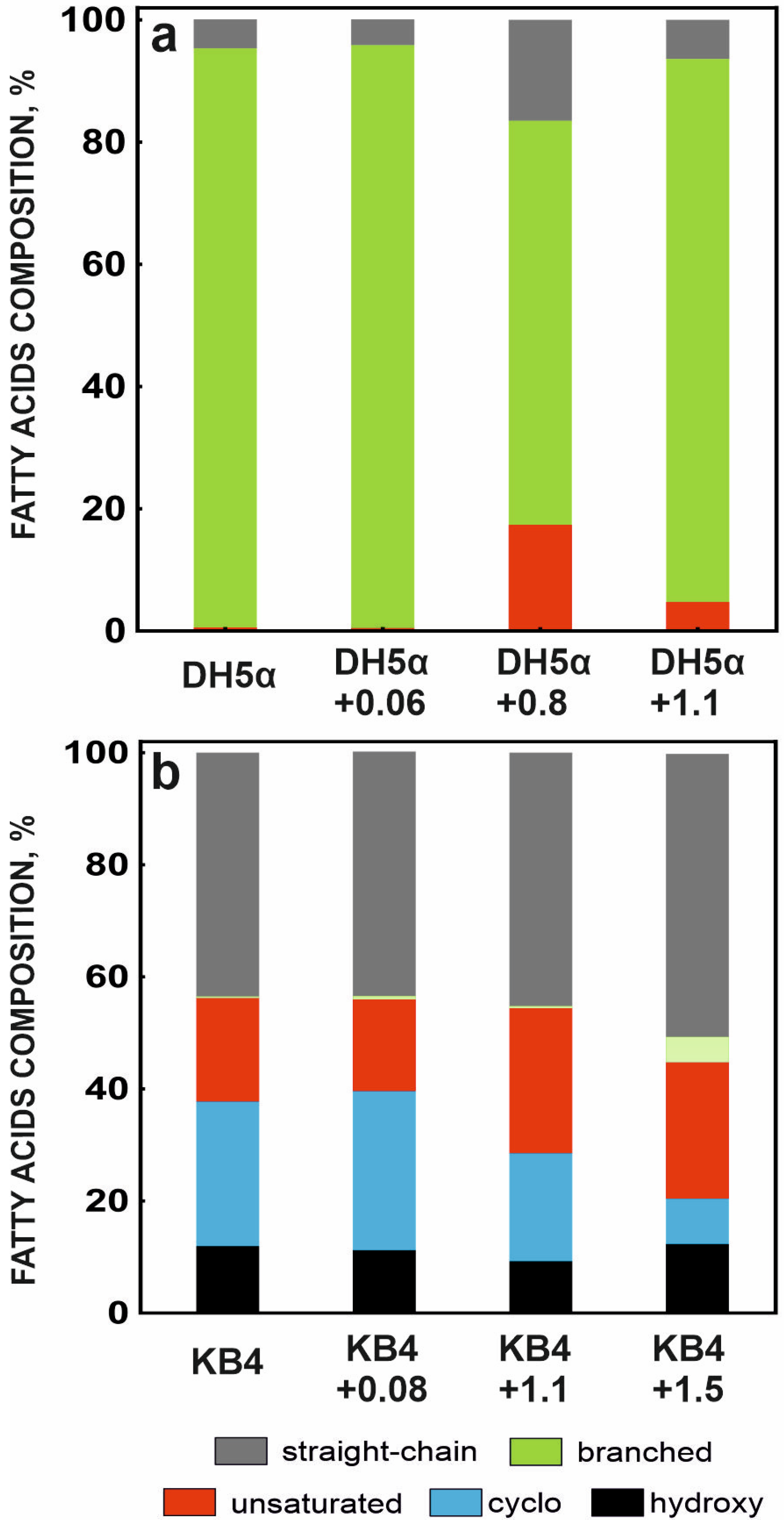
| Fatty Acids | % of Total Fatty Acids | |||
|---|---|---|---|---|
| Escherichia coli DH5α | Escherichia coli DH5α + 0.06 mg/mL Berberine | Escherichia coli DH5α + 0.8 mg/mL Berberine | Escherichia coli DH5α + 1.2 mg/mL Berberine | |
| Saturated | ||||
| 11:0 iso | 0.34 ± 0.07 | 0.22 ± 0.25 | 0.00 ± 0.00 | 0.00 ± 0.00 |
| 11:0 anteiso | 0.19 ± 0.17 | 0.00 ± 0.00 | 0.00 ± 0.00 | 0.00 ± 0.00 |
| 12:0 | 0.00 ± 0.00 | 0.12 ± 0.09 | 2.01 ± 0.02 | 0.00 ± 0.00 |
| 12:0 iso | 0.05 ± 0.09 | 0.00 ± 0.00 | 0.00 ± 0.00 | 0.00 ± 0.00 |
| 13:0 iso | 11.86 ± 1.25 | 9.99 ± 1.93 | 8.35 ± 2.06 | 19.80 ± 0.53 |
| 13:0 anteiso | 9.31 ± 1.14 | 7.57 ± 1.94 | 5.92 ± 0.68 | 11.99 ± 0.56 |
| 14:0 | 0.93 ± 0.06 | 0.69 ± 0.10 | 2.40 ± 0.35 | 2.03 ± 0.50 |
| 14:0 iso | 0.38 ± 0.05 | 0.39 ± 0.06 | 0.00 ± 0.00 | 0.00 ± 0.00 |
| 15:0 iso | 16.26 ± 0.57 | 17.38 ± 0.64 | 13.02 ± 0.79 | 15.47 ± 1.00 |
| 15:0 anteiso | 37.85 ± 1.55 | 39.09 ± 1.99 | 25.25 ± 0.41 | 28.04 ± 3.28 |
| 16:0 | 1.26 ± 0.05 | 1.25 ± 0.08 | 9.71 ± 0.92 | 4.39 ± 1.41 |
| 16:0 iso | 0.62 ± 0.05 | 0.51 ± 0.02 | 0.00 ± 0.00 | 0.00 ± 0.00 |
| 17:0 iso | 7.94 ± 0.51 | 9.30 ± 0.67 | 6.42 ± 0.07 | 6.95 ± 0.44 |
| 17:0 anteiso | 6.90 ± 0.39 | 7.25 ± 0.39 | 5.12 ± 0.14 | 5.47 ± 0.38 |
| 18:0 | 1.72 ± 0.16 | 1.57 ± 0.22 | 2.38 ± 0.00 | 0.00 ± 0.00 |
| 19:0 iso | 1.92 ± 0.17 | 2.50 ± 0.42 | 2.05 ± 0.15 | 1.08 ± 1.52 |
| 19:0 anteiso | 1.03 ± 0.07 | 1.19 ± 0.09 | 0.00 ± 0.00 | 0.00 ± 0.00 |
| 20:0 | 0.54 ± 0.16 | 0.57 ± 0.04 | 0.00 ± 0.00 | 0.00 ± 0.00 |
| Unsaturated | ||||
| 16:1 ω7c/16:1 ω6c | 0.00 ± 0.00 | 0.46 ± 0.10 | 10.19 ± 0.56 | 2.99 ± 1.52 |
| 18:1 ω7c | 0.00 ± 0.00 | 0.00 ± 0.00 | 7.17 ± 0.44 | 1.79 ± 2.52 |
| 18:1 ω9c | 0.58 ± 0.67 | 0.00 ± 0.00 | 0.00 ± 0.00 | 0.00 ± 0.00 |
| Mean Lenght | 14.09 ± 1.39 | 13.98 ± 0.08 | 15.24 ± 0.07 | 14.48 ± 0.06 |
| Sat./unsat. ratio | 172.06 ± 1.37 | 221.70 ± 48.06 | 4.78 ± 0.33 | 31.73 ± 27.75 |
| Fatty Acids | % of Total Fatty Acids | |||
|---|---|---|---|---|
| Pseudomonas moorei KB4 | Pseudomonas moorei KB4+ 0.08 mg/mL Berberine | Pseudomonas moorei KB4 + 1.1 mg/mL Berberine | Pseudomonas moorei KB4 + 1.5 mg/mL Berberine | |
| Saturated | ||||
| 10:0 | 0.11 ± 0.16 | 0.18 ± 0.01 | 0.00 ± 0.00 | 0.44 ± 0.26 |
| 10:0 3OH | 3.94 ± 0.12 | 3.70 ± 0.07 | 2.55 ± 0.32 | 3.46 ± 0.53 |
| 12:0 | 4.42 ± 0.01 | 4.11 ± 0.03 | 4.40 ± 0.41 | 4.74 ± 0.45 |
| 12:0 2OH | 3.35 ± 0.06 | 3.22 ± 0.04 | 2.98 ± 0.15 | 3.72 ± 0.20 |
| 12:0 3OH | 4.64 ± 0.05 | 4.29 ± 0.11 | 3.70 ± 0.35 | 5.13 ± 0.18 |
| 14:0 | 1.37 ± 0.01 | 1.45 ± 0.05 | 2.11 ± 0.16 | 1.68 ± 0.06 |
| 14:0 3OH | 0.00 ± 0.00 | 0.00 ± 0.00 | 0.47 ± 0.81 | 0.00 ± 0.00 |
| 16:0 | 37.07 ± 0.16 | 37.35 ± 0.39 | 37.57 ± 1.30 | 42.66 ± 0.78 |
| 17:0 iso | 0.00 ± 0.00 | 0.00 ± 0.00 | 0.00 ± 0.00 | 0.71 ± 0.00 |
| 17:0 cyclo | 25.22 ± 0.01 | 27.13 ± 0.21 | 19.27 ± 0.99 | 7.25 ± 0.87 |
| 18:0 | 0.52 ± 0.04 | 0.55 ± 0.01 | 1.11 ± 1.06 | 0.96 ± 0.15 |
| 19:0 iso | 0.34 ± 0.47 | 0.63 ± 0.06 | 0.00 ± 0.00 | 4.58 ± 0.27 |
| 19:0 cyclo ω9c | 0.57 ± 0.81 | 1.25 ± 0.03 | 0.00 ± 0.00 | 0.84 ± 0.15 |
| Unsaturated | ||||
| 16:1 ω7c/16:1 ω6c | 12.06 ± 0.64 | 10.44 ± 0.17 | 15.46 ± 0.40 | 13.62 ± 1.85 |
| 17:1 ω7c | 0.00 ± 0.00 | 0.00 ± 0.00 | 0.00 ± 0.00 | 1.27 ± 0.17 |
| 18:1 ω7c | 6.39 ± 0.24 | 5.91 ± 0.07 | 10.38 ± 0.94 | 9.42 ± 0.79 |
| Mean Lenght | 15.65 ± 0.02 | 15.72 ± 0.02 | 15.77 ± 0.06 | 15.61 ± 0.05 |
| Sat./unsat. ratio | 4.43 ± 0.26 | 5.11 ± 0.07 | 2.87 ± 0.13 | 3.14 ± 0.45 |
| Marker | Escherichia coli DH5α | Escherichia coli DH5α + Berberine | Pseudomonas moorei KB4 | Pseudomonas moorei KB4 + Berberine |
|---|---|---|---|---|
| Malondialdehyde | 0.20 ± 0.02 μM | 0.09 ± 0.03 μM | 0.44 ± 0.03 μM | 0.42 ± 0.03 μM |
| Catalase | 29.20 ± 0.92 U/mg of protein | 21.78 ± 0.24 U/mg of protein | 4.36 ± 0.05 U/mg of protein | 5.89 ± 0.19 U/mg of protein |
| Dismutase | 3.46 ± 0.60 U/mg of protein | 4.25 ± 0.06 U/mg of protein | 1.51 ± 0.09 U/mg of protein | 1.65 ± 0.03 U/mg of protein |
| Acid phosphatase | 6.72 ± 0.58 Bessey units/mg of protein | 24.62 ± 2.73 Bessey units/mg of protein | 4.83 ± 0.05 Bessey units/mg of protein | 2.70 ± 0.07 Bessey units/mg of protein |
| Alkaline phosphatase | 7.06 ± 0.47 Bessey units/mg of protein | 28.13 ± 2.30 Bessey units/mg of protein | 0.31 ± 0.06 Bessey units/mg of protein | 3.09 ± 0.32 Bessey units/mg of protein |
Disclaimer/Publisher’s Note: The statements, opinions and data contained in all publications are solely those of the individual author(s) and contributor(s) and not of MDPI and/or the editor(s). MDPI and/or the editor(s) disclaim responsibility for any injury to people or property resulting from any ideas, methods, instructions or products referred to in the content. |
© 2026 by the authors. Licensee MDPI, Basel, Switzerland. This article is an open access article distributed under the terms and conditions of the Creative Commons Attribution (CC BY) license.
Share and Cite
Karczmarzyk, A.; Wojcieszyńska, D.; Nowak, A.; Smułek, W.; Guzik, U. Berberine Toxicity Profile in Experimental Models as a Basis for Assessing Its Biological Safety. Molecules 2026, 31, 1350. https://doi.org/10.3390/molecules31081350
Karczmarzyk A, Wojcieszyńska D, Nowak A, Smułek W, Guzik U. Berberine Toxicity Profile in Experimental Models as a Basis for Assessing Its Biological Safety. Molecules. 2026; 31(8):1350. https://doi.org/10.3390/molecules31081350
Chicago/Turabian StyleKarczmarzyk, Anna, Danuta Wojcieszyńska, Agnieszka Nowak, Wojciech Smułek, and Urszula Guzik. 2026. "Berberine Toxicity Profile in Experimental Models as a Basis for Assessing Its Biological Safety" Molecules 31, no. 8: 1350. https://doi.org/10.3390/molecules31081350
APA StyleKarczmarzyk, A., Wojcieszyńska, D., Nowak, A., Smułek, W., & Guzik, U. (2026). Berberine Toxicity Profile in Experimental Models as a Basis for Assessing Its Biological Safety. Molecules, 31(8), 1350. https://doi.org/10.3390/molecules31081350