Cadmium Toxicity to Zea mays and Its Implications for the Uptake of Other Heavy Metals by the Plant





Abstract
1. Introduction
2. Results
2.1. Cadmium Toxicity to Zea mays
2.2. Cadmium and Other Heavy Metal Content and Translocation in Zea mays
2.3. Uptake of Cadmium and Other Heavy Metals by Zea mays
2.4. Effects of Cadmium and Sorbents on Soil pH and the Content of Carbon and Nitrogen
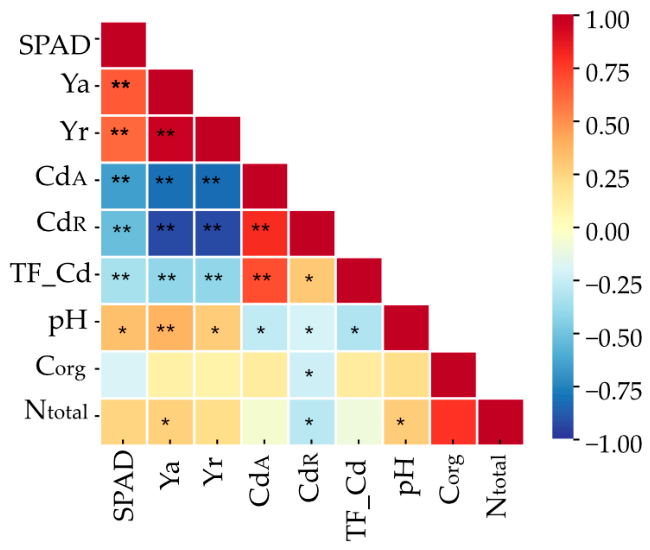
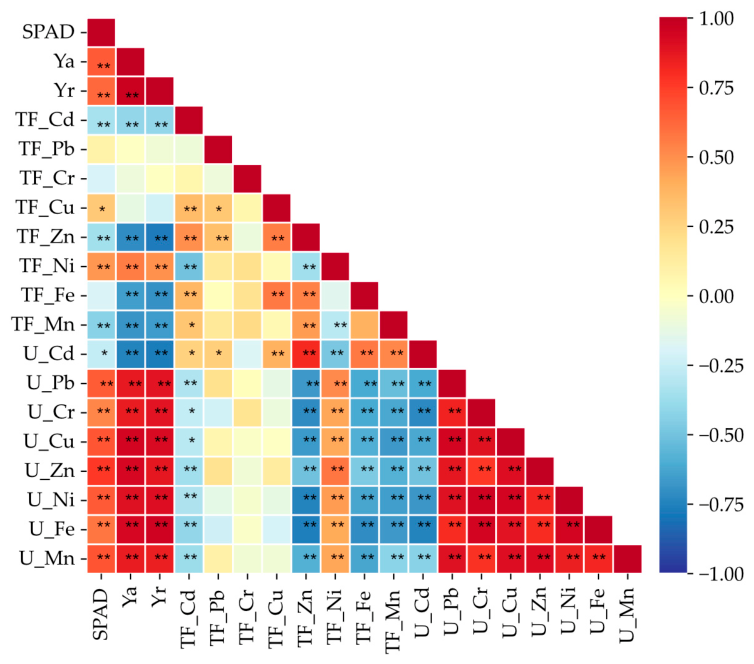
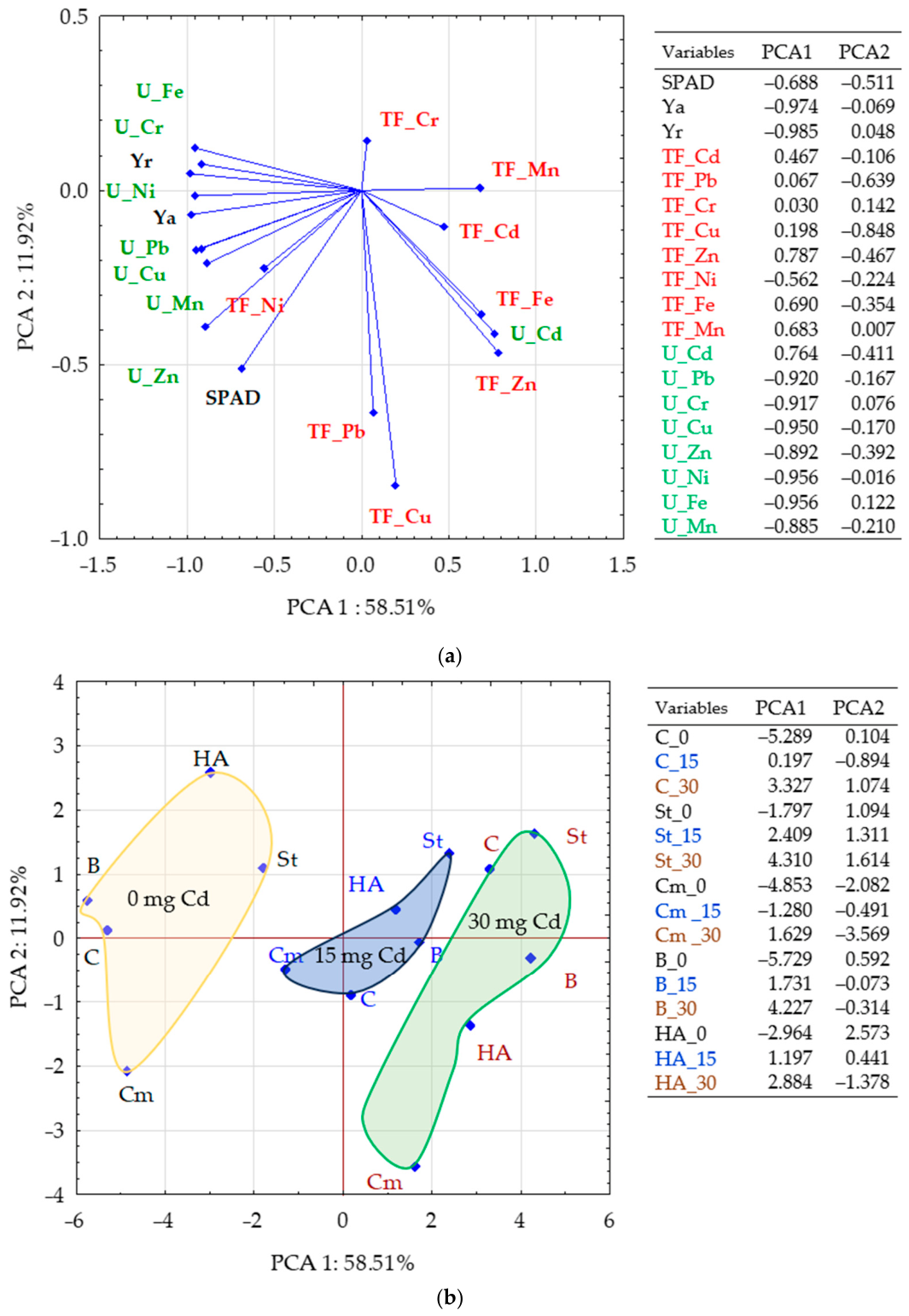
2.5. Interactions Between Zea mays Yield and the Uptake and Translocation of Metal Elements
3. Discussion
4. Materials and Methods
4.1. Characteristics of the Soil, Plants, and Substances Supporting the Remediation Process
4.2. Vegetation Experiment
- Nitrogen (150 mg N kg−1 soil)—urea [CO(NH2)2] (Manufacturer: Stanlab, Lublin, Poland);
- Phosphorus (50 mg P kg−1 soil)—KH2PO4 (Manufacturer: Stanlab, Lublin, Poland);
- Potassium (150 mg K kg−1 soil)—KH2PO4 (Manufacturer: Stanlab, Lublin, Poland) + KCl (Manufacturer: Stanlab, Lublin, Poland);
- Magnesium (20 mg Mg kg−1 soil)—MgSO4·7H2O (Manufacturer: Stanlab, Lublin, Poland).
4.3. Laboratory Analysis Methods
- particle size distribution—using laser diffraction (Malvern Mastersizer 3000 Laser Diffraction (Malvern, Worcestershire, UK),
- Corg and Ntotal content—Vario MaxCube CN macroanalyzer (Elementar, Germany),
- soil pH—measured in 1 mol KCl and in water (pH meter HI 2221, Hanna Instruments, Washington, UK),
- hydrolytic acidity and total exchangeable base cations—according to the procedures described in previous works by the authors [91],
4.4. Analysis of Results
5. Conclusions
Author Contributions
Funding
Institutional Review Board Statement
Informed Consent Statement
Data Availability Statement
Conflicts of Interest
Abbreviations
| 0 | Soil uncontaminated with cadmium |
| C | Soil not fertilized with organic sorbents |
| Cd | Soil contaminated with cadmium |
| St | Soil fertilized with starch |
| Cm | Soil fertilized with compost |
| B | Soil fertilized with fermented starch |
| HA | Soil fertilized with HumiAgra |
| Zm | Zea mays |
| A | Aboveground of Zea mays |
| R | Roots of Zea mays |
| YA | Aboveground yield of Zea mays |
| YR | Root yield of Zea mays |
| YC | Yield of Zea mays in uncontaminated soil (control) |
| YCd | Yield of Zea mays in cadmium-contaminated soil |
| SPAD | Leaf greenness index |
| MeA | Heavy metal content in the aboveground parts of Zea mays |
| MeR | Heavy metal content in Zea mays roots |
| TE | Cadmium toxicity index |
| TF | Heavy metal translocation index |
| U | Heavy metal uptake by Zea mays |
Appendix A

| Treatment | Dose Cd, mg kg–1 Soil | Average | ||
|---|---|---|---|---|
| 0 | 15 | 30 | ||
| Cd | ||||
| Control (C) | 0.015 ± 0.001 h A | 0.300 ± 0.044 g C | 0.923 ± 0.002 d D | 0.413 V |
| Starch (St) | 0.010 ± 0.001 h B | 0.833 ± 0.001 e A | 2.185 ± 0.008 a A | 1.009 I |
| Compost (Cm) | 0.005 ± 0.000 h D | 0.445 ± 0.009 f B | 0.894 ± 0.002 d E | 0.448 IV |
| Bark (B) | 0.008 ± 0.001 h C | 0.830 ± 0.002 e A | 1.892 ± 0.001 b B | 0.910 II |
| HumiAgra (HA) | 0.003 ± 0.001 h E | 0.474 ± 0.002 f B | 1.137 ± 0.001 c C | 0.538 III |
| Average | 0.008 X | 0.576 Y | 1.406 Z | |
| Source of variation (F statistic and probability level): Cd dose: F—70,524.65 (p < 0.01); Treatment: F—6533.69 (p < 0.01); Cd dose x Treatment: F—2598.74 (p < 0.01) | ||||
| Pb | ||||
| Control (C) | 0.750 ± 0.058 cd B | 1.400 ± 0.041 a A | 0.550 ± 0.100 de B | 0.900 I–II |
| Starch (St) | 1.000 ± 0.041 bc A | 1.150 ± 0.100 ab A | 0.800 ± 0.041 cd A | 0.983 I |
| Compost (Cm) | 0.800 ± 0.041 cd B | 0.850 ± 0.058 cd B | 0.800 ± 0.041 cd A | 0.817 II–III |
| Bark (B) | 0.750 ± 0.058 cd B | 0.800 ± 0.082 cd B | 0.350 ± 0.058 ef C | 0.633 IV |
| HumiAgra (HA) | 0.250 ± 0.058 f C | 1.150 ± 0.100 ab A | 0.850 ± 0.058 cd A | 0.750 III |
| Average | 0.710 Y | 1.070 X | 0.670 X | |
| Source of variation (F statistic and probability level): Cd dose: F—281.81 (p < 0.01); Treatment: F—63.39 (p < 0.01); Cd dose x Treatment: F—74.71 (p < 0.01) | ||||
| Cr | ||||
| Control (C) | 4.200 ± 0.566 b B | 3.400 ± 0.163 c A | 2.800 ± 0.163 cdef A | 3.467 II |
| Starch (St) | 2.200 ± 0.041 ef D | 2.750 ± 0.191 def B | 2.050 ± 0.100 gh C | 2.333 III |
| Compost (Cm) | 2.850 ± 0.191 de C | 1.950 ± 0.191 h C | 1.200 ± 0.082 i E | 2.000 III–IV |
| Bark (B) | 6.550 ± 0.252 a A | 3.300 ± 0.183 cd A | 2.575 ± 0.206 efg B | 4.142 I |
| HumiAgra (HA) | 1.850 ± 0.100 g D | 2.750 ± 0.191 def B | 1.850 ± 0.100 h D | 2.150 V |
| Average | 3.530 Z | 2.830 | 2.095 X | |
| Source of variation (F statistic and probability level): Cd dose: F—230.27 (p < 0.01); Treatment: F—236.33 (p < 0.01); Cd dose x Treatment: F—78.01 (p < 0.01) | ||||
| Cu | ||||
| Control (C) | 2.950 ± 0.100 de A | 3.400 ± 0.283 cd A | 4.050 ± 0.100 ab AB | 3.467 I |
| Starch (St) | 2.400 ± 0.041 fg B | 2.900 ± 0.200 e B | 3.750 ± 0.100 bc B | 3.017 II |
| Compost (Cm) | 2.200 ± 0.283 g B | 3.000 ± 0.163 de B | 3.800 ± 0.163 abc B | 3.000 II |
| Bark (B) | 2.800 ± 0.283 ef A | 3.250 ± 0.379 de A | 4.250 ± 0.100 a A | 3.433 I |
| HumiAgra (HA) | 1.600 ± 0.163 h C | 2.950 ± 0.100 de B | 3.950 ± 0.100 ab AB | 2.833 II |
| Average | 2.390 Y | 3.100 X | 3.960 Z | |
| Source of variation (F statistic and probability level): Cd dose: F—357.74 (p < 0.01); Treatment: F—27.88 (p < 0.01); Cd dose x Treatment: F—7.61 (p < 0.01) | ||||
| Zn | ||||
| Control (C) | 17.400 ± 0.082 l D | 34.850 ± 0.100 e A | 32.600 ± 0.100 g E | 28.283 IV |
| Starch (St) | 17.950 ± 0.100 k C | 29.500 ± 0.115 h C | 35.900 ± 0.200 d D | 27.783 V |
| Compost (Cm) | 29.000 ± 0.082 I A | 34.100 ± 0.115 f B | 41.750 ± 0.100 b B | 34.950 I |
| Bark (B) | 21.050 ± 0.100 j B | 35.050 ± 0.100 e A | 37.200 ± 0.082 c C | 31.100 II |
| HumiAgra (HA) | 15.200 ± 0.163 m E | 29.750 ± 0.191 h C | 42.800 ± 0.163 a A | 29.250 III |
| Average | 20.120 X | 32.650 Y | 38.050 Z | |
| Source of variation (F statistic and probability level): Cd dose: F—11,1980.69 (p < 0.01); Treatment: F—6702.75 (p < 0.01); Cd dose x Treatment: F—3874.04 (p < 0.01) | ||||
| Ni | ||||
| Control (C) | 2.700 ± 0.115 b A | 4.000 ± 0.041 a A | 2.350 ± 0.100 bcd A | 3.017 I |
| Starch (St) | 1.650 ± 0.100 g BC | 2.100 ± 0.115 cde B | 2.000 ± 0.082 defg AB | 1.917 III |
| Compost (Cm) | 2.000 ± 0.041 defg B | 1.850 ± 0.191 efg C | 1.800 ± 0.082 efg B | 1.883 III |
| Bark (B) | 2.500 ± 0.115 bc A | 1.750 ± 0.058 efg C | 2.150 ± 0.100 cde AB | 2.133 II |
| HumiAgra (HA) | 1.800 ± 0.041 efg BC | 1.750 ± 0.100 efg C | 1.850 ± 0.100 efg B | 1.800 III |
| Average | 2.130 Y | 2.290 Z | 2.030 X | |
| Source of variation (F statistic and probability level): Cd dose: F—35.18 (p < 0.01); Treatment: F—306.65 (p < 0.01); Cd dose x Treatment: F—89.98 (p < 0.01) | ||||
| Fe | ||||
| Control (C) | 132.850 ± 0.100 def A | 148.550 ± 3.206 c A | 220.550 ± 2.734 a A | 167.317 I |
| Starch (St) | 66.950 ± 3.017 I C | 111.250 ± 4.620 g D | 131.950 ± 2.357 def D | 103.383 V |
| Compost (Cm) | 129.800 ± 0.283 ef A | 136.600 ± 3.960 de B | 163.650 ± 5.468 b B | 143.350 II |
| Bark (B) | 86.200 ± 1.697 h B | 124.450 ± 4.190 f C | 166.400 ± 1.980 b B | 125.683 III |
| HumiAgra (HA) | 61.650 ± 2.169 I D | 134.900 ± 4.337 de BC | 141.200 ± 3.394 cd C | 112.583 IV |
| Average | 95.490 X | 131.150 Y | 164.750 Z | |
| Source of variation (F statistic and probability level): Cd dose: F—2265.90 (p < 0.01); Treatment: F—736.70 (p < 0.01); Cd dose x Treatment: F—111.16 (p < 0.01) | ||||
| Mn | ||||
| Control (C) | 70.550 ± 0.661 jk C | 145.000 ± 3.266 c E | 136.250 ± 1.509 e C | 117.267 III |
| Starch (St) | 67.100 ± 0.476 k D | 213.750 ± 0.943 a A | 145.400 ± 1.470 c A | 142.083 I |
| Compost (Cm) | 79.150 ± 0.473 i A | 126.150 ± 0.755 f C | 110.800 ± 0.653 h D | 105.367 IV |
| Bark (B) | 72.750 ± 0.661 j B | 153.350 ± 2.169 b B | 140.150 ± 1.603 d B | 122.083 II |
| HumiAgra (HA) | 47.450 ± 1.320 l E | 120.300 ± 0.115 g D | 80.750 ± 1.038 I E | 82.833 V |
| Average | 67.400 X | 151.710 Z | 122.670 Y | |
| Source of variation (F statistic and probability level): Cd dose: F—19,363.60 (p < 0.01); Treatment: F—3025.16 (p < 0.01); Cd dose x Treatment: F—866.75 (p < 0.01) | ||||
| Treatment | Dose Cd, mg kg–1 Soil | Average | ||
|---|---|---|---|---|
| 0 | 15 | 30 | ||
| Cd | ||||
| Control (C) | 0.050 ± 0.004 j AB | 5.512 ± 0.096 c A | 6.151 ± 0.011 b B | 3.904 I |
| Starch (St) | 0.052 ± 0.001 j A | 3.569 ± 0.009 g B | 6.426 ± 0.007 a A | 3.349 II |
| Compost (Cm) | 0.039 ± 0.012 j B | 2.884 ± 0.115 I C | 3.687 ± 0.002 f E | 2.203 V |
| Bark (B) | 0.060 ± 0.001 j A | 3.002 ± 0.005 h C | 5.085 ± 0.010 d C | 2.715 III |
| HumiAgra (HA) | 0.056 ± 0.001 j A | 3.004 ± 0.010 h C | 4.342 ± 0.004 e D | 2.467 IV |
| Average | 0.051 X | 3.594 Y | 5.138 Z | |
| Source of variation (F statistic and probability level): Cd dose: F—87,853.40 (p < 0.01); Treatment: F—3707.43 (p < 0.01); Cd dose x Treatment: F—1476.16 (p < 0.01) | ||||
| Pb | ||||
| Control (C) | 2.000 ± 0.082 a A | 1.700 ± 0.,82 ab A | 1.400 ± 0.016 bc A | 1.700 I |
| Starch (St) | 1.100 ± 0.082 cd AB | 1.600 ± 0.163 b A | 1.600 ± 0.082 b A | 1.433 II |
| Compost (Cm) | 0.950 ± 0.058 de B | 1.600 ± 0.041 b A | 0.750 ± 0.100 e BC | 1.100 III |
| Bark (B) | 1.400 ± 0.082 bc B | 1.250 ± 0.100 cd B | 1.000 ± 0.065 de B | 1.217 III |
| HumiAgra (HA) | 1.000 ± 0.041 de B | 1.450 ± 0.100 bc AB | 1.050 ± 0.058 de B | 1.167 III |
| Average | 1.290 Y | 1.520 Z | 1.160 X | |
| Source of variation (F statistic and probability level): Cd dose: F—117.94 (p < 0.01); Treatment: F—127.64 (p < 0.01); Cd dose x Treatment: F—54.36 (p < 0.01) | ||||
| Cr | ||||
| Control (C) | 14.800 ± 0.712 a A | 8.800 ± 0.653 bc A | 4.200 ± 0.245 h B | 9.267 I |
| Starch (St) | 4.400 ± 0.141 gh E | 5.800 ± 0.327 efgh C | 5.200 ± 0.163 fgh A | 5.133 IV |
| Compost (Cm) | 6.000 ± 0.327 efg D | 6.850 ± 0.173 de B | 4.950 ± 0.526 gh A | 5.933 III |
| Bark (B) | 7.800 ± 0.432 bc C | 6.800 ± 0.408 def B | 4.250 ± 0.574 h B | 6.283 III |
| HumiAgra (HA) | 10.050 ± 0.342 b B | 6.950 ± 0.100 de B | 4.250 ± 0.342 h B | 7.083 II |
| Average | 8.610 Z | 7.040 Y | 4.570 X | |
| Source of variation (F statistic and probability level): Cd dose: F—547.38 (p < 0.01); Treatment: F—196.61 (p < 0.01); Cd dose x Treatment: F—136.50 (p < 0.01) | ||||
| Cu | ||||
| Control (C) | 3.700 ± 0.200 fg B | 4.650 ± 0.342 d B | 5.200 ± 0.163 bc B | 4.517 II |
| Starch (St) | 5.200 ± 0.163 bc A | 5.450 ± 0.100 b A | 6.000 ± 0.163 a A | 5.550 I |
| Compost (Cm) | 2.400 ± 0.163 i C | 4.750 ± 0.173 cd B | 2.950 ± 0.191 h D | 3.367 IV |
| Bark (B) | 3.600 ± 0.163 fg B | 4.000 ± 0.327 efg C | 4.100 ± 0.258 ef C | 3.900 III |
| HumiAgra (HA) | 3.550 ± 0.100 g B | 4.400 ± 0.283 de BC | 3.900 ± 0.115 C | 3.950 III |
| Average | 3.690 X | 4.650 Z | 4.430 Y | |
| Source of variation (F statistic and probability level): Cd dose: F—117.95 (p < 0.01); Treatment: F—192.61 (p < 0.01); Cd dose x Treatment: F—28.96 (p < 0.01) | ||||
| Zn | ||||
| Control (C) | 51.400 ± 0.245 a A | 28.400 ± 0.163 h B | 42.850 ± 0.100 b A | 40.883 I |
| Starch (St) | 33.850 ± 0.191 e D | 25.850 ± 0.100 i C | 22.550 ± 0.100 l C | 27.417 IV |
| Compost (Cm) | 36.250 ± 0.100 d C | 32.650 ± 0.100 f A | 23.050 ± 0.100 k B | 30.650 II |
| Bark (B) | 41.450 ± 0.100 c B | 23.000 ± 0.245 k E | 21.050 ± 0.100 n E | 28.500 III |
| HumiAgra (HA) | 29.050 ± 0.100 g E | 23.800 ± 0.082 j D | 22.000 ± 0.245 m D | 24.950 V |
| Average | 38.400 A | 26.740 B | 26.300 C | |
| Source of variation (F statistic and probability level): Cd dose: F—41,552.82 (p < 0.01); Treatment: F—20,136.65 (p < 0.01); Cd dose x Treatment: F—5300.87 (p < 0.01) | ||||
| Ni | ||||
| Control (C) | 9.950 ± 0.191 a A | 9.200 ± 0.490 ab A | 8.600 ± 0.490 bcd A | 9.250 I |
| Starch (St) | 5.100 ± 0.115 j D | 8.800 ± 0.653 bc AB | 7.600 ± 0.490 efg B | 7.167 II–III |
| Compost (Cm) | 4.000 ± 0.163 k E | 7.050 ± 0.100 fgh D | 6.800 ± 0.082 gh B | 5.950 IV |
| Bark (B) | 6.450 ± 0.252 hi B | 8.200 ± 0.327 cde BC | 7.400 ± 0.653 efg B | 7.350 II |
| HumiAgra (HA) | 5.600 ± 0.082 ij C | 7.850 ± 0.129 def CD | 7.200 ± 0.163 fgh B | 6.883 III |
| Average | 6.220 X | 8.220 Z | 7.520 Y | |
| Source of variation (F statistic and probability level): Cd dose: F—166.13 (p < 0.01); Treatment: F—140.73 (p < 0.01); Cd dose x Treatment: F—31.02 (p < 0.01) | ||||
| Fe | ||||
| Control (C) | 2472.550 ± 43.370 c C | 1754.400 ± 48.990 e C | 1265.200 ± 48.990 gh A | 1830.717 III |
| Starch (St) | 1393.750 ± 32.631 f E | 1871.200 ± 48.990 e C | 1277.200 ± 48.990 fgh A | 1514.050 V |
| Compost (Cm) | 1782.200 ± 35.803 e D | 1862.000 ± 20.537 e C | 1275.600 ± 20.493 fgh A | 1639.933 IV |
| Bark (B) | 2722.350 ± 61.105 b B | 2083.200 ± 97.980 d B | 1153.200 ± 65.320 h B | 1986.250 II |
| HumiAgra (HA) | 2874.050 ± 43.240 a A | 2375.300 ± 65.320 c A | 1301.200 ± 22.221 fg A | 2183.517 I |
| Average | 2248.980 Z | 1989.220 Y | 1254.480 X | |
| Source of variation (F statistic and probability level): Cd dose: F—2198.82 (p < 0.01); Treatment: F—353.72 (p < 0.01); Cd dose x Treatment: F—209.66 (p < 0.01) | ||||
| Mn | ||||
| Control (C) | 153.400 ± 2.304 bc A | 145.800 ± 2286 c B | 120.950 ± 1.935 de AB | 140.050 I |
| Starch (St) | 91.850 ± 1.518 g C | 121.550 ± 1.893 de C | 156.250 ± 1.320 b A | 123.217 III |
| Compost (Cm) | 94.050 ± 2.369 g C | 175.200 ± 2.718 a A | 125.200 ± 2.514 d B | 131.483 II |
| Bark (B) | 154.200 ± 2.998 b A | 126.050 ± 8.580 d C | 105.750 ± 1.389 f D | 128.667 II |
| HumiAgra (HA) | 113.600 ± 2.833 ef B | 118.000 ± 2.628 de C | 116.800 ± 3.254 e C | 116.133 IV |
| Average | 121.420 X | 137.320 Z | 124.990 Y | |
| Source of variation (F statistic and probability level): Cd dose: F—138.03 (p < 0.01); Treatment: F—95.62 (p < 0.01); Cd dose x Treatment: F—322.48 (p < 0.01) | ||||
| Treatment | Dose Cd, mg kg–1 Soil | Average | ||
|---|---|---|---|---|
| 0 | 15 | 30 | ||
| pHKCl | ||||
| Control (C) | 4.469 ± 0.025 e D | 4.469 ± 0.025 e B | 4.453 ± 0.012 e C | 4.463 III |
| Starch (St) | 4.521 ± 0.006 d C | 4.468 ± 0.001 e B | 4.527 ± 0.010 cd B | 4.505 II |
| Compost (Cm) | 4.724 ± 0.012 a A | 4.709 ± 0.010 a A | 4.643 ± 0.013 b A | 4.692 I |
| Bark (B) | 4.321 ± 0.009 g E | 4.272 ± 0.006 h D | 4.270 ± 0.021 h D | 4.288 IV |
| HumiAgra (HA) | 4.570 ± 0.002 c B | 4.366 ± 0.028 f C | 4.444 ± 0.006 e C | 4.460 III |
| Average | 4.521 Z | 4.457 Y | 4.467 Y | |
| Source of variation (F statistic and probability level): Cd dose: F—80.59 (p < 0.01); Treatment: F—854.51 (p < 0.01); Cd dose x Treatment: F—67.97 (p < 0.01) | ||||
| Corg, g kg−1 soil | ||||
| Control (C) | 10.568 ± 0.173 a B | 10.561 ± 0.061 a B | 10.522 ± 0.098 a B | 10.550 III |
| Starch (St) | 13.069 ± 0.932 b A | 13.262 ± 0.262 b A | 13.143 ± 0.358 b A | 13.158 I–II |
| Compost (Cm) | 13.570 ± 0.200 b A | 13.459 ± 0.199 b A | 13.321 ± 0.201 b A | 13.450 I |
| Bark (B) | 12.974 ± 0.144 b A | 13.060 ± 0.060 b A | 12.819 ± 0.182 b A | 12.951 II |
| HumiAgra (HA) | 13.092 ± 0.098 b A | 13.082 ± 0.102 b A | 13.110 ± 0.110 b A | 13.095 I–II |
| Average | 12.654 Z | 12.685 Z | 12.583 Z | |
| Source of variation (F statistic and probability level): Cd dose: F—0.47 (p = 0.63); Treatment: F—143.45 (p < 0.01); Cd dose x Treatment: F—0.23 (p < 0.23) | ||||
| Ntotal, g kg−1 soil | ||||
| Control (C) | 0.852 ± 0.012 de C | 0.852 ± 0.030 de C | 0.831 ± 0.031 e D | 0.845 V |
| Starch (St) | 0.922 ± 0.022 de C | 0.942 ± 0.022 cd B | 0.933 ± 0.033 d C | 0.932 IV |
| Compost (Cm) | 1.130 ± 0.070 a A | 1.109 ± 0.009 ab A | 1.121 ± 0.021 a A | 1.120 I |
| Bark (B) | 1.026 ± 0.015 bc B | 1.041 ± 0.041 ab A | 1.029 ± 0.029 bc B | 1.032 III |
| HumiAgra (HA) | 1.095 ± 0.007 ab AB | 1.066 ± 0.038 ab A | 1.060 ± 0.020 ab AB | 1.074 II |
| Average | 1.005 Z | 1.002 Z | 0.995 Z | |
References
- Galan-Freyle, N.J.; Aranguren-Diaz, Y.; Ospina-Maldonado, S.L.; Chapuel-Aguillon, P.F.; Pertuz-Peña, M.F.; Hernandez-Rivera, S.P.; Pacheco-Londoño, L.C. Exploring Cadmium Bioaccumulation and Bioremediation Mechanisms and Related Genes in Soil Microorganisms: A Review. Environ. Sci. Pollut. Res. 2025, 32, 20215–20231. [Google Scholar] [CrossRef] [PubMed]
- Akram, S.; Guan, G.; Hu, B.; Saddique, M.A.B.; Xi, Y.; Luo, X.; Ren, M. Microalgae-Based Strategies for Cadmium Remediation: Insights, Challenges, and Future Directions. Crit. Rev. Biotechnol. 2026, 46, 318–337. [Google Scholar] [CrossRef] [PubMed]
- Tian, H.; Guo, S.; Liu, Z.; Yang, X.; Wang, D.; Yin, A.; Wu, P.; Zhang, H. Deriving Health-Based Soil Cadmium Thresholds in Mining-Impacted Agricultural Regions: An Integrated Deterministic and Probabilistic Risk Assessment. J. Hazard. Mater. 2026, 504, 141358. [Google Scholar] [CrossRef] [PubMed]
- Zaborowska, M.; Wyszkowska, J.; Kucharski, J. Maintenance of Soil Homeostasis under Exposure to Cadmium. Commun. Soil Sci. Plant Anal. 2015, 46, 2051–2069. [Google Scholar] [CrossRef]
- Rahim, H.U.; Akbar, W.A.; Alatalo, J.M. A Comprehensive Literature Review on Cadmium (Cd) Status in the Soil Environment and Its Immobilization by Biochar-Based Materials. Agronomy 2022, 12, 877. [Google Scholar] [CrossRef]
- Rigby, H.; Smith, S.R. The Significance of Cadmium Entering the Human Food Chain via Livestock Ingestion from the Agricultural Use of Biosolids, with Special Reference to the UK. Environ. Int. 2020, 143, 105844. [Google Scholar] [CrossRef]
- Boros-Lajszner, E.; Wyszkowska, J.; Kucharski, J. Phytoremediation of Soil Contaminated with Nickel, Cadmium and Cobalt. Int. J. Phytoremediat. 2021, 23, 252–262. [Google Scholar] [CrossRef]
- Zhang, X.; Yang, M.; Yang, H.; Pian, R.; Wang, J.; Wu, A.-M. The Uptake, Transfer, and Detoxification of Cadmium in Plants and Its Exogenous Effects. Cells 2024, 13, 907. [Google Scholar] [CrossRef]
- Li, Y.; Ding, L.; Zhou, M.; Chen, Z.; Ding, Y.; Zhu, C. Transcriptional Regulatory Network of Plant Cadmium Stress Response. Int. J. Mol. Sci. 2023, 24, 4378. [Google Scholar] [CrossRef]
- Charkiewicz, A.E.; Omeljaniuk, W.J.; Nowak, K.; Garley, M.; Nikliński, J. Cadmium Toxicity and Health Effects—A Brief Summary. Molecules 2023, 28, 6620. [Google Scholar] [CrossRef]
- Kayiranga, A.; Li, Z.; Isabwe, A.; Ke, X.; Simbi, C.H.; Ifon, B.E.; Yao, H.; Wang, B.; Sun, X. The Effects of Heavy Metal Pollution on Collembola in Urban Soils and Associated Recovery Using Biochar Remediation: A Review. Int. J. Environ. Res. Public Health 2023, 20, 3077. [Google Scholar] [CrossRef]
- Zhang, M.; Dong, C. Molecular Mechanisms of Cadmium Stress Resistance in Vegetable Crops. Int. J. Mol. Sci. 2025, 26, 5812. [Google Scholar] [CrossRef] [PubMed]
- Hu, Y.; He, R.; Mu, X.; Zhou, Y.; Li, X.; Wang, H.; Xing, W.; Liu, D. Cadmium Toxicity in Plants: From Transport to Tolerance Mechanisms. Plant Signal Behav. 2025, 20, 2544316. [Google Scholar] [CrossRef] [PubMed]
- Fan, T.-T.; Sun, Q.; Cui, P.-X.; Xuan, L.; Wang, Y.-J. Sorption Mechanism of Cadmium on Soils: A Combination of Batch Experiment, Path Analysis, and EXAFS Techniques. Geoderma 2022, 422, 115950. [Google Scholar] [CrossRef]
- Chen, Y.; Zhang, Y.; Li, H.; Wei, S. Distribution Characteristics of Cadmium in Soil Aggregates and Their Regulating Effects on Cd Bioavailability. Agriculture 2025, 15, 1514. [Google Scholar] [CrossRef]
- Rolka, E.; Wyszkowski, M. Availability of Trace Elements in Soil with Simulated Cadmium, Lead and Zinc Pollution. Minerals 2021, 11, 879. [Google Scholar] [CrossRef]
- Bravo, D.; Braissant, O. Cadmium-tolerant Bacteria: Current Trends and Applications in Agriculture. Lett. Appl. Microbiol. 2022, 74, 311–333. [Google Scholar] [CrossRef]
- Agency for Toxic Substances and Disease Registry (ATSDR). CDC Substance Priority List. Available online: https://www.atsdr.cdc.gov/programs/substance-priority-list.html (accessed on 18 February 2026).
- Qing, Y.; Yang, J.; Zhu, Y.; Li, Y.; Zheng, W.; Wu, M.; He, G. Dose–Response Evaluation of Urinary Cadmium and Kidney Injury Biomarkers in Chinese Residents and Dietary Limit Standards. Environ. Health 2021, 20, 75. [Google Scholar] [CrossRef]
- Yang, Y.; Hassan, M.F.; Ali, W.; Zou, H.; Liu, Z.; Ma, Y. Effects of Cadmium Pollution on Human Health: A Narrative Review. Atmosphere 2025, 16, 225. [Google Scholar] [CrossRef]
- Genchi, G.; Sinicropi, M.S.; Lauria, G.; Carocci, A.; Catalano, A. The Effects of Cadmium Toxicity. Int. J. Environ. Res. Public Health 2020, 17, 3782. [Google Scholar] [CrossRef]
- Landrigan, P.J.; Fuller, R.; Acosta, N.J.R.; Adeyi, O.; Arnold, R.; Basu, N.N.; Baldé, A.B.; Bertollini, R.; Bose-O’Reilly, S.; Boufford, J.I.; et al. The Lancet Commission on Pollution and Health. Lancet 2018, 391, 462–512. [Google Scholar] [CrossRef]
- Mashhadikhan, S.; Ebadi Amooghin, A.; Sanaeepur, H.; Shirazi, M.M.A. A Critical Review on Cadmium Recovery from Wastewater towards Environmental Sustainability. Desalination 2022, 535, 115815. [Google Scholar] [CrossRef]
- Ballabio, C.; Jones, A.; Panagos, P. Cadmium in Topsoils of the European Union—An Analysis Based on LUCAS Topsoil Database. Sci. Total Environ. 2024, 912, 168710. [Google Scholar] [CrossRef]
- Chețan, F.; Moraru, P.I.; Rusu, T.; Șimon, A.; Dinca, L.; Murariu, G. From Contamination to Mitigation: Addressing Cadmium Pollution in Agricultural Soils. Agriculture 2025, 15, 2179. [Google Scholar] [CrossRef]
- Wdowczyk, A.; Tomczyk, P.; Szymańska-Pulikowska, A.; Wiatkowska, B.; Rosik-Dulewska, C. Copper and Cadmium Content in Polish Soil: Analysis of 25-Year Monitoring Study. Land. Degrad. Dev. 2023, 34, 4857–4868. [Google Scholar] [CrossRef]
- ETC DI Report 2022/01 Impacts of Nutrients and Heavy Metals in European Agriculture: Current and Critical Inputs in Relation to Air, Soil and Water Quality. Available online: https://www.eionet.europa.eu/etcs/etc-di/products/etc-di-products/impacts-of-nutrients-and-heavy-metals-in-european-agriculture-current-and-critical-inputs-in-relation-to-air-soil-and-water-quality (accessed on 17 February 2026).
- Genchi, G.; Carocci, A.; Lauria, G.; Sinicropi, M.S.; Catalano, A. Nickel: Human Health and Environmental Toxicology. Int. J. Environ. Res. Public Health 2020, 17, 679. [Google Scholar] [CrossRef] [PubMed]
- Progress in the Management of Contaminated Sites in Europe. Available online: https://www.eea.europa.eu/en/analysis/indicators/progress-in-the-management-of (accessed on 17 February 2026).
- Hou, D.; Jia, X.; Wang, L.; McGrath, S.P.; Zhu, Y.-G.; Hu, Q.; Zhao, F.-J.; Bank, M.S.; O’Connor, D.; Nriagu, J. Global Soil Pollution by Toxic Metals Threatens Agriculture and Human Health. Science 2025, 388, 316–321. [Google Scholar] [CrossRef]
- Deng, J.; Dai, Y.; Zhang, Q.; Shi, F.; Li, W.; Wang, J.; Zhang, J.; Li, Y.; Lin, X.; Zhang, Y. Low Accumulation Crop Rotations Enhance Safe Yields and Cadmium Drawdown in Severely Polluted Farmland. Agric. Ecosyst. Environ. 2026, 399, 110165. [Google Scholar] [CrossRef]
- Huang, C.; Gou, Z.; Ma, X.; Liao, G.; Deng, O.; Yang, Y. Quantification of Sources and Potential Risks of Cadmium, Chromium, Lead, Mercury and Arsenic in Agricultural Soils in a Rapidly Urbanizing Region of Southwest China: The Case of Chengdu. Front. Public Health 2024, 12, 1400921. [Google Scholar] [CrossRef]
- Verma, D.; Kumar, A.; Pandey, T.; Agarwal, R.; Kumar, K.; Ali, M.; Srivastava, A.; Kumar, S.; Kumar, N.; Kumar, P.; et al. High Cadmium Contamination in the Biological Samples of the Exposed Subjects in the Kosi Plain Region of Bihar. Expo. Health 2025, 18, 6. [Google Scholar] [CrossRef]
- Yeganeh, M.; Shahbazi, K.; Cheraghi, M.; Hasheminasab, K.S.; Marzi, M.; Beheshti, M. Risk Assessment of Dietary Exposure to Cadmium and Lead through Wheat and Rice Consumption in Iran. Ecotoxicol. Environ. Saf. 2026, 309, 119582. [Google Scholar] [CrossRef] [PubMed]
- Rasin, P.; Ashwathi, A.V.; Basheer, S.M.; Haribabu, J.; Santibanez, J.F.; Garrote, C.A.; Arulraj, A.; Mangalaraja, R.V. Exposure to Cadmium and Its Impacts on Human Health: A Short Review. J. Hazard. Mater. Adv. 2025, 17, 100608. [Google Scholar] [CrossRef]
- Irfan, M.; Liu, X.; Hussain, K.; Mushtaq, S.; Cabrera, J.; Zhang, P. The Global Research Trend on Cadmium in Freshwater: A Bibliometric Review. Environ. Sci. Pollut. Res. 2023, 30, 71585–71598. [Google Scholar] [CrossRef] [PubMed]
- Xia, R.; Xu, X.; Zeng, Z.; Sun, Y.; Cui, H.; Zhou, J.; Zhou, J. Cadmium Isotopes Reveal Dominant Atmospheric Deposition Pathways in Agroecosystems. Environ. Sci. Technol. 2026, 60, 4159–4170. [Google Scholar] [CrossRef]
- Tasleem, H.; Anwar, S.; Kausar, A.; Kausar, A. Phytostabilization of Cadmium and Lead in Maize Using Biochar and Nanobiochar: Effects on Soil Properties and Metal Dynamics. Int. J. Phytoremediat. 2026, 1–15. [Google Scholar] [CrossRef]
- Wyszkowska, J.; Borowik, A.; Zaborowska, M.; Kucharski, J. Evaluation of the Usefulness of Sorbents in the Remediation of Soil Exposed to the Pressure of Cadmium and Cobalt. Materials 2022, 15, 5738. [Google Scholar] [CrossRef]
- Nie, X.; Huang, X.; Li, M.; Lu, Z.; Ling, X. Advances in Soil Amendments for Remediation of Heavy Metal-Contaminated Soils: Mechanisms, Impact, and Future Prospects. Toxics 2024, 12, 872. [Google Scholar] [CrossRef]
- Kumar, A.; Indhur, R.; Sheik, A.G.; Krishna, S.B.N.; Kumari, S.; Bux, F. A Review on Conventional and Novel Adsorbents to Boost the Sorption Capacity of Heavy Metals: Current Status, Challenges and Future Outlook. Environ. Technol. Rev. 2024, 13, 521–543. [Google Scholar] [CrossRef]
- European Commission. Communication from the Commission to the European Parliament, The Council, The European Economic and Social Committee And The Committee of the Regions EU Soil Strategy for 2030 Reaping the Benefits of Healthy Soils for People, Food, Nature and Climate; European Commission: Brussels, Belgium, 2021. [Google Scholar]
- Wyszkowska, J.; Boros-Lajszner, E.; Kucharski, J. Calorific Value of Festuca Rubra Biomass in the Phytostabilization of Soil Contaminated with Nickel, Cobalt and Cadmium Which Disrupt the Microbiological and Biochemical Properties of Soil. Energies 2022, 15, 3445. [Google Scholar] [CrossRef]
- Strachel, R.; Wyszkowska, J.; Baćmaga, M. The Role of Compost in Stabilizing the Microbiological and Biochemical Properties of Zinc-Stressed Soil. Water Air Soil Pollut. 2017, 228, 349. [Google Scholar] [CrossRef]
- Borowik, A.; Wyszkowska, J.; Zaborowska, M.; Kucharski, J. The Importance of Humic Acids in Shaping the Resistance of Soil Microorganisms and the Tolerance of Zea mays to Excess Cadmium in Soil. Int. J. Mol. Sci. 2025, 26, 12175. [Google Scholar] [CrossRef]
- Wyszkowska, J.; Boros-Lajszner, E.; Borowik, A.; Kucharski, J. The Role of Cellulose in Microbial Diversity Changes in the Soil Contaminated with Cadmium. Sustainability 2022, 14, 14242. [Google Scholar] [CrossRef]
- Lwin, C.S.; Seo, B.-H.; Kim, H.-U.; Owens, G.; Kim, K.-R. Application of Soil Amendments to Contaminated Soils for Heavy Metal Immobilization and Improved Soil Quality—A Critical Review. Soil Sci. Plant Nutr. 2018, 64, 156–167. [Google Scholar] [CrossRef]
- Costa, T.B.; Matias, P.M.C.; Sharma, M.; Murtinho, D.; Rosa, D.S.; Valente, A.J.M. Recent Advances on Starch-Based Adsorbents for Heavy Metal and Emerging Pollutant Remediation. Polymers 2025, 17, 15. [Google Scholar] [CrossRef] [PubMed]
- Starch Europe. The European Starch Industry. Available online: https://starch.eu/the-european-starch-industry/ (accessed on 9 April 2026).
- Verified Market Research. Lightweight Expanded Clay Aggregate LECA Sales Market Size and Forecast. Available online: https://www.verifiedmarketresearch.com/product/lightweight-expanded-clay-aggregate-sales-market/ (accessed on 9 April 2026).
- Junior, A.C.G.; Strey, L.; Lindino, C.A.; Nacke, H.; Schwantes, D.; Seidel, E.P. Applicability of the Pinus bark (Pinus elliottii) for the adsorption of toxic heavy metals from aqueous solutions. Acta Scientiarum. Technol. 2012, 34, 79–87. [Google Scholar] [CrossRef]
- Supriyadi, D.; Damayanti, D.; Veigel, S.; Hansmann, C.; Gindl-Altmutter, W. Unlocking the Potential of Tree Bark: Review of Approaches from Extractives to Materials for Higher-Added Value Products. Mater. Today Sustain. 2025, 29, 101074. [Google Scholar] [CrossRef]
- Parab, C.; Yadav, K.D.; Prajapati, V. Genomics and Microbial Dynamics in Green Waste Composting: A Mini Review. Ecol. Genet. Genom. 2023, 29, 100206. [Google Scholar] [CrossRef]
- Keel, S.G.; Anken, T.; Büchi, L.; Chervet, A.; Fliessbach, A.; Flisch, R.; Huguenin-Elie, O.; Mäder, P.; Mayer, J.; Sinaj, S.; et al. Loss of Soil Organic Carbon in Swiss Long-Term Agricultural Experiments over a Wide Range of Management Practices. Agric. Ecosyst. Environ. 2019, 286, 106654. [Google Scholar] [CrossRef]
- Piccolo, A.; Spaccini, R.; De Martino, A.; Scognamiglio, F.; di Meo, V. Soil Washing with Solutions of Humic Substances from Manure Compost Removes Heavy Metal Contaminants as a Function of Humic Molecular Composition. Chemosphere 2019, 225, 150–156. [Google Scholar] [CrossRef]
- Wang, Y.; Li, J.; Xu, L.; Wu, D.; Li, Q.; Ai, Y.; Liu, W.; Li, D.; Zhou, Y.; Zhang, B.; et al. EDTA Functionalized Mg/Al Hydroxides Modified Biochar for Pb(II) and Cd(II) Removal: Adsorption Performance and Mechanism. Sep. Purif. Technol. 2024, 335, 126199. [Google Scholar] [CrossRef]
- United Nations Department of Economic and Social Affairs. The “4 per 1000” Initiative and Its Implementation. Available online: https://sdgs.un.org/partnerships/4-1000-initiative-and-its-implementation (accessed on 9 April 2026).
- Chen, R.; Chen, X.; Xu, Y.; Ali, I.; Zhu, W.; Liu, J.; Wang, Q.; Huang, W.; Dai, X. Enhancing Remediation Efficiency of Cadmium-Contaminated Soil: Integrating Forage-Microorganism Systems with Agronomic Strategies. Environ. Geochem. Health 2025, 47, 67. [Google Scholar] [CrossRef]
- Dharanipragada, A.S.; Khated, D.; Shamith, B.V.; Ramakrishnan, R.; Al-Khayri, J.M.; Nagella, P. Surviving Under Stress: Exploring Zea mays Adaptive Responses to Cadmium Toxicity and Mitigation Strategies–A Review. In Plant Responses to Cadmium Toxicity: Insights into Physiology and Defense Mechanisms; Aftab, T., Ed.; Springer Nature: Cham, Switzerland, 2024; pp. 137–171. [Google Scholar]
- Cao, X.; Dong, Q.; Mao, L.; Yang, X.; Wang, X.; Zou, Q. Enhanced Phytoextraction Technologies for the Sustainable Remediation of Cadmium-Contaminated Soil Based on Hyperaccumulators—A Review. Plants 2025, 14, 115. [Google Scholar] [CrossRef]
- Obadoni, I.A.; Dania, O.E.; Cyril, U.O. Effect of Cadmium on Chlorophyll Content, Lipid Peroxidation and Some Antioxidative Enzymes in the Leaf of Maize (Zea mays). Int. J. Adv. Multidiscip. Res. Stud. 2023, 4, 54–59. [Google Scholar]
- Mushtaq, G.; Agrawal, S.; Kushwah, A.; Kumar, A.; Lone, R. Cadmium Toxicity in Plants and Its Remediation Management: A Review. Plant Stress 2025, 16, 100894. [Google Scholar] [CrossRef]
- Bhat, B.A.; Rather, M.A.; Bilal, T.; Nazir, R.; Qadir, R.U.; Mir, R.A. Plant Hyperaccumulators: A State-of-the-Art Review on Mechanism of Heavy Metal Transport and Sequestration. Front. Plant Sci. 2025, 16, 1631378. [Google Scholar] [CrossRef] [PubMed]
- Elik, Ü.; Gül, Z. Accumulation Potential of Lead and Cadmium Metals in Maize (Zea mays L.) and Effects on Physiological-Morphological Characteristics. Life 2025, 15, 310. [Google Scholar] [CrossRef]
- Kavian, S.; Zarei, M.; Niazi, A.; Ghasemi-Fasaei, R.; Shahriari, A.G.; Janda, T. Morphophysiological and Biochemical Responses of Zea mays L. under Cadmium and Drought Stresses Integrated with Fungal and Bacterial Inoculation. Agronomy 2023, 13, 1675. [Google Scholar] [CrossRef]
- Karalija, E.; Parić, A. Antioxidant Defense: A Key Mechanism of Cadmium Tolerance. In Cadmium Toxicity Mitigation; Jha, A.K., Kumar, N., Eds.; Springer Nature: Cham, Switzerland, 2024; pp. 195–214. [Google Scholar]
- Moravčíková, D.; Žiarovská, J. The Effect of Cadmium on Plants in Terms of the Response of Gene Expression Level and Activity. Plants 2023, 12, 1848. [Google Scholar] [CrossRef]
- Kim, R.-Y.; Yoon, J.-K.; Kim, T.-S.; Yang, J.E.; Owens, G.; Kim, K.-R. Bioavailability of Heavy Metals in Soils: Definitions and Practical Implementation—A Critical Review. Environ. Geochem. Health 2015, 37, 1041–1061. [Google Scholar] [CrossRef]
- Liu, C.; Wen, L.; Cui, Y.; Ahammed, G.J.; Cheng, Y. Metal Transport Proteins and Transcription Factor Networks in Plant Responses to Cadmium Stress. Plant Cell Rep. 2024, 43, 218. [Google Scholar] [CrossRef]
- Pandolfo, E.; Barra Caracciolo, A.; Rolando, L. Recent Advances in Bacterial Degradation of Hydrocarbons. Water 2023, 15, 375. [Google Scholar] [CrossRef]
- El Rasafi, T.; Oukarroum, A.; Haddioui, A.; Song, H.; Kwon, E.E.; Bolan, N.; Tack, F.M.G.; Sebastian, A.; Prasad, M.N.V.; Rinklebe, J. Cadmium Stress in Plants: A Critical Review of the Effects, Mechanisms, and Tolerance Strategies. Crit. Rev. Environ. Sci. Technol. 2022, 52, 675–726. [Google Scholar] [CrossRef]
- Tang, X.; Nie, M.; Wang, Y.; Zhou, Z.; Ding, C.; Zhang, X.; Zhang, T.; Wang, X. Transitions in Cadmium Speciation in Peanut Vascular Bundles and Their Impact on Cadmium Accumulation in Seeds: A Stable Isotope-Guided Mass Spectrometry Investigation. J. Agric. Food Chem. 2025, 73, 17923–17933. [Google Scholar] [CrossRef]
- Gu, T.-Y.; Qi, Z.-A.; Chen, S.-Y.; Yan, J.; Fang, Z.-J.; Wang, J.-M.; Gong, J.-M. Dual-Function DEFENSIN 8 Mediates Phloem Cadmium Unloading and Accumulation in Rice Grains. Plant Physiol. 2023, 191, 515–527. [Google Scholar] [CrossRef]
- Ismael, M.A.; Elyamine, A.M.; Moussa, M.G.; Cai, M.; Zhao, X.; Hu, C. Cadmium in Plants: Uptake, Toxicity, and Its Interactions with Selenium Fertilizers. Metallomics 2019, 11, 255–277. [Google Scholar] [CrossRef] [PubMed]
- Vassilev, A.; Lidon, F.C.; Matos, M.d.C.; Ramalho, J.C.; Yordanov, I. Photosynthetic Performance and Content of Some Nutrients in Cadmium- and Copper-Treated Barley Plants. J. Plant Nutr. 2002, 25, 2343–2360. [Google Scholar] [CrossRef]
- Hédiji, H.; Djebali, W.; Belkadhi, A.; Cabasson, C.; Moing, A.; Rolin, D.; Brouquisse, R.; Gallusci, P.; Chaïbi, W. Impact of Long-Term Cadmium Exposure on Mineral Content of Solanum lycopersicum Plants: Consequences on Fruit Production. S. Afr. J. Bot. 2015, 97, 176–181. [Google Scholar] [CrossRef]
- Lykas, C.; Zografou, M.; Kazi, M. Cadmium, Nickel, Chromium, and Lead Accumulation in Roots, Shoots, and Leaves of Basil Plants (Ocinum basilicum L.). Int. J. Agric. Sci. 2022, 9, 1–14. [Google Scholar] [CrossRef]
- Adamczyk-Szabela, D.; Lisowska, K.; Romanowska-Duda, Z.; Wolf, W.M. Combined Cadmium-Zinc Interactions Alter Manganese, Lead, Copper Uptake by Melissa Officinalis. Sci. Rep. 2020, 10, 1675. [Google Scholar] [CrossRef]
- Yue, R.; Lu, C.; Qi, J.; Han, X.; Yan, S.; Guo, S.; Liu, L.; Fu, X.; Chen, N.; Yin, H.; et al. Transcriptome Analysis of Cadmium-Treated Roots in Maize (Zea mays L.). Front. Plant Sci. 2016, 7, 1298. [Google Scholar] [CrossRef]
- Borowik, A.; Wyszkowska, J.; Zaborowska, M.; Kucharski, J. Energy Potential of Zea mays Grown in Cadmium-Contaminated Soil. Energies 2025, 18, 2402. [Google Scholar] [CrossRef]
- Rashid, A.; Schutte, B.J.; Ulery, A.; Deyholos, M.K.; Sanogo, S.; Lehnhoff, E.A.; Beck, L. Heavy Metal Contamination in Agricultural Soil: Environmental Pollutants Affecting Crop Health. Agronomy 2023, 13, 1521. [Google Scholar] [CrossRef]
- Jabeen, S.; Basit, M.A.; Mukhtar, A.; Jaffar, M.T.; Ahmed, M.; Zhang, L. Identifying Phytoremediation Potential of Ten Tobacco Varieties: Cadmium-Induced Hormesis, Bioaccumulation and Translocation. J. Environ. Manag. 2026, 402, 129159. [Google Scholar] [CrossRef] [PubMed]
- Huang, W.; Zhang, C.; Zhu, B.; Liu, X.; Xiao, H.; Liu, S.; Shao, H. Systematic Evaluation of Plant Metals/Metalloids Accumulation Efficiency: A Global Synthesis of Bioaccumulation and Translocation Factors. Front. Plant Sci. 2025, 16, 1602951. [Google Scholar] [CrossRef]
- Abbas, S.; Javed, M.T.; Ali, Q.; Akram, M.S.; Tanwir, K.; Ali, S.; Chaudhary, H.J.; Iqbal, N. Elucidating Cd-Mediated Distinct Rhizospheric and in Planta Ionomic and Physio-Biochemical Responses of Two Contrasting Zea mays L. Cultivars. Physiol. Mol. Biol. Plants 2021, 27, 297–312. [Google Scholar] [CrossRef]
- Alam, A.; Fadhillah, F.; Ahmad, J.; Ahmad, F.; Ali, F.A.A.; Shah, M.U.H.; Khan, H. Cadmium Removal from Water Using Conventional and Emerging Adsorbents: Current Status, Challenges, and Future Perspectives. Sep. Purif. Rev. 2026, 1–26. [Google Scholar] [CrossRef]
- Yao, P.; Zhou, H.; Li, X.; Wei, L.; Wang, J.; Zhang, S.; Ye, X. Effect of Biochar on the Accumulation and Distribution of Cadmium in Tobacco (Yunyan 87) at Different Developmental Stages. Ecotoxicol. Environ. Saf. 2021, 207, 111295. [Google Scholar] [CrossRef]
- Amirahmadi, E.; Mohammad Hojjati, S.; Kammann, C.; Ghorbani, M.; Biparva, P. The Potential Effectiveness of Biochar Application to Reduce Soil Cd Bioavailability and Encourage Oak Seedling Growth. Appl. Sci. 2020, 10, 3410. [Google Scholar] [CrossRef]
- Abbas, A.; Azeem, M.; Naveed, M.; Latif, A.; Bashir, S.; Ali, A.; Bilal, M.; Ali, L. Synergistic Use of Biochar and Acidified Manure for Improving Growth of Maize in Chromium Contaminated Soil. Int. J. Phytoremediat. 2020, 22, 52–61. [Google Scholar] [CrossRef]
- Boros-Lajszner, E.; Wyszkowska, J.; Kucharski, J. Phytoremediation Properties of Maize Grown on Heavy Metal-Contaminated Soil and Stimulated with Biochar. Environ. Sci. Pollut. Res. 2025, 32, 23361–23377. [Google Scholar] [CrossRef]
- Abd El-Mageed, T.A.; El-Sherif, A.M.A.; Abd El-Mageed, S.A.; Abdou, N.M. A Novel Compost Alleviate Drought Stress for Sugar Beet Production Grown in Cd-Contaminated Saline Soil. Agric. Water Manag. 2019, 226, 105831. [Google Scholar] [CrossRef]
- Wyszkowska, J.; Boros-Lajszner, E.; Kucharski, J. The Impact of Soil Contamination with Lead on the Biomass of Maize Intended for Energy Purposes, and the Biochemical and Physicochemical Properties of the Soil. Energies 2024, 17, 1156. [Google Scholar] [CrossRef]
- Liu, Q.; Sun, X.; Wang, S.; Zhao, R.; Li, L.; Zhou, J.; Bao, L.; Zhou, W.; Zhang, N. Impacts of Humic Acid and Potassium Fulvate on Cadmium and Lead Accumulation and Translocation in Maize (Zea mays L.) Grown in Co-Contaminated Soil. Agriculture 2025, 15, 2064. [Google Scholar] [CrossRef]
- Boros-Lajszner, E.; Wyszkowska, J.; Kucharski, J. Application of White Mustard and Oats in the Phytostabilisation of Soil Contaminated with Cadmium with the Addition of Cellulose and Urea. J. Soils Sediments 2020, 20, 931–942. [Google Scholar] [CrossRef]
- Kucharski, J.; Boros, E.; Wyszkowska, J. Biochemical Activity of Nickel-Contaminated Soil. Pol. J. Environ. Stud. 2009, 18, 1039–1044. [Google Scholar]
- Wyszkowska, J.; Boros-Lajszner, E.; Baćmaga, M.; Kucharski, J. Effects of Wood Biomass Combustion Residues on the Structure, Diversity, and Trophic Functions of Soil Fungi. Int. J. Mol. Sci. 2026, 27, 2795. [Google Scholar] [CrossRef]
- Rolka, E.; Wyszkowski, M.; Żołnowski, A.C.; Skorwider-Namiotko, A. Role of Woody Biomass Ash Material in Immobilization of Cadmium, Lead and Zinc in Soil. Materials 2024, 17, 2206. [Google Scholar] [CrossRef]
- Zaborowska, M.; Wyszkowska, J.; Kucharski, J. The Possibilities of Restoring the Enzymatic Balance of Soil Contaminated with Cadmium. Int. J. Environ. Pollut. 2015, 58, 197–214. [Google Scholar] [CrossRef]
- Shahkolaie, S.S.; Baranimotlagh, M.; Khodaverdiloo, H.; Khormali, F.; Dordipour, E. Immobilization of Lead and Cadmium in a Calcareous Soil, Bio-Accumulation in Maize (Zea mays L.) and Potential Environmental Risk as Affected by Amendments. Environ. Earth Sci. 2024, 83, 395. [Google Scholar] [CrossRef]
- Castellini, M.; Bondì, C.; Leogrande, R.; Giglio, L.; Vitti, C.; Mastrangelo, M.; Bagarello, V. Evaluating the Effects of Compost, Vermicompost, and Biochar on Physical Quality of Sandy-Loam Soils. Appl. Sci. 2025, 15, 3392. [Google Scholar] [CrossRef]
- Mikajlo, I.; Lerch, T.Z.; Louvel, B.; Hynšt, J.; Záhora, J.; Pourrut, B. Composted Biochar versus Compost with Biochar: Effects on Soil Properties and Plant Growth. Biochar 2024, 6, 85. [Google Scholar] [CrossRef]
- Ansar, A.; Du, J.; Javed, Q.; Adnan, M.; Javaid, I. Biodegradable Waste in Compost Production: A Review of Its Economic Potential. Nitrogen 2025, 6, 24. [Google Scholar] [CrossRef]
- Boysan Canal, S.; Bozkurt, M.A.; Yílmaz, H. Humic Acid Ameliorates Phytoremediation, Plant Growth and Antioxidative Enzymes in Forage Turnip (Brassica rapa L.). Plant Soil Environ. 2023, 69, 567–576. [Google Scholar] [CrossRef]
- Yang, W.; Dai, H.; Wei, S.; Robinson, B.H.; Skuza, L.; Sun, J. Combined Effect of Humic Substances and Nitrogen Fertilizers on Gene Expression Levels and Enhanced Phytoremediation of Cadmium Contaminated Soil by Solanum nigrum L. J. Soils Sediments 2025, 25, 3954–3966. [Google Scholar] [CrossRef]
- Evangelou, M.W.H.; Daghan, H.; Schaeffer, A. The Influence of Humic Acids on the Phytoextraction of Cadmium from Soil. Chemosphere 2004, 57, 207–213. [Google Scholar] [CrossRef] [PubMed]
- Al Mamun, S.; Lehto, N.J.; Cavanagh, J.; McDowell, R.; Kellermann, L.; Robinson, B.H. Temporal Changes in Cd Sorption and Plant Bioavailability in Compost-Amended Soils. Soil Syst. 2023, 7, 107. [Google Scholar] [CrossRef]
- Drabesch, S.; Lechtenfeld, O.J.; Bibaj, E.; León Ninin, J.M.; Lezama Pachecco, J.; Fendorf, S.; Planer-Friedrich, B.; Kappler, A.; Muehe, E.M. Climate Induced Microbiome Alterations Increase Cadmium Bioavailability in Agricultural Soils with pH below 7. Commun. Earth Environ. 2024, 5, 637. [Google Scholar] [CrossRef]
- Matisic, M.; Dugan, I.; Bogunovic, I. Challenges in Sustainable Agriculture—The Role of Organic Amendments. Agriculture 2024, 14, 643. [Google Scholar] [CrossRef]
- Nandillon, R.; Lebrun, M.; Miard, F.; Gaillard, M.; Sabatier, S.; Villar, M.; Bourgerie, S.; Morabito, D. Capability of Amendments (Biochar, Compost and Garden Soil) Added to a Mining Technosol Contaminated by Pb and As to Allow Poplar Seed (Populus nigra L.) Germination. Environ. Monit. Assess. 2019, 191, 465. [Google Scholar] [CrossRef]
- Zulfiqar, U.; Jiang, W.; Xiukang, W.; Hussain, S.; Ahmad, M.; Maqsood, M.F.; Ali, N.; Ishfaq, M.; Kaleem, M.; Haider, F.U.; et al. Cadmium Phytotoxicity, Tolerance, and Advanced Remediation Approaches in Agricultural Soils; A Comprehensive Review. Front. Plant Sci. 2022, 13, 773815. [Google Scholar] [CrossRef]
- FAO. World Food and Agriculture—Statistical Yearbook 2024; Food and Agriculture Organization of the United Nations: Rome, Italy, 2024; Available online: https://openknowledge.fao.org/server/api/core/bitstreams/d784864f-7f28-49d2-903e-6680d09a9d97/content/cd2971en.html (accessed on 10 January 2026).
- Lavagned Ortigue, O. Agricultural Production Statistics 2000–2022; FAO Statistics Division (ESS), Food and Agriculture Organization of the United Nations: Rome, Italy, 2023. [Google Scholar] [CrossRef]
- Rizwan, M.; Ali, S.; Qayyum, M.F.; Ok, Y.S.; Zia-ur-Rehman, M.; Abbas, Z.; Hannan, F. Use of Maize (Zea mays L.) for Phytomanagement of Cd-Contaminated Soils: A Critical Review. Environ. Geochem. Health 2017, 39, 259–277. [Google Scholar] [CrossRef] [PubMed]
- Panoutsou, C.; Giarola, S.; Ibrahim, D.; Verzandvoort, S.; Elbersen, B.; Sandford, C.; Malins, C.; Politi, M.; Vourliotakis, G.; Zita, V.E.; et al. Opportunities for Low Indirect Land Use Biomass for Biofuels in Europe. Appl. Sci. 2022, 12, 4623. [Google Scholar] [CrossRef]
- Kumar, Y.; Singh, S.; Saxena, D.C. A Comprehensive Review on Methods, Mechanisms, Properties, and Emerging Applications of Crosslinked Starches. Int. J. Biol. Macromol. 2025, 306, 141526. [Google Scholar] [CrossRef] [PubMed]
- Dou, J.; Wang, J.; Hietala, S.; Evtuguin, D.V.; Vuorinen, T.; Zhao, J. Structural Features of Lignin–Hemicellulose–Pectin (LHP) Orchestrate a Tailored Enzyme Cocktail for Potential Applications in Bark Biorefineries. Green Chem. 2023, 25, 5661–5678. [Google Scholar] [CrossRef]
- Zaborowska, M.; Wyszkowska, J.; Borowik, A.; Kucharski, J. Evaluation of the Effectiveness of Innovative Sorbents in Restoring Enzymatic Activity of Soil Contaminated with Bisphenol A (BPA). Molecules 2024, 29, 3113. [Google Scholar] [CrossRef]
- Wyszkowska, J.; Borowik, A.; Kucharski, J. The Role of Grass Compost and Zea mays in Alleviating Toxic Effects of Tetracycline on the Soil Bacteria Community. Int. J. Environ. Res. Public Health 2022, 19, 7357. [Google Scholar] [CrossRef]
- Wyszkowska, J.; Borowik, A.; Zaborowska, M.; Kucharski, J. Calorific Value of Zea mays Biomass Derived from Soil Contaminated with Chromium (VI) Disrupting the Soil’s Biochemical Properties. Energies 2023, 16, 3788. [Google Scholar] [CrossRef]
- Smical, I.; Muntean, A.; Micle, V.; Sur, I.M.; Moldovan, A.C. Study on Human Health Risks Associated with Consuming Vegetables Grown in Industrially Polluted Soil in Sasar Area, NW Romania, in the Context of Sustainable Development. Sustainability 2025, 17, 4072. [Google Scholar] [CrossRef]
- TIBCO Software Inc. Statistica, Version 13, Data Analysis Software System; Tibco Software Inc.: Palo Alto, CA, USA, 2017. Available online: https://www.tibco.com/ (accessed on 10 January 2026).
- Posit Software, P.B.C. RStudio: Integrated Development Environment for R, Posit Software, PBC: Boston, MA, USA, 2023. Available online: https://support.posit.co/hc/en-us/articles/206212048-Citing-RStudio (accessed on 10 January 2026).
- R Core Team. R: A Language and Environment for Statistical Computing, R Foundation for Statistical Computing: Vienna, Austria, 2019. Available online: https://www.r-project.org/ (accessed on 10 January 2026).
- Warnes, G.R.; Bolker, B.; Bonebakker, L.; Gentleman, R.; Huber, W.; Liaw, A.; Lumley, T.; Maechler, M.; Magnusson, A.; Moeller, S.; et al. gplots: Various R Programming Tools for Plotting Data, R Package Version 3.1.3, R Foundation for Statistical Computing: Vienna, Austria, 2024. Available online: https://cran.r-project.org/package=gplots (accessed on 10 January 2026).
- Tang, D.; Chen, M.; Huang, X.; Zhang, G.; Zeng, L.; Zhang, G.; Zeng, L.; Zhang, G.; Wu, S.; Wang, Y. SRplot: A free online platform for data visualization and graphing. PLoS ONE 2023, 18, e0294236. [Google Scholar] [CrossRef]


| Treatment | Dose Cd, mg kg–1 Soil | Average | ||
|---|---|---|---|---|
| 0 | 15 | 30 | ||
| Cd | ||||
| Control (C) | 1.253 ± 0.060 f A | 28.975 ± 2. 163 bc AB | 22.239 ± 2.368 e C | 17.489 II |
| Starch (St) | 0.813 ± 0.086 f B | 24.671 ± 3.798 cde B | 23.186 ± 2.002 de C | 16.223 II |
| Compost (Cm) | 0.713 ± 0.140 f B | 34.492 ± 3.418 ab A | 38.200 ± 0.554 a A | 24.468 I |
| Bark (B) | 1.111 ± 0.024 f A | 28.085 ± 1.018 cd B | 26.418 ± 3.671 cde BC | 18.538 II |
| HumiAgra (HA) | 0.687 ± 0.037 f B | 23.719 ± 3.356 cde B | 29.087 ± 3.109 bc B | 17.831 II |
| Average | 0.915 Y | 27.988 Z | 27.826 Z | |
| Source of variation (F statistic and probability level): Cd dose: F—956.37 (p < 0.01); Treatment: F—24.52 (p < 0.01); Cd dose x Treatment: F—11.07 (p < 0.01) | ||||
| Pb | ||||
| Control (C) | 57.130 ± 1.889 a A | 32.304 ± 1.339 d B | 7.374 ± 0.811 h C | 32.269 II |
| Starch (St) | 45.278 ± 2.661 b B | 20.658 ± 1.586 f D | 7.107 ± 0.232 h C | 24.348 III |
| Compost (Cm) | 53.382 ± 2.483 a A | 37.228 ± 2.335 c A | 22.752 ± 0529 ef A | 37.787 I |
| Bark (B) | 53.287 ± 2.778 a A | 19.883 ± 1.330 f D | 5.037 ± 1.193 h D | 26.069 III |
| HumiAgra (HA) | 20.882 ± 2.476 f C | 25.536 ± 1.457 e C | 14.408 ± 0.960 g B | 20.275 IV |
| Average | 45.992 Z | 27.122 Y | 11.335 X | |
| Source of variation (F statistic and probability level): Cd dose: F—1894.34 (p < 0.01); Treatment: F—179.83 (p < 0.01); Cd dose x Treatment: F—115.52 (p < 0.01) | ||||
| Cr | ||||
| Control (C) | 359.919 ± 18.014 b B | 98.464 ± 8.352 efg AB | 29.942 ± 2.374 ij C | 162.775 II |
| Starch (St) | 116.998 ± 8.855 e E | 57.350 ± 6.118 h D | 20.232 ± 1.991 j D | 64.860 V |
| Compost (Cm) | 220.249 ± 10.685 c C | 108.713 ± 14.043 ef A | 51.279 ± 2.929 hi A | 126.747 III |
| Bark (B) | 412.048 ± 24.300 a A | 89.206 ± 2.802 fg BC | 29.201 ± 2.986 j C | 176.818 I |
| HumiAgra (HA) | 180.798 ± 9.314 d D | 80.160 ± 6.159 g C | 37.922 ± 1.734 hij B | 99.627 IV |
| Average | 258.002 Z | 86.779 Y | 33.715 X | |
| Source of variation (F statistic and probability level): Cd dose: F—3869.26 (p < 0.01); Treatment: F—354.52 (p < 0.01); Cd dose x Treatment: F—269.88 (p < 0.01) | ||||
| Cu | ||||
| Control (C) | 178.423 ± 6.062 a A | 80.685 ± 4.107 e B | 41.038 ± 2.628 h C | 100.049 II |
| Starch (St) | 131.147 ± 7.431 c C | 57.794 ± 6.818 g D | 30.561 ± 3.115 h D | 73.167 IV |
| Compost (Cm) | 144.356 ± 8.730 b B | 124.816 ± 5.554 c A | 105.325 ± 6.140 d A | 124.832 I |
| Bark (B) | 179.343 ± 3.475 a A | 76.060 ± 3.618 ef BC | 40.824 ± 3.841 h C | 98.742 II |
| HumiAgra (HA) | 105.394 ± 1.231 d D | 69.237 ± 2.870 efg C | 63.681 ± 2.206 fg B | 79.437 III |
| Average | 147.733 Z | 81.718 Y | 56.286 Z | |
| Source of variation (F statistic and probability level): Cd dose: F—1796.39 (p < 0.01); Treatment: F—200.67 (p < 0.01); Cd dose x Treatment: F—106.91 (p < 0.01) | ||||
| Zn | ||||
| Control (C) | 1380.955 ± 47.795 c C | 744.505 ± 12.990 g B | 332.908 ± 28.297 k C | 819.456 II |
| Starch (St) | 936.598 ± 58.891 f D | 468.714 ± 52.567 j D | 228.513 ± 26.219 k D | 544.608 IV |
| Compost (Cm) | 1955.927 ± 27.858 a A | 1262.289 ± 64.762 d A | 1115.209 ± 53.493 e A | 1444.475 I |
| Bark (B) | 1521.578 ± 36.248 b B | 732.215 ± 29.677 gh B | 319.811 ± 37.587 k C | 857.868 II |
| HumiAgra (HA) | 954.903 ± 54.554 f D | 585.432 ± 76.500 i C | 622.326 ± 20.684 hi B | 720.887 III |
| Average | 1349.992 Z | 758.631 Y | 523.753 X | |
| Source of variation (F statistic and probability level): Cd dose: F—1761.62 (p < 0.01); Treatment: F—671.52 (p < 0.01); Cd dose x Treatment: F—57.38 (p < 0.01) | ||||
| Ni | ||||
| Control (C) | 236.217 ± 10.894 a A | 110.901 ± 0.752 e A | 38.299 ± 2.737 hi C | 128.472 I |
| Starch (St) | 103.554 ± 4.481 e E | 61.400 ± 3.828 g B | 24.378 ± 1.619 j D | 63.111 V |
| Compost (Cm) | 152.140 ± 2.185 c B | 107.180 ± 6.725 e A | 74.116 ± 2.023 f A | 111.145 II |
| Bark (B) | 199.108 ± 9.353 b B | 67.395 ± 1.024 fg B | 34.122 ± 2.269 ij C | 100.208 III |
| HumiAgra (HA) | 134.491 ± 4.788 d D | 69.803 ± 4.087 fg B | 47.778 ± 2.294 h B | 84.024 IV |
| Average | 165.102 Z | 83.336 Y | 43.738 X | |
| Source of variation (F statistic and probability level): Cd dose: F—3220.68 (p < 0.01); Treatment: F—316.88 (p < 0.01); Cd dose x Treatment: F—152.58 (p < 0.01) | ||||
| Fe | ||||
| Control (C) | 33,651.593 ± 1555.263 b B | 10,170.735 ± 257.548 gh CD | 4783.155 ± 361.386 j C | 16,201.827 II |
| Starch (St) | 14,623.211 ± 471.824 f D | 8912.132 ± 481.665 h D | 3032.663 ± 230.238 j E | 8856.002 III |
| Compost (Cm) | 27,382.263 ± 247.786 d C | 17,748.049 ± 811.667 e A | 9686.012 ± 122.297 gh A | 18,272.108 I |
| Bark (B) | 36,982.195 ± 1641.235 a A | 11,352.547 ± 134.515 g C | 4108.865 ± 125.275 j D | 17,481.202 I |
| HumiAgra (HA) | 31,195.475 ± 1310.275 c B | 15,086.661 ± 1099.373 f B | 6157.917 ± 432.782 I B | 17,480.017 I |
| Average | 28,766.947 Z | 12,654.025 Y | 5553.722 X | |
| Source of variation (F statistic and probability level): Cd dose: F—4378.79 (p < 0.01); Treatment: F—278.42 (p < 0.01); Cd dose x Treatment: F—154.58 (p < 0.01) | ||||
| Mn | ||||
| Control (C) | 4988.153 ± 148.305 a B | 3216.047 ± 17.864 b B | 1240.502 ± 115.143 d BC | 3148.234 II |
| Starch (St) | 3196.570 ± 187.200 b C | 3131.340 ± 330.038 b B | 1044.700 ± 107.797 d D | 2457.536 III |
| Compost (Cm) | 5282.130 ± 81.192 a AB | 5068.639 ± 314.562 a A | 3246.746 ± 131.861 b A | 4532.505 I |
| Bark (B) | 5390.533 ± 114.082 a A | 3314.737 ± 176.298 b B | 1271.757 ± 104.448 d BC | 3325.676 II |
| HumiAgra (HA) | 3208.080 ± 221.860 b C | 2486.622 ± 99.121 c C | 1425.686 ± 99.121 d B | 2373.463 III |
| Average | 4413.093 Z | 3443.477 Y | 1645.878 X | |
| Source of variation (F statistic and probability level): Cd dose: F—1334.50 (p < 0.01); Treatment: F—306.82 (p < 0.01); Cd dose x Treatment: F—49.07 (p < 0.01) | ||||
| Parameter | Formula | Explanations |
|---|---|---|
| Cadmium toxicity index (TE) | × 100% | YC—SPAD/yield of Zea mays in uncontaminated (control) soil YCd—SPAD/Zea mays yield in cadmium-contaminated soil |
| Heavy metal translocation index (TF) | MeA—heavy metal content in the aboveground parts of Zea mays MeR—heavy metal content in the roots of Zea mays | |
| Heavy metal uptake by Zea mays (U) | UA = YA × MeA + YR × MeR | YA—yield of aboveground parts of Zea mays MeA—heavy metal content in aboveground parts of Zea mays MeR—heavy metal content in roots of Zea mays |
Disclaimer/Publisher’s Note: The statements, opinions and data contained in all publications are solely those of the individual author(s) and contributor(s) and not of MDPI and/or the editor(s). MDPI and/or the editor(s) disclaim responsibility for any injury to people or property resulting from any ideas, methods, instructions or products referred to in the content. |
© 2026 by the authors. Licensee MDPI, Basel, Switzerland. This article is an open access article distributed under the terms and conditions of the Creative Commons Attribution (CC BY) license.
Share and Cite
Wyszkowska, J.; Borowik, A.; Zaborowska, M.; Kucharski, J. Cadmium Toxicity to Zea mays and Its Implications for the Uptake of Other Heavy Metals by the Plant. Molecules 2026, 31, 1317. https://doi.org/10.3390/molecules31081317
Wyszkowska J, Borowik A, Zaborowska M, Kucharski J. Cadmium Toxicity to Zea mays and Its Implications for the Uptake of Other Heavy Metals by the Plant. Molecules. 2026; 31(8):1317. https://doi.org/10.3390/molecules31081317
Chicago/Turabian StyleWyszkowska, Jadwiga, Agata Borowik, Magdalena Zaborowska, and Jan Kucharski. 2026. "Cadmium Toxicity to Zea mays and Its Implications for the Uptake of Other Heavy Metals by the Plant" Molecules 31, no. 8: 1317. https://doi.org/10.3390/molecules31081317
APA StyleWyszkowska, J., Borowik, A., Zaborowska, M., & Kucharski, J. (2026). Cadmium Toxicity to Zea mays and Its Implications for the Uptake of Other Heavy Metals by the Plant. Molecules, 31(8), 1317. https://doi.org/10.3390/molecules31081317