3.1. Chemistry
Unless stated otherwise, all of the chemical reagents were obtained commercially and used without further purification. All of the dried solvents were prepared through standard methods. Reaction progress was monitored through thin-layer chromatography (TLC) on commercially available precoated TLC silica gel plates, and separation and purification on flash column chromatography were performed through silica gel column (200–300 or 300–400 mesh) eluting with EtOAc/petroleum ether (PE, b.p. 60–90 °C) or MeOH/CH2Cl2 (by v/v). Melting points were measured in open capillaries with an SGW X-4A microscopic melting point apparatus (Shanghai INESA Physico-Optical Instrument Co., Ltd., Shanghai, China) and are uncorrected. Optical rotations were determined on an Anton Paar MCP 4100 polarimeter (Anton Paar OptoTec, Seelze, Germany) at 20 °C in MeOH, DMSO, or H2O as solvent. NMR spectra were recorded on a Bruker Ascend 500 or 600 NMR spectrometer (Bruker Switzerland AG, Fällanden, Switzerland) using CDCl3, DMSO-d6, CD3OD, or D2O as the solvent and TMS (for 1H NMR) or known chemical shifts of carbon signals of deuterated solvents (for 13C NMR) as the internal standard. High-resolution mass spectra (HR-MS) were determined with a Thermo Scientific Exactive Plus mass spectrometer (Thermo Fisher Scientific, Bremen, Germany) equipped with electrospray ionization (ESI) and an Orbitrap mass analyzer. The purities were determined with a Waters Arc HPLC instrument equipped with a UV detector (Waters Corporation, Singapore); Column, chromcore C18 (Nanochrom), 4.6 × 150 mm, 3 μm; eluent, H2O/MeOH = 20/80; flow rate, 0.7 min/min; column temperature, room temperature; wavelength, 201 nm for C1 and C2, 220 nm for the others.
The copies of
1H NMR,
13C NMR,
19F NMR,
11B NMR and HR-MS spectra of the synthesized intermediates and target compounds can be seen in
Supplementary Materials.
General synthetic procedure 1: To a stirred solution of sugar lactol (1.0 eq) in DMSO (about 10 mL/g of sugar derivative) cooled at 0 °C under N2 was added dropwise Ac2O (5 mL/g of sugar derivative) and, after addition, the reaction mixture was stirred at room temperature overnight when TLC analysis indicated completion of the reaction. The reaction mixture was poured into stirred ice water, and the resulting mixture was extracted with EtOAc in three portions (3×). The combined extracts were washed successively with saturated aqueous NaHCO3 and brine, dried (MgSO4), and evaporated on a rotary evaporator to afford a residue, which was purified through column chromatography to obtain the product sugar lactone.
General synthetic procedure 2: To a stirred solution of aryl halide (1.0–1.2 eq) in dried THF (about 10 mL/g of aryl halide) cooled at −78 °C under N2 was added dropwise a solution of n-BuLi in THF (1.0–1.2 eq) and, after addition, the resulting mixture was stirred at this temperature for 1 h followed by dropwise addition of a solution of sugar lactone in dried THF. After addition, the resulting mixture was stirred at this temperature for 1 h followed by dropwise addition of a solution of MeSO3H (5.0 eq) in MeOH. After that, the reaction mixture was stirred at room temperature overnight when TLC analysis indicated completion of the reaction and poured into ice water, and the mixture thus obtained was extracted with EtOAc in three portions (3×). The combined extracts were washed successively with saturated aqueous NaHCO3 and brine, dried (MgSO4), and evaporated on a rotary evaporator to afford a crude methyl glycopyranoside, which was used in the next step without further purification or characterization.
General synthetic procedure 3: To a stirred solution of the crude methyl glycopyranoside prepared above in general synthetic procedure 2 (1.0 eq, calculated by assuming the sample was pure) in dried CH2Cl2 (about 10 mL/g of crude methyl glycopyranoside) cooled at −35 °C under N2 were added successively Et3SiH (2.0–3.0 eq) and BF3·Et2O (1.2–5.2 eq) each in a dropwise manner, and, after additions, the reaction mixture was stirred at room temperature overnight when TLC analysis indicated completion of the reaction. The reaction mixture was poured into ice water, and the mixture thus obtained was extracted with CH2Cl2 in three portions (3×). The combined extracts were washed successively with saturated aqueous NaHCO3 and brine, dried (MgSO4), and evaporated on a rotary evaporator to afford a residue, which was purified through column chromatography to obtain the desired product.
General synthetic procedure 4: To a stirred solution of o-carborane (1.0 eq) in dried THF (about 8 mL/g of o-carborane) cooled at 0 °C under N2 was added dropwise a solution of n-BuLi in THF (1.5 eq) and, after addition, the resulting mixture was stirred at room temperature for 1 h followed by the addition of bis(tri-tert-butylphosphine)palladium(0) (Pd[P(t-Bu)3]2) (0.1–1.0 eq) and tricyclohexylphosphine (PCy3) (0.1–1.0 eq). After that, stirring was continued for 0.5 h, and a solution of aryl iodide in dried m-xylene (20 mL/g of aryl iodide) was added. The reaction mixture was then stirred at 130 °C overnight when TLC analysis indicated completion of the reaction. Upon cooling to room temperature, the reaction mixture was quenched with saturated aqueous NH4Cl, and the mixture thus obtained was extracted with EtOAc in three portions (3×). The combined extracts were washed with brine, dried (MgSO4), and evaporated on a rotary evaporator to afford a residue, which was purified through column chromatography to obtain the desired product.
General synthetic procedure 5: To a stirred dried MeOH (about 20 mL/g of substrate) cooled at 0 °C under N2 was added portion-wise freshly cut sodium (3.0–12.0 eq), and the mixture was stirred until the sodium was consumed completely. The substrate to be deacetylated was added, and stirring was continued at room temperature until completion, as indicated by TLC analysis (typically within 0.5 h). Strongly acidic cation exchange resin (Amberlite 732) was added to neutralize the OH− and absorb the Na+ until pH = 7. The mixture was filtered off, and the filtrate was evaporated on a rotary evaporator to afford a residue, which was purified through column chromatography to obtain the desired product.
General synthetic procedure 6: To a stirred solution of alcohol (1.0 eq) and β-D-glucose pentaacetate (2.0 eq) in dried CH2Cl2 cooled at 0 °C under N2 was added dropwise BF3·Et2O (4.0 eq) and, after addition, the reaction mixture was stirred at room temperature when TLC analysis indicated completion of the reaction. The reaction mixture was poured into ice water, and the resulting mixture was extracted with CH2Cl2 in three portions (3×). The combined extracts were washed successively with saturated aqueous NaHCO3 and brine, dried (MgSO4), and evaporated on a rotary evaporator to afford a residue, which was purified through column chromatography to obtain the desired product.
General synthetic procedure 7: A mixture of aryl halide (1.0 eq), B2Pin2 (1.0–3.0 eq), KOAc (3.0 eq), and Pd(dppf)Cl2 (0.2–0.3 eq) in dried DMSO under N2 was stirred at 87 °C until completion of the reaction, as indicated by TLC analysis (typically within 5–6 h). Upon cooling to room temperature, the reaction mixture was poured into ice water, and the resulting mixture was filtered off through celite. The filtrate was extracted with EtOAc in three portions (3×), and the combined extracts were washed with brine, dried (MgSO4), and evaporated on a rotary evaporator to afford a residue, which was purified through column chromatography to obtain the desired product.
General synthetic procedure 8: To a stirred solution of phenylboronic acid pinacol ester (1.0 eq) in a mixed solvent of acetone/H2O (8/2 by v/v; in total 10 mL/g of phenylboronic acid pinacol ester) at room temperature were added NaIO4 (2.5 eq) and NH4OAc (1.5 eq) and, after addition, the reaction mixture was stirred at room temperature overnight when TLC indicated completion of the reaction. The reaction mixture was then brought to pH = 3 with 1 M HCl and extracted with CH2Cl2 in three portions (3×), and the combined extracts were washed with brine, dried (MgSO4), and evaporated on a rotary evaporator to afford a residue, which was purified through column chromatography to obtain the desired product.
Synthesis of (3
R,4
S,5
R,6
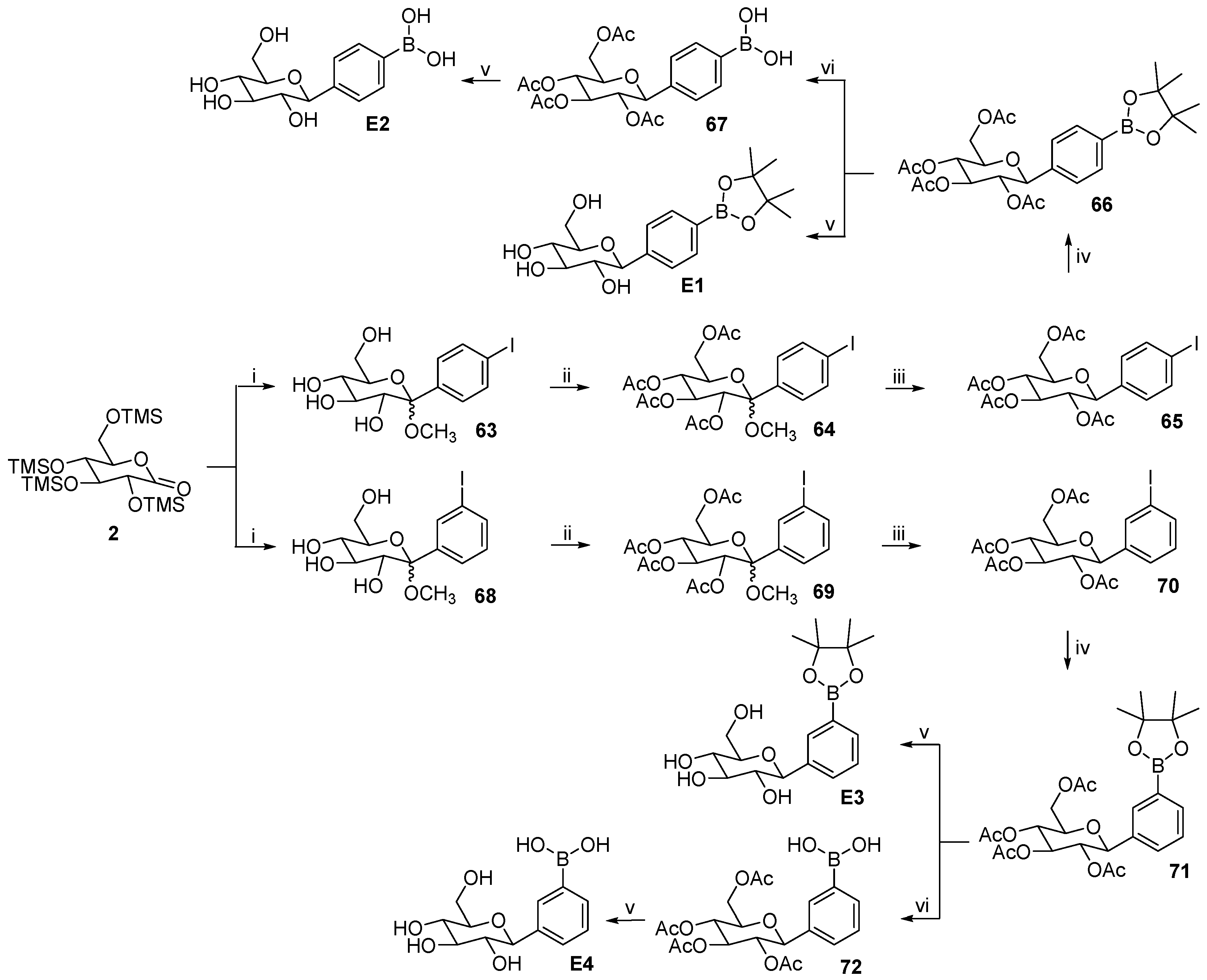
R)-3,4,5-tris((trimethylsilyl)oxy)-6-(((trimethylsilyl)oxy)methyl)tetrahydro-2H-pyran-2-one (
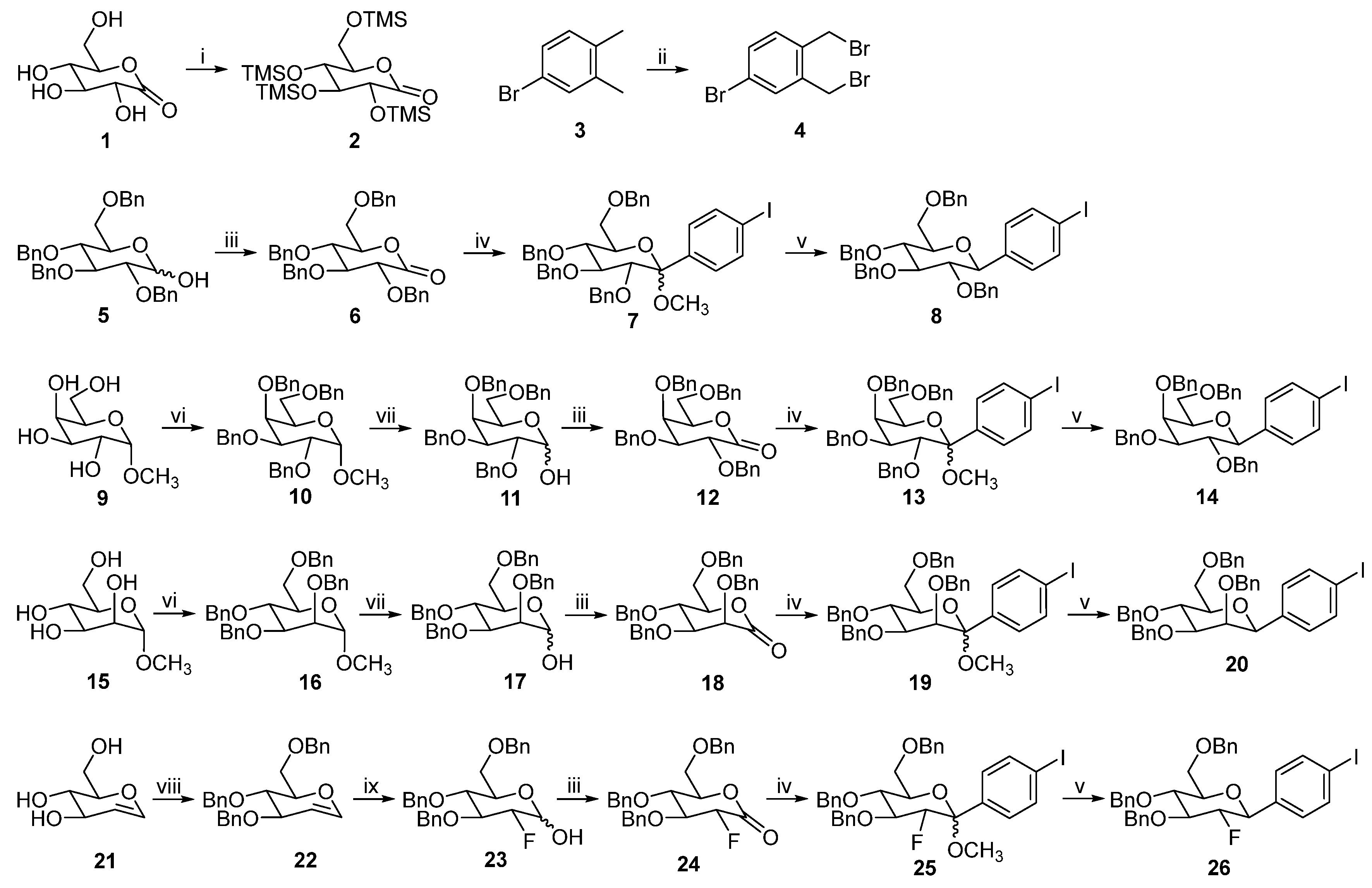
2): To a stirred mixture of D-glucono-δ-lactone (
1, 30.00 g, 0.168 mol) in dried THF (300 mL) cooled at 0 °C under N
2 were added NMM (136.27 g, 1.35 mol) and DMAP (2.06 g, 16.8 mmol), followed by dropwise addition of TMSCl (109.77 g, 1.01 mol), and, after addition, the reaction mixture was stirred at room temperature overnight. The reaction mixture was poured into ice water (300 mL), and the resulting mixture was extracted with
n-hexane (b.p., 60–90 °C; 200 mL × 3). The combined extracts were washed with brine, dried (MgSO
4), and evaporated on a rotary evaporator to afford a residue, which was purified through column chromatography (PE) to give
2. Colorless oil, 53.15 g (68%).
1H NMR (500 MHz, CDCl
3)
δ 4.19–4.16 (m, 1H), 4.00 (d,
J = 8.0 Hz, 1H), 3.90 (t,
J = 7.5 Hz, 1H), 3.83–3.74 (m, 3H), 0.20–0.13 (m, 36H). The
1H NMR data were consistent with those reported [
40].
Synthesis of 4-bromo-1,2-bis(bromomethyl)benzene (
4): To a stirred mixture of 4-bromo-1,2-dimethylbenzene (
3, 10.00 g, 54.0 mmol) and NBS (19.23 g, 0.108 mol) in dried CCl
4 (100 mL) heated at 60 °C under N
2 was added AIBN (0.89 g, 5.40 mmol) portion-wise, and, after addition, the reaction mixture was refluxed (
caution: violent exotherm may occur) until completion of the reaction, as indicated by TLC analysis (typically within 1 h). Upon cooling to room temperature, the reaction mixture was filtered off through celite, and the filtrate was evaporated on a rotary evaporator to afford a residue, which was purified through column chromatography (PE) to give
4. Colorless oil, 5.90 g (37%).
1H NMR (500 MHz, CDCl
3)
δ 7.52 (d,
J = 2.0 Hz, 1H), 7.43 (dd,
J = 8.0, 2.0 Hz, 1H), 7.25–7.23 (m, 1H), 4.59 (s, 2H), 4.58 (s, 2H). The
1H NMR data were consistent with those reported [
41].
Synthesis of (3
R,4
S,5
R,6
R)-3,4,5-tris(benzyloxy)-6-((benzyloxy)methyl)tetrahydro-2H-pyran-2-one (
6): Following the general synthetic procedure 1,
6 was prepared from
5 (25.00 g, 46.2 mmol) using Ac
2O (125 mL) and DMSO (250 mL). The crude
5 was purified through column chromatography (EtOAc/PE = 1/5 by
v/
v) to give
6. Yellow oil, 23.59 g (95%).
1H NMR (500 MHz, CDCl
3)
δ 7.39–7.37 (m, 2H), 7.35–7.28 (m, 14H), 7.26–7.24 (m, 2H), 7.18–7.16 (m, 2H), 4.99 (d,
J = 11.5 Hz, 1H), 4.74–4.69 (m, 2H), 4.65–4.49 (m, 5H), 4.46–4.44 (m, 1H), 4.12 (d,
J = 6.5 Hz, 1H), 3.97–3.89 (m, 2H), 3.74–3.65 (m, 2H). The
1H NMR data were consistent with those reported [
42].
Synthesis of (3R,4S,5R,6R)-3,4,5-tris(benzyloxy)-6-((benzyloxy)methyl)-2-(4-iodophenyl)-2-methoxytetrahydro-2H-pyran (7): Following the general synthetic procedure 2, 7 was prepared from 6 (24.00 g, 44.6 mmol) and 1,4-diiodobenzene (17.64 g, 53.5 mmol) using n-BuLi (33 mL, 1.6 M in THF, 52.8 mmol), MeSO3H (21.40 g, 0.223 mol), MeOH (107 mL), and dried THF (240 mL). The crude compound 7 was isolated as a brown oil, 41.50 g. This sample was used directly in the next step without further purification or characterization.
Synthesis of (2
R,3
R,4
R,5
S,6
S)-3,4,5-tris(benzyloxy)-2-((benzyloxy)methyl)-6-(4-iodophenyl)tetrahydro-2H-pyran (
8): Following the general synthetic procedure 3,
8 was prepared from crude
7 prepared above (41.50 g, deemed to be 54.8 mmol) using Et
3SiH (12.75 g, 0.110 mol) and BF
3·Et
2O (9.34 g, 65.8 mmol) in dried CH
2Cl
2 (415 mL). The crude
8 was purified through column chromatography (EtOAc/PE = 1/5 by
v/
v) to give
8. White solid, 8.90 g (27% overall for
6 to
8). m.p. 102.4–104.9 °C.
1H NMR (500 MHz, CDCl
3)
δ 7.68–7.66 (m, 2H), 7.34–7.27 (m, 13H), 7.22–7.16 (m, 7H), 6.93–6.91 (m, 2H), 4.95–4.85 (m, 3H), 4.64–4.61 (m, 2H), 4.56–4.54 (m, 1H), 4.44 (d,
J = 10.5 Hz, 1H), 4.18 (d,
J = 9.5 Hz, 1H), 3.88 (d,
J = 10.0 Hz, 1H), 3.81–3.73 (m, 4H), 3.59–3.56 (m, 1H), 3.43 (t,
J = 9.0 Hz, 1H). The
1H NMR data were consistent with those reported [
43].
Synthesis of (2
R,3
S,4
S,5
R,6
S)-3,4,5-tris(benzyloxy)-2-((benzyloxy)methyl)-6-methoxytetrahydro-2H-pyran (
10): To a stirred mixture of methyl α-D-galactopyranoside (
9, 50.00 g, 0.257 mol) and BnBr (264.00 g, 1.54 mol) in a mixture of dried DMF (400 mL) and dried THF (100 mL) cooled at 0 °C under N
2 was added portion-wise NaH (61.80 g, 60%, 1.54 mol), and, after addition, the reaction mixture was stirred at room temperature until completion of the reaction, as indicated by TLC analysis (typically within 2 h), and then
slowly poured into stirred ice water (1000 mL). The resulting mixture was extracted with EtOAc (250 mL × 3), and the combined extracts were washed with brine, dried (MgSO
4), and evaporated on a rotary evaporator to afford a residue, which was purified through column chromatography (EtOAc/PE = 1/5 by
v/
v) to give
10. Yellow oil, 130.64 g (91%).
1H NMR (500 MHz, CDCl
3)
δ 7.40–7.27 (m, 20H), 4.95 (d,
J = 11.5 Hz, 1H), 4.86–4.82 (m, 2H), 4.75–4.68 (m, 3H), 4.57 (d,
J = 11.5 Hz, 1H), 4.50–4.47 (m, 1H), 4.41–4.39 (m, 1H), 4.05–4.02 (m, 1H), 3.95–3.89 (m, 3H), 3.53 (d,
J = 6.5 Hz, 2H), 3.37 (s, 3H). The
1H NMR data were consistent with those reported [
44].
Synthesis of (3R,4S,5S,6R)-3,4,5-tris(benzyloxy)-6-((benzyloxy)methyl)tetrahydro-2H-pyran-2-ol (11): To a stirred solution of 10 (130.64 g, 0.236 mol) in AcOH (784 mL) heated at 80 °C was added dropwise 5 M HCl (130 mL), and, after addition, the reaction mixture was stirred at this temperature until completion of the reaction as indicated by TLC (typically within 1 h). Upon completion, the reaction mixture was quickly poured into ice water (700 mL), and the resulting mixture was extracted with EtOAc (600 mL × 3). The combined extracts were washed successively with saturated aqueous NaHCO3 (until pH > 7) and brine, dried (MgSO4), and evaporated on a rotary evaporator to afford a residue, which was purified through column chromatography (EtOAc/PE = 1/6 by v/v) to give 11. Yellow oil, 74.66 g. This sample was used directly in the next step without characterization.
Synthesis of (3
R,4
S,5
S,6
R)-3,4,5-tris(benzyloxy)-6-((benzyloxy)methyl)tetrahydro-2H-pyran-2-one (
12): Following general synthetic procedure 1,
12 was prepared from
11 (74.66 g, 0.138 mmol) using Ac
2O (373 mL) and DMSO (750 mL). Column chromatography purification (EtOAc/PE = 1/10 by
v/
v) gave
12. Colorless oil, 38.00 g (30% overall for
10 to
12).
1H NMR (500 MHz, CDCl
3)
δ 7.42–7.41 (m, 2H), 7.34–7.27 (m, 16H), 7.24–7.22 (m, 2H), 5.18 (d,
J = 11.0 Hz, 1H), 4.93 (d,
J = 11.0 Hz, 1H), 4.79–4.75 (m, 2H), 4.70–4.68 (m, 1H), 4.61 (d,
J = 11.5 Hz, 1H), 4.52–4.44 (m, 3H), 4.35–4.32 (m, 1H), 4.16 (t,
J = 2.0 Hz, 1H), 3.88 (dd,
J = 9.5, 2.0 Hz, 1H), 3.72–3.64 (m, 2H). The
1H NMR data were consistent with those reported [
45].
Synthesis of (3R,4S,5S,6R)-3,4,5-tris(benzyloxy)-6-((benzyloxy)methyl)-2-(4-iodophenyl)-2-methoxytetrahydro-2H-pyran (13): Following the general synthetic procedure 2, 13 was prepared from 12 (25.00 g, 46.4 mmol) and 1,4-diiodobenzene (18.37 g, 55.7 mmol) using n-BuLi (34.8 mL, 1.6 M in THF, 55.68 mmol), MeSO3H (22.30 g, 0.232 mol), MeOH (112 mL), and dried THF (250 mL). The crude 13 was isolated as a brown oil, 48.41 g, which was used in the next step without further purification or characterization.
Synthesis of (2R,3S,4R,5S,6S)-3,4,5-tris(benzyloxy)-2-((benzyloxy)methyl)-6-(4-iodophenyl)tetrahydro-2H-pyran (14): Following the general synthetic procedure 3, 14 was prepared from crude 13 prepared above (48.41 g, deemed to be 64.0 mmol) using Et3SiH (14.88 g, 0.128 mol) and BF3·Et2O (10.90 g, 76.8 mmol) in dried CH2Cl2 (480 mL). Column chromatography purification (EtOAc/PE = 1/10 by v/v) gave 14. Brown oil, 16.20 g (48% overall for 12 to 14). 1H NMR (500 MHz, CDCl3) δ 7.64–7.62 (m, 2H), 7.37–7.27 (m, 14H), 7.24–7.16 (m, 6H), 6.94–6.92 (m, 2H), 5.00 (d, J = 11.5 Hz, 1H), 4.78–4.72 (m, 2H), 4.63 (d, J = 12.0 Hz, 1H), 4.51 (d, J = 10.5 Hz, 1H), 4.47–4.40 (m, 2H), 4.13 (d, J = 9.0 Hz, 1H), 4.04 (d, J = 3.0 Hz, 1H), 3.94 (d, J = 10.5 Hz, 1H), 3.84 (t, J = 9.5 Hz, 1H), 3.69–3.67 (m, 2H), 3.64–3.57 (m, 2H). 13C NMR (151 MHz, CDCl3) δ 139.46, 139.13, 138.57, 137.99, 137.92, 137.31, 129.96, 128.57, 128.55, 128.44, 128.39, 128.36, 128.10, 127.93, 127.91, 127.77, 127.74, 127.63, 93.78, 84.44, 81.60, 80.43, 75.33, 74.70, 74.36, 73.67, 72.67, 68.94. HR-MS (ESI): m/z [M+H]+ calcd for C40H40IO5+: 727.1915, found: 727.1923.
Synthesis of (2
R,3
R,4
S,5
S,6
S)-3,4,5-tris(benzyloxy)-2-((benzyloxy)methyl)-6-methoxytetrahydro-2H-pyran (
16): Following the procedure for the synthesis of
10 from
9,
16 was prepared from
15 (50.00 g, 0.257 mol) using NaH (61.80 g, 60%, 1.54 mol) and BnBr (264.00 g, 1.54 mol) in a mixture of dried DMF (400 mL) and dried THF (100 mL). Column chromatography purification (EtOAc/PE = 1/8 by
v/
v) gave
16. Yellow oil, 109.46 g (77%).
1H NMR (500 MHz, CDCl
3)
δ 7.38–7.26 (m, 16H), 7.24–7.23 (m, 2H), 7.17–7.15 (m, 2H), 4.88 (d,
J = 11.0 Hz, 1H), 4.77–4.76 (m, 1H), 4.74–4.70 (m, 2H), 4.66 (d,
J = 12.0 Hz, 1H), 4.61 (s, 2H), 4.57–4.50 (m, 2H), 3.97 (t,
J = 9.3 Hz, 1H), 3.89–3.87 (m, 1H), 3.79–3.72 (m, 4H), 3.32 (s, 3H). The
1H NMR data were consistent with those reported [
46].
Synthesis of (3S,4S,5R,6R)-3,4,5-tris(benzyloxy)-6-((benzyloxy)methyl)tetrahydro-2H-pyran-2-ol (17): Following the procedure for the synthesis of 11 from 10, 17 was prepared from 16 (109.46 g, 0.197 mol) using 5 M HCl (110 mL) in AcOH (660 mL). Column chromatography purification (EtOAc/PE = 1/6 by v/v) gave 17. Yellow oil, 42.23 g. This sample was used directly in the next step without characterization.
Synthesis of (3
S,4
S,5
R,6
R)-3,4,5-tris(benzyloxy)-6-((benzyloxy)methyl)tetrahydro-2H-pyran-2-one (
18): Following the general synthetic procedure 1,
18 was prepared from
17 (42.23 g, 78.1 mmol) using Ac
2O (211 mL) and DMSO (422 mL). Column chromatography purification (EtOAc/PE = 1/8 by
v/
v) gave
18. Colorless oil, 37.00 g (35% overall for
16 to
18).
1H NMR (500 MHz, CDCl
3)
δ 7.40–7.29 (m, 18H), 7.10–7.08 (m, 2H), 5.06 (d,
J = 12.0 Hz, 1H), 4.83 (d,
J = 12.0 Hz, 1H), 4.65–4.58 (m, 2H), 4.56–4.51 (m, 2H), 4.35–4.32 (m, 2H), 4.26–4.22 (m, 2H), 4.05–4.04 (m, 1H), 3.79–3.77 (m, 1H), 3.63 (d,
J = 4.5 Hz, 2H). The
1H NMR data were consistent with those reported [
47].
Synthesis of (3S,4S,5R,6R)-3,4,5-tris(benzyloxy)-6-((benzyloxy)methyl)-2-(4-iodophenyl)-2-methoxytetrahydro-2H-pyran (19): Following the general synthetic procedure 2, 19 was prepared from 18 (22.00 g, 40.8 mmol) and 1,4-diiodobenzene (16.17 g, 49.0 mmol) using n-BuLi (30.6 mL, 1.6 M in THF, 48.96 mmol), MeSO3H (19.63 g, 0.204 mol), MeOH (98 mL), and dried THF (220 mL). The crude product was isolated as a brown oil, 33.68 g, and used directly in the next step without further purification or characterization.
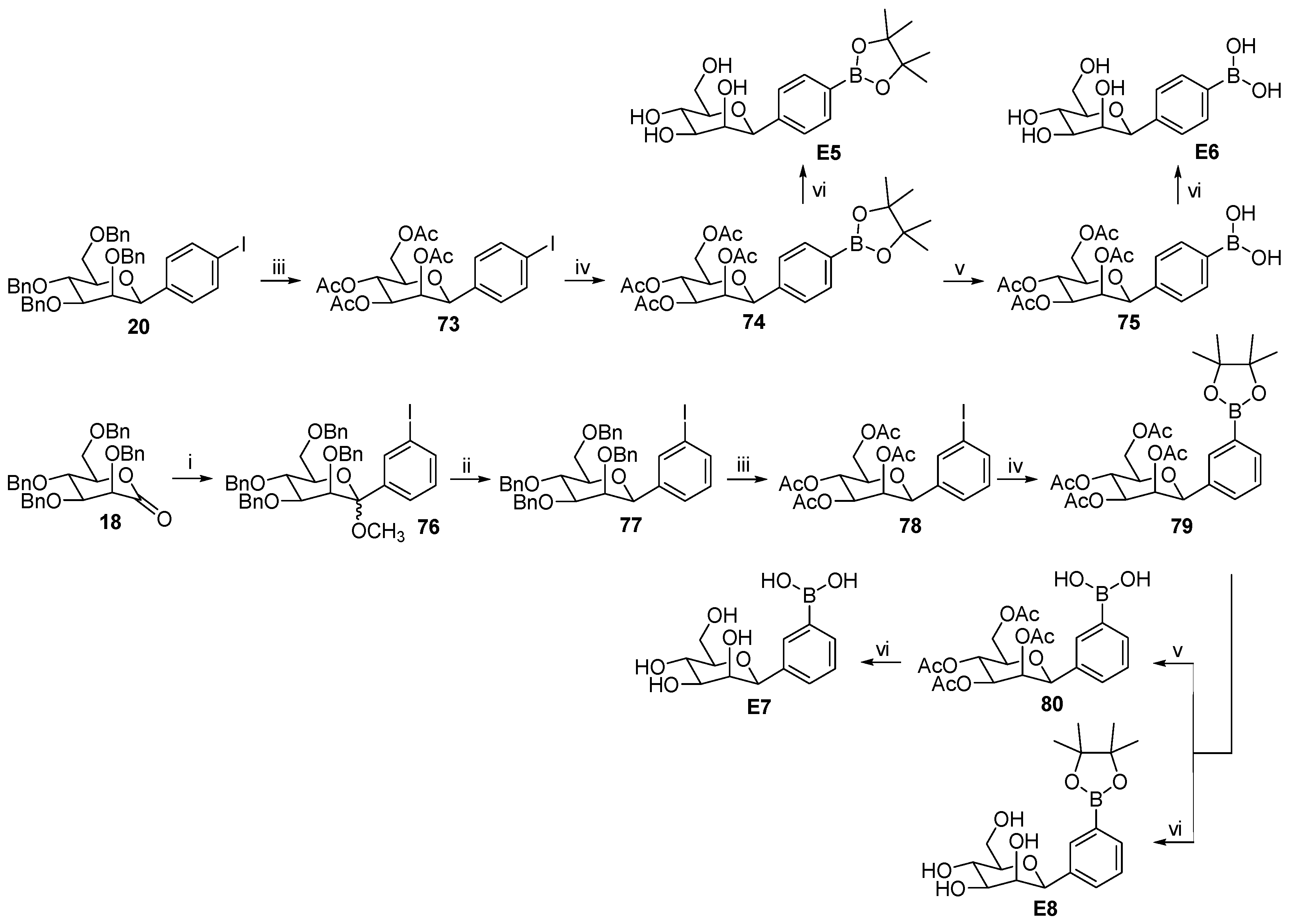
Synthesis of (2R,3R,4R,5R,6S)-3,4,5-tris(benzyloxy)-2-((benzyloxy)methyl)-6-(4-iodophenyl)tetrahydro-2H-pyran (20): Following the general synthetic procedure 3, 20 was prepared from crude 19 prepared above (33.68 g, deemed to be 44.5 mmol) using Et3SiH (10.35 g, 89.0 mmol) and BF3·Et2O (7.58 g, 53.4 mmol) in dried CH2Cl2 (337 mL). Column chromatography purification (EtOAc/PE = 1/15 by v/v) gave 20. Yellow oil, 7.74 g (26% overall for 18 to 20). 1H NMR (500 MHz, CDCl3) δ 7.61–7.58 (m, 2H), 7.38–7.27 (m, 13H), 7.23–7.14 (m, 5H), 7.08–7.07 (m, 2H), 6.90–6.89 (m, 2H), 4.91 (d, J = 10.5 Hz, 1H), 4.76–4.69 (m, 3H), 4.62–4.54 (m, 3H), 4.40 (s, 1H), 4.22 (d, J = 11.5 Hz, 1H), 4.01 (t, J = 9.5 Hz, 1H), 3.89–3.88 (m, 1H), 3.82–3.77 (m, 3H), 3.61–3.58 (m, 1H). 13C NMR (151 MHz, CDCl3) δ 138.84, 138.56, 138.46, 138.42, 138.08, 137.10, 128.66, 128.61, 128.51, 128.47, 128.23, 128.20, 128.17, 128.02, 127.85, 127.83, 127.67, 127.50, 92.84, 85.02, 80.03, 79.41, 75.43, 75.07, 74.57, 73.65, 72.52, 69.71. HR-MS (ESI): m/z [M+Na]+ calcd for C40H39INaO5+: 749.1734, found: 749.1732.
Synthesis of (2
R,3
S,4
R)-3,4-bis(benzyloxy)-2-((benzyloxy)methyl)-3,4-dihydro-2H-pyran (
22): To a stirred mixture of
21 (33.00 g, 0.226 mol) in dried THF (462 mL) cooled at 0 °C under N
2 were added NaH (32.5 g, 60%, 0.813 mol) portion-wise and TBAI (5.00 g, 13.5 mmol) in one portion, and, after additions, stirring was continued for 0.5 h, followed by dropwise addition of BnBr (139.06 g, 0.813 mol). After that, the reaction mixture was stirred at room temperature overnight, when TLC analysis indicated completion of the reaction, and then poured
slowly into stirred ice water (1000 mL). The resulting mixture was extracted with EtOAc (300 mL × 3), and the combined extracts were washed with brine, dried (MgSO
4), and evaporated on a rotary evaporator to afford a residue, which was purified through column chromatography (EtOAc/PE = 1/12 by
v/
v) to give
22. White solid, 48.00 g (51%). m.p. 52.8–55.2 °C.
1H NMR (500 MHz, CDCl
3)
δ 7.33–7.27 (m, 13H), 7.25–7.23 (m, 2H), 6.42 (d,
J = 6.0 Hz, 1H), 4.87 (dd,
J = 6.3, 2.8 Hz, 1H), 4.83 (d,
J = 11.5 Hz, 1H), 4.65–4.62 (m, 2H), 4.61–4.54 (m, 3H), 4.21 (d,
J = 5.5 Hz, 1H), 4.08–4.05 (m, 1H), 3.87–3.84 (m, 1H), 3.82–3.75 (m, 2H). The
1H NMR data were consistent with those reported [
48].
Synthesis of (3R,4S,5R,6R)-4,5-bis(benzyloxy)-6-((benzyloxy)methyl)-3-fluorotetrahydro-2H-pyran-2-ol (23): A mixture of 22 (7.70 g, 18.5 mmol) and selectfluor® (26.20 g, 73.9 mmol) in a mixture of DMF (39 mL) and H2O (39 mL) was stirred at 50 °C overnight when TLC analysis indicated completion of the reaction. Upon cooling to room temperature, the reaction mixture was poured into ice water (90 mL), and the resulting mixture was extracted with EtOAc (80 mL × 3). The combined extracts were washed with brine, dried (MgSO4), and evaporated on a rotary evaporator to afford crude 23 as a yellow oil, 10.90 g, which was used directly in the next step without further purification or characterization.
Synthesis of (3
R,4
S,5
R,6
R)-4,5-bis(benzyloxy)-6-((benzyloxy)methyl)-3-fluorotetrahydro-2H-pyran-2-one (
24): Following the general synthetic procedure 1,
24 was prepared from crude
23 prepared above (10.90 g, deemed to be 24.1 mmol) using Ac
2O (55 mL) and DMSO (109 mL). Column chromatography purification (EtOAc/PE = 1/6 by
v/
v) gave
24. White solid, 1.39 g (17% overall for
22 to
24). m.p. 58.8–60.2 °C.
1H NMR (600 MHz, DMSO-
d6)
δ 7.35–7.29 (m, 13H), 7.23–7.22 (m, 2H), 5.38 (dd,
J = 46.8, 8.4 Hz, 1H), 4.76–4.71 (m, 3H), 4.57–4.53 (m, 3H), 4.51–4.49 (m, 1H), 4.26–4.21 (m, 1H), 3.98 (t,
J = 7.8 Hz, 1H), 3.70 (d,
J = 3.6 Hz, 2H). The m.p. and
1H NMR were consistent with those reported [
38].
Synthesis of (3R,4S,5R,6R)-4,5-bis(benzyloxy)-6-((benzyloxy)methyl)-3-fluoro-2-(4-iodophenyl)-2-methoxytetrahydro-2H-pyran (25): Following the general synthetic procedure 2, 25 was prepared from 24 (0.50 g, 1.11 mmol) and 1,4-diiodobenzene (0.44 g, 1.33 mmol) using n-BuLi (0.83 mL, 1.6 M in THF, 1.328 mmol), MeSO3H (0.53 g, 5.55 mmol), MeOH (2.7 mL), and dried THF (5 mL). The crude 25 was isolated as a yellow oil, 0.24 g, which was used directly in the next step without further purification or characterization.
Synthesis of (2R,3R,4S,5S,6S)-3,4-bis(benzyloxy)-2-((benzyloxy)methyl)-5-fluoro-6-(4-iodophenyl)tetrahydro-2H-pyran (26): Following the general synthetic procedure 3, 26 was prepared from crude 25 prepared above (0.24 g, deemed to be 0.359 mmol) using Et3SiH (83 mg, 0.718 mmol) and BF3·Et2O (61 mg, 0.431 mmol) in dried CH2Cl2 (2.4 mL). Column chromatography purification (EtOAc/PE = 1/20 by v/v) gave 26. Yellow oil, 94 mg (13% overall for 24 to 26). 1H NMR (500 MHz, CDCl3) δ 7.76 (d, J = 8.0 Hz, 2H), 7.41–7.27 (m, 15H), 7.21 (d, J = 8.0 Hz, 2H), 4.96 (t, J = 10.3 Hz, 2H), 4.85–4.82 (m, 1H), 4.67–4.65 (m, 2H), 4.60–4.58 (m, 1H), 4.50–4.39 (m, 1H), 4.35–4.32 (m, 1H), 3.98–3.92 (m, 1H), 3.82–3.79 (m, 3H), 3.68–3.65 (m, 1H). 13C NMR (151 MHz, CDCl3) δ 138.25, 138.19, 138.11, 137.57, 137.48, 129.03, 128.52, 128.51, 128.49, 128.10, 127.94, 127.89, 127.81, 127.76, 95.57, 94.32 (d, J = 5.1 Hz), 84.6 (d, J = 16.3 Hz), 79.39, 78.74 (d, J = 23.2 Hz), 75.34, 75.00 (d, J = 3.0 Hz), 73.56, 68.93. HR-MS (ESI): m/z [M+H]+ calcd for C33H33FIO4+: 639.1402, found: 639.1407.
Synthesis of 1-(
tert-butyldimethylsilyl)-1,2-dicarba-
closo-dodecaborane (
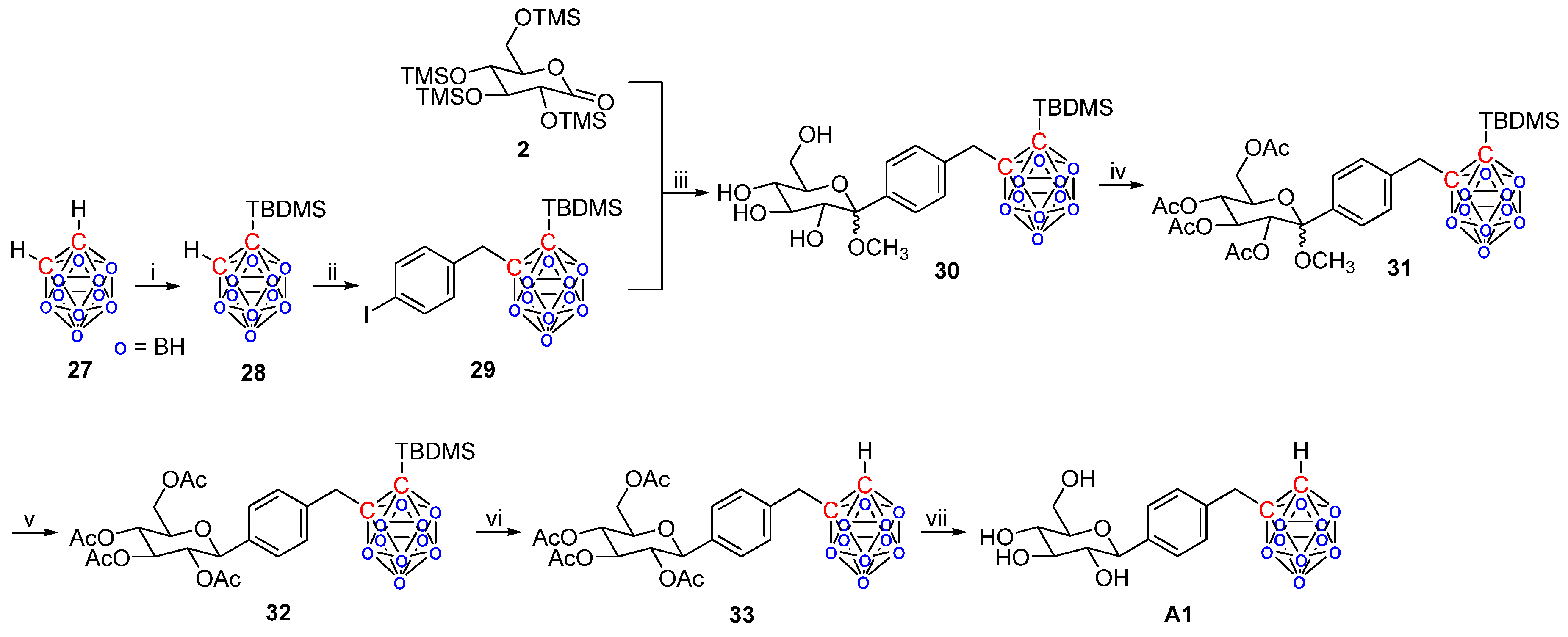
28): To a stirred solution of
o-carborane (
27, 0.20 g, 1.39 mmol) in dried THF (1.6 mL) cooled at 0 °C under N
2 was added
n-BuLi (1 mL, 1.6 M in THF, 1.6 mmol), and, after addition, the reaction mixture was stirred at room temperature for 1 h and cooled back to 0 °C again, followed by the addition of a solution of TBDMSCl (0.27 g, 1.80 mmol) in dried THF (0.4 mL). After that, the reaction mixture was stirred at room temperature overnight, when TLC analysis indicated completion of the reaction, and then poured into ice water (20 mL). The mixture thus obtained was extracted with EtOAc (30 mL × 3), and the combined extracts were washed with brine, dried (MgSO
4), and evaporated on a rotary evaporator to afford a residue, which was purified through column chromatography (PE) to give
28. White solid, 0.29 g (81%). m.p. 60.8–62.2 °C.
1H NMR (500 MHz, CDCl
3)
δ 3.44 (s, 1H), 2.85–1.50 (m, 10H), 1.02 (s, 9H), 0.23 (s, 6H). The m.p. and
1H NMR were consistent with those reported [
49].
Synthesis of 1-tert-butyl-2-[(4-iodophenyl)methyl]-1,2-dicarba-closo-dodecaborane (29): To a stirred solution of 28 (0.50 g, 1.93 mmol) in dried THF (5 mL) cooled at 0 °C under N2 was added dropwise n-BuLi (1.5 mL, 1.6 M in THF, 2.4 mmol), and, after addition, the reaction mixture was stirred at room temperature for 1 h and cooled back to 0 °C again, followed by dropwise addition of 4-iodobenzyl bromide (0.69 g, 2.32 mmol) in dried THF. After that, the reaction mixture was stirred at room temperature overnight, when TLC analysis indicated completion of the reaction, and then poured into ice water (30 mL). The resulting mixture was extracted with EtOAc (30 mL × 3), and the combined extracts were washed with brine, dried (MgSO4), and evaporated on a rotary evaporator to afford a residue, which was purified through column chromatography (PE) to give 29. White solid, 0.28 g (31%). m.p. 124.0–125.8 °C. 1H NMR (500 MHz, CDCl3) δ 7.68–7.65 (m, 2H), 6.91–6.89 (m, 2H), 3.40 (s, 2H), 2.68–1.81 (m, 10H), 1.13 (s, 9H), 0.42 (s, 6H). 13C NMR (151 MHz, CDCl3) δ 137.94, 135.47, 131.84, 93.95, 80.54, 75.25, 75.24, 75.22, 43.12, 27.84, 20.66, −2.02. HR-MS (ESI): m/z [M+H]+ calcd for C15H32B10ISi+: 477.2243, found: 477.2267.
Synthesis of (3R,4S,5S,6R)-6-(hydroxymethyl)-2-methoxy-2-(4-((2-tert-butyldimethylsilyl-1,2-dicarba-closo-dodecaboran-1-yl)methyl)phenyl)tetrahydro-2H-pyran-3,4,5-triol (30): To a stirred solution of 29 (4.27 g, 9.00 mmol) in dried THF (43 mL) cooled at −78 °C under N2 was added dropwise n-BuLi (6.7 mL, 1.6 M in THF, 10.72 mmol), and, after addition, the reaction mixture was stirred at this temperature for 1 h, followed by dropwise addition of a solution of 2 (8.40 g, 18.0 mmol) in dried THF (10 mL). After that, the reaction mixture was stirred at this temperature for 1 h, followed by dropwise addition of a solution of MeSO3H (4.32 g, 45.0 mmol) in MeOH (22 mL). After that, the reaction mixture was stirred at room temperature overnight, when TLC analysis indicated completion of the reaction, and then poured into ice water (150 mL). The resulting mixture was extracted with EtOAc (50 mL × 3), and the combined extracts were washed with brine, dried (MgSO4), and evaporated on a rotary evaporator to afford crude 30 as a brown foam, 5.80 g, which was used directly in the next step without further purification.
Synthesis of (3R,4S,5R,6R)-6-(acetoxymethyl)-2-methoxy-2-(4-((2-tert-butyldimethylsilyl-1,2-dicarba-closo-dodecaboran-1-yl)methyl)phenyl)tetrahydro-2H-pyran-3,4,5-triyl triacetate (31): To a stirred mixture of crude 30 prepared above (5.80 g, deemed to be 10.7 mmol) and DMAP (1.31 g, 10.7 mmol) in pyridine (58 mL) cooled at 0 °C was added dropwise Ac2O (29 mL), and, after addition, the reaction mixture was stirred at room temperature overnight, when TLC analysis indicated completion of the reaction, and then poured into ice water (70 mL). The resulting mixture was extracted with EtOAc (80 mL × 3), and the combined extracts were washed successively with 1 M HCl (until pH = 5–6) and brine, dried (MgSO4), and evaporated on a rotary evaporator to afford crude 31 as a brown oil, 7.06 g, which was used directly in the next step without further purification or characterization.
Synthesis of (2R,3R,4R,5S,6S)-2-(acetoxymethyl)-6-(4-((2-tert-butyldimethylsilyl-1,2-dicarba-closo-dodecaboran-1-yl)methyl)phenyl)tetrahydro-2H-pyran-3,4,5-triyl triacetate (32): Following the general synthetic procedure 3, 32 was prepared from crude 31 prepared above (7.06 g, deemed to be 9.96 mmol) using Et3SiH (3.47 g, 29.9 mmol) and BF3·Et2O (7.35 g, 51.8 mmol) in dried CH2Cl2 (70 mL). Column chromatography purification (EtOAc/PE = 1/3 by v/v) gave 32. White foam, 1.50 g (25% overall for 29 to 32). 1H NMR (500 MHz, CDCl3) δ 7.31 (d, J = 8.5 Hz, 2H), 7.14 (d, J = 8.0 Hz, 2H), 5.35–5.30 (m, 1H), 5.23 (t, J = 9.8 Hz, 1H), 5.10 (t, J = 9.8 Hz, 1H), 4.40 (d, J = 10.0 Hz, 1H), 4.32–4.28 (m, 1H), 4.19–4.11 (m, 1H), 3.86–3.83 (m, 1H), 3.45 (s, 2H), 2.89–1.51 (m, 10H), 2.10 (s, 3H), 2.06 (s, 3H), 2.00 (s, 3H), 1.79 (s, 3H), 1.14 (s, 9H), 0.43 (s, 6H). 13C NMR (126 MHz, CDCl3) δ 170.86, 170.47, 169.64, 168.92, 136.57, 136.32, 130.03, 127.56, 80.99, 80.00, 77.36, 76.34, 75.22, 74.21, 72.74, 68.70, 62.43, 43.31, 27.82, 20.91, 20.76, 20.62, 20.43, −2.04, −2.07. HR-MS (ESI): m/z [M+H]+ calcd for C29H51B10O9Si+: 681.4227, found: 681.4238.
Synthesis of (2R,3R,4R,5S,6S)-2-(acetoxymethyl)-6-(4-((1,2-dicarba-closo-dodecaboran-1-yl)methyl)phenyl)tetrahydro-2H-pyran-3,4,5-triyl triacetate (33): To a stirred solution of 32 (0.75 g, 1.10 mmol) in dried THF (7.5 mL) cooled at −78 °C under N2 was added dropwise a solution of TBAF in THF (1.7 mL, 1.0 M in THF, 1.7 mmol), and, after addition, the reaction mixture was stirred at room temperature for 1 h, when TLC analysis indicated completion of the reaction, and then poured into ice water (30 mL). The resulting mixture was extracted with EtOAc (30 mL × 3), and the combined extracts were washed with brine, dried (MgSO4), and evaporated on a rotary evaporator to afford a residue, which was purified through column chromatography (EtOAc/PE = 1/2 by v/v) to obtain 33. White solid, 0.44 g (71%). m.p. 192.2–195.9 °C. 1H NMR (500 MHz, CDCl3) δ 7.34 (d, J = 8.0 Hz, 2H), 7.12 (d, J = 8.0 Hz, 2H), 5.34 (t, J = 9.5 Hz, 1H), 5.22 (t, J = 9.7 Hz, 1H), 5.02 (t, J = 9.8 Hz, 1H), 4.39 (d, J = 9.5 Hz, 1H), 4.32–4.29 (m, 1H), 4.21–4.18 (m, 1H), 3.87–3.84 (m, 1H), 3.51 (s, 2H), 3.13 (s, 1H), 2.76–1.63 (m, 10H), 2.10 (s, 3H), 2.06 (s, 3H), 2.00 (s, 3H), 1.79 (s, 3H). 13C NMR (151 MHz, CDCl3) δ 170.87, 170.45, 169.67, 168.92, 137.04, 135.03, 130.00, 127.84, 79.92, 76.39, 74.31, 73.93, 73.03, 68.68, 62.38, 59.46, 43.26, 20.94, 20.78, 20.48. HR-MS (ESI): m/z [M+H]+ calcd for C23H37B10O9+: 567.3363, found: 567.3361.
Synthesis of (2R,3S,4R,5R,6S)-2-(hydroxymethyl)-6-(4-((1,2-dicarba-closo-dodecaboran-1-yl)methyl)phenyl)tetrahydro-2H-pyran-3,4,5-triol (A1): Following the general synthetic procedure 5, A1 was prepared from 33 (0.40 g, 0.708 mmol) using Na (98 mg, 4.25 mmol) in MeOH (8 mL). Column chromatography purification (MeOH/CH2Cl2 = 1/10 by v/v) gave A1. White foam, 0.25 g (89%). [α]D20 = +10.2° (c = 10.4, MeOH). 1H NMR (500 MHz, CD3OD) δ 7.43 (d, J = 8.0 Hz, 2H), 7.19 (d, J = 7.5 Hz, 2H), 4.24 (s, 1H), 4.15 (d, J = 9.5 Hz, 1H), 3.90–3.88 (m, 1H), 3.72–3.69 (m, 1H), 3.58 (s, 2H), 3.50–3.47 (m, 1H), 3.42–3.41 (m, 2H), 3.38–3.35 (m, 1H), 2.57–1.63 (m, 10H). 13C NMR (151 MHz, CD3OD) δ 140.94, 136.23, 130.85, 129.35, 83.18, 82.27, 79.81, 76.92, 76.41, 71.91, 63.13, 62.71, 43.98. 11B NMR (161 MHz, CD3OD) δ −2.35, −3.27, −5.39, −6.31,−8.90, −9.83, −10.57, −11.59, −12.56, −13.40. HR-MS (ESI): m/z [M-H]− calcd for C15H27B10O5−: 397.2795, found: 397.2776. HPLC purity, 97.84%.
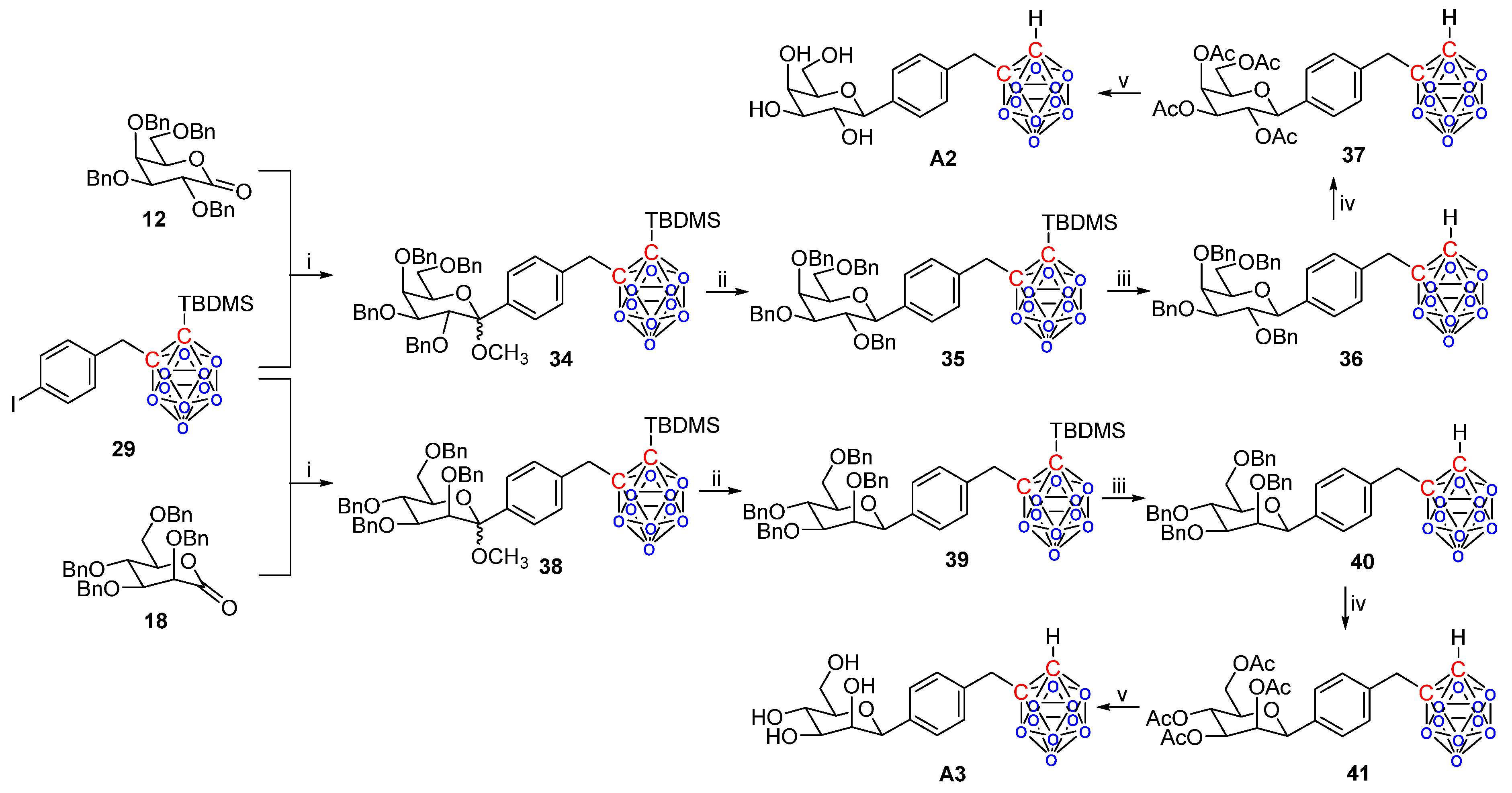
Synthesis of (3R,4S,5S,6R)-3,4,5-tris(benzyloxy)-6-((benzyloxy)methyl)-2-methoxy-2-(4-((2-tert-butyldimethylsilyl-1,2-dicarba-closo-dodecaboran-1-yl)methyl)phenyl)tetrahydro-2H-pyran (34): Following the general synthetic procedure 2, 34 was prepared from 29 (3.78 g, 7.97 mmol) and 12 (6.44 g, 11.9 mmol) using n-BuLi (5.5 mL, 1.6 M in THF, 8.8 mmol), MeSO3H (3.83 g, 39.8 mmol), MeOH (19.2 mL), and dried THF (38 mL) as a crude sample. Brown oil, 10.22 g. This sample was used directly in the next step without further purification or characterization.
Synthesis of (2R,3S,4R,5S,6S)-3,4,5-tris(benzyloxy)-2-((benzyloxy)methyl)-6-(4-((2-tert-butyldimethylsilyl-1,2-dicarba-closo-dodecaboran-1-yl)methyl)phenyl)tetrahydro-2H-pyran (35): Following the general synthetic procedure 3, 35 was prepared from crude 34 prepared above (10.22 g, deemed to be 11.3 mmol) using Et3SiH (2.64 g, 22.7 mmol) and BF3·Et2O (1.93 g, 13.6 mmol) in dried CH2Cl2 (102 mL). Column chromatography purification (EtOAc/PE = 1/10 by v/v) gave 35. White foam, 2.83 g (41%, 29 to 35). 1H NMR (500 MHz, CDCl3) δ 7.45–7.43 (m, 2H), 7.39–7.27 (m, 15H), 7.21–7.19 (m, 3H), 7.15–7.13 (m, 2H), 6.99–6.97 (m, 2H), 5.03 (d, J = 12.0 Hz, 1H), 4.79 (s, 2H), 4.65 (d, J = 11.5 Hz, 1H), 4.51–4.48 (m, 1H), 4.46–4.42 (m, 2H), 4.21 (d, J = 9.5 Hz, 1H), 4.07–4.06 (m, 1H), 3.90 (t, J = 9.3 Hz, 1H), 3.81 (d, J = 10.0 Hz, 1H), 3.72–3.70 (m, 2H), 3.68–3.61 (m, 2H), 3.47 (s, 2H), 2.98–1.71 (m, 10H), 1.14 (s, 9H), 0.44 (s, 6H). 13C NMR (151 MHz, CDCl3) δ 139.78, 139.22, 138.70, 138.04, 135.73, 129.73, 128.56, 128.42, 128.37, 128.36, 128.33, 128.10, 127.91, 127.73, 127.69, 127.61, 127.56, 84.29, 81.84, 81.34, 80.95, 75.40, 75.23, 74.73, 74.54, 73.67, 72.74, 68.96, 43.43, 27.87, 20.66, −1.95, −2.04. HR-MS (ESI): m/z [M+H]+ calcd for C49H67B10O5Si+: 873.5683, found: 873.5743.
Synthesis of (2R,3S,4R,5S,6S)-3,4,5-tris(benzyloxy)-2-((benzyloxy)methyl)-6-(4-((1,2-dicarba-closo-dodecaboran-1-yl)methyl)phenyl)tetrahydro-2H-pyran (36): Following the procedure for the synthesis of 33 from 32, 36 was prepared from 35 (0.59 g, 0.677 mmol) using TBAF (1 mL, 1.0 M in THF) in dried THF (5.9 mL). Column chromatography purification (EtOAc/PE = 1/8 by v/v) gave 36. Pale yellow oil, 0.29 g (57%). 1H NMR (500 MHz, CDCl3) δ 7.47 (d, J = 8.0 Hz, 2H), 7.38–7.33 (m, 8H), 7.32–7.27 (m, 7H), 7.21–7.18 (m, 3H), 7.11 (d, J = 8.0 Hz, 2H), 6.94–6.92 (m, 2H), 5.02 (d, J = 11.5 Hz, 1H), 4.80–4.74 (m, 2H), 4.65 (d, J = 11.5 Hz, 1H), 4.53 (d, J = 10.5 Hz, 1H), 4.49–4.42 (m, 2H), 4.22 (d, J = 9.0 Hz, 1H), 4.08–4.07 m, 1H), 3.89 (t, J = 9.5 Hz, 1H), 3.80 (d, J = 10.0 Hz, 1H), 3.73–3.70 (m, 2H), 3.66–3.60 (m, 2H), 3.52 (s, 2H), 3.17 (s, 1H), 2.60–1.70 (m, 10H). 13C NMR (151 MHz, CDCl3) δ 140.20, 139.13, 138.58, 137.97, 137.95, 134.14, 129.70, 128.78, 128.57, 128.40, 128.36, 128.15, 128.11, 127.97, 127.93, 127.78, 127.63, 84.28, 81.70, 80.75, 77.42, 75.33, 74.76, 74.53, 74.42, 73.68, 72.69, 68.87, 59.37, 43.40. HR-MS (ESI): m/z [M+H]+ calcd for C43H53B10O5+: 759.4818, found: 759.4868.
Synthesis of (2R,3S,4R,5S,6S)-2-(acetoxymethyl)-6-(4-((1,2-dicarba-closo-dodecaboran-1-yl)methyl)phenyl)tetrahydro-2H-pyran-3,4,5-triyl triacetate (37): To a stirred solution of 36 (1.16 g, 1.53 mmol) in Ac2O (11.6 mL) cooled at 0 °C under N2 was added dropwise BF3·Et2O (11.6 mL), and, after addition, the reaction mixture was stirred at 50 °C overnight, when TLC analysis indicated completion of the reaction. Upon cooling to room temperature, the reaction mixture was poured into ice water (50 mL), and the resulting mixture was extracted with EtOAc (70 mL × 3). The combined extracts were washed with brine, dried (MgSO4), and evaporated on a rotary evaporator to afford a residue, which was purified through column chromatography (EtOAc/PE = 1/4 by v/v) to give 37. Yellow foam, 0.36 g (42%). 1H NMR (500 MHz, CDCl3) δ 7.38 (d, J = 8.0 Hz, 2H), 7.13 (d, J = 8.0 Hz, 2H), 5.54–5.53 (m, 1H), 5.24–5.17 (m, 2H), 4.35 (d, J = 8.5 Hz, 1H), 4.23–4.16 (m, 2H), 4.10–4.06 (m, 1H), 3.55–3.49 (m, 2H), 3.13 (s, 1H), 2.86–1.64 (m, 10H), 2.21 (s, 3H), 2.04 (s, 3H), 1.98 (s, 3H), 1.79 (s, 3H). 13C NMR (151 MHz, CDCl3) δ 170.59, 170.37, 170.27, 169.06, 137.38, 134.92, 129.87, 127.97, 80.46, 74.83, 74.36, 71.81, 70.44, 67.84, 61.82, 59.48, 43.19, 20.84, 20.73, 20.57. HR-MS (ESI): m/z [M+H]+ calcd for C23H37B10O9+: 567.3363, found: 567.3369.
Synthesis of (2R,3R,4R,5R,6S)-2-(hydroxymethyl)-6-(4-((1,2-dicarba-closo-dodecaboran-1-yl)methyl)phenyl)tetrahydro-2H-pyran-3,4,5-triol (A2): Following the general synthetic procedure 5, A2 was prepared from 37 (0.36 g, 0.638 mmol) using Na (59 mg, 2.55 mmol) in dried MeOH (7.2 mL). Column chromatography purification (MeOH/CH2Cl2 = 1/10 by v/v) gave A2. White solid, 0.22 g (87%). m.p. 108.6–110.9 °C. [α]D20 = +20.0° (c = 10, MeOH). 1H NMR (500 MHz, DMSO-d6) δ 7.34–7.32 (m, 2H), 7.16–7.14 (m, 2H), 5.11 (s, 1H), 4.71 (d, J = 5.5 Hz, 1H), 4.61–4.60 (m, 1H), 4.57 (t, J = 5.3 Hz, 1H), 4.41–4.40 (m, 1H), 3.96 (d, J = 9.5 Hz, 1H), 3.77–3.75 (m, 1H), 3.57 (s, 2H), 3.56–3.47 (m, 4H), 3.42–3.38 (m, 1H), 2.85–1.47 (m, 10H). 13C NMR (151 MHz, DMSO-d6) δ 140.33, 134.53, 129.28, 127.99, 81.70, 79.38, 76.59, 75.03, 71.53, 68.90, 62.83, 60.89, 41.80. 11B NMR (161 MHz, DMSO-d6) δ −2.75, −3.68, −7.18, −9.32, −9.40, −10.22, −10.27, −12.10. HR-MS (ESI): m/z [M+Na]+ calcd for C15H28B10NaO5+: 421.2760, found: 421.2742. HPLC purity, 97.90%.
Synthesis of (3S,4S,5R,6R)-3,4,5-tris(benzyloxy)-6-((benzyloxy)methyl)-2-methoxy-2-(4-((2-tert-butyldimethylsilyl-1,2-dicarba-closo-dodecaboran-1-yl)methyl)phenyl)tetrahydro-2H-pyran (38): Following the general synthetic procedure 2, 38 was prepared from 29 (3.00 g, 6.32 mmol) and 18 (5.11 g, 9.48 mmol) using n-BuLi (4.3 mL, 1.6 M in THF, 6.88 mmol), MeSO3H (3.04 g, 31.6 mmol), MeOH (15.2 mL), and dried THF (30 mL) as a crude sample. Yellow oil, 7.75 g. This sample was used directly in the next step without further purification or characterization.
Synthesis of (2R,3R,4R,5R,6S)-3,4,5-tris(benzyloxy)-2-((benzyloxy)methyl)-6-(4-((2-tert-butyldimethylsilyl-1,2-dicarba-closo-dodecaboran-1-yl)methyl)phenyl)tetrahydro-2H-pyran (39): Following the general synthetic procedure 3, 39 was prepared from crude 38 prepared above (7.75 g, deemed to be 8.60 mmol) using Et3SiH (2.00 g, 17.2 mmol) and BF3·Et2O (1.46 g, 10.3 mmol) in dried CH2Cl2 (78 mL). Column chromatography purification (EtOAc/PE = 1/13 by v/v) gave 39. Yellow oil, 2.13 g (39% overall for 29 to 39). 1H NMR (500 MHz, CDCl3) δ 7.38–7.27 (m, 16H), 7.24–7.22 (m, 2H), 7.19–7.17 (m, 2H), 7.11 (d, J = 8.0 Hz, 2H), 7.06–7.04 (m, 2H), 4.93 (d, J = 10.5 Hz, 1H), 4.75–4.69 (m, 3H), 4.62 (t, J = 11.0 Hz, 2H), 4.49–4.45 (m, 2H), 4.08–4.02 (m, 2H), 3.96–3.95 (m, 1H), 3.87–3.79 (m, 3H), 3.63–3.60 (m, 1H), 3.47 (s, 2H), 2.98–1.75 (m, 10H), 1.15 (s, 9H), 0.44 (s, 6H). 13C NMR (151 MHz, CDCl3) δ 139.13, 138.66, 138.55, 138.52, 138.45, 135.04, 129.59, 128.57, 128.50, 128.47, 128.27, 128.15, 128.09, 128.00, 127.80, 127.78, 127.64, 127.40, 126.97, 84.77, 81.40, 80.05, 79.56, 78.15, 75.41, 75.25, 75.02, 74.88, 73.74, 72.26, 69.80, 43.41, 27.88, 20.67, −1.98, −1.99. HR-MS (ESI): m/z [M-H]− calcd for C49H65B10O5Si−: 871.5537, found: 871.5599.
Synthesis of (2R,3R,4R,5R,6S)-3,4,5-tris(benzyloxy)-2-((benzyloxy)methyl)-6-(4-((1,2-dicarba-closo-dodecaboran-1-yl)methyl)phenyl)tetrahydro-2H-pyran (40): Following the procedure for the synthesis of 36 from 35, 40 was prepared from 39 (2.00 g, 2.30 mmol) using TBAF (3.4 mL, 1.0 M in THF, 3.4 mmol) in dried THF (20 mL). Column chromatography purification (EtOAc/PE = 1/10 by v/v) gave 40. Yellow oil, 1.14 g (66%). 1H NMR (500 MHz, CDCl3) δ 7.39–7.28 (m, 12H), 7.27–7.13 (m, 8H), 7.07 (d, J = 8.5 Hz, 2H), 6.97–6.96 (m, 2H), 4.92 (d, J = 10.5 Hz, 1H), 4.76–4.71 (m, 3H), 4.63–4.59 (m, 2H), 4.54–4.49 (m, 2H), 4.09 (d, J = 11.5 Hz, 1H), 4.03 (t, J = 9.5 Hz, 1H), 3.95–3.94 (m, 1H), 3.86–3.79 (m, 3H), 3.64–3.60 (m, 1H), 3.55–3.49 (m, 2H), 3.17 (s, 1H), 2.86–1.64 (m, 10H). 13C NMR (151 MHz, CDCl3) δ 139.60, 138.56, 138.45, 138.43, 138.28, 133.41, 129.52, 128.60, 128.51, 128.48, 128.24, 128.16, 128.05, 127.84, 127.82, 127.69, 127.65, 127.49, 127.39, 84.84, 80.01, 79.44, 77.77, 75.44, 75.02, 74.68, 74.59, 73.70, 72.44, 69.75, 59.37, 43.38. HR-MS (ESI): m/z [M-H]− calcd for C43H51B10O5−: 757.4662, found: 757.4716.
Synthesis of (2R,3R,4R,5R,6S)-2-(acetoxymethyl)-6-(4-((1,2-dicarba-closo-dodecaboran-1-yl)methyl)phenyl)tetrahydro-2H-pyran-3,4,5-triyl triacetate (41): Following the procedure for the synthesis of 37 from 36, 41 was prepared from 40 (1.14 g, 1.51 mmol) using Ac2O (11.4 mL) and BF3·Et2O (11.4 mL). Column chromatography purification (EtOAc/PE = 1/4 by v/v) gave 41. White foam, 0.63 g (74%). 1H NMR (500 MHz, CDCl3) δ 7.33 (d, J = 8.0 Hz, 2H), 7.10 (d, J = 7.5 Hz, 2H), 5.51 (d, J = 3.5 Hz, 1H), 5.34 (t, J = 10.0 Hz, 1H), 5.27–5.24 (m, 1H), 4.79 (s, 1H), 4.36–4.33 (m, 1H), 4.27–4.24 (m, 1H), 3.84–3.81 (m, 1H), 3.50 (s, 2H), 3.15 (s, 1H), 2.87–1.63 (m, 10H), 2.12 (s, 3H), 2.09 (s, 3H), 1.99 (s, 3H), 1.89 (s, 3H). 13C NMR (151 MHz, CDCl3) δ 170.91, 170.37, 169.94, 169.91, 136.86, 134.28, 129.80, 126.85, 78.01, 76.67, 74.40, 72.39, 70.79, 66.13, 63.06, 59.44, 43.29, 20.99, 20.90, 20.78, 20.51. HR-MS (ESI): m/z [M+H]+ calcd for C23H37B10O9+: 567.3363, found: 567.3378.
Synthesis of (2R,3S,4R,5S,6S)-2-(hydroxymethyl)-6-(4-((1,2-dicarba-closo-dodecaboran-1-yl)methyl)phenyl)tetrahydro-2H-pyran-3,4,5-triol (A3): Following the general synthetic procedure 5, A3 was prepared from 41 (0.54 g, 0.956 mmol) using Na (66 mg, 2.87 mmol) in MeOH (10.8 mL). Column chromatography purification (MeOH/CH2Cl2 = 1/10 by v/v) gave A3. White solid, 0.35 g (92%). m.p. 197.8–198.9 °C. [α]D20 = +30.4° (c = 7.5, MeOH). 1H NMR (500 MHz, DMSO-d6) δ 7.37 (d, J = 8.0 Hz, 2H), 7.14 (d, J = 8.0 Hz, 2H), 5.09 (s, 1H), 4.78 (d, J = 5.0 Hz, 1H), 4.69 (d, J = 5.5 Hz, 1H), 4.47 (s, 1H), 4.43 (t, J = 5.8 Hz, 1H), 4.16 (d, J = 5.5 Hz, 1H), 3.78–3.74 (m, 2H), 3.56 (s, 2H), 3.53–3.46 (m, 2H), 3.43–3.38 (m, 1H), 3.21–3.17 (m, 1H), 2.90–1.52 (m, 10H). 13C NMR (151 MHz, DMSO-d6) δ 139.82, 133.85, 129.05, 126.91, 81.47, 78.74, 76.68, 75.09, 72.02, 67.11, 62.81, 61.74, 41.83. 11B NMR (160 MHz, CD3OD) δ −2.36, −3.28, −5.55, −6.38, −8.97, −9.90, −10.64, −11.67, −12.69, −13.54. HR-MS (ESI): m/z [M+Na]+ calcd for C15H28B10NaO5+: 421.2760, found: 421.2761. HPLC purity, 95.05%.
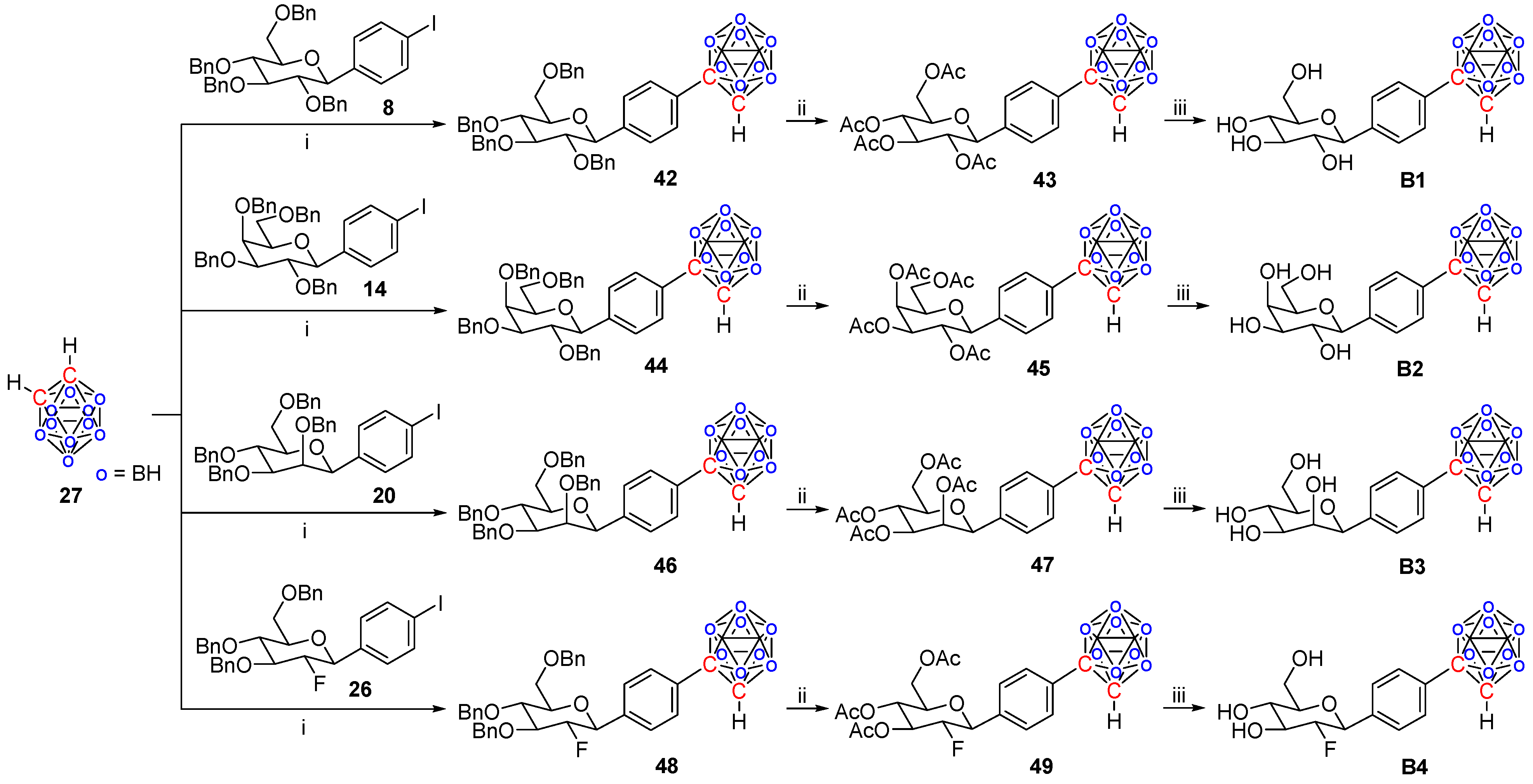
Synthesis of (2R,3R,4R,5S,6S)-3,4,5-tris(benzyloxy)-2-((benzyloxy)methyl)-6-(4-(1,2-dicarba-closo-dodecaboran-1-yl)phenyl)tetrahydro-2H-pyran (42): Following the general synthetic procedure 4, 42 was prepared from o-carborane (0.83 g, 5.75 mmol) and 8 (3.76 g, 5.18 mmol) using 8 (3.76 g, 5.18 mmol), n-BuLi (5.4 mL, 1.6 M in THF, 8.64 mmol), Pd[P(t-Bu)3]2 (0.29 g, 0.575 mmol), PCy3 (0.16 g, 0.575 mmol), dried THF (6.6 mL), and dried m-xylene (16.6 mL). Column chromatography purification (EtOAc/PE = 1/7 by v/v) gave 42. Yellow foam, 0.89 g (21%). 1H NMR (500 MHz, CDCl3) δ 7.45–7.43 (m, 2H), 7.38–7.36 (m, 2H), 7.33–7.32 (m, 8H), 7.31–7.28 (m, 6H), 7.20–7.18 (m, 4H), 6.83–6.81 (m, 2H), 4.95–4.93 (m, 2H), 4.86 (d, J = 10.5 Hz, 1H), 4.64–4.60 (m, 2H), 4.55–4.48 (m, 2H), 4.22 (d, J = 9.5 Hz, 1H), 3.96 (s, 1H), 3.83–3.74 (m, 5H), 3.59–3.57 (m, 1H), 3.44 (t, J = 9.0 Hz, 1H), 2.86–1.48 (m, 10H). 13C NMR (151 MHz, CDCl3) δ 141.42, 138.62, 138.33, 138.19, 137.47, 133.44, 128.63, 128.61, 128.54, 128.42, 128.24, 128.22, 128.13, 127.99, 127.86, 127.80, 127.49, 86.97, 83.88, 80.84, 79.54, 78.40, 76.39, 75.86, 75.32, 75.22, 73.64, 69.18, 60.19. HR-MS (ESI): m/z [M-H]− calcd for C42H49B10O5−: 743.4516, found: 743.4540.
Synthesis of (2R,3R,4R,5S,6S)-2-(acetoxymethyl)-6-(4-(1,2-dicarba-closo-dodecaboran-1-yl)phenyl)tetrahydro-2H-pyran-3,4,5-triyl triacetate (43): Following the procedure for the synthesis of 37 from 36, 43 was prepared from 42 (0.42 g, 0.565 mmol), Ac2O (4.2 mL), and BF3·Et2O (4.2 mL). Column chromatography purification (EtOAc/PE = 1/3 by v/v) gave 43. White solid, 0.20 g (64%). m.p. 186.7–187.9 °C. 1H NMR (500 MHz, CDCl3) δ 7.48–7.45 (m, 2H), 7.33–7.31 (m, 2H), 5.32 (t, J = 9.5 Hz, 1H), 5.22 (t, J = 9.5 Hz, 1H), 5.09 (t, J = 9.5 Hz, 1H), 4.42 (d, J = 9.5 Hz, 1H), 4.29–4.25 (m, 1H), 4.17–4.14 (m, 1H), 3.94 (s, 1H), 3.85–3.81 (m, 1H), 2.78–1.62 (m, 10H), 2.08 (s, 3H), 2.06 (s, 3H), 2.01 (s, 3H), 1.83 (s, 3H). 13C NMR (151 MHz, CDCl3) δ 170.81, 170.48, 169.62, 169.00, 138.46, 134.14, 127.91, 127.74, 79.33, 76.44, 76.03, 74.30, 72.48, 68.49, 62.33, 60.29, 20.91, 20.78, 20.76, 20.58. HR-MS (ESI): m/z [M+H]+ calcd for C22H35B10O9+: 553.3206, found: 553.3228.
Synthesis of (2R,3R,4R,5S,6S)-3,4,5-tris(benzyloxy)-2-((benzyloxy)methyl)-6-(4-(1,2-dicarba-closo-dodecaboran-1-yl)phenyl)tetrahydro-2H-pyran (B1): Following the general synthetic procedure 5, B1 was prepared from 43 (0.19 g, 0.345 mmol) using Na (32 mg, 1.38 mmol) in dried MeOH (3.8 mL). Column chromatography purification (MeOH/CH2Cl2 = 1/10 by v/v) gave B1. White solid, 0.12 g (91%). m.p. 128.8–130.2 °C. [α]D20 = +8.2° (c = 7.4, MeOH). 1H NMR (500 MHz, CD3OD) δ 7.54–7.52 (m, 2H), 7.45–7.43 (m, 2H), 5.11 (s, 1H), 4.15 (d, J = 9.5 Hz, 1H), 3.89–3.86 (m, 1H), 3.72–3.69 (m, 1H), 3.49–3.39 (m, 3H), 3.30–3.26 (m, 1H), 2.89–1.79 (m, 10H). 13C NMR (151 MHz, CD3OD) δ 143.01, 134.62, 129.25, 128.02, 82.61, 82.17, 79.71, 78.04, 76.44, 71.79, 63.05, 61.71. 11B NMR (160 MHz, CD3OD) δ −2.39, −3.31, −4.38, −8.61, −9.54, −10.39, −11.46, −13.19. HR-MS (ESI): m/z [M-H]− calcd for C14H25B10O5−: 383.2638, found: 383.2636. HPLC purity, 96.55%.
Synthesis of (2R,3S,4R,5S,6S)-3,4,5-tris(benzyloxy)-2-((benzyloxy)methyl)-6-(4-(1,2-dicarba-closo-dodecaboran-1-yl)phenyl)tetrahydro-2H-pyran (44): Following the general synthetic procedure 4, 44 was prepared from o-carborane (0.50 g, 3.47 mmol) and 14 (3.02 g, 4.16 mmol) using n-BuLi (3.3 mL, 1.6 M in THF, 5.28 mmol), Pd[P(t-Bu)3]2 (1.77 g, 3.47 mmol), PCy3 (0.97 g, 3.47 mmol), dried THF (4 mL), and dried m-xylene (10 mL). Column chromatography purification (EtOAc/PE = 1/8 by v/v) gave 44. Yellow oil, 1.27 g (49%). 1H NMR (500 MHz, CDCl3) δ 7.42–7.30 (m, 17H), 7.25–7.18 (m, 5H), 6.85–6.84 (m, 2H), 5.00 (d, J = 11.5 Hz, 1H), 4.80–4.73 (m, 2H), 4.64 (d, J = 11.5 Hz, 1H), 4.57 (d, J = 10.5 Hz, 1H), 4.48–4.41 (m, 2H), 4.18 (d, J = 9.0 Hz, 1H), 4.07–4.06 (m, 1H), 3.94–3.91 (m, 2H), 3.87 (t, J = 9.3 Hz, 1H), 3.72–3.68 (m, 2H), 3.64–3.56 (m, 2H), 2.77–1.61 (m, 10H). 13C NMR (151 MHz, CDCl3) δ 141.78, 139.08, 138.46, 137.93, 137.84, 133.24, 128.61, 128.57, 128.44, 128.41, 128.34, 128.32, 128.10, 127.97, 127.88, 127.84, 127.66, 127.35, 84.50, 81.25, 80.20, 77.45, 76.49, 75.40, 74.74, 74.29, 73.69, 72.62, 68.85, 60.20. HR-MS (ESI): m/z [M+H]+ calcd for C42H51B10O5+: 745.4662, found: 745.4706.
Synthesis of (2R,3S,4R,5S,6S)-2-(acetoxymethyl)-6-(4-(1,2-dicarba-closo-dodecaboran-1-yl)phenyl)tetrahydro-2H-pyran-3,4,5-triyl triacetate (45): Following the procedure for the synthesis of 37 from 36, 45 was prepared from 44 (0.96 g, 1.29 mmol) using Ac2O (9.6 mL) and BF3·Et2O (9.6 mL). Column chromatography purification (EtOAc/PE = 1/3 by v/v) gave 45. Yellow foam, 0.37 g (52%). 1H NMR (500 MHz, CDCl3) δ 7.48–7.46 (m, 2H), 7.37–7.35 (m, 2H), 5.52–5.51 (m, 1H), 5.30 (t, J = 9.8 Hz, 1H), 5.18–5.16 (m, 1H), 4.39 (d, J = 10.0 Hz, 1H), 4.19–4.12 (m, 2H), 4.07–4.05 (m, 1H), 3.94 (s, 1H), 2.76–1.71 (m, 10H), 2.20 (s, 3H), 2.03 (s, 3H), 1.99 (s, 3H), 1.84 (s, 3H). 13C NMR (151 MHz, CDCl3) δ 170.58, 170.34, 170.30, 169.03, 138.77, 134.04, 127.88, 127.81, 79.84, 76.08, 74.92, 72.24, 69.72, 67.85, 61.82, 60.30, 20.85, 20.84, 20.76, 20.65. HR-MS (ESI): m/z [M+H]+ calcd for C22H35B10O9+: 553.3206, found: 553.3212.
Synthesis of (2R,3R,4R,5R,6S)-2-(hydroxymethyl)-6-(4-(1,2-dicarba-closo-dodecaboran-1-yl)phenyl)tetrahydro-2H-pyran-3,4,5-triol (B2): Following the general synthetic procedure 5, B2 was prepared from 45 (0.45 g, 0.817 mmol) using Na (56 mg, 2.45 mmol) in dried MeOH (9 mL). Column chromatography purification (MeOH/CH2Cl2 = 1/10 by v/v) gave B2. White solid, 0.28 g (90%). m.p. 124.5–126.1 °C. [α]D20 = +22.2° (c = 12.2, MeOH). 1H NMR (500 MHz, DMSO-d6) δ 7.53 (d, J = 8.0 Hz, 2H), 7.37 (d, J = 8.5 Hz, 2H), 5.78 (s, 1H), 4.72 (t, J = 5.3 Hz, 2H), 4.53 (t, J = 5.3 Hz, 1H), 4.41 (d, J = 5.0 Hz, 1H), 3.98 (d, J = 9.5 Hz, 1H), 3.76–3.74 (m, 1H), 3.54–3.46 (m, 4H), 3.41–3.38 (m, 1H), 2.92–1.64 (m, 10H). 13C NMR (151 MHz, DMSO-d6) δ 142.71, 131.96, 128.28, 126.64, 81.19, 79.45, 77.09, 74.95, 71.38, 68.89, 61.00, 60.86. 11B NMR (160 MHz, CD3OD) δ −2.35, −3.27, −5.14, −8.57, −9.51, −10.54, −11.44, −13.26. HR-MS (ESI): m/z [M+H]+ calcd for C14H27B10O5+: 385.2784, found: 385.2785. HPLC purity, 95.05%.
Synthesis of (2R,3R,4R,5R,6S)-3,4,5-tris(benzyloxy)-2-((benzyloxy)methyl)-6-(4-(1,2-dicarba-closo-dodecaboran-1-yl)phenyl)tetrahydro-2H-pyran (46): Following the general synthetic procedure 4, 46 was prepared from o-carborane (0.20 g, 1.39 mmol) and 20 (1.01 g, 1.39 mmol) using n-BuLi (1.3 mL, 1.6 M in THF, 2.08 mmol), Pd[P(t-Bu)3]2 (0.35 g, 0.693 mmol), PCy3 (0.19 g, 0.693 mmol), dried THF (1.6 mL), and dried m-xylene (4 mL). Column chromatography purification (EtOAc/PE = 1/10 by v/v) gave 46. Yellow oil, 0.25 g (24%). 1H NMR (500 MHz, CDCl3) δ 7.38–7.28 (m, 17H), 7.23–7.11 (m, 5H), 6.81 (d, J = 7.0 Hz, 2H), 4.92 (d, J = 10.5 Hz, 1H), 4.77–4.76 (m, 2H), 4.70–4.68 (m, 1H), 4.64–4.57 (m, 3H), 4.44 (s, 1H), 4.20 (d, J = 12.0 Hz, 1H), 4.03 (t, J = 9.5 Hz, 1H), 3.95 (s, 1H), 3.91–3.90 (m, 1H), 3.82–3.78 (m, 3H), 3.61–3.58 (m, 1H), 2.96–1.64 (m, 10H). 13C NMR (151 MHz, CDCl3) δ 141.22, 138.51, 138.39, 138.35, 138.02, 132.58, 128.65, 128.53, 128.49, 128.22, 128.14, 128.10, 128.01, 127.92, 127.87, 127.71, 127.68, 127.62, 127.15, 127.12, 85.08, 80.07, 79.20, 76.55, 75.47, 75.05, 74.58, 73.70, 72.69, 69.68, 60.22, 29.18. HR-MS (ESI): m/z [M-H]− calcd for C42H49B10O5−: 743.4516, found: 743.4565.
Synthesis of (2R,3R,4R,5R,6S)-2-(acetoxymethyl)-6-(4-(1,2-dicarba-closo-dodecaboran-1-yl)tetrahydro-2H-pyran-3,4,5-triyl triacetate (47): Following the procedure for the synthesis of 37 from 36, 47 was prepared from 46 (0.68 g, 0.915 mmol) using Ac2O (6.8 mL) and BF3·Et2O (6.8 mL). Column chromatography purification (EtOAc/PE = 1/4 by v/v) gave 47. Yellow foam, 0.37 g (73%). 1H NMR (500 MHz, CDCl3) δ 7.45 (d, J = 8.5 Hz, 2H), 7.30 (d, J = 8.0 Hz, 2H), 5.56 (d, J = 3.5 Hz, 1H), 5.34–5.30 (m, 1H), 5.24–5.21 (m, 1H), 4.75 (s, 1H), 4.34–4.31 (m, 1H), 4.25–4.22 (m, 1H), 3.94 (s, 1H), 3.83–3.79 (m, 1H), 2.90–1.65 (m, 10H), 2.10 (s, 3H), 2.08 (s, 3H), 1.99 (s, 3H), 1.92 (s, 3H). 13C NMR (151 MHz, CDCl3) δ 170.84, 170.37, 170.04, 169.87, 138.34, 133.39, 127.61, 126.71, 77.58, 76.69, 76.12, 72.47, 70.22, 65.99, 62.98, 60.25, 20.93, 20.87, 20.75, 20.58. HR-MS (ESI): m/z [M+H]+ calcd for C22H35B10O9+: 553.3206, found: 553.3213.
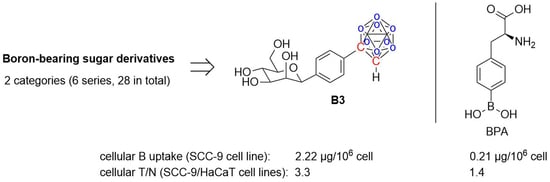
Synthesis of (2R,3S,4R,5S,6S)-2-(hydroxymethyl)-6-(4-(1,2-dicarba-closo-dodecaboran-1-yl)tetrahydro-2H-pyran-3,4,5-triol (B3): Following the general synthetic procedure 5, B3 was prepared from 47 (0.37 g, 0.672 mmol) using Na (62 mg, 2.69 mmol) in dried MeOH (7.4 mL). Column chromatography purification (MeOH/CH2Cl2 = 1/10 by v/v) gave B3. White solid, 0.14 g (54%). m.p. 222.1–223.5 °C. [α]D20 = +12.0° (c = 15.2, MeOH). 1H NMR (500 MHz, DMSO-d6) δ 7.50 (d, J = 8.5 Hz, 2H), 7.40 (d, J = 8.0 Hz, 2H), 5.78 (s, 1H), 4.79 (d, J = 5.5 Hz, 1H), 4.73 (d, J = 5.5 Hz, 1H), 4.48 (s, 1H), 4.41 (t, J = 5.8 Hz, 1H), 4.27 (d, J = 5.5 Hz, 1H), 3.75–3.72 (m, 2H), 3.52–3.46 (m, 2H), 3.42–3.38 (m, 1H), 3.19–3.15 (m, 1H), 2.90–1.71 (m, 10H). 13C NMR (151 MHz, DMSO-d6) δ 142.30, 131.30, 127.26, 126.32, 81.48, 78.37, 77.18, 74.96, 71.83, 67.04, 61.68, 60.98. 11B NMR (160 MHz, CD3OD) δ −2.39, −3.31, −5.32, −8.63, −9.57, −10.39, −11.45, −12.44, −13.38. HR-MS (ESI): m/z [M-H]− calcd for C14H25B10O5−: 383.2638, found: 383.2631. HPLC purity, 98.50%.
Synthesis of (2R,3R,4S,5S,6S)-3,4-bis(benzyloxy)-2-((benzyloxy)methyl)-5-fluoro-6-(4-(1,2-dicarba-closo-dodecaboran-1-yl)tetrahydro-2H-pyran (48): Following the general synthetic procedure 4, 48 was prepared from o-carborane (0.20 g, 1.39 mmol) and 26 (0.80 g, 1.25 mmol) using n-BuLi (1.3 mL, 1.6 M in THF, 2.08 mmol), Pd[P(t-Bu)3]2 (0.35 g, 0.693 mmol), PCy3 (0.19 g, 0.693 mmol), dried THF (1.6 mL), and dried m-xylene (4 mL). Column chromatography purification (EtOAc/PE = 1/12 by v/v) gave 48. Yellow oil, 0.21 g (23%). 1H NMR (500 MHz, CDCl3) δ 7.50–7.49 (m, 2H), 7.41–7.30 (m, 15H), 7.22–7.20 (m, 2H), 4.93–4.89 (m, 2H), 4.81–4.78 (m, 1H), 4.61 (d, J = 12.0 Hz, 2H), 4.56–4.53 (m, 1H), 4.46–4.37 (m, 1H), 4.35–4.34 (m, 1H), 3.96 (s, 1H), 3.93–3.89 (m, 1H), 3.78–3.75 (m, 3H), 3.65–3.61 (m, 1H), 2.89–1.77 (m, 10H). 13C NMR (151 MHz, CDCl3) δ 139.85, 138.20, 138.15, 138.06, 133.63, 128.58, 128.56, 128.54, 128.14, 128.02, 127.98, 127.85, 127.76, 127.57, 95.34, 94.30, 84.59 (d, J = 16.3 Hz), 79.46, 78.44 (d, J = 23.1 Hz), 76.27, 75.42, 75.09 (d, J = 2.9 Hz), 73.64, 68.95, 60.23. HR-MS (ESI): m/z [M-H]− calcd for C35H42B10FO4−: 655.4003, found: 655.4020.
Synthesis of (2R,3R,4S,5S,6S)-2-(acetoxymethyl)-5-fluoro-6-(4-(1,2-dicarba-closo-dodecaboran-1-yl)tetrahydro-2H-pyran-3,4-diyl diacetate (49): Following the procedure for the synthesis of 37 from 36, 49 was prepared from 48 (0.50 g, 0.764 mmol) using Ac2O (5 mL) and BF3·Et2O (5 mL). Column chromatography purification (EtOAc/PE = 1/4 by v/v) gave 49. White solid, 0.25 g (64%). m.p. 202.8–204.4 °C. 1H NMR (500 MHz, CDCl3) δ 7.51 (d, J = 8.0 Hz, 2H), 7.37 (d, J = 8.5 Hz, 2H), 5.48–5.42 (m, 1H), 5.14 (t, J = 9.8 Hz, 1H), 4.49–4.46 (m, 1H), 4.42–4.30 (m, 1H), 4.29–4.27 (m, 1H), 4.18–4.16 (m, 1H), 3.96 (s, 1H), 3.87–3.84 (m, 1H), 2.98–1.69 (m, 10H), 2.08 (s, 6H), 2.07 (s, 3H). 13C NMR (151 MHz, CDCl3) δ 170.74, 170.23, 169.76, 138.50, 134.10, 127.91, 127.38, 91.50, 90.24, 78.36 (d, J = 22.5 Hz), 76.30, 74.05 (d, J = 19.8 Hz), 68.32 (d, J = 7.6 Hz), 62.24, 60.16, 20.87, 20.81, 20.72. HR-MS (ESI): m/z [M-H]− calcd for C20H30B10FO7−: 511.2912, found: 511.2914.
Synthesis of (2R,3S,4S,5R,6S)-5-fluoro-2-(hydroxymethyl)-6-(4-(1,2-dicarba-closo-dodecaboran-1-yl)tetrahydro-2H-pyran-3,4-diol (B4): Following the general synthetic procedure 5, B4 was prepared from 47 (0.20 g, 0.392 mmol) using Na (54 mg, 2.35 mmol) in dried MeOH (4 mL). White solid, 75 mg (50%). m.p. 220.3–221.2 °C. [α]D20 = +18.6° (c = 6.2, MeOH). 1H NMR (500 MHz, DMSO-d6) δ 7.58 (d, J = 8.0 Hz, 2H), 7.44 (d, J = 8.0 Hz, 2H), 5.80 (s, 1H), 5.52 (d, J = 5.0 Hz, 1H), 5.27 (d, J = 5.5 Hz, 1H), 4.54 (s, 1H), 4.42–4.39 (m, 1H), 4.20–4.06 (m, 1H), 3.69 (d, J = 11.5 Hz, 1H), 3.61–3.54 (m, 1H), 3.47–3.44 (m, 1H), 3.34–3.31 (m, 1H), 3.27–3.23 (m, 1H), 2.99–1.66 (m, 10H). 13C NMR (151 MHz, DMSO-d6) δ 140.33, 132.86, 128.04, 127.18, 94.33, 93.12, 81.30, 77.25 (d, J = 23.4 Hz), 76.79, 75.60 (d, J = 16.5 Hz), 70.07 (d, J = 8.3 Hz, 2H), 61.04. 11B NMR (160 MHz, DMSO-d6) δ −2.80, −3.61, −8.72, −9.66, −11.33. 19F NMR (471 MHz, DMSO-d6) δ −193.99. HR-MS (ESI): m/z [M-H]− calcd for C14H24B10FO4−: 385.2595, found: 385.2587. HPLC purity, 95.49%.
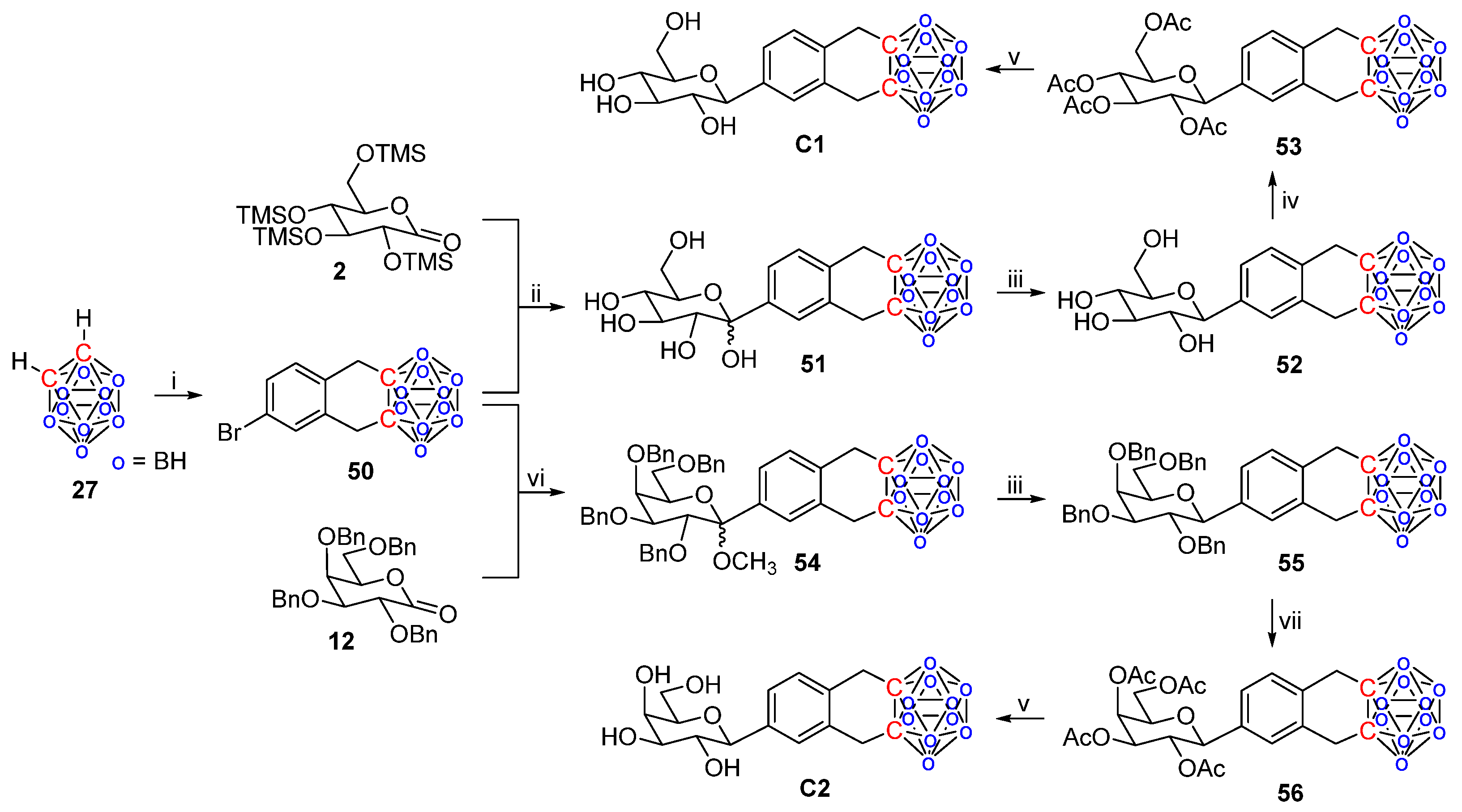
Synthesis of 1,2-[4-bromo-1,2-phenylenebis(methylene)]-1,2-dicarba-closo-dodecaborane (50): To a stirred solution of o-carborane (27, 4.00 g, 27.7 mmol) in a mixture of dried toluene (32 mL) and THF (16 mL) cooled at 0 °C under N2 was added dropwise a solution of n-BuLi in THF (43 mL, 1.6 M in THF, 68.8 mmol), and, after addition, the reaction mixture was stirred at room temperature for 1 h and then cooled back to 0 °C again, followed by dropwise addition of a solution of 4 (14.26 g, 41.6 mmol) in dried toluene (15 mL). After that, the reaction mixture was stirred at 100 °C overnight, when TLC analysis indicated completion of the reaction. Upon cooling to room temperature, the reaction mixture was poured into ice water (100 mL), and the resulting mixture was extracted with EtOAc (70 mL × 3). The combined extracts were washed with brine, dried (MgSO4), and evaporated on a rotary evaporator to afford a residue, which was purified through column chromatography (PE) to give 50. White solid, 4.50 g (50%). m.p. 140.6–142.3 °C. 1H NMR (500 MHz, CDCl3) δ 7.37–7.35 (m, 1H), 7.23 (s, 1H), 6.94 (d, J = 8.5 Hz, 1H), 3.67 (s, 2H), 3.65 (s, 2H), 2.85–1.79 (m, 10H). 13C NMR (151 MHz, CDCl3) δ 131.59, 131.42, 130.90, 130.36, 128.33, 121.35, 70.90, 70.59, 37.34, 37.28. HR-MS (ESI): m/z [M+Na]+ calcd for C10H17B10BrNa+: 349.1336, found: 349.1360.
Synthesis of (3R,4S,5S,6R)-6-(hydroxymethyl)-2-(1,2-(1,2-dicarba-closo-dodecaboranylene)bis(methylene)benzen-4-yl)tetrahydro-2H-pyran-2,3,4,5-tetraol (51): To a stirred solution of 50 (1.30 g, 4.00 mmol) in dried THF (13 mL) cooled at −78 °C under N2 was added dropwise a solution of n-BuLi in THF (3 mL, 1.6 M in THF, 4.8 mmol), and, after addition, stirring was continued at this temperature for 1 h, followed by dropwise addition of a solution of 2 (2.80 g, 6.00 mmol) in dried THF (3 mL). After that, the reaction mixture was stirred at this temperature for 1 h and quenched through dropwise addition of saturated aqueous NH4Cl (10 mL). The resulting mixture was extracted with EtOAc (20 mL × 3), and the combined extracts were washed with brine, dried (MgSO4), and evaporated on a rotary evaporator to afford a residue. The residue was dissolved in MeOH (10 mL) and strongly acidic cation exchange resin (Amberlite 732) was added to adjust the pH = 5–6. The reaction mixture was stirred for an additional 2 h, adjusted to pH = 7–8 through the addition of Et3N and evaporated on a rotary evaporator to give crude 51. Yellow oil, 1.00 g. This sample was used directly in the next step without further purification or characterization.
Synthesis of (2R,3S,4R,5R,6S)-2-(hydroxymethyl)-6-(1,2-(1,2-dicarba-closo-dodecaboranylene)bis(methylene)benzen-4-yl)tetrahydro-2H-pyran-3,4,5-triol (52): To a stirred solution of crude 51 prepared above (1.00 g, deemed to be 2.45 mmol) in dried CH2Cl2 (10 mL) cooled at −35 °C under N2 was added Et3SiH (0.57 g, 4.90 mmol) in one portion, followed by dropwise addition of BF3·Et2O (0.52 g, 3.67 mmol). After that, the reaction mixture was stirred at room temperature overnight, when TLC analysis indicated completion of the reaction. Et3N was added dropwise to the reaction mixture to adjust the pH = 7–8, and the resulting mixture was stirred for another 10 min and then evaporated on a rotary evaporator to dryness to give crude 52. Yellow oil, 1.06 g. This sample was used directly in the next step without further purification or characterization.
Synthesis of (2R,3R,4R,5S,6S)-2-(acetoxymethyl)-6-(1,2-(1,2-dicarba-closo-dodecaboranylene)bis(methylene)benzen-4-yl)tetrahydro-2H-pyran-3,4,5-triyl triacetate (53): Following the procedure for the synthesis of 31 from 30, 53 was prepared from crude 52 prepared above (1.06 g, deemed to be 2.59 mmol) using DMAP (0.48 g, 3.89 mmol) and Ac2O (5.3 mL) in pyridine (10.6 mL). Column chromatography purification (EtOAc/PE = 1/4 by v/v) gave 53. White solid, 0.15 g (7% overall for 50 to 53). m.p. 226.2–227.8 °C. 1H NMR (500 MHz, CDCl3) δ 7.21–7.19 (m, 1H), 7.06–7.03 (m, 2H), 5.32 (t, J = 9.5 Hz, 1H), 5.22 (t, J = 9.8 Hz, 1H), 5.08 (t, J = 9.8 Hz, 1H), 4.36 (d, J = 10.0 Hz, 1H), 4.31–4.28 (m, 1H), 4.17–4.14 (m, 1H), 3.85–3.81 (m, 1H), 3.70–3.65 (m, 4H), 2.89–1.69 (m, 10H), 2.09 (s, 3H), 2.06 (s, 3H), 2.00 (s, 3H), 1.82 (s, 3H). 13C NMR (126 MHz, CDCl3) δ 170.84, 170.49, 169.64, 168.93, 136.09, 130.07, 129.65, 128.94, 127.51, 126.55, 79.71, 76.41, 74.24, 72.65, 71.13, 71.09, 68.59, 62.41, 37.73, 37.55, 20.94, 20.79, 20.77, 20.57. HR-MS (ESI): m/z [M+Na]+ calcd for C24H36B10NaO9+: 601.3182, found: 601.3187.
Synthesis of (2R,3S,4R,5R,6S)-2-(hydroxymethyl)-6-(1,2-(1,2-dicarba-closo-dodecaboranylene)bis(methylene)benzen-4-yl)tetrahydro-2H-pyran-3,4,5-triol (C1): Following the general synthetic procedure 5, C1 was prepared from 53 (60 mg, 0.112 mmol) using Na (31 mg, 1.35 mmol) in MeOH (0.8 mL). Column chromatography purification (MeOH/CH2Cl2 = 1/10 by v/v) gave C1. White solid, 24 mg (52%). m.p. 119.6–121.4 °C. [α]D20 = +0.5° (c = 10.0, MeOH). 1H NMR (600 MHz, DMSO-d6) δ 7.22–7.11 (m, 3H), 4.96–4.79 (m, 3H), 4.44 (s, 1H), 3.98 (d, J = 7.5 Hz, 1H), 3.82 (s, 4H), 3.69 (d, J = 10.0 Hz, 1H), 3.28–3.12 (m, 5H), 2.77–1.56 (m, 10H). 13C NMR (151 MHz, DMSO-d6) δ 139.65, 128.47, 128.22, 127.98, 127.79, 127.09, 81.25, 80.95, 78.43, 74.61, 72.73, 70.36, 61.40, 36.48, 36.24. 11B NMR (160 MHz, CD3OD) δ −5.10, −6.01, −9.64, −10.35. HR-MS (ESI): m/z [M+H]+ calcd for C16H27B10O5+: 409.2784, found: 409.2763. HPLC purity, 94.68%.
Synthesis of (3R,4S,5S,6R)-3,4,5-tris(benzyloxy)-6-((benzyloxy)methyl)-2-methoxy-2-(1,2-(1,2-dicarba-closo-dodecaboranylene)bis(methylene)benzen-4-yl)tetrahydro-2H-pyran (54): Following the general synthetic procedure 2, 54 was prepared from 50 (0.37 g, 1.14 mmol) and 12 (0.74 g, 1.37 mmol) using n-BuLi (0.85 mL, 1.6 M in THF, 1.36 mmol), MeSO3H (0.55 g, 5.69 mmol), dried MeOH (2.8 mL), and dried THF (3.7 mL) as a crude sample. Yellow oil, 0.96 g. This sample was used directly in the next step without further purification or characterization.
Synthesis of (2R,3S,4R,5S,6S)-3,4,5-tris(benzyloxy)-2-((benzyloxy)methyl)-6-(1,2-(1,2-dicarba-closo-dodecaboranylene)bis(methylene)benzen-4-yl)tetrahydro-2H-pyran (55): Following the general synthetic procedure 3, 55 was prepared from crude 54 prepared above (0.96 g, deemed to be 1.20 mmol) using Et3SiH (0.28 g, 2.40 mmol) and BF3·Et2O (0.26 g, 1.80 mmol) in dried CH2Cl2 (9.6 mL) as a crude sample. Yellow oil, 0.20 g. This sample was used directly in the next step without further purification or characterization.
Synthesis of (2R,3S,4R,5S,6S)-2-(acetoxymethyl)-6-(1,2-(1,2-dicarba-closo-dodecaboranylene)bis(methylene)benzen-4-yl)tetrahydro-2H-pyran-3,4,5-triyl triacetate (56): Following the procedure for the synthesis of 37 from 36, 56 was prepared from crude 55 prepared above (0.20 g, deemed to be 0.764 mmol) using Ac2O (2 mL) and BF3·Et2O (2 mL). Column chromatography purification (EtOAc/PE = 1/4 by v/v) gave 56. White foam, 0.10 g (15% overall 50 to 56). 1H NMR (500 MHz, CDCl3) δ 7.23 (d, J = 7.5 Hz, 1H), 7.10 (s, 1H), 7.04 (d, J = 8.0 Hz, 1H), 5.52 (d, J = 3.5 Hz, 1H), 5.28 (t, J = 10.0 Hz, 1H), 5.18–5.15 (m, 1H), 4.32 (d, J = 9.5 Hz, 1H), 4.18–4.14 (m, 2H), 4.07–4.04 (m, 1H), 3.72–3.67 (m, 4H), 2.80–1.67 (m, 10H), 2.21 (s, 3H), 2.04 (s, 3H), 1.99 (s, 3H), 1.82 (s, 3H). 13C NMR (151 MHz, CDCl3) δ 170.60, 170.38, 170.33, 169.02, 136.38, 129.98, 129.60, 128.83, 127.63, 126.76, 80.26, 74.88, 72.18, 71.16, 71.13, 69.94, 67.86, 61.82, 37.74, 37.55, 20.89, 20.86, 20.77, 20.67. HR-MS (ESI): m/z [M+H]+ calcd for C24H37B10O9+: 579.3363, found: 579.3380.
Synthesis of (2R,3R,4R,5R,6S)-2-(hydroxymethyl)-6-(1,2-(1,2-dicarba-closo-dodecaboranylene)bis(methylene)benzen-4-yl)tetrahydro-2H-pyran-3,4,5-triol (C2): Following the general synthetic procedure 5, C2 was prepared from 56 (74 mg, 0.128 mmol) using Na (21 mg, 0.898 mmol) in dried MeOH (1.5 mL). Column chromatography purification (MeOH/CH2Cl2 = 1/10 by v/v) gave C2. White solid, 42 mg (52%). m.p. 118.3–119.2 °C. [α]D20 = +4.1° (c = 2.2, MeOH). 1H NMR (500 MHz, DMSO-d6) δ 7.23–7.22 (m, 1H), 7.15 (s, 1H), 7.13–7.11 (m, 1H), 4.69 (d, J = 5.5 Hz, 1H), 4.59 (d, J = 5.5 Hz, 1H), 4.54–4.52 (m, 1H), 4.38 (d, J = 5.0 Hz, 1H), 3.91 (d, J = 9.0 Hz, 1H), 3.82 (d, J = 5.0 Hz, 4H), 3.76–3.74 (m, 1H), 3.53–3.45 (m, 4H), 3.39–3.37 (m, 1H), 2.88–1.57 (m, 10H). 13C NMR (151 MHz, DMSO-d6) δ 139.94, 128.35, 128.08, 127.90, 127.85, 127.12, 81.63, 79.43, 75.02, 72.68, 71.35, 68.85, 60.86, 54.91, 36.42, 36.19. 11B NMR (160 MHz, CD3OD) δ −5.16, −6.09, −9.54, −9.76, −10.46. HR-MS (ESI): m/z [M-H]− calcd for C16H27B10O5−: 409.2795, found: 409.2800. HPLC purity, 95.34%.
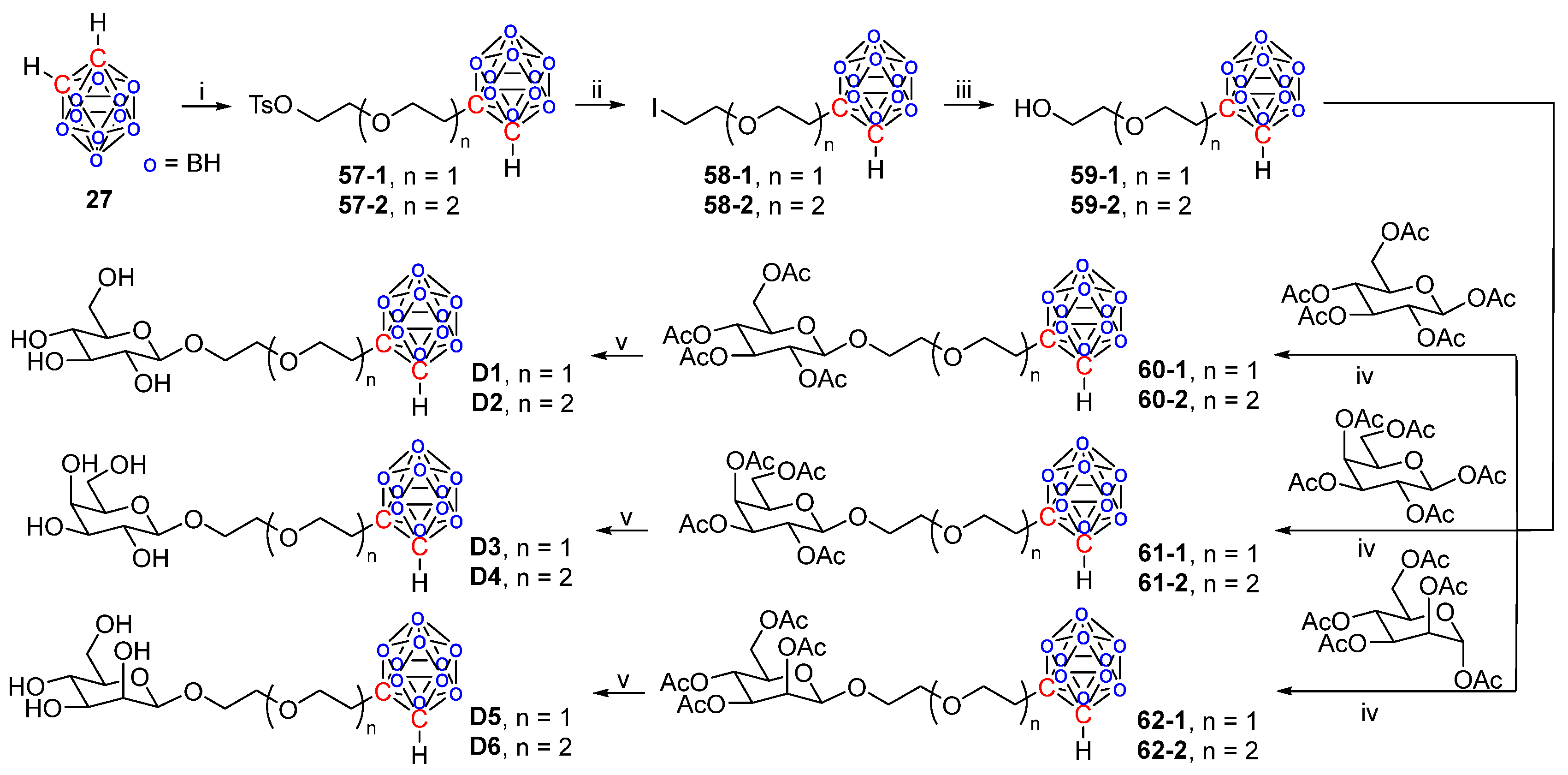
Synthesis of 2-(2-(1,2-dicarba-
closo-dodecaboran-1-yl)ethoxy)ethyl 4-methylbenzenesulfonate (
57-1): To a stirred solution of
o-carborane (
27, 2.50 g, 17.3 mmol) in dried THF (25 mL) cooled at 0 °C was added a solution of
n-BuLi in THF (13 mL, 1.6 M in THF, 20.8 mmol), and, after addition, the reaction mixture was stirred at room temperature for 1 h and then cooled back to 0 °C, followed by dropwise addition of a solution of TsO-(CH
2CH
2O)
2-Ts (8.62 g, 20.8 mmol) in dried THF (25 mL). After that, the reaction mixture was stirred at room temperature overnight, when TLC analysis indicated completion of the reaction, and then poured into ice water (50 mL). The resulting mixture was extracted with EtOAc (50 mL × 3), and the combined extracts were washed with brine, dried (MgSO
4), and evaporated on a rotary evaporator to afford a residue, which was purified through column chromatography (EtOAc/PE = 1/3 by
v/
v) to give
57-1. Yellow oil, 1.03 g (15%).
1H NMR (500 MHz, CDCl
3)
δ 7.79 (d,
J = 8.0 Hz, 2H), 7.37 (d,
J = 8.0 Hz, 2H), 4.15–4.13 (m, 2H), 3.85 (s, 1H), 3.61–3.59 (m, 2H), 3.51 (t,
J = 5.8 Hz, 2H), 2.75–1.68 (m, 10H), 2.47 (s, 3H), 2.46–2.45 (m, 2H). The
1H NMR data were consistent with those reported [
50].
Synthesis of 2-(2-(2-(1,2-dicarba-
closo-dodecaboran-1-yl)ethoxy)ethoxy)ethyl 4-methylbenzenesulfonate (
57-2): Following the procedure for the synthesis of
57-1 from
27,
57-2 was prepared from
o-carborane (
27, 3.0 g, 20.8 mmol) and TsO-(CH
2CH
2O)
3-Ts (11.45 g, 25.0 mmol) using
n-BuLi (15.6 mL, 1.6 M in THF, 24.96 mmol) in dried THF (60 mL). Column chromatography purification (EtOAc/PE = 1/5 by
v/
v) gave
57-2. Yellow oil, 1.94 g (22%).
1H NMR (500 MHz, CDCl
3)
δ 7.80 (d,
J = 8.0 Hz, 2H), 7.36 (d,
J = 8.0 Hz, 2H), 4.14 (t,
J = 4.8 Hz, 2H), 4.08 (s, 1H), 3.68 (t,
J = 5.0 Hz, 2H), 3.57–3.53 (m, 4H), 3.51–3.49 (m, 2H), 2.85–1.58 (m, 10H), 2.50 (t,
J = 5.8 Hz, 2H), 2.46 (s, 3H). The
1H NMR data were consistent with those reported [
50].
Synthesis of 1-(2-(2-iodoethoxy)ethyl)-1,2-dicarba-closo-dodecaborane (58-1): A mixture of 57-1 (1.03 g, 2.66 mmol), NaI (1.60 g, 10.7 mmol), and TBAI (0.30 g, 0.799 mmol) in dried toluene (10.3 mL) was stirred at 100 °C under N2 overnight, when TLC analysis indicated completion of the reaction. Upon cooling to room temperature, the reaction mixture was poured into ice water (30 mL), and the resulting mixture was extracted with EtOAc (30 mL × 3). The combined extracts were washed with brine, dried (MgSO4), and evaporated on a rotary evaporator to afford a residue, which was purified through column chromatography (EtOAc/PE = 1/5 by v/v) to give 58-1. Yellow oil, 0.61 g (62%). 1H NMR (500 MHz, CDCl3) δ 4.11 (s, 1H), 3.67 (t, J = 6.0 Hz, 2H), 3.58 (t, J = 5.5 Hz, 2H), 3.24 (t, J = 6.0 Hz, 2H), 2.89–1.71 (m, 10H), 2.55 (t, J = 5.8 Hz, 2H). 13C NMR (151 MHz, CDCl3) δ 73.18, 71.44, 68.34, 60.63, 37.72, 2.73. HR-MS (ESI): m/z [M-H]− calcd for C6H18B10IO−: 343.1338, found: 343.1328.
Synthesis of 1-(2-(2-(2-iodoethoxy)ethoxy)ethyl)-1,2-dicarba-closo-dodecaborane (58-2): Following the procedure for the synthesis of 58-1 from 57-1, 58-2 was prepared from 57-2 (0.50 g, 1.16 mmol) using NaI (0.70 g, 4.65 mmol) and TBAI (0.13 g, 0.348 mmol) in dried toluene (5 mL). Column chromatography purification (EtOAc/PE = 1/9 by v/v) gave 58-2. Yellow oil, 0.38 g (89%). 1H NMR (500 MHz, CDCl3) δ 4.16 (s, 1H), 3.73 (t, J = 6.8 Hz, 2H), 3.62–3.55 (m, 6H), 3.25 (t, J = 6.8 Hz, 2H), 2.81–1.71 (m, 10H), 2.53 (t, J = 5.5 Hz, 2H). 13C NMR (151 MHz, CDCl3) δ 73.45, 71.99, 70.14, 69.96, 68.75, 60.37, 37.52, 2.70. HR-MS (ESI): m/z [M+H]+ calcd for C8H24B10IO2+: 389.1746, found: 389.1738.
Synthesis of 2-(2-(1,2-dicarba-closo-dodecaboran-1-yl)ethoxy)ethan-1-ol (59-1): A mixture of 58-1 (0.61 g, 1.78 mmol) and AcONa (0.58 g, 7.13 mmol) in dried DMF (6.1 mL) was stirred at 80 °C under N2 overnight, when TLC analysis indicated completion of the reaction. Upon cooling to room temperature, the reaction mixture was poured into ice water (10 mL), and the resulting mixture was extracted with EtOAc (20 mL × 3). The combined extracts were washed with brine, dried (MgSO4), and evaporated on a rotary evaporator to afford a residue, which was dissolved in MeOH (6.1 mL), followed by the addition of NaOH (0.14 g, 3.56 mmol). The resulting mixture was stirred at room temperature under N2 for 1 h, when TLC analysis indicated completion of the reaction, and poured into ice water (10 mL). The mixture thus obtained was extracted with EtOAc (20 mL × 3), and the combined extracts were washed with brine, dried (MgSO4), and evaporated on a rotary evaporator to give a residue, which was purified through column chromatography (EtOAc/PE = 1/3 by v/v) to give 59-1. Yellow oil, 0.23 g (56%). 1H NMR (500 MHz, DMSO-d6) δ 5.12 (s, 1H), 4.62 (t, J = 5.5 Hz, 1H), 3.50–3.46 (m, 4H), 3.38 (t, J = 5.0 Hz, 2H), 2.86–1.64 (m, 10H), 2.53–2.52 (m, 2H). 13C NMR (151 MHz, DMSO-d6) δ 74.29, 71.92, 67.97, 62.47, 60.01, 36.35. HR-MS (ESI): m/z [M-H]− calcd for C6H19B10O2−: 233.2321, found: 233.2318.
Synthesis of 2-(2-(2-(1,2-dicarba-closo-dodecaboran-1-yl)ethoxy)ethoxy)ethan-1-ol (59-2): Following the procedure for the synthesis of 59-1 from 58-1, 59-2 was prepared from 58-2 (0.36 g, 0.932 mmol) using AcONa (0.31 g, 3.73 mmol), NaOH (75 mg, 1.86 mmol) dried DMF (3.6 mL) and MeOH (3.6 mL). Column chromatography purification (EtOAc/PE = 1/3 by v/v) gave 59-2. Yellow oil, 0.13 g (50%). 1H NMR (500 MHz, DMSO-d6) δ 5.07 (s, 1H), 4.57 (t, J = 5.5 Hz, 1H), 3.50–3.46 (m, 8H), 3.41 (t, J = 5.0 Hz, 2H), 2.83–1.59 (m, 10H), 2.53–2.52k (m, 2H). 13C NMR (151 MHz, DMSO-d6) δ 74.27, 72.28, 69.51, 69.39, 67.95, 62.44, 60.20, 36.31. HR-MS (ESI): m/z [M+H]+ calcd for C8H25B10O3+: 279.2729, found: 279.2729.
Synthesis of (2R,3R,4S,5R,6R)-2-(acetoxymethyl)-6-(2-(2-(1,2-dicarba-closo-dodecaboran-1-yl)ethoxy)ethoxy)tetrahydro-2H-pyran-3,4,5-triyl triacetate (60-1): Following the general synthetic procedure 6, 60-1 was prepared from 59-1 (0.23 g, 0.990 mmol) using β-D-glucose pentaacetate (0.77 g, 1.98 mmol) and BF3·Et2O (0.56 g, 3.96 mmol) in dried CH2Cl2 (2.3 mL). Column chromatography purification (EtOAc/PE = 1/3 by v/v) gave 60-1. White solid, 0.23 g (41%). m.p. 130.6–131.3 °C. 1H NMR (500 MHz, CDCl3) δ 5.21 (t, J = 9.5 Hz, 1H), 5.08 (t, J = 9.8 Hz, 1H), 4.99–4.95 (m, 1H), 4.55 (d, J = 8.0 Hz, 1H), 4.29–4.25 (m, 1H), 4.17–4.14 (m, 1H), 4.05 (s, 1H), 3.93–3.89 (m, 1H), 3.72–3.65 (m, 2H), 3.57–3.54 (m, 4H), 2.86–1.60 (m, 10H), 2.50 (t, J = 5.8 Hz, 2H), 2.10 (s, 3H), 2.05 (s, 3H), 2.03 (s, 3H), 2.02 (s, 3H). 13C NMR (151 MHz, CDCl3) δ 170.80, 170.42, 169.53, 169.39, 100.85, 73.30, 72.85, 72.12, 71.32, 69.95, 68.87, 68.75, 68.48, 62.03, 60.40, 37.62, 20.90, 20.85, 20.76, 20.74. HR-MS (ESI): m/z [M+Na]+ calcd for C20H38B10NaO11+: 587.3237, found: 587.3257.
Synthesis of (2R,3R,4S,5R,6R)-2-(acetoxymethyl)-6-(2-(2-(2-(1,2-dicarba-closo-dodecaboran-1-yl)ethoxy)ethoxy)ethoxy)tetrahydro-2H-pyran-3,4,5-triyl triacetate (60-2). Following the general synthetic procedure 6, 60-2 was prepared from 59-2 (0.42 g, 1.52 mmol) using β-D-glucose pentaacetate (1.19 g, 3.04 mmol) and BF3·Et2O (0.86 g, 6.08 mmol) in dried CH2Cl2 (4.2 mL). White solid, 0.29 g (31%). m.p. 93.7–94.8 °C. 1H NMR (500 MHz, CDCl3) δ 5.21 (t, J = 9.5 Hz, 1H), 5.09 (t, J = 9.8 Hz, 1H), 5.01–4.98 (m, 1H), 4.58 (d, J = 8.0 Hz, 1H), 4.28–4.25 (m, 1H), 4.18 (s, 1H), 4.16–4.13 (m, 1H), 3.97–3.93 (m, 1H), 3.72–3.68 (m, 2H), 3.63–3.61 (m, 2H), 3.59–3.55 (m, 4H), 3.54–3.51 (m, 2H), 2.86–1.65 (m, 10H), 2.53 (t, J = 5.8 Hz, 2H), 2.09 (s, 3H), 2.04 (s, 3H), 2.03 (s, 3H), 2.01 (s, 3H). 13C NMR (151 MHz, CDCl3) δ 170.82, 170.43, 169.58, 169.47, 101.00, 73.46, 72.94, 72.01, 71.40, 70.48, 70.36, 70.21, 69.24, 68.65, 68.53, 62.08, 60.43, 37.47, 20.89, 20.83, 20.77, 20.75. HR-MS (ESI): m/z [M-H]− calcd for C22H41B10O12−: 607.3534, found: 607.3549.
Synthesis of (2R,3S,4S,5R,6R)-2-(acetoxymethyl)-6-(2-(2-(1,2-dicarba-closo-dodecaboran-1-yl)ethoxy)ethoxy)tetrahydro-2H-pyran-3,4,5-triyl triacetate (61-1): Following the general synthetic procedure 6, 61-1 was prepared from 59-1 (0.20 g, 0.861 mmol) using β-D-galactose pentaacetate (0.67 g, 1.72 mmol) and BF3·Et2O (0.49 g, 3.44 mmol) in dried CH2Cl2 (2 mL). Column chromatography purification (EtOAc/PE = 1/3 by v/v) gave 61-1. Yellow oil, 0.16 g (33%). 1H NMR (500 MHz, CDCl3) δ 5.40–5.39 (m, 1H), 5.21–5.17 (m, 1H), 5.04–5.01 (m, 1H), 4.50 (d, J = 8.0 Hz, 1H), 4.22–4.18 (m, 1H), 4.14–4.11 (m, 2H), 3.94–3.89 (m, 2H), 3.69–3.65 (m, 1H), 3.60–3.52 (m, 4H), 2.85–1.63 (m, 10H), 2.51 (t, J = 5.8 Hz, 2H), 2.17 (s, 3H), 2.06 (s, 6H), 1.99 (s, 3H). 13C NMR (151 MHz, CDCl3) δ 170.55, 170.45, 170.31, 169.49, 101.40, 73.38, 70.96, 69.96, 68.84, 68.83, 68.82, 67.08, 61.36, 60.45, 37.60, 29.84, 20.94, 20.84, 20.81, 20.73. HR-MS (ESI): m/z [M-H]− calcd for C20H37B10O11−: 563.3272, found: 563.3288.
Synthesis of (2R,3S,4S,5R,6R)-2-(acetoxymethyl)-6-(2-(2-(2-(1,2-dicarba-closo-dodecaboran-1-yl)ethoxy)ethoxy)ethoxy)tetrahydro-2H-pyran-3,4,5-triyl triacetate (61-2): Following the general synthetic procedure 6, 61-2 was prepared from 59-2 (0.40 g, 1.45 mmol) using β-D-galactose pentaacetate (1.13 g, 2.89 mmol) and BF3·Et2O (0.82 g, 5.79 mmol) in dried CH2Cl2 (4 mL). Column chromatography purification (EtOAc) gave 61-2. Colorless oil, 0.25 g (28%). 1H NMR (500 MHz, CDCl3) δ 5.40–5.39 (m, 1H), 5.22–5.19 (m, 1H), 5.03–5.00 (m, 1H), 4.53 (d, J = 8.0 Hz, 1H), 4.20–4.18 (m, 1H), 4.16–4.10 (m, 2H), 3.98–3.94 (m, 1H), 3.93–3.90 (m, 1H), 3.73–3.68 (m, 1H), 3.65–3.62 (m, 2H), 3.59–3.55 (m, 4H), 3.54–3.52 (m, 2H), 2.81–1.62 (m, 10H), 2.53 (t, J = 5.5 Hz, 2H), 2.16 (s, 3H), 2.06 (s, 3H), 2.05 (s, 3H), 1.99 (s, 3H). 13C NMR (201 MHz, CDCl3) δ 170.52, 170.36, 170.27, 169.54, 101.46, 70.99, 70.82, 70.43, 70.30, 70.17, 69.17, 68.87, 68.59, 67.13, 61.37, 60.40, 45.77, 37.42, 20.89, 20.78, 20.77, 20.69. HR-MS (ESI): m/z [M-H]− calcd for C22H41B10O12−: 607.3534, found: 607.3525.
Synthesis of (2R,3R,4S,5S,6R)-2-(acetoxymethyl)-6-(2-(2-(1,2-dicarba-closo-dodecaboran-1-yl)ethoxy)ethoxy)tetrahydro-2H-pyran-3,4,5-triyl triacetate (62-1): Following the general synthetic procedure 6, 62-1 was prepared from 59-1 (0.40 g, 1.72 mmol) using α-D-mannose pentaacetate (1.34 g, 3.44 mmol) and BF3·Et2O (0.98 g, 6.89 mmol) in dried CH2Cl2 (4 mL). Column chromatography purification (EtOAc/PE = 1/4 by v/v) gave 62-1. Colorless oil, 0.38 g (39%). 1H NMR (500 MHz, CDCl3) δ 5.34–5.32 (m, 1H), 5.30–5.27 (m, 1H), 5.24–5.23 (m, 1H), 4.85 (d, J = 2.0 Hz, 1H), 4.30–4.26 (m, 1H), 4.13–4.10 (m, 1H), 4.01–3.98 (m, 1H), 3.94 (s, 1H), 3.82–3.78 (m, 1H), 3.63–3.57 (m, 5H), 2.90–1.65 (m, 10H), 2.53 (t, J = 6.0 Hz, 2H), 2.16 (s, 3H), 2.11 (s, 3H), 2.06 (s, 3H), 2.00 (s, 3H). 13C NMR (151 MHz, CDCl3) δ 170.75, 170.22, 170.03, 169.88, 97.79, 73.18, 69.95, 69.61, 69.06, 69.01, 68.72, 67.33, 66.27, 62.65, 60.50, 37.65, 21.01, 20.88, 20.83, 20.80. HR-MS (ESI): m/z [M-H]− calcd for C20H37B10O11−: 563.3272, found: 563.3290.
Synthesis of (2R,3R,4S,5S,6R)-2-(acetoxymethyl)-6-(2-(2-(2-(1,2-dicarba-closo-dodecaboran-1-yl)ethoxy)ethoxy)ethoxy)tetrahydro-2H-pyran-3,4,5-triyl triacetate (62-2): Following general synthetic procedure 6, 62-2 was prepared from 59-2 (0.47 g, 1.70 mmol) using α-D-mannose pentaacetate (1.33 g, 3.40 mmol) and BF3·Et2O (0.97 g, 6.80 mmol) in dried CH2Cl2 (4.7 mL). Column chromatography purification (EtOAc/PE = 1/3 by v/v) gave 62-2. Colorless oil, 0.57 g (55%). 1H NMR (500 MHz, CDCl3) δ 5.36–5.33 (m, 1H), 5.30 (t, J = 5.0 Hz, 1H), 5.27–5.26 (m, 1H), 4.87 (d, J = 1.5 Hz, 1H), 4.31–4.27 (m, 1H), 4.15–4.13 (m, 1H), 4.12–4.09 (m, 1H), 4.05–4.01 (m, 1H), 3.82–3.78 (m, 1H), 3.67–3.64 (m, 3H), 3.62–3.60 (m, 2H), 3.59–3.54 (m, 4H), 2.92–1.70 (m, 10H), 2.53 (t, J = 6.0 Hz, 2H), 2.16 (s, 3H), 2.11 (s, 3H), 2.05 (s, 3H), 2.00 (s, 3H). 13C NMR (151 MHz, CDCl3) δ 170.84, 170.23, 170.13, 169.85, 97.91, 73.44, 70.60, 70.21, 70.14, 69.66, 69.19, 68.73, 68.64, 67.60, 66.25, 62.55, 60.47, 37.45, 21.04, 20.90, 20.85, 20.83. HR-MS (ESI): m/z [M-H]− calcd for C22H41B10O12−: 607.3534, found: 607.3555.
Synthesis of (2R,3R,4S,5S,6R)-2-(2-(2-(1,2-dicarba-closo-dodecaboran-1-yl)ethoxy)ethoxy)-6-(hydroxymethyl)tetrahydro-2H-pyran-3,4,5-triol (D1): Following the general synthetic procedure 5, D1 was prepared from 60-1 (0.21 g, 0.373 mmol) using Na (43 mg, 1.87 mmol) in dried MeOH (4.2 mL). Column chromatography purification (MeOH/CH2Cl2 = 1/10 by v/v) gave D1. White solid, 0.13 g (88%). m.p. 137.5–138.8 °C. [α]D20 = −8.5° (c = 10.0, MeOH). 1H NMR (500 MHz, DMSO-d6) δ 5.07 (s, 1H), 4.95–4.89 (m, 3H), 4.47 (t, J = 5.8 Hz, 1H), 4.14 (d, J = 8.0 Hz, 1H), 3.85–3.81 (m, 1H), 3.70–3.66 (m, 1H), 3.61–3.57 (m, 1H), 3.54–3.48 (m, 4H), 3.44–3.39 (m, 1H), 3.15–3.07 (m, 2H), 3.03–2.99 (m, 1H), 2.96–2.91 (m, 1H), 2.73–1.58 (m, 10H), 2.54–2.50 (m, 2H). 13C NMR (151 MHz, DMSO-d6) δ 103.03, 76.93, 76.74, 74.24, 73.43, 70.14, 69.38, 67.91, 67.76, 62.45, 61.18, 36.33. 11B NMR (160 MHz, CD3OD) δ −2.25, −3.17, −5.36, −6.29, −9.41, −10.35, −11.41, −12.47, −13.46. HR-MS (ESI): m/z [M+Na]+ calcd for C12H30B10NaO7+: 419.2814, found: 419.2812.
Synthesis of (2R,3R,4S,5S,6R)-2-(2-(2-(2-(1,2-dicarba-closo-dodecaboran-1-yl)ethoxy)ethoxy)ethoxy)-6-(hydroxymethyl)tetrahydro-2H-pyran-3,4,5-triol (D2): Following the general synthetic procedure 5, D2 was prepared from 60-2 (0.29 g, 0.478 mmol) using Na (55 mg, 2.39 mmol) in dried MeOH (5.8 mL). Column chromatography purification (MeOH/CH2Cl2 = 1/15 by v/v) gave D2. Colorless oil, 0.17 g (81%). [α]D20 = −8.7° (c = 7.8, MeOH). 1H NMR (500 MHz, DMSO-d6) δ 5.06 (s, 1H), 4.95 (d, J = 5.0 Hz, 1H), 4.92 (d, J = 4.5 Hz, 1H), 4.89 (d, J = 5.0 Hz, 1H), 4.47 (t, J = 5.8 Hz, 1H), 4.14 (d, J = 8.0 Hz, 1H), 3.87–3.83 (m, 1H), 3.68–3.64 (m, 1H), 3.60–3.54 (m, 3H), 3.53–3.47 (m, 6H), 3.44–3.41 (m, 1H), 3.13–3.02 (m, 3H), 2.96–2.92 (m, 1H), 2.81–1.62 (m, 10H), 2.53–2.52 (m, 2H). 13C NMR (151 MHz, DMSO-d6) δ 103.01, 76.90, 76.78, 74.25, 73.41, 70.07, 69.71, 69.58, 69.42, 68.02, 67.85, 62.54, 61.10, 36.32. 11B NMR (161 MHz, DMSO-d6) δ −2.79, −3.71, −6.52, −9.55, −10.54, −11.89, −12.75, −15.04. HR-MS (ESI): m/z [M-H]− calcd for C14H33B10O8−: 439.3111, found: 439.3097.
Synthesis of (2R,3R,4S,5R,6R)-2-(2-(2-(1,2-dicarba-closo-dodecaboran-1-yl)ethoxy)ethoxy)-6-(hydroxymethyl)tetrahydro-2H-pyran-3,4,5-triol (D3): Following the general synthetic procedure 5, D3 was prepared from 61-1 (0.27 g, 0.480 mmol) using Na (55 mg, 2.40 mmol) in dried MeOH (5.4 mL). Column chromatography purification (MeOH/CH2Cl2 = 1/15 by v/v) gave D3. Colorless oil, 0.10 g (53%). [α]D20 = −2.9° (c = 5.2, MeOH). 1H NMR (500 MHz, DMSO-d6) δ 5.07 (s, 1H), 4.75 (d, J = 4.0 Hz, 1H), 4.69 (d, J = 5.0 Hz, 1H), 4.54 (t, J = 5.5 Hz, 1H), 4.33 (d, J = 4.0 Hz, 1H), 4.09 (d, J = 6.5 Hz, 1H), 3.81–3.78 (m, 1H), 3.63–3.62 (m, 1H), 3.57–3.46 (m, 7H), 3.32–3.23 (m, 3H), 2.89–1.59 (m, 10H), 2.53–2.52 (m, 2H). 13C NMR (151 MHz, DMSO-d6) δ 103.60, 75.21, 74.18, 73.50, 70.49, 69.44, 68.09, 68.04, 67.63, 62.59, 60.41, 36.31. 11B NMR (161 MHz, DMSO-d6) δ −2.78, −3.70, −5.65, −6.51, −9.50, −10.45, −11.43, −11.76, −13.20, −13.78. HR-MS (ESI): m/z [M+H]+ calcd for C12H31B10O7+: 397.2995, found: 397.2984.
Synthesis of (2R,3R,4S,5R,6R)-2-(2-(2-(2-(1,2-dicarba-closo-dodecaboran-1-yl)ethoxy)ethoxy)ethoxy)-6-(hydroxymethyl)tetrahydro-2H-pyran-3,4,5-triol (D4): Following the general synthetic procedure 5, D4 was prepared from 61-2 (0.22 g, 0.363 mmol) using Na (50 mg, 2.18 mmol) in dried MeOH (4.4 mL). Column chromatography purification (MeOH/CH2Cl2 = 1/15 by v/v) gave D4. Colorless oi, 0.11 g (69%). [α]D20 = −2.7° (c = 6.8, MeOH). 1H NMR (500 MHz, DMSO-d6) δ 5.06 (s, 1H), 4.80 (d, J = 4.0 Hz, 1H), 4.68 (d, J = 5.0 Hz, 1H), 4.55 (t, J = 5.8 Hz, 1H), 4.34 (d, J = 4.5 Hz, 1H), 4.09 (d, J = 6.5 Hz, 1H), 3.84–3.80 (m, 1H), 3.63–3.61 (m, 1H), 3.57–3.51 (m, 7H), 3.49–3.46 (m, 4H), 3.31–3.23 (m, 3H), 2.81–1.58 (m, 10H), 2.53–2.52 (m, 2H). 13C NMR (126 MHz, DMSO-d6) δ 103.62, 75.20, 74.27, 73.50, 70.52, 69.74, 69.58, 69.41, 68.13, 68.01, 67.75, 62.53, 60.41, 36.32. 11B NMR (161 MHz, DMSO-d6) δ −2.76, −3.69, −5.74, −6.63, −9.50, −10.49, −11.61, −12.38, −13.80. HR-MS (ESI): m/z [M-H]− calcd for C14H33B10O8−: 439.3111, found: 439.3099.
Synthesis of (2R,3S,4S,5S,6R)-2-(2-(2-(1,2-dicarba-closo-dodecaboran-1-yl)ethoxy)ethoxy)-6-(hydroxymethyl)tetrahydro-2H-pyran-3,4,5-triol (D5): Following the general synthetic procedure 5, D5 was prepared from 62-1 (0.35 g, 0.622 mmol) using Na (57 mg, 2.49 mmol) in dried MeOH (7 mL). Column chromatography purification (MeOH/CH2Cl2 = 1/10 by v/v) gave D5. Colorless oil, 0.19 g (77%). [α]D20 = +33.2° (c = 6.6, MeOH). 1H NMR (500 MHz, DMSO-d6) δ 5.03 (s, 1H), 4.70 (t, J = 4.8 Hz, 2H), 4.62 (s, 1H), 4.53 (d, J = 6.0 Hz, 1H), 4.42 (t, J = 6.0 Hz, 1H), 3.68–3.62 (m, 2H), 3.60–3.58 (m, 1H), 3.52–3.47 (m, 4H), 3.46–3.41 (m, 3H), 3.39–3.35 (m, 1H), 3.31–3.27 (m, 1H), 2.87–1.60 (m, 10H), 2.53–2.51 (m, 2H). 13C NMR (151 MHz, DMSO-d6) δ 99.92, 74.23, 73.93, 70.99, 70.25, 69.14, 67.98, 67.00, 65.50, 62.40, 61.26, 36.33. 11B NMR (161 MHz, DMSO-d6) δ −2.56, −3.49, −5.65, −6.50, −9.42, −10.39, −11.43, −12.54, −13.60. HR-MS (ESI): m/z [M-H]− calcd for C12H29B10O7−: 395.2849, found: 395.2838.
Synthesis of (2R,3S,4S,5S,6R)-2-(2-(2-(2-(1,2-dicarba-closo-dodecaboran-1-yl)ethoxy)ethoxy)ethoxy)-6-(hydroxymethyl)tetrahydro-2H-pyran-3,4,5-triol (D6): Following the general synthetic procedure 5, D6 was prepared from 62-2 (0.55 g, 0.907 mmol) using Na (63 mg, 2.72 mmol) in dried MeOH (11 mL). Column chromatography purification (MeOH/CH2Cl2 = 1/12 by v/v) gave D6. Colorless oil, 0.30 g (75%). [α]D20 = +31.1° (c = 8.6, MeOH). 1H NMR (500 MHz, DMSO-d6) δ 5.05 (s, 1H), 4.70 (dd, J = 11.0, 4.5 Hz, 2H), 4.62 (s, 1H), 4.53 (d, J = 6.0 Hz, 1H), 4.42 (t, J = 6.0 Hz, 1H), 3.68–3.62 (m, 2H), 3.59–3.58 (m, 1H), 3.55–3.43 (m, 11H), 3.39–3.36 (m, 1H), 3.31–3.28 (m, 1H), 2.85–1.57 (m, 10H), 2.53–2.52 (m, 2H). 13C NMR (151 MHz, DMSO-d6) δ 99.99, 74.27, 73.92, 70.95, 70.29, 69.56, 69.50, 69.39, 68.02, 66.94, 65.72, 62.49, 61.26, 36.30. 11B NMR (161 MHz, DMSO-d6) δ −2.75, −3.66, −5.62, −6.55, −9.44, −9.57, −10.48, −11.56, −12.45, −13.64. HR-MS (ESI): m/z [M-H]− calcd for C14H33B10O8−: 439.3111, found: 439.3113.
Synthesis of (3R,4S,5S,6R)-6-(hydroxymethyl)-2-(4-iodophenyl)-2-methoxytetrahydro-2H-pyran-3,4,5-triol (63): Following the general synthetic procedure 2, 63 was prepared from 2 (10.00 g, 21.4 mmol) and 1,4-diiodide (8.48 g, 25.6 mmol) using n-BuLi (16.1 mL, 1.6 M in THF, 25.76 mmol), MeSO3H (4.12 g, 42.8 mmol), MeOH (21 mL) and dried THF (120 mL) as a crude sample. Brown oil, 8.76 g. This sample was used directly in the next step without further purification or characterization.
Synthesis of (3R,4S,5R,6R)-6-(acetoxymethyl)-2-(4-iodophenyl)-2-methoxytetrahydro-2H-pyran-3,4,5-triyl triacetate (64): Following the procedure for the synthesis of 31 from 30, 64 was prepared from crude 63 prepared above (8.76 g, deemed to be 22.2 mmol) using DMAP (3.24 g, 26.6 mmol), Ac2O (36 mL), and pyridine (70 mL). Column chromatography purification (EtOAc/PE = 1/3 by v/v) gave 64. Colorless oil, 5.31 g (44% overall for 2 to 64). 1H NMR (500 MHz, CDCl3) δ 7.70 (d, J = 8.5 Hz, 2H), 7.18 (d, J = 8.5 Hz, 2H), 5.60 (t, J = 9.8 Hz, 1H), 5.22 (t, J = 10.0 Hz, 1H), 4.95 (d, J = 10.0 Hz, 1H), 4.36 (dd, J = 12.0, 5.0 Hz, 1H), 4.23 (dd, J = 12.3, 2.3 Hz, 1H), 4.07–4.03 (m, 1H), 3.12 (s, 3H), 2.12 (s, 3H), 2.06 (s, 3H), 1.96 (s, 6H) 13C NMR (151 MHz, CDCl3) δ 170.84, 170.31, 169.69, 169.11, 137.73, 135.79, 128.76, 100.29, 95.65, 73.96, 71.43, 69.08, 68.90, 62.27, 49.66, 20.91, 20.80, 20.77, 20.62. HR-MS (ESI): m/z [M+Na]+ calcd for C21H25INaO10+: 587.0385, found: 587.0387.
Synthesis of (2R,3R,4R,5S,6S)-2-(acetoxymethyl)-6-(4-iodophenyl)tetrahydro-2H-pyran-3,4,5-triyl triacetate (65): Following the general synthetic procedure 3, 65 was prepared from 64 (1.00 g, 1.77 mmol) using Et3SiH (0.25 g, 2.13 mmol) and BF3·Et2O (0.50 g, 3.54 mmol) in dried CH2Cl2 (10 mL). Column chromatography purification (EtOAc/PE = 1/5 by v/v) gave 65. White solid, 0.80 g (84%). m.p. 142.1–143.7 °C. 1H NMR (500 MHz, CDCl3) δ 7.69–7.66 (m, 2H), 7.10–7.07 (m, 2H), 5.32 (t, J = 9.5 Hz, 1H), 5.22 (t, J = 9.8 Hz, 1H), 5.09 (t, J = 9.5 Hz, 1H), 4.35 (d, J = 9.5 Hz, 1H), 4.28 (dd, J = 12.5, 5.0 Hz, 1H), 4.17–4.12 (m, 1H), 3.84–3.81 (m, 1H), 2.09 (s, 3H), 2.06 (s, 3H), 2.00 (s, 3H), 1.83 (s, 3H). 13C NMR (151 MHz, CDCl3) δ 170.88, 170.53, 169.65, 169.00, 137.76, 136.11, 129.14, 94.99, 79.82, 74.29, 72.58, 68.65, 62.45, 20.92, 20.80, 20.78, 20.57. HR-MS (ESI): m/z [M+Na]+ calcd for C20H23INaO9+: 557.0279, found: 557.0280.
Synthesis of (2R,3R,4R,5S,6S)-2-(acetoxymethyl)-6-(4-(4,4,5,5-tetramethyl-1,3,2-dioxaborolan-2-yl)phenyl)tetrahydro-2H-pyran-3,4,5-triyl triacetate (66): Following the general synthetic procedure 7, 66 was prepared from 65 (0.80 g, 1.50 mmol) using B2Pin2 (0.57 g, 2.25 mmol), KOAc (0.44 g, 4.50 mmol) and Pd(dppf)Cl2 (0.20 g, 0.300 mmol) in dried DMSO (8 mL). Column chromatography purification (EtOAc/PE = 1/2 by v/v) gave 66. White foam, 0.58 g (72%). m.p. 127.8–133.4 °C. 1H NMR (500 MHz, CDCl3) δ 7.77 (d, J = 8.0 Hz, 2H), 7.34 (d, J = 8.0 Hz, 2H), 5.33 (t, J = 9.3 Hz, 1H), 5.23 (t, J = 9.8 Hz, 1H), 5.13 (t, J = 9.8 Hz, 1H), 4.41 (d, J = 10.0 Hz, 1H), 4.29 (dd, J = 12.5, 5.0 Hz, 1H), 4.16 (dd, J = 12.3, 2.3 Hz, 1H), 3.85–3.82 (m, 1H), 2.08 (s, 3H), 2.06 (s, 3H), 2.00 (s, 3H), 1.80 (s, 3H), 1.34 (s, 12H). 13C NMR (151 MHz, CDCl3) δ 170.87, 170.52, 169.63, 168.98, 139.27, 134.96, 126.50, 83.99, 80.28, 76.25, 74.42, 72.72, 68.77, 62.53, 25.03, 24.96, 20.89, 20.78, 20.76, 20.53. HR-MS (ESI): m/z [M+NH4]+ calcd for C26H39BNO11+: 552.2611, found: 552.2610.
Synthesis of (2R,3S,4R,5R,6S)-2-(hydroxymethyl)-6-(4-(4,4,5,5-tetramethyl-1,3,2-dioxaborolan-2-yl)phenyl)tetrahydro-2H-pyran-3,4,5-triol (E1): Following the general synthetic procedure 5, E1 was prepared from 66 (0.43 g, 1.17 mmol) using Na (50 mg, 2.17 mmol) in dried MeOH (8.6 mL). Column chromatography purification (MeOH/CH2Cl2 = 1/10 by v/v) gave E1. White solid, 0.94 g (32%). m.p. 176.8–180.1 °C. [α]D20 = +12.9° (c = 10.0, DMSO). 1H NMR (500 MHz, DMSO-d6) δ 7.62 (d, J = 7.5 Hz, 2H), 7.35 (d, J = 8.0 Hz, 2H), 4.95–4.93 (m, 2H), 4.78 (d, J = 6.0 Hz, 1H), 4.45 (t, J = 5.5 Hz, 1H), 4.02 (d, J = 9.5 Hz, 1H), 3.73–3.69 (m, 1H), 3.48–3.43 (m, 1H), 3.28–3.26 (m, 1H), 3.24–3.22 (m, 1H), 3.19–3.16 (m, 1H), 3.13–3.08 (m, 1H), 1.29 (s, 12H). 13C NMR (151 MHz, DMSO-d6) δ 143.82, 133.85, 129.01, 127.24, 83.57, 81.32, 81.20, 78.42, 74.92, 70.39, 61.44, 24.72, 24.67. HR-MS (ESI): m/z [M+NH4]+ calcd for C18H31BNO7+: 384.2188, found: 384.2184.
Synthesis of (4-((2S,3S,4R,5R,6R)-3,4,5-triacetoxy-6-(acetoxymethyl)tetrahydro-2H-pyran-2-yl)phenyl)boronic acid (67): Following the general synthetic procedure 8, 67 was prepared from 66 (1.20 g, 2.25 mmol) using NaIO4 (1.21 g, 5.61 mmol) and NH4OAc (0.26 g, 3.37 mmol) in a mixture of acetone (9.6 mL) and H2O(4.5 mL). Column chromatography purification (MeOH/CH2Cl2 = 1/10 by v/v) gave 67. White solid, 0.77 g (76%). m.p. 288.8–292.3 °C. 1H NMR (500 MHz, DMSO-d6) δ 8.05 (s, 2H), 7.74 (d, J = 8.0 Hz, 2H), 7.29 (d, J = 7.5 Hz, 2H), 5.37 (t, J = 9.5 Hz, 1H), 5.07 (t, J = 9.8 Hz, 1H), 5.00 (t, J = 9.8 Hz, 1H), 4.69 (d, J = 9.5 Hz, 1H), 4.16–4.12 (m, 1H), 4.10–4.06 (m, 2H), 2.02 (s, 3H), 2.01 (s, 3H), 1.93 (s, 3H), 1.75 (s, 3H). 13C NMR (151 MHz, DMSO-d6) δ 170.18, 169.71, 169.48, 168.56, 138.61, 134.50, 134.01, 126.27, 78.24, 74.72, 73.53, 72.36, 68.56, 62.43, 20.57, 20.46, 20.34, 20.14. HR-MS (ESI): m/z [M+NH4]+ calcd for C20H29BNO11+: 470.1828, found: 470.1833.
Synthesis of (4-((2S,3R,4R,5S,6R)-3,4,5-trihydroxy-6-(hydroxymethyl)tetrahydro-2H-pyran-2-yl)phenyl)boronic acid (E2): Following the general synthetic procedure 5, E2 was prepared from 67 (0.64 g, 1.42 mmol) using Na (55 mg, 2.39 mmol) in dried MeOH (12.8 mL). Column chromatography purification (MeOH/CH2Cl2 = 1/10 by v/v) gave E2. White solid, 0.30 g (74%). m.p. 330 °C (decomposition). [α]D20 = +7.9° (c = 3.4, H2O). 1H NMR (500 MHz, D2O) δ 7.78 (d, J = 7.5 Hz, 2H), 7.48 (d, J = 7.5 Hz, 2H), 4.33–4.31 (m, 1H), 3.90 (d, J = 12.5 Hz, 1H), 3.81–3.77 (m, 1H), 3.65–3.59 (m, 4H). 13C NMR (151 MHz, D2O) δ 139.52, 133.62, 129.66, 127.40, 81.87, 80.02, 77.28, 74.01, 69.76, 60.85. HR-MS (ESI): m/z [M+Na]+ calcd for C12H17BNaO7+: 307.0960, found: 307.0963.
Synthesis of (3R,4S,5S,6R)-6-(hydroxymethyl)-2-(3-iodophenyl)-2-methoxytetrahydro-2H-pyran-3,4,5-triol (68): Following the general synthetic procedure 2, 68 was prepared from 2 (10.00 g, 21.4 mmol) and 1,3-diiodobenzene (8.48 g, 25.6 mmol) using n-BuLi (16.1 mL, 1.6 M in THF, 25.76 mmol), MeSO3H (4.12 g, 42.8mmol), MeOH (21 mL), and dried THF (120 mL) as a crude sample. Yellow oil, 9.86 g. This sample was used directly in the next step without further purification or characterization.
Synthesis of (3R,4S,5R,6R)-6-(acetoxymethyl)-2-(3-iodophenyl)-2-methoxytetrahydro-2H-pyran-3,4,5-triyl triacetate (69): Following the procedure for the synthesis of 31 from 30, 69 was prepared from crude 68 prepared above (9.86 g, deemed to be 24.8 mmol) using DMAP (3.66 g, 29.8 mmol), Ac2O (40 mL), and pyridine (80 mL). Column chromatography purification (EtOAc/PE = 1/3 by v/v) gave 69. Yellow foam, 6.04 g. This sample was used directly in the next step without characterization.
Synthesis of (2R,3R,4R,5S,6S)-2-(acetoxymethyl)-6-(3-iodophenyl)tetrahydro-2H-pyran-3,4,5-triyl triacetate (70): Following the general synthetic procedure 3, 70 was prepared from 69 (6.04 g, 10.7 mmol) using Et3SiH (1.41 g, 12.1 mmol) and BF3·Et2O (1.03 g, 7.25 mmol) in dried CH2Cl2 (60 mL). Column chromatography purification (EtOAc/PE = 1/5 by v/v) gave 70. White solid, 1.62 g (14% overall for 2 to 70). m.p. 136.4–144.2 °C. 1H NMR (500 MHz, CDCl3) δ 7.68–7.65 (m, 2H), 7.34–7.32 (m, 1H), 7.09 (t, J = 7.8 Hz, 1H), 5.32 (t, J = 9.5 Hz, 1H), 5.21 (t, J = 9.8 Hz, 1H), 5.05 (t, J = 9.8 Hz, 1H), 4.34 (d, J = 9.5 Hz, 1H), 4.29 (dd, J = 12.5, 5.0 Hz, 1H), 4.17 (dd, J = 12.3, 2.3 Hz, 1H), 3.84–3.81 (m, 1H), 2.10 (s, 3H), 2.06 (s, 3H), 2.00 (s, 3H), 1.86 (s, 3H). 13C NMR (126 MHz, CDCl3) δ 170.88, 170.50, 169.62, 168.98, 138.70, 138.04, 136.33, 130.38, 126.19, 94.13, 79.37, 76.37, 74.18, 72.73, 68.62, 62.42, 20.93, 20.79, 20.77, 20.58. HR-MS (ESI): m/z [M+H]+ calcd for C20H24IO9+: 535.0460, found: 535.0457.
Synthesis of (2R,3R,4R,5S,6S)-2-(acetoxymethyl)-6-(3-(4,4,5,5-tetramethyl-1,3,2-dioxaborolan-2-yl)phenyl)tetrahydro-2H-pyran-3,4,5-triyl triacetate (71): Following the general synthetic procedure 7, 71 was prepared from 70 (3.55 g, 6.66 mmol) using B2Pin2 (3.38 g, 13.3 mmol), KOAc (1.96 g, 20.0 mmol), and Pd(dppf)Cl2 (1.46 g, 1.20 mmol) in dried DMSO (36 mL). Column chromatography purification (EtOAc/PE = 1/1 by v/v) gave 71. Colorless oil, 1.35 g (38%). 1H NMR (500 MHz, CDCl3) δ 7.76–7.74 (m, 2H), 7.49–7.746 (m, 1H), 7.36 (t, J = 7.5 Hz, 1H), 5.33 (t, J = 9.5 Hz, 1H), 5.23 (t, J = 9.8 Hz, 1H), 5.14 (t, J = 9.5 Hz, 1H), 4.42 (d, J = 9.5 Hz, 1H), 4.28 (dd, J = 12.5, 5.0 Hz, 1H), 4.18 (dd, J = 12.5, 2.5 Hz, 1H), 3.85–3.81 (m, 1H), 2.09 (s, 3H), 2.06 (s, 3H), 2.00 (s, 3H), 1.81 (s, 3H), 1.37–1.34 (m, 12H). 13C NMR (201 MHz, CDCl3) δ 170.92, 170.54, 169.65, 169.07, 135.64, 135.42, 133.97, 129.69, 128.59, 128.13, 84.02, 80.32, 76.31, 74.47, 72.76, 68.82, 62.57, 25.04, 24.98, 20.93, 20.81, 20.78, 20.51. HR-MS (ESI): m/z [M+NH4]+ calcd for C26H39BNO11+: 552.2611, found: 552.2607.
Synthesis of (2R,3S,4R,5R,6S)-2-(hydroxymethyl)-6-(3-(4,4,5,5-tetramethyl-1,3,2-dioxaborolan-2-yl)phenyl)tetrahydro-2H-pyran-3,4,5-triol (E3): Following the general synthetic procedure 5, E3 was prepared from 71 (0.22 g, 0.599 mmol) using Na (30 mg, 1.30 mmol) in MeOH (5 mL). Column chromatography purification (MeOH/CH2Cl2 = 1/10 by v/v) gave E3. White solid, 73 mg (49%). m.p. 151.7–160.5 °C. [α]D20 = +4.1° (c = 11.6, DMSO). 1H NMR (500 MHz, DMSO-d6) δ 7.66 (s, 1H), 7.58–7.56 (m, 1H), 7.45–7.43 (m, 1H), 7.32 (t, J = 7.3 Hz, 1H), 4.94–4.91 (m, 2H), 4.76 (d, J = 6.0 Hz, 1H), 4.47 (t, J = 5.5 Hz, 1H), 4.02 (d, J = 9.5 Hz, 1H), 3.72–3.68 (m, 1H), 3.46–3.44 (m, 1H), 3.28–3.16 (m, 4H), 1.30 (s, 12H). 13C NMR (151 MHz, DMSO-d6) δ 139.80, 133.70, 133.49, 131.33, 127.85, 127.22, 83.64, 81.54, 81.33, 78.49, 70.46, 67.32, 61.38, 24.75, 24.66. HR-MS (ESI): m/z [M+H]+ calcd for C18H28BO7+: 367.1923, found: 367.1918.
Synthesis of (3-((2S,3S,4R,5R,6R)-3,4,5-triacetoxy-6-(acetoxymethyl)tetrahydro-2H-pyran-2-yl)phenyl)boronic acid (72): Following the general synthetic procedure 8, 72 was prepared from 71 (0.63 g, 1.18 mmol) using NaIO4 (0.64 g, 2.95 mmol) and NH4OAc (0.14 g, 1.77 mmol) in a mixture of acetone (5.1 mL) and H2O (1.3 mL). Column chromatography purification (MeOH/CH2Cl2 = 1/10 by v/v) gave 72. White solid, 0.32 g (76%). m.p. 214.4–217.3 °C. 1H NMR (500 MHz, DMSO-d6) δ 8.07 (s, 2H), 7.76–7.73 (m, 2H), 7.37 (d, J = 8.0 Hz, 1H), 7.31 (t, J = 7.5 Hz, 1H), 5.39 (t, J = 9.3 Hz, 1H),5.06 (t, J = 9.3 Hz, 1H), 4.99 (t, J = 9.8 Hz, 1H), 4.68 (d, J = 10.0 Hz, 1H), 4.15–4.07 (m, 3H), 2.02 (s, 3H), 2.01 (s, 3H), 1.93 (s, 3H), 1.73 (s, 3H). 13C NMR (151 MHz, DMSO-d6) δ 170.18, 169.70, 169.48, 168.54, 135.76, 134.33, 133.98, 133.32, 128.84, 127.30, 78.46, 74.66, 73.50, 72.41, 68.57, 62.43, 20.59, 20.46, 20.35, 20.12. HR-MS (ESI): m/z [M+H]+ calcd for C20H26BO11+: 453.1563, found: 453.1555.
Synthesis of (3-((2S,3R,4R,5S,6R)-3,4,5-trihydroxy-6-(hydroxymethyl)tetrahydro-2H-pyran-2-yl)phenyl)boronic acid (E4): Following the general synthetic procedure 5, E4 was prepared from 72 (0.30 g, 0.663 mmol) using Na (50 mg, 2.17 mmol) in MeOH (8 mL). Column chromatography purification (Me/CH2Cl2 = 1/10 by v/v) gave E4. White solid, 0.13 g (66%). m.p. 340 °C (decomposition). [α]D20 = +1.4° (c = 7.8, DMSO). 1H NMR (500 MHz, DMSO-d6) δ 8.01 (s, 2H), 7.78 (s, 1H), 7.68 (d, J = 7.5 Hz, 1H), 7.35 (d, J = 7.5 Hz, 1H), 7.26 (t, J = 7.5 Hz, 1H), 4.96–4.94 (m, 2H), 4.73 (d, J = 5.5 Hz, 1H), 4.43 (t, J = 5.8 Hz, 1H), 3.99 (d, J = 9.5 Hz, 1H), 3.72–3.68 (m, 1H), 3.46–3.43 (m, 1H), 3.27–3.26 (m, 1H), 3.23–3.22 (m, 1H), 3.19–3.17 (m, 1H). HR-MS (ESI): m/z [M+K]+ calcd for C12H17BKO7+: 323.0699, found: 323.0709.
Synthesis of (2R,3R,4R,5R,6S)-2-(acetoxymethyl)-6-(4-iodophenyl)tetrahydro-2H-pyran-3,4,5-triyl triacetate (73): Following the procedure for the synthesis of 37 from 36, 73 was prepared from 20 (1.70 g, 2.34 mmol) using Ac2O (17 mL) and BF3·Et2O (17 mL). Column chromatography purification (EtOAc/PE = 1/5 by v/v) gave 73. Yellow oil, 1.00 g (80%). 1H NMR (500 MHz, CDCl3) δ 7.65 (d, J = 8.5 Hz, 2H), 7.07 (d, J = 8.0 Hz, 2H), 5.54–5.53 (m, 1H), 5.32 (t, J = 9.8 Hz, 1H), 5.23 (dd, J = 10.3, 3.3 Hz, 1H), 4.71 (s, 1H), 4.33 (dd, J = 12.3, 5.8 Hz, 1H), 4.22 (dd, J = 12.3, 2.3 Hz, 1H), 3.83–3.79 (m, 1H), 2.10 (s, 3H), 2.08 (s, 3H), 1.99 (s, 3H), 1.93 (s, 3H). 13C NMR (126 MHz, CDCl3) δ 170.87, 170.36, 170.03, 169.89, 137.44, 136.01, 128.12, 93.90, 77.87, 76.59, 72.47, 70.38, 66.11, 63.06, 20.94, 20.88, 20.76, 20.58. HR-MS (ESI): m/z [M+H]+ calcd for C20H24IO9+: 535.0460, found: 535.0457.
Synthesis of (2R,3R,4R,5R,6S)-2-(acetoxymethyl)-6-(4-(4,4,5,5-tetramethyl-1,3,2-dioxaborolan-2-yl)phenyl)tetrahydro-2H-pyran-3,4,5-triyl triacetate (74): Following the general synthetic procedure 7, 74 was prepared from 73 (0.75 g, 1.41 mmol) using B2Pin2 (0.54 g, 2.11 mmol), KOAc (0.42 g, 4.23 mmol), and Pd(dppf)Cl2 (0.21 g, 0.280 mmol) in dried DMSO (7.5 mL). Column chromatography purification (EtOAc/PE = 1/1 by v/v) gave 74. Colorless oil, 0.65 g (87%). 1H NMR (500 MHz, CDCl3) δ 7.75 (d, J = 8.0 Hz, 2H), 7.32 (d, J = 7.5 Hz, 2H), 5.57–5.56 (m, 1H), 5.33 (t, J = 10.0 Hz, 1H), 5.25 (dd, J = 10.0, 3.0 Hz, 1H), 4.77 (s, 1H), 4.35 (dd, J = 12.0, 6.0 Hz, 1H), 4.23 (dd, J = 12.3, 2.3 Hz, 1H), 3.84–3.801 (m, 1H), 2.10 (s, 3H), 2.08 (s, 3H), 1.99 (s, 3H), 1.90 (s, 3H), 1.34 (s, 12H). 13C NMR (151 MHz, CDCl3) δ 170.92, 170.39, 170.06, 169.93, 139.25, 134.74, 128.33, 125.47, 83.97, 78.46, 76.55, 72.62, 70.63, 66.34, 63.19, 25.06, 24.93, 20.94, 20.89, 20.77, 20.58. HR-MS (ESI): m/z [M+NH4]+ calcd for C26H39BNO11+: 552.2611, found: 552.2611.
Synthesis of (2R,3S,4R,5S,6S)-2-(hydroxymethyl)-6-(4-(4,4,5,5-tetramethyl-1,3,2-dioxaborolan-2-yl)phenyl)tetrahydro-2H-pyran-3,4,5-triol (E5): Following the general synthetic procedure 5, E5 was prepared from 74 (0.50 g, 0.936 mmol) using Na (50 mg, 2.17 mmol) in dried MeOH (10 mL). Column chromatography purification (MeOH/CH2Cl2 = 1/10 by v/v) gave E5. White solid, 0.17 g (49%). m.p. 149.8–155.7 °C. [α]D20 = +3.2° (c = 12.8, DMSO). 1H NMR (500 MHz, DMSO-d6) δ 7.60 (d, J = 7.5 Hz, 2H), 7.39 (d, J = 8.0 Hz, 2H), 4.78 (d, J = 5.5 Hz, 1H), 4.68 (d, J = 5.5 Hz, 1H), 4.49 (s, 1H), 4.44 (t, J = 5.8 Hz, 1H), 4.15 (d, J = 5.5 Hz, 1H), 3.78–3.75 (m, 2H), 3.53–3.47 (m, 2H), 3.43–3.39 (m, 1H), 3.21–3.18 (m, 1H), 1.29 (s, 12H). 13C NMR (151 MHz, DMSO-d6) δ 143.72, 133.61, 127.34, 126.11, 83.49, 81.43, 78.98, 75.09, 72.19, 67.10, 61.70, 24.70, 24.67. HR-MS (ESI): m/z [M+NH4]+ calcd for C18H31BNO7+: 384.2188, found: 384.2187.
Synthesis of (4-((2S,3R,4R,5R,6R)-3,4,5-triacetoxy-6-(acetoxymethyl)tetrahydro-2H-pyran-2-yl)phenyl)boronic acid (75): Following the general synthetic procedure 8, 75 was prepared from 74 (1.32 g, 2.10 mmol) using NaIO4 (1.34 g, 6.18 mmol) and NH4OAc (0.29 g, 3.71 mmol) in a mixture of acetone (10.6 mL) and H2O (2.6 mL). Column chromatography purification (MeOH/CH2Cl2 = 1/10 by v/v) gave 75. Colorless oil, 0.66 g (59%). 1H NMR (500 MHz, DMSO-d6) δ 8.02 (s, 2H), 7.74–7.72 (m, 2H), 7.27–7.25 (m, 2H), 5.42–5.41 (m, 1H), 5.39–5.36 (m, 1H), 5.15–5.11 (m, 2H), 4.20 (dd, J = 12.3, 5.8 Hz, 1H), 4.14 (dd, J = 12.0, 2.5 Hz, 1H), 4.04–4.00 (m, 1H), 2.05 (s, 3H), 2.04 (s, 3H), 1.92 (s, 3H), 1.86 (s, 3H). 13C NMR (151 MHz, DMSO-d6) δ 170.15, 169.70, 169.57, 169.45, 138.57, 133.77, 133.58, 125.07, 76.78, 74.97, 71.59, 70.65, 65.94, 62.59, 20.60, 20.54, 20.37, 20.18. HR-MS (ESI): m/z [M+NH4]+ calcd for C20H29BNO11+: 470.1828, found: 470.1830.
Synthesis of (4-((2S,3S,4R,5S,6R)-3,4,5-trihydroxy-6-(hydroxymethyl)tetrahydro-2H-pyran-2-yl)phenyl)boronic acid (E6): Following the general synthetic procedure 5, E6 was prepared from 75 (0.65 g, 1.44 mmol) using Na (50 mg, 2.17 mmol) in dried MeOH (13 mL). White solid, 0.16 g (39%). m.p. 348.9–356.7 °C. [α]D20 = +60.0° (c = 0.1, H2O-DMSO (1/1 by v/v)). 1H NMR (500 MHz, D2O) δ 7.79 (d, J = 8.0 Hz, 2H), 7.49 (d, J = 8.0 Hz, 2H), 4.94–4.90 (m, 1H), 4.14–4.13 (m, 1H), 3.99 (dd, J = 12.5, 2.5 Hz, 1H), 3.89–3.84 (m, 2H), 3.71 (t, J = 9.8 Hz, 1H), 3.56–3.53 (m, 1H). 13C NMR (151 MHz, D2O) δ 140.91, 133.56, 127.79, 125.62, 80.10, 79.12, 74.28, 72.52, 66.91, 61.24. HR-MS (ESI): m/z [M+Na]+ calcd for C12H17BNaO7+: 307.0960, found: 307.0960.
Synthesis of (3S,4S,5R,6R)-3,4,5-tris(benzyloxy)-6-((benzyloxy)methyl)-2-(3-iodophenyl)-2-methoxytetrahydro-2H-pyran (76): Following the general synthetic procedure 2, 76 was prepared from 18 (10.00 g, 18.6 mmol) and 1,3-diiodide (9.20 g, 27.9 mmol) using n-BuLi (17.4 mL, 1.6 M in THF, 27.84 mmol), MeSO3H (7.50 g, 78.0 mmol), MeOH (38 mL), and dried THF (200 mL) as a crude sample. Brown oil, 16.23 g. This sample was used directly in the next step without further purification or characterization.
Synthesis of (2R,3R,4R,5R,6S)-3,4,5-tris(benzyloxy)-2-((benzyloxy)methyl)-6-(3-iodophenyl)tetrahydro-2H-pyran (77): Following the general synthetic procedure 3, 77 was prepared from crude 76 prepared above (16.23 g, deemed to be 21.5 mmol) using Et3SiH (5.00 g, 43.0 mmol) and BF3·Et2O (3.66 g, 25.8 mmol) in dried CH2Cl2 (163 mL). Column chromatography purification (EtOAc/PE = 1/6 by v/v) gave 77. Pale yellow oil, 2.97 g (22% overall for 18 to 77). 1H NMR (500 MHz, CDCl3) δ 7.75 (s, 1H), 7.61 (d, J = 8.0 Hz, 1H), 7.38–7.28 (m, 14H), 7.24–7.17 (m, 5H), 7.02 (t, J = 7.8 Hz, 1H), 6.95–6.93 (m, 2H), 4.91 (d, J = 10.5 Hz, 1H), 4.74–4.69 (m, 3H), 4.58 (dd, J = 25.5, 11.5 Hz, 3H), 4.40 (s, 1H), 4.20 (d, J = 11.5 Hz, 1H), 3.99 (t, J = 9.8 Hz, 1H), 3.90–3.89 (m, 1H), 3.81 (d, J = 3.5 Hz, 2H), 3.77 (dd, J = 9.5, 3.0 Hz, 1H), 3.61–3.58 (m, 1H). 13C NMR (126 MHz, CDCl3) δ 141.42, 138.56, 138.43, 138.39, 138.01, 136.47, 135.82, 129.77, 128.58, 128.47, 128.21, 128.18, 127.93, 127.81, 127.78, 127.61, 127.59, 127.54, 125.84, 94.17, 84.93, 80.00, 79.09, 75.38, 75.02, 74.58, 73.50, 72.41, 69.61. HR-MS (ESI): m/z [M+NH4]+ calcd for C40H43INO5+: 744.2180, found: 744.2186.
Synthesis of (2R,3R,4R,5R,6S)-2-(acetoxymethyl)-6-(3-iodophenyl)tetrahydro-2H-pyran-3,4,5-triyl triacetate (78): Following the procedure for the synthesis of 37 from 36, 78 was prepared from 77 (2.50 g, 3.44 mmol) using Ac2O (25 mL) and BF3·Et2O (25 mL). Column chromatography purification (EtOAc/PE = 1/5 by v/v) gave 78. Yellow oil, 1.23 g (67%). 1H NMR (500 MHz, CDCl3) δ 7.73–7.72 (m, 1H), 7.62 (d, J = 8.0 Hz, 1H), 7.26–7.24 (m, 1H), 7.05 (t, J = 7.8 Hz, 1H), 5.51–5.50 (m, 1H), 5.35–5.31 (m, 1H), 5.22 (dd, J = 10.3, 3.3 Hz, 1H), 4.71 (s, 1H), 4.33 (dd, J = 12.3, 5.8 Hz, 1H), 4.24 (dd, J = 12.5, 2.5 Hz, 1H), 3.82–3.79 (m, 1H), 2.11 (s, 3H), 2.08 (s, 3H), 1.99 (s, 3H), 1.96 (s, 3H). 13C NMR (126 MHz, CDCl3) δ 170.93, 170.39, 170.04, 169.90, 138.46, 137.37, 135.58, 130.07, 125.48, 94.17, 77.71, 76.66, 72.44, 70.50, 66.10, 63.09, 20.98, 20.89, 20.77, 20.58. HR-MS (ESI): m/z [M+NH4]+ calcd for C20H27INO9+: 552.0725, found: 552.0724.
Synthesis of (2R,3R,4R,5R,6S)-2-(acetoxymethyl)-6-(3-(4,4,5,5-tetramethyl-1,3,2-dioxaborolan-2-yl)phenyl)tetrahydro-2H-pyran-3,4,5-triyl triacetate (79): Following the general synthetic procedure 7, 79 was prepared from 78 (1.94 g, 3.63 mmol) using B2Pin2 (1.38 g, 5.45 mmol), KOAc (1.07 g, 10.9 mmol), and Pd(dppf)Cl2 (0.53 g, 0.726 mmol) in DMSO (19.4 mL). Column chromatography purification (EtOAc/PE = 1/1 by v/v) gave 79. Colorless oil, 0.64 g (33%). 1H NMR (500 MHz, CDCl3) δ 7.73–7.70 (m, 2H), 7.46–7.43 (m, 1H), 7.33 (t, J = 7.5 Hz, 1H), 5.52–5.51 (m, 1H), 5.35 (t, J = 9.8 Hz, 1H), 5.23 (dd, J = 10.0, 3.5 Hz, 1H), 4.76 (s, 1H), 4.33 (dd, J = 12.0, 6.0 Hz, 1H), 4.25 (dd, J = 12.0, 2.5 Hz, 1H), 3.83–3.79 (m, 1H), 2.10 (s, 3H), 2.08 (s, 3H), 1.98 (s, 3H), 1.94 (s, 3H), 1.34 (s, 1H), 1.33 (s, 1H). 13C NMR (151 MHz, CDCl3) δ 170.96, 170.38, 170.09, 169.97, 135.59, 134.73, 132.84, 129.39, 128.35, 127.75, 84.02, 78.74, 76.65, 72.69, 70.87, 66.37, 63.27, 25.09, 24.93, 20.97, 20.91, 20.80, 20.61. HR-MS (ESI): m/z [M+H]+ calcd for C26H36BO11+: 535.2345, found: 535.2346.
Synthesis of (3-((2S,3R,4R,5R,6R)-3,4,5-triacetoxy-6-(acetoxymethyl)tetrahydro-2H-pyran-2-yl)phenyl)boronic acid (80): Following the general synthetic procedure 8, 80 was prepared from 74 (1.36 g, 2.16 mmol) using NaIO4 (1.38 g, 6.37 mmol) and NH4OAc (0.30 g, 3.82 mmol) in a mixture of acetone (10.9 mL) and H2O (2.7 mL). Column chromatography purification (MeOH/CH2Cl2 = 1/10 by v/v) gave 80. Colorless oil, 1.26 g (68%). 1H NMR (500 MHz, DMSO-d6) δ 8.04 (s, 2H), 7.73–7.69 (m, 2H), 7.71–7.69 (m, 1H), 7.35–7.33 (m, 1H), 7.29 (t, J = 7.5 Hz, 1H), 5.40–5.36 (m, 2H), 5.14 (t, J = 10.0 Hz, 1H), 5.10 (s, 1H),4.20–4.17 (m, 1H), 4.15–4.12 (m, 1H), 4.05–4.02 (m, 1H), 2.06 (s, 3H), 2.03 (s, 3H), 1.92 (s, 3H), 1.88 (s, 3H). 13C NMR (151 MHz, DMSO-d6) δ 170.17, 169.73, 169.61, 169.46, 135.75, 133.80, 133.59, 132.16, 128.04, 127.02, 77.08, 75.04, 71.65, 70.82, 65.98, 62.71, 20.61, 20.54, 20.39, 20.18. HR-MS (ESI): m/z [M+H]+ calcd for C20H26BO11+: 453.1563, found: 453.1566.
Synthesis of (3-((2S,3S,4R,5S,6R)-3,4,5-trihydroxy-6-(hydroxymethyl)tetrahydro-2H-pyran-2-yl)phenyl)boronic acid (E7): Following the general synthetic procedure 5, E7 was prepared from 80 (0.21 g, 0.465 mmol) using Na (30 mg, 1.30 mmol) in dried MeOH (4.2 mL). Column chromatography purification (MeOH/CH2Cl2 = 1/10 by v/v) gave E7. White solid. 44 mg (36%). m.p. 105.4–110.3 °C. [α]D20 = +24.6° (c = 2.8, H2O). 1H NMR (500 MHz, D2O) δ 7.80 (s, 1H), 7.73 (d, J = 7.5 Hz, 1H), 7.58 (d, J = 8.0 Hz, 1H), 7.49 (t, J = 7.5 Hz, 1H), 4.81 (s, 1H), 4.13 (d, J = 3.5 Hz, 1H), 4.01–3.98 (m, 1H), 3.90–3.84 (m, 2H), 3.71 (t, J = 9.8 Hz, 1H), 3.57–3.53 (m, 1H). 13C NMR (151 MHz, D2O) δ 137.59, 132.86, 131.98, 131.17, 128.69, 127.94, 80.06, 79.07, 74.30, 72.53, 66.92, 61.26. HR-MS (ESI): m/z [M+NH4]+ calcd for C12H21BNO7+: 302.1406, found: 302.1408.
Synthesis of (2R,3S,4R,5S,6S)-2-(hydroxymethyl)-6-(3-(4,4,5,5-tetramethyl-1,3,2-dioxaborolan-2-yl)phenyl)tetrahydro-2H-pyran-3,4,5-triol (E8): Following the general synthetic procedure 5, E8 was prepared from 79 (0.50 g, 1.11 mmol) using Na (50 mg, 2.17 mmol) in dried MeOH (10 mL). Column chromatography purification (MeOH/CH2Cl2 = 1/10 by v/v) gave E8. White solid. 0.18 g (53%). m.p. 277.6–286.3 °C. [α]D20 = +11.8° (c = 11.8, DMSO). 1H NMR (500 MHz, DMSO-d6) δ 7.72 (s, 1H), 7.53 (d, J = 7.0 Hz, 1H), 7.48 (d, J = 8.0 Hz, 1H), 7.30 (t, J = 7.5 Hz, 1H), 4.78 (d, J = 5.5 Hz, 1H), 4.68 (d, J = 5.5 Hz, 1H), 4.48 (s, 1H), 4.45 (t, J = 5.8 Hz, 1H), 4.19 (d, J = 5.5 Hz, 1H), 3.79–3.76 (m, 1H), 3.73–3.71 (m, 1H), 3.54–3.48 (m, 2H), 3.43–3.39 (m, 1H), 3.21–3.18 (m, 1H), 1.30 (s, 12H). 13C NMR (151 MHz, DMSO-d6) δ 139.67, 133.08, 132.82, 132.42, 129.97, 126.95, 83.58, 81.65, 79.20, 75.11, 72.28, 67.17, 61.69, 24.74, 24.71. HR-MS (ESI): m/z [M+NH4]+ calcd for C18H31BNO7+: 384.2188, found: 384.2190.
Synthesis of (2R,3R,4S,5S,6S)-2-(acetoxymethyl)-5-fluoro-6-(4-iodophenyl)tetrahydro-2H-pyran-3,4-diyl diacetate (81): Following the procedure for the synthesis of 37 from 36, 81 was prepared from 26 (0.40 g, 0.627 mmol) using Ac2O (4 mL) and BF3·Et2O (4 mL). Column chromatography purification (EtOAc/PE = 1/6 by v/v) gave 81. Colorless oil, 0.25 g (80%). 1H NMR (500 MHz, CDCl3) δ 7.74–7.71 (m, 2H), 7.14–7.13 (m, 2H), 5.45–5.40 (m, 1H), 5.14 (t, J = 9.8 Hz, 1H), 4.42–4.41 (m, 1H), 4.40–4.30 (m, 1H), 4.30–4.27 (m, 1H), 4.16 (dd, J = 12.3, 2.3 Hz, 1H), 3.86–3.83 (m, 1H), 2.08 (s, 6H), 2.06 (s, 3H). 13C NMR (126 MHz, CDCl3) δ 170.79, 170.28, 169.78, 137.83, 136.20, 128.85, 90.93 (d, J = 189.6 Hz), 78.82 (d, J = 22.6 Hz), 74.16 (d, J = 19.8 Hz), 68.45 (d, J = 7. 6 Hz), 20.90, 20.85, 20.75. HR-MS (ESI): m/z [M+NH4]+ calcd for C18H24FINO7+: 512.0576, found: 512.0583.
Synthesis of (2R,3R,4S,5S,6S)-2-(acetoxymethyl)-5-fluoro-6-(4-(4,4,5,5-tetramethyl-1,3,2-dioxaborolan-2-yl)phenyl)tetrahydro-2H-pyran-3,4-diyl diacetate (82): Following the general synthetic procedure 7, 81 was prepared from 81 (0.24 g, 0.486 mmol) using B2Pin2 (0.19 g, 0.729 mmol), KOAc (0.14 g, 1.458 mmol) and Pd(dppf)Cl2 (0.07 g, 0.097 mmol) in dried DMSO (2.4 mL). Column chromatography purification (EtOAc/PE = 1/2 by v/v) gave 82. Colorless oil, 0.82 g (34%). 1H NMR (500 MHz, CDCl3) δ 7.84–7.82 (m, 2H), 7.40–7.38 (m, 2H), 5.48–5.43 (m, 1H), 5.17–5.13 (m, 1H), 4.48–4.47 (m, 1H), 4.46–4.36 (m, 1H), 4.30 (dd, J = 12.3, 5.3 Hz, 1H), 4.16 (dd, J = 12.5, 2.5 Hz, 1H), 3.88–3.84 (m, 1H), 2.08 (s, 6H), 2.07 (s, 3H), 1.34 (s, 12H). 13C NMR (201 MHz, CDCl3) δ 170.85, 170.33, 169.82, 139.37, 135.12, 128.73, 126.38, 90.95 (d, J = 188.9 Hz), 84.04, 79.51, 79.40, 76.20, 74.36 (d, J = 19.7 Hz), 68.61 (d, J = 7.4 Hz), 62.47, 25.03, 24.96, 20.91, 20.88, 20.78. HR-MS (ESI): m/z [M+NH4]+ calcd for C24H36BFNO9+: 512.2462, found: 512.2469.
Synthesis of (2R,3S,4S,5R,6S)-5-fluoro-2-(hydroxymethyl)-6-(4-(4,4,5,5-tetramethyl-1,3,2-dioxaborolan-2-yl)phenyl)tetrahydro-2H-pyran-3,4-diol (E9): Following the general synthetic procedure 5, E9 was prepared from 82 (0.30 g, 0.607 mmol) using Na (50 mg, 2.17 mmol) in dried MeOH (3 mL). Column chromatography purification (MeOH/CH2Cl2 = 1/10 by v/v) gave E9. White solid, 34 mg (15%). m.p. 145.8–153.7 °C. [α]D20 = +9.5° (c = 5.8, DMSO). 1H NMR (500 MHz, DMSO-d6) δ 7.67 (d, J = 8.0 Hz, 2H), 7.41 (d, J = 8.0 Hz, 2H), 5.49–5.48 (m, 1H), 5.26–5.25 (m, 1H), 4.56 (t, J = 6.0 Hz, 1H), 4.38 (dd, J = 9.5, 3.0 Hz, 1H), 4.14–4.00 (m, 1H), 3.74–3.70 (m, 1H), 3.62–3.58 (m, 1H), 3.57–3.49 (m, 1H), 3.48–3.44 (m, 1H), 3.28–3.25 (m, 1H), 1.29 (s, 12H). 19F NMR (471 MHz, DMSO-d6) δ −193.80. HR-MS (ESI): m/z [M+H]+ calcd for C18H27BFO6+: 369.1879, found: 369.1880.
Synthesis of (3R,4S,5R,6R)-3,4,5-tris(benzyloxy)-6-((benzyloxy)methyl)-2-(3,5-dibromophenyl)-2-methoxytetrahydro-2H-pyran (83): Following the general synthetic procedure 2, 83 was prepared from 6 (10.00 g, 18.6 mmol) and 1,3,5-tribromobenzene (14.6 g, 46.4 mmol) using n-BuLi (23.2 mL, 1.6 M in THF, 37.12 mmol), MeSO3H (8.94 g, 0.093 mol), MeOH (45 mL), and dried THF (200 mL) as a crude sample. Brown oil, 18.33 g. This sample was used directly in the next step without further purification or characterization.
Synthesis of (2R,3R,4R,5S,6S)-3,4,5-tris(benzyloxy)-2-((benzyloxy)methyl)-6-(3,5-dibromophenyl)tetrahydro-2H-pyran (84): Following the general synthetic procedure 3, 84 was prepared from crude 83 prepared above (18.33 g, deemed to be 23.2 mmol) using Et3SiH (5.40 g, 46.4 mmol) and BF3·Et2O (3.95 g, 27.8 mmol) in dried CH2Cl2 (183 mL). Column chromatography purification (EtOAc/PE = 1/5 by v/v) gave 84. Colorless oil, 3.10 g. This sample was used directly in the next step without characterization.
Synthesis of (2R,3R,4R,5S,6S)-2-(acetoxymethyl)-6-(3,5-dibromophenyl)tetrahydro-2H-pyran-3,4,5-triyl triacetate (85): Following the procedure for the synthesis of 37 from 36, 85 was prepared from 84 (3.10 g, 4.07 mmol) using Ac2O (31 mL) and BF3·Et2O (31 mL). Column chromatography purification (EtOAc/PE = 1/3 by v/v) gave 85. Yellow oil, 1.41 g (11% overall for 6 to 85). 1H NMR (500 MHz, CDCl3) δ 7.63–7.62 (m, 1H), 7.43 (d, J = 1.5 Hz, 2H), 5.31–5.29 (m, 1H), 5.20 (t, J = 9.8 Hz, 1H), 4.99 (t, J = 9.8 Hz, 1H), 4.34 (d, J = 9.5 Hz, 1H), 4.29 (dd, J = 12.5, 5.0 Hz, 1H), 4.17 (dd, J = 12.5, 2.5 Hz, 1H), 3.84–3.81 (m, 1H), 2.11 (s, 3H), 2.06 (s, 3H), 2.00 (s, 3H), 1.91 (s, 3H). 13C NMR (151 MHz, CDCl3) δ 170.86, 170.46, 169.58, 168.96, 140.30, 134.58, 128.88, 123.06, 78.70, 76.45, 74.00, 72.69, 68.47, 62.34, 20.93, 20.77, 20.75, 20.57. HR-MS (ESI): m/z [M+Na]+ calcd for C20H22Br2NaO9+: 586.9523, found: 586.9535.
Synthesis of (2R,3R,4R,5S,6S)-2-(acetoxymethyl)-6-(3,5-bis(4,4,5,5-tetramethyl-1,3,2-dioxaborolan-2-yl)phenyl)tetrahydro-2H-pyran-3,4,5-triyl triacetate (86): Following the general synthetic procedure 7, 86 was prepared from 85 (0.78 g, 1.38 mmol) using B2Pin2 (1.05 g, 4.14 mmol), KOAc (0.82 g, 8.28 mmol), and Pd(dppf)Cl2 (0.40 g, 0.552 mmol) in dried DMSO (7.8 mL). Column chromatography purification (EtOAc/PE = 1/2 by v/v) gave 86. Colorless oil, 0.37 g (41%). 1H NMR (500 MHz, CDCl3) δ 8.22 (s, 1H), 7.88–7.86 (m, 2H), 5.31 (d, J = 9.5 Hz, 1H), 5.23 (t, J = 9.5 Hz, 1H), 5.14 (t, J = 9.8 Hz, 1H), 4.44 (d, J = 10.0 Hz, 1H), 4.27 (dd, J = 12.5, 5.0 Hz, 1H), 4.20 (dd, J = 12.3, 2.3 Hz, 1H), 3.84–3.80 (m, 1H), 2.10 (s, 3H), 2.06 (s, 3H), 1.99 (s, 3H), 1.80 (s, 3H), 1.34 (s, 12H), 1.33 (s, 12H) 13C NMR (151 MHz, CDCl3) δ 171.02, 170.61, 169.67, 169.08, 141.93, 136.39, 134.96, 84.01, 80.37, 76.38, 74.58, 72.91, 68.90, 62.68, 25.04, 25.02, 20.97, 20.83, 20.80, 20.51. HR-MS (ESI): m/z [M+H]+ calcd for C32H47B2O13+: 661.3197, found: 661.3214.
Synthesis of (5-((2S,3S,4R,5R,6R)-3,4,5-triacetoxy-6-(acetoxymethyl)tetrahydro-2H-pyran-2-yl)-1,3-phenylene)diboronic acid (87): Following the general synthetic procedure 8, 87 was prepared from 86 (0.40 g, 0.806 mmol) using NaIO4 (0.86 g, 4.03 mmol) and NH4OAc (0.19 g, 2.42 mmol) in a mixture of acetone (3.2 mL) and H2O (0.80 mL). Column chromatography purification (MeOH/CH2Cl2 = 1/10 by v/v) gave 87. Colorless oil, 0.16 g. This sample was used directly in the next step without characterization.
Synthesis of (5-((2S,3R,4R,5S,6R)-3,4,5-trihydroxy-6-(hydroxymethyl)tetrahydro-2H-pyran-2-yl)-1,3-phenylene)diboronic acid (F1): Following the general synthetic procedure 5, F1 was prepared from 87 (0.16 g, 0.323 mmol) using Na (30 mg, 1.74 mmol) in dried MeOH (3.2 mL). Column chromatography purification (MeOH/CH2Cl2 = 1/10 by v/v) gave F1. White solid, 34 mg (17% overall for 86 to F1). m.p. 362.2–378.9 °C. [α]D20 = +5.3° (c = 4.0, H2O). 1H NMR (500 MHz, D2O) δ 8.12 (s, 1H), 7.90 (s, 2H), 4.36–4.35 (m, 1H), 3.91–3.88 (m, 1H), 3.80–3.75 (m, 2H), 3.65–3.60 (m, 3H). 13C NMR (151 MHz, D2O) δ 139.21, 136.63, 135.53, 81.84, 79.92, 77.25, 74.06, 69.71, 60.82. HR-MS (ESI): m/z [M+Na]+ calcd for C12H18B2NaO9+: 351.1029, found: 351.1028.
Synthesis of (2S,3R,4R,5S,6R)-2-(3,5-bis(4,4,5,5-tetramethyl-1,3,2-dioxaborolan-2-yl)phenyl)-6-(hydroxymethyl)tetrahydro-2H-pyran-3,4,5-triol (F2): Following the general synthetic procedure 5, F2 was prepared from 86 (0.40 g, 0.606 mmol) using Na (50 mg, 2.17 mmol) in dried MeOH (8 mL). Column chromatography purification (MeOH/CH2Cl2 = 1/10 by v/v) gave F2. White solid, 0.15 g (49%). m.p. 175.7–181.3 °C. [α]D20 = +2.4° (c = 14.0, MeOH). 1H NMR (500 MHz, DMSO-d6) δ 7.96–7.95 (m, 1H), 7.73–7.72 (m, 2H), 4.94–4.93 (m, 1H), 4.91–4.90 (m, 1H), 4.77–4.75 (m, 1H), 4.49 (t, J = 5.5 Hz, 1H), 4.04 (d, J = 9.5 Hz, 1H), 3.71–3.68 (m, 1H), 3.48–3.46 (m, 1H), 3.27–3.20 (m, 3H), 3.14–3.11 (m, 1H), 1.30 (s, 24H). 13C NMR (151 MHz, DMSO-d6) δ 140.20, 139.23, 136.82, 127.14, 83.72, 81.53, 81.39, 78.47, 70.47, 67.30, 61.30, 24.75, 24.63. HR-MS (ESI): m/z [M-H]− calcd for C24H39B2O9−: 493.2786, found: 493.2773.
Synthesis of (3S,4S,5R,6R)-3,4,5-tris(benzyloxy)-6-((benzyloxy)methyl)-2-(3,5-dibromophenyl)-2-methoxytetrahydro-2H-pyran (88): Following the general synthetic procedure 2, 88 was prepared from 18 (10.00 g, 18.6 mmol) and 1,3,5-tribromobenzene (8.78 g, 27.9 mmol) using n-BuLi (14 mL, 1.6 M in THF, 22.4 mmol), MeSO3H (8.94 g, 93 mmol), MeOH (45 mL), and dried THF (200 mL) as a crude sample. Brown oil, 15.65 g. This sample was used directly in the next step without further purification or characterization.
Synthesis of (2R,3R,4R,5R,6S)-3,4,5-tris(benzyloxy)-2-((benzyloxy)methyl)-6-(3,5-dibromophenyl)tetrahydro-2H-pyran (89): Following the general synthetic procedure 3, 89 was prepared from crude 88 prepared above (15.65 g, deemed to be 19.9 mmol) using Et3SiH (4.63 g, 39.8 mmol) and BF3·Et2O (3.39 g, 23.9 mmol) in dried CH2Cl2 (157 mL). Column chromatography purification (EtOAc/PE = 1/5 by v/v) gave 89. Colorless oil, 2.25 g. This sample was used directly in the next step without characterization.
Synthesis of (2R,3R,4R,5R,6S)-2-(acetoxymethyl)-6-(3,5-dibromophenyl)tetrahydro-2H-pyran-3,4,5-triyl triacetate (90): Following the procedure for the synthesis of 37 from 36, 90 was prepared from 89 (2.25 g, 2.97 mmol) using Ac2O (23 mL) and BF3·Et2O (23 mL). Column chromatography purification (EtOAc/PE = 1/3 by v/v) gave 90. Brown oil, 1.08 g (11% overall for 18 to 90). 1H NMR (500 MHz, CDCl3) δ 7.59–7.57 (m, 1H), 7.45–7.42 (s, 2H), 5.48–5.47 (m, 1H), 5.31–5.29 (m, 1H), 5.19 (dd, J = 10.0, 3.5 Hz, 1H), 4.69 (s, 1H), 4.31 (dd, J = 12.3, 5.8 Hz, 1H), 4.23–4.20 (m, m, 1H), 3.81–3.78 (m, 1H), 2.11 (s, 3H), 2.07 (s, 3H), 1.98 (s, 6H). 13C NMR (126 MHz, CDCl3) δ 170.85, 170.30, 169.91, 169.82, 140.05, 133.98, 128.39, 122.89, 77.24, 76.72, 72.28, 70.28, 65.88, 62.98, 20.94, 20.85, 20.73, 20.53. HR-MS (ESI): m/z [M+H]+ calcd for C20H23Br2O9+: 564.9703, found: 564.9712.
Synthesis of (2R,3R,4R,5R,6S)-2-(acetoxymethyl)-6-(3,5-bis(4,4,5,5-tetramethyl-1,3,2-dioxaborolan-2-yl)phenyl)tetrahydro-2H-pyran-3,4,5-triyl triacetate (91): Following the general synthetic procedure 7, 91 was prepared from 90 (0.85 g, 1.50 mmol) using B2Pin2 (1.14 g, 4.50 mmol), KOAc (0.88 g, 9.00 mmol), and Pd(dppf)Cl2 (0.44 g, 0.60 mmol) in dried DMSO (8.5 mL). Column chromatography purification (EtOAc/PE = 1/2 by v/v) gave 91. Colorless oil, 0.39 g (39%). 1H NMR (500 MHz, CDCl3) δ 8.19 (s, 1H), 7.86–7.85 (m, 2H), 5.45–5.44 (m, 1H), 5.35 (t, J = 10.0, 1H), 5.22 (dd, J = 10.0, 3.5 Hz, 1H), 4.74 (s, 1H), 4.29–4.28 (m, 1H), 3.82–3.79 (m, 1H), 3.74–3.70 (m, 1H), 2.10 (s, 3H), 2.08 (s, 3H), 1.98 (s, 6H), 1.34 (s, 12H), 1.32 (s, 12H). 13C NMR (201 MHz, CDCl3) δ 171.00, 170.36, 170.10, 170.00, 141.41, 136.11, 134.83, 83.97, 79.11, 76.78, 72.69, 70.94, 66.48, 63.43, 25.12, 24.91, 20.99, 20.92, 20.81, 20.58. HR-MS (ESI): m/z [M+H]+ calcd for C32H47B2O13+: 661.3197, found: 661.3211.
Synthesis of (5-((2S,3R,4R,5R,6R)-3,4,5-triacetoxy-6-(acetoxymethyl)tetrahydro-2H-pyran-2-yl)-1,3-phenylene)diboronic acid (92): Following the general synthetic procedure 8, 92 was prepared from 91 (0.48 g, 0.727 mmol) using NaIO4 (0.78 g, 3.64 mmol) and NH4OAc (0.17 g, 2.18 mmol) in a mixture of acetone (3.8 mL) and H2O (1 mL). Column chromatography purification (MeOH/CH2Cl2 = 1/10 by v/v) gave 92. Colorless oil, 0.18 g. This sample was used directly in the next step without characterization.
Synthesis of (5-((2S,3S,4R,5S,6R)-3,4,5-trihydroxy-6-(hydroxymethyl)tetrahydro-2H-pyran-2-yl)-1,3-phenylene)diboronic acid (F3): Following the general synthetic procedure 5, F3 was prepared from 92 (0.18 g, 0.363 mmol) using Na (30 mg, 1.74 mmol) in MeOH (3.2 mL). Column chromatography purification (MeOH/CH2Cl2 = 1/10 by v/v) gave F3. White solid, 26 mg (11% overall for 91 to F3). m.p. 348.9–350.7 °C. [α]D20 = +12.8° (c = 3.6, H2O). 1H NMR (500 MHz, D2O) δ 8.06 (s, 1H), 7.90 (s, 2H), 4.96 (s, 1H), 4.15–4.14 (m, 1H), 4.01–3.99 (m, 1H), 3.90–3.84 (m, 2H), 3.71 (t, J = 9.8 Hz, 1H), 3.57–3.53 (m, 1H). 13C NMR (151 MHz, D2O) δ 138.01, 137.01, 133.66, 80.03, 78.97, 74.31, 72.44, 66.93, 61.31. HR-MS (ESI): m/z [M+NH4]+ calcd for C12H22B2NO9+: 346.1475, found: 346.1474.
Synthesis of (2S,3S,4R,5S,6R)-2-(3,5-bis(4,4,5,5-tetramethyl-1,3,2-dioxaborolan-2-yl)phenyl)-6-(hydroxymethyl)tetrahydro-2H-pyran-3,4,5-triol (F4): Following the general synthetic procedure 5, F4 was prepared from 91 (0.14 g, 0.212 mmol) using Na (30 mg, 1.74 mmol) in dried MeOH (2.8 mL). Column chromatography purification (MeOH/CH2Cl2 = 1/10 by v/v) gave F4. White solid, 43 mg (41%). m.p. 157.8–166.1 °C. [α]D20 = +1.9° (c = 10.6, MeOH). 1H NMR (500 MHz, DMSO-d6) δ 7.92 (s, 1H), 7.79–7.78 (m, 2H), 4.77 (d, J = 5.5 Hz, 1H), 4.66 (d, J = 5.5 Hz, 1H), 4.52 (s, 1H), 4.48 (t, J = 5.5 Hz, 1H), 4.21 (d, J = 5.5 Hz, 1H), 3.80–3.76 (m, 1H), 3.69–3.68 (m, 1H), 3.52–3.49 (m, 2H), 3.42–3.38 (m, 1H), 3.21–3.17 (m, 1H), 1.30 (s, 24H). 13C NMR (151 MHz, DMSO-d6) δ 139.63, 139.19, 135.93, 126.76, 83.67, 81.76, 79.19, 75.00, 72.36, 67.16, 61.64, 24.73, 24.69. HR-MS (ESI): m/z [M+NH4]+ calcd for C24H42B2NO9+: 510.3140, found: 510.3043.




 ,
,