Structure–Activity Relationships of Hemocompatible Cationic 6-Azaindole Pyridinium Salts: Antimicrobial and Anticancer Activity

 , ,
, ,  and
and
Abstract
1. Introduction
2. Results and Discussion
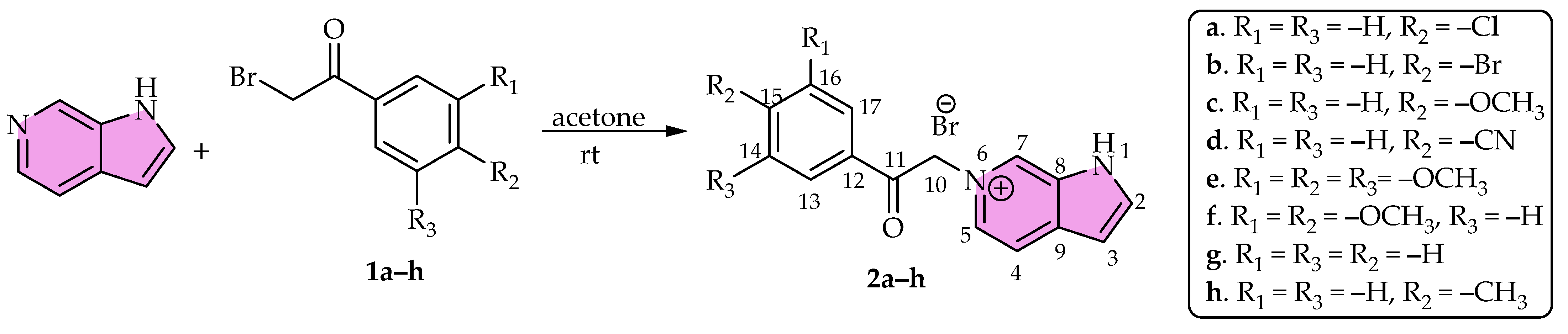
2.1. Synthesis
2.2. In Silico Adsorption, Distribution, Metabolism, Excretion (ADME) Predictions
2.3. Biological Activity
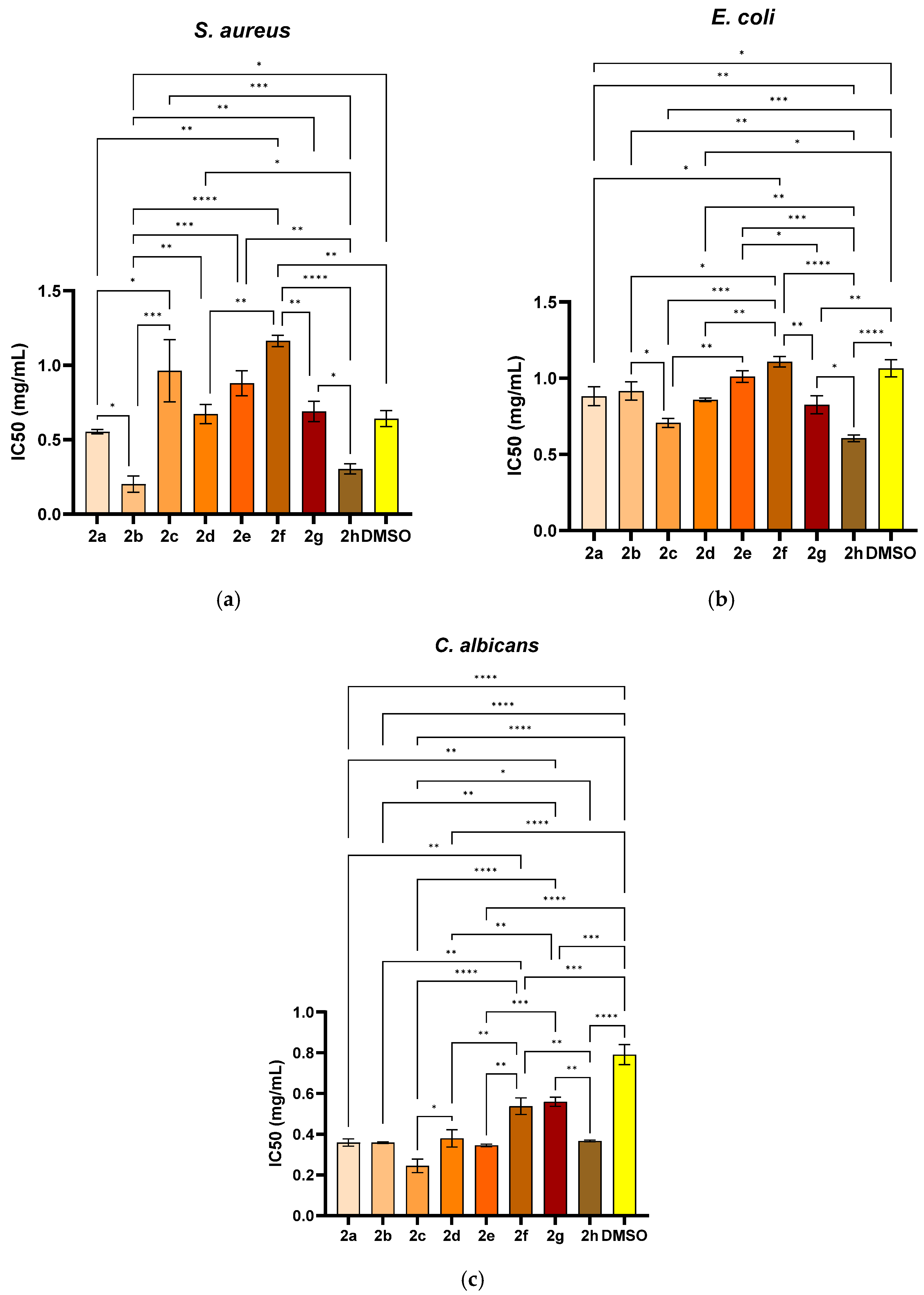
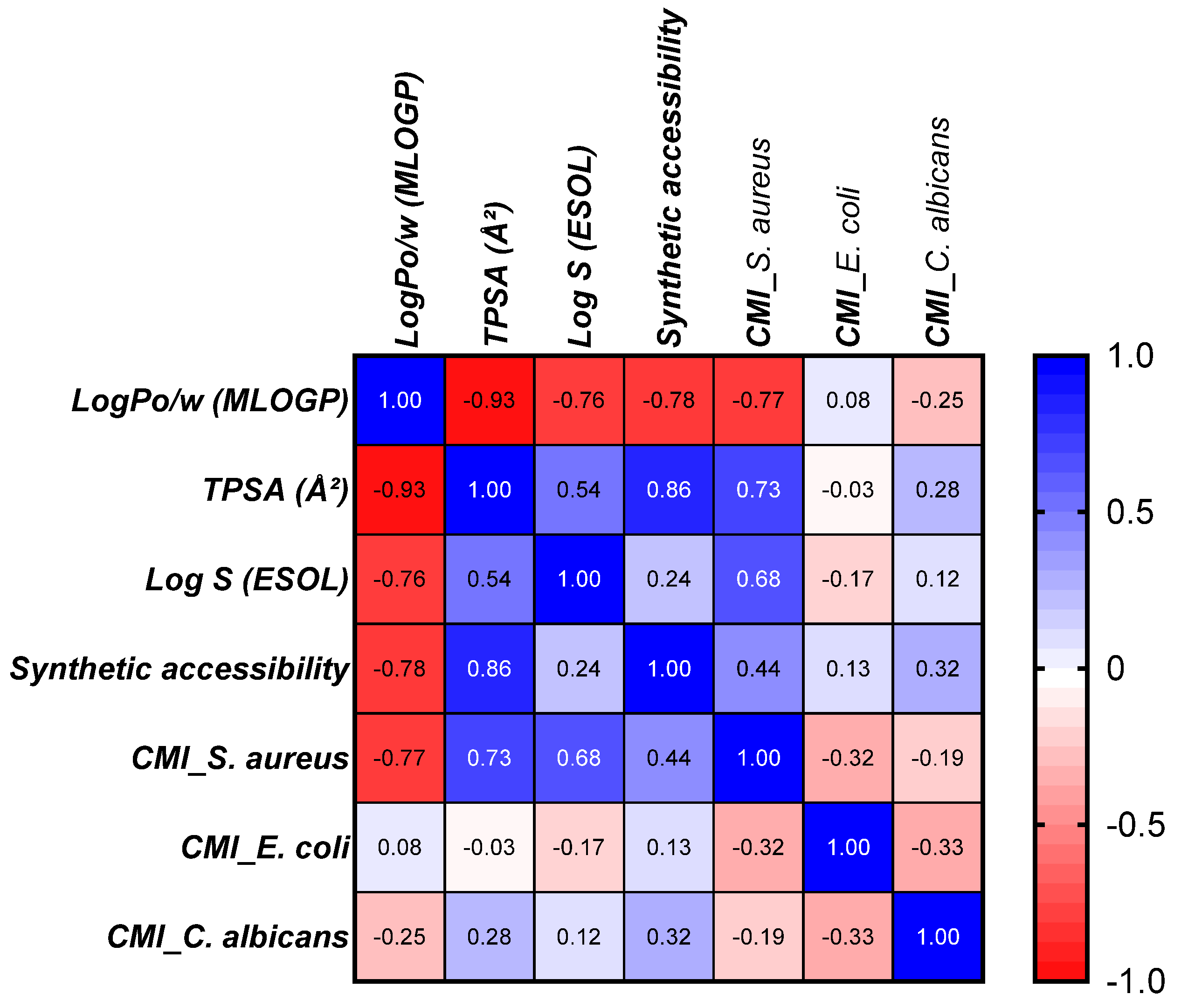
2.3.1. Antimicrobial Activity
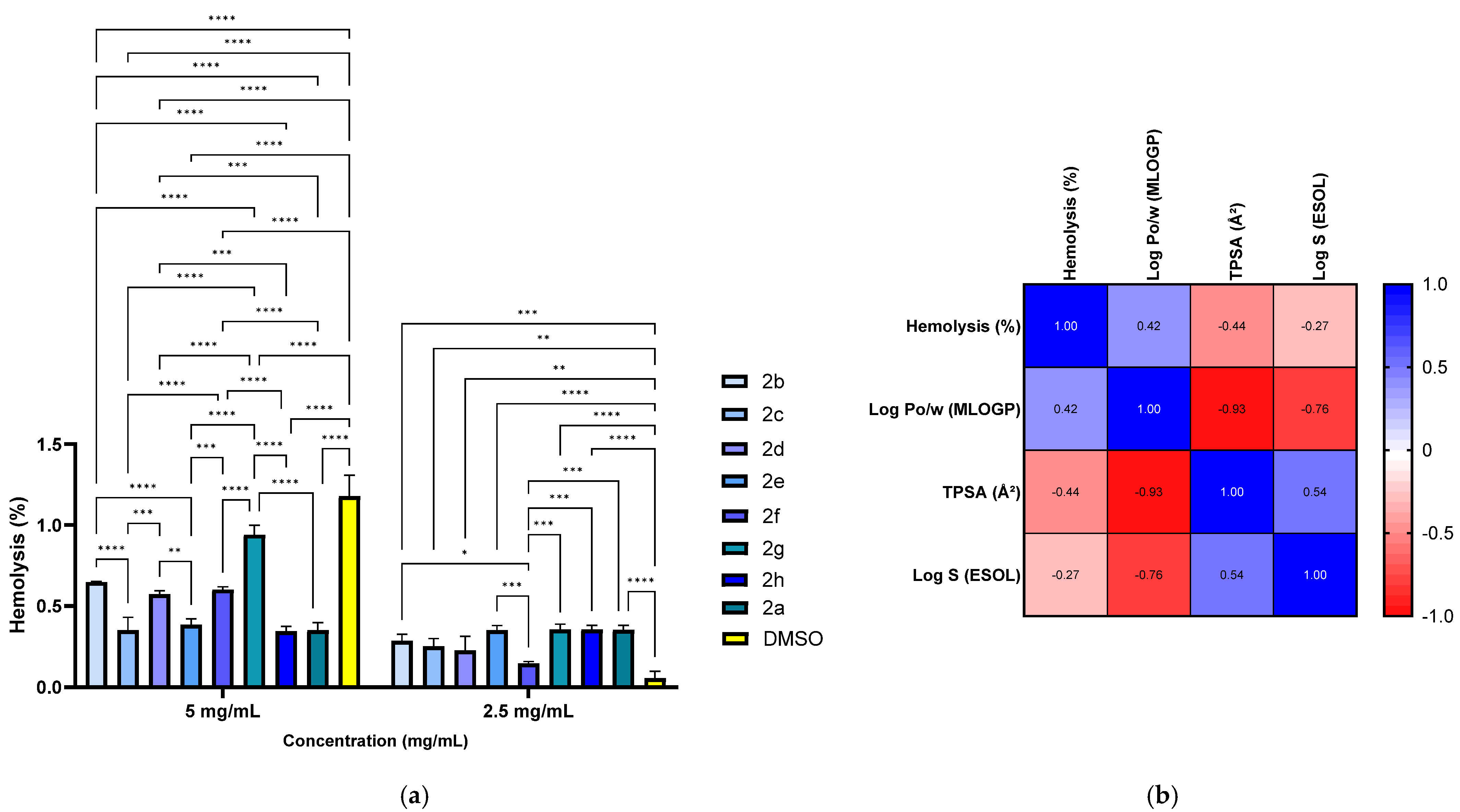
2.3.2. Hemocompatibility
2.3.3. Anticancer Evaluation
3. Materials and Methods
3.1. Chemistry
3.1.1. General Procedure for Compounds 2
3.1.2. Physico-Chemical and Spectral Data of Compounds 2a–h
3.2. In Silico ADME
3.3. Biological Activity
3.3.1. Antimicrobial Activity
Microbial Strains
Qualitative Evaluation of Antimicrobial Activity
Quantitative Evaluation of Antimicrobial Activity
Evaluation of Microbicidal Activity
Microbial Adherence to Inert Surface
3.3.2. Hemocompatibility
3.3.3. Anticancer Activity
Cell Proliferation Assay
3.3.4. Statistical Analysis
4. Conclusions
Supplementary Materials
Author Contributions
Funding
Data Availability Statement
Acknowledgments
Conflicts of Interest
References
- Dattani, S.; Spooner, F.; Ritchie, H.; Roser, M. Antibiotics and Antibiotic Resistance. In Our World in Data; OWID: Oxford, UK, 2024. [Google Scholar]
- Hutchings, M.I.; Truman, A.W.; Wilkinson, B. Antibiotics: Past, Present and Future. Curr. Opin. Microbiol. 2019, 51, 72–80. [Google Scholar] [CrossRef]
- Siegel, R.L.; Miller, K.D.; Wagle, N.S.; Jemal, A. Cancer Statistics, 2023. CA Cancer J. Clin. 2023, 73, 17–48. [Google Scholar] [CrossRef]
- Suzuki, H.; Fujiwara, N.; Singal, A.G.; Baumert, T.F.; Chung, R.T.; Kawaguchi, T.; Hoshida, Y. Prevention of Liver Cancer in the Era of Next-Generation Antivirals and Obesity Epidemic. Hepatology 2025. [Google Scholar] [CrossRef] [PubMed] [PubMed Central]
- Global Antimicrobial Resistance and Use Surveillance System (GLASS). Available online: https://www.who.int/initiatives/glass (accessed on 26 February 2026).
- Antimicrobial Resistance Collaborators. Global Burden of Bacterial Antimicrobial Resistance in 2019: A Systematic Analysis. Lancet 2022, 399, 629–655. [Google Scholar] [CrossRef]
- Siegel, R.L.; Giaquinto, A.N.; Jemal, A. Cancer Statistics, 2024. CA A Cancer J. Clin. 2024, 74, 12–49. [Google Scholar] [CrossRef] [PubMed]
- Marshall, C.M.; Federice, J.G.; Bell, C.N.; Cox, P.B.; Njardarson, J.T. An Update on the Nitrogen Heterocycle Compositions and Properties of U.S. FDA-Approved Pharmaceuticals (2013–2023). J Med. Chem. 2024, 67, 11622–11655. [Google Scholar] [CrossRef]
- Arora, P.; Arora, V.; Lamba, H.S.; Wadhwa, D. Importance of Heterocyclic Chemistry: A Review. Int. J. Pharm. Sci. Res. 2012, 3, 2947–2954. [Google Scholar] [CrossRef]
- Heravi, M.M.; Zadsirjan, V. Prescribed Drugs Containing Nitrogen Heterocycles: An Overview. RSC Adv. 2020, 10, 44247–44311. [Google Scholar] [CrossRef]
- France, S.P.; Lindsey, E.A.; McInturff, E.L.; Berritt, S.; Carney, D.W.; DeForest, J.C.; Fink, S.J.; Flick, A.C.; Gibson, T.S.; Gray, K.; et al. Synthetic Approaches to the New Drugs Approved During 2022. J. Med. Chem. 2024, 67, 4376–4418. [Google Scholar] [CrossRef]
- Pennington, L.D.; Moustakas, D.T. The Necessary Nitrogen Atom: A Versatile High-Impact Design Element for Multiparameter Optimization. J. Med. Chem. 2017, 60, 3552–3579. [Google Scholar] [CrossRef] [PubMed]
- Kerru, N.; Gummidi, L.; Maddila, S.; Gangu, K.K.; Jonnalagadda, S.B. A Review on Recent Advances in Nitrogen-Containing Molecules and Their Biological Applications. Molecules 2020, 25, 1909. [Google Scholar] [CrossRef] [PubMed]
- Motati, D.R.; Amaradhi, R.; Ganesh, T. Azaindole Therapeutic Agents. Bioorg. Med. Chem. 2020, 28, 115830. [Google Scholar] [CrossRef]
- Amariucai-Mantu, D.; Antoci, V.; Sardaru, M.C.; Matarneh, C.M.A.; Mangalagiu, I.; Danac, R. Fused Pyrrolo-Pyridines and Pyrrolo-(Iso)Quinoline as Anticancer Agents. Phys. Sci. Rev. 2023, 8, 2583–2645. [Google Scholar] [CrossRef]
- Urvashi; Senthil Kumar, J.B.; Das, P.; Tandon, V. Development of Azaindole-Based Frameworks as Potential Antiviral Agents and Their Future Perspectives. J. Med. Chem. 2022, 65, 6454–6495. [Google Scholar] [CrossRef]
- Mérour, J.-Y.; Buron, F.; Plé, K.; Bonnet, P.; Routier, S. The Azaindole Framework in the Design of Kinase Inhibitors. Molecules 2014, 19, 19935–19979. [Google Scholar] [CrossRef]
- Wang, T.; Yin, Z.; Zhang, Z.; Bender, J.A.; Yang, Z.; Johnson, G.; Yang, Z.; Zadjura, L.M.; D’Arienzo, C.J.; DiGiugno Parker, D.; et al. Inhibitors of Human Immunodeficiency Virus Type 1 (HIV-1) Attachment. 5. An Evolution from Indole to Azaindoles Leading to the Discovery of 1-(4-Benzoylpiperazin-1-Yl)-2-(4,7-Dimethoxy-1H-Pyrrolo[2,3-c]Pyridin-3-Yl)Ethane-1,2-Dione (BMS-488043), a Drug Candidate That Demonstrates Antiviral Activity in HIV-1-Infected Subjects. J. Med. Chem. 2009, 52, 7778–7787. [Google Scholar] [CrossRef] [PubMed]
- Chen, G.; Ren, H.; Zhang, N.; Lennox, W.; Turpoff, A.; Paget, S.; Li, C.; Almstead, N.; Njoroge, F.G.; Gu, Z.; et al. 6-(Azaindol-2-Yl)Pyridine-3-Sulfonamides as Potent and Selective Inhibitors Targeting Hepatitis C Virus NS4B. Bioorg. Med. Chem. Lett. 2015, 25, 781–786. [Google Scholar] [CrossRef]
- Lougiakis, N.; Sakalis, N.; Georgiou, M.; Marakos, P.; Pouli, N.; Skaltsounis, A.-L.; Mavrogonatou, E.; Pratsinis, H.; Kletsas, D. Synthesis, Cytotoxic Activity Evaluation and Mechanistic Investigation of Novel 3,7-Diarylsubstituted 6-Azaindoles. Eur. J. Med. Chem. 2023, 261, 115804. [Google Scholar] [CrossRef]
- Lalezari, J.P.; Latiff, G.H.; Brinson, C.; Echevarría, J.; Treviño-Pérez, S.; Bogner, J.R.; Thompson, M.; Fourie, J.; Sussmann Pena, O.A.; Mendo Urbina, F.C.; et al. Safety and Efficacy of the HIV-1 Attachment Inhibitor Prodrug BMS-663068 in Treatment-Experienced Individuals: 24 Week Results of AI438011, a Phase 2b, Randomised Controlled Trial. Lancet HIV 2015, 2, e427–e437. [Google Scholar] [CrossRef]
- Liu, Y.A.; Jin, Q.; Zou, Y.; Ding, Q.; Yan, S.; Wang, Z.; Hao, X.; Nguyen, B.; Zhang, X.; Pan, J.; et al. Selective DYRK1A Inhibitor for the Treatment of Type 1 Diabetes: Discovery of 6-Azaindole Derivative GNF2133. J. Med. Chem. 2020, 63, 2958–2973. [Google Scholar] [CrossRef] [PubMed]
- Jin, Q.; Wu, T.Y.-H. Discovery and Optimization of 6-Azaindole URAT1 Inhibitors to Address Kidney and Liver Related Toxicities. ACS Med. Chem. Lett. 2025, 16, 1163–1169. [Google Scholar] [CrossRef]
- Harcken, C.; Riether, D.; Liu, P.; Razavi, H.; Patel, U.; Lee, T.; Bosanac, T.; Ward, Y.; Ralph, M.; Chen, Z.; et al. Optimization of Drug-like Properties of Nonsteroidal Glucocorticoid Mimetics and Identification of a Clinical Candidate. ACS Med. Chem. Lett. 2014, 5, 1318–1323. [Google Scholar] [CrossRef]
- Olaru, A.-M.; Vasilache, V.; Danac, R.; Mangalagiu, I.I. Antimycobacterial Activity of Nitrogen Heterocycles Derivatives: 7-(Pyridine-4-Yl)-Indolizine Derivatives. Part VII8-12. J. Enzyme Inhib. Med. Chem. 2017, 32, 1291–1298. [Google Scholar] [CrossRef] [PubMed]
- Amărandi, R.-M.; Al-Matarneh, M.-C.; Popovici, L.; Ciobanu, C.I.; Neamțu, A.; Mangalagiu, I.I.; Danac, R. Exploring Pyrrolo-Fused Heterocycles as Promising Anticancer Agents: An Integrated Synthetic, Biological, and Computational Approach. Pharmaceuticals 2023, 16, 865. [Google Scholar] [CrossRef] [PubMed]
- Al Matarneh, C.M.; Mangalagiu, I.I.; Shova, S.; Danac, R. Synthesis, Structure, Antimycobacterial and Anticancer Evaluation of New Pyrrolo-Phenanthroline Derivatives. J. Enzyme Inhib. Med. Chem. 2016, 31, 470–480. [Google Scholar] [CrossRef]
- Danac, R.; Daniloaia, T.; Antoci, V.; Vasilache, V.; Mangalagiu, I.I. Design, Synthesis and Antimycobacterial Activity of Some New Azaheterocycles: Phenanthroline with p-Halo-Benzoyl Skeleton. Part V. Lett. Drug Des. Discov. 2015, 12, 14–19. [Google Scholar] [CrossRef]
- Ruan, S.; Tu, C.-H.; Bourne, C.R. Friend or Foe: Protein Inhibitors of DNA Gyrase. Biology 2024, 13, 84. [Google Scholar] [CrossRef]
- Ong, C.J.N.; Elesho, O.E.; Bramwell, B.B.; Cabuhat, K.S.P.; Bacalzo, G.D.; Nuevo, J.J.M.; Fortaleza, J.A.G. Staphylococcus Aureus: Antimicrobial Resistance, Quorum Sensing, and Antibiofilm Approaches. Eur. J. Microbiol. Immunol. 2025, 15, 195–209. [Google Scholar] [CrossRef]
- de Morais Oliveira-Tintino, C.D.; Muniz, D.F.; Dos Santos Barbosa, C.R.; Silva Pereira, R.L.; Begnini, I.M.; Rebelo, R.A.; da Silva, L.E.; Mireski, S.L.; Nasato, M.C.; Lacowicz Krautler, M.I.; et al. NorA, Tet(K), MepA, and MsrA Efflux Pumps in Staphylococcus Aureus, Their Inhibitors and 1,8-Naphthyridine Sulfonamides. Curr. Pharm. Des. 2023, 29, 323–355. [Google Scholar] [CrossRef] [PubMed]
- Fayeulle, A.; Trudel, E.; Damiens, A.; Josse, A.; Ben Hadj Youssef, N.; Vigneron, P.; Vayssade, M.; Rossi, C.; Ceballos, C. Antimicrobial and Antioxidant Activities of Amines Derived from Vanillin as Potential Preservatives: Impact of the Substituent Chain Length and Polarity. Sustain. Chem. Pharm. 2021, 22, 100471. [Google Scholar] [CrossRef]
- Sim, M.; Boya, B.R.; Kim, Y.-G.; Lee, J.-H.; Lee, J. Multi-Halogenated Indoles as Antimicrobial and Antivirulence Agents Against Drug-Resistant Staphylococcus Aureus. Microb. Biotechnol. 2025, 18, e70280. [Google Scholar] [CrossRef]
- Molchanova, N.; Nielsen, J.E.; Sørensen, K.B.; Prabhala, B.K.; Hansen, P.R.; Lund, R.; Barron, A.E.; Jenssen, H. Halogenation as a Tool to Tune Antimicrobial Activity of Peptoids. Sci. Rep. 2020, 10, 14805. [Google Scholar] [CrossRef]
- Tischer, M.; Pradel, G.; Ohlsen, K.; Holzgrabe, U. Quaternary Ammonium Salts and Their Antimicrobial Potential: Targets or Nonspecific Interactions? ChemMedChem 2012, 7, 22–31. [Google Scholar] [CrossRef]
- Crisà, G.; Amata, S.; Rizzo, C.; Buscemi, S.; Piccionello, A.P. Cationic Compounds in Antimicrobial Therapy: Struc-ture–Activity Relationships and Emerging Technologies. Transl. Chem. 2025, 1, 1–17. [Google Scholar] [CrossRef]
- Faleye, O.S.; Boya, B.R.; Lee, J.-H.; Choi, I.; Lee, J. Halogenated Antimicrobial Agents to Combat Drug-Resistant Pathogens. Pharmacol. Rev. 2023, 76, 90–141. [Google Scholar] [CrossRef]
- Padmapriya, M.; Hakkimane, S.S.; Gaonkar, S.L. Synthetic Approaches, Emerging Applications, and Challenges of Indole-Based Five-Membered Heterocycles in Medicinal Chemistry. Discov. Appl. Sci. 2025, 7, 208. [Google Scholar] [CrossRef]
- Hanheiser, N.; Jiang, Y.; Nie, C.; Haag, R. Mechanism and Molecular Design Principles of Cationic Surfactants: From Charge-Driven Membrane Interactions to Next-Generation Quaternary Ammonium Compounds. ChemMedChem 2026, 21, e202501104. [Google Scholar] [CrossRef]
- Alptüzün, V.; Parlar, S.; Taşlı, H.; Erciyas, E. Synthesis and Antimicrobial Activity of Some Pyridinium Salts. Molecules 2009, 14, 5203–5215. [Google Scholar] [CrossRef] [PubMed]
- Sowmiah, S.; Veiros, L.F.; Esperança, J.M.S.S.; Rebelo, L.P.N.; Afonso, C.A.M. Organocatalyzed One-Step Synthesis of Functionalized N-Alkyl-Pyridinium Salts from Biomass Derived 5-Hydroxymethylfurfural. Org. Lett. 2015, 17, 5244–5247. [Google Scholar] [CrossRef] [PubMed]
- Podunavac-Kuzmanovic, S.O.; Cvetkovic, D.D.; Barna, D.J. The Effect of Lipophilicity on the Antibacterial Activity of Some 1-Benzylbenzimidazole Derivatives. J. Serb. Chem. Soc. 2008, 73, 967–978. [Google Scholar] [CrossRef]
- Biagi, G.L.; Guerra, M.C.; Barbaro, A.M.; Gamba, M.F. Influence of Lipophilic Character on the Antibacterial Activity of Cephalosporins and Penicillins. J. Med. Chem. 1970, 13, 511–516. [Google Scholar] [CrossRef]
- Dudek, A.; Dejnaka, E.; Sulecka-Zadka, J.; Perz, M.; Krawczyk-Łebek, A.; Kostrzewa-Susłow, E.; Pruchnik, H.; Pawlak, A. Bromo- and Chloro-Substituted Flavones Induce Apoptosis and Modulate Cell Death Pathways in Canine Lymphoma and Leukemia Cells—A Comparative in Vitro Study. Front. Mol. Biosci. 2025, 12, 1738255. [Google Scholar] [CrossRef]
- Malovrh, P.; Sepčić, K.; Turk, T.; Maček, P. Characterization of Hemolytic Activity of 3-Alkylpyridinium Polymers from the Marine Sponge. Comp. Biochem. Physiol. C Pharmacol. Toxicol. Endocrinol. 1999, 124, 221–226. [Google Scholar] [CrossRef]
- Li, Y.; Yang, Y.; Kong, H.; Li, R.; Qu, Y.; Ge, X.; Li, Z.-H.; Li, D.; Wu, Y.; Wang, Y.-N.; et al. Design, Synthesis and Antibacterial Evaluation of Bis-Pyridinium Cationic Antimicrobial Peptide Mimics with Low Hemolytic Toxicity. Eur. J. Med. Chem. 2025, 299, 118012. [Google Scholar] [CrossRef] [PubMed]
- Sánchez, L.; Martínez, V.; Infante, M.R.; Mitjans, M.; Vinardell, M.P. Hemolysis and Antihemolysis Induced by Amino Acid-Based Surfactants. Toxicol. Lett. 2007, 169, 177–184. [Google Scholar] [CrossRef] [PubMed]
- Kopiasz, R.J.; Rukasz, A.; Chreptowicz, K.; Podgórski, R.; Kuźmińska, A.; Mierzejewska, J.; Tomaszewski, W.; Ciach, T.; Jańczewski, D. Influence of Lipid Bilayer Composition on the Activity of Antimicrobial Quaternary Ammonium Ionenes, the Interplay of Intrinsic Lipid Curvature and Polymer Hydrophobicity, the Role of Cardiolipin. Colloids Surf. B Biointerfaces 2021, 207, 112016. [Google Scholar] [CrossRef] [PubMed]
- Marinas, I.C.; Simionescu, N.; Andreiu, N.D.; Al-Matarneh, A.; Pinteala, T.; Chifiriuc, M.C.; Al-Matarneh, C.M. Influence of Substitution Patterns on the Antimicrobial Properties of Pyrrole Sulfonamide Scaffolds. Front. Chem. 2026, 14, 1726389. [Google Scholar] [CrossRef]
- Marinas, I.C.; Ignat, L.; Maurușa, I.E.; Gaboreanu, M.D.; Adina, C.; Popa, M.; Chifiriuc, M.C.; Angheloiu, M.; Georgescu, M.; Iacobescu, A.; et al. Insights into the Physico-Chemical and Biological Characterization of Sodium Lignosulfonate—Silver Nanosystems Designed for Wound Management. Heliyon 2024, 10, e26047. [Google Scholar] [CrossRef]
- Shoemaker, R.H. The NCI60 Human Tumour Cell Line Anticancer Drug Screen. Nat. Rev. Cancer 2006, 6, 813–823. [Google Scholar] [CrossRef]
- Skehan, P.; Storeng, R.; Scudiero, D.; Monks, A.; McMahon, J.; Vistica, D.; Warren, J.T.; Bokesch, H.; Kenney, S.; Boyd, M.R. New Colorimetric Cytotoxicity Assay for Anticancer-Drug Screening. J. Natl. Cancer Inst. 1990, 82, 1107–1112. [Google Scholar] [CrossRef]
- Al-Matarneh, M.C.; Amărandi, R.-M.; Mangalagiu, I.I.; Danac, R. Synthesis and Biological Screening of New Cyano-Substituted Pyrrole Fused (Iso)Quinoline Derivatives. Molecules 2021, 26, 2066. [Google Scholar] [CrossRef] [PubMed]



| ADME Parameter | 2a | 2b | 2c | 2d |
|---|---|---|---|---|
| Physicochemical Properties | ||||
| Molecular weight | 351.63 g/mol | 396.08 g/mol | 347.21 g/mol | 342.19 g/mol |
| Log Po/w (MLOGP) | 2.31 | 2.43 | 1.46 | 1.12 |
| Number of H-bond acceptors | 1 | 1 | 2 | 2 |
| Number of H-bond donors | 1 | 1 | 1 | 1 |
| Number of rotatable bonds | 3 | 3 | 4 | 3 |
| TPSA | 36.74 Å2 | 36.74 Å2 | 45.97 Å2 | 60.53 Å2 |
| Pharmacokinetics | ||||
| Gastrointestinal (GI) absorption | high | high | high | high |
| Blood–brain barrier (BBB) permeant | no | no | no | no |
| P-gp substrate | yes | yes | yes | yes |
| Drug likeness | ||||
| Log S (ESOL) | −5.04 | −5.35 | −4.50 | −4.38 |
| Water solubility class | moderately soluble | moderately soluble | moderately soluble | moderately soluble |
| Lipinski rule | no violation | no violation | no violation | no violation |
| Veber rule | no violation | no violation | no violation | no violation |
| Bioavailability | 0.55 | 0.55 | 0.55 | 0.55 |
| Medicinal Chemistry | ||||
| PAINS alerts | 0 | 0 | 0 | 0 |
| Brenk alerts | 1: quaternary nitrogen | 1: quaternary nitrogen | 1: quaternary nitrogen | 1: quaternary nitrogen |
| Synthetic accessibility | 1.94 | 1.96 | 1.98 | 2.09 |
| ADME parameter | 2e | 2f | 2g | 2h |
| Physicochemical Properties | ||||
| Molecular weight | 407.26 g/mol | 377.23 g/mol | 317.18 g/mol | 331.21 g/mol |
| Log Po/w (MLOGP) | 0.82 | 1.13 | 1.80 | 2.04 |
| Number of H-bond acceptors | 4 | 3 | 1 | 1 |
| Number of H-bond donors | 1 | 1 | 1 | 1 |
| Number of rotatable bonds | 6 | 5 | 3 | 3 |
| TPSA | 64.43 Å2 | 55.20 Å2 | 36.74 Å2 | 36.74 Å2 |
| Pharmacokinetics | ||||
| Gastrointestinal (GI) absorption | high | high | high | high |
| Blood–brain barrier (BBB) permeant | no | no | no | no |
| P-gp substrate | yes | yes | yes | yes |
| Drug likeness | ||||
| Log S (ESOL) | −4.62 | −4.56 | −4.45 | −4.75 |
| Water solubility class | moderately soluble | moderately soluble | moderately soluble | moderately soluble |
| Lipinski rule | no violation | no violation | no violation | no violation |
| Veber rule | no violation | no violation | no violation | no violation |
| Bioavailability | 0.55 | 0.55 | 0.55 | 0.55 |
| Medicinal Chemistry | ||||
| PAINS alerts | 0 | 0 | 0 | 0 |
| Brenk alerts | 1: quaternary nitrogen | 1: quaternary nitrogen | 1: quaternary nitrogen | 1: quaternary nitrogen |
| Synthetic accessibility | 2.54 | 2.32 | 1.85 | 1.96 |
| Sample | Analytical Parameter | S. aureus | E. coli | C. albicans | Sample | Analytical Parameter | S. aureus | E. coli | C. albicans |
|---|---|---|---|---|---|---|---|---|---|
| 2a | MIC (mg/mL) | 1.25 | 2.5 | 0.625 | 2g | MIC (mg/mL) | 1.25 | 1.25 | 1.25 |
| MMC (mg/mL) | >2.5 | 2.5 | 2.5 | MMC (mg/mL) | >2.5 | >2.5 | 2.5 | ||
| MBEC (mg/mL) | 2.5 | 2.5 | nd | MBEC (mg/mL) | 1.25 | 2.5 | nd | ||
| IZD (mm) | 8.67 ± 0.58 | 7.33 ± 0.58 | 7.00 ± 0.00 | IZD (mm) | 6.00 ± 0.00 | 7.33 ± 0.58 | 6.00 ± 0.00 | ||
| 2b | MIC (mg/mL) | 0.625 | 1.25 | 1.25 | 2h | MIC (mg/mL) | 1.25 | 2.5 | 1.25 |
| MMC (mg/mL) | >2.5 | 1.25 | 1.25 | MMC (mg/mL) | >2.5 | 2.5 | 2.5 | ||
| MBEC (mg/mL) | ≤0.078 | 2.5 | nd | MBEC (mg/mL) | 1.25 | ≤0.078 | nd | ||
| IZD (mm) | 8.00 ± 1.00 | 10.00 ± 0.0 | 8.67 ± 0.58 | IZD (mm) | 9.00 ± 1.00 | 7.67 ± 0.58 | 8.00 ± 0.00 | ||
| 2c | MIC (mg/mL) | 2.5 | 1.25 | 0.625 | Genta micin | MIC (mg/mL) | 4.38 | 8.75 | - |
| MMC (mg/mL) | >2.5 | 2.5 | 1.25 | MMC (mg/mL) | 17.5 | 8.75 | - | ||
| MBEC (mg/mL) | ≤0.078 | 2.5 | nd | MBEC (mg/mL) | 4.38 | 8.75 | - | ||
| IZD (mm) | 6.67 ± 0.58 | 6.67 ± 0.58 | 5.67 ± 0.58 | IZD (mm) | 19.00 ± 1.41 | 19.50 ± 0.71 | - | ||
| 2d | MIC (mg/mL) | 2.5 | 1.25 | 1.25 | Ketoconazole | MIC (mg/mL) | - | - | 17.5 |
| MMC (mg/mL) | >2.5 | 2.5 | 2.5 | MMC (mg/mL) | - | - | 7 | ||
| MBEC (mg/mL) | 2.5 | ≤0.078 | nd | MBEC (mg/mL) | - | - | nd | ||
| IZD (mm) | 6.33 ± 1.16 | 6.00 ± 0.00 | 6.67 ± 0.58 | IZD (mm) | - | - | 8.00 ± 0.00 | ||
| 2e | MIC (mg/mL) | 2.5 | 1.25 | 1.25 | DMSO | MIC (mg/mL) | 2.5 | 2.5 | 1.25 |
| MMC (mg/mL) | >2.5 | 2.5 | 1.25 | MMC (mg/mL) | >2.5 | >2.5 | >2.5 | ||
| MBEC (mg/mL) | 2.5 | 2.5 | nd | MBEC (mg/mL) | 1.25 | 1.25 | nd | ||
| IZD (mm) | 9.33 ± 1.16 | 6.00 ± 0.00 | 7.33 ± 0.58 | IZD (mm) | 6.00 ± 0.00 | 6.00 ± 0.00 | 7.67 ± 0.58 | ||
| 2f | MIC (mg/mL) | 1.25 | 1.25 | 1.25 | |||||
| MMC (mg/mL) | >2.5 | 2.5 | 1.25 | ||||||
| MBEC (mg/mL) | 2.5 | 2.5 | nd | ||||||
| IZD (mm) | 5.00 ± 0.00 | 6.33 ± 0.58 | 7.67 ± 1.53 |
Disclaimer/Publisher’s Note: The statements, opinions and data contained in all publications are solely those of the individual author(s) and contributor(s) and not of MDPI and/or the editor(s). MDPI and/or the editor(s) disclaim responsibility for any injury to people or property resulting from any ideas, methods, instructions or products referred to in the content. |
© 2026 by the authors. Licensee MDPI, Basel, Switzerland. This article is an open access article distributed under the terms and conditions of the Creative Commons Attribution (CC BY) license.
Share and Cite
Ciorteanu, R.; Marinas, I.C.; Ciobanu, C.I.; Mangalagiu, I.I.; Danac, R. Structure–Activity Relationships of Hemocompatible Cationic 6-Azaindole Pyridinium Salts: Antimicrobial and Anticancer Activity. Molecules 2026, 31, 1220. https://doi.org/10.3390/molecules31071220
Ciorteanu R, Marinas IC, Ciobanu CI, Mangalagiu II, Danac R. Structure–Activity Relationships of Hemocompatible Cationic 6-Azaindole Pyridinium Salts: Antimicrobial and Anticancer Activity. Molecules. 2026; 31(7):1220. https://doi.org/10.3390/molecules31071220
Chicago/Turabian StyleCiorteanu, Roxana, Ioana C. Marinas, Catalina Ionica Ciobanu, Ionel I. Mangalagiu, and Ramona Danac. 2026. "Structure–Activity Relationships of Hemocompatible Cationic 6-Azaindole Pyridinium Salts: Antimicrobial and Anticancer Activity" Molecules 31, no. 7: 1220. https://doi.org/10.3390/molecules31071220
APA StyleCiorteanu, R., Marinas, I. C., Ciobanu, C. I., Mangalagiu, I. I., & Danac, R. (2026). Structure–Activity Relationships of Hemocompatible Cationic 6-Azaindole Pyridinium Salts: Antimicrobial and Anticancer Activity. Molecules, 31(7), 1220. https://doi.org/10.3390/molecules31071220