Article

Silicalite-Supported Ni Catalysts for Efficient CO2 Conversion into CH4

1
Division of Materials Science, Department of Engineering Science and Mathematics, Luleå University of Technology, 97187 Luleå, Sweden
2
Technical Chemistry, Department of Chemistry, Chemical-Biological Centre, Umeå University, 90187 Umeå, Sweden
3
Industrial Chemistry and Reaction Engineering, Johan Gadolin Process Chemistry Centre, Åbo Akademi University, FI20500 Åbo-Turku, Finland
*
Author to whom correspondence should be addressed.
Molecules 2026, 31(7), 1215; https://doi.org/10.3390/molecules31071215
Submission received: 3 February 2026 / Revised: 25 March 2026 / Accepted: 1 April 2026 / Published: 7 April 2026
(This article belongs to the Special Issue Design, Synthesis, and Application of Zeolite Materials)

Abstract

The catalytic conversion of CO2 into methane (CH4) offers a sustainable solution to the worsening global warming scenario, especially for controlling CO2 levels. This study reports silicalite-1 supported Ni catalysts with different loadings for CO2 conversion to CH4, prepared via wet impregnation. The X-ray diffraction pattern revealed an increase in crystallite size at higher Ni loadings, which was further supported by N2 sorption, where the specific surface area and microporosity of the catalysts were decreased. There was a slight shift in the reducibility of the catalysts, potentially indicating the impact of loading on dispersion and spatial distribution. The catalyst performance was evaluated over a range of temperatures at 5 bar and a GHSV of 20,000 mL gcat−1 h−1. Surprisingly, the Ni(5)@Silicalite-1 exhibited higher CO2 conversion efficiency across the range of temperatures compared to Ni(10)@Silicalite-1. The NiO(5)@Silicalite-1 demonstrated a maximum CO2 conversion of 88% at 450 °C, which was approximately 14% higher than that of the catalyst with a 10 wt.% loading. Notably, the CH4 selectivity pattern was quite identical across the catalysts, underscoring that the reaction pathways were unaffected by the loadings. The higher performance of NiO(5)@Silicalite-1 could be ascribed to smaller NiO crystallites and improved textural properties.

1. Introduction

Excessive burning of fossil fuels has led to severe global warming, causing unusual climate changes worldwide. Greenhouse gas emissions, especially carbon dioxide (CO2), have reached a new high level of 422.5 ppm in the atmosphere, posing a pressing challenge to maintaining the 1.5 °C rise in temperature to limit global warming [1]. The need of the time is to accelerate the efforts toward carbon capture and utilization (CCU). The CCU techniques facilitate the conversion of CO2 into value-added chemicals, such as methane (CH4), methanol, and syngas, using renewable hydrogen. Beyond mitigating CO2 emissions, such processes also provide an effective pathway for hydrogen storage (Power-to-gas) and transport, with CH4 serving as a convenient energy carrier for diverse applications. Among the existing CCU technologies, catalytic conversion of CO2 into CH4 is a promising technique with mature industrial applications [2,3,4,5,6].
The catalytic conversion of CO2 is carried out using transition-metal and noble-metal catalysts under varying temperature and pressure conditions. Noble metal catalysts, such as ruthenium (Ru), palladium (Pd), and platinum (Pt), have been reported to transform CO2 into various products with stable performance and high efficiency [7,8,9]. However, economic concerns and the availability of noble metals limit their use for commercial applications [10]. Transition metals, such as nickel (Ni), manganese (Mn), and iron (Fe), have been reported to catalyze the conversion of CO2 into various products with appreciable efficiency [11,12,13]. Among them, Ni received much attention due to its higher activity, CH4 selectivity, and availability [14]. Notably, the highly exothermic CO2 methanation reaction is thermodynamically favorable at low temperatures; however, it is challenging to activate inert CO2 molecules, and the reaction typically proceeds at higher temperatures. Elevated temperatures lead to coking and sintering of the Ni-based catalyst, resulting in deactivation [15,16,17].
The characteristics of catalysts strongly depend on the support material [18]. Commonly used support materials include porous materials such as alumina (Al2O3), zeolite, silica (SiO2), MOFs, and carbon [19,20,21,22]. The Al2O3 has been extensively investigated as a support material due to its thermal and chemical stability. However, Ni can form Ni aluminate (NiAl2O4), which is challenging to reduce and can significantly limit the catalyst’s performance [23]. The SiO2-based material has been employed due to its higher thermal stability and its ordered meso-structured nature. Chen et al. [24] investigated the cage-type properties of SBA-15 (mesoporous SiO2) to control the size of Ni nanoparticles by incorporating carboxylic functional groups (-COOH) into the pores. The modified SBA-15 facilitated tuning of Ni nanoparticle size, resulting in enhanced CO2 methanation performance and high CH4 selectivity.
Additionally, zeolites are microporous materials characterized by high surface areas, flexible pore chemistry, and thermal and chemical stability. The characteristics of zeolite-supported Ni catalysts depend on the nature of the support, porosity, and chemistry of the framework [25,26]. Yan et al. [27] investigated the impact of zeolite support on the activity of Ni catalysts for CO2 methanation. It was observed that the zeolite 13X-supported catalyst performs better than others due to the availability of Ni on the surface compared to confined nanoparticles in the ZSM-5 and BEA zeolites. Also, the chemistry of the zeolite framework significantly influences its surface properties, particularly CO2 adsorption, hydrothermal stability, and hydrophilicity [28]. The hydrothermal stability of the support material is crucial, as the CO2 methanation reaction produces water. At high temperatures, zeolite steaming leads to dealumination, rendering the catalyst unstable [29]. Interestingly, the hydrothermal stability of the zeolite can be tuned by increasing the Si/Al ratio. For example, Faujasite (Zeolite 13X, Zeolite Y) exhibits better hydrothermally stability in the form of zeolite Y compared to X, due to a higher Si/Al ratio [29]. Changes in the Si/Al ratio affect catalyst properties, particularly porosity, CO2 adsorption, acidity, and water affinity. CO2 adsorption may be altered by increasing the Si/Al ratio, due to changes in exchangeable cations and the framework structure. Bacariza et al. [30] studied the impact of the Si/Al ratio on zeolite Y-supported Ni catalysts for CO2 hydrogenation to CH4. The catalyst with a high Si/Al ratio exhibited higher CO2 conversion than the one with a lower ratio. The enhanced performance correlated with increased hydrophobicity, leading to rapid water removal from the catalyst’s surface and shifting the equilibrium toward the product. The removal of Al also leads to the development of stronger metal–support interactions, shifting the reduction temperatures of the catalysts to higher values [30]. Additionally, zeolites without Al in the framework, known as silicalite, are porous materials with high surface area and reduced affinity for water. Limited studies are exploring the silicalite for CO2 methanation. Herein, we investigated silicalite-1-supported catalysts with varying Ni loadings prepared by wet impregnation. The prepared catalysts were characterized using X-ray diffraction (XRD), scanning electron microscopy (SEM), energy-dispersive X-ray spectroscopy (EDX), temperature-programmed desorption (CO2-TPD), temperature-programmed reduction (H2-TPR), and N2 sorption isotherms. The catalysts were evaluated for CO2 methanation at various temperatures and 5 bar pressure, with a GHSV of 20,000 mL gcat−1 h−1. The Ni(5)@Silicalite-1 catalysts exhibited higher catalytic performance compared to the catalyst with higher Ni loading. The activity of the catalyst was correlated with better textural properties and smaller Ni nanoparticles, resulting in higher CO2 methanation at various temperatures.

2. Results

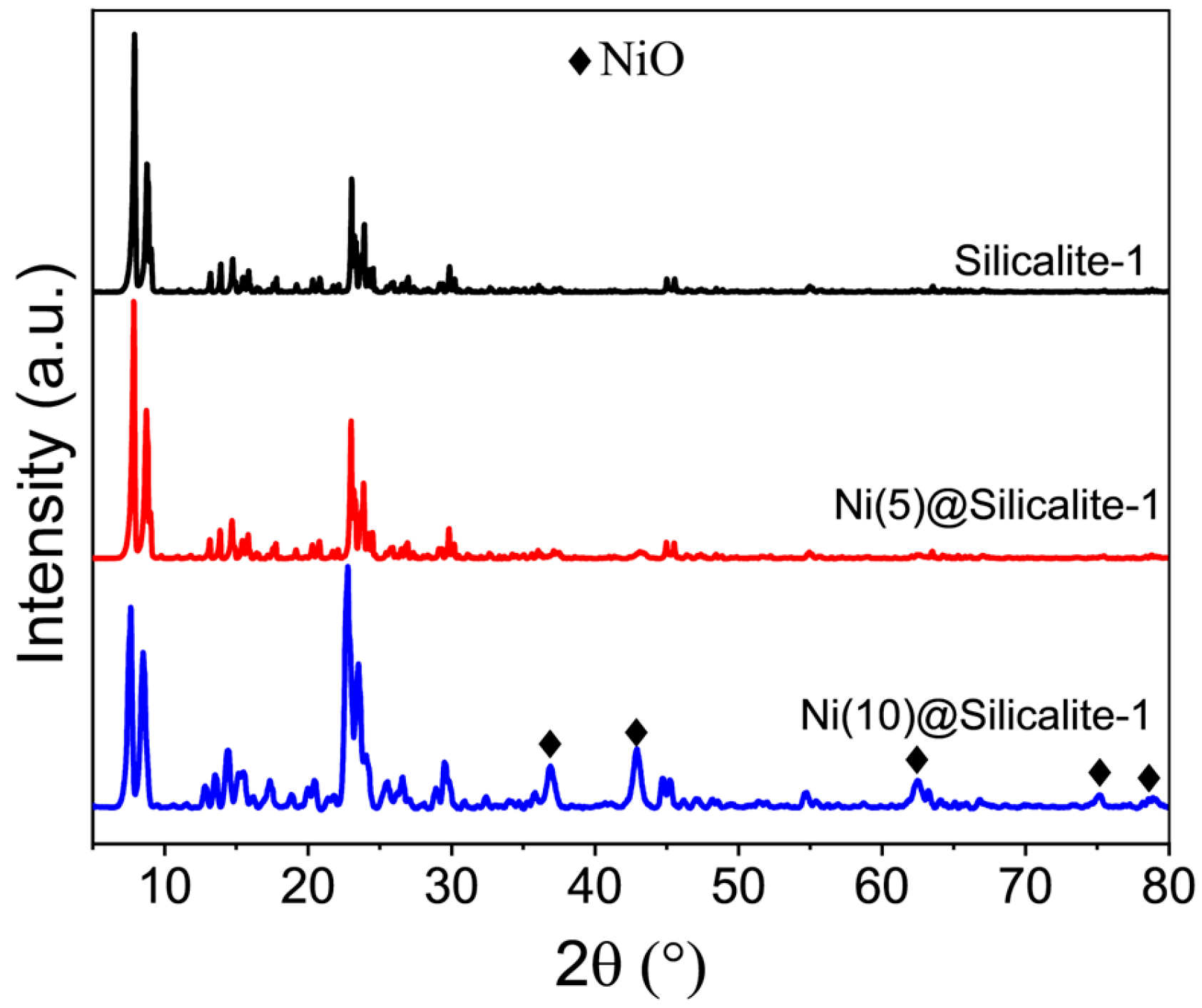
The powder X-ray diffraction (XRD) patterns (Figure 1) of pristine silicalite-1 and the Ni-loaded catalysts confirm that all samples are highly crystalline in nature. The silicalite-1 sample displays well-defined diffraction peaks corresponding to various crystallographic planes of the MFI-type zeolite structure, confirming its phase purity. Both Ni(5)@Silicalite-1 and Ni(10)@Silicalite-1 exhibit the characteristic peaks of silicalite, indicating that the structural framework of the host material remains intact upon Ni incorporation. In the case of Ni(10)@Silicalite-1 catalyst, additional diffraction peaks appear at 2θ values of approximately 37°, 43°, 62°, 75°, and 79°, which are consistent with the (111), (200), (220), (311), and (222) planes of NiO, respectively, confirming the formation of NiO crystallites [31]. For Ni(5)@Silicalite-1, only broad humps are observed in the same 2θ regions, suggesting the presence of highly dispersed, ultra-small NiO nanoparticles with limited crystallinity [32,33]. The gradual broadening of the silicalite peaks with increasing Ni content further supports partial surface coverage by NiO nanoparticles and suggests the possible introduction of lattice strain or slight structural disorder during impregnation and calcination.
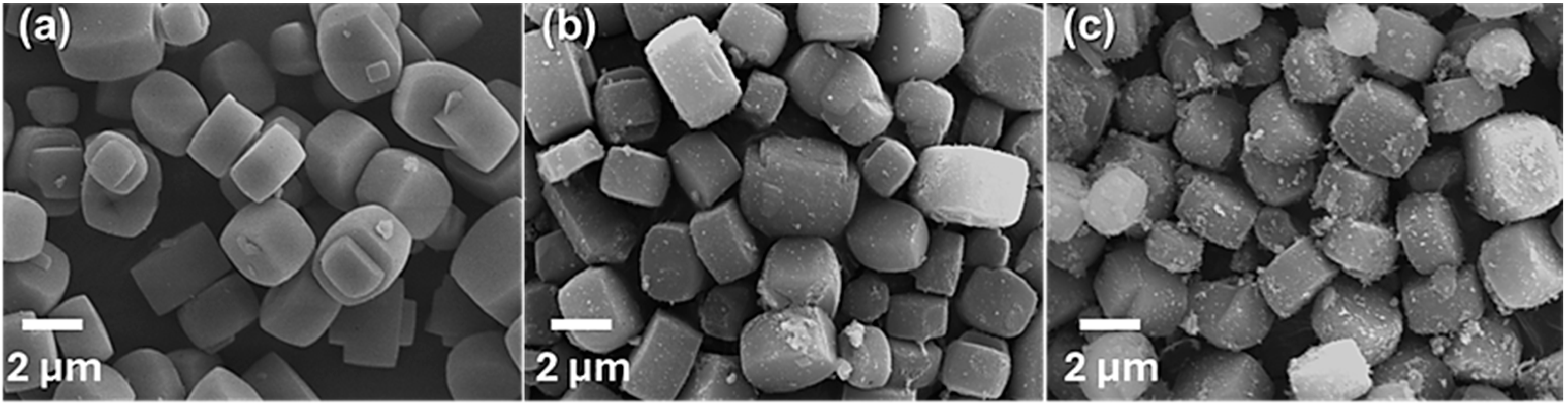
To investigate the morphological changes induced by NiO loading, scanning electron microscopy (SEM) analysis was performed. As shown in Figure 2, the pristine silicalite-1 sample (Figure 2a) exhibits well-defined hexagonal prism-shaped crystals with slightly rounded edges and smooth surfaces. The average crystal size is approximately 5 µm. Notably, intergrowth twin crystals are observed emerging from the hexagonal faces, suggesting a high degree of crystallinity and uniformity. Upon NiO impregnation, a progressive alteration in surface morphology is evident. The prismatic structure of the silicalite is retained in both Ni(5)@Silicalite-1 (Figure 2b) and Ni(10)@Silicalite-1 (Figure 2c), but surfaces become increasingly rough with higher Ni loading. In the case of Ni(5)@Silicalite-1, small NiO nanoparticles appear as discrete, pimple-like protrusions on the otherwise smooth silicalite surface, indicating uniform dispersion with minimal aggregation. Meanwhile, Ni(10)@Silicalite-1 displays a significantly rougher surface with widespread deposition and agglomeration of NiO particles. Excess NiO results in uneven surface coverage and visible nanoparticle clusters, suggesting oversaturation of the silicalite-1 surface.
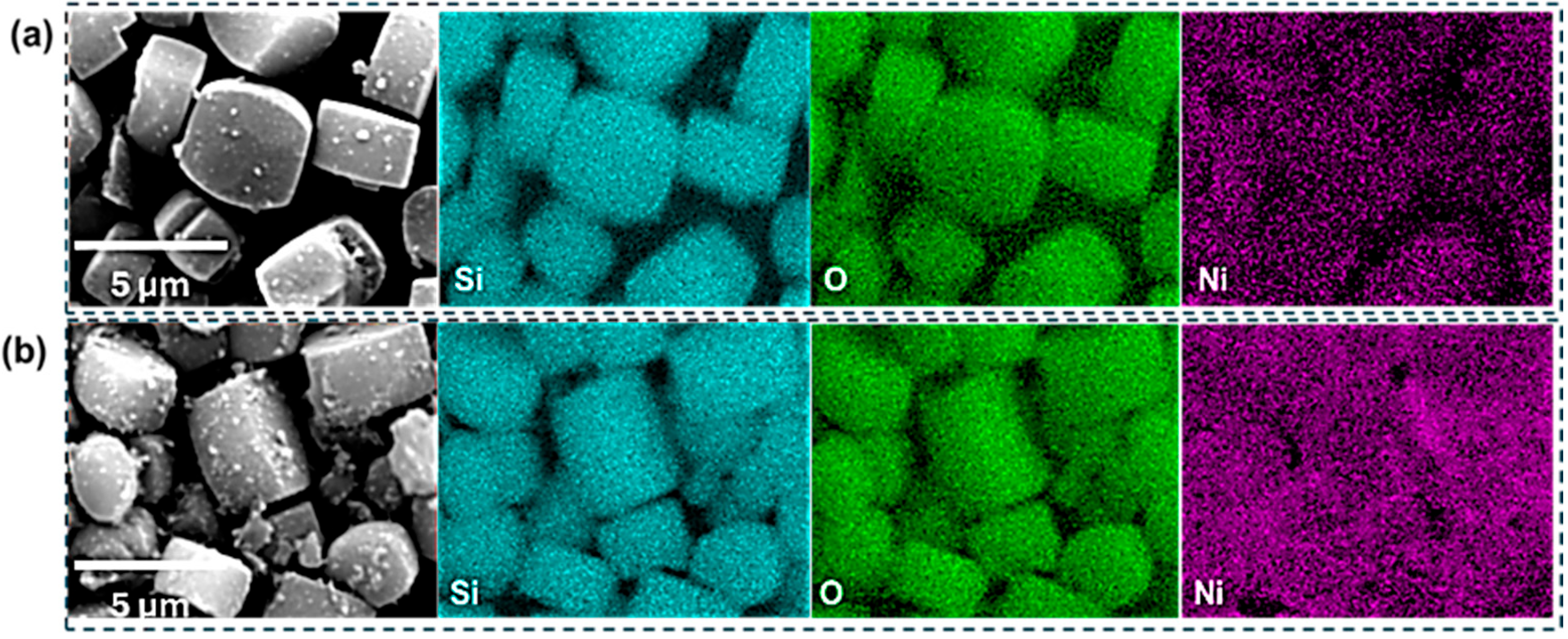
Energy-dispersive X-ray spectroscopy (EDS) mapping was performed in conjunction with SEM to further support the successful incorporation of NiO into the silicalite-1 framework, as shown in Figure 3. The Ni signal intensity is significantly higher in the Ni(10)@Silicalite-1 sample compared to Ni(5)@Silicalite-1, consistent with the increased Ni loading. While Ni is uniformly distributed across both samples, Ni(10)@Silicalite exhibits slightly enhanced signals at the edges of the silicalite crystals, suggesting localized surface deposition of NiO.
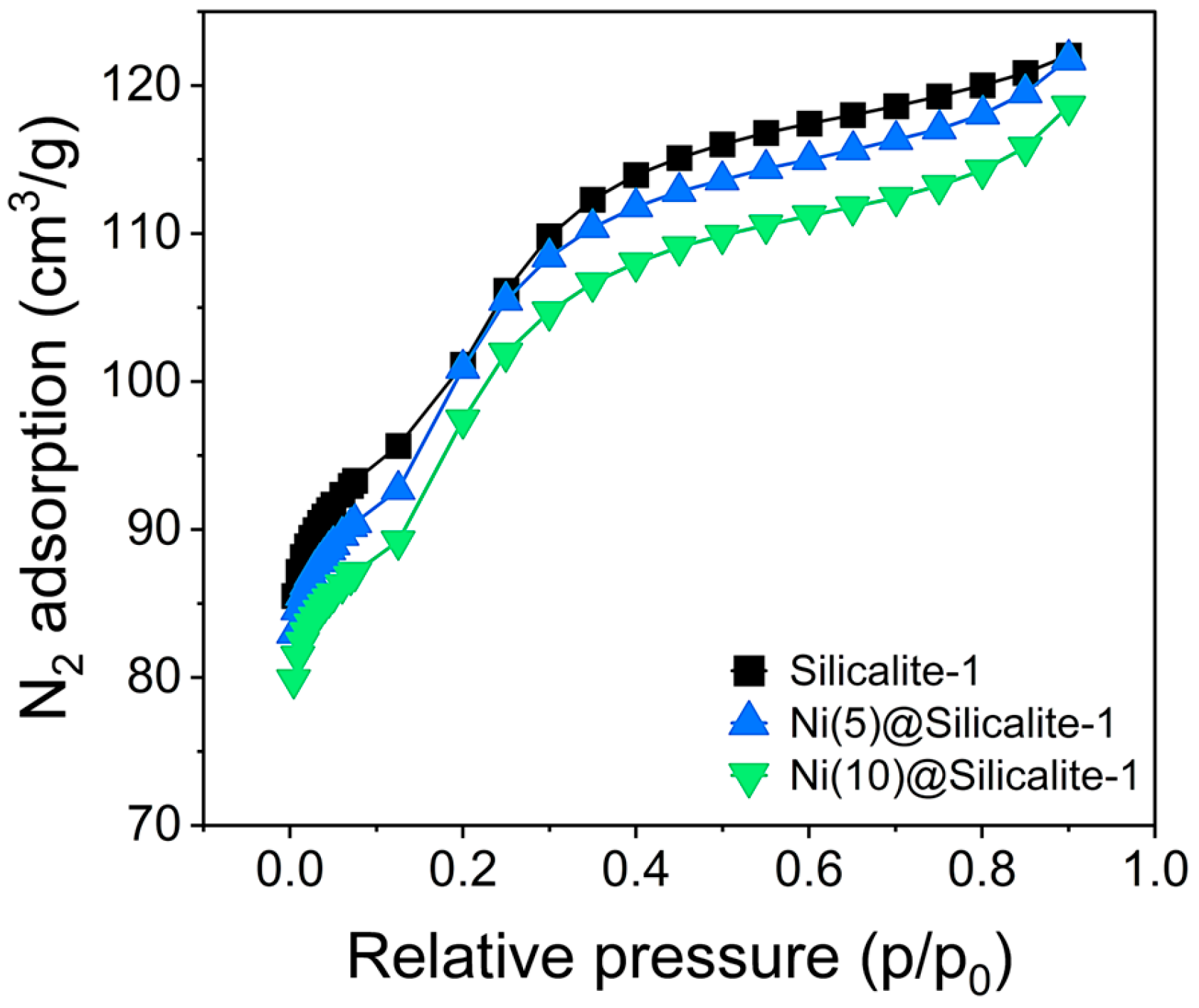
The textural properties of the pristine silicalite-1 and the catalysts were characterized by the N2 sorption isotherms, as shown in Figure 4 and Table 1. Both the support and catalyst samples exhibited similar sorption patterns, consistent with the characteristics of micro- and mesoporous materials. The steep N2 sorption at p/p0 < 0.15 bar shows the presence of a typical microporous structure, whereas the inflection point starting from the p/p0 > 0.15 bar indicates the existence of mesopores [34]. Loading of NiO obviously resulted in a decrease in surface area; more specifically, higher loading led to a greater decrease. The external and micropore area estimated from t-plots shows that NiO impregnation resulted in a loss of micropore area. Notably, there is an increase in the external surface area at the cost of a reduction in the micropore area. Importantly, at higher Ni loading, microporosity loss is more pronounced, suggesting pore blockage [35]. Furthermore, the loss of surface area with loading can be attributed to the dispersion of NiO. Typically, poorly dispersed Ni results in greater surface area blockage. Specifically, the Ni(5)@Silicalite-1 shows only a slight reduction in surface area compared to pristine silicalite, indicating that the mesopores remain largely accessible and unblocked. However, for Ni(10)@Silicalite-1, the substantial surface coverage and particle aggregation lead to a marked decrease in BET surface area, indicating pore blockage and reduced accessibility. The observed differences support the SEM surface morphology results and the XRD NiO crystallite size results, which reveal severe agglomeration of Ni on the support surface at higher loadings. Overall, a decrease in microporosity accompanied by an increase in mesoporosity indicated that the silicalite structure had further deteriorated as a result of the NiO precursor during the impregnation and calcination process [20,36].
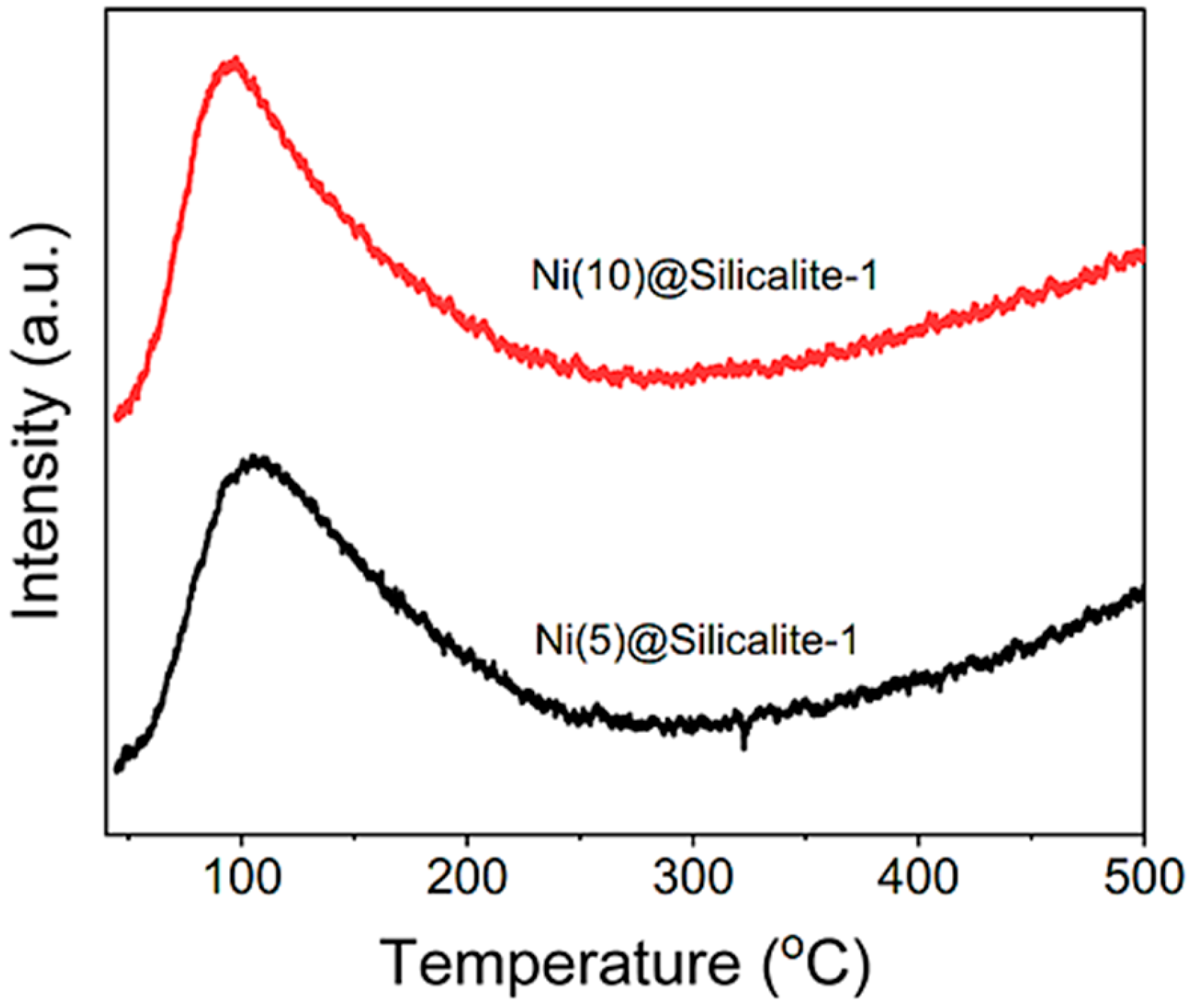
The catalysts were further analyzed by CO2-TPD to estimate their basicity. The CO2 methanation process involves adsorbing CO2 on the catalyst’s surface, followed by activation and conversion to CH4. The adsorption sites are categorized into weak, medium, and strong basic sites, depending on the temperature required to desorb CO2 from the catalyst [37]. The silicalite support contains various hydroxyl groups, and CO2 might coordinate with them as carbonates and bicarbonates [37]. As shown in Figure 5, both catalysts exhibited a broad peak at temperatures below 250 °C, indicating CO2 desorption from weak-to-medium basic sites. The peak pattern is almost identical in both catalysts, underscoring that the desorption might originate from chemisorption and physisorption sites that are identical [21,38]. The peak intensity is relatively higher in Ni(10)@Silicalite-1, which can be attributed to the higher NiO loadings. Calculated amount of desorbed CO2 was 0.44 and 0.046 mmol/g for Ni(5)@Silicalite-1 and Ni(10)@Silicalite-1, respectively. The impregnated NiO contributes to CO2 adsorption as carbonates and bicarbonates via O2− lattice oxygen and Ni2+ cation sites. There is no peak at higher temperatures, indicating the absence of strong basic sites. During high-temperature reactions, CO2 may adsorb and activate as formate species directly on the Ni-NiO interface, depending on the availability and dispersion of Ni species [39]. Westermann et al. [40] reported the absence of the CO2-TPD peak at higher temperatures for the 5% Ni/USY catalyst due to a lower amount of CO2, which might not rise to a peak by the TCD, whereas the catalyst with higher loadings ≥ 10% showed a clear peak in the medium-temperature range. This also indicates that silicalite lacks strong basic sites [41] and chemisorbed CO2 mainly depends on NiO loadings.
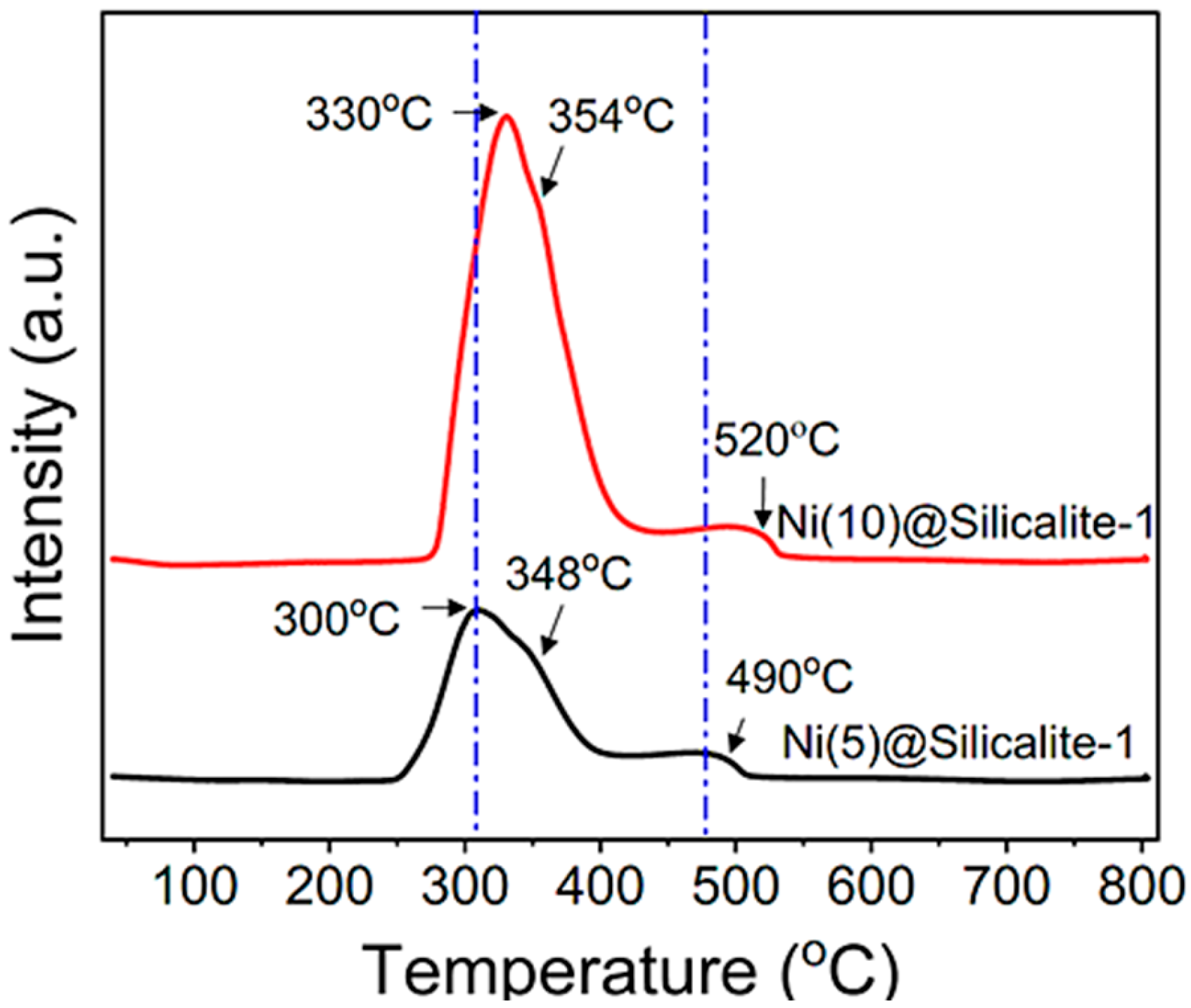
To trigger the CO2 methanation reaction, it is essential to activate H2 into H, which depends on the availability of Ni0 generated by NiO reduction. H2-TPR analysis was performed to estimate the catalysts’ reduction profiles. The reduction temperature and peak patterns by the analysis also provide information about the spatial distribution and strength of Ni attachment to the support [33,42]. As shown in Figure 6, both catalysts exhibited identical behavior, displaying three distinct peaks with varying intensities. The peak intensities may be correlated with the Ni content; clearly, the catalyst with 10% Ni shows higher intensity. The peaks at 300 °C and 330 °C represent the weakly associated surface-bound NiO nanoparticles, whereas the small peak at 490–520 °C indicates the strongly attached nanoparticles with strong metal–support interaction [43,44]. Another main peak, at approximately 350 °C, indicates the medium strength of NiO attachment on the catalyst surface. As revealed by N2 sorption, the catalyst contains mesopores that can confine NiO within the pores of the silicalite support. The minor peaks in the 490–520 °C range could represent confined NiO, resulting in different spatial distributions and metal–support interactions. A shift in the positions of the TPR peaks can be attributed to the strength of metal–support interactions across the catalysts.

3. Catalytic Activity

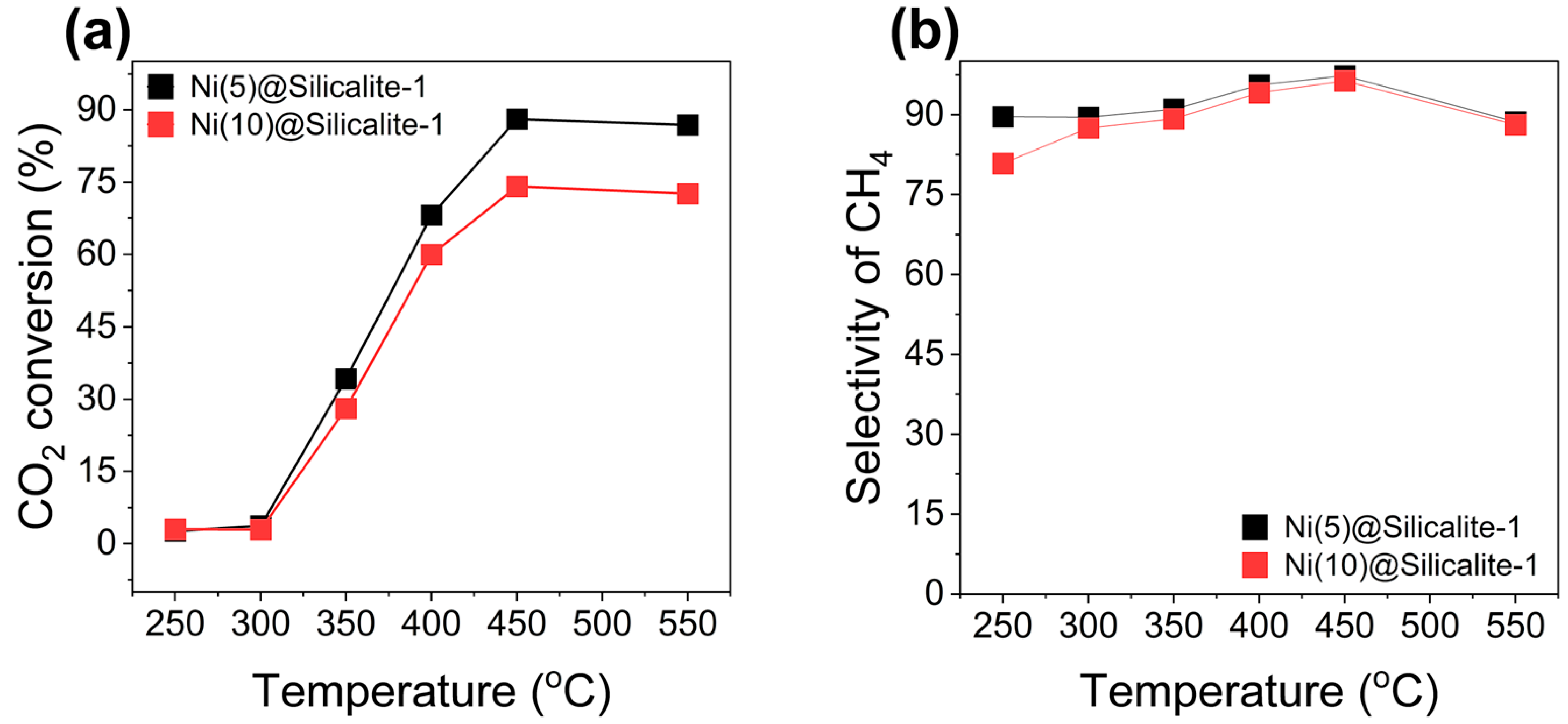
The catalytic activity of the catalysts was evaluated for CO2 conversion into CH4 across a range of temperatures at 5 bar pressure and a GHSV of 20,000 mL gcat−1 h−1. Thermodynamically, the CO2 conversion reaction is exothermic, and therefore, it exhibits higher conversion at lower temperatures. Therefore, optimized temperature conditions are essential for achieving the catalyst’s maximum performance. As shown in Figure 7a, both catalysts exhibited increased activity with increasing temperature. This indicates that CO2 conversion is kinetically limited at low temperatures but proceeds at appreciable rates as temperature increases [45,46]. More specifically, performance was quite low at 250 °C, and the difference in activity was negligible, indicating the intrinsic limitation of the Ni-based catalyst, which performs better at elevated temperature conditions. The Ni(5)@Silicalite-1 catalyst exhibited better performance than the Ni(10)@Silicalite-1 catalyst, with a maximum CO2 conversion of approximately 88% at 450 °C, which is 14% higher than that of the latter. The difference in conversion can be correlated with the catalyst’s characteristics, such as surface area, reducibility, and the size of NiO nanoparticles. As revealed by N2 sorption, surface area and micropore area decreased at higher loading, negatively affecting the catalyst’s catalytic activity. The performance of both catalysts decreased after 450 °C due to associated thermodynamic limitations. As CO2 methanation releases heat, high temperature is not favorable.
In addition, the selectivity of CH4 was evaluated over temperature, and the results are shown in Figure 7b. The selectivity of CH4 followed a similar trend for both the catalysts, with marginally higher values for Ni(5)@Silicalite. Like CO2 conversion, selectivity of CH4 was highest at 450 °C with values of 97% and 96% over Ni(5)@Silicalite and Ni(10)@Silicalite, respectively. A further increase in temperature led to a decrease in CH4 selectivity from 97% to 88%, underscoring that high temperatures negatively impacted CH4 formation. The decrease in CH4 selectivity is related to the exothermic nature of methanation (CO2 + 4H2 → CH4 + 2H2O) reaction and the endothermic nature of the reverse water gas shift reaction (RWGS, CO2 + H2 → CO + H2O) [47,48]. The RWGS began to dominate at higher temperature conditions due to its thermodynamics, thereby promoting the formation of CO, which is otherwise a side product of the CO2 methanation reaction. Notably, the formation of a specific product is influenced by catalyst type, process conditions, and reaction mechanism. The Ni has been reported to be selective towards CH4 formation. However, there are studies in which CO has been reported to increase depending on the reaction mechanism. In this study, no CO2 desorption peak was observed at high temperatures in the CO2-TPD analysis, indicating that adsorption and activation of CO2 occurred at the surface of Ni0. Formation of formate species through an associated mechanism might be dominating where CO2 molecules react with H on the surface of the Ni0 (CO2 + H→HCOO) [49]. The higher selectivity of CH4 over both catalysts indicated that formate intermediates were hydrogenated to a greater extent. Westermann et al. [40] examined the mechanism of CO2 methanation over a Ni/USY catalyst and found that the formate ion concentration rapidly decreased with a rise in temperature compared to CO formation, indicating the complete hydrogenation of formate species into CH4. Thus, a Ni loading of 5 wt.% over silicalite-1 proved to be optimal for efficient CO2 conversion into CH4 due to the textural properties and size of the catalyst’s nanoparticles.

4. Materials and Methods

4.1. Chemicals

The nickel(II) nitrate hexahydrate (99.999%) was purchased from Sigma Aldrich (St. Louis, MO, USA) and used without further purification. Ethanol (absolute, ≥99.5%) was procured from Merck (Darmstadt, Germany).

4.2. Preparation of Ni@Silicalite-1

Two catalyst samples were prepared by varying the amount of Ni-salt relative to silicalite using the wet impregnation method. Initially, the specified amount of nickel(II) nitrate hexahydrate was dissolved in 50 mL of ethanol in a 250 mL beaker under stirring using a magnetic stirrer over a hot plate. Meanwhile, silicalite-1 was degassed overnight at 200 °C under vacuum. Subsequently, 1 g of the degassed silicalite-1 powder was added to the nickel solution. The mixture was stirred for 1 h at 20 °C, followed by 1 h at 30 °C, and then at 50 °C until the solvent had evaporated entirely. The resulting solid was then oven-dried at 80 °C overnight. Here, Ni-containing silicalite-1 samples were synthesized by impregnating 1 g of silicalite-1 with 248 mg and 496 mg of nickel(II) nitrate hexahydrate, corresponding to calculated Ni loadings of approximately 5 wt.% and 10 wt.%, respectively. The catalyst samples were first placed in a vacuum oven and heated overnight at 200 °C. Subsequently, the samples were calcined in a muffle furnace at 500 °C for 4 h, with a heating ramp rate of 1 °C/min, and were designated as Ni(5)@Silicalite-1 and Ni(10)@Silicalite-1, respectively. To validate the Ni contents, the catalysts were analyzed using ICP-MS, and the results showed 4.7 wt.% and 9.9 wt.% Ni, corresponding to 5 wt.% and 10 wt.% loading in Ni(5)@Silicalite-1 and Ni(10)@Silicalite-1 samples, respectively.

4.3. Characterization

The physical and chemical characteristics of the synthesized catalysts were analyzed using various analytical techniques. The X-ray diffraction data of the catalysts and silicalite were collected through the X-ray diffractometer using Cu k-α radiation, λ = 1.5418 Å (Empyrean, Malvern Panalytical, Malvern, UK) and processed using Highscore Plus (Version 5.2, Malvern Panalytical) software. The morphology of the catalysts was analyzed using scanning electron microscopy (SEM, JSM-IT300LV, JEOL GmbH, Freising, Germany) with an applied voltage of 10 kV and probe current 30 n, using a secondary electron detector (SED). Before the SEM investigation, a 10 nm platinum coating was applied to the sample surfaces using a sputter coater (Leica EM ACE200, Leica Microsystems, Wetzlar, Germany). Elemental distribution mapping of catalysts was obtained using energy-dispersive X-ray spectroscopy (EDS) with SEM. The Oxford X-Max 80 EDS detector (Oxford Instruments plc, Abingdon, UK) was used, and the AZTEC software package (Version 5.1) was used to record and process the EDS data. During EDS scans, the applied voltage and probe current increased to 20 kV and 50 nA, respectively. The H2-TPR and CO2-TPD experiments were conducted using a calibrated BELCAT II instrument (MicrotracBEL Corp., Osaka, Japan) equipped with a thermal conductivity detector (TCD). Typically, 50–60 mg of pre-calcined sample was loaded into a quartz U-shaped reactor, pretreated at 400 °C for 1 h under an argon atmosphere, and then cooled to 40 °C. The reducibility profile was recorded using 10% H2/Ar up to 800 °C with a heating rate of 10 °C/min. For CO2-TPD measurements, approximately 50–60 mg of each sample was in situ pretreated at 400 °C under He gas for 1 h, then cooled to 40 °C. Subsequently, the catalyst was saturated with 10% CO2/He for 2 h at 40 °C. Subsequently, the sample was flushed with helium for 30 min to remove traces of physiosorbed CO2. The desorption of chemisorbed CO2 was carried out from 40 °C to 500 °C at a heating rate of 10 °C/min under a He gas flow. After each measurement, the amount of chemisorbed CO2 was determined from a calibration curve obtained by varying the CO2 volume in He. The N2 adsorption isotherms were recorded at −196.15 °C (77 K) after degassing the samples at 219.85 °C (493 K) for 3 h using Gemini VII 2390, Micromeritics, Norcross, GA, USA. The surface areas were calculated using the BET method, and the micropore and external surface areas were estimated from t-plots.

4.4. Catalytic Measurements

The performance of the synthesized catalysts was evaluated in a continuous fixed-bed reactor system for CO2 conversion to CH4. The reactor setup consists of a quartz glass tube enclosed within a stainless-steel tube, which is positioned inside the tube furnace. A 300 mg catalyst sample was mixed with 1000 mg of quartz sand (Sigma Aldrich, 50–70 mesh) and loaded into a quartz glass tube, supported by glass wool at both the bottom and the top. After closing the reactor, a leak test was performed at 10 bar to ensure no gas leakage. The reactor temperature was increased to 500 °C at a heating rate of 10 °C/min, and the catalyst was reduced under 20% H2/80% N2 atmosphere for 1 h. The reactor was cooled to 250 °C, and the pressure was adjusted to 5 bar. Then, 100 mL of reaction gas mixture (CO2/H2/N2) with a molar ratio of 12:48:40 was introduced at a GHSV of 20,000 mL gcat−1 h−1, and catalytic experiments were performed at different temperatures from 250 to 500 °C. The reactor outlet was connected to the GC-TCD/FID for analysis of the product gases. The CO2 conversion and CH4 selectivity were evaluated using the following Equations (1)–(3), where F represents the molar flow of the respective gas at the inlet and outlet of the reactor.
CO 2     Conversion ,   X CO 2   ( % ) = F CO 2 in   F CO 2 out F CO 2 in × 100
C H 4   S e l e c t i v i t y ,   S C H 4 ( % ) = F CH 4 out F CH 4 out + F C O o u t × 100
C O   S e l e c t i v i t y ,   S C O ( % ) = F C O o u t F CH 4 out + F C O o u t × 100

5. Conclusions

This work reports the evaluation of silicalite-1-supported Ni catalysts with varying Ni loadings, prepared by wet impregnation for CO2 methanation. The higher loading resulted in poorly dispersed Ni species, as evidenced by the increased crystallite size revealed by XRD analysis. The textural properties of the silicalite-1 support were severely affected, resulting in a reduction in micropore area for catalysts with higher Ni contents. A slight variation in the reduction temperatures of the catalysts, as revealed by H2-TPR, indicated changes in the metal–support interaction and dispersion of Ni, further supporting the XRD results. The catalytic CO2 conversion performance of Ni(5)@Silicalite-1 was superior to that of Ni(10)@Silicalite-1, with a maximum conversion of 88% at 450 °C under 5 bar and a GHSV of 20,000 mL gcat−1 h−1. Although Ni(5)@Silicalite-1 exhibited 14% higher CO2 conversion than Ni(10)@Silicalite-1 catalyst, the CH4 selectivity was approximately identical over both catalysts across the temperatures. The enhanced performance of the catalyst with lower loading can be attributed to its better textural properties and smaller Ni nanoparticle crystallite size.

Author Contributions

Conceptualization, N.S. and A.D.; methodology, N.S. and A.D.; formal analysis, N.S., A.D. and A.S.; investigation, N.S., A.D. and A.S.; writing—original draft preparation, N.S. and A.D.; writing—review and editing, N.S., A.D., A.S., J.-P.M. and F.A.; supervision, J.-P.M. and F.A.; project administration, F.A.; funding acquisition, J.-P.M. and F.A. All authors have read and agreed to the published version of the manuscript.

Funding

This work was funded by Vetenskapsrådet, Sweden (No. 2018-04407). In addition, this work is part of the Bio4Energy program and the Johan Gadolin Process Chemistry Centre.

Institutional Review Board Statement

Not applicable.

Informed Consent Statement

Not applicable.

Data Availability Statement

The data presented in this study are available on request from the corresponding author.

Conflicts of Interest

The authors declare no conflicts of interest.

References

  1. Global CO2 Emissions from Energy Combustion and Industrial Processes and Their Annual Change, 1900–2023–Charts–Data & Statistics-IEA. Available online: https://www.iea.org/data-and-statistics/charts/global-co2-emissions-from-energy-combustion-and-industrial-processes-and-their-annual-change-1900-2023 (accessed on 9 June 2025).
  2. Hidalgo, D.; Martín-Marroquín, J.M. Power-to-methane, coupling CO2 capture with fuel production: An overview. Renew. Sustain. Energy Rev. 2020, 132, 110057. [Google Scholar] [CrossRef]
  3. Bacariza, M.C.; Maleval, M.; Graça, I.; Lopes, J.M.; Henriques, C. Power-to-methane over Ni/zeolites: Influence of the framework type. Micropor Mesopor Mat. 2019, 274, 102–112. [Google Scholar] [CrossRef]
  4. Chen, J.; Xiao, T.; Yao, B.; Li, M.; Zhang, H.; Tan, M.; Xi, S.; Tang, S.; Jia, W.; Yang, Q.; et al. Inverse In2O3-x/Ni interfaces via Ni3InC0.5 surface reconstruction for efficient CO2 hydrogenation to methanol. Nat. Commun. 2025, 16, 10935. [Google Scholar] [CrossRef] [PubMed]
  5. Zhang, B.; Ma, L.; Shen, J.; Tian, X.; Zhang, R.; Ding, M. Engineering of Metal–Support Interfaces and Cun-Ov Synergistic Sites in Cu/CeO2 Catalyst for Enhanced Low-Temperature CO2 Hydrogenation. ACS Catal. 2025, 16, 491–503. [Google Scholar] [CrossRef]
  6. Chen, J.; Zhang, D.; Liu, B.; Zheng, K.; Li, Y.; Xu, Y.; Li, Z.; Liu, X. Photoinduced Precise Synthesis of Diatomic Ir1Pd1-In2O3 for CO2 Hydrogenation to Methanol via Angstrom-Scale-Distance Dependent Synergistic Catalysis. Angew. Chem.-Int. Ed. 2024, 63, e202401168. [Google Scholar] [CrossRef]
  7. Quindimil, A.; De-La-Torre, U.; Pereda-Ayo, B.; Davó-Quiñonero, A.; Bailón-García, E.; Lozano-Castelló, D.; González-Marcos, J.A.; Bueno-López, A.; González-Velasco, J.R. Effect of metal loading on the CO2 methanation: A comparison between alumina supported Ni and Ru catalysts. Catal. Today 2020, 356, 419–432. [Google Scholar] [CrossRef]
  8. Umeda, M.; Niitsuma, Y.; Horikawa, T.; Matsuda, S.; Osawa, M. Electrochemical Reduction of CO2 to Methane on Platinum Catalysts without Overpotentials: Strategies for Improving Conversion Efficiency. ACS Appl. Energy Mater. 2020, 3, 1119–1127. [Google Scholar] [CrossRef]
  9. Erdöhelyi, A.; Pásztor, M.; Solymosi, F. Catalytic hydrogenation of CO2 over supported palladium. J. Catal. 1986, 98, 166–177. [Google Scholar] [CrossRef]
  10. Moioli, E.; Züttel, A. A model-based comparison of Ru and Ni catalysts for the Sabatier reaction. Sustain. Energy Fuels 2020, 4, 1396–1408. [Google Scholar] [CrossRef]
  11. Burger, T.; Koschany, F.; Thomys, O.; Köhler, K.; Hinrichsen, O. CO2 methanation over Fe- and Mn-promoted co-precipitated Ni-Al catalysts: Synthesis, characterization and catalysis study. Appl. Catal. A Gen. 2018, 558, 44–54. [Google Scholar] [CrossRef]
  12. Franken, T.; Heel, A. Are Fe based catalysts an upcoming alternative to Ni in CO2 methanation at elevated pressure? J. CO2 Util. 2020, 39, 101175. [Google Scholar] [CrossRef]
  13. Kirchner, J.; Zambrzycki, C.; Kureti, S.; Güttel, R. CO2 Methanation on Fe Catalysts Using Different Structural Concepts. Chem. Ing. Tech. 2020, 92, 603–607. [Google Scholar] [CrossRef]
  14. Medina, O.E.; Amell, A.A.; López, D.; Santamaría, A. Comprehensive review of nickel-based catalysts advancements for CO2 methanation. Renew. Sustain. Energy Rev. 2025, 207, 114926. [Google Scholar] [CrossRef]
  15. Hansen, T.W.; Delariva, A.T.; Challa, S.R.; Datye, A.K. Sintering of catalytic nanoparticles: Particle migration or Ostwald ripening? Acc. Chem. Res. 2013, 46, 1720–1730. [Google Scholar] [CrossRef]
  16. Shezad, N.; Samikannu, A.; Safdar, M.; Arellano-García, H.; Mikkola, J.-P.; Seo, D.-K.; Akhtar, F. Nickel Supported Over Hierarchical Zeolite 13X Catalysts for Enhanced Conversion of Carbon Dioxide into Methane. Int. J. Energy Res. 2025, 2025, 4728304. [Google Scholar] [CrossRef]
  17. Gao, X.; Li, J.; Zheng, M.; Cai, S.; Zhang, J.; Askari, S.; Dewangan, N.; Ashok, J.; Kawi, S. Recent progress in anti-coking Ni catalysts for thermo-catalytic conversion of greenhouse gases. Process Saf. Environ. Prot. 2021, 156, 598–616. [Google Scholar] [CrossRef]
  18. Shen, L.; Xu, J.; Zhu, M.; Han, Y.F. Essential role of the support for nickel-based CO2 methanation catalysts. ACS Catal. 2020, 10, 14581–14591. [Google Scholar] [CrossRef]
  19. Mo, W.; Wang, X.; Zou, M.; Huang, X.; Ma, F.; Zhao, J.; Zhao, T. Influence of Ni Precursors on the Structure, Performance, and Carbon Deposition of Ni-Al2O3 Catalysts for CO Methanation. ACS Omega 2021, 6, 16373–16380. [Google Scholar] [CrossRef]
  20. Zieliński, M.; Janiszewska, E.; Drewniak, A.; Pietrowski, M. Methanation of CO2 over Ruthenium Supported on Alkali-Modified Silicalite-1 Catalysts. Molecules 2023, 28, 6376. [Google Scholar] [CrossRef]
  21. Wei, L.; Grénman, H.; Haije, W.; Kumar, N.; Aho, A.; Eränen, K.; Wei, L.; de Jong, W. Sub-nanometer ceria-promoted Ni 13X zeolite catalyst for CO2 methanation. Appl. Catal. A Gen. 2021, 612, 118012. [Google Scholar] [CrossRef]
  22. Zurrer, T.; Wong, K.; Horlyck, J.; Lovell, E.C.; Wright, J.; Bedford, N.M.; Han, Z.; Liang, K.; Scott, J.; Amal, R. Mixed-Metal MOF-74 Templated Catalysts for Efficient Carbon Dioxide Capture and Methanation. Adv. Funct. Mater. 2021, 31, 2007624. [Google Scholar] [CrossRef]
  23. Beierlein, D.; Häussermann, D.; Traa, Y.; Klemm, E. Rapid Aging as a Key to Understand Deactivation of Ni/Al2O3 Catalysts Applied for the CO2 Methanation. Catal. Lett. 2022, 152, 2908–2919. [Google Scholar] [CrossRef]
  24. Chen, C.S.; Budi, C.S.; Wu, H.C.; Saikia, D.; Kao, H.M. Size-Tunable Ni Nanoparticles Supported on Surface-Modified, Cage-Type Mesoporous Silica as Highly Active Catalysts for CO2 Hydrogenation. ACS Catal. 2017, 7, 8367–8381. [Google Scholar] [CrossRef]
  25. Derbe, T.; Temesgen, S.; Bitew, M. A Short Review on Synthesis, Characterization, and Applications of Zeolites. Adv. Mater. Sci. Eng. 2021, 2021, 6637898. [Google Scholar] [CrossRef]
  26. Zhang, H.; bin Samsudin, I.; Jaenicke, S.; Chuah, G.K. Zeolites in catalysis: Sustainable synthesis and its impact on properties and applications. Catal. Sci. Technol. 2022, 12, 6024–6039. [Google Scholar] [CrossRef]
  27. Yan, P.; Peng, H.; Wu, X.; Rabiee, H.; Weng, Y.; Konarova, M.; Vogrin, J.; Rozhkovskaya, A.; Zhu, Z. Impact of varied zeolite materials on nickel catalysts in CO2 methanation. J. Catal. 2024, 432, 115439. [Google Scholar] [CrossRef]
  28. Simancas, R.; Chokkalingam, A.; Elangovan, S.P.; Liu, Z.; Sano, T.; Iyoki, K.; Wakihara, T.; Okubo, T. Recent progress in the improvement of hydrothermal stability of zeolites. Chem. Sci. 2021, 12, 7677–7695. [Google Scholar] [CrossRef]
  29. Martínez, C.; Verboekend, D.; Pérez-Ramírez, J.; Corma, A. Stabilized hierarchical USY zeolite catalysts for simultaneous increase in diesel and LPG olefinicity during catalytic cracking. Catal. Sci. Technol. 2013, 3, 972–981. [Google Scholar] [CrossRef]
  30. Bacariza, M.C.; Graça, I.; Lopes, J.M.; Henriques, C. Enhanced activity of CO2 hydrogenation to CH4 over Ni based zeolites through the optimization of the Si/Al ratio. Microporous Mesoporous Mat. 2018, 267, 9–19. [Google Scholar] [CrossRef]
  31. Wei, Z.; Qiao, H.; Yang, H.; Zhang, C.; Yan, X. Characterization of NiO nanoparticles by anodic arc plasma method. J. Alloys Compd. 2009, 479, 855–858. [Google Scholar] [CrossRef]
  32. Shetty, M.; Murugappan, K.; Prasomsri, T.; Green, W.H.; Román-Leshkov, Y. Reactivity and stability investigation of supported molybdenum oxide catalysts for the hydrodeoxygenation (HDO) of m-cresol. J. Catal. 2015, 331, 86–97. [Google Scholar] [CrossRef]
  33. Wei, L.; Haije, W.; Kumar, N.; Peltonen, J.; Peurla, M.; Grenman, H.; de Jong, W. Influence of nickel precursors on the properties and performance of Ni impregnated zeolite 5A and 13X catalysts in CO2 methanation. Catal. Today 2021, 362, 35–46. [Google Scholar] [CrossRef]
  34. Yin, C.; Ni, R.; Bao, X.; Chen, Y. Synthesis of hierarchical porous silicalite-1 and its catalytic performance in Beckmann rearrangement. Microporous Mesoporous Mater. 2015, 202, 133–137. [Google Scholar] [CrossRef]
  35. Najfach, A.J.; Almquist, C.B.; Edelmann, R.E. Effect of Manganese and zeolite composition on zeolite-supported Ni-catalysts for dry reforming of methane. Catal. Today 2021, 369, 31–47. [Google Scholar] [CrossRef]
  36. Barton, R.R.; Carrier, M.; Segura, C.; Fierro, J.L.G.; Escalona, N.; Peretti, S.W. Ni/HZSM-5 catalyst preparation by deposition-precipitation. Part 1. Effect of nickel loading and preparation conditions on catalyst properties. Appl. Catal. A Gen. 2017, 540, 7–20. [Google Scholar] [CrossRef]
  37. Kuhaudomlap, S.; Srifa, A.; Koo-Amornpattana, W.; Fukuhara, C.; Ratchahat, S. Insight and comprehensive study of Ni-based catalysts supported on various metal oxides for CO2 methanation. Sci. Rep. 2024, 14, 23149. [Google Scholar] [CrossRef]
  38. Shezad, N.; Safdar, M.; Arellano-García, H.; Tai, C.W.; Chen, S.; Seo, D.K.; You, S.; Vomiero, A.; Akhtar, F. Deciphering the role of APTES in tuning the metal support interaction of NiO nanolayers over hierarchical zeolite 13X for CO2 methanation. Carbon Capt. Sci. Technol. 2025, 15, 100424. [Google Scholar] [CrossRef]
  39. Tang, S.; Qin, S.; Wang, Z.; Sang, L.; Cheng, J.; Liu, Z. Plasma-catalytic CO2 methanation over NiO/bentonite catalysts prepared by solution combustion synthesis. Plasma Process. Polym. 2024, 21, 2400001. [Google Scholar] [CrossRef]
  40. Westermann, A.; Azambre, B.; Bacariza, M.C.; Graça, I.; Ribeiro, M.F.; Lopes, J.M.; Henriques, C. Insight into CO2 methanation mechanism over NiUSY zeolites: An operando IR study. Appl. Catal. B 2015, 174–175, 120–125. [Google Scholar] [CrossRef]
  41. Wirawan, S.K.; Creaser, D. CO2 adsorption on silicalite-1 and cation exchanged ZSM-5 zeolites using a step change response method. Microporous Mesoporous Mater. 2006, 91, 196–205. [Google Scholar] [CrossRef]
  42. Garbarino, G.; Riani, P.; Magistri, L.; Busca, G. A study of the methanation of carbon dioxide on Ni/Al2O3 catalysts at atmospheric pressure. Int. J. Hydrogen Energy 2014, 39, 11557–11565. [Google Scholar] [CrossRef]
  43. Gao, J.; Jia, C.; Zhang, M.; Gu, F.; Xu, G.; Su, F. Effect of nickel nanoparticle size in Ni/α-Al2O3 on CO methanation reaction for the production of synthetic natural gas. Catal. Sci. Technol. 2013, 3, 2009–2015. [Google Scholar] [CrossRef]
  44. Park, K.S.; Goag, T.Y.; Kwon, J.H.; Park, Y.M.; Yu, J.S.; Jeong, H.E.; Choung, J.W.; Bae, J.W. Effects of spatially confined nickel nanoparticles in surface-pretreated hydrophobic SBA-15 for dry reforming of CH4 with CO2. J. CO2 Util. 2021, 51, 101629. [Google Scholar] [CrossRef]
  45. Ahmad, W.; Al-Matar, A.; Shawabkeh, R.; Rana, A. An experimental and thermodynamic study for conversion of CO2 to CO and methane over Cu-K/Al2O3. J. Environ. Chem. Eng. 2016, 4, 2725–2735. [Google Scholar] [CrossRef]
  46. Safdar, M.; González-Castaño, M.; Penkova, A.; Centeno, M.A.; Odriozola, J.A.; Arellano-García, H. CO2 methanation on Ni/YMn1-xAlxO3 perovskite catalysts. Appl. Mater. Today 2022, 29, 101577. [Google Scholar] [CrossRef]
  47. Gao, J.; Wang, Y.; Ping, Y.; Hu, D.; Xu, G.; Gu, F.; Su, F. A thermodynamic analysis of methanation reactions of carbon oxides for the production of synthetic natural gas. RSC Adv. 2012, 2, 2358–2368. [Google Scholar] [CrossRef]
  48. Yarbaş, T.; Ayas, N. A detailed thermodynamic analysis of CO2 hydrogenation to produce methane at low pressure. Int. J. Hydrogen Energy 2024, 49, 1134–1144. [Google Scholar] [CrossRef]
  49. Wu, H.C.; Chang, Y.C.; Wu, J.H.; Lin, J.H.; Lin, I.K.; Chen, C.S. Methanation of CO2 and reverse water gas shift reactions on Ni/SiO2 catalysts: The influence of particle size on selectivity and reaction pathway. Catal. Sci. Technol. 2015, 5, 4154–4163. [Google Scholar] [CrossRef]
Figure 1. Crystallinity of the catalysts.
Molecules 31 01215 g001
Figure 2. Morphology of the catalysts: (a) Silicalite-1, (b) Ni(5)@Silicalite-1, and (c) Ni(10)@Silicalite-1.
Molecules 31 01215 g002
Figure 3. SEM-EDS maps of the catalysts: (a) Ni(5)@Silicalite-1 and (b) Ni(10)@Silicalite-1.
Molecules 31 01215 g003
Figure 4. N2 sorption isotherms of the catalysts.
Molecules 31 01215 g004
Figure 5. Basicity of the catalysts using CO2-TPD analysis.
Molecules 31 01215 g005
Figure 6. Reduction profile of the catalyst by H2-TPR analysis.
Molecules 31 01215 g006
Figure 7. Catalytic activity of the catalyst at different temperatures: (a) CO2 conversion, (b) CH4 selectivity.
Molecules 31 01215 g007
Table 1. Textural properties of the catalysts.
CatalystStotal (m2/g)Sext (m2/g)Smicro (m2/g)
Silicalite-1381194187
Ni(5)@Silicalite-1371241129
Ni(10)@Silicalite-1357239117
Disclaimer/Publisher’s Note: The statements, opinions and data contained in all publications are solely those of the individual author(s) and contributor(s) and not of MDPI and/or the editor(s). MDPI and/or the editor(s) disclaim responsibility for any injury to people or property resulting from any ideas, methods, instructions or products referred to in the content.