

Article

Heavy-Atom Effect Modulated Photoluminescence Properties of Trinuclear Copper(I) Clusters with Haloarylacetylene Ligands


1
College of Chemistry and Materials Science, Fujian Normal University, Fuzhou 350108, China
2
State Key Laboratory of Structural Chemistry, Fujian Institute of Research on the Structure of Matter, Chinese Academy of Sciences, Fuzhou 350002, China
*
Authors to whom correspondence should be addressed.
Molecules 2026, 31(6), 987; https://doi.org/10.3390/molecules31060987
Submission received: 14 February 2026 / Revised: 7 March 2026 / Accepted: 13 March 2026 / Published: 15 March 2026

Abstract

Copper(I) clusters have attracted significant interest due to their ultrasmall size, excellent photostability, large Stokes shift, and long emission lifetime. However, research on their structure–property relationship remains limited. In this study, we synthesized and comprehensively characterized a series of trinuclear copper(I) clusters, [Cu3(dppm)3(C≡CC6H4X)2]PF6 [Cu3-X, X = F, Cl, Br, and I, dppm = bis(diphenylphosphino)methane], in order to investigate the effect of ligands containing heavy atoms on photoluminescence. All clusters have the same triangular metal core and similar distribution of ligands, with the only difference being the substituent on the phenyl ring of the arylacetylene ligand. Owing to the heavy-atom effect, a notable Stokes shift was observed in the emission spectra of the clusters. Specifically, the emission peak of Cu3-I reached 564 nm, representing a 73 nm red shift compared to that of Cu3-F. Furthermore, Cu3-Br showed an absolute photoluminescence quantum yield of 15.24% and a lifetime of 114.56 μs, corresponding to 3.3-fold and 3.7-fold increases over the values for Cu3-F. This study provides novel insights into the heavy-atom effect of surface ligands on the luminescence of copper(I) clusters and offers a robust platform for probing their structure–property relationships.

1. Introduction

Nanotechnology advances are driven by precision synthetic method development, in-depth characterization of sophisticated nanomaterials, and targeted exploration of their structure–property relationships [1,2,3]. Ligand-protected metal clusters, a prototypical class of nanomaterials, have garnered significant interest in view of their precisely controllable synthesis and tunable properties [4,5,6,7]. Among them, coinage metal (gold, silver and copper) clusters exhibit unique properties according to composition of metal core as well as the specific characteristics of ligands, including advanced optics, magnetic properties, biomedicine, and catalytic activity [8,9,10,11,12,13,14,15,16,17,18]. Copper(I) clusters have attracted significant interest in the field of materials science due to ultrasmall size, excellent photostability, large Stokes shift, long emission lifetime, and outstanding biocompatibility [19,20,21].
The heavy-atom effect (HAE) in metal clusters is a critical phenomenon influencing their photophysical properties, particularly phosphorescence and intersystem crossing (ISC), due to enhanced spin-orbit coupling (SOC) [22,23,24]. The presence of heavy atoms promotes the transition from the singlet excited state (S1) to the triplet excited state (T1), thus increasing the efficiency of phosphorescence and significantly affecting both photoluminescence quantum yield and lifetime [25]. Recent research on silver nanoclusters embedded in amorphous matrices demonstrated that the incorporation of halogens (Cl, Br, I) significantly enhanced phosphorescence, achieving a quantum yield of 27.54% through strengthened SOC and accelerated ISC [26].
However, the HAE is not always straightforward. In some cases, an anti-heavy-atom effect has been observed, where the introduction of heavier halogens leads to a decrease in the photoluminescence quantum yield [27]. For instance, bimetallic nanoclusters of the type Au28Cu12X4Cl4 (X = Cl, Br, and I) exhibited strong near-infrared emission, but the introduction of heavier halogens (Br, I) resulted in a decrease in photoluminescence quantum yield (PLQY), contrary to the expected enhancement from HAE [28]. The primary cause of this phenomenon may be that the larger atomic sizes of heavier halides induce expansion of the cluster core, resulting in an increased non-radiative transition rate. This suggests a complex interplay between electronic structure, SOC, and other deactivation pathways, such as non-radiative decay. While HAE can significantly enhance ISC efficiency and triplet exciton population, it can also accelerate radiative decay, potentially reducing phosphorescence lifetime. Moreover, tunable surface ligands offer a powerful means to design clusters with tailored properties [29,30]. While introducing heavy atoms onto ligands is known to influence cluster luminescence, systematic studies remain scarce [31,32]. Thus, to establish clear structure–property relationships, there is a compelling need for well-defined model clusters.
Herein, we developed a series of trinuclear copper(I) complexes, [Cu3(dppm)3(C≡CC6H4X)2]PF6 [Cu3-X, X = F, Cl, Br, and I, dppm = bis(diphenylphosphino)-methane], designed as a model system to examine the effect of ligands containing heavy atoms on the photoluminescence properties of copper(I) clusters [33,34]. These clusters possess an identical trigonal-planar Cu3 core and coordination geometry, differing only in the substituent groups on the arylacetylene ligands. Notably, these heavy atom substituents significantly influence the band structure and the luminescence properties of the clusters by modulating the SOC strength and the nature of excited-state transitions. Theoretical and experimental results confirm that the luminescence of Cu3-X clusters originates from metal-to-ligand charge transfer (MLCT) mixed with partial ligand-to-ligand charge transfer (LLCT) triplet excited states, with halogen p-orbitals participating in the composition of the conduction band and regulating the energy level of the excited state. Specifically, with the introduction of heavier atoms, the emission peak progressively red-shifted from 491 nm (Cu3-F) to 564 nm (Cu3-I), corresponding to a red shift of 73 nm. In addition, the absolute PLQY and lifetime of Cu3-Br were determined to be 15.24% and 114.56 μs, respectively, marking a 3.3-fold enhancement in PLQY and a 3.7-fold extension in lifetime relative to Cu3-F. These observations highlight the significant impact of heavy atoms on the phosphorescent properties of the copper clusters by tuning the ISC efficiency and non-radiative decay pathways. The study underscores the role of the HAE of surface ligands in modulating the luminescence behavior of clusters and providing an excellent model platform for investigating structure–property relationships in cluster systems.

2. Results and Discussion

2.1. Crystal Structure of Cu3-X

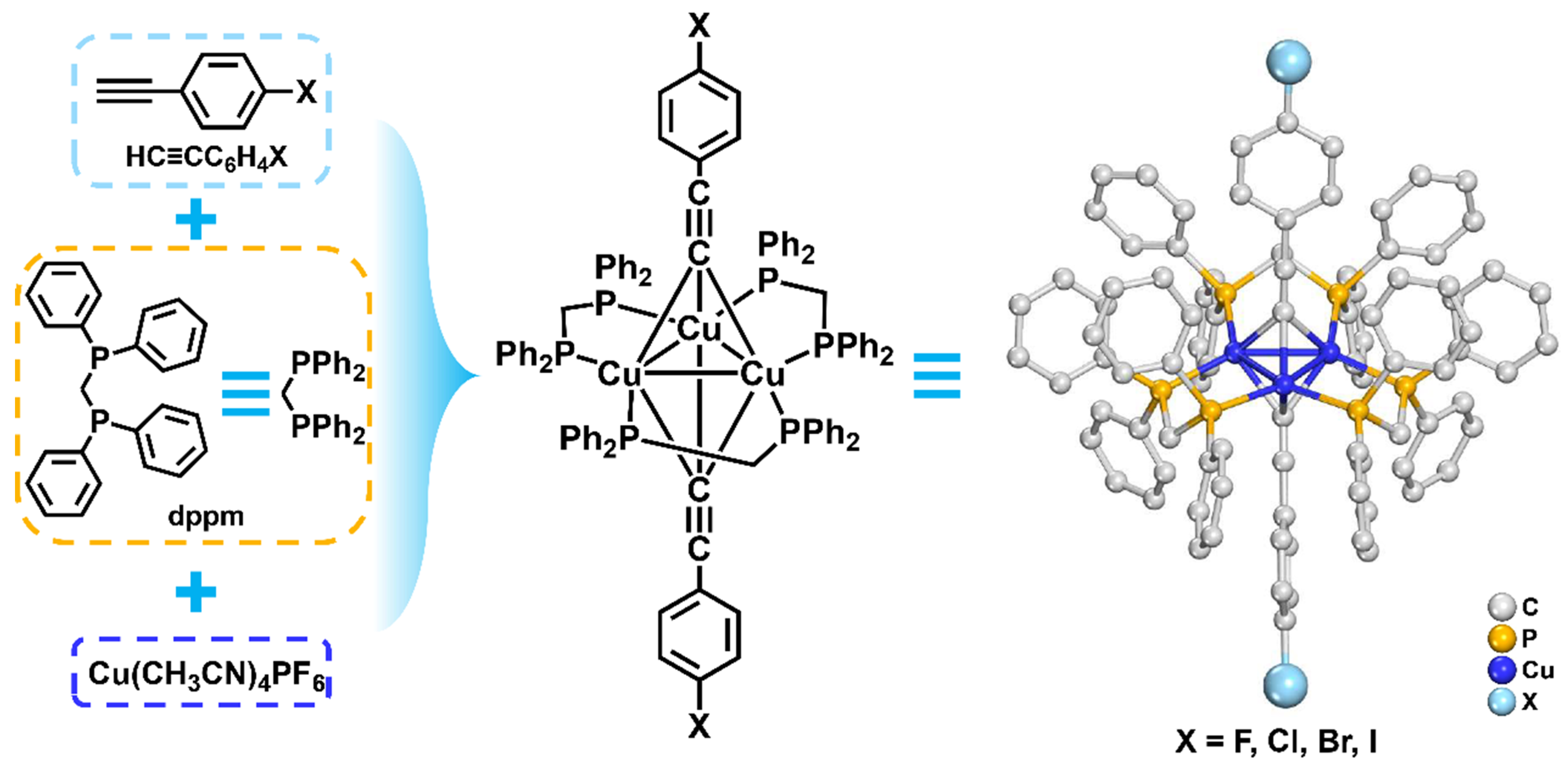
All trinuclear copper(I) clusters were synthesized utilizing a one-pot synthesis approach. Take Cu3-F as an example, Cu(CH3CN)4PF6, 4-Fluorophenylacetylene, and dppm were dissolved in a solvent mixture comprising Et3N and DCM (Figure 1). The resultant mixture was agitated overnight at ambient temperature. Subsequently, this solution underwent centrifugation and diffusion with ether, culminating in the production of white crystals as the final products. Cu3-Cl, Cu3-Br, and Cu3-I can be obtained using an analogous procedure by replacing 4-fluorophenylacetylene with the corresponding haloarylacetylene.
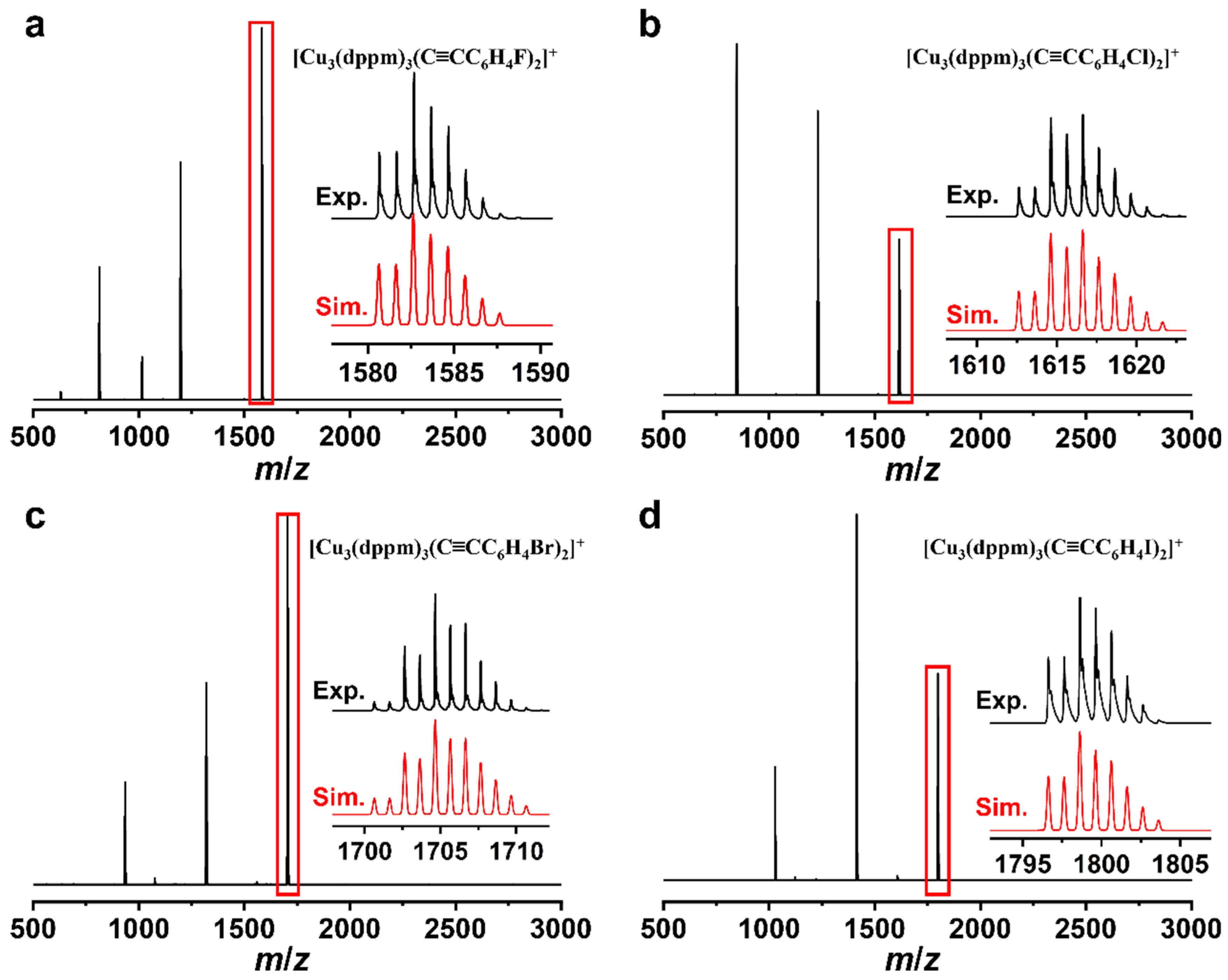
The 1H and 31P{1H} NMR spectroscopic results evidenced the successful formation of trinuclear copper(I) clusters (Figures S1–S12). A systematic downfield shift of the 1H nuclei adjacent to the halogen atoms is observed, and the magnitude of this shift increases progressively from F to Cl, Br, and I, which is attributed to the enhanced Spin-Orbit Heavy Atom on the Light Atom effect with increasing halogen atomic weight [35]. 1H DOSY spectroscopy revealed that all protons of the clusters possessed identical diffusion coefficients (Figures S13–S16). The high-resolution electrospray-ionization mass spectrometry (HR-ESI-MS) analyses further confirmed the chemical formula of Cu3-X clusters. The spectrum of Cu3-X features a series of peaks corresponding to +1 charged species with progressive loss of counter anions and dppm ligands. As shown in Figure 2, the selected molecular ion peaks at m/z 1582.6639, 1616.8998, 1704.6508, and 1798.6416 of Cu3-F, Cu3-Cl, Cu3-Br, and Cu3-I, respectively, which corresponding to the [Cu3(dppm)3(C≡CC6H4F)2]+ (calcd. m/z 1582.2151), [Cu3(dppm)3(C≡CC6H4Cl)2]+ (calcd. m/z 1616.1559), [Cu3(dppm)3(C≡CC6H4Br)2]+ (calcd. m/z 1704.0549), and [Cu3(dppm)3(C≡CC6H4I)2]+ (calcd. m/z 1798.0272). Additional ion peaks observed in the HR-ESI-MS spectra and their corresponding species are summarized in Figures S17–S20. Notably, the HR-ESI-MS spectrum of Cu3-F shows one peak at m/z 1016.0740 corresponding to [Cu2(dppm)2(C≡CC6H4F)]+ (calcd. m/z 1016.1360) with the loss of 1 C≡CC6H4F, 1 dppm, 1 Cu and counter anion (Figure S17c).
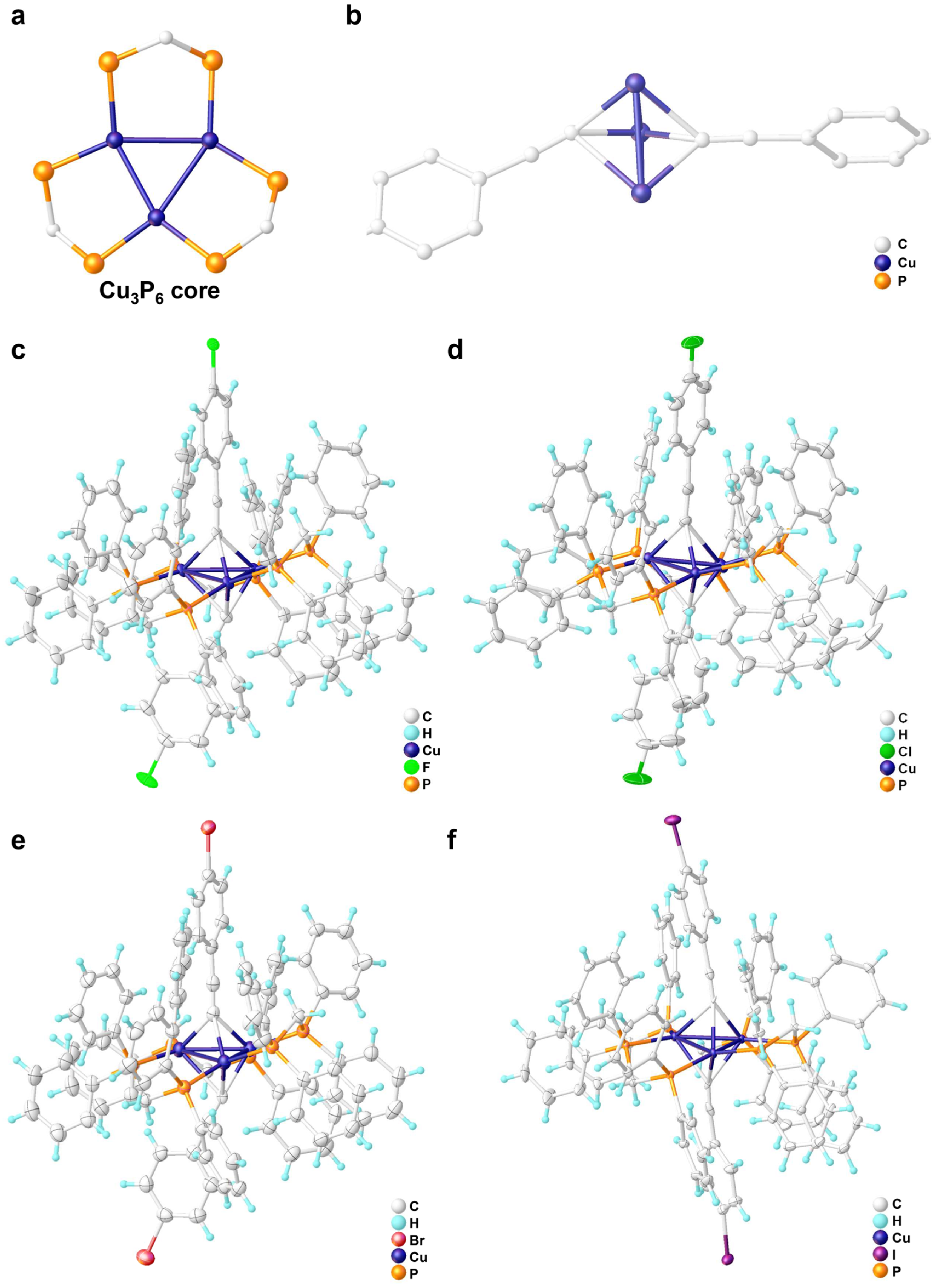
The structures of the crystals were further determined by single-crystal X-ray analysis. Cu3-Cl and Cu3-Br were found to crystallize in the triclinic P-1 space group, while Cu3-F and Cu3-I crystallized in the monoclinic Cc space group and the monoclinic P21/n space group, respectively. Crystallographic data and selected bond lengths and angles are listed in Tables S1–S12. All clusters exhibit an identical structural framework. As shown in Figure 3a, all trinuclear copper(I) complexes feature a trigonal-planar Cu3 core, with Cu–Cu distances ranging from 2.51 to 2.72 Å. This value is shorter than the van der Waals radius sum of copper atoms (2.8 Å), thus confirming the existence of metal–metal interactions. Furthermore, each dppm ligand bridges two copper atoms with an average Cu–P bond distances of 2.28 Å, whereby three ligands collectively form the Cu3P6 core structure. Two alkynyl ligands were each σ-bonded to three copper atoms in the μ3-η1 bridging modes, with Cu–C distances ranging from 2.07 to 2.46 Å (Figure 3b). Notably, the axes of the alkyne triple bonds were not perfectly perpendicular to the Cu3 plane, but rather tilted slightly toward the Cu–C edges with the longest Cu–C bond lengths. Specifically, the angles of the C≡C bond relative to the Cu3 plane were measured to be (84.79°, 74.65°) for Cu3-F, (90.00°, 62.25°) for Cu3-Cl, (90.00°, 61.44°) for Cu3-Br, and (78.30°, 80.54°) for Cu3-I.

2.2. Photophysical Property and Theoretical Calculations

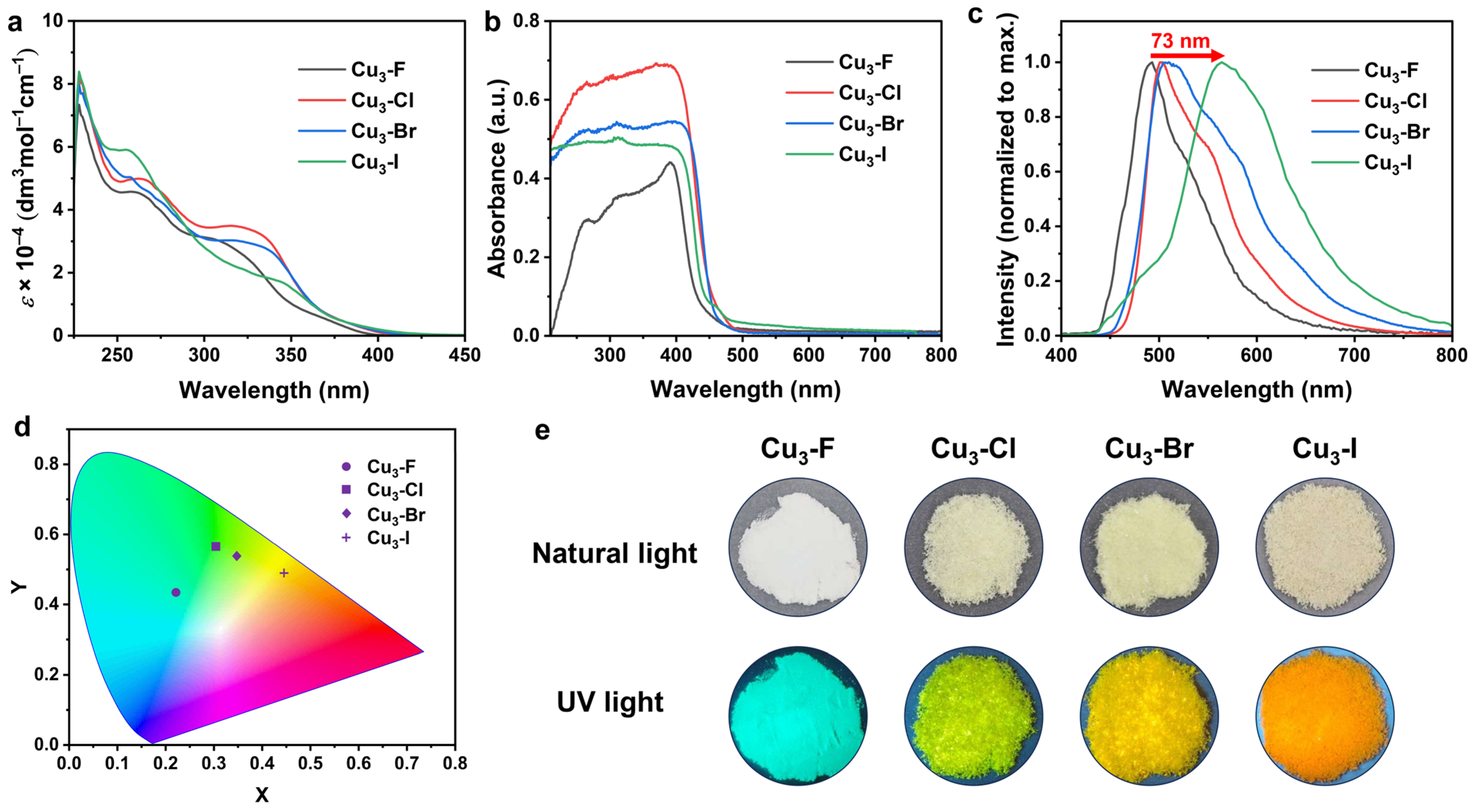
The electronic absorption spectra of the trinuclear copper(I) complexes in CH2Cl2 exhibit absorption bands at approximately 230–250 nm and 250–320 nm (Figure 4a). The high-energy absorptions around 230–250 nm occur at positions similar to the absorption maxima of the free dppm ligand and are assigned to intraligand transitions (Figure S21). The lower-energy absorption in the range of about 250–310 nm is tentatively attributed to acetylide ligand-centered absorption, given its similarity in energy to those of free haloarylacetylene (Figure S21). Additionally, low-energy absorptions are observed in the region of approximately 320–400 nm. It is noteworthy that due to the HAE, Cu3-F exhibits a higher-energy absorption at approximately 316 nm, while with the substitution of heavier atoms, Cu3-Cl, Cu3-Br, and Cu3-I display progressively lower-energy absorptions at 326 nm, 332 nm, and 346 nm, respectively. In addition, the UV-Vis diffuse reflectance spectra of Cu3-X were recorded in the range of 200–800 nm at room temperature (Figure S22). For a better visualization of the absorption features, the reflectance data were converted to −lg(R) values, which serve as a qualitative representation of the absorbance for solid powder samples. All Cu3-X clusters exhibit strong absorption in the 200–450 nm range, with negligible visible-light absorption above 450 nm (Figure 4b). The similar shape of all absorption curves suggests consistent electronic transition behaviors, dominated by charge-transfer transitions from the valence band to the conduction band. The data were subsequently transformed via the Kubelka–Munk function, from which the optical band gap energies were derived (Figure S23). The optical band gaps of Cu3-F, Cu3-Cl, Cu3-Br, and Cu3-I are 2.94 eV, 2.83 eV, 2.79 eV and 2.84 eV, respectively. These results clearly demonstrate that halogen substitution effectively modulates the optical absorption properties of the copper-based clusters.
First-principles calculations based on density functional theory (DFT) were carried out for Cu3 clusters using the Vienna Ab initio Simulation Package (VASP). The electronic states at the valence band maximum (VBM) are predominantly derived from the Cu 3d and C 2p orbitals, whereas the conduction band minimum (CBM) is primarily composed of states from organic ligands, dominated by C 2p orbitals. Given the incorporation of halide atoms (F, Cl, Br, I) within the organic ligands, the contributions of halide p-orbitals (F 2p, Cl 3p, Br 4p, and I 5p) were additionally evaluated in the calculations. As illustrated in Figure S24, the heavier halogen atoms (Cl, Br and I) contribute to the conduction band. Based on these electronic structure characteristics, the emission mechanisms of the four complexes are assigned to either LLCT or MLCT processes.
The photoluminescence (PL) characteristics of the trinuclear copper(I) complexes were subsequently investigated. The photoluminescence spectra of solid of Cu3-X at room temperature are shown in Figure 4c, and Cu3-F shows a strong blue emission at 491 nm with an excitation wavelength of 320 nm. Notably, clusters built from ligands with heavier substituents display a pronounced redshift, as their emission maxima are shifted to considerably longer wavelengths. Specifically, Cu3-Cl, Cu3-Br, and Cu3-I showed a single-band emission peak at 502 nm, 511 nm, and 564 nm at excitation wavelengths of 320 nm, respectively. The Commission Internationale de L’Eclairage color coordinates (CIE) of Cu3-F, Cu3-Cl, Cu3-Br, and Cu3-I are (0.22, 0.43), (0.30, 0.56), (0.35, 0.53), and (0.44, 0.49), respectively (Figure 4d). As shown in Figure 4e, the luminescence color of Cu3-X clusters can be better adjusted by the controlled modification of organic ligands.
To evaluate the luminescence properties of Cu3-X clusters, the absolute PLQY were measured at room temperature. The PLQY of Cu3-F, Cu3-Cl, Cu3-Br, and Cu3-I were 4.61%, 2.97%, 15.24% and 0.19%, respectively. At the excitation wavelengths of Cu3-X clusters, the luminescence lifetime decay curves of the complexes were tested in their maximum emission wavelengths and emission ranges, and exponential fitting was performed (Figure S25). The luminescence lifetimes of Cu3-F, Cu3-Cl, Cu3-Br, and Cu3-I were calculated to be 30.64 μs, 72.19 μs, 114.56 μs and 18.08 μs, respectively. The microsecond radiative decay lifetime confirms the phosphorescent character of the emission, which arises from the triplet excited states. For Cu3-F, Cu3-Cl, and Cu3-Br, the HAE strengthens progressively with the increasing atomic number of the halogen, leading to a corresponding increase in the PLQY and luminescence lifetime. Specifically, Cu3-Br exhibited a 3.3-fold higher PLQY and a 3.7-fold longer photoluminescence lifetime than Cu3-F. These results demonstrate that introducing heavy atoms into the ligands is a viable strategy to enhance the luminescence performance of the clusters through the HAE, as the enhanced SOC promotes intersystem crossing. However, Cu3-I exhibited an unexpected and sharp decrease in both PLQY and luminescence lifetime, deviating from the trend observed in the other clusters. We monitored the changes in the 1H and 31P{1H} NMR spectra of Cu3-I upon light irradiation. After exposure to 365 nm UV light for 2 min, the 1H NMR signals became broadened, and additional peaks appeared in the 31P{1H} NMR spectrum (Figure S26), suggesting that the structure of Cu3-I might be disrupted. This poor photostability of Cu3-I is responsible for its compromised optical performance. Moreover, the characteristic peaks of Cu3-I in both the 1H and 31P{1H} NMR spectra gradually vanished with increasing irradiation time. A new resonance at δ = 25 in the 31P{1H} NMR spectrum indicated the oxidation of dppm ligands to bis(diphenylphosphanyl)methane oxide, which abolished its chelating ability toward the Cu3 core and led to disassembly of the trinuclear cluster framework. Comparison with other low-nuclearity copper clusters reported in the literature reveals that the Cu3-X series in this work exhibits a remarkably wide tunability of phosphorescence lifetimes (Table S13). Notably, the lifetime of Cu3-Br (114.56 μs) is significantly longer than most entries in the table, such as [Cu3(dppm)3(C≡CC6H4OMe-p)2]PF6 (63.8 μs) [34] and [Cu3(dppm)3 (C≡CC6H4-4-NHC(O)NHC6H4-4-CF3)2F] (54.1 μs) [20]. In contrast, the lifetime of Cu3-I (18.08 μs) is comparable to that of clusters bearing heavy atoms, as exemplified by Cu4I4L4 (6.6 μs) [36] and [Cu4I4(4-dpda)4] (2.54 μs) [37].
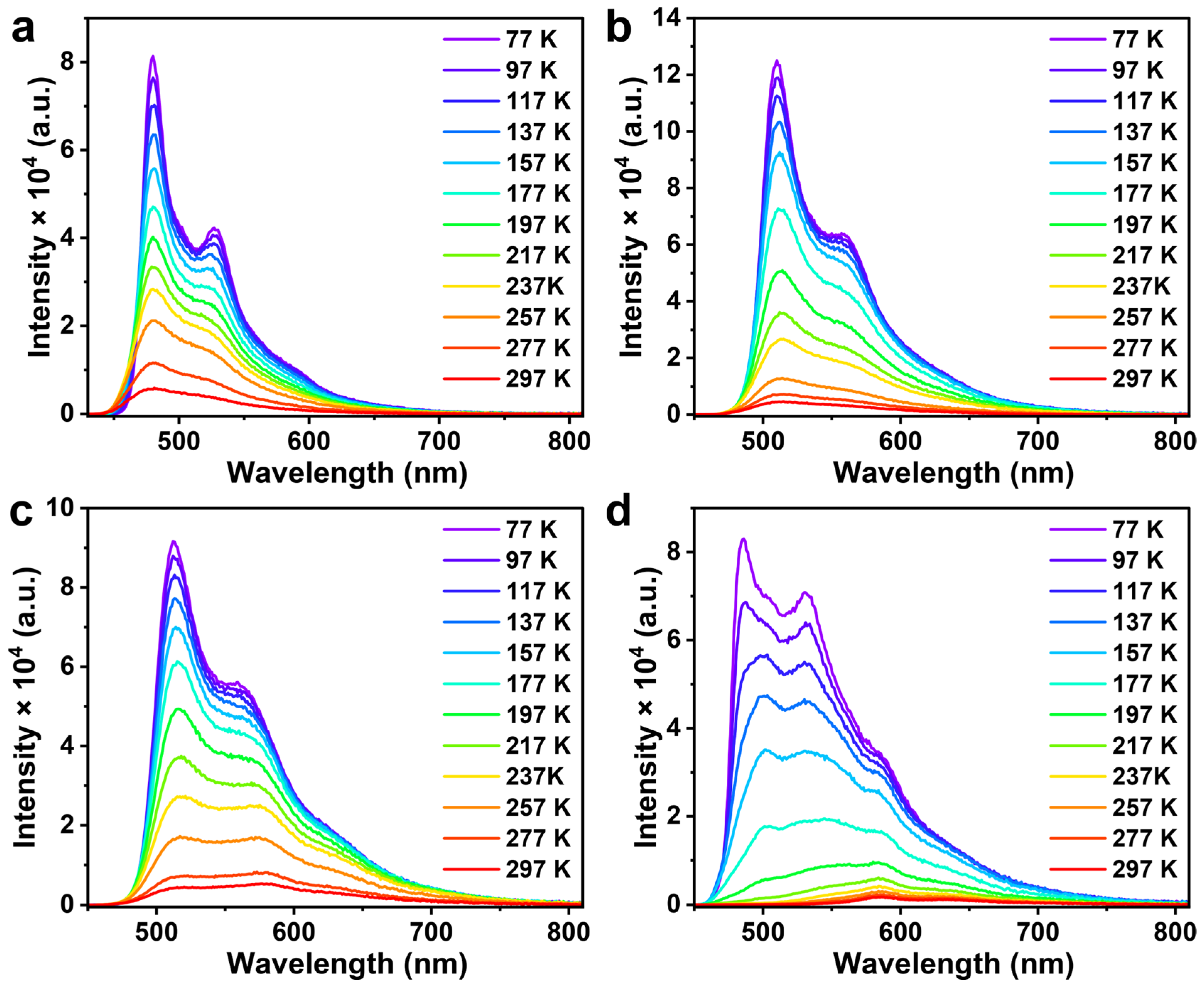
Subsequently, the photoluminescence characteristics of Cu3-X clusters were evaluated at a temperature of 77 K (Figure S27). At this temperature, all four compounds exhibit very similar emission spectra, with peaks in the blue-green-yellow region (~480–580 nm). Specifically, Cu3-F exhibited emission at a wavelength of 480 nm, accompanied by a shoulder at 527 nm. Cu3-Cl showed emission at 511 nm with a shoulder at 560 nm. Cu3-Br emitted at 512 nm, with a corresponding shoulder at 561 nm. For Cu3-I, the emission maximum was observed at 486 nm, accompanied by two shoulders at 531 and 586 nm. This indicates that non-radiative processes are frozen at 77 K, and the emission is dominated by the intrinsic radiative decay from T1. Moreover, the phosphorescence lifetimes of Cu3-X clusters follow the order: Cu3-F (363.20 µs) > Cu3-Cl (313.70 µs) ≈ Cu3-Br (313.70 µs) > Cu3-I (265.84 µs), which decrease progressively with increasing atomic number of the halogen (Table 1 and Figure S28). This trend is a classic manifestation of the HAE, where stronger SOC in the heavier halogens partially relaxes the spin-forbidden triplet-singlet transition, thereby accelerating the radiative rate and shortening the observed lifetime.
The temperature-dependent luminescence characteristics of the solid-state samples were assessed, revealing distinct luminescent behaviors for Cu3-X clusters at lower temperatures (Figure 5). As the temperature was raised from 77 K to 297 K, a significant decrease in both the intensity and lifetime of the phosphorescence was observed, which mainly attributed to the transition from radiative-dominated to non-radiative-dominated kinetics. For Cu3-F and Cu3-Cl, the pronounced rigidity of the crystal lattice and weak electron–phonon coupling effectively suppress excited-state structural relaxation. As a result, their room-temperature emission maxima remain nearly identical to those observed at 77 K, and their phosphorescence lifetimes are moderate. In contrast, Cu3-Br exhibits intermediate lattice flexibility and electron–phonon coupling strength, enabling partial relaxation of the excited state without leading to complete thermal quenching. Consequently, its emission peak undergoes a slight red-shift relative to the low-temperature position, yet it retains the longest room-temperature lifetime among Cu3-X clusters (114 µs), indicative of a relatively high activation energy barrier for non-radiative decay. Cu3-I, however, represents the extreme case within Cu3-X clusters. As the heaviest halogen, iodide introduces two synergistic effects that profoundly influence the photophysical behavior. First, the strong SOC inherent to iodine, while promoting phosphorescence at low temperatures, simultaneously exacerbates non-radiative recombination at elevated temperatures by enhancing spin–vibration coupling. Second, the large ionic radius and high polarizability of iodide ligands hinder dense crystal packing, resulting in an exceptionally soft lattice with reduced structural rigidity. This combination of strong spin–orbit coupling and loose packing permits extensive thermally induced structural reorganization of the excited state at ambient temperature, leading to the formation of a lower-energy self-trapped exciton (STE) state. This is manifested as a significantly red-shifted emission band that deviates entirely from the original low-temperature peak. Concurrently, such excessive structural relaxation facilitates highly efficient non-radiative dissipation pathways, yielding an extremely short lifetime (18 µs) and severely quenched luminescence at room temperature. In summary, systematic halogen substitution on the ligand represents an effective strategy to regulate the excited-state dynamics. Furthermore, the values of the radiative rate constant (kr) and non-radiative rate constant (knr) were calculated to quantitatively assess the degree of non-radiative decay in the structures of Cu3-X (Table 1). Notably, Cu3-I exhibited the largest non-radiative rate constant (knr = 5.52 × 10⁴ s−1), whereas Cu3-Br displays the smallest knr value (7.4 × 10³ s−1) among the series. This pronounced difference further confirmed that the softer lattice and enhanced electron-phonon coupling imparted by the heavier iodide ligand dramatically accelerate non-radiative recombination, consistent with the severely quenched emission and ultrashort lifetime observed for Cu3-I at room temperature.
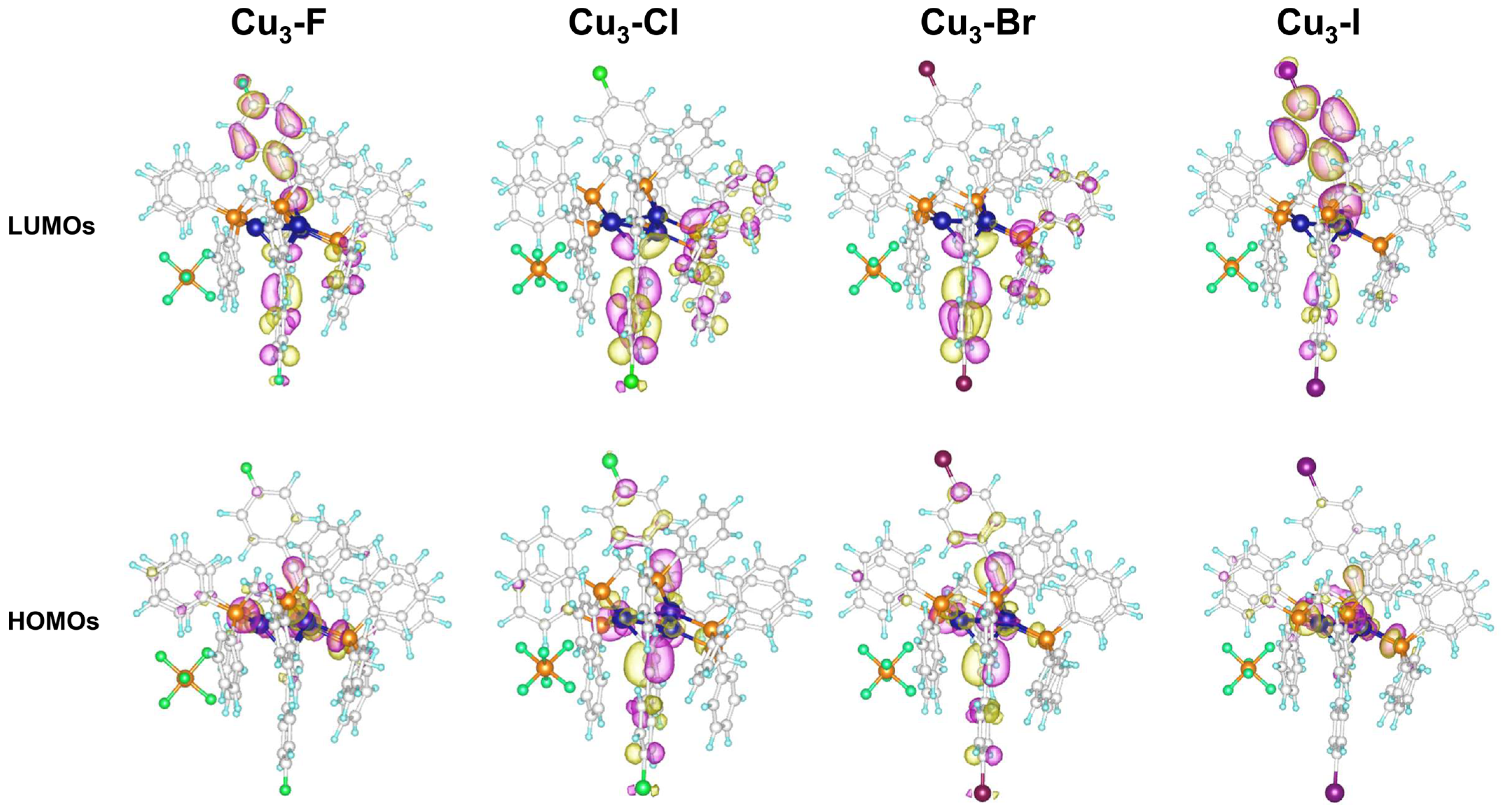
To rationalize the experimental spectroscopic results at the molecular level, time-dependent density functional theory (TD-DFT) and spin–orbit coupling calculations were carried out. The T1 energies and SOC constants were calculated and listed in Table S14. The T1 excitation energies decrease gradually from Cu3-F to Cu3-I, consistent with the progressive red shift in emission wavelength. The SOC matrix elements between the lowest S1 and T1 were calculated to quantitatively evaluate the ISC process, which governs the phosphorescence emission. Notably, the SOC constant increases significantly from 1.59 cm−1 (Cu3-F) to 14.6 cm−1 (Cu3-I), providing direct quantitative evidence for HAE. The transition orbital analysis (Table S15) indicates that the T1 state possesses dominant MLCT character (Figure 6), with notable halogen contribution. These results clearly demonstrate that the halogen ligands modulate the emission energy and photophysical behavior via tuning the excited-state energy and SOC strength.

3. Materials and Methods

Unless otherwise stated, all reagents were purchased from commercial suppliers and used without further purification. [Cu(MeCN)4]PF6, bis(diphenylphosphino)methane (dppm), 4-fluorophenylacetylene (HC≡CC6H4F), 4-chloroethynylbenzene (HC≡CC6H4Cl), 4-bromophenylacetylene (HC≡CC6H4Br) and 4-iodophenylacetylene (HC≡CC6H4I) were purchased from Titan, Shanghai, China.

3.1. Synthesis of Cu3-X

3.1.1. Synthesis of the [Cu3(dppm)3(C≡CC6H4F)2]PF6 (Cu3-F)

To a solution of Cu(CH3CN)4PF6 (33.50 mg, 0.09 mmol), 4-fluorophenylacetylene (7.21 mg, 0.06 mmol), dppm (34.60 mg, 0.09 mmol), Et3N (30 μL), and DCM (4 mL) were charged. After stirring at room temperature overnight, the mixture was concentrated under reduced pressure. The residue was dissolved in DCM (2 mL) and filtered. White crystals suitable for single-crystals X-ray analysis can be obtained after one week by slow vapor diffusion of diethyl ether into the filtrate at ambient temperature. Yield: 36 mg, 69%, based on Cu(CH3CN)4PF6.1H NMR (400 MHz, CDCl3) δ 7.37–7.30 (m, 4H), 7.19 (t, J = 8.6 Hz, 4H), 7.10–7.01 (m, 36H), 6.82 (t, J = 7.7 Hz, 24H), 3.06 (s, 6H). 31P{1H} NMR (162 MHz, CDCl3) δ −5.37, −143.58. HR-ESI-MS calcd. for [Cu3(C25H22P2)3(C8H4F)2]+ 1582.2151, found 1582.6639; calcd. for [Cu3(C25H22P2)2(C8H4F)2]+ 1198.0953, found 1198.1968; calcd. for [Cu2(C25H22P2)2(C8H4F)]+ 1016.1360, found 1016.0740; calcd. for [Cu3(C25H22P2)(C8H4F)2]+ 813.9757, found 813.7292.

3.1.2. Synthesis of the [Cu3(dppm)3(C≡CC6H4Cl)2]PF6 (Cu3-Cl)

The procedure was similar to that for Cu3-F except 4-chloroethynylbenzene (8.20 mg, 0.06 mmol) was used in place of 4-fluorophenylacetylene. White crystals of Cu3-Cl were obtained. Yield: 42 mg, 80%, based on Cu(CH3CN)4PF6. 1H NMR (400 MHz, CDCl3) δ 7.45 (d, J = 8.5 Hz, 4H), 7.27 (d, J = 8.4 Hz, 4H), 7.11–7.03 (m, 36H), 6.82 (t, J = 7.7 Hz, 24H), 3.07 (s, 6H). 31P{1H} NMR (162 MHz, CDCl3) δ −5.22, −143.60. HR-ESI-MS calcd. for [Cu3(C25H22P2)3(C8H4Cl)2]+ 1616.1559, found 1616.8998; calcd. for [Cu3(C25H22P2)2(C8H4Cl)2]+ 1230.0363, found 1230.3870; calcd. for [Cu3(C25H22P2)(C8H4Cl)2]+ 845.9166, found 845.8566.

3.1.3. Synthesis of the [Cu3(dppm)3(C≡CC6H4Br)2]PF6 (Cu3-Br)

The procedure was similar to that for Cu3-F except 4-bromophenylacetylene (10.86 mg, 0.06 mmol) was used in place of 4-fluorophenylacetylene. Yellow block-shaped single crystals of Cu3-Br were obtained. Yield: 40 mg, 72%, based on Cu(CH3CN)4PF6. 1H NMR (400 MHz, CDCl3) δ 7.61 (d, J = 8.4 Hz, 4H), 7.20 (d, J = 8.4 Hz, 4H), 7.10–7.01 (m, 36H), 6.82 (t, J = 7.8 Hz, 24H), 3.06 (s, 6H). 31P{1H} NMR (162 MHz, CDCl3) δ −5.20, −143.62. HR-ESI-MS calcd. for [Cu3(C25H22P2)3(C8H4Br)2]+ 1704.0549, found 1704.6508; calcd. for [Cu3(C25H22P2)2(C8H4Br)2]+ 1319.9352, found 1320.1622; calcd. for [Cu3(C25H22P2)(C8H4Br)2]+ 935.8156, found 935.6915.

3.1.4. Synthesis of the [Cu3(dppm)3(C≡CC6H4I)2]PF6 (Cu3-I)

The procedure was similar to that for Cu3-F except 4-iodophenylacetylene (13.68 mg, 0.06 mmol) was used in place of 4-fluorophenylacetylene. Yellow block-shaped single crystals of Cu3-I were obtained. Yield: 45 mg, 78%, based on Cu(CH3CN)4PF6. 1H NMR (400 MHz, CDCl3) δ 7.83 (d, J = 8.2 Hz, 4H), 7.12–7.02 (m, 40H), 6.84 (t, J = 7.6 Hz, 24H), 3.08 (s, 6H). 31P{1H} NMR (162 MHz, CDCl3) δ −5.78, −144.25. HR-ESI-MS calcd. for [Cu3(C25H22P2)3(C8H4I)2]+ 1798.0272, found 1798.6416; calcd. for [Cu3(C25H22P2)2(C8H4I)2]+ 1413.9075, found 1414.1814; calcd. for [Cu3(C25H22P2)(C8H4I)2]+ 1029.7878, found 1029.7231.

3.2. NMR and HR-ESI-MS Measurements

1H NMR spectra were recorded on a Bruker (Billerica, MA, USA) Biospin Avance III (400 MHz) spectrometer or JEOL (Akishima, Tokyo, Japan) ECZ400S/L1 spectrometer with chemical shifts (δ, ppm) relative to tetramethylsilane (Me4Si). COSY and DOSY NMR spectra were recorded on a Bruker Biospin Avance III (400 MHz) spectrometer. 31P{1H} NMR spectra were recorded on a Bruker Biospin Avance III 400 (162 MHz) Fourier transform NMR spectrometer with chemical shifts (δ, ppm) relative to 85% H3PO4.
HR-ESI-MS were recorded on a Waters (Milford, MA, USA) Synapt HDMS G2-Si mass spectrometer in positive reflection mode. The data analyses of mass spectra were performed based on the isotope distribution patterns using Waters MassLynx V4.1. The reported m/z values represent the monoisotopic mass of the most abundant peak within the isotope pattern.

3.3. Single-Crystal X-Ray Crystallography

X-Ray diffraction data of Cu3-F, Cu3-Cl, Cu3-Br, and Cu3-I were carried out on Synergy-R-Cu diffractometer equipped with a graphite-monochromated Cu-Kα radiation source (λ = 1.54184 Å) at 100 K. Using Olex2 (Version 1.5) [38], the crystal structures were determined by direct methods with ShelxT and refined by the full-matrix least-squares method based on F2 with the SHELXL 2016 [39,40,41]. Non-hydrogen atoms were refined anisotropically. All hydrogen atoms on C were bonded by theory. Some solvent molecules in the crystal structure were omitted using SQUEEZE program as they were highly disordered and could not be resolved unambiguously [42]. The X-ray crystallographic data for Cu3-X have been deposited at the Cambridge Crystallographic Data Centre (CCDC), number CCDC 2528138-2528141.

3.4. UV-Vis Absorption Spectra Measurements

The UV-vis absorption spectra of Cu3-F, Cu3-Cl, Cu3-Br, and Cu3-I was recorded using an Agilent (Santa Clara, CA, USA) Cary 60 UV-vis spectrophotometer using a quartz cuvette with a 1 cm optical path length. The data were collected in the wavelength range of 200–450 nm.

3.5. Optical Diffuse Reflectance Measurements

Optical diffuse reflectance spectra were measured by a Shimadzu (Tokyo, Japan) UV-2600i spectrophotometer with BaSO4 powder as the standard (100% reflectance) at room temperature. The data were collected in the wavelength range of 200–800 nm.
The relative absorbance (A) of the samples was converted from the diffuse reflectance data using the simplified formula:
A = l g ( R ) ,  
where R is the relative reflectance of the sample calibrated against BaSO4.
In order to evaluate the band gap, the Kubelka–Munk function is used to collect and transform the data. Specifically, the Kubelka–Munk transformation converts the diffuse reflectance data (R) into the remission function F(R) using the equation:
F ( R ) = ( 1 R ) 2 ( 2 × R ) ,  
where R represents the absolute reflectance of the sample relative to the BaSO4 reference.
The optical band gap (Eg) was determined by plotting the Kubelka–Munk function F(R) against photon energy (, calculated as = 1240/λ, where λ is the wavelength in nm). A tangent line was fitted to the steepest linear portion of the absorption edge in the F(R) vs. plot, and the optical band gap was obtained by extrapolating this tangent to the axis at F(R) = 0.

3.6. Photoluminescence Spectra Measurements and Lifetime Measurements

Photoluminescence measurements of Cu3-X in the solid state were recorded using an Edinburgh Instrument (Livingston, UK) FLS1000 photoluminescence spectrometer at room temperature. The obtained sample powder was put into between two glass plates for measurements. The lifetime decay data is also recorded using an Edinburgh Instrument FLS1000 photoluminescence spectrometer at room temperature. The lifetimes of the sample were extracted by fitting the decay curves in Origin with first, second or third order exponential decay functions with coefficient of determination (R2) values larger than 0.99.

3.7. Quantum Yield Measurements

The room temperature absolute photoluminescence quantum yields of Cu3-X in powder were measured on an Edinburgh Instrument FLS1000 photoluminescence spectrometer with an integrating sphere accessory under ambient conditions. The sample to be measured is prepared by spreading the powder sample evenly on the bottom of the quartz sample holder.

3.8. Radiative and Non-Radiative Rate Constant

The radiative rate constant and non-radiative rate constant (kr and knr, respectively) were estimated by the following equations:
k r = Φ τ ,   k n r = 1 Φ τ ,
where Φ represents the absolute photoluminescence quantum yield of Cu3-X and the and τ represents its average photoluminescence lifetime.

3.9. Computational Details

All density functional theory (DFT) calculations were performed using the Vienna Ab initio Simulation Package (VASP, Version 6.0) [43,44,45], with the projector-augmented wave (PAW) method [46] to describe the electron-ion interactions. The Perdew-Burke-Ernzerhof (PBE) [47] functional within the generalized gradient approximation (GGA) was adopted for the exchange-correlation potential.

3.9.1. Structural Optimization

The geometric optimization of the Cu cluster was carried out in a periodic cubic box with lattice parameters of 25.9675 × 25.9675 × 45.9675 Å3 (sufficient vacuum layer to eliminate periodic interactions between cluster images). The plane-wave cutoff energy was set to 500 eV to ensure the convergence of valence electron wavefunctions for both light (H/C/F) and heavy (Cu/I/Br/Cl/P) elements. The electronic self-consistency convergence criterion was set to 1 × 10⁻⁶ eV, and the ionic relaxation was terminated when the maximum Hellmann-Feynman force on each atom was less than 0.001 eV Å−1 (EDIFFG = −1 × 10⁻³). The conjugate gradient algorithm (IBRION = 2) was used for ionic relaxation with a maximum of 200 ionic steps (NSW = 200), and only atomic positions were optimized (ISIF = 2) while the lattice parameters were fixed. The real-space projection (LREAL = Auto) and augmented grid (ADDGRID = .TRUE.) were enabled to accelerate the calculation and improve the accuracy for heavy elements, respectively. Non-spherical pseudopotential correction (LASPH = .TRUE.) was adopted to enhance the precision of p-block elements (F/P).

3.9.2. DOS and PDOS Calculations

After structural optimization, static self-consistent field (SCF) calculations were performed with a stricter electronic convergence criterion (1 × 10⁻⁸ eV) to generate accurate charge density (CHGCAR) and wavefunction (WAVECAR) files. Subsequently, non-self-consistent field (NSCF) calculations were carried out to compute the density of states (DOS) and projected density of states (PDOS), with the following key settings: the k-point sampling was restricted to the 1 × 1 × 1 Monkhorst-Pack grid due to the isolated cluster nature; the energy range for DOS sampling was set from −20 eV to 15 eV relative to the Fermi level, with 3000 discrete energy points (NEDOS = 3000) to ensure smooth DOS curves; the LORBIT = 11 tag was enabled to output full PDOS information (including s/p/d orbital projections for each atom).
The total DOS (TDOS) and PDOS data were extracted and visualized using VASPKIT [48], with the Fermi level set to zero for normalization. All calculations were performed on x-core CPU nodes with a parallelization scheme based on plane-wave and k-point decomposition.

3.9.3. TD-DFT and SOC Calculations

All comprehensive excited-state TD-DFT calculations were performed using Gaussian 16 at the B3LYP-D3BJ level, with the LanL2DZ basis set for Cu, Br, and I atoms and 6-31G(d) for other atoms. SOC calculations were carried out using ORCA 6.0 at the B3LYP-D3BJ/cc-pvdz level.

4. Conclusions

In this study, a series of well-defined trinuclear copper(I) clusters protected by dppm and haloarylacetylene, [Cu3(dppm)3(C≡CC6H4X)2]PF6 (Cu3-X, X = F, Cl, Br, and I), were synthesized and systematically investigated. The luminescence mechanism of all Cu3-X clusters was confirmed to be triplet-state phosphorescence dominated by MLCT transitions with partial LLCT character, where the halogen p-orbitals (F 2p, Cl 3p, Br 4p, I 5p) participate in the construction of the conduction band, effectively regulating the excited-state energy levels and electronic transition properties of the clusters. The results demonstrate that the HAE introduced via halogen substitution on the ligands effectively modulates the luminescence properties of the clusters by enhancing the SOC strength and thus promoting the ISC process from S1 toT1. As the atomic number of the halogen increases, the emission peaks exhibit a pronounced red-shift from 491 nm for Cu3-F to 564 nm for Cu3-I, corresponding to a total shift of 73 nm. This redshift is attributed to the gradual decrease in the T1 energy induced by HAE, and this trend is consistent with the results of TD-DFT and SOC calculations. Meanwhile, both the phosphorescence quantum yield and lifetime are significantly enhanced for Cu3-Cl and Cu3-Br. Cu3-Br exhibited the optimal performance, with a 3.3-fold increase in quantum yield and a 3.7-fold extension in lifetime compared to Cu3-F. This superior luminescence performance is primarily due to the enhanced SOC that promotes ISC. It also suppresses non-radiative decay via a rigid crystal lattice and weak electron-phonon coupling. In contrast, Cu3-I shows a sharp drop in luminescence efficiency, arising from photoexcitation-induced structural instability as well as the synergistic effect of strong spin-vibration coupling and a soft lattice. These factors accelerate non-radiative recombination at room temperature and confirm the non-monotonic nature of the HAE. Excessive atomic size induces photodegradation and abnormal excited-state dynamics, which offset the benefits of enhanced ISC. This work clearly elucidates the role of ligand modification in regulating the photophysical properties of copper clusters via precise molecular design and structural characterization, and reveals the intrinsic links between halogen substitution, electronic structure, SOC strength and luminescence performance in Cu3 clusters, providing crucial guidance for the rational design of high-performance luminescent cluster-based materials and unraveling the structure-property relationship.

Supplementary Materials

The following supporting information can be downloaded at: https://www.mdpi.com/article/10.3390/molecules31060987/s1, Figures S1–S16: 1H, 31P{1H},1H-1H COSY and DOSY NMR spectra of clusters; Figures S17–S20: HR-ESI-MS spectra of clusters; Figure S21: UV-Vis absorption spectra of ligands; Figures S22 and S23: UV-Vis diffuse reflectance spectra and Kubelka–Munk transformed spectra of clusters; Figure S24: Density of states plots; Figure S25: Plots of emission decay lifetime; Figure S26: Time-dependent evolution of 1H and 31P{1H} NMR spectra; Figures S27 and S28: Photoluminescence characteristics of Cu3-X clusters at 77 K; Tables S1–S12: Crystal data, structure refinement, selected bond lengths and angles for clusters; Table S13: Comparison of photophysical properties of Cu3-X clusters with literature reports; Table S14: Calculated triplet excitation energies, SOC constants, and emission wavelengths for Cu3-X clusters; Table S15: Molecular orbitals contributing to the T1 excited state of Cu3-X clusters. Refs. [20,33,34,36,37,49,50,51,52,53,54] are cited in the Supplementary Materials.

Author Contributions

Conceptualization, Q.Y. and Y.W.; formal analysis, Q.Y. and L.-L.C.; writing—original draft preparation, Q.Y., J.Y., and Y.W.; data curation, Q.Y., L.-L.C., F.-X.X., Y.-T.M. and S.-Y.L.; software, J.Y.; writing—review and editing, J.Y. and Y.W.; funding acquisition, Y.W.; supervision, J.Y. and Y.W. All authors have read and agreed to the published version of the manuscript.

Funding

This research was funded by the Outstanding Postdoctoral Support Program of Fujian Province (grant No. E4391101), administered by the Human Resources and Social Security Department of Fujian Province.

Institutional Review Board Statement

Not applicable.

Informed Consent Statement

Not applicable.

Data Availability Statement

All data are contained within the article and its Supplementary Materials.

Acknowledgments

Y.W. acknowledges the Outstanding Postdoctoral Support Program of Fujian Province.

Conflicts of Interest

The authors declare that they have no conflicts of interest.

Abbreviations

The following abbreviations are used in this manuscript:
HAEHeavy-atom effect
ISCIntersystem crossing
PLQYPhotoluminescence quantum yield
DOSYDiffusion ordered spectroscopy
HR-ESI-MSHigh-resolution electrospray-ionization mass spectrometry
dppmbis(diphenylphosphino)methane

References

  1. Ma, F.; Ivanov, S.A.; Dobrzycki, L.M.; Zeng, C. Programmable synthesis of atomically precise semiconductor artificial atoms. Nat. Synth. 2025, 4, 1258−1269. [Google Scholar] [CrossRef]
  2. Yao, Y.; Dong, Q.; Brozena, A.; Luo, J.; Miao, J.; Chi, M.; Wang, C.; Kevrekidis, I.G.; Ren, Z.J.; Greeley, J.; et al. High-entropy nanoparticles: Synthesis-structure-property relationships and data-driven discovery. Science 2022, 376, eabn3103. [Google Scholar] [CrossRef]
  3. Liu, Y.; Goebl, J.; Yin, Y. Templated synthesis of nanostructured materials. Chem. Soc. Rev. 2013, 42, 2610−2653. [Google Scholar] [CrossRef] [PubMed]
  4. Li, S.; Li, N.-N.; Dong, X.-Y.; Zang, S.-Q.; Mak, T.C.W. Chemical Flexibility of Atomically Precise Metal Clusters. Chem. Rev. 2024, 124, 7262−7378. [Google Scholar] [CrossRef]
  5. Chakraborty, I.; Pradeep, T. Atomically Precise Clusters of Noble Metals: Emerging Link between Atoms and Nanoparticles. Chem. Rev. 2017, 117, 8208−8271. [Google Scholar] [CrossRef]
  6. Yao, Q.; Zhu, M.; Yang, Z.; Song, X.; Yuan, X.; Zhang, Z.; Hu, W.; Xie, J. Molecule-like synthesis of ligand-protected metal nanoclusters. Nat. Rev. Mater. 2025, 10, 89−108. [Google Scholar] [CrossRef]
  7. Matus, M.F.; Häkkinen, H. Understanding ligand-protected noble metal nanoclusters at work. Nat. Rev. Mater. 2023, 8, 372−389. [Google Scholar] [CrossRef]
  8. Zhang, X.; Xu, H. Electroluminescent Clusters. Angew. Chem. Int. Ed. 2023, 63, e202317597. [Google Scholar] [CrossRef]
  9. Zheng, H.; Li, Y.; Zhan, W.-W.; Zhou, J.; Wu, G.; Zhang, C.; Sun, D.; Yang, Y. Integrating Circular Polarized Luminescence and Long Persistent Luminescence in Cu8 Cage-like Clusters via Ligand Engineering. Angew. Chem. Int. Ed. 2025, 64, e202423787. [Google Scholar] [CrossRef] [PubMed]
  10. Li, J.-K.; Dong, J.-P.; Liu, S.-S.; Hua, Y.; Zhao, X.-L.; Li, Z.; Zhao, S.-N.; Zang, S.-Q.; Wang, R. Promoting CO2 Electroreduction to Hydrocarbon Products via Sulfur-Enhanced Proton Feeding in Atomically Precise Thiolate-Protected Cu Clusters. Angew. Chem. Int. Ed. 2024, 63, e202412144. [Google Scholar] [CrossRef]
  11. Liu, L.-J.; Wang, Z.-Y.; Wang, Z.-Y.; Wang, R.; Zang, S.-Q.; Mak, T.C.W. Mediating CO2 Electroreduction Activity and Selectivity over Atomically Precise Copper Clusters. Angew. Chem. Int. Ed. 2022, 61, e202205626. [Google Scholar] [CrossRef]
  12. Hu, F.; Yang, G.; Zheng, L.-M.; Liang, G.-J.; Wang, Q.-M. Deciphering icosahedra structural evolution with atomically precise silver nanoclusters. Science 2025, 389, 921−924. [Google Scholar] [CrossRef] [PubMed]
  13. Zou, X.; Kang, X.; Zhu, M. Recent developments in the investigation of driving forces for transforming coinage metal nanoclusters. Chem. Soc. Rev. 2023, 52, 5892−5967. [Google Scholar] [CrossRef] [PubMed]
  14. Wang, X.; Yin, B.; Jiang, L.; Yang, C.; Liu, Y.; Zou, G.; Chen, S.; Zhu, M. Ligand-protected metal nanoclusters as low-loss, highly polarized emitters for optical waveguides. Science 2023, 381, 784−790. [Google Scholar] [CrossRef]
  15. Shi, W.-Q.; Zeng, L.; He, R.-L.; Han, X.-S.; Guan, Z.-J.; Zhou, M.; Wang, Q.-M. Near-unity NIR phosphorescent quantum yield from a room-temperature solvated metal nanocluster. Science 2024, 383, 326−330. [Google Scholar] [CrossRef] [PubMed]
  16. Yin, B.; Luo, Z. Coinage metal clusters: From superatom chemistry to genetic materials. Coord. Chem. Rev. 2021, 429, 213643. [Google Scholar] [CrossRef]
  17. Lu, L.; Zhu, C.; Li, F.; Wang, P.; Kang, X.; Pei, Y.; Zhu, M. Ligand effects on geometric structures and catalytic activities of atomically precise copper nanoclusters. Chin. J. Struct. Chem. 2024, 43, 100411. [Google Scholar] [CrossRef]
  18. Yuan, J.-W.; Zhang, M.-M.; Dong, X.-Y.; Zang, S.-Q. Master key to coinage metal nanoclusters treasure chest: 38-metal clusters. Nanoscale 2022, 14, 1538−1565. [Google Scholar] [CrossRef]
  19. Jin, Y.; Peng, Q.-C.; Li, S.; Su, H.-F.; Luo, P.; Yang, M.; Zhang, X.; Li, K.; Zang, S.-Q.; Tang, B.Z.; et al. Aggregation-induced barrier to oxygen—a new AIE mechanism for metal clusters with phosphorescence. Natl. Sci. Rev. 2022, 9, nwab216. [Google Scholar] [CrossRef]
  20. Zhou, Y.-P.; Wei, Z.-W.; Lin, Z.-J.; Ling, H.-T.; Guo, Z.; Zhang, M.; Lam, C.-K.; Ye, B.-H.; Chao, H.-Y. Diverse binding of important anions in 1-D tricopper anion coordination polymer (ACP) architectures. CrystEngComm 2017, 19, 2349−2358. [Google Scholar] [CrossRef]
  21. Troyano, J.; Zamora, F.; Delgado, S. Copper(i)–iodide cluster structures as functional and processable platform materials. Chem. Soc. Rev. 2021, 50, 4606−4628. [Google Scholar] [CrossRef]
  22. Akiyama, A.; Hossain, S.; Niihori, Y.; Oiwa, K.; Roy, J.; Kawawaki, T.; Pradeep, T.; Negishi, Y. Enhancement of Photoluminescence Quantum Yield of Silver Clusters by Heavy Atom Effect. Small 2025, 21, 2500700. [Google Scholar] [CrossRef] [PubMed]
  23. Veerapathiran, S.; Muduli, G.; Rawat, A.; Siddhant, K.; Singh, J.; Matsumoto, K.; Tsutsumi, O.; Prabusankar, G. Organo Chalcogenone-Triggered Luminescent Copper(I) Clusters for Light Emitting Applications. Inorg. Chem. 2024, 63, 12708−12720. [Google Scholar] [CrossRef]
  24. Huang, Z.; Zhao, E.; Qi, P.; Song, A. Zero-dimensional antimony halides with tunable photoluminescence via halogen ligand modulation. J. Mater. Chem. C 2023, 11, 15742−15749. [Google Scholar] [CrossRef]
  25. He, Y.; Wang, J.; Li, Q.; Qu, S.; Zhou, C.; Yin, C.; Ma, H.; Shi, H.; Meng, Z.; An, Z. Highly Efficient Room-Temperature Phosphorescence Promoted via Intramolecular-Space Heavy-Atom Effect. Adv. Opt. Mater. 2023, 11, 2201641. [Google Scholar] [CrossRef]
  26. Zheng, W.; Li, S.; Liu, Q.; Cai, M.; Huang, F.; Tian, Y.; Qiao, X.; Zhang, J.; Xu, S.; Fan, X. Elucidating the Photoluminescence Origin of Silver Nanoclusters in Amorphous Matrices through Heavy-Atom Engineering. ACS Appl. Nano Mater. 2025, 8, 19712–19717. [Google Scholar] [CrossRef]
  27. Singh, A.; Kumar, M.; Bhalla, V. Regulating the Twisted Intramolecular Charge Transfer and Anti-heavy Atom Effect at Supramolecular Level for Favorable Photosensitizing Activity in Water. ACS Appl. Mater. Interfaces 2024, 16, 62064−62081. [Google Scholar] [CrossRef]
  28. Hu, F.; Long, Z.-C.; Zhao, F.; Shi, W.-Q.; Zhou, M.; Wang, Q.-M. Anti-Heavy-Atom Effect Observed in Near-Infrared Emissive Bimetallic Nanoclusters Au28Cu12X4Cl4 (X = Cl, Br, and I). J. Am. Chem. Soc. 2025, 147, 19886–19892. [Google Scholar] [CrossRef]
  29. Zhang, B.; Chen, J.; Cao, Y.; Chai, O.J.H.; Xie, J. Ligand Design in Ligand-Protected Gold Nanoclusters. Small 2021, 17, 2004381. [Google Scholar] [CrossRef]
  30. Cao, Y.; Fung, V.; Yao, Q.; Chen, T.; Zang, S.; Jiang, D.-e.; Xie, J. Control of single-ligand chemistry on thiolated Au25 nanoclusters. Nat. Commun. 2020, 11, 5498. [Google Scholar] [CrossRef]
  31. Liu, X.; Zhao, X.; Chen, X.; Ying, L.; Miao, X. Revisiting the anti-heavy-atom effect: Absence of halogen-based bonding and lack of enhanced aggregation-induced emission in bromine-substituted tetraphenylethylene derivatives. Mater. Chem. Front. 2025, 9, 1228−1239. [Google Scholar] [CrossRef]
  32. Shao, J.-J.; Ni, J.-L.; Chen, W.-M.; Liu, P.-L.; Mensah, A.; Chen, L.-Z.; Wang, F.-M. Systematic regulation of ligands realizes the transition of luminescence color cuprous iodide inorganic–organic hybrid materials from blue to green light. New J. Chem. 2023, 47, 2556−2564. [Google Scholar] [CrossRef]
  33. Yam, V.W.-W.; Fung, W.K.-M.; Cheung, K.-K. Synthesis, Luminescence, and Electrochemistry of Mix-Capped Trinuclear Copper(I) Acetylide Complexes. X-ray Crystal Structures of [Cu3(μ-dppm)3(μ3-η1-C≡CC6H4OMe-p)(μ3-η1-C≡CC6H4OEt-p)]PF6 and [Cu3(μ-dppm)3(μ3-η1-C≡CC6H4OMe-p)(μ2-η1-C≡CC6H4NO2-p)]PF6. Organometallics 1998, 17, 3293−3298. [Google Scholar] [CrossRef]
  34. Yam, V.W.-W.; Fung, W.K.-M.; Cheung, K.-K. Luminescence Behavior of Polynuclear Alkynylcopper(I) Phosphines. J. Cluster Sci. 1999, 10, 37−69. [Google Scholar] [CrossRef]
  35. Vícha, J.; Novotný, J.; Komorovsky, S.; Straka, M.; Kaupp, M.; Marek, R. Relativistic Heavy-Neighbor-Atom Effects on NMR Shifts: Concepts and Trends Across the Periodic Table. Chem. Rev. 2020, 120, 70652−77103. [Google Scholar] [CrossRef]
  36. Egly, J.; Bissessar, D.; Achard, T.; Heinrich, B.; Steffanut, P.; Mauro, M.; Bellemin-Laponnaz, S. Copper(I) complexes with remotely functionalized phosphine ligands: Synthesis, structural variety, photophysics and effect onto the optical properties. Inorg. Chim. Acta 2021, 514, 119971. [Google Scholar] [CrossRef]
  37. Shan, X.-C.; Jiang, F.-L.; Chen, L.; Wu, M.-Y.; Pan, J.; Wan, X.-Y.; Hong, M.-C. Using cuprophilicity as a multi-responsive chromophore switching color in response to temperature, mechanical force and solvent vapors. J. Mater. Chem. C 2013, 1, 4339–4349. [Google Scholar] [CrossRef]
  38. Dolomanov, O.V.; Bourhis, L.J.; Gildea, R.J.; Howard, J.A.K.; Puschmann, H. OLEX2: A complete structure solution, refinement and analysis program. J. Appl. Crystallogr. 2009, 42, 339−341. [Google Scholar] [CrossRef]
  39. Sheldrick, G.M. A short history of SHELX. Acta Crystallogr. 2008, A64, 112−22. [Google Scholar] [CrossRef]
  40. Sheldrick, G.M. Crystal structure refinement with SHELXL. Acta Crystallogr. 2015, C71, 3−8. [Google Scholar] [CrossRef]
  41. CrysAlisPro, Version 1.171.39.46; Rigaku Oxford Diffraction: Abingdon, UK, 2018.
  42. Spek, A. Single-crystal structure validation with the program PLATON. J. Appl. Crystallogr. 2003, 36, 7. [Google Scholar] [CrossRef]
  43. Kresse, G.; Furthmüller, J. Efficient iterative schemes for ab initio total-energy calculations using a plane-wave basis set. Phys. Rev. B 1996, 54, 11169–11186. [Google Scholar] [CrossRef] [PubMed]
  44. Kresse, G.; Furthmüller, J. Efficiency of ab-initio total energy calculations for metals and semiconductors using a plane-wave basis set. Comput. Mater. Sci. 1996, 6, 15–50. [Google Scholar] [CrossRef]
  45. Kresse, G.; Joubert, D. From ultrasoft pseudopotentials to the projector augmented-wave method. Phys. Rev. B 1999, 59, 1758–1775. [Google Scholar] [CrossRef]
  46. Blöchl, P.E. Projector augmented-wave method. Phys. Rev. B 1994, 50, 17953–17979. [Google Scholar] [CrossRef]
  47. Perdew, J.P.; Burke, K.; Ernzerhof, M. Generalized gradient approximation made simple. Phys. Rev. Lett. 1996, 77, 3865–3868. [Google Scholar] [CrossRef]
  48. Wang, V.L.; Xu, N.; Liu, J.; Tang, G.; Geng, W.-T. VASPKIT: A user-friendly interface facilitating high-throughput computing and analysis using VASP code. Comput. Phys. Commun. 2021, 267, 108033. [Google Scholar] [CrossRef]
  49. Lo, W.-Y.; Lam, C.-H.; Yam, V.W.-W.; Zhu, N.; Cheung, K.-K.; Fathallah, S.; Messaoudi, S.; Le Guennic, B.; Kahlal, S.; Halet, J.-F. Synthesis, Photophysics, Electrochemistry, Theoretical, and Transient Absorption Studies of Luminescent Copper(I) and Silver(I) Diynyl Complexes. X-ray Crystal Structures of [Cu3(μ-dppm)3(μ3-η1-C≡CC≡CPh)2]PF6 and [Cu3(μ-dppm)3(μ3-η1-C≡CC≡CH)2]PF6. J. Am. Chem. Soc. 2004, 126, 7300–7310. [Google Scholar] [CrossRef]
  50. Yam, V.W.W.; Lee, W.K.; Lai, T.F. Synthesis, spectroscopy, and electrochemistry of trinuclear copper(I) acetylides. X-ray crystal structure of [Cu3(μ-Ph2PCH2PPh2)3(μ3-η1-C≡CtBu)(μ3-Cl)]PF6. Organometallics 1993, 12, 2383–2387. [Google Scholar] [CrossRef]
  51. Yam, V.W.-W.; Lo, W.-Y.; Lam, C.-H.; Fung, W.K.-M.; Wong, K.M.-C.; Lau, V.C.-Y.; Zhu, N. Synthesis and luminescence behaviour of mixed-metal rhenium(I)–copper(I) and –silver(I) alkynyl complexes. Coord. Chem. Rev. 2003, 245, 39–47. [Google Scholar] [CrossRef]
  52. Zhang, M.; Su, B.-C.; Li, C.-L.; Shen, Y.; Lam, C.-K.; Feng, X.-L.; Chao, H.-Y. Trinuclear copper(I) acetylide complexes bearing carbonyl moiety: Synthesis, characterization, and photophysical properties. J. Organomet. Chem. 2011, 696, 2654–2659. [Google Scholar] [CrossRef]
  53. Du, P.; Sachurilatu; Jiang, W.; Wei, J.; Li, S.; Shen, H. Ligand effects in photoluminescence of copper nanoclusters. Dalton Trans. 2024, 53, 15190–15197. [Google Scholar] [CrossRef] [PubMed]
  54. Utrera-Melero, R.; Huitorel, B.; Cordier, M.; Mevellec, J.-Y.; Massuyeau, F.; Latouche, C.; Martineau-Corcos, C.; Perruchas, S. Combining Theory and Experiment to Get Insight into the Amorphous Phase of Luminescent Mechanochromic Copper Iodide Clusters. Inorg. Chem. 2020, 59, 13607–13620. [Google Scholar] [CrossRef] [PubMed]
Figure 1. Scheme of synthetic rotes of Cu3-X, X = F, Cl, Br, and I.
Molecules 31 00987 g001
Figure 2. HR-ESI-MS spectra of (a) Cu3-F, (b) Cu3-Cl, (c) Cu3-Br, and (d) Cu3-I with insets showing a comparison between the experimental (Exp.) and simulated (Sim.) isotope patterns for the component signals in the red boxes.
Molecules 31 00987 g002
Figure 3. (a) The trigonal-planar Cu3 core and Cu3P6 core structure. (b) The μ3-η1 bridging mode of haloarylacetylene ligands, hydrogen atoms are omitted for clarity. Molecular structure of (c) Cu3-F, (d) Cu3-Cl, (e) Cu3-Br, and (f) Cu3-I.
Molecules 31 00987 g003
Figure 4. (a) UV-Vis absorption spectra of Cu3-X (conc. 1 × 10⁻⁵ mol L−1) in CH2Cl2. (b) Solid-state UV-Vis absorption spectra of Cu3-X. (c) Photoluminescence spectra of Cu3-X powders. (d) CIE coordinates of Cu3-F (circle), Cu3-Cl (square), Cu3-Br (rhombus) and Cu3-I (plus). (e) Images of the Cu3-X powders coated under natural light and 365 nm UV light.
Molecules 31 00987 g004
Figure 5. Temperature dependence of the emission spectra in the range of 77–297 K of (a) Cu3-F, (b) Cu3-Cl, (c) Cu3-Br, and (d) Cu3-I.
Molecules 31 00987 g005
Figure 6. Key molecular orbitals contributing to the T1 excited state of Cu3-X Clusters.
Molecules 31 00987 g006
Table 1. Emission peaks, estimated optical band gaps, luminescence lifetime, PLQY values, the radiative rate constant (kr) and non-radiative rate constant (knr) of Cu3-X clusters.
Cluster Nameλem (nm)CIEOptical Band Gap (eV)τ (μs, 298 K)τ (μs, 77 K)PLQY (%, 298 K)kr (×103, s−1)knr (×104, s−1)
Cu3-F491(0.22, 0.43)2.9430.64363.204.611.503.11
Cu3-Cl502(0.30, 0.56)2.8372.19313.702.970.411.34
Cu3-Br511(0.35, 0.53)2.79114.56313.7015.241.330.74
Cu3-I564(0.44, 0.49)2.8418.08264.840.190.115.52
Disclaimer/Publisher’s Note: The statements, opinions and data contained in all publications are solely those of the individual author(s) and contributor(s) and not of MDPI and/or the editor(s). MDPI and/or the editor(s) disclaim responsibility for any injury to people or property resulting from any ideas, methods, instructions or products referred to in the content.