Article

Regioselective Stepwise Synthesis of Unsymmetrical 1,2,5-Triarylpyrroles via Palladium-Catalyzed Decarboxylative Cross-Coupling and C–H Arylation

1
Department of Chemistry and Biochemistry, Concordia University, 7141 Sherbrooke O., Montréal, QC H4B 1R6, Canada
2
Centre in Green Chemistry and Catalysis, Montréal, QC H3C 3J7, Canada
3
Research and Development, Boehringer Ingelheim (Canada) Ltd., 2100 rue Cunard, Laval, QC H7S 2G5, Canada
*
Author to whom correspondence should be addressed.
Molecules 2026, 31(6), 986; https://doi.org/10.3390/molecules31060986
Submission received: 31 January 2026 / Revised: 20 February 2026 / Accepted: 27 February 2026 / Published: 15 March 2026

Abstract

Pyrrole derivatives are natural organic molecules that are important to the pharmaceutical industry due to their occurrence in nature and their use in a wide range of medical applications. In general, non-symmetric, 1,2,5-triaryl-substituted pyrroles are prepared either by Paal–Knorr condensation or cycloaddition that present synthetic challenges particularly if late-stage functionalization is required. The present study describes a modular approach to synthesizing 1,2,5-triarylpyrroles containing three different arene substituents. Using pyrrole ester building blocks, a sequence of decarboxylative cross-coupling and C–H arylation provides unsymmetrical 1,2,5-triarylpyrroles in a regioselective, stepwise manner; the scope and limitations of the sequence are disclosed.

1. Introduction

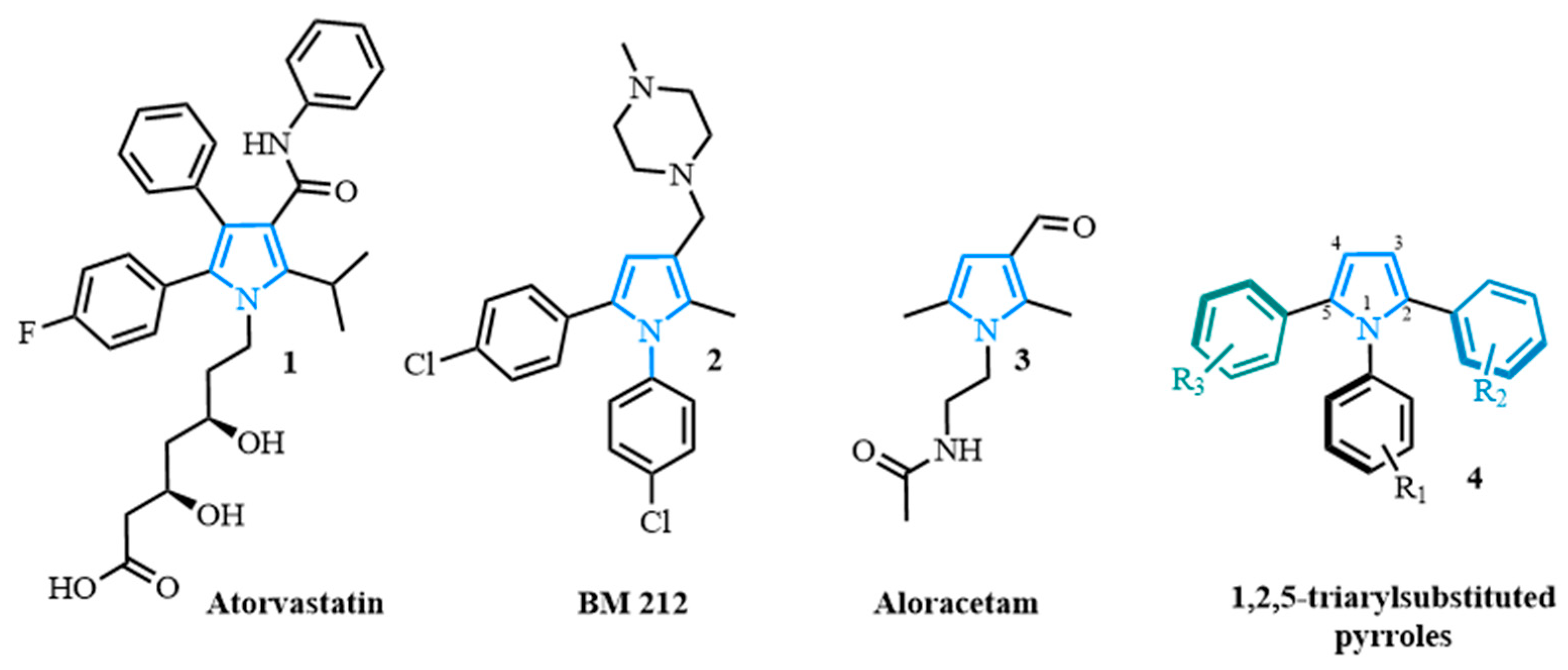
Pyrroles, a class of naturally occurring compounds, and their derivatives have been proven to be therapeutically beneficial [1,2]. Consequently, the pyrrole scaffold is of particular interest to the pharmaceutical industry [3,4] as it can be used to develop anti-cancer agents [5,6], HIV inhibitors [7], and anti-inflammatory compounds [8,9]. The synthesis of pyrrole derivatives has therefore been pursued by several researchers due to their applications (Figure 1) [1,3,10,11,12,13,14,15,16].
Among the wide variety of pyrrole motifs, relatively few 1,2,5-substituted pyrroles have been reported; nevertheless, examples of this scaffold have shown promising biological activity in the context of cardiovascular disease (Atorvastatin 1) [10,13,14], as potential antimycobacterial agents (BM 212 2) [17], or in the treatment of Alzheimer’s disease (Aloracetam 3) [14] (Figure 1). In particular, 1,2,5-triaryl pyrroles 4 gained initial attention among physical chemists due to their photochemical properties [18,19,20,21,22,23] and, more notably, within the synthetic chemistry community for their pharmaceutical applications [24,25].
The main interest in synthesizing 1,2,5-triaryl-substituted pyrroles lies in the hindered rotation of the N–C(Ar1) bond and the two C–C(Ar) bonds (Figure 1), which favors a non-planar arrangement of the three aryl rings, particularly in the presence of ortho substitution. This three-dimensional conformation arises from high torsional barriers about the N–C and C–C bonds, rendering the scaffold conformationally restricted [26,27,28]. As a result, 1,2,5-triaryl-substituted pyrroles can access distinct three-dimensional chemical space relative to coplanar pyrroles, which may translate to improved complementarity with biological targets [29,30]. In some cases, this can be leveraged in atropisomer-based designs without requiring C(sp3) stereocentres [31,32,33,34].
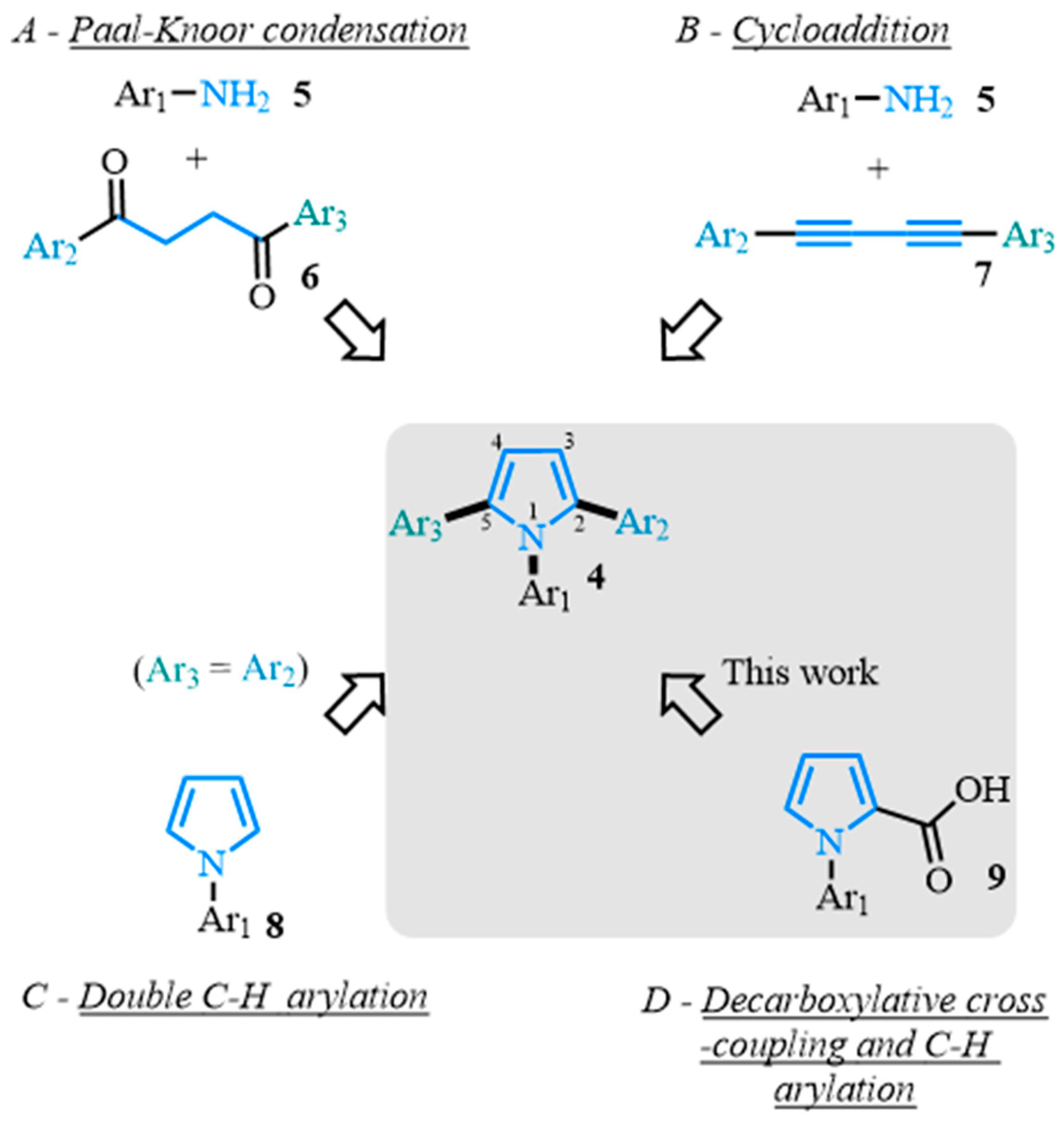
Several routes have been reported towards the synthesis of the 1,2,5-triaryl-substituted pyrrole scaffold 4 (Figure 2) [1,3,10,11,12,13,14,16]. Most of the previous methods make use of the pioneering Paal–Knorr [35,36] and Hantzch [37] condensations involving a diketone, 6, and a primary amine, 5, respectively (Figure 2A) [38,39,40,41,42,43,44,45,46,47]. Recently, metal-catalyzed cycloadditions of 1,3-butadiynes 7 with primary amines 5 have been developed as a promising alternative approach (Figure 2B) [48,49,50,51,52]. The difficulty of accessing these starting materials limits the routes used to synthesize 1,2,5-triaryl-substituted pyrroles and does not allow for the possibility of late-stage functionalization that is particularly valued in drug discovery and materials applications to fine-tune the desired target properties [38,39,40,41,42,43,44,45,46,47,48,49,50,51,52,53,54,55,56,57,58,59,60]. There have been numerous industrial applications of palladium-catalyzed cross-couplings in the synthesis of therapeutic compounds [61,62,63], providing a more modular strategy. While classic palladium-catalyzed cross-coupling reactions could be employed toward this end, the organometallic derivatives used as coupling partners in the reaction and the release of stoichiometric amounts of organometallic by-products can be challenging to purify and potentially interfere with final applications. Over the past decade, C–H arylation has proven successful as a more atom-economic process in the synthesis of polyarylated pyrroles such as 4 (Figure 2C) [64,65,66,67]. Despite its advantages, the C–H arylation reaction does not allow for regioselective control producing symmetrical molecules [65]. Alternatively, palladium-catalyzed decarboxylative cross-couplings [68,69,70,71,72,73,74,75,76,77] have emerged as a regioselective and sustainable route in the synthesis of heteroaromatics [78,79,80,81,82,83,84,85,86,87] and pyrroles [88], releasing CO2 as a by-product. Here we propose a new synthetic pathway towards 1,2,5-triaryl pyrroles 4 featuring palladium-catalyzed decarboxylative cross-coupling and C–H arylation as key steps (Figure 2D) involving a family of N-arylated pyrrole carboxylic acids 9. Employing decarboxylative cross-coupling followed by C–H arylation ensures a highly regioselective and modular methodology to synthesize 1,2,5-triaryl pyrroles compared to existing procedures.
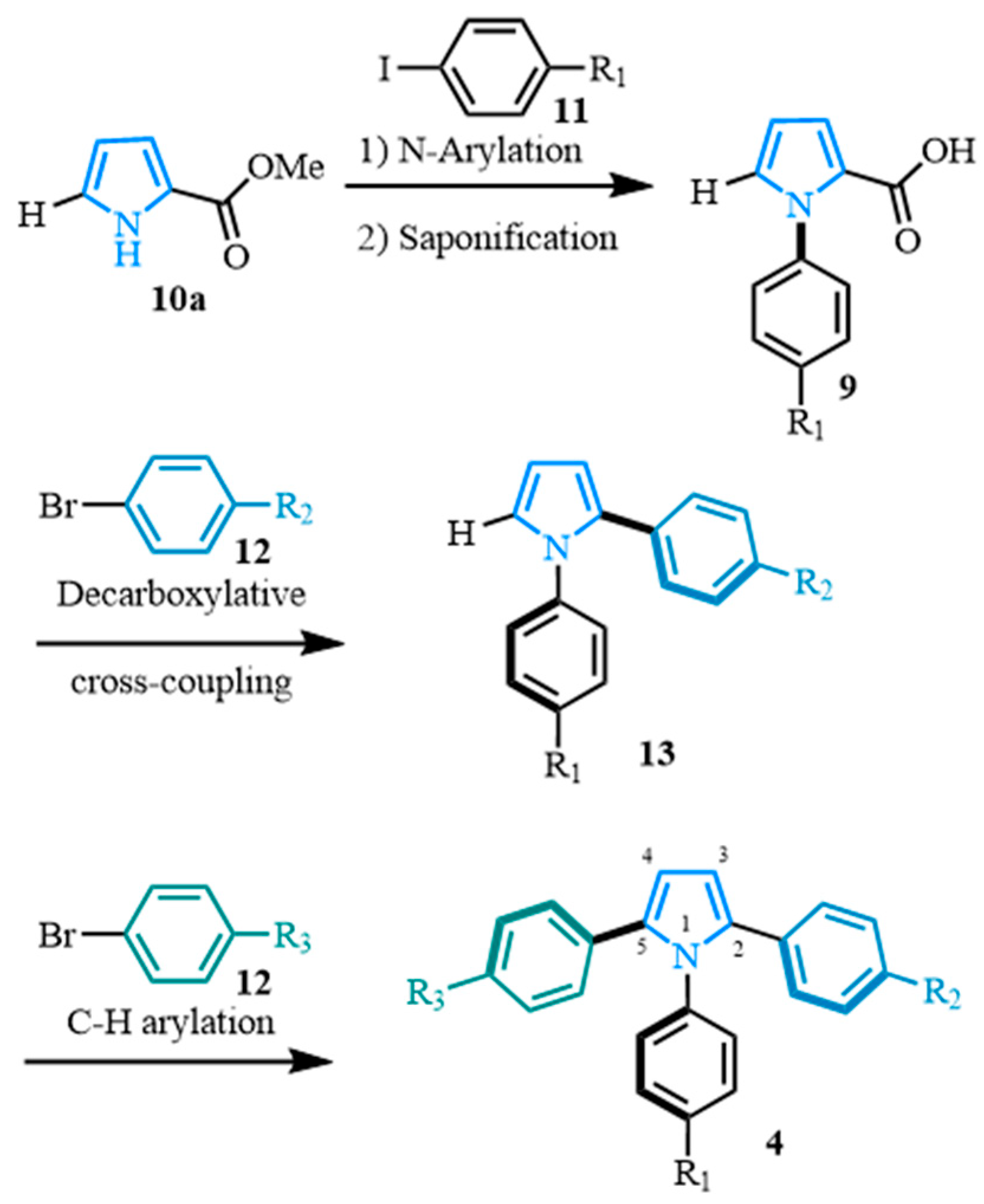
Our proposed synthetic pathway starts with the versatile and easily accessible pyrrole ester 10a (Figure 3). In our approach, various N-arylated pyrrole carboxylic acids 9 were obtained after a Buchwald cross-coupling [89] from the pyrrole carboxylate 10a and the aryl iodides 11, followed by a saponification reaction. The carboxylic acids 9 were then submitted to palladium-catalyzed decarboxylative cross-coupling conditions to form the desired diarylated pyrroles 13 [87]. In this way, position two is blocked by the aromatic substituent, controlling the regioselectivity of the subsequent step. The diarylated pyrrole 13 and aryl bromides 12 would then be involved in a C–H arylation [65,67], leading to the non-symmetrical 1,2,5-triaryl pyrroles 4.
Although the individual transformations employed herein—Pd-catalyzed decarboxylative cross-coupling and Pd-catalyzed C–H arylation of pyrroles—are well established, this work integrates them into an efficient, practical, and regioselective sequence that enables the controlled, sequential installation of three distinct aryl groups at N, C2, and C5 from a common pyrrole-2-carboxylate precursor. Using a modular, building block strategy from commercially available and inexpensive starting materials, the approach facilitates late-stage diversification and provides a regioselective, atom-economic, and tunable route to unsymmetrical 1,2,5-triarylpyrroles that are difficult to access by previous methods.

2. Results and Discussion

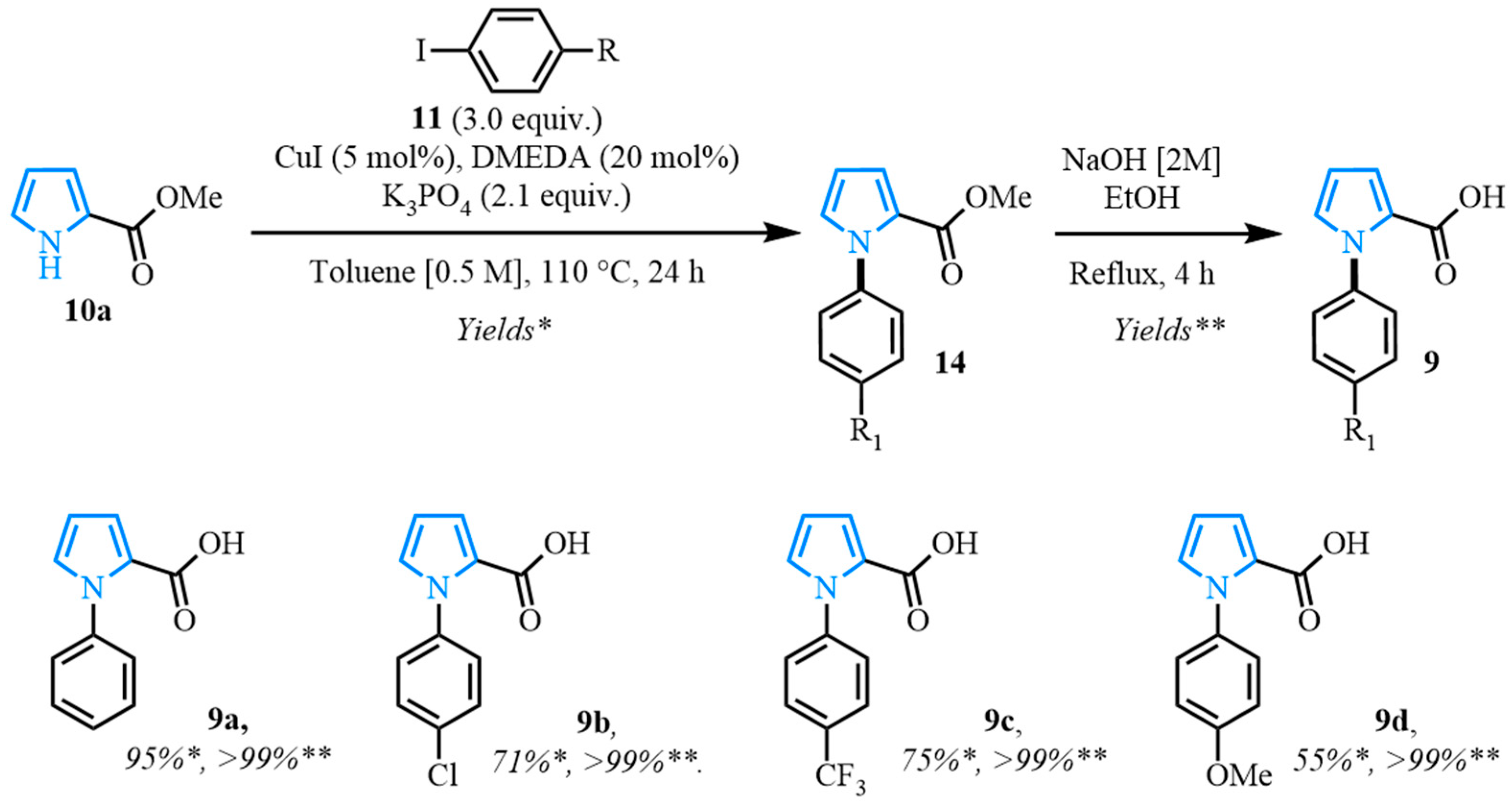
Following a two-step process involving a Buchwald coupling and saponification, four distinct carboxylic acids were obtained (Figure 4). The first arylation involved the preparation of various N-arylated pyrroles that were synthesized from methyl 1H-pyrrole-2-carboxylate 10a using Buchwald’s previously reported conditions [89]. The electron-neutral N-aryl-substituted carboxylic acid 9a was obtained after a high-yielding C-N coupling reaction was followed by a quantitative saponification. The electron-deficient N-arylated carboxylic acids 9bc were obtained with good yields, whereas a moderate yield was observed for the formation of the electron-rich N-aryl carboxylic acid 9d.
After obtaining the carboxylic acids, the palladium-catalyzed decarboxylative cross-coupling step was optimized (Table 1). The optimization was carried out in the presence of the N-phenyl carboxylic acid 9a and the aryl bromide 12e to obtain the diarylated pyrrole 13a. Conditions previously reported [87] were initially evaluated as a starting point for the optimization of the reaction (Table 1, entry 1), producing an excellent yield of the corresponding product.
To improve the efficiency of the cross-coupling, the original 2:1 ratio of acid 9a towards bromide 12e was inverted to a 1:2 ratio (Table 1, entry 2), using one equivalent of carboxylic acid 9a and two equivalents of aryl bromide 12e. This change resulted in a much lower yield; therefore, the original ratio of two equivalents of carboxylic acid to one equivalent of aryl bromide was used for further optimizations. The reaction was evaluated in the absence of n-Bu4NCl·H2O (Table 1, entry 3), which resulted in the formation of a slurry mixture and gave a yield similar to that obtained with the additive present. However, because the slurry likely led to a less homogeneous reaction medium, potentially increasing by-product formation and lowering yields, further optimizations were performed with the additive included. Continuing the evaluation of the additive impact, reduced amounts of 0.3 and 0.5 equivalents were compared (Table 1, entries 4–5), resulting in similar quantitative yields, with no significant by-product formation or slurry formation. The final optimized conditions used the 0.3 equivalent of n-Bu4NCl·H2O, which was chosen to provide the most atom-economic conditions for the decarboxylative cross-coupling step.
Having determined the optimized conditions, various aryl bromide coupling partners were used to evaluate the scope of the reaction (Table 2). The choice of coupling partners was largely limited to electron-withdrawing groups to maximize the stability of the triaryl pyrroles. Because pyrroles are easily oxidized, electron-rich pyrroles are more susceptible to chemical degradation and can also undergo polymerization under acidic conditions [11,90,91,92,93,94], which can complicate strongly electron-donating substitution patterns in multi-step sequences.
The N-phenyl pyrrole carboxylic acid 9a was coupled with para -NO2-, -Me-, and -CF3-substituted aryl bromides with excellent isolated yields (Table 2, entries 1–3). The scope of pyrrole carboxylic acids was then extended to additional pyrroles using 4-bromobenzonitrile as the coupling partner (Table 2, entries 4–6). Excellent yields were obtained when electron-deficient carboxylic acids were used (Table 2, entries 4–5). The highest yield was obtained when the pyrrole carboxylic acid was substituted with a -Cl substituent 9b (Table 2, entry 4) and was marginally lower when pyrrole was substituted with a -CF3 group 9c (Table 2, entry 5). In comparison, electron-rich -OMe-substituted pyrrole 9d was obtained in a moderate yield (Table 2, entry 6). Overall, a range of diarylated pyrroles 13 were synthesized in moderate to excellent yields.
The final step of the sequence was a C–H arylation based on the conditions derived from Doucet and his research group’s work on related pyrroles (Table 3) [65,67]. We initiated our investigations with pyrrole 13a and the bromo coupling partner 12h, leading to the formation of the 1,2,5-triarylated pyrrole 4a [65,67].
Unfortunately, the previously reported conditions did not result in the expected product 4a (Table 3, entry 1). Palladium catalyst levels were increased to 5%; however, the expected product still was not observed (Table 3, entry 2). A temperature increase from 150 °C to 170 °C was evaluated that resulted in a moderate yield (Table 3, entry 3). When PPh3 was used as the ligand, the yield of the reaction increased significantly (Table 3, entry 4). The stoichiometry between the pyrrole 13a and the aryl bromide 12h was assessed, determining if the equivalent of pyrrole could be reduced (Table 3, entry 5). When only one equivalent of pyrrole was used, the results were similar to what was observed when the diarylated species were employed in excess. The pyrrole was maintained as the limiting reagent for further optimization of the C–H arylation reaction. Subsequently, other PdII and Pd0 sources were assessed (Table 3, entries 6–8) where PdCl2 was identified as the best palladium source for C–H arylation resulting in an impressive yield (Table 3, entry 6), while the Pd(PPh3)4 catalyst showed a much lower yield than when generated in situ (Table 3, entry 7). The lower yields were obtained with Pd2(dba)3 (Table 3, entry 9). After screening different ligands, the bulkier options, such as JohnPhos and CyJohnPhos, were less suitable for this reaction, resulting in lower yields (Table 3, entries 9–10). Finally, while the ligand PCy3·HBF4 provided the corresponding products in good yields (Table 3, entry 11), the best ligand choice remained PPh3. In conclusion, following an evaluation of numerous conditions, the optimal C–H arylation parameters were identified (Table 3, entry 6) for the synthesis of 1,2,5-triaryl pyrroles 4a in an excellent yield of 92%.
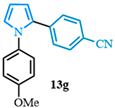
The 1,2-diaryl pyrroles 13 that were synthesized previously were subjected to the optimized conditions for C–H arylation (Table 4) to evaluate the scope of the transformation. First, the effect of the substituent position on the aryl bromide coupling partner was evaluated using diarylated pyrrole 13a (Table 4, entries 1–3). As previously demonstrated, a para-substituted bromo coupling partner can be employed, resulting in excellent yields (Table 4, entry 1). The reaction is also tolerant to substituents present at the meta- and ortho-positions on the aryl ring, affording the desired product in good yields (Table 4, entries 2–3). A systematic study was carried out employing 1-bromo-4-(trifluoromethyl)benzene 12h as a coupling partner (Table 4, entries 4–8). The yields were very good in the case of the -NO2-substituted pyrrole 13b (Table 4, entry 4) but were slightly lower for the -CF3-substituted pyrrole 13d, providing moderate yields of the corresponding product (Table 4, entry 5). Lastly, diarylated pyrroles 13 bearing different substituents on the N-phenyl group were evaluated (Table 4, entries 6–8). As previously observed, the electron-deficient-substituted pyrroles 13ef led to the highest yields (Table 4, entries 6–7) while the electron-rich-substituted pyrrole 13g provided the lowest yield of their corresponding products (Table 4, entry 6).
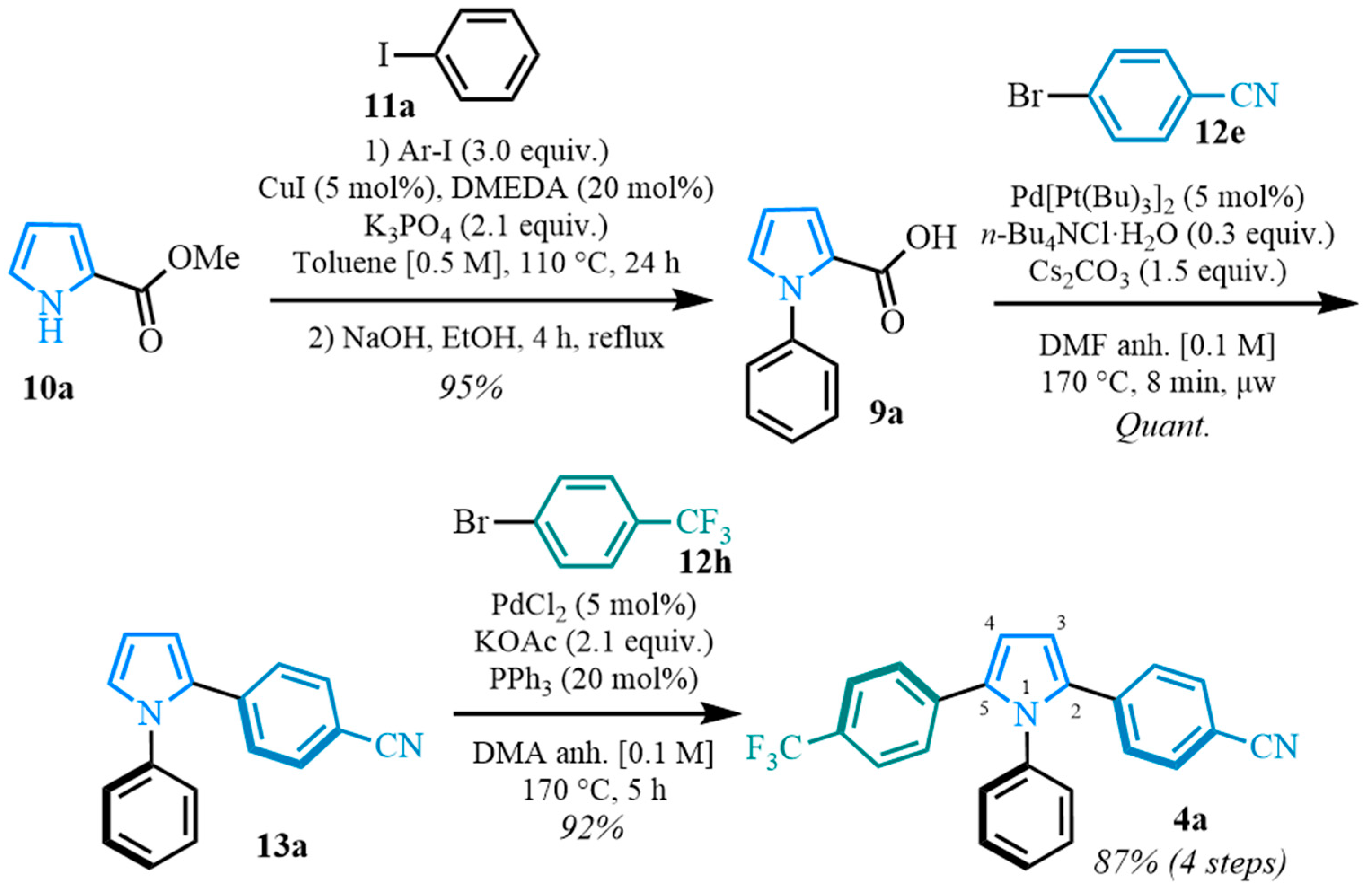
A representative example is shown in Figure 5 to illustrate the stepwise regiocontrol of the sequence. Although the synthesis comprises four steps overall, it is designed to be modular and provides higher overall yields than previously reported routes. Zhu and their co-workers reported a convergent oxidative route to related triarylpyrroles [55]; in contrast, the present approach enables the programmed, regioselective installation of three distinct aryl groups from readily available aryl halides, which is advantageous for analogue/library synthesis where positional control is required.

3. Materials and Methods

3.1. General Remarks

Reactions were carried out in regular glassware under air unless otherwise noted. All anhydrous flasks were flame-dried while under high vacuum and purged with argon unless otherwise stated. Commercially available starting materials (methyl 1H-pyrrole-2-carboxylate and all aryl halides) and reagents (K3PO4, N,N′-Dimethylethylenediamine, CuI, nBu4NCl·H2O, Cs2CO3, and K2CO3) were purchased from Sigma-Aldrich (Burlington, MA, USA), Alfa Aesar (Waltham, MA, USA) and AK Scientific (Union City, CA, USA) and used without further purification. Palladium catalysts were purchased from STREM (Newburyport, MA, USA) and stored under inert gas at room temperature (PdCl2) or in the freezer at −10 degrees Celsius (Pd(PtBu3)2). All solvents were purchased from (Montreal, QC, Canada) and Sigma-Aldrich as ACS grade. Anhydrous solvents were dried and stored in a flame-dried Schlenk flask using 3 Å molecular sieves, which were activated by heating at 150 °C under a high vacuum overnight. Distilled water was obtained from an in-house distillery. Solids were weighed on a balance open to the air and added to a round-bottomed flask or microwave vial unless otherwise noted. Liquids were transferred using a glass syringe with a stainless-steel needle or a micropipette for µL volumes unless noted otherwise. Compounds were purified using column chromatography on silica-gel (Zeoprep 60 Eco, 40–63 µm, and Zeochem AG (Rüti, Switzerland)) from SiliCycle (Quebec City, QC, Canada). Microwave-assisted reactions were carried out using the Biotage Initiator™ 2.3 build 6250 microwave system with a 400 W magnetron (Biotage, Uppsala, Sweden), which monitors temperature during the reaction time period and adjusts wattage accordingly. Proton nuclear magnetic resonance spectra (1H NMR) were measured at 500 MHz using a Varian VNMRS-500 (Varian, Inc., Palo Alto, CA, USA) in CDCl3 unless stated otherwise. Carbon–nuclear magnetic resonance spectra (13C NMR) were measured at 125 MHz using the Varian VNMRS-500 in CDCl3 unless stated otherwise. The chemical shifts are reported in parts per million (ppm) and referenced from either residual solvent or the tetramethylsilane (TMS) signal. The multiplicity is represented as: s = singlet, d = doublet, t = triplet, q = quartet and m = multiplet, which is indicated in parentheses along with the number of protons and coupling constants (in Hz). High-resolution mass spectral data (HRMS) was collected using a LC-TOF ESI mass spectrometer (Agilent, Santa Clara, CA, USA) operated in positive ion mode unless otherwise noted. Yield determination was completed using 1H NMR and was done using trimethoxybenzene (TMB) as an internal standard. 1H NMR and 13C NMR spectra are available in the Supplementary Materials.

3.2. Synthetic Procedures

3.2.1. General Procedure for the Buchwald Couplings of Methyl 1H-Pyrrole-2-carboxylate (A)

To a 5 mL conical microwave vial that was equipped with a spin-vein added methyl 1H-pyrrole-2-carboxylate (2.0 mmol, 1.0 equiv.), the aryliodide (6.0 mmol, 3.0 equiv.), K3PO4 (4.2 mmol, 2.1 equiv.), N,N′-Dimethylethylenediamine (0.4 mmol, 20 mol%), and CuI (0.1 mmol, 5 mol%). Next, 2 mL of anhydrous Toluene were added to the vial. The reaction vial was immersed into a preheated oil bath at 110 °C and heated for 24 h. After cooling down, the crude mixture was diluted with ethyl acetate (10 mL) and water (10 mL). The organic layer was washed with a saturated NaCl aqueous solution (2 × 10 mL). The combined aqueous phases were washed with EtOAc (3 × 10 mL). The combined organic phases were dried over Na2SO4, and after filtration the solvent evaporated under reduced pressure, and the solid residue was purified by flash column chromatography.

3.2.2. General Procedure for the Formation of Carboxylic Acids (B)

The pyrrole ester (2 mmol, 1.0 equiv.) was dissolved in ethanol (1 mL). A solution of NaOH 2M (20 mmol, 10 equiv.) was added to the mixture. The reaction was heated at reflux temperature for 4 h and then allowed to cool down. The ethanol was evaporated under vacuo. The crude reaction media was diluted with ethyl acetate (10 mL) and water (10 mL). The organic layer was discarded. Ethyl acetate was added to the separatory funnel (10 mL). The media was acidified to pH = 2 using a pure solution of hydrochloric acid. The aqueous layer was washed with ethyl acetate (2 × 10 mL). The combined organic layers were washed with a saturated NaCl aqueous solution (10 mL). The combined organic phases were dried over Na2SO4 and after filtration the solvent evaporated under reduced pressure and the solid residue was collected.

3.2.3. General Procedure for the Palladium-Catalyzed Decarboxylative Cross-Couplings (C)

To a 10 mL conical microwave vial equipped with a spin-vein was added the pyrrole carboxylic acid (2.0 mmol, 2.0 equiv.), the aryl coupling partner (1.0 mmol, 1.0 equiv.), nBu4NCl·H2O (0.6 mmol, 0.3 equiv.), Cs2CO3 (3.0 mol, 1.5 equiv.), and Pd[P(tBu)3]2 (0.10 mmol, 5 mol%). 5 mL of anhydrous DMF were added to the vial. The reaction vial was pre-stirred for 30 s at 23 °C followed by 8 min of heating at 170 °C. After cooling down, the crude mixture was diluted with ethyl acetate (50 mL) and water (50 mL). The organic layer was washed with a saturated NaHCO3 aqueous solution (2 × 20 mL), a saturated NaCl aqueous solution (2 × 20 mL). The combined aqueous phases were washed with EtOAc (3 × 20 mL). The combined organic phases were dried over Na2SO4 and after filtration the solvent evaporated under reduced pressure and the solid residue was purified by flash column chromatography.

3.2.4. General Procedure for the Palladium-Catalyzed C–H Arylations (D)

A 5 mL conical microwave vial equipped with a spin-vane was added with the diaryl pyrrole (0.2 mmol, 1.0 equiv.), the aryl coupling partner (0.4 mmol, 2.0 equiv.), KOAc (0.4 mmol, 2.0 equiv.), PPh3 (0.04 mol, 20 mol%), and PdCl2 (0.01 mmol, 5 mol%). Then, 2 mL of anhydrous DMA were added to the vial. The reaction vial was immersed into a preheated oil bath at 170 °C and heated for 5 h. After cooling down, the crude mixture was diluted with ethyl acetate (10 mL) and water (10 mL). The organic layer was washed with a saturated NaHCO3 aqueous solution (2 × 10 mL) and a saturated NaCl aqueous solution (2 × 10 mL). The combined aqueous phases were washed with EtOAc (3 × 10 mL). The combined organic phases were dried over Na2SO4, and after filtration the solvent evaporated under reduced pressure and the solid residue were purified by flash column chromatography.

3.3. Spectroscopic Data

methyl 1-phenyl-1H-pyrrole-2-carboxylate (14a). Following the general procedure (A), methyl 1H-pyrrole-2-carboxylate (2.5 g, 20 mmol) was reacted with iodobenzene (60 mmol). The spectral data was in agreement with reported data [95].
methyl 1-(4-chlorophenyl)-1H-pyrrole-2-carboxylate (14b). Following the general procedure (A), methyl 1H-pyrrole-2-carboxylate (1.25 g, 10 mmol) was reacted with 1-chloro-4-iodobenzene (30 mmol). The spectral data was in agreement with reported data [95].
methyl 1-(4-(trifluoromethyl)phenyl)-1H-pyrrole-2-carboxylate (14c). Following the general procedure (A), methyl 1H-pyrrole-2-carboxylate (2.5 g, 20 mmol) was reacted with 1-iodo-4-(trifluoromethyl)benzene (60 mmol). The spectral data was in agreement with reported data [95].
methyl 1-(4-methoxyphenyl)-1H-pyrrole-2-carboxylate (14d). Following the general procedure (A), methyl 1H-pyrrole-2-carboxylate (2.5 g, 20 mmol) was treated with 1-iodo-4-methoxybenzene (60 mmol). The spectral data was in agreement with reported data [95].
1-phenyl-1H-pyrrole-2-carboxylic acid (9a). Following the general procedure (B), methyl 1-phenyl-1H-pyrrole-2-carboxylate (3.8 g, 19 mmol) was reacted with sodium hydroxide (190 mmol). After extraction, 1-phenyl-1H-pyrrole-2-carboxylic acid (9a) was obtained as a white powder (3.55 g, 100%). The spectral data was in agreement with reported data [95].
1-(4-chlorophenyl)-1H-pyrrole-2-carboxylic acid (9b). Following the general procedure (B), methyl 1-(4-chlorophenyl)-1H-pyrrole-2-carboxylate (1.7 g, 7.1 mmol) was reacted with sodium hydroxide (71 mmol). After extraction, 1-(4-chlorophenyl)-1H-pyrrole-2-carboxylic acid (9b) was obtained as a brown powder (1.55 g, 99%). The spectral data was in agreement with reported data [95].
1-(4-(trifluoromethyl)phenyl)-1H-pyrrole-2-carboxylic acid (9c). Following the general procedure (B), methyl 1-(4-(trifluoromethyl)phenyl)-1H-pyrrole-2-carboxylate (4.0 g, 15 mmol) was reacted with sodium hydroxide (150 mmol). After extraction, 1-(4-(trifluoromethyl)phenyl)-1H-pyrrole-2-carboxylic acid (9c) was obtained as a white powder (3.8 g, 98%). The spectral data was in agreement with reported data [95].
1-(4-methoxyphenyl)-1H-pyrrole-2-carboxylic acid (9d). Following the general procedure (B), methyl 1-(4-methoxyphenyl)-1H-pyrrole-2-carboxylate (2.5 g, 11 mmol) was reacted with sodium hydroxide (110 mmol). After extraction, 1-(4-methoxyphenyl)-1H-pyrrole-2-carboxylic acid (9d) was obtained as a pink powder (2.32 g, 97%). The spectral data was in agreement with reported data [95].
4-(1-phenyl-1H-pyrrol-2-yl)benzonitrile (13a). Following the general procedure (C), 1-phenyl-1H-pyrrole-2-carboxylic acid (0.8 mmol, 149 mg) was reacted with 1-bromo-4-(trifluoromethyl)benzene (0.4 mmol). The reaction was purified by flash chromatography (9:1 hexanes/diethyl ether) to afford 4-(1-phenyl-1H-pyrrol-2-yl)benzonitrile as a white powder (0.36 mmol, 89%). The spectral data was in agreement with reported data [96].
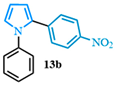
2-(4-nitrophenyl)-1-phenyl-1H-pyrrole (13b). Following the general procedure (C), 1-phenyl-1H-pyrrole-2-carboxylic acid (0.8 mmol, 149 mg) was reacted with 1-bromo-4-nitrobenzene (0.4 mmol). The reaction was purified by flash chromatography (9:1 hexanes/diethyl ether) to afford 2-(4-nitrophenyl)-1-phenyl-1H-pyrrole (0.36 mmol, 90%) as yellow crystals. Rf: 0.44 (90:10 hexanes/diethyl ether). 1H NMR (300 MHz, CDCl3) δ = 8.05 (d, J = 8.9 Hz and 2H), 7.39 (m, 3H), 7.25–7.15 (m, 4H), 7.02 (dd, J = 2.8, 1.7 Hz and 1H), 6.63 (dd, J = 3.7, 1.7 Hz and 1H), 6.41 (dd, J = 3.7, 2.8 Hz and 1H) ppm. 13C NMR (75 MHz, CDCl3) δ = 145.58, 139.96, 139.24, 131.48, 129.56, 129.55, 127.89, 127.71, 127.03, 126.89, 125.80, 125.79, 123.59, 113.36, 110.06 ppm. The spectral data was in agreement with reported data [96].
1-phenyl-2-(p-tolyl)-1H-pyrrole (13c). Following the general procedure (C), 1-phenyl-1H-pyrrole-2-carboxylic acid (0.8 mmol, 149 mg) was reacted with 1-bromo-4-methylbenzene (0.4 mmol). The reaction was purified by flash chromatography (9:1 hexanes/diethyl ether) to afford 1-phenyl-2-(p-tolyl)-1H-pyrrole (0.37 mmol, 93%) as a white powder. Rf: 0.32 (90:10 hexanes/diethyl ether). 1H NMR (300 MHz, CDCl3) δ = 7.65 (d, J = 2.0 Hz and 1H), 7.61–7.46 (m, 5H), 7.45–7.37 (m, 3H), 7.17 (dd, J = 2.8, 1.8 Hz and 1H), 6.64 (d, J = 1.8 Hz and 1H), 6.61–6.55 (m, 1H), 2.54 (s, 3H) ppm. 13C NMR (75 MHz, CDCl3) δ = 140.63, 135.96, 133.89, 130.12, 128.83, 128.23, 126.53, 125.74, 124.09, 124.00, 110.32, 110.19, 109.19, 99.99, 21.12 ppm. HRMS (ESI): calculated for [C17H15N + H] = 234.1277, found 234.1277. The spectral data was in agreement with reported data [97].
1-phenyl-2-(4-(trifluoromethyl)phenyl)-1H-pyrrole (13d). Following the general procedure (C), 1-phenyl-1H-pyrrole-2-carboxylic acid (0.8 mmol, 149 mg) was reacted with 1-bromo-4-(trifluoromethyl)benzene (0.4 mmol). The reaction was purified by flash chromatography (9:1 hexanes/diethyl ether) to afford 1-phenyl-2-(4-(trifluoromethyl)phenyl)-1H-pyrrole (0.36 mmol, 89%) as a white powder. Rf: 0.24 (90:10 hexanes/diethyl ether). 1H NMR (300 MHz, CDCl3) δ = 7.44 (d, J = 8.2 Hz and 2H), 7.38–7.28 (m, 3H), 7.21 (d, J = 8.2 Hz and 2H), 7.17 (dd, J = 8.1, 1.6 Hz and 2H), 6.98 (dd, J = 2.8, 1.8 Hz and 1H), 6.53 (dd, J = 3.6, 1.8 Hz and 1H), 6.39 (dd, J = 3.6, 2.8 Hz and 1H) ppm. 13C NMR (75 MHz, CDCl3) δ = 140.18, 136.38, 132.26, 129.26, 128.16, 128.01, 127.73, 127.04, 126.07, 125.70, 125.57, 125.09, 125.05, 122.47, 111.98, 109.69, 109.59 ppm. HRMS (ESI): calculated for [C17H12F3N + H] = 288.0995, found 288.0997. The spectral data was in agreement with reported data [98].
4-(1-(4-chlorophenyl)-1H-pyrrol-2-yl)benzonitrile (13e). Following the general procedure (C), 1-(4-chlorophenyl)-1H-pyrrole-2-carboxylic acid (2.0 mmol, 443 mg) was reacted with 1-bromo-4-(trifluoromethyl)benzene (1.0 mmol). The reaction was purified by flash chromatography (95:5 hexanes/diethyl ether) to afford 4-(1-(4-chlorophenyl)-1H-pyrrol-2-yl)benzonitrile (0.93 mmol, 93%) as a white powder. Rf: 0.42 (95:5 hexanes/diethyl ether). 1H NMR (300 MHz, CDCl3) δ = 7.54–7.42 (m, 2H), 7.39–7.29 (m, 2H), 7.23–7.16 (m, 2H), 7.14–7.04 (m, 2H), 6.96 (dd, J = 2.8, 1.7 Hz and 1H), 6.55 (dd, J = 3.7, 1.8 Hz and 1H), 6.40 (dd, J = 3.7, 2.8 Hz and 1H) ppm. 13C NMR (75 MHz, CDCl3) δ = 138.52, 136.97, 133.09, 132.17, 131.82, 129.66, 128.01, 126.88, 126.29, 118.94, 113.14, 110.38, 109.55 ppm. HRMS (ESI): calculated for [C17H11ClN2] = 278.0605, found 278.0605.
4-(1-(4-(trifluoromethyl)phenyl)-1H-pyrrol-2-yl)benzonitrile (13f). Following the general procedure (C), 1-(4-(trifluoromethyl)phenyl)-1H-pyrrole-2-carboxylic acid (0.2 mmol, 51 mg) was reacted with 1-bromo-4-(trifluoromethyl)benzene (0.1 mmol). The reaction was purified by flash chromatography (9:1 hexanes/diethyl ether) to afford 4-(1-(4-(trifluoromethyl)phenyl)-1H-pyrrol-2-yl)benzonitrile (0.09 mmol, 83%) as a white powder. Rf: 0.13 (9:1 hexanes/diethyl ether). 1H NMR (300 MHz, CDCl3) δ = 7.68–7.58 (m, 2H), 7.57–7.47 (m, 2H), 7.31–7.23 (m, 2H), 7.19 (d, J = 8.5 Hz and 2H), 7.01 (dd, J = 2.9, 1.7 Hz and 1H), 6.58 (dd, J = 3.7, 1.7 Hz and 1H), 6.44 (dd, J = 3.7, 2.9 Hz and 1H) ppm. 13C NMR (75 MHz, CDCl3) δ = 142.83, 136.81, 132.26, 132.09, 131.87, 129.43, 128.24, 128.13, 126.64, 126.23, 126.12, 125.68, 125.53, 121.91, 118.84, 113.81, 110.80, 109.82 ppm. HRMS (ESI): calculated for [C18H11F3N2] = 312.0869, found 312.0867.
4-(1-(4-methoxyphenyl)-1H-pyrrol-2-yl)benzonitrile (13g). Following the general procedure (C), 1-(4-methoxyphenyl)-1H-pyrrole-2-carboxylic acid (2.0 mmol, 434 mg) was reacted with 1-bromo-4-(trifluoromethyl)benzene (1.0 mmol). The reaction was purified by flash chromatography (9:1 hexanes/diethyl ether) to afford 4-(1-(4-methoxyphenyl)-1H-pyrrol-2-yl)benzonitrile (0.55 mmol, 55%) as a white powder. Rf: 0.18 (9:1 hexanes/diethyl ether). 1H NMR (300 MHz, CDCl3) δ = 7.46 (d, J = 8.5 Hz and 2H), 7.24–7.14 (m, 2H), 7.12–7.05 (m, 2H), 6.94 (dd, J = 2.8, 1.7 Hz and 1H), 6.93–6.84 (m, 2H), 6.55 (dd, J = 3.7, 1.7 Hz and 1H), 6.36 (dd, J = 3.7, 2.8 Hz and 1H), 3.83 (s, 3H) ppm. 13C NMR (75 MHz, CDCl3) δ = 158.71, 137.36, 133.07, 131.87, 127.93, 127.00, 126.60, 119.14, 114.49, 112.19, 109.53, 109.06, 55.61 ppm. HRMS (ESI): calculated for [C18H14N2O + H] = 275.1179, found 275.1178.
4-(1-phenyl-5-(4-(trifluoromethyl)phenyl)-1H-pyrrol-2-yl)benzonitrile (4a). Following the general procedure (D), 4-(1-phenyl-1H-pyrrol-2-yl)benzonitrile (0.2 mmol, 49 mg) was reacted with 1-bromo-4-(trifluoromethyl)benzene (0.4 mmol). The reaction was purified by flash chromatography (9:1 hexanes/diethyl ether) to afford 4-(1-phenyl-5-(4-(trifluoromethyl)phenyl)-1H-pyrrol-2-yl)benzonitrile (0.18 mmol, 90%) as light orange crystals. Rf: 0.27 (9:1 hexanes/diethyl ether). 1H NMR (500 MHz, CDCl3) δ = 7.43 (t, J = 8.1 Hz and 4H), 7.40–7.27 (m, 3H), 7.13 (d, J = 8.2 Hz and 2H), 7.11 (d, J = 8.3 Hz and 2H), 7.04 (dd, J = 7.2, 1.9 Hz and 2H), 6.61 (d, J = 3.8 Hz and 1H), 6.58 (d, J = 3.8 Hz and 1H) ppm. 13C NMR (126 MHz, CDCl3) δ = 138.05, 137.24, 134.56, 131.80, 129.44, 128.63, 128.54, 128.47, 128.29, 124.96, 118.94, 112.08, 111.63, 109.56 ppm. HRMS (ESI): calculated for [C24H15F3N2] = 388.1182, found 388.1179. The spectral data was in agreement with reported data [55].
4-(1-phenyl-5-(3-(trifluoromethyl)phenyl)-1H-pyrrol-2-yl)benzonitrile (4b). Following the general procedure (D), 4-(1-phenyl-1H-pyrrol-2-yl)benzonitrile (0.1 mmol, 25 mg) was reacted with 1-bromo-3-(trifluoromethyl)benzene (0.2 mmol). The reaction was purified by flash chromatography (9:1 hexanes/diethyl ether) to afford 4-(1-phenyl-5-(3-(trifluoromethyl)phenyl)-1H-pyrrol-2-yl)benzonitrile (0.09 mmol, 90%) as white crystals. Rf: 0.25 (9:1 hexanes/diethyl ether). 1H NMR (500 MHz, CDCl3) δ = 7.44 (d, J = 8.5 Hz and 2H), 7.41 (d, J = 7.8 Hz and 1H), 7.37–7.27 (m, 5H), 7.20 (d, J = 7.9 Hz and 1H), 7.13 (d, J = 8.5 Hz and 2H), 7.04 (dd, J = 8.3, 1.5 Hz and 2H), 6.62 (d, J = 3.8 Hz and 1H), 6.57 (d, J = 3.8 Hz and 1H) ppm. 13C NMR (126 MHz, CDCl3) δ = 138.00, 137.25, 135.91, 133.31, 131.81, 131.64, 129.40, 128.64, 128.43, 128.41, 128.27, 125.30, 118.96, 111.99, 111.22, 109.49 ppm. HRMS (ESI): calculated for [C24H15F3N2] = 388.1182, found 388.1180.
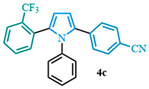
4-(1-phenyl-5-(2-(trifluoromethyl)phenyl)-1H-pyrrol-2-yl)benzonitrile (4c). Following the general procedure (D), 4-(1-phenyl-1H-pyrrol-2-yl)benzonitrile (0.1 mmol, 25 mg) was reacted with 1-bromo-2-(trifluoromethyl)benzene (0.2 mmol). The reaction was purified by flash chromatography (9:1 hexanes/diethyl ether) to afford 4-(1-phenyl-5-(2-(trifluoromethyl)phenyl)-1H-pyrrol-2-yl)benzonitrile (0.08 mmol, 85%) as white crystals. Rf: 0.21 (9:1 hexanes/diethyl ether). 1H NMR (500 MHz, CDCl3) δ =7.70–7.64 (m, 1H), 7.43 (d, J = 8.5 Hz and 2H), 7.33 (t, J = 7.7 Hz and 1H), 7.28 (dd, J = 7.7, 1.3 Hz and 1H), 7.19 (dd, J = 6.3, 1.5 Hz and 3H), 7.14 (d, J = 8.5 Hz and 2H), 7.00 (d, J = 7.6 Hz and 1H), 6.98–6.93 (m, 2H), 6.63 (d, J = 3.7 Hz and 1H), 6.46 (dd, J = 3.8, 1.0 Hz and 1H) ppm. 13C NMR (126 MHz, CDCl3) δ = 138.23, 137.44, 133.81, 133.11, 131.82, 130.51, 128.95, 128.40, 128.00, 127.84, 127.65, 125.99, 119.08, 112.42, 111.46, 109.11 ppm. HRMS (ESI): calculated for [C24H15F3N2 + H] = 389.1260, found 389.1258.
2-(4-nitrophenyl)-1-phenyl-5-(4-(trifluoromethyl)phenyl)-1H-pyrrole (4d). Following the general procedure (D), 2-(4-nitrophenyl)-1-phenyl-1H-pyrrole (0.4 mmol, 106 mg) was reacted with 1-bromo-4-(trifluoromethyl)benzene (0.8 mmol). The reaction was purified by flash chromatography (9:1 hexanes/diethyl ether) to afford 2-(4-nitrophenyl)-1-phenyl-5-(4-(trifluoromethyl)phenyl)-1H-pyrrole (0.33 mmol, 83%) as yellow crystals. Rf: 0.42 (9:1 hexanes/diethyl ether). 1H NMR (500 MHz, CDCl3) δ = 8.07–7.98 (m, 2H), 7.44 (d, J = 8.2 Hz and 2H), 7.41–7.29 (m, 3H), 7.19–7.14 (m, 4H), 7.10–7.03 (m, 2H), 6.68 (d, J = 3.8 Hz and 1H), 6.59 (d, J = 3.8 Hz and 1H) ppm. 13C NMR (126 MHz, CDCl3) δ = 145.74, 139.18, 138.02, 136.32, 135.99, 134.20, 129.53, 128.63, 128.58, 128.42, 128.31, 125.02, 124.99, 124.96, 123.46, 112.68, 111.79 ppm. HRMS (ESI): calculated for [C23H15F3N2O2 + H] = 409.1158, found 409.1156.
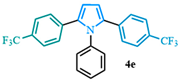
1-phenyl-2,5-bis(4-(trifluoromethyl)phenyl)-1H-pyrrole (4e). Following the general procedure (D), 1-phenyl-2-(4-(trifluoromethyl)phenyl)-1H-pyrrole (0.25 mmol, 71 mg) was reacted with 1-bromo-4-(trifluoromethyl)benzene (0.5 mmol). The reaction was purified by flash chromatography (100 hexanes) to afford 1-phenyl-2,5-bis(4-(trifluoromethyl)phenyl)-1H-pyrrole (0.13 mmol, 53%) as white crystals. Rf: 0.21 (100 hexanes). 1H NMR (500 MHz, CDCl3) δ = 7.42 (d, J = 8.2 Hz and 4H), 7.38–7.27 (m, 3H), 7.14 (d, J = 8.2 Hz and 4H), 7.08–7.02 (m, 2H), 6.57 (s, 2H) ppm. 13C NMR (126 MHz, CDCl3) δ = 138.21, 136.29, 135.15, 129.31, 128.70, 128.46, 128.07, 124.95, 124.92, 111.40 ppm. HRMS (ESI): calculated for [C24H15F6N] = 431.1103, found 431.1108. The spectral data was in agreement with reported data [64].
4-(1-(4-chlorophenyl)-5-(4-(trifluoromethyl)phenyl)-1H-pyrrol-2-yl)benzonitrile (4f). Following the general procedure (D), 4-(1-(4-chlorophenyl)-1H-pyrrol-2-yl)benzonitrile (0.4 mmol, 111 mg) was reacted with 1-bromo-4-(trifluoromethyl)benzene (0.8 mmol). The reaction was purified by flash chromatography (9:1 hexanes/diethyl ether) to afford 4-(1-(4-chlorophenyl)-5-(4-(trifluoromethyl)phenyl)-1H-pyrrol-2-yl)benzonitrile (0.28 mmol, 71%) as white crystals. Rf: 0.16 (9:1 hexanes/diethyl ether). 1H NMR (500 MHz, CDCl3) δ = 7.48 (t, J = 8.4 Hz and 4H), 7.30 (d, J = 8.6 Hz and 2H), 7.13 (dd, J = 10.0, 8.4 Hz and 4H), 6.97 (d, J = 8.6 Hz and 2H), 6.60 (d, J = 3.8 Hz and 1H), 6.57 (d, J = 3.8 Hz and 1H) ppm. 13C NMR (126 MHz, CDCl3) δ = 136.94, 136.54, 135.81, 134.52, 134.16, 131.97, 129.76, 129.69, 128.65, 128.58, 125.14, 118.80, 112.41, 111.96, 109.90 ppm. HRMS (ESI): calculated for [C24H14ClF3N2 + H] = 423.0870, found 423.0870.
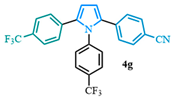
4-(1,5-bis(4-(trifluoromethyl)phenyl)-1H-pyrrol-2-yl)benzonitrile (4g). Following the general procedure (D), 4-(1-(4-(trifluoromethyl)phenyl)-1H-pyrrol-2-yl)benzonitrile (0.4 mmol, 125 mg) was reacted with 1-bromo-4-(trifluoromethyl)benzene (0.8 mmol). The reaction was purified by flash chromatography (9:1 hexanes/diethyl ether) to afford 4-(1,5-bis(4-(trifluoromethyl)phenyl)-1H-pyrrol-2-yl)benzonitrile (0.26 mmol, 66%) as white crystals. Rf: 0.18 (9:1 hexanes/diethyl ether). 1H NMR (500 MHz, CDCl3) δ = 7.59 (d, J = 8.3 Hz and 2H), 7.48 (t, J = 8.3 Hz and 4H), 7.13 (dd, J = 12.2, 8.2 Hz and 4H), 7.10 (d, J = 8.4 Hz and 2H), 6.62 (d, J = 3.8 Hz and 1H), 6.59 (d, J = 3.8 Hz and 1H) ppm. 13C NMR (126 MHz, CDCl3) δ = 141.07, 136.79, 135.79, 135.64, 134.54, 132.02, 130.37, 130.11, 129.07, 128.91, 128.81, 128.72, 128.68, 126.53, 125.24, 124.59, 122.92, 122.43, 118.69, 112.82, 112.38, 110.14 ppm. HRMS (ESI): calculated for [C25H14F6N2 + H] = 419.1366, found 419.1364.
4-(1-(4-methoxyphenyl)-5-(4-(trifluoromethyl)phenyl)-1H-pyrrol-2-yl)benzonitrile (4h). Following the general procedure (D), 4-(1-(4-methoxyphenyl)-1H-pyrrol-2-yl)benzonitrile (0.4 mmol, 109 mg) was reacted with 1-bromo-4-(trifluoromethyl)benzene (0.8 mmol). The reaction was purified by flash chromatography (9:1 hexanes/diethyl ether) to afford 4-(1-(4-methoxyphenyl)-5-(4-(trifluoromethyl)phenyl)-1H-pyrrol-2-yl)benzonitrile (0.2 mmol, 45%) as white crystals. Rf: 0.12 (9:1 hexanes/diethyl ether). 1H NMR (500 MHz, CDCl3) δ = 7.45 (dd, J = 8.6, 7.2 Hz and 4H), 7.15 (dd, J = 10.9, 8.3 Hz and 4H), 6.96 (d, J = 8.8 Hz and 2H), 6.83 (d, J = 8.8 Hz and 2H), 6.60 (d, J = 3.8 Hz and 1H), 6.56 (d, J = 3.8 Hz and 1H), 3.83 (s, 3H) ppm. 13C NMR (126 MHz, CDCl3) δ = 159.18, 137.33, 136.17, 135.98, 134.67, 131.82, 130.81, 129.59, 128.49, 128.47, 128.41, 124.97, 118.99, 114.54, 111.81, 111.37, 109.44, 55.44 ppm. HRMS (ESI): calculated for [C25H17F3N2O] = 456.1056, found 456.1054.

4. Conclusions

We have described a flexible and modular method that uses several key reactions, including Pd-catalyzed decarboxylative cross-coupling and C–H arylation, to efficiently synthesize 1,2,5-triarylpyrroles. Key advantages include simple catalytic systems, short reaction times, practical protocols, and readily available starting materials. Owing to the modularity of the sequence, a range of 1,2,5-triarylpyrroles was prepared. Scope studies focused on aryl bromides to prioritize analogue synthesis and consistency across the sequence since aryl bromides are well documented coupling partners for both the decarboxylative cross-coupling and C–H arylation steps. Because the two steps were optimized under different solvent/base/ligand conditions, the process was carried out stepwise; telescoping with intermediate workup and solvent exchange is a potential direction for future development. These compounds exhibit potentially interesting properties that arise from their three-dimensional shape, which allows them to occupy new chemical space and may enhance interactions with biological targets. Given established atropisomerism in substituted aryl–heteroarene frameworks, the unsymmetrical substitution patterns accessible here may also serve as a starting point for future studies of conformationally restricted or atropisomeric scaffolds.

Supplementary Materials

The following supporting information can be downloaded at https://www.mdpi.com/article/10.3390/molecules31060986/s1. File S1: 1HNMR and 13CNMR spectra are available.

Author Contributions

The reaction optimization and reaction scopes were all contributed by the author. Author C.B. contributed to the investigation, methodology, project administration, visualization, and writing of the original draft. Co-authors S.P. and J.S.N. contributed to the synthesis of the pyrrole ester and pyrrole carboxylic acids. Co-author C.M. participated in the review of the manuscript and started the preliminary work on the formation of the pyrrole esters. Co-author S.T. participated in the review and editing of the manuscript. Co-author F.B. contributed to the conceptualization. Co-author P.F. contributed to the conceptualization, funding acquisition, resources, and supervision. All authors have read and agreed to the published version of the manuscript.

Funding

This research was funded by: NSERC Discovery Grant (RGPIN-2020-07211), Centre in Green Chemistry and Catalysis (FRONT-2020-RS4-265155-CCVC), MITACS/Paraza Pharma and the Richard and Edith Strauss Foundation.

Institutional Review Board Statement

Not applicable.

Informed Consent Statement

Not applicable.

Data Availability Statement

Dataset available on request from the authors.

Conflicts of Interest

Author François Bilodeau was employed by the company “Boehringer Ingelheim (Canada) Ltd.”. The remaining authors declare no conflicts of interest.

Abbreviations

The following abbreviations are used in this manuscript:
DMEDAN,N′-Dimethylethylenediamine
DMFDimethylformamide
DMADimethylacetamide
NMRNuclear magnetic resonance
HRMSHigh-resolution mass spectrometry
TMSTetramethylsilane
TMB1,3,5-Trimethoxybenzene

References

  1. Ferreira, V.F.; De Souza, M.C.B.V.; Cunha, A.C.; Pereira, L.O.R.; Ferreira, M.L.G. Recent advances in the synthesis of pyrroles. Org. Prep. Proced. Int. 2001, 33, 411–454. [Google Scholar] [CrossRef]
  2. Bhardwaj, V.; Gumber, D.; Abbot, V.; Dhiman, S.; Sharma, P. Pyrrole: A Resourceful Small Molecule in Key Medicinal Hetero-Aromatics. RSC Adv. 2015, 5, 15233–15266. [Google Scholar] [CrossRef]
  3. Kaur, R.; Rani, V.; Abbot, V.; Kapoor, Y.; Konar, D.; Kumar, K. Recent Synthetic and Medicinal Perspectives of Pyrroles: An Overview. J. Pharm. Chem. Chem. Sci. 2017, 1, 17–32. [Google Scholar]
  4. Gholap, S.S. Pyrrole: An Emerging Scaffold for Construction of Valuable Therapeutic Agents. Eur. J. Med. Chem. 2016, 110, 13–31. [Google Scholar] [CrossRef]
  5. Lee, H.; Lee, J.; Lee, S.; Shin, Y.; Jung, W.; Kim, J.-H.; Park, K.; Kim, K.; Cho, H.S.; Ro, S.; et al. A Novel Class of Highly Potent, Selective, and Non-Peptidic Inhibitor of Ras Farnesyltransferase (FTase). Bioorg. Med. Chem. Lett. 2001, 11, 3069–3072. [Google Scholar] [CrossRef]
  6. La Regina, G.; Bai, R.; Coluccia, A.; Famiglini, V.; Pelliccia, S.; Passacantilli, S.; Mazzoccoli, C.; Ruggieri, V.; Sisinni, L.; Bolognesi, A.; et al. New Pyrrole Derivatives with Potent Tubulin Polymerization Inhibiting Activity As Anticancer Agents Including Hedgehog-Dependent Cancer. J. Med. Chem. 2014, 57, 6531–6552. [Google Scholar] [CrossRef]
  7. Bianco, M.D.C.A.D.; Marinho, D.I.L.F.; Hoelz, L.V.B.; Bastos, M.M.; Boechat, N. Pyrroles as Privileged Scaffolds in the Search for New Potential HIV Inhibitors. Pharmaceuticals 2021, 14, 893. [Google Scholar] [CrossRef] [PubMed]
  8. Said Fatahala, S.; Hasabelnaby, S.; Goudah, A.; Mahmoud, G.; Helmy Abd-El Hameed, R. Pyrrole and Fused Pyrrole Compounds with Bioactivity against Inflammatory Mediators. Molecules 2017, 22, 461. [Google Scholar] [CrossRef] [PubMed]
  9. Zlatanova-Tenisheva, H.; Vladimirova, S. Anti-Inflammatory and Immunomodulatory Effects of 2-(3-Acetyl-5-(4-Chlorophenyl)-2-Methyl-1H-Pyrrol-1-Yl)-3-Phenylpropanoic Acid. Biomedicines 2025, 13, 2003. [Google Scholar] [CrossRef]
  10. Philkhana, S.C.; Badmus, F.O.; Dos Reis, I.C.; Kartika, R. Recent Advancements in Pyrrole Synthesis. Synthesis 2021, 53, 1531–1555. [Google Scholar] [CrossRef]
  11. Hunjan, M.K.; Panday, S.; Gupta, A.; Bhaumik, J.; Das, P.; Laha, J.K. Recent Advances in Functionalization of Pyrroles and Their Translational Potential. Chem. Rec. 2021, 21, 715–780. [Google Scholar] [CrossRef] [PubMed]
  12. Rostami, H.; Shiri, L. Review on Synthesis of Pyrrole Derivatives Promoted by Nanoparticles. Appl. Organomet. Chem. 2021, 35, e6209. [Google Scholar] [CrossRef]
  13. Singh, N.; Singh, S.; Kohli, S.; Singh, A.; Asiki, H.; Rathee, G.; Chandra, R.; Anderson, E.A. Recent Progress in the Total Synthesis of Pyrrole-Containing Natural Products (2011–2020). Org. Chem. Front. 2021, 8, 5550–5573. [Google Scholar] [CrossRef]
  14. Tzankova, D.; Vladimirova, S.; Peikova, L.; Georgieva, M. Synthesis of pyrrole and substituted pyrroles (Review). J. Chem. Technol. Metall. 2018, 53, 451–464. [Google Scholar]
  15. Ganesh, B.H.; Raj, A.G.; Aruchamy, B.; Nanjan, P.; Drago, C.; Ramani, P. Pyrrole: A Decisive Scaffold for the Development of Therapeutic Agents and Structure-Activity Relationship. ChemMedChem 2024, 19, e202300447. [Google Scholar] [CrossRef] [PubMed]
  16. Estévez, V.; Villacampa, M.; Menéndez, J.C. Recent Advances in the Synthesis of Pyrroles by Multicomponent Reactions. Chem. Soc. Rev. 2014, 43, 4633–4657. [Google Scholar] [CrossRef] [PubMed]
  17. Ragno, R.; Marshall, G.R.; Di Santo, R.; Costi, R.; Massa, S.; Rompei, R.; Artico, M. Antimycobacterial Pyrroles: Synthesis, Anti-Mycobacterium Tuberculosis Activity and QSAR Studies. Bioorg. Med. Chem. 2000, 8, 1423–1432. [Google Scholar] [CrossRef]
  18. Fomina, L.; Galán, G.Z.; Bizarro, M.; Sánchez, J.G.; Zaragoza, I.P.; Salcedo, R. Semiconductor Behavior of 2,5-Aromatic Disubstituted Pyrroles, Viewed from an Experimental and Theoretical Perspective. Mater. Chem. Phys. 2010, 124, 257–263. [Google Scholar] [CrossRef]
  19. Han, T.; Lam, J.W.Y.; Zhao, N.; Gao, M.; Yang, Z.; Zhao, E.; Dong, Y.; Tang, B.Z. A Fluorescence-Switchable Luminogen in the Solid State: A Sensitive and Selective Sensor for the Fast “Turn-on” Detection of Primary Amine Gas. Chem. Commun. 2013, 49, 4848–4850. [Google Scholar] [CrossRef]
  20. Dong, L.; Shang, G.; Shi, J.; Zhi, J.; Tong, B.; Dong, Y. Effect of Substituent Position on the Photophysical Properties of Triphenylpyrrole Isomers. J. Phys. Chem. C 2017, 121, 11658–11664. [Google Scholar] [CrossRef]
  21. Monroy, O.; Fomina, L.; Sánchez-Vergara, M.E.; Gaviño, R.; Acosta, A.; Bada, J.R.Á.; Salcedo, R. Synthesis, Characterization and Semiconducting Behavior of N,2,5-Trisubstituted Pyrroles. J. Mol. Struct. 2018, 1171, 45–53. [Google Scholar] [CrossRef]
  22. Monroy, O.; Fomina, L.; Sánchez-Vergara, M.-E.; Vázquez-Hernández, G.A.; Alexandrova, L.; Gaviño, R.; Rumsh, L.; Zolotukhin, M.G.; Salcedo, R. Synthesis, Characterization and Evaluation of Optical Band Gap of New Semiconductor Polymers with N-Aryl-2,5-Diphenyl-Pyrrole Units. J. Mol. Struct. 2021, 1245, 131012. [Google Scholar] [CrossRef]
  23. Vázquez-Hernández, G.A.; Cruz-Gómez, M.J.; Vergara, M.E.S.; Salcedo, R.; Fomina, L. Synthesis and Characterization of New Organic Semiconductors, Based on Metallophthalocyanines and Pyrrole Derivatives. J. Mol. Struct. 2025, 1336, 141996. [Google Scholar] [CrossRef]
  24. Blackburn, T.J.; Ahmed, S.; Coxon, C.R.; Liu, J.; Lu, X.; Golding, B.T.; Griffin, R.J.; Hutton, C.; Newell, D.R.; Ojo, S.; et al. Diaryl- and Triaryl-Pyrrole Derivatives: Inhibitors of the MDM2–P53 and MDMX–P53 Protein–Protein Interactions. MedChemCommun 2013, 4, 1297–1304. [Google Scholar] [CrossRef]
  25. Yeh, T.-K.; Kuo, C.-C.; Lee, Y.-Z.; Ke, Y.-Y.; Chu, K.-F.; Hsu, H.-Y.; Chang, H.-Y.; Liu, Y.-W.; Song, J.-S.; Yang, C.-W.; et al. Design, Synthesis, and Evaluation of Thiazolidine-2,4-Dione Derivatives as a Novel Class of Glutaminase Inhibitors. J. Med. Chem. 2017, 60, 5599–5612. [Google Scholar] [CrossRef]
  26. Cheng, J.K.; Xiang, S.-H.; Li, S.; Ye, L.; Tan, B. Recent Advances in Catalytic Asymmetric Construction of Atropisomers. Chem. Rev. 2021, 121, 4805–4902. [Google Scholar] [CrossRef] [PubMed]
  27. Jones, R.A.; Spotswood, T.M.L.; Cheuychit, P. Pyrrole Studies—XII: The aromatic character of 1-substituted pyrroles. Tetrahedron 1967, 23, 4469–4479. [Google Scholar] [CrossRef]
  28. Clayden, J.; Moran, W.J.; Edwards, P.J.; LaPlante, S.R. The Challenge of Atropisomerism in Drug Discovery. Angew. Chem. Int. Ed. 2009, 48, 6398–6401. [Google Scholar] [CrossRef] [PubMed]
  29. Lovering, F.; Bikker, J.; Humblet, C. Escape from Flatland: Increasing Saturation as an Approach to Improving Clinical Success. J. Med. Chem. 2009, 52, 6752–6756. [Google Scholar] [CrossRef]
  30. Lovering, F. Escape from Flatland 2: Complexity and Promiscuity. MedChemCommun 2013, 4, 515–519. [Google Scholar] [CrossRef]
  31. Thirumalairajan, S.; Pearce, B.M.; Thompson, A. Chiral Molecules Containing the Pyrrole Framework. Chem. Commun. 2010, 46, 1797–1812. [Google Scholar] [CrossRef]
  32. Campbell, J.W.; Cotnam, M.J.; Annan, F.R.; Hilborn, J.W.; Thompson, A. Synthesis of Chiral Systems Featuring the Pyrrole Unit: A Review. Chem. Commun. 2024, 60, 11385–11414. [Google Scholar] [CrossRef] [PubMed]
  33. Toenjes, S.T.; Gustafson, J.L. Atropisomerism in Medicinal Chemistry: Challenges and Opportunities. Future Med. Chem. 2018, 10, 409–422. [Google Scholar] [CrossRef]
  34. LaPlante, S.R.; Edwards, P.J.; Fader, L.D.; Jakalian, A.; Hucke, O. Revealing Atropisomer Axial Chirality in Drug Discovery. ChemMedChem 2011, 6, 505–513. [Google Scholar] [CrossRef] [PubMed]
  35. Knorr, L. Pyrrole Synthesis. Berichte Dtsch. Chem. Ges. 1884, 17, 1635. [Google Scholar] [CrossRef]
  36. Paal, C. Pyrroles Synthesis. Berichte Dtsch. Chem. Ges. 1885, 18, 367. [Google Scholar] [CrossRef]
  37. Hantzsch, A. Pyrroles Synthesis. Berichte Dtsch. Chem. Ges. 1890, 23, 1474. [Google Scholar] [CrossRef]
  38. Balakrishna, A.; Aguiar, A.; Sobral, P.J.M.; Wani, M.Y.; Almeida e Silva, J.; Sobral, A.J.F.N. Paal–Knorr Synthesis of Pyrroles: From Conventional to Green Synthesis. Catal. Rev.-Sci. Eng. 2019, 61, 84–110. [Google Scholar] [CrossRef]
  39. Handy, S.; Lavender, K. Organic Synthesis in Deep Eutectic Solvents: Paal–Knorr Reactions. Tetrahedron Lett. 2013, 54, 4377–4379. [Google Scholar] [CrossRef]
  40. Rahmatpour, A. Polystyrene-Supported GaCl3 as a Highly Efficient and Recyclable Heterogeneous Lewis Acid Catalyst for One-Pot Synthesis of N-Substituted Pyrroles. J. Organomet. Chem. 2012, 712, 15–19. [Google Scholar] [CrossRef]
  41. Srinivas, R.; Thirupathi, B.; Prashanth Kumar, J.K.; Prasad, A.N.; Reddy, B.M. One-Step Synthesis of 1,2,5-Trisubstituted Pyrroles by Copper Catalyzed Condensation of 1,4-Diones with Primary Amines. Curr. Org. Chem. 2012, 16, 2482–2489. [Google Scholar] [CrossRef]
  42. He, Y.H.; Wang, G.Q.; Xu, K.L.; Guan, Z. An Efficient Procedure for the Synthesis of Polysubstituted Pyrroles in an Ionic Liquid. Z. Naturforsch.-Sect. B J. Chem. Sci. 2011, 66, 191–196. [Google Scholar] [CrossRef]
  43. Rahmatpour, A. ZrOCl2·8H2O as a Highly Efficient, Eco-Friendly and Recyclable Lewis Acid Catalyst for One-Pot Synthesis of N-Substituted Pyrroles under Solvent-Free Conditions at Room Temperature. Appl. Organomet. Chem. 2011, 25, 585–590. [Google Scholar] [CrossRef]
  44. He, Y.; Wang, G.; Guan, Z. N-Substituted Pyrrole Synthesis by Paal–Knorr Condensation Using Recyclable Cationic Exchange Resin in Water. J. Heterocycl. Chem. 2010, 47, 486–489. [Google Scholar] [CrossRef]
  45. Chen, J.; Liu, M.; Yang, X.; Ding, J.; Wu, H. Indium(III)-Catalyzed Synthesis of N-Substituted Pyrroles under Solvent-Free Conditions. J. Braz. Chem. Soc. 2008, 19, 877–883. [Google Scholar] [CrossRef]
  46. De, S.K. Cobalt(II) Chloride as a Novel and Efficient Catalyst for the Synthesis of Solvent-Free Conditions. Heteroat. Chem. 2008, 19, 592–595. [Google Scholar] [CrossRef]
  47. De, S.K. Ruthenium (III) Chloride as a Novel and Efficient Catalyst for the Synthesis of Substituted Pyrroles under Solvent-Free Conditions. Catal. Lett. 2008, 124, 174–177. [Google Scholar] [CrossRef]
  48. Chiu, H.C.; Tonks, I.A. Trimethylsilyl-Protected Alkynes as Selective Cross-Coupling Partners in Titanium-Catalyzed [2+2+1] Pyrrole Synthesis. Angew. Chem.-Int. Ed. 2018, 57, 6090–6094. [Google Scholar] [CrossRef]
  49. Younis, F.M.; Krieck, S.; Görls, H.; Westerhausen, M. S-Block-Metal-Mediated Hydroamination of Diphenylbutadiyne with Primary Arylamines Using a Dipotassium Tetrakis(Amino)Calciate Precatalyst. Organometallics 2015, 34, 3577–3585. [Google Scholar] [CrossRef]
  50. Kramer, S.; Madsen, J.L.H.; Rottlander, M.; Skrydstrup, T. Access to 2,5-Diamidopyrroles and 2,5-Diamidofurans by Au(I)-Catalyzed Double Hydroamination or Hydration of 1,3-Diynes. Org. Lett. 2010, 12, 2758–2761. [Google Scholar] [CrossRef]
  51. Zheng, Q.; Hua, R. CuCl-Catalyzed Cycloaddition of 1,3-Butadiynes with Primary Amines: An Atom-Economic Process for Synthesis of 1,2,5-Trisubsituted Pyrroles. Tetrahedron Lett. 2010, 51, 4512–4514. [Google Scholar] [CrossRef]
  52. Ramanathan, B.; Keith, A.J.; Armstrong, D.; Odom, A.L. Pyrrole Syntheses Based on Titanium-Catalyzed Hydroamination of Diynes. Org. Lett. 2004, 6, 2957–2960. [Google Scholar] [CrossRef] [PubMed]
  53. Zheng, Q.; Hua, R.; Jiang, J.; Zhang, L. A General Approach to Arylated Furans, Pyrroles, and Thiophenes. Tetrahedron 2014, 70, 8252–8256. [Google Scholar] [CrossRef]
  54. Vázquez-Hernández, G.A.; Delgado-Cruz, R.; Sánchez-Vergara, M.E.; Fomina, L.; Gómez-Vidales, V.; de la Mora, B.; Acosta, A.; Ríos, C.; Salcedo, R. New 2,5-Aromatic Disubstituted Pyrroles, Prepared Using Diazonium Salts Procedures. J. Mol. Struct. 2021, 1233, 130107. [Google Scholar] [CrossRef]
  55. Zhou, Y.; Wu, M.; Liu, Y.; Cheng, C.; Zhu, G. Synthesis of Polysubstituted Pyrroles via Silver-Catalyzed Oxidative Radical Addition of Cyclopropanols to Imines. Org. Lett. 2020, 22, 7542–7546. [Google Scholar] [CrossRef]
  56. Luo, K.; Mao, S.; He, K.; Yu, X.; Pan, J.; Lin, J.; Shao, Z.; Jin, Y. Highly Regioselective Synthesis of Multisubstituted Pyrroles via Ag-Catalyzed [4+1C]Insert Cascade. ACS Catal. 2020, 10, 3733–3740. [Google Scholar] [CrossRef]
  57. Ryabchuk, P.; Leischner, T.; Kreyenschulte, C.; Spannenberg, A.; Junge, K.; Beller, M. Cascade Synthesis of Pyrroles from Nitroarenes with Benign Reductants Using a Heterogeneous Cobalt Catalyst. Angew. Chem.-Int. Ed. 2020, 59, 18679–18685. [Google Scholar] [CrossRef] [PubMed]
  58. Yasukawa, N.; Kuwata, M.; Imai, T.; Monguchi, Y.; Sajiki, H.; Sawama, Y. Copper-Catalyzed Pyrrole Synthesis from 3,6-Dihydro-1,2-Oxazines. Green Chem. 2018, 20, 4409–4413. [Google Scholar] [CrossRef]
  59. Lee, H.; Yi, Y.; Jun, C.H. Copper(II)-Promoted, One-Pot Conversion of 1-Alkynes with Anhydrides or Primary Amines to the Respective 2,5-Disubstituted Furans or Pyrroles under Microwave Irradiation Conditions. Adv. Synth. Catal. 2015, 357, 3485–3490. [Google Scholar] [CrossRef]
  60. Banik, B.K.; Banik, I.; Renteria, M.; Dasgupta, S.K. A Straightforward Highly Efficient Paal-Knorr Synthesis of Pyrroles. Tetrahedron Lett. 2005, 46, 2643–2645. [Google Scholar] [CrossRef]
  61. Nicolaou, K.C.; Bulger, P.G.; Sarlah, D. Palladium-Catalyzed Cross-Coupling Reactions in Total Synthesis. Angew. Chem. Int. Ed. 2005, 44, 4442–4489. [Google Scholar] [CrossRef]
  62. Torborg, C.; Beller, M. Recent Applications of Palladium-Catalyzed Coupling Reactions in the Pharmaceutical, Agrochemical, and Fine Chemical Industries. Adv. Synth. Catal. 2009, 351, 3027–3043. [Google Scholar] [CrossRef]
  63. Biajoli, A.F.P.; Schwalm, C.S.; Limberger, J.; Claudino, T.S.; Monteiro, A.L. Recent Progress in the Use of Pd-Catalyzed C-C Cross-Coupling Reactions in the Synthesis of Pharmaceutical Compounds. J. Braz. Chem. Soc. 2014, 25, 2186–2214. [Google Scholar] [CrossRef]
  64. Ehlers, P.; Petrosyan, A.; Baumgard, J.; Jopp, S.; Steinfeld, N.; Ghochikyan, T.V.; Saghyan, A.S.; Fischer, C.; Langer, P. Synthesis of 2,5-Diarylpyrroles by Ligand-Free Palladium-Catalyzed CH Activation of Pyrroles in Ionic Liquids. ChemCatChem 2013, 5, 2504–2511. [Google Scholar] [CrossRef]
  65. Zhao, L.; Bruneau, C.; Doucet, H. Palladium-Catalysed Direct Polyarylation of Pyrrole Derivatives. ChemCatChem 2013, 5, 255–262. [Google Scholar] [CrossRef]
  66. Zheng, J.; Huang, L.; Huang, C.; Wu, W.; Jiang, H. Synthesis of Polysubstituted Pyrroles via Pd-Catalyzed Oxidative Alkene C–H Bond Arylation and Amination. J. Org. Chem. 2015, 80, 1235–1242. [Google Scholar] [CrossRef] [PubMed]
  67. Roger, J.; Doucet, H. Regioselective C-2 or C-5 Direct Arylation of Pyrroles with Aryl Bromides Using a Ligand-Free Palladium Catalyst. Adv. Synth. Catal. 2009, 351, 1977–1990. [Google Scholar] [CrossRef]
  68. Peschko, C.; Winklhofer, C.; Steglich, W. Biomimetic Total Synthesis of Lamellarin L by Coupling of Two Different Arylpyruvic Acid Units. Chem.-Eur. J. 2000, 6, 1147–1152. [Google Scholar] [CrossRef]
  69. Tanaka, D.; Romeril, S.P.; Myers, A.G. On the Mechanism of the Palladium(II)-Catalyzed Decarboxylative Olefination of Arene Carboxylic Acids. Crystallographic Characterization of Non-Phosphine Palladium(II) Intermediates and Observation of Their Stepwise Transformation in Heck-like Processes. J. Am. Chem. Soc. 2005, 127, 10323–10333. [Google Scholar] [CrossRef]
  70. Goossen, L.J.; Deng, G.; Levy, L.M. Synthesis of Biaryls via Catalytic Decarboxylative Coupling. Science 2006, 313, 662–664. [Google Scholar] [CrossRef] [PubMed]
  71. Forgione, P.; Brochu, M.-C.; St-Onge, M.; Thesen, K.H.; Bailey, M.D.; Bilodeau, F. Unexpected Intermolecular Pd-Catalyzed Cross-Coupling Reaction Employing Heteroaromatic Carboxylic Acids as Coupling Partners. J. Am. Chem. Soc. 2006, 128, 11350–11351. [Google Scholar] [CrossRef]
  72. Becht, J.-M.; Catala, C.; Le Drian, C.; Wagner, A. Synthesis of Biaryls via Decarboxylative Pd-Catalyzed Cross-Coupling Reaction. Org. Lett. 2007, 9, 1781–1783. [Google Scholar] [CrossRef] [PubMed]
  73. Park, K.; Bae, G.; Moon, J.; Choe, J.; Song, K.H.; Lee, S. Synthesis of Symmetrical and Unsymmetrical Diarylalkynes from Propiolic Acid Using Palladium-Catalyzed Decarboxylative Coupling. J. Org. Chem. 2010, 75, 6244–6251. [Google Scholar] [CrossRef]
  74. Lange, P.P.; Gooßen, L.J.; Podmore, P.; Underwood, T.; Sciammetta, N. Decarboxylative Biaryl Synthesis in a Continuous Flow Reactor. Chem. Commun. 2011, 47, 3628–3630. [Google Scholar] [CrossRef] [PubMed]
  75. Rodríguez, N.; Goossen, L.J. Decarboxylative Coupling Reactions: A Modern Strategy for C–C-Bond Formation. Chem. Soc. Rev. 2011, 40, 5030–5048. [Google Scholar] [CrossRef]
  76. Jafarpour, F.; Zarei, S.; Barzegar, M.; Olia, A.; Rahiminejadan, S. Palladium-Catalyzed Decarboxylative Cross-Coupling Reactions: A Route for Regioselective Functionalization of Coumarins. J. Org. Chem. 2013, 78, 2957–2964. [Google Scholar] [CrossRef]
  77. Wei, Y.; Hu, P.; Zhang, M.; Su, W. Metal-Catalyzed Decarboxylative C–H Functionalization. Chem. Rev. 2017, 117, 8864–8907. [Google Scholar] [CrossRef] [PubMed]
  78. Minami, S.; Hirano, K.; Satoh, T.; Miura, M. Synthesis of [1]Benzothieno[3,2-b][1]Benzothiophene (BTBT) and Its Higher Homologs through Palladium-Catalyzed Intramolecular Decarboxylative Arylation. Tetrahedron Lett. 2014, 55, 4175–4177. [Google Scholar] [CrossRef]
  79. Karale, U.B.; Kalari, S.; Shivakumar, J.; Makane, V.B.; Babar, D.A.; Thakare, R.P.; Babu, B.N.; Chopra, S.; Rode, H.B. Ligand-Free Pd-Catalysed Decarboxylative Arylation of Imidazo[1,2-a]Pyridine-3-Carboxylic Acids with Aryl Bromides. RSC Adv. 2016, 6, 65095–65104. [Google Scholar] [CrossRef]
  80. Mahajan, J.P.; Mhaske, S.B. Synthesis of Methyl-Protected (±)-Chlorizidine A. Org. Lett. 2017, 19, 2774–2776. [Google Scholar] [CrossRef]
  81. Hackenberger, D.; Weber, P.; Blakemore, D.C.; Goossen, L.J. Synthesis of 3-Substituted 2-Arylpyridines via Cu/Pd-Catalyzed Decarboxylative Cross-Coupling of Picolinic Acids with (Hetero)Aryl Halides. J. Org. Chem. 2017, 82, 3917–3925. [Google Scholar] [CrossRef]
  82. Chacon-Huete, F.; Mangel, D.; Ali, M.; Sudano, A.; Forgione, P. High-Value Biomass-Derived 2,5-Furandicarboxylic Acid Derivatives Obtained by a Double Decarboxylative Cross-Coupling. ACS Sustain. Chem. Eng. 2017, 5, 7071–7076. [Google Scholar] [CrossRef]
  83. Messina, C.; Douglas, L.Z.; Liu, J.T.; Forgione, P. Successive Pd-Catalyzed Decarboxylative Cross-Couplings for the Modular Synthesis of Non-Symmetric Di-Aryl-Substituted Thiophenes. Eur. J. Org. Chem. 2020, 2020, 5182–5191. [Google Scholar] [CrossRef]
  84. Chacon-Huete, F.; Lasso, J.D.; Szavay, P.; Covone, J.; Forgione, P. Synthesis of 2,5-Diaryl Nonsymmetric Furans C6-Platform Chemicals via Catalytic Conversion of Biomass and the Formal Synthesis of Dantrolene. J. Org. Chem. 2021, 86, 515–524. [Google Scholar] [CrossRef] [PubMed]
  85. Messina, C.; Ottenwaelder, X.; Forgione, P. Programmed Synthesis of Tetra-Aryl Thiophenes with Stepwise, Ester-Controlled Regioselectivity. Org. Lett. 2021, 23, 7348–7352. [Google Scholar] [CrossRef]
  86. Liu, J.T.; Hase, H.; Taylor, S.; Salzmann, I.; Forgione, P. Approaching the Integer-Charge Transfer Regime in Molecularly Doped Oligothiophenes by Efficient Decarboxylative Cross-Coupling. Angew. Chem. Int. Ed. 2020, 6, 7146–7153. [Google Scholar] [CrossRef] [PubMed]
  87. Bilodeau, F.; Brochu, M.C.; Guimond, N.; Thesen, K.H.; Forgione, P. Palladium-Catalyzed Decarboxylative Cross-Coupling Reaction between Heteroaromatic Carboxylic Acids and Aryl Halides. J. Org. Chem. 2010, 75, 1550–1560. [Google Scholar] [CrossRef]
  88. Figliola, C.; Greening, S.M.; Lamont, C.; Groves, B.R.; Thompson, A. Decarboxylative Arylation of Substituted Pyrroles N-Protected with 2-(Trimethylsilyl)Ethoxymethyl (SEM). Can. J. Chem. 2018, 96, 534–542. [Google Scholar] [CrossRef]
  89. Antilla, J.C.; Baskin, J.M.; Barder, T.E.; Buchwald, S.L. Copper−Diamine-Catalyzed N-Arylation of Pyrroles, Pyrazoles, Indazoles, Imidazoles, and Triazoles. J. Org. Chem. 2004, 69, 5578–5587. [Google Scholar] [CrossRef]
  90. Howard, J.K.; Rihak, K.J.; Bissember, A.C.; Smith, J.A. The Oxidation of Pyrrole. Chem. Asian J. 2016, 11, 155–167. [Google Scholar] [CrossRef]
  91. Waltman, R.J.; Bargon, J. Electrically Conducting Polymers: A Review of the Electropolymerization Reaction, of the Effects of Chemical Structure on Polymer Film Properties, and of Applications towards Technology. Can. J. Chem. 1986, 64, 76–95. [Google Scholar] [CrossRef]
  92. Nadeau, J.M.; Swager, T.M. New β-Linked Pyrrole Monomers: Approaches to Highly Stable and Conductive Electrochromic Polymers. Tetrahedron 2004, 60, 7141–7146. [Google Scholar] [CrossRef]
  93. Kiren, S.; Grimes, F.; Mohammed, H.; Alazawi, D. A Facile Synthesis of 4-Azaisoindoles and Their Transformation into Novel Pyrrole-Fused 2-Pyridones. Tetrahedron 2021, 78, 131807. [Google Scholar] [CrossRef]
  94. Alvarez-Montoya, A.; Gillions, J.P.; Winfrey, L.; Hawker, R.R.; Singh, K.; Ortu, F.; Fu, Y.; Li, Y.; Pulis, A.P. B(C6F5)3-Catalyzed Dehydrogenation of Pyrrolidines to Form Pyrroles. ACS Catal. 2024, 14, 4856–4864. [Google Scholar] [CrossRef] [PubMed]
  95. Buonomano, C.; Holtz-Mulholland, M.; Sullivan, S.; Forgione, P. Development of a Palladium-Catalyzed Decarboxylative Arene Cross-Coupling of Pyrrole Derivatives in a Flow Reactor. J. Flow Chem. 2022, 12, 275–283. [Google Scholar] [CrossRef]
  96. Gryko, D.T.; Vakuliuk, O.; Gryko, D.; Koszarna, B. Palladium-Catalyzed 2-Arylation of Pyrroles. J. Org. Chem. 2009, 74, 9517–9520. [Google Scholar] [CrossRef]
  97. Katritzky, A.R.; Zhang, L.; Yao, J.; Denisko, O.V. Preparation of 1,2-Diaryl(Heteroaryl)Pyrroles and -3-Methylpyrroles from N-Allylbenzotriazole. J. Org. Chem. 2000, 65, 8074–8076. [Google Scholar] [CrossRef] [PubMed]
  98. Jin, R.; Yuan, K.; Chatelain, E.; Soulé, J.; Doucet, H. Palladium-Catalysed Direct Desulfitative Arylation of Pyrroles Using Benzenesulfonyl Chlorides as Alternative Coupling Partners. Adv. Synth. Catal. 2014, 356, 3831–3841. [Google Scholar] [CrossRef]
Figure 1. Examples of polysubstituted pyrroles of pharmaceutical interest.
Molecules 31 00986 g001
Figure 2. Selected synthetic pathways to 1,2,5-triarylpyrroles. (A) Paal-Knoor condensation (B) Cycloaddition (C) Double C–H arylation (D) Decarboxylative cross-coupling and C–H arylation.
Molecules 31 00986 g002
Figure 3. Proposed synthetic pathway toward 1,2,5-triaryl-substituted pyrroles.
Molecules 31 00986 g003
Figure 4. Buchwald coupling and saponification for the synthesis of N-arylated pyrrole carboxylic acids. Yields * corresponds to the yield for Buchwald coupling. Yields ** corresponds to the yield for saponification.
Molecules 31 00986 g004
Figure 5. Example of the synthesis of a 1,2,5-triarylated pyrrole with specific yields and conditions.
Molecules 31 00986 g005
Table 1. Optimization of the decarboxylative cross-coupling.
Molecules 31 00986 i001
Entry9a:12e Ratio
(y Equiv.:w Equiv.)
n-Bu4NCl·H2O
(x Equiv.)
1H NMR
Yield (%)
12:11.093 (89)
21:2 a1.031
32:1085–95
42:10.3Quant. (95)
52:10.5Quant.
General conditions: 2.0 equiv. of 1-phenyl-1H-pyrrole-2-carboxylic acid (0.2 mmol), 1.0 equiv. of 4-bromobenzonitrile, 1.5 equiv. of Cs2CO3, n-Bu4NCl·H2O, Pd[P(tBu)3]2 (5 mol%) and 2 mL of anhydrous DMF heated for 8 min at 170 °C in the microwave. Conditions a: 1.0 equiv. of 1-phenyl-1H-pyrrole-2-carboxylic acid (0.1 mmol), 2.0 equiv. of 4-bromobenzonitrile, 1.5 equiv. of Cs2CO3, n-Bu4NCl·H2O, Pd[P(tBu)3]2 (5 mol%) and 2 mL of anhydrous DMF heated for 8 min at 170 °C in the microwave. Yield determined by 1H NMR with 1,3,5-trimethoxybenzene as the internal standard. The yields in parenthesis are isolated.
Table 2. Scope of the decarboxylative cross-coupling.
Molecules 31 00986 i002
EntryCarboxylic AcidProductYield (%)
1Molecules 31 00986 i003Molecules 31 00986 i00490
2Molecules 31 00986 i005Molecules 31 00986 i00693
3Molecules 31 00986 i007Molecules 31 00986 i00889
4Molecules 31 00986 i009Molecules 31 00986 i01093
5Molecules 31 00986 i011Molecules 31 00986 i01283
6Molecules 31 00986 i013Molecules 31 00986 i01455
General conditions: 2.0 equiv. of 1-phenyl-1H-pyrrole-2-carboxylic acid (0.2 mmol), 1.0 equiv. of 4-bromobenzonitrile, 1.5 equiv. of Cs2CO3, 0.3 equiv. of n-Bu4NCl·H2O, Pd[P(tBu)3]2 (5 mol%) and 2 mL of anhydrous DMF heated for 8 min at 170 °C in the microwave.
Table 3. Optimization of the C–H arylation.
Molecules 31 00986 i015
EntryPalladium SourceLigandTemperature
(°C)
A:B Ratio1H NMR
Yield (%)
Source(x mol%)Source(z mol%)
1Pd(OAc)20.1--1502:10
2Pd(OAc)25--1502:10
3Pd(OAc)25--1702:147
4Pd(OAc)25PPh3201702:174
5Pd(OAc)25PPh3201701:2 b74
6PdCl25PPh3201701:2 b92
7Pd(PPh3)45--1701:2 b58
8Pd2(dba)35--1701:2 b38
9PdCl25JohnPhos101701:2 b75
10PdCl25CyJohnPhos101701:2 b68
11PdCl25PCy3·HBF4101701:2 b81
General conditions: 2.0 equiv. of methyl 1-phenyl-1H-pyrrole-2-carboxylate (0.2 mmol), 1.0 equiv. of 1-bromo-4-(trifluoromethyl)benzene, 2.1 equiv. of KOAc, palladium source (x mol%), ligand (20 mol%) and 2 mL of anhydrous DMA heated for 5 h. Conditions b: 1.0 equiv. of methyl 1-phenyl-1H-pyrrole-2-carboxylate (0.1 mmol), 2.0 equiv. of 1-bromo-4-(trifluoromethyl)benzene, 2.1 equiv. of KOAc, Pd(OAc)2 (5 mol%), PPh3 (20 mol%) and 2 mL of anhydrous DMA heated for 5 h. The yield was determined by 1H NMR with 1,3,5-trimethoxybenzene as internal standard.
Table 4. Scope of the C–H arylation.
Molecules 31 00986 i016
EntryCarboxylic AcidProductYield (%)
1Molecules 31 00986 i017Molecules 31 00986 i01892
2Molecules 31 00986 i019Molecules 31 00986 i02090
3Molecules 31 00986 i021Molecules 31 00986 i02285
4Molecules 31 00986 i023Molecules 31 00986 i02483
5Molecules 31 00986 i025Molecules 31 00986 i02653
6Molecules 31 00986 i027Molecules 31 00986 i02871
7Molecules 31 00986 i029Molecules 31 00986 i03066
8Molecules 31 00986 i031Molecules 31 00986 i03245
General conditions: 1.0 equiv. of pyrrole (0.4 mmol), 2.0 equiv. of aryl bromide, 2.1 equiv. of KOAc, PdCl2 (5 mol%), PPh3 (20 mol%) and 2 mL of anhydrous DMA heated for 5 h.
Disclaimer/Publisher’s Note: The statements, opinions and data contained in all publications are solely those of the individual author(s) and contributor(s) and not of MDPI and/or the editor(s). MDPI and/or the editor(s) disclaim responsibility for any injury to people or property resulting from any ideas, methods, instructions or products referred to in the content.