Molecular Mechanisms Underlying the Anti-Tumor Activity of Lotus-Derived Alkaloids in Breast Cancer

 and
and
Abstract
1. Introduction
2. Results
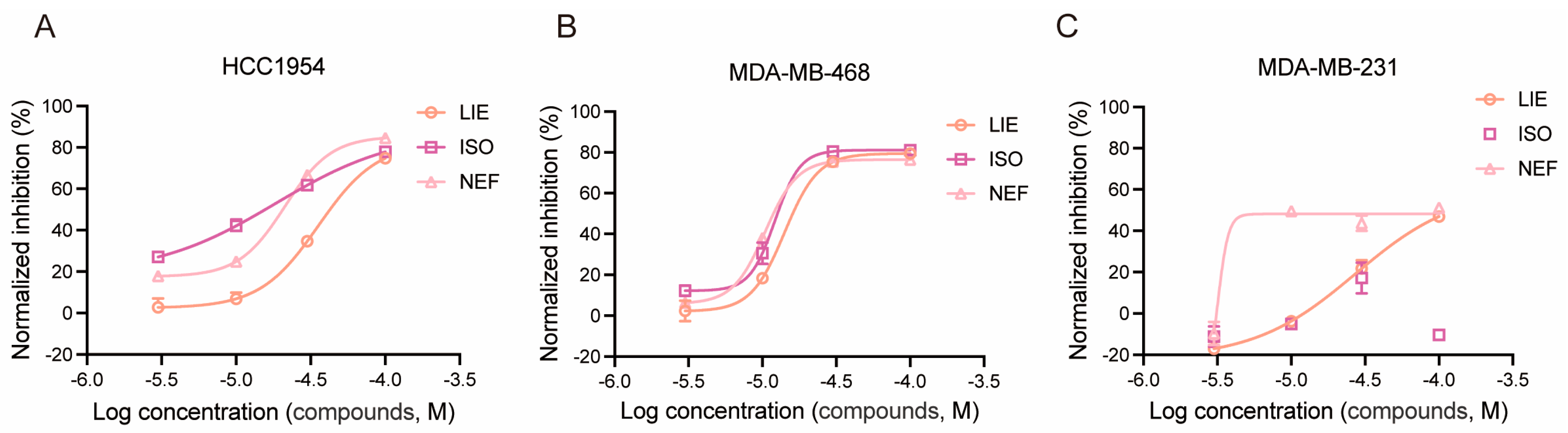
2.1. LIE, ISO, and NEF Inhibit Breast Cancer Cell Proliferation in a Dose-Dependent Manner
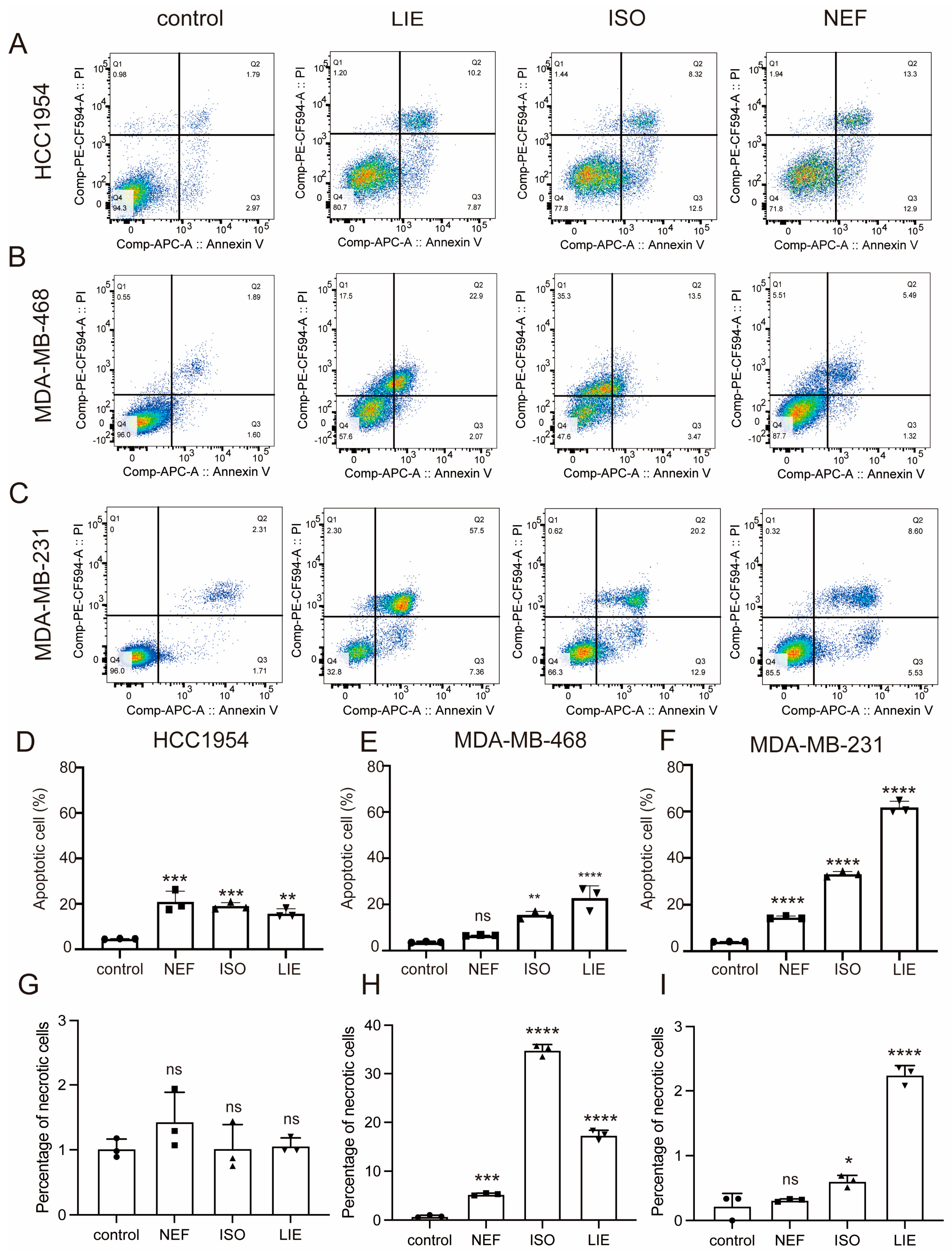
2.2. LIE, NEF, and ISO Induce Robust Apoptosis in Breast Cancer Cells
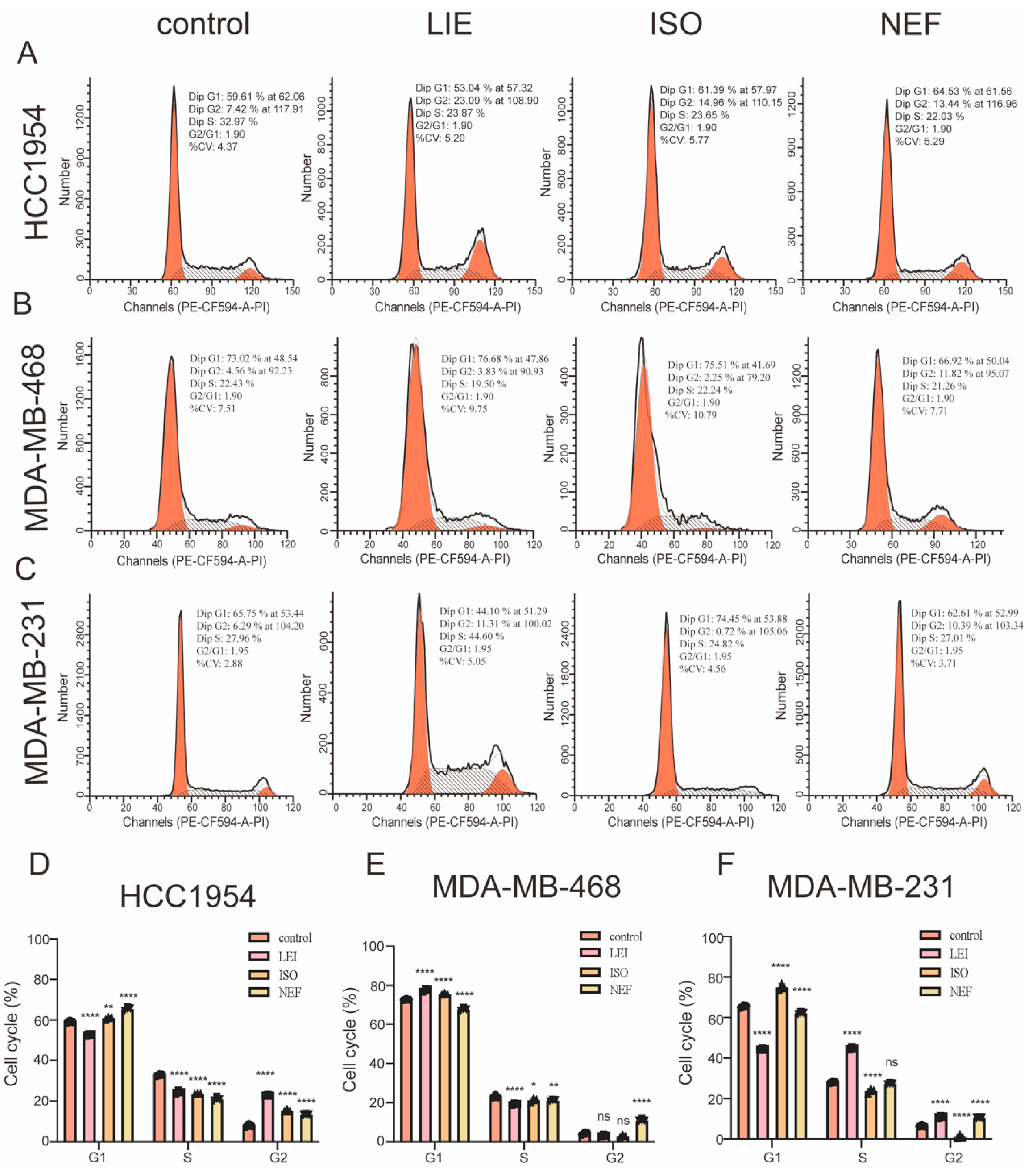
2.3. Cell Cycle Disruption by LIE, ISO, and NEF in Breast Cancer Cells
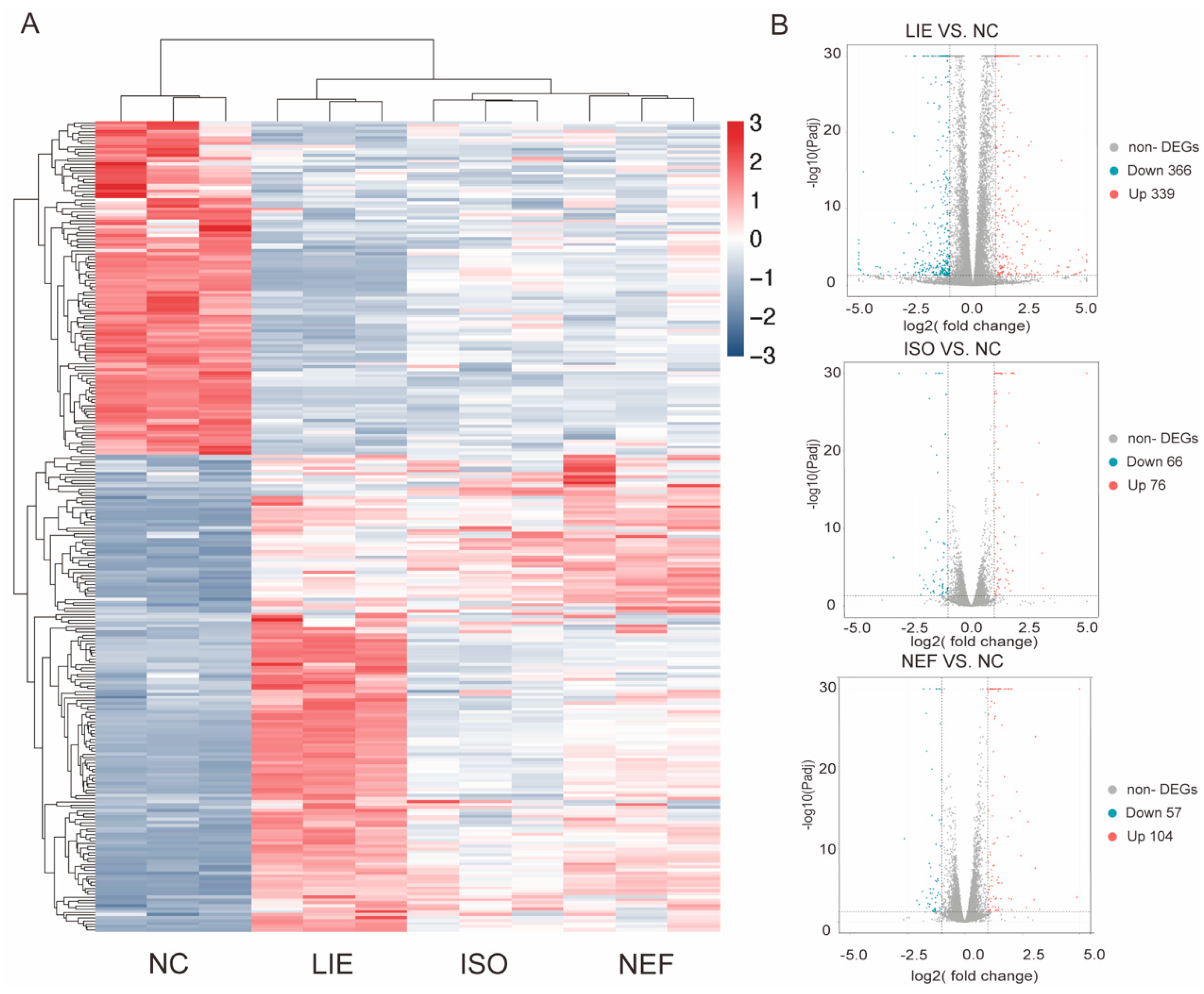
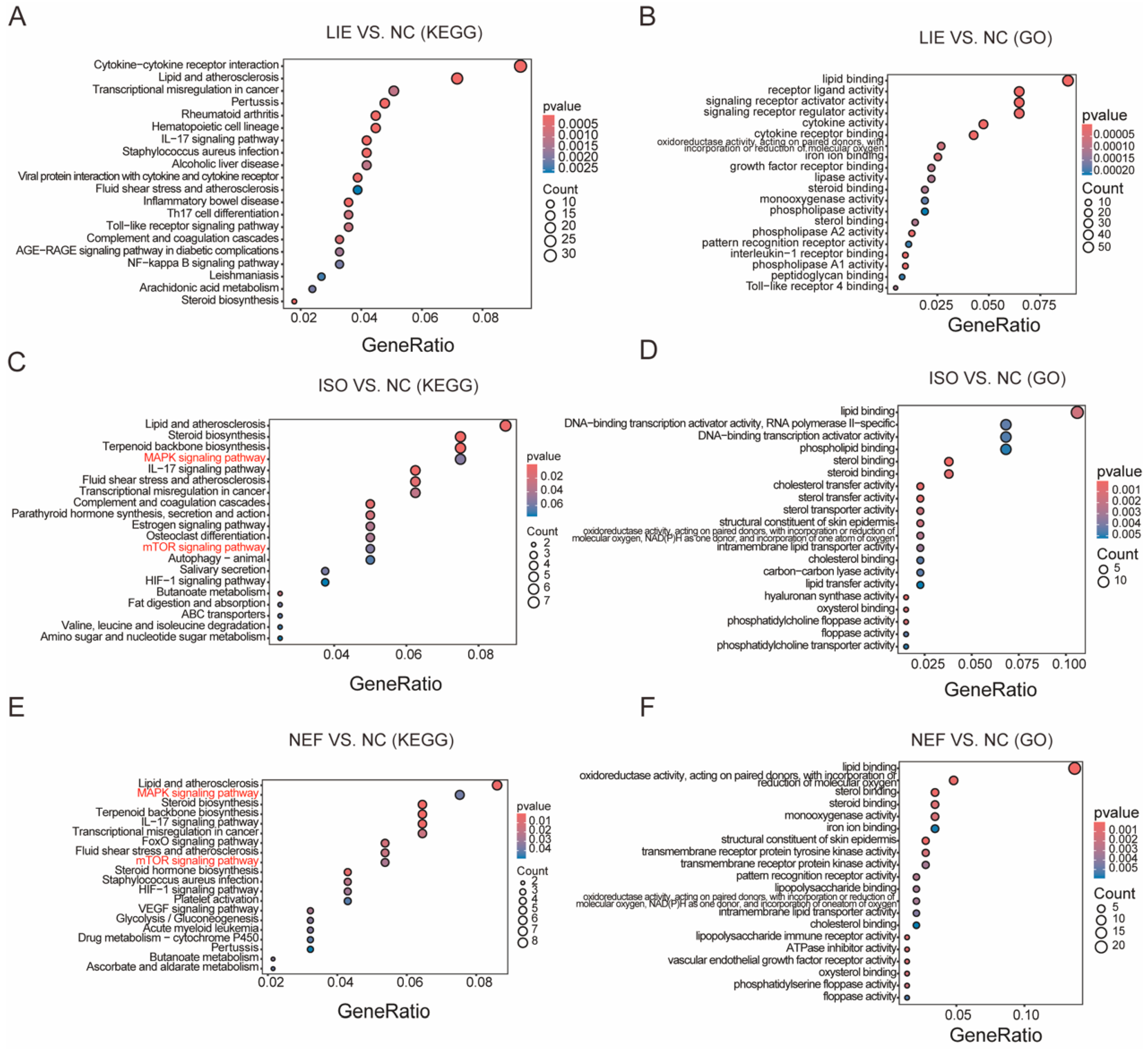
2.4. Transcriptomic Profiling Reveals Distinct Gene Expression Programs and Signaling Pathway Perturbations Induced by LIE, ISO, and NEF
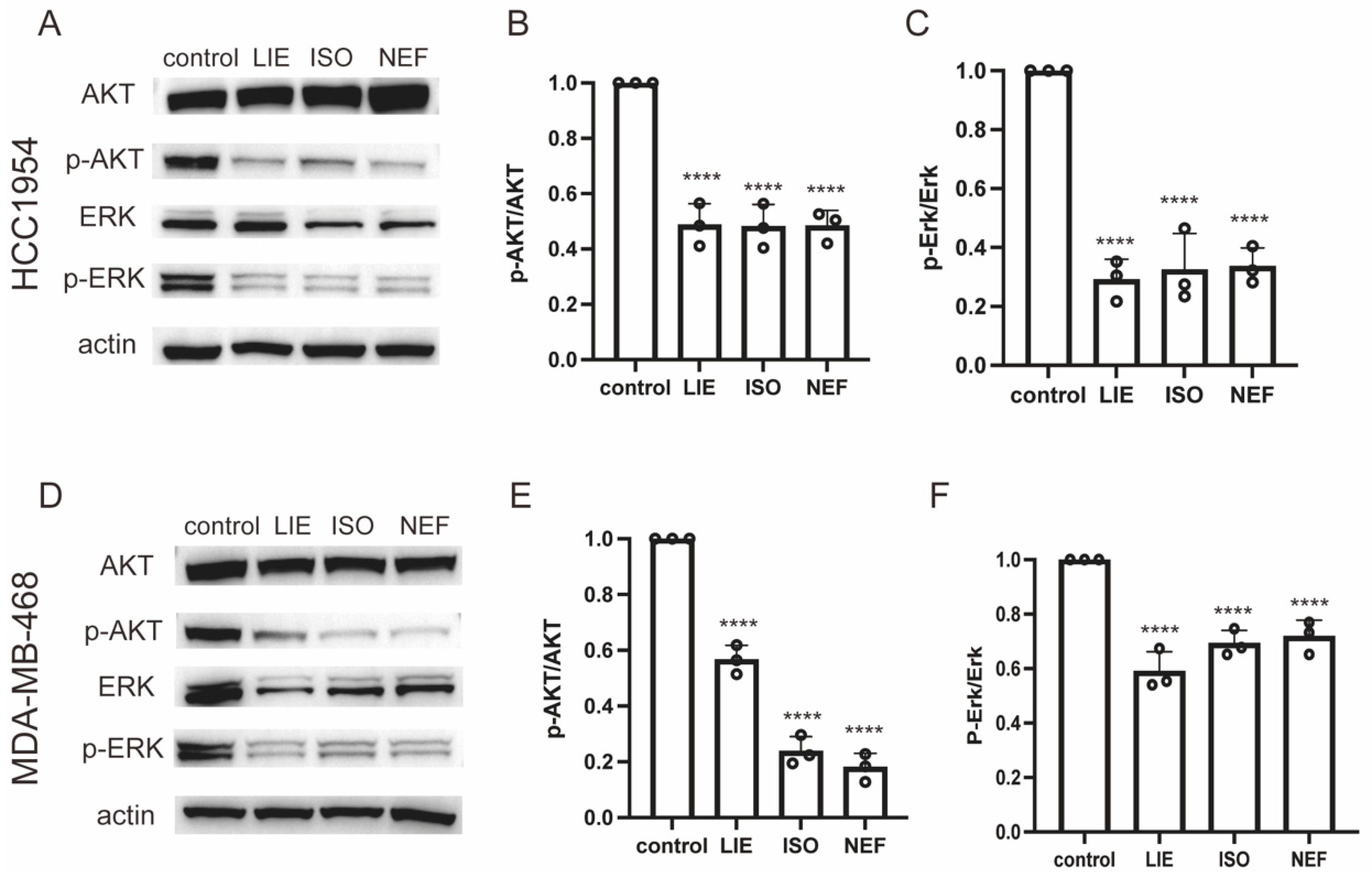
2.5. Protein-Level Validation Confirms Inhibition of MAPK and AKT Signaling Pathways by LIE, ISO, and NEF
3. Discussion
4. Materials and Methods
4.1. Compounds
4.2. Breast Cancer Cell Cultures
4.3. CCK-8 Assay
4.4. Apoptosis Assay (Annexin V/Propidium Iodide (PI) Staining)
4.5. Cell Cycle Analysis
4.6. RNA Sequencing (RNA-Seq)
4.7. Western Blot Analysis
4.8. Statistical Analysis
5. Conclusions
Author Contributions
Funding
Institutional Review Board Statement
Informed Consent Statement
Data Availability Statement
Conflicts of Interest
References
- Sung, H.; Ferlay, J.; Siegel, R.L.; Laversanne, M.; Soerjomataram, I.; Jemal, A.; Bray, F. Global Cancer Statistics 2020: GLOBOCAN Estimates of Incidence and Mortality Worldwide for 36 Cancers in 185 Countries. CA Cancer J. Clin. 2021, 71, 209–249. [Google Scholar] [CrossRef]
- Bray, F.; Laversanne, M.; Sung, H.; Ferlay, J.; Siegel, R.L.; Soerjomataram, I.; Jemal, A. Global Cancer Statistics 2022: GLOBOCAN Estimates of Incidence and Mortality Worldwide for 36 Cancers in 185 Countries. CA Cancer J. Clin. 2024, 74, 229–263. [Google Scholar] [CrossRef] [PubMed]
- Harbeck, N.; Penault-Llorca, F.; Cortes, J.; Gnant, M.; Houssami, N.; Poortmans, P.; Ruddy, K.; Tsang, J.; Cardoso, F. Breast Cancer. Nat. Rev. Dis. Primer 2019, 5, 66. [Google Scholar] [CrossRef]
- Huang, S.; Dong, M.; Chen, Q. Tumor-Derived Exosomes and Their Role in Breast Cancer Metastasis. Int. J. Mol. Sci. 2022, 23, 13993. [Google Scholar] [CrossRef]
- Zhang, A.; Wang, X.; Fan, C.; Mao, X. The Role of Ki67 in Evaluating Neoadjuvant Endocrine Therapy of Hormone Receptor-Positive Breast Cancer. Front. Endocrinol. 2021, 12, 687244. [Google Scholar] [CrossRef]
- Manto, K.; Ustun Yilmaz, S.; Pala Kara, Z.; Kara, H.; Tokat, F.; Akyerli, C.B.; Uras, C.; Muftuoglu, M.; Özbek, U. Association of Mitochondrial DNA Copy Number Variations with Triple-Negative Breast Cancer: A Potential Biomarker Study. Diseases 2025, 13, 175. [Google Scholar] [CrossRef]
- Chapdelaine, A.G.; Sun, G. Challenges and Opportunities in Developing Targeted Therapies for Triple Negative Breast Cancer. Biomolecules 2023, 13, 1207. [Google Scholar] [CrossRef]
- Kan, L.L.-Y.; Chan, B.C.-L.; Leung, P.-C.; Wong, C.-K. Natural-Product-Derived Adjunctive Treatments to Conventional Therapy and Their Immunoregulatory Activities in Triple-Negative Breast Cancer. Molecules 2023, 28, 5804. [Google Scholar] [CrossRef]
- Emens, L.A. Breast Cancer Immunotherapy: Facts and Hopes. Clin. Cancer Res. 2018, 24, 511–520. [Google Scholar] [CrossRef] [PubMed]
- Gupta, N.; Kumar, H.; Gupta, S.; Basavarajaiah, S.M.; Saini, K. A Concise Review on Natural Products and Their Derivatives for Breast Cancer Treatment. Chem. Biodivers. 2023, 20, e202300688. [Google Scholar] [CrossRef] [PubMed]
- Liu, Y.; Wang, C.; Liao, Q.; Du, C. Pharmacological Potential and Mechanisms of Bisbenzylisoquinoline Alkaloids from Lotus Seed Embryos. Biomolecules 2025, 15, 1377. [Google Scholar] [CrossRef]
- Newman, D.J.; Cragg, G.M. Natural Products as Sources of New Drugs over the Nearly Four Decades from 01/1981 to 09/2019. J. Nat. Prod. 2020, 83, 770–803. [Google Scholar] [CrossRef]
- Parveen, S.; Arjmand, F.; Tabassum, S. Clinical Developments of Antitumor Polymer Therapeutics. RSC Adv. 2019, 9, 24699–24721. [Google Scholar] [CrossRef]
- Cheng, Y.; Li, H.-L.; Zhou, Z.-W.; Long, H.-Z.; Luo, H.-Y.; Wen, D.-D.; Cheng, L.; Gao, L.-C. Isoliensinine: A Natural Compound with “Drug-Like” Potential. Front. Pharmacol. 2021, 12, 630385. [Google Scholar] [CrossRef] [PubMed]
- Grosinger, A.; Bradley, E. Malaria-Induced Ptosis. Am. J. Ophthalmol. Case Rep. 2021, 22, 101038. [Google Scholar] [CrossRef]
- Yang, M.; Zhu, L.; Li, L.; Li, J.; Xu, L.; Feng, J.; Liu, Y. Digital Gene Expression Analysis Provides Insight into the Transcript Profile of the Genes Involved in Aporphine Alkaloid Biosynthesis in Lotus (Nelumbo nucifera). Front. Plant Sci. 2017, 8, 80. [Google Scholar] [CrossRef]
- Jiang, H.; Zhu, S.; Wu, B.; Su, Y.; Wang, Q.; Lei, Y.; Shao, Q.; Gao, Y.; Gao, K.; Wu, G. CDK2 and CDK4 Targeted Liensinine Inhibits the Growth of Bladder Cancer T24 Cells. Chem. Biol. Interact. 2023, 382, 110624. [Google Scholar] [CrossRef] [PubMed]
- Lin, X.; Lin, T.; Liu, M.; Chen, D.; Chen, J. Liensinine Diperchlorate and Artemisitene Synergistically Attenuate Breast Cancer Progression through Suppressing PI3K-AKT Signaling and Their Efficiency in Breast Cancer Patient-Derived Organoids. Biomed. Pharmacother. 2024, 176, 116871. [Google Scholar] [CrossRef] [PubMed]
- Zhu, X.; Bao, W.; Xie, X.; Chen, B.; Li, R.; Zhao, J.; Wu, L.; Yu, Z.; Li, S.; Zhu, Q.; et al. Liensinine Inhibits Progression of Intrahepatic Cholangiocarcinoma by Regulating TGF-Β1 /P-Smad3 Signaling through HIF-1a. Mol. Carcinog. 2024, 63, 772–784. [Google Scholar] [CrossRef]
- Ren, H.-L.; Zhang, J.-H.; Xiao, J.-H. Benzylisoquinoline Alkaloids Inhibit Lung Fibroblast Activation Mainly via Inhibiting TGF-Β1/Smads and ERK1/2 Pathway Proteins. Heliyon 2023, 9, e16849. [Google Scholar] [CrossRef]
- Kang, E.J.; Lee, S.K.; Park, K.-K.; Son, S.H.; Kim, K.R.; Chung, W.-Y. Liensinine and Nuciferine, Bioactive Components of Nelumbo nucifera, Inhibit the Growth of Breast Cancer Cells and Breast Cancer-Associated Bone Loss. Evid. Based Complement. Alternat. Med. 2017, 2017, 1583185. [Google Scholar] [CrossRef] [PubMed]
- Zhang, X.; Wang, X.; Wu, T.; Li, B.; Liu, T.; Wang, R.; Liu, Q.; Liu, Z.; Gong, Y.; Shao, C. Isoliensinine Induces Apoptosis in Triple-Negative Human Breast Cancer Cells through ROS Generation and P38 MAPK/JNK Activation. Sci. Rep. 2015, 5, 12579. [Google Scholar] [CrossRef] [PubMed]
- Kim, E.K.; Choi, E.-J.; Kim, E.K.; Choi, E.J. Pathological Roles of MAPK Signaling Pathways in Human Diseases. Biochim. Biophys. Acta 2010, 1802, 396–405. [Google Scholar] [CrossRef]
- Guo, Y.-J.; Pan, W.-W.; Liu, S.-B.; Shen, Z.-F.; Xu, Y.; Hu, L.-L. ERK/MAPK Signalling Pathway and Tumorigenesis (Review). Exp. Ther. Med. 2020, 19, 1997–2007. [Google Scholar] [CrossRef] [PubMed]
- Reinhold, W.C.; Marangoni, E.; Elloumi, F.; Montagne, R.; Varma, S.; Wang, Y.; Rezai, K.; Morriset, L.; Dahmani, A.; El Botty, R.; et al. Acetalax and Bisacodyl for the Treatment of Triple-Negative Breast Cancer: A Combined Molecular and Preclinical Study. Cancer Res. Commun. 2025, 5, 375–388. [Google Scholar] [CrossRef]
- Ma, L.-F.; Xu, L.L.; Yuan, L.-J.; Yang, X.; Wu, R.; Bao, S.-M.; Chen, Y.-L.; Duan, H.-L.; Fang, L.; Zhao, H.-J.; et al. Discovery of NO Donor-Aurovertin Hybrids as Dual Ferroptosis and Apoptosis Inducers for Treating Triple Negative Breast Cancer. J. Med. Chem. 2024, 67, 13089–13105. [Google Scholar] [CrossRef]
- Castro-Oropeza, R.; Velazquez-Velazquez, C.; Vazquez-Santillan, K.; Mantilla-Morales, A.; Ruiz Tachiquin, M.E.; Torres, J.; Rios-Sarabia, N.; Mayani, H.; Piña-Sanchez, P. Landscape of lncRNAs Expressed in Mexican Patients with Triple-negative Breast Cancer. Mol. Med. Rep. 2025, 31, 163. [Google Scholar] [CrossRef]
- Yu, L.; Shen, Q.; Zhou, Q.; Jiang, H.; Bi, H.; Huang, M.; Zhou, H.; Zeng, S. In Vitro Characterization of ABC Transporters Involved in the Absorption and Distribution of Liensinine and Its Analogs. J. Ethnopharmacol. 2013, 150, 485–491. [Google Scholar] [CrossRef]
- Rauf, A.; Abu-Izneid, T.; Khalil, A.A.; Imran, M.; Shah, Z.A.; Emran, T.B.; Mitra, S.; Khan, Z.; Alhumaydhi, F.A.; Aljohani, A.S.M.; et al. Berberine as a Potential Anticancer Agent: A Comprehensive Review. Molecules 2021, 26, 7368. [Google Scholar] [CrossRef]
- Takahashi, C.; Kato, J. Targeting Abnormal Cell Cycle in Cancer: A Preface to the Special Issue. Onco 2022, 2, 34–35. [Google Scholar] [CrossRef]
- Hanahan, D.; Weinberg, R.A. Hallmarks of Cancer: The next Generation. Cell 2011, 144, 646–674. [Google Scholar] [CrossRef]
- Faysal, M.; Zehravi, M.; Amin, M.A.; Sweilam, S.H.; Panigrahy, U.P.; Khan, A.S.; Kar, N.R.; Dash, S.K.; Padhan, A.; Rab, S.O.; et al. Targeting Key Molecular Mechanisms in Triple-Negative Breast Cancer Therapies with Natural Compounds. Curr. Pharm. Des. 2025, 32, 1–19. [Google Scholar] [CrossRef]
- Kaulage, M.H.; Maji, B.; Pasadi, S.; Ali, A.; Bhattacharya, S.; Muniyappa, K. Targeting G-Quadruplex DNA Structures in the Telomere and Oncogene Promoter Regions by Benzimidazole–carbazole Ligands. Eur. J. Med. Chem. 2018, 148, 178–194. [Google Scholar] [CrossRef]
- Liu, Z.; Zhang, S.; Wang, T.; Shao, H.; Gao, J.; Wang, Y.; Ge, Y. Neferine Inhibits MDA-MB-231 cells Growth and Metastasis by Regulating miR-374a/FGFR-2. Chem. Biol. Interact. 2019, 309, 108716. [Google Scholar] [CrossRef] [PubMed]
- Kong, J.; Long, Y.-Q. Recent Advances in the Discovery of Protein Tyrosine Phosphatase SHP2 Inhibitors. RSC Med. Chem. 2022, 13, 246–257. [Google Scholar] [CrossRef]
- Luis, E.; Anaya-Hernández, A.; León-Sánchez, P.; Durán-Pastén, M.L. The Kv10.1 Channel: A Promising Target in Cancer. Int. J. Mol. Sci. 2022, 23, 8458. [Google Scholar] [CrossRef]
- Wei, F.; Gou, X.; Xu, X.; Wang, S.; Bao, T. Sensitive Quantification of Liensinine Alkaloid Using a HPLC-MS/MS Method and Its Application in Microvolume Rat Plasma. J. Anal. Methods Chem. 2021, 2021, 6629579. [Google Scholar] [CrossRef] [PubMed]
- Kang, S.-S.; Lan, J.-X.; Huang, H.; Miao, Z.-Y.; Jiang, J.-X.; Xie, Y.; Liu, S.-L.; Dai, W.; Zeng, J.-L.; Song, L.-R.; et al. Discovery of Anti-Tumor Targets Based on Photo-Affinity Labeling. Eur. J. Med. Chem. 2026, 301, 118248. [Google Scholar] [CrossRef] [PubMed]
- Deepak, K.G.K.; Vempati, R.; Nagaraju, G.P.; Dasari, V.R.; Nagini, S.; Rao, D.N.; Malla, R.R. Tumor Microenvironment: Challenges and Opportunities in Targeting Metastasis of Triple Negative Breast Cancer. Pharmacol. Res. 2020, 153, 104683. [Google Scholar] [CrossRef]
- Zhong, F.; Chen, Y.; Chen, J.; Liao, H.; Li, Y.; Ma, Y. Jatrorrhizine: A Review of Sources, Pharmacology, Pharmacokinetics and Toxicity. Front. Pharmacol. 2022, 12, 783127. [Google Scholar] [CrossRef]
- Zhu, K.; Wu, Y.; He, P.; Fan, Y.; Zhong, X.; Zheng, H.; Luo, T. PI3K/AKT/mTOR-Targeted Therapy for Breast Cancer. Cells 2022, 11, 2508. [Google Scholar] [CrossRef] [PubMed]
- Fang, K.; Ohihoin, A.G.; Liu, T.; Choppavarapu, L.; Nosirov, B.; Wang, Q.; Yu, X.-Z.; Kamaraju, S.; Leone, G.; Jin, V.X. Integrated Single-Cell Analysis Reveals Distinct Epigenetic-Regulated Cancer Cell States and a Heterogeneity-Guided Core Signature in Tamoxifen-Resistant Breast Cancer. Genome Med. 2024, 16, 134. [Google Scholar] [CrossRef] [PubMed]
- Rad, S.K.; Yeo, K.K.L.; Li, R.; Wu, F.; Liu, S.; Nourmohammadi, S.; Murphy, W.M.; Tomita, Y.; Price, T.J.; Ingman, W.V.; et al. Enhancement of Doxorubicin Efficacy by Bacopaside II in Triple-Negative Breast Cancer Cells. Biomolecules 2025, 15, 55. [Google Scholar] [CrossRef]
- Zhu, G.-X.; Gao, D.; Shao, Z.-Z.; Chen, L.; Ding, W.-J.; Yu, Q.-F. Wnt/Β-catenin Signaling: Causes and Treatment Targets of Drug Resistance in Colorectal Cancer (Review). Mol. Med. Rep. 2021, 23, 105. [Google Scholar] [CrossRef] [PubMed]
- Morsy, M.A.; Abdel-Latif, R.; Hafez, S.M.N.A.; Kandeel, M.; Abdel-Gaber, S.A. Paeonol Protects against Methotrexate Hepatotoxicity by Repressing Oxidative Stress, Inflammation, and Apoptosis-The Role of Drug Efflux Transporters. Pharmaceuticals 2022, 15, 1296. [Google Scholar] [CrossRef] [PubMed]
- Xu, W.; Chen, S.; Wang, X.; Tanaka, S.; Onda, K.; Sugiyama, K.; Yamada, H.; Hirano, T. Molecular Mechanisms and Therapeutic Implications of Tetrandrine and Cepharanthine in T Cell Acute Lymphoblastic Leukemia and Autoimmune Diseases. Pharmacol. Ther. 2021, 217, 107659. [Google Scholar] [CrossRef]



Disclaimer/Publisher’s Note: The statements, opinions and data contained in all publications are solely those of the individual author(s) and contributor(s) and not of MDPI and/or the editor(s). MDPI and/or the editor(s) disclaim responsibility for any injury to people or property resulting from any ideas, methods, instructions or products referred to in the content. |
© 2026 by the authors. Licensee MDPI, Basel, Switzerland. This article is an open access article distributed under the terms and conditions of the Creative Commons Attribution (CC BY) license.
Share and Cite
He, Q.; Luo, L.; Zhang, D.; Zhou, W.; Bai, N.; Du, C.; Li, S. Molecular Mechanisms Underlying the Anti-Tumor Activity of Lotus-Derived Alkaloids in Breast Cancer. Molecules 2026, 31, 947. https://doi.org/10.3390/molecules31060947
He Q, Luo L, Zhang D, Zhou W, Bai N, Du C, Li S. Molecular Mechanisms Underlying the Anti-Tumor Activity of Lotus-Derived Alkaloids in Breast Cancer. Molecules. 2026; 31(6):947. https://doi.org/10.3390/molecules31060947
Chicago/Turabian StyleHe, Qinyi, Ling Luo, Dezhao Zhang, Wenxiang Zhou, Ningning Bai, Canwei Du, and Songlian Li. 2026. "Molecular Mechanisms Underlying the Anti-Tumor Activity of Lotus-Derived Alkaloids in Breast Cancer" Molecules 31, no. 6: 947. https://doi.org/10.3390/molecules31060947
APA StyleHe, Q., Luo, L., Zhang, D., Zhou, W., Bai, N., Du, C., & Li, S. (2026). Molecular Mechanisms Underlying the Anti-Tumor Activity of Lotus-Derived Alkaloids in Breast Cancer. Molecules, 31(6), 947. https://doi.org/10.3390/molecules31060947