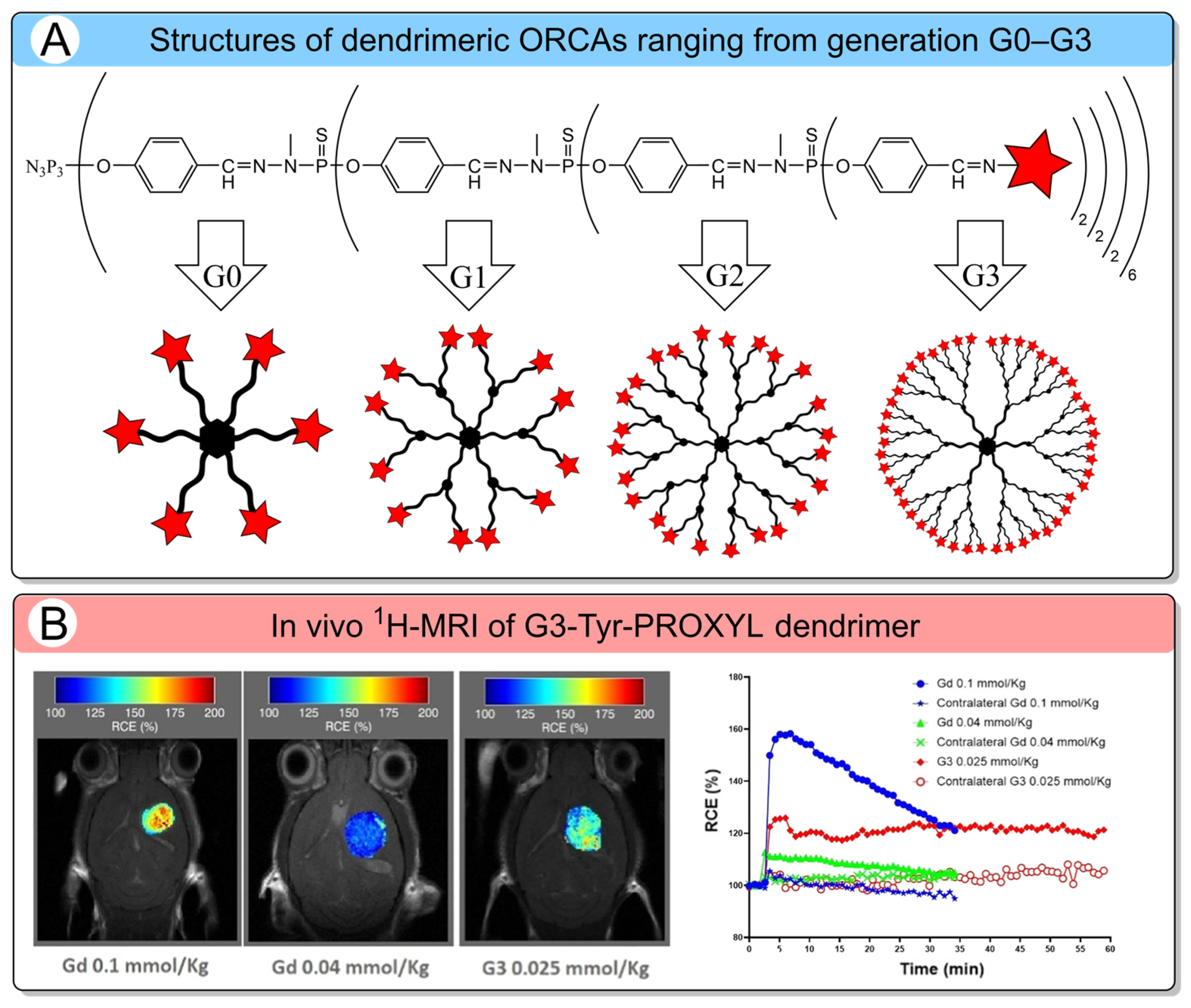
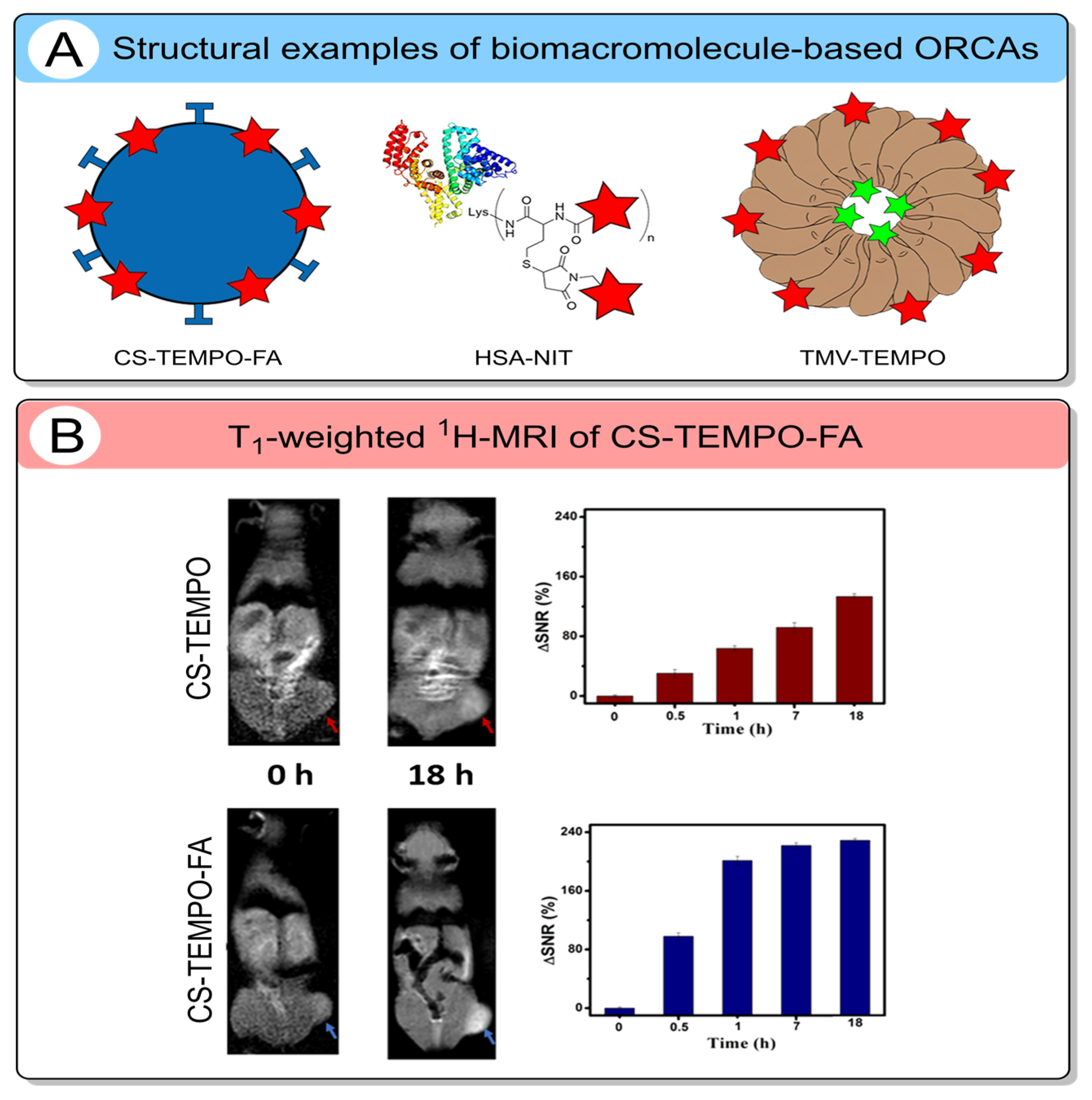
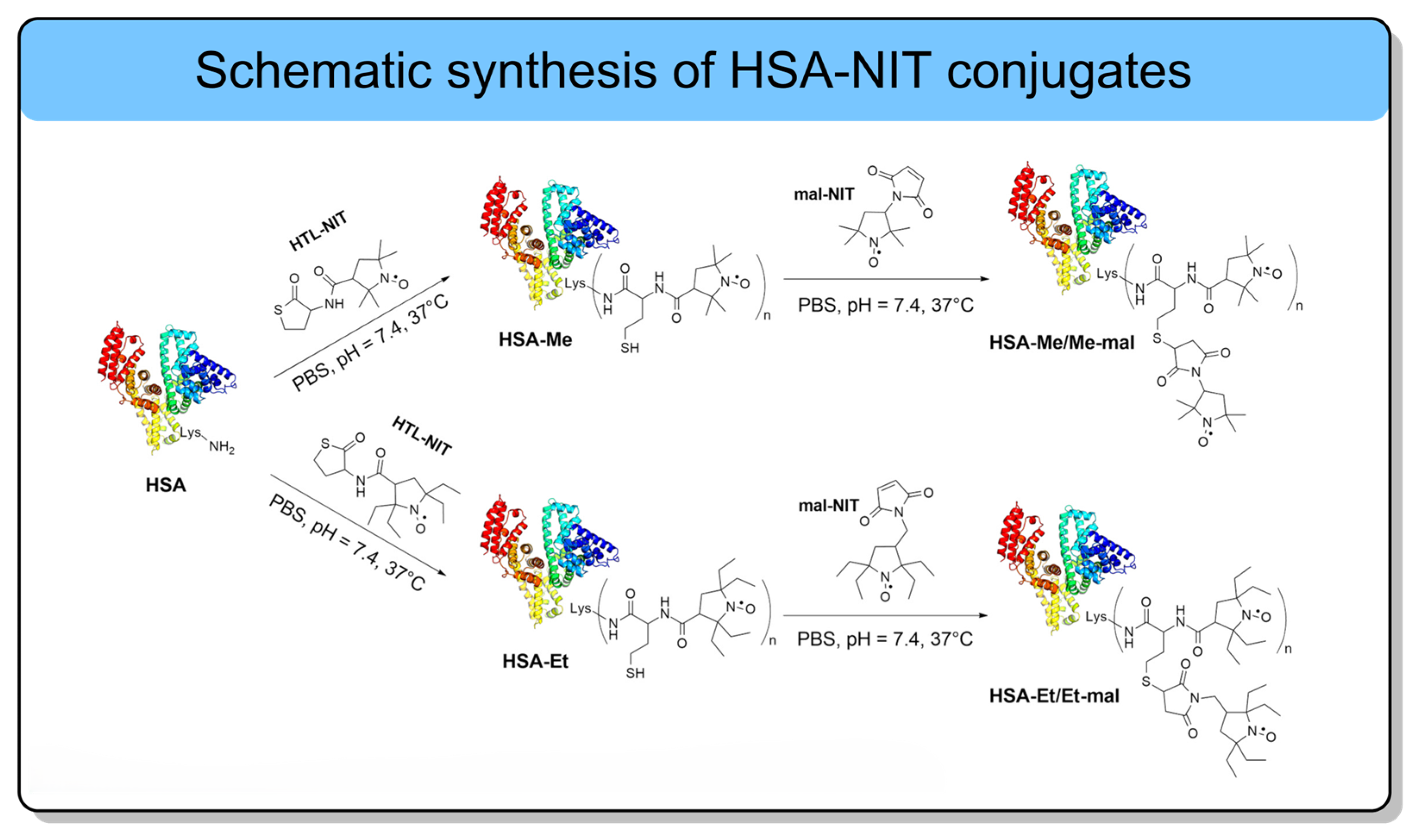
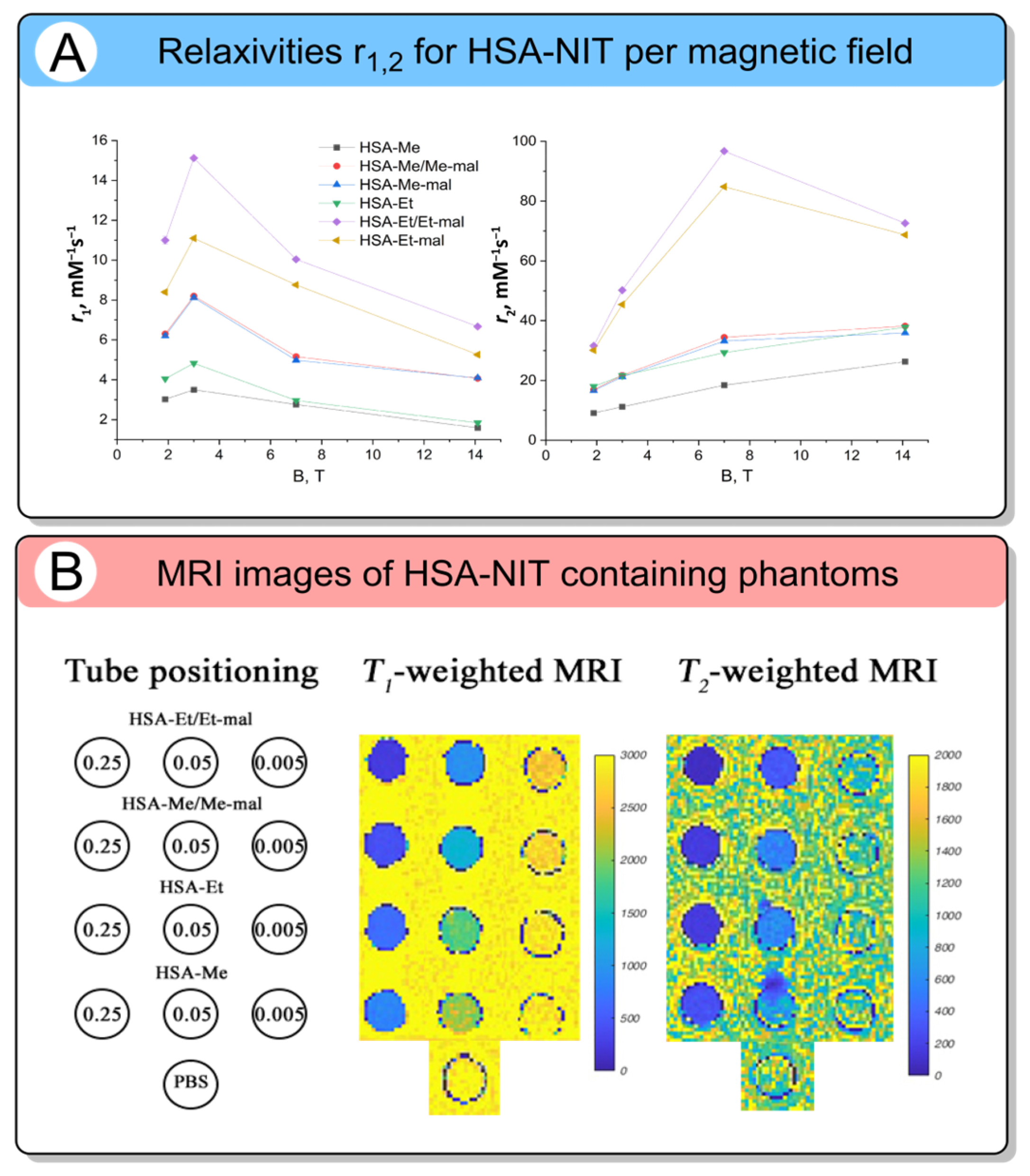
Nitroxide-Based Contrast Agents for MRI Cancer Diagnostics: Progress, Limitations, and Perspectives



Abstract
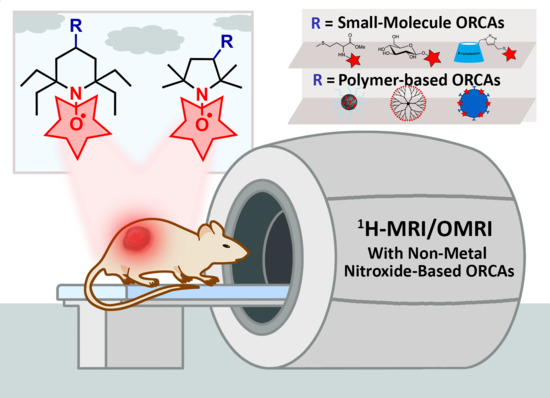
1. Introduction
2. Classification and Properties of ORCA
2.1. Low-Molecular-Weight and Self-Assembled ORCA

| Nitroxide | Magnetic Field Strength, T | r1, mM−1s−1 | 1H-MRI Application | Ref. |
|---|---|---|---|---|
 * *TEEPO-Met | 11.7 | 0.17 | in vitro MRI phantoms | [79] |
 TEEPO-Glc | 1.5 | 0.23 | in vivo MRI of Wistar rats bearing C6 tumor | [81] |
| 9.4 | 0.13 | |||
| 11.7 | 0.12 | |||
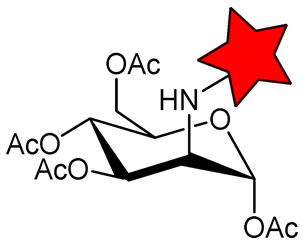 O-acetyl D-mannosamine-SpiroHex | - | - | in vivo MRI of C57BL/6 J mice | [58] |
 CD3 | 11.7 | 0.32 | - | [87] |
 CD6 | 11.7 | 1.60 | - | [87] |
 CD78 | 9.4 | 0.88 | in vivo MRI of Wistar rats bearing glioma | [88] |
2.2. Polymer-Based ORCA
2.2.1. Linear Polymer-Based ORCA
2.2.2. Brush-Arm Star Polymer-Based ORCA
2.2.3. Dendrimeric Polymer-Based ORCA
2.3. Biomacromolecule-Based ORCA
2.4. Comparison of Different Types of Nitroxides and Studies’ Limitations
3. Application of Nitroxides for OMRI Techniques
4. Future Perspectives and Conclusions
Author Contributions
Funding
Institutional Review Board Statement
Informed Consent Statement
Data Availability Statement
Conflicts of Interest
Abbreviations
| BASP | Brush-arm star polymer |
| CD | β-cyclodextrin |
| EPR | Electron paramagnetic resonance |
| EPR effect | Enhanced Permeability and Retention effect |
| HSA | Human serum albumin |
| MNP | Iron oxide nanoparticles |
| MRI | Magnetic resonance imaging |
| ODNP | Overhauser dynamic nuclear polarization |
| OMRI | Overhauser-enhanced magnetic resonance imaging |
| ORCA | Organic radical contrast agent |
| PROXYL | 2,2,5,5-tetramethylpyrrolidin-1-oxyl |
| TEMPO | 2,2,6,6-tetramethylpiperidin-1-oxyl |
| TEEPO | 2,2,6,6-tetraethylpiperidin-1-oxyl |
References
- Lambert, A.W.; Pattabiraman, D.R.; Weinberg, R.A. Emerging Biological Principles of Metastasis. Cell 2017, 168, 670–691. [Google Scholar] [CrossRef] [PubMed]
- Yousaf, T.; Dervenoulas, G.; Politis, M. Advances in MRI Methodology. Int. Rev. Neurobiol. 2018, 141, 31–76. [Google Scholar]
- Kim, H.K.; Lee, G.H.; Chang, Y. Gadolinium as an MRI contrast agent. Future Med. Chem. 2018, 10, 639–661. [Google Scholar] [CrossRef]
- Bartusik-Aebisher, D.; Bober, Z.; Zalejska-Fiolka, J.; Kawczyk-Krupka, A.; Aebisher, D. Multinuclear MRI in Drug Discovery. Molecules 2022, 27, 6493. [Google Scholar] [CrossRef]
- Caspani, S.; Magalhães, R.; Araújo, J.P.; Sousa, C.T. Magnetic nanomaterials as contrast agents for MRI. Materials 2020, 13, 2586. [Google Scholar] [CrossRef]
- Lv, J.; Roy, S.; Xie, M.; Yang, X.; Guo, B. Contrast Agents of Magnetic Resonance Imaging and Future Perspective. Nanomaterials 2023, 13, 2003. [Google Scholar] [CrossRef]
- Geraldes, C.F.G.C.; Peters, J.A. MRI Contrast Agents in Glycobiology. Molecules 2022, 27, 8297. [Google Scholar] [CrossRef] [PubMed]
- Yue, P.; Nagendraraj, T.; Wang, G.; Jin, Z.; Angelovski, G. The role of responsive MRI probes in the past and the future of molecular imaging. Chem. Sci. 2024, 15, 20122–20154. [Google Scholar] [CrossRef]
- Sadleir, R.; Minhas, A.S. Electrical Properties of Tissues—Quantitative Magnetic Resonance Mapping; Springer: Berlin/Heidelberg, Germany, 2022; ISBN 9783031038723. [Google Scholar]
- Walker, S.M.; Fernandez, M.; Turkbey, B. Advances in Prostate Magnetic Resonance Imaging. Magn. Reson. Imaging Clin. N. Am. 2020, 28, 407–414. [Google Scholar] [CrossRef] [PubMed]
- Sinharay, S.; Pagel, M.D. Advances in Magnetic Resonance Imaging Contrast Agents for Biomarker Detection. Annu. Rev. Anal. Chem. 2016, 9, 95–115. [Google Scholar] [CrossRef]
- Lu, Z.R.; Laney, V.; Li, Y. Targeted Contrast Agents for Magnetic Resonance Molecular Imaging of Cancer. Acc. Chem. Res. 2022, 55, 2833–2847. [Google Scholar] [CrossRef]
- Du, T.; Luo, H.; Song, H.; Lin, T.; Yu, Q. Novel non–metal–based contrast agents for MR imaging: Emerging approaches and clinical perspectives (Review). Int. J. Oncol. 2025, 67, 70. [Google Scholar] [CrossRef]
- Mitin, D.E.; Chubarov, A.S. Fluorinated Human Serum Albumin as Potential 19F Magnetic Resonance Imaging Probe. Molecules 2023, 20, 1695. [Google Scholar] [CrossRef] [PubMed]
- Godovikova, T.S.; Lisitskiy, V.A.; Antonova, N.M.; Popova, T.V.; Zakharova, O.D.; Chubarov, A.S.; Koptyug, I.V.; Sagdeev, R.Z.; Kaptein, R.; Akulov, A.E.; et al. Ligand-directed acid-sensitive amidophosphate 5-trifluoromethyl-2′-deoxyuridine conjugate as a potential theranostic agent. Bioconjug. Chem. 2013, 24, 780–795. [Google Scholar] [CrossRef] [PubMed]
- Ruiz-Cabello, J.; Barnett, B.P.; Bottomley, P.A.; Bulte, J.W.M. Fluorine 19F MRS and MRI in biomedicine. NMR Biomed. 2011, 24, 114–129. [Google Scholar] [CrossRef]
- Chubarov, A.S. Serum Albumin for Magnetic Nanoparticles Coating. Magnetochemistry 2022, 8, 13. [Google Scholar] [CrossRef]
- Popova, V.; Dmitrienko, E.; Chubarov, A. Magnetic Nanocomposites and Imprinted Polymers for Biomedical Applications of Nucleic Acids. Magnetochemistry 2023, 9, 12. [Google Scholar] [CrossRef]
- Wahsner, J.; Gale, E.M.; Rodríguez-Rodríguez, A.; Caravan, P. Chemistry of MRI contrast agents: Current challenges and new frontiers. Chem. Rev. 2019, 119, 957–1057. [Google Scholar] [CrossRef]
- Xiao, Y.D.; Paudel, R.; Liu, J.; Ma, C.; Zhang, Z.S.; Zhou, S.K. MRI contrast agents: Classification and application (Review). Int. J. Mol. Med. 2016, 38, 1319–1326. [Google Scholar] [CrossRef] [PubMed]
- Bonnet, C.S.; Tóth, É. Metal-based environment-sensitive MRI contrast agents. Curr. Opin. Chem. Biol. 2021, 61, 154–169. [Google Scholar] [CrossRef]
- Zhao, S.; Yu, X.; Qian, Y.; Chen, W.; Shen, J. Multifunctional magnetic iron oxide nanoparticles: An advanced platform for cancer theranostics. Theranostics 2020, 10, 6278–6309. [Google Scholar] [CrossRef] [PubMed]
- Biedenbänder, T.; Aladin, V.; Saeidpour, S.; Corzilius, B. Dynamic Nuclear Polarization for Sensitivity Enhancement in Biomolecular Solid-State NMR. Chem. Rev. 2022, 122, 9738–9794. [Google Scholar] [CrossRef]
- Li, H.; Meade, T.J. Molecular MR Imaging with Gd(III)-based Agents: Challenges and Key Advances. J. Am. Chem. Soc. 2019, 141, 17025–17041. [Google Scholar] [CrossRef] [PubMed]
- Akakuru, O.U.; Iqbal, M.Z.; Saeed, M.; Liu, C.; Paunesku, T.; Woloschak, G.; Hosmane, N.S.; Wu, A. The Transition from Metal-Based to Metal-Free Contrast Agents for T1 Magnetic Resonance Imaging Enhancement. Bioconjug. Chem. 2019, 30, 2264–2286. [Google Scholar] [CrossRef] [PubMed]
- Caravan, P.; Farrar, C.T.; Frullano, L.; Uppal, R. Influence of molecular parameters and increasing magnetic field strength on relaxivity of gadolinium- and manganese-based T1 contrast agents. Contrast Media Mol. Imaging 2009, 4, 89–100. [Google Scholar] [CrossRef] [PubMed]
- Hagberg, G.E.; Schef, K. Effect of r 1 and r 2 relaxivity of gadolinium-based contrast agents on the T 1 -weighted MR signal at increasing magnetic fi eld strengths. Contrast Media Mol. Imaging 2013, 8, 456–465. [Google Scholar] [CrossRef]
- Thomsen, H.S.; Morcos, S.K.; Almén, T.; Bellin, M.F.; Bertolotto, M.; Bongartz, G.; Clement, O.; Leander, P.; Heinz-Peer, G.; Reimer, P.; et al. Nephrogenic systemic fibrosis and gadolinium-based contrast media: Updated ESUR Contrast Medium Safety Committee guidelines. Eur. Radiol. 2013, 23, 307–318. [Google Scholar] [CrossRef]
- Pasquini, L.; Napolitano, A.; Visconti, E.; Longo, D.; Romano, A.; Tomà, P.; Espagnet, M.C.R. Gadolinium-Based Contrast Agent-Related Toxicities. CNS Drugs 2018, 32, 229–240. [Google Scholar] [CrossRef]
- Ramalho, J.; Ramalho, M. Gadolinium Deposition and Chronic Toxicity. Magn. Reson. Imaging Clin. N. Am. 2017, 25, 765–778. [Google Scholar] [CrossRef]
- Malikova, H.; Holesta, M. Gadolinium contrast agents—Are they really safe? J. Vasc. Access 2017, 18, s1–s7. [Google Scholar] [CrossRef]
- Swaminathan, S.; Horn, T.D.; Pellowski, D.; Abul-Ezz, S.; Bornhorst, J.A.; Viswamitra, S.; Shah, S.V. Nephrogenic systemic fibrosis, gadolinium, and iron mobilization. N. Engl. J. Med. 2007, 357, 720–722. [Google Scholar] [CrossRef] [PubMed]
- European Medicines Agency. EMA’s Final Opinion Confirms Restrictions on Use of Linear Gadolinium Agents in Body Scans. Recommendations Conclude EMA’s Scientific Review of Gadolinium Deposition. European Medicines Agency, November, Document Reference: EMA/625317/2017 EMA’s. 2017. Available online: https://www.ema.europa.eu/en/news/emas-final-opinion-confirms-restrictions-use-linear-gadolinium-agents-body-scans? (accessed on 15 February 2026).
- Abakumov, M.A.; Semkina, A.S.; Skorikov, A.S.; Vishnevskiy, D.A.; Ivanova, A.V.; Mironova, E.; Davydova, G.A.; Majouga, A.G.; Chekhonin, V.P. Toxicity of iron oxide nanoparticles: Size and coating effects. J. Biochem. Mol. Toxicol. 2018, 32, e22225. [Google Scholar] [CrossRef] [PubMed]
- Singh, N.; Jenkins, G.J.S.; Asadi, R.; Doak, S.H. Potential toxicity of superparamagnetic iron oxide nanoparticles (SPION). Nano Rev. 2010, 1, 5358. [Google Scholar] [CrossRef]
- Vallabani, N.V.S.; Singh, S. Recent advances and future prospects of iron oxide nanoparticles in biomedicine and diagnostics. 3 Biotech 2018, 8, 279. [Google Scholar] [CrossRef]
- Petrov, K.D.; Chubarov, A.S. Magnetite Nanoparticles for Biomedical Applications. Encyclopedia 2022, 2, 1811–1828. [Google Scholar] [CrossRef]
- Nguyen, H.V.T.; Chen, Q.; Paletta, J.T.; Harvey, P.; Jiang, Y.; Zhang, H.; Boska, M.D.; Ottaviani, M.F.; Jasanoff, A.; Rajca, A.; et al. Nitroxide-Based Macromolecular Contrast Agents with Unprecedented Transverse Relaxivity and Stability for Magnetic Resonance Imaging of Tumors. ACS Cent. Sci. 2017, 3, 800–811. [Google Scholar] [CrossRef]
- Bye, N.; Hutt, O.E.; Hinton, T.M.; Acharya, D.P.; Waddington, L.J.; Moffat, B.A.; Wright, D.K.; Wang, H.X.; Mulet, X.; Muir, B.W. Nitroxide-loaded hexosomes provide MRI contrast in vivo. Langmuir 2014, 30, 8898–8906. [Google Scholar] [CrossRef]
- Yuan, X.; Yu, H.; Wang, L.; Uddin, M.A.; Ouyang, C. Nitroxide radical contrast agents for safe magnetic resonance imaging: Progress, challenges, and perspectives. Mater. Horiz. 2025, 12, 1726–1756. [Google Scholar] [CrossRef]
- Nguyen, H.V.T.; Detappe, A.; Gallagher, N.M.; Zhang, H.; Harvey, P.; Yan, C.; Mathieu, C.; Golder, M.R.; Jiang, Y.; Ottaviani, M.F.; et al. Triply Loaded Nitroxide Brush-Arm Star Polymers Enable Metal-Free Millimetric Tumor Detection by Magnetic Resonance Imaging. ACS Nano 2018, 12, 11343–11354. [Google Scholar] [CrossRef] [PubMed]
- Dobrynin, S.; Kutseikin, S.; Morozov, D.; Krumkacheva, O.; Spitsyna, A.; Gatilov, Y.; Silnikov, V.; Angelovski, G.; Bowman, M.K.; Kirilyuk, I.; et al. Human serum albumin labelled with sterically-hindered nitroxides as potential MRI contrast agents. Molecules 2020, 25, 1709. [Google Scholar] [CrossRef]
- Fu, C.; Yu, Y.; Xu, X.; Wang, Q.; Chang, Y.; Zhang, C.; Zhao, J.; Peng, H.; Whittaker, A.K. Functional polymers as metal-free magnetic resonance imaging contrast agents. Prog. Polym. Sci. 2020, 108, 101286. [Google Scholar] [CrossRef]
- Rajca, A.; Wang, Y.; Boska, M.; Paletta, J.T.; Olankitwanit, A.; Swanson, M.A.; Mitchell, D.G.; Eaton, S.S.; Eaton, G.R.; Rajca, S. Organic Radical Contrast Agents for Magnetic Resonance Imaging. J. Am. Chem. Soc. 2012, 134, 15724–15727. [Google Scholar] [CrossRef]
- Zhao, C.; Chen, Q.; Garcia-Hernandez, J.D.; Watanabe, L.K.; Rawson, J.M.; Rao, J.; Manners, I. Uniform and Length-Tunable, Paramagnetic Self-Assembled Nitroxide-Based Nanofibers for Magnetic Resonance Imaging. Macromolecules 2023, 56, 263–270. [Google Scholar] [CrossRef]
- Akakuru, O.U.; Iqbal, M.Z.; Liu, C.; Xing, J.; Wei, Z.; Jiang, Z.; Fang, Q.; Yuan, B.; Nosike, E.I.; Xia, J.; et al. Self-assembled, biocompatible and biodegradable TEMPO-conjugated nanoparticles enable folate-targeted tumor magnetic resonance imaging. Appl. Mater. Today 2020, 18, 100524. [Google Scholar] [CrossRef]
- Okazaki, S.; Mannan, M.A.; Sawai, K.; Masumizu, T.; Miura, Y.; Takeshita, K. Enzymatic reduction-resistant nitroxyl spin probes with spirocyclohexyl rings. Free Radic. Res. 2007, 41, 1069–1077. [Google Scholar] [CrossRef]
- Bačić, G.; Pavićević, A.; Peyrot, F. In vivo evaluation of different alterations of redox status by studying pharmacokinetics of nitroxides using magnetic resonance techniques. Redox Biol. 2016, 8, 226–242. [Google Scholar] [CrossRef]
- Bobko, A.A.; Kirilyuk, I.A.; Grigor’ev, I.A.; Zweier, J.L.; Khramtsov, V.V. Reversible reduction of nitroxides to hydroxylamines: Roles for ascorbate and glutathione. Free Radic. Biol. Med. 2007, 42, 404–412. [Google Scholar] [CrossRef]
- Kocherginsky, N.; Swartz, H.M. Metabolism and Distribution of Nitroxides In Vivo. In Nitroxide Spin Labels: Reactions in Biology and Chemistry; CRC Press: Boca Raton, FL, USA, 1995; pp. 153–174. [Google Scholar]
- Matsumoto, K.I.; Yamasaki, T.; Nakamura, M.; Ishikawa, J.; Ueno, M.; Nakanishi, I.; Sekita, A.; Ozawa, Y.; Kamada, T.; Aoki, I.; et al. Brain contrasting ability of blood-brain-barrier–permeable nitroxyl contrast agents for magnetic resonance redox imaging. Magn. Reson. Med. 2016, 76, 935–945. [Google Scholar] [CrossRef]
- Matsumoto, K.I.; Nakanishi, I.; Zhelev, Z.; Bakalova, R.; Aoki, I. Nitroxyl Radical as a Theranostic Contrast Agent in Magnetic Resonance Redox Imaging. Antioxid. Redox Signal. 2022, 36, 95–121. [Google Scholar] [CrossRef]
- Ernotte, P.; Maes, A.; Garifo, S.; Drewek, I.; Frapart, Y.-M.; Muller, R.N.; Stanicki, D.; Laurent, S. Nitroxide-Modified Silica Nanoparticles: Impact of Radical Density on Relaxometric and EPR Properties. Langmuir 2025, 41, 18622–18631. [Google Scholar] [CrossRef] [PubMed]
- Wahab, A.; Suhail, M.; Eggers, T.; Shehzad, K.; Akakuru, O.U.; Ahmad, Z.; Sun, Z.; Iqbal, M.Z.; Kong, X. Innovative perspectives on metal free contrast agents for MRI: Enhancing imaging efficacy, and AI-driven future diagnostics. Acta Biomater. 2025, 193, 83–106. [Google Scholar] [CrossRef]
- Cui, X.; Zhang, Z.; Yang, Y.; Li, S.; Lee, C. Organic radical materials in biomedical applications: State of the art and perspectives. Exploration 2022, 2, 20210264. [Google Scholar] [CrossRef]
- Wang, Y.; Ma, X.; Zhang, Y.; Yang, Y.; Wang, P.; Chen, T.; Gao, C.; Dong, C.; Zheng, J.; Wu, A. Insights into Non-Metallic Magnetic Resonance Imaging Contrast Agents: Advances and Perspectives. Small 2025, 21, 2411875. [Google Scholar] [CrossRef]
- Luo, T.; Wang, B.; Chen, R.; Qi, Q.; Wu, R.; Xie, S. Research progress of nitroxide radical-based MRI contrast agents: From structure design to application. J. Mater. Chem. B 2025, 13, 372. [Google Scholar] [CrossRef]
- Zhang, S.; Dhakal, S.; Curtis, E.; Miller, H.; Paletta, J.T.; Gee, C.; Rajca, S.; Kievit, F.; Rajca, A. Towards Metabolic Organic Radical Contrast Agents (mORCAs) for Magnetic Resonance Imaging. Molecules 2025, 30, 1581. [Google Scholar] [CrossRef] [PubMed]
- Li, Q.; Li, X.; Zhao, C. Strategies to Obtain Encapsulation and Controlled Release of Small Hydrophilic Molecules. Front. Bioeng. Biotechnol. 2020, 8, 437. [Google Scholar] [CrossRef] [PubMed]
- Matsumoto, K.I.; Mitchell, J.B.; Krishna, M.C. Effects of oxygen challenging to tissue redox and pO2 status. Free Radic. Biol. Med. 2019, 130, 343–347. [Google Scholar] [CrossRef]
- Franco, L.; Isse, A.A.; Barbon, A.; Altomare, L.; Hyppönen, V.; Rosa, J.; Olsson, V.; Kettunen, M.; Melone, L. Redox Properties and in Vivo Magnetic Resonance Imaging of Cyclodextrin-Polynitroxides Contrast Agents. ChemPhysChem 2023, 24, e202300100. [Google Scholar] [CrossRef] [PubMed]
- Rivera, E.J.; Sethi, R.; Qu, F.; Krishnamurthy, R.; Muthupillai, R.; Alford, M.; Swanson, M.A.; Eaton, S.S.; Eaton, G.R.; Wilson, L.J. Nitroxide radicals@US-tubes: New spin labels for biomedical applications. Adv. Funct. Mater. 2012, 22, 3691–3698. [Google Scholar] [CrossRef]
- Tanimoto, E.; Karasawa, S.; Ueki, S.; Nitta, N.; Aoki, I.; Koga, N. Unexpectedly large water-proton relaxivity of TEMPO incorporated into micelle-oligonucleotides. RSC Adv. 2013, 3, 3531–3534. [Google Scholar] [CrossRef]
- Mellet, P.; Massot, P.; Madelin, G.; Marque, S.R.A.; Harte, E.; Franconi, J.M.; Thiaudière, E. New Concepts in Molecular Imaging: Non-Invasive MRI Spotting of Proteolysis Using an Overhauser Effect Switch. PLoS ONE 2009, 4, e5244. [Google Scholar] [CrossRef]
- Pinto, L.F.; Lloveras, V.; Zhang, S.; Liko, F.; Veciana, J.; Muñoz-Gómez, J.L.; Vidal-Gancedo, J. Fully Water-Soluble Polyphosphorhydrazone-Based Radical Dendrimers Functionalized with Tyr-PROXYL Radicals as Metal-Free MRI T1 Contrast Agents. ACS Appl. Bio Mater. 2020, 3, 369–376. [Google Scholar] [CrossRef]
- Zhang, S.; Lloveras, V.; Pulido, D.; Liko, F.; Pinto, L.F.; Albericio, F.; Royo, M.; Vidal-Gancedo, J. Radical dendrimers based on biocompatible oligoethylene glycol dendrimers as contrast agents for MRI. Pharmaceutics 2020, 12, 772. [Google Scholar] [CrossRef]
- Dobrynin, S.A.; Usatov, M.S.; Zhurko, I.F.; Morozov, D.A.; Polienko, Y.F.; Glazachev, Y.I.; Parkhomenko, D.A.; Tyumentsev, M.A.; Gatilov, Y.V.; Chernyak, E.I.; et al. A Simple Method of Synthesis of 3-Carboxy-2,2,5,5- Tetraethylpyrrolidine-1-oxyl and Preparation of Reduction- Resistant Spin Labels and Probes of Pyrrolidine Series. Molecules 2021, 26, 5761. [Google Scholar] [CrossRef]
- Varga-Szemes, A.; Kiss, P.; Rab, A.; Suranyi, P.; Lenkey, Z.; Simor, T.; Bryant, R.G.; Elgavish, G.A. In vitro longitudinal relaxivity profile of Gd (ABE-DTTA), an investigational magnetic resonance imaging contrast agent. PLoS ONE 2016, 11, e0149260. [Google Scholar] [CrossRef] [PubMed]
- Sasaki, M.; Shibata, E.; Kanbara, Y.; Ehara, S. Enhancement effects and relaxivities of gadolinium-DTPA at 1.5 versus 3 Tesla: A phantom study. Magn. Reson. Med. Sci. 2005, 4, 145–149. [Google Scholar] [CrossRef] [PubMed]
- Shen, Y.; Goerner, F.L.; Snyder, C.; Morelli, J.N.; Hao, D.; Hu, D.; Li, X.; Runge, V.M. T1 relaxivities of gadolinium-based magnetic resonance contrast agents in human whole blood at 1.5, 3, and 7T. Investig. Radiol. 2015, 50, 330–338. [Google Scholar] [CrossRef]
- Tomizawa, A.; Ishii, I.; Zhelev, Z.; Aoki, I.; Shibata, S.; Kitada, M.; Bakalova, R. Carbamoyl-PROXYL-enhanced MRI detects very small disruptions in brain vascular permeability induced by dietary cholesterol. Biochim. Biophys. Acta Gen. Subj. 2011, 1810, 1309–1316. [Google Scholar] [CrossRef]
- Matsumoto, K.I.; Hyodo, F.; Matsumoto, A.; Koretsky, A.P.; Sowers, A.L.; Mitchell, J.B.; Krishna, M.C. High-resolution mapping of tumor redox status by magnetic resonance imaging using nitroxides as redox-sensitive contrast agents. Clin. Cancer Res. 2006, 12, 2455–2462. [Google Scholar] [CrossRef] [PubMed]
- Gwozdzinski, K.; Pieniazek, A.; Gwozdzinski, L. Nitroxides: Chemistry, Antioxidant Properties, and Biomedical Applications. Molecules 2025, 30, 2159. [Google Scholar] [CrossRef]
- Paletta, J.T.; Pink, M.; Foley, B.; Rajca, S.; Rajca, A. Synthesis and Reduction Kinetics of Sterically Shielded Pyrrolidine Nitroxides. Org. Lett. 2012, 14, 5322–5325. [Google Scholar] [CrossRef]
- Zhurko, I.F.; Dobrynin, S.A.; Glazachev, Y.I.; Gatilov, Y.V.; Kirilyuk, I.A. Reasonable Limit of Sterical Loading for Higher Resistance to Reduction? Molecules 2024, 29, 599. [Google Scholar] [CrossRef]
- Azuma, R.; Yamasaki, T.; Emoto, M.C.; Sato-Akaba, H.; Sano, K.; Munekane, M.; Fujii, H.G.; Mukai, T. Effect of relative configuration of TEMPO-type nitroxides on ascorbate reduction. Free Radic. Biol. Med. 2023, 194, 114–122. [Google Scholar] [CrossRef]
- Usatov, M.S.; Dobrynin, S.A.; Polienko, Y.F.; Morozov, D.A.; Glazachev, Y.I.; An, S.V.; Tolstikova, T.G.; Gatilov, Y.V.; Bagryanskaya, I.Y.; Raizvikh, A.E.; et al. Hydrophilic Reduction-Resistant Spin Labels of Pyrrolidine and. Int. J. Mol. Sci. 2024, 25, 1550. [Google Scholar] [CrossRef] [PubMed]
- Dobrynin, S.A.; Glazachev, Y.I.; Gatilov, Y.V.; Chernyak, E.I.; Salnikov, G.E.; Kirilyuk, I.A. Synthesis of 3,4-Bis(hydroxymethyl)-2,2,5,5-tetraethylpyrrolidin-1-oxyl via 1,3-Dipolar Cycloaddition of Azomethine Ylide to Activated Alkene. J. Org. Chem. 2018, 83, 5392–5397. [Google Scholar] [CrossRef] [PubMed]
- Soikkeli, M.; Horkka, K.; Moilanen, J.O.; Timonen, M.; Kavakka, J.; Heikkinen, S. Synthesis, stability and relaxivity of teepo-met: An organic radical as a potential tumour targeting contrast agent for magnetic resonance imaging. Molecules 2018, 23, 1034. [Google Scholar] [CrossRef] [PubMed]
- Wang, Y.; Paletta, J.T.; Berg, K.; Reinhart, E.; Rajca, S.; Rajca, A. Synthesis of unnatural amino acids functionalized with sterically shielded pyrroline nitroxides. Org. Lett. 2014, 16, 5298–5300. [Google Scholar] [CrossRef]
- Soikkeli, M.; Kettunen, M.I.; Nivajärvi, R.; Olsson, V.; Rönkkö, S.; Laakkonen, J.P.; Lehto, V.P.; Kavakka, J.; Heikkinen, S. Assessment of the Relaxation-Enhancing Properties of a Nitroxide-Based Contrast Agent TEEPO-Glc with in Vivo Magnetic Resonance Imaging. Contrast Media Mol. Imaging 2019, 2019, 5629597. [Google Scholar] [CrossRef]
- Soikkeli, M.; Sievänen, K.; Peltonen, J.; Kaasalainen, T.; Timonen, M.; Heinonen, P.; Rönkkö, S.; Lehto, V.P.; Kavakka, J.S.; Heikkinen, S. Synthesis and in vitro phantom NMR and MRI studies of fully organic free radicals, TEEPO-glucose and TEMPO-glucose, potential contrast agents for MRI. RSC Adv. 2015, 5, 15507–15510. [Google Scholar] [CrossRef]
- Currie, S.; Hoggard, N.; Craven, I.J.; Hadjivassiliou, M.; Wilkinson, I.D. Understanding MRI: Basic MR physics for physicians. Postgrad. Med. J. 2013, 89, 209–223. [Google Scholar] [CrossRef]
- Davies, G.-L.; Krambergera, I.; Davis, J.J. Environmentally responsive MRI contrast agents. Chem. Commun. 2013, 49, 9704–9721. [Google Scholar] [CrossRef] [PubMed]
- Gossuin, Y.; Serhan, Z.; Sandiford, L.; Henrard, D.; Marquardsen, T.; de Rosales, R.T.M.; Sakellariou, D.; Ferrage, F. Sample Shuttling Relaxometry of Contrast Agents: NMRD Profiles above 1 T with a Single Device. Appl. Magn. Reson. 2016, 47, 237–246. [Google Scholar] [CrossRef]
- Bennett, H.F.; Brown, R.D.; Koenig, S.H.; Swartz, H.M. Effects of nitroxides on the magnetic field and temperature dependence of 1/T1 of solvent water protons. Magn. Reson. Med. 1987, 4, 93–111. [Google Scholar] [CrossRef]
- Caglieris, F.; Melone, L.; Canepa, F.; Lamura, G.; Castiglione, F.; Ferro, M.; Malpezzi, L.; Mele, A.; Punta, C.; Franchi, P.; et al. Effective magnetic moment in cyclodextrin-polynitroxides: Potential supramolecular vectors for magnetic resonance imaging. RSC Adv. 2015, 5, 76133–76140. [Google Scholar] [CrossRef]
- Melone, L.; Bach, A.; Lamura, G.; Canepa, F.; Nivajärvi, R.; Olsson, V.; Kettunen, M. Cyclodextrin-Based Organic Radical Contrast Agents for in vivo Imaging of Gliomas. Chempluschem 2020, 85, 1171–1178. [Google Scholar] [CrossRef] [PubMed]
- Morishita, K.; Okamoto, Y.; Murayama, S.; Usui, K.; Ohashi, E.; Hirai, G.; Aoki, I.; Karasawa, S. Water-Proton Relaxivities of Radical Nanoparticles Self-Assembled via Hydration or Dehydration Processes. Langmuir 2017, 33, 7810–7817. [Google Scholar] [CrossRef] [PubMed]
- Morishita, K.; Ueki, S.; Fuchi, Y.; Murayama, S.; Kaneko, T.; Narita, N.; Kobayashi, S.; Hirai, G.; Aoki, I.; Karasawa, S. Self-Assembled Biradical Ureabenzene Nanoparticles for Magnetic Resonance Imaging. ACS Appl. Nano Mater. 2018, 1, 6967–6975. [Google Scholar] [CrossRef]
- Chubarov, A.; Spitsyna, A.; Krumkacheva, O.; Mitin, D.; Suvorov, D.; Tormyshev, V.; Fedin, M.; Bowman, M.K.; Bagryanskaya, E. Reversible Dimerization of Human Serum Albumin. Molecules 2021, 26, 108. [Google Scholar] [CrossRef]
- Dial, C.F.; Gemeinhart, R.A. Biophysical Characterization of Interactions between Serum Albumin and Block Copolymer Micelles. ACS Biomater. Sci. Eng. 2022, 8, 2899–2907. [Google Scholar] [CrossRef]
- Muir, B.W.; Acharya, D.P.; Kennedy, D.F.; Mulet, X.; Evans, R.A.; Pereira, S.M.; Wark, K.L.; Boyd, B.J.; Nguyen, T.H.; Hinton, T.M.; et al. Metal-free and MRI visible theranostic lyotropic liquid crystal nitroxide-based nanoparticles. Biomaterials 2012, 33, 2723–2733. [Google Scholar] [CrossRef]
- Guo, S.; Wang, X.; Li, Z.; Pan, D.; Dai, Y.; Ye, Y.; Tian, X.; Gu, Z.; Gong, Q.; Zhang, H.; et al. A nitroxides-based macromolecular MRI contrast agent with an extraordinary longitudinal relaxivity for tumor imaging via clinical T1WI SE sequence. J. Nanobiotechnol. 2021, 19, 244. [Google Scholar] [CrossRef]
- Zhang, S.; Lloveras, V.; Lope-Piedrafita, S.; Calero-Pérez, P.; Wu, S.; Candiota, A.P.; Vidal-Gancedo, J. Metal-Free Radical Dendrimers as MRI Contrast Agents for Glioblastoma Diagnosis: Ex Vivo and in Vivo Approaches. Biomacromolecules 2022, 23, 2767–2777. [Google Scholar] [CrossRef] [PubMed]
- Chan, J.M.W.; Wojtecki, R.J.; Sardon, H.; Lee, A.L.Z.; Smith, C.E.; Shkumatov, A.; Gao, S.; Kong, H.; Yang, Y.Y.; Hedrick, J.L. Self-Assembled, Biodegradable Magnetic Resonance Imaging Agents: Organic Radical-Functionalized Diblock Copolymers. ACS Macro Lett. 2017, 6, 176–180. [Google Scholar] [CrossRef]
- Tian, C.; Zhang, S.; Lloveras, V.; Gancedo, J.V. Application of radical dendrimers as organic radical contrast agents for magnetic resonance imaging. Adv. Ind. Eng. Polym. Res. 2024, 7, 255–261. [Google Scholar] [CrossRef]
- Nguyen, H.V.T.; Detappe, A.; Harvey, P.; Gallagher, N.; Mathieu, C.; Agius, M.P.; Zavidij, O.; Wang, W.; Jiang, Y.; Rajca, A.; et al. Pro-organic radical contrast agents (“pro-ORCAs”) for real-time MRI of pro-drug activation in biological systems. Polym. Chem. 2020, 11, 4768–4779. [Google Scholar] [CrossRef] [PubMed]
- Liechty, W.B.; Kryscio, D.R.; Slaughter, B.V.; Peppas, N.A. Polymers for drug delivery systems. Annu. Rev. Chem. Biomol. Eng. 2010, 1, 149–173. [Google Scholar] [CrossRef]
- Wei, Y.; Wang, M. Tumor-Targeting Theranostic Polymers. Langmuir 2025, 41, 7928–7945. [Google Scholar] [CrossRef]
- Garmendia, S.; Mantione, D.; Alonso-De Castro, S.; Jehanno, C.; Lezama, L.; Hedrick, J.L.; Mecerreyes, D.; Salassa, L.; Sardon, H. Polyurethane based organic macromolecular contrast agents (PU-ORCAs) for magnetic resonance imaging. Polym. Chem. 2017, 8, 2693–2701. [Google Scholar] [CrossRef]
- Cheng, H.; Fan, X.; Ye, E.; Chen, H.; Yang, J.; Ke, L.; You, M.; Liu, M.; Zhang, Y.W.; Wu, Y.L.; et al. Dual Tumor Microenvironment Remodeling by Glucose-Contained Radical Copolymer for MRI-Guided Photoimmunotherapy. Adv. Mater. 2022, 34, 2107674. [Google Scholar] [CrossRef] [PubMed]
- Espedal, H.; Fonnes, T.; Fasmer, K.E.; Krakstad, C.; Haldorsen, I.S. Imaging of preclinical endometrial cancer models for monitoring tumor progression and response to targeted therapy. Cancers 2019, 11, 1885. [Google Scholar] [CrossRef]
- Pop, C.F.; Veys, I.; Bormans, A.; Larsimont, D.; Liberale, G. Fluorescence imaging for real-time detection of breast cancer tumors using IV injection of indocyanine green with non-conventional imaging: A systematic review of preclinical and clinical studies of perioperative imaging technologies. Breast Cancer Res. Treat. 2024, 204, 429–442. [Google Scholar] [CrossRef]
- Mauri, E.; Micotti, E.; Rossetti, A.; Melone, L.; Papa, S.; Azzolini, G.; Rimondo, S.; Veglianese, P.; Punta, C.; Rossi, F.; et al. Microwave-assisted synthesis of TEMPO-labeled hydrogels traceable with MRI. Soft Matter 2018, 14, 558–565. [Google Scholar] [CrossRef]
- Sowers, M.A.; Mccombs, J.R.; Wang, Y.; Paletta, J.T.; Morton, S.W.; Dreaden, E.C.; Boska, M.D.; Francesca Ottaviani, M.; Hammond, P.T.; Rajca, A.; et al. Redox-responsive branched-bottlebrush polymers for in vivo MRI and fluorescence imaging. Nat. Commun. 2014, 5, 5460. [Google Scholar] [CrossRef] [PubMed]
- Huang, L.; Yan, C.; Cui, D.; Yan, Y.; Liu, X.; Lu, X.; Tan, X.; Lu, X.; Xu, J.; Xu, Y.; et al. Organic radical contrast agents based on polyacetylenes containing 2,2,6,6-tetramethylpiperidine 1-oxyl (TEMPO): Targeted magnetic resonance (MR)/optical bimodal imaging of folate receptor expressing HeLa tumors in vitro and in vivo. Macromol. Biosci. 2015, 15, 788–798. [Google Scholar] [CrossRef] [PubMed]
- Guo, S.; Wang, X.; Dai, Y.; Dai, X.; Li, Z.; Luo, Q.; Zheng, X.; Gu, Z.; Zhang, H.; Gong, Q.; et al. Enhancing the Efficacy of Metal-Free MRI Contrast Agents via Conjugating Nitroxides onto PEGylated Cross-Linked Poly(Carboxylate Ester). Adv. Sci. 2020, 7, 2000467. [Google Scholar] [CrossRef] [PubMed]
- Huang, Y.; Nan, A.; Rosen, G.M.; Winalski, C.S.; Schneider, E.; Tsai, P.; Ghandehari, H. N-(2-Hydroxypropyl)methacrylamide (HPMA) Copolymer-Linked Nitroxides: Potential Magnetic Resonance Contrast Agents. Macromol. Biosci. 2003, 3, 647–652. [Google Scholar] [CrossRef]
- Alvaradejo, G.G.; Nguyen, H.V.-T.; Harvey, P.; Gallagher, N.M.; Le, D.; Ottaviani, M.F.; Jasanoff, A.; Delaittre, G.; Johnson, J.A. Polyoxazoline-Based Bottlebrush and Brush-Arm Star Polymers via ROMP: Syntheses and Applications as Organic Radical Contrast Agents. ACS Macro Lett. 2019, 8, 473–478. [Google Scholar] [CrossRef]
- Oberdick, S.D.; Jordanova, K.V.; Lundstrom, J.T.; Parigi, G.; Poorman, M.E.; Zabow, G.; Keenan, K.E. Iron oxide nanoparticles as positive T1 contrast agents for low-field magnetic resonance imaging at 64 mT. Sci. Rep. 2023, 13, 11520. [Google Scholar] [CrossRef] [PubMed]
- Knobloch, G.; Colgan, T.; Wiens, C.N.; Wang, X.; Schubert, T.; Hernando, D.; Sharma, S.D.; Reeder, S.B. Relaxivity of Ferumoxytol at 1.5 T and 3.0 T. Investig. Radiol. 2018, 53, 257–263. [Google Scholar] [CrossRef]
- Wang, Y.-X.J. Superparamagnetic iron oxide based MRI contrast agents: Current status of clinical application. Quant. Imaging Med. Surg. 2011, 1, 35–40. [Google Scholar] [CrossRef]
- Bonvin, D.; Alexander, D.T.L.; Millán, A.; Piñol, R.; Sanz, B.; Goya, G.F.; Martínez, A.; Bastiaansen, J.A.M.; Stuber, M.; Schenk, K.J.; et al. Tuning properties of iron oxide nanoparticles in aqueous synthesis without ligands to improve MRI relaxivity and SAR. Nanomaterials 2017, 7, 225. [Google Scholar] [CrossRef]
- Colbert, C.M.; Ming, Z.; Pogosyan, A.; Finn, J.P.; Nguyen, K.L. Comparison of Three Ultrasmall, Superparamagnetic Iron Oxide Nanoparticles for MRI at 3.0 T. J. Magn. Reson. Imaging 2022, 57, 1819–1829. [Google Scholar] [CrossRef]
- Francese, G.; Dunand, F.A.; Loosli, C.; Merbach, A.E.; Decurtins, S. Functionalization of PAMAM dendrimers with nitronyl nitroxide radicals as models for the outer-sphere relaxation in dentritic potential MRI contrast agents. Magn. Reson. Chem. 2003, 41, 81–83. [Google Scholar] [CrossRef]
- Niidome, T.; Gokuden, R.; Watanabe, K.; Mori, T.; Naganuma, T.; Utsumi, H.; Ichikawa, K.; Katayama, Y. Nitroxyl radicals-modified dendritic poly(l-lysine) as a contrast agent for Overhauser-enhanced MRI. J. Biomater. Sci. Polym. Ed. 2014, 25, 1425–1439. [Google Scholar] [CrossRef]
- Winalski, C.S.; Shortkroff, S.; Mulkern, R.V.; Schneider, E.; Rosen, G.M. Magnetic resonance relaxivity of dendrimer-linked nitroxides. Magn. Reson. Med. 2002, 48, 965–972. [Google Scholar] [CrossRef]
- Wu, A.; Iqbal, Z.M.; Zheng, J.; Akakuru, O.U.; Xu, C.; Liu, C.; Li, Z.; Xing, J.; Pan, C.; Li, Y.; et al. Metal-free organo-theranostic nanosystem with high nitroxide stability and loading for image-guided targeted tumor therapy. ACS Nano 2021, 15, 3079–3097. [Google Scholar] [CrossRef]
- Mitin, D.; Bullinger, F.; Dobrynin, S.; Engelmann, J.; Scheffler, K.; Kolokolov, M.; Krumkacheva, O.; Buckenmaier, K.; Kirilyuk, I.; Chubarov, A. Contrast Agents Based on Human Serum Albumin and Nitroxides for 1 H-MRI and Overhauser-Enhanced MRI. Int. J. Mol. Sci. 2024, 25, 4041. [Google Scholar] [CrossRef]
- Dharmarwardana, M.; Martins, A.F.; Chen, Z.; Palacios, P.M.; Nowak, C.M.; Welch, R.P.; Li, S.; Luzuriaga, M.A.; Bleris, L.; Pierce, B.S.; et al. Nitroxyl Modified Tobacco Mosaic Virus as a Metal-Free High-Relaxivity MRI and EPR Active Superoxide Sensor. Mol. Pharm. 2018, 15, 2973–2983. [Google Scholar] [CrossRef] [PubMed]
- Lee, H.; Shahrivarkevishahi, A.; Lumata, J.L.; Luzuriaga, M.A.; Hagge, L.M.; Benjamin, C.E.; Brohlin, O.R.; Parish, C.R.; Firouzi, H.R.; Nielsen, S.O.; et al. Supramolecular and biomacromolecular enhancement of metal-free magnetic resonance imaging contrast agents. Chem. Sci. 2020, 11, 2045–2050. [Google Scholar] [CrossRef] [PubMed]
- Sreena, R.; Nathanael, A.J. Biodegradable Biopolymeric Nanoparticles for Biomedical Applications-Challenges and Future Outlook. Materials 2023, 16, 2364. [Google Scholar] [CrossRef] [PubMed]
- Kurowiak, J.; Klekiel, T.; Będziński, R. Biodegradable Polymers in Biomedical Applications: A Review—Developments, Perspectives and Future Challenges. Int. J. Mol. Sci. 2023, 24, 16952. [Google Scholar] [CrossRef]
- Yu, A.; Shi, H.; Liu, H.; Bao, Z.; Dai, M.; Lin, D.; Lin, D.; Xu, X.; Li, X.; Wang, Y. Mucoadhesive dexamethasone-glycol chitosan nanoparticles for ophthalmic drug delivery. Int. J. Pharm. 2020, 575, 118943. [Google Scholar] [CrossRef]
- Ryu, J.H.; Yoon, H.Y.; Sun, I.C.; Kwon, I.C.; Kim, K. Tumor-Targeting Glycol Chitosan Nanoparticles for Cancer Heterogeneity. Adv. Mater. 2020, 32, 2002197. [Google Scholar] [CrossRef] [PubMed]
- Yuan, Y.; Gao, H.; Jiang, S.; You, Q.; Zhou, J.; Chen, J. Magnetic resonance imaging contrast agents based on albumin nanoparticles. Biomater. Sci. 2024, 13, 408–421. [Google Scholar] [CrossRef] [PubMed]
- Spada, A.; Emami, J.; Tuszynski, J.A.; Lavasanifar, A. The Uniqueness of Albumin as a Carrier in Nanodrug Delivery. Mol. Pharm. 2021, 18, 1862–1894. [Google Scholar] [CrossRef] [PubMed]
- Kragh-Hansen, U. Albumin in Medicine; Springer: Berlin/Heidelberg, Germany, 2016; ISBN 978-981-10-2115-2. [Google Scholar]
- Islam, W.; Niidome, T. Enhanced Permeability and Retention Effect as a Ubiquitous and Epoch-Making Phenomenon for the Selective Drug Targeting of Solid Tumors. J. Pers. Med. 2022, 12, 1964. [Google Scholar] [CrossRef]
- Kalyane, D.; Raval, N.; Maheshwari, R.; Tambe, V.; Kalia, K.; Tekade, R.K. Employment of enhanced permeability and retention effect (EPR): Nanoparticle-based precision tools for targeting of therapeutic and diagnostic agent in cancer. Mater. Sci. Eng. C 2019, 98, 1252–1276. [Google Scholar] [CrossRef]
- Wu, J. The enhanced permeability and retention (Epr) effect: The significance of the concept and methods to enhance its application. J. Pers. Med. 2021, 11, 771. [Google Scholar] [CrossRef]
- Holtackers, R.J.; Wildberger, J.E.; Wintersperger, B.J.; Chiribiri, A. Impact of Field Strength in Clinical Cardiac Magnetic Resonance Imaging. Investig. Radiol. 2021, 56, 764–772. [Google Scholar] [CrossRef]
- Tian, L.; Peng, N.; Qian, Z.; Hu, J.; Cheng, W.; Xia, Y.; Cheng, C.; Ji, Y. Clinical evaluation of resection of functional area gliomas guided by intraoperative 3.0 T MRI combined with functional MRI navigation. BMC Surg. 2024, 24, 216. [Google Scholar] [CrossRef]
- Koonjoo, N.; Parzy, E.; Massot, P.; Lepetit-Coiffé, M.; Marque, S.R.A.; Franconi, J.M.; Thiaudiere, E.; Mellet, P. In vivo Overhauser-enhanced MRI of proteolytic activity. Contrast Media Mol. Imaging 2014, 9, 363–371. [Google Scholar] [CrossRef] [PubMed]
- Elliott, S.J.; Stern, Q.; Ceillier, M.; El Daraï, T.; Cousin, S.F.; Cala, O.; Jannin, S. Practical dissolution dynamic nuclear polarization. Prog. Nucl. Magn. Reson. Spectrosc. 2021, 126–127, 59–100. [Google Scholar] [CrossRef]
- Boudries, D.; Massot, P.; Parzy, E.; Seren, S.; Mellet, P.; Franconi, J.M.; Miraux, S.; Bezançon, E.; Marque, S.R.A.; Audran, G.; et al. A system for in vivo on-demand ultra-low field Overhauser-enhanced 3D-Magnetic resonance imaging. J. Magn. Reson. 2023, 348, 107383. [Google Scholar] [CrossRef]
- Waddington, D.E.J.; Sarracanie, M.; Salameh, N.; Herisson, F.; Ayata, C.; Rosen, M.S. An Overhauser-enhanced-MRI platform for dynamic free radical imaging in vivo. NMR Biomed. 2018, 31, e3896. [Google Scholar] [CrossRef]
- Fehling, P.; Buckenmaier, K.; Dobrynin, S.A.; Morozov, D.A.; Polienko, Y.F.; Khoroshunova, Y.V.; Borozdina, Y.; Mayer, P.; Engelmann, J.; Scheffler, K.; et al. The effects of nitroxide structure upon 1H Overhauser dynamic nuclear polarization efficacy at ultralow-field. J. Chem. Phys. 2021, 155, 144203. [Google Scholar] [CrossRef]
- Kumara Dhas, M.; Utsumi, H.; Jawahar, A.; Milton Franklin Benial, A. Dynamic nuclear polarization properties of nitroxyl radical in high viscous liquid using Overhauser-enhanced Magnetic Resonance Imaging (OMRI). J. Magn. Reson. 2015, 257, 32–38. [Google Scholar] [CrossRef]
- Dollmann, B.C.; Kleschyov, A.L.; Sen, V.; Golubev, V.; Schreiber, L.M.; Spiess, H.W.; Münnemann, K.; Hinderberger, D. Spin-Labeled Heparins as Polarizing Agents for Dynamic Nuclear Polarization. ChemPhysChem 2010, 11, 3656–3663. [Google Scholar] [CrossRef] [PubMed]
- Kosem, N.; Naganuma, T.; Ichikawa, K.; Phumala Morales, N.; Yasukawa, K.; Hyodo, F.; Yamada, K.I.; Utsumi, H. Whole-body kinetic image of a redox probe in mice using Overhauser-enhanced MRI. Free Radic. Biol. Med. 2012, 53, 328–336. [Google Scholar] [CrossRef] [PubMed]
- Massot, P.; Parzy, E.; Pourtau, L.; Mellet, P.; Madelin, G.; Marque, S.; Franconi, J.M.; Thiaudiere, E. In vivo high-resolution 3D Overhauser-Enhanced MRI in mice at 0.2T. Contrast Media Mol. Imaging 2012, 7, 45–50. [Google Scholar] [CrossRef]
- Benial, A.M.F.; Ichikawa, K.; Murugesan, R.; Yamada, K.I.; Utsumi, H. Dynamic nuclear polarization properties of nitroxyl radicals used in Overhauser-enhanced MRI for simultaneous molecular imaging. J. Magn. Reson. 2006, 182, 273–282. [Google Scholar] [CrossRef]
- Parzy, E.; Bouchaud, V.; Massot, P.; Voisin, P.; Koonjoo, N.; Moncelet, D.; Franconi, J.M.; Thiaudière, E.; Mellet, P. Overhauser-Enhanced MRI of Elastase Activity from In Vitro Human Neutrophil Degranulation. PLoS ONE 2013, 8, e57946. [Google Scholar] [CrossRef]


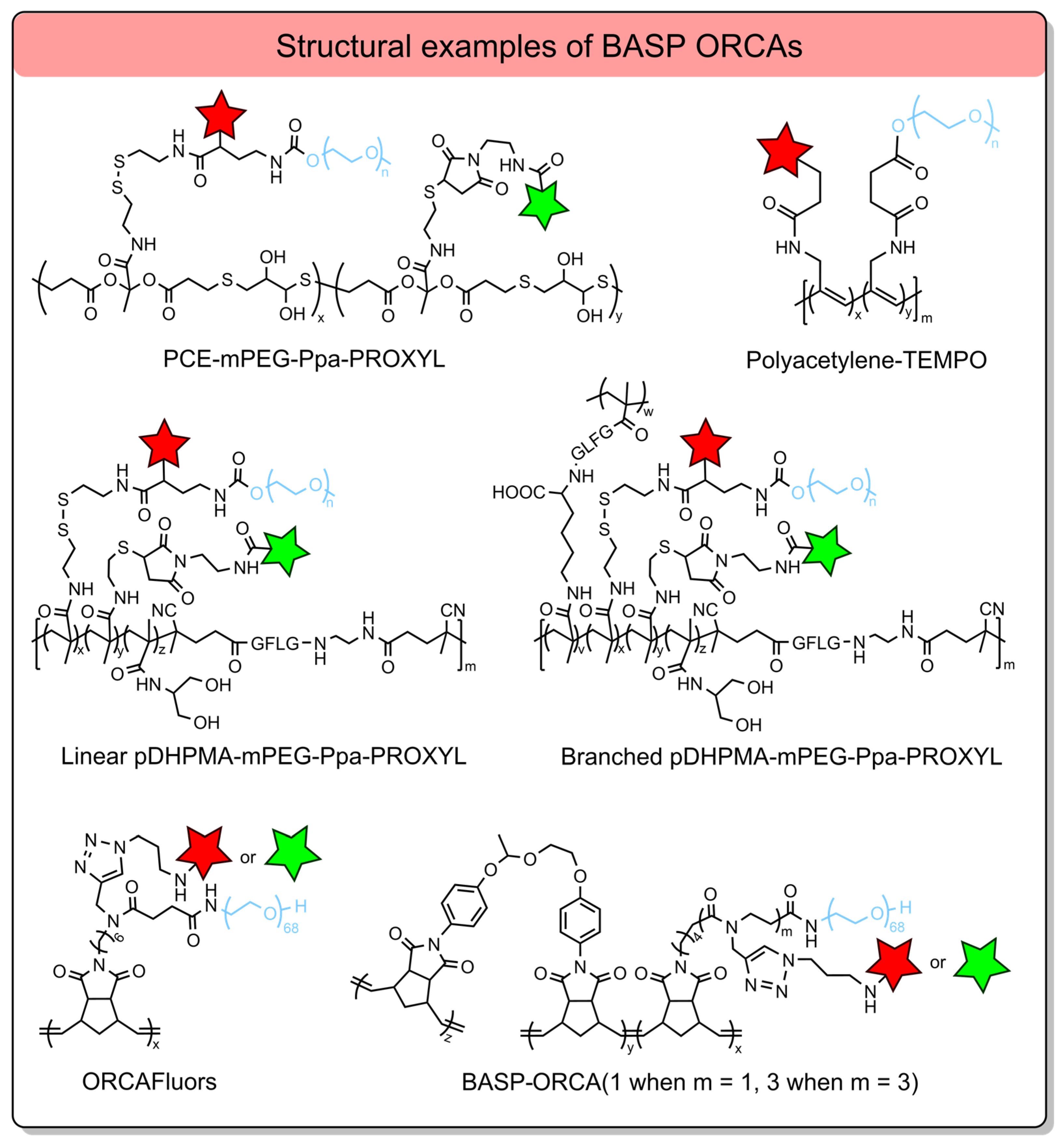


| Nitroxide | Magnetic Field Strength, T | r1/r2, mM−1s−1 | kred, M−1s−1 | 1H-MRI Application | Ref. |
|---|---|---|---|---|---|
| TEMPO | 1.4 | 0.15/0.10 | - | in vitro MRI phantoms | [62] |
| TEMPOL | 1.0 | 0.26/- | 5.6 ± 0.2 | in vitro MRI phantoms | [63] |
| 7.0 | 0.14/- | ||||
| Oxo-TEMPO | 0.2 | 0.50/- | - | in vitro MRI phantoms | [64] |
| 3-carboxy-PROXYL | 7.0 | 0.20/0.23 | 0.063 ± 0.002 | - | [65,66] |
| 0.18/0.20 | |||||
| 2,2,5,5-tetraethyl-PROXYL | 1.4 | 0.21/0/25 | <0.001 | - | [67] |
| SpiroHex | 7.0 | 0.21/0.30 | 0.031 ± 0.003 | in vitro MRI phantoms | [38] |
| MCP | 1.0 | 0.27/- | - | - | [51,52] |
| 4.7 | 0.16/- | ||||
| 7.0 | 0.14/- | ||||
| CMP | 4.7 | 0.17/- | - | in vivo MRI of mice bearing squamous carcinoma | [51] |
| Gd-DTPA * Magnevist | 1.5 | 3.8/5.2 | - | - | [68,69] |
| 3.0 | 3.3/5.0 | ||||
| 7.0 | 3.1/- | ||||
| Gd-DOTA * Dotarem | 1.5 | 3.9/- | - | - | [70] |
| 3.0 | 3.4/- | ||||
| 7.0 | 2.8/- |
| Nitroxide, Size of Nanosystem (nm) * | Magnetic Field Strength, T | r1/r2, mM−1s−1 per Molecule | r1/r2, mM−1s−1 per Nitroxide | 1H-MRI Application | Ref. |
|---|---|---|---|---|---|
 Myristic acid nitroxide phytantriol, 226 nm | 3.0 | 0.59/1.35 | - | in vivo MRI of Sprague Dawley rat | [93] |
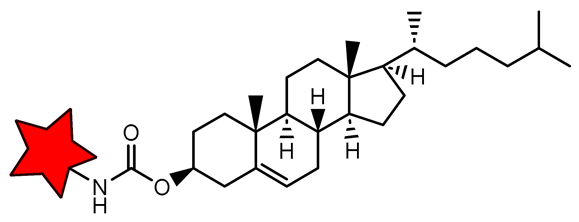 Cholesterol nitroxide phytantriol, 224 nm | 3.0 | 1.08/2.21 | - | in vivo MRI of Sprague Dawley rat | [39] |
 TEMDO-UBD (RNP 2), 200 nm | 1.0 | - | 0.29/0.26 | in vivo MRI of BALB/c mice bearing colon-26 tumors | [89] |
 TEMDO-UBD (2-HEG), 450 nm | 1.0 | - | 0.41/0.42 | in vitro MRI phantoms | [90] |
| ORCA, Size (nm) * | Magnetic Field Strength, T | r1/r2, mM−1s−1 per Nitroxide | r1/r2, mM−1s−1 per Molecule | MRI Application | Ref. |
|---|---|---|---|---|---|
| Polyurethane-TEMPO, 70 nm | 1.5 | 0.66/0.98 | ~10/15 | in vitro MRI phantoms | [101] |
| PEG-b-polycarbon- ate-based copolymers-PROXYL, 103 nm | 3.0 | 0.22/- | 2.4/- | in vivo MRI of C57BL/6 J mice | [96] |
| Glucose-PEO-poly-(L-lactic acid)-TEMPO, 281 nm | 3.0 | 0.3/- | 0.3/- | in vivo MRI of mice bearing tumor cells Hep1-6 | [102] |
| Hydrogel with TEMPO-PEG, poly(acrylic acid), and agarose | 7.0 | 0.30/- | - | in vivo MRI of mice | [105] |
| ORCA, Size (nm) * | Magnetic Field Strength, T | r1/r2, mM−1s−1 per Nitroxide | r1/r2, mM−1s−1 per Molecule | 1H-MRI Application | Ref. |
|---|---|---|---|---|---|
| Polyacetylene-TEMPO | 3.0 | 0.27/- | 3.3/- | in vivo MRI BALB/c mice bearing HeLa tumor cells | [107] |
| pDHPMAmPEG-PpaPROXYL (branched), 28 nm | 3.0 | 0.50/- | 4.7/- | in vivo MRI of BALB/c mice bearing 4T1 tumor cells | [96] |
| pDHPMAmPEGPpaPROXYL (linear), 23 nm | 3.0 | 0.93/- | 10.5/- | [102] | |
| PCE-mPEG-Ppa-PROXYL, 12 nm | 3.0 | 0.64/- | 1.2/- | in vivo MRI of BALB/c mice bearing | [108] |
| ORCAFluors, 19 nm | 7.0 | 0.32/0.82 | 37/95 | in vivo MRI of BALB/c mice | [106] |
| BASP-ORCA1, 31 nm | 7.0 | 0.41/4.67 | 37.6/428.8 | in vivo MRI of NCr/NU mice | [38] |
| BASP-ORCA3, 29 nm | 7.0 | 0.63/4.62 | ~126/>1000 | in vivo MRI of SCID mice bearing myeloma | [41] |
| Pro ORCA BASPs, 25 nm | 7.0 | 0.26/4.85 | ~20/380 | in vivo MRI NCr/NU mice bearing A549 tumor | [98] |
| Fe3O4/Feraheme ** | 1.5 | - | 20/61 | - | [38,111,112] |
| 3.0 | 10/88 | ||||
| 7.0 | -/68 | ||||
| Fe3O4/Resovist ** | 1.5 | - | 25.4/151 | - | [113,114] |
| 3.0 | 9.7/189 |
| ORCA | Dendrimer Generation | Magnetic Field Strength, T | r1/r2, mM−1s−1 per Nitroxide | r1/r2, mM−1s−1 per Molecule | 1H-MRI Application | Ref. |
|---|---|---|---|---|---|---|
| Polyamidoamine (PAMAM) | 0–1 | 0.5 | 0.11–0.13/- | 1.3–1.6/- | - | [116,118] |
| Polypropylenimine (PPI) | 2–4 | 7.0 | 0.29–0.42/- | 3.8–13.1/- | in vivo MRI C57BL/6 mice | [44] |
| Poly (L-lysine) | 6 | 1.5 | 0.50–0.80/- | 4–10/- | in vivo MRI of ddY mice bearing 4T1 cells | [117] |
| Oligoethylene glycol (OEG) | 0–1 | 7.0 | 0.17–0.18/ 0.19–0.20 | 0.9–3.4/ 1.0–4.0 | - | [66] |
| Polyphosphorhydrazone (PPH) | 0–3 | 7.0 | 0.23–0.27/ 0.24–0.33 | 1.4–12.9/ 1.4–16.0 | in vivo MRI of GL261 GB-bearing mice | [65,95] |
| ORCA | Magnetic Field Strength, T | r1/r2, mM−1s−1 per Nitroxide | r1/r2, mM−1s−1 per Molecule | 1H-MRI Application | Ref. |
|---|---|---|---|---|---|
| CS-TEMPO-FA | 0.5 | 2.63/3.47 | - | in vivo MRI of mice bearing 4T1 cells | [46,119] |
| 1.5 | 1.58/2.11 | 254/340 | |||
| HSA-Me | 1.9 | 0.30/0.9 | 3.0/9 | in vitro MRI phantoms | [120] |
| 3.0 | 0.38/1.2 | 3.5/11 | |||
| 7.0 | 0.20/1.4 | 2.7/18 | |||
| 14.1 | 0.12/1.9 | 1.6/26 | |||
| HSA-Et | 1.9 | 0.39/1.7 | 4.0/18 | in vitro MRI phantoms | [120] |
| 3.0 | 0.50/2.1 | 4.8/22 | |||
| 7.0 | 0.23/2.2 | 2.9/29 | |||
| 14.1 | 0.14/2.9 | 1.8/38 | |||
| HSA-Me/Me-mal | 1.9 | 0.33/0.9 | 6.3/17 | in vitro MRI phantoms | [120] |
| 3.0 | 0.48/1.3 | 8.2/22 | |||
| 7.0 | 0.30/2.0 | 5.2/34 | |||
| 14.1 | 0.24/2.2 | 4.1/38 | |||
| HSA-Et/Et-mal | 1.9 | 0.42/1.2 | 11.0/32 | in vitro MRI phantoms | [120] |
| 3.0 | 0.38/1.3 | 15.1/50 | |||
| 7.0 | 0.43/4.2 | 10.0/97 | |||
| 14.1 | 0.29/3.1 | 6.7/73 | |||
| TMV-TEMPO | 1.5 | 1.5/4.7 | ~270/840 | in vitro MRI phantoms | [121,122] |
| 9.4 | 0.4/5.2 |
| ORCA Type and Number of Nitroxides | Relaxivity * | Tumor Accumulation Selectivity ** | Circulation Time | Biocompatibility ** | Advantages (+)/Limitations (−) | |
|---|---|---|---|---|---|---|
| r1/r2 | ERP-Effect | Targeting | ||||
| Low-MW 1–10 | −/− | − | − or + | Short | + | + Cheap and easy synthesis − Rapid reduction and elimination; short contrast period |
| Linear Polymer 5–20 | +/+ | − or + | − or + | Moderate | + with PEGylation | + Moderate or high relaxivity and radical stability − Hard and expensive polymer synthesis; poor aqueous solubility due to the high modification by nitroxides |
| Brush-Arm Star Polymer 10–200 | ++/+++ | + | − or + | Moderate | + with PEGylation | |
| Dendrimeric Polymer 16–64 | +/+ | − or + | − or + | Moderate | + | |
| Biomacromolecule 10–200 | ++/+++ | ++ | ++ | Long | ++ | + Moderate or high relaxivity, good or excellent nitroxide stability, biodegradability, and low immunogenicity − Complex synthesis with preservation of biological properties |
| ORCA | P1/2, W | |Emax| | OMRI Application | Ref. |
|---|---|---|---|---|
| TEMPO | 6.2 | 153.7 | in vitro OMRI | [139] |
| 6.1 | 101.9 | |||
| TEMPOL | 7.1 | 91.1 | in vivo OMRI of Sprague-Dawley rat | [138,139] |
| PROXYL | 4.7 | 107.9 | in vitro OMRI | [139] |
| 3-carbamoyl-PROXYL (3-CP) | - | 101.0 | in vivo OMRI of mice bearing RKO colorectal cancer | [140,141] |
| 5.3 | 88.1 | |||
| 2,2,5,5-tetraethyl-PROXYL | 7.8 | 62.6 | in vitro OMRI | [140] |
| SL-heparin | - | 27.0 | in vitro OMRI | [142] |
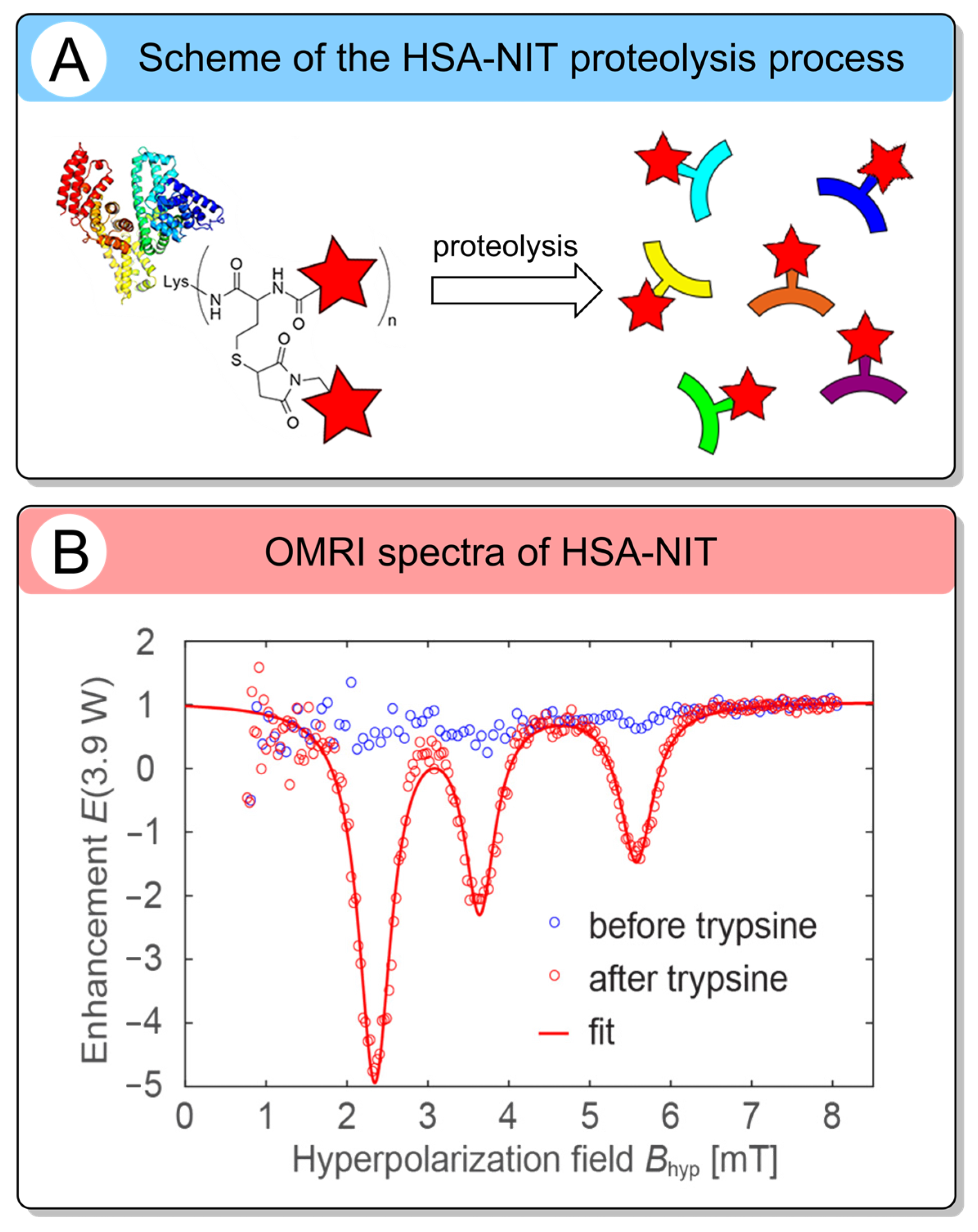
| HSA-NIT | 10.8 | 54.0 | in vitro OMRI | [120] |
Disclaimer/Publisher’s Note: The statements, opinions and data contained in all publications are solely those of the individual author(s) and contributor(s) and not of MDPI and/or the editor(s). MDPI and/or the editor(s) disclaim responsibility for any injury to people or property resulting from any ideas, methods, instructions or products referred to in the content. |
© 2026 by the authors. Licensee MDPI, Basel, Switzerland. This article is an open access article distributed under the terms and conditions of the Creative Commons Attribution (CC BY) license.
Share and Cite
Mitin, D.; Chubarov, A. Nitroxide-Based Contrast Agents for MRI Cancer Diagnostics: Progress, Limitations, and Perspectives. Molecules 2026, 31, 942. https://doi.org/10.3390/molecules31060942
Mitin D, Chubarov A. Nitroxide-Based Contrast Agents for MRI Cancer Diagnostics: Progress, Limitations, and Perspectives. Molecules. 2026; 31(6):942. https://doi.org/10.3390/molecules31060942
Chicago/Turabian StyleMitin, Dmitry, and Alexey Chubarov. 2026. "Nitroxide-Based Contrast Agents for MRI Cancer Diagnostics: Progress, Limitations, and Perspectives" Molecules 31, no. 6: 942. https://doi.org/10.3390/molecules31060942
APA StyleMitin, D., & Chubarov, A. (2026). Nitroxide-Based Contrast Agents for MRI Cancer Diagnostics: Progress, Limitations, and Perspectives. Molecules, 31(6), 942. https://doi.org/10.3390/molecules31060942