Biodegradation of Cyanide-Based Compounds by Rhodanese Produced from Kocuria rhizophila Under Submerged Fermentation and Its Role in Environmental Detoxification

 , , ,
, , ,
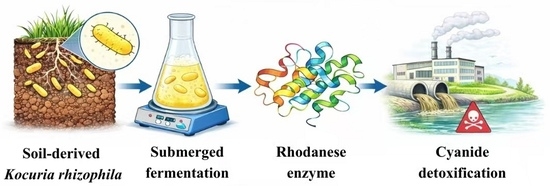
Abstract
1. Introduction
2. Results
2.1. Isolation of Kocuria rhizophila Isolates
2.2. Identification of Kocuria rhizophila Isolates
2.2.1. Morphological-Based Identification
2.2.2. VIETK-Based Biochemical Identification
2.2.3. Molecular Identification and Phylogenetic Characterization of the Isolate
2.3. Rhodanese-Producing Capacity of Kocuria rhizophila
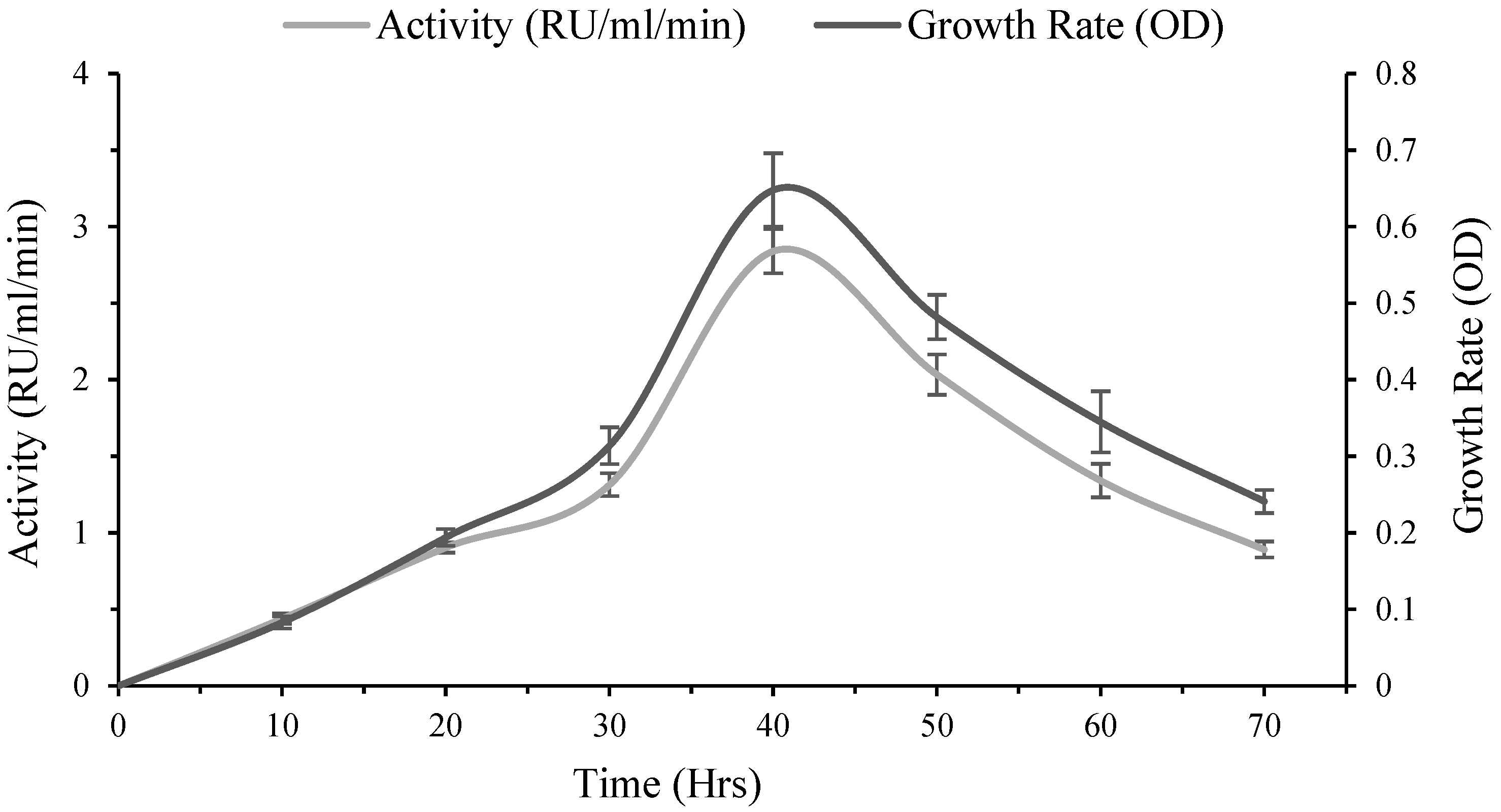
2.4. Production Profile of Rhodanese Enzyme by Kocuria rhizophila
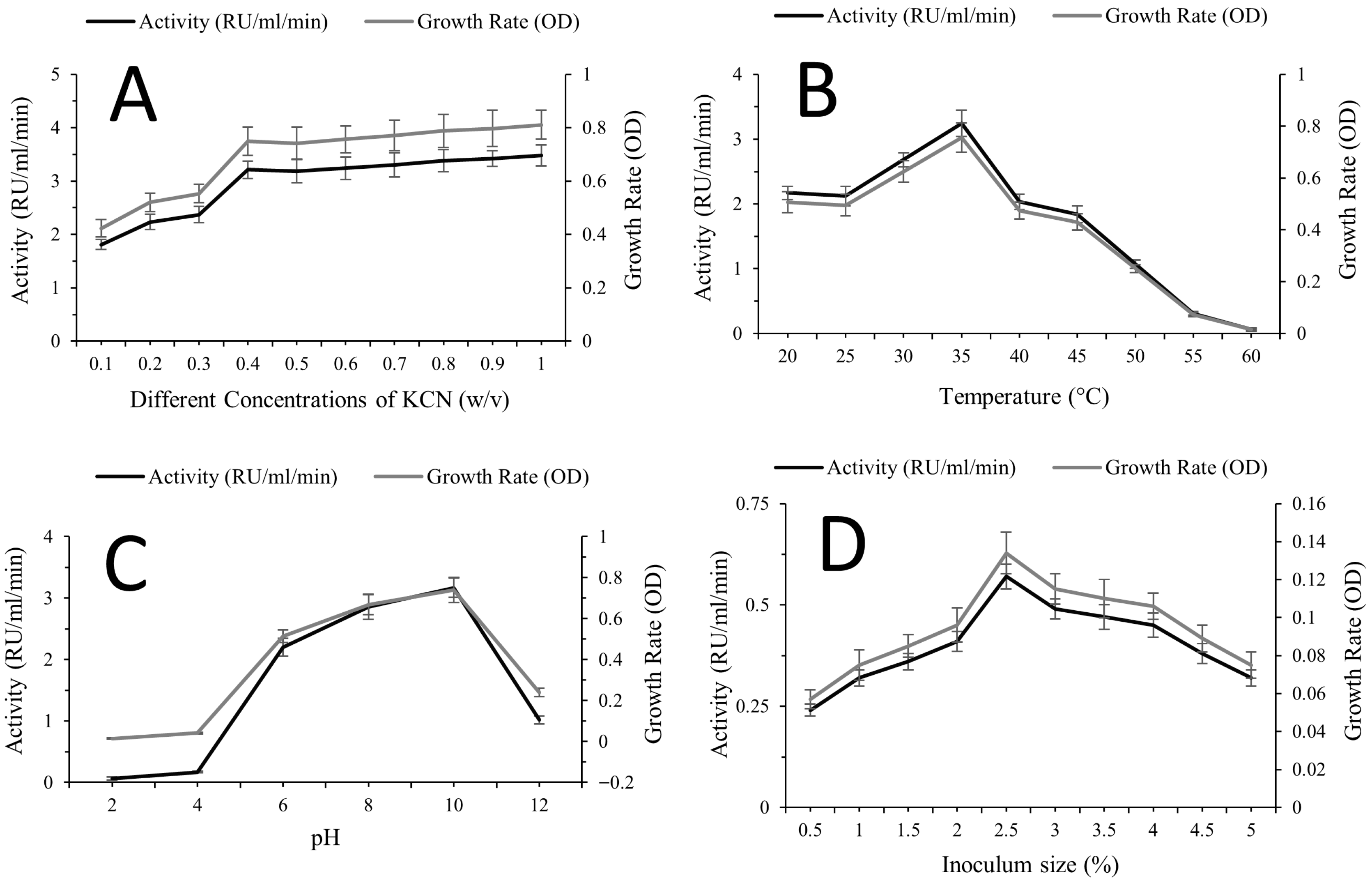
2.5. Influence of Variable Fermentation Conditions on Enzyme Production
2.5.1. Influence of Substrate Concentration on Enzyme Yield
2.5.2. Influence of Temperature on Enzyme Yield
2.5.3. Influence of pH on Enzyme Yield
2.5.4. Influence of Initial Inoculum Concentration on Enzyme Yield
2.6. Enzyme Purification
2.7. Rhodanese Enzyme Extract Characterization
2.7.1. Determination of Kinetic Parameters
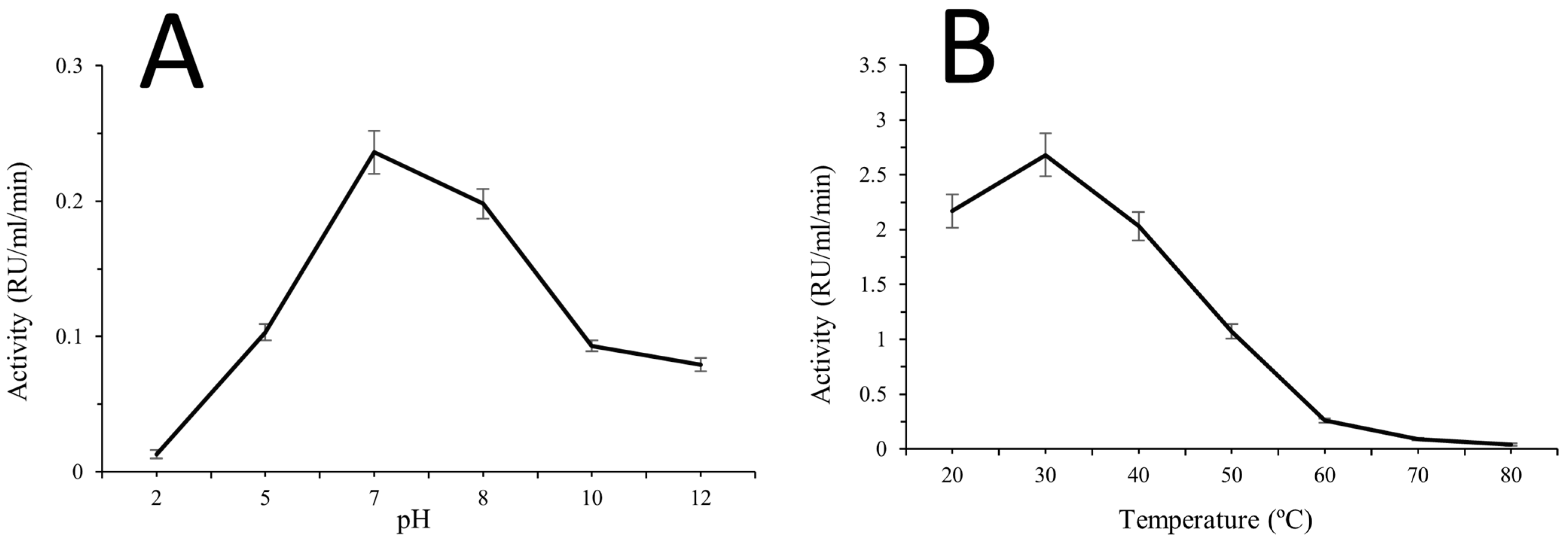
2.7.2. Effect of pH on Enzyme Activity
2.7.3. Effect of Temperature on Enzyme Activity
2.7.4. Effect of Metal Ions
2.7.5. Substrate Specificity and Kinetics
2.7.6. SDS-PAGE Protein Profiling
2.8. Biodegradation Potential of Cyanide-Based Pesticides by Rhodanese Enzyme
3. Discussion
4. Materials and Methods
4.1. Isolation of Kocuria rhizophila from Soil
4.1.1. Soil Sampling
4.1.2. Serial Dilution and Culturing on Brain Heart Infusion Agar
4.1.3. Inoculum Preparation
4.2. Identification of Kocuria rhizophila Isolates
4.2.1. Macroscopic and Microscopic Examination
4.2.2. VITEK-Based Biochemical Identification
4.2.3. Molecular Identification via 16S rRNA Gene Amplification and Sequencing
4.3. Evaluation of the Rhodanese-Producing Potential of Kocuria rhizophila
4.4. Rhodanese Production Under Submerged Fermentation
4.5. Optimization of Rhodanese Production Under Variable Fermentation Conditions
4.5.1. Influence of Substrate Concentration on Enzyme Yield
4.5.2. Influence of Temperature on Enzyme Yield
4.5.3. Influence of pH on Enzyme Yield
4.5.4. Influence of Initial Inoculum Concentration on Enzyme Yield
4.6. Rhodanese Activity Assay and Protein Quantification
4.7. Crude Enzyme Extract Purification
4.7.1. Acetone Precipitation
4.7.2. Ammonium Sulfate Fractionation
4.7.3. Ion-Exchange Chromatography (CM-Sephadex C-50)
4.7.4. Gel Filtration Chromatography (Sephadex G-100)
4.8. Characterization of Partially Purified Rhodanese
4.8.1. Determination of Kinetic Parameters
4.8.2. Effect of pH on Enzyme Activity
4.8.3. Effect of Temperature on Enzyme Activity
4.8.4. Effect of Metal Ions
4.8.5. Substrate Specificity and Kinetics
4.8.6. SDS-PAGE Protein Profiling
4.9. Evaluation of Rhodanese-Mediated Cyanide Pesticide Degradation
4.9.1. Reaction Mixture Preparation and Incubation
4.9.2. Determination of Remaining Cyanide (König Reaction)
4.9.3. Calculation of Cyanide Degradation Efficiency
4.10. Statistical Analysis of Experimental Data
5. Conclusions
Supplementary Materials
Author Contributions
Funding
Data Availability Statement
Conflicts of Interest
References
- Vaca-Escobar, K.; Arregui-Almeida, D.; Espinoza-Montero, P. Chemical, ecotoxicological characteristics, environmental fate, and treatment methods applied to cyanide-containing wastewater. NPJ Clean Water 2024, 7, 103. [Google Scholar] [CrossRef] [Scilit]
- Pathak, V.M.; Verma, V.K.; Rawat, B.S.; Kaur, B.; Babu, N.; Sharma, A.; Dewali, S.; Yadav, M.; Kumari, R.; Singh, S.; et al. Current status of pesticide effects on environment, human health and it’s eco-friendly management as bioremediation: A comprehensive review. Front. Microbiol. 2022, 13, 962619. [Google Scholar] [CrossRef] [Scilit] [PubMed]
- Berkinbayeva, A.; Kenzhaliyev, B.; Smailov, K.; Aimagambetov, A.; Kamenov, B.; Saulebekkyzy, S.; Tolegenova, N.; Putri, P.S.R. An overview of biological cyanide elimination from tailing wastewater as a promising tool for sustainable utilization. Water Res. X 2025, 29, 100400. [Google Scholar] [CrossRef] [Scilit]
- Shekhar, C.; Khosya, R.; Thakur, K.; Mahajan, D.; Kumar, R.; Kumar, S.; Sharma, A.K. A systematic review of pesticide exposure, associated risks, and long-term human health impacts. Toxicol. Rep. 2024, 13, 101840. [Google Scholar] [CrossRef] [Scilit] [PubMed] [PubMed Central]
- Patel, J.; Harkhani, K.; Sharma, A.K.; Choudhary, N. Recent Advances in the Microbial based biodegradation of Pesticides. Adv. Bioresearch 2024, 15, 358–365. [Google Scholar] [CrossRef]
- Thakur, M.; Medintz, I.L.; Walper, S.A. Enzymatic Bioremediation of Organophosphate Compounds-Progress and Remaining Challenges. Front. Bioeng. Biotechnol. 2019, 7, 289. [Google Scholar] [CrossRef] [Scilit] [PubMed] [PubMed Central]
- Agboola, O.E.; Ayinla, Z.A.; Itakorode, B.O.; Akinsanya, P.O.; Okonji, R.E.; Odeghe, O.B.; Agboola, S.S.; Oluranti, O.E.; Olojo, F.O.; Oyinloye, B.E. Structural and Kinetic Properties of Liver Rhodanese from Coptodon zillii: Implications for Cyanide Detoxification in Gold Mining-Impacted Aquatic Ecosystems. Toxics 2025, 13, 750. [Google Scholar] [CrossRef] [Scilit]
- Cáceda Quiroz, C.J.; Fora Quispe, G.d.L.; Carpio Mamani, M.; Maraza Choque, G.J.; Sacari Sacari, E.J. Cyanide Bioremediation by Bacillus subtilis under Alkaline Conditions. Water 2023, 15, 3645. [Google Scholar] [CrossRef] [Scilit]
- Cipollone, R.; Ascenzi, P.; Frangipani, E.; Visca, P. Cyanide detoxification by recombinant bacterial rhodanese. Chemosphere 2006, 63, 942–949. [Google Scholar] [CrossRef] [Scilit] [PubMed]
- Cipollone, R.; Bigotti, M.G.; Frangipani, E.; Ascenzi, P.; Visca, P. Characterization of a rhodanese from the cyanogenic bacterium Pseudomonas aeruginosa. Biochem. Biophys. Res. Commun. 2004, 325, 85–90. [Google Scholar] [CrossRef] [Scilit]
- Raphael, E.O.; Bamidele, S.F.; Leonard, O.E.; Zainab, A.A.; Olajumoke, O.O. Physicochemical properties of rhodanese: A cyanide-detoxifying enzyme from Pseudomonas aeruginosa (Baill) root. Afr. J. Biotechnol. 2017, 16, 704–711. [Google Scholar] [CrossRef] [Scilit]
- Itakorode, B.O.; Apalowo, O.E.; Boateng, I.D.; Okonji, R.E. Characterization of rhodanese synthesized by the wild and EMS-mutated Klebsiella oxytoca JCM1665. J. Agric. Food Res. 2024, 18, 101358. [Google Scholar] [CrossRef] [Scilit]
- Shi, Q.; Wang, X.; Ju, Z.; Liu, B.; Lei, C.; Wang, H.; Li, H. Technological and Safety Characterization of Kocuria rhizophila Isolates from Traditional Ethnic Dry-Cured Ham of Nuodeng, Southwest China. Front. Microbiol. 2021, 12, 761019. [Google Scholar] [CrossRef] [Scilit] [PubMed] [PubMed Central]
- Takarada, H.; Sekine, M.; Kosugi, H.; Matsuo, Y.; Fujisawa, T.; Omata, S.; Kishi, E.; Shimizu, A.; Tsukatani, N.; Tanikawa, S.; et al. Complete genome sequence of the soil actinomycete Kocuria rhizophila. J. Bacteriol. 2008, 190, 4139–4146. [Google Scholar] [CrossRef] [Scilit] [PubMed] [PubMed Central]
- Guesmi, S.; Pujic, P.; Nouioui, I.; Dubost, A.; Najjari, A.; Ghedira, K.; Igual, J.M.; Miotello, G.; Cherif, A.; Armengaud, J.; et al. Ionizing-radiation-resistant Kocuria rhizophila PT10 isolated from the Tunisian Sahara xerophyte Panicum turgidum: Polyphasic characterization and proteogenomic arsenal. Genomics 2021, 113, 317–330. [Google Scholar] [CrossRef] [Scilit]
- Řezanka, T.; Zahradník, J.; Zavala-Meneses, S.G.; Marešová, H.; Řezanka, M.; Pelantová, H.; Grulich, M.; Filištein, V.; Palyzová, A. Elucidation of new sulfamethoxazole catabolic pathways in whole-cell catalyst of bacterium Kocuria rhizophila SA117. Bioresour. Technol. 2025, 435, 132912. [Google Scholar] [CrossRef] [Scilit] [PubMed]
- Ventura MCanchaya, C.; Tauch, A.; Chandra, G.; Fitzgerald, G.F.; Chater, K.F.; van Sinderen, D. Genomics of Actinobacteria: Tracing the Evolutionary History of an Ancient Phylum. Microbiol. Mol. Biol. Rev. 2007, 71, 495–548. [Google Scholar] [CrossRef] [Scilit]
- Mascarin, G.M.; Golo, P.S.; de Souza Ribeiro-Silva, C.; Muniz, E.R.; de Oliveira Franco, A.; Kobori, N.N.; Fernandes, É.K.K. Advances in submerged liquid fermentation and formulation of entomopathogenic fungi. Appl. Microbiol. Biotechnol. 2024, 108, 451, Erratum in Appl. Microbiol. Biotechnol. 2025, 109, 224. https://doi.org/10.1007/s00253-025-13610-2. [Google Scholar] [CrossRef] [Scilit] [PubMed] [PubMed Central]
- Luque-Almagro, V.M.; Moreno-Vivián, C.; Roldán, M.D. Biodegradation of cyanide wastes from mining and jewellery industries. Curr. Opin. Biotechnol. 2016, 38, 9–13. [Google Scholar] [CrossRef] [Scilit]
- Sheldon, R.A.; Woodley, J.M. Role of Biocatalysis in Sustainable Chemistry. Chem. Rev. 2018, 118, 801–838. [Google Scholar] [CrossRef] [Scilit] [PubMed]
- Kovács, G.; Burghardt, J.; Pradella, S.; Schumann, P.; Stackebrandt, E.; Màrialigeti, K. Kocuria palustris sp. nov. and Kocuria rhizophila sp. nov., isolated from the rhizoplane of the narrow-leaved cattail (Typha angustifolia). Int. J. Syst. Evol. Microbiol. 1999, 49, 167–173. [Google Scholar] [CrossRef] [Scilit] [PubMed]
- BacDive. Kocuria rhizophila DSM 348 Strain Entry (Bacdive ID 7646); Leibniz Institute DSMZ–German Collection of Microorganisms and Cell Cultures: Braunschweig, Germany, 2024. [Google Scholar]
- Ziogou, A.; Giannakodimos, I.; Giannakodimos, A.; Baliou, S.; Ioannou, P. Kocuria Species Infections in Humans—A Narrative Review. Microorganisms 2023, 11, 2362. [Google Scholar] [CrossRef] [Scilit]
- Hassan, R.M.; Bassiouny, D.M.; Matar, Y. Bacteremia Caused by Kocuria kristinae from Egypt: Are There More? A Case Report and Review of the Literature. Case Rep. Infect. Dis. 2016, 2016, 6318064. [Google Scholar] [CrossRef] [Scilit] [PubMed]
- Whon, T.W.; Kim, H.S.; Bae, J.W. Complete genome sequence of Kocuria rhizophila BT304, isolated from the small intestine of castrated beef cattle. Gut Pathog. 2018, 10, 42. [Google Scholar] [CrossRef] [Scilit]
- Itakorode, B.O.; Okonji, R.E.; Adedeji, O.S.; Torimiro, N.; Famakinwa, O.; Chukwuejim, S. Isolation, screening and optimization of Bacillus cereus for a thiosuphate sulphur transferase production. J. Chem. Pharm. Sci. 2019, 12, 79–84. [Google Scholar] [CrossRef] [Scilit]
- Cipollone, R.; Ascenzi, P.; Tomao, P.; Imperi, F.; Visca, P. Enzymatic detoxification of cyanide: Clues from Pseudomonas aeruginosa Rhodanese. J. Mol. Microbiol. Biotechnol. 2008, 15, 199–211. [Google Scholar] [CrossRef] [Scilit] [PubMed]
- Gardner, M.N.; Rawlings, D.E. Production of rhodanese by bacteria present in bio-oxidation plants used to recover gold from arsenopyrite concentrates. J. Appl. Microbiol. 2000, 89, 185–190. [Google Scholar] [CrossRef] [Scilit] [PubMed]
- Itakorode, B.O.; Apalowo, O.E. Isolation and Statistical Optimization of Rhodanese (A Thiosulphate Sulphur Transferase) Production Potential of Klebsiella oxytoca JCM 1665 Using Response Surface Methodology. Nova Biotechnol. Et Chim. 2022, 21, e1083. [Google Scholar] [CrossRef] [Scilit]
- Oyedeji, O.O.; Awojobi, K.O.; Okonji, R.E.; Olusola, O.O. Characterization of rhodanese produced by Pseudomonas aeruginosa and Bacillus brevis isolated from soil of cassava processing site. Afr. J. Biotechnol. 2013, 12, 1104–1114. [Google Scholar] [CrossRef]
- Lawal, O.T.; Sanni, D.M. Characterization of thermotolerant and thermostable rhodanese from Aspergillus welwitschiae LOT1 isolated from battery-effluent contaminated soil. Biocatal. Agric. Biotechnol. 2023, 52, 102807. [Google Scholar] [CrossRef] [Scilit]
- Al Mousa, A.A.; Hassane, A.M.A.; Gomaa, A.E.-R.F.; Aljuriss, J.A.; Dahmash, N.D.; Abo-Dahab, N.F. Response-Surface Statistical Optimization of Submerged Fermentation for Pectinase and Cellulase Production by Mucor circinelloides and M. hiemalis. Fermentation 2022, 8, 205. [Google Scholar] [CrossRef] [Scilit]
- Ehigie, A.F.; Okonji, R.E.; Oladiran, W.A.; Ehigie, O.L. Isolation and Characterization of Rhodanese from Bacillus licheniformis Obtained from Industrial Effluents of Steel Rolling Industry in Ilorin. IRA Int. J. Appl. Sci. 2018, 13, 14–34. [Google Scholar] [CrossRef] [Scilit]
- Ullah, N.; Rehman, M.U.; Sarwar, A.; Nadeem, M.; Nelofer, R.; Shakir, H.A.; Irfan, M.; Idrees, M.; Naz, S.; Nabi, G.; et al. Purification, Characterization, and Application of Alkaline Protease Enzyme from a Locally Isolated Bacillus cereus Strain. Fermentation 2022, 8, 628. [Google Scholar] [CrossRef] [Scilit]
- Adedire, S.A.; Agunbiade, O.J.; Adewale, I.O. Purification and characterization of alkaline lipase from Brevundimonas diminuta isolated from cocoa processing plant effluent. Microbe 2025, 8, 100492. [Google Scholar] [CrossRef] [Scilit]
- Itakorode, B.O.; Itakorode, D.I.; Torimiro, N.; Okonji, R.E. Kinetic and thermodynamic investigation of Rhodanese synthesized by enhanced Klebsiella oxytoca JCM 1665 strain: A comparative between the free and immobilized enzyme entrapped in alginate beads. Prep. Biochem. Biotechnol. 2024, 54, 1275–1284. [Google Scholar] [CrossRef] [Scilit] [PubMed]
- Gupta, A.; Naseem, M.; Gupta, E.; Srivastava, P.K.; Barik, S.K. Metagenomic profiling of cyanide-degrading microbial communities in steel industry wastewater with an implication for bioremediation. Front. Environ. Sci. Eng. 2025, 19, 137. [Google Scholar] [CrossRef] [Scilit]
- Libiad, M.; Sriraman, A.; Banerjee, R. Polymorphic Variants of Human Rhodanese Exhibit Differences in Thermal Stability and Sulfur Transfer Kinetics. J. Biol. Chem. 2015, 290, 23579–23588. [Google Scholar] [CrossRef] [Scilit] [PubMed] [PubMed Central]
- Lawal, O.T.; Sanni, D.M. Physicochemical and thermodynamic properties of purified rhodanese from A. welwitschiae LOT1 and the cyanide detoxification potential of the enzyme. World J. Microbiol. Biotechnol. 2024, 40, 355. [Google Scholar] [CrossRef] [Scilit] [PubMed]
- Atlas, R.M.; Bartha, R. Microbial Ecology: Fundamentals and Applications, 1st ed.; Addison-Wesley Publishing Company: Reading, MA, USA, 1981; ISBN 978-0201023439. [Google Scholar]
- Cappuccino, J.G.; Welsh, C.T. Microbiology: A Laboratory Manual, 11th Global ed.; Pearson Education Limited: Harlow, UK, 2017; ISBN 978-1292175799. [Google Scholar]
- CLSI. M45-A2: Methods for Antimicrobial Susceptibility Testing of Bacteria That Grow Aerobically; Clinical and Laboratory Standards Institute: Wayne, PA, USA, 2015. [Google Scholar]
- Funke, G.; von Graevenitz, A.; Clarridge, J.E., 3rd; Bernard, K.A. Clinical microbiology of coryneform bacteria. Clin. Microbiol. Rev. 1997, 10, 125–159. [Google Scholar] [CrossRef] [PubMed] [PubMed Central]
- Weisburg, W.G.; Barns, S.M.; Pelletier, D.A.; Lane, D.J. 16S ribosomal DNA amplification for phylogenetic study. J. Bacteriol. 1991, 173, 697–703. [Google Scholar] [CrossRef] [Scilit] [PubMed] [PubMed Central]
- Kumar, S.; Stecher, G.; Li, M.; Knyaz, C.; Tamura, K. MEGA X: Molecular Evolutionary Genetics Analysis across Computing Platforms. Mol. Biol. Evol. 2018, 35, 1547–1549. [Google Scholar] [CrossRef] [Scilit] [PubMed]
- Majumder, K.; Paul, B.; Sundas, R. An analysis of exo-polygalacturonase bioprocess in submerged and solid-state fermentation by Pleurotus ostreatus using pomelo peel powder as carbon source. J. Genet. Eng. Biotechnol. 2020, 18, 47. [Google Scholar] [CrossRef] [Scilit]
- Nagar, S.; Gupta, V.K.; Kumar, D.; Kumar, L.; Kuhad, R.C. Production and optimization of cellulase-free, alkali-stable xylanase by Bacillus pumilus SV-85S in submerged fermentation. J. Ind. Microbiol. Biotechnol. 2010, 37, 71–83. [Google Scholar] [CrossRef] [Scilit] [PubMed]
- Khusro, A.; Barathikannan, K.; Aarti, C.; Agastian, P. Optimization of Thermo-Alkali Stable Amylase Production and Biomass Yield from Bacillus sp. Under Submerged Cultivation. Fermentation 2017, 3, 7. [Google Scholar] [CrossRef] [Scilit]
- Nawawi, M.H.; Ismail, K.I.; Sa’ad, N.; Mohamad, R.; Tahir, P.M.; Asa’ari, A.Z.; Saad, W.Z. Optimisation of Xylanase–Pectinase Cocktail Production with Bacillus amyloliquefaciens ADI2 Using a Low-Cost Substrate via Statistical Strategy. Fermentation 2022, 8, 119. [Google Scholar] [CrossRef] [Scilit]
- Bradford, M.M. A rapid and sensitive method for the quantitation of microgram quantities of protein utilizing the principle of protein-dye binding. Anal. Biochem. 1976, 72, 248–254. [Google Scholar] [CrossRef] [PubMed]
- Scopes, R.K. Protein Purification: Principles and Practice, 3rd ed.; Springer: Berlin/Heidelberg, Germany, 1994. [Google Scholar] [CrossRef] [Scilit]
- Duong-Ly, K.C.; Gabelli, S.B. Salting out of proteins using ammonium sulfate precipitation. Methods Enzymol. 2014, 541, 85–94. [Google Scholar] [CrossRef] [Scilit] [PubMed]
- Liu, S.; Li, Z.; Yu, B.; Wang, S.; Shen, Y.; Cong, H. Recent advances on protein separation and purification methods. Adv. Colloid Interface Sci. 2020, 284, 102254. [Google Scholar] [CrossRef] [Scilit] [PubMed]
- Duong-Ly, K.C.; Gabelli, S.B. Chapter Nine—Gel Filtration Chromatography (Size Exclusion Chromatography) of Proteins. In Methods in Enzymology: Protein Part C; Elsevier: Amsterdam, The Netherlands, 2014; Volume 541, pp. 105–114. [Google Scholar] [CrossRef] [Scilit]
- Lineweaver, H.; Burk, D. The Determination of Enzyme Dissociation Constants. J. Am. Chem. Soc. 1934, 56, 658–666. [Google Scholar] [CrossRef] [Scilit]
- Agboola, F.K.; Okonji, R.E. Presence of rhodanese in the cytosolic fraction of the fruit bat (Eidolon helvum) liver. J. Biochem. Mol. Biol. 2004, 37, 275–281. [Google Scholar] [CrossRef] [Scilit]
- Lee, C.H.; Hwang, J.H.; Lee, Y.S.; Cho, K.S. Purification and characterization of mouse liver rhodanese. J. Biochem. Mol. Biol. 1995, 28, 170–176. [Google Scholar]
- Westley, J. Thiosulfate: Cyanide sulfurtransferase (rhodanese). Methods Enzymol. 1981, 77, 285–291. [Google Scholar] [CrossRef] [Scilit] [PubMed]
- Laemmli, U.K. Cleavage of structural proteins during the assembly of the head of Bacteriophage T4. Nature 1970, 227, 680–685. [Google Scholar] [CrossRef] [Scilit] [PubMed]
- Toida, T.; Tanabe, S.; Imanari, T. Fluorometric determination of cyanide and thiocyanate by the König reaction. Chem. Pharm. Bull. 1981, 29, 3763. [Google Scholar] [CrossRef] [Scilit]




| Purification Steps | Total Protein (mg/mL) | Total Activity (µmol/min) | Specific Activity (µmol/mg/min) | Yield % | Purification Fold |
|---|---|---|---|---|---|
| Crude | 1.275 | 132.30 | 2.17 | 100 | 1.00 |
| Acetone | 1.052 | 62.41 | 3.92 | 48.29 | 1.81 |
| Ammonium sulfate | 1.010 | 58.67 | 2.82 | 9.63 | 1.30 |
| CM sephadex C 50 ion exchange chromatography | 0.270 | 19.56 | 9.83 | 2.73 | 4.53 |
| Sephadex G-100 gel filteration | 0.050 | 4.54 | 11.56 | 12.78 | 5.33 |
| Substrate | Km (mM) | Vmax (RU/mL/min) |
|---|---|---|
| KCN | 33.92 ± 0.11 | 5.60 ± 0.03 |
| Na2S2O3 | 19.65 ± 0.24 | 5.84 ± 0.014 |
| Metals | Rhodanese Activity (%) Under Different Concentration (1.0, 5.0, 10.0 mM) | ||
|---|---|---|---|
| 1.0 mM | 5.0 mM | 10.0 mM | |
| Control | 100.00 | 100.00 | 100.00 |
| KCl | 70.75 ± 0.35 | 64.19 ± 0.87 | 61.05 ± 0.32 |
| MgCl2 | 92.15 ± 0.21 | 82.16 ± 0.20 | 75.00 ± 0.65 |
| BaCl2 | 80.20 ± 0.28 | 87.32 ± 0.94 | 91.73 ± 0.80 |
| NiCl2 | 83.45 ± 0.35 | 91.00 ± 0.38 | 95.00 ± 1.02 |
| MnCl2 | 78.93 ± 0.39 | 88.64 ± 0.76 | 93.81 ± 0.98 |
| SnCl2 | 87.75 ± 0.35 | 93.00 ± 1.02 | 98.58 ± 0.10 |
| NaCl | 88.46 ± 0.20 | 45.76 ± 0.24 | 18.50 ± 0.31 |
| Sulphur Compounds | Specificity (%) |
|---|---|
| Sodium thiosulphate (Na2S2O3) | 100.0 ± 0.00 |
| Sodium metabisulphite (Na2S2O5) | 15.4 ± 0.28 |
| Ammonium persulphate ((NH4)2S2O8) | 24.15 ± 0.21 |
| 2-mercaptoethanol (CH2(SH)CH2(OH)) | 18.0 ± 0.00 |
| Sodium sulfite | 19.80 ± 0.14 |
Disclaimer/Publisher’s Note: The statements, opinions and data contained in all publications are solely those of the individual author(s) and contributor(s) and not of MDPI and/or the editor(s). MDPI and/or the editor(s) disclaim responsibility for any injury to people or property resulting from any ideas, methods, instructions or products referred to in the content. |
© 2026 by the authors. Licensee MDPI, Basel, Switzerland. This article is an open access article distributed under the terms and conditions of the Creative Commons Attribution (CC BY) license.
Share and Cite
Mahdi, N.Z.; Al-Siraj, S.S.; Taher, N.A.; Alenezi, M.A.; Alfifi, K.J.; Albalwe, F.M.; Anazi, H.K.; AL-Balawi, S.M.; Galal, M.; Lotfy, M.F.; et al. Biodegradation of Cyanide-Based Compounds by Rhodanese Produced from Kocuria rhizophila Under Submerged Fermentation and Its Role in Environmental Detoxification. Molecules 2026, 31, 915. https://doi.org/10.3390/molecules31060915
Mahdi NZ, Al-Siraj SS, Taher NA, Alenezi MA, Alfifi KJ, Albalwe FM, Anazi HK, AL-Balawi SM, Galal M, Lotfy MF, et al. Biodegradation of Cyanide-Based Compounds by Rhodanese Produced from Kocuria rhizophila Under Submerged Fermentation and Its Role in Environmental Detoxification. Molecules. 2026; 31(6):915. https://doi.org/10.3390/molecules31060915
Chicago/Turabian StyleMahdi, Nada Z., Suhair Sh. Al-Siraj, Nehad A. Taher, Muneefah Abdullah Alenezi, Khyreyah J. Alfifi, Fauzeya Mateq Albalwe, Hanan Khalaf Anazi, Siham M. AL-Balawi, Mahmoud Galal, Maha F. Lotfy, and et al. 2026. "Biodegradation of Cyanide-Based Compounds by Rhodanese Produced from Kocuria rhizophila Under Submerged Fermentation and Its Role in Environmental Detoxification" Molecules 31, no. 6: 915. https://doi.org/10.3390/molecules31060915
APA StyleMahdi, N. Z., Al-Siraj, S. S., Taher, N. A., Alenezi, M. A., Alfifi, K. J., Albalwe, F. M., Anazi, H. K., AL-Balawi, S. M., Galal, M., Lotfy, M. F., & Sharaf, E. M. (2026). Biodegradation of Cyanide-Based Compounds by Rhodanese Produced from Kocuria rhizophila Under Submerged Fermentation and Its Role in Environmental Detoxification. Molecules, 31(6), 915. https://doi.org/10.3390/molecules31060915