Skip to Content
MoleculesMolecules
  • Article
  • Open Access

22 March 2026

Whole-Cell Biocatalysis for the Production of Structurally Diverse Methoxydihydrochalcones: Broad Activity of the Yarrowia Clade


,
,
,
and
1
Department of Food Chemistry and Biocatalysis, Wrocław University of Environmental and Life Sciences, 50-375 Wrocław, Poland
2
Department of Biotechnology and Food Microbiology, Wrocław University of Environmental and Life Sciences, 51-630 Wrocław, Poland
*
Authors to whom correspondence should be addressed.
Molecules2026, 31(6), 1049;https://doi.org/10.3390/molecules31061049 
(registering DOI)
This article belongs to the Special Issue Bioactive Compounds in Plants: Extraction and Application

Abstract

Whole-cell biocatalysis presents a sustainable and efficient approach for the selective reduction in α,β-unsaturated bonds in flavonoid derivatives. This study investigates the capability of yeast strains from the Yarrowia clade to catalyze the chemoselective reduction of 4′-methoxychalcone (1a) to its dihydro derivative. All tested strains exhibited similarly high hydrogenation activity, indicating a broadly conserved enoate reductase function within the clade. Among them, Yarrowia lipolytica KCh 71, previously reported and well characterized in the literature, was selected for preparative-scale transformation of a diverse series of synthetic methoxychalcones bearing additional methoxy groups in positions C-2, C-3, C-4, C-5, and C-6 of ring B. All derivatives were effectively converted into the corresponding dihydrochalcones, with yields ranging from 62% to 92%. Among the tested derivatives, the 2′,4′,6′-trimethoxy chalcone (7a) did not undergo biotransformation under our conditions, whereas mono- and di-methoxy derivatives (2a6a) were efficiently reduced. These results confirm the broad substrate tolerance, high efficiency, and potential scalability of Y. lipolytica KCh 71, supporting its potential as a whole-cell biocatalyst for the sustainable synthesis of bioactive dihydrochalcones. The consistently high hydrogenation activity observed across 21 tested strains suggests the involvement of evolutionarily conserved enoate reductases. Bioinformatic analysis supports that the Yarrowia clade possesses a robust complement of Old Yellow Enzymes (OYE), providing a reliable enzymatic basis for the observed chemoselective reductions. All Yarrowia tested strains showed the same general transformation type, although the extent and rate of conversion differed among strains, and Y. lipolytica KCh 71 was one of the most tolerant. The broad reduction in α,β-unsaturated chalcones is consistent with the action of flavoenzymatic ene-reductases, particularly Old Yellow Enzyme (OYE)–like reductases. Bioinformatic analysis of Yarrowia genomes reveals putative OYE homologs, supporting this mechanistic interpretation, although the specific enzymes were not identified in this study.

1. Introduction

Whole-cell biocatalysis has emerged as a pivotal tool in modern biotechnology, offering a sustainable and efficient method for producing a wide range of valuable chemicals [1]. Unlike isolated enzymes, whole cells serve as self-sufficient biocatalytic systems, capable of performing complex, multi-step reactions within a stable environment. These systems offer significant advantages, such as the ability to regenerate cofactors and maintain enzyme activity over longer periods [2]. However, the success of whole-cell biocatalysis largely depends on selecting the most suitable biocatalyst, one that ensures optimal substrate conversion, high catalytic efficiency, and robust performance under industrial conditions [3]. The choice of biocatalyst is, therefore, a critical factor in maximizing product yield and achieving cost-effective production processes.
One promising group of microorganisms in this context is the Yarrowia clade, particularly Yarrowia lipolytica, which has gained increasing attention for its versatility in industrial applications [4]. Yarrowia species are capable of metabolizing a broad spectrum of substrates, including complex organic compounds such as lipids [5], hydrocarbons [6], and other hydrophobic substances [7]. This metabolic flexibility, coupled with their ability to produce valuable metabolites like polyols and organic acids [8] or enzymes like lipases [9], makes them attractive candidates for various biotechnological applications. In industries such as biofuel production [10], pharmaceuticals [11], and nutraceuticals, Yarrowia species have been utilized to improve efficiency and sustainability. Moreover, Yarrowia lipolytica–based processes are regarded as safe for industrial and food applications. Regulatory agencies, including the U.S. Food and Drug Administration (FDA), have granted GRAS (“Generally Recognized as Safe”) status to several commercial-scale processes involving this species [12,13].
In particular, the biocatalytic production of bioactive compounds like 4′-methoxychalcones and 4′-methoxydihydrochalcones holds great promise. These compounds are natural derivatives of the flavonoid biosynthesis pathway, predominantly found in plants [14]. 4′-methoxychalcones have been widely studied for their potent biological activities, including anti-inflammatory [15,16], antioxidant [16,17] and antimicrobial effects [18,19]. Meanwhile, 4′-methoxydihydrochalcones, their hydrogenated counterparts, exhibit similar bioactivities and are recognized for their potential in managing metabolic disorders. Both classes of compounds offer significant pro-health benefits, such as cardioprotective [20], neuroprotective [21], and anti-diabetic [22] properties, positioning them as valuable candidates for pharmaceutical and nutraceutical development.
Methoxy substituents act as electron-donating groups that delocalize electron density into the conjugated α,β-unsaturated carbonyl system. Spectroscopic and quantum-chemical studies show that such resonance donation lowers the C=C and C=O stretching frequencies and bathochromically shifts UV–Vis absorbance bands, indicating partial weakening of the double bond [23]. This modulation of bond order affects hydride transfer by flavoenzymatic ene-reductases (Old Yellow Enzyme family): electron-withdrawing groups generally increase reactivity in hetero-Michael additions, whereas strongly donating or sterically hindering groups can slow the reaction [24]. Nonetheless, moderate electron donation combined with increased hydrophobicity can improve substrate binding in the OYE active site, which may explain why methoxylated chalcones are reduced efficiently in our whole-cell system.
Given the increasing demand for these bioactive compounds, developing efficient and scalable biocatalytic processes for their production is of great importance. This study aims to explore the potential of whole-cell biocatalysis, particularly using Yarrowia clade species, in optimizing the conversion of 4′-methoxychalcones to 4′-methoxydihydrochalcones. By selecting the most efficient biocatalyst, this work seeks to enhance substrate conversion efficiency, improve yields, and ultimately contribute to the sustainable production of these valuable compounds. In this study, we first compared the catalytic capabilities of closely related Yarrowia clade species in the hydrogenation of 4′-methoxychalcone. The screening revealed generally similar biotransformation efficiencies, with Y. lipolytica KCh 71 showing one of the highest conversion under the applied conditions. This strain was selected for preparative-scale transformations of additional methoxychalcone derivatives due to its superior catalytic performance, robustness in whole-cell biotransformations, and its well-documented use in chalcone reduction in previous studies. In particular, we have previously employed Y. lipolytica KCh 71 for the hydrogenation of other chalcone derivatives. Using the same strain here allows direct comparison with those earlier results and provides continuity across our research program.
Given the increasing demand for these bioactive compounds, developing efficient and scalable biocatalytic processes is essential. Whole-cell biocatalysis using non-conventional yeasts of the Yarrowia clade offers a promising strategy because these organisms efficiently reduce the C=C bond in various substituted chalcones; for instance, Y. lipolytica has been reported to transform methoxy-, bromo-, furyl- and thienyl-chalcones to the corresponding dihydrochalcones [25,26,27], often at higher rates than other yeasts [25,26,28]. Y. lipolytica is also recognized as an established industrial microorganism, authorized as a novel food in the EU, and can achieve conversions above 90% within a few hours for hydrogenation of chalcone substrates. Strain KCh 71, in particular, has been described as a practical and robust biocatalyst delivering fast, high-selectivity reductions across diverse substitution patterns [27,29]. Based on these literature reports highlighting its broad substrate specificity, operational robustness and regulatory acceptance, we selected Y. lipolytica KCh 71 as the biocatalyst for preparative-scale work in this study.

2. Results and Discussion

This study aims to select the most suitable and the most efficient biocatalyst among species of the Yarrowia clade (Table 1). The primary goal was to find a strain that most effectively transforms the tested 4′-methoxychalcone (1a) into the corresponding dihydrochalcone (1c).
Table 1. Yarrowia clade species used in this study.
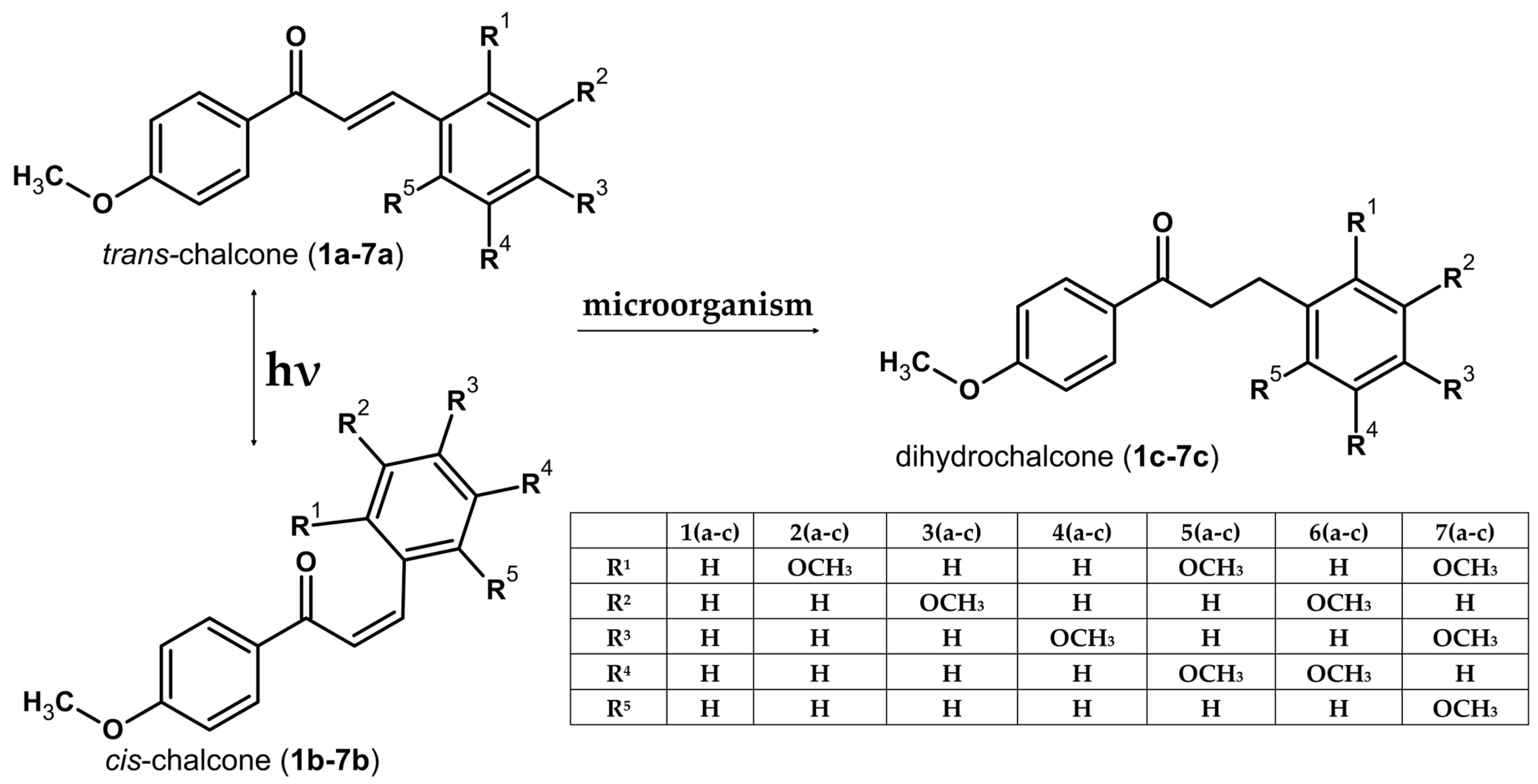
Our previous works proved that either Y. lipolytica or other yeast species like Saccharomyces cerevisiae or Rhodotorula rubra are capable of reducing the double C=C bond in prop-2-en-1-on linker in differently substituted chalcones [25,29]. These works demonstrated that either hydroxychalcones and bromochalcones or furylchalcones and thienylchalcones had been effectively transformed into their corresponding dihydrochalcones by Y. lipolytica. The 2‘-hydroxychalcones tested were generally transformed similarly or faster than the similarly substituted 4′-hydroxychalcones and both groups of compounds mentioned were more efficiently transformed than chalcones containing a bromine atom attached to the B ring of chalcone [29,30]. The double C=C bond in furylchalcone and thienylchalcone was reduced with the use of Y. lipolytica on higher rates [26] than in bromochalcones [25] and similar to hydroxychalcones [28,29]. The formation of cis-chalcone (2) was observed as in the case of 4′-hydroxychalcones [29]. All tested Yarrowia clade species catalyzed the same general transformation of 4′-methoxychalcone, namely chemoselective reduction in the α,β-unsaturated C=C bond; however, the extent and rate of conversion differed among strains (Figure 1). This suggests that the enoate reductase activity responsible for C=C bond saturation is broadly conserved in this clade indicating that it is likely a conserved metabolic trait across the clade. Comparable findings were previously described for isolated OYE-like enzymes from Y. lipolytica, which effectively catalyze reductions in α,β-unsaturated ketones under mild and cofactor-free conditions [25,26,28,29,30]. These results collectively confirm that the Yarrowia whole-cell system maintains an efficient internal redox environment enabling such transformations. Given the similar performance across strains, Y. lipolytica KCh 71 was chosen for preparative-scale transformations of a series of methoxychalcone derivatives bearing one to three additional methoxy substituents in various positions on ring B. This strain was selected due to its proven robustness, catalytic efficiency, and extensive documentation in the literature [27,29,30].
Figure 1. Light-induced transcis isomerisation of chalcones (1a7a) solutions to corresponding cis-chalcones (1b7b), and their subsequent transformations to 4′-methoxydihydrochalcones (1c7c) using Y. lipolytica KCh 71. The transformation is chemoselective and involves reduction in the α,β-unsaturated C=C bond of the chalcone linker. Compound labels “a” denote chalcone substrates, whereas labels “c” denote the hydrogenated products (dihydrochalcones). R1–R5 indicate the methoxy substitution pattern on ring B (positions C-2, C-3, C-4 and C-5, respectively).
The biotransformation of 4′-methoxychalcone (1a) to 4′-methoxydihydrochalcone (1c) by Yarrowia clade species, as detailed in Table 2, showcases the efficiency of whole-cell biocatalysis in reducing α,β-unsaturated bonds, achieving high conversion rates (e.g., 94.6% for Y. lipolytica ClY29-26-3 and 84.3% for Candida galli CBS9722 at 24 h). This process, driven by enoate reductases (likely OYE homologues), targets the C=C bond in the prop-2-en-1-one linker of chalcones, yielding bioactive flavonoid derivatives with pharmaceutical and nutraceutical potential. The cis-chalcone (1b) is neither an intermediate nor a byproduct but an isomer of (1a) [29] formed through a non-yeast-mediated process, possibly during substrate preparation or chemical handling prior to biocatalysis.
Table 2. Content (%) of reaction mixture of reduction 4′-methoxychalcone by Yarrowia clade species in time based on UHPLC data.
Relative composition (%) of the reaction mixture during the reduction in trans-4′-methoxychalcone (1a) by strains of the Yarrowia clade (UPLC/UHPLC-DAD). Biotransformations were performed in growing cultures in Sabouraud medium (3% glucose, 1% peptone) in 300 mL Erlenmeyer flasks containing 100 mL medium, shaken at 131 rpm and 25 °C. Substrate was added as a DMSO stock solution (10 mg in 1 mL DMSO; final DMSO ~1% v/v). Samples were collected 1 h, 12 h and 24 h after substrate addition. Values are mean ± SD (n = 3). 1atrans-4′-methoxychalcone; 1bcis-4′-methoxychalcone; 1c—4′-methoxy dihydrochalcone.
A series of methoxylated chalcones (2a7a) were synthesized via Claisen–Schmidt condensation and subjected to biotransformation with Y. lipolytica KCh 71 under identical whole-cell conditions used for compound 1. The substrates included derivatives with methoxy groups at C-2 (2a), C-3 (3a), C-4 (4a), C-2 and C-5 (5a), C-3 and C-5 (6a), and C-2, C-4, and C-6 (7a) positions of ring B. Chalcones 2a6a were effectively reduced to the corresponding dihydrochalcones, reaching near-complete conversion within the first hour. Although conversions were high, isolated yields (62–92%) were lower due to recovery losses during extraction/evaporation and preparative TLC. In addition, only the highest-purity TLC fractions were pooled for structural characterization; fractions containing co-extractives and endogenous yeast metabolites were intentionally discarded, which inevitably reduced the overall mass recovery. No conversion was observed for the 2′,4′,6′-trimethoxy derivative (7a). These results are consistent with the electron-donating nature of methoxy groups in ortho and para positions, enhancing substrate activation for enolate reductase catalysis. Our bioinformatic analysis suggests that this activity is likely mediated by a conserved family of Old Yellow Enzymes (OYEs).
The investigation was initiated using the crystal structure of Old Yellow Enzyme 3 (OYE3) from Saccharomyces cerevisiae (PDB: 5V4V), which corresponds to the reference protein NP_015154.1. Given that the Yarrowia clade lacks extensive protein annotations, we employed a multi-step homology-based search. An initial BLASTp (BLASTP 2.17.0+) analysis against the non-redundant database identified the protein KAG5370926.1 (from Yarrowia sp. E02) as a high-confidence ortholog, providing a sequence bridge to the Yarrowia genus.
To further explore the genomic diversity of this clade, we performed a tBLASTn search against the Whole Genome Shotgun (WGS) database. This allowed for the identification of OYE-encoding loci directly from unannotated genomic assemblies. Specifically, we retrieved full-length sequences from Yarrowia osloensis CBS 10146 (contig YAOS0S02, ULGU01000002.1) and Yarrowia bubula CBS 12934 (contig YABU0S02, ULGX01000002.1).
Comparative analysis between the Yarrowia sequences and the OYE3 template revealed significant evolutionary divergence. The identified sequence for Y. osloensis shared 68.4% identity, while the sequence for Y. bubula showed 50.7% identity. Despite this sequence-level divergence, the query coverage remained at 98–100% for all retrieved orthologs. This nearly total coverage confirms the strict maintenance of the TIM-barrel architecture and the essential active-site geometry across the tested clade [31].
This observation is consistent with structural work on OYE/PETNR family enzymes showing that the substrate-binding pocket and entrance channel can act as steric ‘gates’, restricting access and productive orientation of bulky α,β-unsaturated substrates. Structure-guided mutagenesis of PETNR and related ene-reductases has demonstrated that substitutions at pocket/entrance residues can modulate substrate accommodation and catalytic performance. Moreover, recent engineering studies on OYE homologues explicitly targeted steric hindrance at the entrance/pocket region to enable conversion of more sterically demanding substrates. Therefore, the three methoxy substituents in 7a likely prevent the reactive C=C bond from adopting the geometry required for hydride transfer in an OYE/PETNR-like active site [32,33,34,35]. Similar steric effects were reported to suppress OYE-mediated reductions in highly substituted chalcones and enones [34,36,37,38,39,40,41,42,43,44,45,46,47].
The Yarrowia-mediated reduction of 4′-methoxychalcone (1a) to (1c) demonstrates robust performance, with strains like Y. lipolytica ClY29-26-3 achieving 94.6% conversion to (1c) and only 0.8% unreacted (1a) at 24 h. In contrast, Y. yakushimensis CBS10253 yields 39.3% (1c), with 50.4% of the cis-chalcone isomer (1b) and 10.3% unreacted (1a), suggesting that (1b) is present in the substrate mixture and less effectively reduced by this strain. Previous studies show Y. lipolytica reduces other chalcones, such as 2′-hydroxychalcones (up to 95%) [28], furylchalcones (85–90%) and thienylchalcones (80–90%) [26], outperforming bromochalcones (50–70%) [25] due to electron-donating groups enhancing substrate affinity. The 4′-methoxyl group in (1a) likely stabilizes the transition state, facilitating reduction, as seen in OYE reductions in electron-rich substrates [34].
Comparatively, Saccharomyces cerevisiae and Rhodotorula rubra achieve lower conversions (50–80%) for chalcones [29], often due to alcohol dehydrogenase (ADH) activity forming alcohols [36]. Y. lipolytica KCh 71 reduces 2′-hydroxychalcones to its dihydrochalcone with comparable conversion after 7 days [28], as Y. lipolytica ClY29-26-3 94.6% for (1c) after just 24 h. Yarrowia efficient membrane transport and lipid metabolism enhance hydrophobic chalcone uptake [37], providing an advantage over other yeasts.
Enals, such as cinnamaldehyde and citral, are reduced by OYE1-3 (old yellow enzyme) from S. cerevisiae or Saccharomyces pastorianus to (S)-α-methyldihydrocinnamaldehyde derivatives (e.g., Lilial™) with 100% conversion and >95% enantiomeric ratio (er) in biphasic systems (20% t-BuOMe) [38]. Similarly, (E/Z)-citral is converted to (S)- or (R)-citronellal with 100% and 69% conversion, respectively and >95% ee using isolated OYEs [39]. These high conversions align with Yarrowia’s performance for (1a), but whole-cell Yarrowia systems eliminate the need for cofactor supplementation, reducing costs [2]. Unlike enal reductions, where ADHs in S. cerevisiae produce saturated alcohols (20–30%) [36], Yarrowia’s chalcone reduction avoids alcohol formation, with (1b) present as an isomer in the substrate mixture rather than a yeast-generated product [29].
OYE1 and pentaerythritol tetranitrate reductase (PETNR) from Enterobacter cloacae reduce (R)-carvone to dihydrocarvone with >90% conversion and 98% ee [40], comparable to Yarrowia’s 89.6% for (1c). Strains with high (1b) levels (e.g., Y. yakushimensis, 71.50% at 24 h) may have lack of sufficient cofactor pools, a limitation also noted in OYE reductions in nitriles (50–80% conversion) due to weak substrate activation [41]. PETNR also reduced ketoisophorone to (2R)-levodione with 99% of yield and 49% of ee [39].
Yarrowia lipolytica’s high conversion rates (up to 94.6% for (1c)) and stereoselectivity make it a superior platform for producing dihydrochalcones, surpassing S. cerevisiae and rivaling isolated OYE systems for enals and enones. Its GRAS (Generally Recognized As Safe) [42] status and metabolic versatility [43] support pharmaceutical and nutraceutical applications, leveraging dihydrochalcone’s anti-inflammatory [44] and anti-diabetic [45] properties. While enal and nitroalkene reductions achieve high ee, they often require purified enzymes or cascades, increasing costs. Yarrowia lipolytica whole-cell approach simplifies processes, but optimizing reduction in both (1a) and its isomer (1b) is critical for industrial scalability, particularly in strains less efficient with (1b).
Future studies should characterize Yarrowia’s OYE homologues to understand substrate specificity for (1a) and (1b), enabling targeted engineering to enhance reduction in both isomers but chalcone 7a did not undergo biotransformation. Kinetic studies could identify rate-limiting steps, and computational modeling of chalcone-enzyme interactions could optimize substrate design. Exploring Yarrowia clade for other α,β-unsaturated substrates (e.g., maleimides, nitriles) could broaden its biotechnological applications, building on its success with chalcones.
Yarrowia clade species excel in reducing the α,β-unsaturated bond of 4′-methoxychalcone, achieving conversions up to 94.6% that rival OYE-mediated reductions in enals, enones and nitroalkenes (70–100%) [46,47]. The cis-chalcone (1b), as an isomer of (1a) highlights the importance of substrate preparation in biotransformation outcomes. By optimizing reduction in both isomers through strain engineering and bioprocess improvements, Yarrowia can advance sustainable production of bioactive compounds, bridging laboratory and industrial biocatalysis. Taken together, these findings highlight the remarkable catalytic potential of Yarrowia clade species as sustainable whole-cell biocatalysts for chalcone hydrogenation. Their high efficiency, stability, and broad substrate scope emphasize their technological relevance for future applications in the biotransformation of flavonoids and other α,β-unsaturated compounds.

3. Materials and Methods

3.1. Substrates

Chalcones for biotransformation were prepared through Claisen–Schmidt condensation using 4-methoxyacetophenone and benzaldehyde with methoxyl group(s) (Figure 2) at appropriate positions, sourced from Sigma-Aldrich (St. Louis, MO, USA).
Figure 2. Synthesis scheme of 4′-methoxychalcones via Claisen-Schmidt condensation. R1–5 = -OCH3.
To synthesize the chalcones, 50 mmoles each of acetophenone and benzaldehyde were dissolved in 150 mL methanol in a 500 mL round-bottom flask. Subsequently, 30 mL water and 5.0 g sodium hydroxide (NaOH) were added slowly. The mixture was refluxed for 2 h, with reaction progress tracked via thin-layer chromatography (TLC). Once complete, the mixture was poured into a 1 L beaker, neutralized with 1 M HCl, stirred thoroughly to precipitate the chalcone, and left for 24 h. The crude chalcone was isolated by vacuum filtration, then purified by recrystallization in ethanol: dissolved under reflux, cooled to room temperature, and left for 24 h to crystallize. The crystals were collected via vacuum filtration with a Büchner funnel, dried, and analyzed by NMR to confirm purity and structure. The resulting compounds (1a8a)—including 4′-methoxychalcone and its derivatives with additional methoxy groups in various positions of ring B—were used as biotransformation substrates (see Table 3). The purity and structures of all synthesized chalcones were confirmed by 1H NMR, 13C NMR (Table 3), HMBC, HMQC, and COSY analyses. Our goal was to obtain highly purified chalcone substrates for biotransformation, rather than to optimize synthetic yields. For this reason we recrystallized the crude products to maximize purity, monitored the reactions by TLC to ensure complete conversion, and did not determine isolated yields. The purity of each chalcone was verified by comprehensive NMR analysis and by UPLC (near-quantitative purity), with the full spectra provided in the Supplementary Materials.
Table 3. 13C NMR (600 MHZ, acetone) of compounds 1a7a.
4′-methoxychalcone (1a): 1H NMR (400 MHz, acetone) δ 8.19–8.14 (m, 2H, H-2′ and H-6′), 7.88 (d, 1H, J = 15.6 Hz, H-β), 7.85–7.80 (m, 2H, H-2 and H-6), 7.76 (d, J = 15.6 Hz, 1H, H-α), 7.49–7.43 (m, 3H, H-3 and H-4 and H-5), 7.11–7.05 (m, 2H, H-3′ and H-5′), 3.91 (s, 3H, C-4′-OCH3).
2,4′-dimethoxychalcone (2a): 1H NMR (600 MHz, Acetone) δ 8.15–8.12 (m, 3H, H-β, H-2′ and H-6′), 7.86 (dd, J = 7.7, 1.6 Hz, 1H, H-6), 7.86 (d, J = 15.7 Hz, 1H, H-α), 7.41 (ddd, J = 8.3, 7.1, 1.6 Hz, 1H, H-4), 7.09 (d, J = 8.3, Hz, 1H, H-3), 7.08–7.05 (m, 2H, H-3′ and H-5′), 7.01 (s, J = 7.5 Hz, 1H, H-5), 3.94 (s, 3H, C-2-OCH3), 3.90 (s, 3H, C-4′-OCH3).
3,4′-dimethoxychalcone (3a): 1H NMR (600 MHz, Acetone) δ 8.18–8.14 (m, 2H, H-2′ and H-6′), 7.88 (d, J = 15.6 Hz, 1H, H-α), 7.73 (d, J = 15.6 Hz, 1H, H-β), 7.41–7.39 (m, 1H, H-2), 7.39–7.37 (m, 1H, H-4), 7.36 (s, J = 7.5 Hz, 1H, H-5), 7.09–7.05 (m, 2H, H-3′ and H-5′), 7.01 (dt, J = 7.1, 2.3 Hz, 1H, H-6), 3.91 (s, 3H, C-4′-OCH3), 3.86 (s, 3H, C-3-OCH3).
4,4′-dimethoxychalcone (4a): 1H NMR (600 MHz, Acetone) δ 8.17–8.11 (m, 2H, H-2′ and H-6′), 7.79–7.75 (m, 2H, H-2 and H-6), 7.75 (d, J = 15.6 Hz, 1H, 1H, H-α), 7.88 (d, J = 15.6 Hz, 1H, H-β), 7.08–7.04 (d, m, 2H, H-3′ and H-5′), 7.02–6.99 (d, m, H-3 and H-5), 3.90 (s, 3H, C-4′-OCH3), 3.86 (s, 3H, C-4-OCH3).
2,5,4′-trimethoxychalcone (5a): 1H NMR (600 MHz, Acetone) δ 8.13–8.09 (m, 2H, H-2′ and H-6′), 8.07 (d, J = 15.7 Hz, 1H, H-β), 7.80 (d, J = 8.6 Hz, 1H, H-3), 7.74 (d, J = 15.7 Hz, 1H, H-α), 7.07–7.03 (m, 2H, H-3′ and H-5′), 6.64 (d, J = 2.4 Hz, 1H, H-6), 6.61 (dd, J = 8.6, 2.4 Hz, 1H, H-4), 3.95 (s, 3H, C-2-OCH3), 3.89 (s, 3H, C-4′-OCH3), 3.87 (s, 3H, C-5-OCH3).
3,5,4′-trimethoxychalcone (6a): 1H NMR (600 MHz, Acetone) δ 8.18–8.11 (m, 2H, H-2′ and H-6′), 7.86 (d, J = 15.5 Hz, 1H, H-α), 7.68 (d, J = 15.6 Hz, 1H, H-β), 7.09–7.05 (m, 2H, H-3′ and H-5′), 6.99 (d, J = 2.1 Hz, 2H, H-2 and H-6), 6.57 (t, J = 2.2 Hz, 1H, H-4), 3.91 (s, 3H, C-4′-OCH3), 3.85 (s, 6H, C-3′ and C-5′-OCH3).
2,4,6,4′-tetramethoxychalcone (7a): 1H NMR (600 MHz, Acetone) δ 8.23 (d, J = 15.7 Hz, 1H, H-β), 8.05–8.03 (m, 2H, H-2′ and H-6′), 7.98 (d, J = 15.7 Hz, 1H, H-α), 7.06–7.02 (m, 2H, H-3′ and H-5′), 6.32 (s, 2H H-3 and H-5), 3.96 (s, 6H, C-2 and C-6-OCH3), 3.89 (s, 3H, C-4′-OCH3), 3.88 (s, 3H, C-4-OCH3).

3.2. Microorganisms

The experimental material comprised 21 yeast strains representing the genera Yarrowia and Candida. The specific strains utilized in this study were: Yarrowia lipolytica (W-29, 24lIV, 24lI, H222, ClY29-26-3, A101, KCh 71), Y. phangngaensis (CBS10407), Y. parophonii (CBS12427), Y. bubula (CBS12934), Y. keelungensis (CBS11062), Y. brassicae (CBS15225), Y. deformans (CBS2071), Y. divulgata (CBS11013), Y. yakushimensis (CBS10253), Y. porcina (CBS12932), Candida osloensis (CBS10146), C. hispaniensis (CBS9996), C. alimentaria (CBS10151), C. galli (CBS9722), and C. hollandica (CBS4855). With the exception of strain KCh 71, which was obtained from the Department of Food Chemistry and Biocatalysis, all strains were provided by the Department of Biotechnology and Food Microbiology at the Wrocław University of Environmental and Life Sciences (Wrocław, Poland). The storage conditions and characteristics for these isolates have been previously documented [20,25,41]. The strains were stored in a 25% glycerol solution at −80 °C and periodically inoculated onto solid YPG medium (Yeast extract-Peptone-Glycerol) medium and stored at 4 °C. Using a sterilized inoculation loop, the yeast cells were transferred from the YPG agar slants into 300 mL conical flasks containing 100 mL of sterile liquid medium. The cultures were then incubated at 25 °C for 48 h on a rotary shaker (131 rpm) to prepare pre-incubation cultures.

3.3. Screening

A total of 0.5 mL of inoculum of the tested yeast strains from the pre-incubation culture was transferred to 300 mL Erlenmeyer flasks for analytical-scale biotransformation. Each flask contained 100 mL of Sabouraud culture medium (3% glucose, 1% peptone) and was incubated for two days at 25 °C on a rotary shaker set to 131 rpm. After this time, 10 mg of the substrate was dissolved in 1 mL of DMSO (dimethyl sulfoxide) and added to the biocatalyst culture. Samples were collected after 1, 3, 6, 12 and 24 h. Portions of 10 mL of the transformation mixture were taken out and extracted with 10 mL of ethyl acetate. The extracts were dried over MgSO4, concentrated in vacuo and analyzed using Ultra Performance Liquid Chromatography (ULPC) and thin-layer chromatography (TLC). All experiments were conducted in triplicate as three independent biological replicates to confirm data reproducibility. Substrate stock solutions (in DMSO) and biotransformation samples were handled under standard laboratory lighting conditions and were not protected from light (the experiments were performed before we introduced light-exclusion precautions for chalcone biotransformations). Under these conditions, the cis/trans isomer (1a/1b) could be detected by UPLC as part of the reaction mixture composition. Because light exposure was not controlled, we cannot unambiguously assign whether transcis isomerisation occurred during the biotransformation or during subsequent sample handling.

3.4. Preparative Scale

Preparative biotransformations with methoxychalcones 2a7a were performed only with Y. lipolytica KCh 71, were carried out in 2 L Erlenmeyer flasks containing 500 mL of culture medium (3% glucose, 1% peptone). The yeast strain Y. lipolytica KCh 71 was cultured for three days at 25 °C on a rotary shaker set to 131 rpm. Then, 100 mg of substrate dissolved in 2 mL DMSO was added. After seven days, the product was extracted three times with 300 mL ethyl acetate, dried with anhydrous magnesium sulfate, and evaporated under reduced pressure. The biotransformation products were purified by preparative TLC and characterized using TLC, UPLC, and NMR (Table 4). Only fractions corresponding to the pure target product (as assessed by TLC and UPLC-DAD) were combined and used for yield calculation and NMR characterization.
Table 4. 13C NMR (600 MHZ, acetone) of compounds 1c7c.
4′-methoxydihydrochalcone (1c): 1H NMR (600 MHz, Acetone) δ 8.02–7.99 (m, 2H, H-2′ and H-6′), 7.30 (dd, J = 8.1, 1.4 Hz, 2H, H-2 and H-6), 7.28–7.26 (m, 2H, H-3 and H-5), 7.19–7.15 (m, 1H, H-4), 7.03–6.99 (m, 2H, H-3′ and H-5′), 3.88 (s, 3H, C-4′-OCH3), 3.32–3.27 (m, 2H, H-α), 3.03–2.98 (m, 2H, H-β).
2,4′-dimethoxydihydrochalcone (2c): 1H NMR (600 MHz, Acetone) δ 8.01–7.97 (m, 2H, H-2′ and H-6′), 7.21 (dd, J = 7.4, 1.6 Hz, 1H, H-6), 7.18 (td, J = 7.4, 1.6 Hz, 1H, H-4), 7.04–7.00 (m, 2H, H-3′ and H-5′), 6.95 (d, J = 8.0 Hz, 1H, H-3), 6.86 (td, J = 7.4, 1.0 Hz, 1H, H-5), 3.88 (s, 3H, C-4′-OCH3), 3.84 (s, 3H, C-2-OCH3), 3.23–3.17 (m, 2H, H-α), 2.99–2.94 (m, 2H, H-β).
3,4′-dimethoxydihydrochalcone (3c): 1H NMR (600 MHz, Acetone) δ 8.02–7.98 (m, 2H, H-3′ and H-5′), 7.18 (t, J = 7.9 Hz, 1H, H-5), 7.03–6.99 (m, 2H, H-2′ and H-6′), 6.90–6.87 (m, 1H, H-2), 6.87–6.85 (m, 1H, H-4), 6.74 (ddd, J = 8.2, 2.5, 0.5 Hz, 1H, H-6), 3.87 (s, 3H, C-4′-OCH3), 3.76 (s, 3H, C-3-OCH3), 3.31–3.26 (m, 2H, H-α), 2.99–2.95 (m, 2H, H-β).
4,4′-dimethoxydihydrochalcone (4c): 1H NMR (600 MHz, Acetone) δ 8.02–7.95 (m, 2H, H-2′ and H-6′), 7.22–7.17 (d, m, 2H, H-2 and H-6), 7.02–6.96 (m, 2H, H-3′ and H-5′), 6.89–6.77 (m, 2H, H-3 and H-5), 3.87 (s, 3H, C-4′-OCH3), 3.75 (s, 3H, C-4-OCH3), 3.27–3.21 (m, 2H, H-α), 2.95–2.91 (t, m, 2H, H-β).
2,5,4′-trimethoxydihydrochalcone (5c): 1H NMR (600 MHz, Acetone) δ 8.02–7.94 (m, 2H, H-2′ and H-6′), 7.09 (d, J = 8.2 Hz, 1H, H-3), 7.03–6.97 (m, 2H, H-3′ and H-5′), 6.52 (d, J = 2.4 Hz, 1H, H-6), 6.43 (dd, J = 8.2, 2.4 Hz, 1H, H-4), 3.87 (s, 3H, C-4′-OCH3), 3.83 (s, 3H, C-2-OCH3), 3.76 (s, 3H, C-5-OCH3), 3.17–3.13 (m, 2H, H-α), 2.91–2.86 (m, 2H, H-β).
3,5,4′-trimethoxydihydrochalcone (6c): 1H NMR (600 MHz, Acetone) δ 8.03–7.98 (m, 2H, H-2′ and H-6′), 7.05–6.99 (m, 2H, H-3′ and H-5′), 6.47 (d, J = 2.2 Hz, 2H H-2 and H-6), 6.31 (t, J = 2.3 Hz, 1H, H-4), 3.88 (s, 3H, C-4′-OCH3), 3.75 (s, 6H, C-3-OCH3 and C-5-OCH3), 3.30–3.26 (m, 2H, H-α), 2.95–2.91 (m, 2H, H-β).

3.5. TLC and NMR Analysis

Biotransformation’s course was monitored using TLC plates (SiO2, DC Alufolien Kieselgel 60 F254 (0.2 mm thick), Merck, Darmstadt, Germany). The products were separated using preparative TLC plates (Silica Gel GF, 20 × 20 cm, 500 µm, Analtech, Newark, DE, USA) and developed in a mixture of cyclohexane and ethyl acetate (9:0.5, v/v) as the eluent. The product was observed (without additional visualization) under the UV lamp at a wavelength of 254 nm. The NMR analysis was performed using a DRX 600 MHz Bruker spectrometer (Bruker, Billerica, MA, USA). The prepared samples were dissolved in deuterated DMSO and acetone-d6. The performed analyses include 1H-NMR, 13C-NMR, HMBC (two-dimensional analysis), HMQC (heteronuclear correlation), and COSY (correlation spectroscopy) (all NMR spectra are in Supplementary Materials).

3.6. UPLC

The biotransformation was analyzed using a UPLC-DAD method on a Dionex Ulti-mate 3000 UHPLC+ system (Thermo Fisher Scientific, Waltham, MA, USA). The system was equipped with a DGP-3600A dual pump liquid control compartment, a TCC-3200 thermostatted column module, a WPS-3000 autosampler, a diode array detector (DAD), and an analytical Cosmosil Cholester Waters column (5 μm, 4.6 × 250 mm, Nacalai Tesque Inc., Kyoto, Japan) maintained at 28 °C. Separation was performed using two mobile phases: (A) 0.1% formic acid in water and (B) 0.1% formic acid in acetonitrile, with the following gradient program: 0–13 min, 25–95% B; 13–15 min, 95% B; 15–17 min, 95–25% B; and 17–20 min, 25% B, at a flow rate of 0.7 mL/min. System control and data acquisi-tion were carried out using Chromeleon 6.80 software (Dionex, Sunnyvale, CA, USA). Substrates and products were identified by comparison with authentic standards at a de-tection wavelength of 280 nm, based on retention times and UV spectra.

3.7. Bioinformatics Analysis

The investigation was initiated using the structural template of OYE3 from Saccharomyces cerevisiae S288C (PDB: 5V4V), corresponding to the reference protein sequence NP_015154.1. Due to the limited characterization of the Yarrowia genus, a multi-step homology search strategy was employed.
Initial protein-protein BLAST (BLASTp) searches were conducted against the National Center for Biotechnology Information (NCBI) non-redundant (nr) protein database, which identified the protein KAG5370926.1 from Yarrowia sp. E02 as a high-confidence ortholog. This sequence served as a primary anchor for further genomic mining. Subsequently, to identify OYE-encoding loci in unannotated genomic data, tBLASTn (protein-to-translated nucleotide) searches were performed against the Whole Genome Shotgun (WGS) database. The search space was taxonomically restricted to the Yarrowia clade (taxid:4951).
High-stringency criteria were applied to ensure functional orthology, focusing on a Query Coverage (QC) threshold of 98–100% to guarantee the integrity of the protein fold. This in silico analysis supports the presence of putative OYE-like ene-reductases across the Yarrowia clade; however, it does not constitute experimental identification of the enzyme(s) responsible for the observed whole-cell activity [12].

4. Conclusions

This study demonstrates that ene-reductase activity is broadly conserved across Yarrowia clade species, enabling fast and selective saturation of α,β-unsaturated double bonds in methoxychalcones. Across 21 tested strains, conversions of 4′-methoxychalcone (1a) were consistently high within hours (Table 2), and Y. lipolytica KCh 71 proved to be a particularly efficient biocatalyst for structurally diverse derivatives. Mono- and di-methoxy substrates (2a6a) were reduced almost quantitatively (>96% within 24 h; high isolated yields after 7 days), whereas the 2,4,6,4′-tetramethoxy chalcone (7a) remained unreacted, indicating a steric limitation for heavily ortho-substituted molecules.
Compared with conventional yeasts that often reduce both C=C and C=O functionalities, Yarrowia clade species displayed remarkable chemoselectivity, reducing only the C=C bond. The observed cis-isomers resulted from photoisomerization rather than enzymatic activity. The obtained reaction rates and space–time yields are comparable to those of isolated OYE/PETNR enzymes, but the process is simpler, cofactor-independent, and potentially scalable. The preparative runs were extended to 7 days primarily to secure sufficient material for NMR characterization; no dedicated operational stability experiments (e.g., cell recycling or activity decay measurements) were performed, and stability is discussed here only in the practical sense that biotransformation capability was retained over the experimental time window.
Future research should focus on identifying and characterizing individual OYE homologues responsible for this activity, exploring enzyme engineering strategies to expand substrate tolerance, and evaluating the biological activities of the resulting dihydrochalcones. Overall, Y. lipolytica KCh 71 represents a versatile and sustainable whole-cell platform for the biocatalytic production of bioactive dihydrochalcones.

Supplementary Materials

The following supporting information can be downloaded at: https://www.mdpi.com/article/10.3390/molecules31061049/s1. Figures S1–S20 (UV-Vis Spectra of chalcones and dihydrochalcones); Figures S21–S84 (NMR spectra of chalcones and dihydrochalcones); Figure S85. Time-course of the biotransformation of 1a to 1c; Table S1. Comparative analysis of identified Yarrowia OYE sequences retrieved from the WGS database, showing high structural conservation across the clade.

Author Contributions

Conceptualization, P.C. and T.J.; methodology, P.C., A.K., M.M. and T.J.; investigation, P.C., M.M. and A.K.; resources, A.K. and Z.L.; data curation, P.C.; formal analysis, P.C. and T.J.; visualization, P.C.; writing—original draft, P.C.; writing—review and editing, M.M., A.K., Z.L. and T.J.; supervision, T.J.; funding acquisition, T.J. All authors have read and agreed to the published version of the manuscript.

Funding

This work was financed by the (Polish) National Science Centre, Grant No. 2021/43/O/NZ7/01517. The APC funded by: Wrocław University of Environmental and Life Sciences.

Institutional Review Board Statement

Not applicable.

Data Availability Statement

Data are contained within this article and Supplementary Materials.

Acknowledgments

This article is part of a PhD dissertation titled “Chemo-enzymatic synthesis of dihydrochalcones glycosides and their health promoting activity”, prepared during doctoral school at the Wrocław University of Environmental and Life Sciences.

Conflicts of Interest

The authors declare no conflicts of interest.

References

  1. de Carvalho, C.C.C.R. Whole Cell Biocatalysts: Essential Workers from Nature to the Industry. Microb. Biotechnol. 2017, 10, 250–263. [Google Scholar] [CrossRef]
  2. Lin, B.; Tao, Y. Whole-Cell Biocatalysts by Design. Microb. Cell Factories 2017, 16, 106. [Google Scholar] [CrossRef]
  3. Wachtmeister, J.; Rother, D. Recent Advances in Whole Cell Biocatalysis Techniques Bridging from Investigative to Industrial Scale. Curr. Opin. Biotechnol. 2016, 42, 169–177. [Google Scholar] [CrossRef]
  4. Park, Y.-K.; Ledesma-Amaro, R. What Makes Yarrowia lipolytica Well Suited for Industry? Trends Biotechnol. 2023, 41, 242–254. [Google Scholar] [CrossRef]
  5. Qiao, K.; Wasylenko, T.M.; Zhou, K.; Xu, P.; Stephanopoulos, G. Lipid Production in Yarrowia lipolytica Is Maximized by Engineering Cytosolic Redox Metabolism. Nat. Biotechnol. 2017, 35, 173–177. [Google Scholar] [CrossRef]
  6. Fukuda, R. Utilization of N-Alkane and Roles of Lipid Transfer Proteins in Yarrowia lipolytica. World J. Microbiol. Biotechnol. 2023, 39, 97. [Google Scholar] [CrossRef] [PubMed]
  7. Fickers, P.; Benetti, P.; Wache, Y.; Marty, A.; Mauersberger, S.; Smit, M.; Nicaud, J. Hydrophobic Substrate Utilisation by the Yeast and Its Potential Applications. FEMS Yeast Res. 2005, 5, 527–543. [Google Scholar] [CrossRef] [PubMed]
  8. Fickers, P.; Cheng, H.; Lin, C.S.K. Sugar Alcohols and Organic Acids Synthesis in Yarrowia lipolytica: Where Are We? Microorganisms 2020, 8, 574. [Google Scholar] [CrossRef] [PubMed]
  9. Carvalho, A.S.S.; Sales, J.C.S.; Nascimento, F.V.d.; Ribeiro, B.D.; Souza, C.E.C.d.; Lemes, A.C.; Coelho, M.A.Z. Lipase Production by Yarrowia lipolytica in Solid-State Fermentation Using Amazon Fruit By-Products and Soybean Meal as Substrate. Catalysts 2023, 13, 289. [Google Scholar] [CrossRef]
  10. Blazeck, J.; Hill, A.; Liu, L.; Knight, R.; Miller, J.; Pan, A.; Otoupal, P.; Alper, H.S. Harnessing Yarrowia lipolytica Lipogenesis to Create a Platform for Lipid and Biofuel Production. Nat. Commun. 2014, 5, 3131. [Google Scholar] [CrossRef]
  11. Arnesen, J.A.; Belmonte Del Ama, A.; Jayachandran, S.; Dahlin, J.; Rago, D.; Andersen, A.J.C.; Borodina, I. Engineering of Yarrowia lipolytica for the Production of Plant Triterpenoids: Asiatic, Madecassic, and Arjunolic Acids. Metab. Eng. Commun. 2022, 14, e00197. [Google Scholar] [CrossRef]
  12. EFSA Panel on Nutrition, Novel Foods and Food Allergens (NDA); Turck, D.; Bohn, T.; Castenmiller, J.; De Henauw, S.; Hirsch-Ernst, K.I.; Maciuk, A.; Mangelsdorf, I.; McArdle, H.J.; Naska, A.; et al. Safety of an Extension of Use of Yarrowia lipolytica Yeast Biomass as a Novel Food Pursuant to Regulation (EU) 2015/2283. EFSA J. 2023, 21, e8416. [Google Scholar] [CrossRef]
  13. EFSA Panel on Nutrition, Novel Foods and Food Allergens (NDA); Turck, D.; Castenmiller, J.; de Henauw, S.; Hirsch-Ernst, K.; Kearney, J.; Maciuk, A.; Mangelsdorf, I.; McArdle, H.J.; Naska, A.; et al. Safety of Yarrowia lipolytica Yeast Biomass as a Novel Food Pursuant to Regulation (EU) 2015/2283. EFSA J. 2019, 17, e05594. [Google Scholar] [CrossRef] [PubMed]
  14. Dias, M.C.; Pinto, D.C.G.A.; Silva, A.M.S. Plant Flavonoids: Chemical Characteristics and Biological Activity. Molecules 2021, 26, 5377. [Google Scholar] [CrossRef] [PubMed]
  15. Lee, D.-S.; Li, B.; Im, N.-K.; Kim, Y.-C.; Jeong, G.-S. 4,2′,5′-Trihydroxy-4′-Methoxychalcone from Dalbergia odorifera Exhibits Anti-Inflammatory Properties by Inducing Heme Oxygenase-1 in Murine Macrophages. Int. Immunopharmacol. 2013, 16, 114–121. [Google Scholar] [CrossRef] [PubMed]
  16. Chen, Y.F.; Wu, S.N.; Gao, J.M.; Liao, Z.Y.; Tseng, Y.T.; Fülöp, F.; Chang, F.R.; Lo, Y.C. The Antioxidant, Anti-Inflammatory, and Neuroprotective Properties of the Synthetic Chalcone Derivative AN07. Molecules 2020, 25, 2907. [Google Scholar] [CrossRef]
  17. Tseng, Y.T.; Tsai, Y.H.; Fülöp, F.; Chang, F.R.; Lo, Y.C. 2-Iodo-40-Methoxychalcone Attenuates Methylglyoxal-Induced Neurotoxicity by Activation of GLP-1 Receptor and Enhancement of Neurotrophic Signal, Antioxidant Defense and Glyoxalase Pathway. Molecules 2019, 24, 2249. [Google Scholar] [CrossRef]
  18. Marques, B.C.; Santos, M.B.; Anselmo, D.B.; Monteiro, D.A.; Gomes, E.; Saiki, M.F.C.; Rahal, P.; Rosalen, P.L.; Sardi, J.C.O.; Regasini, L.O. Methoxychalcones: Effect of Methoxyl Group on the Antifungal, Antibacterial and Antiproliferative Activities. Med. Chem. 2020, 16, 881–891. [Google Scholar] [CrossRef]
  19. Nowakowska, Z. A Review of Anti-Infective and Anti-Inflammatory Chalcones. Eur. J. Med. Chem. 2007, 42, 125–137. [Google Scholar] [CrossRef]
  20. Johnson, R.; Dludla, P.V.; Muller, C.J.F.; Huisamen, B.; Essop, M.F.; Louw, J. The Transcription Profile Unveils the Cardioprotective Effect of Aspalathin against Lipid Toxicity in an In Vitro H9c2 Model. Molecules 2017, 22, 219. [Google Scholar] [CrossRef]
  21. Zhang, G.; Yang, G.; Liu, J. Phloretin Attenuates Behavior Deficits and Neuroinflammatory Response in MPTP Induced Parkinson’s Disease in Mice. Life Sci. 2019, 232, 116600. [Google Scholar] [CrossRef]
  22. Jesus, A.R.; Vila-Viçosa, D.; Machuqueiro, M.; Marques, A.P.; Dore, T.M.; Rauter, A.P. Targeting Type 2 Diabetes with C-Glucosyl Dihydrochalcones as Selective Sodium Glucose Co-Transporter 2 (SGLT2) Inhibitors: Synthesis and Biological Evaluation. J. Med. Chem. 2017, 60, 568–579. [Google Scholar] [CrossRef]
  23. Olender, D.; Kujawski, J.; Skóra, B.; Baranowska-Wójcik, E.; Sowa-Kasprzak, K.; Pawełczyk, A.; Zaprutko, L.; Szwajgier, D.; Szychowski, K.A. Bis-Chalcones Obtained via One-Pot Synthesis as the Anti-Neurodegenerative Agents and Their Effect on the HT-22 Cell Line. Heliyon 2024, 10, e37147. [Google Scholar] [CrossRef] [PubMed]
  24. Jackson, P.A.; Widen, J.C.; Harki, D.A.; Brummond, K.M. Covalent Modifiers: A Chemical Perspective on the Reactivity of α,β-Unsaturated Carbonyls with Thiols via Hetero-Michael Addition Reactions. J. Med. Chem. 2017, 60, 839–885. [Google Scholar] [CrossRef] [PubMed]
  25. Łużny, M.; Kaczanowska, D.; Gawdzik, B.; Wzorek, A.; Pawlak, A.; Obmińska-Mrukowicz, B.; Dymarska, M.; Kozłowska, E.; Kostrzewa-Susłow, E.; Janeczko, T. Regiospecific Hydrogenation of Bromochalcone by Unconventional Yeast Strains. Molecules 2022, 27, 3681. [Google Scholar] [CrossRef]
  26. Łużny, M.; Krzywda, M.; Kozłowska, E.; Kostrzewa-Susłow, E.; Janeczko, T. Effective Hydrogenation of 3-(2”-Furyl)- and 3-(2”-Thienyl)-1-(2′-Hydroxyphenyl)-Prop-2-En-1-One in Selected Yeast Cultures. Molecules 2019, 24, 3185. [Google Scholar] [CrossRef]
  27. Chlipała, P.; Janeczko, T.; Mazur, M. Effect of Sunlight-Induced Isomerisation on the Biotransformation of 4′-Hydroxychalcones by Yarrowia lipolytica KCh 71. Int. J. Mol. Sci. 2025, 26, 9027. [Google Scholar] [CrossRef]
  28. Łużny, M.; Kozłowska, E.; Kostrzewa-Susłow, E.; Janeczko, T. Highly Effective, Regiospecific Hydrogenation of Methoxychalcone by Yarrowia lipolytica Enables Production of Food Sweeteners. Catalysts 2020, 10, 1135. [Google Scholar] [CrossRef]
  29. Chlipała, P.; Bienia, J.; Mazur, M.; Dymarska, M.; Janeczko, T. Efficient Production of 4′-Hydroxydihydrochalcones Using Non-Conventional Yeast Strains. Int. J. Mol. Sci. 2024, 25, 10735. [Google Scholar] [CrossRef] [PubMed]
  30. Chlipała, P.; Janeczko, T.; Mazur, M. Bioreduction of 4′-Hydroxychalcone in Deep Eutectic Solvents: Optimization and Efficacy with Various Yeast Strains. Int. J. Mol. Sci. 2024, 25, 7152. [Google Scholar] [CrossRef]
  31. Toogood, H.S.; Gardiner, J.M.; Scrutton, N.S. Biocatalytic Reductions and Chemical Versatility of the Old Yellow Enzyme Family of Flavoprotein Oxidoreductases. ChemCatChem 2010, 2, 892–914. [Google Scholar] [CrossRef]
  32. Wu, S.; Wang, Q.; Ma, X.; Qiu, L.; Yan, H. Modulation of the Catalytic Performance of OYE3 by Engineering Key Residues at the Entrance of the Catalytic Pocket. Biotechnol. Appl. Biochem. 2023, 70, 1720–1730. [Google Scholar] [CrossRef] [PubMed]
  33. Fryszkowska, A.; Toogood, H.; Sakuma, M.; Gardiner, J.M.; Stephens, G.M.; Scrutton, N.S. Asymmetric Reduction of Activated Alkenes by Pentaerythritol Tetranitrate Reductase: Specificity and Control of Stereochemical Outcome by Reaction Optimisation. Adv. Synth. Catal. 2009, 351, 2976–2990. [Google Scholar] [CrossRef]
  34. Toogood, H.S.; Scrutton, N.S. Discovery, Characterization, Engineering and Applications of Ene-Reductases for Industrial Biocatalysis. ACS Catal. 2018, 8, 4333. [Google Scholar] [CrossRef]
  35. Ding, Y.; Perez-Ortiz, G.; Peate, J.; Barry, S.M. Redesigning Enzymes for Biocatalysis: Exploiting Structural Understanding for Improved Selectivity. Front. Mol. Biosci. 2022, 9, 908285. [Google Scholar] [CrossRef]
  36. Gatti, F.G.; Parmeggiani, F.; Sacchetti, A. Synthetic Strategies Based on C=C Bioreductions for the Preparation of Biologically Active Molecules. In Synthetic Methods for Biologically Active Molecules; Brenna, E., Ed.; Wiley: Hoboken, NJ, USA, 2013; pp. 49–84. [Google Scholar]
  37. Thevenieau, F.; Beopoulos, A.; Desfougeres, T.; Sabirova, J.; Albertin, K.; Zinjarde, S.; Nicaud, J.-M. Uptake and Assimilation of Hydrophobic Substrates by the Oleaginous Yeast Yarrowia lipolytica. In Handbook of Hydrocarbon and Lipid Microbiology; Timmis, K.N., Ed.; Springer: Berlin/Heidelberg, Germany, 2010; pp. 1513–1527. [Google Scholar]
  38. Stueckler, C.; Mueller, N.J.; Winkler, C.K.; Glueck, S.M.; Gruber, K.; Steinkellner, G.; Faber, K. Bioreduction of α-Methylcinnamaldehyde Derivatives: Chemo-Enzymatic Asymmetric Synthesis of LilialTM and HelionalTM. Dalton Trans. 2010, 39, 8472. [Google Scholar] [CrossRef]
  39. Sánchez-Moreno, I.; Iturrate, L.; Doyagüez, E.G.; Martínez, J.A.; Fernández-Mayoralas, A.; García-Junceda, E. Activated α,β-Unsaturated Aldehydes as Substrate of Dihydroxyacetone Phosphate (DHAP)-Dependent Aldolases in the Context of a Multienzyme System. Adv. Synth. Catal. 2009, 351, 2967–2975. [Google Scholar] [CrossRef]
  40. Fan, X.-Y.; Yu, Y.; Yao, Y.; Li, W.-D.; Tao, F.-Y.; Wang, N. Applications of Ene-Reductases in the Synthesis of Flavors and Fragrances. J. Agric. Food Chem. 2024, 72, 18305–18320. [Google Scholar] [CrossRef] [PubMed]
  41. Brenna, E.; Crotti, M.; Gatti, F.G.; Manfredi, A.; Monti, D.; Parmeggiani, F.; Santangelo, S.; Zampieri, D. Enantioselective Synthesis of (R)-2-Arylpropanenitriles Catalysed by Ene-Reductases in Aqueous Media and in Biphasic Ionic Liquid–Water Systems. ChemCatChem 2014, 6, 2425–2431. [Google Scholar] [CrossRef]
  42. Du, F.; Zhang, F.; Hang, Y.; Jing, H.; Zheng, Y.; Ma, W.; Sun, X.; Huang, H. Advances in Production of Customized Functional Unsaturated Fatty Acids in Yarrowia lipolytica. Agric. Prod. Process. Storage 2025, 1, 14. [Google Scholar] [CrossRef]
  43. Laribi, A.; Zieniuk, B.; Bouchedja, D.N.; Hafid, K.; Elmechta, L.; Becila, S. Valorization of Olive Mill Wastewater via Yarrowia lipolytica: Sustainable Production of High-Value Metabolites and Biocompounds—A Review. Fermentation 2025, 11, 326. [Google Scholar] [CrossRef]
  44. Liu, X.; Wang, C.; Tang, S.; Wang, G.; Huang, Y.; Yang, F.; Tan, X.; Bai, J.; Huang, L. Comparative Study on the Alleviating Effect of Neohesperidin Dihydrochalcones and Its Synthetic Precursor Neohesperidin on Ovalbumin-Induced Food Allergy. Food Res. Int. 2025, 212, 116436. [Google Scholar] [CrossRef] [PubMed]
  45. Liu, M.; Liu, C.; Zhaxi, P.; Kou, X.; Liu, Y.; Xue, Z. Research Progress on Hypoglycemic Effects and Molecular Mechanisms of Flavonoids: A Review. Antioxidants 2025, 14, 378. [Google Scholar] [CrossRef]
  46. Hall, M.; Stueckler, C.; Hauer, B.; Stuermer, R.; Friedrich, T.; Breuer, M.; Kroutil, W.; Faber, K. Asymmetric Bioreduction of Activated C=C Bonds Using Zymomonas Mobilis NCR Enoate Reductase and Old Yellow Enzymes OYE 1–3 from Yeasts. Eur. J. Org. Chem. 2008, 2008, 1511–1516. [Google Scholar] [CrossRef]
  47. Toogood, H.S.; Fryszkowska, A.; Hare, V.; Fisher, K.; Roujeinikova, A.; Leys, D.; Gardiner, J.M.; Stephens, G.M.; Scrutton, N.S. Structure-Based Insight into the Asymmetric Bioreduction of the C=C Double Bond of α,β-Unsaturated Nitroalkenes by Pentaerythritol Tetranitrate Reductase. Adv. Synth. Catal. 2008, 350, 2789–2803. [Google Scholar] [CrossRef] [PubMed]
Disclaimer/Publisher’s Note: The statements, opinions and data contained in all publications are solely those of the individual author(s) and contributor(s) and not of MDPI and/or the editor(s). MDPI and/or the editor(s) disclaim responsibility for any injury to people or property resulting from any ideas, methods, instructions or products referred to in the content.

Article Metrics

Citations

Article Access Statistics

Article metric data becomes available approximately 24 hours after publication online.